Rome in the Rain: What to Do Indoors
In short. It doesn't rain much in Rome, but when it does, it means it: short, violent downpours that in half an hour turn the cobblestones into sheets of water, flood the underpasses and make any plan built around the Forum or the Appian Way impossible.
It doesn't rain much in Rome, but when it does, it means it: short, violent downpours that in half an hour turn the cobblestones into sheets of water, flood the underpasses and make any plan built around the Forum or the Appian Way impossible. The question for someone with only one day, when the sky closes in, is no longer "what do I see in Rome" but "what do I do now". The good answer is not a list of museums: it's knowing which places hold up for three or four hours straight, which are closed on exactly the day you need them and which you book the day before. Below you'll find indoor Rome sorted by type: the underground, big museums and small ones, churches worth a whole afternoon, covered galleries and passages, libraries you can visit, historic cinemas, hot baths, covered markets, historic cafés and bookshops. At the end comes the practical part: weekly closures, what to book, where to buy an umbrella, how transit moves in the rain and which parts of the city go under water first.
Rome in the rain: what really changes in the city
Roman rain is concentrated in a few days a year, almost all between October and January, with a second, less predictable window between March and May: the Mediterranean climate produces many dry days and few intense events, not the continuous rain of northern Europe. The practical consequence is that a November thunderstorm often lasts less than an hour, and the window of sun that follows is enough for a walk between two indoor places. With a cloudburst, on the other hand, the storm drains can't handle the flow, traffic grinds to a halt and it's best to give up any unnecessary transfer, staying where you are in a place big enough to justify two or three hours.
Underground Rome: the driest place in the city
The underground is the most obvious answer to rain: you go down below street level and the weather stops mattering. Rome has dozens of visitable examples, almost all at constant temperature, and many have to be booked because entry is in limited groups. One clarification: underground doesn't mean accessible. Steep stairs, narrow walkways and uneven floors are the norm, and several sites can't be visited in a wheelchair: if you have mobility difficulties, have it checked with the site.
San Clemente, the three levels that tell a thousand years
The Basilica of San Clemente, a stone's throw from the Colosseum on Via Labicana, is Rome's most instructive underground site: you go down from the medieval church of the 12th century to the early Christian basilica of the 4th, and from there still further down to a complex from the Roman age that includes a mithraeum with the altar intact. Entry to the excavations costs €10, reduced to €5 for students under 26 with ID and free for children under 16 accompanied by a paying adult. Online booking is required, because the number of daily entries is limited. The upper church, with the apse mosaic of the tree of life, remains accessible free of charge during worship hours. The complex's hours vary between summer and winter seasons and include a lunch closure: the site invites you to check its official channels, and it's best to do so the day before. On leaving you are five minutes from San Pietro in Vincoli and the Santi Quattro Coronati.
The Roman Houses of the Celio
The Roman Houses of the Celio are open every day from 10:00 to 16:00, with the ticket office closing an hour earlier. The full ticket costs €8, the reduced €6 for groups over 12 people, children from 6 to 14 and school groups, with a €2 online booking fee. The site lies under the Basilica of Santi Giovanni e Paolo and preserves about 20 frescoed rooms from late antiquity. The 16:00 closing often catches visitors out: it's a place for the morning or early afternoon. Back at the surface, the Celio offers other interiors a few meters away: Santo Stefano Rotondo with its circular plan and the Santi Quattro Coronati with the Oratory of San Silvestro.
Vicus Caprarius, the city of water under the Trevi Fountain
The Vicus Caprarius, at Vicolo del Puttarello 25, is open Tuesday to Sunday from 11:00 to 17:00 and closed on Monday. It's an archaeological area discovered during the renovation of a cinema, with the remains of an imperial-era residential building and a large cistern fed by the Acqua Vergine, the same aqueduct that still brings water to the Trevi Fountain today. The single guided visit costs €8 and must be booked in advance. Its strength is the location: less than 100 meters from the fountain, exactly where you are when the storm arrives and the square suddenly empties.
The Domus Romane of Palazzo Valentini
The Domus Romane of Palazzo Valentini, at Via Foro Traiano 84, are open every day except Tuesday: from 10:00 to 19:00 from March 1 to October 31 and from 10:00 to 18:00 from November 1 to the end of February. The full ticket costs €15, or €16 in the open-date version, with a reduced €9 for ages 6 to 17 and for over 65s, and free entry under 6. The visit to the domus alone lasts an hour, the one that also includes Trajan's Column runs to an hour and a half, and it's best to show up at the ticket office a quarter of an hour early. The format divides the public: you don't walk among mute ruins, you watch a multimedia reconstruction projected onto the remains of aristocratic homes, which those who love bare archaeology find intrusive and those traveling with children find the best thing they've seen in Rome. On leaving you are 100 meters from Trajan's Markets, that is, from a second indoor site right next door.
The mithraea, the caves of a vanished religion
Rome preserves more mithraea than any other city in the Mediterranean, almost all underground by construction: the cult of Mithras was celebrated in dark rooms that imitated the cave of the myth. The Barberini Mithraeum can only be visited by reservation, on dates set by the Capitoline Superintendency, and preserves the only tauroctony fresco still in its place in the city. The mithraeum under the basilica of Santa Prisca on the Aventine follows a similar logic, with periodic openings. The one at San Clemente, on the other hand, can be seen without a separate reservation because it's included in the excavation route. The practical rule is just one: mithraea are not places you pass through, they are places you plan days in advance.
The catacombs and their closing days
The catacombs of Rome open to the public have a feature that makes them perfect for the rain and treacherous at the same time: they are all closed one day a week, but not the same day. The Catacombs of San Callisto, on the Appian Way, are closed on Wednesday and observe a long annual closure between mid-January and mid-February. The hours are 9:00 to 12:00 and 14:00 to 17:00, guided tours leave every half hour and last about 40 minutes, the minimum group is two people and online booking is required. The Catacombs of San Sebastiano, a little further on, follow a different calendar, as do the Catacombs of Priscilla on Via Salaria and the Catacombs of Domitilla on Via Ardeatina: the closing day must be checked on the site of each catacomb, because getting all the way to the Appian Way in the rain and finding the gate closed is one of the most depressing Roman experiences there is. The Catacombs of Santa Tecla and the Hypogeum of Via Dino Compagni, among the least visited painted complexes in the city, also open on special occasions.
The other underground sites few people know
Under Piazza Navona you can visit the underground of the Stadium of Domitian, the foundations of the building that gave the square its shape. The underground basilica of Porta Maggiore, a Neopythagorean building of the 1st century with extraordinary stucco vaults, opens only on set days and with mandatory reservation. The Crypta Balbi, one of the four venues of the Museo Nazionale Romano, is a covered urban excavation turned into a museum, the best place to understand the layering of the city. The Domus Aurea, on the Oppian Hill, is visited as a working site with a helmet and a guided route and must be booked days in advance.
The big museums, the ones that hold up for a whole afternoon
Not all Roman museums suit the rain equally: some have a 40-minute route, others have so many rooms that you go in at 10:00 and come out at 16:00. For a rainy day you need the second kind, and the criterion is not fame but covered floor area.
Capitoline Museums, open every day and free for residents
The Capitoline Museums, at Piazza del Campidoglio 1, are open every day from 9:30 to 19:30, with last entry an hour earlier, and close only on May 1 and December 25. It's the fact that makes them the big Roman museum that never lets you down: there's no Monday closure. The full ticket for non-residents costs €16.50 and the reduced €11 during periods with an exhibition under way, plus €1 advance-sale fee on online purchases. Residents of Rome and the Metropolitan City enter free with ID, as do MIC card holders and children under 6. The route includes the Palazzo dei Conservatori, the Pinacoteca and the Tabularium with the view over the Forum: all together it holds up for three hours.
Vatican Museums, the covered kilometer
The Vatican Museums are open Monday to Saturday from 8:00 to 20:00, with last entry at 18:00, and on the last Sunday of the month from 9:00 to 14:00 with free admission. On other Sundays they are closed, as on a series of holidays that change every year and must be checked on the official calendar. The ticket must be bought exclusively on the official ticketing site, and the museums' management publicly warns about sites with similar domain names. For the rain they are unbeatable for a physical reason: the mandatory route from the entrance to the Sistine Chapel measures several kilometers and is almost entirely indoors, and you can stay inside five hours without effort. The only weak point is the line at the entrance, which in bad weather becomes miserable: booking a time slot is not a suggestion, it's a necessity. A few steps away is St. Peter's Basilica, free and covered, with the only caveat that the security line forms in the square, in the rain.
The Museo Nazionale Romano, four venues and a single ticket
The Museo Nazionale Romano is spread over four venues close to one another: Palazzo Massimo alle Terme near Termini, Palazzo Altemps behind Piazza Navona, the Baths of Diocletian and the Crypta Balbi. The single ticket is valid for all venues within a set number of days, which lets you chain two without paying twice. Palazzo Massimo, with the frescoes of the Villa of Livia and the mosaics on the second floor, is the venue that best holds up a long visit. At the Baths of Diocletian there is also the Octagonal Hall and, a few steps away, the Basilica of Santa Maria degli Angeli, carved by Michelangelo inside the baths' own tepidarium and free. Hours and closing days of the individual venues must be checked on the museum's website, because they don't always coincide.
The galleries you book
The Galleria Borghese is the extreme case of the museum to book: access is by timed shifts with limited numbers and a fixed duration, and without a reservation you don't get in. This makes it unsuited to a last-minute decision and perfectly suited to someone who saw the rain in the forecast two days earlier. Hours, rates and shift length change over time and must be checked on the official website. The route is splendid but short and doesn't fill a day: combine it with a second indoor site, for example the Museo Carlo Bilotti or the Museo Pietro Canonica, both inside the park of Villa Borghese and a few minutes' walk away.
Palazzo Barberini and Galleria Corsini
The Gallerie Nazionali di Arte Antica have two venues, Palazzo Barberini at Via delle Quattro Fontane 13 and Palazzo Corsini at Via della Lungara 10, with the same hours: Tuesday to Sunday from 10:00 to 19:00, closed on Monday. On the first Sunday of the month admission is free, with the predictable consequence in terms of crowds. Barberini adds up a collection running from the 1200s to the 1700s, the hall vault frescoed by Pietro da Cortona and the two opposing monumental staircases, the square one by Bernini and the helical one by Borromini. On leaving you are five minutes from San Carlo alle Quattro Fontane and Sant'Andrea al Quirinale, that is, from the direct comparison between Borromini and Bernini, which takes 20 minutes and costs nothing.
Centrale Montemartini and the contemporary
The Centrale Montemartini, at Via Ostiense 106, is open Tuesday to Sunday from 9:00 to 19:00 and closed on Monday, as well as on May 1 and December 25. Last entry is an hour earlier. It's an old thermoelectric power plant converted into an archaeological museum, big enough that you're never on top of other visitors, and a few hundred meters from the Metro B, Garbatella stop. It belongs to the Musei Civici, so it's free for residents. The MAXXI at Flaminio, with Zaha Hadid's ramps and interior walkways, and the MACRO on Via Nizza cover the contemporary side. Palazzo delle Esposizioni, on Via Nazionale, is open Tuesday to Sunday from 10:00 to 20:00 with last entry at 19:00 and is closed on Monday: besides exhibitions it has a study room, a bookshop and a café inside that can be used without a ticket, that is, one of the few places in the center where you can sit in the warmth without having to order. A little further on, the Scuderie del Quirinale host major exhibitions, but the calendar is not continuous and it's best to check before heading up. Also running continuous temporary programs are Palazzo Bonaparte, the Chiostro del Bramante, open Sunday to Thursday from 10:00 to 19:00 and on Friday and Saturday from 10:00 to 20:00, and Palazzo Merulana on the Esquiline.
Small museums, house museums and oddities
When the big museums are crowded, Rome offers a second row of tiny places that often give more satisfaction than the famous names: low or free admission, an hour's visit, few people.
House museums
The Keats-Shelley House, at the corner of the Trinità dei Monti stairway, is the room where John Keats died in 1821, today a library and museum of English Romanticism in Rome. The Casa di Goethe at Via del Corso 18 is the apartment where the writer lived during his journey to Italy. The Mario Praz Museum, inside Palazzo Primoli, preserves the apartment of the great Anglicist with all his objects in their places and can only be visited at fixed times with an escort. In the same building the Museo Napoleonico tells the story of the Roman Bonapartes. The Casina delle Civette at Villa Torlonia, with its Liberty-style stained glass, shows its best precisely in gray light, and the Hendrik Christian Andersen Museum, near Piazza del Popolo, is free and full of colossal sculptures in a studio that has remained intact.
Curious museums
The Museo delle Anime del Purgatorio, inside the church of Sacro Cuore del Suffragio on the Lungotevere Prati, displays objects that according to popular tradition are said to bear the marks left by souls in purgatory: take it for what it is, a document of 1800s devotion and not an established fact. The Museo dei Frati Cappuccini on Via Veneto includes the crypts decorated with the friars' bones. The Museo delle Illusioni and the Museo delle Cere are commercial attractions with no scientific pretensions, but with bored kids they solve an afternoon. The Museo Storico della Liberazione on Via Tasso, carved out of the cells of the Nazi prison, is one of the harshest places in the city, with free admission. The Jewish Museum of Rome, under the Tempio Maggiore, tells 22 centuries of Jewish presence in the city and includes the visit to the synagogues.
Science, university and children's museums
They are the most underrated category and almost all have free or nearly free admission, but with reduced hours tied to the academic calendar. The Museo Civico di Zoologia, next to the Bioparco, is big, covered and perfect for children when the zoo garden is unusable. The Museo Laboratorio della Mente, in the former asylum of Santa Maria della Pietà, is a multimedia route on the history of psychiatry. The National Museum of Musical Instruments preserves a harpsichord by Bartolomeo Cristofori, the inventor of the piano. Explora, the children's museum on Via Flaminia, works by booked shifts that sell out quickly on rainy days. The VIGAMUS in Prati and the MIAC at Cinecittà keep older kids busy.
Image: interior of a lightly crowded Roman museum room, terracotta floor, a lit display case and a high window letting in the gray light of rain.
The churches worth a whole afternoon
Churches are Rome's most abundant, most free and driest resource, and also the one visitors use worst: you go in for three minutes, take a photo and leave. In the rain it's best to use them the way you would use a museum, that is, by stopping. One clarification that solves half the problems: almost all Roman churches close for lunch, usually between half past noon and four in the afternoon, and some close earlier. The window between 13:00 and 16:00 is exactly the one when you'd want to be indoors.
The Caravaggio triangle, three churches and an hour
Three Caravaggio cycles can be seen free of charge in three churches less than 10 minutes' walk from one another: San Luigi dei Francesi with the stories of Saint Matthew in the Contarelli Chapel, Sant'Agostino with the Madonna of the Pilgrims, and Santa Maria del Popolo with the Conversion of Saint Paul and the Crucifixion of Saint Peter. In all three chapels there is a coin-operated lighting device: you need €1 coins, because without light the canvases are almost invisible and with an overcast sky they are even more so. The route takes an hour and a half and crosses the most sheltered part of the center, where the narrow alleys act as a canopy.
The mosaics, which look their best with gray outside
Rome has the largest concentration of early Christian and medieval mosaics in the West, and their gold background looks better under the artificial light of churches than under the sun. Santa Prassede, near Santa Maria Maggiore, holds the Chapel of San Zeno, entirely covered in Carolingian mosaics. Santa Maria Maggiore preserves the 5th-century mosaics along the nave and the apse mosaic by Jacopo Torriti. Santa Maria in Trastevere has the apse by Pietro Cavallini, and Santa Cecilia, not far away, the Last Judgment by the same Cavallini, visible however only during the reduced opening hours of the nuns' choir. The Mausoleum of Santa Costanza, next to Sant'Agnese fuori le mura, preserves the 4th-century mosaics, the oldest on this list.
Baroque ceilings, or looking up for half an hour
In the rain, the best exercise you can do in Rome is to enter a Baroque church and look at the ceiling until your neck hurts. Sant'Ignazio di Loyola has Andrea Pozzo's vault and the painted false dome, an illusory perspective that works only from one precise point in the nave, marked on the floor by a marble disc. The Church of the Gesù, a few minutes away, has the Triumph of the Name of Jesus by Baciccia, in which the figures spill out of the frame and cast painted shadows on the vault. Santa Maria della Vittoria holds Bernini's Ecstasy of Saint Teresa, and Santa Maria sopra Minerva, the only Gothic church in the center, has the starry vault and Michelangelo's Christ Carrying the Cross. Sant'Ivo alla Sapienza, with Borromini's spiral lantern, has very limited opening hours, usually Sunday morning: it's the case where checking first is indispensable.
The great basilicas and the Pantheon in the rain
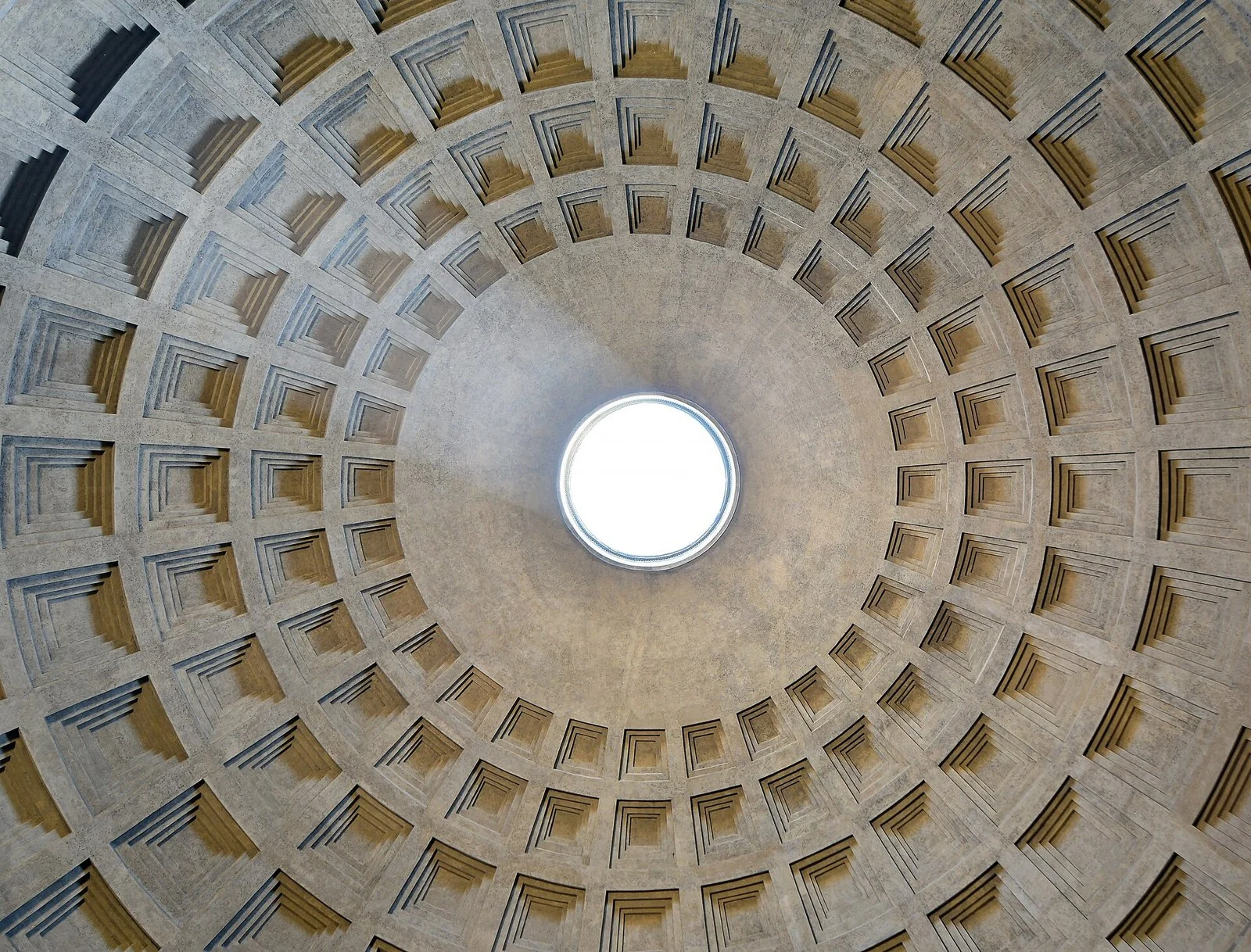
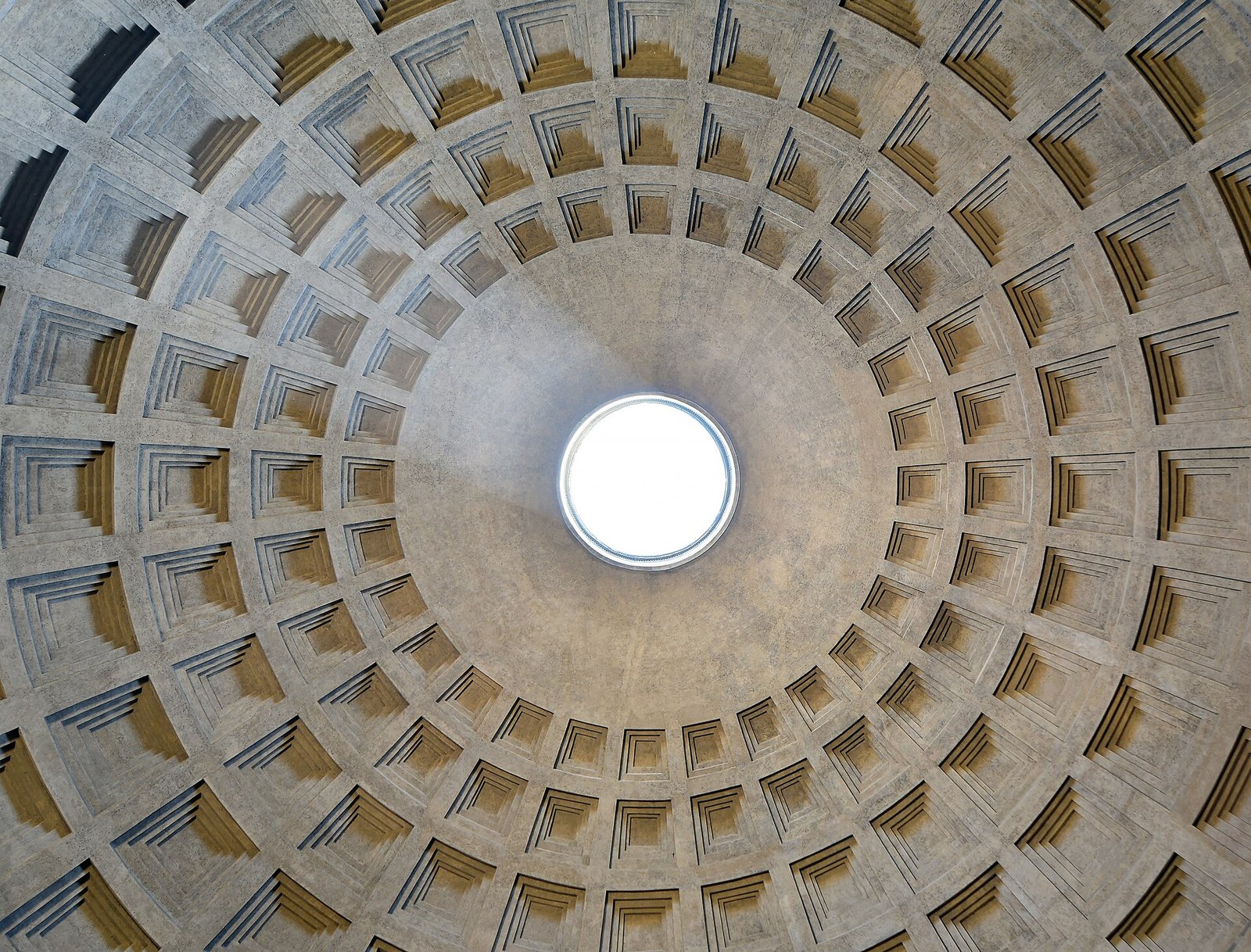
When it rains hard and you only want an immense, dry place, the papal basilicas solve the problem by definition. St. John Lateran, the cathedral of Rome, has a nave of over 100 meters, the Cosmatesque cloister, which charges admission, and the adjoining baptistery. San Paolo fuori le mura adds the Vassalletto cloister and is served by the Metro B with a stop of the same name, which lets you arrive almost without getting wet, and Santa Maria in Cosmedin preserves, besides the Bocca della Verità in the portico, one of the best-preserved medieval interiors in the city. The Pantheon deserves a separate note: the oculus is a real opening with no glass, so when it rains the water really does come in, falls in a vertical column in the middle of the hall and drains through the holes in the floor, which is slightly convex precisely for this reason.
Galleries, arcades and covered passages
The Galleria Alberto Sordi
The Galleria Alberto Sordi, between Piazza Colonna and Via del Corso, is the only true historic shopping gallery in the center of Rome: built in the early 1900s as the Galleria Colonna and named after the actor following his death, it has a glass and iron roof and a Y-shaped plan with three entrances. After a long restyling it is operating again, but with a reduced number of shops: the retail spaces went from 27 to about 15 and in 2026 some brands left the gallery, including the toy store Hamleys, while clothing chains, a bookshop and several places to eat remain active. The picture is that of a gallery that is open but with vacant windows, and the city press discusses the reasons, from the cost of rents on the central stretch of Via del Corso to Romans' distrust of enclosed shopping spaces. For those looking for shelter it remains a covered passage in the heart of the center, with a bar and seating, 50 meters from Palazzo Venezia and three minutes from the Trevi Fountain.
Libraries you can enter
Rome's great historic libraries are institutions of preservation, not tourist attractions, and this changes the rules: the reading room is open to those who register and show ID, the monumental spaces are visited on specific occasions and photographs are often subject to authorization. In return you find some of the most beautiful interiors in the city, almost always empty, free and quiet. Hours change with the administrative calendar and summer closures: they must be checked on the institution's website.
Angelica, Casanatense, Vallicelliana
The Biblioteca Angelica, in Piazza Sant'Agostino, is considered the oldest public library in Europe by foundation and preserves the great 1700s hall designed by Luigi Vanvitelli, with wooden shelving on two levels and the gallery. The Biblioteca Casanatense, on Via Sant'Ignazio a stone's throw from the Pantheon, has a monumental hall of similar grandeur, born from the bequest of Cardinal Girolamo Casanate to the Dominicans of the Minerva. The Biblioteca Vallicelliana occupies Borromini's Oratory of the Filippini, one of the most refined buildings of the Roman 1600s.
The libraries you really use
The Biblioteca Nazionale Centrale, on Viale Castro Pretorio, has spacious reading rooms, a cafeteria and exhibition spaces, and is a place where you can spend half a day. The Istituto Centrale per la Grafica, between Via della Stamperia and Palazzo Poli, that is, literally inside the building that serves as the backdrop of the Trevi Fountain, preserves the national chalcography collection and stages graphic art exhibitions: its position makes it the perfect refuge when the storm empties the fountain's square. The Garum, library and museum of cuisine in Largo di Torre Argentina is halfway between a specialized library and a thematic museum, devoted to the history of food.
Historic cinemas and venues that are also something else
Several historic Roman cinemas have been saved and reopened as hybrid cultural spaces, where the screening is only one of the possible things and you can go in even without a movie ticket.
The Cinema Troisi and the study room
The Cinema Troisi, at Via Girolamo Induno 1 in Trastevere, was recovered by the Piccolo America collective and works as a movie theater, foyer with bar, terrace, video library, exhibition space and study room, the latter presented by the management as open 24 hours a day every day of the year. It's the most useful place in the city on a long rainy day: you study, read, have a coffee and then watch a film, all in the same building. Access to the study room follows its own rules, to be checked on the venue's channels.
Baths, hammams and hot baths
Spending the afternoon in hot water indoors is what the ancient Romans did at the Baths of Caracalla. The contemporary version exists, on a much smaller scale.
The hammam in the Sant'Angelo district
Acquamadre, at Via di Sant'Ambrogio 17, is a hammam built on the model of the Greco-Roman thermal bath: the route passes through apodyterium, tepidarium at about 34 degrees, calidarium at about 45 degrees with humidity close to 100 percent, frigidarium at 26 degrees and relaxation room, and the facility also offers massages and treatments with black olive oil soap. Hours, any days reserved for a single audience and prices change over time and must be checked with the facility, which works by reservation. The location, a stone's throw from the Portico d'Ottavia and the Jewish Museum, makes it easy to fit into an indoor day. Outside the city, along Via Aurelia and in the Colli Albani area, there are thermal establishments with covered and open-air pools, but they require a car and a planned day.
Covered markets, where you eat under shelter
Testaccio, Esquilino and the market inside the station
The Nuovo Mercato Testaccio, on Via Beniamino Franklin, is a modern, fully covered structure, with food stalls and eateries where you eat at market prices and not restaurant prices. The Nuovo Mercato Esquilino, on Via Filippo Turati, is the biggest multiethnic market in Rome, also covered: spices, fish, tropical fruit and products you don't find in the rest of the city. Both generally close in the afternoon and on Sunday, so they work as a morning or lunch stop. The Mercato Centrale Roma, in the market wing of Termini station with entrance from Via Giovanni Giolitti, is instead a multi-level food market open seven days a week with long hours, and has a unique advantage: you reach it from the metro and the trains without ever going outside.
Historic cafés and bookshops, the places where you can stay
The historic cafés, with a warning
The Antico Caffè Greco on Via Condotti, founded in 1760 and for two and a half centuries Rome's literary café par excellence, can't be visited at the moment: on October 8, 2025 the eviction was carried out after a decade-long dispute between the operator and the building's owner, the Ospedale Israelitico, and the venue is closed. The owner has declared the intention to reopen it and the Court of Cassation ruled that the space keep its cultural purpose, but the dispute remains open, including over the fate of the furnishings and works of art, placed under judicial custody, and in 2026 the matter is still the subject of press releases and appeals. Anyone who finds it listed as open on guides and maps should consider the information outdated and check before going. The other two historic references of Roman coffee remain open, both a stone's throw from the Pantheon: Sant'Eustachio il Caffè in Piazza Sant'Eustachio, with its gran caffè served already sweetened unless you ask otherwise, and the Casa del Caffè Tazza d'Oro on Via degli Orfani. These are counter places and not table places: to stay seated for a long time, something else is better.
The bookshops where you stay
Rome has some bookshops big enough to work as waiting rooms: the chains on the Corso and at Termini have very long hours, while the independents between Campo Marzio and the Pantheon and the neighborhood ones in San Lorenzo, Pigneto and Trastevere often have an in-house café and a dense program of evening presentations, free of charge. The bookshops of Palazzo delle Esposizioni, the MAXXI and the Gallerie Nazionali are accessible without a museum ticket and have a serious art stock. The bookshop of the Capitoline Museums is also located before the turnstiles.
The practical side: closures, reservations, umbrellas, transit and flooding
Closing days, trap number one
Monday is the worst day for rain in Rome, because a good part of the state and civic museums close: among others Centrale Montemartini, Palazzo Barberini, Galleria Corsini, Palazzo delle Esposizioni and Vicus Caprarius. Open on Monday are the Capitoline Museums, the Museo dell'Ara Pacis and Trajan's Markets, all with hours of 9:30 to 19:30 and annual closure limited to May 1 and December 25, plus the Vatican Museums, which instead close on Sunday except the last one of the month. The Domus Romane of Palazzo Valentini close on Tuesday, an exception that is easy to forget. The catacombs each close on a different day, and San Callisto also observes an annual closure of about a month between January and February. Almost all churches close in the early afternoon. The operating rule is one: before going out with the umbrella, check the day of the week on the website of the chosen place, not on an aggregator.
What you book and what you don't
Booking is mandatory for the Galleria Borghese, the San Clemente excavations, the Domus Aurea, the Vicus Caprarius, the underground basilica of Porta Maggiore, the mithraea and the catacombs. Booking is strongly recommended for the Vatican Museums, where the outdoor line in bad weather becomes unbearable, and for Explora, whose shifts sell out on rainy days. As a rule, booking isn't required at the Capitoline Museums, the Centrale Montemartini, Palazzo Barberini and the churches. One detail that is worth money: many Roman museums sell tickets for a fixed date and time that are non-refundable and can't be changed, so booking too far ahead for a day when you don't know the weather is a calculated risk.
Where to buy an umbrella in Rome
The exact moment it starts to rain, street vendors with folding umbrellas for a few euros appear in all the tourist areas: they work for half an hour and break at the first gust of wind, but they solve the emergency. For something that lasts the whole trip there are three alternatives: housewares stores and neighborhood hardware stores, scattered everywhere off the main streets, department stores and clothing chains in the center, where in autumn the umbrella is a seasonal item, and the few historic shops left, which sell handmade pieces at much higher prices. A note many people discover late: in Rome the wind often comes with the rain, and a large umbrella holds up much better than a folding one.
How transit works when it rains
The metro is the most reliable means of transport by far, because it runs underground and is affected neither by traffic nor by water on the roadway: lines A, B and C cover a good part of the places listed above. Surface buses suffer more: with traffic blocked, frequencies fall apart, and Roman bus shelters rarely really keep you covered. Trams suffer similar delays. Taxis become impossible to find in the exact hour you need them, that is, at the start of the storm, and apps work better than taxi stands, but with dynamic fares. The most useful advice: download the public transport app beforehand for real waiting times and buy tickets in advance, because the ticket machines at outdoor stops are the worst place to look for coins in the rain.
The areas that flood
Rome has a structural problem with intense storms, tied to the age of the drainage network and to the morphology of the city, made of hills and valleys. The critical points, which come back in the news with every cloudburst, are the road and rail underpasses, which fill in a few minutes and are closed to traffic, the valleys between the historic hills, where water converges by gravity, the low-lying areas along the Tiber and the Aniene, and the arteries of the northern and eastern outskirts, where the sunken stretches collect water from the surrounding basin. In the historic center actual flooding is rare, but wet cobblestones become extremely slippery, especially going downhill: the slopes of the Capitoline, the Aventine and the Janiculum and the stairways of the center must be approached with caution. During weather alerts from Rome's Civil Protection, parks and historic villas can be closed because of the risk of falling branches, which removes Villa Borghese, Villa Pamphilj and Villa Ada all at once: one more reason to have a plan that is entirely indoors.
Two ready-made indoor days
If you don't feel like putting together the itinerary, you can use one of these two plans, built on two main stops with a long break in the middle and short transfers.
Underground day, Colosseum and Celio area
Morning at the Roman Houses of the Celio, which close at 16:00 and so must be done first, with a detour inside Santo Stefano Rotondo and the Santi Quattro Coronati. Long lunch in the area of Via San Giovanni in Laterano. Afternoon at the San Clemente excavations, booked, to go down from the 12th century to the mithraeum. If time is left, San Pietro in Vincoli is 10 minutes away and the Museo Storico della Liberazione, free, 15. All within a radius of a kilometer and a half, with the Metro B as a safety net.
Historic center day, without ever really going out
Start from the Domus Romane of Palazzo Valentini, which open at 10:00 and close on Tuesday, and continue on foot toward Trajan's Markets, open every day. Lunch in the Pantheon area. Afternoon with the Caravaggio triangle, remembering the churches' afternoon closure and bringing coins for the lights. Finish at the Pantheon to see the water falling from the oculus, or at the Istituto Centrale per la Grafica. The transfers are all under 10 minutes and go through narrow alleys, which shelter better than wide streets.
Frequently asked questions about Rome in the rain
What can you do in Rome when it rains?
In Rome when it rains you can choose among the underground city, museums, churches and covered places like markets, libraries and cinemas. The underground is the most effective answer: San Clemente, the Roman Houses of the Celio, the Vicus Caprarius, the Domus Romane of Palazzo Valentini and the catacombs are sheltered by definition. The Capitoline Museums, open every day from 9:30 to 19:30, and the Vatican Museums, with an indoor route of several kilometers, can each fill half a day on their own.
Which museums in Rome are open on Monday?
On Monday in Rome the Capitoline Museums, the Museo dell'Ara Pacis and Trajan's Markets stay open, all with hours of 9:30 to 19:30 and annual closure limited to May 1 and December 25, plus the Vatican Museums, open Monday to Saturday from 8:00 to 20:00. Closed on Monday are the Centrale Montemartini, Palazzo Barberini, the Galleria Corsini, the Palazzo delle Esposizioni and the Vicus Caprarius. The Domus Romane of Palazzo Valentini are the exception and close on Tuesday.
How much does it cost to visit underground Rome?
Prices for underground Rome run from €8 to €15 per site. The San Clemente excavations cost €10, reduced to €5 for students under 26 and free for under 16 accompanied by an adult. The Roman Houses of the Celio cost €8 full and €6 reduced, plus €2 for online booking. The guided visit to the Vicus Caprarius costs €8. The Domus Romane of Palazzo Valentini cost €15, which becomes €16 in the open-date version, with reduced €9 for ages 6 to 17 and for over 65s.
What absolutely has to be booked if it rains in Rome?
In Rome the Galleria Borghese, the San Clemente excavations, the Domus Aurea, the Vicus Caprarius, the catacombs, the mithraea and the underground basilica of Porta Maggiore must be booked. Booking is strongly recommended for the Vatican Museums, where in bad weather the entrance line forms in the square, and for Explora, the children's museum, whose shifts sell out quickly on rainy days. The Capitoline Museums, the Centrale Montemartini and churches don't require booking.
Is the Antico Caffè Greco on Via Condotti open?
No, the Antico Caffè Greco has been closed since October 8, 2025, when the eviction was carried out at the end of a decade-long dispute with the building's owner, the Ospedale Israelitico. The owner has announced the intention to reopen it and the Court of Cassation ruled that the space keep its cultural purpose, but in 2026 the dispute still appears to be open, including over the fate of furnishings and works of art placed under judicial custody. It's best to check before going.
Is the Galleria Alberto Sordi still open?
Yes, the Galleria Alberto Sordi in Piazza Colonna is open and remains a usable covered passage between Via del Corso and Piazza Colonna, but it is a struggling shopping gallery: after the restyling the spaces went from 27 to about 15 shops and in 2026 some brands closed, including Hamleys. Clothing chains, a bookshop and places to eat remain active, and the glass roof is one of the few shelters on the central stretch of the Corso.
How do you get around Rome when it rains?
In Rome in the rain the metro is the most reliable means of transport, because it runs underground and isn't affected by the flooded traffic on the surface. Buses suffer heavy delays, trams too, and taxis become hard to find right at the start of the storm, when demand explodes. It's best to download the public transport app beforehand for real waiting times and to buy tickets in advance, avoiding the ticket machines at outdoor stops.
Can you visit the Pantheon when it rains?
Yes, the Pantheon can be visited in the rain, and in fact it's one of the best moments to see it: the oculus of the dome is a real opening with no glass, so the water comes in and falls in a vertical column in the middle of the hall, then drains through the holes made in the marble floor, which is slightly convex precisely for this reason. It's one of the few occasions when an ancient engineering detail can be seen working before your eyes.
Are there free things to do in Rome when it rains?
In Rome in the rain you can spend a whole day indoors without spending anything: all churches are free, including the Caravaggios of San Luigi dei Francesi and Sant'Agostino, the mosaics of Santa Prassede and the vaults of Sant'Ignazio and the Gesù. Residents of Rome and the Metropolitan City enter the civic museums free, on the first Sunday of the month admission is free at Palazzo Barberini and the Galleria Corsini, and the Museo Storico della Liberazione is always free to enter.
If you organize trips for others and have to build indoor alternatives in real time, when the weather changes the program of a group already in the city, on tourleaderpro.com you'll find the tools designed for guides and tour leaders: group management, backup plans for bad weather days and coordination of fixed-time bookings, which are exactly the weak point of a rainy day in Rome.
If instead you're preparing your own trip to Italy and want to work out how to fit Rome in with the rest of the itinerary, taking into account the season, the museums' weekly closures and the travel times between one city and another, on italyplanner.com you'll find guides and planning tools useful for building a program able to withstand even a week of autumn rain.