Casina delle Civette – Villa Torlonia Museums
In short. The Casina delle Civette is inside Villa Torlonia, at Via Nomentana 70, 00161 Rome, on the left side of the park coming from the main entrance.

The Casina delle Civette is inside Villa Torlonia, at Via Nomentana 70, 00161 Rome, on the left side of the park coming from the main entrance. You enter through the gate on Via Nomentana, take the avenue that goes down to the right, and in three minutes of walking the villino appears among the holm oaks, recognizable by the gray slate roofs and the glazed tiles. The museum is open Tuesday through Sunday, from 09:00 to 19:00, with last entry one hour before closing. It's closed on Mondays, May 1 and December 25, while on December 24 and 31 the hours are reduced to 09:00 to 14:00 and on January 1 opening is pushed to 11:00 to 20:00. The ticket for the Casina delle Civette alone, during the period in which it hosts a temporary exhibition, is €10.50 full price and €7.00 reduced. The combined ticket for the Villa Torlonia Museums costs €17.00 full price and €13.00 reduced when all four sites are open, and drops to €14.00 full price and €11.00 reduced in July and August, when the Serra Moresca complex is closed to the public. The audio guide costs €4.00 and is available in Italian, English and French. Residents of Rome and the Metropolitan City get into the civic museums free by showing an ID, and the same goes for holders of the MIC card. Prices for temporary exhibitions may vary, however, so it's worth checking the updated price list on the Villa Torlonia Museums website before you go. Reservations aren't required for a self-guided visit. The call center of the civic museums answers at 060608, every day from 09:00 to 19:00.
You get there by subway line B, getting off at Bologna or Policlinico and walking about 10 minutes, by tram 3 and tram 19, Viale Regina Margherita/Nomentana stop, by the buses that run along Via Nomentana, that is lines 60, 62, 66, 82 and 90, or by those of Via Bari, that is 61, 490, 495 and 649. By car it's a nightmare: Via Nomentana has prohibitions almost everywhere and the blue-line parking of the Nomentano neighborhood rarely frees up. The most concrete advice is to leave the car at home and arrive by tram 3, which drops you 200 meters from the gate.
The villino is part of the museum system of Villa Torlonia, together with the Casino Nobile and the Casino dei Principi. To get oriented in the wider landscape of the city's civic and state museums, you can start from the page dedicated to the museums of Rome.

What you visit at the Casina delle Civette
Whoever enters for the first time expects a dollhouse and instead finds a real museum, with a precise collection and a theme unique in the world: Italian artistic stained glass of the early 20th century, told inside the building for which those windows were designed. The route runs on two levels and 20 rooms, with wall paintings, stuccoes, mosaics, majolica and boiseries. The displayed heritage includes 54 original windows of the Casina, put back in their position after the restoration, 18 windows acquired later and displayed on free-standing supports, and 105 sketches and preparatory cartoons. It's a density that no other house in the world can claim for this technique, and it's the reason applied-art historians come here from half of Europe while many Romans, who pass on Via Nomentana every day, have never been in.
The Casina delle Civette was the home of Prince Giovanni Torlonia junior until 1938, the year of his death. It's a fact to take seriously, because it explains all the rest: what you see is not a garden pavilion decorated on a whim, but the house in which a very rich and reserved man chose to live, rejecting the family's official residence, and which he had tailored on himself room by room over 20 years.
From Jappelli's Swiss Hut to the Casina delle Civette
1840, Giuseppe Jappelli and the rustic hut
At the origin of everything is a completely different building. In 1840 Prince Alessandro Torlonia commissioned from Giuseppe Jappelli, a Paduan architect and hydraulic engineer, a Swiss hut to be placed at the edge of the park, hidden behind an artificial hillock. Jappelli was the right man: he came from the experience of the English landscape garden, had already worked for the Torlonia on the Romantic layout of the villa and knew the repertoire of the architectural caprice, that is those fake-rustic constructions that in 19th-century parks served to interrupt the symmetry of the avenues. The result was a rustic Swiss hut with exterior facings of tuff ashlar and interiors painted in tempera, imitating rocks and wooden boards: a declared fiction, an inhabitable stage set.
The function was explicit, and it's worth keeping in mind because it's the key to reading the whole later building: the Swiss Hut was born as a place of escape from the formality of the main residence. The Casino Nobile served to receive, to represent, to show the economic power of a family that in three generations had gone from the cloth trade to princely rank. The hut, instead, served to disappear. Whoever visits the Casina delle Civette without knowing this mistakes it for an exercise in Liberty style. Whoever knows it understands that the building's strangeness is programmatic, not decorative.
1908 and the transformation into the Villaggio Medioevale
From 1908 the Swiss Hut began to undergo a progressive and radical transformation at the will of Giovanni Torlonia junior, Alessandro's grandson. The building took on the look and name of Villaggio Medioevale, and the works were directed by the architect Enrico Gennari, who remained tied to the work site for decades. The little hut became a refined residence, with large windows, small loggias, porticoes, turrets, majolica decorations, colored glass, boiseries and symbols.
The word Villaggio isn't random. Gennari didn't enlarge a building: he multiplied its bodies, as if on the spot different constructions had accumulated over the centuries, added by successive generations. It's the pittoresco principle applied to domestic architecture, the same one that in those same years produced in Rome the fantasies of the Coppedè neighborhood, a quarter of an hour's walk from here. The difference is that Gino Coppedè worked for a real estate company and had to sell apartments, while Gennari worked for a single client who wanted a house in his own image.
From 1917 Vincenzo Fasolo and the southern front
In 1917 the architect Vincenzo Fasolo came on the scene, adding the structures of the southern front of the Casina by developing a fantasy decorative apparatus in Liberty style. Fasolo's imprint is recognized in the choice of volumes, which aggregate and intersect, taking shape in a great variety of materials and decorative details. Fasolo was a Dalmatian from Split trained in Rome, destined for a long academic career and for much more monumental works, and here he allowed himself a rare amusement: building without having to justify himself to anyone.
The element that holds together this accumulation of architectural solutions is chromatic even before formal: the gray tone of the finishing layer of the roofs, for which slate in thin slabs was used, shaped in different ways, set against the lively polychromy of the glazed terracotta tiles. Look at the roofs from the lawn before going in, with the raking light of late afternoon: the matte gray of the slate and the bottle green and yellow of the majolica make up a chord that holds the whole building together. It's the part of the project that visitors look at least and that restorers consider most fragile.
The two bodies of the Casina delle Civette
The architectural complex you visit today consists of two buildings, the main villino and the annex, connected by a small wooden gallery and by an underground passage. Of that romantic alpine-flavored refuge conceived in the 19th century by Jappelli few things remain, and they are structural things: the masonry of the two main bodies, arranged in an L, the deliberately rustic imprint, the use of the different building materials left exposed and the pitched roofing. Everything else is a 20th-century invention. The wooden gallery and the underground passage, in particular, say something about the owner's character: two different ways to move from one building to the other without ever crossing the lawn, without ever being seen.
Giovanni Torlonia junior, the prince who lived in the Casina delle Civette
Giovanni Torlonia junior is one of the least told characters of early 20th-century Rome, and one of the most interesting. A surly man, a lover of esoteric symbols, he preferred the Casina to the Casino Nobile and lived there in solitude, surrounded by a vocabulary of images that he had chosen one by one. The rooms bear names that are the memory of his fantasies and his fixations: the owl room, the nail room, the satyrs' little parlor, the cyclamen room, the rose balcony. They aren't museum labels invented afterward: they're the names the house was known by.
In 1925 the Casino Nobile was granted to Benito Mussolini as his Roman residence, and the Torlonia family continued to occupy the other buildings of the park. The prince remained in his Casina until his death, in 1938. Whoever looks for the spicy anecdote will find many pages on Mussolini as the Torlonia's tenant. What interests me more is that a few hundred meters from the head of government lived an aristocrat who had spent 30 years building himself a refuge full of owls, cyclamens and initiation symbols, and who wanted to know nothing of that cumbersome neighbor.
Why it's called Casina delle Civette
From 1916 the building began to be called Villino delle Civette. The name arose from two converging reasons: the presence of the window with two stylized owls among ivy tendrils, made by Duilio Cambellotti as early as 1914, and the almost obsessive recurrence of the owl theme in the decorations and furniture, wanted by Prince Giovanni. The owl appears on glass, wrought iron, majolica, furniture inlays, above the entrance door. Whoever enters distracted counts three or four. Whoever enters with open eyes stops counting after the first room.
The owl between superstition and wisdom
The owl has always been a controversial animal. The nocturnal habits, the round close-set eyes that give it a vaguely human and unsettling expression, the mournful call: everything contributed to making it the protagonist of a very long series of superstitions, myths and legends. The common denominator is the belief that this animal brings bad luck and that its song foretells death and assorted misfortunes.
The Egyptians believed it foretold death and considered it a symbol of the Sun disappearing at the horizon, that is of darkness. For the Japanese it brought famine and disease. In the Middle Ages owls were tied tightly to witchcraft, both because witches were believed to take on their shape to wander undisturbed, and because parts of their bodies, feathers, heart, eyes, were used as ingredients of magic philters and of little-recommended potions. In short, the owl has always caused unease in the common man and over time has been associated with misfortune, dark plots and diabolical pacts.
Yet for the Greeks and the Romans, among whom it also symbolized death, the owl was also an expression of wisdom, intuition and knowledge: Athena, and the Minerva who gathers her Latin legacy, is often represented with an owl or a horned owl on her shoulder, and the small raptor ends up on the coins of Athens as the city's mark. This duplicity is precisely the reason why a cultured man fond of symbols, at the start of the 20th century, could choose it as a personal emblem: the owl says wisdom to those who can read it and says threat to those who can't.
The esoteric meaning of the owl according to the prince
That Giovanni Torlonia junior exploited these popular beliefs by building his fairy-tale Casina to protect his privacy and keep away those he didn't want near him is a fascinating hypothesis and has to be presented for what it is: a hypothesis, not a documented fact. What is documented, instead, is his passion for esoteric symbols and the systematic way he brought them into the house. Alongside the owls appear ivy, which in the symbolic tradition stands for attachment and plant immortality, butterflies, which stand for metamorphosis and the soul, satyrs, peacocks, migratory birds. None of these motifs is neutral in the European Symbolist culture of those years, and none of them is there to fill a space.
In our judgment the esoteric reading of the Casina delle Civette is often pushed too far by popularization, which sees coded messages where there is instead the cultured, melancholy taste of a man of his time. European Liberty is full of ivy, butterflies and night birds. The difference here is consistency. The prince didn't decorate a room, he decorated a life.
The windows of the Casina delle Civette, one by one
The windows of the house were made within barely a decade, between 1910 and the early 1920s, that is in the golden years of Italian Liberty, and came out of the workshop of Cesare Picchiarini from designs by Duilio Cambellotti, Umberto Bottazzi, Vittorio Grassi and Paolo Paschetto. Their presence is so prevalent that it constitutes the distinctive mark of the building and a unique case in the international artistic landscape. Below I tell them one by one, with the room they belong to, the author and the dating: it's the best way not to cross the museum the way you cross a corridor.
The geometric windows of the passetto, 1910-1912
They are the oldest in the complex and the least conspicuous, and for that reason almost nobody stops to look at them. Coming out of the Picchiarini workshop between 1910 and 1912, they decorate the passetto, that is one of the connecting spaces of the Casina. The design is purely geometric, without figures: lozenges, panels, fields of flat color held together by the lead outline. They matter because they document the starting point, when Italian stained glass was still a craft matter on a northern model and had not found its own language. Look at them at the start of the visit and then go back in memory to Cambellotti's owls: between the one and the others there are four years and a leap of category.
Umberto Bottazzi's peacocks in the cyclamen room, 1912
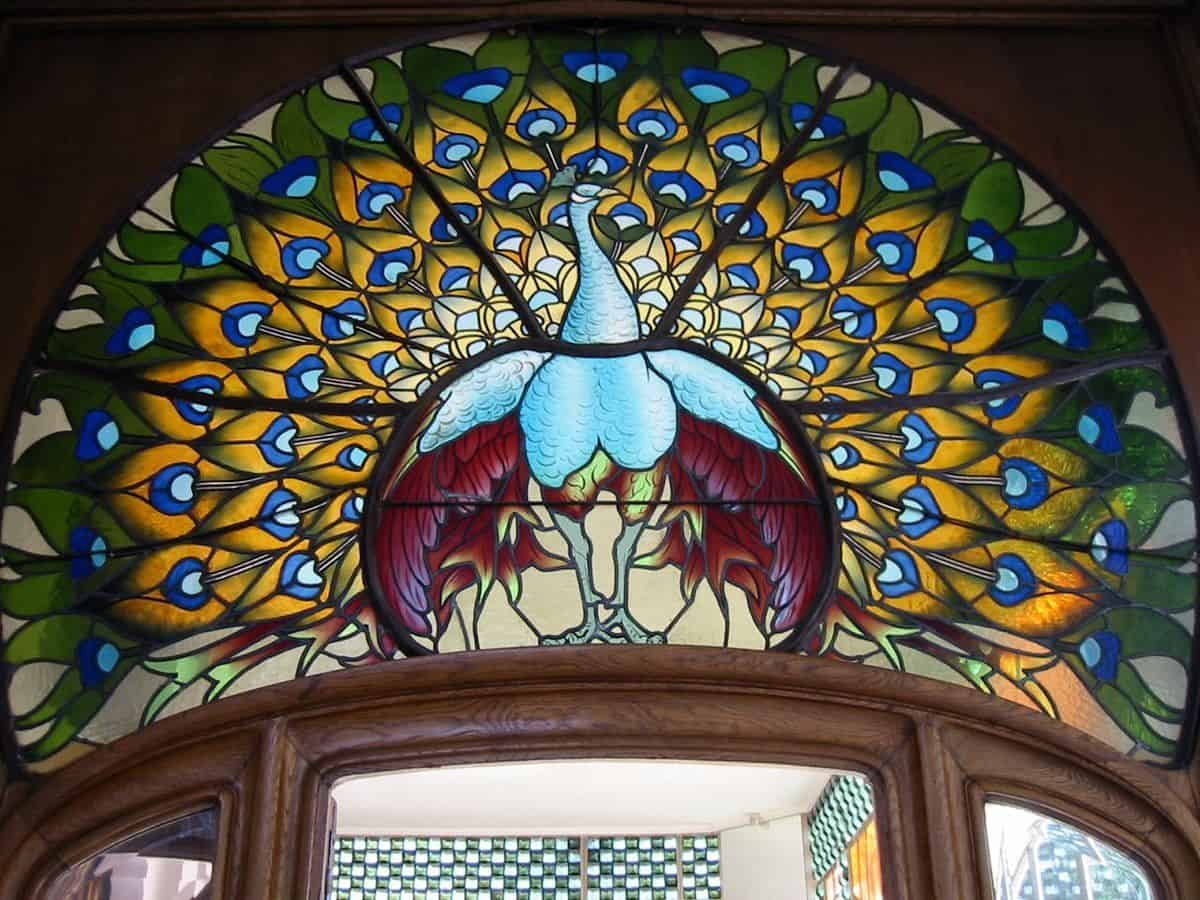
The peacock window is from 1912 and is the work of Umberto Bottazzi. It's in the cyclamen room and is, chronologically, the first large figured window of the house. The peacock is an animal that late 19th-century Symbolism loved madly: tail with eyes, immortality in the early Christian tradition, vanity in the moralistic reading, a perfect decoration for the curved line of Liberty. Bottazzi treats it with a taste still close to illustration and graphic art, that is to the field in which he had built his career. If the eye is trained, the difference from Cambellotti shows in two seconds: Bottazzi draws a motif, Cambellotti builds a scene.
The Lake with the Swan, Picchiarini workshop, 1914
The window with the lake and the swan, from 1914, comes out of the Picchiarini workshop and is one of the pieces in which the workshop's technical mastery is best measured. The theme is a water landscape, with the white of the animal floating on a range of greens and light blues. In a stained glass window, landscape is the hardest test, because the nuances of water and sky aren't painted: they're obtained by choosing glass already colored in the mass and cutting it so that the lead follows the natural course of the form instead of contradicting it. Here the lead works like a line of drawing, and this is the merit of the glassmaker even before the designer.
The windows with leaves and grape tendrils of the dining room, around 1914
In the dining room the Picchiarini workshop made around 1914 the windows with leaves and grape tendrils. The choice of subject has a limpid, almost didactic logic: the vine in a room where you eat and drink. It's worth pausing on the green, which in morning light turns acid and in the afternoon warms up. The dining room of the Casina delle Civette is one of the spaces where the hour of the visit really changes what you see.
The Nail with Tendrils and Grapes in the nail room, Cambellotti, 1914-1915
The nail room takes its name from its window, designed by Duilio Cambellotti between 1914 and 1915, in which a nail appears around which tendrils and bunches of grapes wind. It's the most enigmatic image in the house and the one about which guides tell the most fanciful things. The nail belongs to the symbolic repertoire of fixity, of the fixed point, and in Christian iconography refers to the Passion. The grape refers to wine and therefore to blood, but also simply to the fertility of the vine. That the prince intended a precise rebus or a matter of taste in combination isn't established by any known document, and whoever tells you it as certainty is selling you a story. Look at it for what it is: a piece of very powerful graphic art, with a line that holds its own against any poster of the period.
The Swallows, Picchiarini workshop, around 1914
The swallow room owes its name to the windows that came out of the Picchiarini workshop around 1914. Swallows in flight are a motif that Art Nouveau used everywhere, from posters to ceramics, because it lets you fill a surface with a dynamic diagonal without weighing it down. Here the reading is more intimate: the swallow is the bird that leaves and returns, and in a house built by a man who hated moving around the choice has a particular flavor.
The Owls window by Duilio Cambellotti, 1914
It's the window that gave its name to the building and the museum, and it's from 1914. Cambellotti arranges two stylized owls among ivy tendrils, in a balance of symmetry and deviation that is the secret of its effectiveness: the animals face each other, but aren't identical. The stylization is pushed to the point where the natural form becomes a graphic sign and at the same time remains recognizable. The lead, instead of arbitrarily cutting the design, runs along the outlines of the feathers and branches, so that the supporting structure of the window coincides with the drawing itself. That's why this window works even in photography, where so many others go dead.
If you have little time and want to see only one thing at the Casina delle Civette, it's this. The right moment: in the hours when the light doesn't hit the glass directly, because full sun burns the tones and flattens the ivy into a single blotch. The diffuse light of an overcast day, which visitors consider bad luck, is the best condition for stained glass.
The Fairy in the Turret room, Cambellotti, 1917
From 1917 is the fairy window, also by Duilio Cambellotti, placed in the Turret room. It's the most narrative piece in the house, and the closest to the world of theater, which for Cambellotti was a trade as much as the applied arts: the winged female figure belongs to the repertoire of the Symbolist stage and of the fairy-tale illustrations that circulated all over Europe in those years. The Turret is also the highest and most secluded space in the building, with the narrow stair that leads to it and the walkway from which you see the park: the fairy governs a space that seems built just for her. Among all the windows of the Casina delle Civette it's the one that strikes children most deeply, and I'll come back to this later.
Ivy and Ribbons in the satyrs' little parlor, Cambellotti, 1918
In the satyrs' little parlor Cambellotti signs in 1918 the window with ivy and ribbons. The ivy returns here as an independent motif, no longer just as a support for the owls: a climbing, tenacious, evergreen plant, it is the plant that in ancient symbolism stands for fidelity and for life that doesn't break off. The ribbons serve to introduce into the design a free line, which derives not from nature but from ornament: it's the typical play of mature Liberty, which pairs the observed botanical datum and pure arabesque. The name of the room comes instead from the decorative apparatus of the satyrs, and recalls that in the Casina the glass never works alone, but inside a space that answers it with stuccoes, woods and paintings.
Vittorio Grassi's Idol in the prince's bedroom, 1918
Giovanni Torlonia junior's bedroom is lit by the Idol window, designed in 1918 by Vittorio Grassi. Grassi was a painter, engraver and designer of postage stamps, and brought to stained glass a graphic sensibility different from Cambellotti's, tauter and drier. The subject is what the title declares: an idol-like figure, archaic, frontal, which in the room of a solitary man fond of symbols takes on a weight that no flower would have had. It's the window that visitors look at longest in silence, and I understand why.
The Migrants on the four seasons staircase, Cambellotti, 1918
On the four seasons staircase, again in 1918, Cambellotti places the migrants window. The placement is the best part of the idea: the birds on a journey accompany whoever goes up and whoever goes down, and the movement of the body along the steps sets the design in motion. The staircase takes its name from the cycle of the seasons that governs its decoration, and the theme of the migrants fits it exactly, because migration is the way animals measure the year. It's one of the points of the Casina delle Civette where architecture, decoration and visitor route coincide, and one of the few worth walking twice, up and down.
Roses, Ribbons and Butterflies by Paolo Paschetto on the rose balcony, 1920
The rose balcony houses the window with roses, ribbons and butterflies designed by Paolo Paschetto in 1920. Paschetto is the name that always surprises visitors when it's explained: he is the author of the emblem of the Italian Republic, the one with the star, the cogwheel, the olive branch and the oak, adopted in 1948. In 1920, 28 years earlier, he was drawing roses and butterflies for Prince Torlonia, with the same steady hand and the same attention to outline that would win him that competition. The butterfly, in the symbolic repertoire, is the soul that transforms, and paired with the rose and the ribbon it makes a piece of pure decorative grace, the sunniest in the house. Look at it in the early afternoon, when the pink of the glass lights up.
The artists and the workshop: who made the windows of the Casina delle Civette
Cesare Picchiarini, the glassmaker
The story of 20th-century Italian stained glass begins in a Roman workshop. Cesare Picchiarini is the master glassmaker who physically executed the windows of the Casina, from other people's designs, and his role has to be understood properly because it always risks being underrated. In artistic glass the designer provides a scale cartoon, but the translation into the work is an autonomous craft: choosing the right sheets, cutting them, deciding where the lead goes and where not, where you need grisaille painted and fired and where color in the mass is enough. A bad glassmaker can destroy a good cartoon. Picchiarini was the opposite: his workshop gave designers possibilities that they alone wouldn't even have imagined, and trained a generation. If the Casina delle Civette is a unicum, it's because a rich and stubborn client met a craftsman of that level.
Duilio Cambellotti, the total artist
Duilio Cambellotti is the name that dominates the house: his are the owls window, the fairy, the ivy and ribbons, the migrants, the nail with tendrils and grapes. A Roman, trained at the Museo Artistico Industriale, he was an illustrator, sculptor, ceramist, set designer, author of posters and furniture. He worked for the Greek theater of Syracuse and for the reclamation of the Agro Pontino, and brought into all these experiences the same idea of art as useful work and as clear sign. In the windows of the Casina delle Civette you see his essential stroke: few, decisive lines, natural forms reduced to the skeleton, no complacency. That's why his Liberty hasn't aged like that of so many contemporaries.
Umberto Bottazzi, Vittorio Grassi and Paolo Paschetto
Alongside Cambellotti three other leading designers worked. Umberto Bottazzi, author of the 1912 peacocks, came from the world of illustration and decoration and was among the first in Italy to take stained glass seriously as an autonomous artistic genre. Vittorio Grassi, who signs the 1918 Idol, was a painter, engraver and designer of postage stamps, and brought to the house a more severe register. Paolo Paschetto, author of the 1920 roses, was a Waldensian from Piedmont, a pastor's son, who would tie his name to the emblem of the Republic. Four designers, one glassmaker: the Casina delle Civette is also the most complete sampler that exists of how different artists tackled the same technique in the same years and in the same workshop.
Room by room: the visitor route of the Casina delle Civette
The interior spaces are laid out on two levels and are all particularly refined in the finishing works. Painted decorations, stuccoes, mosaics, polychrome majolica, inlaid woods, wrought iron, wall fabrics and marble sculptures show the prince's attention to living comfort, which was a modern concern and not at all a given in an early 20th-century aristocratic residence. The 20 rooms of the route have names that come from their decorations, and walking through them in order means retracing the way the house was conceived.
The entrance and the first rooms
The bird of prey with round eyes welcomes you already above the entrance door: it's the first signal the house gives of itself, and it's worth stopping before crossing the threshold to look at how the materials sit together, the tuff, the glazed terracotta, the wrought iron, the wood. Inside, the first rooms serve to orient: the L plan of the two building bodies isn't immediately readable, and in the first minutes almost everyone gets lost. It's deliberate. A building that wants to hide whoever lives in it can't have a clear layout.
The dining room
The dining room is one of the most complete spaces, with the leaf and grape tendril windows of the Picchiarini workshop and an apparatus of woods and fabrics that frames them. Here you can clearly understand something that escapes those who look only at the glass: in the Casina delle Civette the window is not a hung picture, it's an architectural element. It regulates the light, colors the air of the room, changes the color of the wood surfaces around it. Take it away and the room becomes another room.
The owl room
It's the iconographic heart of the building, the room from which the name of the whole house comes, embellished by windows with stories showing the animal perched on ivy tendrils. The theme doesn't stay confined to the glass: it returns in the ironwork, the woods, the furnishing elements, with that insistence that to contemporaries must have seemed eccentric and that to us looks like a signature. Take your 10 minutes here, because it's the space that justifies the ticket.
The nail room and the satyrs' little parlor
The nail room, with Cambellotti's window of 1914-1915, and the satyrs' little parlor, with the ivy and ribbons of 1918, form a pair worth reading together. The first space is dry, almost heraldic. The second is soft, vegetal, enveloping. The passage from one to the other shows the freedom with which the prince and his architects treated the decorative theme: no style consistency imposed from above, but a sequence of rooms each with its own character, like chapters of a book written at different times.
The cyclamen room and the swallow room
The cyclamen room, which houses Bottazzi's peacocks of 1912, and the swallow room, with the Picchiarini workshop windows of about 1914, belong to the oldest phase of the figured decoration. The cyclamen is a flower of shade, born under trees and blooming when other plants slow down: another choice that in the house of a solitary man sounds less casual than it seems. The swallows instead bring into the building the theme of journey and return, which will come back with the migrants on the staircase.
The prince's bedroom
The bedroom, with Vittorio Grassi's Idol of 1918, is the most private space and the most revealing. Whoever chooses to wake up every morning in front of an idol-like figure isn't furnishing: he's declaring himself. It's also the room where the relationship between glass and furniture reads best, because the furnishings designed for the house and the window speak the same formal language.
The four seasons staircase and the Turret room
The four seasons staircase, with Cambellotti's migrants of 1918, leads to the Turret room, where the 1917 fairy is. It's the most vertical and most scenographic part of the visit, the one children remember and adults photograph badly, because the stair is narrow and the light changes at every step. Climb slowly. The Casina delle Civette rewards those who slow down.
The rose balcony and the passetto
The rose balcony, with Paschetto's window of 1920, is the brightest and lightest space. The passetto, with the geometric windows of 1910-1912, is the most technical and most neglected. Line them up in your mind and you'll have the complete path of Italian stained glass in a decade: from the abstract geometry of the beginning to full figurative maturity.
Furniture, majolica, mosaics and wrought iron
Reducing the Casina delle Civette to its windows is the most common mistake. The house is a complete decorative organism, and the applied arts all coexist in it. The polychrome majolica covers exterior and interior surfaces and ties the building to the ceramic taste that in those years ran through all of Europe. The mosaics work on the floors and on some wall surfaces. The stuccoes model ceilings and cornices. The inlaid woods and boiseries line the walls and build the fixed furnishings. The wrought iron draws railings, grilles and everyday details. The wall fabrics, which are the most fragile component and the one the restorations have to watch continuously, gave the rooms the warmth that today can only be imagined. And then the marble sculptures, distributed sparingly.
The furniture deserves a separate discussion, because it was conceived together with the house and not bought to furnish it. The owl theme recurs in the inlays, the chair backs, the handles, and this continuity between architecture, fixed decoration and furniture is precisely what European Liberty culture pursued as an ideal of the total work of art. Few buildings in Italy came as close to it as this. If the comparison interests you, the Casino Nobile keeps the bedroom furniture of Giovanni Torlonia, later used by Mussolini, found in a government storeroom and brought back to the villa: two opposite ways of living in the same park.
The collection of the Casina delle Civette: windows, sketches and cartoons
The museum keeps 54 original windows of the Casina, put back in the site they were designed for after the restoration work, and 18 windows acquired later and displayed on free-standing supports, that is readable from both sides and artificially lit. To these are added 105 sketches and preparatory cartoons.
On the sketches and cartoons it's worth spending a couple of words, because they are the part of the museum that visitors cross fastest and that instead explains all the rest. The sketch is the preliminary study, often in color, in which the designer fixes the idea. The cartoon is the full-scale drawing on which the glassmaker works, with the lines that indicate where the lead will run. Putting them next to the finished windows means showing the thought before the work: where the design was simplified, where a color was changed because the available glass didn't render, where the lead imposed a solution that the cartoon hadn't foreseen. I don't know another place in Italy where this comparison is possible on this scale, and it's the reason I consider the Casina delle Civette a museum for professionals disguised as a fairy-tale house.
From 1944 to 1997: ruin, fire and rebirth of the Casina delle Civette
The occupation by the Anglo-American troops
The destruction of the building began in 1944, with the occupation by the Anglo-American troops, which lasted more than three years. It wasn't a bombing that ruined the Casina: it was the daily use of a fragile house by large numbers of people who had no reason to treat it with care. The windows, which are the most delicate part of any building, paid first. Whoever knows the history of Roman palaces after the war knows this script was repeated dozens of times, and that the damage of then is still today the most expensive chapter of any restoration.
1978 and the acquisition by the City of Rome
When in 1978 the City of Rome acquired Villa Torlonia, both the buildings and the park were in disastrous condition. The park was opened to the public and slowly began to become a garden again. The buildings stayed closed for years, fenced off, inhabited by weeds. Whoever saw Villa Torlonia in the 1980s remembers a very beautiful and wrecked place, with broken glass and a caved-in roof. It's worth keeping in mind crossing the lawn in front of the Casina today: what you visit didn't survive, it was brought back.
The 1991 fire
The 1991 fire worsened the state of decay of the Casina, which in the meantime had also suffered thefts and vandalism. It was the lowest point in the history of the building and, paradoxically, the fact that determined its salvation: the loss risked becoming definitive, and this set in motion a work site that otherwise would have kept slipping. It's a dynamic that in Rome has been seen many times, and that does honor to nobody.
The restoration from 1992 to 1997
The present image of the Casina delle Civette is the result of a long, patient and meticulous restoration, carried out from 1992 to 1997, which with what was still preserved and on the basis of the many documentary sources made it possible to give back to the city one of the most singular and interesting artifacts of the early years of the last century. The method deserves respect: the surviving windows were dismantled, consolidated and put back in their original position. The lost ones were documented through sketches, cartoons and archive photographs. The gaps were treated without inventing, distinguishing the ancient from the integration. Since 1997 the building has housed the museum dedicated to artistic stained glass, with works made between 1910 and 1925.
How to visit the Casina delle Civette: duration and route
Count on an hour for a normal visit and an hour and a half if you stop at the sketches and cartoons. The route is one-way and reasonably clear, with the stair leading to the upper level and the return to the ground floor. The spaces are small, and this means that with a large group ahead of you a line forms. The audio guide, at €4.00 in Italian, English and French, is an expense I recommend to those who visit alone: without a common thread, the risk is leaving with the feeling of having seen many beautiful windows and no story.
The operational advice: combine the Casina delle Civette with the Casino Nobile in the same morning, taking the combined ticket. They're two buildings five minutes from each other inside the same park, and they tell two Romes that didn't speak to each other. If you still have energy, the Casino dei Principi, home of the Archivio della Scuola Romana, completes the picture. In a full day you do everything and eat on the lawn.
The Casina delle Civette with children
It works, and works well, as long as you set up the visit the right way. A child of six or seven in front of a Liberty window doesn't think about the history of the applied arts: he sees a fairy-tale house with owls, the fairy, peacocks, swallows and butterflies. Turn the route into a hunt: how many owls can you find among glass, ironwork, woods and majolica. I assure you the counting lasts longer than your patience.
Two practical warnings. The spaces are narrow and rich in fragile surfaces, so the stroller is awkward and the children have to be kept close. And the right duration with little ones is 40 minutes, not an hour and a half, after which it's best to go out on the lawn. Villa Torlonia, from this point of view, is one of the most generous historic villas in Rome: wide lawn, shade, space to run. The museum-plus-park combination makes this place, for families, preferable to Villa Borghese, where distances are long and museums crowded.
Accessibility of the Casina delle Civette
Here honesty is needed. The Casina delle Civette is an early 20th-century historic building, laid out on two levels, with narrow stairs, internal level changes, tiny passages and thresholds: it is, by its nature, the opposite of a museum designed for accessibility. The ground floor can be walked more easily, while the upper level, including the Turret, presents objective difficulties for those who get around in a wheelchair or have problems walking. The park of Villa Torlonia and the access avenues are instead flat and in good condition. Those with specific needs should phone the 060608 call center beforehand, which is the quickest channel to know which spaces are reachable at the time of the visit and which assistance services are active.
Tickets, MIC card and combined tickets for the Villa Torlonia Museums
The Villa Torlonia fare system is articulated because the museums are four and the temporary exhibitions affect the price. The ticket for the Casina delle Civette alone, with the temporary exhibition under way, is €10.50 full price and €7.00 reduced. The Casino Nobile costs €11.00 full price and €6.50 reduced. The Casino dei Principi with the current exhibition €8.00 full price and €5.00 reduced. The Serra Moresca with the Moorish Tower €8.00 full price and €5.00 reduced. The Bunker and the air-raid shelters €12.00 full price and €6.00 reduced, with guided visit and mandatory booking.
The combined ticket almost always pays off. In the period when the Serra Moresca is closed, that is July and August, the ticket that includes the Casino Nobile, Casino dei Principi and Casina delle Civette costs €14.00 full price and €11.00 reduced. The rest of the year, with the Serra Moresca included, it goes up to €17.00 full price and €13.00 reduced. Do the math: two museums out of three already pay it back.
On the MIC card the story is simple and worth repeating because many don't know it: for €5 it gives free access for 12 months to the Rome Capital Museum System, plus discounts on exhibitions. It is reserved for those who reside or study in Rome. If you live in the city and over the course of a year you plan to enter at least two civic museums, the card pays for itself on the first visit. For residents of Rome and the Metropolitan City entry to the civic museums is free by showing an ID. For temporary exhibitions different conditions may apply, so check the updated price list on the Villa Torlonia Museums website before getting in line.
When to go to the Casina delle Civette
The windows need light, but the right light. The best moment for the visit is the morning of a bright but not dazzling day, or an overcast day: diffuse light passes through the glass without burning it and gives back full colors. The low, direct sun of January, which comes in horizontal, produces spectacular effects on some windows and wipes out others. In summer early afternoon is the worst slot, both for the light and for the heat inside a small building.
On the calendar: Tuesday and Wednesday mornings are the quietest slots, Sunday afternoon is the worst. On Mondays the museum is closed, and every time someone gets all the way to the gate to find out. Keep in mind that July and August take the Serra Moresca out of the combined ticket, and that the Serra complex stays closed to the public from July 1 to August 31: if that's your interest, move your visit.
What's around the Casina delle Civette
Inside the park, besides the three museums, there are things almost nobody looks for and that are worth the walk: the obelisks of Villa Torlonia, erected by Alessandro Torlonia in memory of his parents, the Theater, the Temple of Saturn, the Tribune with fountain, the Serra Moresca complex with the Tower. Under the Casino Nobile are the gas shelter and the bunker built by Mussolini, which can be visited on guided tours by reservation.
Outside the gate, within 10 minutes on foot, you reach the Luigi Pirandello house museum on Via Antonio Bosio, where the writer lived his last years. The Coppedè neighborhood, with the fountain of the frogs and the Palazzo del Ragno, is the natural architectural complement to a visit to the Casina. And there's the MACRO on Via Nizza, the contemporary art museum housed in the former Peroni brewery. A little farther north, along the Nomentana, the Catacombs of Priscilla open up, and on the other side of the neighborhood the big park of Villa Ada. It's one of the sectors of Rome with the greatest density of interesting things per square meter, and one of the least trodden by foreign visitors.
A curiosity about Casina delle Civette - Villa Torlonia Museums
The window with the roses, ribbons and butterflies that lights the balcony carries the signature of Paolo Paschetto and the date 1920. The same Paolo Paschetto, 28 years later, would draw the emblem of the Italian Republic, the one with the star, the cogwheel, the olive branch and the oak branch that today appears on every official document of the State. It means that inside this house, built for a reserved prince fond of esoteric symbols, worked an artist destined to lend his hand to the most official civil symbol Italy has. It's a short circuit worth keeping in mind while looking at that pink glass: the same attention to the sharp outline, the closed composition, the balance between natural elements and geometry, which in 1920 serves to compose a bunch of roses and in 1948 will serve to build a coat of arms.
The second curiosity concerns the origin of the building, and surprises practically everyone. What today looks like a fantasy medieval village was born in 1840 as a Swiss hut, that is as a caprice of an English park, with tuff ashlar on the outside and fake wooden boards painted in tempera on the inside. A rustic 19th-century fake. The load-bearing walls of that hut are still there, inside the building, like the skeleton of a different animal. The Casina delle Civette is therefore a fiction built on top of another fiction, and this is perhaps the most honest thing that can be said about its appeal: it's not an ancient place disguised as modern, it's a modern place disguised as ancient twice in a row.
One thing nobody tells you about Casina delle Civette - Villa Torlonia Museums
Nobody tells you that part of what you see doesn't belong to the house. Of the displayed windows, 54 are the original ones of the Casina, put back after the restoration in the position they were designed for. The other 18 were acquired later and are displayed on free-standing supports, that is as museum pieces, lit and readable from both sides. The distinction matters for understanding what you're looking at: in the first case the window is still a piece of architecture, filters the real light of the park and changes with the hours. In the second it's a glass picture, isolated from its context. Learning to recognize the two situations changes the visit completely, and no caption shouts it in your face.
The second thing almost nobody tells is that the museum owns 105 sketches and preparatory cartoons. The cartoon is the full-scale drawing the glassmaker worked from, with lines marking the path of the lead. The sketch is the color study that came before everything. Comparing one of these sheets with the corresponding window means seeing the work as conceived next to the work as executed, and understanding how much of what we admire belongs to the designer and how much to the glassmaker.
Third piece of information, entirely practical and able to save money: the combined ticket of Villa Torlonia changes price according to the season, because in July and August the Serra Moresca is closed and the combined ticket drops from €17.00 to €14.00. Whoever buys the single without asking for the combined, often, pays more to see less.
The advice I give you for visiting Casina delle Civette - Villa Torlonia Museums
Go when the sky is overcast. It's the most counterintuitive advice and the most effective: artistic stained glass gives its best in diffuse light, which crosses the glass uniformly and gives back full colors, while direct sun burns the light tints and turns the fields of color into a blot of light. Whoever arrives here on an August morning at 14:00 sees half of what there is.
Second piece of advice: buy the combined ticket and not the single, even if you think you'll visit just one museum. You'll almost certainly change your mind once inside the park, and the three buildings are a few minutes' walk from each other. Third: take the audio guide at €4.00 if you're alone. The Casina is small and without a narrative thread you come out with a head full of images and empty of story.
Fourth, and it concerns the order of the visit: begin with the geometric windows of the passetto, the ones from 1910-1912 that everyone walks through without looking, and only afterward go to the owl room. Seeing the starting point first makes the leap made in four years visible, and Cambellotti's 1914 window will appear to you for what it is, that is an act of rupture, rather than a nice decoration.
Fifth: Tuesday or Wednesday morning, right at opening, at 09:00. The spaces are tiny and two tour groups are enough to make it impossible to stop in front of a window. If you have children, reverse: do half an hour of lawn first, then go in. A child who has run looks. A child who hasn't run fidgets.
Another well-known fact, yet rarely cited
Everyone knows the house has been restored. Very few realize how deep the wound was and how recent the healing. The ruin began in 1944, with the occupation by the Anglo-American troops, which lasted more than three years: not a bombing, but the daily wear of a fragile building used as lodging. When in 1978 the City of Rome acquired Villa Torlonia, the buildings and the park were in disastrous condition. Then came thefts and vandalism, and finally, in 1991, the fire, which worsened an already advanced decay.
The restoration work site was carried out from 1992 to 1997 and gave back to the city one of the most singular and interesting artifacts of the early 20th century, working on what was still preserved and on the many available documentary sources. Since 1997 the building has housed the museum dedicated to artistic stained glass, with works made between 1910 and 1925.
Do the math of the years: from 1944 to 1997 it is 53 years of abandonment, looting and work site. A Roman citizen born in 1950 could enter this house only after the age of 47. It's a fact that says a lot about the city's relationship with its 20th-century heritage, considered for decades too recent to deserve attention and too fragile to be defended. And it's also the reason why, to anyone who wonders if it's worth paying a ticket for a small house, the answer is that the ticket doesn't pay for the square meters: it pays for 50 years of work to avoid losing it.
The right photo to take at Casina delle Civette - Villa Torlonia Museums
The photograph almost everyone takes is the frontal facade with the turret, taken from the avenue, with the sun behind. It always comes out flat, because direct sun zeroes out the reliefs and squashes the materials into a single surface. The right photo is another one, and it's double.
Outside, stand on the lawn off to the side in late afternoon, when the light comes in raking, and frame the roofs: the matte gray of the slate slabs, shaped in different forms, and the polychromy of the glazed terracotta tiles make up the chromatic chord that holds the whole building together, and it's the thing visitors look at least and that good photographers look for first. Include a branch of the holm oaks in the frame: the dark green makes the terracotta stand out.
Inside, the photograph that brings home the sense of the place isn't the close-up of the window. It's the reverse shot: frame the colored light that the glass projects on the floor, on the wood of a boiserie, on a light wall. The window is a device that colors the air, and that coloring is the real subject. If you still want the owls window in close-up, wait for an overcast day, lean against a wall to stabilize, don't use the flash, which kills the glass, and underexpose slightly so as not to blow out the light tones of the ivy.
A note of good manners, valid in all civic museums: tripods, selfie sticks and professional shooting follow their own rules and must be agreed upon. With a phone in hand and without flash, instead, you can work very well.
Some important events that happened here in history
The first event is from 1840: Prince Alessandro Torlonia commissions from Giuseppe Jappelli a Swiss hut at the edge of the park, hidden by an artificial hillock, and has it built with tuff ashlar on the outside and fake boards painted in tempera on the inside. It's born as a place of escape from the formality of the main residence, and it will never lose this vocation.
The second is from 1908, when Giovanni Torlonia junior starts the progressive and radical transformation of the building, which becomes the Villaggio Medioevale under the direction of the architect Enrico Gennari, with large windows, small loggias, porticoes, turrets, majolica, colored glass, boiseries and symbols. In 1914 Duilio Cambellotti designs the window with the two owls among the ivy tendrils. In 1916 the building begins to be called Villino delle Civette. In 1917 Vincenzo Fasolo adds the structures of the southern front with a fantasy decorative apparatus in Liberty style.
1938 is the year of the death of Giovanni Torlonia junior, who had lived in the Casina to the last. 1944 brings the occupation by the Anglo-American troops, which lasts more than three years and opens the season of ruin. In 1978 the City of Rome acquires Villa Torlonia, finding the buildings and park in disastrous condition. In 1991 the fire worsens a decay already marked by thefts and vandalism.
Between 1992 and 1997 the restoration takes place, long, patient and meticulous, which rebuilds the building on the basis of what remained and the documentary sources. Since 1997 the Casina houses the museum dedicated to artistic stained glass. 157 years between the first stone and the first ticket office: few Roman buildings have as bumpy a biography in so short a time.
Who has passed through Casina delle Civette - Villa Torlonia Museums
The first name is Giuseppe Jappelli, the Paduan architect and engineer who in 1840 conceived the Swiss Hut for Alessandro Torlonia. Jappelli was the greatest Italian interpreter of the landscape garden, the man of the Caffè Pedrocchi in Padua, and at Villa Torlonia he left the Romantic imprint that the park still keeps.
Then there are the two 20th-century architects: Enrico Gennari, who from 1908 directed the transformation into the Villaggio Medioevale and remained tied to the work site for years, and Vincenzo Fasolo, who from 1917 added the southern front with his Liberty apparatus. Fasolo, a Dalmatian of Roman training, would have a long academic career and far more official projects. Here he allowed himself the freedom that a private client permitted.
The roster of artists is the most important. Cesare Picchiarini, master glassmaker, executed in his workshop all the windows of the house. Duilio Cambellotti, illustrator, sculptor, ceramist and set designer, designed the 1914 owls window, the 1914-1915 nail with tendrils and grapes, the 1917 fairy, the ivy and ribbons and the migrants of 1918. Umberto Bottazzi signed the peacocks in 1912, Vittorio Grassi the Idol in 1918, Paolo Paschetto the roses with ribbons and butterflies in 1920.
The real client, though, remains him: Giovanni Torlonia junior, a surly man, a lover of esoteric symbols, who chose this house instead of the Casino Nobile and lived in it until 1938. He is the character missing from all the guides to Rome and without whom the Casina would not exist.
One last presence has to be named for historical precision, because it always generates confusion: in 1925 the Casino Nobile of Villa Torlonia was granted to Benito Mussolini as his Roman residence, and under that building the gas shelter and the air-raid bunker that can be visited today were made. The Casina delle Civette, instead, remained the prince's house. Two buildings in the same park, two stories that must not be mixed.
Quick questions about Casina delle Civette - Villa Torlonia Museums
Where is the Casina delle Civette?
Inside the park of Villa Torlonia, at Via Nomentana 70, 00161 Rome. You enter through the main gate on Via Nomentana and follow the avenue to the right for about three minutes on foot.
How much is the ticket for the Casina delle Civette?
During the period in which it hosts a temporary exhibition, €10.50 full price and €7.00 reduced. The updated price list is published on the Villa Torlonia Museums website.
What are the opening hours of the Casina delle Civette?
Tuesday through Sunday, from 09:00 to 19:00, with last entry at 18:00. On December 24 and 31 the hours are 09:00 to 14:00, on January 1 11:00 to 20:00.
When is the Casina delle Civette closed?
Every Monday, May 1 and December 25.
Is the combined ticket for Villa Torlonia worth it?
Yes, almost always. It costs €17.00 full price and €13.00 reduced when all the sites are open, and €14.00 full price and €11.00 reduced in July and August, when the Serra Moresca is closed. With just two museums out of three you already recoup the cost.
What does the combined ticket include?
Casino Nobile, Casino dei Principi and Casina delle Civette, plus the Serra Moresca with the Moorish Tower in the months when it is open. The Bunker and the air-raid shelters have a separate ticket and booking.
Is the MIC card valid for the Casina delle Civette?
Yes. The MIC card costs €5, lasts 12 months, gives free entry to the Rome Capital Museum System and is reserved for those who reside or study in Rome.
Do residents of Rome get in free?
Residents of Rome and the Metropolitan City get into the civic museums free by showing an ID. For temporary exhibitions different conditions may apply: the detail is on the Villa Torlonia Museums website.
Do you need to book to visit the Casina delle Civette?
For a self-guided visit no, you buy the ticket on site. Booking is mandatory for the Bunker and for school visits.
How long does the visit to the Casina delle Civette take?
An hour for a normal visit, an hour and a half if you stop at the sketches and preparatory cartoons. With small children, 40 minutes.
Is there an audio guide?
Yes, it costs €4.00 and is available in Italian, English and French.
Can you take photographs inside the Casina delle Civette?
With a phone or a hand-held camera, without flash, you can photograph without problems. Tripods, selfie sticks and professional shooting follow their own rules and must be agreed with the museum.
Why is it called Casina delle Civette?
For the window with two stylized owls among ivy tendrils made by Duilio Cambellotti in 1914 and for the recurrence of the owl theme in all the decorations and in the furniture. From 1916 the building began to be called Villino delle Civette.
How many windows are there at the Casina delle Civette?
54 original windows put back in their position after the restoration and 18 windows acquired later, displayed on free-standing supports, plus 105 sketches and preparatory cartoons.
Who made the windows of the Casina delle Civette?
All came out of the workshop of the master glassmaker Cesare Picchiarini, from designs by Duilio Cambellotti, Umberto Bottazzi, Vittorio Grassi and Paolo Paschetto.
Which is the most important window?
The owls one, designed by Cambellotti in 1914, which gave the building its name. If you have time for only one thing, it's that.
Is the Casina delle Civette suitable for children?
Very, if you set it up as a hunt for owls hidden among glass, ironwork, woods and majolica. The spaces are narrow and fragile, though: the stroller is awkward and the children have to be kept close.
Is the Casina delle Civette wheelchair accessible?
The ground floor can be walked more easily, while the upper level and the Turret have narrow stairs and level changes that make access difficult. The park and the avenues are instead flat. For updated information it's worth phoning the 060608 call center.
How do you get to the Casina delle Civette by public transit?
Subway B, Bologna or Policlinico stops, then 10 minutes on foot. Trams 3 and 19, Viale Regina Margherita/Nomentana stop. Buses 60, 62, 66, 82 and 90 on Via Nomentana, or 61, 490, 495 and 649 on Via Bari.
Can you park near the Casina delle Civette?
With difficulty. Via Nomentana has prohibitions almost everywhere and the neighborhood's blue-line parking rarely frees up. Tram 3 remains the best solution.
What is the difference between the Casina delle Civette and the Casino Nobile?
The Casino Nobile was the official residence of the Torlonia family and today houses the Villa Museum and the Scuola Romana collection, plus the bunker in the basement. The Casina delle Civette was Giovanni Torlonia junior's private house and is today the museum of artistic stained glass. Two buildings, two functions, two stories.
What is the Serra Moresca and why is it sometimes excluded?
It's the complex with the Moorish Tower, another historic building in the park, which stays closed to the public from July 1 to August 31. In those two months the combined ticket drops in price because it includes one site fewer.
What is the best time to visit the Casina delle Civette?
Early morning on a weekday, preferably with an overcast sky: diffuse light passes through the windows uniformly and gives back full colors, while direct sun burns them.
What can you see nearby?
Inside the park the obelisks of Villa Torlonia, the Theater, the Temple of Saturn and the Serra Moresca. Outside, within 10 minutes on foot, the Pirandello house museum, the Coppedè neighborhood, the MACRO on Via Nizza, and a little farther north the Catacombs of Priscilla.
How much is the Villa Torlonia Bunker?
€12.00 full price and €6.00 reduced, with guided visit and mandatory booking. The reduced price applies to young people aged six to 18, to holders of the MIC card and Roma Pass and to people with disabilities with a companion.
In the end, what I recommend is to treat the Casina delle Civette the way you treat a reserved person: without hurry, without expecting it to explain itself right away. There are museums you visit and museums you frequent, and this one belongs to the second category. Better to go back on a gray day: every time you find a window that had escaped you. It's worth the ticket, it's worth the tram, and above all it's worth the hour you give it without looking at your phone.
Article written by the editorial team of TourLeaderPro, contact them for Private/Corporate/V.I.P. Tours and Experiences.
Planning a trip to Rome? The English guides to visiting the city are on ItalyPlanner.com.