Studio Pirandello – Luigi Pirandello House Museum
In short. Via Antonio Bosio 13/b, Nomentano neighborhood, a few dozen meters from Via Nomentana and from the boundary wall of Villa Torlonia: the top-floor apartment of this villino is the last home lived in by Luigi Pirandello, and today it is…
Via Antonio Bosio 13/b, Nomentano neighborhood, a few dozen meters from Via Nomentana and from the boundary wall of Villa Torlonia: the top-floor apartment of this villino is the last home lived in by Luigi Pirandello, and today it is the House Museum that the Institute of Pirandellian Studies and Contemporary Theater keeps on behalf of the State. The main door also bears the number 15, because the building has two numberings and the official address of the Institute is given as Via Antonio Bosio 13B - 15, 00161 Rome. Phone and fax 06 44291853, email posta@studiodiluigipirandello.it. The offices are open Monday to Friday from 10 to 17, Tuesday until 19, closed Saturday, Sunday and holidays. Opening to the public is suspended in the central weeks of summer, and the Institute's official site indicates for this year closure from July 23 to August 21. The visit to the house is by appointment only: you write to the Institute's email address and agree on day and time. No admission fee is published. The cost, if there is one, must be asked at the time of booking. You get there by metro B, Bologna or Policlinico stations, 10 or 12 minutes on foot from either, or by trams 3 and 19 that run along Viale Regina Margherita and have a stop at the intersection with Via Nomentana. The surface lines that go up Via Nomentana let you off in front of Villa Torlonia, and from there you cross and turn into Via Antonio Bosio.
To orient yourself among the other possible visits in the city, the guide to Rome's tourist attractions gathers the places open to the public neighborhood by neighborhood.
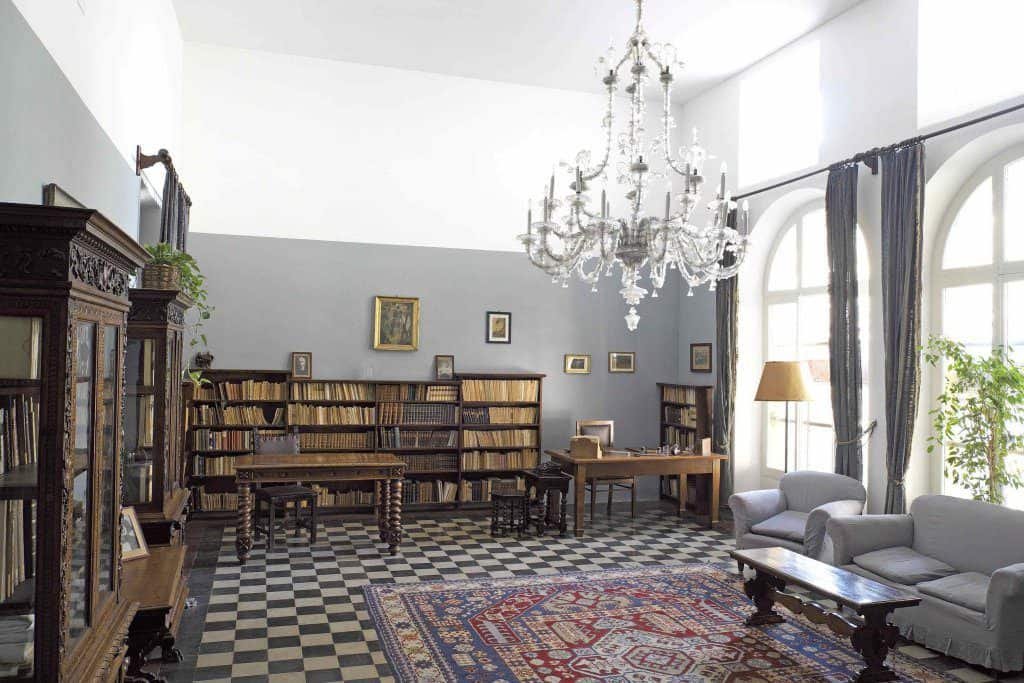
What the Studio Pirandello - Luigi Pirandello House Museum really is
It's best to clear up right away a misunderstanding that sends quite a few visitors off course. This is not a house museum in the sense in which the great aristocratic residences turned into exhibition routes are, with ticket office, bookshop and uniformed custodians. It's a three-room apartment inside a villino owned by the State that also houses public offices, and its reason for being is twofold: on one side the preservation of the places in which Pirandello lived the last three and a half years of his life, on the other the daily work of a research institute that keeps archives, catalogs papers, digitizes photographs and publishes studies. Whoever enters here enters a study center that accepts visitors, not a museum that also hosts a library. The difference is felt as soon as you cross the threshold, and it's the main reason it's worth coming.
The collection was not built by a curator. It is what was in the house on December 10, 1936, the day Pirandello died in the bedroom that can still be visited today. The furniture is his, bought partly in 1910 and partly at the time of the 1933 move. The books are his, with his pencil annotations. The paintings on the walls are largely the work of his son Fausto, a painter of the Roman School. The clothes in the wardrobe are those he wore. No philological reconstruction, no staging: a house left where it was, by a commitment made to the State by the heirs in 1942 and not always honored with the care it deserved.
The villino on Via Antonio Bosio: the building and its history
The building is a villino built around the 1910s, in that stretch of Nomentano that urbanized rapidly between 1907 and 1925, when the city began to eat up the lands of the Torlonia vineyard and the ecclesiastical properties along Via Nomentana. Architecturally it has nothing memorable, and anyone arriving expecting the flowery Liberty style of the nearby Casina delle Civette will be disappointed: it is a three-story bourgeois building, light plaster, garden in front, narrow stairs. Pirandello himself, who had changed many houses, did not choose it for beauty but for practicality and price.
The Pirandello family had already lived in this villino in the years between 1913 and 1918, when the writer taught at the Magistero and the three children were still kids. Then there were other Roman addresses, among them Via Alessandro Torlonia, in the same quadrant. In 1933 Pirandello came back here, and this time alone: he took the top-floor apartment, while on the floor below lived his son Stefano with his own family and in the room next to his apartment lodged Francesco Armellini, the driver and factotum who also acted as his secretary for practical matters. A domestic arrangement that says a lot about his old age: close to his children, but with a door to close.
The story of the building after the writer's death is the part visitors know least and the one that explains why the house still exists. The children took over the lease, and for two years nothing happened. Then, on November 10, 1938, the whole villino was bought by the State and earmarked as the seat of the Central Metric Office: the Ministry of Corporations ordered immediate vacating. The heirs found themselves facing a stark choice, and resolved it with a proposal we would call today a cultural barter: donate to the State everything contained in the Studio, furniture, paintings, books, manuscripts and personal objects, on condition that the State hand the premises over to the Ministry of National Education with the commitment to keep them exactly as they were found. The deed was signed on December 28, 1942, in the middle of the war, while Rome was beginning to know air-raid alarms.
The commitment was formally kept, the maintenance wasn't. For almost 20 years the house stayed closed and slowly deteriorated, with damp working on the bindings and woodworm on the furniture. It took the 25th anniversary of the death and a pressure campaign led by the writer's children together with a group of intellectuals for the Ministry of Public Education in 1961 to entrust the custody of the Studio to the Institute of Pirandellian Studies and Contemporary Theater, established that same year. Since then the house has been open, looked after and studied.
How to get to the Studio Pirandello - Luigi Pirandello House Museum
By metro
Line B serves the area with two nearly equidistant stations. From Policlinico you go up Viale Regina Elena and then Viale Regina Margherita to the intersection with Via Nomentana: a good 10 minutes, all flat, without a single complicated crossing. From Bologna you go down Viale delle Province or cut through Via Michele di Lando and Via Alessandro Torlonia: same duration, a less straight route but shadier in summer, which in July is not a detail. Anyone arriving from Termini takes less than a quarter of an hour of metro plus the walk.
By tram and bus
Trams 3 and 19 run the length of Viale Regina Margherita and stop at Via Nomentana. From that stop you go up Via Nomentana toward Villa Torlonia and turn into Via Antonio Bosio: five or six minutes. The 19 is the longest line of the Roman tram network and links Piazza del Risorgimento, that is, the Vatican, with the eastern periphery: anyone planning a morning at the Vatican Museums and a Pirandello afternoon can make the whole transfer without changing vehicles, and it takes less than they fear. The surface lines that go up Via Nomentana let you off in front of the entrances of Villa Torlonia.
On foot and by car
Anyone staying between Piazza Bologna, the Policlinico and the Trieste district arrives on foot in a quarter of an hour. From the historic center the walk is long but lovely if you go by Porta Pia and continue along Via Nomentana: a full 40 minutes, with the facades of early-20th-century villini as a backdrop. By car it's another matter: Via Antonio Bosio is a narrow residential street, parking is on blue lines and for much of the day simply isn't there. The practical advice is to leave the car and take the metro.
Hours, booking and tickets for the Studio Pirandello - Luigi Pirandello House Museum
The Institute keeps research-center hours, not museum hours: Monday to Friday from 10 to 17, extended on Tuesday until 19, closed Saturday, Sunday and holidays. These hours apply equally to the visit to the house and to consultation of the archives and library, and are a serious constraint for anyone coming to Rome for a weekend: here you can't get in on Saturday or Sunday. In the central weeks of summer public opening is suspended, and for this year the official site indicates the period between July 23 and August 21.
Booking is not a suggestion, it's the condition of access. You write to posta@studiodiluigipirandello.it saying how many of you there are and on which days you could come, and the Institute replies proposing an appointment. Anyone who arrives without having written finds a closed door and nobody to ask. The same holds for consultation of the Archive and the Library, which follow a regulation published by the Institute itself and require declaring in advance what you intend to work on.
On the ticket the position to take is cautious: the Institute doesn't publish a fee, and the question has to be put directly when you agree on the appointment. Bear in mind, if only out of fairness, that you're asking for time from an organization with two employees and a board that works for free. A small contribution, if requested, is the most sensible thing in the world.
Why Pirandello lived in Rome and not in Sicily
The question comes up on every visit, and it deserves an answer that isn't brusque. Pirandello was born on June 28, 1867 in the Caos district, at the gates of Girgenti, into a family of landowners and sulfur traders of Garibaldian tradition. Sicily gave him the raw material of almost all his fiction, the characters of the novellas, the moral landscape of his imaginary towns. But the Sicily of the late 19th century offered a young man with literary ambitions no possible career.
In 1886 he enrolled at the University of Palermo, in November 1887 he moved to the faculty of letters in Rome, and in 1889 he left for Bonn, where on March 21, 1891 he graduated with a thesis on the dialect of Girgenti under the philologist Wendelin Förster. A detail worth keeping in mind when you look at his library: the future Nobel winner for theater was a Romance philologist of German training, someone who had studied the sounds of a Sicilian speech with the tools of historical linguistics. The maniacal precision with which the characters in his plays argue over the meaning of words comes from there.
He returned to Rome and stayed for the rest of his life. In April 1898 he obtained the appointment in aesthetics and stylistics at the Istituto Superiore di Magistero femminile, and held it until 1922: 24 years of lessons, first out of economic need and then out of habit, in front of audiences of female students who would become teachers. It was that salary, not royalties, that supported the family in the difficult years. Rome, for Pirandello, was never a city of conquest: it was the place where you worked, where the magazine offices, the theaters, the publishers and the state competitions were. Sicily stayed inside the pages.
The sulfur mine disaster and the illness of Antonietta Portulano
In January 1894, in Girgenti, Pirandello married Maria Antonietta Portulano, daughter of a business partner of his father. It was an arranged marriage according to the customs of that milieu, but not an unhappy one in the early years: Stefano was born in 1895, Rosalia called Lietta in 1897, Fausto Calogero in 1899. Antonietta's dowry and the family capital were invested in the sulfur mine of Aragona.
In 1903 a flooding and a landslide destroyed the mine. In one blow the wife's dowry and the father's fortune vanished. Antonietta, who was already fragile by temperament, had a collapse from which she never recovered: in the following years her condition worsened into a delirious jealousy that fell on her husband and then on her daughter, and the Pirandello home became a place where reality was daily contested by those living inside it. In 1919 the writer consented to her hospitalization, and Antonietta spent the last 40 years of her life in a Roman clinic on Via Nomentana, where she died in 1959, at 88, 23 years after her husband.
On this point a romanticized version circulates that must be handled with care. One often reads that The Late Mattia Pascal was written in the nights of vigil beside his ailing wife: it is a fascinating biographical tradition with no documentary support, and it should be told for what it is. What can be said on firm ground is something else, and in our judgment more interesting: the daily experience of a loved person who sees a world different from the one others see, and who firmly believes in that world, precedes and feeds Pirandello's whole reflection on truth as a subjective construction. It's not the source of a novel. It's the school of an entire body of work.
The visit to the Studio Pirandello - Luigi Pirandello House Museum, room by room
The apartment is made up of a large living room-study, a bedroom and a terrace. Three rooms, no more: anyone arriving thinking of a museum route of an hour and a half has to recalibrate expectations. The visit is shorter, but dense, and its quality depends almost entirely on who accompanies you: here you enter with a person from the Institute who opens the rooms and tells the story, and the difference between a mediocre visit and a memorable one is made by the conversation.
The living room-study of the Luigi Pirandello House Museum
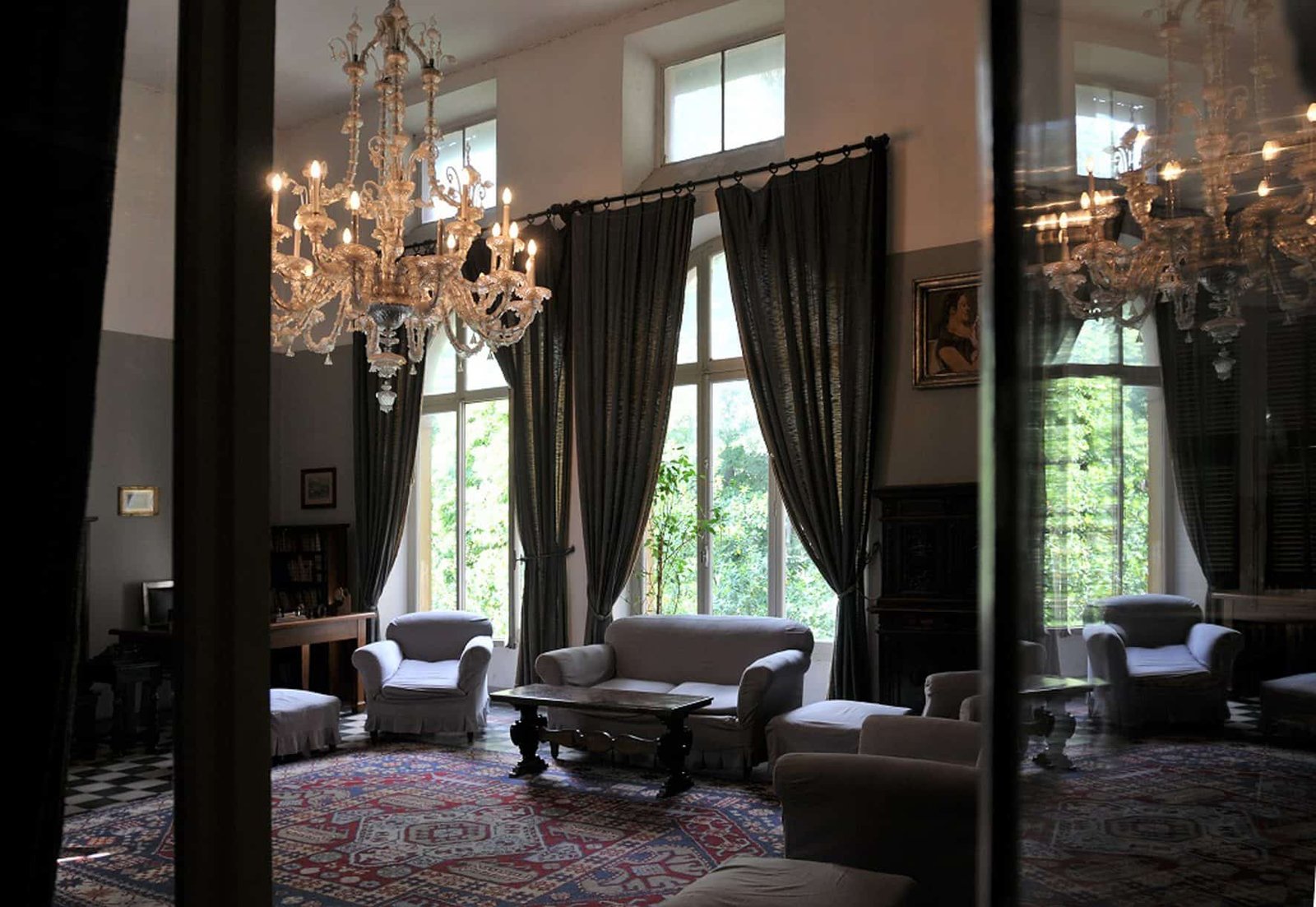
It's the room in which Pirandello worked, read, received visitors. It has a wall of large windows that fill it with light until early afternoon, and this explains why in period photographs he is almost always seen seated in that corner. The furnishings are those brought here in 1933 and reflect two different moments of the writer's taste: pieces in Florentine style bought around 1910, and furniture of rationalist line bought in the following years. The coexistence of the two registers, the somewhat pompous neo-Renaissance and the essential modern, is not as discordant as one might fear: it speaks of a man who carried his furniture with him and added what he needed.
The desk, the bookcases and the savonarola chairs
In the room are a desk, two glass-fronted bookcases, two savonarola chairs, a large sofa, armchairs, a second desk and shelving. The main desk is the point around which the visit revolves, and it deserves close attention: it's not a monumental piece of furniture, it's a work surface. The two glass-fronted bookcases hold the volumes in the order in which he kept them, which is a functional order, not an alphabetical one. The savonarola chairs, those X-shaped folding seats with a carved back that in the early 20th century were the obligatory furnishing of every Italian man of letters' study, today are almost touching: they were the way the cultured bourgeoisie dressed up as the Renaissance.
Pirandello's typewriter
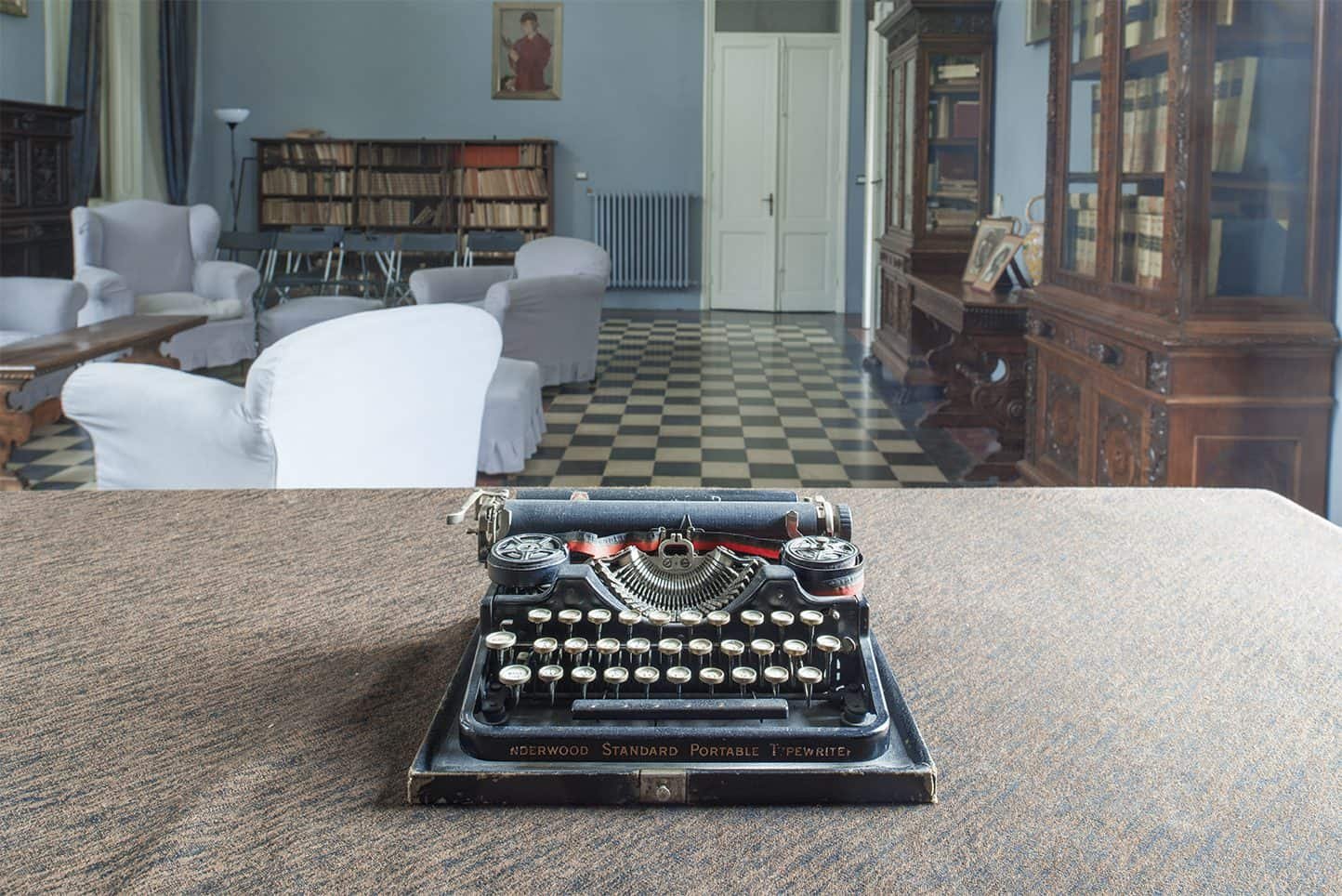
The small portable you see in the Studio is the most photographed object in the house, and has a precise documentary value: Pirandello really used it, it was not an ornament. Anyone who knows his manuscripts knows he worked a lot by hand, with a small, nervous handwriting, and that the machine came in at a second stage, that of fine-tuning. Look at it thinking about working times: in the years between 1922 and 1936 this man wrote dozens of theatrical texts, corrected proofs, kept up a vast correspondence and traveled half the world with a company.
The personal library: about 2,000 volumes
The library of Luigi Pirandello kept in the Studio includes roughly 2,000 volumes that belonged to the writer. It's not a collector's library: it's a working library, and you can tell. There are dictionaries and encyclopedias, and among them heavyweight pieces like the 1717 Vocabolario degli Accademici della Crusca and the Dizionario della lingua italiana by Niccolò Tommaseo and Bernardo Bellini, tools of a professional philologist. There are volumes annotated and marked in his own hand, which are the most precious part for scholars because they show the way he read. There are inscribed books, sent by the authors: among the names documented by the Institute are Italo Svevo, Sibilla Aleramo, Massimo Bontempelli, André Gide and Albert Einstein. There are translations of his works in the most diverse languages, arrived in an avalanche after 1922. And there are period magazines, from the 1910s to the 1930s, with titles that tell a whole cultural system: Cinema, Il Dramma, Pègaso, Scenario.
The paintings of the Studio Pirandello and Fausto's painting
Among the paintings hanging on the walls of the Studio are four works by his son Fausto Pirandello, who was one of the most solid painters of the Roman School and who had a complicated relationship with his father, made of admiration and impatience with the long shadow of that surname. The Institute's collection documents an oil on panel titled Bagnanti, dated 1929: anyone who knows Fausto's painting knows that the heavy bodies, dense matter and earthy colors of his bathers are the exact opposite of the Novecento grace that was in fashion in those years. Seeing that painting in his father's house, and not in a gallery, changes the way you read it.
The bedroom and personal objects
The bedroom is furnished with essential lines and opens onto the terrace. Kept there are his clothes, hats, walking stick and the uniform of the Royal Academy of Italy, that is, the bicorne and the embroidery due to the academicians appointed by the regime. It's the room in which Pirandello died on December 10, 1936. In the drawers even the medicines remain. An unpopular judgment: it's the most unsettling room in the whole house, and precisely for this reason it's best not to cross it quickly. The academic uniform hung a few steps from the bed in which he died is, without anyone having designed it that way, the most honest visual synthesis of his last season.
The terrace
The terrace completes the apartment and looks out over the neighborhood. It's not a viewpoint and promises no panoramas: it serves to understand what Pirandello saw when he raised his eyes from the page, that is, roofs, antennas, trees of a Roman garden and the profile of pines. Anyone who has read The Giants of the Mountain will find it interesting to imagine the unfinished last act written with that view in front of them.
The archives of the Studio Pirandello - Luigi Pirandello House Museum
The part that distracted visitors don't see is the one that makes this address important for Italian culture. In the same apartment, and in the Institute's premises, are kept archival holdings declared of notable historical interest by the Archival Superintendency for Lazio and subject to the protection provided by the sector's legislation. It's not decorative material: it's the documentation on which critical editions are made.
The Luigi Pirandello Archive
It includes autograph manuscripts, among them those of Henry IV and of 'U Ciclopu, the Sicilian translation of Euripides' Cyclops that Pirandello made for Angelo Musco, and then letters exchanged with the personalities of the time, corrected proofs, notes and fragments. The archive has been recently reorganized and has an updated inventory. For anyone who studies 20th-century theater, the chance to see the corrections on a proof of Henry IV is worth the trip on its own.
The photographic and iconographic archive
Hundreds of documents among positives and negatives, originals and reproductions: portraits of the writer, photographs with family members, stage images, company materials. About 1,000 negatives have undergone conservation restoration and been rehoused in acid-free cardboard sleeves. In this holding is also the photograph of the 1926 duel between Massimo Bontempelli and Giuseppe Ungaretti in the garden of the Pirandello house, which is probably the most curious document of the whole collection.
The Marta Abba Archive
Donated to the Institute in two stages, in 2016 with a core of letters from the years between 1926 and 1936, and in 2018 with documents, photographs and scripts. In 2018 the Superintendency declared it of particularly important historical interest. It is the holding that allows close study of the relationship between Pirandello and the actress who was his last reason to work, and it should be kept together with the other side of the correspondence, that of Pirandello's letters to her, which ended up at Princeton University and was published in full only in the 1990s.
The other holdings kept
The Institute also holds the Ugo Betti Archive, with autograph manuscripts of theatrical, narrative and poetic works, notes, drafts, sketches, film subjects and correspondence: Betti, a magistrate and playwright, was one of the most original voices of 20th-century Italian theater and his critical fortune depends in large part on these papers. There is then the Alessandro d'Amico Archive, donated in 2012, of one of the greatest Pirandello editors. There is the collection of Franca Angelini, scholar and professor, with archive and library donated in 2015 and declared of notable interest in 2019. And there is the Lucio d'Ambra Archive, arrived in July 2024 and already declared of particularly important historical interest in 2022. Five archives of different people inside the house of a sixth: over the years the Institute has built a small preservation system for contemporary Italian theater.
The study library and the catalog
Alongside Pirandello's books, over the years the Institute has put together a specialized library of critical studies on his work and his biography, which is the working tool of those who come to do research. The catalog of this library can be consulted online through the library service of the Lazio Region. For consultation on site the same hours as the offices apply and the same obligation of appointment.
The digital collection and the audio library
From 2010, with the contribution of a banking foundation and with later tranches in 2012 and 2017, the Institute started and continued the digitization of its holdings. The result can be consulted remotely and includes sections devoted to theatrical manuscripts, the photographic archive, inscribed volumes, annotated and marked volumes, author covers, documentation on the Nobel Prize and relations with the Royal Academy of Italy. There is also a section devoted to Dantean traces in the library and archives, which is the kind of research that can be done only on a collection that has remained intact. A practical tip for those coming from afar: take a look at the digital collection before coming, so you'll know what to ask for once here.
Pirandello the novelist: The Late Mattia Pascal and One, No One and 100,000
The Late Mattia Pascal, 1904
It came out in installments in the Nuova Antologia in 1904 and in the same year was published as a book. It's the novel that made Pirandello a recognizable writer, and is still today his most read book. Almost everyone knows the plot: Mattia Pascal, an ordinary man of an imaginary town, runs away after an unbearable married life, wins at the Monte Carlo casino, discovers from the newspapers that he has been declared dead because a corpse found in the mill pond was identified as his, and decides to be reborn under another name, Adriano Meis. Absolute freedom lasts little: without papers you can't report a theft, you can't marry, you can't exist. He returns home, finds his wife remarried to his friend Pomino, and chooses to remain what he now is, the late Mattia Pascal, librarian of a collection of books nobody consults.
What few notice is how Roman the novel is in its central part: Adriano Meis lives in Rome, in a boarding house, among spiritualists and small bourgeois, and the city works as the perfect place where a man without an identity can vanish among other people's identities. Pirandello wrote about Rome because he lived there, and he knew it the way those who use it know it: trams, offices, rents, doorkeepers' lodges.
One, No One and 100,000, 1925 and 1926
The novel that Pirandello considered the complete synthesis of everything he had done had a very long gestation: the first traces go back to at least 1909, serial publication began in December 1925 in the Fiera Letteraria, and the book edition came in 1926. Vitangelo Moscarda, a 30-year-old who lives off bank income, discovers from a remark by his wife that his nose tilts to the right. From that detail a systematic demolition begins: if my body is not what I believe, then neither am I what I believe, and each of those who know me has a different Moscarda in his head. One, no one, 100,000. The ending, with Moscarda liquidating the bank, donating his goods and ending up living in a hospice founded by himself, cured of his name, is one of the most radical pages of 20th-century Italian prose.
He called it the bitterest of his novels, profoundly humoristic, one of the decomposition of life. Anyone who wants to understand what he meant by humor should read the 1908 essay, On Humor, where the distinction between the perception of the opposite and the feeling of the opposite explains half of the century's European theater.
Six Characters in Search of an Author and the fiasco at the Teatro Valle
On the evening of May 9, 1921, at the Teatro Valle in Rome, the first performance of Six Characters in Search of an Author took place. It was a resounding disaster. The audience didn't understand, or understood perfectly and took offense: an empty stage, a company rehearsing, six figures entering from the stalls claiming to be characters rejected by an author and demanding to be performed. No scenery, no story told the proper way, no fourth wall. Between detractors and admirers there was a risk of physical clash, and the writer left the theater accompanied by his daughter while the shouting continued in the street.
What is rarely told is the speed of the reversal. Four and a half months later, on September 27, 1921, the same text was staged at the Teatro Manzoni in Milan and was a triumph. From there Pirandello's international career took off: London, New York, Paris, Berlin. In 1925 the author reworked the text and added a preface that is still one of the most lucid reflections ever written by a playwright on his own trade.
On the Teatro Valle a clarification is needed, because it's a frequent question: the hall on Via del Teatro Valle and the house on Via Antonio Bosio belong to two different seasons of Pirandello's life, and in 1921 the writer did not live here. This house is that of the last three years, those of the Nobel and of death. Anyone looking for the places of the Six Characters must look in the center.
The Teatro d'Arte di Roma and Marta Abba
In 1924 a group of young intellectuals, among them Stefano Pirandello, proposed to his father that he put himself at the head of a permanent company. This is how the Teatro d'Arte di Roma was born, based in a hall carved out of the basements of Palazzo Odescalchi, in Piazza Santi Apostoli. The opening was on April 2, 1925, with a double bill: Sagra del Signore della Nave by Pirandello and The Gods of the Mountain by Lord Dunsany. Pirandello was artistic director and actor-manager, that is, he also took on the business risk.
It was a splendid and ruinous experience. The renovation costs of the hall doubled compared to forecasts, and the hall itself had only 348 seats, a number that did not allow breaking even even with a sellout. Critics were lukewarm. The subsidies promised by the regime never arrived in full. The company kept itself afloat with tours: the European capitals, Brazil, Argentina, the Italian towns. It dissolved on August 15, 1928 in Viareggio, with a performance of Ibsen's The Lady from the Sea. After that the core continued as the Compagnia Pirandello. In October of the same year Pirandello left Italy for Berlin, together with Marta Abba.
Marta Abba, from Milan, born in 1900, was hired in 1925 after a review by Marco Praga had pointed out her stage qualities. She became the company's leading lady and the recipient of a series of texts written for her: Diana and Tuda, The Wives' Friend, To Find Oneself, As You Desire Me. Between 1926 and 1936 Pirandello wrote her about 500 letters, a corpus that is at once a literary document and the self-portrait of a man of 60 in love and aware of the ridiculous. She moved to the United States after her marriage in 1938, kept acting until 1952 and died in Milan in 1988, the day before turning 88. Part of the papers concerning her is now kept in this very house.
The 1934 Nobel Prize received in this house
On November 9, 1934 the Swedish Academy announced the award of the Nobel Prize for Literature to Luigi Pirandello, with a citation that pointed to his bold and ingenious renewal of dramatic and scenic art. The telegram from the permanent secretary Per Hallström reached the writer in Rome, in this apartment: it's the main reason Via Antonio Bosio appears in every Pirandello chronology. The ceremony was held in Stockholm on December 10, 1934.
At the official banquet Pirandello spoke in French, and said something worth reporting for the way it overturned expectation: he claimed to have been formed in the school of life and not in that of the academy, and to have become for this reason wholly unfit for living, capable only of thinking and feeling. He attributed his own work to bitter disappointments, painful experiences and wounds, and made it depend on human sincerity more than on technical skill. A speech that, read today, seems the preventive defense of a man who knew how little he had left to live.
There is a coincidence that in the biography of a master of the absurd sounds like a joke built on purpose: the Stockholm ceremony fell on December 10, 1934, and Pirandello died on December 10, 1936. Same day, exactly two years later.
Pirandello and Fascism, no sugarcoating and no trial
On this chapter two opposite legends have been built, and both are false. The first says Pirandello was a convinced fascist and that the regime showered him with deserved honors. The second says he joined only out of opportunism and that basically he had nothing to do with it. The documents tell a story more uncomfortable than both.
In September 1924, while Italy was still shaken by the kidnapping and murder of Giacomo Matteotti and the regime was wobbling, Pirandello wrote to Mussolini asking to be enrolled in the National Fascist Party. The text of the telegram declared a faith always nurtured and served in silence. The moment chosen was not random and he himself presented it as a stand against the current: to join when joining cost something, not when it was convenient. Let it be clear what this means: one of the most celebrated writers in Europe sided publicly with the government at the moment when that government was under accusation for the murder of an opposition deputy. It's not a detail that can be softened.
From that moment relations were ambiguous and never comfortable. The regime denied him for years the subsidies promised to the Teatro d'Arte, and the company died also because of that. In 1927, according to a testimony reported by several biographers and which must be taken for what it is, that is, a testimony and not an archival document, Pirandello tore up his party card in front of the general secretary at the climax of an argument. In 1929 he was appointed Academician of Italy, and the uniform you see in the bedroom comes from that appointment. The political police kept watching him.
In 1935, after the aggression against Ethiopia and the League of Nations sanctions, the regime launched the gold-to-the-fatherland campaign: Italians handed wedding rings and precious objects over to the State. Pirandello handed over the medal of the Nobel Prize. It's the gesture that more than any other complicates the portrait, and it's also the reason why in this house the Nobel diploma is kept but not the medal. That metal ended up in the crucible together with the wedding rings of millions of people.
What does today's visitor do with this? Neither a trial nor an acquittal. You hold together the greatness of the work and the wretchedness of a political choice, without mistaking one for the other and without using the first to wash the second. The Giants of the Mountain, the work left unfinished on the table, is among other things the text in which the conflict between poetry and the power that despises it becomes explicit. Anyone looking in Pirandello for a singer of the regime goes away empty-handed. So does anyone looking for an opponent.
December 10, 1936: death in the house on Via Antonio Bosio
In the last days of November 1936 Pirandello was following at Cinecittà the shooting of a film based on The Late Mattia Pascal, the French version directed by Pierre Chenal that would come out the following year. The studios were new, enormous and freezing. He came back with a cold that degenerated into bronchopneumonia. He was 69 and had a heart already strained.
He died on the morning of December 10, 1936 in the bedroom of this house, with very few people around. The regime offered a state funeral: the family refused it, because there was a will, written in 1911, that left no room for interpretation. It's worth reading its words, because they are among the driest ever dictated by an Italian writer: a hearse of the lowest class, the poor people's, bare, and nobody to accompany it, neither relatives nor friends. The hearse, the horse, the coachman and that's all. And then the order to burn the body and let the ashes be scattered.
The wish was respected only by half, and the story that followed is Pirandellian. The body was cremated, but scattering of the ashes was forbidden by law and opposed by the Church: the urn ended up in the Verano cemetery and stayed there 11 years. In 1947 the city of Agrigento demanded its return. For the transport an American military plane was made available, and during that trip episodes happened that no author would have dared to invent, from the Sicilian passengers who refused to fly together with the box out of superstition to the continuation by train, where unaware travelers used the trunk as a card table. In Agrigento the bishop refused to bless a Greek vase, and the ashes were moved into a small white coffin. The final placement came only in 1962, under the pine of the Caos district, and on that occasion too part of the contents ended up scattered by the wind toward the sea. The most involuntary and most exact way of fulfilling the last line of the will.
A curiosity about the Studio Pirandello - Luigi Pirandello House Museum
The street where Pirandello chose to die bears the name of a man who had spent his life going underground to look for other people's dead. Antonio Bosio, born in Malta in 1575 and died in Rome on September 6, 1629, was the first systematic explorer of the Roman catacombs: he entered the catacomb of Domitilla for the first time on December 10, 1593 with his friend Pompeo Ugonio, and in the following 36 years identified more than 30, taking along draftsmen to document frescoes and sarcophagi. His Underground Rome came out posthumously in 1632 and founded Christian archaeology as a discipline. Giovanni Battista de Rossi, who was the great 19th-century systematizer of that discipline, called him the Christopher Columbus of underground Rome.
The street naming of this stretch of Nomentano isn't random: the streets between Villa Torlonia and Viale XXI Aprile were named after archaeologists and historians of the Roman Campagna, and so beside Via Antonio Bosio run Via Giovanni Battista de Rossi and Via Marcantonio Boldetti, that is, the names of the three men who pulled the catacombs out of the dark. It's chance, of course. But it's the kind of chance Pirandello would have loved: the author who built a whole body of work on the idea that identity is a mask imposed by others spent his last years on a street named for someone who had brought erased names back to light, and died there on December 10, the same day of the month on which Bosio, three and a half centuries earlier, had first gone underground.
There is a second curiosity, less literary and more concrete, that concerns the books. Among the materials digitized by the Institute is a section devoted to author covers: woodcuts and paintings done by Pirandello on the covers of some volumes of his library. Pirandello painted, and not as a game. His son Fausto became a painter in a domestic environment where colors were at home. Some of those volumes with painted covers have undergone conservation restoration with public funding, which means that today the Italian State officially protects the hand-painted bindings of a Nobel Prize winner in literature. If you're looking for a detail to tell at dinner after the visit, that is the best I've found.
One thing nobody tells you about the Studio Pirandello - Luigi Pirandello House Museum
In the display cases of this house the Nobel Prize diploma is there. The medal is not, and not because it was stolen or lent to an exhibition. In 1935 Pirandello handed it over to the gold-to-the-fatherland campaign, the collection with which the regime financed the Ethiopian war in response to international sanctions, and that gold disc of 196 grams followed the fate of everything else: melting. The visitor who enters expecting the case with the medal comes out with a history lesson that no explanatory panel would have given him better. Whoever guides the visit, if you ask, will tell you without reticence, and that is also why the Institute is a serious place.
The second thing no one will tell you concerns a story everyone repeats. You'll happen to read everywhere that The Late Mattia Pascal was born in the nights spent watching over the ailing wife, as if the novel were the coded diary of a domestic tragedy. It's a biographical tradition with no documentary support, probably born to give a novelistic origin to a novel about identity. The truth is less moving and more interesting: Antonietta Portulano's illness did not produce a book, it produced a method. Living for years beside a person who sees a different world and firmly believes in it teaches, better than any philosophy, that reality is what each person builds. From there comes Right You Are (If You Think So), from there comes One, No One and 100,000, from there comes the whole dramaturgy of plural truth.
Third thing, practical and equally little known: this address isn't only a house museum, it's a cultural institute registered in the register of the Lazio Region since 2008 and recognized as a legal entity since 1998, with a board that serves for free and only two employees to deal materially with archives, library, digitization and visits. When you book a visit you're not buying a service: you're asking a tiny organization to devote an hour of its working time to you. Showing up on time, giving notice in case of cancellation and having read something before arriving are not courtesies, they are the minimum.
The advice I give you for visiting the Studio Pirandello - Luigi Pirandello House Museum
The main advice is to come on a Tuesday. It's the only day on which the schedule extends until 19, and late afternoon is the best moment for two reasons: the light that comes in through the large windows of the living room-study at that hour is low and warm, and the people at the Institute have finished the heaviest part of the office work and are more willing to stop and talk. Between one time slot and another the difference is clear.
The second piece of advice concerns preparation. This is not a house that explains itself. Anyone who arrives having read nothing sees three rooms with old furniture and leaves after 20 minutes convinced it wasn't worth it. Anyone who arrives having read even just The Late Mattia Pascal and the 1925 preface to Six Characters sees something quite different. If you have little time to prepare, read the preface: it's 20 pages and it puts in your hands the key to everything else. Alternatively, look first at the Institute's digital collection and arrive with two or three precise questions about a manuscript or a photograph. Precise questions unlock stories that no standard visit would give you.
Third piece of advice: don't come here as the only destination of the day. The visit is short and the area offers others within walking distance. Build an afternoon that combines this house and the museums of Villa Torlonia, which are five minutes away: the Casina delle Civette with its stained-glass windows and the Casino Nobile tell the same Rome of the years in which Pirandello lived here, seen from the side of power rather than that of writing. The contrast between the three-room home of a Nobel winner and the villa the regime put at the head of government's disposal is the best history lesson you can have in this neighborhood.
Fourth and last: write to book well ahead, at least 10 days, and propose several alternative dates. The Institute works with office hours and with two people. A flexible request gets an answer much more easily than a rigid one. And if your trip to Rome falls on a weekend, bear in mind that you can't get in here: consider shifting a day or give up, but don't show up hoping for an exception.
Another well-known fact, yet rarely mentioned
That this is Pirandello's last home everyone knows. That it's owned by the State and that public offices have been and are in the same villino, far fewer. Yet it's the fact that explains the very form of the museum: the apartment was saved because in 1938 the State bought the building to make it the seat of the Central Metric Office and ordered the vacating, and the heirs replied by offering as a gift everything that was inside in order to obtain in return the preservation restriction. Without that eviction order, in all likelihood the furniture would have been divided among the children and the house rented to anyone, and today on Via Antonio Bosio there would be a plaque and nothing else.
The sequel is less edifying and must be told all the same. The deed of December 28, 1942 was formally respected but not accompanied by any maintenance plan: for almost 20 years the house stayed closed and deteriorated. Only in 1961, on the 25th anniversary of the death, and only after a new solicitation by the writer's children and a group of intellectuals, did the Ministry of Public Education entrust custody to an institute specially constituted. Between the donation and effective protection 19 years passed. It's an exemplary Italian story, and it should be told in full instead of limiting oneself to the moving part.
There is then a second well-known fact almost nobody cites: the Institute that runs the house wasn't born to run a house. It was born in 1961 on the initiative of Umberto Bosco, Dante scholar and future director of the Enciclopedia Dantesca, and on the wave of an international congress of Pirandello studies. The first board brought together scholars and theater people, from Franca Angelini to Alessandro d'Amico, from Diego Fabbri to Paolo Grassi, from Rossella Falk to Renzo Ricci, from Luigi Squarzina to Bonaventura Tecchi. The statutory purpose, formulated then and never changed, speaks of promoting research and studies on the life and work of Pirandello and on contemporary theater. The founding act of 1961 was renewed and perfected on July 26, 1979, and recognition of legal personality came with a ministerial decree of December 4, 1997, published in the Gazzetta Ufficiale on February 12, 1998. The house museum, in all this, is the consequence of a research project, not its purpose.
The right photo to take at the Studio Pirandello - Luigi Pirandello House Museum
Always ask first if you can photograph: there is no regulation posted at the entrance here as in civic museums, and the answer depends on the room and on what you have in your hands. That said, the photograph worth taking away from this house is only one, and it's not the typewriter.
The typewriter is the image everyone takes, and it's also the one that circulates online: small, portable, resting on the surface, perfect for a frontal shot. It's a good photograph and you'll take it anyway. But it's a portrait of an object, and says little. The right photograph is the one that holds the desk and the window together: you stand to the side, with the windows of the living room-study on the right and the work surface in the foreground, and you let the light enter the frame instead of fighting it. What comes out is not the photo of a piece of furniture, it's the photo of a point of view: exactly what a man raising his head from the page had before his eyes.
If you have a camera that lets you work on shutter speeds, try a long exposure without flash, resting the camera on a stable surface. The rooms are bright but not brazen, and flash flattens everything, ruins the colors of Fausto's paintings and annoys whoever is accompanying you. If you only have a phone, raise the exposure slightly and step back one pace: the temptation to fill the frame with the object is the ruin of every interior photograph.
A recommendation that counts as a firm opinion: in the bedroom, if they let you photograph, don't photograph the bed. It's the easiest framing and the most insipid, and it has something voyeuristic that adds nothing. Photograph instead the uniform of the Royal Academy of Italy, hanging. That garment, in this house, contains a whole story: the honor received from a regime, the 1929 appointment, the Nobel medal that ended in the foundry six years later. A photograph that makes you think is worth 10 photographs that document.
Outside, before leaving, go around the corner and take a shot of the street sign. Via Antonio Bosio, with the name of the explorer of the catacombs, under the house number of Pirandello's house: it's the photograph that closes the story and that nobody ever thinks of taking.
A few important events that happened here in history
The first, in order of sensation, is the duel. In 1926 Giuseppe Ungaretti and Massimo Bontempelli fought with swords in the garden of the Pirandello house, and the photograph of that duel is kept in the Institute's photographic archive. At the origin was a literary polemic degenerated into a slap given in public. Sword duels were by then banned but tolerated provided they were conducted with discretion, and the formula was first blood, that is, whoever wounded first won. The two reconciled. That two of the greatest Italian writers of the 20th century faced each other with weapons in hand in the garden of a third, and that the third was the future Nobel winner, is the kind of episode that seems invented for a novel and is instead documented by a plate.
The second event is the telegram of November 1934. In this house, in these rooms, the communication from the Swedish Academy arrived. Try to imagine the scene without rhetoric: a 67-year-old man, alone in a top-floor apartment of a suburban villino, with his son on the floor below and the driver in the next room, who opens a telegram and discovers he has won the Nobel. No crowd, no ceremony. The ceremony would come in Stockholm a month later, on December 10.
The third is the death, on December 10, 1936, in the bedroom that can be visited. With it the refusal of the state funeral offered by the regime and the carrying out of the 1911 will: the lowest-class hearse, no accompaniment, cremation. It was the most radical public gesture of his life, and he made it dead.
The fourth event has nothing novelistic about it and weighs more than all: on November 10, 1938 the State bought the villino to make it the seat of the Central Metric Office and the Ministry of Corporations ordered the vacating. It was that bureaucratic order that provoked the donation of December 28, 1942 and therefore the birth, tortuous and late, of this house museum. The preservation of Pirandello's memory in Rome stems from an expropriation procedure.
The fifth is 1961: on the 25th anniversary of the death custody of the Studio passes to the Institute of Pirandellian Studies and Contemporary Theater, just constituted. From that moment the house stops being a closed depot and becomes a place of study. The sixth, much more recent and just as important, is the season of restorations and digitizations: from 2010 onward, with the support of private foundations, volumes, documents and about 1,000 photographic negatives have been restored, and the digital collection has been built that today allows a scholar in Buenos Aires to read a Pirandello marginal note without climbing these stairs.
Who has passed through the Studio Pirandello - Luigi Pirandello House Museum
Let's start with the family, because in this house they were part of the daily landscape. Stefano Pirandello, the firstborn, lived downstairs with his own family: a writer and playwright in his own right, he long signed with the pseudonym Stefano Landi so as not to weigh on his father's surname, and it was he who in 1924 proposed that he put himself at the head of the Teatro d'Arte. Fausto Pirandello, the second son, came up here with his paintings: four of his works hang on the walls of the Studio, and the collection documents an oil on panel from 1929. Lietta, the daughter, had been at the center of her mother's jealous delusion and lived for a long time away from Italy. And there was Francesco Armellini, the driver and factotum, who occupied the next room and who was one of the few constant presences of the last years.
Then there are the guests. The living room-study was a conversation room, and family and personalities of the culture of the time passed through it. Among the recurring names in the Institute's documentation is Lucio d'Ambra, writer, journalist and film director, whose archive arrived in this house in 2024, closing a circle after almost a century. There is Eduardo De Filippo, who had a relationship of work and admiration with Pirandello and who translated Cap and Bells into Neapolitan. There is Marta Abba, leading lady of the Teatro d'Arte and recipient of the roughly 500 letters written between 1926 and 1936.
In the garden, in 1926, passed Giuseppe Ungaretti and Massimo Bontempelli, and they passed with a sword in hand. Bontempelli, theorist of magic realism and director of the magazine 900, was at the time one of the most influential intellectuals in Italy. Ungaretti came from the experience of the front and from The Buried Harbor. The reconciliation was immediate, the friendship survived.
After 1961 the house changed the kind of visitor, but didn't stop receiving them. The scholars who made Pirandello's critical fortune in the second half of the 20th century passed through: Umberto Bosco, who founded the Institute. Alessandro d'Amico, editor of the major editions, whose personal archive has been here since 2012. Franca Angelini, who taught Italian literature at Sapienza and whose collection arrived in 2015. Every year doctoral students, directors looking for a reading, translators who come to check a variant on an autograph pass through. It's a house that has kept working after the death of its master, which, for the author of Six Characters in Search of an Author, seems almost an ending written on purpose.
What Pirandello wrote in the years on Via Antonio Bosio
The last three years weren't a retreat. Between 1933 and 1936 Pirandello kept working at full pace: he revised texts for the definitive editions, followed the translations coming out around half the world, kept up a dense correspondence and wrote. The Stories for a Year, the great project of 365 stories, one for each day, remained unfinished but occupied his desk to the end: the collection stopped at around 240 novellas, and is now the reservoir from which Italian cinema has drawn for decades, from the Taviani brothers onward.
The most important construction site of those years, however, was The Giants of the Mountain, the unfinished theatrical myth, whose last part was never put in writing. Family tradition has it that the author had dictated or told the ending to his son Stefano in the last hours, and that this ending revolved around the image of a tree: a tradition that has to be reported as such, because the written text breaks off before. What remains is in any case one of the most visionary works of 20th-century European theater, in which a poor and stubborn company of actors brings poetry to an audience of giants who don't want it. Writing it in this house, in the years of the academic uniform hanging in the bedroom, says much more than any political declaration.
Theater in Sicilian and Pirandello's language
One chapter that always gets overlooked, and which has a material trace in this house, is his output in dialect. Between 1916 and 1920 Pirandello wrote or rewrote in Sicilian a series of texts for Angelo Musco and for Nino Martoglio's company, and he translated Euripides' Cyclops into Sicilian under the title 'U Ciclopu, whose autograph manuscript is kept in the Institute's archives. It wasn't folklore: it was the work of a philologist who had earned his degree in Bonn with a thesis on the sounds of the speech of Girgenti and who knew perfectly well how much truth lies inside a language that nobody uses for writing. Anyone who visits the house and asks about this aspect almost always gets a more interesting conversation than average.
How much a Pirandello day in Rome costs and how to save
The visit to this house, the way it is organized, doesn't weigh on the budget of a day in Rome: the Institute doesn't publish a fee and access is by appointment. The real cost of the day comes from the other admissions and from transport. A combined ticket for the Villa Torlonia museums lets you see the Casino Nobile and the Casina delle Civette with a single ticket, and the updated fares are on the website of the civic museum system. For transport, a daily pass for the urban network covers metro, tram and bus and pays for itself after just three rides.
The smartest saving, though, isn't about fares but about planning: grouping all the destinations of this quadrant into a single afternoon avoids crossing the city twice. Anyone entitled to reductions, under 18s and European Union citizens in the reduced-fare bracket, has to bring an ID: in the civic museums the check is strict.
How long the visit to Studio Pirandello - Luigi Pirandello House Museum takes
Allow between 40 minutes and an hour. The three rooms can be walked through in barely a quarter of an hour. The rest of the time is made by the storytelling, and the storytelling grows in proportion to the questions you bring. In the same house, with the same guide, a visit can last 20 minutes or an hour and a half: the difference is entirely in the visitor.
Those who come to consult the archive or the library work on a different scale: they take a whole morning, arrive at 10:00 and work until closing, having agreed beforehand on what they intend to see. Tuesday, with the extended hours until 19:00, is the most productive day. Keep in mind that this is archival material subject to regulations: you don't leaf through it, you request it.
If you have to fit the visit into a day in Rome, the model that works best is this: morning at the Villa Torlonia museums, lunch in Piazza Bologna area or along Via Nomentana, early afternoon here, late afternoon on foot toward the Coppedè neighborhood or toward the Catacombs of Sant'Agnese. These are all trips of under 20 minutes on foot or one tram stop.
The Luigi Pirandello House Museum with children and teenagers
I'll be frank: with small children, under 10, this isn't a visit I recommend. There are no interactive stations, no reconstructions, nothing to touch, and the house requires a silence that at that age is torture. Rome has dozens of places better suited, starting with the parks and the science museums.
With high school students, on the other hand, it works very well, and for a precise reason: Pirandello is in the senior-year curriculum, and seeing the desk of an author you are studying has an effect that no lesson achieves. The advice for teachers is not to arrive with the whole class for a generic visit but to build a route around a text: whoever has read Il fu Mattia Pascal looks at the library with different eyes, whoever has read Six Characters understands what an archive of scripts means. The Institute works with schools and organizes educational activities: raise it when booking, well in advance, because places and availability are limited.
With middle schoolers the result depends entirely on how much you're willing to work. If you tell the story of the duel in the garden, the one about the Nobel medal being melted down and the one about the journey of the ashes, you hold their attention effortlessly: they are three stories that work at any age. If you just say that a great writer lived here, you lose them by the second room.
Accessibility of Studio Pirandello - Luigi Pirandello House Museum
The point has to be addressed honestly, because it concerns quite a few people. The apartment is on the top floor of an early 20th-century villino, and a building of that type and that era isn't born accessible. Anyone with mobility difficulties, anyone who uses a wheelchair or anyone accompanying an elderly person must ask when booking what the actual access conditions are: how many flights of stairs, if there is an elevator and how big it is, if alternative solutions exist. This is information the Institute provides, and asking for it beforehand avoids a wasted trip.
Once inside, the spaces are small: three furnished rooms, with narrow passages between original furniture that can't be moved. Large groups feel it too, and that is another reason the visit is arranged in advance. For people with hearing difficulties, the visit is essentially spoken: if you need some kind of support, let them know by email when you book.
For those who can't climb the stairs, there is an option that isn't a second best: the Institute's digital collection makes available manuscripts, photographs, annotated volumes and documentation on the Nobel, which can be consulted from home. It isn't the same as seeing the desk. But it's more than most Italian museums offer.
What to see around Studio Pirandello - Luigi Pirandello House Museum
Villa Torlonia, five minutes on foot
Cross Via Nomentana and you enter Villa Torlonia, the park that was the residence of the Torlonia family and then, from 1925 to 1943, Mussolini's Roman home for a symbolic rent. The complex includes the Casino Nobile, the Casina delle Civette with its extraordinary collection of Liberty-style stained glass, the Moorish Greenhouse and the two obelisks of Villa Torlonia that Alessandro Torlonia had erected in memory of his parents. It is the natural complement to this visit: in the same neighborhood and in the same years, the three-room home of a writer and the villa of the head of government.
The catacombs and underground Rome of the northern quadrant
The place-name theme of the area isn't a whim: a little farther north, along Via Salaria, the Catacombs of Priscilla open up, one of the oldest Christian cemeteries in Rome and one of the richest in painting, and under Via Nomentana runs the Sant'Agnese complex. Anyone who wants to understand why Pirandello's street bears the name of Antonio Bosio should go down into one of these galleries on the same day: the contrast between the darkness of the catacombs and the light of the stained glass in the living room-study is worth the itinerary.
The Coppedè neighborhood and the villini of the Nomentano area
About 10 minutes on foot to the west opens the Coppedè neighborhood, the group of buildings that Gino Coppedè built between 1913 and 1927, mixing medieval, baroque and Liberty in a way that has no equal in Italy. It is exactly contemporary with the villino on Via Antonio Bosio, and it helps you understand what the architectural taste was in the Rome where Pirandello found a home. A stroll along Via Alessandro Torlonia and Via Michele di Lando gives the same picture in a smaller and more authentic version.
Villa Ada and the green space to the north
Anyone who wants to end the day outdoors has Villa Ada a little over a kilometer away, the second-largest public park in Rome by size, with its small lakes and the Savoy bunker. In summer it hosts a concert series that has been going on for decades.
A Pirandello and literary itinerary in Rome
This house is the end point of a Roman literary geography that deserves to be followed in full. If you have two or three days and a serious interest in 20th-century writers, here is how I would build it.
You start from Casa Moravia, the apartment on Lungotevere della Vittoria where Alberto Moravia lived from 1963 until his death, now open to visitors and kept with the same philosophy as this house: objects where the owner left them. You continue with the Mario Praz Museum at Palazzo Primoli, which is the opposite case, that is, the home of a collector built as a total work of art, and which any reader of La casa della vita must see at least once.
You add the Casa delle Letterature in Piazza dell'Orologio, which isn't a house museum but a center of literary activity with a specialized library, and the Casa della Memoria e della Storia in Trastevere for the 20th-century and civic side. For 20th-century visual arts, the Hendrik Christian Andersen Museum and the Pietro Canonica Museum in Villa Borghese tell the story of two preserved artists' studios, and it's interesting to compare them with a writer's study. The Carlo Bilotti Museum, also in Villa Borghese, holds works by Giorgio de Chirico, that is, by the artist who was almost a contemporary of Pirandello in the way he treated the double and the enigma.
Anyone who wants to close the circle on the story of the ashes can go up to the Verano cemetery, where the urn stayed 11 years before the Sicilian journey of 1947. For the theater side, the stages that tell the story of Pirandello's Rome and today's range from the Teatro Sala Umberto to the Teatro Brancaccio, both still in operation and with seasons that regularly host Pirandello productions. For contemporary music and the spoken word there is the Auditorium Parco della Musica and, for theater in the classical tradition, the Teatro Olimpico. Anyone interested in old books and the history of libraries, after seeing Pirandello's 2,000 volumes, will find something to sink their teeth into at the Biblioteca Casanatense, on Via di Sant'Ignazio, the oldest public library in Rome by Dominican foundation.
When to go to Studio Pirandello - Luigi Pirandello House Museum and when to avoid it
The best period runs from October to June, with a preference for autumn and spring. In July and August the city empties out and the Institute suspends public opening in the central weeks of the summer: for this year the official website indicates closing from July 23 to August 21. Anyone planning a trip in that period should simply take this item off the list.
During the week, Tuesday remains the best day for the extended hours. Monday morning is when the offices have the most backlog to clear. Friday afternoon, for reasons that anyone who has worked in an office knows, is the least productive for a long conversation. On weekends you don't get in, period.
There are two dates that deserve special attention. The first is December 10, the anniversary of his death and also the anniversary of the Nobel ceremony: around that date the Institute and Rome's cultural institutions often organize meetings and events, and it's worth checking in advance. The second is June 28, the anniversary of his birth. In both cases attendance is higher and the appointment has to be requested weeks in advance.
Why it is worth visiting the Luigi Pirandello House Museum
Rome has hundreds of museums and a handful of houses. The difference between the two categories is that in a museum you look at objects selected by someone, while in a house you look at what a person was left with on the day they stopped living in it. Here there are the medicines in the drawer, the cane next to the clothes, the books that open where he used to open them. It isn't a display, it's an interruption.
I'll add a thought that concerns the work of those who guide: this house is one of the few places in Rome where you can explain to a group what it concretely means to preserve. The volumes restored after damage from mold and woodworm, a thousand negatives rehoused in acid-free cardboard sleeves, the inventories redone, the digitization funded in successive tranches: these are operations invisible to the public and they are the reason why in 100 years it will still be possible to read a pencil note in the margin. Anyone who leaves here having understood this has learned more than they would have in three big museums.
Quick questions about Studio Pirandello - Luigi Pirandello House Museum
Where exactly is Studio Pirandello - Luigi Pirandello House Museum
At Via Antonio Bosio 13/b, in the Nomentano neighborhood, on the top floor of an early 20th-century villino a few steps from Via Nomentana and from Villa Torlonia. The Institute's official address is Via Antonio Bosio 13B - 15, 00161 Rome, because the building has two street numbers.
Do you need to book to visit the Luigi Pirandello House Museum
Yes, always. The visit is by appointment and is arranged by writing to posta@studiodiluigipirandello.it. There is no free entry at fixed hours as in the civic museums.
What are the opening hours of Studio Pirandello
Monday to Friday from 10:00 to 17:00, Tuesday until 19:00. Closed Saturday, Sunday and public holidays. In the central weeks of the summer public opening is suspended: for this year the official website indicates the period between July 23 and August 21.
How much is the ticket for the Luigi Pirandello House Museum
The Institute doesn't publish an admission fee. The question should be put directly when arranging the appointment by email.
How long does the visit to Studio Pirandello - Luigi Pirandello House Museum take
Between 40 minutes and an hour, depending on how much you talk with the guide. There are three rooms and they are walked through in a few minutes: the value is in the storytelling.
Can you visit the Luigi Pirandello House Museum on Saturday or Sunday
No. The Institute keeps office hours Monday to Friday and stays closed on weekends. Anyone coming to Rome only for the weekend has to give up or move the trip by a day.
Can you take photographs inside Studio Pirandello
Ask at the time of the visit: there are no posted rules and the answer depends on the room. Flash, in any case, is to be avoided out of respect for the paintings and for the person accompanying you.
Is the Luigi Pirandello House Museum wheelchair accessible
The apartment is on the top floor of an early 20th-century villino and the interior spaces are narrow. The actual access conditions should be asked of the Institute when booking, before setting out.
How many rooms do you visit
Three rooms: the living room-study, the bedroom and the terrace. It's an apartment, not a palace.
What can you see at Studio Pirandello - Luigi Pirandello House Museum
The original 1933 furnishings, the desk, the two glass-fronted bookcases, the Savonarola chairs, the portable typewriter, about 2,000 volumes from his personal library, the paintings including four works by his son Fausto, the clothes, the hats, the cane and the uniform of the Royal Academy of Italy, and the Nobel Prize diploma.
Is Pirandello's Nobel Prize medal there
No. In 1935 Pirandello handed it over to the gold-for-the-fatherland drive promoted by the regime during the Ethiopian war, and it was melted down. The diploma remains in the house.
Did Pirandello die in this house
Yes. He died on the morning of December 10, 1936, in the bedroom of the apartment, of a bronchopneumonia caught a few weeks earlier while following at Cinecittà the shooting of a film based on Il fu Mattia Pascal.
Where are Pirandello's ashes
In Agrigento, in the Caos district, under a pine tree, where they were finally placed in 1962. Before that they had remained 11 years at the Verano cemetery in Rome and then, from 1947, in Agrigento in another location.
Who runs the Luigi Pirandello House Museum
The Institute of Pirandello Studies and Contemporary Theater, founded in 1961 on the initiative of Umberto Bosco, to which the Ministry of Public Education entrusted the custody of the Studio on the 25th anniversary of the writer's death.
Can you consult the archives and the library
Yes, during the same office hours and by appointment, according to regulations published by the Institute. You have to declare in advance which materials you intend to work on.
What do the archives of Studio Pirandello contain
The Luigi Pirandello Archive with autograph manuscripts, including Enrico IV and 'U Ciclopu, letters, drafts and notes. The photographic and iconographic archive. The Marta Abba Collection. The Ugo Betti Archive. The Alessandro d'Amico Archive. The Franca Angelini collection. The Lucio d'Ambra Archive.
Can you consult anything from home
Yes. The Institute has digitized a substantial part of its holdings and publishes it in its digital collection: theatrical manuscripts, photographs, inscribed volumes, annotated volumes, author's covers, documentation on the Nobel.
Is the Luigi Pirandello House Museum suitable for children
Not very, under 10: there are no interactive activities and the visit requires silence and attention. It works very well with high school students, especially if they have read a text before coming.
How do you get to Studio Pirandello by public transport
Metro line B, Bologna or Policlinico stations, 10 or 12 minutes on foot from either. Trams 3 and 19 along Viale Regina Margherita, with a stop at the intersection with Via Nomentana. The surface lines that run along Via Nomentana drop you in front of Villa Torlonia.
Is there parking near the Luigi Pirandello House Museum
Only blue-line spaces on narrow residential streets, and in the middle hours of the day finding a spot is unlikely. The advice is to use the metro.
What is the difference between this house and Pirandello's Birthplace in Sicily
The birthplace is the one in the Caos district, at the gates of Agrigento, where Pirandello was born in 1867 and where his ashes now rest. The Studio on Via Antonio Bosio is instead his last home, the one from the years between 1933 and 1936, and it is the only one that preserves the furnishings, books and objects in the arrangement in which he left them.
Did Pirandello write Six Characters in this house
No. Six Characters in Search of an Author premiered at the Teatro Valle on May 9, 1921, when the writer lived elsewhere. He moved to this house permanently in 1933, and here he wrote, among other things, the pages of I giganti della montagna, which remained unfinished.
Where did he receive the news of the Nobel Prize
Right here. The telegram from the Swedish Academy arrived in Rome at this apartment in November 1934. The ceremony was held in Stockholm on December 10 of the same year.
What to see near Studio Pirandello - Luigi Pirandello House Museum
The Villa Torlonia museums with the Casina delle Civette, five minutes on foot. The Coppedè neighborhood, about 10 minutes. The Catacombs of Priscilla along Via Salaria. Villa Ada for green space.
Are visits organized for groups and schools
Yes, the Institute works with schools and receives groups, but the spaces are small and availability limited: the request must be sent well in advance by email.
What is the best day to visit Studio Pirandello
Tuesday, the only day with extended hours until 19:00. Late afternoon offers the best light in the living room-study and the quietest moment for talking with the guide.
What is worth reading before the visit
The 1925 preface to Six Characters in Search of an Author, which explains the author's method in 20 pages, and at least one of Il fu Mattia Pascal and Uno, nessuno e centomila. If you have time, add L'umorismo from 1908.
Let's close with our opinion. This is not a spectacular visit and never will be: anyone looking for wonder in Rome is spoiled for choice and would do well to go elsewhere. But it is one of the few Roman visits that change the way you will read a book. You leave Via Antonio Bosio with the physical image of a man who at 66 starts over in three rooms, who receives the Nobel alone in front of a telegram, who hands his medal over to a colonial war and who leaves in writing that he wants to be carried away on a pauper's cart. Hold all these things together, without choosing one: that is exactly what his theater asks you to do with his characters.
Article written by the editorial team of TourLeaderPro, contact them for Private/Corporate/V.I.P. Tours and Experiences.
Planning a trip to Rome? The English guides to visiting the city are on ItalyPlanner.com.