Casa delle Letterature
In short. The Casa delle Letterature is in Rome at Piazza dell'Orologio 3, inside the monumental complex of the former Oratorio dei Filippini, the building that Francesco Borromini built between 1637 and 1667 next to the church of Santa Maria in…
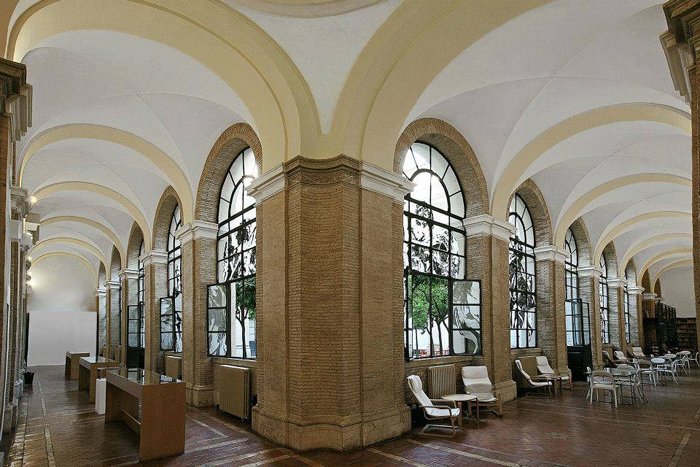
The Casa delle Letterature is in Rome at Piazza dell'Orologio 3, inside the monumental complex of the former Oratorio dei Filippini, the building that Francesco Borromini built between 1637 and 1667 next to the church of Santa Maria in Vallicella, the one everyone calls the Chiesa Nuova. I want to say it right away, because it's the first thing that needs clearing up and the first that almost nobody clears up: the Casa delle Letterature is not a museum, it has no ticket, it has no visitor route with arrows on the floor and it has no ticket office where you stand in line. It is a civic house of Roma Capitale dedicated to contemporary literature, with a specialized library, rooms for meetings, a courtyard and a program of events that you follow by reading the calendar, not by buying a ticket. Whoever arrives thinking they'll find a collection to look at is left disoriented for 10 minutes. Whoever arrives knowing what it is stays a whole afternoon.
Along the Baroque spine that runs from Piazza Navona to Campo de' Fiori, in front of the main door of Piazza dell'Orologio, whoever looks up toward the tower wonders what that strange bell tower was, all iron and curves, with the clock on top and a golden mosaic under the dial. I used to answer that it was Borromini, that the tower dates to 1648, that the mosaic depicts the Madonna della Vallicella from a design by Pietro da Cortona and that under that tower, behind that door, there is a public library dedicated to books written in the last 100 years. At that point someone always asked if you could go in. The answer is yes, and it's free, and this is the reason I decided to write a long page about a place that in the guides to Rome usually gets three lines or not even that.
Where the Casa delle Letterature is and how to get there
The address is Piazza dell'Orologio 3, in Municipio I, a few dozen meters from Corso Vittorio Emanuele II and a stone's throw from the Chiesa Nuova. The piazza is small, irregular, wedged between Via dei Banchi Nuovi, Via del Governo Vecchio and the climb of Monte Giordano: one of those Roman open spaces that don't seem designed but grown, where cars turn with difficulty and the walls are still those of the 16th and 17th centuries. You get there without any difficulty on foot, and it is the way I recommend to everyone, because the approach is part of the experience at least as much as the library.
On foot from Piazza Navona and from Campo de' Fiori
From Piazza Navona you leave from the Sant'Agnese in Agone side, take Via di Tor Millina, come out on Via del Governo Vecchio and walk the whole of it in the direction of the Tiber: seven or eight minutes of slow walking, with the windows of the secondhand dealers, the doorways with worn coats of arms and that mix of historic shops and new places that is by now the character of the street. Via del Governo Vecchio ends exactly on Piazza dell'Orologio: the tower appears suddenly on the left, and the first time it is a small coup de théâtre. From Campo de' Fiori the time is almost identical: you cut toward Via dei Cappellari or Via del Pellegrino, cross Corso Vittorio at the height of the Chiesa Nuova and turn behind the apse, entering the maze of the Filippini from Via dei Filippini or from Via della Chiesa Nuova.
Buses, trams and subway stations
Corso Vittorio Emanuele II is less than 200 meters away and remains the backbone of surface public transport in this part of the center: the lines that run along it stop in front of the Chiesa Nuova or a little farther on, at the height of Sant'Andrea della Valle, and from any stop you reach Piazza dell'Orologio in three or four minutes on foot. Whoever comes by subway has to count on a walk: the most useful line A stations are Barberini and Spagna, both about 20 minutes away on foot, while whoever arrives from Termini station gets there faster with a surface bus than with any underground combination. In these years the area is affected by the construction sites of metro line C, and it's always best to check detours and temporary stops before setting out: the Roman historic center is an organism that changes skin continually.
The door at Piazza dell'Orologio 3
The entrance of the Casa delle Letterature is not monumental and is not meant to be spectacular: it is a door that opens onto the piazza, with the plaque and the doorbell, and behind it is the body of the Filippini complex. Whoever expects an atrium of polychrome marble is disappointed. Whoever knows Borromini knows that austerity is part of the design, and that the real game, in this building, is all in the proportions, in the light and in the way the brick is worked. The Casa occupies a very specific portion of the complex: not all of the former Oratorio, which also houses other institutes that I will talk about further on.
What the Casa delle Letterature really is: a civic house, not a museum
I insist on the point because it is the source of all the misunderstandings. The Casa delle Letterature is a city center entirely dedicated to Italian and foreign literatures of the 20th century and of the new millennium. It depends on the Capitoline administration, belongs to the network of the Istituzione Biblioteche di Roma Capitale and works in collaboration with universities, cultural institutions, public and private associations, Italian and foreign. Its reason for being is not to conserve objects and show them: it is to put in contact those who write and those who read, in a city that has lived on literature for centuries but that until 2000 had no civic address dedicated exclusively to this.
No ticket, no visitor route
There is no ticket for the Casa delle Letterature. There is no reduced rate, there is no audio guide, there is no exit bookshop. There is a calendar of meetings, presentations, readings, conferences, workshops and documentary exhibitions, and the almost invariable rule is free admission until seats run out, with reservation recommended when the event is highly anticipated. There is also a library that you use the way you use a library: you go in, sit down, consult, in some cases borrow. This is the fundamental difference from a museum, and it is also the reason the Casa delle Letterature does not appear in organized tourist circuits: there is nothing to sell.
The public that frequents it
The public is mixed in a way that is rarely seen in Rome. There are the university students of the Sapienza and Roma Tre who come to work in the reading room, there are the residents of the rione who come down for the evening presentation, there are the editors and translators who stop by for a hard-to-find title, there are the cultured tourists who read the name somewhere and want to understand, and there are the writers, who come here to speak and sometimes even just to sit down. The Casa delle Letterature works well precisely because it is not a place of quick cultural consumption: it is a place where you stay.
What to expect in concrete terms
If you arrive on an ordinary day, with no events scheduled, you find a specialized library and a 17th-century building. If you arrive on an evening of programming, you find a full room, an author speaking, a moderator pressing him and 70, 80, 100 people listening. Both are worth the trip, but they are different experiences, and it's best to know in advance which of the two you are looking for: the calendar is consulted on the channels of the Istituzione Biblioteche di Roma and on the cultural portal of Roma Capitale.
The birth of the Casa delle Letterature in May 2000
The Casa delle Letterature was founded in May 2000 and was the first "Casa" of the Roman city cultural system. This detail, which at first sight seems an archive note, is instead the key to understanding everything else. At the end of the 1990s the Capitoline administration came up with a simple and rather radical idea: instead of building new containers, take underused historic buildings and assign them to a language, one at a time. A house for literature, then one for cinema, one for jazz, one for architecture, one for memory and history, one for translation. Not museums, not theaters, not conference centers: houses. The vocabulary was not accidental, nor innocent.
Why it is called "casa" and not "centro"
Calling a public institution a "casa" means declaring that whoever enters is not a visitor but a guest, and that the building does not have a collection to defend but a community to welcome. It is a warm word that jars in Italian bureaucratic vocabulary, and precisely for this reason it works. The Casa delle Letterature was born with this declared ambition: to be a privileged meeting point between writers and the public, a gathering space for groups, trends, associations and institutions, a center of interaction between literatures, the arts and the languages of cultural communication, an exhibition hub, a structure for the dissemination and conservation of literary heritage, a place of reading, and, the formula I like best among those used to describe it, an oasis to visit, a cultural station in the center of Rome.
The first of the series
Having been the first means that all the other Roman houses, when they were born, already had a precedent to look at. The Casa delle Letterature acted as a prototype, with the merits and limits of prototypes: it showed that a light institution, with no permanent collections and no museum costs, could sustain a dense program and attract a loyal public. It also showed how fragile a model is that depends entirely on the continuity of programming and on the stability of municipal budgets. In its more than 25 years of history the Casa has gone through different administrations, reorganizations, changes of city councilor and periods of suspension. It has survived them all, which, for an Italian public cultural institution, is already a notable result.
The relationship with the Istituzione Biblioteche di Roma
Today the Casa delle Letterature operates within the Istituzione Biblioteche di Roma Capitale, the network that runs the city's public libraries. That puts it in a hybrid and interesting position: it is a library in every respect, with a catalog, a collection and rules for consultation and lending, but it is also a cultural production center that designs programs, curates festivals and invites authors from abroad. The dual nature is its strength. A library that schedules events is common. A library that curates an international festival is something else, and in Rome it is an almost unique case.
The Borromini Complex That Houses the Casa delle Letterature
Now let's talk about the building, because the Casa delle Letterature lives inside one of the absolute masterpieces of Roman Baroque architecture, and this is not a side note. Between 1637 and 1640 the brothers of the Congregation of the Oratory of Saint Philip Neri chose Francesco Borromini as the architect of the new Oratory to be built next to their church, Santa Maria in Vallicella. The work continued until 1667, the very year of the architect's death. It was therefore a construction site lasting 30 years, which accompanies the whole maturity of Borromini and records his obsessions.
Why the Filippini Chose Borromini
The choice was not obvious. Borromini was not the courtly architect par excellence, he did not have Bernini's happy, worldly touch, and his reputation was already that of a difficult man. The Filippini, however, were less tied to the architectural tradition of representation, and they saw in him the artist committed to his profession, practiced with great discipline: words that describe well both Borromini's character and the spirit of the Congregation, born from the teaching of a saint who detested pomp. It was a meeting between a sober patron and a rigorous architect, and it produced a building that is both austere and dizzying.
"A human body with open arms"
Borromini himself defined the Oratory as "a human body with open arms, as if to embrace everyone who enters". The phrase is famous and is repeated in all the textbooks, but it is worth pausing to consider it while standing in front of the facade, because it describes exactly what you see: the central body divided into five sectors by pilasters on a concave plan, the wings that open out, the interplay between the central portion of the first order, curving outward, and the depth of the niche of the upper order. The pediment, for the first time in the history of architecture, has a mixtilinear profile, which generates curvilinear and angular movement at the same time. It is a facade that breathes. And it is the facade you pass under to go read a contemporary novel, which is both comic and sublime.
Brick as a Material to Shape
The Congregation explicitly asked for the facade to be built in brick. For Borromini, who loved simple materials (brick, stucco, plaster), it was not a limitation but an opportunity. He made a brick "lining" over the mixed masonry, with the bricks rubbed smooth, grouted and the joints finished by pointing, and he played on differences of texture and color: the central area of the facade and its pilasters are in thin, straw-yellow bricks, with very fine joints of two or three millimeters. The remaining parts are in ordinary pinkish bricks, with joints pointed at around a centimeter, marked off by pilasters that are also brick, with panels that imitate rustication. The corner solution places giant pilasters of thin bricks so as to cancel out the corner, replaced by a concave stretch of wall. It is pure virtuosity, and it comes from daily familiarity with the construction site.
Sagramatura, or the Smoothed Brick
The brick of the Oratory is carefully smoothed on site with the technique called sagramatura: the brick is polished and treated until it becomes a continuous surface, almost a skin. If you get close to the facade and look at it edgewise, against the light, you can see it: it is a wall that reflects light like a fabric, not like masonry. In the construction details of the cornices and openings this sculptural quality becomes evident. It is worth spending five minutes on this observation before going in: it changes the way you look at the whole rest of the building.
The Layout of the Rooms in the Casa delle Letterature Building
Borromini conceived the layout of the different rooms (oratory, sacristy, library) according to criteria of functionality and representational coherence. Paolo Portoghesi summed it up with an exact formula: in the Filippini complex one finds "a courtly tone in the collective spaces, modest and welcoming in the rooms meant for private residence." The architect placed the sacristy between a courtyard and a garden, creating a succession of main spaces flanked by two long corridors. Anyone who frequents the Casa delle Letterature walks inside this geometry almost without noticing.
The Oratory Proper
The oratory hall, the one that today bears the name Sala Borromini, has a biaxial layout, determined by the altar on the longitudinal axis and the entrance designed on the transverse axis. It is an anomalous solution and a logical one at the same time: the oratory was not a church, it was the place where sermons, spiritual readings and music were held, and Borromini designed a space that would work as a listening hall even before it worked as a liturgical space. If you think that today, in the same complex, people listen to writers reading aloud, the functional continuity is almost moving.
The Courtyard
The inner courtyard is one of the most beautiful and least photographed places in the center of Rome. It is a regular rectangle, arcaded, with brick masonry and a light that in the middle hours of the day cuts across the floor on the diagonal. It has no statues, no monumental fountains, none of what a Roman Baroque square usually displays: it has proportions. And that is precisely why you stop.
The Inner Galleries and the Orange Garden
Among the services of the Casa delle Letterature there are spaces for free reading, both in the inner galleries of the center and in the Orange Garden. The Orange Garden discussed here is not the famous park on the Aventine, but a space inside the complex. This is one of the small place-name confusions of Rome that is worth clearing up, because every so often someone arrives in Piazza dell'Orologio convinced they will find the viewpoint of Santa Sabina. Reading outdoors, seated inside a Borromini complex, with the noise of Corso Vittorio traffic muffled by the walls, is one of the Roman experiences I recommend most firmly and that almost nobody knows.
The Clock Tower Above the Casa delle Letterature
The tower that gives the square its name and that signals the Casa delle Letterature from afar was built by Borromini in 1648. It is a singular architectural object even in the catalog of an architect used to inventing: a vertical structure that thins out toward the top, with volutes and wrought iron that draw a moving outline in the air, and at the top the clock face. It is not a bell tower, even though everyone calls it that. It is a civic tower, an urban signal, a way of marking the presence of the Congregation in the dense fabric of the rione.
The Mosaic of the Madonna della Vallicella
Below the clock face is placed a mosaic depicting the Madonna della Vallicella, a work made from a design by Pietro da Cortona. It is the detail I recommend looking for first when you arrive in the square: you can see it well from the opposite sidewalk, even better in the hours when the sun hits the tower and lights up the golden tesserae. The image refers to the miraculous fresco kept in the Chiesa Nuova, and establishes a visual link between the tower and the church, that is, between the secular square and the devotional heart of the complex.
Why the Square Is Called That
The name Piazza dell'Orologio comes exactly from this tower. In the past the same urban space was called Piazza dei Rigattieri and Piazza di Monte Giordano. The first name recalls the dealers in used goods who had shops there, the second the nearby rise on which stands the Palazzo degli Orsini, one of the great feudal strongholds of the center. That a square changes its name three times in five centuries is normal in Rome. That it ends up taking its name from a clock is instead a precise sign of how the modern city worked. The public clock is an instrument of collective discipline: since it has been there, the rione has had an official time.
Looking at the Tower from the Right Spot
The best spot to observe the tower is not under the tower itself, where perspective flattens everything, but at the mouth of Via del Governo Vecchio, coming from Piazza Navona. From there the tower stands out against the sky with its iron silhouette, the mosaic is legible, and the facade of the Casa delle Letterature building enters the frame in full. The reaction is always the same: an instinctive step back, to fit everything into the field of view.
Philip Neri, the Chiesa Nuova and the Setting of the Casa delle Letterature
You cannot understand the Casa delle Letterature building without understanding who wanted it. In 1551 Philip Neri founded the Congregation of the Oratory in Rome, recognized in 1575 by Pope Gregory XIII. To his followers was assigned an old church in very poor condition, dedicated to the Nativity of the Madonna and recorded in the area since the 13th century, known in the 1400s and 1500s as Santa Maria in Puteo albo. The church was rebuilt from scratch, and the new construction took the name it still bears today in the everyday speech of Romans: the Chiesa Nuova.
A Not Very Solemn Saint
Philip Neri is a figure I recommend getting to know before visiting this part of Rome, because he explains the atmosphere of the neighborhood better than any architectural description. He was a man who distrusted solemnity, who educated young people with cheerfulness and music, who refused ecclesiastical honors and who chose a pastoral method based on conversation. The Oratory, as an institution, was born from the practice of talking together: informal meetings, readings, songs, commentary. In contemporary terms we would say that Philip Neri had invented the format of the public event. That four and a half centuries later, in the same building, book presentations and conversations with writers are held seems to me anything but a coincidence.
The Chiesa Nuova Construction Site
The reconstruction was long and involved many protagonists. The initial design is by Matteo di Città di Castello. Domenico Fontana and Giovanni Antonio Dosio worked on the stucco and marble decorations. From 1586 the direction passed to Martino Longhi the Elder, with funding from Cardinal Pierdonato Cesi. The semicircular apse, the transept and the dome were inaugurated in 1591. Giacomo Della Porta had supplied a design as early as 1585, and Giovan Battista Guerra oversaw the later works, when the side chapels were set back to create true aisles. The facade, the work of Fausto Rughesi, was built between 1594 and 1605. The staircase was completed in 1614, the bell tower dates to 1666, by Camillo Arcucci, and the right side was clad in 1675 by Carlo Rainaldi.
Pietro da Cortona and Rubens a Short Walk from the Casa delle Letterature
Philip Neri had asked that the interior remain whitewashed, without decoration. His wish was disregarded in grand style: between 1647 and 1666 Pietro da Cortona frescoed the vault, the dome with its pendentives and the apse, and in 1650 he added a lantern to the dome to increase the interior light. The vault depicts the Madonna and Saint Philip Neri, in reference to a vision of 1576. On the high altar, since 1608, stands the miraculous image of the Madonna della Vallicella, protected by an ingenious device: Peter Paul Rubens painted on slate an altarpiece with angels and cherubs in adoration arranged in concentric circles, and on a copper plate a Madonna and Child that, through a system of ropes and pulleys, moves aside to uncover the venerated image. Rubens painted two other works on slate for the same church: Saints Gregory the Great, Papias and Maurus on the left wall, Saints Flavia Domitilla, Nereus and Achilleus on the right. They are less than 100 meters from the door of the Casa delle Letterature and you can see them for free.
The Square in Front of the Casa delle Letterature and the Terrina Fountain
Piazza dell'Orologio has changed quite a bit in recent years and it helps to know why. The church and the Oratory once faced a small closed square, which disappeared with the opening of Corso Vittorio Emanuele II in 1885, one of those post-unification demolitions that gave Rome modern roads and took away a great many intimate spaces. In the square of the Chiesa Nuova, the one that formed after the demolition, the monument to Pietro Metastasio and the Terrina Fountain were placed.
The Story of the Terrina
The Terrina Fountain is one of the most itinerant objects in Rome. Made for Campo de' Fiori, it was removed from there and replaced with a copy in 1899, when room had to be made for the monument to Giordano Bruno, and moved to Piazza della Chiesa Nuova. During the works for the Metro C station it was moved again, and placed provisionally in the center of Piazza dell'Orologio, that is, right in front of the Casa delle Letterature. It is a wide, covered basin that recalls a soup tureen (hence the nickname) and that has gone through more moves than many Romans make in a lifetime.
The Metro C Construction Site and the Historic Center
The construction site of Line C has noticeable effects on this part of the city: altered pedestrian routes, barriers, narrowed roadways, relocated street furniture. It is not a short parenthesis and it is not worth making a drama of it: Rome is a city that has been digging for 3,000 years and every dig produces both inconvenience and archaeological discoveries. For anyone going to the Casa delle Letterature the practical consequence is just one: check the route before leaving and allow for some detours on foot.
The Library of the Casa delle Letterature
The daily heart of the Casa delle Letterature is its library, and this is where it is worth going into detail, because it is the least talked about part and the most useful. The library services are organized around two distinct collections, with different rules and different functions: the Biblioteca Letteraria and the Biblioteca del Terzo Millennio. It is not a bureaucratic distinction, it is a precise cultural choice, and understanding it means understanding how the institution was conceived.
A Specialized Library, Not a General One
Neighborhood public libraries have the job of offering a bit of everything: fiction, nonfiction, manuals, children's books, film, music. The Casa delle Letterature does not. It is a library specialized in the literature of the 20th century and the new millennium, and this specialization is visible as soon as you scan a shelf. Anyone looking for a tax law manual has the wrong address. Anyone looking for the complete works of an Italian novelist of the second half of the 20th century, or the Italian translation of a foreign poet published by a small publisher that has since closed, has a good chance of finding it.
Consultation and Lending: Two Different Regimes
The fundamental distinction is this: the Biblioteca Letteraria is available to the public for consultation only, while the Biblioteca del Terzo Millennio is available for both lending and consultation. Put into practice: the volumes of the historical collection are read on site, those of the contemporary collection can be taken home. It is a conservation choice, not discourtesy: an author's collection acquired as a whole loses documentary value if it is dispersed into the lending circuit.
How to Behave in the Reading Room
The rules of any serious public library apply, and they are worth recalling. You speak in a low voice or you don't speak. Phone calls are made outside. Bulky backpacks are left where indicated. Books are not put back on the shelf by yourself, they are left on the table or at the collection point, because putting a volume back in the wrong place is equivalent to losing it. Photographs of books are taken only if allowed and without flash. And above all: you ask. The staff of a specialized library is the most underused resource in Italy. A well-posed question at the desk is worth half a day of fruitless searching in the catalog.
The Fondo Enzo Siciliano, Heart of the Casa delle Letterature
The Biblioteca Letteraria of the Casa delle Letterature was created with the acquisition of the Fondo Enzo Siciliano: about 20,000 volumes, made available to the public for consultation only. 20,000 volumes is a private library of imposing size, the kind of collection built over 50 years of full-time intellectual work and which, at the owner's death, usually scatters among heirs, the antiquarian market and boxes in the basement. That it remained whole and became public is a rare and precious fact.
Who Enzo Siciliano Was
Enzo Siciliano was born in Rome on May 27, 1934, to parents from Bisignano, in the province of Cosenza, and died in Rome on June 9, 2006. He graduated in philosophy. His formation was marked by some of the great figures of 20th-century Italian culture: Giacomo Debenedetti, Alberto Moravia, Pier Paolo Pasolini, Giorgio Bassani, Attilio Bertolucci. He made his debut in fiction in 1963 with Racconti ambigui. He was co-editor of the magazine Nuovi Argomenti and director of the Gabinetto Vieusseux in Florence. In 1998 he won the Premio Strega with I bei momenti, a novel about the life of Mozart. Among his books at least the following should be mentioned: La notte matrigna, from 1975, Campo dei fiori, from 1993, which is a literary and historical fresco of Italian cultural life in the 1970s and 1980s, Non entrare nel campo degli orfani, from 2002, and the posthumous La vita obliqua, set in a harsh and ancestral Calabria.
Siciliano at Rai and the Night of Macbeth
Before his literary debut Siciliano had been a teacher and a Rai executive. He was president of Rai from July 10, 1996 to January 21, 1998. In that role he made a decision that caused a stir: to broadcast live the opening of the opera season of the Teatro alla Scala in Milan, with Macbeth, in prime time on Rai Uno, in place of the 20:00 news. It was the first time this had happened in the history of Italian television. It is an episode that says precisely what kind of man put those 20,000 books together: someone who thought that culture had a right to prime time.
What It Means to Consult an Author's Collection
Consulting an author's collection is not like consulting a library shelf. It means entering the mind of a reader. The order, the editions chosen, the presences and above all the absences tell an intellectual path. In a collection like this you find first editions of friends and teachers, magazines, books of poetry bought when nobody was buying them, critical essays, foreign translations. Anyone studying the Italian second half of the 20th century has here a primary source, not a duplicate of what can be found elsewhere. And anyone who is not studying anything can still try the experience, which I recommend, of leafing through a volume that has passed through the hands of a real writer.
The Biblioteca del Terzo Millennio of the Casa delle Letterature
The other collection is the Biblioteca del Terzo Millennio: books of fiction, poetry and literary nonfiction published in first edition from the year 2000 onward, available for both lending and consultation. It is an acquisition criterion so simple as to seem banal and in fact very sharp. Not "recent books," an elastic formula that ages by itself, but books published in first edition after a fixed date. The result, a quarter of a century later, is an ever-growing photograph of the literature of our time.
A Collection That Ages Well
In 2000 that threshold seemed like a line on the present. Today it already covers 25 years of publishing output, that is, a historical period. It means that anyone who enters the Casa delle Letterature today can follow, shelf after shelf, the evolution of Italian fiction from the 2000s to today: the explosion of narrative nonfiction, the return of the historical novel, the season of migration literature, the growth of poetry from small publishers, the rise of women writers. You don't need an exhibition to tell all this. The shelves are enough, if they were built with a criterion.
The Value of Small Publishers
A collection built on first editions has a merit that bookstores no longer have: it keeps the books of small and mid-sized publishers, the ones that stay in print for 18 months and then vanish from the windows. Much of the living Italian literature of the last 20 years has come from small publishing houses, often with print runs of a few thousand copies. Finding those titles in a public library in the center of Rome, and being able to borrow them too, is a service worth much more than it costs.
Lending, Card and the City Network
Lending in the Roman municipal libraries works through registration in the system of the Istituzione Biblioteche di Roma: you register for free with an ID and get the right to borrow from the libraries of the network. There is also a paid card, the Bibliocard, which adds services and discounts. I recommend that anyone who lives in Rome, even for just a few months, register: the municipal network is large, the catalog is unified and books can often be requested from one library to another. For up-to-date conditions it is always worth checking the website of the Istituzione Biblioteche di Roma, because regulations and loan periods change over time.
The Program of Events at the Casa delle Letterature
At the Casa delle Letterature the public finds permanent cultural initiatives, and the official list of what takes place there is more varied than anyone who has never been would imagine: exhibitions, bibliographic and documentary shows with a thematic focus or dedicated to the life and work of authors of Italian and international culture. Shows by artists, painters, sculptors and photographers. Musical and theatrical performances. Screenings. Conferences and lectures on themes, authors, philosophers and thinkers, Italian and foreign. Writing and reading workshops and seminars.
Book Presentations
The book presentation is the most overused format in Italy and, when done badly, it is one of the most depressing experiences you can have in public: the author summarizing the plot, the moderator praising, 14 people in the room of whom 11 are relatives. At the Casa delle Letterature it works differently because the room is the right one and because the audience is competent. An audience that has read asks uncomfortable questions, and uncomfortable questions are the only thing that makes a presentation come alive. I recommend that anyone who happens by for the first time stay until the end, when the floor opens for comments: that is where you find out who is really in the room.
Readings and Reading Aloud
Readings are something else again, and in the Filippini complex they have a particular resonance. Hearing a text read aloud inside a building designed as a listening hall is a physical experience before it is an intellectual one. The rhythm of Italian prose, which is a language of open vowels and long sentences, reveals itself only when it leaves the page. If you happen upon an evening of readings, go even if you don't know the author: you learn more in an hour of listening than in three reviews.
Conferences, Seminars and Writing Workshops
Alongside the evening events the Casa delle Letterature hosts training activities: writing and reading workshops and seminars, often in collaboration with universities, associations and cultural institutions. It is the least visible part of the program and perhaps the most useful, because it builds readers instead of just entertaining them. Anyone who wants to take part must move in good time: places are limited for practical reasons and booking is almost always necessary.
The Bibliographic and Documentary Exhibitions of the Casa delle Letterature
The bibliographic exhibition is an exhibition genre that is practiced little and badly in Italy, and which is instead at home at the Casa delle Letterature. It consists of telling the story of an author, a theme or a cultural season through books, magazines, papers, photographs and documents, instead of through works of art. The advantage is that these are materials that speak for themselves to anyone who can read them. The disadvantage is that they require well-written captions, and a bibliographic exhibition with mediocre captions is a mute paper display case.
Why a Display of Books Can Move You
Some people are moved in front of the first edition of a novel they had read as teenagers. The book as an object keeps an emotional charge that the work of art, paradoxically, has lost: because we held the book in our hands, because the cover of a certain series means an era, because the typeface of certain publishers is part of the memory of reading. Bibliographic exhibitions work on this register and the Casa delle Letterature knows it.
Exhibitions of Artists and Photographers
Alongside the book exhibitions, the Casa also hosts exhibitions of painters, sculptors and photographers, and musical and theatrical performances. The logic is the one declared since its founding: to present literatures in their mixing with the other languages of cultural communication. It is not a generic formula. It means that the boundary between text and image, between page and voice, between writing and stage, is considered here a territory to cross and not a frontier to guard.
LETTERATURE Festival Internazionale di Roma and the Casa delle Letterature
If I had to name the reason the Casa delle Letterature counts for much more than its size, I would name this: the Casa curates the program of LETTERATURE Festival Internazionale di Roma, the historic Roman event that every summer brings to the city some of the most important names in world fiction. The festival is promoted by the Culture Department of Roma Capitale, curated by the Istituzione Biblioteche di Roma Capitale, with the organizational coordination of Zètema Progetto Cultura, and over the years has seen the collaboration of the Colosseum Archaeological Park, SIAE and the Biblioteca Nazionale Centrale di Roma.
Simona Cives and the Scientific Committee
The festival program is curated by Simona Cives, head of the Casa delle Letterature. The scientific committee, in recent years, has brought together Paolo Di Paolo, Melania Mazzucco, Davide Orecchio, Igiaba Scego and Nadia Terranova. The artistic coordination and the direction of the performances were entrusted to Fabrizio Arcuri. It is a curatorial structure you can see in the quality of the program: the evenings have a theme, the authors are paired with care and the texts written for the occasion have a common thread.
The Festival Venues
The festival has changed venues several times, always staying within a very Roman idea of outdoor summer entertainment. In recent editions it was held at the Palatine Stadium, at Via di San Gregorio 30, inside the Colosseum Archaeological Park: five summer evenings, starting at 21:00, free admission without reservation until seats run out, with a livestream on the social channels of the Biblioteche di Roma. In 2025 the 24th edition, titled "Ritorni," was held at the Teatro India, on Lungotevere Vittorio Gassman. Reading a novel aloud inside an imperial stadium, with the Palatine at your back, is the kind of short circuit that only this city can afford.
The Themed Editions
Recent editions have had precise titles and dedications. In 2022 the 21st edition was titled "Tempo nostro." In 2023 the 22nd, "La memoria del mondo," paid homage to the centenary of the birth of Italo Calvino. In 2024 the 23rd, "Questa è la Storia," celebrated Elsa Morante on the 50th anniversary of the novel La Storia, published in 1974. In 2025 the 24th, "Ritorni," included an evening for the 100 years since the birth of Andrea Camilleri. It is a program that holds together the anniversary and the current moment, the canon and the unpublished, and that addresses a wide audience without lowering its aim.
The Festival Previews at the Casa delle Letterature
Not all of the festival takes place in the big summer venues. An important part, and in some ways the most precious, is held right in the rooms of the Casa delle Letterature, in Piazza dell'Orologio: conversations with international guests, previews, limited-capacity events in which the author speaks in front of 70 or 100 people instead of in front of 1,000. In the 2022 edition the Casa hosted four conversations with international guests in the month of June. In 2023 the preview hosted by the Casa delle Letterature featured Bernardine Evaristo, Ali Smith, Brenda Lozano and Anna Maria Gehnyei.
Why the Preview Is Worth More Than the Big Evening
I say it without rhetoric: the evening with 1,000 seats is beautiful, but it is a show. The meeting in the room of the Casa delle Letterature is a conversation. Anyone who has attended both formats knows that in the second case the author behaves differently, answers at length, contradicts himself, changes his mind midsentence. It is the difference between listening to a reading and watching a thought as it forms. If you have to choose just one date of the Roman summer program, the best choice is the preview in Piazza dell'Orologio.
How to Book
The events at the Casa delle Letterature are generally free and open until seats run out, with booking recommended. The formula is repeated consistently in the press releases and should be taken literally: "recommended" means that without a reservation you get in if there is room, and for highly anticipated international guests there is no room left. The booking arrangements change from one series to another, because the event is often organized together with outside partners. It is always worth reading the listing for the event on the cultural portal of Roma Capitale before showing up.
Foreign Writers and the International Vocation of the Casa delle Letterature
The international vocation has been written into the program since the founding: the work of devising and curating projects relies on collaboration with public and private cultural institutions, universities and associations, Italian and foreign, and this network of relationships is declared necessary to the Casa's international and interdisciplinary approach. In practice it means that foreign authors arrive here thanks to a chain that includes cultural institutes, Italian publishers, translators and embassies.
The Role of Foreign Cultural Institutes
Rome hosts one of the densest concentrations in the world of foreign academies and cultural institutes: the French Academy at Villa Medici, the American Academy on the Janiculum, the British School, the Spanish Academy at San Pietro in Montorio, the Hungarian Academy, the Swiss Institute, the German Academy at Villa Massimo and many others. Each of these institutions hosts fellows every year, including writers and translators. The Casa delle Letterature is in dialogue with this ecosystem, which is why on any given evening you might find in the room an author who has lived in Rome for six months thanks to a fellowship and who is famous in his own country without anyone here knowing it.
Authors Who Have Come Through the Casa's Program
The list of authors brought to Rome by the program curated by the Casa delle Letterature in recent years gives an idea of the level. Among the foreigners: Margaret Atwood, Jeanette Winterson, Colson Whitehead, Javier Cercas, Andrew O'Hagan, Mircea Cărtărescu, Fernando Aramburu, Julie Otsuka, Valeria Luiselli, Bernardine Evaristo, Ali Smith, David Diop, Maaza Mengiste, William T. Vollmann, Burhan Sönmez, Katja Petrowskaja, Jean-Baptiste Del Amo, Sam Riviere, Brenda Lozano, Alicia Giménez-Bartlett, Claire Messud, Peter Cameron, Tatiana Țîbuleac, Amira Ghenim, Laurent Petitmangin, Temim Fruchter, Roy Chen, A. K. Blakemore and Paul Lynch, winner of the Booker Prize in 2023. Among the Italians: Dacia Maraini, Antonio Scurati, Paolo Giordano, Nicola Lagioia, Mario Desiati, Silvia Avallone, Maurizio De Giovanni, Alessandro Piperno, Bernardo Zannoni, Chiara Valerio, Giulia Caminito, Antonio Franchini, Melania Mazzucco, Igiaba Scego, Nadia Terranova, Paolo Di Paolo, Davide Orecchio, Ascanio Celestini and Laura Morante.
Translation as a Political Question
Bringing a foreign author to Italy means having had him translated, and translation in Italy is an underpaid and decisive trade. A civic house that schedules international events does, indirectly, a cultural policy of translation: it supports the publishers who take a risk on an unknown name, gives visibility to translators, widens the canon. It is invisible, cumulative work, whose effects you see 10 years later.
The Casa delle Letterature in the System of Rome's Civic Houses
I said that the Casa delle Letterature was the first of the Roman houses. It is worth reviewing the others, because together they make up a system that no other Italian city has in the same form and that is still little known even to Romans themselves.
The Casa delle Traduzioni
The Casa delle Traduzioni, on Via degli Avignonesi, is dedicated to literary translators: it has a specialized library, hosts seminars and provides a guesthouse for foreign translators working on Italian authors. It is the twin and complementary institution to the Casa delle Letterature: one deals with those who write, the other with those who rewrite in another language. Both are part of the network of the Istituzione Biblioteche di Roma Capitale.
The Casa del Cinema and the Casa del Jazz
The Casa del Cinema occupies the former Casina delle Rose in Villa Borghese and programs screenings, retrospectives, meetings with directors and, in summer, an open-air arena. The Casa del Jazz is on Viale di Porta Ardeatina, inside a park of 2,500 square meters confiscated from organized crime, and it is perhaps the most interesting case of all: an asset taken from the mafia and turned into an auditorium. The logic is the same as the Casa delle Letterature, applied to different languages.
Casa della Memoria e della Storia, Casa dell'Architettura, Casa Internazionale delle Donne
The Casa della Memoria e della Storia, on Via San Francesco di Sales in Trastevere, brings together associations tied to the Resistance, to deportation and to the history of the 20th century. The Casa dell'Architettura occupies the former Acquario Romano in Piazza Manfredo Fanti, a 19th-century building by Ettore Bernich, and hosts architecture exhibitions and conferences. The Casa Internazionale delle Donne, in the Buon Pastore complex on Via della Lungara, is one of the largest European centers dedicated to women's associations. Each of these has its own history and its own problems. Together they tell the story of an idea of a city in which culture has civic addresses and not just billboards.
What They Have in Common
They have three things in common: a reused historic building, a sharp thematic specialization and access that is generally free. They are the opposite of the big multipurpose container. When they work, they work because they are small and recognizable. When they go into crisis, they go into crisis because they depend on public budgets and reduced staff. The Casa delle Letterature has gone through both phases and is still standing.
The Biblioteca Vallicelliana, Next-Door Neighbor of the Casa delle Letterature
In the same complex, on the second floor of the Oratorio dei Filippini, is the Biblioteca Vallicelliana, which is one of the oldest public libraries in Rome and today a peripheral institute of the Ministry of Culture. Between the two institutions lie a few meters of 17th-century masonry and about four centuries of history, which makes Piazza dell'Orologio one of the points with the highest density of books in Italy.
Achille Stazio and the 1581 Bequest
The first documentary trace of the Vallicelliana dates to 1581, when the Portuguese humanist Achille Stazio, with a bequest in his will in favor of Philip Neri and the Congregation of the Oratory, donated a collection of about 1,700 printed volumes and 300 manuscripts. They were mostly works on the Church of the 1500s, in the years of the Reformation and the Counter-Reformation. Everything else grew out of that bequest.
Leone Allacci and the Manuscript Collections
In 1669 the manuscript collection of Leone Allacci, a Greek scholar and custodian of the Vatican Library, arrived at the Vallicelliana: about 237 Latin and Greek manuscripts. During the 1600s other donations were added from Oratorian and ecclesiastical figures, forming a collection that is mainly historical-ecclesiastical and theological. Today the library holds about 140,000 volumes, largely from between the 16th and 19th centuries.
From 1874 to Today
In 1874 the Vallicelliana became a library under public law. From 1883 to 1946 the Società romana di storia patria handled its scholarly direction. The passage from ecclesiastical to state ownership is the same story that affected the whole Filippini complex after 1870, and explains why today a ministerial institute, a municipal archive, a historical institute and a civic house of literature live together in one building.
Visiting the Vallicelliana
The Vallicelliana is a library of conservation and study: you gain access for research, with the procedures set by ministerial regulations, and on the occasion of special openings, exhibitions or events you can visit the great monumental hall, which is one of the most impressive Borromini interiors in Rome. Anyone going to the Casa delle Letterature would do well to check if the Vallicelliana can be visited the same day: they are two very different experiences 30 meters from each other, and together they tell four centuries of the life of the book in the same masonry.
The Archivio Storico Capitolino, the Other Big Tenant Next to the Casa delle Letterature
In the same complex, with its entrance at Piazza dell'Orologio 4, the Archivio Storico Capitolino has been housed since 1922. It collects the documentation produced by the city of Rome and is today an organizational unit of the Sovrintendenza Capitolina ai Beni Culturali. It is the institution that keeps the administrative memory of the city, and it is a formidable neighbor for anyone who frequents the Casa delle Letterature for research reasons.
How the Archive Came to Be
The idea of a unified Roman municipal archive was born in the wake of the taking of Rome in 1870. Between 1874 and 1898 the city council of the new capital of the Kingdom of Italy brought together into a single institute the several old papal archives: the Archivio notarile urbano, with documents from 1348 to 1871. The Archivio della Camera capitolina, from 1515 to 1847. The Archivio del comune pontificio, from 1847 to 1870. To these were gradually added all the acts of the post-unification city government. The Camera Capitolina, headed by the Conservatori dell'Urbe, was one of the two civil magistracies that governed Rome from the Renaissance to 1847, and dealt above all with food supply, public order, maintenance of the city's property and public works.
The Biblioteca Romana and the Emeroteca
Part of the Archive, besides the collections of administrative records, are two extraordinary collections. The Biblioteca Romana today includes about 80,000 volumes relating to Rome, its history and its economy. Around 1930 the Biblioteca del Popolo romano, founded in 1523 and joined to the Capitoline Archive in 1879, merged into it. It includes about 600 16th-century printed books, a collection of topographic maps of the city and folders of engravings and drawings. The Emeroteca Romana, created in 1970, holds about 2,000 periodical titles and 278 collections of daily newspapers published in Rome, mostly from after Unification, but it also includes a collection of newspapers of the papal commune from 1815 to 1851.
The Orsini Parchments and the Libro d'Oro
The Archive also holds family archives that were purchased or donated. The most famous is that of the Orsini family, purchased in 1904: more than 4,200 registers and bundles, with thousands of parchment documents. Then there is the Libro d'oro of the Roman nobility, established by Benedict XIV in 1746 and recompiled between 1839 and 1847, because the original deposited on the Capitoline Hill had been burned during the Jacobin Roman Republic of 1798-99. Part of these materials has been digitized and can be consulted online.
Why It Interests Those Who Come for Literature
Because a writer who wants to set a novel in the Rome of the 1800s, or an essayist studying the urban transformation of the capital, finds the primary sources here: the council resolutions, the land registries, the maps, the newspapers. The physical contiguity between a library of contemporary literature and a municipal historical archive is a piece of luck, and those who work seriously take advantage of it. The Archive is open to the public Monday through Friday with its own hours, which are worth checking on the website of the Archivio Storico Capitolino.
The Istituto Storico Italiano per il Medio Evo and Other Uses of the Building
Since 1924 the complex has also housed the Istituto Storico Italiano per il Medio Evo, facing Piazza dell'Orologio, and on Via dei Filippini a theater was located for years. To recap: in a single block coexist a religious congregation founded in the 1500s, a monumental church, a state library, a municipal archive, a historical research institute, a civic house of literature and a theater space. I don't know many buildings in the world with such a dense functional stratification.
30 Years of Courts
There is a little-known chapter in this story. The building was requisitioned by the State in 1870, after the end of temporal power, and for 30 years it was the seat of courts. The same rooms in which the Filippini had sung oratorios and in which novels are presented today hosted hearings, clerks' offices, trial files. It is a healthy reminder: historic buildings do not have a natural purpose, they have a succession of purposes, and each leaves traces.
The Complex Today
Today the coexistence is governed by distinct administrative arrangements: the Vallicelliana depends on the Ministry of Culture, the Capitoline Archive on the Sovrintendenza Capitolina, the Casa delle Letterature on the Culture Department of Roma Capitale through the Istituzione Biblioteche. Each has its own hours, access rules and calendars. That is why there is no "Filippini complex ticket" and no single visit: you enter through different doors, for different reasons.
The Rione Around the Casa delle Letterature
There is a small place-name question worth addressing, because it recurs in all the descriptions and creates confusion. The church of Santa Maria in Vallicella and the Oratorio dei Filippini are commonly assigned to the rione Parione, and the Biblioteca Vallicelliana is described as located in the rione Parione. Piazza dell'Orologio, however, is often attributed to the rione Ponte. The reason is simple: the boundary between the two rioni passes exactly through here, and the Filippini complex straddles it. It is not an error of the sources, it is an administrative line that cuts through a block.
Via del Governo Vecchio
Via del Governo Vecchio is one of the most beautiful and most misunderstood streets in the center. The name comes from the palazzo that housed the papal governorate before the move to Palazzo Madama. It is a narrow street, with small 16th-century palazzi, travertine portals and a commercial vocation that in recent decades has gone from secondhand dealers and used clothes to evening venues. Walking it by day, when it is almost empty, is a completely different experience from walking it in the evening.
Monte Giordano and the Banchi Nuovi
The name of Monte Giordano recalls the artificial rise on which the Orsini built their urban stronghold, today Palazzo Taverna. Via dei Banchi Nuovi instead preserves the memory of the financial Rome of the 1500s: the "banchi" were the bankers, largely Florentine and Sienese, who had shops on the route between Ponte Sant'Angelo and the center. Walking here means crossing, in 200 meters, feudal Rome and banking Rome, which are the two forces that built this city much more than devotion did.
Palazzo Bennicelli
Also facing the square is Palazzo Bennicelli, a building with a curious history: it was commissioned by Monsignor Virginio Spada to serve as the seat of the Banco di Santo Spirito, which entrusted the design to Borromini. Work began in 1660, but two years later, at the death of the monsignor, the Banco's seat was built elsewhere and the palazzo remained with the Spada. Its current appearance is the result of a late-19th-century remodeling by Gaetano Koch for the Bennicelli counts, who had bought it from the Spada. It means that on the square of the Casa delle Letterature there are two Borromini construction sites, one completed and one interrupted.
What Is Five Minutes Away
Five minutes on foot from the Casa delle Letterature are the Chiesa Nuova with its Rubens and Pietro da Cortona works, the Museo di Roma at Palazzo Braschi, the talking statue of Pasquino,
Piazza Navona with the Fountain of the Four Rivers, the Basilica of Sant'Andrea della Valle, Campo de' Fiori with the morning market and Ponte Sant'Angelo with the Bernini statues. It is a density of monuments that, in any other European city, would justify a weekend on its own.
How to Actually Use the Casa delle Letterature
Let's get to the practical instructions, which are the part that is usually missing. The Casa delle Letterature can be used in three different ways, and it helps to decide in advance which one interests you, because they require different preparation.
First Way: Walk In and Look
The simplest way is to show up during opening hours and ask if you can take a look. It is not a guided visit and there is nothing organized for occasional visitors: you go in, you see the atrium, you glimpse the courtyard, you look at the shelves and any exhibitions under way. It takes 20 minutes and works as a complement to a walk around the rione. Opening hours can vary over the year and on the occasion of events: they should be checked before leaving the house, and this is a rule that holds for all the Roman municipal libraries.
Second Way: Use It as a Library
If the goal is to consult or borrow, the preparation changes. You need an ID for registration in the library system, it helps to have already searched for the titles in the online catalog of the Biblioteche di Roma, and it helps to have a plan B, because the volumes of the Siciliano collection are consulted on site and not taken away. Bring something to take notes with: in the reading rooms the rules on the use of devices can be restrictive, and a notebook never needs a power outlet.
Third Way: Go to an Event
This is the way I recommend to anyone who has only one chance. You pick a date on the calendar, you book if required, you arrive 20 or 30 minutes early. Arriving early is not pedantry: the rooms have limited capacity and the formula "until seats run out" translates, for important guests, into a line on the sidewalk. Arriving early also means being able to sit in the front rows, which in a historic room with imperfect acoustics makes a substantial difference.
Accessibility
The events of the Casa delle Letterature are generally listed as accessible. However, since it is a 17th-century building, with courtyards, thresholds and historic stairs, anyone with specific mobility needs would do well to call or write beforehand, to be told the best route and the most convenient entrance. It is a precaution that applies to the entire Roman historic center, where the sampietrino cobblestone remains the number one enemy of anyone moving on wheels.
When to Go to the Casa delle Letterature
Not all times of the year are equal, and the difference is more marked than you might imagine.
Autumn and Spring
From October to December and from March to May the program is in full swing: presentations, meetings, seminars, lecture series. It is the period when the Casa runs at full capacity and when you are most likely to find something interesting on the calendar on any evening of the week. It is also the period when the historic center is most livable: reasonable temperatures, beautiful light, fewer crowds.
Summer and the Estate Romana
In summer the program moves outdoors and into the big container of the Estate Romana, the widespread series that for decades has filled the city with arenas, stages and festivals from June to September. It is within this frame that LETTERATURE Festival Internazionale di Roma sits, with its evenings in the monumental venues. Anyone in Rome in July therefore has two options: the big evenings of the festival and the previews in the rooms of Piazza dell'Orologio.
Hours of the Day
For the library, morning is the best time: emptier rooms, more available staff, natural light in the galleries. For events, the standard slot is late afternoon and evening. For the building and the square, I recommend the first hour of the afternoon on a sunny day, when the light cuts across the courtyard and Borromini's brick takes on that color between pink and straw yellow that no photograph really captures.
The Casa delle Letterature for Those Who Write
There is a category of visitors for whom this page should be required reading: those who write, or think they want to. The Casa delle Letterature is, strictly speaking, a public service for aspiring writers, and almost nobody knows it.
Seeing Writers Up Close
The first service is free and implicit: here you see writers up close, you hear how they talk about their own books, you understand what they can explain and what they can't. It is a very useful sentimental education, because it dismantles the mythology. A writer answering a hard question in public is a craftsman discussing his trade, not an oracle. Anyone who spends six months attending presentations learns more about writing than in a year of manuals.
Reading What Is Being Published Now
The second service is the Biblioteca del Terzo Millennio. Anyone who wants to write today needs to know what is being published today, not what was being published in 1975. Having free and open access to a collection of first editions from 2000 onward means being able to read 30 Italian debuts in a month without spending €600 in a bookstore. It is the cheapest way I know to get an idea of the real state of Italian fiction.
The Workshops
The third service is the writing and reading workshops and seminars that the Casa organizes, often in collaboration with other cultural players. They do not replace a paid writing school, and that is not their purpose. They serve to bring into circulation people who read and write in the same city, which is exactly what a beginner needs.
The Casa delle Letterature for Those Who Study
Students and researchers also have serious reasons to frequent this place, and they are not the same as the writers' reasons.
An Author's Collection Within Reach
20,000 volumes that belonged to a critic and novelist who was a protagonist of half a century of Italian culture constitute a source for the literary history of the 20th century. Anyone working on Moravia, on Pasolini, on Nuovi Argomenti, on the militant criticism of the 1970s, on the relationship between literature and television in Italy, finds here a documentary context that elsewhere has to be reconstructed in pieces.
Proximity to the Archive and the Historical Library
In the same block are the Archivio Storico Capitolino, with its Biblioteca Romana and its Emeroteca, and the Biblioteca Vallicelliana, with its manuscripts. For a researcher it means being able to go in a single morning from the Roman periodical press of the 1800s to a contemporary author's collection without taking a bus. In Rome, where distances kill working days, this concentration is a luxury.
Working in the Reading Room
The reading rooms and inner galleries offer places to study in a quiet and free environment, in a part of the city where every indoor square meter costs a lot. I recommend treating it as a daily resource and not as an attraction: public libraries live on habitual use, and the best way to support them is to use them.
The Neighborhood Around the Casa delle Letterature, Between Books and Shops
The rione has an old and still living vocation for books. Between Via del Governo Vecchio, Via dei Banchi Nuovi, Via del Pellegrino and the streets around Campo de' Fiori, independent bookstores, antiquarians, bookbinders and restoration workshops survive. It is a fragile fabric, under pressure from rents and from the tourist transformation of the center, but it has not yet disappeared.
The Rome of the Secondhand Dealers
The old name of the square, Piazza dei Rigattieri, recalls that used goods were sold here, and to a certain extent that is still so: the vintage clothing markets of Via del Governo Vecchio are the direct descendants of those stalls. Anyone with a free hour after the library can take a walk that holds together a 20th-century book collection and a jacket from the 1960s, and the thing has its own coherence.
The Campo de' Fiori Market
A few minutes away is the morning market of Campo de' Fiori, under the statue of Giordano Bruno placed in 1889 on the spot where he was burned in 1600. It is a very touristy market and has to be taken for what it is, but it remains one of the oldest urban spectacles in the city: the market has been held here, with interruptions, since the mid-1800s, and the square has been a place of exchange for centuries.
Eating in the Area Without Getting Burned
I give a general piece of advice and no names, because places open and close and an outdated recommendation is worse than none. The rule in the Roman historic center is simple: move two blocks away from the monumental squares, be wary of menus translated into six languages displayed at the door, avoid places with a tout, prefer small rooms with a short list. Between Piazza dell'Orologio and the Tiber this rule still works, because the rione keeps a share of residents.
Mistakes to Avoid When Going to the Casa delle Letterature
I list the most frequent misunderstandings, because avoiding them saves time and disappointment.
Confusing It with a Literary Museum
The first mistake is arriving expecting relics: a poet's desk, a novelist's pen, the reconstruction of a study. It is not that kind of institution. The Casa delle Letterature keeps books and produces events. The fetish object does not interest it. Anyone looking for the house-museums of writers in Rome has to look elsewhere, for example the houses of the English Romantic poets near Piazza di Spagna.
Showing Up Without Checking the Calendar
The second mistake is arriving at random. A civic house lives on programming: the same venue, in the same month, can be half empty on Tuesday and full on Thursday. Looking at the calendar beforehand is the difference between a visit and an experience.
Thinking It's Only for Insiders
The third mistake, and the most common, is self-exclusion. Many people think that a library specialized in contemporary literature is reserved for those with a degree in literature. It is false. The events are open to everyone and free, and the room fills with people who simply read. If you have read three novels in the last year, you are the audience of this house.
Treating It Like a Pit Stop
The fourth mistake is going in, taking a couple of steps, going out. It is a place that rewards slowness. You sit down, take a volume, look at the courtyard, read for half an hour. The value is not in seeing but in staying.
The Casa delle Letterature and the Estate Romana
It is worth spending a few lines on the relationship between this institution and the Estate Romana, because it is a structural relationship and not an occasional one. The Estate Romana is the widespread series that since the 1970s has filled the city with outdoor events during the warm months: film arenas, concerts, theater, literary festivals, initiatives in parks and archaeological sites. Born as an experiment in cultural policy, it has become the summer identity of the city.
Literature Inside the Summer Program
The LETTERATURE festival, curated by the Casa delle Letterature, is the literary voice of this program: five evenings, Italian and foreign authors, texts written for the occasion, readings entrusted to actors, live music. In recent editions performers such as Carlo Cecchi, Iaia Forte and Michele Riondino have read passages on stage, and musicians such as Rita Marcotulli and Ginevra Nervi have played. It is one of the few literary events in Italy that manages to fill 1,000 seats without giving up on the quality of the names.
Free, and It's Not a Detail
The festival evenings have been free of charge, until seats run out, with a livestream on the social channels of the Biblioteche di Roma and on YouTube. In a landscape in which the big Italian literary festivals have tickets, passes and lines, a free international event in a European capital is a precise political choice, and it should be said.
A Curiosity About the Casa delle Letterature
The most beautiful curiosity concerns music. In 1600, in this same complex, the Rappresentatione di Anima et di Corpo by Emilio de' Cavalieri was performed, considered one of the very first examples of the musical form that would take the name oratorio. The name of the musical genre, that is, comes from the place: it is called oratorio because it was born in the Oratorio dei Filippini. Every time anyone in the world performs an oratorio by Handel, Bach or Haydn, they are using a word that comes from this Roman address.
There is a symmetry that I find perfect. In this building an art form was born founded on listening to a text narrated aloud with musical accompaniment. 400 years later, in the same building, people gather to listen to authors reading their own texts aloud, sometimes with live music. The use of the masonry, in the meantime, has changed six or seven times: church, congregation, court, archive, research institute, library, civic house. The deep function, instead, has stayed the same. You come here to listen to someone telling a story.
I add a detail that completes the picture and that almost nobody connects. The form of the musical oratorio was born from a pastoral need of Philip Neri: to attract young people with music, to keep them in a pleasant place, to teach them something without boring them. It was, in modern terms, an audience strategy. The Casa delle Letterature today does the very same thing with the tools of our time: free events, recognizable authors, beautiful venues, streaming. Saint Philip Neri's method, in short, is still in service, even if nobody says so.
Something Nobody Tells You About the Casa delle Letterature
What nobody tells you is that this is one of the few places in the historic center of Rome where you can sit indoors, for free, for hours, without buying anything and without anyone giving you a dirty look. It sounds like little. It is not little. Within a radius of 500 meters of Piazza dell'Orologio, every available chair has a price: the café table, the restaurant, the museum, the bar with a view. The historic city has become, in practice, a place where to stop you have to pay. A free public library, in this context, is not just a cultural service: it is a civic infrastructure of survival.
Try to think what it means for an out-of-town student, for a retiree of the rione, for a worker with two hours between one commitment and the next, for a tourist with rain on his back and the museum closed. A Borromini building where you can sit and read for free is something that, if it existed in Paris or Vienna, would be flagged in all the guides as the secret experience of the city. In Rome it just sits there, with its plaque and its doorbell, and those who know go in.
The second thing nobody tells you concerns the books themselves. In a library specialized in the contemporary, the author's collection contains volumes that have passed through a writer's hands, with everything that implies: pages leafed through a thousand times, worn spines, editions chosen for personal reasons. In the houses of literature it often happens that books arrive with dedications, notes, traces of use, and every volume of this kind is two books in one: the published text and the story of its circulation among real people. Consulting a collection like this is not like downloading a file. It is a form of contact.
The third thing, the most prosaic, is that the hours and programming of a civic house depend on public budgets and reduced staffing. Always check before going, and don't take it as a criticism: take it as the real functioning of Italian cultural institutions, which stand thanks to a few highly competent and chronically understaffed people.
My Advice for Visiting the Casa delle Letterature
My advice is to build half a day around the Casa delle Letterature instead of squeezing it into an itinerary. Here is how I organize it, and it has worked for years.
You start at 10 a.m. at the Chiesa Nuova: you go into Santa Maria in Vallicella, you look at the vault by Pietro da Cortona, you stand in front of the high altar to understand Rubens's mechanism with the copper plate and the miraculous image underneath, then you look at the two altarpieces on slate in the transept. Half an hour, free. You go out, walk around the apse and arrive in Piazza dell'Orologio: five minutes devoted to the facade of the Oratory, looking for the differences in color and joints between the bricks of the central part and those of the wings, and five minutes to the tower, looking for the mosaic of the Madonna della Vallicella under the clock face.
At that point you go into the Casa delle Letterature. If you have a title in mind, ask for it at the desk. If you don't, ask what is worth seeing at that moment, because exhibitions and displays change. Give the library at least an hour and a half: really sit down, don't just wander among the shelves. Then go out and walk along Via del Governo Vecchio to Piazza Navona, or in the opposite direction to the Banchi Nuovi and the Tiber.
If you can choose the day, choose it based on the events calendar and come back in the evening for an event. And if you are in Rome in summer, the advice shifts: aim for the festival previews hosted here, in Piazza dell'Orologio, rather than the big evenings. They are more intimate, easier to book and the conversation is more real. One last practical suggestion: bring a roomy bag. Leaving here without wanting to buy three books almost never happens, and the rione's bookstores are a couple of steps away.
Another Well-Known Fact, Yet Rarely Cited
The well-known fact is that this building is by Borromini. All the guides say so, every sign repeats it, anyone who has taken an art history course knows it. What almost nobody adds is that the facade of the Oratorio dei Filippini is, technically, one of the most important documents in the history of brick construction in Europe, and that this quality is not an aesthetic whim but the consequence of a constraint imposed by the patron.
The Congregation explicitly asked for brick. Not travertine, not marble: brick, a poor material, a material for service masonry. For an architect of the mid-1600s it was a serious limitation, because the facade of a Roman religious building was by definition a matter of classical orders and stone. Borromini turned the problem upside down. He clad the mixed masonry with a brick lining, had the bricks rubbed smooth, grouted and the joints finished by pointing, and used the variation in size, color and thickness of the joints the way chiaroscuro is used: thin straw-yellow bricks with joints of two or three millimeters in the central area and its pilasters, ordinary pinkish bricks with pointed joints of about a centimeter in the side parts. The result is a polychrome facade without a gram of marble.
Then there is the matter of the corners, which is the part I enjoy showing most. The giant corner pilasters are made of thin bricks so as to cancel out the edge, which is replaced by a concave stretch of wall. Put differently: Borromini made the corner of the building disappear. A building with a rectangular plan that presents itself to the eye without edges. It is a virtuosity that comes from daily familiarity with the construction site and from technical knowledge of the materials, not from drawing at a table, and for this reason it continues to amaze builders more than art historians.
I add the detail almost nobody mentions: the sagramatura. The brick was smoothed on site, that is, treated in place until it formed a continuous, almost textile surface. Go and see it edgewise, on a day of low sun, with your cheek almost against the wall. You will see the wall light up with a soft glow, without sharp shadows. It is the secret of how this facade manages to be both severe and sensual, and it explains why generations of modern architects (from those who worked with exposed brick in the 20th century onward) have come to study it in person. Anyone who frequents the Casa delle Letterature passes in front of it every time and, generally, does not know it.
The Right Photo to Take at the Casa delle Letterature
The right photo is not the frontal facade. The frontal facade of the Oratory, shot head-on, is a rectangle that flattens all the work on the curves: the concavity of the plan, the play of the mixtilinear pediment, the breathing of the wings. If you have only one frame, don't waste it like that.
The right photo is taken at the mouth of Via del Governo Vecchio, coming from Piazza Navona, keeping to the right side of the street. From there the Clock Tower stands out sharply against the sky, with its wrought-iron silhouette and the clock face at the top, and the frame also takes in a portion of the facade and the backdrop of the small palazzi on the street, which gives depth. The best time is late afternoon in the cold months and first thing in the morning in summer: when the sun is low the brick lights up, and the tower casts a legible profile. If you have a lens that lets you zoom in, look for the mosaic of the Madonna della Vallicella under the clock face: it is the detail nobody photographs and that tells more than any panorama.
The second photo, the one I recommend to anyone with time and permission to be inside, is the courtyard. The opposite rule applies compared to the exterior: no wide angle, no attempt to fit everything in. Choose a stretch of portico, an arch, the line of shadow on the floor, and compose on that. Borromini's architecture is photographed in fragments, because it is built in fragments: each portion contains the rule of the whole.
Two warnings, and I mean them seriously. Inside a library you don't photograph people and you don't photograph books without asking: copyright on recent editions exists and so does respect for those who are studying. And during events with authors, the unwritten but inflexible rule is not to use flash and not to stand up to photograph the guest up close: you are in a hall, not at a press conference. The best photo of an evening at the Casa delle Letterature, in any case, remains the one of the full room seen from the back, with heads in silhouette and the lit table at the far end. It tells exactly what this place is.
Some Important Events That Happened Here in History
The chronology of this block is one of the densest in Rome, and it is worth running through it in full because it explains the layering you feel on entering.
In 1551 Philip Neri founds the Congregation of the Oratory in Rome. In 1575 Pope Gregory XIII officially recognizes it and assigns to it the old church of the area, in very poor condition. In 1581 the Portuguese humanist Achille Stazio leaves by will to Philip Neri and the Congregation about 1,700 printed volumes and 300 manuscripts: it is the birth certificate of the Biblioteca Vallicelliana. In 1591 the apse, transept and dome of the new church are inaugurated. In 1600 the Rappresentatione di Anima et di Corpo by Emilio de' Cavalieri is performed here, one of the first examples of the musical form of the oratorio. In 1608 it is decided to place on the high altar the miraculous image of the Madonna della Vallicella, with the device painted by Rubens.
Between 1637 and 1640 Borromini is chosen as architect of the Oratory. The construction site continues until 1667. In 1648 the Clock Tower is built, with the mosaic from a design by Pietro da Cortona under the clock face. Between 1647 and 1666 Pietro da Cortona frescoes the vault, dome and apse of the Chiesa Nuova, and in 1650 he adds the lantern to the dome. In 1660 begins, on the same square, the Borromini construction site of the palazzo commissioned by Monsignor Virginio Spada for the Banco di Santo Spirito, interrupted two years later at the death of the patron. In 1666 the bell tower of the church is completed. In 1669 the manuscript collection of Leone Allacci arrives at the Vallicelliana, with about 237 Latin and Greek codices. In 1675 Carlo Rainaldi clads the right side of the church.
In 1870, with the end of temporal power, the building is requisitioned by the State and for 30 years houses courts. In 1874 the Vallicelliana becomes a library under public law and the city council of the new capital starts the formation of the municipal historical archive. In 1885 the opening of Corso Vittorio Emanuele II erases the small closed square onto which the church and Oratory faced, changing forever the perception of the complex. In 1922 the Archivio Storico Capitolino settles in the Oratory, and in 1924 the Istituto Storico Italiano per il Medio Evo arrives. In 1970 the Emeroteca Romana of the Archive is born. In 1904 the archive of the Orsini family had been purchased, with more than 4,200 registers and bundles.
In May 2000 the Casa delle Letterature is born, the first Casa of the Roman city cultural system. In the following years the Casa builds its specialized library around the Enzo Siciliano collection and the collection of first editions from 2000 onward, and begins to curate the program of LETTERATURE Festival Internazionale di Roma, which reached its 24th edition in 2025. Meanwhile the Terrina Fountain, already moved from Campo de' Fiori to Piazza della Chiesa Nuova in 1899, is provisionally moved to the center of Piazza dell'Orologio for the Metro C works. 475 years in one block: few addresses in the world withstand such a comparison.
Who Has Passed Through the Casa delle Letterature
I begin with the ghosts, because they are the most illustrious. Through this complex passed Philip Neri, who founded his community here and imposed a pastoral method made of conversation and music. Francesco Borromini worked here for 30 years, building here one of his major works and leaving the most poetic description of it: "a human body with open arms, as if to embrace everyone who enters." Pietro da Cortona, author of the design of the mosaic on the tower and of the frescoes in the church next door, and Peter Paul Rubens, with his panels on slate, left a mark here. The music of Emilio de' Cavalieri rang out here in 1600. Achille Stazio and Leone Allacci deposited their papers here. Not bad, as a list of predecessors, for a library of contemporary literature.
Then there is Enzo Siciliano, who is the posthumous master of the house of this place. The 20,000 volumes of his private library are the collection on which the Biblioteca Letteraria of the Casa delle Letterature was built. Siciliano, born in Rome in 1934 and died in 2006, had been a student and interlocutor of Giacomo Debenedetti, Alberto Moravia, Pier Paolo Pasolini, Giorgio Bassani and Attilio Bertolucci. He was co-editor of Nuovi Argomenti, director of the Gabinetto Vieusseux, president of Rai between 1996 and 1998, winner of the Premio Strega in 1998 with I bei momenti. Through his books, the people who made Italian culture of the second half of the 20th century have entered this house, materially, in the form of volumes with dedications, magazines and papers.
The link with the Premio Strega deserves a couple of words, because it is the thread that connects this house to literary life in Rome in the strict sense. The Strega was born in Rome in 1947, on the initiative of the writer Maria Bellonci and Guido Alberti, owner of the company that makes the liqueur that gives the prize its name. The jury is still called today the Amici della domenica, from the day chosen for the first meetings: gatherings born between the winter and spring of 1944, when, as Maria Bellonci wrote, there began to gather "friends, journalists, writers, artists, men of letters, people of every party united in sharing a theme painful in the present and uncertain in the future." The first winner, in 1947, was Ennio Flaiano with Tempo di uccidere. The final is traditionally held in the nymphaeum of Villa Giulia. Among the prize-winning novels are Il Gattopardo by Giuseppe Tomasi di Lampedusa and Il nome della rosa by Umberto Eco. The Casa delle Letterature does not organize the prize, but lives in the same ecosystem: Strega winners and finalists are regular guests of the program curated by the Casa, and at the festival evenings the presence of the year's winner is by now a custom.
Let's turn to the contemporaries, that is, the writers who have truly passed through these rooms and the stages of the festival curated from here. Among the foreign authors: Margaret Atwood, Jeanette Winterson, Bernardine Evaristo, Ali Smith, Colson Whitehead, Javier Cercas, Andrew O'Hagan, Mircea Cărtărescu, Fernando Aramburu, Julie Otsuka, Valeria Luiselli, Brenda Lozano, David Diop, Maaza Mengiste, William T. Vollmann, Burhan Sönmez, Katja Petrowskaja, Jean-Baptiste Del Amo, Sam Riviere, Alicia Giménez-Bartlett, Claire Messud, Peter Cameron, Tatiana Țîbuleac, Amira Ghenim, Laurent Petitmangin, Temim Fruchter, Anna Metcalfe, Roy Chen, A. K. Blakemore and Paul Lynch, who won the Booker Prize in 2023. Among the Italians: Dacia Maraini, Antonio Scurati, Paolo Giordano, Nicola Lagioia, Mario Desiati, Silvia Avallone, Maurizio De Giovanni, Alessandro Piperno, Bernardo Zannoni, Chiara Valerio, Giulia Caminito, Antonio Franchini, Melania Mazzucco, Igiaba Scego, Nadia Terranova, Paolo Di Paolo, Davide Orecchio, Ascanio Celestini and Laura Morante. Performers such as Carlo Cecchi, Iaia Forte and Michele Riondino took part in the readings and the staging, along with musicians such as Rita Marcotulli and Ginevra Nervi.
The person who holds all this together must also be named: the program is curated by Simona Cives, head of the Casa delle Letterature, with a scientific committee that has brought together Paolo Di Paolo, Melania Mazzucco, Davide Orecchio, Igiaba Scego and Nadia Terranova, and with the direction of the artistic interventions entrusted to Fabrizio Arcuri. Cultural institutions are judged by the signatures on their programs, not by their facades.
Finally, and this is not a rhetorical close, every year a far larger number of nameless people pass through this house: students, readers, beginning translators, retirees of the rione, aspiring writers who sit at the back of the room and don't ask questions. A civic house exists for them. The famous authors are the occasion. The audience that comes back is the result. If you go and sit down, for one evening, you are part of the list too.
Quick Questions About Casa delle Letterature
Where Is the Casa delle Letterature
You'll find it in Rome at Piazza dell'Orologio 3, inside the complex of the former Oratorio dei Filippini built by Borromini next to the Chiesa Nuova. The square is small and wedged between Via dei Banchi Nuovi, Via del Governo Vecchio and the Monte Giordano slope, less than 200 meters from Corso Vittorio Emanuele II. The entrance is a large door on the square with the plaque and the doorbell, under the Clock Tower.
How Do You Get to the Casa delle Letterature
It's best to get there on foot. From Piazza Navona, walk the whole length of Via del Governo Vecchio, seven or eight minutes, and you come out on the square. From Campo de' Fiori the time is almost the same. The buses on Corso Vittorio stop in front of the Chiesa Nuova, three or four minutes on foot. The most useful Metro A stations, Barberini and Spagna, are about 20 minutes away. For the Metro C works, check detours and temporary stops.
Do You Pay to Enter the Casa delle Letterature
No, there is no ticket. It is not a museum but a civic house of Roma Capitale with a specialized library and a calendar of events, readings, conferences and documentary exhibitions. Events are generally free, open until seats run out. The library is free to use too: you go in, sit down and consult. Registration in the Biblioteche di Roma system for lending is free and requires an ID.
Do You Need to Book for Events
Booking is recommended, and for highly anticipated guests in practice you need it: without it, you only get in if there is room. The arrangements change from one series to another, because the event is often organized with outside partners, so read the listing for the event on the cultural portal of Roma Capitale. Arrive 20 or 30 minutes early: the rooms have limited capacity. For workshops and seminars booking is almost always necessary.
When Is the Best Time to Go to the Casa delle Letterature
The best periods are from October to December and from March to May, when the program is in full swing. For the library, the morning is best, with emptier rooms and more available staff. Events are in the late afternoon and evening. For the building and the square, choose the first hour of the afternoon on a sunny day. Opening hours can vary over the year, so check them before leaving the house.
Can You Borrow Books
It depends on the collection. The Biblioteca del Terzo Millennio, with fiction, poetry and literary nonfiction published in first edition from the year 2000 onward, is available for both lending and consultation. The Biblioteca Letteraria, born from the Fondo Enzo Siciliano with about 20,000 volumes, is consulted on site only. For lending you register with the system of the Istituzione Biblioteche di Roma. Regulations and loan periods change over time, so check them on the Istituzione's website.
Article written by the editorial team of TourLeaderPro, contact them for Private/Corporate/V.I.P. Tours and Experiences.
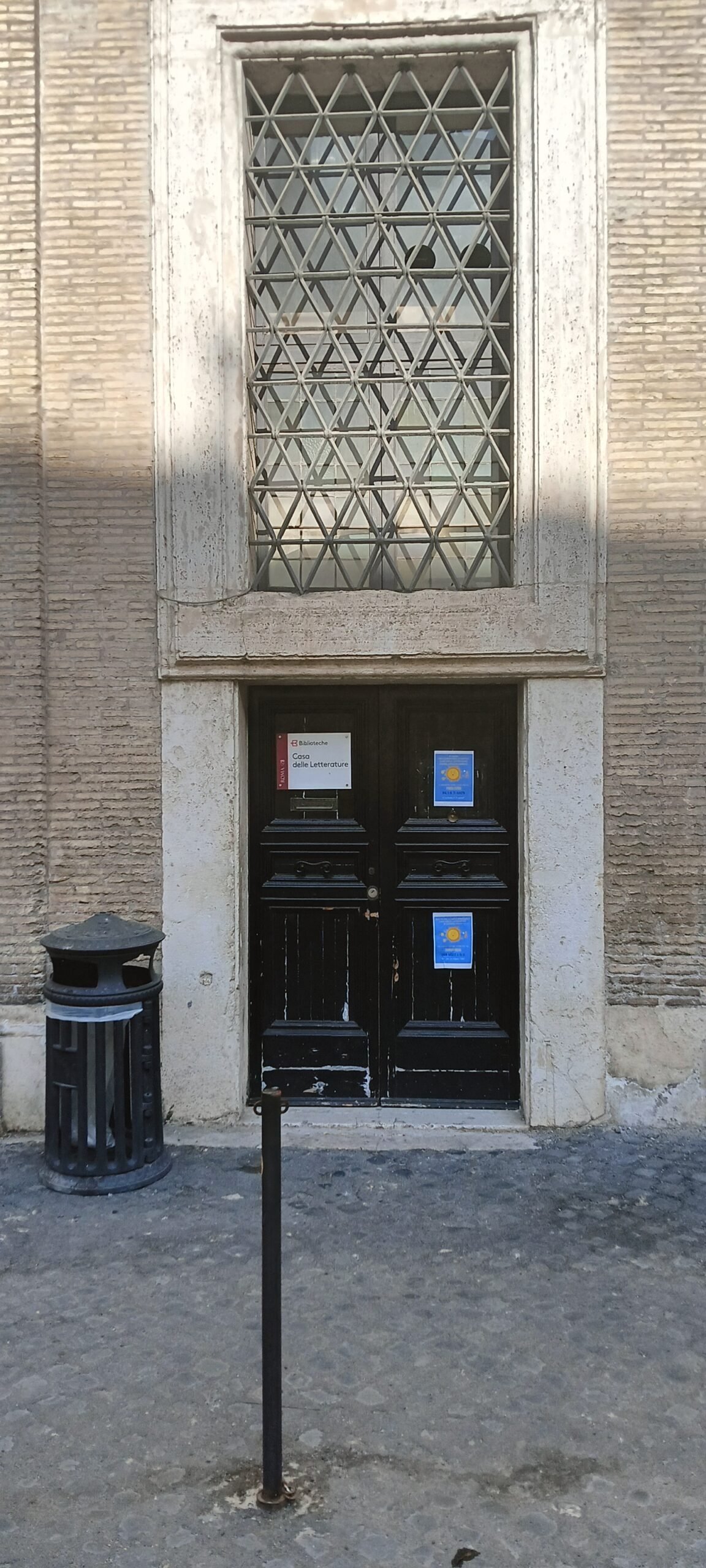
Planning a trip to Rome? The English-language guides for visiting the city are on ItalyPlanner.com.
Contact Information
Piazza dell'Orologio, 3
Roma Roma Città, Roma Città