Museum of Rome – Palazzo Braschi
In short. The Museum of Rome - Palazzo Braschi has two addresses and only one entrance that matters: Piazza di San Pantaleo 10 and Piazza Navona 2, 00186 Rome, in the Parione district, with the bulk of the palace wedged between Corso Vittorio…
The Museum of Rome - Palazzo Braschi has two addresses and only one entrance that matters: Piazza di San Pantaleo 10 and Piazza Navona 2, 00186 Rome, in the Parione district, with the bulk of the palace wedged between Corso Vittorio Emanuele II and the south corner of Piazza Navona. You get there on the buses of Corso Vittorio Emanuele II, which stop at Sant'Andrea della Valle or level with the Barracco Museum, 70 meters from the doorway. Tram 8 and the lines of Largo di Torre Argentina leave you eight minutes away on foot. The metro doesn't come here, and it's good to know that before planning your day. The ticket for the museum alone costs €7.50 full price and €6.00 reduced. Buying online adds a €1.00 advance-sale fee and is non-refundable and non-changeable. Residents of Rome and the Metropolitan City get in for free by showing an ID. The MIC card, €5 a year for residents, people domiciled in Rome and university students, opens the whole civic system for 12 months. The museum is open Tuesday to Sunday, generally from 10:00 to 19:00, with last entry one hour before closing. It's closed on Monday, as well as on January 1, May 1 and December 25, while on December 24 and 31 the hours are shorter. The temporary exhibitions on the first floor have their own ticket office and conditions, which don't follow those of the permanent collection. The single number for information and bookings is 060608. Hours and prices of the exhibitions on the calendar should be confirmed on the official website of the museum before you leave the house.
This guide is part of EstateRomana's collection of museums of Rome: if you're building an itinerary of several days, that page is the place to start.
Where the Museum of Rome - Palazzo Braschi is and how to get there
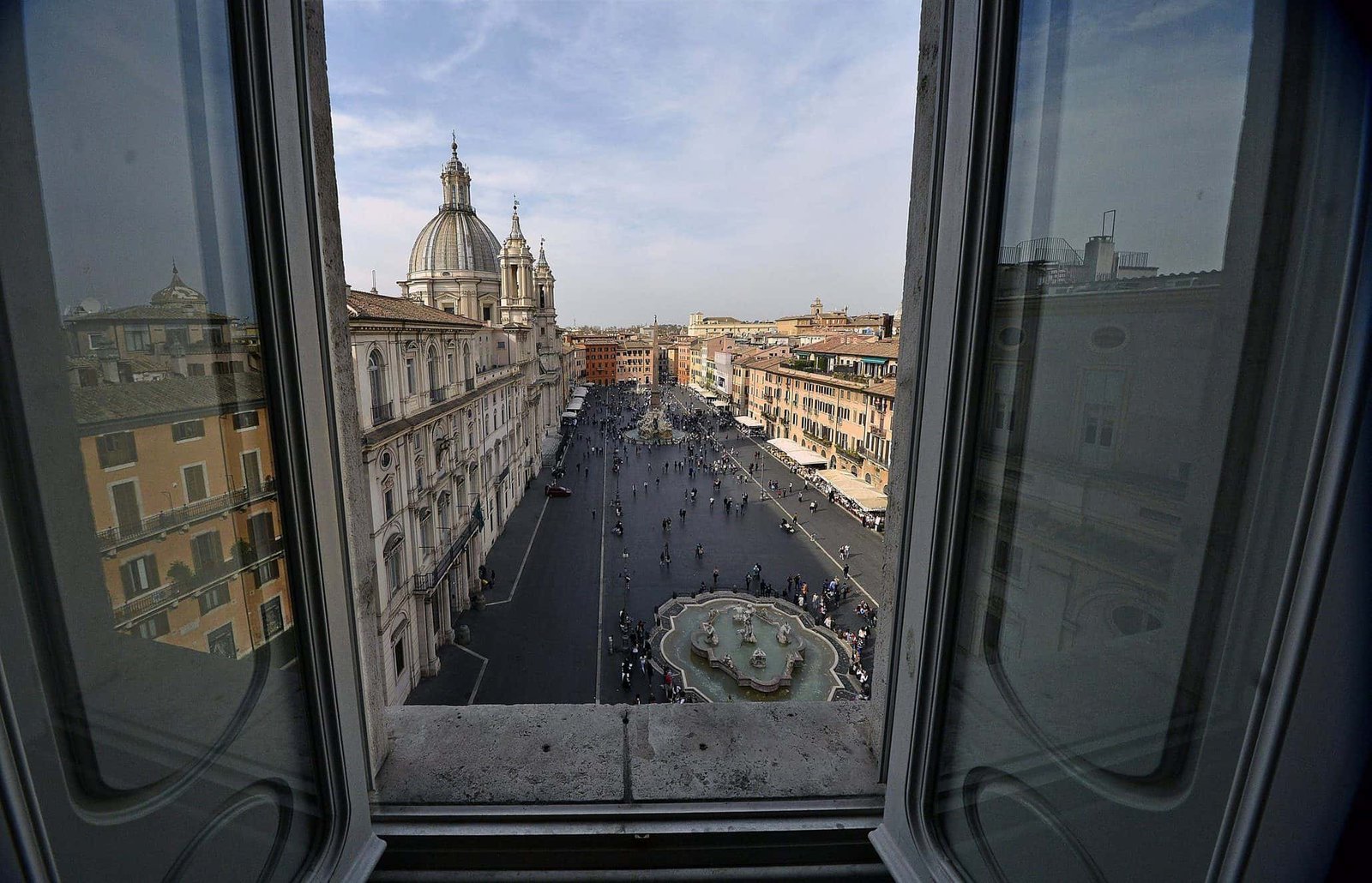
Palazzo Braschi takes up an entire block of trapezoidal shape. It's not a detail for scholars: it means the building has different faces on four urban fronts, and that depending on where you arrive from you see it as three different palaces. The main front, the one with the two monumental doorways, looks onto Piazza di San Pantaleo, the widening on Corso Vittorio Emanuele II. A second arched entrance opens on Via della Cuccagna, the alley that runs down toward the southern side of Piazza Navona, and a third looks directly onto the square. The public entrance, with ticket office and checks, is the one on Piazza San Pantaleo.
By bus to the Museum of Rome - Palazzo Braschi
Corso Vittorio Emanuele II is one of the best-served surface routes in the historic center, and the useful stop is Sant'Andrea della Valle, in front of the basilica with the second highest dome in Rome. From there to the museum doorway it's a walk of less than a minute: you pass the facade of the Barracco Museum, go past the church of San Pantaleo and you've arrived. The lines that run along the Corso connect Termini station, the Vatican, the Janiculum and Trastevere. The numbers change over time and it's best to check them the same day on the public transport app, because on this route detours for demonstrations and religious events are frequent.
By metro and tram to Palazzo Braschi
It has to be said bluntly: Rome's metro carefully avoids the quadrant between the Pantheon, Piazza Navona and Campo de' Fiori. There's no convenient stop, there won't be for years, and if you arrive on Line A you have to get off at Barberini or Spagna and count on 20 minutes of walking, or change vehicles. Tram 8, which reaches Largo di Torre Argentina from the Trastevere side and continues toward Piazza Venezia, is the most sensible alternative for anyone coming from south of the river: from Largo Argentina you take Via dei Barbieri or follow the Corso and in eight minutes you're in front of the palace.
On foot and by car
On foot the museum is five minutes from the Fountain of the Four Rivers, seven from Campo de' Fiori, 12 from the Pantheon, a quarter of an hour from Castel Sant'Angelo via Via dei Coronari. By car, quite simply, you don't come here: the whole area is a limited traffic zone with electronic gates active almost all day, parking spaces don't exist and the nearest sensible parking is the one at the Janiculum or Villa Borghese. If you come by taxi, get dropped off on Corso Vittorio Emanuele II and not in Piazza Navona, where taxis can't enter.
Tickets, free entry and MIC card at the Museum of Rome - Palazzo Braschi
The fee structure of the Museum of Rome - Palazzo Braschi deserves two minutes of attention, because it has changed and because it distinguishes between two different products: the permanent collection on the upper floors and the temporary exhibitions on the first floor.
How much the Museum of Rome - Palazzo Braschi costs
The official website of the museum lists €7.50 full price and €6.00 reduced for the permanent collection alone. Buying in advance online carries a presale fee of one euro, and a ticket bought online is non-refundable and non-changeable: a hard rule, which I advise taking literally before you pick a date. You can also buy at the museum's ticket window and through the 060608 call center, which answers every day with extended hours. For groups of five to 25 people booking is mandatory and free, with a minimum of five tickets bought in advance and the balance of the rest paid on site.
Who gets in free at the Museum of Rome - Palazzo Braschi
Since February 2026, residents of Rome and the Metropolitan City get into the permanent collection for free, by showing an identity document at the ticket office. It's the most significant change in recent years for the Roman public, and it changes how you use this museum: it's no longer the visit to plan once in a lifetime, it's the place where you go in for half an hour because you were passing by. Also free are children under six, people with disabilities with a companion, EU tour guides and tourist interpreters, ICOM and ICOMOS members, journalists with a valid ID, and students of European courses in architecture and conservation of cultural heritage. On the first Sunday of every month entry is free for everyone.
The MIC card and who it really suits
The MIC card costs €5 and is valid for 12 months from activation. It is reserved for residents, temporarily domiciled people and students of the public and private universities of Rome, and it gives access to the system of civic museums. With the free entry introduced for residents the card loses part of its reason to exist for this single museum, but it remains the right tool for people who live in Rome without being residents: out-of-town students, PhD students, professionals on long assignments. €5 for a year of civic museums is, by a wide margin, the best ratio of price to culture this city offers. Anyone who lives in Rome and hasn't gotten one is throwing away an opportunity.
Reductions and temporary exhibitions
The reduced rate goes to non-residents between six and 25, permanent teachers of state schools and groups of at least 20 people. On Wednesdays, in the last hours of opening, non-residents get a 50 percent reduction. School groups get in free by presenting the name list of students and teachers on school letterhead, with one teacher free for every 10 students. Watch out for one point that causes confusion at the ticket window: free entry and reductions for the permanent collection do not apply to the exhibitions on the first floor of the Museum of Rome, which have their own ticket, nor to the exhibition spaces of the Ara Pacis, Villa Caffarelli and the Planetarium. If you come for an exhibition, the math is different.
The palace of Pius VI: how Palazzo Braschi came to be
To understand this building you have to understand a mechanism that worked in Rome for three centuries and that ends here. In 1775 Giannangelo Braschi, a native of Cesena, ascends to the papal throne with the name Pius VI. Like his predecessors, he has a family, and like his predecessors he sets them up. His nephew Luigi Braschi Onesti receives titles, offices, incomes and exemptions with a generosity that even the Rome of the time, used to everything, judges immoderate. With that money the nephew builds the palace that still bears his name today.
The demolition of Palazzo Orsini
The land was not empty. Where Palazzo Braschi stands today there was the Orsini palace at Pasquino, a 15th-century building that had belonged to the Santobuono and before them to the Della Rovere, and that in the 16th century had hosted leading figures of the papal court. In 1791 that palace is bought and torn down. Anyone passing along Via di San Pantaleo today has no clue as to what was there before, except for the talking statue that was set against the corner of the old building and that has stayed in its place: Pasquino, precisely, the only surviving witness.
Cosimo Morelli, the architect from Imola
The commission goes to Cosimo Morelli (1732-1812), an architect from Imola, a man of the papal Romagna like the pope who chooses him. Morelli had built theaters, cathedrals and palaces in the Papal Legations, and he arrives in Rome already mature. The design he delivers is not an exercise in fashionable neoclassicism: Morelli looks to the Roman models of the 16th century, to the relationship between brick and travertine, to the rustication that is high at the base and at the corners, and he builds a building that looks older than it is. It's a conscious choice and it's the reason the palace holds its own against its Renaissance neighbors without looking like an intruder. Anyone looking here for the revolution of neoclassical taste will be disappointed. Anyone looking for the last great statement of the Roman tradition finds it whole.
A building site interrupted by history
Work starts in 1791 and goes on until 1798, when the French occupation of Rome stops everything. Pius VI is deported and dies in exile in Valence in 1799. The building site stands still for four years and resumes in 1802, under another pontificate and in a changed world. By 1804 the monumental staircase is finished, and in all probability so is the chapel on the first floor, which critics attribute to Giuseppe Valadier (1762-1839). The economic difficulties of Duke Luigi Braschi Onesti prevent him from completing all the decorations: at his death, in 1816, several rooms are still unfinished. The palace we see is therefore a project that partly remained at the stage of intention, and this incompleteness can still be read today as you climb to the upper floors.
The last palace of papal nepotism
Palazzo Braschi has a distinction that no other Roman building can claim: it is the last great palace built in Rome with the mechanisms of papal nepotism. After it, the French Revolution, the occupation, the Restoration and finally the end of temporal power close that season forever. Looking at this facade knowing it is the conclusion of a series that includes the Farnese, the Borghese, the Barberini, the Pamphilj and the Chigi completely changes the way you look at it. It's not a late palace: it's an epilogue.
The monumental staircase of Palazzo Braschi
If I had to give a single reason to enter this museum even with only 20 minutes, I would give the staircase. It's not a brochure figure of speech: it's a work that stands at the absolute peak of Roman civic architecture and that the general public doesn't know.
The 18 red granite columns of Palazzo Braschi
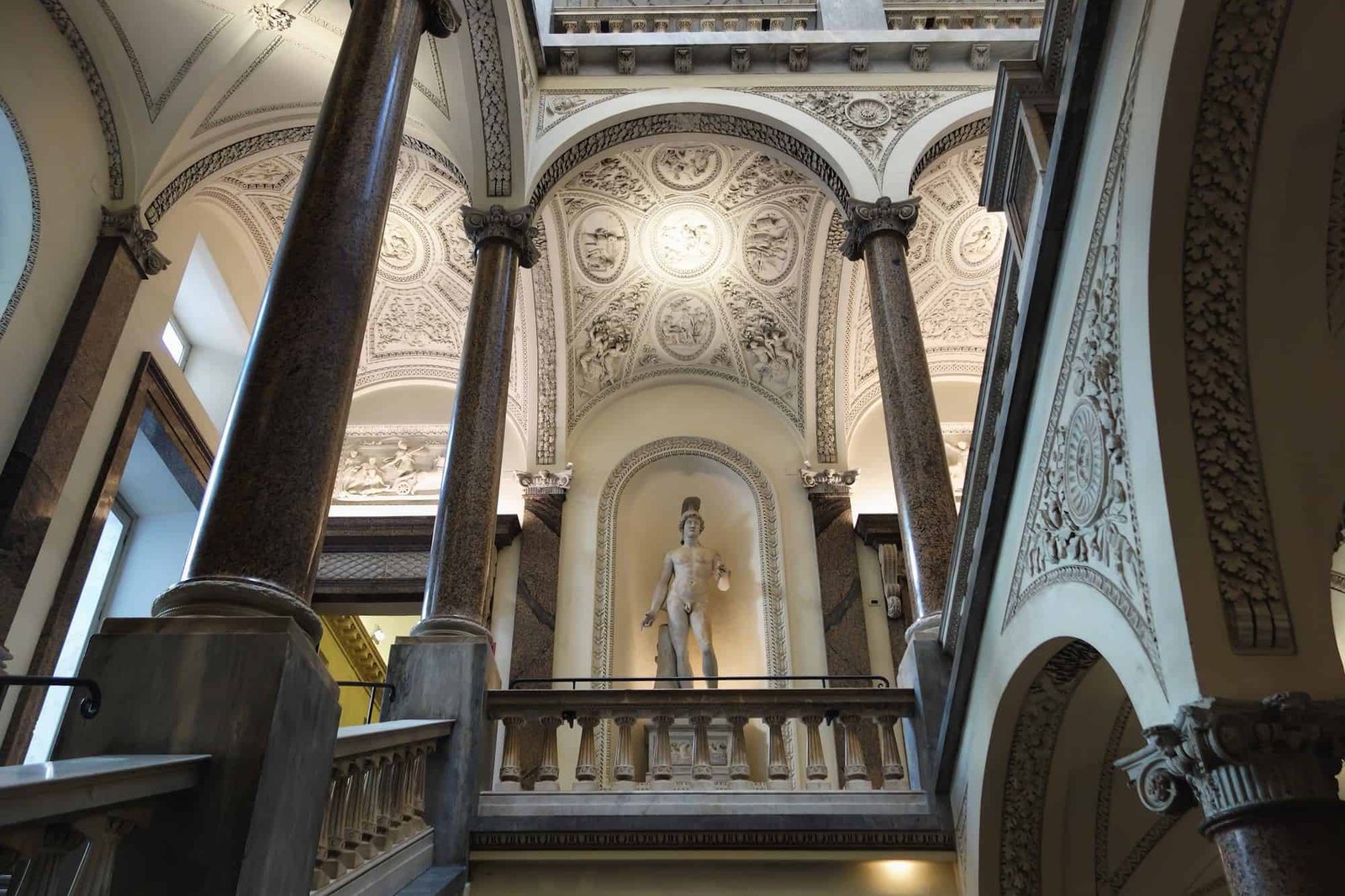
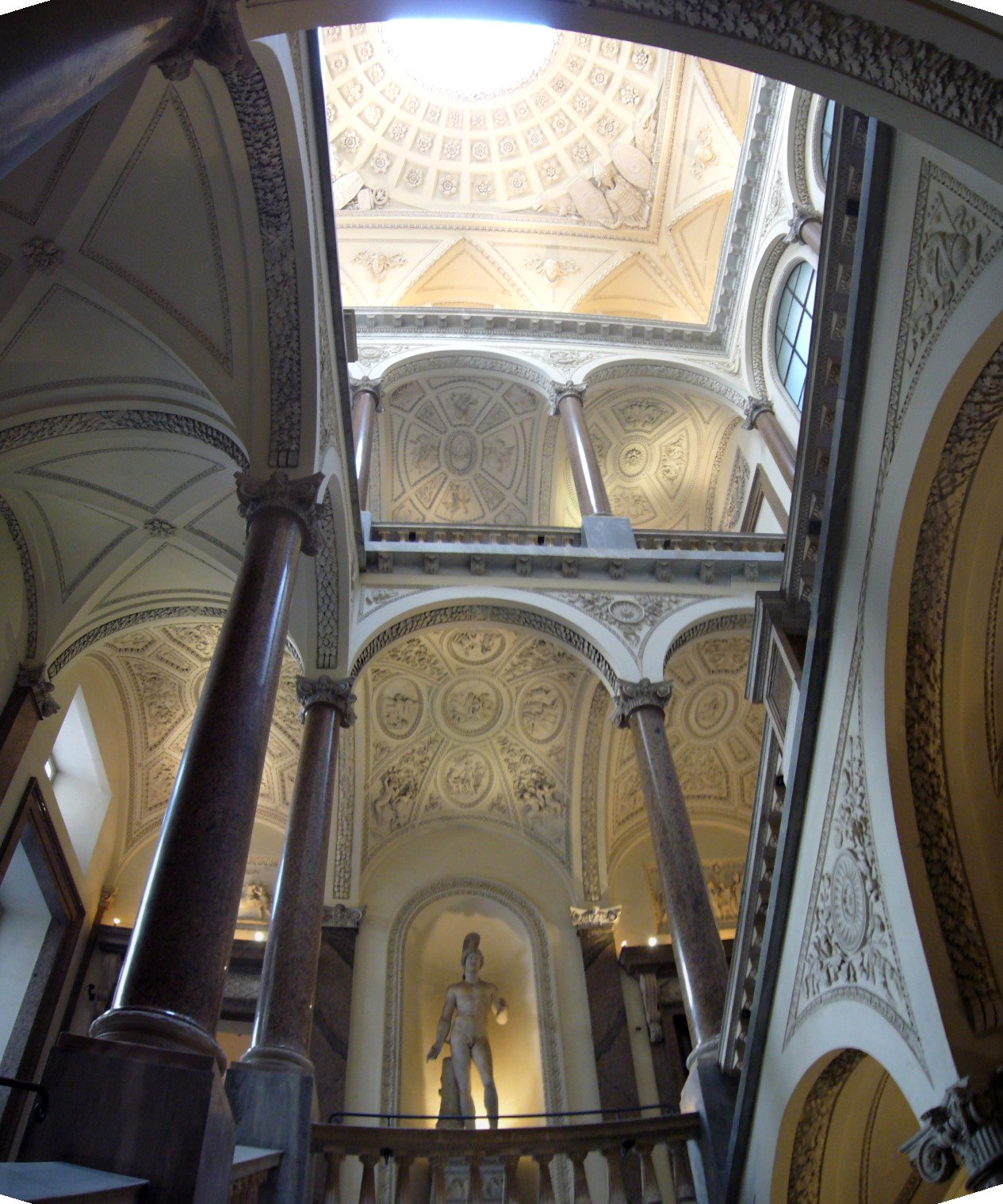
The staircase unfolds in two flights marked by 18 red granite columns. Those columns have a very long biography. Before arriving here they were in a cloister of the Santo Spirito in Sassia Hospital, and before that they belonged to a portico commissioned by the emperor Caligula on the banks of the Tiber. Between the first installation, in the first century AD, and the present placement, 17 centuries and at least two reuses go by. It's Roman reuse in its purest form: nobody threw away a shaft of Egyptian granite, ever. I point out one thing because the wrong version often circulates: the provenance documented by the museum indicates the portico of Caligula by way of Santo Spirito, not the Portico of Octavia with which it is sometimes confused.
Luigi Acquisti and the Iliad in stucco
The walls of the staircase are modeled with stucco reliefs by Luigi Acquisti (1745-1823), a Bolognese sculptor trained in the climate of Emilian neoclassicism. The iconographic program is entirely Homeric: the myth of Achilles and the stories of the Iliad. Achilles among the daughters of Lycomedes, the wrath, the duel, the ransom of Hector's body. It's not generic decoration. It's a cycle, and it has a precise meaning. The patron, the nephew of a pope, has the story of the Greek hero par excellence told to him in his own home. It's worth climbing slowly, stopping at every landing and reading the panels one by one: they are among the best stucco sculptures of Roman neoclassicism and nobody ever looks at them because everyone is in a hurry to get to the ticket office.
Valadier and the last great Baroque staircase
Morelli designs the staircase, but its realization takes place with the collaboration of Giuseppe Valadier, who in the Rome of those years is the most influential architect. The cultural heritage catalog defines this staircase as the last great Baroque staircase on the threshold of the 19th century, and it is an exact formula: the space is still conceived to amaze whoever climbs, with the staging of light and columns, but the decorative vocabulary is already the new one. For some years now the lighting system has been completely redone, and the difference shows: the granite columns regain the color they had lost under the old lamps.
The exterior architecture of the Museum of Rome - Palazzo Braschi
Before going in, walk around the building. It takes six minutes and saves you half an hour of captions.
The facades, the rustication and the coats of arms of Palazzo Braschi
Morelli works on the contrast between brick and travertine, with rustication that is high at the base and on the corners, which gives the building the solidity of an urban fortress. Raise your eyes to the cornice: in the metopes the stars and lilies of the Braschi coat of arms are carved. They are the heraldic signature of the family, repeated along the whole perimeter. Lower down, at the ground-floor windows, look for the lion heads with a pine cone in their mouths: they are the emblem of the Onesti, the maternal branch, and whoever notices them for the first time usually stops to count them. It's the 18th-century way of writing your name on stone, without writing it.
The atrium of the Museum of Rome and the Chigi carriage
The entrance atrium, refitted with the new museum design, hosts an 18th-century carriage of the Chigi family. It is a gala sedan chair from 1776, commissioned by Sigismondo Chigi: carved wood, gilding, glass, an object built to be seen from outside as it crossed the streets of Rome. Putting it at the entrance was a smart choice, because it is exactly the kind of object this museum tells better than anyone: not sublime art, but the way a city represented itself to itself.
The courtyard of Palazzo Braschi
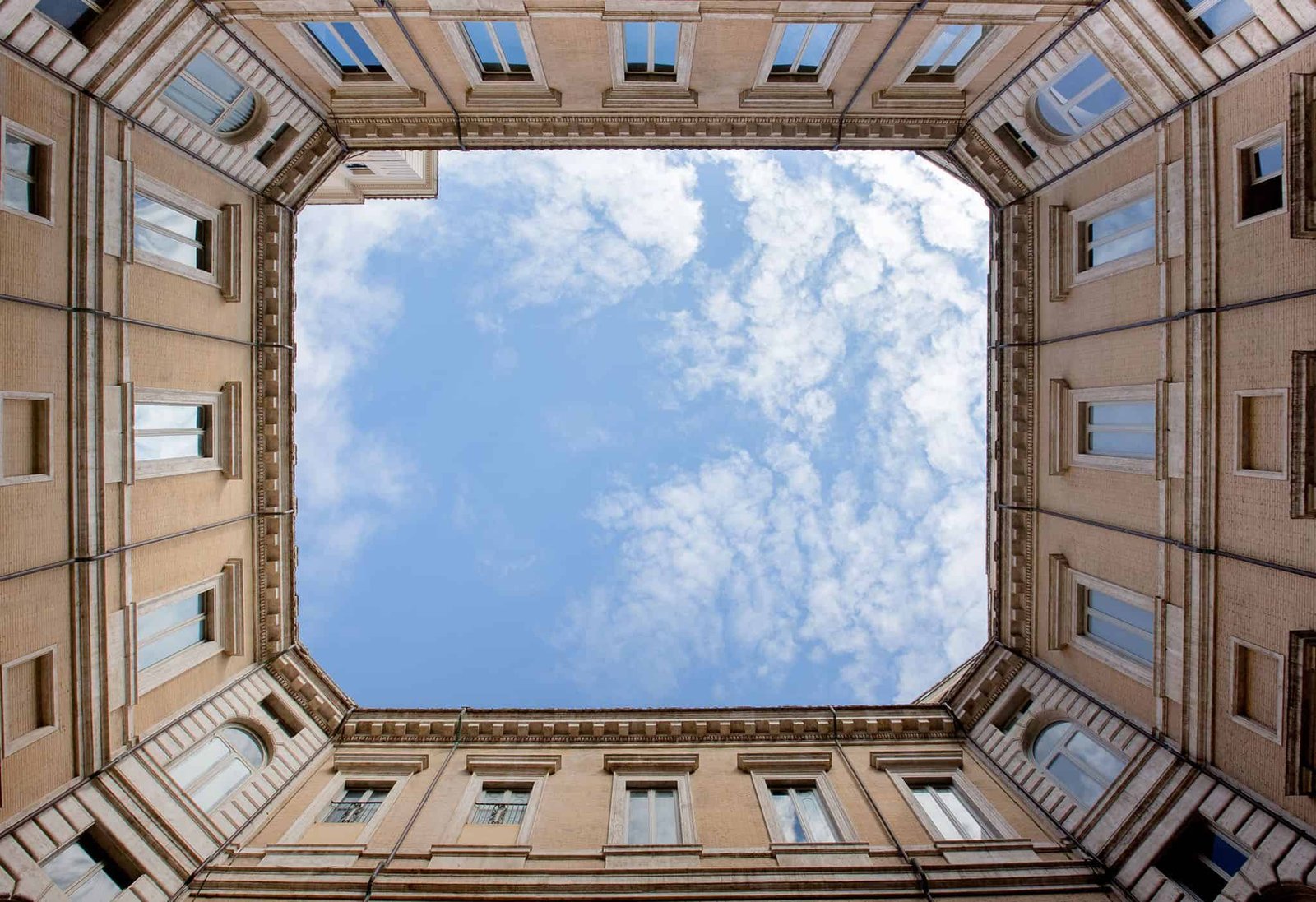
The central courtyard is the most severe part of the building, and for years it was a service space. Anyone lucky enough to cross it on a clear day understands how the machine of the palace worked: the noble apartments on the upper floors, the services and storerooms below, the grand staircase as the only ceremonial route. The rest of the circulation took place on secondary stairs that the visitor never sees.
The frescoed rooms: Liborio Coccetti and the decoration of the apartments
One thing the distracted visitor misses completely is that quite a few rooms of the museum are works of art in their own right. They are not neutral containers: they are decorated spaces, and in several cases the decoration is worth as much as what is displayed inside.
Who Liborio Coccetti was, the painter of Palazzo Braschi
Liborio Coccetti (1739-1816), a painter from Foligno active in Rome, decorates the three noble apartments of Palazzo Braschi between the very last years of the 18th century and the first decade of the 19th. He works in tempera, with a repertoire of grotesques, false architecture and landscapes that derives from the rediscovery of the Domus Aurea and the Vatican Loggias, filtered through late 18th-century taste. He is an artist that art historians know very well and that the general public ignores completely. Here he left his most extensive work.
The rooms of Proserpina, Apollo, Cephalus and Procris
The cycles that are best recognized are those of the Proserpina room, the Apollo room and the room dedicated to the story of Cephalus and Procris, the unhappy couple of Ovid's Metamorphoses. Then there is the room with the Roman Stories, where the repertoire moves from Greek mythology to the history of the city. The advice is simple: in each of these rooms, before looking at the display cases, raise your head and go around the ceiling. Then look at the works. The relationship between container and content changes completely.
The chapel on the first floor of Palazzo Braschi
On the first floor is the chapel, probably completed by 1804 and attributed by critics to Giuseppe Valadier. The attribution should be taken for what it is: a widely accepted proposal, not a signature on the contract. The private chapel was the sign of a precise status, the right to have Mass celebrated in your own home, and its presence in a cardinal's or prince's palace was never a devotional detail but a legal fact.
From Ministry of the Interior to Fascist Federation: Palazzo Braschi in the 20th century
The most surprising part of this building's history is not from the 18th century. It's from the 20th, and it's a story that in Rome is rarely told.
The sale to the Italian State
In 1871, with Rome the capital for only a few months, the Braschi heirs sell the palace to the Italian State. The new owner turns it into the seat of the Ministry of the Interior and the Presidency of the Council: for half a century, anyone entering from Piazza San Pantaleo was entering the central administrative machine of the Kingdom. In 1923 the Ministry moves to the Viminale, into the palace built for the purpose, and Palazzo Braschi is left empty.
The Provincial Federation of the National Fascist Party
The emptiness doesn't last long. The building becomes the seat of the Roman Provincial Federation of the National Fascist Party, and for 20 years it is one of the most concrete centers of power in the city: not the stage of the speeches, which was elsewhere, but the office where membership cards, recommendations, hirings and purges were decided. The mosaic of the so-called Madonna del Fascio also passed temporarily through the palace, later transferred to Predappio. After September 8, 1943, the seat passes to the Republican Fascist Party and hosts the headquarters of the Armed Guard of Palazzo Braschi, a formation that in occupied Rome earned a very bad reputation. These are pages that the museum doesn't hide and that no plaque on the facade summarizes: whoever wants to understand what Rome was between 1943 and 1944 must know that this address was one of the addresses.
300 families inside Palazzo Braschi
When the war is over, the abandoned palace is occupied. Until 1949 about 300 families of displaced people and homeless people lived there: improvised kitchens, fires lit in the reception rooms, partitions put up in the frescoed halls. The damage is enormous. The frescoes blacken, the floors are ruined, furnishings and materials are carried off. It is the hardest page in the history of the building, and at the same time the most human: while Italy was coming out of the war, the last palace of papal nepotism served as a refuge for those who had no roof. Whoever visits the restored rooms today walks on floors that have seen both things.

How the Museum of Rome Began: From the Pastificio Pantanella to Palazzo Braschi
The museum and the palace have two separate histories that meet only in 1952. It is worth keeping them distinct, because they explain why this museum is the way it is.
April 21, 1930, the Birthday of Rome
The Museum of Rome was inaugurated on April 21, 1930, the day of the Birthday of Rome, in the spaces of the former Pastificio Pantanella in Piazza della Bocca della Verità. It was founded and directed by Antonio Munoz, director of Antiquities and Fine Arts of the Governorate, one of the men who materially rewrote the face of Rome in those years, with the demolitions and the freeing of ancient monuments. The museum was born within a precise program of cultural propaganda.
Next to the Museum of the Empire
In the same building there was already the Museum of the Empire, founded in 1926. The division of tasks was clear: the Antiquarium and the Museum of the Empire celebrated the myth of ancient Roman greatness, of which the regime proclaimed itself the legitimate heir, while the Museum of Rome had the job of filling the gap between that era and the present, reconstructing an epic of medieval and modern Rome. Put another way: a continuous line was needed between Augustus and the regime, and this museum had to supply the centuries in between. Understanding this origin is indispensable for reading the collections correctly, which were formed with that criterion and which today are looked at with very different eyes.
The 1952 Move to Palazzo Braschi
In 1952 the Museum of Rome moved to Palazzo Braschi. It is the meeting of a container just freed of its occupants and a collection that was looking for a home. On the exact date of the transfer of ownership from the State to the city administration the sources do not fully agree, and when in doubt it is best to stick to the certain fact: since 1952 the palace has been the seat of the civic museum that tells the story of the city.
The Gabinetto delle Stampe and the Photographic Archive
At the beginning of the 1970s the extraordinary growth of the graphic and photographic collections required a reorganization: the Gabinetto delle Stampe and the Archivio Fotografico Comunale were born as autonomous structures. In 1994 they were absorbed back into the Museum of Rome. From that moment the historical-documentary vocation of the origins gradually turned into a vocation of artistic enhancement, and the museum began to behave like a picture gallery as well as an archive of the city.
Closure, Restoration and Reopening
In 1987 the building was closed as unfit for use. Years of complex and costly work followed, with a partial reopening in 2002 that left out the upper floors. The chapter closed on March 28, 2017, when the new arrangement of the museum rooms was inaugurated: a thematic rather than chronological route, spread over the second and third floors, with the first floor reserved for temporary exhibitions. 30 years between the closure and the completion. It is a fact that says a lot about how restoration is done in Italy.
The New Layout of the Museum of Rome - Palazzo Braschi
The 2017 project overturned the approach. The criterion is no longer chronological but thematic, and the visitor is no longer a receiver of information but the center of the narrative: the declared idea is that Palazzo Braschi should mirror and reflect the history of Rome between the 17th and the 20th centuries through a cross-cutting reading of social and cultural phenomena. In practice, instead of starting from the 1600s and ending in the 1900s, you move through themes: the city as represented, families and their palaces, festivals, the taste for the exotic, furnishings, the portrait, photography.
Why the Thematic Route Works Here
With 120,000 objects in storage, a chronological route would have produced the usual string of rooms that the visitor walks through without remembering anything. The thematic route instead makes it possible to put side by side a painted view and a photograph of the same place a century apart, a dress and the portrait of the person who wore it, a model of a carriage and the print that shows it in procession. It is a museum that is read by juxtaposition, and anyone who visits it looking for masterpieces one by one comes out dissatisfied. The judgment is clear: this is not a museum of masterpieces, and anyone who goes in thinking of the Galleria Borghese has the wrong address. It is a museum of visual documents, and it is the best of its kind in Italy.
How Many Rooms and How They Are Arranged
The permanent collection route occupies about 15 rooms on the second floor and a smaller group, around half a dozen, on the third. The first floor is reserved for temporary exhibitions and has its own entrance and ticket. The atrium and the grand staircase can be crossed anyway, and are free up to the ticket office: anyone who really has only 10 minutes can go in, climb the staircase and leave, and will still have seen one of the best things in the historic center.
The Room-by-Room Visit on the Second Floor of the Museum of Rome
I describe the main floor of the museum as it presents itself to the visitor. The installations are updated and some rooms rotate the displayed pieces, especially the works on paper, which for conservation reasons cannot stay in the light beyond certain periods.
The Roman families and their palaces at the Museum of Rome
A substantial part of the second floor is organized around the great Roman families and their interiors: Barberini, Rospigliosi, Torlonia, Chigi. It is not a gallery of noble portraits, but the reconstruction of how people lived inside a Roman palace between the 17th and 19th centuries: tapestries, inlaid furniture, tables of inlaid hard stone, mirrors, medal cabinets, chests of drawers, carved bases made to hold busts. Among the tapestries, one stands out with the bees of the Barberini coat of arms, an emblem you meet everywhere in Rome, from the canopy of St. Peter's to the fountains, and which here is found woven into a domestic setting. It is the physical proof of how much a family symbol could saturate the daily life of a house.
The Chinese room of Palazzo Braschi and the taste for the exotic
Among the most memorable rooms is the one dedicated to exoticism and the decorative arts, commonly called the Chinese room or the chinoiserie, created around the middle of the 19th century. The fashion for Chinese-themed decoration runs across all of Europe between the 18th and 19th centuries, and Roman palaces are no exception: screens, lacquers, painted papers, furniture imitating Oriental models seen through prints. It's a room that surprises those who expected only views of Rome, and that documents a little-told aspect of the papal aristocracy: its curiosity for a world it had never seen.
The Torlonia alcove and the Muses
The route includes the reconstruction of the alcove from Palazzo Torlonia, with the frescoes depicting the Muses. An alcove was the bed niche in noble apartments, a scenographic space inside the bedroom, often separated by columns or an arch. What you see here is a setting taken apart and put back together, saved from a demolition, and it should be looked at as a piece of archaeology of 19th-century living. It's also one of the points where visitors stop the longest, because they understand immediately what is in front of them without needing to read the label.
The views of Rome at the Museum of Rome - Palazzo Braschi
The documentary heart of the Museum of Rome - Palazzo Braschi is the collection of views: paintings, watercolors, tempera works and prints that depict the city before the great transformations. They are the images of a Rome that no longer exists: the port of Ripetta, the markets under the porticoes, the Tiber without its embankment walls, the alleys demolished to open Corso Vittorio Emanuele II and Via Nazionale, the Ghetto before the demolitions. Whoever looks at these works next to the current topography understands how much the historic center that we call intact today is in reality the result of very heavy demolitions, carried out between 1870 and 1940. This is exactly why the museum exists, and it is exactly what no other Roman museum does.
Festivals, processions and ceremonial Rome
One section documents public festivals and ceremonies: the papal possessi, the processions, the fireworks of Castel Sant'Angelo, the Girandola, the ephemeral apparatuses built of wood and stucco for a single evening and then taken down. Nothing remains of those apparatuses except the engravings and drawings kept here. It is one of the most important collections in the world on a subject Italy invented: the Baroque festival as a political instrument. Look at the prints carefully, because they contain a level of urban detail that no written description conveys.
Portraits, sculptures and the Braschi collection
The museum holds ancient sculptures from the Braschi collection, along with a sizable series of sculpted portraits: popes above all, and to a lesser extent busts of nobles. In terms of artistic quality they are uneven works. In documentary terms they are extremely valuable, because they give back the faces of a ruling class that governed Rome for centuries. Among the paintings the collection includes works attributed to leading masters, with the Rospigliosi collection among the nuclei of provenance. The attributions, as always in these collections formed by aggregation, have different degrees of certainty and the labels report them with due caution.
Bartolomeo Pinelli at the Museum of Rome - Palazzo Braschi
Bartolomeo Pinelli (1781-1835), a Roman from Trastevere, is the artist who fixed forever the image of the popular Rome of the 19th century: the brigands, the pipers, the women of Ciociaria, the taverns, the scenes of everyday customs. A draftsman and engraver prolific beyond belief, he sold his series to Grand Tour travelers, who took them home the way people buy postcards today. The Museum of Rome holds a substantial collection of his work. One clarification: Pinelli doesn't document Rome, he stages it. His figures are built for the foreign market and have to be read as such. Which takes nothing away from their graphic force, which is remarkable.

The Third Floor of the Museum of Rome - Palazzo Braschi
The third floor is the part almost nobody reaches, and that is one of the reasons I recommend it. People who arrive tired on the second floor stop there. Those who keep climbing find less crowded rooms and material of great interest.
The Mosaics of the Constantinian Basilica of St. Peter
Among the most notable pieces in the museum are mosaic fragments from the Constantinian basilica of St. Peter, the fourth-century building demolished between the 1400s and 1500s to make room for the present basilica. Of that immense church, which stood for over 1,000 years, very few physical traces remain, scattered between the Vatican and Rome's museums. Having a fragment of those mosaics in front of you means standing before the only St. Peter's the Middle Ages ever knew. It is worth the ticket on its own, and nobody talks about it.
The Print Room and the Municipal Photographic Archive
The third floor is home to the Print Room and the Municipal Photographic Archive, two institutions that make up the city's visual memory. The collections include engravings, drawings, printing plates, and a photographic collection that covers the period from the mid-19th century onward: photographs of the demolitions, the construction sites, the floods, the streets before and after. Consulting the holdings is reserved for scholars, with procedures of its own, but a selection regularly enters the exhibition route and the shows. For anyone interested in urban history, this is one of the richest deposits in Europe.
Historical Photography at the Museum of Rome - Palazzo Braschi
The photography section is the one that strikes younger visitors most. Seeing Piazza Navona without cars, the Tiber before the embankment walls, the neighborhoods demolished around the Altare della Patria, the countryside that began where the established suburbs are today, produces an immediate effect that no text achieves. Anyone interested in vanished Rome will find their floor here.
Views of the 20th Century
The third floor also hosts works that bring the story into the 20th century: the city of the ventennio, the postwar years, the years of reconstruction. It is the part closest to us in time and, paradoxically, the one that causes the most astonishment, because Rome's 20th century has been removed from the usual tourist narrative.
The Carriages, Clothes, and Objects of the Museum of Rome - Palazzo Braschi
Among the collections that make this museum unique are those that no art museum would agree to keep.
The Carriages and Sedan Chairs of Palazzo Braschi
The collection of historic vehicles includes gala carriages and sedan chairs from the 1700s and 1800s. The first piece you meet, at the entrance, is the Chigi sedan chair of 1776 commissioned by Sigismondo Chigi. These objects were the 18th-century equivalent of the official limousine: they cost as much as a house, they were shown in public, and they communicated rank. Their state of conservation is a serious technical problem, because wood, fabric, leather, glass, and gilding age at different speeds within the same object.
The Clothes and Costumes of the Museum of Rome
The museum keeps a collection of clothing that covers the 1600s to the 1900s: court dress, liveries, ceremonial costumes, civilian garments. Textiles are very fragile materials, sensitive to light and humidity, and for this reason their display is necessarily rotating and for limited periods. If you find a clothing section open during your visit, consider it a stroke of luck and look at it slowly: the history of Roman costume is told almost only here.
Ceramics, Medals, Furnishings
The picture is completed by ceramics, medal cabinets, coins, mirrors, and fine furniture, concentrated in the 1700s and 1800s. These are the collections the museum inherited from donations and 20th-century purchases, and they document the taste of Roman households. Anyone with a weakness for the applied arts can spend an hour in there without noticing.
Temporary Exhibitions at the Museum of Rome - Palazzo Braschi
The first floor of Palazzo Braschi is one of the most active exhibition venues in Rome, and for a substantial share of the public it is the only reason they know this address. The exhibitions have their own ticket office and do not follow the free admission of the permanent collection.
What Is On Now and What Is Coming
This season the museum hosts the exhibition dedicated to Ettore Scola, titled Ettore Scola. Non ci siamo mai lasciati, open from May 2 to September 13, 2026: a documentary route through the director's personal and artistic life, with material that interweaves Italian cinema and the city. From October 6, 2026 to April 11, 2027, a major retrospective on Keith Haring is announced, one of the most recognizable figures of the late 20th century. In the small rooms on the ground floor, shorter projects follow one another, often dedicated to young artists and to collaborations with the Academy of Fine Arts. The calendar changes constantly: if you plan your visit around a particular title, check the dates on the official website before you set out.
The Museum of Rome - Palazzo Braschi for Visitors Who Are Blind
Throughout 2026 there is a program of tactile and sensory guided tours, titled Il Museo di Roma e il suo racconto in-tatto, designed for blind and partially sighted visitors. It is the kind of initiative that gets announced a lot and delivered little: here it is scheduled across the whole year, and it must be booked through the museum's channels.
The Relationship Between Exhibitions and the Collection
I'll give an opinion that is not popular among insiders: the machine of the big exhibitions has overshadowed the permanent collection. Many Romans have been to Palazzo Braschi three or four times and have never set foot on the second floor, because they always came in for an exhibition and left after it. With free admission for residents, this balance may change, and that would be good news. The collection is worth more than half of the exhibitions it hosts.

The Museum of Rome - Palazzo Braschi and the Museum of Rome in Trastevere
One of the most frequent misunderstandings concerns the two museums that have almost the same name. The Museum of Rome in Trastevere, in Piazza Sant'Egidio, is the branch location, housed in the former Carmelite convent. It is not a duplicate: it has a different focus, devoted to popular traditions, photography, and exhibitions.
The Watercolors of Ettore Roesler Franz and the Museum of Rome
The most common confusion concerns the watercolors of vanished Rome by Ettore Roesler Franz (1845-1907), a Roman painter from a family originally from northern Europe, who between 1878 and 1896 painted from memory and from life the parts of the city that were being demolished. They are visual chronicles of an almost documentary topographical precision, and they are the best way to understand what Rome lost in 30 years. Anyone looking for them should know that the cycle is on view at the Museum of Rome in Trastevere, not at Palazzo Braschi: many visitors come here specifically for it and leave disappointed. The two locations belong to the same museum and the same collections, but the layout of the visit is different and it is worth checking before you set off.
How to Combine the Two Locations
If you have a day, the pairing works very well: Palazzo Braschi in the morning, a long lunch along the river, and in the afternoon Trastevere, with the museum in Piazza Sant'Egidio and then the churches of the rione. From Piazza San Pantaleo to Piazza Sant'Egidio it is a 20-minute walk across Ponte Sisto. It is one of the most coherent itineraries you can build in central Rome, because it tells the story of the same city from two complementary angles.
Pasquino, the Talking Statue Under the Windows of Palazzo Braschi
On the northwest corner of the palace, where the small piazza that bears his name opens up, stands Pasquino. It is a mutilated marble torso, from the Hellenistic age or a Roman copy of a Greek original, identified by scholars with a group of Menelaus supporting the body of Patroclus. It was found in the area and placed here in 1501 on the initiative of Cardinal Oliviero Carafa.
Why Pasquino Talks Under Palazzo Braschi
Since then, at the foot of the statue, Romans have stuck anonymous notes with satirical verses against those in power: these are the pasquinades, and the term has entered the vocabulary of half of Europe. The mechanism was simple and brilliant: attaching a piece of writing to a statue made it possible to say things for which a man would have ended up in prison, without exposing anyone. Pasquino conversed for centuries with Rome's other talking statues, the Babuino, Marforio, Madama Lucrezia, the Abate Luigi, the Facchino. The pasted papers are still there today: the victims have changed, the method is identical.
The Coincidence Worth a Chapter
The fact that the city's civic museum sits in the building at whose foot anonymous Roman satire has been practiced for 500 years is a perfect coincidence, and nobody emphasizes it enough. Before going in, stop for 30 seconds in front of the torso and read what is stuck to it today. Then go in. The museum that tells how Rome has represented itself begins exactly there.
How to Visit the Museum of Rome - Palazzo Braschi: Duration and Route
Here are the real numbers, useful for organizing your day.
How Much Time You Need at the Museum of Rome - Palazzo Braschi
For the permanent collection alone, second and third floors, you need 90 minutes at a normal pace. If you read all the labels and linger over the prints, you easily reach two and a half hours. If you are short on time, you can do a quick 40-minute visit focused on the grand staircase, the atrium, the frescoed rooms, and the views section. If you add an exhibition on the first floor, count on at least an hour more: the big retrospectives in this venue are dense and create internal lines.
The Route I Recommend Inside Palazzo Braschi
Go in, get your ticket, but don't take the elevator up right away. Climb the grand staircase on foot, all of it, stopping at Acquisti's reliefs. Reach the second floor and go through it clockwise, leaving the views section for last, since it is the one you look at best once you have understood the context. Then go up to the third floor, which is less crowded and where the St. Peter mosaics and the historical photography close the circle. Finally, go down to the first floor for the exhibition, if there is one. Done in this order, the museum makes narrative sense. Done in reverse, it looks like a storeroom.
Guides, Audio Guides, and Video Guides
The museum offers paid guided tours in several languages and video guides that can be purchased through the iOS and Android apps. The advice is simple: in this museum a guide changes the visit more than elsewhere, because what is on display is made of documents that are mute without context. A view of the Porto di Ripetta, without someone explaining where it was and why it is no longer there, is just a gray painting.
Bookshop, Coat Check, and Services
The museum has the standard services of the Capitoline civic venues, with a bookshop and storage for backpacks and umbrellas at the entrance. The rules on bulky luggage are the usual ones for civic museums: large backpacks must be left. The operating conditions of the individual services may vary and are indicated in the notices on the official website.
The Museum of Rome - Palazzo Braschi with Children
To the most frequent question the answer is yes, but with judgment. It is not a museum designed for small children and it has no interactive routes like certain science museums. But it has three cards that almost always work.
The Three Things at Palazzo Braschi That Win Children Over
The first is the grand staircase. 18 columns, light from above, stucco warriors: you climb it like in a movie, and children sense it immediately. Have them look for Achilles in the reliefs. The second is the carriage: a gilded 18th-century vehicle that every child stops in front of on their own, without anyone asking. The third is the historical photographs and views: showing a photograph of a place they saw this morning, as it was 150 years ago, is an experiment that always works. Ask them to find the differences. It works better than any workshop.
Practical Rules for Families
Children under six don't pay. Strollers are allowed in, and there is an elevator to reach the floors. A sustainable length of visit with children between six and 10 is about an hour: beyond that, you lose everything you gained. The palace has few places to sit, so it's best to plan a break outside, and Piazza Navona with its fountains is two minutes away. There are no play areas and no permanent educational route for the youngest, but the museum organizes periodic educational activities, whose calendar is on the official website.
Accessibility at the Museum of Rome - Palazzo Braschi
The building is a historic palace and this sets objective limits, but the museum is among the best equipped in the civic system.
Wheelchairs and Elevators
Piazza San Pantaleo entrance is accessible and the elevator allows you to reach the exhibition floors without tackling the grand staircase. People with disabilities enter free with a companion. Some internal passages between rooms of an 18th-century palace have thresholds and changes of level: anyone with specific needs does well to report them to 060608 when booking, so the staff can prepare the best route.
Blind and Partially Sighted Visitors
The program of tactile and sensory tours active throughout 2026 is the museum's most concrete answer on this front. The tours are booked in advance and are led by trained staff. It is one of the most serious offerings in the city on this subject and deserves to be known much more than it is.
When to Go to the Museum of Rome - Palazzo Braschi
The museum is open Tuesday to Sunday, with approximate hours of 10:00 to 19:00 and last entry one hour earlier. It is closed on Monday, like almost all Roman civic museums, and anyone arriving in the city on a Monday has to reorganize the day around other destinations.
The Best Hours for the Museum of Rome - Palazzo Braschi
The permanent collection never has serious lines, which is both a stroke of luck and an injustice. The first-floor exhibitions, on the other hand, create real waits on weekends and in the last weeks before closing. The best moment by far is Tuesday or Wednesday morning between 10:00 and 11:30: empty rooms, good light from the windows on the courtyard, staff available to answer questions. The worst moment is the first Sunday of the month, when free admission for everyone brings in many more people than usual. If you go that Sunday, arrive at opening time.
The Seasons
In summer this museum is a refuge: cool rooms, shade, 100 meters from a piazza that is impassable at noon in July. In winter it is the right alternative for a rainy day in the Historic Center, because it combines with Sant'Andrea della Valle, the Barracco Museum, and the porticoes of Corso Vittorio without ever staying outdoors too long. During long weekends and periods of heavy tourist flow it remains one of the least crowded addresses in the center.
Closures of the Museum of Rome - Palazzo Braschi to Keep in Mind
The museum observes closures on January 1, May 1, and December 25. On December 24 and 31 the hours are reduced to the morning only. Before planning a visit on a holiday or during city events, the notices page of the official website is the reference to consult.
What Is Around the Museum of Rome - Palazzo Braschi
This address is one of the best starting points in the Historic Center. Within a 10-minute walk there is more material than you find in some entire cities.
Piazza Navona and the Stadium of Domitian
The palace looks directly onto Piazza Navona, which preserves the shape of the Stadium of Domitian because it is built literally inside it. In the middle of the piazza is Bernini's Fountain of the Four Rivers, and at the northern end you go down to the underground levels of the stadium, where you can see the original structures of the first-century complex. 30 meters below the paving of the piazza runs the arena where Greek athletes ran.
Sant'Andrea della Valle and the Barracco Museum
Crossing Corso Vittorio you reach the Sant'Andrea della Valle Basilica, with the tallest dome in Rome after St. Peter's and the first act of Puccini's Tosca set in the Attavanti chapel. 100 meters away, in the Piccola Farnesina, the Barracco Museum gathers ancient Egyptian, Assyrian, Greek, and Roman sculpture in a small 16th-century palazzo: it is small, takes an hour to visit, and is one of the least visited museums in the center.
Campo de' Fiori and the Renaissance Neighborhood
Five minutes to the south opens Campo de' Fiori, with the market in the morning and the statue of Giordano Bruno in the middle. The network of alleys between the piazza and the Tiber is that of the Renaissance Rome of the guilds: Via dei Cappellari, Via dei Baullari, Via del Pellegrino. Walking through them means seeing an urban structure that has not changed since the 1500s.
The Other Museums in the Area
10 minutes to the north is Palazzo Altemps with the ancient sculpture of the National Roman Museum, and on the western side of Piazza Navona the Napoleonic Museum, an intact 19th-century apartment that almost nobody visits and that deserves half an hour. Not far away, San Luigi dei Francesi Church holds the three Caravaggios of the Contarelli chapel, free of charge. If you still have energy, Borromini's Sant'Ivo alla Sapienza Church is 15 minutes away and is open with very limited hours, so check first.
A Half-Day Itinerary Around Palazzo Braschi
The pairing that works best, and the one I always suggest to anyone with four hours: opening at the Museum of Rome - Palazzo Braschi, exit toward Piazza Navona and the underground levels of the stadium, San Luigi dei Francesi for the Caravaggios, a quick lunch around Campo de' Fiori, and closing at the Barracco Museum. Four very different places, no transfer longer than seven minutes, and an understanding of the city that no panoramic bus tour can give.
A Curiosity About the Museum of Rome - Palazzo Braschi
The curiosity that throws everyone off concerns the 18 red granite columns of the grand staircase. They were not cut for the palace. They were not bought from a quarry. They arrive here at the end of a journey of 17 centuries. The red granite is Egyptian, quarried at Aswan, shipped to Ostia and brought up the Tiber. The first patron was the emperor Caligula, who had them set up in a portico built on the banks of the river in the first half of the first century AD. When that portico disappeared, the shafts ended up reused in a cloister of the Santo Spirito in Sassia Hospital, where they stayed for centuries holding up the arches of a medieval hospital. At the end of the 1700s they were dismantled again and carried here, to support the state staircase of a pope's nephew.
Three patrons, three eras, three completely different functions for the same piece of stone: an emperor with a reputation for dissoluteness, a charitable institution of Christendom, a duke of papal nepotism. This is how Rome has really worked for 2,000 years, and the columns of the staircase say it better than any book. I'll add a note of precision, because a widespread error circulates on this point: the provenance given by the museum's documentation is the portico of Caligula by way of the cloister of Santo Spirito, not the Portico of Octavia, which sometimes appears in oral accounts and in inaccurate guides. They are two different monuments and two different stories.
There is one more detail I recommend checking with your own eyes. Look at the shafts up close, at hand height. The granite has different veining and inclusions from column to column, because the blocks come from different points of the quarry and because two millennia of history have treated them unevenly. Some have ancient tool marks, others show modern repairs. They are not 18 identical pieces. They are 18 objects with separate biographies lined up to make a single stage set. And that is exactly how this city is made.
Something Nobody Tells You About the Museum of Rome - Palazzo Braschi
What nobody tells you is that the atrium and the grand staircase of Palazzo Braschi can be walked through without a ticket. The ticket office is not at the main door: you go in, you are inside the palace, you see the Chigi sedan chair, you climb the first flight of the staircase, and only after that do you meet the checkpoint. This means that anyone passing through Piazza San Pantaleo can treat themselves to five minutes inside one of the most beautiful architectural spaces in the city without spending anything. It is a handy solution on full days, when there is no time for the complete visit: you go in, climb the flight, look at the columns and Acquisti's reliefs, and leave. There is nothing irregular about it: it is a public entrance.
The second thing nobody says concerns the third floor. People who buy a ticket almost all use it up on the second floor, arrive tired at the end of the route, and go down without climbing the last flight. The result: on the third floor you almost always find two or three people in total, and that is where the fragments of the mosaics from the Constantinian basilica of St. Peter and the historical photography of the city are. You paid for those rooms as much as for the others. Go up.
The third concerns a mistaken expectation that I see every week. Many visitors arrive here convinced they will find Roesler Franz's watercolors of vanished Rome, because they have read that they belong to the collections of the Museum of Rome. It is true that they belong to these collections, but the cycle is on view in the other location, the one in Trastevere. Anyone who cares about them must plan the day accordingly, and check beforehand which rooms are open in the chosen period: works on paper rotate for conservation reasons, and no serious museum leaves them exposed to light all year.
The Advice I Give You for Visiting the Museum of Rome - Palazzo Braschi
The most useful advice I can give is to reverse the mental order in which people approach this museum. Don't come here to see paintings. Come here to see places that no longer exist. It changes everything.
In practice it works like this. Before going in, take a five-minute purposeful walk: stop on Corso Vittorio Emanuele II and look at the width of the street, then slip into one of the side alleys that go down toward Campo de' Fiori. The difference between the two spaces is violent. That avenue was opened between 1876 and 1888 by demolishing entire blocks of the medieval and Renaissance fabric. The alleys left at its sides are what was there before. Keep that image in your head, go in, and look in the views section for depictions of that same area before the demolitions. At that moment the museum lights up and you understand why it exists.
Second practical piece of advice: give yourself an hour and a half, not 40 minutes. It is a museum for reading, not for glancing, and its works need to be compared with one another. Third: if you are a Roman, go for free and go often, half an hour at a time, instead of one marathon. The museum works very well in small repeated doses and very badly in a single dose. Fourth, and here I am direct: if you have only one day in Rome and it is your first time, this is not the museum to start from. Go to the Capitoline Museums, the Pantheon, the Colosseum. Palazzo Braschi is a museum for a second or third visit, when you have already seen Rome and want to understand how it became what it is. Taken at the right moment it pays back more than many famous names. Taken at the wrong moment it will seem like a string of dark paintings.
Another Well-Known Fact, Yet Rarely Cited
That Palazzo Braschi was the seat of the Fascist Federation can be read in many entries. What is rarely cited is that this building was, literally, the place where Roman fascism kept its daily accounts: not the balcony of the speeches, which was at Palazzo Venezia, but the office where party membership cards were handed out and, with them, jobs, licenses, pensions, recommendations. Anyone who wanted to work in Rome came through here. After September 8, 1943, with the city occupied by the Germans, the palace became the seat of the Republican Fascist Party and housed the headquarters of an armed guard that took its name from the building itself, the Guardia Armata di Palazzo Braschi. In the Rome of the nine months of occupation that name meant something very precise, and it was not a good thing.
Even less cited is what happened right afterward. Between 1945 and 1949 the empty palace was occupied by about 300 families of displaced people. They cooked and heated themselves with fires lit in the state rooms. Coccetti's frescoes blackened, the floors caved in, furnishings and materials disappeared. The same rooms that had housed the regime's bureaucracy became, within a few months, a shelter for those who had lost the war in every way possible. It is a sequence of events that no sign on the facade tells and that ought to be told at the entrance, because it explains better than any text the relationship between this city and its 20th century.
The well-known fact, finally, that nobody ever connects to the rest: the closure for unsafe conditions in 1987 and the complete reopening that came only in 2017 are not a case of bureaucratic failure, they are the direct consequence of what had happened in the previous 40 years. The palace was closed because the damage of the war and the occupation had never really been repaired. 30 years of construction work to remedy five years of neglect: it is an exchange rate worth keeping in mind every time we talk about preservation.
The Right Photo to Take at the Museum of Rome - Palazzo Braschi
The right photo is taken on the grand staircase, and it is taken for free, because as said the ticket office lies beyond. The exact position is on the first landing: stand in the center, put your back against the wall, and frame upward keeping two granite columns at the sides of the frame, so that they act as a border, with the flight rising diagonally and Acquisti's stucco reliefs closing the field. The new lighting system works in your favor: the red granite regains its color and the white stucco stands out sharply. With your phone, switch on the wide-angle mode and step down half a pace, because the space is taller than it is wide and the temptation to step back too far leads you to frame only the ceiling.
The best light is mid-morning, between 10:30 and 12:00, when the light coming from above is strong enough to model the shafts without burning them out. In the early afternoon the light flattens and the photo loses depth. Avoid the flash, which kills the texture of the granite and flattens the stucco.
The second photo I recommend is completely different and is taken outside, from the corner of Piazza di Pasquino. From there you frame the mutilated torso of the statue in the foreground, with the little notes stuck to it, and behind it the rusticated corner of Palazzo Braschi rising out of frame. It is an image that tells power and its satire in one stroke, and it is far more interesting than yet another Bernini fountain photographed from the middle of Piazza Navona. Take it at sunset, when the travertine of the corner catches a warm light and the little piazza is in shade: the contrast does all the work. One last practical note: inside the museum the rules on photography may vary from exhibition to exhibition, and in temporary exhibitions a ban on photographing is frequent for rights reasons. On the permanent collection and the grand staircase, as a rule, there are no problems with shots taken without flash and without a tripod.
Some Important Events That Happened Here in History
The first event is a demolition. In 1791 the Orsini palace at Pasquino, a 15th-century building with a long history of illustrious owners, was torn down to make room for the new construction. It was not a ruin: it was a working palace. It was bought and razed because the pope's nephew wanted that area. It is an episode that says a lot about Rome at the end of the 1700s and about how easily, with the right power, a piece of the city could be erased.
The second is 1798. French troops occupy Rome, the Roman Republic is proclaimed, work on Palazzo Braschi stops, and Pius VI is deported: he will die at Valence in 1799, a prisoner. The palace built to celebrate his pontificate was left half finished, unroofed by history exactly while history was wiping out the world that had wanted it. In those same years many Roman works of art took the road to France and for the most part never came back.
The third is 1871. Rome has been the capital for a few months and the Braschi heirs sell the palace to the Italian state, which installs the Ministry of the Interior and the Presidency of the Council of Ministers there. A palace born of papal nepotism becomes the administrative center of the state that took the temporal power away from the papacy. It is hard to imagine a more eloquent handover.
The fourth is 1923, when the Ministry moves to the Viminale and the building passes to the provincial Federation of the National Fascist Party. From then on, for 20 years, this address is one of the centers of real power in Rome. The sequence closes between 1943 and 1944 with the seat of the Republican Fascist Party and the armed guard that takes its name from the palace.
The fifth is the postwar occupation, until 1949, with the 300 families of displaced people and the very serious damage to frescoes and floors. The sixth is 1952, the arrival of the Museum of Rome after 22 years at the Pantanella pasta factory. The seventh is the closure of 1987 for unsafe conditions, the long restoration, and the partial reopening of 2002. The eighth is March 28, 2017, with the inauguration of the new thematic display. The ninth, for the Roman public, is February 2026, when free admission for residents changed the way the city can use this museum. Nine dates in 235 years, and each corresponds to a complete reversal of the building's function. I know of no other palace in Rome with a curve like that.
Who Has Passed Through the Museum of Rome - Palazzo Braschi
The first name is that of the involuntary patron: Pius VI, born Giannangelo Braschi, from Cesena, pope from 1775 to 1799, the man who paid for this palace through the privileges granted to his nephew and who died a prisoner in France without seeing it finished. The second is Luigi Braschi Onesti, the nephew, first Duke of Nemi, who lived here and who died here in 1816 leaving the decorations unfinished.
Then there are the builders. Cosimo Morelli, the architect from Imola who designed everything. Giuseppe Valadier, who collaborated on the grand staircase and to whom the first-floor chapel is attributed, and who in those same years was redesigning Piazza del Popolo and the Pincio, that is, the neoclassical face of Rome. Luigi Acquisti, the sculptor from Bologna of the Homeric reliefs. Liborio Coccetti, the painter from Foligno who decorated the noble apartments in tempera. These are four names the general public does not know and who built one of the most successful interiors in the city.
In the palace, when it was the seat of the Ministry of the Interior and the Presidency of the Council of Ministers between 1871 and 1923, the ministers and prime ministers of the Kingdom of Italy passed through: 50 years of Italian political history had one of their offices here. Then, from 1923, the leaders of the Roman federation of the Fascist party, and between 1943 and 1944 the men of the Republican Fascist Party.
There are also those who passed through without choosing: the 300 families of displaced people who lived in here between 1945 and 1949. We don't know their names, there is no plaque, but they are the protagonists of the densest chapter of this story.
Then there are those who made the museum: Antonio Munoz, who founded and directed the Museum of Rome from 1930, a central and controversial figure of the ventennio's cultural heritage policy. The directors and curators who held the collections together during the decades of closure. The restorers who recovered the frescoes blackened by the fires.
Finally there are those who passed through in effigy and in works. Bartolomeo Pinelli, from Trastevere, with his brigands and his bagpipers. The Barberini, Rospigliosi, Torlonia, and Chigi families, present with furnishings, tapestries, alcoves, and carriages. And, in a sense, all the anonymous Romans of the views and photographs: the boatmen of Ripetta, the market vendors, the inhabitants of the demolished alleys. They are the real subject of this museum, and they are the only category of people who truly have the place of honor here.
Quick Questions About the Museum of Rome - Palazzo Braschi
Where Exactly Is the Museum of Rome - Palazzo Braschi?
Piazza di San Pantaleo 10 and Piazza Navona 2, 00186 Rome, rione Parione, between Corso Vittorio Emanuele II and the southern corner of Piazza Navona. The public entrance is on Piazza San Pantaleo.
How Much Is a Ticket to the Museum of Rome - Palazzo Braschi?
The official website lists €7.50 full price and €6.00 reduced for the permanent collection only. Buying online adds one euro in advance-sale fee. The temporary exhibitions on the first floor have their own tickets.
Do Rome Residents Get In Free at the Museum of Rome - Palazzo Braschi?
Yes. Since February 2026, residents of Rome and the Metropolitan City enter the permanent collection free by showing an ID at the ticket office.
How Much Is the MIC Card and Who Needs It?
€5, valid for 12 months from activation, reserved for residents, temporary domiciliaries, and students of Rome's public and private universities. It gives access to the civic museum system.
What Are the Opening Hours of the Museum of Rome - Palazzo Braschi?
Tuesday to Sunday, with approximate hours of 10:00 to 19:00 and last entry one hour before closing. Monday is a closing day.
When Is the Museum of Rome - Palazzo Braschi Closed?
Every Monday, January 1, May 1, and December 25. On December 24 and 31 the opening is reduced to the morning.
Is Admission Free on the First Sunday of the Month?
Yes, on the first Sunday of every month admission to the permanent collection is free for everyone. It is also the busiest day: it's best to show up at opening time.
How Long Does a Visit to the Museum of Rome - Palazzo Braschi Take?
90 minutes for the permanent collection at a normal pace, up to two and a half hours for those who read everything. With an exhibition on the first floor, count on at least an hour more.
Do I Need to Book for the Museum of Rome - Palazzo Braschi?
For individuals it is not necessary. For groups of five to 25 people, booking is mandatory and free of charge at 060608, with at least five tickets purchased in advance.
Is the Museum of Rome - Palazzo Braschi Wheelchair Accessible?
Piazza San Pantaleo entrance is accessible and an elevator reaches the exhibition floors. People with disabilities enter free with a companion. For specific needs, it's best to report them to 060608 before the visit.
Can You Take Photographs Inside the Museum of Rome - Palazzo Braschi?
On the permanent collection and the grand staircase, as a rule yes, without flash and without a tripod. In temporary exhibitions the ban is frequent for rights reasons: the rules are posted at the entrance of each exhibition.
Can You See the Grand Staircase of Palazzo Braschi Without Paying?
Yes. The atrium and the first part of the staircase are before the ticket office, so they are accessible to anyone who comes in through Piazza San Pantaleo door.
Is the Museum of Rome - Palazzo Braschi Suitable for Children?
With some care, yes. The grand staircase, the 18th-century carriage, and the comparison between historical photographs and present-day places work very well. A sustainable visit length for ages six to 10 is about an hour. Under six, admission is free.
What Is the Difference Between the Museum of Rome and the Museum of Rome in Trastevere?
They are two locations of the same civic museum. Palazzo Braschi hosts the main collection on the city between the 1600s and 1900s. Piazza Sant'Egidio location, in Trastevere, is devoted to popular traditions, photography, and exhibitions.
Where Can You See Roesler Franz's Watercolors?
At the Museum of Rome in Trastevere, not at Palazzo Braschi. The cycle of vanished Rome belongs to the collections of the Museum of Rome but is displayed in the Trastevere location.
What Exhibition Is On Now at the Museum of Rome - Palazzo Braschi?
This season Ettore Scola. Non ci siamo mai lasciati is open, from May 2 to September 13, 2026. From October 6, 2026 to April 11, 2027, a retrospective on Keith Haring is announced. The calendar changes often: confirm the dates on the official website.
Does Free Admission Also Apply to the Exhibitions?
No. Free admission and reductions for the permanent collection do not apply to the first-floor exhibitions of the Museum of Rome, nor to the spaces of the Ara Pacis, Villa Caffarelli, and the Planetarium.
How Do You Get to the Museum of Rome - Palazzo Braschi by Public Transport?
By the buses on Corso Vittorio Emanuele II, Sant'Andrea della Valle stop, 70 meters away. Tram 8 and the lines at Largo di Torre Argentina drop you eight minutes away on foot. There is no nearby metro stop.
Can You Get to the Museum of Rome - Palazzo Braschi by Car?
No. The area is a limited traffic zone with electronic gates and there is no parking. Have a taxi stop on Corso Vittorio Emanuele II.
How Long Is the Wait in Line at the Museum of Rome - Palazzo Braschi?
For the permanent collection practically none, on any day. For the big first-floor exhibitions the waits become real on weekends and in the last weeks of opening.
What Is the Best Time to Visit the Museum of Rome - Palazzo Braschi?
Tuesday or Wednesday morning between 10:00 and 11:30. Empty rooms, good light, staff available. The worst moment is the first Sunday of the month in the middle of the afternoon.
Are There Guided Tours and Audio Guides?
The museum offers paid guided tours in several languages and video guides that can be purchased through the iOS and Android apps. Tactile and sensory tours for blind and partially sighted visitors are scheduled throughout 2026 and are booked in advance.
Is There a Coat Check at the Museum of Rome - Palazzo Braschi?
At the entrance there is storage for backpacks and umbrellas, according to the usual rules of civic museums on bulky luggage. The conditions of the services may vary and are reported in the notices on the official website.
How Many Rooms Does the Museum of Rome - Palazzo Braschi Have?
The permanent collection occupies about 15 rooms on the second floor and a smaller group on the third. The first floor is reserved for temporary exhibitions.
What Is Absolutely Worth Seeing?
The monumental grand staircase with the 18 granite columns and Acquisti's reliefs, the rooms frescoed by Coccetti, the views section of vanished Rome, the Chigi sedan chair in the atrium, and, on the third floor, the mosaic fragments from the Constantinian basilica of St. Peter.
Who Was Pasquino and Where Is He in Relation to Palazzo Braschi?
He is the talking statue set against the corner of the palace, in the little piazza of the same name: an ancient torso placed there in 1501, at whose feet for five centuries Romans have stuck satirical notes against those in power.
Can the Museum of Rome - Palazzo Braschi Be Combined with Other Visits?
Perfectly. Piazza Navona and the underground levels of the Stadium of Domitian, Sant'Andrea della Valle, the Barracco Museum, San Luigi dei Francesi, Palazzo Altemps, and Campo de' Fiori are all within a 10-minute walk.
Is It a Museum Worth the Ticket?
Yes, provided you know what you are going to see. It is not a picture gallery of masterpieces: it is the visual archive of how Rome has represented itself and of how much it has demolished of itself. At that price, for anyone who wants to understand the city, it has no rivals.
If I had to put this museum in a single sentence, I'd say it is the place where Rome keeps the evidence of what it threw away. It's best to put it toward the end of an itinerary, never at the beginning, because it works like a key: when you have already walked through the center and then see what that center was like before the demolitions, the city rearranges itself in your head in a different and definitive way. And if you are a Roman and have never been inside, now it costs nothing and it is 10 minutes from where you have your coffee.
Article written by the editorial team of TourLeaderPro, contact them for Private/Corporate/V.I.P. Tours and Experiences.
Planning a trip to Rome? The English-language guides to visiting the city are on ItalyPlanner.com.