Piazza Navona
In short. Piazza Navona is in Rome, in the Parione district, and it has neither a ticket nor opening hours: you can cross it at any hour of the day or night, for free.

Piazza Navona is in Rome, in the Parione district, and it has neither a ticket nor opening hours: you can cross it at any hour of the day or night, for free. The address that really matters is that of its three main entrances: from the north, Via di Tor Sanguigna and Via Agonale, from the south, Via di Pasquino and Corsia Agonale, from the east, the two openings onto Corso del Rinascimento. Under the pavement, about four and a half meters down, runs the archaeological area of the Stadium of Domitian, with its entrance at Via di Tor Sanguigna 3 and an opening onto Piazza Navona 45. The official site of the Stadium lists opening from Friday to Monday with continuous hours of 10:00-19:00, and on Saturday until 20:00, with the ticket office closing 40 minutes earlier. However, access to the area is suspended for works, so before going down, it's best to check stadiodomiziano.com or call 06 68805311. Also opening onto the square is Museo di Roma at Palazzo Braschi, Piazza San Pantaleo 10, with a second opening onto Piazza Navona 2. It is open Tuesday to Sunday 10:00-19:00, with last entry one hour before closing, and closed on Mondays, May 1, and December 25. The ticket price changes with the current exhibition and is listed on the website of the Sistema Musei di Roma Capitale.
How to get there. Metro, no: no line runs nearby, and the nearest useful stop is Spagna (line A), from which it's a good 20-minute walk. The bus, yes: lines 30, 70, 81, 87, 130F, 186, 492 and 628 stop on Corso del Rinascimento or at Corso Vittorio Emanuele II, a two or three minute walk away. The 46, 62 and 64 stop at Corso Vittorio Emanuele II at the height of Sant'Andrea della Valle. The tram doesn't serve the area. By car, there's no point in trying: the area is inside the ZTL of the Historic Center, and the nearest parking is paid and far away. Those arriving from Termini are faster taking the 64 to Corso Vittorio, then a two-minute walk.
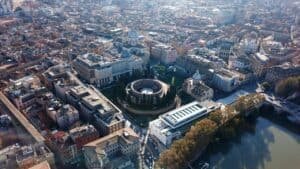
Piazza Navona is the most photographed Baroque square in Rome and the only one that preserves, intact in the layout of the ground, the plan of an ancient building. Its elongated shape, with one short straight side and one curved side, is not an urban whim. It is the perimeter of the stadium that Domitian had built in the 80s of the first century AD. Whoever looks at it from above sees a stadium. Whoever crosses it sees three fountains, a church with a concave facade, the palace of a papal family and, 10 months a year, a carpet of little tables. This guide covers the square piece by piece: the ancient building, the construction site of Innocent X, the three fountains with their sculptors, Sant'Agnese in Agone room by room, the palaces, the August lake, the Befana market, the people who passed through, and the practical questions everyone asks before coming.

What Exactly Is Piazza Navona
A square that is also an archaeological monument in negative. The ground you walk on is the level of the cavea of the Stadium of Domitian, filled in and raised over the centuries. The houses that border the square rest, many of them, on the brick piers of the ancient stands, reused as foundations and as cellars. The result is a square about 240 meters long and roughly 60 meters wide in its usable part, with the north end rounded and the south end cut straight, exactly as in the Roman building. No other European square of this importance preserves so well the fossil of what was there before.
The second thing to know is that Piazza Navona was not born as a monumental square: it became one in 11 years, between 1644 and 1655, by the will of a pope and a family. Before that it was a market area, a place for joust, carnivals and people's barracks. Afterward it became the scenic salon of the Pamphilj. Both natures still coexist: the square is at once a Baroque theater and a very heavily used public space, and anyone who visits looking only for the masterpiece misses half of the story.
How to Get to Piazza Navona Without Wasting Time
Buses That Serve Piazza Navona
The lines that stop closest are those on Corso del Rinascimento, the street that runs alongside the square on its long eastern side: 30, 70, 81, 87, 130F, 186, 492, 628. The Rinascimento stop is 70 meters from the Corsia Agonale entrance, the one that passes beside Sant'Agnese. Those arriving from Trastevere or the Gianicolo can use the lines on Corso Vittorio Emanuele II and turn into Via di Pasquino: two minutes, and you come out at the south corner of the square, in front of the Fontana del Moro. From the Vatican, you walk: from Castel Sant'Angelo, after crossing the bridge, take Via dei Coronari, and in 10 minutes you're at Piazza Navona.
On Foot: Which Side to Enter Piazza Navona From
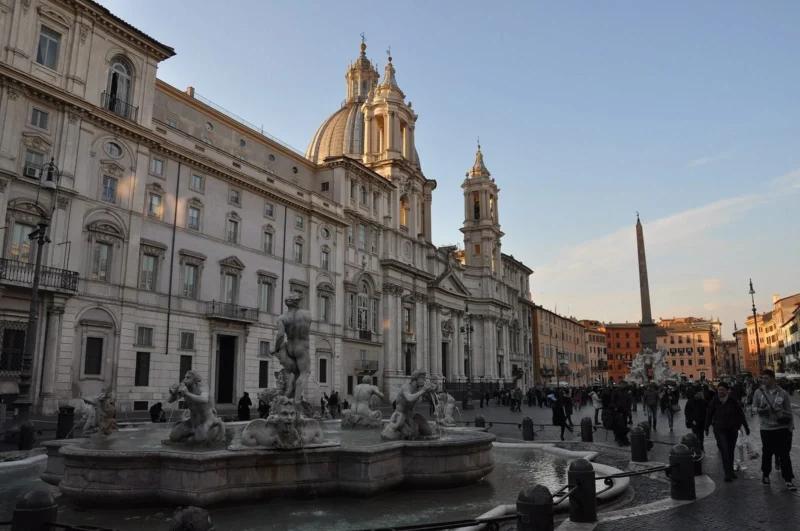
The tip: enter from Via di Tor Sanguigna, that is, from the northwest corner. It is the only entrance that shows the whole square at a glance, with the Fountain of Neptune in the foreground, the obelisk in the center, and the facade of Sant'Agnese closing the scene halfway along the long side. Those who enter from Corsia Agonale find the church right on top of them and lose the depth. Those who enter from Via di Pasquino reach the Fountain of the Moor first, which is the least spectacular of the three, and waste the surprise. The difference between the three entrances is worth 30 seconds of walking and completely changes the impression.
How Much Does Piazza Navona Cost
Standing in the square costs nothing and doesn't require a reservation. What costs money is the coffee and the ice cream at the tables, which here have Historic Center prices: a coffee at the table can exceed 4 euros, and the law requires the price list to be displayed and readable before you sit down. The ticket for the archaeological area of the Stadium of Domitian costs money, when it's accessible, and so does the ticket for Museo di Roma at Palazzo Braschi. Everything else, including the three fountains and the interior of Sant'Agnese in Agone, is free. Current prices for the two museums are listed on their respective official websites.
The Stadium of Domitian Under Piazza Navona
In 85 AD, or shortly after, the emperor Titus Flavius Domitian had built in the northern Campus Martius a building that didn't yet exist in Rome: a masonry stadium for athletic contests in the Greek style. Not a circus, not an amphitheater. A stadium, with a long, narrow track, one short curved side and one straight side, meant for running, boxing, wrestling and pankration.Sources and surveys agree on impressive dimensions: about 265 meters long by 106 wide, with an estimated capacity of around 30,000 spectators.
Why the Stadium of Domitian Was Not a Circus
The distinction matters, and almost no one makes it. In a circus, like the Circus Maximus, there are the carceres, the starting gates for the chariots, and the spina, the central wall decorated with obelisks and metae around which the chariots turned. The Stadium of Domitian had none of this. The track was open, because the athletes ran back and forth, not in circles. This is why the obelisk that stands in the center of Piazza Navona today has nothing to do with the ancient building: no Greek or Roman stadium had an obelisk in the middle.
The Agones Games and the Name of Piazza Navona
Domitian established a cycle of contests held every five years, the Certamen Capitolino in honor of Jupiter, modeled on the Olympic Games and including athletic, equestrian, musical and poetic events. The stadium was its athletic venue. The Greek name of the contests, agones, stuck to the place: in the Middle Ages the area is documented as Campus Agonis, "in agone," and popular corruption did the rest. In agone became nagone, then navone, and finally Navona. Those who believe the name comes from ships, or from the naumachie, get the etymology wrong for an understandable reason: the square really did flood, but three centuries after the name was already in use.
What Remains of the Stadium of Domitian
Much more than you'd think, and it's all under your feet. The remains resurfaced in 1936, during demolitions and rebuilding at the northern corner of the square, and were incorporated into the building that now houses the visitable area. What you see is a section of the northern curve: travertine block piers, brick walls with traces of plaster, the substructure chambers of the tiered seating, and the ancient floor level. The stadium's exterior facade had a double order of arches, Ionic below and Corinthian above: a monumental front that faced the streets of the Campus Martius.
The sculptures that decorated the upper galleries were scattered, but at least one had a dramatic second life: the marble group found in the area in 1501, a Hellenistic fragment that scholars recognize as Menelaus supporting the body of the dying Patroclus, is the statue of Pasquino. Cardinal Oliviero Carafa saved it from being scattered during work at Palazzo Orsini, had it placed at the corner where it still stands, and from there began the longest-running satirical tradition in Rome.
How to Visit the Archaeological Area of the Stadium of Domitian
The entrance is at Via di Tor Sanguigna 3. The visit route, when the area is open, lasts between 40 and 60 minutes, and includes the audio guide for everyone, including children, information panels, archival photos and three-dimensional reconstructions of the stadium and of sports in ancient Rome. Marble sculptural fragments recovered in the area are on display. There is also an extended route that adds the eastern sector of the hemicycle and the remains under the seat of the Ecole francaise de Rome. The official website lists opening hours from Friday to Monday, 10:00-19:00, and on Saturday until 20:00, with the ticket office closing 40 minutes earlier. However, visits appear to be suspended for works. So checking in advance on the Stadium's website or by phone at 06 68805311 avoids a wasted trip. The dedicated page on this site is the one for the Stadium of Domitian.

From Campus Agonis to Piazza Navona: the long Middle Ages
Once the empire fell, the stadium stopped working but did not disappear. Its arches became shops, warehouses, and homes, the floor of the track filled slowly with earth and rubble and rose in level. Between the 10th and 11th centuries the entire Campus Agonis, with its cryptas, that is, the vaulted rooms of the substructures, is recorded as property of the Abbazia di Farfa, one of the most powerful monastic institutions in Lazio. In the 13th century the area passed under the control of the Capitoline Chamber, the civic magistracy of Rome, which periodically assigned it to games: a use that lasted until the full Renaissance, when the area still appears as a field for knightly training and a venue for carnival games.
In the interval between the two ownerships, the surface of the Circus Agonis was divided among private owners and ecclesiastical bodies: a patchwork of rights that explains why the perimeter of the stadium was preserved while the building disappeared. Each owner built on top of his own piece of arch, and no one could encroach on the track, which was public. The shape survived the monument.
The jousts and carnivals of Piazza Navona
That the square in Nagoni had returned to recreational use is documented as early as the second half of the 15th century: under Paul II, Carnival was held there, and in 1476 the family of Sixtus IV organized a joust there on the day of Saint Mark. These are the first records of a vocation that was never interrupted: Piazza Navona is the place where Rome, for five centuries, staged itself. Between 1810 and 1839 even jockey races were run there, with horses carrying riders, not to be confused with the more famous Barberi races held on Via del Corso, which had riderless horses.
The market moved from the Capitoline Hill
In 1477 Sixtus IV ordered the transfer of a large part of the market held on the Capitoline Hill: from that moment Piazza Navona had a stable neighborhood market, similar in function to the one in Campo de' Fiori but different in shape, because the stalls were arranged following the oval of the square instead of filling a rectangle. Anyone who looks at the 18th-century views immediately recognizes this spindle-shaped layout, with the row of stalls following the curve and leaving the center in front of the fountains free.
The market had a seasonal suspension that seems like an eccentricity but was actually a necessity: in the hot months it was dismantled, because the square was flooded to cool the citizens. A market that closes because the square turns into a lake is news that is worth the trip on its own.

Innocent X and the Pamphilj construction site in Piazza Navona
In 1644 Giovanni Battista Pamphilj became pope under the name Innocent X. His family already owned houses on the west side of the square, the pope decided to turn that property into a statement. The goal is declared: to make Piazza Navona the dynastic theater of the Pamphilj, in open competition with the Barberini of Urban VIII, the previous pope, and with the memory of the Farnese. To succeed, they need a palace, a family church, a monumental fountain and an obelisk. In 11 years all four are there.
The reshaping of the area required demolitions: several blocks disappeared, including the Cybo and Mellini palaces, to make room for the new front. The contest for awarding the commissions was fought without ruling out any expedient among the leading architects of the time, and the fact that three names such as Girolamo Rainaldi, Francesco Borromini and Gian Lorenzo Bernini succeeded one another on the same space in a few years shows how high the stakes were.
Donna Olimpia Maidalchini, the arbiter of Piazza Navona
No account of this square is honest if it skips Olimpia Maidalchini. A widow of Pamphilo Pamphilj, the pope's brother, she was Innocent X's sister-in-law and the person who in practice controlled access to the pontiff. Romans called her La Pimpaccia. Her weight in the artistic choices made on the site is documented more by its effects than by the documents. Bernini, shut out of the pope's favor at the start of the pontificate, reopened the door by having a silver model of the fountain, about 1.5 meters tall, delivered to her. The pope saw it, and the commission changed hands. According to another tradition, it was still Donna Olimpia who pushed for replacing Rainaldi with Borromini on the church site. The first account is reported consistently by the sources. The second has the character of tradition and should be taken as such.
The Fountain of the Four Rivers in Piazza Navona
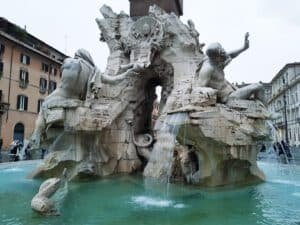
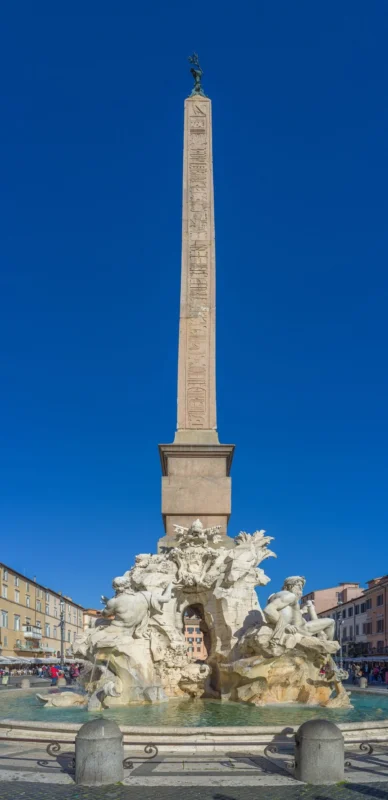
It is the absolute masterpiece of the square and one of the high points of European sculpture. Innocent X had first commissioned Borromini to bring the water of the Acqua Vergine to Piazza Navona, and in 1647 he announced a competition for the central fountain. Bernini was not among those invited. He won anyway, and between 1648 and 1651 he built a machine that resembles nothing before it: a hollow, pierced rock, topped by an Egyptian obelisk of red granite, with four marble colossi seated at the corners.
The four rivers, one by one
The four statues represent the rivers then considered the major rivers of the four known continents, that is, the four corners of the Earth. Bernini designed the whole and entrusted the execution to his best collaborators, each working on one figure.
The Nile, for Africa, is by Giacomo Antonio Fancelli, 1650. Its head is veiled by a cloth. The correct explanation is that in the seventeenth century the Nile's sources were unknown, and the veil is the image of geographic ignorance: not an architectural snub, as the legend would have it.
The Ganges, for Asia, is by Claude Poussin, 1651. He holds a long oar, a sign that the river is navigable for an immense stretch, and he has the relaxed pose of its slow course.
The Danube, for Europe, is by Antonio Raggi, 1650. He touches the papal coat of arms: it is the river closest to Rome, and the gesture declares it.
The Río de la Plata, for the Americas, is by Francesco Baratta, 1651. He sits on a heap of coins, an allusion to the riches of the New World, and raises his arm with an open hand. Here too the legend has seized on the gesture. The iconographic explanation is the gesture of astonishment before the light, which in the overall design indicates the spread of the faith across the continents.
The agonal obelisk above Piazza Navona
The obelisk crowning the fountain measures about 16.54 meters, and exceeds 30 when the base and the finial are included. It is made of red granite from Aswan, but it is not a reused pharaonic obelisk: it was made in the Domitianic age, imitating Egyptian models, and the hieroglyphs were carved in Rome. The faces bear the name of Domitian and scenes of the emperor before Egyptian deities, including Hathor, who offers him the pschent, the double crown.
Its journey is long. Originally raised near the temples of Serapis and Isis in the Campus Martius, in 311 it was moved by Maxentius to the circus he had built on the Appian Way in memory of his son Valerius Romulus, where today you can visit the Villa of Maxentius. It collapsed there in the medieval period and broke apart. Innocent X had it recovered, in four sections, and raised again in the center of his square between 1649 and 1651. At the top there is no cross, as on almost all Roman obelisks, but a dove with an olive branch: the heraldic emblem of the Pamphilj, which is also a symbol of peace. The pope put his own coat of arms where others put the sign of the Church.
The rock, the animals and the plants
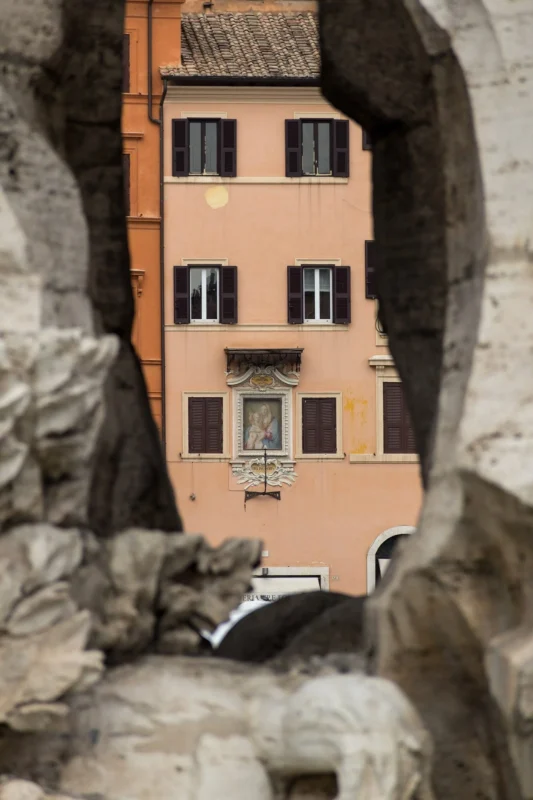
The base is not a pedestal: it is a rock pierced by grottoes, which supports the obelisk on only four points of contact. In the cavities and on the sides Bernini arranged a small bestiary and symbolic herbarium: a lion drinking, a horse emerging from the rock, a serpent, a crocodile, a dolphin, and plants that allude to the continents, including a palm. The choice to hollow out the rock serves one purpose only: to let the sky be seen through the fountain, so that the obelisk seems suspended. It is the invention that makes this fountain different from all others.
The monument has undergone two major restoration campaigns in recent times, the first carried out by Istituto Centrale per il Restauro, the second in 2021 after localized damage, including the detached jaw of the lion and the garland of the Ganges. Marble and travertine, in a fountain that works 24 hours a day, never stay still.
The Legend of the Rivalry between Bernini and Borromini in Piazza Navona
Every improvised guide tells it, and social media repeats it: the Nile covers its head so it doesn't have to see the ugly facade of Sant'Agnese, and the Río de la Plata raises a hand to shield itself from the church's imminent collapse. It's a beautiful story, and it's false, and one date is enough to debunk it. The Fountain of the Four Rivers was inaugurated in 1651. The facade of Sant'Agnese in Agone was begun by Borromini starting in 1653. Bernini couldn't have been mocking a facade that didn't exist yet. The Nile's veil has the geographic explanation already given, and the Río de la Plata's gesture belongs to the language of Baroque wonder.
The statue of Sant'Agnese on the facade has also become part of the legend, with her hand on her chest read as a gesture of distress at the sight of the fountain. The pose lends itself to several interpretations, and distress is one of the later ones. There is a documented bit of teasing, though, and it comes from the construction site. When Borromini's team criticized the structural soundness of a hollow rock, Bernini's team responded by fixing the group with braces made of plain string, flaunting that they served no purpose. The rivalries of seventeenth-century Rome were real, but they were expressed this way, not through statues.
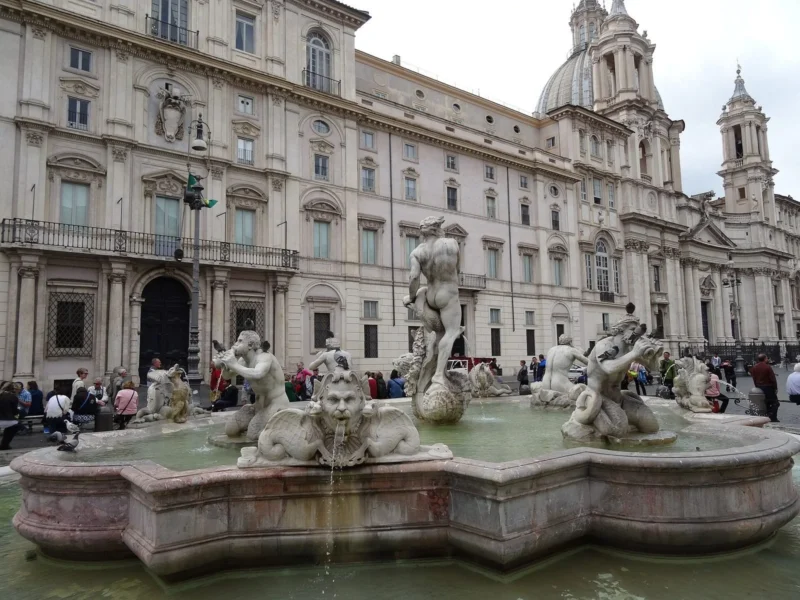
The Fontana del Moro, the South Corner of Piazza Navona
The southern fountain is the older of the three in its layout. In 1574, Gregory XIII commissioned Giacomo della Porta to equip the square with two fountains at its ends, fed by the Acqua Vergine. The marble basin with a mixtilinear plan, resting on two steps, dates to 1575-76 and is his work. For almost 80 years it was a sober fountain, with tritons and masks and a simple central jet.
In 1651, Innocent X, who had just finished the large fountain, commissioned Bernini to enlarge the one to the south. Bernini added an outer basin and, above all, invented the central group: a muscular male sea figure who grips and bends a dolphin, with water spurting from the fish's mouth as a result of the grip. The figure's features earned it the popular nickname il Moro, and the nickname became the fountain's official name. The actual carving of the group was entrusted to Giovanni Antonio Mari, based on a model by Bernini.
A detail almost no one notices: what you see today is not seventeenth-century marble. In 1874, the original groups were removed and replaced with copies by Luigi Amici, and the original tritons ended up in the lake garden of Villa Borghese. Anyone photographing the Fontana del Moro is photographing a faithful nineteenth-century copy, and the originals are a half-hour walk away. The fountain has also been a victim of vandalism in recent times, with damage to the central figure.
The Fontana del Nettuno, the North Corner of Piazza Navona
At the northern end, the fountain twin to the previous one remained unfinished for three centuries. This basin too is by Giacomo della Porta, 1574-76, with the same mixtilinear plan and the same two steps. For centuries it was simply the Fontana dei Calderari, named after the coppersmiths' workshops that crowded the area: a basin of water with no sculptures, used by craftsmen and cart drivers.
Completion came with Rome as the capital. In 1873, the city government held a competition to equip it with sculptures in harmony with the square's other two fountains. Two sculptors won: Antonio Della Bitta made the central group, with Neptune fighting an octopus, and Gregorio Zappalà carved the nereids with putti and sea horses arranged along the rim. The sculptures were installed in 1878, and only from that date has the fountain been called Fontana del Nettuno. It is a nineteenth-century work that imitates the seventeenth century, and by imitating it so well it has fooled generations of visitors.
A professional observation: the Fontana del Nettuno is the most underrated of the three and the best one to photograph at dawn, because the light from the northeast strikes it from the side and separates the god's group from the back facade. At that hour, the Fountain of the Four Rivers is still in shade.

Sant'Agnese in Agone, the Church of Piazza Navona
The church occupies the center of the long western side, attached to Palazzo Pamphilj, and for the Pamphilj it was in effect the family chapel. It stands on the site where a small parish church dedicated to the saint already existed since the Middle Ages. Tradition holds that here, in the vaults of the stadium used as a brothel, the young Agnes was exposed naked to public shame during the persecution, and that her hair miraculously grew to cover her. Historians are cautious about the episode's historical value: it is hagiographic tradition, not documentation.
The word fornice and a surprising etymology
A piece of vocabulary that everyone uses without knowing it comes right from the fornices, that is, the vaulted chambers of the stadium's substructures. In Latin, fornix means vault or arch. Since those underground chambers housed prostitution, the word also came to mean brothel, and from there comes the root of the verb fornicate. A square that offers an etymology like this deserves an extra hour of your time.
Rainaldi, Borromini and the church construction site
Construction begins in 1652 to a design by Girolamo Rainaldi, with his son Carlo working alongside him. The first design did not convince the patron, and in 1653 the project passed to Francesco Borromini, who changed it deeply: he curved the facade so that it was concave, widened the distance between the two bell towers, and pushed the central body back so that the dome, set further back, became part of the view. Borromini left the site in 1657, after the death of Innocent X, and the works were completed by Carlo Rainaldi by 1672.
The result is the most intelligent facade in Rome. The concavity is not a whim: it is the solution to a practical problem, namely the short distance between the church and the square. A flat front would have crushed the dome behind the pediment. The curved front frees it and puts it on display. Anyone who stands in front of the Fountain of the Four Rivers and looks at the church sees exactly what Borromini had calculated.
The dome and bell towers of Sant'Agnese in Agone
The drum of the dome is by Giovanni Maria Baratta, and the lantern is by Carlo Rainaldi. The two twin bell towers, with their spires, frame the dome and give the facade a vertical rhythm that no other church in the area has. Inside, the pendentives were frescoed between 1667 and 1671 by Giovan Battista Gaulli, known as Baciccio, with the cardinal virtues. The top of the dome shows Saint Agnes received into Paradise. Baciccio is the same painter who, a few years later, would paint the vault of the Gesù. Here you can see him at work in a still young phase, and the comparison is instructive.
The Greek cross interior and the altars
The plan is a Greek cross with cut corners, topped by the central dome: a unified, luminous space with no side aisles, where everything converges on the center. The altars are set into the eight bays around the perimeter and hold large marble reliefs instead of painted altarpieces, a rare and very Baroque choice that unifies the marble lining of the nave. The sculptures are by some of the finest Roman chisels of the late 17th century: Ercole Ferrata, Melchiorre Cafa, Domenico Guidi, Antonio Raggi.
Take your time with the relief showing the martyrdom of Saint Emerenziana, begun by Melchiorre Cafa and completed by Ercole Ferrata after the early death of the Maltese sculptor, and with the Holy Family group by Domenico Guidi. The high altar, built between 1720 and 1724, uses columns of ancient marble from the Arch of Marcus Aurelius: a reuse of spolia in the full 18th century, which shows how much ancient material continued to circulate in Rome.
The crypt and the relic of Saint Agnes
Beneath the church floor is a medieval space, the oratory of the earlier church, with fragments of frescoes and the archaeological level that belongs to the structures of the stadium. This is the point where the ancient monument and the Baroque church physically touch. The relic of the skull of Saint Agnes, long kept at the Lateran, is preserved in this church. Visits to the crypt depend on the parish's availability and are not always guaranteed.
The tomb of Innocent X
The pope who built the square rests in the church he commissioned, above the interior entrance, in a funerary monument that places him exactly where he had planned to be: at the center of his own stage set, in front of his own fountain, next to his own palace. Few patrons have achieved a result so literal.
Entry to the church is free. The opening hours are those of an active parish and change with the services. The safest window is the afternoon, and it's best to avoid Mass time if you want to look at the altars calmly.
Palazzo Pamphilj in Piazza Navona, today the Embassy of Brazil
The long façade that closes the west side of the square, just to the left as you face the church, is Palazzo Pamphilj. The first nucleus dates from 1630, in late Renaissance forms. After Innocent X was elected in 1644, the family decided on a monumental expansion and entrusted the job to Girolamo Rainaldi, who absorbed the neighboring buildings, including Palazzo Cybo and Palazzo Mellini. The works were concluded around 1650. The palace, the church and the connected structures form what art historians call the insula Pamphilj: a single block, conceived as one scenographic organism.
The gallery of Pietro da Cortona
The piano nobile holds 23 frescoed rooms by the major Baroque painters. The highlight is the long gallery, designed by Borromini, that connects the palace to the church. Between 1651 and 1654, Pietro da Cortona painted here the Stories of Aeneas, a cycle that ties the Pamphilj dynasty to Rome's Trojan origins. It is one of the great fresco cycles of 17th-century Roman painting and one of the least seen, because the palace is not a museum.
Since 1920, part of the building has housed the Embassy of Brazil in Italy, and the palazzo still partly serves as a residence. There is no free tourist visit: access happens on special opening days or at the initiative of the diplomatic mission, and it has to be checked case by case. If you want to see Pamphilj paintings without waiting, go to the Galleria Doria Pamphilj on Via del Corso, which belongs to the same family and is open every day.
The Other Palazzi of Piazza Navona
Palazzo Braschi and Museo di Roma
On the southern corner, between the square and Corso Vittorio Emanuele II, stands Palazzo Braschi, from the late eighteenth century, built for the nephews of Pius VI on the site where the palazzo built by Francesco Orsini, prefect of Rome in the fifteenth century, once stood. It is the last noble palace built in Rome by papal power, and it has one of the most theatrical staircases in the city. Today it houses Museo di Roma, with collections that tell the life and image of the city from the Middle Ages to the twentieth century: views, portraits, furnishings, costumes, festival decorations. The address is Piazza San Pantaleo 10, with a second entrance at Piazza Navona 2. Opening hours are Tuesday to Sunday 10:00-19:00, last entry one hour before closing, closed on Mondays and also on May 1 and December 25. The ticket price varies depending on the exhibition on show, and you can buy it at the ticket office or online through the official channel of the Sistema Musei di Roma Capitale.
Palazzo De Torres Lancellotti
On the northern side, toward the Fountain of Neptune, you'll find Palazzo De Torres, later Lancellotti, built around 1552 to a design by Pirro Ligorio. It is the oldest of the palazzi overlooking the square and keeps its sixteenth-century character, with the rusticated portal and the pedimented windows. Looking at it next to the facade of Sant'Agnese makes it clear right away what separates the High Renaissance from the High Baroque.
Palazzo Tuccimei, formerly de Cupis Ornani
Also on the northern front, Palazzo Tuccimei, originally de Cupis Ornani, was built in the second half of the sixteenth century, incorporating a small palazzo and some houses from the previous century. Roman tradition links it to the figure of Costanza de Cupis, the lady with the beautiful hand, and to the legend of the walled-up window: one of those stories Romans pass down and that no document confirms.
Among the smaller palazzi, the small palazzo attributed to Vignola, on the east side, is worth noting, though today it goes unnoticed among the signs of the businesses.

The Lake of Piazza Navona
For two centuries, every summer, Piazza Navona turned into a public swimming pool. The mechanism was simple and clever at the same time: the square had a concave floor, and it was enough to close the chiavicone then located near the Fountain of the Moor and plug the fistulas of the central pilo so that the concave part filled up in just two hours. The flooding began on Saturday evening in August and lasted until one in the morning on the following Sunday, and it was repeated every Saturday throughout the month.
The celebration was called the lake of Piazza Navona and was, in papal Rome, the summer event above all others. Carriages entered the water and crossed it at a walk, horsemen followed, and the common people splashed around. The clergy, the nobility and the financiers rented the balconies and covered them with tapestries. Introduced under Innocent X in 1653, the custom was banned for hygiene reasons in 1676, restored 27 years later by Clement XI at the request of the city, and permanently abolished by Pius IX in 1866 for health reasons, after the level of the pavement had already been raised and made flat.
Giuseppe Baracconi, in his Rioni di Roma of 1904, left the most vivid description of it:
«Among the memorable spectacles of Piazza Navona, which in the Renaissance became the Circus Maximus of the Romans for carnival festivities, tournaments, races, hunts, stage performances and games of every kind, the one on the lake will remain famous and very unique. On Saturday evenings in August, the sluice gate located then near the Fountain of the Moor was closed: the outlets of the central basin were plugged, and the concave part of the vast square remained flooded for just two hours. The flooding lasted until one in the morning the following Sunday, and was renewed every Saturday throughout the month. In Rome, the city of waters par excellence, the memory and the delight of natatoria and naumachiae survived, and from this harmless, bourgeois custom, Piazza Navona made one of the most picturesque and entertaining festivals. Introduced under the reign of Innocent X in 1653, the golden age of Piazza Navona, it was banned in 1676 for hygiene scruples and for the hypochondria of a cardinal. Clement XI restored it 27 years later, at the request of Rome, which the severity of the last popes had forbidden almost all traditional festivities. Its glories date from this period. No sovereign comes to Rome without wanting to enjoy that magical sight. The high clergy, the nobility, the financiers, the beauties leave the elegant strolls of Villa Medici and Piazza di Spagna for the lake, from the Sacred College to the lowest plebs, all of Rome flocks there. A colorful hedge, swaying with people, lines the dry edges of the square, the windows and balconies, adorned with tapestries and brilliant hangings, display the flower of beauty and fashion, while in the water the coming and going of gilded carriages, calèches, carts, horsemen and tucked-up commoners becomes tangled and intersects. What an attractive spectacle!»
All the places that Baracconi cites as fashionable alternatives can still be visited: Villa Medici, home of Accademia di Francia, and Piazza di Spagna.
The Market and the Befana of Piazza Navona
The daily market of Piazza Navona ended in the 1800s, absorbed by the one in Campo de' Fiori as the square took on an increasingly touristic and representative role. Only one offshoot of it remains, and it's the one every Roman knows: the December festival and the Befana of Epiphany. The stalls occupy the square from early December until January 6, selling sweets, sugar coal, stockings, toys, nativity sets and crafts. Stall assignments are made through a public tender by Roma Capitale, and the rules change from year to year.
A clear opinion, from someone who frequents the square for a living: the Befana of Piazza Navona is no longer the craft fair it was in the 1970s, and during the peak hours of the pre-Christmas weekend it's a crush where you can't see a thing. Anyone who wants to go should come on a weekday afternoon in mid-December, when the lights are already on and the square still breathes. Anyone looking for the postcard image should come early on the morning of January 6, before the families arrive.
Artists and Portrait Painters of Piazza Navona
Since the postwar period, Piazza Navona has been one of the three or four Roman places permanently taken over by painters and sketch artists, along with the steps of Trinità dei Monti, Via Margutta and the Galleria Alberto Sordi, which older Romans still call Galleria Colonna. Easels set up on the spot, oil views, watercolors and, above all, the quick portrait, often caricatured, done for a passerby while they wait. Over time, street artists, musicians, mimes and living statues have joined the painters, filling the square especially in the evening.
The verdict on quality is harsh, and it needs saying: among the stalls you'll find a few serious craftsmen and a lot of serially produced work. Anyone looking for a well-painted view of Rome will more easily find one in the shops of Via dei Coronari or the galleries of Via Giulia. If you want a portrait as a keepsake, though, go ahead: it has been part of the square's ritual for 70 years.
Piazza Navona in Art and Literature
The Views: Van Wittel, Pannini, Piranesi
Piazza Navona is one of the most painted subjects of modern Rome. Gaspar van Wittel, the Dutchman whom the Romans called Gaspare Vanvitelli, father of the Italian topographical view and registered father of the architect Luigi Vanvitelli, painted it around 1700 with the optical rigor that came from his use of the camera obscura: in his canvases you can count the market stalls, recognize the signs and measure the shadows. It is the best iconographic source for understanding how the square worked before the nineteenth-century rebuilding.
From then on the square becomes a fixed item on the Grand Tour, with the views by Giovanni Paolo Pannini and the engravings by Giovanni Battista Piranesi, who exaggerate its proportions to make it even more theatrical. A large part of this material is kept at the Museum of Rome in Palazzo Braschi, 50 meters from the square. Looking at the views and then stepping out into the real space is the most instructive exercise you can do here.

Giuseppe Gioachino Belli and Piazza Navona
The most effective literary portrait of the square is in two Roman sonnets by Giuseppe Gioachino Belli. The first, from February 1, 1833, is a social, economic and artistic snapshot all at once, and it also recalls the public pillory that stood there in papal times, with the torturer's discretion to add more lashes for the benefit of the spectacle, since the sentence generally left the number of lashes to him:
"You can brag about my Piazza Navona
and about St. Peter's and Piazza di Spagna.
This isn't a square, it's a countryside,
a theater, a fair, a bit of merriment.
Go from the Pulinara to the Corsia,
run from the Corsia to the Cuccagna.
Everywhere you find food to eat,
everywhere people carrying it off.
Here three fountains are raised up high,
here an obelisk that looks like a sentence,
here the lake forms when summer comes.
Here the little wooden horse rises that dispenses
on the backside of whoever wants 30 lashes,
and five more for good measure."
The second sonnet, from March 20, 1834, deals with the Wednesday market and targets the emerging trade in secondhand books, as well as the spread of almanacs, the popular calendars that enjoyed enormous success in the first half of the 19th century:
"On Wednesday at the market, my people,
there are scrap dealers and box makers,
secondhand dealers, street sweepers, glassmakers,
rag men, and lots of other goods,
there's nothing to say. But these shelves
of books, these bookstalls and these booksellers,
what do they come to do? What do you learn
from so many books and so many bookshops?
You take a book on an empty stomach, and then
after you've held it for about a quarter of an hour,
tell me if you're hungry or if you've eaten too much.
What did the priest preach at the Mission?
Books are not a thing for Christians:
children, for charity's sake, don't read them."
Pietro Della Valle and the comparison with Isfahan
The Roman traveler Pietro Della Valle, who arrived in Isfahan in Persia in the early 17th century, came upon the great royal square, the meidan Naqsh-e Jahan, and drew the only comparison that came naturally to him: the one with the square back home. The verdict, for a Roman, is almost a betrayal:
"One of these is the meidan, or main square, in front of the royal palace, about 690 of my paces long and about 230 wide. All around it runs one and the same order of architecture, even, straight and never interrupted by streets or anything else, built as large, level arcades under shops with goods of every kind arranged in order, place by place. And above, with balconies and windows, with 1,000 very graceful little ornaments. This union of architecture is so grand that it looks so good to the eye that, although the buildings of Piazza Navona are taller and richer by our custom, nonetheless, because of their discordance and for other details that I will mention about the meidan of Isfahan, I dare to place it above Piazza Navona itself."
Della Valle hits the true weak point of Piazza Navona: its building facades are rich but mismatched, 1,000 different fronts stitched together. That is also why the square feels alive rather than like a museum.
What to See Around Piazza Navona in a 10-Minute Walk
Pasquino, 30 meters away
Leaving from the southwest corner, you reach Piazza di Pasquino, where the mutilated torso of the group of Menelaus and Patroclus, found in 1501 and possibly from the decoration of the stadium, has served as a satirical bulletin board since the 16th century. The sheets with anonymous verses against popes, cardinals and the powerful were called pasquinades, and some still exist today. Pasquino used to talk from a distance with Rome's other talking statues, particularly with Marforio, which today stands in the courtyard of Palazzo Nuovo at the Capitoline Museums on the Capitoline Hill. The custom faded after 1870, but the pedestal still collects paper.
San Luigi dei Francesi and Caravaggio
200 meters to the east, behind Corso del Rinascimento, the Church of San Luigi dei Francesi holds in the Contarelli Chapel the three large canvases by Caravaggio with the stories of Saint Matthew. Free admission. It is the most important piece of painting within a five-minute radius of Piazza Navona, and there is usually a line only on weekends.
Sant'Ivo alla Sapienza
A little farther on, inside the courtyard of the Sapienza palace on Corso del Rinascimento, hides the Church of Sant'Ivo alla Sapienza, built by Borromini between 1642 and 1660 and consecrated in that year. The plan is a six-pointed star generated by the doubling of a triangle, with additions and subtractions of circular portions according to a very rigorous geometric logic. The dome closes in a spiral lantern that alludes to the lighthouse of Alexandria. The base triangle, read with its inversions, stylizes three bees: a virtue and also the coat of arms of the Barberini, the family of Urban VIII who commissioned the work. Public opening is limited: the church houses the Paolo VI Cultural Center and opens on Sunday in the hours before the 11:00 mass. If you pass by Piazza Navona and find the door open, go in right away, because the chance doesn't come around every day.
Palazzo Madama and Palazzo Altemps
To the east of the square, on Corso del Rinascimento, stands Palazzo Madama, seat of the Senate of the Republic, with its 17th-century facade and a cornice crowded with scrolls. To the north, beyond the Fountain of Neptune and Via dei Coronari, is Palazzo Altemps, one of the sites of the National Roman Museum, where the great Ludovisi and Mattei collections of ancient sculpture are displayed: the Dying Gaul (Galata suicida), the Ludovisi Throne, the Grande Ludovisi sarcophagus. If you have two hours and want to understand the ancient sculpture from which all the Baroque of the square derives, go in there.
The Pantheon, Trevi and the Rest of the Center
10 minutes on foot to the east takes you to the Pantheon. 15 minutes to the northeast, to the Trevi Fountain. 10 minutes to the west, across the Tiber, to Castel Sant'Angelo. To the south, beyond Campo de' Fiori, you reach the front of Palazzo Farnese and the Ghetto area. It is the stretch of Rome with the greatest density of monuments per square meter, and Piazza Navona is its hinge: almost all the itineraries of the Historic Center pass through it.
When to Go to Piazza Navona
The square changes character four times a day. At dawn, between 6:00 and 7:30, it is almost empty: there are the street sweepers, the bar suppliers and the photographers, and the raking light from the northeast lights up the Neptune and leaves the rest in cold shadow. It is absolutely the best moment to see the architecture with no people in front of it. In mid-morning the groups arrive and the tables fill up. Between 11 and 15, from April to October, the square is a funnel of crowds and anyone in a hurry would do better to pass by. In the late afternoon the light comes in from the west and hits the facade of Sant'Agnese at an angle: it is the hour of the best photograph of the church. After dinner the square becomes an open-air theater, with musicians and portrait artists, and stays lively until late at night.
The seasons. February and November are the months with the fewest people and the softest lighting. July and August are the worst: heat, scarce shade, tables everywhere. December brings the stalls and completely changes the perception of the space, for better or for worse depending on taste. Anyone who wants to see the urban design of the square in December won't see it, because the stands hide it. On days of light rain, instead, Piazza Navona is magnificent: the cobblestones reflect the facades and the crowd is cut in half.
Piazza Navona with Children
It works very well, and for concrete reasons: it is closed to traffic, it is flat, it is wide, and it has three fountains within sight. Children handle the story of the animals of the Fountain of the Four Rivers with no problem, which is a real search game: finding the lion, the horse, the crocodile, the snake, the dolphin and the palm keeps a family busy for 20 minutes. The visit to the archaeological area of the Stadium of Domitian, when it is accessible, includes the audio guide even for the youngest and lasts less than an hour, the right measure for a child of eight or 10. In December the Befana festival is designed precisely for them, with sugar coal and stockings.
Two practical warnings. There are no public restrooms on the square: the nearest are in the cafes and restaurants, and you have to ask for them by buying something. The fountains are not for swimming and the urban police regulations forbid climbing on them, sitting on the monumental edges and getting in: the fines exist and are enforced.
Accessibility of Piazza Navona
The square is fully pedestrian and free of steps along the main route, so it's accessible by wheelchair and stroller. The paving is in sampietrini, and this is the real obstacle: the joints are wide and small wheels suffer. The stretches of more even paving run along the edges, in front of the buildings, and it's better to use those. Sant'Agnese in Agone has a few steps at the main entrance. The archaeological area of the Stadium of Domitian develops underground, and information on accessibility should be requested directly from the site before your visit. Museo di Roma at Palazzo Braschi has an elevator.
Eating and Drinking at Piazza Navona: The Uncomfortable Advice
The tables on Piazza Navona sell the view, and the view is expensive. There's nothing illegal about it as long as the price list is posted, but the ratio between what you pay and what you eat, in most of the square's restaurants, is unfavorable. If you want to sit in the square, do it for a coffee or an aperitif, aware of the surcharge, and ask for the price list before sitting down. If you want to eat well, walk two or three minutes: Via del Governo Vecchio, Via dei Banchi Nuovi, Via della Pace, the stretch toward Sant'Eustachio, and the Campo de' Fiori area have a density of serious trattorias that the square doesn't have. The rule applies throughout the Roman historic center, and here it applies squared.
Frequently Asked Questions about Piazza Navona
How much does it cost to enter Piazza Navona?
Entering Piazza Navona costs nothing: it's a public space open 24 hours a day, with no ticket, no turnstiles and no reservation. You only pay for the archaeological area of the Stadium of Domitian underground and for Museo di Roma at Palazzo Braschi, at the corner of the square.
How much time do you need to visit Piazza Navona?
For a walk around Piazza Navona with its three fountains, about 20 minutes is enough, the time to cross it and look at the Fountain of the Four Rivers, the Fountain of the Moor and the Fountain of Neptune. If you want to explore the Stadium of Domitian underground or enter Palazzo Braschi, you should allow for more time.
How do you get to Piazza Navona by public transport?
Piazza Navona is reached by buses that run along Corso del Rinascimento, the street that borders the square on its eastern side: lines 30, 70, 81, 87, 130F, 186, 492 and 628 stop at Rinascimento, about 70 meters from the Corsia Agonale entrance. If you're coming from Trastevere, you can use the lines on Corso Vittorio Emanuele II.
Is Piazza Navona suitable for a visit with children?
Piazza Navona works very well with children because it's closed to traffic, it's flat, and it has three fountains within sight. Children easily follow the story of the animals on the Fountain of the Four Rivers, a real search game between lion, horse, crocodile, snake, dolphin and palm tree that keeps a family busy for about 20 minutes.
Is Piazza Navona accessible by wheelchair and stroller?
Yes, Piazza Navona is fully pedestrian and free of steps along the main route, so it's accessible by wheelchair and stroller. The real obstacle is the sampietrini paving, with wide joints that strain small wheels: it's better to use the stretches of more even paving that run along the edges, in front of the buildings.
Is it worth eating at the tables on Piazza Navona?
Eating at the tables that overlook Piazza Navona means paying mainly for the view, and the ratio between what you spend and what you eat in most of the square's restaurants is unfavorable. If you want to sit in the square, do it for a coffee or an aperitif, checking the price list before sitting down, while for a good meal it's better to move to the nearby streets.
What is the best time of day to see Piazza Navona?
The best time to see Piazza Navona is at dawn, between six and seven 30, when the square is almost empty and the low light lights up the Fountain of Neptune while leaving the rest in shadow. Between 11:00 and 15:00, especially from April onward, the square fills up instead with groups and tourists.
Guided Tours and Groups at Piazza Navona
Piazza Navona is the classic visit that seems easy and isn't. Without someone to explain the relationship between the ancient stadium and the modern design, between the fountain and the church, between the Pamphilj and the Barberini, it remains a nice place to take a photo. With a well-prepared guide it becomes a lesson in urban planning 2,000 years long. For groups, companies and private itineraries in Rome, the reference is TourLeaderPro, which works with tour operators and organized groups. Anyone looking for a guide for a full Italian itinerary will find tour guiding services on the dedicated page. For English-speaking travelers building their own Rome plan, ItalyPlanner's guides on things to see in Rome and the three-day itinerary place Piazza Navona within a realistic route, without the impossible list of 22 monuments in one day.
A curiosity about Piazza Navona
The curiosity that almost no one knows concerns what lies underground and why the square flooded so easily. The modern ground level is about four and a half meters above the track of the ancient stadium, but until the 1800s it was not flat. The square had a concave profile, a very slight basin that still followed the profile of the Roman arena, filled with rubble and settled over the centuries. All it took was closing the main drain, the chiavicone near the Fontana del Moro, and plugging the openings of the central pilo, so the water from the fountains, instead of draining away, would accumulate. In two hours the concave part was covered.
The real curiosity is in the next detail: the lake of Piazza Navona was not a court whim, it was a policy. Papal Rome had suppressed almost all the traditional festivals out of strictness, and the lake was the popular concession the city had earned. Clement XI brought it back in the early eighteenth century precisely at the request of the Romans, after the ban of 1676. For nearly two centuries a monumental square worked as a public swimming pool authorized by the pope.
There is a second one, this time linguistic. The name Navona has nothing to do with ships or water. It comes from the Greek athletic games, the agones, which were held in the stadium. Agone became nagone, then navone, and finally Navona through popular assimilation. The sequence is documented by the medieval forms of the place name, and it's worth telling because the wrong explanation, the one about fake naval battles, is everywhere and easier to remember. The coincidence between a name that seems to hint at water and a square that really did flood is one of the finest false clues in Roman toponymy.
Something nobody tells you about Piazza Navona
That almost everything you can touch in the two side fountains is not seventeenth-century. The Fountain of the Moor that people photograph today is a copy: in 1874 the original sculptural groups were taken down and replaced with replicas made by Luigi Amici, and the ancient tritons ended up in the lake garden of Villa Borghese, where anyone can see them for free. The Fontana del Nettuno, which looks like the Baroque twin of the Moor, has sculptures from 1878. The Neptune wrestling the octopus is by Antonio Della Bitta, and the nereids with putti and sea horses are by Gregorio Zappalà. They came out of a competition announced by the Comune di Roma in 1873 to complete a basin that had remained bare for three centuries. Until then it was the Fontana dei Calderari, a simple water basin for the artisans of the area.
The result is that the square everyone sees as a unified Baroque ensemble is actually a collage of four eras: the foundations are Flavian, the basins are late sixteenth-century by Giacomo della Porta, the center is Bernini's, from 1651, and the two sculpted ends are nineteenth-century, one from 1874 and one from 1878. Knowing that two-thirds of the sculptures you look at are less than 150 years old doesn't take anything away from the view, but it changes the way you look at it.
The second thing nobody mentions concerns the water. The fountains of Piazza Navona are fed by the Acqua Vergine, the aqueduct built by Agrippa in 19 BC and never completely decommissioned, the same one that feeds the Trevi Fountain and the Barcaccia. The conduit reaches the square through a branch designed in the time of Innocent X, when Borromini received the commission to bring water here, before anyone was talking about a monumental fountain. Without that preliminary hydraulic work, Bernini would have had nothing to make flow over his rock.
The advice I give you for visiting Piazza Navona
Come twice, and not at the same time of day. Make your first visit at dawn or shortly after, between six and seven 30, entering from Via di Tor Sanguigna. The square is empty, you can really hear the water, and for about 10 minutes you have the Fountain of the Four Rivers all to yourself. In that silence you understand Bernini's invention, the pierced rock that lets the sky through and makes the obelisk float. With the crowds, you don't see that emptiness.
The second visit is made in the late afternoon, around five in winter or seven in summer, and goes into Sant'Agnese in Agone. Entry is free, and it takes 20 minutes to go around the altars with their large marble reliefs, look up at the pendentives by Baciccio, and go down, if the parish allows it, to the underground space where the church rests on the structures of the stadium. Then you go out and look at the facade from the fountain: you'll understand why Borromini curved it.
Three practical tips that are worth more than any description. First: don't sit at the tables thinking you'll eat well. Sit down only if you want to pay for the view, and ask for the price list first. Second: spend 40 minutes at Museo di Roma in Palazzo Braschi, which is 50 meters away and that almost no one considers, and look at the views of the square before going back out to see it in person. Third: if you're with a group, meet at the obelisk and not at the church, because the obelisk can be seen from every point in the square, while the facade of Sant'Agnese disappears behind the stalls and awnings. It's the kind of detail you learn on site, not by reading guidebooks.
Another Well-Known Fact, Yet Rarely Mentioned
Everyone knows Piazza Navona has the shape of the Stadium of Domitian. Almost no one stops to consider what it actually means that this shape has survived. It isn't a lucky accident: it's the result of a legal system. In the Middle Ages the arena was public space, while the perimeter arcades were private or church property, often divided among dozens of owners. Each owner could build on top of their own piece of the stands, reusing the ancient piers as foundations and cellars, but no one could encroach on the track. The houses grew along the circumference for centuries without ever eating into the central void.
Two consequences of this are still visible. The first: the buildings on the perimeter rest on Roman structures and have unusual cellar levels, with vaulted rooms that belong to the stadium. The second: the streets that enter the square correspond, in several places, to the ancient entrances, because the passageways were preserved as rights of way. Corsia Agonale, Via Agonale and Via di Tor Sanguigna are not 19th-century openings: they are the memory of the access points to the stadium.
Then there's the matter of the obelisk, equally well known and equally little considered. The Agonal obelisk does not belong to the stadium: it was commissioned in the Domitianic age with hieroglyphs carved in Rome, erected in the Campus Martius near the Isis temples, brought by Maxentius in 311 to his circus on the Appian Way, and recovered in four pieces by Innocent X. A monument that seems to be the oldest sign of the square arrived there last, in 1649, and from another neighborhood. The coincidence between the Domitianic commissioning of the stadium and that of the obelisk is real, but the two objects only came together after 15 centuries.
The Right Photo to Take in Piazza Navona
The photo everyone tries is the frontal view of the Fountain of the Four Rivers with Sant'Agnese in the background, and it's the worst one you can take at noon: the sun overhead flattens the rock, erases the shadows in the cavities and bleaches the travertine of the facade. The same framing at seven in the morning in summer or at half past eight in winter is a completely different thing.
The right photo, the one almost no one takes, is shot from the east side, that is, from the edge of the square in front of the buildings that face the church, getting on your knees or at least lowering yourself one meter. From there, with a lens around 35 millimeters, you line up the cavity of Bernini's rock with the central door of Sant'Agnese, and you can see the sky through the fountain: it's exactly the effect Bernini had calculated, and you can't get it standing up. If you have the patience to wait for the wind to move the plume of water, the obelisk stays clean against the sky.
The other two framings are worth it. The first is the detail of the Rio de la Plata with the raised hand, shot from below so that the palm stands out against the facade: it's the photo that tells the legend even to those who know it's false. The second is the Fountain of Neptune at dawn from the north, with side light that separates the god and the octopus group from the dark background of the buildings. In December, with the market stalls, the best photo is taken from above the side stairs of the bars or simply by zooming in on a stall: the whole square, full of gazebos, doesn't work in any frame. One last warning: setting up a tripod in the middle of the square at peak hours is a bad idea, out of respect and for practical reasons.
Some Important Events That Happened Here in History
The first event is the construction itself: around 85 AD Domitian gives Rome its first and only stone stadium, a building designed for athletic contests in the Greek style, as part of a program that also included the nearby odeon and the Capitoline Games in honor of Jupiter, a competition held every five years with athletic, musical and poetic events. Rome officially imported the Olympic model, and this building was its venue.
In the 3rd century, the stadium was restored by Alexander Severus, a sign that it was still in use a century and a half after it was built. With the end of antiquity, the building fell silent and began its second life. Between the 10th and 11th centuries, the Campus Agonis belonged to the Abbey of Farfa. In the 13th century it passed to the Camera Capitolina, which used it for games and entertainment. In 1476, Sixtus IV's family organized a joust there for Saint Mark's Day. The following year, in 1477, the same pope ordered the market moved from the Capitoline Hill, and the square took on the commercial role it would keep for four centuries.
In 1501, the discovery of the Hellenistic torso later called Pasquino, at the corner of Palazzo Orsini, gave rise to the most famous satirical tradition in Rome. In 1574, Gregory XIII commissioned Giacomo della Porta to build the two side fountains, completed in 1575-76.
The decisive decade was that of Innocent X. Elected in 1644, the pope began the expansion of Palazzo Pamphilj with Girolamo Rainaldi, which was completed around 1650. In 1647, he announced the competition for the central fountain and had the obelisk recovered from the Circus of Maxentius. Between 1648 and 1651, Bernini built the Fountain of the Four Rivers, with the obelisk raised between 1649 and 1651. In 1651, Bernini enlarged the southern fountain by creating the group of the Moor. In 1652, the construction site of Sant'Agnese in Agone opened. In 1653, the project passed to Borromini, who left it in 1657. Also in 1653, the custom of the August lake began. In less than 10 years, the square took on the appearance it has today.
1655 marks the death of Innocent X. The lake was banned in 1676 for hygiene reasons, restored by Clement XI 27 years later, and permanently abolished by Pius IX in 1866. Between 1810 and 1839, the square hosted horse races with jockeys. In 1672, Carlo Rainaldi completed the church. Between 1720 and 1724, the high altar was erected there, with columns from the Arch of Marcus Aurelius. In 1873, the city announced the competition for the sculptures of the northern fountain, which were installed in 1878. In 1874, the groups of the Fountain of the Moor were replaced with copies. In 1936, during demolitions at the north corner, the remains of the stadium resurfaced. They were excavated and incorporated into the modern building, and this is how the archaeological area open to visitors was born.
Who Has Passed Through Piazza Navona
Domitian, first of all: the emperor who built the stadium and who appears, with his name in hieroglyphs, on the faces of the obelisk that now crowns the fountain. Alexander Severus, who oversaw its restoration in the 3rd century. Maxentius, who in 311 moved the obelisk to the circus on the Appian Way, dedicated to his son Valerius Romulus.
Then the popes. Sixtus IV, who in 1477 brought the market from the Capitoline Hill there, and whose family had organized a joust there the year before. Gregory XIII, who in 1574 gave the square the two fountains by Giacomo della Porta. Innocent X, who made it what it is, and who is buried inside Sant'Agnese in Agone. Clement XI, who gave the Romans back the lake festival. Pius VI, whose nephews built Palazzo Braschi. Pius IX, who in 1866 closed the lake's floodgates for good.
Then the artists, who all worked here. Gian Lorenzo Bernini with the Fountain of the Four Rivers and the group of the Moor. Francesco Borromini, first as the pope's hydraulic engineer to bring in the Acqua Vergine, then as the architect of the facade of Sant'Agnese. Girolamo and Carlo Rainaldi. Pietro da Cortona, with the Stories of Aeneas in the gallery of Palazzo Pamphilj. Giovan Battista Gaulli, known as Baciccio, with the frescoes of the pendentives and the dome. The sculptors Giacomo Antonio Fancelli, Claude Poussin, Antonio Raggi, Francesco Baratta, Giovanni Antonio Mari, Ercole Ferrata, Melchiorre Cafa, and Domenico Guidi. Pirro Ligorio for Palazzo De Torres. In the 1800s, Luigi Amici, Antonio Della Bitta, and Gregorio Zappalà.
Then the travelers and writers. Pietro Della Valle, who from Isfahan judged the Persian square to be superior to his own. Gaspar van Wittel, who painted it with topographic precision around 1700, and after him Pannini and Piranesi, who turned it into the souvenir of the Grand Tour. Giuseppe Gioachino Belli, who in 1833 and 1834 dedicated two of the most famous sonnets in his Roman dialect corpus to it. Giuseppe Baracconi, who in 1904 described the lake with the nostalgia of someone who had heard about it from the old people. And the sovereigns visiting Rome, of whom Baracconi says that none would give up the spectacle of the flooding.
Today thousands of visitors pass through every day, and painters, portraitists, musicians, and the guides who lead groups work here. The square continues to do what it has always done: gather people and put them on stage.
Quick Questions About Piazza Navona
How much does it cost to enter Piazza Navona?
Nothing. Piazza Navona is a public square open 24 hours a day, with no ticket, no turnstiles and no reservation. You only pay for the archaeological area of the Stadium of Domitian underground and for Museo di Roma at Palazzo Braschi.
How long does it take to visit Piazza Navona?
A walk around the square with the three fountains takes 20 minutes. Adding the interior of Sant'Agnese in Agone brings it to 40. With the archaeological area of the Stadium of Domitian, when it is open, you go past two hours. With Museo di Roma at Palazzo Braschi, it makes for a full half day.
How do you get to Piazza Navona by public transport?
By bus 30, 70, 81, 87, 130F, 186, 492 and 628, stopping on Corso del Rinascimento, or by the lines on Corso Vittorio Emanuele II, including 46, 62 and 64. The metro doesn't reach it. The nearest useful stop is Spagna on Line A, about a 20-minute walk away.
Is there a metro stop at Piazza Navona?
No. No line of the Rome metro serves Piazza Navona directly, and that is one of the reasons the neighborhood has kept its layout. If you use the metro, get off at Spagna or Barberini, then continue on foot or take a surface bus.
Can you visit the Stadium of Domitian under Piazza Navona?
The archaeological area has its entrance at Via di Tor Sanguigna 3, with an opening also on Piazza Navona 45. The official site lists opening hours from Friday to Monday, 10:00-19:00, and Saturday until 20:00, with the ticket office closing 40 minutes earlier. However, access is suspended for works. Before you go, it's best to check stadiodomiziano.com or call 06 68805311.
How long does the underground tour of Piazza Navona take?
The standard route takes between 40 and 60 minutes, with an audio guide included for everyone, children too. There is also an extended route that adds the eastern section of the exedra and the remains under the seat of the Ecole francaise de Rome.
How many fountains are there in Piazza Navona?
Three. In the center is Bernini's Fountain of the Four Rivers, 1648-1651, with the Agonal obelisk. To the south is the Fountain of the Moro, a basin by Giacomo della Porta from 1575-76 and a central group designed by Bernini in 1651. To the north is the Fountain of Neptune, with the same 16th-century basin and sculptures from 1878.
Who made the Fountain of the Four Rivers in Piazza Navona?
The design is by Gian Lorenzo Bernini, who won the competition called by Innocent X in 1647. The four statues were carried out by his collaborators: the Nile by Giacomo Antonio Fancelli, the Ganges by Claude Poussin, the Danube by Antonio Raggi, and the Rio della Plata by Francesco Baratta, between 1650 and 1651.
Is it true that the Rio della Plata raises its hand because it fears Sant'Agnese will collapse?
No. The fountain was inaugurated in 1651, and Borromini began the church's facade in 1653. The statue could not react to a building that did not yet exist. The gesture belongs to the language of Baroque wonder, and the veil over the Nile shows that in the 1600s the river's source was unknown.
Where does the obelisk in Piazza Navona come from?
It was made during Domitian's time with hieroglyphs carved in Rome, and erected in the Campus Martius near the temples of Serapis and Isis. Massenzio moved it in 311 to the circus on the Appian Way dedicated to his son Valerio Romolo. Innocent X recovered it in four sections and raised it here between 1649 and 1651. At the top is the Pamphilj dove, not a cross.
Why is it called Piazza Navona?
It comes from the name of the Greek athletic games, the agones, which were held in the Stadium of Domitian. Agone became nagone, then navone, and finally Navona. It does not come from ships, despite the coincidence with the ancient custom of flooding the square.
Is entry to Sant'Agnese in Agone in Piazza Navona free?
Yes, entry is free. The hours follow the life of the parish and change with the services. The afternoon is the most reliable time. Visits to the underground area depend on the parish's availability.
Can you visit Palazzo Pamphilj in Piazza Navona?
Not on a free tourist visit. Since 1920 the palace has housed the Embassy of Brazil in Italy, and part of it remains a private residence. Access happens on special opening occasions or at the initiative of the diplomatic mission.
How much does Museo di Roma at Palazzo Braschi cost?
The price depends on the current exhibition and is listed on the official website of the Sistema Musei di Roma Capitale, where you can also buy tickets online. Opening hours are Tuesday to Sunday, 10:00-19:00, with last entry one hour before closing. It is closed on Mondays, May 1 and December 25.
Is Piazza Navona wheelchair accessible?
Yes, the square is pedestrian, flat and step-free along the main route. The real obstacle is the sampietrini paving. It's best to follow the strips of more even paving along the edges. Sant'Agnese in Agone has a few steps at the entrance. For the underground archaeological area, ask the site for information.
Can you take photos in Piazza Navona?
Yes, freely, and even with a tripod, although at peak hours a tripod in the middle of the crowd is not very practical. Inside churches and museums the rules of each individual site apply: photos without flash are generally allowed.
Can you sit on the edge of the fountains in Piazza Navona?
No. The urban police regulations prohibit climbing onto the monumental fountains, sitting on their edges, and bathing in them, and fines are issued. Benches and the steps of the palazzi are the alternative.
When is the Christmas market in Piazza Navona?
From early December until January 6, Epiphany Day, with the festival of La Befana as the climax. The stalls sell sweets, sugar coal, stockings, toys and handicrafts, the assignment of the stalls takes place through a public tender by Roma Capitale.
Is Piazza Navona suitable for children?
Very much so. It is closed to traffic, flat and wide, with three fountains to look at and a small bestiary carved into the Fountain of the Four Rivers to search for. However, public restrooms are lacking and can only be found inside the establishments.
How much does a coffee cost in Piazza Navona?
At the piazza's outdoor tables, the service carries Historic Center prices, and a coffee at the table can exceed four euros. The price list must be posted and readable before you sit down: asking to see it is your right, and it's a good idea to do so.
What is the best time to see Piazza Navona?
At dawn, between six and seven-30, when the piazza is empty and the light comes in at an angle. The second good time is late afternoon, with the sun hitting the facade of Sant'Agnese. Between 11:00 and 15:00, from April to October, the crowd makes it hard even to walk.
What is the difference between Piazza Navona and Campo de' Fiori?
Piazza Navona is a monumental Baroque piazza built over an ancient stadium, with fountains, a church and palazzi built to impress, Campo de' Fiori is a market square, smaller and irregular, which still has its fruit and vegetable stalls in the morning and its nightlife in the evening. The two are five minutes apart and show two different Romes.
Where is Pasquino in relation to Piazza Navona?
At the southwest corner, in Piazza di Pasquino, less than 50 meters away. The statue is a Hellenistic fragment identified as Menelaus holding up Patroclus, found in 1501 and possibly coming from the decoration of the Stadium of Domitian.
Does Piazza Navona still flood?
No. The lake festival was abolished by Pius IX in 1866, and the piazza's surface was later leveled: the concavity that made flooding possible no longer exists. The fountains and the stories remain.
Do you need a reservation for Piazza Navona?
Not for the piazza, never. A reservation is only needed for the archaeological area of the Stadium of Domitian, which has limited entry numbers when it is open, and is recommended for Museo di Roma during highly visited exhibitions.
What is there to see near Piazza Navona?
Pasquino at 50 meters, San Luigi dei Francesi with the Caravaggios at 200, Sant'Ivo alla Sapienza inside the courtyard of the Sapienza, Palazzo Madama, seat of the Senate, Palazzo Altemps with the ancient sculpture of Museo Nazionale Romano, the Pantheon 10 minutes away, Campo de' Fiori five, Castel Sant'Angelo 10, passing through Via dei Coronari.
The final advice on Piazza Navona
The most compelling thing about Piazza Navona is not Bernini: it's the fact that a piazza built to celebrate a family has become, without asking permission, the living room of an entire city. The project was propaganda, the result is public. No other Roman Baroque space has made this leap so completely.
If you have little time in Rome, it's better not to sacrifice it to a 10-minute pass between the Pantheon and Castel Sant'Angelo. Give it a real hour, at the right time, and start at the fountain, looking at the sky through the rock. If instead you have a full day to spend in this part of the city, the combination that always works is this: dawn at Piazza Navona, Sant'Agnese when it opens, Palazzo Braschi mid-morning, San Luigi dei Francesi before lunch, and the afternoon at Palazzo Altemps. Come back in the evening for the sound of the water, and you'll understand the Campo Marzio better than someone who spent a week there.
Article written by the editorial team of TourLeaderPro, contact them for Tours and Private/Corporate/V.I.P. Experiences.
Planning a trip to Rome? English-language guides for visiting the city are available at ItalyPlanner.com.
Contact Information
Nearby
 Fountain of the Four Rivers100 m
- Baroque Rome: An Itinerary Through Churches, Piazzas and Fountains100 m
- Obelisco Agonale100 m
- Sant’Agnese in Agone100 m
- Gladiator Museum100 m
- Moro Fountain100 m
Upcoming events nearby
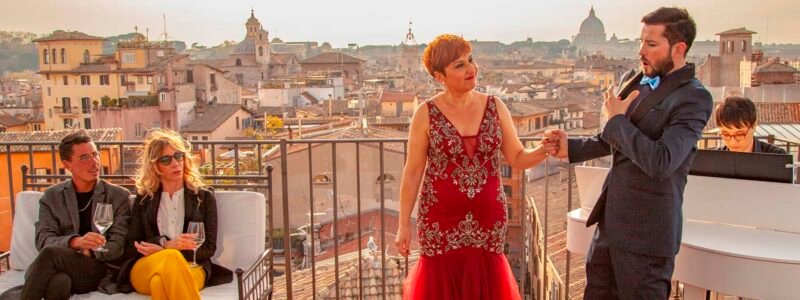
- Rooftop Bar Opera Show at Palazzo Pamphilj, until December 30, 2026100 m
- Primarosa Cesarini Sforza, Ines Fontenla, Thorsten Kirchhoff, Daniela Monaci, Luana Perilli at Galleria Emmeotto, from October 3 to November 27, 2026200 m
- Keith Haring at Museo di Roma in Palazzo Braschi, from October 6, 2026 to April 11, 2027200 m
- «Canova-Cicognara. Epistolario (1822-1833)», book presentation at Museo di Roma, Tuesday, November 17, 2026200 m