Palatine Hill
In short. The Palatine Hill sits at the center of the archaeological area between the Roman Forum, the Circus Maximus and the Colosseum, and its historic entrance is at Via di San Gregorio 30, Rome.
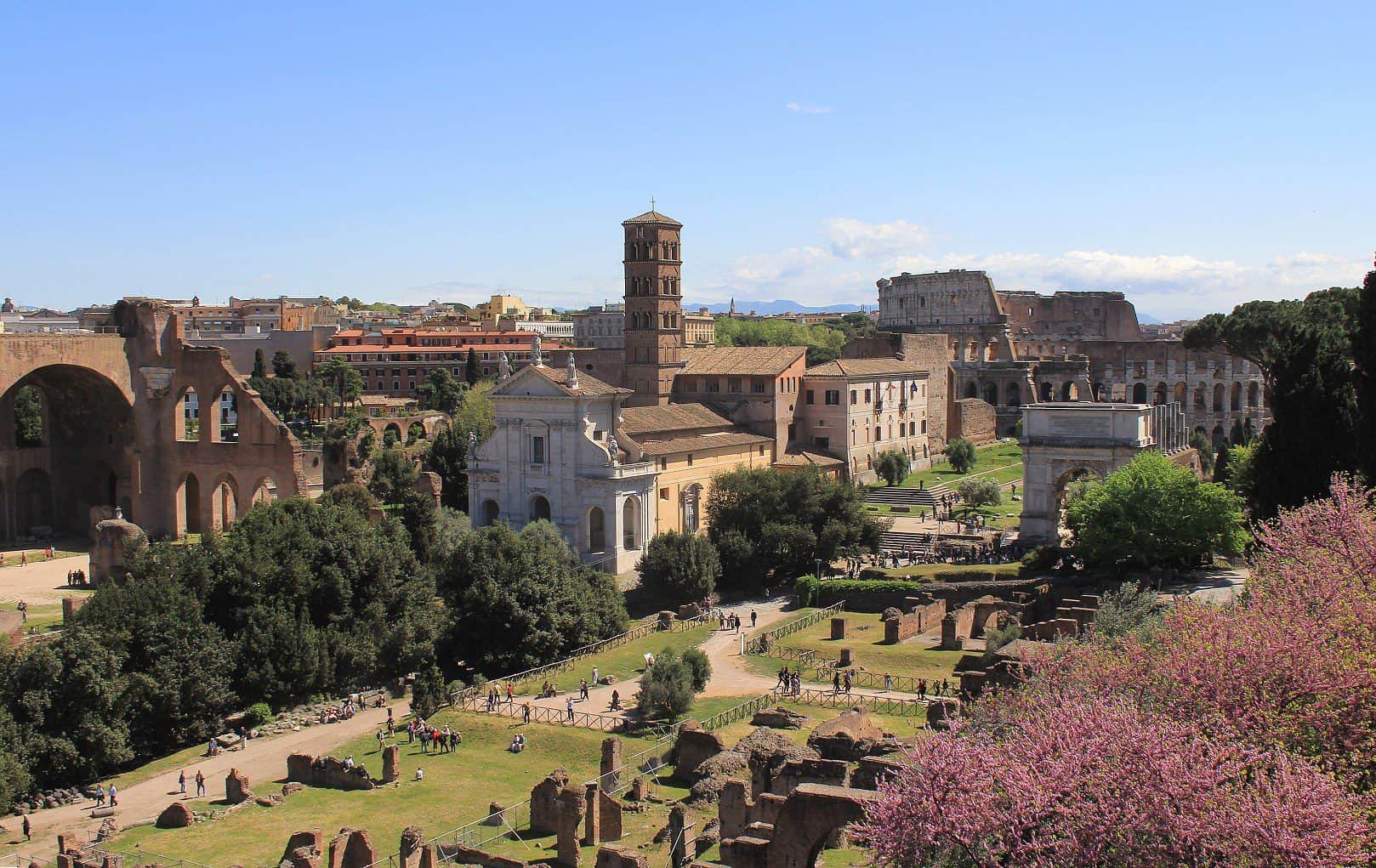
The Palatine Hill sits at the center of the archaeological area between the Roman Forum, the Circus Maximus and the Colosseum, and its historic entrance is at Via di San Gregorio 30, Rome. You can get there by Metro B, Colosseo stop, and since December 16, 2025, also by Metro C, which has opened its temporary terminus at the Colosseo Fori Imperiali station, where it connects with Line B. At street level, buses 51, 75, 85, 87 and 118 and tram 3 serve the area. The standard ticket, the one the Colosseum Archaeological Park calls Colosseo, Foro Romano, Palatino, costs 18,00 euro full price and 2,00 euro reduced for EU citizens aged 18 to 25. The discounted rate is 11,50 euro for Roma Pass holders and 14,00 euro for participants in the RAP program. It is valid for 24 hours and requires a timed-entry reservation for the Colosseum only. It includes the Roman Forum, the Palatine Hill, the Domus Tiberiana and the Ninfeo della Pioggia, weather permitting. Anyone who has already seen the Colosseum buys the Forum Pass SUPER, 18,00 euro full price and 2,00 euro reduced, valid for one day for a single entry and without a timed slot. In 2026, the hill opens at 9.00, with last entry at 18.15 and closing at 19.15 from March 29 to September 30. From October 1 to 24, last entry moves back to 17.30 and closing is at 18.30. From October 25 to February 28, 2027, last entry is at 15.30 and closing at 16.30. Total closure on December 25, 2026 and January 1, 2027. Free admission on the first Sunday of every month, April 25, June 2 and November 4. All tickets are named, and at the gates you'll be asked for an ID document. The official ticket office is the Park's online site, and it's best to buy in advance.
The Palatine Hill is not a museum with one door and a set route. It is just under 40 hectares of hill where Rome piled up 1,200 years of construction, and then planted a Renaissance garden on top. It belongs to the big family of Museums of Rome only for administrative convenience, because in reality it is a fossil neighborhood. I'll say it right away, no beating around the bush: if you have just one morning in Rome and have to choose between the Colosseum and the Palatine Hill, the Colosseum will give you the photograph, and the Palatine Hill will give you the city. It's the most underrated spot in the whole archaeological area, and the reason is simple: people arrive tired, after waiting in line, and climb the hill when they've already worn out their legs in the Forum. It should be the other way around: start here.

Which ticket you need for the Palatine Hill
The most frequent question, even before what there is to see, is about the ticket. The system of the Colosseum Archaeological Park is less complicated than it seems, but it needs to be understood on one point: the Palatine Hill and the Roman Forum are one and the same in terms of pricing, while the Colosseum is another matter. Everything else follows from this.
The Colosseo, Foro Romano, Palatino ticket
This is the standard ticket, the one almost everyone buys. It costs 18,00 euro full price and 2,00 euro reduced for EU citizens aged 18 to 25. Under-18s don't pay. Roma Pass holders pay 11,50 euro, and people in the RAP program pay 14,00 euro. It's valid for 24 hours and includes the first and second tiers of the Colosseum with its panoramic terraces, the Colosseum museum, the Roman Forum with its museum, the Palatine Hill, the Domus Tiberiana and the Ninfeo della Pioggia, the latter weather permitting. The timed-entry reservation applies only to entry to the Colosseum. You can visit the Roman Forum and Palatine Hill area at any time within the 24 hours, before or after, entering through whichever gate you prefer. Watch out for one detail that throws off a lot of days: time spent inside the Colosseum is limited, and the flow is designed for a visit of just over an hour. The long time, the real one, you should save for the hill.
Forum Pass SUPER, the right ticket if you've already seen the Colosseum
The Forum Pass SUPER costs €18.00 full price and €2.00 reduced for European citizens between the ages of 18 and 25, and it is free for those under 18. It is valid for one day and one entry, and it has no time slot: enter whenever you like. It covers the Roman Forum, the Palatine Hill and the Imperial Forums in a single route that crosses Trajan's Forum, passes under Via dei Fori Imperiali through the ancient houses, continues into the Forum of Caesar and comes out at the Curia. It also includes the restricted-access sites that the Park calls SUPER, and the Palatine Museum. The main route is free of architectural barriers. In our view, if you have two days in Rome and want to see this area properly, the Forum Pass SUPER is the smartest ticket on the market, because it takes away the stress of timing and opens exactly what the ordinary ticket doesn't open, namely the painted houses. You do the Colosseum at another time, maybe in the last hour of the afternoon when the organized groups have already left.
Other Tickets and Reductions on the Palatine Hill
The Park also sells special packages for the Colosseum, from the Only Arena, which adds access to the arena floor, to the Full Experience, which combines the arena and the underground areas and is valid for two consecutive days. All of them include the Roman Forum and the Palatine Hill in any case, and all come in versions with or without a guided educational route. The prices of these special packages change more often than the ordinary ones, so check them on the Park's official ticket office before you buy, because the difference between one ticket and another can be worth more than €10 per person. It's also worth knowing that there is an annual Membership Card for the Park, designed for people who live in Rome or come back often: if you plan to go up the Palatine Hill more than twice in a year, the cost pays for itself almost right away.
When You Can Enter the Palatine Hill for Free
Entry is free on the first Sunday of every month, on April 25, on June 2 and on November 4. On these days the free ticket is collected in person at the ticket office in Piazza del Colosseo, on a first-come, first-served basis, and it is valid only for that day. On these dates the Forum Pass SUPER is not accepted. June 2 has a peculiarity that catches someone by surprise every year: the morning is taken up by the parade on the Imperial Forums, and the archaeological area opens only in the early afternoon. If you plan to visit the Palatine Hill for free on June 2, expect to enter around midday and not before. On the free Sundays the verdict is clear: the Palatine Hill handles them better than other sites, because the hill is large and absorbs the crowd, but the frescoed houses and the Palatine Museum, which have limited capacity, become a lottery on that day. If your main interest is the House of Livia and the House of Augustus, pay for the ticket and go on a weekday.
Palatine Hill Opening Hours, Season by Season
The hill follows the seasonal schedule of the Colosseum Archaeological Park, which is set by the light and not by visitor convenience. From March 29 to September 30, 2026, entry starts at 9.00, the last entry is at 18.15 and closing time is 19.15. From October 1 to 24, the last entry moves earlier to 17.30 and closing time is 18.30. From October 25, 2026 to February 28, 2027, the last entry is at 15.30 and closing time is 16.30. The Colosseum opens half an hour earlier, at 8.30, but that changes nothing for the hill. On December 25, 2026 and January 1, 2027, everything is closed.
Two warnings that come from mistakes I have seen happen in front of me. The first concerns winter: from October 25, the last entry at 15.30 means that the Palatine Hill, from November to February, is strictly a morning visit. Anyone who arrives at three in the afternoon thinking they have two hours ahead ends up with the guards starting to push everyone toward the exit just as they have finished the climb. The second concerns the restricted-access sites: they open later than the hill, around 9.30, and they close earlier. If you are aiming for the House of Livia or the House of Augustus, enter at 9.00 through the lower gate, do the climb while the hill is still empty and be at the right door when it opens. It is the best half hour spent in the whole day.
Palatine Museum Hours
The Palatine Museum, which is the Antiquarium of the hill, has its own schedule, narrower than that of the archaeological area, and a limited capacity that on peak days creates small waits at the door. The upper floor, with the imperial sculptures and the detached paintings, has in recent years had temporary closures for maintenance, so the guaranteed part is the ground floor. Before you plan a visit to the museum as the highlight of the day, check the hours and opening status on the Park's official website. The museum is not charged separately: it is included in the ticket for the archaeological area.
Where to Enter the Palatine Hill
The entrances to the Roman Forum and Palatine Hill area are five, and choosing the entrance shapes the quality of your morning much more than you might imagine. The first is via di San Gregorio 30, the historic entrance, the one that puts you right at the foot of the hill. The second is the one at the Arch of Titus, at the top of the Clivo Palatino, convenient if you're coming from the Colosseum. The third is largo della Salara Vecchia, on the side of via dei Fori Imperiali. The fourth is via del Tulliano, next to the Mamertine Prison. The fifth is via del Foro Romano. All five use the same ticket and the same area.
There is only one practical tip, and I repeat it every time: enter from via di San Gregorio. It's the least crowded entrance because it's the one that groups with a guide use the least, it usually has the shortest line, and above all it puts you on the uphill right away. Go up, and in four minutes you have the hill all to yourself while 90 percent of visitors pour into the Forum. Entering from largo della Salara Vecchia, by contrast, means slipping into the main current, walking an hour through the Forum and tackling the climb up the Palatine with short breath and the sun high. If I had to sum up everything I know about this visit in one line, I'd write: from the bottom up in the morning, from the top down at noon.
How to Get to the Palatine Now That There's Metro C
Until recently the answer was simple and a bit dull: Metro B, Colosseo stop, and then you walk. On December 16, 2025 something important changed. That day the Porta Metronia and Colosseo Fori Imperiali stations on Line C opened to the public, and the latter is now the end of the line, with direct interchange to Line B. The station, by the way, is by far the most interesting on the Roman network: during the 13 years of construction, the excavations uncovered thermal rooms of a Republican-era domus, votive material and minor statuary, and part of those finds has been put on display inside the station itself, with an exhibit you walk through without a ticket while going to catch the train. The line runs Monday through Thursday, and on Sunday the last train leaves around 23:30, while on Friday and Saturday it runs until 01:30.
Of course, the surface lines are still available: 51, 75, 85, 87 and 118, plus tram 3, which is the recommended option for anyone arriving from Trastevere or the Aventine because it drops you right on the Circus Maximus side. By car, in theory you can, in practice you can't: we're inside the limited traffic zone, the few spaces around are expensive and guarded, and every minute spent looking for parking is a minute taken away from the hill. Anyone coming from outside Rome should base themselves at a metro station and get off at Colosseo: it's the solution that always works.
The Palatine Before Rome
This is where the part worth the ticket begins. On the Palatine, around 1000 BC, there was a village of huts. This isn't a romantic legend: it's an excavation finding. The hill had all the features needed for an Iron Age settlement in Lazio, namely a defensible plateau, springs at the foot of the slopes, and visual control of a ford over the Tiber, the one that would later become Tiber Island. Around it there was stagnant water: the Forum valley was a swamp drained only centuries later with the Cloaca Maxima, and the Velabrum, the slope between the Palatine and the Capitoline Hill, was a marsh. The village occupied a few dozen huts on two heights, the Palatium proper and the Cermalus, both included in the archaic Septimontium list.
The literary tradition, the one the Romans told themselves and that Virgil put into verse in the Aeneid, placed on the Palatine a settlement of Arcadians led by Evander and his son Pallas, who had arrived in Italy before the Trojan War, and set there the meeting with Hercules and then with Aeneas. It should be taken for what it is, that is, a mythical construction of the late Republican and Augustan age, not a chronicle. What is documented, instead, is that the twentieth-century excavations found, on the western slope, postholes and hut floors from the Iron Age exactly where the tradition placed the origins of the city. The relationship between myth and terrain, on the Palatine, is closer than anywhere else in Rome.

Why It's Called Palatine Hill
The ancient explanations are three, and none of the three is proven. The first brings in Pales, a deity of shepherds and livestock, whose festival, the Palilia or Parilia, fell on April 21: that is, the same day tradition assigns to the founding of Rome. It is not a chance coincidence, it is the coincidence itself that generated the explanation. The second derives the name from palus, the swamp, because the hill was surrounded by stagnant waters, and it has even been suggested that the first huts stood on stilts. The third, which is the most solid linguistically, traces the name back to a root meaning height, protrusion, which survives in Italian pala in the sense of mountainside. The third is the most convincing, without any pretense of being a linguist: it is the only one that doesn't need a story to work. The other two are after-the-fact etymologies, built by the Romans themselves to give a father to the name of their most sacred hill.
The Lupercal, the She-Wolf and the Lupercalia
At the foot of the Palatine Hill, on the side facing the Velabrum, tradition placed the Lupercal, the cave where the she-wolf was said to have nursed Romulus and Remus. The cave was the center of a very ancient rite, the Lupercalia, celebrated in February: the priests called Luperci, half-naked and girded with the skins of freshly sacrificed goats, ran around the hill striking anyone they met with strips of that same skin. Women placed themselves along the route willingly, because the blow was considered beneficial for fertility. It was not a college prank: it was one of the most archaic and harshest rites of the Roman calendar, surviving until the late empire.
Here a distinction is needed that almost no one makes, and that changes how you look at the matter. The rite is very ancient. The story of the twins nursed by the she-wolf, in the form we know it, is a later explanation, stitched onto a rite whose original reason had been lost. The ancient sources themselves, when they try to explain the Lupercalia, contradict one another and propose different solutions. It is the classic case of a ceremony that outlives its own motivation, and of a community that invents a new one. The Palatine Hill is full of such cases: people keep doing it, and then find the why.
The Republican Palatine Hill, the Neighborhood of the Ruling Class
Between the fifth and the first century BC the Palatine Hill becomes what we would today call an address. It was not the richest neighborhood by surface area, it was the most prestigious by position: it overlooked the Forum, that is, the place of power, and you got there on foot in two minutes. Anyone who mattered lived here. The list of known residents is one of the aspects that make the hill fascinating even for those who don't like archaeology: they are the people you read about in the textbooks, and they all lived within a radius of 300 meters.
Living here were Marcus Valerius Maximus, consul in 505 BC and the first illustrious resident of whom a record survives, Gnaeus Octavius, consul in 165, Tiberius Sempronius Gracchus, father of the two tribunes of the plebs who would set Roman politics on fire, Marcus Fulvius Flaccus, consul in 125, Marcus Livius Drusus, tribune of the plebs in 91. And then the generation of the civil war: Cicero and his brother Quintus, Titus Annius Milo, Publius Clodius Pulcher, Quintus Hortensius Hortalus, Mark Antony, Tiberius Claudius Nero, father of the future emperor Tiberius. Milo and Clodius, who hated each other to the point that the first had the second killed on Via Appia in 52 BC, were neighbors. Cicero's house, bought at a high price and demolished by Clodius during his exile, was on this hill. When you walk among the Republican walls of the north slope, you are walking through a condominium of mortal enemies.
The Magna Mater and the Cults of the Palatine Hill
In 204 BC, in the middle of the Second Punic War, Rome brought in from Asia Minor the black stone that represented Cybele, the Magna Mater, after the Sibylline Books had promised victory to whoever brought the goddess to the city. The temple was built for her on the Palatine Hill, on the southwest slope, and dedicated in 191. It is the first great Eastern cult officially welcomed in Rome, with everything that came with it: eunuch priests, music, processions that seemed improper to Romans of the old school. The podium of the temple, in tufa blocks, can still be read next to the House of Augustus, and the foundations tell of at least three phases, because the building burned and was rebuilt several times.
Next to it stood the temple of Victory, and not far away that of Victoria Virgo. These are the cults that explain why Augustus chose this very sector of the hill for his house: it was not a whim about the view, it was a choice of religious neighborhood. Whoever lives next to the gods of victory and the mother of the gods sends a precise political message, and Augustus was a master of this kind of message.
The House of the Griffins
The Casa dei Grifi is the oldest surviving residential building on the Palatine, dating to the late Republican period, and it takes its name from two stucco griffins that decorate a lunette. It lies on a lower level, built into the foundations of the later Domus Flavia: when the Flavians leveled the top of the hill to build the palace, the older houses were buried rather than demolished, and this is what saved them. The frescoes belong to the Second Pompeian Style, the one that paints architecture in perspective on the walls, and in the main room the floor is a polychrome mosaic. It was discovered and excavated by Giacomo Boni, who had worked on the Palatine from 1907, and who dated it to the second century BC.
The Casa dei Grifi is one of the sites with restricted access: it opens on a rotating basis and with very small capacities, because it is an underground room and narrow. If it happens to be open when you visit, go in without thinking twice. It's the place where you physically understand what Roman stratification means: above your head is the throne room of Domitian, and beneath your feet is the floor of a senator of the Republic.
The Aula Isiaca and the Loggia Mattei
The Aula Isiaca is a room from the Augustan period, decorated with a painted cycle on Egyptianizing subjects, a rare and valuable situation: sistra, uraei, lotuses, symbols of the cult of Isis, painted in a Roman aristocratic house in the years when Egypt had just become a province. This room too came to light with Boni's excavations. Above it, and this is the circumstance that makes the place memorable, is the Loggia Mattei, a frescoed 16th-century loggia: the Mattei family owned a vineyard on the Palatine, and the loggia is part of the villa's casino. Climbing a few steps takes you from Roman painting of the first century to painting in the Raphaelesque school of the 16th century. I don't know many other places in Rome where 1,500 years of the history of painting can be crossed on a staircase.
The Palatine Becomes the Hill of the Emperors
The shift from aristocratic neighborhood to imperial palace is the most important political story this hill has to tell, and it unfolds over a century and a half. It begins in 31 BC, when Octavian, born on the Palatine, buys the house of the orator Quintus Hortensius Hortalus and starts to expand by acquiring the neighboring properties. It ends with Septimius Severus, who at the end of the second century AD extends the palace to the southern edge of the hill, above the Circus Maximus, with a facade as tall as a 10-story building. In between are Tiberius, Caligula, Nero, the Flavians, and Hadrian.
What I keep finding brilliant is Augustus's initial choice. He could have built himself a palace, he had the means and the power. Instead he chose to live in an ordinary-sized private house, with low ceilings and no fine marble, and to spend the money on the temple next door. The message was: I am a citizen among citizens, luxury belongs to the gods. Suetonius tells us he slept in the same bedroom for 40 years. It's propaganda, certainly, but it's propaganda built with architecture, and it worked so well that his successors, when they began building real palaces, still had to call their residence a domus, a house.
The House of Augustus on the Palatine
The House of Augustus occupies the southwest slope of the hill and is organized into two sectors: the private wing, with small rooms and black-and-white mosaic floors, and the representational sector, with larger halls around a paved courtyard. The painted decoration belongs to the Second Style in its most mature phase and is dated to around 30 BC. Three rooms are worth the trip on their own. The Room of the Masks, where the walls simulate a theatrical set with stage masks and small rustic shrines seen in perspective. The Room of the Pine Garlands, with pine garlands hung between painted pillars, considered among the most remarkable Second Style paintings that survive. And the studiolo, a tiny room with panels of plant and animal motifs and a ceiling decorated with stucco, traditionally identified as the place where Augustus withdrew to work.
The house was brought back to light by excavations carried out on this slope starting in the 1960s, which recovered its paintings from under meters of fill. Today it is visited with a guided-light display: the rooms are kept in dim light and lit one at a time, because the original colors would not withstand continuous exposure. It is a site with restricted access, closed on Mondays. I should warn you about one thing: the visit lasts only a few minutes and the rooms are small. Anyone expecting a royal palace will be disappointed, anyone who knows what they are looking at leaves with the sense of having seen one of the three or four most important painted cycles of antiquity.
The Temple of Apollo Palatinus and the Two Libraries
Next to the house, Augustus had the temple of Apollo Palatine built. Work began after 36 BC and it was dedicated in 28, entirely in Luni marble. It was the first great Roman temple built in white Italic marble, and it served to link the victory at Actium to the protector god of the prince. A portico ran around the temple, and two libraries were housed in the portico, one Greek and one Latin: the first great public library on the Palatine, the place where sessions of the Senate were also held. Today only the podium and the remains of the foundations of the complex survive, and it takes a little imagination, but the position is very easy to read: the temple dominated the Circus Maximus and was visible from the whole valley.
The House of Livia
The House of Livia is a domus from the first century BC, with a quadrangular atrium onto which four rooms open, paved with mosaics and frescoed around 30 BC. At the center of the back of the atrium is the tablinum, the reception room, flanked by two symmetrical rooms, the alae. On the right is the triclinium, the dining room. The attribution to Augustus's wife is not a romantic hypothesis. It comes from a lead pipe found in the house and inscribed with the name Iulia Augusta, that is, the name Livia took after her adoption into the gens Iulia. It is strong circumstantial evidence, the kind of evidence that in archaeology is worth more than 10 pages of literature.
The house reopened to the public on July 22, 2024, after a restoration, with a display that deserves to be described. You enter in semi-darkness. Then the rooms light up in rotation, from the atrium to the tablinum to the triclinium, while a narrator's voice and a lightmapping system reconstruct the mythological stories painted on the walls. In the tablinum you can recognize Polyphemus chasing Galatea. Elsewhere Io, watched by Argus, appears, along with scenes of Egyptianizing landscape. The cinnabar red background of the triclinium is the most expensive color in the ancient palette, and this alone tells you who lived there. It is a site with reserved entry, closed on Tuesdays.
I'll be frank about one point that causes some grumbling: the guided-light display delights anyone who has never seen Roman painting, and it annoys those who would rather look at the walls calmly with their own flashlight. It deserves defending. Those paintings have survived 2,000 years underground and are in a closed space without natural ventilation. The dimness is not set design, it is conservation. Go knowing that you'll have only a few minutes and that you'll have to look where you are directed. In exchange, you'll see colors that wouldn't be legible in full light.
The Domus Tiberiana, the First Imperial Palace
The Domus Tiberiana occupies the northwest corner of the Palatine, the one that overlooks the Roman Forum, and covers about four hectares. It takes its name from Tiberius by ancient tradition, but excavations have shown that most of the visible structures date to the Neronian and Flavian periods, with Hadrianic reworking. The first Tiberian core exists, but it is buried under what came later. It was the first imperial residential building conceived as a unified palace, and for centuries it remained the base on which the Farnese later laid out their garden. Literally: the Farnese Gardens are the roof of the Domus Tiberiana.
The palace had been closed to the public for almost 50 years due to serious structural problems. It reopened on September 21, 2023, after a long consolidation and restoration worksite, with a route that enters from the Clivo della Vittoria, the ancient covered road that climbed the hill. It crosses the substructure arches and the service rooms, then emerges toward the Domitian ramp and the Farnese Gardens. Along the route, a museum circuit of 13 rooms has been set up, titled Imago imperii, which tells the history of the monument and daily life in the palace through the materials recovered by the excavations. Among the pieces on display is a vertical loom rebuilt with 63 original weights found in 2010. In the evening, a lighting system makes the arches legible from via dei Fori Imperiali.
This is, by far, the most important development of the last 20 years on the Palatine, and many printed guidebooks still don't include it. Visitors to the hill today have access to a part that two generations of Romans have never seen. The extent of the opening may vary depending on ongoing work, so check the Park's website for what is accessible on the day of your visit.

Nero on the Palatine: the Domus Transitoria
Before the fire of 64 AD, Nero had built the Domus Transitoria, so called because it connected the imperial properties on the Palatine with the family gardens on the Esquiline. The fire destroyed it, and on its ruins rose the Domus Aurea, the oversized project that took up an enormous slice of the city. Beneath the later Domus Flavia, however, rooms of the Domus Transitoria survive, with floors in opus sectile of colored marbles, nymphaeum fountains, and paintings of very high quality. They are not permanently open to visitors: the detached paintings and mosaics are displayed in the Palatine Museum, on the upper floor.
The Domus Transitoria is the great absentee from almost all Palatine visits, and that's a shame, because it may be the most refined complex on the entire hill. When it opens on a special basis, usually with limited reservations and in very small numbers, it's worth any line. Keep an eye on the special openings calendar of the Park if you're lucky enough to be in Rome with a few days to spare.
The Domus Flavia and the Domus Augustana
With Domitian, in the years between 81 and 92 AD, the Palatine stops being a collection of houses and becomes a single palace. The architect was Rabirius, one of the few designers from antiquity whose name we know. The complex is divided into two parts: the Domus Flavia, the official reception wing, and the Domus Augustana, the residential wing, laid out on two levels and overlooking the Circus Maximus with a large semicircular exedra.
In the Domus Flavia, three large ceremonial rooms can still be recognized in their foundations and floors: the aula regia, the throne room, where the emperor received visitors, the basilica, where he administered justice, and the lararium, the household shrine. At the center is a peristyle with an octagonal labyrinth fountain, and on the opposite side the triclinium, the dining hall, with two oval nymphaea on either side that could be seen through large windows while people reclined to eat. The triclinium floor still preserves slabs of colored marble from all over the Mediterranean. This room is understood in one sentence: people didn't eat here, they were admitted here. The difference is entirely political.
The Domus Augustana, lower down, was the part where the emperor actually lived. It is built around two stacked peristyles, with a lower courtyard that had a small model temple set in a pool at its center. From here the view of the Circus Maximus was direct: the emperor could watch the races from his own home. Domitian's palace remained the official residence of emperors for more than three centuries, with adaptations but without rebuilding from the ground up. It is the longest-lasting case of continuity of function that Roman architecture has left us.
The Stadium of Domitian
The Stadium of Domitian is an elongated rectangle of about 160 meters by 48, with one short end curved, that occupies the entire eastern flank of the Domus Augustana. It was built as part of Rabirius's construction project, begun after 81 and completed in 92 AD, and was later reworked under Hadrian in its porticoes and under the Severans in its exedra. On the eastern side a semicircular stand juts out at the upper level of the portico, supported by three rooms open toward the arena: the imperial box.
The shape is misleading. Despite the modern name, public races were hardly held here: the dimensions are smaller than those of a competition stadium, and the most widely accepted hypothesis interprets it as a huge architectural garden and private riding ground, a viridarium modeled on the great villas of the period, like those Pliny the Younger describes in his letters. The Acts of the Martyrs, however, mention a Hippodromus Palatii, identified by tradition as the site of the martyrdom of Saint Sebastian. This is a hagiographic account, not an archaeological source, and it should be kept in its place. Practical advice: look down into the stadium from the long northern side, where the difference in height gives you the whole figure at a glance. From inside, among the grass, you can't make out anything.

The Severan Palace and the Septizodium
Septimius Severus, between 193 and 211 AD, pushed the palace past the southern edge of the hill, where there was no longer any ground. To do it he built an artificial platform on stacked arches, as tall as a modern multi-story building, and set the Domus Severiana with its baths on top of it. The arches are still there, and seen from below, from the Circus Maximus side, they are the most impressive sight the Palatine has to offer: a brick retaining wall that continues the hill through engineering.
At the southeast corner stood the Septizonium, a scenic façade with several orders of columns, with no residential function, built to be seen by those arriving in Rome along the Appian Way. It was pure architectural propaganda: whoever entered the city from the south found a wall of marble dozens of meters high in front of them, and understood. Practically nothing of the Septizonium is left standing. The last remains were demolished at the end of the sixteenth century under Sixtus V, and the material was reused in several building sites around Rome. It is one of the most painful losses of Roman archaeology, and it can still be read in sixteenth-century views.
The Neronian Cryptoporticus
The Neronian Cryptoporticus is a semi-underground corridor 130 meters long, built in the Neronian age, which connected the imperial properties to one another and, originally, the Palatine with the Domus Aurea. At a later time an arm was opened off it that joined the palace of the Flavians to the Domus Tiberiana. It takes light from splayed windows opened high up, and preserves, in the stretch toward the House of Livia, the reproduction of a stucco decoration with geometric panels and cupids among plant motifs. The original is kept elsewhere for reasons of protection. The floor had mosaics, partly still legible.
It's a reserved-entry site, and there's a seasonal tip that nobody gives: in summer, between 11:00 and 14:00, the cryptoporticus is the coolest spot on the entire Palatine. That was part of its purpose, after all. Walking inside it, with the light coming in in bands from above and the noise of the city disappearing, is the strongest sensory experience the hill can give. If you have the Forum Pass SUPER and have to choose only two reserved sites, it's best to take the House of Livia and this one.
The Horrea Piperataria
On the northern slopes, toward the Forum, extend the Horrea Piperataria, the spice warehouses of the Domitianic age. Pepper, cinnamon and aromatics arrived here from the East, goods worth as much as gold that were stored under the direct control of imperial power. They were largely sacrificed to make room for the Basilica of Maxentius. The excavations of recent years have brought to light rooms and structures that today are part of the reserved routes, and that tell about an aspect of the Palatine that is never discussed: the hill was not only a residence, it was also the top of a commercial machine that reached as far as India.
From Palatium to Palace
The name of the hill entered the vocabulary of half of Europe, and this is the Palatine's most curious legacy. The mechanism is simple: Palatium meant the hill. Then, by metonymy, the imperial residence that stood on it. Then, by extension, any sovereign residence. Finally, as a common noun, any large building. From the Italian palazzo descend the French palais, the Spanish palacio, the Portuguese palácio, the English palace. The German Pfalz, which designates the itinerant residences of the medieval emperors, comes from the same root through late Latin.
A curiosity that always amuses groups: whoever says Buckingham Palace is pronouncing, without knowing it, the name of a Roman hill of 40 hectares. None of the other six hills left a comparable linguistic legacy. The Aventine, the Caelian, the Quirinal are place names. The Palatine became a common noun in about 10 languages.
The Christian and Medieval Palatine
Between 375 and 379 AD the remains of Saint Caesarius of Terracina were translated, with the official assistance of Pope Damasus, into the imperial palace. The sources say intro Romanum Palatium, in optimo loco, imperiali cubicolo. The place, identified in the area later occupied by Villa Mills, housed the oratory of San Cesareo in Palatio, the first regularly established Christian place of worship on the hill. It was not just any church. It took the place of the domestic lararium of the pagan emperors, with the function of a palatine chapel, and the images of the emperors elected in Byzantium were displayed there. It is the exact moment when Christianity enters the house of Roman power, and chooses to enter by replacing the family shrine.
The Palatine continued to be inhabited well beyond the end of the Western Empire. In the eighth century Pope John VII kept his residence there, in an isolated but significant episode: before the papacy settled at the Lateran and then in the Vatican, there was a moment when the bishop of Rome lived where the Caesars had lived. In the Middle Ages the hill filled with towers, fortifications and convents, and the summit slowly went back to being countryside: vineyards, vegetable gardens, a few farmhouses. That, and nothing else, was the landscape the Farnese found when they arrived in the sixteenth century.
The Farnese Gardens, the Garden Above the Palaces
The part of the Palatine Hill that surprises visitors most isn't Roman: it dates from the sixteenth century. Above the ruins of the Domus Tiberiana stretches a terraced garden commissioned by Cardinal Alessandro Farnese, nephew of Pope Paul III. Starting in 1537, he began buying, one after another, the plots of vineyard and vegetable garden that covered the slope facing the Forum. The operation lasted decades and was anything but random. Occupying the hill of Rome's origins and of the Julio-Claudian and Flavian dynasties meant, for a family that had only recently reached the papal throne, buying themselves a genealogy. The final layout was completed by 1628.

The Farnese Botanical Garden
The Farnese Gardens were not only a showpiece garden. They were a botanical collection, among the first of their kind in Europe, fed by ships that brought seeds and plants from the Americas and the East. The proof is a book. In 1625, Tobia Aldini, a physician and botanist from Cesena in the service of Cardinal Odoardo Farnese and in charge of the garden, published the Exactissima descriptio rariorum quarundam plantarum quae continentur Romae in horto Farnesiano, a description of the rare plants grown up here. Among them was a new species of acacia that has carried the family name ever since: Acacia farnesiana, the gaggia, a Mexican shrub with very fragrant yellow flowers that spread from the Palatine throughout the Mediterranean. Agaves and prickly pears completed the garden's American exoticism.
It's the most beautiful story of the hill. The first place in Europe where the gaggia was grown and described is the roof of Domitian's palace. Anyone who today sniffs a gaggia flower in Sicily or Liguria is, without knowing it, following a line that starts in a Roman garden of the seventeenth century.
The Farnese Aviaries and the Viewpoint
Between 1612 and 1626, Odoardo Farnese had a grotto-style room built, later transformed into the Ninfeo della Pioggia, and a terrace that used the ruins of the Domus Tiberiana as its stage backdrop, with the Teatro del Fontanone. Above this structure stood a first aviary. Between 1627 and 1635, on the occasion of his wedding to Margherita de' Medici celebrated in 1628, Odoardo added a second aviary, symmetrical to the first. He connected the two levels of the garden with double-ramp staircases and decorated the system with graffiti and stuccoes by Giovanni Battista Magni. Inside the aviaries lived exotic birds, a luxury item that in the seventeenth century counted for as much as a collection of statues.
Between the two aviaries is the viewpoint, and here I can be categorical. It's the most beautiful lookout in the archaeological area of Rome, and the proof is that every photographer who climbs up here reaches it and stops. From there the Roman Forum can be read in full, from the Arch of Septimius Severus to the Curia, with the Basilica of Maxentius on the right and the profile of the Vittoriano closing the background. In the nineteenth century, the English on the Grand Tour climbed up here on purpose, and in 1787 Goethe described this garden in his journey through Italy.

The Ninfeo della Pioggia and the Teatro del Fontanone
The Ninfeo della Pioggia is a grotto-style room decorated with statues, frescoes and water games. It is named this way because water fell in a veil from the vault, simulating a downpour: a Baroque entertainment machine, designed to amaze guests in the July heat. Restored and reopened in recent years, it is now included in the standard ticket. However, its opening depends on weather conditions and available staff. When you find it open, go in right away, because it is one of the few indoor spaces on the hill and has a tiny capacity.
The Teatro del Fontanone is the architectural backdrop below, with basins, monumental staircases and niches, which links the level of the Forum to that of the garden. It's worth looking at it from below, while climbing, and not from above. It was designed to be seen on the way up, like a theatrical set that opens up for whoever arrives.
From the Farnese Gardens to the Italian State
After the middle of the seventeenth century, when Ranuccio II definitively moved the court to Parma, the garden began to decline and turned into a farm, the Reale Azienda Farnesiana. The Farnese inheritance passed through the female line to Elisabetta Farnese, wife of Philip V of Bourbon, and then to the Bourbons of Naples. At the beginning of the nineteenth century, the French administration had the aviaries remodeled in a neoclassical style, a work attributed to Valadier.
In 1861 Napoleon III bought the Farnese Gardens from Francis II of Bourbon and financed the excavations of Pietro Rosa, who was the first to investigate the hill systematically. In 1870, with Rome as capital, the property passed to the Italian State. The garden then remained closed to the public from 1988. A long restoration site opened in 2013, costing about 1,500,000 euros, of which 483,000 euros came from the World Monuments Fund, and gave it back to the city by 2018. Those who climb up today walk through a garden that two generations of Romans had seen only from the outside.
Giacomo Boni's Tomb
At the center of the Farnese Gardens is a tomb, and almost nobody notices it. Giacomo Boni is buried there. He was born in Venice on April 25, 1859, and died in Rome on July 10, 1925. He was the archaeologist who invented the modern way of excavating Rome. A Venetian, trained as an architect at the Academy of Fine Arts between 1880 and 1884 after working as a very young man on the restoration of the Doge's Palace, Boni brought the stratigraphic method into classical archaeology: dig in layers and record everything, instead of hunting for beautiful objects. Between 1898 and 1905 he led the excavations of the Roman Forum, where he identified the Lapis Niger, the archaic burial ground and the Regia. From 1907 he worked on the Palatine, where he uncovered the House of the Griffins and the Isiac Hall. He was buried here by decision of the government.
Stop for a minute in front of that slab. He is the only Roman by adoption to have been granted the right to rest inside the archaeological area he excavated, and the choice of spot, the center of the Farnese garden above the emperors' palace, is anything but random.
The Palatine Museum
The Palatine Museum, which people still also call the Antiquarium, occupies the building of the former convent of the Visitation nuns. It was built from 1868 over the structures of the imperial palace and partly demolished from 1928 to make room for excavations. It has two floors and collects what the hill has yielded over a century and a half of investigation.

The Ground Floor of the Palatine Museum
The ground floor tells the story of the hill from its origins to the Republican age, and for the attentive visitor it is the most valuable part, because it gives meaning to everything else. There are materials from the Iron Age from the huts on the western slope: impasto pottery fragments, hut-shaped cinerary urns, post holes shown in section. There are finds from archaic cults, and materials from Republican houses, with painted plaster, floors and small sculpture. The sequence is chronological and can be read in half an hour, but it is worth slowing down in front of the hut-shaped vases. They are miniature reproductions, made by the people who lived there, of the dwellings whose holes can be seen in the tufa a short distance away.

The First Floor of the Palatine Museum
The first floor is dedicated to the imperial age. The sixth room gathers the materials of the Augustan age, including the famous Campana reliefs in terracotta that decorated the Temple of Apollo, and portraits of the first imperial family. The seventh room displays mosaics and detached paintings from Nero's Domus Transitoria, that is, precisely the complex that cannot be visited on the hill. If you want to see Nero on the Palatine, you have to come here. A section then continues, documenting the artistic taste of the court from Augustus to Late Antiquity, with sculptures, portraits and copies of Greek originals that furnished the palace. The first floor has, however, recently experienced temporary closures for maintenance. Check the Park's official website that it is open before planning the climb.

The History of the Palatine Antiquarium
The story of this museum is a small piece of Italian history, and I'm telling it because it explains why many things from the Palatine are today not on the Palatine. The first Antiquarium was founded in the second half of the nineteenth century at the wish of Pietro Rosa, who was excavating on behalf of Napoleon III. It occupied the ground floor of Villa Mills, the neo-Gothic villa that the Scotsman Charles Mills had adapted around 1830 from a sixteenth-century villa on the top of the hill. In 1882 Rodolfo Lanciani had Villa Mills demolished to physically connect the Forum and the Palatine, and the collections were moved to the Museum of the Baths of Diocletian, where Gherardo Ghirardini cataloged them.
In the 1930s Alfonso Bartoli set up a new site using the surviving parts of Villa Mills, which were incorporated into the building of the Sisters of the Visitation, and he brought part of the materials back to the hill. World War II required the works to be moved to safe places, and on their return a dispute over attribution arose: the Museo Nazionale Romano claimed the best pieces. The Ministry of Public Education ruled in favor of the Museo Nazionale Romano, with a justification that today makes people smile and at the time was taken seriously, namely that visitors to the Palatine were more interested in the places than in the museum. Only with the 1981 law on Rome's archaeological heritage did the sculptures return to the Antiquarium. A part of the Palatine material remains, however, spread among Palazzo Massimo alle Terme, the Baths of Diocletian and the Crypta Balbi. Since 2016 the Antiquarium is part of the Colosseum Archaeological Park.
What to See on the Palatine, in the Recommended Order
The hill's signage is scarce and the structures overlap across four centuries: without a reading order you end up photographing identical brick walls. Here, then, is the recommended itinerary, with timings.
Enter from Via di San Gregorio 30 at 9.00, as soon as they open. Climb the path on the eastern side and you reach the top in about 10 minutes, while the hill is still empty. At 9.30, when the restricted sites open, you are already in front of the House of Augustus or the House of Livia, depending on the day of the week: the first is closed on Mondays, the second on Tuesdays. Then continue with the House of the Griffins and the Aula Isiaca with the Loggia Mattei, if open, and then go down into the Neronian Cryptoporticus. By this point it is half past 10 and you have already seen what 90 percent of visitors to the Palatine will never see.
Next, pass the Palatine Stadium, looking at it from its long north side, and continue toward the Domus Augustana and the Domus Flavia, walking along the peristyle and looking out over the semicircle that faces the Circus Maximus. From there you enter the Domus Tiberiana, which easily takes 40 minutes if the museum route is open in full. Around 11.30 climb up to the Farnese Gardens: it is the time when the sun has moved enough to light the Forum, and the viewpoint among the aviaries is at its best. I save the Palatine Museum for last, because it is indoors and because it helps put in order what you have just seen. Leave around one o'clock from the Arch of Titus, going downhill, crossing the Roman Forum in the right direction.

How Much Time the Palatine Takes
The hill alone, walked at a relaxed pace with the frescoed houses open, takes two and a half hours. The Palatine with the Roman Forum takes four hours. The Palatine with the Forum and the Colosseum takes the whole day, and by the end of the day you will have walked on uneven ground for eight or nine kilometers: allow for breaks, and don't pretend the ground is a sidewalk.
I'll be blunt, because it's the advice that saves the most visits: if you have three hours in total and you absolutely want to see the Colosseum, you will skip the Palatine anyway, so it's just as well to plan a second entry on another day instead of rushing. If you have half a day, cut the museum and the stadium, not the painted houses. If you have two days, dedicate one day to the Palatine and the Farnese Gardens and one day to the Forum and the Colosseum: it's the split that works best, because each of the two parts has its own pace and mixing them only produces exhaustion.
The Palatine with Children
The hill works with children better than the Forum, and much better than the Colosseum, for three concrete reasons: there are lawns where you can sit, there is the shade of the pines, and there are indoor spaces, namely the painted houses and the museum, where you can cool off. The stadium is the spot that always wins them over, because the shape is recognizable at a glance and lets you tell something concrete. The cryptoporticus is liked because it is a tunnel.
The stroller, however, is a problem: ancient steps, gravel, roots, ramps. With a small child, a baby carrier or a child carrier backpack works much better. Bring water, because drinking fountains exist but are not everywhere, and bring a hat: from June to September, after 11 in the morning, there is little shade on the plateau and the sun beats down unobstructed.
Accessibility of the Palatine
The Park states that the area is accessible and provides equipped restrooms, audio guides and an elevator. The Imperial Forums route connected to the Forum Pass SUPER is free of architectural barriers. That said, and I say this with the respect the subject deserves, the Palatine remains an archaeological site with real elevation changes, ancient pavements, gravel and sloped stretches. Access conditions vary depending on the sector and on ongoing construction. Anyone with specific needs should contact the Park in advance and ask which entrance and route suit their situation. Here, the difference between a successful visit and a bad day comes down to the choice of itinerary.
When to Go to the Palatine and When to Avoid It
The best months are April, May and October: the right temperature, long light, green lawns. July and August can only be done by entering at opening and leaving by one in the afternoon, because from 11 onward the plateau is exposed and there is no way to take shelter except in the cryptoporticus and the museum. November, December and January have an advantage few take advantage of: the hill is almost empty, the low morning light is magnificent, and Roman winter greenery is still green. The downside is the schedule, with last entry at 15.30.
When it rains, the Palatine stays open, but the views disappear and the ground becomes seriously slippery. The advice, if it is raining hard, is to postpone the visit and use that day for an indoor museum. If it is only light rain, however, the wet hill takes on a color it never has otherwise, and the crowds halve. It is one of the few cases where bad weather works in your favor.
Practical Things Almost Nobody Tells You About the Palatine
Small dogs, roughly between 5 and 10 kilograms, are allowed in the open areas of the Roman Forum and the Palatine as long as they stay in a carrier, and they don't pay. In enclosed spaces and at the Colosseum they are not admitted. Guided groups cannot exceed 25 people, guide included, and from nine people up the use of audio guides is mandatory. If you book a private tour, ask first, because without audio guides the group will be stopped.
The passage connecting the Park area to the Imperial Forums is open every day during daylight hours, and it lets you cross from one side of Via dei Fori Imperiali to the other without leaving. It is the part of the route free of architectural barriers. Tickets are all named, and at the gates you are asked for an ID: if you buy online for several people, enter the right names, because the check is taken seriously. Drinking fountains with potable water are present at several points on the hill, and they are the only sensible way to drink up here. Bring a reusable bottle and fill it, because around the archaeological area the bottled water prices are what they are.
A Curiosity About the Palatine
For centuries, on the northwest corner of the hill, the Romans kept a hut standing. Not a metaphorical hut: a structure of straw, reeds and wooden beams, of the type built in the Iron Age, maintained and rebuilt identically generation after generation a few dozen meters from Augustus's house and the Temple of Apollo in Luni marble. They called it the casa Romuli, the house of Romulus, and considered it the dwelling of the founder. When it burned, and it burned more than once, it was rebuilt identically, with the same humble materials.
Pause for a moment on this image, because it is more eloquent than any monument. The richest city of the ancient world, at the height of its power, kept a straw hut at the center of its seat of power and spent public money keeping it in order. It was its identity card: we were shepherds, and we don't forget it. It is an act of political self-representation of a refinement few empires have matched.
The part that makes the story irresistible is archaeological. In 1946, excavations on the western slope found, exactly where ancient sources placed the house of Romulus, the foundations and postholes of Iron Age huts, datable to around the 9th and 8th centuries BC. This does not mean that this was truly the house of Romulus, a figure who remains legendary. It means something more interesting: Roman collective memory had preserved for eight centuries, without writing and without archaeologists, the correct location of the first village. In this case, tradition knew. On the ground you can still see the cuts in the tufa, aligned one beside the other. They mark the exact spot where Rome begins, and most visitors walk past them without looking, because there is no wall to photograph.
Something Nobody Tells You About the Palatine
On November 21, 2007, Minister for Cultural Heritage Francesco Rutelli and archaeological superintendent Angelo Bottini announced to the world that the Lupercal, the cave of the she-wolf, had been identified beneath the Casa di Augusto. During investigations to consolidate the house's structures, a 30 centimeter hole had been drilled, and through that hole a laser scanner probe had been lowered. At seven meters deep, it returned images of a cavity decorated with mosaics, pumice and shell valves, with a white eagle on a blue background at the center of the vault. The photographs made the rounds of newspapers across half the world.
What almost nobody tells you is how it ended up. The identification was challenged almost immediately by Adriano La Regina, who had been archaeological superintendent of Rome for over 20 years. According to him, there was no certainty, and above all the Lupercal, as ancient sources place it, should be further west, in the area facing the temples of the Magna Mater and of Victory. The alternative hypothesis, supported by several scholars, is that it is simply a nymphaeum of one of the imperial domus, magnificent but not mythological.
Since then the question has remained open, and the identification has never been officially confirmed. The cavity is not open to visitors, does not appear on any route in the Park, and cannot be reached. It lies beneath the structures of the Casa di Augusto and is essentially inaccessible without putting what sits above it at risk. So if a tour seller promises you a visit to the Lupercal, know that they are selling you something else. It's worth saying so because it's a frequently asked question, and the disappointment, when the explanation comes on site, is always worse.
My tip for visiting Palatine Hill
Get to the gate at via di San Gregorio 30 at 9.00 sharp, not at 9.30 and not even at 10. It sounds like a detail for nitpickers, but it's the decision that determines the rest of the day. At nine the hill is empty, and the climb is done with fresh legs and the low sun. At 10 the first organized groups arrive, and at 11 the plateau is full. The difference between the two options isn't one of comfort, it's a difference of kind: in the first case you see a landscape, in the second you see a line.
The second part of the tip is about direction. Palatine Hill is an uphill climb at the start, and the Roman Forum is saved for the final descent, leaving through the Arch of Titus around noon or 1. Almost everyone does the opposite. They enter from Largo della Salara Vecchia, spend an hour and a half in the Forum, and tackle the climb already tired and with the sun overhead. That's why so many people remember Palatine Hill as a real slog past some walls. The third part concerns the opening hours of the indoor sites. The restricted-entry sites open at 9.30, so plan to be standing at the door of the Casa di Livia or the Casa di Augusto right at that moment, before the small crowd forms, which later costs you 20 minutes.
The fourth part is about the Farnese Gardens: go up around 11.30, because before that the Roman Forum seen from the belvedere is still in shade, and the photo doesn't hold the contrast. The fifth is seasonal, and it's worth writing in big letters: from October 25, the last entry is at 15.30, so from late October to late February Palatine Hill is a morning-only visit, period. Anyone who arrives after lunch in winter doesn't physically have the time to do it well. Closed shoes with a grooved sole, a water bottle, a hat. The hill is not a mountain, but it's not a public garden either.
Another well-known fact, yet one rarely mentioned
Everyone knows Rome was founded on April 21, 753 BC, and every year the city celebrates the Natale di Roma with parades and reenactments. Much less often, people add the piece that makes the date make sense: that day wasn't chosen for the founder, it was borrowed from the shepherds' calendar. April 21 was the festival of the Palilia, or Parilia, dedicated to Pales, the deity who protected the flocks. It was celebrated by lighting straw fires and making the livestock leap through them to purify it. The city's founding was attached after the fact to the pastoral festival, not the other way around.
The second little-mentioned point concerns the perimeter. Tradition holds that Romulus traced the sacred furrow, the pomerium, with a plow, and that this furrow ran around Palatine Hill. That was the Roma quadrata, which had almost nothing square about it and took its name from the more or less rhomboid shape of the plateau. Ancient sources describe the route starting from the Forum Boarium, at the foot of the hill on the Tiber side, and circling the slopes. The practical consequence is that every time you walk along the edge of Palatine Hill, on the Circus Maximus side or the Forum side, you're walking along what the Romans considered the sacred boundary of their city's origins.
Third piece, and perhaps the most overlooked: the Palatine was not a single hill. Sources preserve the memory of two distinct summits, the Palatium proper and the Cermalus, both listed among the hills of the Septimontium, the ancient festival of the seven mounts that has nothing to do with the canonical seven hills of imperial Rome. The saddle that separated them was erased by fill from the imperial age, and today the plateau looks uniform. Walking across it, if you look at the elevations, you can still sense something.
The Right Photo to Take on the Palatine
Two photos are worth taking on the Palatine, and neither one features a monument. The first is taken from the lookout between the two Farnese aviaries, facing the Roman Forum: the frame includes the Arch of Septimius Severus, the roof of the Curia, the columns of the Temple of Saturn, the Basilica of Maxentius on the right and, in the background, the Imperial Forums with the silhouette of the Vittoriano. It is the photograph that has circulated the world for two centuries, and the view painters depicted it from this very spot. The right time is late morning, between 11 and 11 30: before that the Forum is still in shade and the details get lost, and after two the sun moves around and shines right in your face.
The second is taken from the terrace above the Palatine Stadium, on the side facing the Domus Severiana and the Circus Maximus. Here a single frame takes in the Severan arches, the valley of the Circus and, beyond, the green of the Aventine: it is the photograph that conveys the true height of the hill, something you can't grasp from the top of the Forum. The best moment is the afternoon, with the sun sinking toward the Aventine and cutting the arches from the side.
A technical tip from someone who has seen many of them go wrong. On the Palatine, work with a wide angle and with the overall scene, not a telephoto lens on the details: brick walls, framed up close, all look identical, and within a week you won't remember which was which. What will stay with you is the relationship between the hill and the city below, which is exactly why the emperors built their homes up here. If you have only one shot, put a pine tree in the foreground at the edge of the frame: it gives the scale and it gives Rome. And if you want the hard photo, the one almost nobody takes, wait for the last half hour before the winter closing time, when raking light enters inside the arches of the Domus Severiana and turns them into a grid of shadow.
Some Important Events That Took Place Here in History
Around 1000 BC a village of huts settled on the hill, confirmed by excavations: it is the first inhabited nucleus of what will become Rome. In 505 BC the consul Marco Valerio Massimo lived here, the first distinguished resident whose name is preserved. In 204 BC, during the Second Punic War, the black stone of the Magna Mater arrives from Asia Minor and its temple is built on the Palatine, dedicated in 191: it is the first Eastern cult officially received by the Roman state. In 31 BC Octavian buys the house of the orator Quinto Ortensio Ortalo and begins building for himself, one plot at a time, the headquarters of the principate. In 28 BC he dedicates the Temple of Apollo Palatinus, entirely in Luni marble, with its two libraries.
In AD 64 the great fire destroys Nero's Domus Transitoria, and Nero responds with the Domus Aurea. Between 81 and 92 Domitian has the imperial palace built by Rabirio, with the Domus Flavia, the Domus Augustana and the Palatine Stadium: from then on, and for three centuries, the Palatine is the official residence of the empire. Between 117 and 138 Hadrian extensively reworks the structures, including the Domus Tiberiana. Between 193 and 211 Septimius Severus extends the palace toward the Circus Maximus with the Domus Severiana and builds the Septizonium. Between 375 and 379 the remains of Saint Caesarius of Terracina are moved inside the imperial palace with the assistance of Pope Damasus, and the oratory of San Cesareo in Palatio is established. In the eighth century Pope John VII establishes his residence on the hill.
From 1537 Cardinal Alessandro Farnese begins buying the vineyards on the north slope, and the project for the Farnese Gardens takes shape. By 1628, with the marriage of Odoardo Farnese and Margherita de' Medici, the garden reaches its finished form, with the two aviaries. In 1625 Tobia Aldini publishes the description of the garden's rare plants, including the Farnese acacia. Around 1830 the Scot Charles Mills transforms a sixteenth-century villa into the neo-Gothic villino of Villa Mills. In 1861 Napoleon III buys the Gardens and funds the excavations of Pietro Rosa. In 1870, with Rome as capital, everything passes to the Italian State. In 1882 Rodolfo Lanciani has Villa Mills demolished. From 1898 to 1905 Giacomo Boni excavates the Roman Forum, and from 1907 the Palatine. He dies in 1925 and is buried in the Farnese Gardens by decision of the government.
From 1928 the Convent of the Visitation was demolished to make way for excavations. In the 1930s Alfonso Bartoli set up the new Antiquarium. In 1946 excavations identified the Iron Age huts at the site of the house of Romulus. In 1981 the law on Rome's archaeological heritage returned the sculptures to the Antiquarium. In 1988 the Farnese Gardens were closed to the public, and the restoration begun in 2013 gave them back by 2018. In 2007 the identification of the Lupercal was announced and immediately challenged. In 2016 the Colosseum Archaeological Park was created. On September 21, 2023, the Domus Tiberiana reopened after almost 50 years. On July 22, 2024, the House of Livia reopened with its new layout. On December 16, 2025, the Colosseo Fori Imperiali station of Metro C entered service.
Who Has Passed Through the Palatine
The list of people who lived on or frequented this hill is, without exaggeration, the index of a history textbook. In the Republican era, Marcus Valerius Maximus, consul in 505 BC, lived here. Gnaeus Octavius, consul in 165. Tiberius Sempronius Gracchus, father of the two tribunes. Marcus Fulvius Flaccus, consul in 125, and Marcus Livius Drusus, tribune of the plebs in 91. Then came the generation that tore the Republic apart: Cicero and his brother Quintus, Quintus Hortensius Ortalus, Mark Antony, Titus Annius Milo and Publius Clodius Pulcher, who hated one another as neighbors to the point of murder, and Tiberius Claudius Nero, father of the future emperor.
With the principate, the hill became the address of the world. Augustus was born and lived there, Livia had her own house there, and then came Tiberius, Caligula, Claudius, Nero, the Flavians with Domitian, Trajan, Hadrian, Septimius Severus and his successors. For four centuries, anyone who mattered in the Mediterranean, from Parthian ambassadors to client kings, senators and generals, had to climb up here to be received. Christianity entered the palace with Pope Damasus at the end of the 4th century, and in the 8th century Pope John VII lived on the Palatine.
In the Renaissance came the Farnese: Cardinal Alessandro, nephew of Paul III, who bought the vineyards, the architects who designed the terraced garden, Odoardo Farnese, who completed it and who in 1628 married Margherita de' Medici, the occasion for the aviaries, and Giovanni Battista Magni, author of the stuccoes and graffiti. In 1625 the physician and botanist Tobia Aldini worked there. In the 19th century the hill passed into the hands of Charles Mills, who built his neo-Gothic villa there, and of Napoleon III, who bought it in order to excavate it.
Finally, the archaeologists, who count here as much as the emperors: Pietro Rosa, who opened the excavations on behalf of the French emperor, Rodolfo Lanciani, who demolished Villa Mills in 1882, Gherardo Ghirardini, who cataloged the collections, Alfonso Bartoli, who returned the sculptures to the hill in the 1930s, and above all Giacomo Boni, who excavated the House of the Griffins and the Isiac Hall on the Palatine from 1907, and who has rested at the center of the Farnese Gardens since 1925. On the literary side, the hill was a regular stop on the Grand Tour: Goethe, who visited Rome between 1786 and 1788, described the Farnese garden in his travel account, and generations of view painters and engravers worked from the belvedere among the aviaries.

What's Around the Palatine
The same ticket includes the Roman Forum, the Colosseum and the Palatine Museum. They are the natural pairings, and should be spread over two half-days rather than crammed into one. A short walk from Via di San Gregorio entrance are the Arch of Constantine, which can be seen for free from the square, and the Circus Maximus, also free, about 10 minutes' walk along the southern flank of the hill.
On the Velabrum side, at the foot of the Palatine toward the Tiber, are the Republican temples of the Forum Boarium and the basilica of Santa Maria in Cosmedin with the Mouth of Truth. They make a perfect pairing for early afternoon, when the hill closes in winter. From there, climb the Aventine, which is at its best in late afternoon, with the Orange Garden and the basilica of Santa Sabina.
On the opposite side, toward the Imperial Forums, you can see the Trajan's Markets from above, along with the Imperial Forums Museum, which have separate tickets. Then you climb up to the Capitoline Hill for the Capitoline Museums. On the Celio, on the Colosseum side, you can visit the Case Romane del Celio and the basilica di San Clemente, which is the best lesson in Roman stratigraphy you can get indoors. If you want to complete the story about Nero, book the Domus Aurea, which is visited with a helmet and by reservation. If you want to find the sculptures that left the Palatine Hill, look for them at Palazzo Massimo alle Terme, at the Terme di Diocleziano, and at the Crypta Balbi.
The Lupercale, the Cave of the She-Wolf and the Contested Discovery of 2007
On the Palatine, somewhere along the slopes facing the Circus Maximus, the Romans pointed to a cave and called it the Lupercale. For them it was the exact spot where the she-wolf had nursed Romulus and Remus. Around that point, every year in February, one of the city's oldest and strangest festivals was celebrated. It's best to clear up right away how the two things stand, because they are constantly confused. That the Romans believed in the Lupercale and held rituals there is documented by ancient sources. That a she-wolf really nursed two babies in that cave is a founding myth, not a historical fact. And then there is a third question, entirely modern, that in 2007 filled newspapers across half the world and that, years later, remains open.
What the Lupercalia Were, and Why the Festival Is the Solid Part
The festival existed, and no one disputes this. On February 15, a priestly college, the Luperci, gathered at the Lupercale and sacrificed goats and a dog. Then some of its members ran almost naked around the hill, striking whomever they met with strips of hide, especially women, to whom the blow would bring fertility. The rite is described by ancient authors and appears in a very famous political episode. At the Lupercalia of 44 B.C., Mark Antony publicly offered Caesar a royal diadem, and Caesar refused it in front of the crowd. A month later, Caesar was killed. That scene, with its date, is history, and it shows how alive and central the festival still was in the political heart of the city.
What those gestures meant exactly is a matter of interpretation. Purification, fertility, rites of passage linked to young men, and memory of an ancient pastoral sphere: the proposed explanations differ from one another, and they do not rule each other out, but none has been proven. The origin of the name also remains debated, between those who connect it to the word for wolf and those who propose other paths. When you read an explanation presented as definitive, treat it with caution. The festival is certain, its original meaning is not.
The Cave: A Real Place to Which a Story Was Attached
The Lupercale as a physical place is attested. The sources place it at the foot of the Palatine, in an area that faces the slope toward the valley, and they speak of it as a space known to everyone, not a vague suggestion. Augustus himself, in his account of his works, declares that he restored it. This is the kind of evidence one can reason from: a natural or reworked space, kept in working order, subject to public upkeep.
The leap comes when the she-wolf is added. The story of the twins exposed on the Tiber, picked up by the current and fed by the animal, belongs to the narrative of origins that the Romans had built for themselves. It was put in writing centuries after the events it claims to recount. There is no way to verify it, and scholars have long read it as a foundation story, not a chronicle. The cave existed. The scene the Romans placed there is tradition, and this should be made clear to children even before it is said to adults.
The 2007 Announcement and the Objections That Followed Immediately
In 2007, an investigation campaign carried out with probes in the subsoil of the area of the House of Augustus identified an underground chamber with an apsidal plan, vaulted and decorated with mosaics, shells and glass paste, in conditions that did not allow it to be reached directly. The announcement presented it as the rediscovered Lupercale, and the news went around the world with images from the camera lowered into the hole.
Objections came quickly, and not from marginal voices: several archaeologists challenged the identification, noting that this type of decoration with shells and glass paste is typical of nymphaea, the water rooms of grand residences, and that the elevation and position of the room do not match well with where ancient sources place the Lupercal. According to this reading, it would instead be a nymphaeum or a reception room linked to the imperial residence. Those supporting the identification countered by pointing to the exceptional character of the decoration and the documented Augustan restoration. The debate has not been settled. As things stand, those who tell you the Lupercal has been found and those who tell you it has been ruled out are both oversimplifying. We'll stop here and not take sides.
The Iron Age Huts, and the Difference Between Settlement and Legend
Cuts in the rock left by very ancient huts have been identified on the hill, with post holes and drainage channels, attributed to the earliest phases of the settlement. Tradition has dubbed them the "House of Romulus," and the name has stayed on maps and signs. Here we need to be precise, because this is where people most often slip up: archaeology confirms that the Palatine had a very ancient settlement, long predating monumental Rome. Confirming this does not amount to confirming the legend. The huts tell us that people lived here before there were temples and palaces. They do not tell us that a founder named Romulus lived in one of them, whose historical existence remains unproven and debated. The archaeological evidence is solid and interesting on its own, and it doesn't need a proper name to have value.
The thing to understand is that Romans reasoned the opposite way from us. They didn't look for proof of the story. They took the story for granted and kept the places that anchored it to the ground. The hut was rebuilt when it fell apart, and the cave was restored. It was memory kept alive, not an artifact.
Why Augustus Wanted to Live Exactly Here
And here is the strongest link between myth and politics this hill has to offer. Augustus could have built a residence anywhere, and he chose the part of the Palatine where tradition placed the city's origins: next to the founder's hut, above or near the cave of the twins, a short walk from the temple he dedicated to Apollo. The choice isn't sentimental. It's a message. The power he was building presented itself as restoration, a return to origins, and an end to the civil wars. Living at the exact spot where Rome said it had been born meant putting his own name beside Romulus's without having to declare it. It's worth adding that his house, by later imperial standards, was modest in size, and that was part of the message too.
Quick Questions About the Palatine Hill
How Much Does the Palatine Hill Ticket Cost?
The Colosseum, Roman Forum, Palatine Hill ticket costs 18,00 euro full price and 2,00 euro reduced for citizens of the European Union aged 18 to 25. It is free for those under 18. Holders of the Roma Pass pay 11,50 euro, and those who join the RAP program pay 14,00 euro. Reduction conditions can be checked on the official website of the Colosseum Archaeological Park before buying.
Can You Visit the Palatine Hill Without the Colosseum?
Yes, and it's what I recommend for people who have already done the Colosseum or will do it another time. The ticket is called the Forum Pass SUPER. It costs 18,00 euro full price and 2,00 euro reduced. It is valid for one day with a single entry, does not require booking a time slot, and includes the Roman Forum, Palatine Hill, Imperial Forums, the reserved-entry sites, and the Palatine Museum. The Colosseum, however, is not included.
What's the Difference Between the 18 Euro Ticket With the Colosseum and the Forum Pass SUPER?
They cost the same but serve two different purposes. The first lasts 24 hours, requires booking a time slot to enter the Colosseum, and does not open the reserved-entry sites on the Palatine. The second lasts one day, has no time slots, opens the reserved-entry sites and the Imperial Forums, but does not get you into the Colosseum. If your main interest is the painted houses of the Palatine, the second one is the right one.
Is the Palatine Hill Ticket Also Valid for the Roman Forum?
Yes. The Palatine and Roman Forum are the same archaeological area and the same ticket, with five entry gates available. You pass from one to the other without leaving, through the Clivo Palatino next to the Arch of Titus.
How Long Is the Ticket Valid?
It depends on the type. The Colosseum, Roman Forum, Palatine Hill ticket is valid for 24 hours. The Forum Pass SUPER is valid for the day of use. The Full Experience packages are valid for two consecutive days. Before buying, check which validity you really need: paying for two days and using one is the most common waste I see.
What Time Does the Palatine Hill Open?
The Palatine opens at 9.00. The Colosseum opens half an hour earlier, at 8.30, and the reserved-entry sites on the hill open around 9.30. If you want the hill empty, enter at 9.00 through the gate on via di San Gregorio.
What Time Does the Palatine Hill Close?
In 2026 the Park follows its seasonal schedule. From March 29 to September 30, last entry is at 18.15 and closing is at 19.15. From October 1 to 24, last entry is at 17.30 and closing is at 18.30. From October 25 to February 28, 2027, last entry is at 15.30 and closing is at 16.30.
When is the Palatine Hill closed?
On December 25, 2026, and January 1, 2027. Otherwise the archaeological area is open every day. The closures that really change the visit are the indoor ones: the House of Augustus is closed on Mondays, and the House of Livia on Tuesdays.
Do I need a reservation for the Palatine Hill?
With the Forum Pass SUPER, no. You can enter whenever you want during the day. With the Colosseum, Roman Forum, Palatine Hill ticket, yes, but the reservation only covers the entry time slot for the Colosseum. Sales open 30 days in advance. In high season, buying online in advance isn't a suggestion, it's a necessity.
Are the House of Augustus and the House of Livia included in the Palatine Hill ticket?
They are restricted-access sites, included in the Forum Pass SUPER, the Full Experience packages and the Park Membership Card, but not in the ordinary 24-hour ticket. The House of Augustus is closed on Mondays, and the House of Livia on Tuesdays. If you have only one day, check that it falls on the right day.
Which restricted-access sites are there on the Palatine Hill?
House of Augustus, House of Livia, House of the Griffins, Aula Isiaca con Loggia Mattei, Neronian Cryptoporticus, Palatine Stadium and Horrea Piperataria. Opening times rotate and capacities are small. The day's schedule is on the Park's website and at the entrance gates.
Can you visit the Domus Tiberiana?
Yes. It reopened on September 21, 2023, after nearly 50 years of closure for structural problems, with a route that climbs the Clivo della Vittoria and a museum display across 13 rooms titled Imago imperii. How much of it is open can change depending on construction work, so check the official website before you go.
Can you walk through the Neronian Cryptoporticus?
Yes, it's one of the restricted-access sites. It's a semi-underground corridor 130 meters long beneath the Farnese Gardens, lit by bocca di lupo windows, with stucco decoration reproduced along the stretch toward the House of Livia. In summer it's the coolest spot on the hill.
Are the Farnese Gardens included in the Palatine Hill ticket?
Yes, they are part of the hill's area and don't require any extra payment. Closed to the public from 1988, and restored between 2013 and 2018, they include two aviaries, the lookout point, the Nymphaeum of the Rain and the Teatro del Fontanone.
How long does a visit to the Palatine Hill take?
The hill alone, taken at a relaxed pace with the painted houses open, needs two and a half hours. With the Roman Forum it comes to four hours. The Palatine Museum adds about an hour. With the Colosseum, you're looking at a full day.
Do I have to pay separately for the Palatine Museum?
No, it's included in the archaeological area ticket. It does have its own schedule, which is narrower than the hill's, and a limited capacity. The first floor has had temporary closures for maintenance, though. Check the opening status on the Park's website.
Can you visit the Domus Transitoria?
As a rule, no. The Neronian rooms beneath the Domus Flavia aren't part of the regular route, and they open only on special occasions, with very small numbers. The detached paintings and mosaics can be seen on the first floor of the Palatine Museum, however.
How do I get to the Palatine Hill by public transport?
By Metro Line B, Colosseo stop, and by Metro Line C, Colosseo Fori Imperiali station, open since December 16, 2025, and connected by interchange with Line B. On the surface, buses 51, 75, 85, 87 and 118 and tram 3 serve the area. The main entrance is at Via di San Gregorio 30.
Does Metro C reach the Palatine Hill?
It arrives a few minutes on foot. Colosseo Fori Imperiali station opened on December 16, 2025, and is now the line's terminus. Inside the station, there's a display of finds from the excavation, including the thermal rooms of a Republican-era domus.
Can you reach the Palatine Hill by car?
Technically yes, practically no. The area is a limited traffic zone, there are few parking spaces nearby and they're expensive, and the time spent looking for one is time taken away from the visit. Metro, tram or bus, always.
When is entry to the Palatine Hill free?
On the first Sunday of every month, on April 25, on June 2 and on November 4. The free ticket is collected in person at the ticket office in Piazza del Colosseo, on a first-come, first-served basis, and it is valid only for that day.
On June 2, does the Palatine Hill open in the morning?
No. Entry is free, but opening is in the afternoon because the Imperial Forums are occupied by the parade in the morning. Plan to enter in the early afternoon.
Is the Forum Pass SUPER valid on free Sundays?
No. On free-admission days you need the free ticket collected at the ticket office. The Forum Pass SUPER is not accepted. It's one of the few rules that regularly surprises even Romans.
Is the Palatine Hill accessible to people with mobility difficulties?
The Park declares the area accessible and provides equipped restrooms, audio guides and an elevator, and the Imperial Forums route is free of architectural barriers. However, it remains an archaeological site with changes in level and uneven ground: it's best to contact the Park in advance and arrange the entry point and itinerary.
Can you enter the Palatine Hill with a dog?
In the open areas of the Roman Forum and Palatine Hill, small dogs are allowed, roughly between five and 10 kilos, and they must stay in a carrier. Admission for them is free. They are not allowed inside enclosed spaces or at the Colosseum.
Are there restrooms, drinking fountains and refreshment stops on the Palatine Hill?
Yes: restrooms, an information point, a refreshment stand and a bookshop are present in the area. Drinking water fountains are located at several points on the hill, and they are the only sensible way to get a drink up here.
What's the difference between the Palatine Hill and the Roman Forum?
The Roman Forum is the public square below, the place of politics, temples and trials. The Palatine is the hill above, the place of homes: first of the Republican aristocracy, then of the emperors. They are connected, they share the same ticket, and you pass from one to the other via the Clivo Palatino next to the Arch of Titus.
Where is the best place to enter the Palatine Hill?
From via di San Gregorio 30. It's the historic entry point, usually the least crowded, and it puts you straight uphill: you reach the hill while others spread out in the Forum. The other entry points are the Arch of Titus, largo della Salara Vecchia, via del Tulliano and via del Foro Romano.
Is the climb up the Palatine Hill tiring?
It's not a mountain, but it's a real climb, with ramps and ancient steps and uneven ground. You need closed, comfortable shoes. The advice is to do it at the start of your visit, not after three hours of walking around the Forum.
Do you need a guide to visit the Palatine Hill?
A guide is not mandatory and a good audio guide is enough, but here a guide is worth more than at the Colosseum: the signage is poor and the structures overlap across four centuries, so without a narrative thread the hill risks becoming a series of walls. It's the place in the archaeological area where the story matters most.
How many people can a group have on the Palatine Hill?
The limit is 25 people, guide included, and from nine people up, the use of radio guides is mandatory. These are rules enforced at the entry points, not recommendations.
Is the Palatine Hill ticket personal?
Yes, for all types, and at the entry points you will be asked for an identity document. If you buy for several people, enter the correct names at the time of purchase.
Can you see the Lupercal on the Palatine Hill?
No. The cavity identified in 2007 under the House of Augustus is not open to visitors and is not part of any route, its identification with the Lupercal, disputed from the very beginning, has never been confirmed.
Where is the tomb of Giacomo Boni?
In the center of the Farnese Gardens on the Palatine. The archaeologist, who died in 1925, was buried there by government decision, in the place where he had excavated.
What is the best time to visit the Palatine Hill?
April, May and October. In summer the plateau is exposed and after 11 o'clock the sun is harsh, so enter at opening and leave by noon. In winter the hill is beautiful and almost empty, but the last entry at 15.30 forces you to gamble on the morning.
Can you visit the Palatine Hill in the rain?
It stays open, but the ground becomes slippery and the views, which are the main reason to climb up, disappear. In heavy rain it's best to move your visit and spend that day in an indoor museum.
Is the Palatine Hill suitable for children?
Yes, and it works better than the Roman Forum: there are lawns, shade from pine trees and indoor spaces such as the painted houses and the museum. A stroller is impractical, though, because of steps and uneven ground: a baby carrier or a child carrier backpack is better.
How many kilometers do you walk on the Palatine Hill?
The hill alone, walked in full including the restricted sites, comes to around two or three kilometers, but on gravel, ramps and steps. Adding the Roman Forum and the Colosseum, you easily reach eight or nine kilometers for the day: plan around your shoes and your breaks.
Why is it called the Palatine Hill?
There are three ancient explanations and none is proven: from the goddess Pales, protector of shepherds, whose festival fell on April 21, from palus, the marsh that surrounded the hill, from a root meaning height, which is the most solid from a linguistic point of view. The word palazzo derives from the name of the hill, and with it the French palais, the Spanish palacio and the English palace.

The last thing to know about the Palatine Hill
If I had to boil it all down to one gesture, it would be this: at nine at the entrance on Via di San Gregorio, with a Forum Pass SUPER in your pocket if you've already seen the Colosseum, at nine 30 in front of the door of the House of Livia while the light comes in through the small windows and there's no one there, at 11 30, sitting on the low wall of the belvedere between the two Farnese aviaries, which is the spot where Rome is seen from above without spending one euro more. Then head down from the Arch of Titus, taking it easy.
And as you go down, do just one thing. Stop for a second and think about how you're walking over 1,500 years of houses, and that under those houses there is a straw hut that the Romans rebuilt exactly the same for centuries so they wouldn't forget where they had started. The Palatine Hill is exactly this: the place where the greatest power of the ancient world chose to keep, right beside it, proof that it had started from nothing. No other hill in Rome will tell you something just as serious.
Article written by the editorial team of TourLeaderPro, contact them for Private/Corporate/V.I.P. Tours and Experiences.
Are you planning a trip to Rome? The English-language guides for visiting the city are on ItalyPlanner.com.