Basilica of Santa Sabina on the Aventine
In short. Basilica of Santa Sabina on the Aventine, Piazza Pietro d'Illiria 1, 00153 Rome, rione XII Ripa, on top of the Aventine Hill next to the Giardino degli Aranci.
Basilica of Santa Sabina on the Aventine, Piazza Pietro d'Illiria 1, 00153 Rome, rione XII Ripa, on top of the Aventine Hill next to the Orange Garden. Free admission, no reservation needed: this is stated on the official website of the Dominicans who look after it, basilicasantasabina.it. Visiting hours: Tuesday to Saturday from 08.00 to 19.00, Sunday and Monday from 12.00 to 19.00. On holy days of obligation, the Sunday schedule applies. Visits are not allowed during scheduled services: weekdays Lauds and Mass at 07.15 and Office of Readings with Vespers at 19.15, Sunday Mass at 08.00 and 11.00 and Vespers at 19.15. The excavations under the basilica are not accessible, again according to the official website. Contact: rettore.basilica@curia.op.org, rector Fra Carlyle Fortune OP, meetings by appointment. How to get there: metro line B, Circo Massimo stop, then walk uphill along the hill, about one kilometer between Viale Aventino, Via del Circo Massimo and Via di Valle Murcia. Bus line numbers should be checked on the ATAC trip planner before you leave. No tickets, no turnstiles, no mandatory audio guide. You'll need comfortable shoes for the climb and a bit of quiet: a religious community lives here, and it is not a museum.
The Basilica of Santa Sabina on the Aventine deserves a proper explanation, because it is one of the very few churches in Rome where you can still understand, with your own eyes and not with imagination, what it was like inside a Christian building of the fifth century.
Where the Basilica of Santa Sabina on the Aventine is and how to really get there
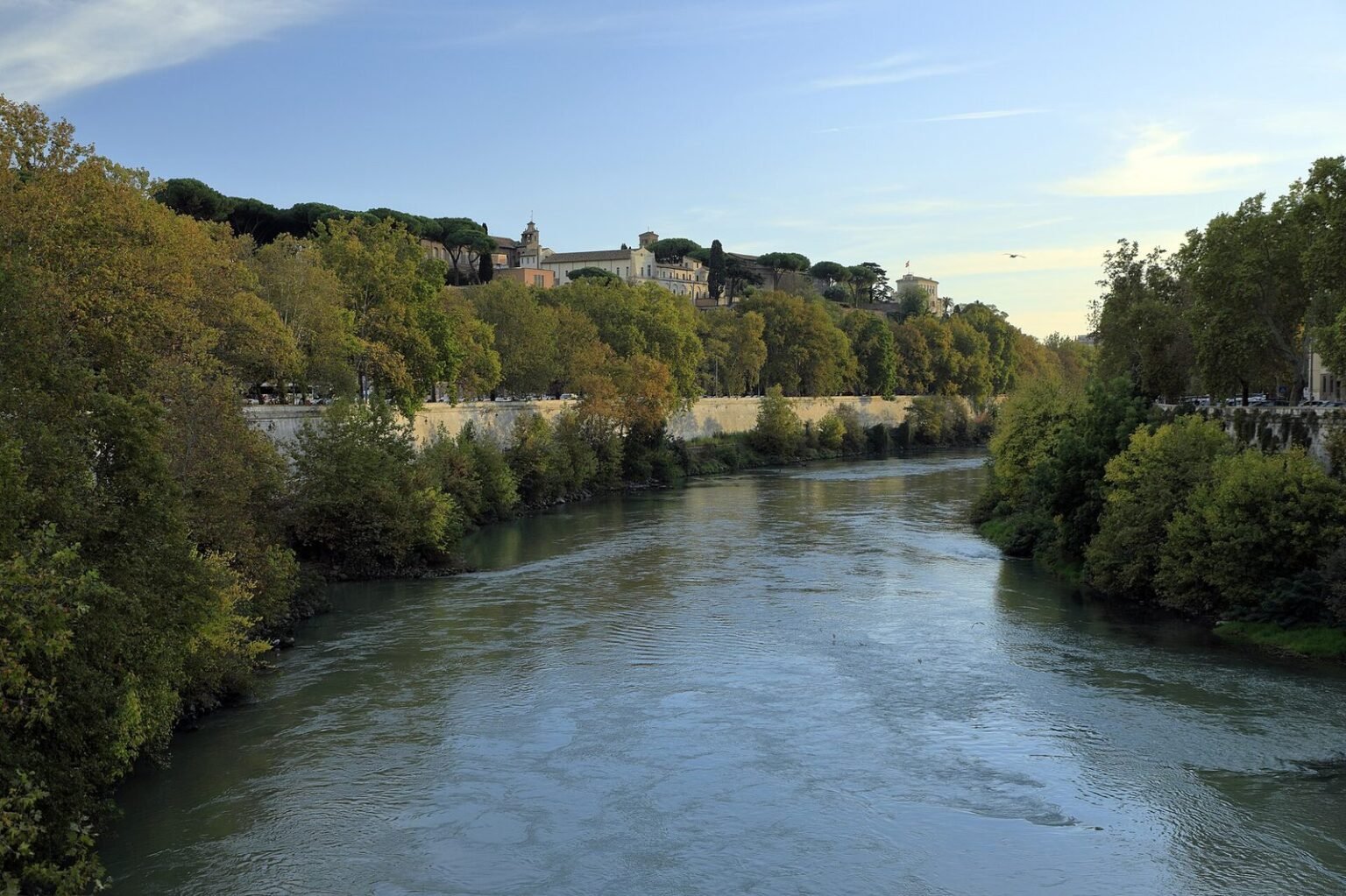
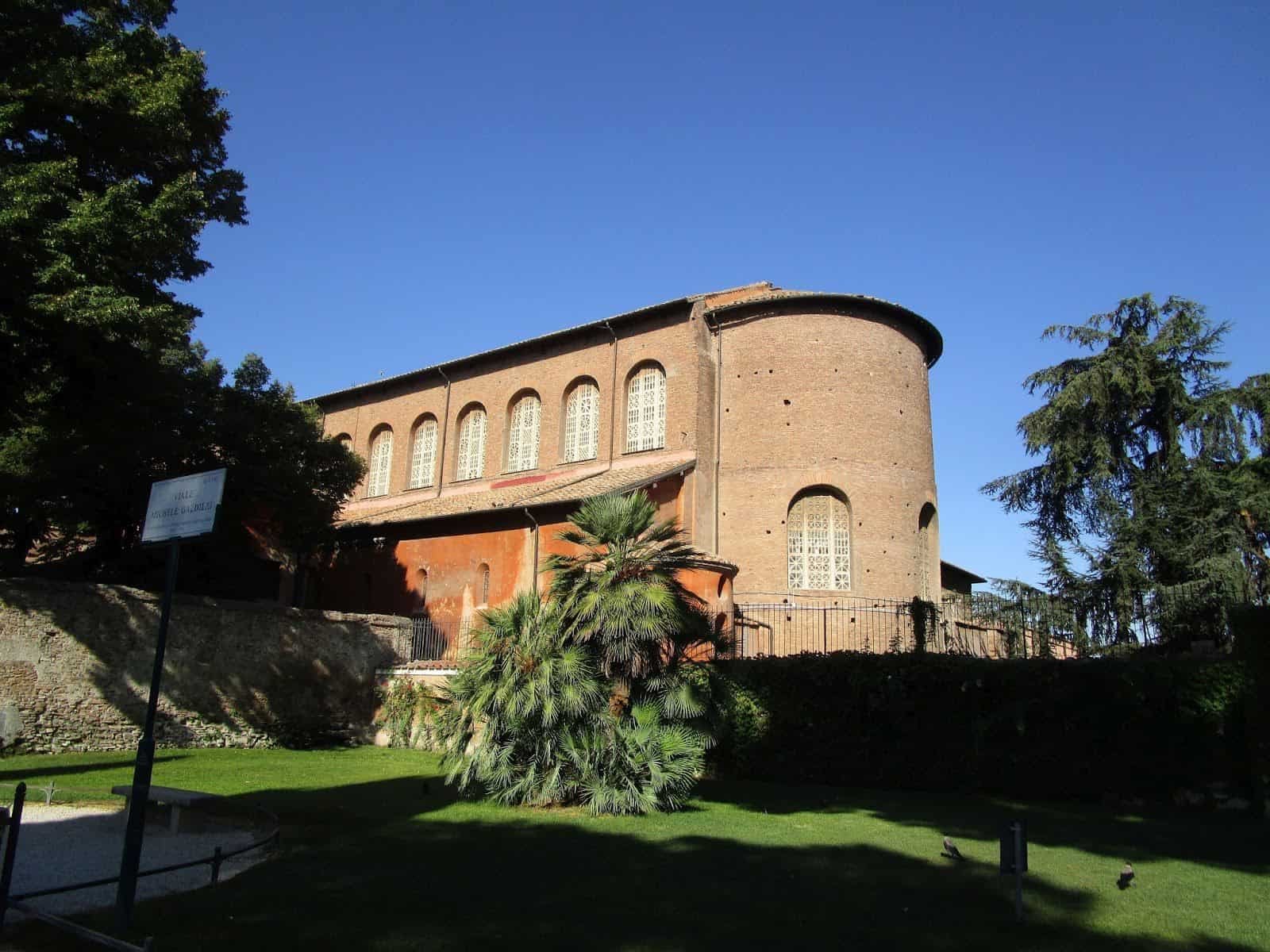
The address is Piazza Pietro d'Illiria 1. The piazza is that small open space with the Mascherone fountain in front of the wall of the Orange Garden, on the western side of the Aventine, overlooking the Tiber and Trastevere. The Basilica of Santa Sabina on the Aventine sits there, with its long flank facing the piazza and an entrance that, for those arriving, seems almost hidden under a portico.
The simplest route: metro B to Circo Massimo, exit, walk along the Circus Maximus, take the uphill road of Via di Valle Murcia, and you reach the Giardino degli Aranci. The basilica is the building on the left as soon as you enter the piazza. It's a good 20 minutes on foot, almost all uphill, and with 40 degrees in August, you feel the climb.
The second route, for those coming from the Tiber: get to Lungotevere Aventino, then go up Via di Santa Sabina or the staircase that comes out near the rose garden. It's steeper but shorter.
Bus line numbers have not been confirmed by an official source: check the ATAC trip planner or the app before you leave home. The Churches of Rome Wiki, which is not an official source but is written by people who know these places, warns that there are no stops right in front of the church and suggests getting off along Via del Circo Massimo, at the height of Piazzale Ugo La Malfa, and then walking up. In the end, on the Aventine you climb with your legs.
How far is the walk from the Circo Massimo metro?
About one kilometer, with an elevation gain of about 40 meters. 20 minutes at a normal pace, 15 if you're in a hurry and have the breath for it.
Can you get to the Basilica of Santa Sabina on the Aventine by car?
You can get there, but parking on Piazza Pietro d'Illiria is a lottery, and the Aventine is a residential area with paid parking. Taxis can drop you off right at the door, though.
Hours, admission and rules: what the official sources say
The official website of the Basilica of Santa Sabina on the Aventine, on its opening hours page, says: Sunday and Monday 12.00-19.00, Tuesday to Saturday 08.00-19.00. It also says that access is free and requires no reservation, that visits are not allowed during scheduled liturgical services, and that the excavations are not accessible.
The Turismo Roma listing, the official portal for tourism in the city, instead only reports "holy days of obligation from 12.00 to 19.00" and the Mass times, without the long weekday schedule. This is not a denial, it is partial information. If the two pages confuse you, stick with the Dominicans' website: they are the ones who run the church.
Third source, and here the difference is real: the Churches of Rome Wiki still gives the split hours 8.15-12.30 and 15.30-18.00, that is, with the midday closure. That is not what the official website says. That split schedule still circulates on many guides online, and if you arrive at 14 on a Tuesday thinking it's closed, you'll miss an hour of good light.
Do you need to pay to enter the Basilica of Santa Sabina on the Aventine?
No. Free admission, no ticket, no reservation. Source: official website.
Do you need to book?
No. The official website says so explicitly.
Can you enter during Mass?
Visits are not allowed during scheduled celebrations. In practice: avoid 07.15 on weekdays, 08.00 and 11.00 on Sundays, and 19.15 every day.
How much time you need to visit the Basilica of Santa Sabina on the Aventine
40 minutes if you really look. A quarter of an hour if you go in, walk around the nave and leave. An hour and a half if you start reading the door panels one by one, and it's worth it. Plan on another 20 minutes for the Giardino degli Aranci next door, which is free too.
The Basilica of Santa Sabina on the Aventine pairs well with a walk: first the church, then the garden, then the keyhole of Villa del Priorato di Malta 200 meters away, then down toward the Rome Rose Garden. A full half day, zero euros in tickets.
Who was Sabina, and why her name is on this basilica
The traditional version goes like this: Sabina was a Roman matron, converted to Christianity by her servant Serapia, and ended up beheaded under the emperor Hadrian. Her body is said to have been buried in a titulus, that is, a house consecrated to worship, and the basilica is said to have been built over that house.
A clarification is needed here, because the legend is often treated as a biography. The Churches of Rome Wiki, which summarizes the state of scholarship, reports that Sabina's passio is considered legendary: it places the martyrdom in 114 at Vindena, in Umbria, and the modern revision of the Roman Martyrology no longer identifies that Sabina with the woman behind the name of this church, who is described simply as the founder of the place of worship. Said in Roman dialect: probably Sabina was not a beheaded martyr, she was a lady who had made her house available for the Christians' gatherings, and in Rome that was more than enough to tie her name to the church forever.
The inscription from which tradition derived her identity is on the lid of the marble chest that held the relics, and today you find it at the center of the schola cantorum, inside the basilica. It remains, however, an authentic and very old piece: it's not the story that is false, it's the chronicle that was written centuries later.
Are Saint Sabina's relics still here?
Tradition places them under the high altar together with those of other martyrs. The slab that covered them, which has a part in this story, is today at the center of the schola cantorum.
The titulus Sabinae: the house before the church
The tituli were Rome's first parish churches, often set up inside private houses. The titulus Sabinae is one of the oldest documented on the Aventine. The Basilica of Santa Sabina on the Aventine grew out of that: it's not a building dropped from above, it's the monumental growth of a room where 30 people used to gather.
Under the floor, excavations have found a very long stratigraphy: a small temple from the Republican era, perhaps from the 3rd century BC and perhaps dedicated to Jupiter Liber, a stretch of the Servian Walls a little to the north, a Roman house, materials linked to the cult of Isis. Some of the Roman house is still visible through a grate in the floor, and in the right aisle there is an ancient column that tradition links to Sabina's house. It is described as "granite column set against the right wall": it's there, and it's real.
But remember the practical detail: the actual excavations are not accessible. The official website says so. What you see is the hole in the floor, not an underground route. If you're looking for a church in Rome where you can really go down underground, go to the San Clemente Basilica.
Pietro di Illiria, the priest who built the Basilica of Santa Sabina on the Aventine
The founder has a full name, and it's written in gold above the entrance door. His name was Pietro, he was a presbyter of Illyrian origin, and the square in front of the church still bears his name today: Piazza Pietro d'Illiria.
The sources don't say exactly the same thing about the date. Here are all three. Italian Wikipedia says "between 422 and 432, under the pontificate of Celestine I." Turismo Roma says "founded in 425." Cathopedia says founded in 425 under Celestine I and completed in 432 under Sixtus III. They are not numbers at war with each other: they are the same construction site described with different precision. If you need just one sentence: the Basilica of Santa Sabina on the Aventine dates from the 420s-430s of the 5th century, and it has come down to us with its walls.
The mosaic of the inner façade and the gold inscription
Turn around as soon as you enter. Above the door, on the inner wall of the facade, there is a band of 5th-century mosaic: gold letters on a blue background, seven lines of Latin hexameters. It is the church's dedication, and it attributes the foundation to Peter. Cathopedia reports the text, which begins with CULMEN APOSTOLICUM CUM CAELESTINUS HABERET, meaning "when Celestine held the apostolic summit," and goes on to say that the building you are admiring was founded by Peter, a priest of the City, of Illyrian descent, rich for the poor and poor for himself.
On either side of the inscription there are two female figures. They are not saints: they are two allegories of the Church, the Ecclesia ex circumcisione, meaning Christians of Jewish origin, and the Ecclesia ex gentibus, meaning converts from paganism. They are the only surviving fragment of the original mosaic decoration of the Basilica of Santa Sabina on the Aventine. All the rest of the ancient mosaics, the apse included, has been lost.
That mosaic is the most important thing in the church after the door, and 90 out of 100 visitors don't notice it because they walk in and look straight ahead. Turn around.
The 24 Columns: Where They Really Come From
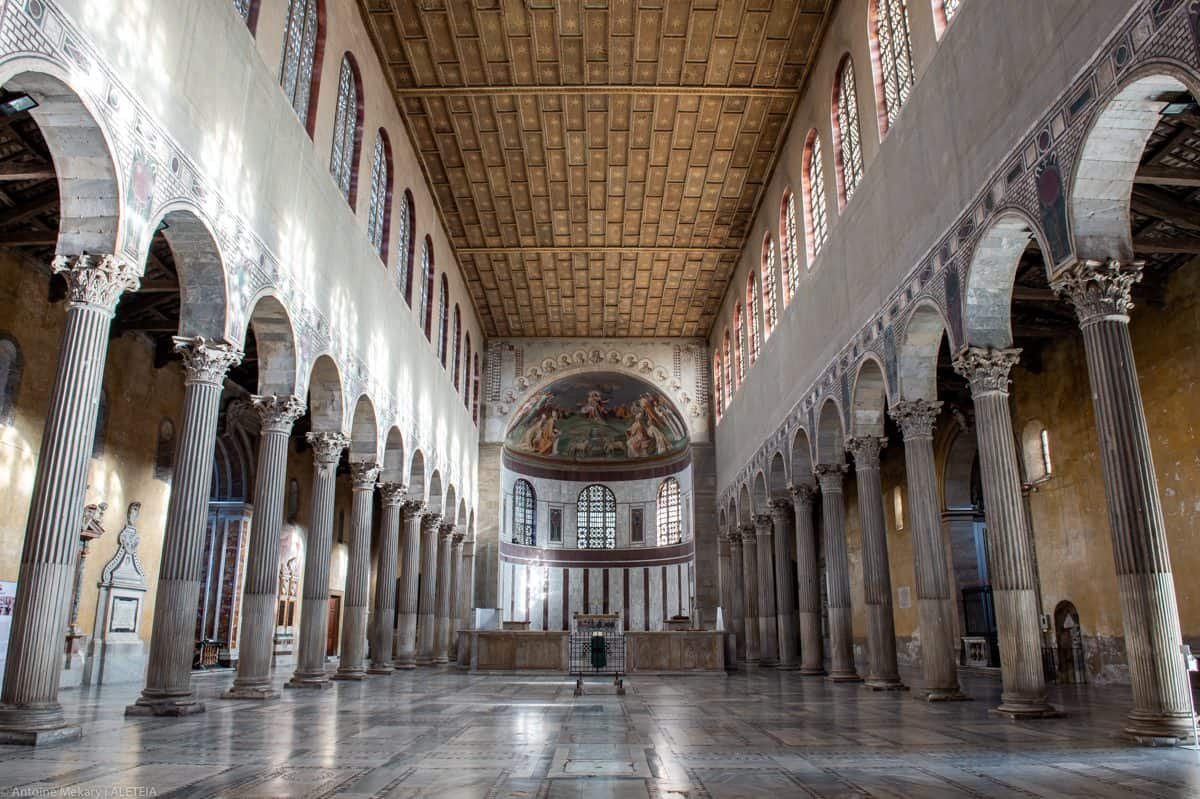
The central nave of the Basilica of Santa Sabina on the Aventine is lined by 24 Corinthian columns in Proconnesian marble, with capitals and bases that all look alike. They support the arches directly, without a continuous architrave, and this is what gives the church that light feeling that no other early Christian basilica in Rome has.
About where the columns come from, people often take for granted something that isn't actually established. It is said that the temple of Juno Regina stood near the church, and that 24 of its columns were reused here, citing the inscriptions CIL VI 364 and CIL VI 365. As an alternative, the Baths of Surа are named.
The sources don't agree. English Wikipedia and Cathopedia accept the derivation from the temple of Juno as correct. Italian Wikipedia reports both hypotheses and also mentions columns from a late imperial monument that may never have been erected. The Churches of Rome Wiki says the columns date to the 2nd century, that the two hypotheses on the table are the temple of Juno and an imperial storehouse for building materials, and notes that the columns show very few signs of reuse, which points toward the storehouse hypothesis. It adds a curious detail: the proportions follow Vitruvius's rules precisely, with the columns' height at 9.5 times their diameter and the spacing between them at 5 times the diameter.
Translated: Peter of Illyria probably didn't empty a temple. He bought a lot of new marble that nobody bought. Which is a much more Roman story than the legend.
How many columns does the Basilica of Santa Sabina on the Aventine have?
24, in Proconnesian marble, Corinthian order, 12 per side.
The 5th-Century Cypress Wood Door
If you only have time to see one thing, see this. The entrance door of the Basilica of Santa Sabina on the Aventine is made of cypress wood and dates to the 5th century, roughly between 420 and 450. It is the oldest surviving example of early Christian wooden sculpture. Not a copy: that one.
The carved panels were originally 28. Italian Wikipedia, English Wikipedia and Cathopedia agree that 18 remain, the Churches of Rome Wiki, in its summary, instead speaks of about 10 surviving panels out of the 28 originals. The figure that circulates most, in three out of four sources, is 18.
The scenes set the Old and New Testaments side by side: Moses and Christ, the Exodus and the miracles, the theophanies. In one panel God is shown only as a hand coming out of a cloud, which is the oldest convention in Christian art.
A practical warning: the door is under the portico, in semi-darkness, and for years it was seen badly. Since March 2025 this is no longer the case: the reason is explained below.
The Crucifixion Panel, the Oldest Known
At the top left, on the door, there is the panel that art historians come here for from all over the world: Christ on the cross between the two thieves. It is considered the oldest known depiction of the Crucifixion, and the first shown publicly on a building.
Look at it closely, because it doesn't resemble any crucifixion you have in your head. Christ has his eyes open, he has no halo, no crown of thorns, there is no blood, and the cross is barely visible: you sense it from the outstretched arms and the nails. Behind, there is an architectural backdrop with pediments alluding to a Roman mausoleum. The three bodies are three different sizes. In the 5th century the cross was still a shameful execution in people's living memory, and depicting it was an act of courage: they did it with a fine chisel, in a small panel, up high, where the eye of someone who already knows what to look for can reach it.
Where exactly is the Crucifixion panel located?
In the upper row of the wooden door, on the left side. Look up just as you pass under the portico, before going in.
The selenite windows and the light inside the Basilica of Santa Sabina on the Aventine
The nave windows have no glass: they have sheets of selenite, that is, crystalline gypsum, set in pierced screens with geometric designs. Cathopedia mentions 29 arched windows, five of which are on the facade. The light that comes through them is milky. It doesn't cut, it doesn't dazzle, and it fills the nave evenly.
That's why the Basilica of Santa Sabina on the Aventine is the church in Rome where you get the most honest sense of what it was like inside a fifth-century building. A small caveat, to be fair: the screens you see today are not all ancient. Antonio Munoz rebuilt them in the 1930s starting from the original fragments found during the excavations. The design is authentic, but a large part of the material is not.
What's the best time for the light?
Late afternoon. The basilica is oriented so that in the afternoon the light enters from the long side toward the nave: between 16 and 18 in summer the selenite works at its best. Early in the morning, from Tuesday to Saturday, you get total silence in return.
What you see when you enter: nave, apse, floor
Inside you find three naves, no transept, an apse almost as wide as the central nave, and a floor full of medieval tombstones. Cathopedia gives the measurements: 56 meters long at most, 25 wide at most. It's not huge, and that is exactly what makes it easy to take in at a glance.
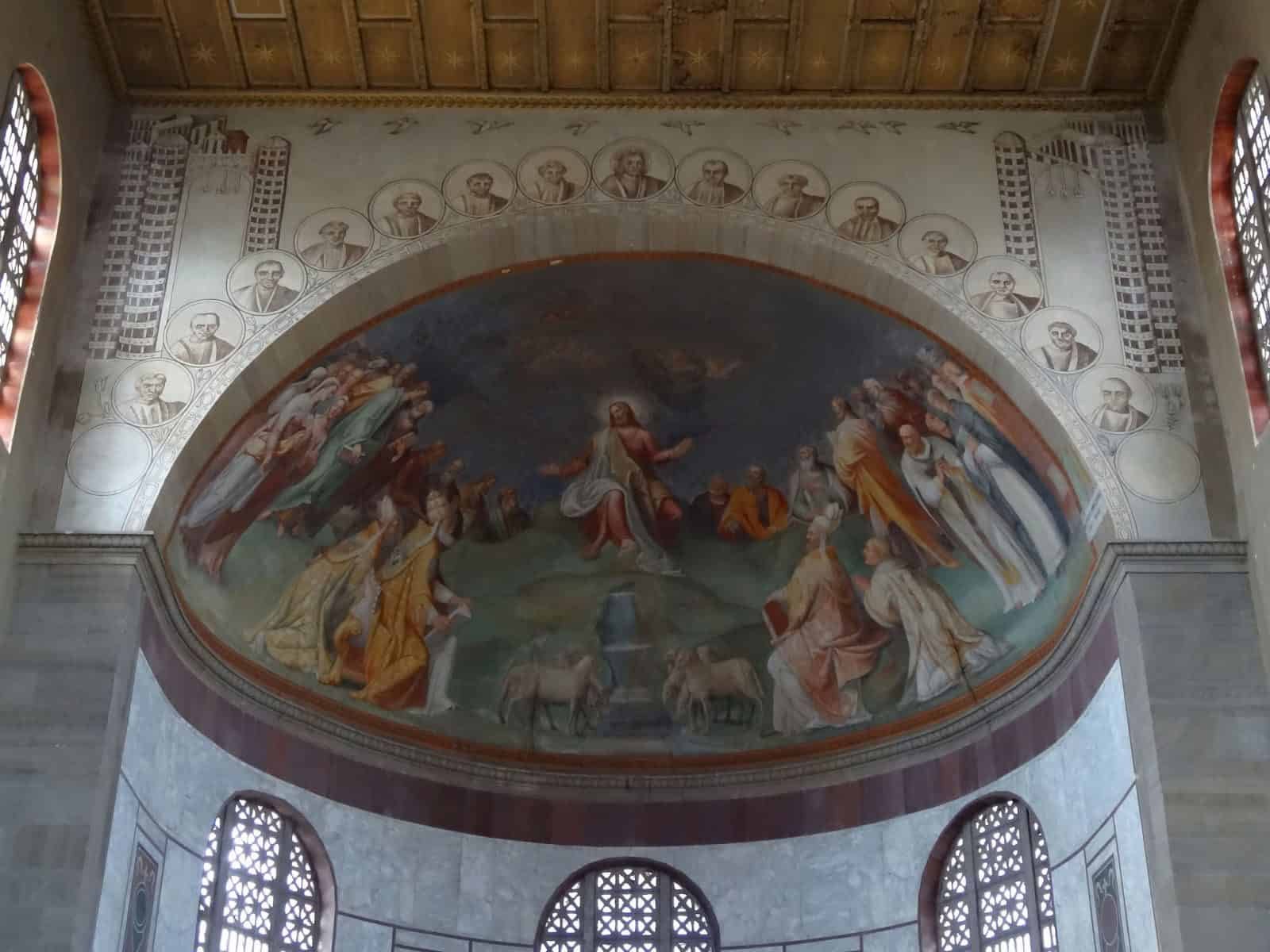
The apse basin is frescoed: the original early Christian mosaic is gone, and what you see is a fresco by Taddeo Zuccari, dating from around 1560, which according to the Churches of Rome Wiki was made from drawings of the old mosaic but with great freedom. It shows Christ in glory above the river of life, where the sheep drink, surrounded by apostles and saints. So it's an early Christian scheme repainted by a Mannerist. It's worth knowing this before you look, or it will seem out of place.
Are there famous works inside?
There's no postcard masterpiece. The Basilica of Santa Sabina on the Aventine is worth visiting for the architecture, the door, the mosaic on the inner entrance wall, and the mosaic slab of Munoz de Zamora. Anyone who goes in looking for a Caravaggio leaves disappointed, anyone who goes in looking for the fifth century leaves happy.
The schola cantorum and the slab with the inscription
The marble enclosure in the middle of the nave is the schola cantorum, that is, the space reserved for the singers. What you see is a 1936 reconstruction modeled on the early Christian one, reusing the ancient plutei that were recovered, which date to the work of Pope Eugene II around 824. The flat screens have crosses decorated with interlaced knots and scrolls, in a style some call Persian.
Inside the enclosure is the slab derived from the lid of the marble chest that held the relics of Saint Sabina and other martyrs, with the inscription from which tradition drew its story. It is the same slab that, according to the legend of the Lapis Diaboli, the devil supposedly broke into pieces. Who actually broke it, and when, is discussed further down.
The mosaic slab of Munoz de Zamora
On the nave floor is a tombstone unlike any other: a mosaic effigy of a Dominican friar, probably Munoz de Zamora, master general of the order, who died in 1300. The Churches of Rome Wiki attributes it to Iacopo Torriti and calls it the only mosaic burial slab left in Rome. The Italian Wikipedia agrees on the date and attribution.
It's one of those things people walk over without seeing. It sits there, in the middle of the nave, and if you don't look down you walk right over it.
The side chapels: San Giacinto and Saint Catherine of Siena
The chapel of San Giacinto was added in 1600, after the canonization of the Polish Dominican saint, and has frescoes by Federico Zuccari with an altarpiece by Lavinia Fontana, the Madonna with Saint Hyacinth. That a sixteenth-century Roman church has an altarpiece signed by a woman painter is not a given, and it's one more reason to go and look.
The d'Elci chapel, dedicated to Saint Catherine of Siena, is baroque and very rich, designed by Giovanni Battista Contini. It contains three cardinals' tombs and has a dome lit by eight round windows, with the fresco by Giovanni Odazzi showing Catherine presented to Christ, from the early 18th century. It is the only point in the Basilica of Santa Sabina on the Aventine where the baroque survived the restorations: keep that in mind when you read that Munoz "removed all the baroque." He didn't remove all of it.
San Domenico on the Aventine: the cell, the cloister, the order
In 1219 Pope Honorius III granted the church and the adjoining palace to Dominic of Guzman and his order of preaching friars. On this date nearly all the sources agree: the Italian Wikipedia, Turismo Roma and Cathopedia all say 1219, Cathopedia specifies that the Dominicans moved here from San Sisto Vecchio in 1220, English Wikipedia says that Honorius III invited Dominic to settle here in 1220. The difference is between the decree and the move.
Dominic lived in the adjacent convent for a time, shortly before his death in 1221. His cell was converted into a chapel and can be visited by request to the convent. Since then, Santa Sabina has been the mother house of the Dominicans: the general curia of the Order of Preachers is here, that is, its worldwide headquarters. This is not a minor detail: it means that when you go in, you are inside the central seat of a living religious order, with friars who live there.
The main cloister is Romanesque, from the 13th century, and the Churches of Rome Wiki credits it with 103 columns. Right next to it is the chapter house where Saint Hyacinth took his vows. It is not part of the regular visit route: the same source describes access by request and with restrictions. If you're interested, write to the rector at the email address listed at the top.
Can you visit the cloister of Santa Sabina?
Not freely. The cloister belongs to the Dominican convent. The only way is to ask the rector in writing. Don't count on an impromptu visit on a Sunday afternoon.

The orange tree in the cloister and the little hole in the wall
In the cloister of the Basilica of Santa Sabina on the Aventine there is a bitter orange tree. Dominican tradition says that Saint Dominic planted it in 1220, from a shoot brought from Spain, and that it would have been the first orange tree transplanted to Italy.
From the portico, before you enter the church, there is an opening in the wall protected by glass. Look inside and you'll see the tree. It's one of the nicest free things to do in Rome, and kids go crazy for it because it looks like a peephole.
It's often said that the orange tree has "the record for the oldest existing tree in Rome," and the same sentence admits that the original dried up and the tree was reborn several times through other plants. The two claims don't fit together. The correct fact is this: the tree you see today is not the plant from 1220. It is a descendant of that plant, as the Churches of Rome Wiki also confirms when it says the orange tree in the new cloister descends from the one planted by Saint Dominic. The title of "oldest tree in Rome" is a nice line, but it doesn't hold up. The real story is a relay: a plant that has been replanting itself for eight centuries, which is even better.
About the five candied oranges that Saint Catherine of Siena would have given to Pope Urban VI in 1379, picked from this very tree: it's a devotional tradition. It is not documented in any historical source and shouldn't be taken as history.
Can you go into the cloister to see the orange tree up close?
No, not freely. You see it through the hole in the wall under the portico, and that's where everyone lines up.
The Lapis Diaboli, the black stone
To the left of the entrance, on a small twisted column, there is a round, shiny black stone. They call it the Lapis Diaboli, the Devil's Stone. The legend: the devil hurled it at Saint Dominic while he was praying on the slab covering the martyrs' bones, missing him and shattering the slab.
The Churches of Rome Wiki notes that the object looks a lot like an ancient Roman scale weight, and that it is not at all clear whether the original stone was a meteorite, as another version of the story claims. It's the funniest thing about the Basilica of Santa Sabina on the Aventine: a diabolical legend built around a little market weight.
A wrong date is circulating about the slab. It is said that the slab was broken by the architect Domenico Fontana "during the 1527 restoration." That date doesn't hold up: Domenico Fontana was born in 1543 and died in 1607, so he wasn't born yet in 1527. His work at the Basilica of Santa Sabina on the Aventine is dated 1586-1587 by Cathopedia and the Churches of Rome Wiki. The correct date is that of Fontana's worksite, that is 1586-1587, not 1527. The slab fragments were later thrown away, found again and reassembled, and today they sit at the center of the schola cantorum. That part of the story holds up.
Where is the Lapis Diaboli?
Under the portico, on your left as you face the door, resting on a spiral column. Small, black, very easy to miss.
The bell tower and the bells
The bell tower of the Basilica of Santa Sabina on the Aventine is not the one you see in the romantic photos: it's a narrow, truncated tower, built against the left flank. Cathopedia describes it as square, 25 meters tall, of 13th-century origin, originally with four stories and double trifore, then cut down in the Baroque era. The Churches of Rome Wiki states more clearly that the Baroque bell tower replaced the Romanesque tower of the 13th century. Italian Wikipedia dates it to the 12th or 13th century, rebuilt in the Baroque era.
The sources don't agree on the bells: Italian Wikipedia mentions three bells dated 1596, 1843 and 1906. Cathopedia says 1596, 1843 and 1946. The first two agree, the third doesn't, and there's no third source to settle it.
In the Middle Ages: fortress, popes, restorations
The Basilica of Santa Sabina on the Aventine was not always just a church. In the 9th century it was absorbed into the hill's fortifications, and in the 10th it became part of a fortified residence of Roman noble families: the Aventine was a strategic position, high, easy to defend, with the river below. Pope Leo III and Pope Eugene II restored and embellished it, and it is precisely to Eugene II that we owe the plutei of 824, reused in the rebuilt schola cantorum.
When Dominic arrived, in 1219, he did not find an isolated church in a meadow. He found a fortified complex. The bell tower and the cloister were built precisely for the Dominicans.
The Conclave of 1287-1288, the One Where Six Cardinals Died
This is the darkest story that ever happened in here.
Pope Honorius IV died on April 3, 1287. The conclave opened the next day, April 4, and was held in Rome, at Santa Sabina. Summer came, and with it the epidemic: six cardinals died, probably of an illness favored by the heat. Three were not present because they were busy on diplomatic missions. Of the 16 cardinals at the start, seven remained.
Tradition has it that the others fled in terror and that only one stayed locked in at Santa Sabina: Cardinal Girolamo Masci. The chronicle of the conclave speaks of seven cardinals remaining, not one. The phrase "only one stayed" is wonderful, but it should be taken as tradition, not as the minutes.
Precision is needed on the date of the election. It is often read that the cardinals met again on February 22, 1288, and that on that same day they elected Girolamo Masci. The correct fact: Nicholas IV was unanimously elected a first time on February 15, 1288, refused the election, and was elected a second time on the 22nd of the same month, and then he accepted. The date of February 22 is right, but it is the second election, not the only one.
Girolamo Masci took the name Nicholas IV and was the first Franciscan in history to become pope. That a conclave gathered at the Dominicans' headquarters decided it is one of those short circuits that keep happening in Rome.
Why was the conclave held at Santa Sabina?
Because in the 13th century the Aventine was high, breezy, fortified, and outside the chaos of the lower city. The paradox is that the place chosen to be safe turned out to be a trap.
Fontana 1587 and Borromini 1643: What They Took Away
In 1586-1587 Sixtus V commissioned Domenico Fontana to modernize the interior. Fontana did what was done back then: he dismantled the schola cantorum, removed the original ciborium and the iconostasis, eliminated the apse mosaic, closed the nave windows, and put in a ceiling. The Churches of Rome Wiki uses the word "ruthless" about the destruction of the medieval furnishings. In 1643 Francesco Borromini took the building in hand again, and in the 18th century there were further alterations.
This is why the Basilica of Santa Sabina on the Aventine of today is a restoration: what you see is the idea the 20th century had of the 5th century, layered over what the 16th and 17th centuries had left. Better to know it than to believe you're stepping into a time machine.
1870, the Dominicans Driven Out, and the Lazaretto
With the capture of Rome and the suppression of religious orders, the Dominicans were expelled and the complex was converted into a lazaretto, that is, an isolation hospital for infectious diseases. Wikipedia in English reports this, adding a detail that says a lot: the choice to put a lazaretto here shows how peripheral the Aventine still was, almost countryside, at the end of the 19th century.
Today you get there from the metro in 20 minutes, and it feels like the center. 150 years ago it was the place they took you if you had to stay away from everyone.
Antonio Munoz and the Restoration That Turned Back the Clock
In the 20th century Antonio Munoz stripped away the Baroque and returned the Basilica of Santa Sabina on the Aventine to the early Christian and medieval appearance it has now: the windows reopened, the selenite screens rebuilt starting from fragments found in the excavations, the schola cantorum reassembled, the marbles brought back into view.
On the dates, the sources contradict each other. Italian Wikipedia speaks of two phases, 1914-19 and 1936-37. English Wikipedia and the Churches of Rome Wiki say Munoz worked in 1914-1919 and that the second phase, 1936-1938, was completed by P. Berthier. Cathopedia places the medievalist restoration in 1938, with additional work in 1959. The phases are the same. The closing years and the name of who signed them change.
The other side should be said too: that restoration is debated. Munoz threw out Baroque furnishings of good quality in pursuit of an idea of original purity. What today seems to you "authentic 5th century" is also an ideological choice of the 1930s.
The First Lenten Station: Ash Wednesday on the Aventine
The Basilica of Santa Sabina on the Aventine is the first station church of Roman Lent. On Ash Wednesday the pope goes up here and celebrates the Mass that opens Lent, at the end of a penitential procession. Since 1962 the procession starts from the nearby church of Sant'Anselmo all'Aventino. Before that, it started from the basilica of Sant'Anastasia on the Palatine.
Why exactly here, nobody knows for sure. Two hypotheses circulate that remain hypotheses: that the pope retreated up high for a few days of rest before the Lenten labors, and that the steep climb was a symbol of the soul's spiritual ascent.
Ash Wednesday 2026: what happened on February 18
On February 18, 2026, Pope Leo XIV presided over the Ash Wednesday Mass at the Basilica of Santa Sabina on the Aventine: his first as pope. The penitential procession started from Sant'Anselmo all'Aventino, marked by the litany of the saints, with the Benedictine monks of Sant'Anselmo, the Dominican fathers of Santa Sabina, bishops and cardinals together with the faithful. The ashes on the pope's head were imposed by Cardinal Angelo De Donatis, major penitentiary, and then the pope imposed them on the faithful. Source: Vatican News.
If you want to be there too, once in your life: it's Ash Wednesday, in the afternoon, and you get there early because the basilica is small and the square fills up.
The new lighting of 2025
Concrete news, and it really changes the visit. In March 2025 a new LED lighting system was inaugurated in the Basilica of Santa Sabina on the Aventine, funded by the Fondo Edifici di Culto and overseen by the Special Superintendency of Rome, with design by EKOTECH Engineering, construction by ZP Elettronica, and under the direction of architect Ilaria Delsere.
The work covers the fifth-century wooden door, with warm light managed by home automation, the mosaic of the inner facade, the central nave lit by LED strips along the window sills, the side aisles, the chapels of San Giacinto and Santa Caterina, the choir and the apse, plus the audio-video system and the emergency lighting. Superintendent Daniela Porro presented it, saying that lighting is not only a duty toward one of the oldest churches.
Translated for those who go: the cypress door, which for decades has been looked at in the dark under the portico, can now be seen. If you have a visit in mind from before 2025, that one is no longer today's visit.
The cardinal title of Santa Sabina
The same-named cardinal title is attached to the basilica. As of August 2026, the title of Santa Sabina is listed as vacant since August 8, 2022, the day of the death of Cardinal Jozef Tomko, who held it from January 29, 1996. Before him came Gabriel-Marie Garrone from 1967 to 1994 and Ernesto Ruffini from 1946 to 1967. The title would have been established by Pope Celestine I around 423, or perhaps only confirmed at that time. Cardinal titles are assigned at each consistory: this detail should be verified.
With children at the Basilica of Santa Sabina on the Aventine
It works better than you'd think, under three conditions. First: the visit has to be short, 20 minutes is enough. Second: give them a mission, for example finding the hand of God coming out of the cloud on the wooden door, or counting the columns. Third: the little hole of the orange is the winning card, so save it for last.
Right after, you have the Giardino degli Aranci, a real park with lawn and benches, and the keyhole of Villa del Priorato di Malta 200 meters away. A perfect combination for an afternoon with the kids without spending anything.
Accessibility
The problem with the Basilica of Santa Sabina on the Aventine is not the interior, which is essentially flat on a single level: it's getting there. The Aventine is a hill, and the climb from the Circo Massimo metro stop is long and steady. Those with mobility difficulties would do better to have a taxi drop them off in Piazza Pietro d'Illiria.
At the entrance there is the portico, and there are steps. The Turismo Roma website refers to the "Roma accessibile" section for detailed information. The basilica's official website does not report an explicit statement on accessibility: if you need certainty, write to the rector before you leave.
When to go in summer, and when to avoid
In August, go up after 17:00, never at noon: the climb has no shade, and on the Aventine there isn't a bar every 50 meters like in the center. Inside the basilica it's cool because the walls are five centuries thick, and the rush of cool air when you walk in is one of the best things about a Roman summer.
The Giardino degli Aranci at sunset is packed, and that's the only time the area gets crowded. If you want the Basilica of Santa Sabina on the Aventine all to yourself: Tuesday morning at 08:15, right when it opens.
What's nearby, all on foot
The Aventine is one of the few places in Rome where you can string together five good things without ever taking a vehicle. From the Basilica of Santa Sabina on the Aventine, in order of distance:
- Orange Garden, literally next door, with the terrace over the Tiber.
- Villa del Priorato di Malta, 200 meters away, the famous keyhole with the dome of Saint Peter framed in it.
- Rome Rose Garden, on the side facing the Circus Maximus, open during the flowering season.
- Circus Maximus, at the foot of the hill.
- Santa Maria in Cosmedin and the Mouth of Truth, 10 minutes downhill.
- Baths of Caracalla, 20 minutes on foot toward the south.
- Pyramid of Cestius and Non-Catholic Cemetery in Rome, on the Testaccio side.
- Nuovo Mercato Testaccio, if you're hungry and want to eat properly.
- Basilica of Santa Cecilia in Trastevere, across the bridge.
If instead you're doing the tour of Rome's great early Christian basilicas, after Santa Sabina put San Clemente, Saint Paul Outside the Walls, Santa Maria Maggiore and i Santi Giovanni e Paolo on the Celio on your schedule. For the underground chapter, though, you go to the catacombs of Rome and along the Appian Way Park.
Where the official sources don't agree
When two reliable sources say different things, here they are, lined up: you decide whether you need to look into it further.
- Opening hours: the basilica's official site says Tuesday-Saturday 8-19 and Sunday-Monday 12-19. Turismo Roma only lists the holy days of obligation, 12-19. The Churches of Rome Wiki still gives 8.15-12.30 and 15.30-18.00. The official site counts, but check before you go.
- Founding date: 422-432 according to Italian Wikipedia, 425 according to Turismo Roma, 425-432 with completion under Sixtus III according to Cathopedia.
- Columns: temple of Juno Regina according to Cathopedia and English Wikipedia, a double hypothesis with the Terme Surane according to Italian Wikipedia, imperial warehouse as the preferred hypothesis according to the Churches of Rome Wiki.
- Door panels: 18 surviving out of 28 according to Italian Wikipedia, English Wikipedia and Cathopedia. About 10 surviving according to the summary by the Churches of Rome Wiki.
- Bells: 1596, 1843 and 1906 according to Italian Wikipedia. 1596, 1843 and 1946 according to Cathopedia.
- Munoz restorations: 1914-19 and 1936-37 according to Italian Wikipedia. 1914-1919 and 1936-1938 with P. Berthier according to English Wikipedia and the Churches of Rome Wiki. 1938 and then 1959 according to Cathopedia.
- San Domenico: grant in 1219 according to Italian Wikipedia, Turismo Roma and Cathopedia, with the friars' transfer in 1220. Invitation in 1220 according to English Wikipedia.
A curiosity about the Basilica of Santa Sabina on the Aventine
The curiosity is this: the Basilica of Santa Sabina on the Aventine is the worldwide headquarters of a religious order, and nobody notices it. This is where the General Curia of the Order of Preachers is, meaning the Dominicans' center on a global scale, since 1219. That means while you're looking at the columns, behind that wall there's an office where decisions are made that affect friars in Vietnam, Brazil and Congo.
The second curiosity, smaller but nice: the square in front is called Piazza Pietro d'Illiria, which means it bears the name of the priest who paid for the church in the 5th century. Rome names streets after generals and kings. Here it has given a square to a construction financier from 16 centuries ago, and the name is written in gold above the door, 50 meters further on. A circle that closes.
Something nobody tells you about the Basilica of Santa Sabina on the Aventine
That the devil's stone looks very much like a Roman balance weight. The Churches of Rome Wiki says so plainly, and once you know it you can't see it any other way: that black, shiny thing on the little column, which according to legend the devil hurled at Saint Dominic, is probably a market tool that someone found during the excavations and put there.
And another one, about substance. What you admire as "early Christian purity" is to a large extent a 20th-century arrangement. Munoz remade the selenite screens using fragments found during the excavation, the schola cantorum is a reconstruction from 1936, the apse mosaic no longer exists, and in its place is a Mannerist fresco from around 1560. The Basilica of Santa Sabina on the Aventine is authentic in its walls, columns, door and the mosaic on the inner facade. The rest is an honest reconstruction, well made, but still a reconstruction. No guide says so, because it spoils the effect. In our view, though, it improves it.
The advice I give you for visiting the Basilica of Santa Sabina on the Aventine
Go on a Tuesday morning, right when it opens at 08:00. It's the only day of the week when the long opening hours start early and there's still no one there. Do it this way: before going in, stop under the portico for a good 10 minutes and look at the cypress door panel by panel, starting from the top left where the Crucifixion is. Now that the new lighting has been in place since 2025, you can really see it.
Then go in, and as soon as you're inside, turn right away toward the mosaic above the door. Only after that walk toward the altar. Anyone who walks in looking straight ahead misses the two best things about the Basilica of Santa Sabina on the Aventine in the first 10 seconds.
Last piece of advice, and it's worth gold: don't bring loud groups and don't film videos with the sound turned up. The Dominicans still live here, the basilica doesn't have security staff at every corner, and the freedom to wander around a 5th-century place is a courtesy, not an acquired right.
Another well-known fact, yet rarely mentioned
The Basilica of Santa Sabina on the Aventine is the first Lenten station church in Rome, so every year, on Ash Wednesday, the pope climbs up here. Everyone in Rome knows it, and almost no one outside Rome does. On February 18, 2026, it was Pope Leo XIV's turn, with the procession setting out from Sant'Anselmo and the ashes placed on the pope's head by Cardinal Angelo De Donatis.
The little-cited part is the why: nobody knows for sure. The two theories going around are that the pope used to climb up here to rest for a few days before Lent, and that the steep climb was a symbol of spiritual effort. These are theories. The fact that such a solid tradition has such an uncertain origin is very Roman.
The right photo to take at the Basilica of Santa Sabina on the Aventine
The right photo isn't the facade, which is bare and tells you nothing. There are three, ranked by how well they turn out.
The first: the central nave backlit from the back, looking toward the apse, late afternoon, with light coming through the selenite screens and outlining the columns one behind the other. It's the photo that explains why this church is famous. Rest your phone on a column or a pew instead of raising the ISO: inside it's darker than it looks.
The second: the Crucifixion panel, top left on the wooden door, now that it's well lit. Optical zoom if you have it, no flash.
The third, the one nobody takes: the small hole in the wall with the orange tree inside. Focus on the tree and let the wall go out of focus. You get a strange and recognizable photo.
General rule: no flash and no tripods, as in all the churches in Rome. And if they're celebrating, the phone stays in your pocket.
Some important events that happened here throughout history
The facts in order, with the date and no beating around the bush.
Years 420-432. The presbyter Peter of Illyria founds the basilica under the pontificate of Celestine I, on a preexisting titulus. Some sources place its completion under Sixtus III, in 432.
Circa 824. Pope Eugene II intervenes on the furnishings. The plutei from that period were reused in the schola cantorum rebuilt in the 20th century.
9th-10th century. The church is incorporated into the hill's fortifications and becomes part of a fortified residence of noble Roman families.
1219. Pope Honorius III grants the church and the palace to Saint Dominic de Guzman and the Friars Preachers. The Dominicans arrive from San Sisto Vecchio in 1220. Dominic dies in 1221.
1287-1288. The conclave: opening on April 4, 1287 after the death of Honorius IV, six cardinals dying during the summer epidemic, election of Girolamo Masci on February 15, 1288, refusal, second election and acceptance on February 22, 1288. Pope Nicholas IV is born, the first Franciscan in history.
Circa 1300. The mosaic tomb slab of the Dominican master general is laid, attributed to Iacopo Torriti: the only one of its kind left in Rome.
Circa 1560. Taddeo Zuccari frescoes the apse basin in place of the lost early Christian mosaic.
1586-1587. Domenico Fontana, commissioned by Sixtus V, dismantles the schola cantorum, the ciborium and the iconostasis and closes the windows. It is during this worksite, and not in 1527 as is sometimes stated, that the breaking of the martyrs' slab is placed.
1600. The chapel of Saint Hyacinth is built after the canonization, with frescoes by Federico Zuccari and an altarpiece by Lavinia Fontana.
1643. Francesco Borromini returns to work on the building.
1870. Capture of Rome, expulsion of the Dominicans, the complex becomes a lazaretto.
1914-1919 and the 1930s. Restorations that return the Basilica of Santa Sabina on the Aventine to its early Christian appearance, with Antonio Munoz and, according to some sources, with P. Berthier in the second phase.
1962. The penitential procession on Ash Wednesday begins from Sant'Anselmo all'Aventino instead of from Sant'Anastasia al Palatino.
March 2025. The new LED lighting system is inaugurated, financed by the Fondo Edifici di Culto and overseen by the Soprintendenza Speciale di Roma.
February 18, 2026. Pope Leo XIV celebrates his first Ash Wednesday Mass as pope here.
Who Has Passed Through the Basilica of Santa Sabina on the Aventine
The list is a heavy one, and nearly all of it is Dominican.
Saint Dominic de Guzman. He lived there in the last years of his life, in the convent next door. His cell was turned into a chapel and can be visited on request.
Saint Thomas Aquinas. He stayed in this convent. The most influential thinker of the Latin Middle Ages walked down this nave.
Saint Hyacinth. The apostle of Bohemia and Hungary took his Dominican vows here, in the chapter hall of the cloister. The chapel dedicated to him dates from the 1600s.
Pope Saint Pius V. A Dominican, he lived in this house before becoming pope.
Pope Honorius III. It is he who, in 1219, entrusted the basilica to the preachers.
Pope Nicholas IV, that is, Girolamo Masci. Elected right here in February 1288, after the most lethal conclave in Roman history.
Domenico Fontana, Francesco Borromini, Taddeo and Federico Zuccari, Lavinia Fontana, Giovanni Battista Contini, Giovanni Odazzi, Iacopo Torriti. Some built, some dismantled, some painted. The Basilica of Santa Sabina on the Aventine has been through all of them.
Antonio Munoz. The architect who, in the 1910s and 1930s, decided what this church would look like for us. Like it or not, the Santa Sabina we see is his too.
The popes of Ash Wednesday. Since John XXIII, the climb up the Aventine has been a fixed appointment. The most recent, on February 18, 2026, was Leo XIV.
The Two Dominican Legends of Santa Sabina, and What Remains When You Take Them Apart
At the Basilica of Santa Sabina on the Aventine there are two objects that carry a story more famous than they are: a dark stone block resting on a column drum to the left of the door, and an orange tree in the cloister that you look at through an open hole cut into the portico wall. The first is said to be the stone the devil hurled at Saint Dominic while he was praying, and the second is said to be the orange tree planted by the saint himself around 1220. These are two stories born within the Dominican order, not verified facts. The interesting thing is that the objects, by contrast, really do exist: and when you try to separate the object from the story, stranger things come out than the legend.
How the Stone Is Told
The version you hear from guides and find in Dominican devotional literature is always the same, with small variations. Dominic de Guzman prays at night in the basilica, kneeling on the slab that covered the relics of the martyrs. The devil, annoyed by the founding of the order, grabs a boulder and hurls it at him. He misses: the saint remains unharmed, and the slab beneath him shatters. The holes visible on the surface of the block are said to be the marks left by the devil's fingers.
This part is popular and devotional tradition, not historical fact, and it's best to say so plainly. No document from Dominic's own time tells the episode: the story takes hold much later, within the order's hagiography. The historical core underneath is solid but much more sober: the presence of Dominic and the first friars at Santa Sabina is documented from 1219, when Pope Honorius III entrusted the basilica to them. That is a fact, the flying boulder is not.
What That Block Is, According to Those Who Have Studied It
Here the sources don't all say the same thing, and it's right to report that. The most widespread interpretation among archaeologists and popularizers is that it is a lapis aequipondus, that is, a Roman-era scale counterweight, reused in the church centuries later like many other ancient pieces that are found everywhere at Santa Sabina, starting with the columns. The holes on the surface, in this reading, are the housings for the iron rings or hooks used to lift and suspend the weight: not claw marks, but hardware.
The descriptions of the rock's nature differ. Several Italian popular sources describe a spheroidal basalt block. Petrographic studies of similar black stones kept in other Italian churches have instead identified serpentinites, very dark green metamorphic rocks that easily pass for basalt to the naked eye, and have reconstructed their weight as a multiple of Roman weight units. For the Aventine block, no published laboratory analysis is on record that settles the question: until there is one, the honest description is dark stone of Roman date, probable counterweight, rock type not confirmed.
There is then a third layer that almost no one tells, and it is the most beautiful one. In ancient Roman devotion, these black stones were also called lapides martyrum. It was handed down that they were the weights tied to the necks of martyrs thrown into wells, and for this reason they were kept in churches. This means the block of Santa Sabina has changed meaning at least three times: a market tool in Roman times, a relic of martyrdom in early medieval devotion, and a weapon of the devil in Dominican tradition. None of these phases erases the previous one. They are overlapping deposits, like the restorations of the basilica.
The Broken Slab: Who Really Broke It
The most verifiable detail of the legend is also the one that debunks it best. The burial slab that, according to the story, broke under the devil's blow does exist. It has been reassembled and can be seen in the schola cantorum. However, historical sources attribute the break to a construction site: the late sixteenth-century works commissioned by Sixtus V and directed by Domenico Fontana, when the slab was lifted and broken to move the remains of the martyrs. The date that appears in most sources is 1587, and it is consistent with Fontana's work in the basilica. Some popular web pages instead report 1527, which is most likely a typo, because Fontana was not yet born in 1527. It is a discrepancy that you often find online.
The mechanism is the classic one: first there is real, documentable damage, then devotion finds a cause that is worth more.
The Cloister Orange Tree: The Tree Is Real, the Genealogy Is Tradition
The hole in the portico wall exists, you can really look through it, and on the other side there is an orange tree in a courtyard. So far, everything can be verified with your own eyes. What cannot be verified is the rest: that the tree grew from the seed or from the plant Domenico brought from Spain, and that it is the first orange tree in Italy. The second claim, which is often repeated, does not hold up for botanical reasons. The bitter orange was grown in the Mediterranean basin well before the thirteenth century, and the sweet orange reached Europe even later. A primacy of this kind cannot be attributed to a single Roman tree.
The order's tradition is also more cautious about the continuity of the plant than it seems. It is said that the tree died and was reborn several times from the shoots of the stump, so that the current one would be a vegetative descendant and not the specimen of 1220. It is an elegant explanation, but it remains internal tradition, not a reconstruction documented plant by plant. So: real tree, real hole, continuity with Domenico not provable.
What Is Really Worth the Trip, and What No One Photographs
The irony of the Aventine is that the two legendary things attract more attention than the two exceptional things. The cypress wood door at the side entrance dates to the fifth century, contemporary with the founding of the basilica, and it is one of the very few late antique wooden portals surviving in the world. On one of its panels there is one of the oldest known depictions of the Crucifixion: Christ and the two thieves, without a drawn cross, in a tiny scene that is hard to find unless you know where to look. It is not a legend, it is a dated object, and it is worth the climb on its own.
The second is the light. The nave windows do not have stained glass but thin sheets of selenite, translucent gypsum, following the late antique system reconstructed in the twentieth-century restoration. The result is a white, milky light that changes from hour to hour and that you almost can't find anywhere else.
Quick Questions About the Basilica of Santa Sabina on the Aventine
How much does it cost to enter the Basilica of Santa Sabina on the Aventine?
Nothing. Entry is free and no reservation is needed, as the basilica's official website states.
What are the opening hours?
Tuesday to Saturday, 08.00-19.00. Sunday and Monday, 12.00-19.00. On days of obligation, the Sunday hours apply.
Is the Basilica of Santa Sabina on the Aventine closed on Mondays?
No, but it opens later: on Mondays you can enter from 12.00, like on Sundays.
How long does the visit take?
From a quarter of an hour to an hour and a half, depending on how much time you spend on the wooden door. The reasonable average is 40 minutes.
How do you get there by public transportation?
Metro Line B, Circo Massimo stop, then about one kilometer on foot uphill. The bus line numbers have not been verified against an official ATAC source: check the trip planner or the app.
Can you take photos inside?
Yes, without flash and without a tripod, and never during celebrations. It is a church where services are held, not an exhibition hall.
Can you visit the cloister with the orange tree?
Not freely: the cloister belongs to the Dominican convent. The orange tree can be seen through the hole in the wall under the portico. To visit the cloister, you need to make a request to the rector.
Where can you see the orange tree?
Through an opening protected by glass in the portico wall, before you enter the church.
Is it true that Saint Dominic planted the orange tree in 1220?
It is the Dominican tradition. The tree you see today is not the original but a descendant of it: the original dried up centuries ago.
Can you visit the excavations under the basilica?
No. The official website states that the excavations are not accessible. Through a grate in the floor you can glimpse part of the Roman house.
What's the most important thing to see?
The fifth-century cypress door under the portico, and in particular the panel with the Crucifixion, the oldest one known.
Where is the oldest Crucifixion in the world?
In the upper row of the wooden door of the Basilica of Santa Sabina on the Aventine, on the left side. You look at it from outside, under the portico.
How many columns are there?
24, Corinthian, in Proconnesian marble, 12 per side along the central nave.
Do the columns really come from the Temple of Juno?
That's one hypothesis. Another says they come from the Thermae Surane, and yet another from an imperial storehouse of materials never put to use. The sources don't agree.
Why do the windows look cloudy?
Because they aren't glass but selenite, crystalline gypsum, set in pierced screens. Rebuilt in the 20th century on the original fragments.
Is the basilica wheelchair accessible?
The interior is basically level, but the entrance has steps and the climb up the hill is demanding. There is no official accessibility statement on record: it's best to write to the rector first.
Is it cold inside?
It's cool in summer, like all old masonry churches. In winter it's an unheated church: dress accordingly.
Is it suitable for children?
Yes, if the visit is short and you turn it into a detail hunt. The buco dell'arancio is the attraction that always works.
Is there a restroom?
There are no public restrooms in the basilica. The nearest are those of the bars in the area or the Giardino degli Aranci when it's open.
Can you go in shorts?
It's a working church and common sense applies: shoulders covered, no tank tops, no swimsuits. The official website doesn't post a written dress code, but respect for the place is taken for granted.
Is there a ticket office or a bookshop?
No. There's no ticket office because there's no ticket. The official website doesn't list a bookshop.
Are there guided tours?
The official website doesn't announce any and specifies that you must bring your own tour guide. For groups or special requests, write to the rector.
What's the difference between Santa Sabina and Santa Maria in Cosmedin?
They are two medieval churches close together but different: Santa Maria in Cosmedin has the Romanesque bell tower, the Cosmatesque floor and the Mouth of Truth with its line, the Basilica of Santa Sabina on the Aventine is older, has the fifth-century door and has no lines.
What's the difference from San Clemente?
San Clemente has underground levels you can visit for a fee. At Santa Sabina the underground is not open to visitors and entry is free.
Is there a line to get in?
Practically never. It's one of the great advantages of the Basilica of Santa Sabina on the Aventine over any other Roman monument of this level.
When does the pope visit?
On Ash Wednesday, which opens Lent. In 2026 it fell on February 18, and Leo XIV celebrated.
Does anyone get married at Santa Sabina?
It's a basilica run by the Dominicans and requests go to the rector. There is no public information about this on the official website: you ask by email.
Who holds the cardinal title of Santa Sabina?
As of August 2026 it had been vacant since August 8, 2022, the death of Cardinal Jozef Tomko. Check after every consistory.
Is it a major basilica?
No, it's a minor basilica. The major papal basilicas are others, starting with St. John Lateran.
Is it worth going if I only have one day in Rome?
If it's your very first day in Rome, no: go to the Colosseum. If you've already been once and want to understand something rather than photograph everything, the Basilica of Santa Sabina on the Aventine is one of the best half-days Rome can offer, and it costs nothing.
What do you do after the visit?
The Giardino degli Aranci, the keyhole of the Villa del Priorato di Malta, a walk down toward the Circus Maximus or toward Testaccio for a meal.
Why climb all the way up here
The Basilica of Santa Sabina on the Aventine is the right place to understand that Rome is not just grandeur and colored marble. Inside there's no gold, no stucco, no line. There's a brick box from the fifth century with 24 columns, a wooden door that has seen the empire fall, and the milky light passing through the gypsum.
The panel of the Crucifixion is one of those things people walk past for years without seeing. Look up under the portico, take 10 minutes, and then go in. It costs nothing and stays with you for years.