Rome Rose Garden
In short. The Rome Rose Garden occupies the western flank of the Aventine, at Via di Valle Murcia 6, on the slope that looks onto the Circus Maximus and the Palatine Hill.
The Rome Rose Garden occupies the western flank of the Aventine, at Via di Valle Murcia 6, on the slope that looks onto the Circus Maximus and the Palatine Hill. You can reach it in a few minutes from the Circo Massimo station on metro line B, and the surface stop in front of the garden is called Circo Massimo/Roseto Comunale (for up-to-date line numbers, check the transport company's website before you head out). The main entrance to the collections section is at number 3, Clivo dei Publicii, and the entrance to the new varieties section is at Via di Valle Murcia 6. In 2026 the spring season opens on Saturday, April 11 and runs until Sunday, June 14, every day, holidays included, with continuous hours from 8:30 to 19:30. The competition roses section opens to the public on May 18. Admission is free. In autumn, when a second bloom allows it, the garden reopens as a special measure for a few weeks in October. The dates vary from year to year and should be checked on the City's official website. For information and to book a guided tour, the number is 06 5746810 (answered on weekdays from 9 to 12) and the email address is rosetoromacapitale@comune.roma.it.
If you're looking for other green and monumental places in the same area, the tourist attractions page covers the rest of the Aventine and the Ripa district.
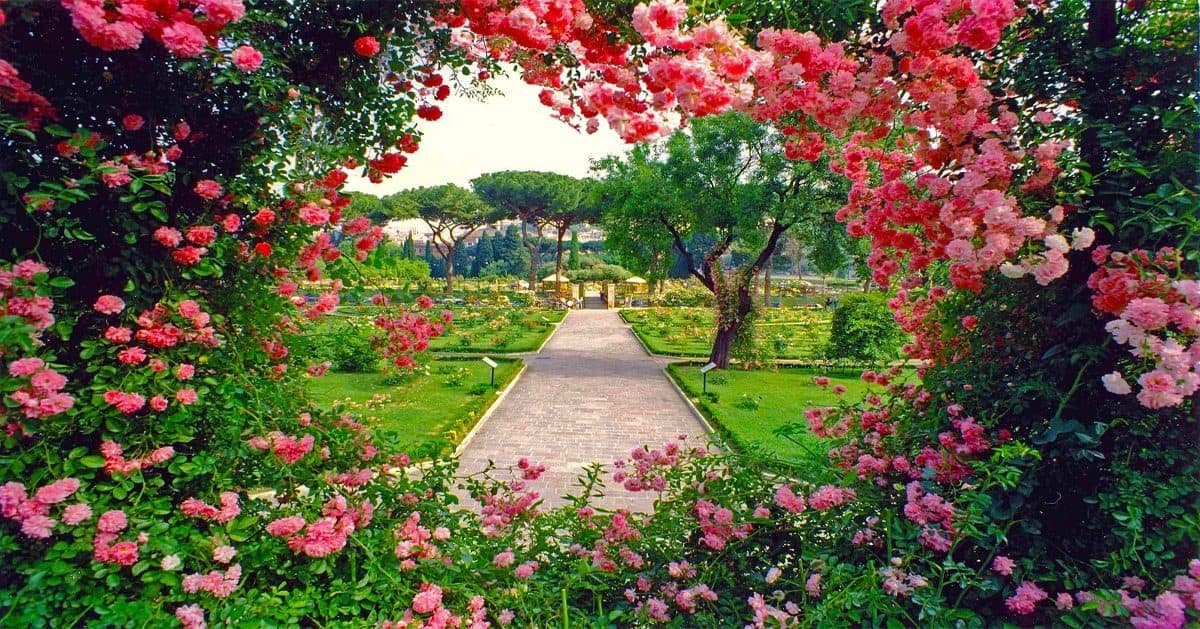
Where the Rome Rose Garden is and how to get there
The garden stands on the slopes of the Aventine facing the Circus Maximus, in a natural amphitheater of gently sloping earth that descends toward the valley. The position is no accident: from up here your gaze takes in the Palatine Hill in front of you and the long open space where the chariots raced, and the afternoon light cuts across the beds from the west, which explains why photographers and enthusiasts come mostly in the hours before sunset.
The entrances to the Rome Rose Garden
There are two entrances and it helps to know which one to choose. From Clivo dei Publicii, at number 3, you enter the large section, the one with the permanent collections, open for the whole season. From Via di Valle Murcia, at number 6, you enter the smaller section, where the new competition varieties are lined up every spring. This second gate opens to the public only after the awards ceremony in mid-May. The two enclosures face each other on either side of the road that divides them.
Getting to the Rome Rose Garden by public transport
The most convenient way is the metro: line B, Circo Massimo station, and from there a climb on foot of five or six minutes along the flank of the Aventine. On the surface, the bus stop in front of the garden is actually called Circo Massimo/Roseto Comunale. The lines change over time, so it's worth checking the current numbers on the Rome transport website instead of trusting an old indication. If you arrive by car, you'll find a few spots on the streets that climb toward the Orange Garden, behind Piazzale Ugo La Malfa, but on Sundays of full bloom the area is crowded and my practical advice is to leave the car far away and walk up.
When the Rome Rose Garden is open
The Rome Rose Garden is not a garden open all year: it follows the bloom, and this is the first thing to pin down before planning your visit. The main season is spring. In 2026 the gate opens on Saturday, April 11 and stays open until Sunday, June 14, every day holidays included, with continuous hours from 8:30 to 19:30. The opening date shifts slightly from one year to the next, historically around Rome's birthday on April 21, while the closing usually falls around the second Sunday of June.
The autumn reopening of the Rome Rose Garden
Many people don't know that repeat-blooming roses give a second season. When the weather in September and October is mild, the garden reopens for a few weeks in autumn. The bloom is less exuberant than in May but the light is softer and there are far fewer visitors. The autumn dates are not fixed and are announced each time on the City's official website, so if you're aiming for October you need to check them shortly before.
The best time of day
In our opinion the first hour of the morning and the last one before closing are worth twice as much as midday. In the middle of the day the light is flat, the May heat on the Aventine makes itself felt and the scent of the roses, which is half the show, evaporates. Early or late, instead, the air is still, the scent stays low among the beds and the crowd thins out. If you can choose, avoid the middle Sunday of May: it's the day when all of Rome comes.
How much it costs to enter the Rome Rose Garden
Admission to the Rome Rose Garden is free, with no ticket and no required reservation for an individual visit. It's one of the rare historic gardens in the city that asks nothing of the visitor, and it stays free even on the busiest days. Booking is needed only for guided tours, which are arranged by phone or email with the garden's office. Don't expect a ticket office, a cloakroom or a café inside: the Rose Garden is a garden, not an equipped museum, and it's best to arrive already carrying water and a hat on hot days.
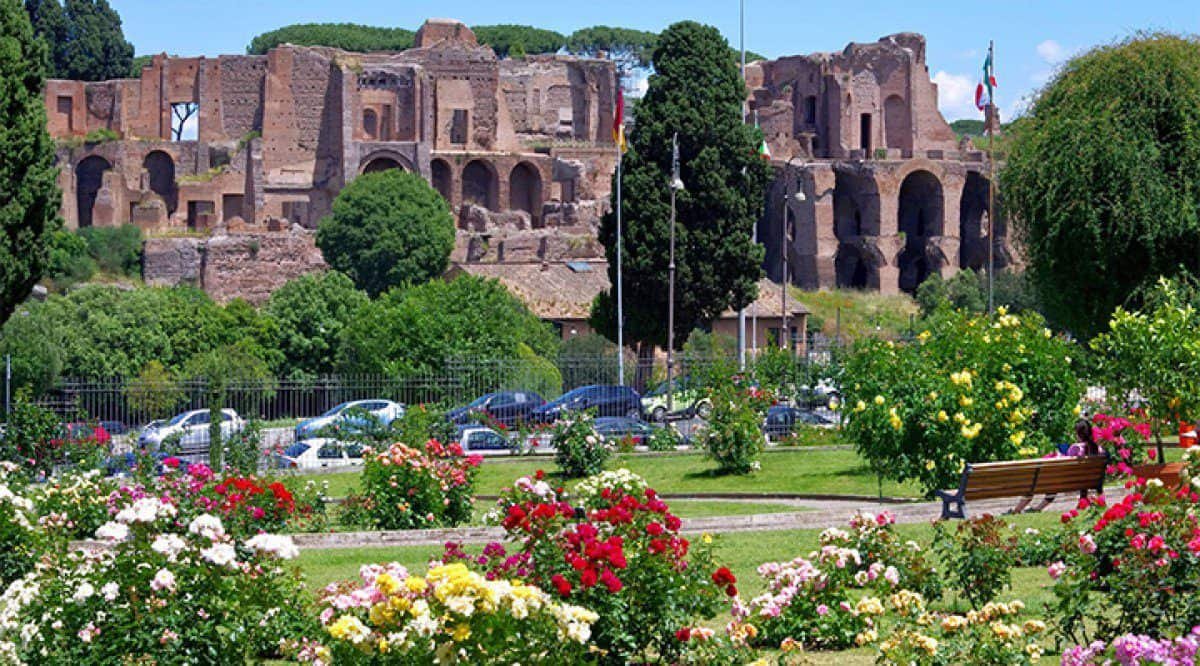
The history of the Rome Rose Garden
The history of the Rome Rose Garden is more intricate than the calm of its beds suggests, and it's worth telling in full because it even explains the shape of the paths. The garden you see today is the second incarnation of an idea born almost a century ago, in another part of the city.
The founding on the Oppian Hill in 1931
The rose garden was established in 1931 by decision of the governor of Rome, Prince Francesco Boncompagni Ludovisi, at the urging of Countess Mary Gayley Senni, American by birth and a passionate rose grower who had settled in Italy. Its original location was not the Aventine but the Oppian Hill, a stone's throw from the Colosseum. The first core held about 300 plants, including a collection of roses that came from the Vivaio del Governatorato. It was a garden for study and for show, designed to give Rome a collection comparable to those of the great European capitals.
The birth of the Premio Roma in 1933
In May 1933 a competition meant to last was added to the rose garden: the Premio Roma for new varieties of roses. It's the oldest competition in the world devoted to these flowers after the one at Bagatelle, at the gates of Paris, which had been established in 1907. Mary Gayley Senni oversaw the first editions and sat on the jury until 1954, representing the American Rose Society: a role that tied the Roman garden to the international world of rose growers from its very first years.
The destruction of the war and the return to Valle Murcia
World War II overwhelmed the rose garden on the Oppian Hill too, and it was destroyed. When, in the postwar period, people wanted to give it back to the city, a different site was chosen: Valle Murcia, the hollow at the foot of the Aventine facing the Circus Maximus. In 1950 the City, in agreement with the Jewish Community of Rome, decided to recreate the garden here. The choice of place, as we'll see, carried an ancient memory that was not erased but engraved in the very layout of the beds.
The Rome Rose Garden and the Jewish cemetery of the Ortaccio
This is the chapter that turns a walk among flowers into something more. The ground where the roses grow today was, for almost three centuries, the cemetery of the Jewish Community of Rome. Knowing this layering changes the way you walk along the paths.
The Ortaccio degli Ebrei
Starting in 1645 the Jewish charity confraternity acquired this land on the slopes of the Aventine to make it its burial place. Popular place-naming called it by a contemptuous name: Ortaccio degli Ebrei. The word comes from hortus, vegetable garden, but with the pejorative suffix it had already been used in the 16th century for another disreputable area of the city, and it was later pinned on the cemetery in a derogatory sense. The famous plan of Rome engraved by Giovanni Battista Nolli in 1748 records two distinct sectors, the Ortaccio degli Ebrei and the Ortaccio vecchio degli Ebrei, a sign of a long occupation of the slope.
Centuries of bans and the end of the cemetery
The life of that cemetery was marked by papal provisions. Edicts such as that of Urban VIII in 1625 and that of Pius VI in 1775 forbade putting up tombstones and monuments on the graves, a restriction that accompanied the Community for generations. Only in 1846, under Pius IX, was the ban lifted. The cemetery was closed in the last stretch of the 19th century, when the urban planning of the area required its decommissioning, and the burials were finally moved to a section of the monumental cemetery of Verano. The clearing and reclamation of the area took place in the 1930s. After that the land stayed for a time as wartime vegetable plots and then fallow, awaiting its new purpose.
The menorah drawn among the beds of the Rome Rose Garden
When it was decided in 1950 to plant roses here, the old function of the place was not forgotten but translated into the form of a garden. If you look at a plan of the collections section, you discover that the paths separating the beds draw, seen from above, the outline of a menorah, the seven-branched candelabrum of the Jewish tradition. It isn't a decorative ornament: it's an act of memory, the way the garden remembers those who rested here before. At the two entrances a stele with the Tablets of the Law of Moses was also placed, the work of the architect Angelo Di Castro, to mark explicitly the respect for the site's previous purpose. Anyone who wants to explore this memory further will find its natural complement at the Jewish Museum of Rome, in the Portico d'Ottavia.
Valle Murcia and the temple of Flora
The coincidence that makes the choice of place almost ironic is that this hollow, long before hosting a cemetery and then a rose garden, was already tied to flowers. Valle Murcia, the small depression between the Aventine and the Palatine Hill, housed from the 3rd century BC a temple dedicated to Flora, the Roman goddess of blossoming and spring. Here the Floralia were celebrated, the festivals in honor of the goddess, with games and ritual blooms. Growing roses in this exact spot of the city means, without intending it, picking up a thread more than 2,000 years long. It's the kind of layering that in Rome you find underfoot almost everywhere, but here it becomes almost programmatic.
How the Rome Rose Garden is organized: the three great families
The Rome Rose Garden is not a decorative heap of bushes: it's an ordered collection that tells the evolution of the rose from antiquity to today. On an area of about 10,000 square meters on a slope, roughly 1,100 varieties are grown, coming literally from all over the world, from the Far East to South Africa, from old Europe to New Zealand, by way of the Americas. In the large section the plants are arranged to follow an almost chronological route, divided into three great families.
Botanical roses
These are the primordial roses, the wild species from which everything began. Some go back to a very ancient heritage, with ancestors that appeared millions of years ago. They often have simple flowers with five petals, and a fragility that makes them precious and little known: you won't see them in ornamental gardens, but they are the genetic root of every modern rose. Looking at them means understanding where we come from, botanically speaking.
Old roses
These are the varieties cultivated over the centuries before the great 19th-century revolution: European roses with names that sound like history, blooming only once a year but with a scent that modern ones have partly lost. Their spread began to decline when, at the beginning of the 19th century, Chinese roses arrived in Europe, bringing the ability to bloom again several times in the season. This is the moment when the history of the rose changes direction.
Modern roses
From the crossing of the old European roses with the repeat-blooming Chinese ones came the immense family of modern roses, the ones we recognize in today's gardens: hybrid teas, floribundas, climbers, in a thousand shapes and colors. It's the largest and most variable family, and it takes up the greater part of the collections section. Walking from the beginning to the end of the route, you cross, in practice, the whole evolutionary adventure of the flower.
The roses to look for at the Rome Rose Garden
In such a vast collection it's easy to get lost, so it's best to arrive with a few names in mind. Among the botanical curiosities worth looking for is the Chinese rose with green petals, the so-called Viridiflora, in which the petals are replaced by tiny leaves and the flower seems never to really open. There is the Mutabilis, which changes color as the flower ages, going from pale yellow to pink and then to carmine, so that three different shades live together on the same bush. These are the plants in front of which it's worth stopping calmly, much more than the big patches of color that catch the eye right away but say less.
How to read the labels
Every group of plants comes with a label showing the name of the variety, often the year and the name of the breeder, and sometimes the country of origin. Reading them transforms the walk: you find out who created that rose and when, and you start to recognize the signatures of the great nurserymen. It's the best way not to reduce the visit to a parade of colors.
A brief history of the rose as told by the Rome Rose Garden
The strength of the garden is that its layout tells, bed after bed, a thousand-year story. It's worth keeping the main stages in mind, because walking informed multiplies what you see.
From wild species to the roses of ancient gardens
At the origin are the wild species, spread across the northern hemisphere: simple flowers with five petals, often fragrant, which in Europe and Asia people began to cultivate early. From the European roses cultivated in antiquity and in the Middle Ages descend the great historic families that you can still admire today in the old roses section, with full flowers and an intense scent but only one bloom a year. They were the roses of cloisters, noble gardens and apothecaries' shops, cultivated also for perfumery and pharmacopoeia.
The arrival of Chinese roses and the turning point of the 19th century
The great break comes at the turn of the 18th and 19th centuries, when roses from China arrive in Europe. They brought two gifts that the European ones did not have: the ability to bloom again several times in the season and new nuances of color and scent. The crosses between the old European roses and the new Chinese ones produced, within a few decades, an explosion of varieties: this is the birth of modern roses, the family that fills the greater part of the collections. Walking through the large section of the Rose Garden from beginning to end means crossing exactly this passage, from the rose that bloomed only once to the rose that accompanies the whole good season.
Why all three ages live together at the Rose Garden
It's not common to find primordial, old and modern roses side by side in a single garden. This simultaneity is what makes the Rome Rose Garden a place of study as well as pleasure: in front of a botanical species with sparse petals and, a few meters farther on, a modern hybrid with very dense flowers, you read in a few steps the whole distance traveled by human selection. Be patient with the simple roses: they are the least showy and the most important.
Scent, the other half of the Rome Rose Garden
You come to the Rose Garden for your eyes and end up remembering it with your nose. Scent is the hidden half of the visit and it has precise rules. Not all roses smell the same: the old European ones and the damasks have the dense, classic fragrance we imagine when we say the word rose, while many modern ones offer lighter, fruity or spicy notes, and some, selected only for looks, almost don't smell at all. Scent, moreover, is volatile: it rises with the humidity of morning and evening and dissolves in the dry heat of midday. That's why the advice about timing is not a photographers' whim but concerns all the senses. Walk slowly, bend down over the most intense varieties and give yourself time to smell: it's a way of visiting that no museum allows and that here is free. The competition roses in the contest section, by the way, are also judged on this, because scent has become a required quality again and not a negligible luxury.
The Premio Roma for new rose varieties
The living heart of the garden is the competition. In the smaller section, every year, the new varieties created by rose growers from around the world are planted. The plants stay on trial for two seasons, observed and evaluated by an international jury on parameters such as vigor, disease resistance, flower shape, repeat blooming and scent. At the end, every May, the Premio Roma is awarded. The ceremony effectively opens the international season of events devoted to the rose and is an event of great weight in the botanical world.
The dates of the Premio Roma in 2026
In 2026 the awards ceremony is set for Sunday, May 17 at 18:00, with the ceremony open to the public. From the following day, May 18, the competition roses section opens to visitors, who can thus see up close the varieties just judged next to those awarded in previous years. Anyone who wants to catch the garden at its most intense should aim for the second half of May, when both sections are open and the bloom is at its peak.
Rome and Bagatelle, the two oldest competitions
It's worth putting the record in context. The Roman competition is second in seniority only to that of the Parc de Bagatelle, at the gates of Paris, begun in 1907. 20 years and a little more separate the two events, which together set the model for all the international competitions that came afterward. Even today, winning the Premio Roma is a recognition that nurserymen display with pride in their catalogs, and for the visitor it means that the competition roses in the small section are not a side dish but the leading edge of floral research worldwide, observable for free a few meters away.
How a new rose is judged
The jury doesn't reward only the beauty of the flower. During the two years of trial, they evaluate the vigor of the plant, resistance to disease without heavy treatments, the abundance and continuity of the bloom, the habit and, last but not least, the scent, a quality that in the 20th century many commercial roses had sacrificed to looks. It's a judgment that looks to the future of real gardens, not the single perfect photo, and this explains why the verdict of the Rose Garden carries weight in the world of rose growers.
The dolphin fountain
A detail that escapes those who rush through the beds is the small fountain with a dolphin hidden in the garden. The sculpture was made by Adolfo Marini at the end of the 1920s and originally stood in Borgo Vecchio, one of the alleys that were demolished in the 1930s to open Via della Conciliazione in front of St. Peter's. Left without a home, the little fountain was sheltered for a time at the Theatre of Marcellus and found its final place here at the Rose Garden only several decades later. It's one of those fragments of Rome that migrate from one end of the city to the other following its transformations, and that turn up where you least expect them.
The Rome Rose Garden with children
The garden is a great destination for families, and not only because it's free. The spaces are open, the paths wide, and for the little ones the game of looking for the rose that changes color or the one with green petals works better than any explanation. There are no rides or play areas: it's a garden for contemplation, so it works with children old enough to enjoy a walk, less well with those who need to run and climb. A few minutes' walk away, though, the nearby Orange Garden offers a lawn and a panoramic terrace, and together they make a full morning.
Accessibility of the Rome Rose Garden
The ground is sloped, and that has to be said honestly: the garden descends along the flank of the Aventine and some paths have a fair incline, with a surface that's not always perfectly smooth. If you use a wheelchair or push a stroller, you can still follow a good part of the main paths by choosing the most convenient entrance, but you should expect some uphill stretches. For precise information on access conditions, contact the garden's office in advance, which answers on weekdays. The restrooms inside are not always guaranteed, so better not to rely on them.
The garden rules and guided tours at the Rome Rose Garden
The Rose Garden is a botanical garden, not just any park, and this translates into a few good rules of conduct. The beds must be respected: don't pick flowers, don't trample the borders, don't move the labels that identify the varieties, because every plant is part of a scientific collection. On the busiest days access may be regulated at the entrances so as not to congest the paths. If you want to really understand what you're seeing, you can book a guided tour by contacting the garden's office: it's the best way to hear the story of the individual varieties, the meaning of the menorah design and the behind-the-scenes of the competition from the people who look after the plants. Booking is arranged by phone at 06 5746810, on weekdays from 9 to 12, or by email.
Mary Gayley Senni, the woman who wanted the Rome Rose Garden
Behind the garden there is a figure who deserves more than a footnote. Mary Gayley Senni, an American who moved to Italy, was the true soul of the project: passionate and knowledgeable about roses, she fought so that Rome would have a collection worthy of the European capitals and an international competition. Her tie to the American Rose Society, which she represented on the Premio Roma jury until 1954, kept the garden open to the world from its foundation. Remembering her, while you walk among the beds that owe their existence to her, is the least an attentive visitor can do.
What's around the Rome Rose Garden
The nice thing about this corner of the Aventine is that the garden is only the beginning of a memorable walk. Within 10 minutes on foot are concentrated some of the finest views and monuments in the city, and it's better to plan half a day rather than a quick stop.
The Circus Maximus and the Palatine Hill
At the foot of the Rose Garden opens the long expanse of the Circus Maximus, the ancient circus where chariot races were run, today an immense public lawn dominated by the ruins of the Palatine Hill on the other side. Seeing them from above, from the beds of the garden, is already half the experience.
The Orange Garden and Santa Sabina
Climbing the hill you reach the Orange Garden, with its terrace overlooking the Tiber and the dome of St. Peter's on the horizon, and the nearby Basilica of Santa Sabina, an early Christian masterpiece with famous wooden doors. A little farther on, the Villa of the Priory of Malta hides the famous keyhole through which you frame the Vatican dome.
The Mouth of Truth and the Baths of Caracalla
Going down toward the river you come to the Mouth of Truth, in the portico of Santa Maria in Cosmedin Church, while in the opposite direction, beyond the Circus, you reach the imposing Baths of Caracalla. If you love gardens, you can complete the theme with the Rome Botanical Garden in Trastevere or, outside the city, with the famous Garden of Ninfa.
The Aventine, the hill that guards the Rome Rose Garden
To really understand the garden, it's best to look up at the hill that embraces it. The Aventine has always been the quietest Rome: a residential and conventual height, outside the big tourist flows, where the noise of the city suddenly fades as soon as you leave the valley. In ancient times it was the plebeian hill par excellence, the stage in republican history of the famous secessions of the plebs, when the people withdrew here to claim their rights. Today it's a maze of villas, cloistered gardens and very ancient basilicas, and this very quiet frames the Rose Garden: in a few minutes you go from the din of traffic around the Circus Maximus to the fragrant silence of the beds.
A garden inside the archaeological landscape
What sets the Rome Rose Garden apart from any other rose garden is the backdrop. It isn't surrounded by other gardens or modern buildings, but by 2,000 years of history under the open sky: below, the hollow of the Circus Maximus. In front, the flank of the Palatine Hill with the arches of the imperial palaces. Behind, the hill of the convents. It's a garden set into an archaeological landscape, and this makes it a rare place even internationally. The roses, here, are never alone.
When to avoid the Rome Rose Garden
Good advice also covers the wrong moments. Avoid the middle Sundays of May in the middle of the day: they are the absolute peak of crowds, with lines at the entrances and congested paths that take away the garden's calm. Avoid the hours of full sun on the hottest days, when the shadeless slope becomes tiring and the scent of the roses, which needs cool air to stay perceptible, vanishes. Finally, avoid planning the visit without having checked the dates: showing up in March, in July or on an unannounced autumn day means finding the gates closed, because the Rose Garden lives only in its bloom windows. Whoever respects these three noes takes home a completely different experience from the one who happens by at the wrong hour and on the wrong day.
A curiosity about the Rome Rose Garden
The curiosity that almost nobody knows concerns the layout of the garden itself. The paths of the collections section are not arranged at random: seen from above they draw a menorah, the seven-branched candelabrum of the Jewish tradition. It isn't an aesthetic whim but the sign of a memory. Before hosting roses, this land was for almost three centuries the cemetery of the Jewish Community of Rome, and when in 1950 the City decided to make a rose garden of it, it did so in agreement with the Community, committing not to erase that history. Hence the design of the paths and the steles with the Tablets of the Law placed at the two entrances, the work of the architect Angelo Di Castro. It's a curiosity worth the ticket, all the more so since there is no ticket: while you stroll among the flowers you are walking inside a symbol, and most visitors don't notice at all. The next time you hear someone praise only the colors of the beds, you can tell them that the whole garden is, first of all, a gesture of respect toward those who rested here.
One thing nobody tells you about the Rome Rose Garden
No hurried guide explains it, but the Rome Rose Garden is not a park open all year: it has only two bloom windows, and showing up at the wrong moment means finding the gates closed. The big season is spring, from mid-April to mid-June. Then the garden closes and reopens only in autumn, for a few weeks in October, when the repeat-blooming varieties give a second round of flowers. The autumn dates aren't even fixed: they change every year depending on the weather and are announced at the last minute. There's more: the new varieties section, the competition one, stays closed to the public even in full spring until after the awards ceremony in mid-May. This means that showing up on April 20, even if you find the garden open, means seeing only half of the Rose Garden. Anyone who wants to catch it complete, with both enclosures in bloom, should aim for the second half of May. It's the practical information that makes the difference between a successful visit and a half disappointment, and oddly it's the hardest to find clearly written.
The advice I give you for visiting the Rome Rose Garden
My advice is to flip the instinct of the majority. Almost everyone comes on the Sunday in mid-May, around midday, with the sun straight overhead: the result is crowds on the paths, flat light for photos and scent evaporated by the heat. Do the opposite. Come on a weekday, at the 8:30 opening or in the last hour before 19:30, when the air is still and the scent of the roses stays low among the beds, dense and recognizable variety by variety. The raking light of morning and evening sculpts the flowers instead of flattening them, and you'll have the paths almost to yourself. Bring water and a hat, because there's little shade on the slope, and plan for at least a good hour: the Rose Garden rewards those who walk slowly and stop to read the labels, not those who cross it in 10 minutes. If you can, combine the visit with a climb to the nearby Orange Garden for the sunset over the Tiber: half a day on the Aventine organized this way is worth more than a whole afternoon spent in line somewhere else.
Another well-known fact, yet rarely cited
People often repeat that the Rose Garden hosts roses from all over the world, but they almost always forget the record carried by its competition. The Premio Roma for new rose varieties, born in May 1933, is the oldest competition in the world devoted to this flower after the one at Bagatelle, at the gates of Paris, established in 1907. It's no small detail: it means that every May, on this slope overlooking the Circus Maximus, one of the founding events of the international botanical calendar has been taking place for more than 90 years. Breeders from half the world send their creations here and submit them to two years of trial before the jury's verdict. The fact that all this happens in a garden with free admission, without fanfare, is typical of Rome: the city guards world records and leaves them in the hands of passersby as if they were obvious. Countess Mary Gayley Senni, who stood godmother to the competition and oversaw its first editions until 1954, should be remembered far more than she is.
The right photo to take at the Rome Rose Garden
The photograph that brings home the sense of the place is not the close-up of the perfect rose, which you can take in any nursery. It's the framing that holds together the two layers of Rome: the flowering beds in the foreground and, in the background, the ruins of the Palatine Hill or the expanse of the Circus Maximus descending below you. From here you understand where you are, and no other rose in the world has a backdrop like this. To get it, stand at the high point of the collections section and look down toward the valley in the light of late afternoon, when the sun comes from the west and lights up the petals and the ancient bricks together. If you're after detail instead, aim at the Mutabilis, the rose that carries three colors on the same bush, or at the Chinese one with green petals: these are images that tell a story, not just a pretty flower. One last professional tip: kneel down. Photographing the beds at eye level flattens them. Getting down to their height gives back the depth of the slope and the true number of flowers.
Some important events that happened here in history
The slope of the Rose Garden has seen more history pass than its present quiet suggests, and it's worth retracing it stage by stage. In the 3rd century BC Valle Murcia already housed a temple dedicated to Flora, where the Floralia were celebrated, the festivals of blossoming: the floral vocation of the place is therefore very ancient. Starting in 1645 the same slope became the cemetery of the Jewish Community of Rome, the Ortaccio degli Ebrei, and remained so, amid papal edicts banning tombstones and a long season of burials, until the decommissioning at the end of the 19th century and the transfer of the remains to Verano in the following decades. On the front of the garden proper, the founding date is 1931, when the rose garden was born on the Oppian Hill by the will of Governor Boncompagni Ludovisi. In May 1933 the first Premio Roma was held. World War II destroyed that first layout, and in 1950 the garden was reborn here in Valle Murcia, with the agreement between the City and the Jewish Community that made it a place of memory as well as beauty. Since then, every spring, the international awards ceremony renews a rite that has lasted for more than 90 years.
Who has passed through the Rome Rose Garden
More than a place of illustrious passing visitors, the history of the Rose Garden is made of the people who wanted it and shaped it, and it's worth giving them a face. The first is Countess Mary Gayley Senni, an American settled in Italy, a passionate rose grower: it was her insistence that convinced the city authorities, and she stayed on the Premio Roma jury until 1954 as a representative of the American Rose Society, keeping the garden tied to the international world of roses. Next to her, Prince Francesco Boncompagni Ludovisi, governor of Rome, who in 1931 signed the establishment of the rose garden. Then there is the architect Angelo Di Castro, author of the steles with the Tablets of the Law placed at the two entrances when the garden was recreated in Valle Murcia: to him we owe the translation of the place's memory into built form. And there is the sculptor Adolfo Marini, whose small fountain with a dolphin, born at the end of the 1920s for Borgo Vecchio, ended up here after a long wandering around the city. To these documented names is added every year, in silence, the host of breeders from all over the world who send their new varieties to the competition: they are, in the end, the most faithful visitors of the Rose Garden, present through the flowers that carry their work.
Quick questions about the Rome Rose Garden
How much is the ticket for the Rome Rose Garden?
Nothing: admission to the Rome Rose Garden is free, with no ticket and no reservation for an individual visit.
When is the Rome Rose Garden open in 2026?
The 2026 spring season runs from Saturday, April 11 to Sunday, June 14, every day holidays included. In autumn a special reopening of a few weeks in October is planned, with dates to be checked on the official website.
What are the hours of the Rome Rose Garden?
The hours are continuous, from 8:30 to 19:30, every day during the opening period.
Where exactly is the Rome Rose Garden?
On the slopes of the Aventine overlooking the Circus Maximus: entrances at Via di Valle Murcia 6 and Clivo dei Publicii 3.
How do you get to the Roseto di Roma by public transportation?
The easiest way is Metro Line B, Circo Massimo stop, and then a short walk uphill. A surface bus also stops in front of the garden. Check the line numbers on the transit website because they change over time.
Do you need to book to visit the Roseto di Roma?
Not for an individual visit. Booking is only needed for guided visits, which you arrange with the office by phone or email.
How many varieties of roses are there at the Roseto di Roma?
About 1,100, spread over an area of about 10,000 square meters and divided into botanical, old and modern roses, plus the new varieties in competition.
What is the best time to see the roses in bloom?
The second half of May, when the bloom is at its peak and both sections are open, including the one with the competition roses.
What is the Premio Roma?
It's the international competition for new rose varieties, founded in 1933, the oldest in the world after the one at Bagatelle in Paris. The 2026 awards ceremony is set for Sunday, May 17 at 18:00.
Is the competition roses section always open to visitors?
No. It opens to the public only after the awards ceremony. In 2026, from May 18.
Is the Roseto di Roma wheelchair accessible?
The ground slopes and some stretches are uphill, but a large part of the main paths can be walked. For precise conditions, it's best to contact the office in advance.
Is it suitable for children?
Yes, as a garden for walking and looking. There are no play areas or equipped areas. It works better with children who enjoy a quiet walk.
Can you bring dogs?
Since it's a botanical garden with delicate collections, the rules on animals can be restrictive. It's better to check with the office before showing up with your dog.
Are there restrooms and a café inside?
There is no refreshment service and restrooms are not always guaranteed. It's a good idea to arrive already equipped with water, especially on hot days.
How much time do you need to visit the Roseto di Roma?
At least an hour to walk calmly and read the labels. If you like to take photos and look at the individual varieties, you can stay even longer.
Why are the paths shaped like a menorah?
Because the garden stands on the old Jewish cemetery of the Ortaccio. The layout of the paths and the stelae with the Tablets of the Law recall that purpose, in agreement with the Jewish Community of Rome.
Which special roses should you look for?
The Chinese Viridiflora with green petals, and the Mutabilis, which changes color as it ages and shows several shades on the same bush.
Is the Roseto di Roma the same as the Orange Garden?
No, they are two separate places close to each other on the Aventine. The Roseto is in Valle Murcia, above the Circus Maximus. The Orange Garden is higher up, with the panoramic terrace. They go well together.
Are there guided tours of the Roseto di Roma?
Yes, by reservation, by contacting the garden's office by phone at 06 5746810 on weekdays from 9:00 to 12:00 or by email.
Does the Roseto di Roma close when it rains?
It's an outdoor garden and stays open during the scheduled hours even in uncertain weather, but in heavy rain the visit loses a lot. Better to move it by a few hours or a day.
Do the roses of the Roseto di Roma smell good?
Many do, and intensely, especially the old varieties and the damask roses. The scent is best in the early morning and toward evening, when the air is cooler and more humid. In the midday heat it tends to fade.
Why is the Roseto di Roma in Valle Murcia?
Because after the war, with the first rose garden on the Oppian Hill destroyed, the city recreated the garden here in 1950 in agreement with the Jewish Community, on the area that had long been the Jewish cemetery. By an ancient coincidence, the hollow already housed a temple dedicated to Flora, goddess of flowers, in Roman times.
How big is the Roseto di Roma?
It covers an area of about 10,000 square meters on a gentle slope on the side of the Aventine, divided into the two sections of the collections and the competition roses.
Can you combine the visit with other nearby places?
Yes, and it's recommended. In 10 minutes on foot you reach the Orange Garden, the Santa Sabina Basilica, the Villa of the Priory of Malta with its famous keyhole, the Circus Maximus and the Mouth of Truth. Half a day on the Aventine is the best way to enjoy the area.
One last thing: the Roseto di Roma deserves slowness. It's not a monument to tick off a list, it's a place that gives back exactly as much time as you give it. Give yourself an hour, arrive early or late, read the names on the labels, look for the rose that changes color and stop to look at the Palatine across the way, thinking of those who rested here before the roses. Done this way, it's one of the most beautiful mornings Rome knows how to give, and it doesn't cost you a euro.
Article written by the editorial team of TourLeaderPro, contact them for Private/Corporate/V.I.P. Tours and Experiences.
Planning a trip to Rome? The English guides for visiting the city are on ItalyPlanner.com.