Orange Garden
In short. The Giardino degli Aranci opens onto the Aventine hill, in the Ripa district, with three entrances: the main one on piazza Pietro d'Illiria, a second on via di Santa Sabina and a third on the clivo di Rocca Savella.

The Giardino degli Aranci opens onto the Aventine hill, in the Ripa district, with three entrances: the main one on piazza Pietro d'Illiria, a second on via di Santa Sabina and a third on the clivo di Rocca Savella. Official name in the city records: parco Savello. Area of about 7,800 square meters, with free entry. Opening hours change with the seasons: from October to February from 7 to 18, in March and September from 7 to 20, from April to August from 7 to 21. There's no ticket to buy, no reservation needed, and no ticket office: you just walk in. The easiest way to get there is to get off at the Circo Massimo stop on metro line B and walk up the Aventine slope, a good 10 minutes on a slight incline. Alternatively, buses 81, 160 and 628 and tram 3 stop in the Circo Massimo and Bocca della Verità area, where you take the same slope. At the top there's a lookout facing the Tiber, Trastevere and the dome of Saint Peter's. It's for that view, and for the sunset, that most people come up here.
If you want to fit the Giardino degli Aranci into a longer walk on the Aventine, the rest of the hill is within easy reach: the Basilica of Santa Sabina is built right against the park, the famous keyhole of the Villa del Priorato di Malta is 100 meters farther on, and the Rome Rose Garden slopes down on the opposite side toward the Circo Massimo.
Exactly where the Giardino degli Aranci is
The address to type is piazza Pietro d'Illiria, on the northwest side of the Aventine, the southernmost of the ancient Roman hills and still one of the quietest neighborhoods in the center today. The park occupies the edge of the hill that drops toward the river. On one side, the retaining wall overlooks the Lungotevere Aventino and the river port of Ripa Grande. On the other, the garden borders the orchard and cloister of the Dominican friars of Santa Sabina. The district is Ripa, one of the oldest in the city, named after the Tiber's bank and the port activity that went on for centuries at the foot of the Aventine.
The hill is high, but the climb is never brutal. Those coming from the Circo Massimo take the clivo dei Publicii, the same ancient Roman road that linked the Circus valley to the top of the Aventine, and within a few minutes you're standing in front of the park gate. Those coming down from Santa Sabina pass almost without noticing, moving from the shade of the basilica into the open air of the lookout. It is this continuity between church, orchard and garden that sets the Giardino degli Aranci apart from any ordinary urban park: it is a piece of monastic Aventine that has become public.
How to get to the Giardino degli Aranci by public transport
The useful stop is Circo Massimo, on metro line B. From there you walk: the road is signposted, and in 10 minutes you reach the gate on piazza Pietro d'Illiria. On the surface, several bus lines stop in the Circo Massimo area, including the 81, the 160 and the 628, along with tram 3, which links Trastevere and the Colosseum via the Lungotevere. If you're coming by car, you're better off giving up the idea: the Aventine is a residential area, parking spaces are few and almost all reserved for residents, and the final climb is on foot anyway. By bike the ramp is demanding but short, and at the top there are informal bike racks along the wall.
A curious fact about the Giardino degli Aranci
The curious fact that almost nobody connects to the park concerns its official name and its birth date as a public garden. The Giardino degli Aranci you visit today is not at all an ancient medieval orchard left intact. It's a twentieth-century landscape architecture project, designed in 1932 by architect Raffaele De Vico, the same man who designed the park at Villa Glori, the gardens of piazza Vittorio and other green-space projects around the city. De Vico took the area the Dominican friars had kept as an orchard and turned it into a geometric lookout, with a strictly symmetrical layout: a single central avenue aligned with the view over the river, and two large mirror-image open spaces on either side. The feeling of absolute order you get on entering, with the orange trees lined up as in an outdoor cloister, is no accident: it is composition, not spontaneous nature.
The name Savello, the one that appears in the city's municipal records, came even later, in 1942, when the Governorate of Rome decided to officially name the park after the Savelli family, who had built a fortress here between 1285 and 1287. So the site has three overlapping identities: the medieval Savelli stronghold, the Dominicans' vegetable garden, and De Vico's garden. The real curiosity is that the public knows it by a fourth name, the popular one, the Giardino degli Aranci, which doesn't appear in any founding act and simply came from the trees. A park with four names and only one view.
The History of the Giardino degli Aranci, Hill by Hill
Beneath today's tidy lawn lie at least a thousand years of layered history. The first documented fortified settlement on this spot of the Aventine dates back to the 10th century, when the powerful Crescenzi family had a castle built to control the bend of the Tiber and the port below. On top of that earlier structure, between 1285 and 1287, the Savelli built their fortified stronghold, a genuine rocca that incorporated older structures and dominated the riverbank. The Savelli were one of Rome's great baronial houses, gave two popes to the Church, and held the Aventine as a family fief for generations.
When the fortress lost its military role, the area changed hands several times. In 1548 the Dominicans ceded part of the land to the Rufini family, then the property passed to the Capizucchi, and in 1616 it was purchased by Cardinal Domenico Ginnasi. Right in the Ginnasi garden, in the early 1700s, the Accademia dell'Arcadia, the famous Roman literary circle, met for a period, in an outdoor theater built specifically by the architect Giovan Battista Contini. It's a detail few people know: long before the summer performances of the 20th century, the Aventine already hosted poets and recitation among these very trees.
The modern turning point came in 1932, with the expropriation of the land by the Governorate of Rome and the project by Raffaele De Vico. The idea, within the urban redevelopment of the Aventine in those years, was to open a new belvedere over the city to the public, to be placed alongside the already beloved ones of the Pincio and the Janiculum. Since then, the Giardino degli Aranci is what we see: the lowest and most intimate of the three green terraces.
The Savelli Fortress and the Big Wall
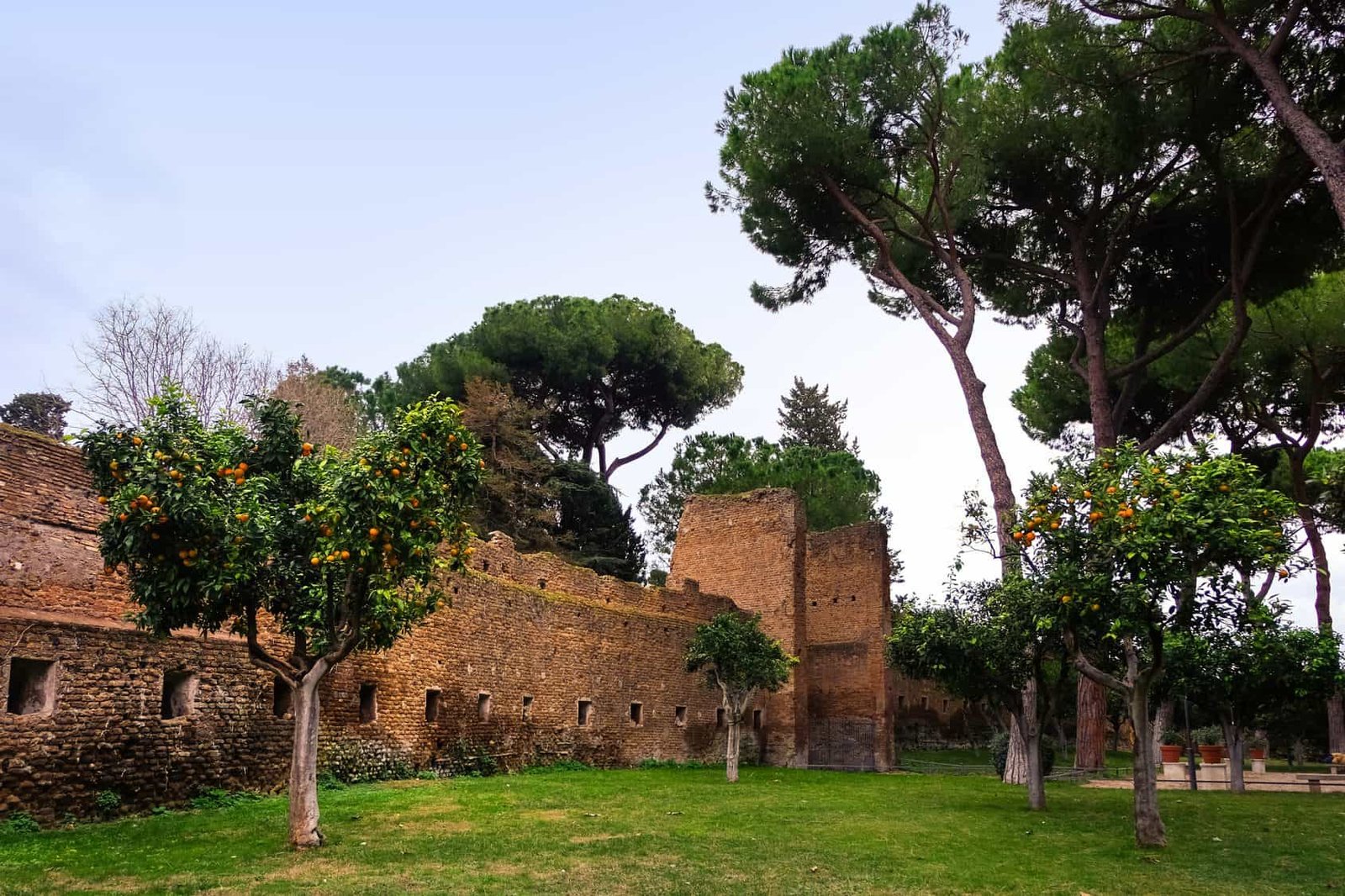
What remains of that medieval fortress is mainly its perimeter: the massive enclosure walls that still today mark the park's boundary and give the impression of walking inside a fortified enclosure, not inside an open garden. The big wall on the river side, with its merlons and buttresses, is what survives of the defensive curtain wall. Standing at the belvedere, you are literally on the edge of the Savelli fortress, at the point from which the lords of the hill controlled who came up the Tiber from the sea toward the port of Rome.
The Giardino degli Aranci and the Dominicans' Vegetable Garden
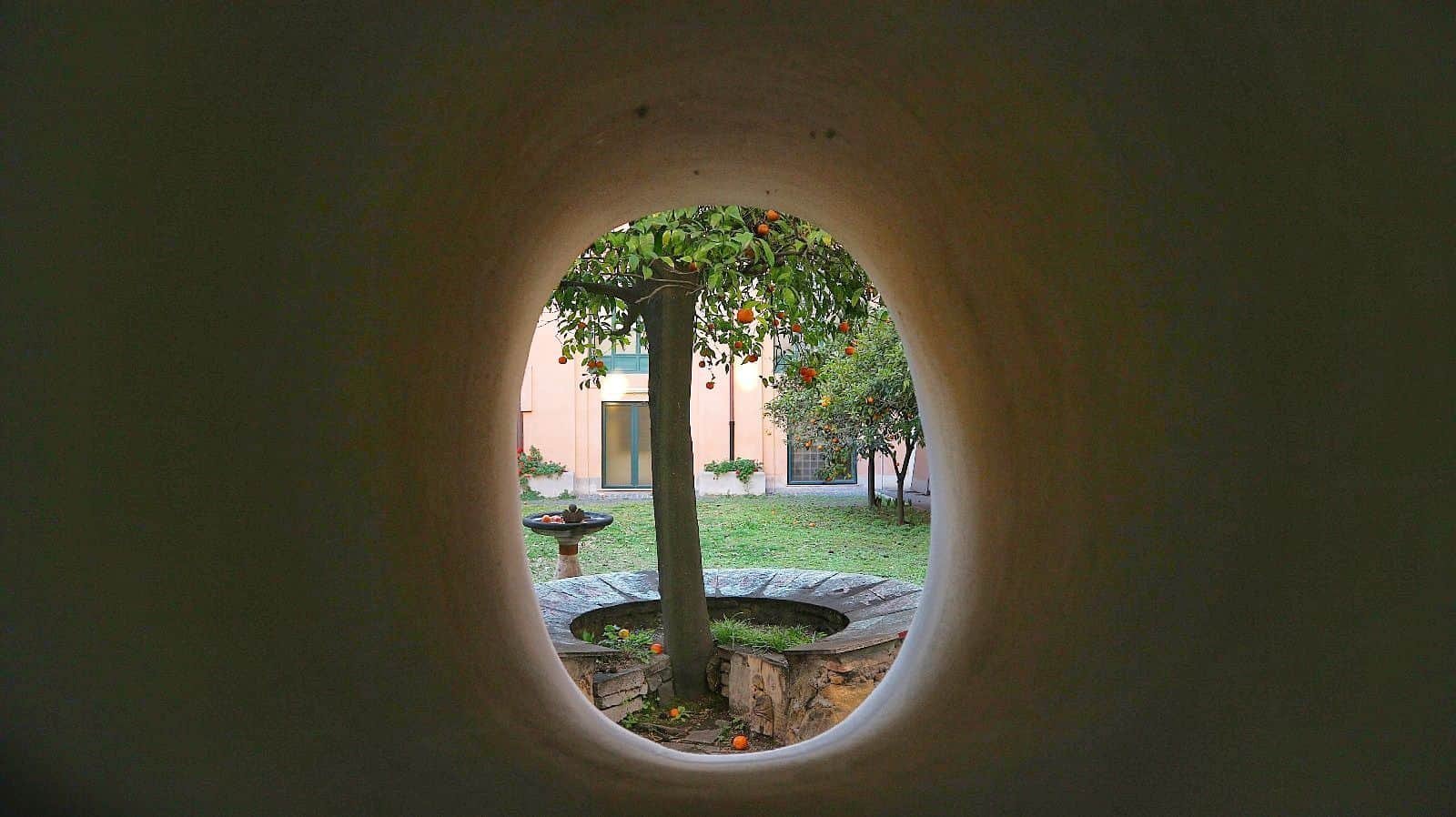
Before it was a public park, this was the vegetable garden of the Dominican friars of the nearby Basilica of Santa Sabina, the early Christian church of the 5th century that is the mother house of the order. The Dominicans grew vegetables and fruit trees here, among them the bitter oranges that gave the site its popular name. The bond between the garden and the convent was never severed: the wall that separates the park from the convent vegetable garden still exists, and through a gap in that wall you can see one of the trees richest in legend in all of Rome.
It's worth going into Santa Sabina, before or after the walk through the park: the three-aisled interior with its spolia Corinthian columns, the 5th-century wooden door with one of the oldest known Crucifixions, and the Dominican cloister make a perfect counterpoint to the view from the belvedere. The Giardino degli Aranci without Santa Sabina is only half a visit.
One Thing Nobody Tells You About the Giardino degli Aranci
The thing that hurried guides skip is that the park's orange trees are not the orange trees of legend, and that the truly miraculous tree is not inside the garden at all. The trees lined up in the park are ornamental bitter orange trees, planted for compositional reasons and as a symbolic reference to the monastic vegetable garden: picking their fruit is strictly forbidden, and besides, they are extremely bitter and inedible raw. The tree of tradition is a different one, and it's in the cloister of Santa Sabina, beyond the wall.
The Dominican tradition holds that Saint Dominic de Guzman, founder of the order, brought an orange tree shoot from Spain and planted it in the cloister of Santa Sabina at the beginning of the thirteenth century, and that this plant was among the first of its species transplanted to Italy. The tree, it is said, survived for centuries by regenerating itself: once the original trunk dried up, it would have been reborn from shoots growing from the same stump, so much so that it is considered the oldest living tree in Rome. It can be glimpsed, protected by glass, through an opening in the convent wall, opposite the old wooden door of the basilica. That it is botanically the same tree as 800 years ago belongs to tradition, not to science, but the fact that an orange tree has existed at that spot for time immemorial is documented. The thing almost nobody knows, in short, is that the real protagonist of the story of orange trees is behind a wall, not among the flower beds where everyone snaps photos.
The legend of the miraculous orange at the Giardino degli Aranci
The legend of Saint Dominic's tree is intertwined with one of the most important saints in Italian history. It is said that the five candied oranges that Catherine of Siena gave to Pope Urban VI in 1379 were picked from the orange tree in the cloister of Santa Sabina. Catherine, who spent the last years of her life in Rome and died there in 1380, would have candied those bitter fruits herself, turning them into a gift for the pope. The scene, handed down by Dominican hagiography, has turned the tree into a small plant reliquary: not a relic of bones, but of branches.
It's best to keep a cool head here. That the orange tree exists and is very ancient can be verified, that it is exactly Saint Dominic's plant, and that Catherine picked those five oranges from it, is a matter of tradition, not of documentation. This distinction takes nothing away from the appeal of the story, quite the opposite: it makes it more interesting, because it shows how a tree can become, over the centuries, the keeper of a religious memory that no land registry will ever be able to certify. When standing in front of the gap in the wall, it's worth remembering this: you are looking at a legend, and legends aren't debunked, they're listened to.

The fountain of the Giardino degli Aranci
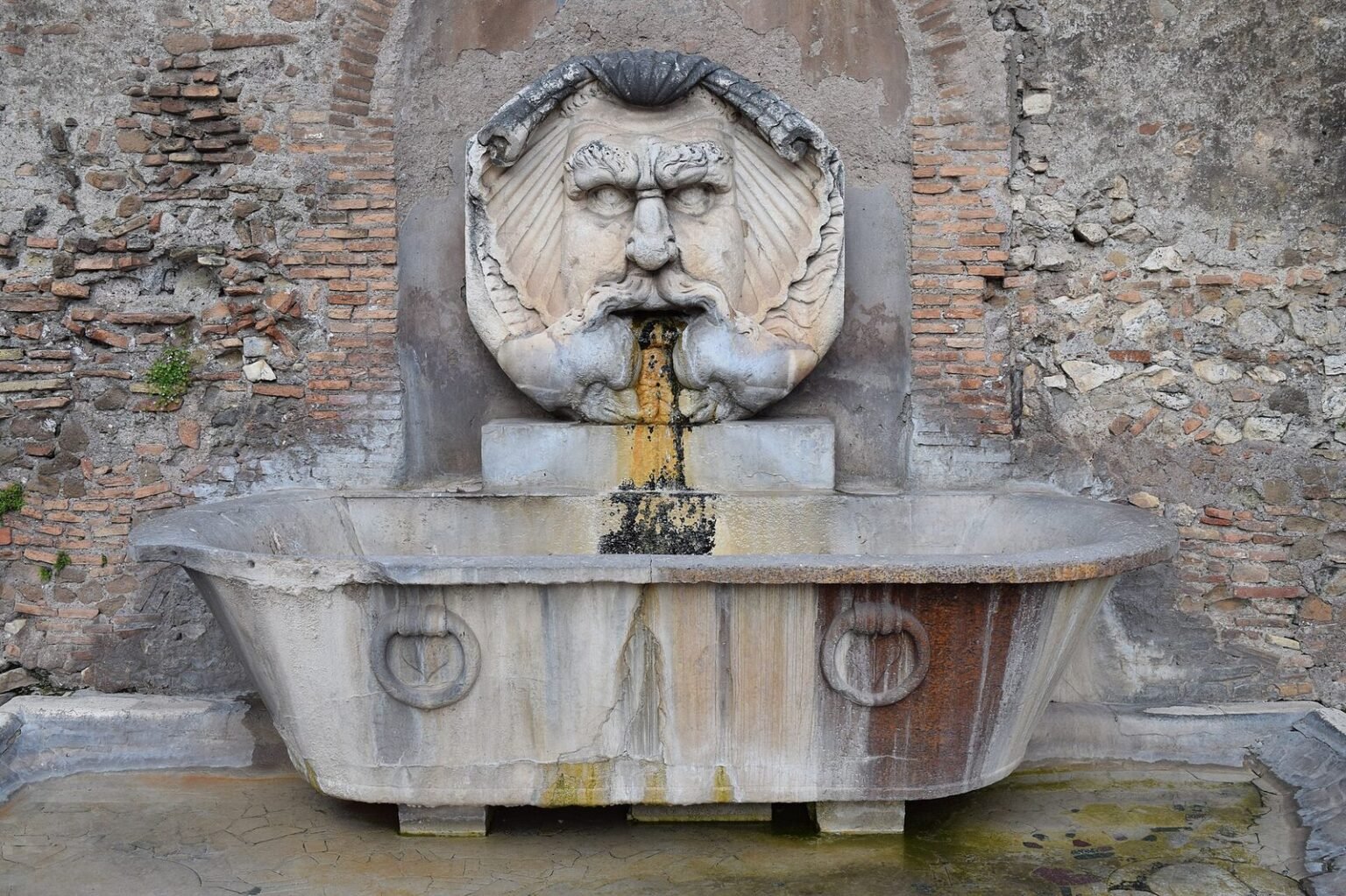
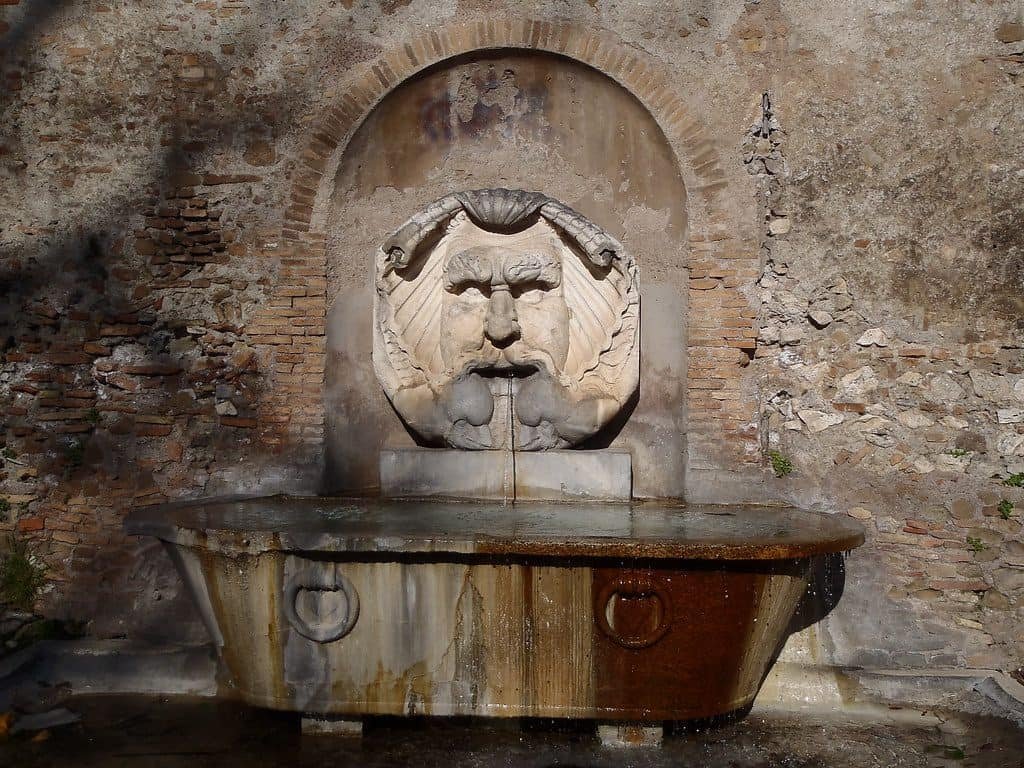
At the entrance to Piazza Pietro d'Illiria, leaning against a niche in the boundary wall, there is a fountain that deserves more than a distracted glance, because it is a small collage of reassembled ancient pieces. It is made up of two spolia from different eras. The first is a Roman thermal basin in granite, decorated with large bas-relief handles, placed at the center of a rectangular basin set slightly below street level and edged with a band of travertine. The second is the real protagonist: a monumental marble mask with furrowed brows and a thick mustache, set inside a large shell, which pours water into the basin below.
That mask has had more lives than a cat. It was carved in 1593 to decorate a fountain in the Campo Vaccino, that is, the Roman Forum when it was still pasture for livestock. After the dismantling, in 1816, of an earlier fountain by Giacomo della Porta, the mask was recovered and, from 1827, reused to decorate a fountain erected on the right bank of the Tiber, at the height of the Porto Leonino. That fountain was also demolished around 1890, and the sculpture ended up for decades in municipal storage, forgotten, until it found its current location here on the Aventine. In the open space to the right of the park, moreover, another fountain by Giacomo della Porta once stood, the one originally designed for the vanished Piazza Montanara, later moved in 1973 to Piazza San Simeone ai Coronari. The Giardino degli Aranci is also this: an outdoor museum of migrant marbles, pieces of Rome taken apart in one place and reassembled in another.
The viewpoint of the Giardino degli Aranci and the view of Saint Peter's
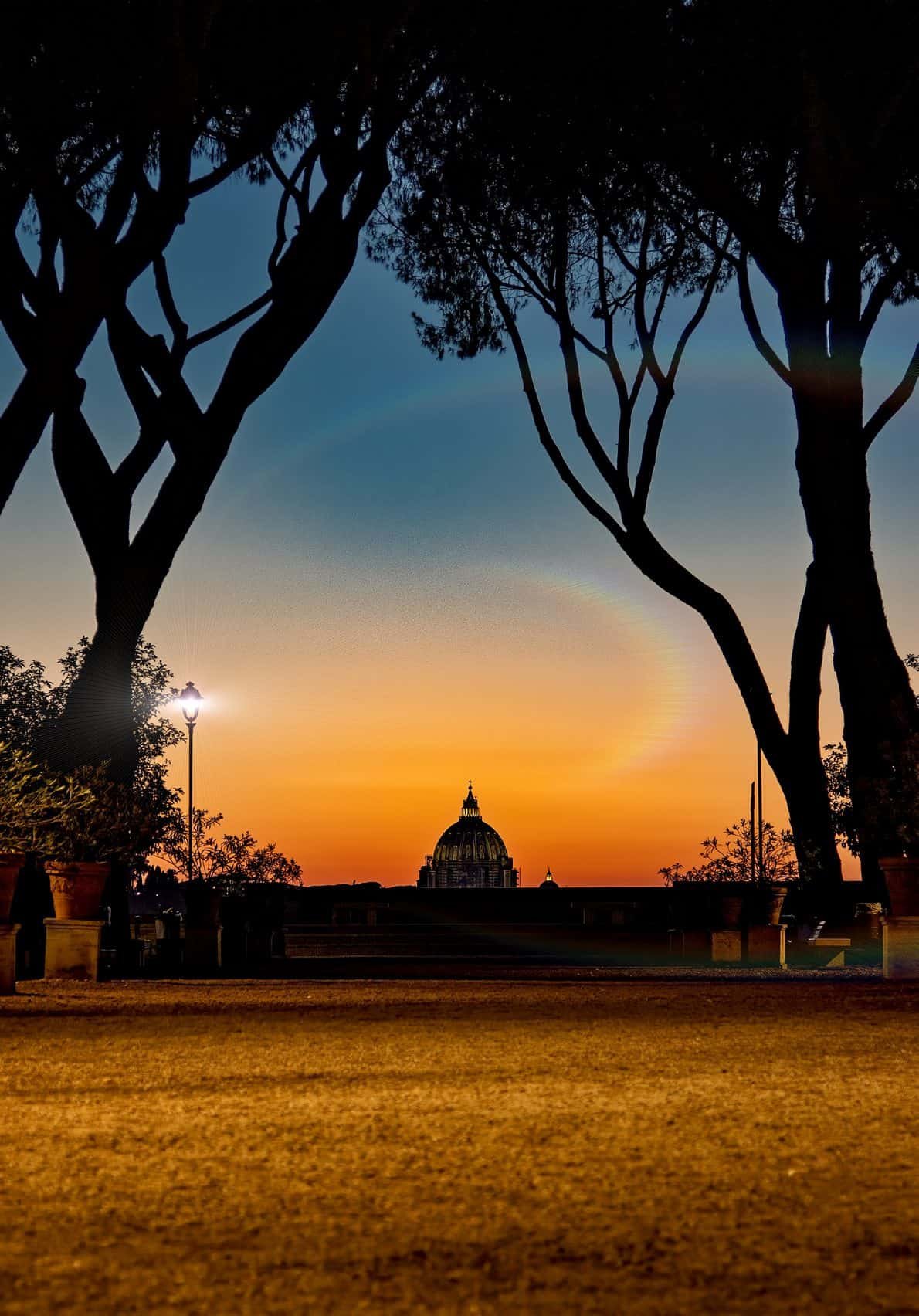
The viewpoint is the reason the Giardino degli Aranci has ended up in millions of photographs. From the parapet at the end of the central avenue, the gaze takes in all at once the Tiber bending below the Aventine, the rooftops of Trastevere, the Janiculum in the background and, shifted to the right, the dome of Saint Peter's floating above the city. On clear evenings, when the sun sets behind the Janiculum and the light turns orange, the viewpoint fills with people sitting silently on the low wall: it is one of the few places in Rome where the sunset is still a free, shared show.
The viewpoint is today dedicated to Luigi Magni, the Roman screenwriter and director of films about papal power and nineteenth-century Rome, such as Nell'anno del Signore and In nome del Papa Re. The choice is not random: the Rome of Magni, mocking and popular, is the same one you sense from the Aventine, looking down toward the river and the Ripa district. The road that leads to the viewpoint is instead named after Nino Manfredi, the actor from Ciociaria by birth and Roman by adoption, who was Magni's favorite interpreter. Walking along Viale Manfredi to the Magni Belvedere is, without any signs explaining it, a small tribute to Italian cinema.
The perspective trick of the St. Peter's dome
There is an optical effect worth trying for yourself. Entering the park and walking along the path toward the St. Peter's dome, instead of growing larger, the dome seems to move away and shrink as you approach the viewpoint. It is the same perceptual paradox you can find in several places in Rome that were built for it: along Via Piccolomini, where the Cupolone gets smaller as you walk toward it, and above all 100 meters further on, at the keyhole of the Priory of Malta.
The Orange Garden and the keyhole of the Priory of Malta
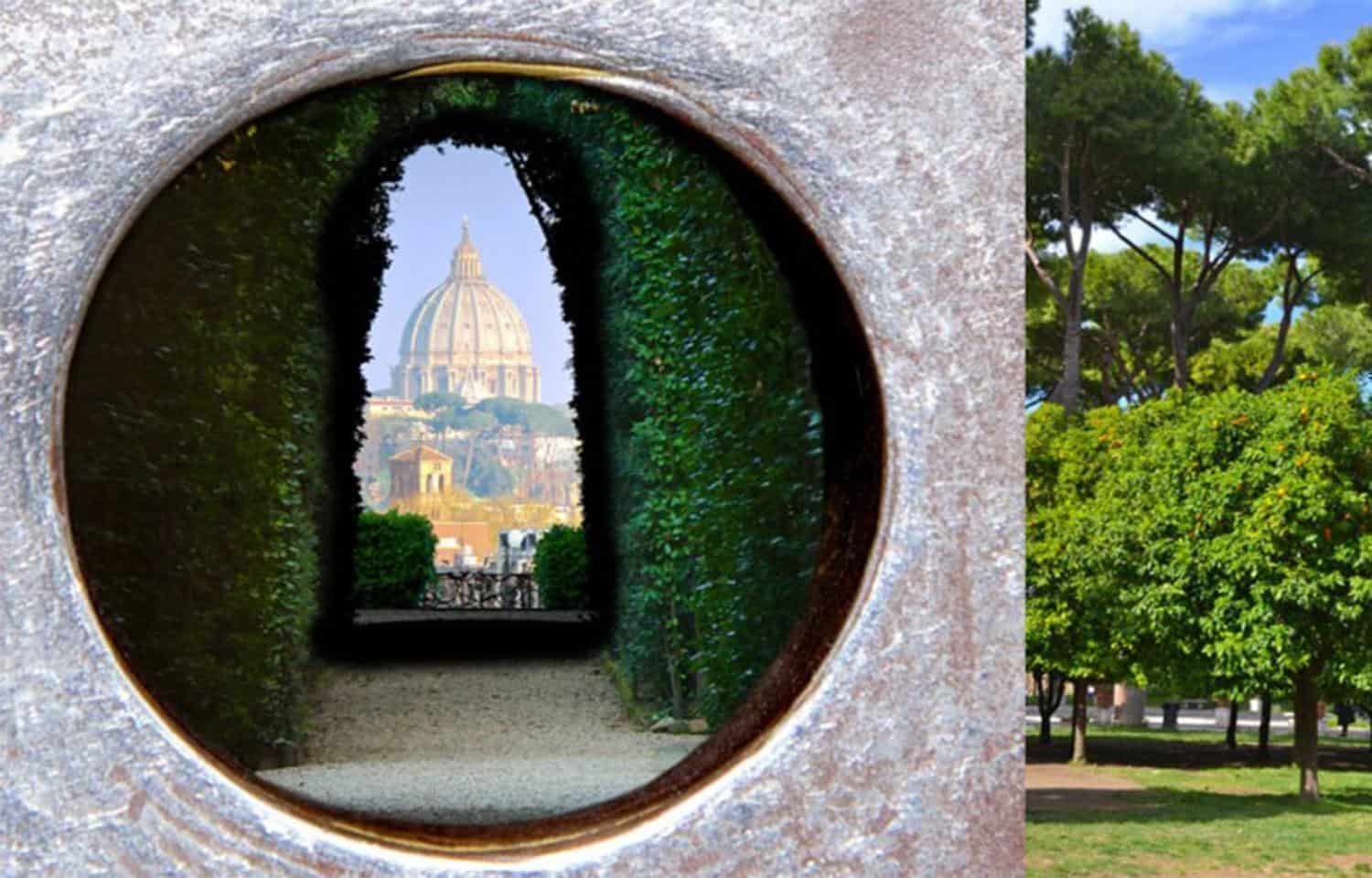
A few steps from the park, in Piazza dei Cavalieri di Malta, you'll find one of the most famous optical tricks in Rome. At number 3, behind the portal of the Villa del Priorato di Malta, there is a door whose keyhole, if you bend down to look inside, frames the St. Peter's dome perfectly centered at the end of an avenue of pruned holm oaks shaped into a tunnel. The square and the portal were redesigned in 1765 by Giovanni Battista Piranesi, the Venetian engraver and architect, who replaced the existing rows with a laurel hedge precisely to create that telescope effect. The result is that Michelangelo's dome, which is very far away, appears framed and strangely close.
The Villa Magistrale has been the representative seat of the Grand Master and the government of the Sovereign Order of Malta since 1834, which has owned this site since 1312. Looking through the keyhole costs nothing and only requires a little patience for the line, which can be long on sunny days. Anyone who has just watched the same dome play with distance from the viewpoint of the Orange Garden will find here the concentrated, perfect version of the same perspective joke.
My advice for visiting the Orange Garden
There is only one piece of advice, and it matters more than any other: choosing the time. The Orange Garden has two completely different faces. Early in the morning, right after it opens at 7, it is empty and cool, and the full light shows St. Peter's without backlighting. This is the best time to photograph the dome clearly and to enjoy the park in silence, perhaps combining it with a visit to Santa Sabina, which opens early. The late afternoon, on the other hand, is the kingdom of sunsets and crowds: in the hour before sunset the viewpoint fills up, spots on the low wall have to be claimed in advance, and in summer you find yourself shoulder to shoulder with hundreds of people and a few guitars.
My verdict is clear: if you're looking for the postcard photo with a pink sky, accept the crowd and arrive at least 40 minutes before sunset to get a spot. If instead you're looking for peace and the real Rome, come at opening and leave the sunset to the tourists. Avoid the midday hours of summer at all costs: the park has few benches in the shade, the orange trees don't provide enough foliage, and the blazing sun takes away any pleasure from a walk. Bring water, because there are no bars inside the park, and don't count on restrooms, which are missing. One last thing: the site is free and runs on mutual respect, so no picking fruit from the trees and no loud music that spoils the sunset for others.
Another well-known fact, yet rarely mentioned
Everyone knows the Aventine is one of Rome's seven hills, but few remember that for centuries it was the hill of outcasts and rebels, and that the Orange Garden sits right inside that memory. In republican Rome the Aventine was the hill of the plebs: here, according to tradition, the plebeians withdrew in the famous secession to protest against the patricians, giving rise to the expression aventiniano, which came back into use 26 centuries later for the parliamentary Aventine of 1924. The hill long remained outside the sacred pomerium of the city, a land of foreign temples, of plebeian deities such as Ceres, and of people who didn't count.
This secluded vocation runs through the whole history of the place. In the Middle Ages the Aventine emptied out and was covered with vegetable gardens, vineyards and convents: while the rest of Rome crowded into the bend of the river, the hill remained countryside inside the walls. It was precisely that silence and isolation that made it, over the centuries, a refuge for monks and then the elegant, private neighborhood it is today, with its Liberty-style villas hidden behind walls. The Orange Garden inherits all of this: it is public and crowded at sunset, yet it keeps the air of a place somewhat out of the world, as if the hill had never stopped being the Rome of those who want to be left to themselves.
The right photo to take at the Orange Garden
The photo everyone is after is the obvious one: the dome of St. Peter's framed by the orange trees, with the sunset sky. But the right photo, the one that not thousands of others take, takes a bit of know-how. First: don't stand at the far end of the avenue with everyone else. The best spot for the dome is slightly off to the right side of the belvedere, where a branch of orange tree can come into the foreground and add depth to the frame, with St. Peter's in the background and the river in between. Second: the hour matters more than the composition. In the so-called blue hour, the 20 minutes after sunset when the sky turns a deep blue and the first city lights come on, the scene is worth twice as much as it is at midday.
Then there's the less obvious photo, the horizontal one of the wall and the parapet with people leaning over it, backlit: it tells the story of the Giardino degli Aranci as a place for everyone better than any postcard. And there's the vertical photo of the entrance portal on Piazza Pietro d'Illiria, with its baroque frame, which few people photograph because they're focused only on the panoramic view. A practical warning from someone who has been here a thousand times: at sunset the belvedere is so crowded that a clean shot with no heads in the foreground is almost impossible. If you really want it, come back at dawn. The morning light on St. Peter's, with the park empty, gives you shots that no crowded sunset could ever give.
What to See Around the Giardino degli Aranci
The great thing about the Aventine is that everything is reachable on foot in a few minutes, and the Giardino degli Aranci is the ideal starting point for a half-day walk. On the side of the hill that slopes down toward the Circus Maximus lies the Rome Rose Garden, the municipal rose garden that from April to June bursts into thousands of rose varieties and that occupies, not by chance, an area that for centuries was Rome's Jewish cemetery. Further down still opens the valley of the Circus Maximus, the ancient chariot racing circus, today a large archaeological lawn and the stage for summer concerts.
Toward the river, at the foot of the Aventine, you'll find the Forum Boarium with its two perfectly preserved Republican temples, and the church of Santa Maria in Cosmedin with the famous Mouth of Truth in its portico. A little further south, toward Testaccio, stand the Pyramid of Cestius, a pyramid-shaped tomb of a Roman magistrate from the 1st century BC, and the Cimitero Acattolico, where Keats and Shelley rest in the shadow of the pyramid itself. In a single day, starting from the Giardino degli Aranci, you can cross 2,500 years of Rome.
The Giardino degli Aranci with Children
The park works well with young children: the spaces are open and flat, there are no busy roads inside, and the central avenue is perfect for a run. What's missing, though, is an equipped play area, so don't expect swings or slides. For the little ones, the fun is all in the game of the dome getting farther away down the avenue and in looking for the mysterious tree behind the wall of Santa Sabina. Strollers and pushchairs get in without trouble through the three entrances, all at street level or with ramps. One tip: avoid the middle hours and bring snacks and water, because you won't find anything inside.
Accessibility at the Giardino degli Aranci
The Giardino degli Aranci is largely flat and the paths are compact dirt, passable even in a wheelchair with some care after rain. The entrance on Piazza Pietro d'Illiria is the most convenient for those with mobility difficulties, because it avoids the slopes of the Clivo di Rocca Savella. The real obstacle isn't the park itself but the climb to reach it from the Circus Maximus, which is steep: anyone with mobility problems should consider a taxi to Piazza Pietro d'Illiria, which takes you right there. The belvedere can be reached without steps.
Some Important Events That Took Place Here in History
The first major event in this place is the construction of the Savelli fortress between 1285 and 1287, which made the western Aventine a military stronghold controlling the Tiber and the port of Rome. From this fortress, the Savelli family, which would give the Church Popes Honorius III and Honorius IV, exercised their power for generations over the Ripa district and over the river traffic coming up from the sea. The wall that still today marks the boundary of the park is the scar of that feudal era.
A second event, less well known but fascinating, dates to the early 1700s: in the garden, then owned by the Ginnasi family, the Accademia dell'Arcadia, the most important literary academy of Baroque Rome, met for a period in an outdoor theater built specifically by the architect Giovan Battista Contini. Poets and men of letters recited verses among these same trees, in an eighteenth-century anticipation of the link between the Aventine and performance that would return two centuries later.
The third event is the very birth of the public park in 1932, when the Governorate of Rome expropriated the orchard from the Dominicans and entrusted Raffaele De Vico with the design of the new belvedere. It was a precise urban planning move: to equip the Aventine with a terrace open to everyone, just like the Pincio and the Janiculum. 10 years later, in 1942, the Comune officially adopted the name Parco Savello, closing the circle between the medieval fortress and the modern garden.
The Summer Theater of Fiorenzo Fiorentini
In the second half of the 1900s, the Giardino degli Aranci was a stage for years. The park's central square is today named after Fiorenzo Fiorentini, the Roman actor, voice actor and composer who staged his summer theater season here for a long time, bringing Roman comedy and variety shows outdoors under the stars of the Aventine. For a generation of Romans, the name Giardino degli Aranci was synonymous with evenings of popular theater, with the audience seated among the trees and the dome of St. Peter's as a natural backdrop. Naming the square after Fiorentini, like naming the avenue after Manfredi and the belvedere after Magni, has made the park a small pantheon of Roman cinema and theater.
Who Has Passed Through the Giardino degli Aranci
The oldest figure linked with certainty to this place is Saint Dominic de Guzman, founder of the Dominican order, who at the beginning of the 1200s lived in the convent of Santa Sabina, which adjoins the park, and who according to tradition planted the orange tree in the cloister, the tree from which the entire garden takes its meaning. A little later, in the 1300s, the memory of the place is tied to Catherine of Siena: the saint, who spent the last months of her life in Rome and died there in 1380, would have picked from that very orange tree the five candied oranges she gave to Pope Urban VI in 1379.
The fortress was the fief of the Savelli family, a noble house that gave the Church Honorius III, the pope who approved the Dominican order, and Honorius IV. In the early 1700s, the poets of the Arcadia, the academy that brought together the most prominent men of letters of the Rome of the popes, passed through here among the trees of the Ginnasi garden. And in the 1900s, the park became home to three great names of Roman entertainment: Nino Manfredi, to whom the avenue is dedicated, Luigi Magni, to whom the belvedere is dedicated, and Fiorenzo Fiorentini, to whom the square is dedicated, where he performed for years.
To these are added the anonymous and constant crowds of Romans and travelers who, from the 1700s onward, climb the Aventine for the same reason: the view. Grand Tour travelers sought the romantic panoramic views over the city of the popes from the hills of Rome, and the Aventine belvedere, with its dome framed by trees, is the most intimate version of that search. Today as then, whoever passes through the Giardino degli Aranci does so to look at Rome from above and take an image of it away with them.
When to Visit the Giardino degli Aranci
The ideal season is spring, between April and June, when the light lasts long, the heat is still bearable, and the nearby Roseto is in bloom: the two visits can be combined into a single walk. Autumn brings spectacular sunsets and a less crowded park, with the orange trees loaded with fruit that no one can pick. Summer is the most touristy and hottest season: beautiful at sunset, tiring at midday. Winter has the advantage of an almost empty park and clear skies, but the short days bring closing time much earlier, at 18 from October to February.
Within the day, the advice remains the same as always: opening at 7 for the peace and clean light on St. Peter's, the last hour before sunset for the atmosphere and postcard photography, and avoiding the central hours of summer. On weekends, especially Sunday at sunset, the belvedere reaches its peak crowds: if you're looking for silence, choose a weekday.
The Giardino degli Aranci and Rome's other viewpoints
Rome has three large public terraces overlooking the city, and it's worth knowing what sets the Giardino degli Aranci apart from the other two. The Pincio, above Piazza del Popolo, offers the broadest and most monumental panorama, with the domes of the historic center lined up: it's the most scenic and most touristy viewpoint. The Janiculum looks over Rome from the west, higher up, with the widest view of all and the cannon that fires at noon. The Giardino degli Aranci is the lowest, the most sheltered and the most intimate of the three: it doesn't dominate the whole city, but it frames a detail, the dome of St. Peter's above the river, and it does so from inside an enclosure of trees that the other two don't have. It's the viewpoint you choose when you want to look at Rome up close, not from afar.
Rome's optical illusions near the Giardino degli Aranci
The trick of the dome that seems to recede, which you experience on entering the Giardino degli Aranci, is part of a small family of Roman perspective illusions worth collecting. The most perfect is, as mentioned, the keyhole of the Priorato di Malta, just a short walk from here. But two others, in the center, are worth a detour. At the Galleria Spada, near Campo de' Fiori, you can admire the famous perspective gallery created by Francesco Borromini in 1653: a colonnade only 8.82 meters long that, thanks to an extremely skillful narrowing, seems four times as long, with at the far end a statue 60 centimeters tall that appears imposing.
In Campo Marzio, at the Church of Sant'Ignazio di Loyola, there are instead two painted illusions signed by Andrea Pozzo at the end of the 17th century: the nave vault painted to look open to the sky, and above all the false dome, a flat disc painted in perspective that, seen from the right spot on the floor, looks like a real dome that was in fact never built. Anyone who gets into the perspective game of the Giardino degli Aranci will find in these three places its natural continuation.
The entrance portal of the Giardino degli Aranci
The main portal, the one on Piazza Pietro d'Illiria, was not part of the garden from the start: it was added in 1937, five years after the park opened, and it too is a piece of spolia, like the fountain and the mascaron. It comes from Villa Balestra, on Via Flaminia, and was reassembled here to give the entrance a monumental frame worthy of the viewpoint. It's a detail that almost everyone misses: most visitors enter already looking at the view at the end of the avenue and don't look up at the frame they are passing through. Yet that portal tells the same story as the method used to build the whole garden: a skilled assembly of ancient and nineteenth-century fragments put back together in the 1930s to create, with pieces taken from elsewhere, a place that seems to have always existed.
Stop for a moment, before heading toward the view, to look at the portal from outside and from inside: it's the park's calling card and the key to understanding it. The Giardino degli Aranci is a work of landscape direction, not a relic: everything you see, from the portal to the fountain to the rows of orange trees, was chosen and placed on purpose. Knowing this doesn't take away the magic of the place, it adds to it, because it shows how much work lies behind a spot that seems simply natural.
The bitter oranges of the Giardino degli Aranci
It's worth spending a couple of words on the trees that give the park its name, because almost everyone photographs them and almost no one knows them. They are not sweet table oranges but bitter oranges, the species botanists call melangolo, the same one used to make English marmalade and essential oils for perfumery. It's a hardy plant, resistant to Rome's urban cold, that flowers in spring with white orange blossom of very intense fragrance, and bears fruit that stays on the tree for much of the winter, orange and glossy but very hard and extremely bitter. Choosing this species was not only an aesthetic decision: the bitter orange is the symbol tree of Mediterranean monastic gardens, and planting it here, where the Dominicans once cultivated, was a way to link the modern garden to its convent memory.
Anyone visiting the Giardino degli Aranci in spring, between March and May, finds the trees in bloom and the air heavy with the scent of orange blossom: it's perhaps the most beautiful moment of the year, even more than a summer sunset. In autumn and winter, instead, the trees are loaded with fruit that stands out against the dark green of the leaves, and that no one can pick. The temptation to pick one is strong, but besides being forbidden it would also be pointless: raw, the bitter orange is inedible. It's beautiful precisely because it stays there, decorative and untouchable, framing the dome of St. Peter's.
The Ripa neighborhood and the river at the foot of the Giardino degli Aranci
To really understand the Giardino degli Aranci, it helps to look down toward the river and remember what was at the foot of the hill. The Ripa neighborhood, where the park is located, takes its name from the ripa, that is, the bank of the Tiber, and for centuries it was Rome's port district. At the foot of the Aventine, where the Lungotevere runs today, lay the port of Ripa Grande, the river landing where boats came up the Tiber from the sea at Ostia loaded with grain, wine, marble and goods. The fortified Aventine of the Savelli watched over exactly that traffic: whoever controlled the hill controlled the entry of goods into the city.
This port vocation, today erased by the nineteenth-century embankments that confine the Tiber, explains why a fortress rose exactly here and why the viewpoint faces in that direction. The panorama enjoyed from the parapet is not just any view chosen for its beauty. It is the lookout point of a medieval fortress, the place from which you could see everything that entered Rome by river. When you look out at sunset over the Tiber and Trastevere, you are looking from the same corner of wall from which the Savelli kept an eye on their port. The romance of the view was born from a very military reason.
Practical tips for visiting the Giardino degli Aranci
Some concrete advice. Bring water: there is nothing inside the park, and the climb from the Circo Massimo in summer makes you thirsty. Wear comfortable shoes, because the climb and the dirt paths don't like heels. If you come for sunset in high season, arrive well ahead of time to grab a spot on the low wall of the viewpoint, which becomes the most sought-after spot in the park as the sun goes down. If you can choose, prefer a weekday and the early morning: the park empty at opening is worth more than any crowded sunset.
One combination that always works: Santa Sabina right when it opens in the morning, then the Giardino degli Aranci for the view, then 100 meters to the keyhole of the Priorato di Malta, and finally the descent toward the Roseto and the Circo Massimo. It's a half day on the Aventine that brings together an early Christian basilica, a viewpoint, a famous optical illusion and a rose garden, without ever taking any transport. Anyone who wants to make it longer goes down to the Bocca della Verità and the Foro Boario, at the foot of the hill, and ends the loop on the Tiber at the height of the Tiber Island.
Quick questions about the Giardino degli Aranci
How much does it cost to enter the Giardino degli Aranci?
Nothing. Entry to the Giardino degli Aranci, that is, to the Savello Park, is free of charge. There's no ticket office, no booking is needed, and there are no turnstiles: you enter through one of the three entrances during opening hours.
What are the opening hours of the Giardino degli Aranci?
Hours vary with the season: from October to February from 7 to 18, in March and September from 7 to 20, and from April to August from 7 to 21. In any case, it's worth checking the up-to-date hours on the official website of the Sovrintendenza Capitolina before your visit, because they can change.
How do you get to the Giardino degli Aranci?
The simplest way is metro B to Circo Massimo, then a 10 minute uphill walk to Piazza Pietro d'Illiria. Alternatively, buses 81, 160 and 628 and tram 3 stop in the Circo Massimo area, from where you walk uphill.
Where is the Giardino degli Aranci?
On the Aventine hill, in the Ripa neighborhood, with its main entrance on Piazza Pietro d'Illiria and two other access points on Via di Santa Sabina and Clivo di Rocca Savella.
Why is it called the Giardino degli Aranci?
For the bitter orange trees planted there, a nod to the old kitchen garden of the Dominican friars of Santa Sabina. The official name in the municipal documents, however, is Savello Park, after the medieval fortress of the Savelli.
Can you pick the oranges in the Giardino degli Aranci?
No, it's forbidden. The orange trees are ornamental, and the fruit is bitter and inedible raw. The legendary tree, the one of St. Dominic, is not in the park but in the cloister of Santa Sabina, visible only through a gap in the wall.
What is the best time to visit the Giardino degli Aranci?
It depends on what you're looking for: opening at 7 for peace and clean light over St. Peter's, or the last hour before sunset for the atmosphere and postcard photos. The central hours of summer should be avoided because of the heat and the scarcity of shade.
Can you see the sunset from the Giardino degli Aranci?
Yes, and it's one of the most famous sunsets in Rome. From the viewpoint, the sun sets behind the Janiculum and lights up the dome of St. Peter's and the Tiber. At sunset, though, the viewpoint is very crowded, especially on weekends.
Is the Giardino degli Aranci suitable for children?
Yes, the spaces are open, flat and safe, but there is no equipped play area. Bring water and a snack, because there are no bars inside the park.
Is the Giardino degli Aranci wheelchair accessible?
The park is largely flat, with paths of compacted dirt. The entrance on Piazza Pietro d'Illiria is the most convenient. The biggest obstacle is the climb to get there from the Circo Massimo, which can be overcome by taxi up to the entrance.
Is there a bar or a restroom inside the Giardino degli Aranci?
No, there are no bars or restrooms inside the park. It's best to plan ahead and use the places around the Circus Maximus or the Aventine.
How long does a visit to the Giardino degli Aranci take?
The park itself can be walked in 20 or 30 minutes. Adding a stop at the viewpoint for sunset and a visit to Santa Sabina and the keyhole in Malta easily turns it into a half day on the Aventine.
Do I need to book ahead for the Giardino degli Aranci?
No, no booking is needed. It's a public park with free access: you just go in during opening hours.
Can you bring dogs to the Giardino degli Aranci?
Yes, dogs are allowed on a leash, as in most of Rome's public parks. It's good practice to pick up after your dog and respect the flower beds with the orange trees.
Can you get married or have wedding photos taken at the Giardino degli Aranci?
The park is one of the most requested locations for photo shoots, thanks to the panoramic views. Professional shoots and ceremonies may require permits from the Sovrintendenza Capitolina. It's best to check in advance with the competent offices.
What's the difference between the Giardino degli Aranci and the Roseto di Roma?
They are two nearby gardens, but they are different. The Giardino degli Aranci is a tree-lined viewpoint on top of the Aventine, open all year. The Roseto comunale runs down the slope toward the Circus Maximus and is best visited in spring, when the roses are in bloom.
Is the Giardino degli Aranci the same as the keyhole?
No, but they are very close. The keyhole is in Piazza dei Cavalieri di Malta, 100 meters beyond the park, behind the portal of the Villa del Priorato di Malta. From there you can see the dome of St. Peter's framed by a hedge of laurel.
What is the real name of the Giardino degli Aranci?
The official name is Savello Park, assigned by the Comune di Roma in 1942 in memory of the medieval fortress of the Savelli family. Giardino degli Aranci is the popular name, which comes from the trees.
Who designed the Giardino degli Aranci?
The park as it looks today was designed in 1932 by architect Raffaele De Vico, who worked on many public green-space projects in Rome. He was the one who gave it its symmetrical layout, with the central avenue aligned with the viewpoint over the river.
Why does St. Peter's dome seem to move away from the Giardino degli Aranci?
It's an optical effect of perspective: as you walk along the central avenue toward the viewpoint, the distant dome seems to shrink instead of grow. The same paradox, deliberately built, can be found at the keyhole of the Priorato di Malta, a few steps from here and along Via Piccolomini.
Is the Giardino degli Aranci open all year?
Yes, it's open every day all year, with hours that change by season: it closes at 18:00 in winter and at 21:00 at the height of summer. There are no weekly closing days.
What can you see from the viewpoint at the Giardino degli Aranci?
From the railing you can take in the Tiber, the rooftops of Trastevere, the Janiculum in the background, and St. Peter's dome on the right. At sunset, the sun sets behind the Janiculum and lights up the whole scene in orange.
Can you have a picnic at the Giardino degli Aranci?
On the lawns, you can sit down and have a light snack, with the common sense not to leave litter and to respect the flower beds with the orange trees. There are no plentiful trash bins nor drinking fountains inside the park, so it's best to take away what you bring in. On summer evenings the viewpoint is very crowded: picnics work better in the morning or early afternoon, when there's more room.
What's the best season to visit the Giardino degli Aranci?
Spring, between April and June, when the orange trees are in bloom and the nearby Roseto is open and in full blossom. Both can be visited together on one walk. Autumn brings clear sunsets and fewer crowds, and winter brings clear skies but an early closing at 18:00.
One last thing, from someone who has brought more groups to this viewpoint than they can remember: the Giardino degli Aranci doesn't deserve to be reduced to a quick sunset photo in the crowd. Go up one morning early, when the gate opens and there's no one there, and sit quietly in front of St. Peter's with the smell of the bitter oranges all around. It's in that moment, not among the evening selfies, that you understand why Romans call this place the most beautiful balcony on the Aventine.
Article written by the editorial team of TourLeaderPro, contact them for Tours and Private/Corporate/V.I.P. Experiences.
Are you planning a trip to Rome? English-language guides for visiting the city are available at ItalyPlanner.com.