Tiber Island
In short. Tiber Island sits in the center of Rome, set in the Tiber between the rione Ripa and Trastevere, level with the Ghetto and the Foro Boario.
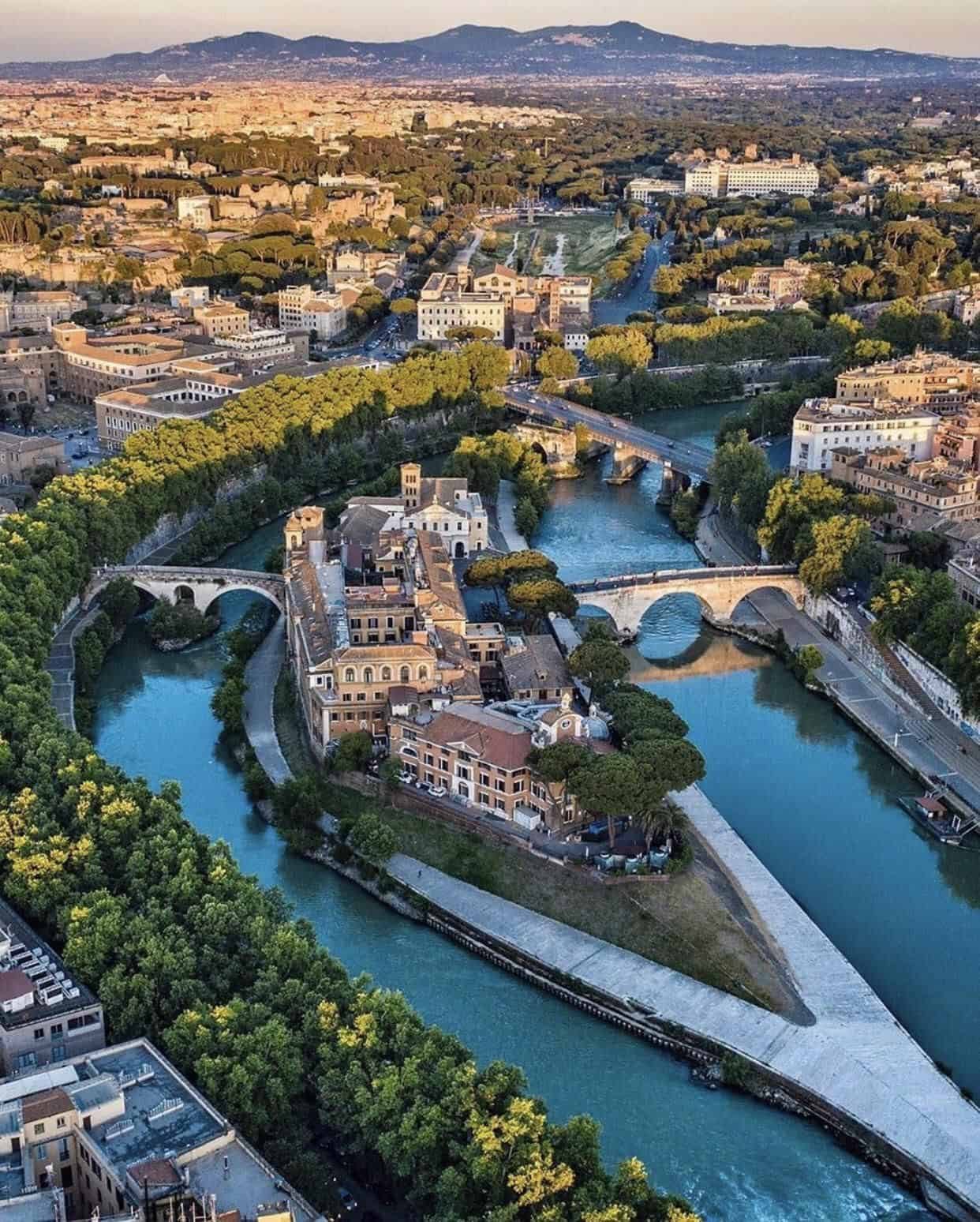
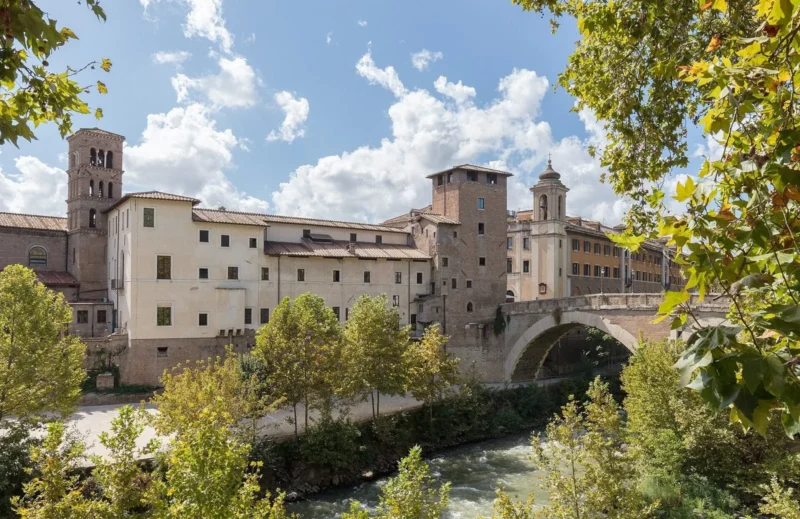
Tiber Island sits in the center of Rome, set in the Tiber between the rione Ripa and Trastevere, level with the Ghetto and the Foro Boario. The reference address is Lungotevere degli Anguillara, Roma, and you can reach it from both banks by two pedestrian and vehicular bridges, the Ponte Fabricio on the Ghetto side and the Ponte Cestio on the Trastevere side. There is no ticket to pay. The island is a public space open day and night, you can cross it freely on foot, and no reservation is needed for your visit. The Basilica di San Bartolomeo all'Isola generally opens in the morning and late afternoon, with a break in the middle of the day, and entry to the church is free. Exact hours change with the seasons and should be checked on the parish website before you go. The best way to get there is on foot from the historic center, but the useful public transport stops are the buses along the Lungotevere and tram 8, a short distance away in Trastevere. If you're looking for a considered guide to Rome's destinations, you'll find one on the Tourist Attractions page.
This guide covers Tiber Island in full: its ship-like shape carved from travertine, the serpent of Aesculapius that for centuries made it the place of medicine, the Basilica of San Bartolomeo with its relics and mysteries, the hospitals that still treat Romans today, the two ancient bridges and the stump of the Broken Bridge, the Torre dei Caetani with its legend, and the summer evenings of the Isola del Cinema. It's a small patch of land just over 300 meters long, yet it holds as much history as an entire neighborhood.
How to Get to Tiber Island
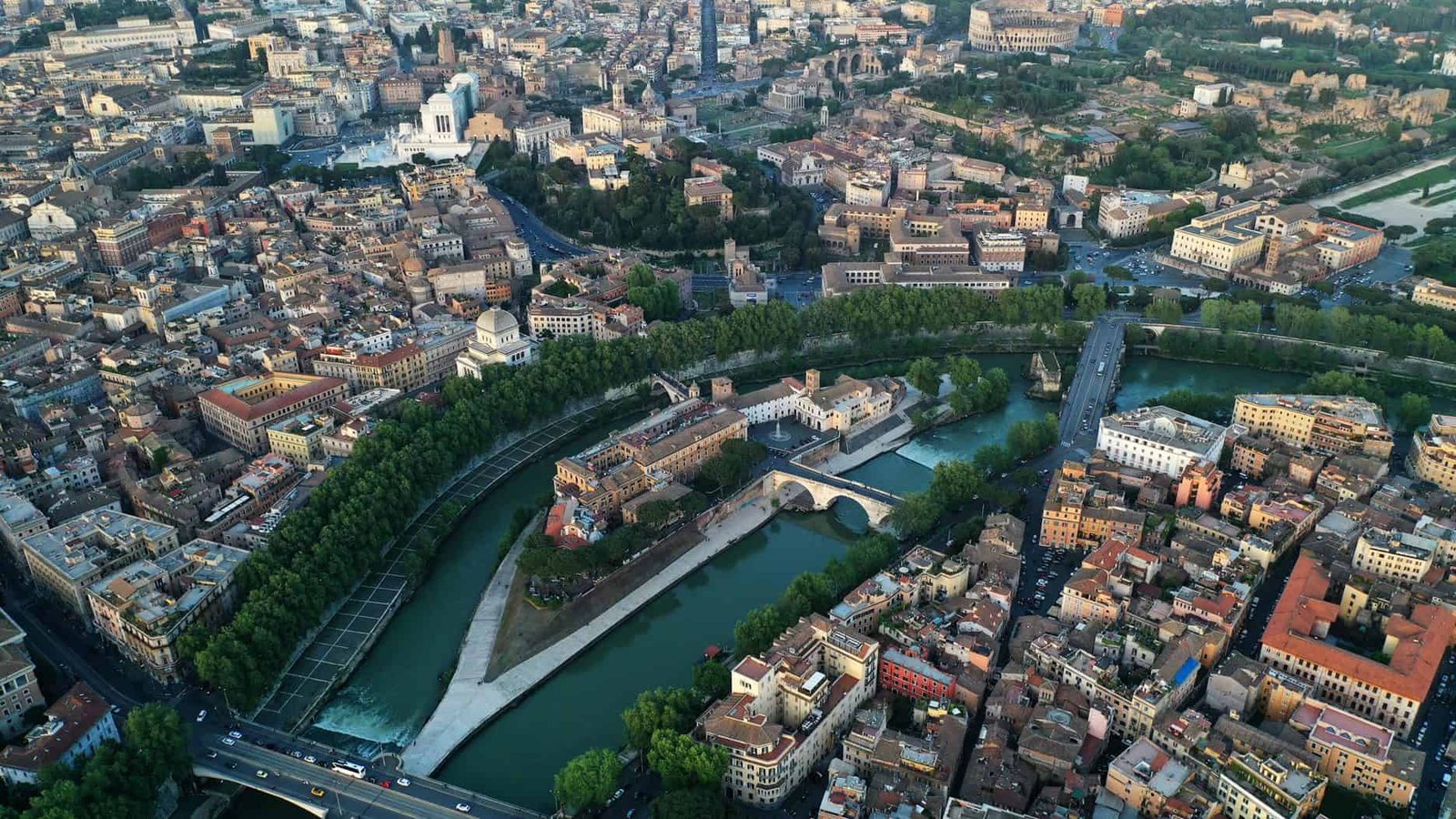
Tiber Island is one of the few places in Rome worth reaching without hurrying and without transport. From the Ghetto and Largo di Torre Argentina, the walk takes about 10 minutes along the Lungotevere. From Trastevere it's even less, because Ponte Cestio connects it directly to the network of alleys starting at Piazza in Piscinula. Anyone coming from the Campidoglio heads down toward Teatro di Marcello, walks past the Portico d'Ottavia, and finds themselves at Ponte Fabricio almost without realizing it.
On Foot to Tiber Island
The most beautiful route starts at the Foro Boario, in front of the church of Santa Maria in Cosmedin and the Bocca della Verità. From there, follow the Lungotevere dei Pierleoni upstream, keeping the river on your left, and in five minutes you'll be at Ponte Fabricio. Alternatively, if you're coming from Campo de' Fiori, cut through the Ghetto, pass under the Portico d'Ottavia, and emerge on the Lungotevere de' Cenci directly across from the island. It's an approach worth the walk: the island reveals itself little by little, first the travertine prow, then the Romanesque bell tower, and finally the single arch of the Broken Bridge floating alone in the current.
By Bus and Tram to Tiber Island
The bus lines running along the Lungotevere stop a short distance from both bridges. On the Trastevere side, tram 8, which starts from Piazza Venezia, stops at Trastevere and drops you a few minutes from Ponte Cestio. Routes and timetables change with service revisions, so check them on the official public transport app the same day. There is no metro stop right on the island. The nearest one is still a walk away, and the historic center is better explored on foot than underground.
By Car: Why It's Better to Leave It at Home
Driving to Tiber Island is the worst choice. The area falls within the historic center's traffic restriction zone, parking is scarce and expensive, and the island's two bridges are effectively pedestrian for a large part of the day. No beating around the bush: anyone who wants to enjoy the island gets there on foot along the river, not by looking for a parking spot.
What Is Tiber Island: The Only Urban Island on the Tiber
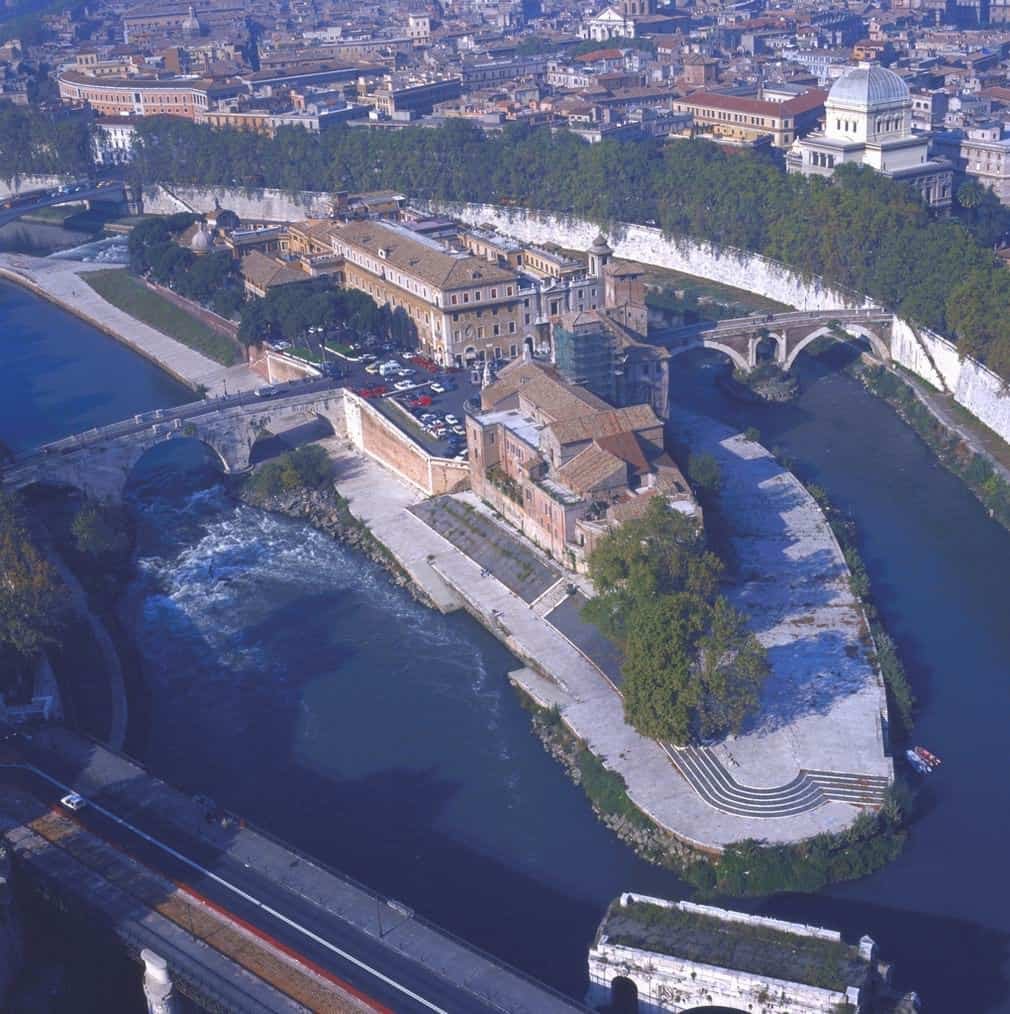
Tiber Island is the only urban island on the Tiber within the city, a bank of earth and sedimentary rock around which the river divides into two arms. It measures just over 300 meters long and roughly 90 meters wide at its widest point. Its elongated shape, with the point facing downstream, has suggested since antiquity the image of a ship at anchor in the middle of the current. The ancients also called it inter duos pontes, between the two bridges, and the Severan-period Forma Urbis, the great marble plan of Rome, already records it with this expression.
The location is not just any geographical detail. Right at the island, the Tiber could be forded more easily, and for this reason Rome's first settlement found one of its natural crossings here, between the Etruscan and Latin banks. The island is both an obstacle and a bridge. It breaks the current, makes it less treacherous, and allowed people to cross the river at a point that was otherwise dangerous. That the god of medicine settled here, and that two hospitals still work here today, fits a place that for 25 centuries has been linked to healing and passage.
The ship shape of Tiber Island
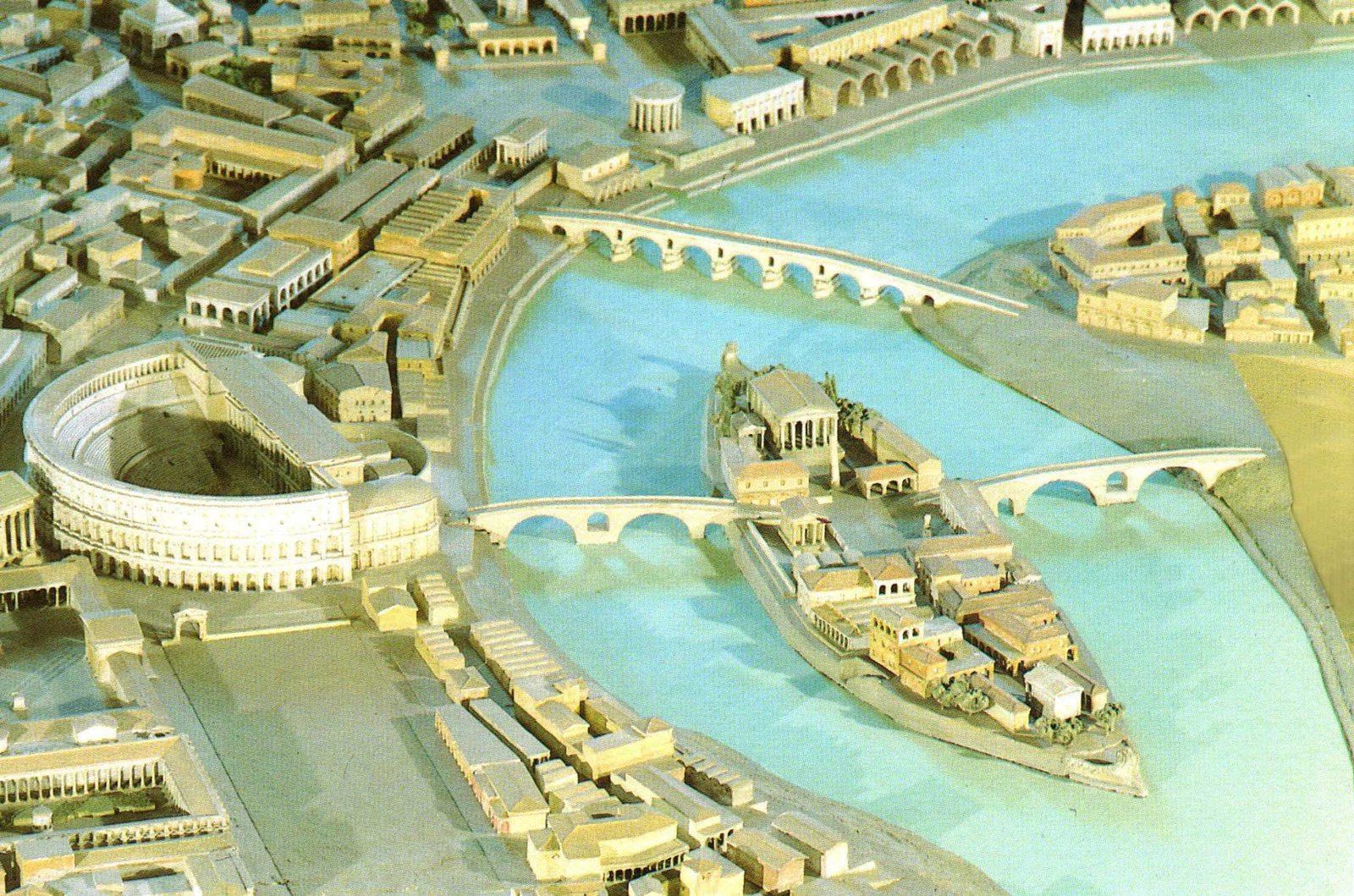
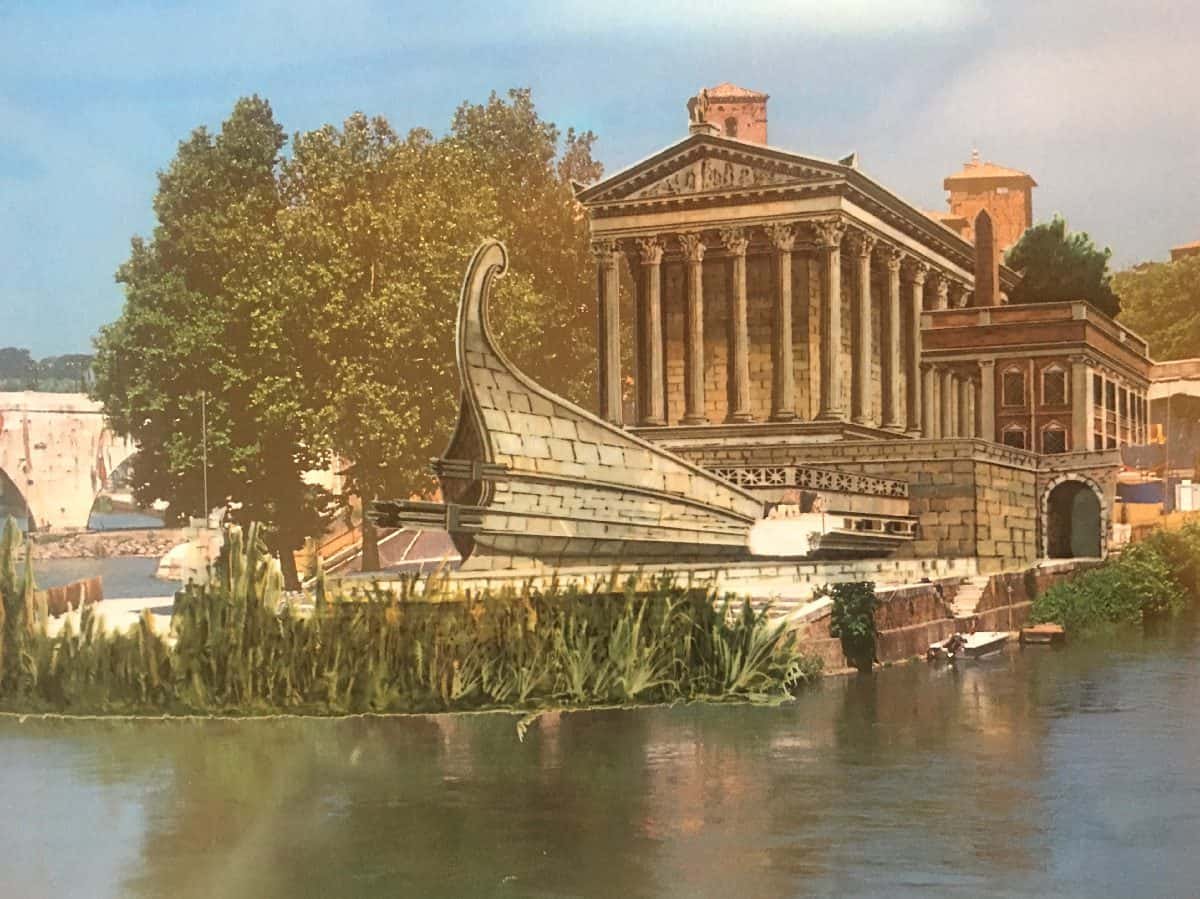
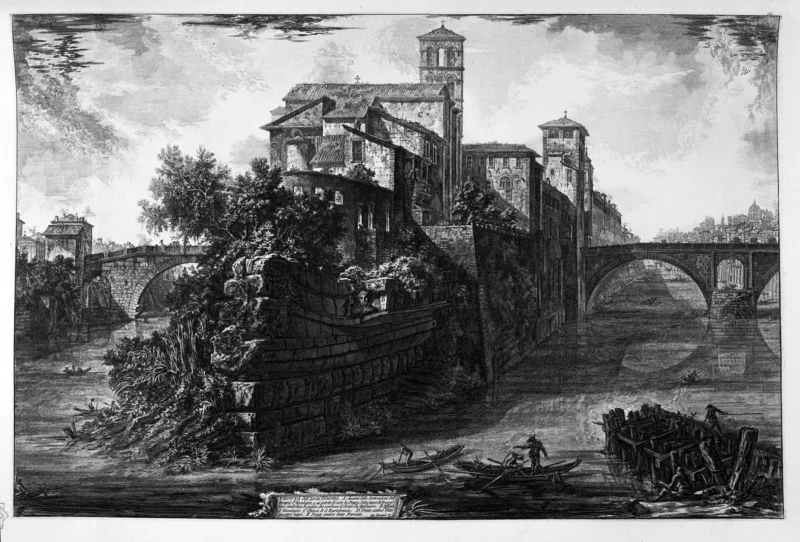
The most fascinating thing about Tiber Island is that its ship shape is not merely an impression of the eye: it is the result of a deliberate intervention. In the first half of the 1st century BC, during the same decades in which the Ponte Fabricio and Ponte Cestio were being built in masonry, the island was monumentalized in opus quadrata, that is, faced with large squared blocks, so as to give it deliberately the look of a vessel. At the downstream end, toward the Ponte Rotto, a fragment of this facing is still preserved today: the so-called prow.
The travertine prow and the serpent of Aesculapius
The prow is a block of travertine covering a core of peperino, the dark volcanic stone of the Alban Hills. On its surface one can still make out, worn by the centuries and by floods, the relief of a head of Aesculapius with his attribute, the serpent coiled around the staff. Beside it, the protome of a bull, the animal of sacrifice, can be recognized. It is a worn fragment, and to see it well you need to lean over from the tip of the island or look at it from the Ponte Cestio when the river level is low. It is worth looking for. It is one of the very few surviving traces in situ of the ancient fittings, and it turns a stone quay into the carved flank of an imaginary ship.
The obelisk as mainmast
At the center of the island, ancient tradition places an obelisk that would have represented the mainmast of the stone ship. It was a way of fixing in the landscape the memory of the foundation legend, that of the ship that arrived from Epidaurus with the sacred serpent. Today, in the center of the island, in the small square in front of the churches, there is instead a column topped by a cross. But the idea of a ship sailing the Tiber has remained the key through which Romans have always read this place.
The legend of the foundation and the cult of Aesculapius
The birth of Tiber Island as a sacred place is wrapped in a story that the Romans repeated with conviction. According to the most widespread version, the island formed from the sheaves of grain that belonged to Tarquin the Proud, Rome's last king. Once the tyrant was driven out, the people threw the cursed harvest of his lands into the river, and that grain, piling up on the bottom with the silt, gave rise to the bank of land. It is an etiological legend, a way of explaining the origin of the island after the fact. Geological studies indicate that the bank existed much earlier, but the story tells well how much the Romans tied this place to their most ancient history.
The serpent that came from Epidaurus
The second story, the one that made the island famous, concerns the arrival of the cult of Aesculapius, the Greek god of medicine. In 292 BC a plague struck Rome. After consulting the Sibylline Books, the Romans decided to bring the healing god from his sanctuary at Epidaurus, in Greece. An embassy set sail and, according to tradition, when the delegation was about to leave, a serpent, the god's favorite form, boarded the ship of its own accord. Sailing back up the Tiber, the serpent would have thrown itself into the water right at the height of the island, thus choosing the site of its temple by itself. The plague, the tradition says, ended. The temple of Aesculapius was dedicated in 289 BC in the southern part of the island, and from that moment Tiber Island became the place of healing for Rome.
A temple, an open-air hospital
Around the temple a true healing sanctuary developed. There was a portico where the sick would stay overnight, waiting for the god to appear to them in a dream and indicate the cure, a practice the Greeks called incubation. The sources also recall other cults established on the island: two temples dedicated in 194 BC to Faunus and Veiovis, a shrine to Iuppiter Iurarius, guarantor of oaths, an altar to Semo Sancus of Sabine origin, and worship of Tiberinus, Gaia and Bellona Insulensis. In short, the island was a concentrate of sacredness, and its vocation for healing has never stopped. Where the temple of the god of medicine once stood, a hospital works today.
A curiosity about Tiber Island
The curiosity that almost no one knows concerns the absolute continuity of this place's medical function. It is not a figure of speech: on Tiber Island the sick have been cared for, without any significant break, for over 2,000 years. In 289 BC the temple of Aesculapius was inaugurated there, with its portico for the incubation of the sick. In 1583 AD, on almost the very same square meters, the followers of Saint John of God founded the Ospedale Fatebenefratelli, which is still in full operation. In between, the Christian Middle Ages had already transformed the pagan sanctuary into a place of care and relics. Very few places in the world can claim a use that has remained exactly the same for 25 centuries.
There is more, and it concerns sacred topography. The Basilica of San Bartolomeo stands exactly above the ruins of the temple of Aesculapius: the well in the center of the church, in front of the altar, probably descends toward the water source that fed the healing practices of the ancient sanctuary. The water pagan pilgrims considered healthful is the same water Christian faithful later venerated as miraculous. Beneath the stone of the Christian church, the heart of the pagan cult of medicine still beats: this layering makes Tiber Island an almost unique case of the persistence of the sacred. The attentive visitor, entering San Bartolomeo, walks over the temple of the serpent god almost without noticing.
The Basilica of San Bartolomeo all'Isola
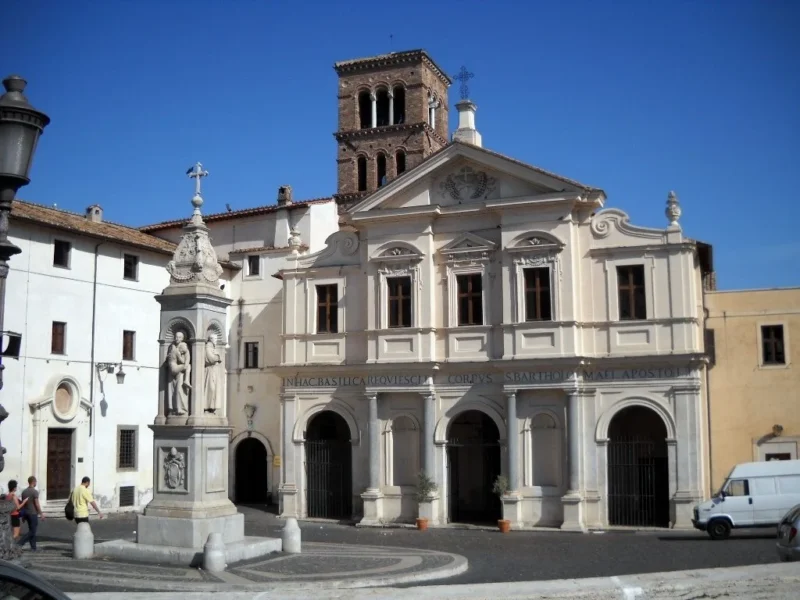
The Basilica of San Bartolomeo all'Isola is the island's main monument and deserves a careful visit, room by room. It was built at the end of the 10th century at the wish of Emperor Otto III on the ruins of the temple of Aesculapius, and originally it was dedicated to Saints Adalbert, Paulinus, and Bartholomew. After the restoration promoted by Pope Alexander III around 1180, only the dedication to Saint Bartholomew the Apostle remained, whose relics are kept beneath the high altar, in an ancient red porphyry basin.
The Romanesque Bell Tower and Façade
The bell tower, one of the most beautiful Romanesque towers in Rome, was added in 1113 under Pope Paschal II. It is built of brick, with its twin-light windows and small arches, and is clearly visible from the Ponte Cestio, outlining the island against the sky. The current façade is a 17th-century Baroque remake, but it keeps the solemnity of a church that has lived through 1,000 years of Roman history without ever losing its purpose.
The Miraculous Well at the Center of the Church
The most extraordinary piece inside is the well curb placed on the step of the presbytery, aligned with the central nave. The relief that decorates it dates to the 13th century and is attributed, on stylistic grounds, to the circle of Nicola d'Angelo or Pietro Vassalletto, the great Roman marble workers of the time. Tradition holds that the well was miraculous and that the bones of the martyrs Exuperantius and Marcellus were found in its waters. Many believe it was the conduit of the sanctuary of Aesculapius, though this is not certain. Even so, it remains the only case in Rome of a well placed so solemnly inside a basilica, a sign of how central water was to the cult of this place.
The Madonna of the Lamp
In the first chapel on the right, the image of the Madonna of the Lamp is venerated, a 13th-century fresco. The name comes from an episode linked to the Tiber's floods: tradition says that during the flood of 1557 the lamp lit in front of the sacred image kept burning even though it was submerged by the water, and this was interpreted as a miracle. It is one of those stories that say a lot about the relationship between the island and the river that surrounds it and that, cyclically, submerges it.
The 1849 Cannonball
In the Chapel of the Sacrament is kept a cannonball about 14 centimeters in diameter, a remnant of the 1849 siege of Rome, when French troops bombarded the city to bring down the Roman Republic of Mazzini and Garibaldi. It is a small object that brings the history of the Risorgimento into the basilica: the island, with its hospitals, during those months received and treated the wounded from the fighting on the Janiculum.
The Martyrs of the 20th Century
In 1999 Pope John Paul II established a commission to gather the records of Christians killed for their faith in the 20th century, the so-called New Martyrs. The commission worked for about two years right in the Basilica of San Bartolomeo, gathering an enormous number of dossiers, on the order of 12,000 cases. In October 2002 a large icon dedicated to the martyrs of the 20th century was placed on the high altar, and since then the basilica has become the Roman sanctuary of the New Martyrs, a destination for ecumenical celebrations that bring together the different Christian denominations. It is a contemporary aspect that few visitors know about, and it gives the church a fully current meaning.
The Central Shrine and the Four Saints
In the center of the island, in the open space in front of the churches, rises a column topped by a small shrine with a cross, erected in 1869 at the wish of Pope Pius IX, designed by Ignazio Jacometti. Its four niches hold statues of Saint Bartholomew, Saint Paulinus of Nola, Saint Francis of Assisi, and Saint John of God, the spiritual patrons of the island. It is the visual pivot of the central square, the point where the two churches meet and the entrance to the hospital is.
Something Nobody Tells You About Tiber Island
What the hasty guidebooks skip is the story of the column of Easter absences and its almost comic consequences. Until the 1800s, a column stood on the island with a list posted on it of those who had not fulfilled the Easter precept, that is, those who had not confessed and received communion at Easter. It was a form of social and religious control, and for the residents of the nearby Ghetto and for Romans in general, ending up on that list was a small public disgrace. The column, later moved to the portico of the basilica, was actually broken in 1867 by the impact of a cart: a traffic accident ante litteram that cut the monument of absences clean in two.
There's an episode from 1834 worth telling because it makes you smile and says a lot about the Roman character. That year the great engraver Bartolomeo Pinelli, famous for his prints of women of the people and bandits, formally complained that he had been registered on a list as a simple miniaturist rather than as an engraver, a profession he considered of higher rank. An artist protesting the wrong title on an island register: it's the kind of detail you won't find in the first search result, and it conveys the daily life of this place better than a thousand dates. Tiber Island is not just ancient stones: for centuries it was a piece of living city, with its pride and its squabbles.
The Church of San Giovanni Calibita
Next to the bulk of the hospital, often ignored by passersby, stands the small church of San Giovanni Calibita. It was built around 870 on the ruins of the shrine of Iuppiter Iurarius, the ancient guarantor of oaths, in one of those overlaps between pagan and Christian sacred space that are the rule on the island. The current facade was designed in 1640 by Luigi Barattoni and completed in 1711 by Romano Carapecchia. The interior, surprisingly rich for its modest size, is a small, richly decorated Baroque interior that is worth the five-minute detour. It is tied to the hospital work of the Fatebenefratelli, who hold services there.
The Hospitals of Tiber Island: Fatebenefratelli and Israelitico
Two hospitals still work on Tiber Island today, and this is the reason the place, though rich in history, never became an open-air museum: it is a piece of city that works.
The Fatebenefratelli Hospital
The Fatebenefratelli Hospital was founded in 1583 by the followers of Saint John of God, the hospital order whose popular name comes from the appeal the friars made when asking for alms for the sick, "fate bene, fratelli" ("do good, brothers"). It occupies the northern part of the island, opposite the Basilica di San Bartolomeo, and was expanded and modernized between 1930 and 1934 to a design by architect Cesare Bazzani. It's a real hospital, with its emergency room and its departments. A great many Romans were born here, and the idea that you can come into the world in the same place where plague was treated in the 3rd century BC gives the measure of this place's continuity.
Fra Giambattista Orsenigo, the Friar Dentist
Among the stories tied to the hospital, the most unusual is that of Fra Giambattista Orsenigo, from Lombardy, who practiced as a dentist on the island between 1867 and 1903. Tradition, repeated by several sources, credits him with an impressive number of extractions and even the care of illustrious patients. It is said that among his patients was also Pope Leo XIII. The numbers should be taken with the caution that anecdotes require, but the figure of the friar who for decades pulled teeth for Romans has entered the folklore of the island.
The Israelitico Hospital
On the southern side, next to the basilica, operates the Israelitico Hospital, one of the healthcare facilities linked to Rome's Jewish community. Its presence on the island is explained by its proximity to the Ghetto, just beyond the Ponte Fabricio. The coexistence on the same strip of land of a Catholic hospital and a Jewish hospital, a few meters apart, is another feature that makes Tiber Island a place of plural care, faithful to its millennia-old vocation.
The Bridges of Tiber Island: Fabricio and Cestio
Tiber Island is joined to both banks by two ancient bridges, and both deserve more than a distracted glance. They are among the oldest bridges in Rome, and one of them is in fact the oldest in the city to have survived in its original form.
The Ponte Fabricio, the Oldest Bridge in Rome
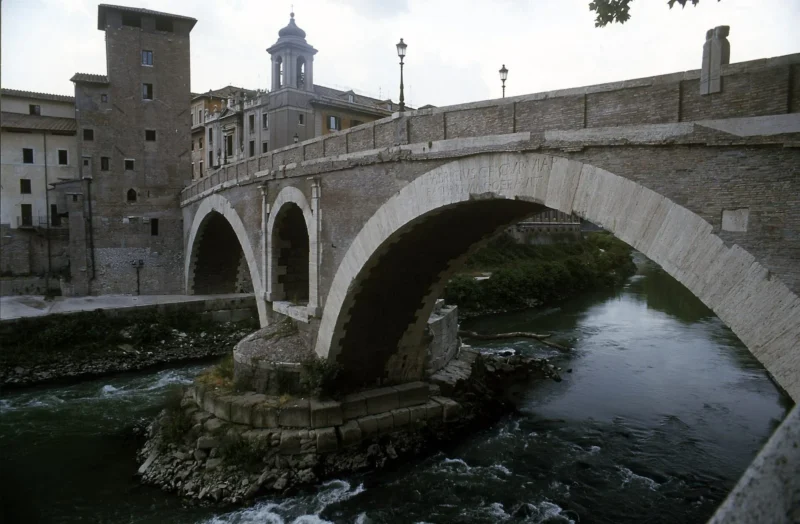
The Ponte Fabricio connects the island to the Ghetto bank. It was built in 62 BC by Lucius Fabricius, curator of the roads, as the inscriptions carved on its arches, which repeat his name, attest. It is the oldest bridge in Rome that still survives in its original form. Two large arches spanning about 24.5 meters rest on a central pier, and above the pier a smaller arch opens to relieve the pressure of the water during floods. It measures about 62 meters long and 6 meters wide. The core is tufa and the facing is travertine, with brick repairs from the 17th-century restorations. It was already restored in 23 BC after a flood, and later under Pope Eugenius IV and under Pope Innocent XI in 1679.
People call it the Ponte dei Quattro Capi because of the four-faced herms of Janus that serve as supports for the parapet: two small pillars with four faces each. A legend explains the name in a different and darker way, attributing it to four architects whom Pope Sixtus V supposedly had beheaded for quarreling during the work. But it is only a legend, disproved by a simple count of the carved faces. From the Middle Ages the bridge has also been called Pons Judaeorum, the Bridge of the Jews, because of its proximity to the Ghetto.
Ponte Cestio toward Trastevere
On the opposite side, the Ponte Cestio connects the island to Trastevere. The original construction dates to the 1st century BC and is attributed to a member of the gens Cestia. However, the bridge we see today is not the original intact one. Between 1888 and 1892, as part of the large works to regulate the Tiber and build the embankment walls, the Ponte Cestio was largely dismantled and rebuilt to fit the new widened riverbed, reusing part of the original materials. It is nonetheless the direct heir of a crossing that is 2,000 years old, and it remains the most beautiful way to get from the island to the alleys of Trastevere.
The Ponte Rotto Seen from Tiber Island
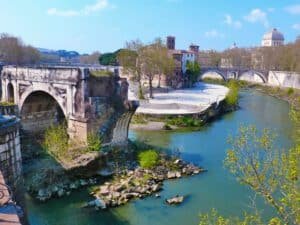
Looking downstream from the prow of the island or from the Ponte Palatino, you can see a solitary stone arch floating in the current that leads nowhere. This is the Ponte Rotto, meaning what remains of the Pons Aemilius, Rome's first stone bridge. Sources place its origin in the 2nd century BC, with masonry arches that replaced a wooden footbridge in 142 BC. The precise attribution wavers between the censors of 179 BC and even earlier dates. It was restored under Augustus in 12 BC and rebuilt several times in the modern era, under Pope Julius III in 1552 and under Pope Gregory XIII between 1573 and 1575.
Its history is a long battle lost against the river. Damaged by floods in 1230 and 1422, it collapsed several times until the great flood on Christmas Eve 1598, under Pope Clement VIII, knocked down three of its arches. From then on it was never rebuilt in full, and people named it Ponte Rotto. In the 19th century, between 1853 and 1887, suspended metal footbridges connected the stump to the left bank, but with the construction of the nearby Ponte Palatino, these too were removed. Today only one 16th-century arch remains, resting on ancient piers. It is a ruin in the middle of the water that has become one of the most photographed subjects on the Tiber.
The Torre dei Caetani and the Pulzella
At the end of the island toward the Ponte Fabricio stands the Torre dei Caetani, a sturdy medieval tower linked to the families who fortified the island in the Middle Ages, first the Pierleoni and then the Caetani, turning this strip of land into a small urban stronghold. Set into the masonry, facing the bridge, you can make out an enigmatic female face carved in marble, from the Roman era and datable to the 1st century AD. This is the so-called Pulzella.
A late medieval legend grew up around this face, set around 1350. It tells of a noble Roman girl locked in the tower for refusing an arranged marriage. She supposedly spent her life at the window waiting for her beloved, who had gone off to war, until she turned to stone while waiting. The marble, it must be said clearly, is a Roman reuse that has nothing to do with the story. But the tale of the Pulzella in love is now part of the island's narrative heritage, and it's worth looking up for her while you cross the Ponte Fabricio.
My Tip for Visiting Tiber Island
My advice is to visit Tiber Island twice, at two different times of day, because it is two different places. Early in the morning, when Romans cross the bridges on their way to work and the hospital is in full swing, the island is lively and workaday. This is the time to go into San Bartolomeo at a relaxed pace, look for the well in front of the altar, look up along the Romanesque bell tower, and lean over the prow to look for the relief of Aesculapius's serpent. Set aside an extra 10 minutes for the small church of San Giovanni Calibita, which almost everyone ignores.
In the late afternoon, instead, when the low light lights up the travertine of the bridges and the river turns to gold, it's time for photography and slow strolling: go down to the embankments, if the river level allows and they are accessible, and look at the island from below, from the water's level, which is the perspective that truly conveys the idea of the ship. Our firm opinion is that Tiber Island in summer, during the evenings of the Isola del Cinema, is one of the few nighttime experiences in Rome that are really worth the wait in line: sitting outdoors on the riverbank, with the screen lit up and the bridges illuminated behind you, is a privilege that few capitals can offer.
The Isola del Cinema: summer evenings on Tiber Island
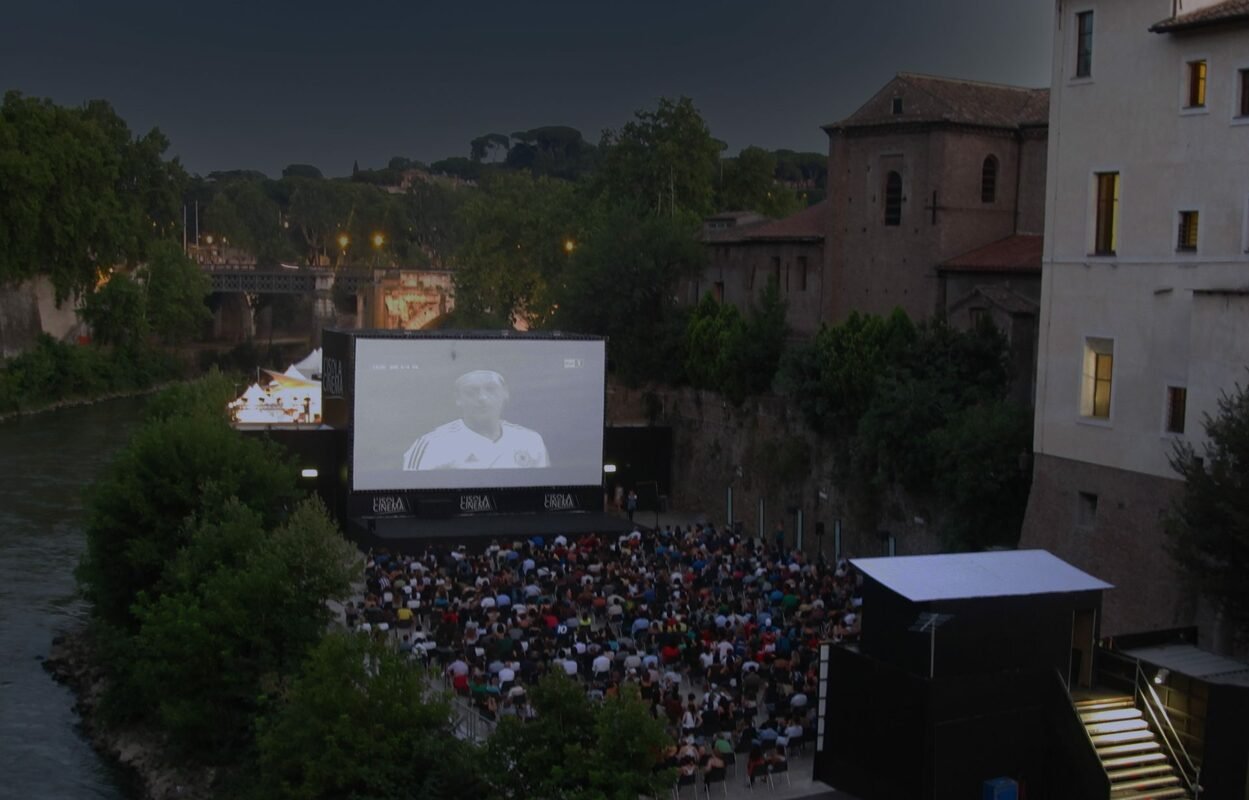
For over 20 years, during the summer months, Tiber Island has hosted the Isola del Cinema, one of the longest-running and most loved outdoor cinema events in Rome. On the embankments and in the spaces along the river, arenas with large screens are set up, and the programming alternates premieres, unreleased films, meetings with Italian and international directors and actors, retrospectives, and sections dedicated to art-house cinema, short films, and new Italian cinema, often grouped under the banner of a true film workshop.
The event generally runs through the long Roman summer, with evening screenings almost every night, and turns the island into a cinema village overlooking the water. The exact dates, the screening calendar, and the entry rules change from year to year and are published every season on the official Isola del Cinema website: it's worth checking it before you go, because some evenings are free admission and others are paid, and seats in the arenas are limited. It is the event that, more than any other, has brought Romans back to the island in the evening.
Tiber Island traditions
Few areas of Rome keep a calendar of folk traditions as dense as the island's, and it's worth knowing it because it explains the deep bond between Romans, the island, and the river.
The Sacconi Rossi procession on November 2
Since the 1600s, on the evening of November 2, the day commemorating the dead, the Confraternita dei Sacconi Rossi di Santa Maria dell'Orto goes down to the island for a ceremony in memory of those who drowned in the Tiber: at sunset the waters are blessed and wreaths of flowers are thrown into the river. The ceremony, interrupted for a period, was resumed in 1984 by the Confraternita dei Sacconi Scuri, and it continues to renew the ritual bond between the city and its river, which for centuries gave life and death.
August 24, watermelons and the swimming race
In the past, August 24 was a popular holiday on the island. There was a watermelon festival and, above all, a swimming race in which young people dove into the Tiber and swam from Ponte Fabricio to Ponte Rotto to grab the melons left floating in the current. It was a daring spectacle, because the Tiber's current is treacherous: in 1870, after a series of deadly accidents, the race was banned. What remains is the memory of a Roman summer when the river, today separated from the city by the embankment walls, was still a place for swimming and festivities.
Another well-known fact, yet rarely mentioned
Everyone knows the island is shaped like a ship, but few stop to consider how deliberately that shape was planned out and how little of it is left. The monumentalization in opus quadrata of the 1st century BC transformed the entire island into a huge ship-shaped simulacrum, with the prow downstream, the flanks clad in stone, and the central obelisk serving as the mainmast. It was an urban stage design of colossal scale, intended so that anyone arriving from the bridges would see before their eyes not a sandbank, but the sacred ship of Aesculapius moored in the river.
Of all this apparatus, today almost only the fragment of the prow survives, with its worn relief. The recurring floods of the Tiber, medieval and modern rebuilding, and the construction of the embankment walls between 1876 and 1926 have gradually erased the ancient cladding. Here is the little-cited fact: the image of the ship that everyone repeats rests, physically, on a single remnant of travertine only a few meters long. The rest is a reconstruction in the mind, fed by the sources and by the elongated shape of the island. Looking at that prow means looking at the last surviving plank of a stone vessel that 2,000 years ago was whole.
The right photo to take at Tiber Island
The photo that captures Tiber Island isn't taken from the island itself, but from the bridges that surround it. The best spot is Ponte Palatino, downstream: from there, in a single frame, you can line up the lone arch of the Ponte Rotto in the foreground, the travertine prow of the island with the bell tower of San Bartolomeo rising above it, and the arches of Ponte Cestio in the background. It's the image that condenses 2,000 years of Tiber history into one glance, and it's the reason this view is among the most photographed in Rome.
The right time is late afternoon, when the low sun from the west lights up the prow and turns the travertine orange, or a summer evening, with the arenas of the Isola del Cinema lit up and the lights reflecting on the water. A tip from a professional: get lower. If the riverbanks along the river are accessible, photograph from water level, looking at the side of the island against the light. It conveys the idea of the vessel much better than the view from above the embankment walls. Avoid midday in summer, though, when flat light flattens the volumes and erases the relief of the stone.
Some important events that took place here in history
Tiber Island has been the setting for episodes that run through the whole history of Rome. The first, the founding one, is the arrival of the cult of Asclepius in 292 BC and the dedication of the temple in 289 BC: an event that made the island the center of ancient medicine and fixed its vocation forever. For centuries, around that temple, the practice of incubation for the sick took place, and the sources even record the decision of Emperor Claudius to grant freedom to enslaved sick people whom their masters abandoned on the island so they wouldn't have to care for them.
In the Middle Ages the island became a stronghold: the Pierleoni and Caetani families built towers and fortifications there, and on December 23, 1598, the great flood that brought down the Ponte Rotto permanently changed the river's landscape. In modern times the island was in the spotlight again during the French siege of 1849, when its hospitals received the wounded from the defense of the Roman Republic, and traces of those days remain in the cannonball kept in San Bartolomeo.
In the 20th century, finally, the island was the setting for two opposite and very high-stakes episodes. During the Nazi occupation of Rome, in 1943, doctors at the Fatebenefratelli invented a nonexistent illness, the so-called "K disease," to admit and hide Jews and antifascists who were being hunted, keeping them away from deportation: a clinical fiction that saved lives. And in 1999 the basilica hosted the commission wanted by John Paul II to remember the Christian martyrs of the 20th century, which culminated in 2002 with the icon being placed on the altar. Care and witness, once again, in the same place.
Who has passed through Tiber Island
Over 25 centuries, people from every era have passed through this strip of land. The first is a snake: the one that, according to tradition, brought the cult of Asclepius to Rome from Epidaurus in 292 BC, choosing the island as its home. Around that myth revolve the Roman ambassadors who sailed to Greece and the priests who officiated there for centuries.
Among the popes, the island bears the mark of many: Otto III, the emperor who wanted the basilica at the end of the 10th century, Paschal II, who built the bell tower there in 1113, Alexander III, who re-established its title around 1180, Pius IX, who placed the central aedicule there in 1869, and John Paul II, who gathered the commission of the New Martyrs there in 1999. Among the artists, there were the marble workers responsible for the bas-relief of the well, the circle of Nicola d'Angelo and Pietro Vassalletto, and in the 19th century the engraver Bartolomeo Pinelli, who had his famous dispute with the island over the title. Among the doctors, popular memory preserves Fra Giambattista Orsenigo, the friar dentist active between 1867 and 1903, to whom tradition also attributes the care of Pope Leo XIII. And every summer, for the Isola del Cinema, Italian and international directors and actors have passed through here, presenting their films while seated on the riverbed of the Tiber.
What to see around Tiber Island within 10 minutes on foot
The best thing about Tiber Island is its location: within a 10-minute walk, one of the highest concentrations of history in all of Rome is packed onto both banks of the river.
On the Ghetto side, just past the Ponte Fabricio, you'll find the Portico of Octavia and the Sinagoga di Roma con il Tempio Maggiore, the heart of Jewish Rome. A little farther on you reach Campo de' Fiori with its market and, continuing on, the baroque stage set of Piazza Navona. Toward the Foro Boario, along the Lungotevere, you come across the Mouth of Truth and the church that houses it, Santa Maria in Cosmedin, one of the most beautiful Romanesque bell towers in the city.
Once you cross the Ponte Cestio, you're right in Trastevere. Within a few minutes you can reach the Basilica di Santa Maria in Trastevere with its gold mosaics, the Basilica di Santa Cecilia, and the Museo di Roma in Trastevere. Going up, the Janiculum Hill offers the city's most famous view. A little upstream, toward the center, you can continue on to the Pantheon. This is an itinerary that branches out from the island in every direction without ever needing transport.
Tiber Island, the River and the Floods
You can't understand Tiber Island without understanding its relationship with the Tiber, a relationship of both dependence and conflict. The island exists because the river, meeting an obstacle, split into two arms and deposited silt around the rocky outcrop. But that same river, for centuries, periodically submerged it. Tiber floods have been a constant throughout this place's entire history: they brought down the Ponte Rotto, inspired the miracle of the lamp that kept burning underwater, and made continuous repairs to the bridges and walls necessary.
The island's present face is the result of a radical undertaking, the construction of the Tiber embankments between 1876 and 1926, decided on after the disastrous flood of 1870 to protect the new capital of Italy from the floods. Those great travertine embankments made the city safe, but they also cut Romans off from their river, which had once been lived at water level, with landings, mills and baths. Tiber Island, with its quays still facing the current, is one of the few places where you can go down and touch the water and recover that lost connection. That's why walking its banks, when they're open, is a different experience from any other walk along the Lungotevere. Here the river isn't a distant backdrop behind a wall, but a presence within arm's reach, with all its force and its history.
When to Visit Tiber Island
Tiber Island is open all year, by day and by evening, and there's no ticket, so the best time depends on what you're looking for. Spring and early autumn are the ideal seasons for a stroll and for going into the churches at a relaxed pace. Summer is the season of the Isola del Cinema and evenings by the river, but it's also the busiest period: on screening nights the open-air areas fill up, so it's best to arrive early. Winter gives you the quietest island and, after the rains, the sight of the Tiber swollen as it laps against the prow.
A practical warning: after the autumn and winter floods, the quays along the river may be closed or covered in mud, and on those days you can only enjoy the island from above, from the bridges. If your main interest is the quays and photography from water level, check the river's conditions before planning your visit.
Tiber Island with Children
The island is an excellent destination for a walk with children: it's pedestrian-only, with no traffic, and the story of the stone ship with the serpent that chose on its own where to stop is one kids enjoy hearing. Looking together for the serpent relief on the prow turns into a little treasure hunt, and the stump of the Ponte Rotto in the middle of the river always captures the imagination. The distances are short, and Trastevere's gelato shops are just a few steps away, past the Ponte Cestio. The only caution concerns the riverside quays, which lack tall railings: with small children, it's best to stay on the upper part of the island and on the bridges.
Accessibility on Tiber Island
The upper part of the island, with its bridges, central open space and churches, can be reached on level ground by crossing the Ponte Fabricio or the Ponte Cestio, both pedestrian-only. The riverside quays, on the other hand, are reached by stairs and ramps that aren't always easy to use, and they can be challenging for people with mobility difficulties or for anyone pushing a stroller. For entry to the churches and for access conditions at summer events, it's best to check ahead with the parish or the organizers of the event, because the historic layout of the place includes steps and changes in level.
The Serpent of Epidaurus: What the Ancient Sources Say
Tiber Island owes its ancient fame to a serpent that, according to the Roman account, chose on its own where a temple should be built for it. The story is well known: at the beginning of the third century BC a plague struck Rome, the Sibylline Books advised bringing Aesculapius, the Greek god of medicine, into the city, and a delegation set out for Epidaurus, in the Peloponnese, where the god had his most famous sanctuary. The envoys returned with a sacred serpent, which in the Greek sanctuary was the visible form of the god. Having come up the Tiber, the animal is said to have slipped into the water and reached the island: there, and nowhere else, the temple was built. It should be stated clearly right away: this is a story handed down by ancient sources, not a verifiable fact. What the sources record is the story Romans told themselves about the origin of the cult, and it is worth separating it carefully from what is documented.
What Livy, Ovid, and Valerius Maximus Say
The embassy to Epidaurus is not a late invention: it appears in different authors who are far apart from one another. Livy mentions it in the 10th book of his history, linking it to an epidemic and to the response of the Sibylline Books, and the ancient summary of the lost books (the so-called Periochae) records the serpent's arrival and the founding of the temple on the island. Valerius Maximus, in the first book of his Memorable Deeds and Sayings, recounts the same episode. The fullest and most literary version is Ovid's, in the 15th book of the Metamorphoses, where the serpent takes to the sea with the envoys, is welcomed all along the coast, and finally chooses the island in the middle of the river.
On dates, modern historians do not fully agree: the embassy is usually placed between 293 and 291 BC, and the dedication of the temple is traditionally set at 291 BC. On one point, however, the sources are unanimous, and that point is the one that matters: in Rome there was a temple of Aesculapius on the island, and the Romans explained it with the story of the serpent. Put simply, the legend did not arise by chance: it arose to answer a practical question, namely why that god stood right there, on a rock in the middle of the river, outside the pomerium, far from the temples of the center. The answer "the god himself decided it" closed the question better than any urban-planning argument could.
The Travertine Prow: What Is Still Visible
Here the story gives way to stone. The island's ship-shaped cladding is real and partly still visible: on the tip facing downstream, from the side of the Ponte Rotto, a stretch of travertine facing survives, worked like the side and prow of a boat, with a relief showing the staff wrapped by the serpent, the emblem of Aesculapius, next to a male head. No imagination is needed to recognize it: the curve of the hull and the relief can be read with the naked eye from the riverbank or the bridge, though vegetation and the river level sometimes partly hide them.
Scholars debate the dating of the cladding, and they usually place it in the late Republican era or in the first centuries of the empire, so well after the supposed arrival of the serpent. This is the point to keep firmly in mind: the ship shape does not prove the story, it stages it. It is a Roman monumentalization built to be consistent with the legend, a way of giving travertine form to a story everyone knew, just like an inscription or a statue. The idea that an obelisk once rose in the center of the island to serve as a mainmast has also circulated for centuries, but it remains a debated reconstruction, not a certain fact.
2,300 Years of Care on the Same Rock
If there is one truly remarkable thing about this story, it is not the serpent: it is the continuity. On the same piece of ground where Romans once brought the sick to the sanctuary of Aesculapius, a hospital operates today. The ancient sanctuary practiced incubation, meaning the sick person slept within the sacred area waiting for a dream from the god, and left votive offerings in thanks. From the Tiber in this area, anatomical ex-votos of the kind found in healing sanctuaries have been recovered, although the precise attribution of each piece to the island's sanctuary is not always certain.
Then the torch passes hands. In the Middle Ages the island became Christian, and the basilica of San Bartolomeo was established above the site of the ancient cult, founded around the year 1000. In the late 16th century the Fatebenefratelli arrived, the hospital order of Saint John of God, who took charge of the church of San Giovanni Calibita and began a care activity that has never been interrupted. From there came the hospital that still bears that name. Lining up the dates, from the temple of Aesculapius to today's wards, we arrive at about 2,300 years of care in the same place: not a legend, but a documented chain of different institutions that handed down the same function. There is no other address in all of Rome that can stand up to a comparison like this.
The Grain of the Tarquins: A Legend That Explains the Island
There is also a second story, older in the internal chronology and just as legendary, that explains how the island formed. Livy reports it in the second book: after the Tarquins were expelled, the Romans decided not to touch the crop that had grown in the king's fields in the Campus Martius, because it was consecrated, and threw it into the river. The ears of grain and the reeds supposedly caught on the shallow bottom, trapping silt and making the island grow. Livy himself distances himself from it, presenting it as a tradition that was circulating, not as a fact. Scholars classify it as an aetiological legend, that is, a story built after the fact to give a cause for something that already existed: the island is a natural sandbank of river origin, much older than the Republic.
The two stories, the grain and the serpent, do the same thing at two different times: they explain why the island exists and why it is sacred. Looking at them closely shows how Roman memory worked, since it rarely left a place without a narrative to justify it.
How to read it on site
Quick questions about Tiber Island
How much does it cost to visit Tiber Island?
Nothing: Tiber Island is an outdoor public space and you can cross it for free at any hour. Entry to the Basilica di San Bartolomeo is also free. Only a few evenings of the Isola del Cinema in summer are paid.
Do I need a reservation to visit Tiber Island?
No, no reservation is needed to visit the island and its churches. A reservation may be needed only for certain events or screenings of the Isola del Cinema, according to the rules the organizers publish every summer.
How long does it take to visit Tiber Island?
For a complete visit, including the Basilica di San Bartolomeo, the prow with the relief of Aesculapius, the two bridges and a look at the Ponte Rotto, allow from 45 minutes to an hour and a half. If you include it in a walk between the Ghetto and Trastevere, the island becomes the central stop of a half-day outing.
How do I get to Tiber Island?
On foot from the Ghetto across the Ponte Fabricio, or from Trastevere across the Ponte Cestio. By public transport, with the buses along the Lungotevere or with tram 8 to Trastevere. By car it is strongly discouraged because of traffic restrictions and the lack of parking.
Is Tiber Island wheelchair accessible?
The upper part of the island, with the churches and the central open area, can be reached on level ground from the two pedestrian bridges. The riverside embankments, on the other hand, are reached by stairs and are generally not accessible. For entry to the churches, it's best to ask the parish to confirm.
Can I take photos on Tiber Island?
Outdoors you can take photos freely, and the view from the Ponte Palatino with the Ponte Rotto and the prow of the island is one of the most beautiful in Rome. Inside the churches the rules of respect for places of worship apply, during services, avoid taking photos.
Why does Tiber Island have the shape of a ship?
Because in the 1st century BC it was deliberately clad in travertine shaped like a vessel, with the prow facing downstream and a central obelisk as the mainmast, to recall the ship that, according to legend, brought the serpent of Aesculapius to Rome. Today the only surviving part of the ancient decoration is the fragment of the prow.
What is there to see on Tiber Island?
The Basilica di San Bartolomeo all'Isola with its miraculous well, the church of San Giovanni Calibita, the travertine prow with the relief of the serpent of Aesculapius, the Ponte Fabricio and Ponte Cestio, the view of the Ponte Rotto, and the Torre dei Caetani with the Pulzella. In summer, the Isola del Cinema.
What is the Isola del Cinema?
It is the summer outdoor film festival that for over 20 years has set up arenas with large screens along the river, on Tiber Island, with previews, unreleased films and meetings with directors and actors. Dates, program and tickets are published every year on the festival's official website.
What is the oldest bridge on Tiber Island?
The Ponte Fabricio, built in 62 BC, which connects the island to the Ghetto: it is the oldest bridge in Rome that has survived in its original form. It is also called the Ponte dei Quattro Capi, for the herms of Janus placed on the balustrade.
What is the Ponte Rotto near Tiber Island?
It is the stump of the Pons Aemilius, Rome's first stone bridge, dating from the 2nd century BC. It collapsed several times because of floods and was largely destroyed by the flood of 1598, today a single isolated arch remains in the current, downstream of the island.
Is there still a hospital on Tiber Island?
Yes, there are two that are still operating: the Ospedale Fatebenefratelli, founded in 1583, and the Ospedale Israelitico. The island's medical vocation has never been interrupted since the time of the temple of Aesculapius, and it is one of the most extraordinary features of the place.
Can you enter the Basilica di San Bartolomeo all'Isola?
Yes, entry is free during opening hours, generally in the morning and late afternoon with a break in the middle of the day. The exact hours change with the seasons and should be checked on the parish website. During services, visit discreetly.
Is Tiber Island suitable for children?
Very: it's pedestrian, the distances are short, and the story of the stone ship and the serpent captures the attention of the little ones. The only caution concerns the quays along the river, which have no high parapets, so with small children it's best not to go down there.
What is the best photo to take of Tiber Island?
From Ponte Palatino, looking downstream, framing in a row the Ponte Rotto, the prow of the island with the bell tower of San Bartolomeo, and the Ponte Cestio. The ideal time is late afternoon, with low light on the travertine, or summer evening with the lit-up arenas.
Why is Tiber Island linked to medicine?
Because in 292 BC, after a plague, the cult of Aesculapius, the Greek god of healing, was introduced there, and his temple rose on the island with a therapeutic sanctuary. Since then the island has been associated with care, so much so that two hospitals still operate there today.
Who was the Pulzella of Tiber Island?
The Pulzella is a female face in marble, from the Roman era, set into the Torre dei Caetani near the Ponte Fabricio. A late medieval legend links it to a young woman locked in the tower waiting for her beloved. The marble, in fact, is an ancient reuse that has nothing to do with the story.
When is the best time to visit Tiber Island?
Spring and early autumn are ideal for a walk and for the churches. Summer is the season of the Isola del Cinema, but it's also the most crowded. After the autumn floods the quays may be closed, in which case you can enjoy the island from the bridges.
What is near Tiber Island?
A few minutes on foot: the Portico d'Ottavia and the Synagogue in the Ghetto, the Bocca della Verità in the Foro Boario, and, beyond the Ponte Cestio, all of Trastevere with Santa Maria in Trastevere, Santa Cecilia and the climb up to the Janiculum.
If I had to sum up Tiber Island in one sentence, I'd say it's the place in Rome where time has never changed jobs. Plague was treated here 25 centuries ago, people are born here today at the Fatebenefratelli, and in between, emperors, popes, doctors and film directors have all passed through. Go on foot, without rushing, look for the serpent on the prow, and lean over to watch the Ponte Rotto floating in the current. You'll understand why Romans are as attached to this rock in the middle of the river as to few other things in their city.
Article written by the editorial team of TourLeaderPro, contact them for Tours and Private/Corporate/V.I.P. Experiences.
Planning a trip to Rome? English-language guides for visiting the city are available at ItalyPlanner.com.
Contact Information
Nearby
 Isola del Cinema100 m
- Ponte Cestio100 m
- Ponte Fabricio100 m
- Basilica of San Bartolomeo all’Isola100 m
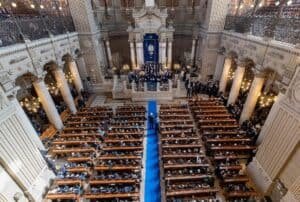
- Rome Synagogue (Great Synagogue)100 m
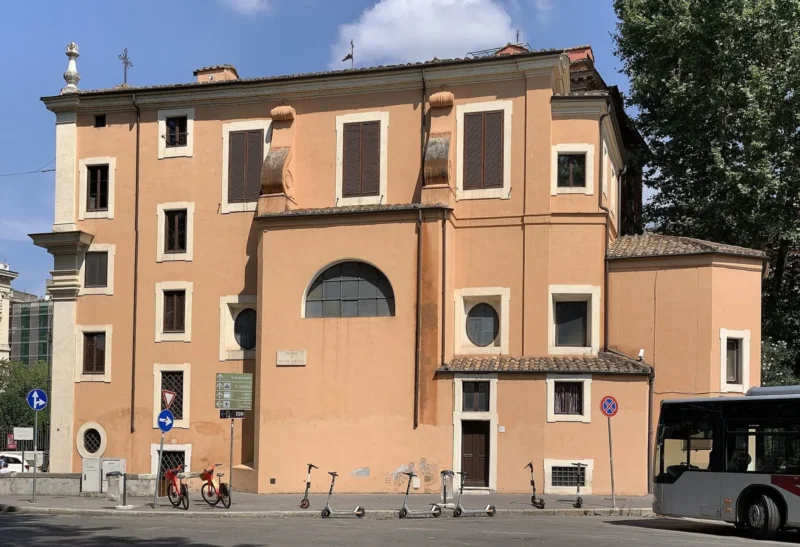
- San Gregorio della Divina Pietà100 m
Upcoming events nearby
- La musica avvolge il Portico d’Ottavia: Monumenti Sonori at Portico d’Ottavia, until October 25, 2029200 m
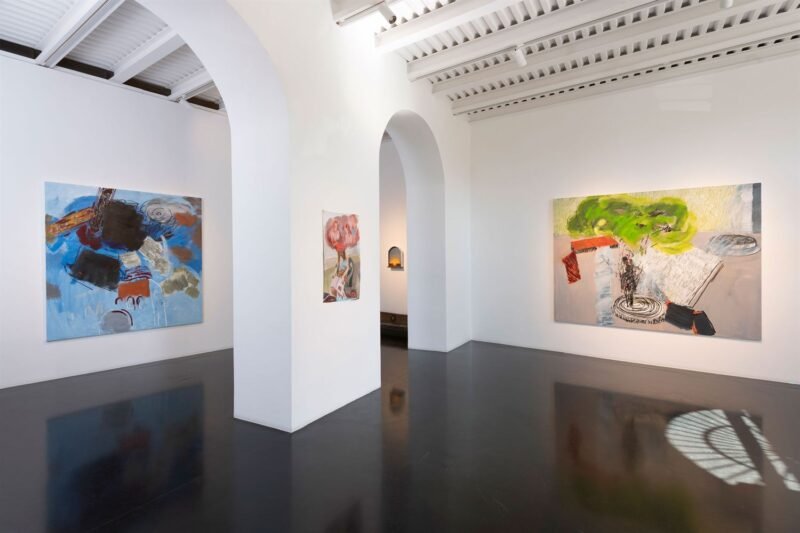
- Antonio Marras, Vorrei riempire la tua stanza di rose at Galleria Valentina Bonomo, from October 20, 2026 to February 10, 2027200 m
- Xi Niu: In Search of New Routes at the Rhinoceros Gallery, September 11, 2026 to January 6, 2027500 m
- White Rabbit Red Rabbit at Teatro della Cometa, December 1 to 6, 2026500 m