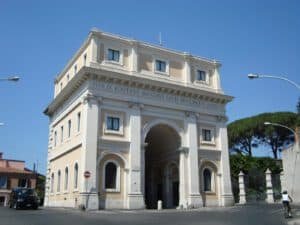
Bosco Parrasio, Accademia dell’Arcadia
In short. Bosco Parrasio is the historic home of Accademia dell'Arcadia, on the eastern flank of the Janiculum, inside the Trastevere district.

Bosco Parrasio is the historic home of Accademia dell'Arcadia, on the eastern flank of the Janiculum, inside the Trastevere district. The entrance is at Salita del Bosco Parrasio 8, the uphill lane that branches off Via Garibaldi just before you reach Porta San Pancrazio, between the garden wall of Palazzo Riario Corsini and the convent attached to San Pietro in Montorio. The garden is not a museum and has no ticket office. You enter only with the guided visits organized by the Academy, which are free, by reservation through the calendar published by Accademia dell'Arcadia, in groups of at most 15 people, on Fridays from 11:00 to 12:00, closed in July and August, with a release form to sign at the entrance. The route covers only the garden, not the inhabited building, and there are no restrooms. At the moment the visits appear to be suspended. The calendar on Accademia dell'Arcadia's official website is the only source to check before setting out, because the reopening depends on a property that is both academic and private. By public transport, bus line 115 runs along Via Garibaldi and connects the area with Viale di Trastevere and the Lungotevere. From Piazza Sonnino, the natural terminus for those arriving by tram along Viale di Trastevere, it's a walk uphill of a good 20 minutes, all of it on a slope. If you come from above, that is from the panoramic promenade, you instead walk down from Porta San Pancrazio and find the gate on your right.
A practical warning that is worth more than any description: Bosco Parrasio can't be seen from the street. Anyone walking along Via Garibaldi sees a doorway and a wall, and keeps going. It is one of the very few places in Rome where an entire 18th-century open-air theater, with its tiers, its grotto and its aedicule, stays invisible a couple of steps from a street used every day by thousands of people heading to the Janiculum.

Where Bosco Parrasio is and how to get there
The address and entrance of Bosco Parrasio
The lane that carries the name of the place opens halfway along Via Garibaldi, the road that climbs from Trastevere, hairpin after hairpin, toward the Fontanone dell'Acqua Paola and Porta San Pancrazio. The street number the City of Rome gives for the complex is Salita del Bosco Parrasio 8. In some sources the same compound appears grouped under the numbering of Via di Porta San Pancrazio, because the property faces two fronts and has had different entrances over time. Those who book receive the meeting point from the Academy. Stick to that and arrive with 10 minutes to spare, because the group is small and the schedule is exactly one hour.
The street front is deceptive. Behind the doorway the ground rises steeply and within a few meters you go from the noise of traffic to an almost rural silence, broken only by the bells of San Pietro in Montorio and by the seagulls. It is exactly the effect the Arcadians were after in 1725: a fake countryside 10 minutes from the center, where you could pretend to be shepherds without giving up walking back toward Ponte Sisto for dinner.
How to get to Bosco Parrasio by public transport
Bus 115 is the line that really serves this stretch. It's a small circular line, suited to the curves of Via Garibaldi, and along its route it touches Via Garibaldi, Via Goffredo Mameli, Via Emilio Morosini, Via Dandolo, Viale Glorioso and Viale di Trastevere. The vehicles are medium-sized, the frequency is around 10 to 20 minutes and the service covers the daytime hours. For a visit at 11:00 there are no schedule problems, but no room for delay either if you take the last useful bus.
The second way is for those who arrive in Trastevere along Viale di Trastevere and then climb. From the crossroads of Piazza Sonnino you take Via della Lungaretta or follow the lower stretch of Via Garibaldi. It's about 25 minutes of continuous uphill, with the final stretch in hairpins. It's not a walk to do in flip-flops in August, but in autumn it is one of the most beautiful routes in Rome, because at every hairpin the city drops below the boundary wall.
One tip: if you have trouble walking, do the route in reverse. Take the bus up to the Porta San Pancrazio area and walk down toward the gate, avoiding the ramp altogether. The garden itself, though, remains a succession of stairs and terraces. It is not wheelchair accessible, and you should factor that in before booking.
Booking a visit to Bosco Parrasio
Booking goes through the calendar of Accademia dell'Arcadia, which opens the available dates and asks you to fill in a release form. Entry is free. The maximum of 15 people per turn is not a formality. The terraces are narrow and the group moves in single file. The visits stop in July and August and, in general, the calendar can stay closed for long periods. There is no alternative ticket office, no resale channel, no paid entrance that jumps the list. Anyone promising immediate access has no right to do so.
Frequently asked questions about Bosco Parrasio , Accademia dell'Arcadia
Where exactly is Bosco Parrasio?
Bosco Parrasio is on the eastern flank of the Janiculum, in the Trastevere district of Rome, with its entrance at Salita del Bosco Parrasio 8, a lane that branches off Via Garibaldi just before Porta San Pancrazio, between the garden of Palazzo Riario Corsini and the convent of San Pietro in Montorio.
How much does it cost to visit Bosco Parrasio?
Entry to Bosco Parrasio is free. There is no ticket office and no sales channel for tickets, because access is by reservation through the calendar of Accademia dell'Arcadia, the institution that still runs the garden today.
When can you visit Bosco Parrasio?
The opening window of Bosco Parrasio is narrow by definition: a single turn a week, on Fridays from 11:00 to 12:00, when the Academy's calendar is open, with closure in July and August. The best season for the visit is late spring, between the second half of April and early May.
What was Accademia dell'Arcadia based at Bosco Parrasio?
Accademia dell'Arcadia was a literary institution founded in Rome in 1690 to bring Italian poetry back to simpler and purer forms, taking inspiration from the names, customs and calendar of the Greek shepherds. It is still active, transformed in 1925 into an institute of historical and literary studies with the subtitle Accademia Letteraria Italiana, and today it has its operating seat at Biblioteca Angelica.
Is Bosco Parrasio suitable for a visit with children?
Bosco Parrasio works with children on two conditions: age, because under six the climb, the uneven steps and the lack of continuous railings make the visit tiring, and the story, because if you explain beforehand that here adults dressed up as Greek shepherds with invented names, the route becomes more engaging.
Who designed Bosco Parrasio?
Bosco Parrasio was designed by the Roman architect Antonio Canevari, a member of Accademia dell'Arcadia who waived his fee because he worked for the institution as an Arcadian, with the collaboration of the young Nicola Salvi, future author of the Trevi Fountain. The work was financed by the 4,000 scudi donated in 1724 by John V of Portugal.
What is there to see near Bosco Parrasio?
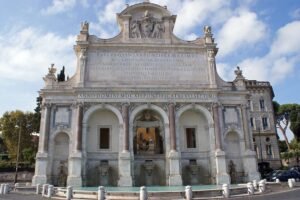
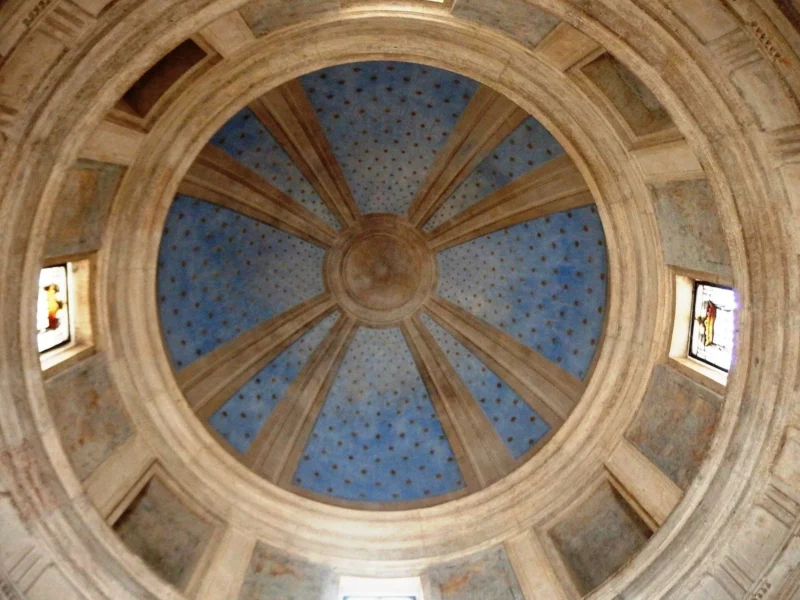
Less than five minutes' walk from Bosco Parrasio, going up, you find San Pietro in Montorio with Bramante's Tempietto in the convent courtyard, the exact place where Accademia dell'Arcadia was founded in 1690. A little higher up you reach the Fontanone dell'Acqua Paola, with a panoramic terrace over half the city.
For organized groups and for those who want to fit Bosco Parrasio into a broader itinerary on the Janiculum, it's best to rely on licensed professionals, such as the network of guides of TourLeaderPro in Rome, who know the Academy's real response times and know how to build a credible plan B for the same morning.
What Accademia dell'Arcadia was
The void left by Christina of Sweden
To understand Bosco Parrasio you have to start from a death. Christina of Sweden, the queen who had abdicated, converted and settled in Rome at Palazzo Riario alla Lungara, died in April 1689, leaving orphaned the circle of writers, musicians and prelates that gathered around her. That informal court had been for years the freest intellectual center of the city. With the queen gone, her regulars found themselves without a home and without a patroness.
The answer comes the following year. On October 5, 1690, in the convent attached to the church of San Pietro in Montorio, 14 men of letters founded Accademia dell'Arcadia. The promoters were Gian Vincenzo Gravina and Giovanni Mario Crescimbeni, joined by Paolo Coardi. With them were the Umbrians Giuseppe Paolucci of Spello, Vincenzo Leonio of Spoleto and Paolo Antonio Viti of Orvieto, the Romans Silvio Stampiglia and Jacopo Vicinelli, the Genoese Pompeo Figari and Paolo Antonio del Nero, the Tuscans Melchiorre Maggio of Florence and Agostino Maria Taia of Siena, Giambattista Felice Zappi of Imola and Cardinal Carlo Tommaso Maillard de Tournon, from Nice.
It's no small detail that the place of the founding was San Pietro in Montorio, that is, the spot on the Janiculum where Bramante's Tempietto stands. 35 years later the Academy would buy its own land a few hundred meters from there. The circle closes on the same hill.
A movement, not a salon
Arcadia was not a school of thought and not even a club of friends who read each other their verses. It was a literary movement that spread across all of Italy in the 1700s, with a precise polemic: a reaction against what its members considered the bad taste of the Baroque. Bloated metaphors, twisted conceits, erudition displayed for the pleasure of displaying it. Against all this Arcadia proposed pastoral simplicity, clarity, a return to the classics.
The name came about almost by chance, during a gathering at the Prati di Castello, which at the end of the 1600s were truly a rural landscape of reeds and pastures below Castel Sant'Angelo. The tradition, reported in the Academy's 19th-century chronicles, tells the scene like this: while walking outside the city and reciting verses in turn in the shade of the trees and to the murmur of the streams, one of those present exclaimed that it seemed like bringing the ancient Arcadia back to life. Agostino Maria Taia fixed the name. The critic Giuseppe Baretti, who was a fierce enemy of Arcadia, ironically called those words magic, because from them came the idea of founding an academy.
Shepherds, the syrinx of Pan and Arcadian names
The members are called Shepherds. The chosen patron is the Baby Jesus, adored first by the shepherds of Bethlehem, an operation that reconciles Greek myth with Roman devotion and shields the Academy from suspicions of paganism. The emblem is the syrinx of the god Pan, the reed pipe, wreathed with laurel and pine branches. Every member must take a pseudonym inspired by Greek pastoral tradition, and is registered under it in the catalogs.
It's a collective disguise that makes us smile today and that back then had a precise social function: inside Arcadia, titles were left at the door. A cardinal and a schoolmaster sat on the same wooden steps with two invented Greek names. In a Rome of courts, precedence and liveries, it was a small revolution practiced in the form of a game.
35 years without a home: Arcadia's seats before Bosco Parrasio
The most common mistake is to imagine Arcadia born already inside Bosco Parrasio. Between the founding and the final seat, 35 years pass of precarious hospitality, evictions and improvised theaters. It is the least told part of the story, and it is the one that explains why, when the money finally arrived, the Arcadians wanted a garden all their own and designed it with such care.
The gardens of the Duke of Paganica
The first gatherings are held in the gardens of the Duke of Paganica, near San Pietro in Vincoli. There is no theater. The Shepherds sit on the ground or on stones and recite their verses. It is the founding image of Arcadia, the one the members would love to recall when they had marble tiers.
Palazzo Riario, where it all began
From May 27, 1691 the meetings move to the garden of Palazzo Riario alla Lungara, the former residence of Christina of Sweden. Today that same building houses Palazzo Corsini with the National Gallery of Ancient Art, and its historic garden borders the Botanical Garden. There the Arcadians have at their disposal a sort of round ditch that at least has the look of a theater. Going back to the house of the dead queen is a gesture of declared continuity.
The Orti Palatini and the theater of foliage
In 1693 they move again, guests of the Duke of Parma, to the Orti Palatini, that is, on the Palatine Hill. The duke grants permission to build a rustic theater of circular shape, with two tiers of seats made of wood and earth and covered with laurel fronds. It is the first attempt to give Arcadia an architecture of its own, however ephemeral: a theater made of branches that lasts one season.
Duke Salviati's excavated theater
In 1699 comes the hospitality of Duke Antonio Salviati, who has an ancient-style theater dug into a small hill in his own garden. Here Arcadia finds the most dignified setting of its early years. It doesn't last long: when the duke dies, in January 1704, his heirs evict the academicians without much ceremony.
The Ruspoli years, between the Esquiline and the Aventine
In July 1705, to celebrate the Arcadian Olympic Games, the Shepherds have to ask Prince Vincenzo Giustiniani for hospitality. Then, from September 11, 1707, Francesco Maria Ruspoli enters the scene, prince of Cerveteri, one of the great musical patrons of Rome in the early 1700s. Ruspoli makes a park on the Esquiline available while an amphitheater is made ready in another villa of his, on the Aventine. That amphitheater becomes the permanent seat of the gatherings until 1725.
18 years on the Aventine are the longest season of the nomadic phase. When the Portuguese donation finally makes a purchase possible, Arcadia leaves one hill for another hill, and passes from the left bank to the right bank of the Tiber.
Bosco Parrasio and the donation of John V of Portugal
4,000 scudi from Lisbon
The money arrives in 1724 from John V of Portugal, a sovereign who was himself enrolled in Arcadia and a patron on a European scale, who donates 4,000 scudi to the institution. It is the sum that changes the Academy's history: it allows it to buy land and build on it. The Portuguese king, who in those years was also financing Roman works of far greater scale, thus enters the sentimental place names of the Janiculum.
The name chosen for the new seat is Bosco Parrasio, from Parrhasia, a mountainous region of Greek Arcadia tied to the cult of Pan and of Zeus Lykaios. It is not a scholarly affectation. It is the consistency of an academy that had already chosen the syrinx of Pan as its emblem and Greek names for its members. The seat had to be named after the landscape the Shepherds pretended to inhabit.
Orto dei Livi
The land purchased is the old Orto dei Livi, a steeply sloping plot on the flank of the Janiculum, wedged between the garden of Palazzo Riario and the property of the religious of San Pietro in Montorio. An apparently inconvenient choice: a steep, exposed slope, hard to cultivate and very hard to build on. In reality it is the perfect choice, because that slope makes it possible to create, in a few dozen square meters, a garden on stacked levels, exactly the kind of theatrical scenography that was needed.

Antonio Canevari and the design of Bosco Parrasio
The design is entrusted to Antonio Canevari, a Roman architect who was also a member of the Academy. The fact worth remembering is that Canevari accepted no payment: he worked for Arcadia as an Arcadian. The young Nicola Salvi collaborated with him, and a few years later he would sign the design of the Trevi Fountain. Bosco Parrasio is therefore, among other things, a training ground for one of the architects who would give Late Baroque Rome its face.
The three terraces of Bosco Parrasio
Canevari organizes the land into three stacked levels, connected by ramps of steps alternately concave and convex. It is the solution that gives the complex its character: a sinuous movement that accompanies the climb and that cites, on a smaller scale and in a rustic key, the staircase of Trinità dei Monti, opened in those very years. Whoever climbs doesn't take a straight stair, but a succession of curves that lengthens the route and multiplies the viewpoints.
The play of concave and convex is the architectural signature of the place. It's worth stopping halfway up a ramp and looking back. The geometry of the design can be read entirely from there, much better than from above.
The oval theater
On the first terrace, the lowest, Canevari builds an oval theater with three tiers of seats and a marble lectern in the center. It is the functional heart of Bosco Parrasio. Here the Shepherds sat, and here one at a time they went to the lectern to recite. The oval shape is not a decorative whim, it is applied acoustics: it gathers the voice and returns it to the steps without any need for devices.
The marble lectern is the most moving object in the complex. There is no stage, no curtain, no wings. There is a stone surface on which to rest a sheet of paper. Everything else is the garden.
The grotto and the commemorative aedicule
On the second level there is a false Arcadian grotto, shaded by a pine of considerable size, and a fountain. The artificial grotto is a classic theme of Italian gardens, but here it has a direct literary meaning: it is the pastoral cave, the refuge of myth, the symbolic entrance into the landscape of Arcadia. On the third and last level Canevari places a commemorative aedicule dedicated to the donation of John V of Portugal. On the lower terrace, moreover, you can read the inscription of 1726 recalling the sovereign's gift, and over the entrance appears the wording Accademia degli Arcadi.
The sequence is an initiatory path disguised as a stroll: you enter from below, you recite in the theater, you climb to the grotto, you arrive at the memorial of the benefactor. The visitor makes an ascent that is at once physical, poetic and ceremonial.
The Serbatoio
Next to the garden stands the Serbatoio, the building that housed the Academy's archive and secretariat: the place where the catalogs of the Shepherds, the records of the gatherings, and the rhymes and prose of the members were kept. The form we see today, with its exedra facade, is the result of the work of Giovanni Azzurri, who renovated the building in 1838. The name deserves an explanation: the Serbatoio is not a water tank, it is the reservoir of papers, the written memory of an academy that kept everything about itself.
The vegetation of Bosco Parrasio
The greenery is not a backdrop, it is building material. The garden is laid out on majestic laurels, magnolias, cypresses, pines, oleanders and wisterias. The laurel has a double role: it is the plant of Apollo and the crown of poets, and also the hedge that visually closes the terraces. The wisterias give the best moment of the year, in April, when the clusters cover the ramps. The pines do the rest, that is, the shade.
If someone tells you Bosco Parrasio is a woodland, correct them. It is a terraced garden of modest size, and the word bosco is a literary program, not a botanical description.
The inauguration of 1726 and the Arcadian Olympic Games
The complex was inaugurated on September 9, 1726, on the occasion of the celebration of the Academy's Olympic Games. They are Arcadia's four-yearly festival, modeled on the Greek calendar. During those days offices were renewed, the best compositions were read, and new Shepherds were admitted. That Bosco Parrasio was opened on precisely that occasion is not organizational chance. It is the choice to make the birth of the seat coincide with the institution's most solemn rite.
36 years after its founding, Arcadia finally had a stone theater built to measure. And it must be said frankly: that day is the true peak of the Academy's history. Afterward there would be a century of activity, many pages and many members, but never again a moment of such perfect coincidence between the idea and the place.
The literary program of Accademia dell'Arcadia
The Academy's 19th-century sources summarize the founders' program in clear terms: by taking the names, customs and even the calendar of the Greek shepherds, they wanted to wage war on the bombast of the century and bring Italian poetry back, by means of the pastoral, to its pure forms. By pretending to be shepherds, imagining living in the countryside, banishing all pomp and removing every title of precedence, and by studying the Greek, Latin and Italian classics, the Arcadians saw to it that the pompous metaphors, the distorted conceits and the immoderate luxury of erudition fell away on their own, which formed the delight of the most applauded poets and sacred orators, and in which the seat of the sublime and the beautiful was foolishly placed.
Put in modern prose: Arcadia declares war on conceptism. It replaces wonder with measure. It is right in the diagnosis and, often, produces weak poetry in the cure. That is the paradox the critics would reproach it with for two centuries.
Gian Vincenzo Gravina
Gravina, from Calabria, a jurist and theorist, saw in the Academy the engine of a renewal that was not only literary but cultural. His conception of poetry was lofty and severe: poetry as a vehicle of essential truths. He proposed Homer and Dante as models, that is, the two authors furthest from drawing-room grace. He could hardly stand the worldly drift Arcadia was taking, with its ladies admitted by acclamation and its honorary cardinals.
Giovanni Mario Crescimbeni
Crescimbeni, from Macerata, was General Custodian for 38 years and is the true political builder of the Academy. His program was more moderate: react to Baroque disorder by restoring good taste, without refounding culture. He aimed at an attainable classicism, with clear and regular poetry of Petrarchan stamp, inspired by the metrical forms of Gabriello Chiabrera.
Crescimbeni prevailed, and not through intrigue. The majority of members didn't want a new culture, they wanted a new poetry, simple and graceful. The length of his term also explains the solidity of the institution: 38 years at the helm are enough to give an academy archives, rules, colonies and, in the end, a seat.
The split of 1711 and the Accademia de' Quirini
The dispute between the two founders erupted in 1711 with a split: Gravina's pupils founded a Second Arcadia, which three years later took the name Accademia de' Quirini. The rift lasted eight years. In 1719 the two branches came back together, to honor Gravina, who had died the year before. It is a civil, almost elegant ending to a quarrel that had divided literary Rome.
Classicists in aesthetics, rationalists in philosophy
On the aesthetic level the writers of Arcadia are classicists. On the philosophical level they are rationalists and look to Descartes. It is a combination that explains a lot about 18th-century Italy, and that reads well in the career of Pietro Metastasio, a pupil of Gravina. The theorists of the movement were above all Gravina and Crescimbeni. Among the poets of greater standing one should remember Carlo Innocenzo Frugoni, Paolo Rolli, Jacopo Vittorelli, Ludovico Savioli and Metastasio himself.
Among the members were also leading musicians, from Arcangelo Corelli to Alessandro Scarlatti, and later Carlo Goldoni. Arcadia was not just a matter of verses. It was a network of relationships that held together poetry, music and theater in 18th-century Europe.
How you got into Arcadia: rules, offices and names
The organization chart of Accademia dell'Arcadia
Arcadia gave itself an almost republican form. Sovereign was the assembly of members, required to meet at least twice in winter and once in summer. A Custodian, elected by secret ballot every four years during the celebration of the Olympic Games, was in charge of convening and presiding over it. The Custodian appointed, from among the Arcadians resident in Rome, a college of 12 Vice-Custodians, half of whom were renewed each year. Also appointed by the Custodian were two Sub-Custodians with the functions of chancellors and a Vicar, also called Protocustodian, charged with replacing the acting Custodian in case of impediment.
A structure of this kind, in a papal Rome where almost everything was appointed from above, was already a statement in itself. The secret vote, in particular, was the guarantee that not even a cardinal could impose a name.
The five ways of admission
The Academy had a closed membership and to enter three requirements were needed: having reached the age of 24, enjoying a respectable reputation and personal history, and being recognized as an expert in some area of knowledge. For male candidates competence in a literary discipline was also required. Admission took place in five distinct forms depending on the candidate.
- By acclamation. Reserved for cardinals, princes, viceroys and ambassadors. Once the name was proposed, each Arcadian gave assent or refusal aloud during a closed-door assembly.
- By enumeration. Reserved for ladies. The College of Vice-Custodians proposed the candidates to the assembly, which decided behind closed doors and aloud.
- By representation. Reserved for young nobles. The assembly delegated a small commission that decided in its place.
- By substitution. Reserved for everyone else. To fill the places left vacant by death or illness, the assembly decided by secret ballot.
- By destination. A supplement to the previous one, designed not to keep prominent figures out for too long.
Destination deserves an explanation, because it is the most curious mechanism. Keeping an exact count of deceased Arcadians was difficult, and the vacant places remained uncertain. By secret vote of the assembly, therefore, the green light was given to associate new members, assigning them the Arcadian name in advance. They became full members, that is, participants in the events, only when the Custodian, upon receiving certain news of the death of an old member, summoned them and proceeded to the official appointment. In practice there was a waiting list with the appointment already made.
A detail not to let drop: the admission of women was provided for by the regulations, with a procedure of its own. In a European academy of the late 1600s it was not at all a given.
The Arcadian name
At the moment of entry the newcomer received from the assembly a new name, by which he would be known in Arcadia. The name was made of two parts. The first was assigned by lot, the second, the epithet, was chosen by the candidate and approved by the gathering, provided it referred to a place of mythological or geographical Arcadia, or was in any case connected to it.
Half chance and half choice: it is perhaps the cleverest device the Academy invented. The lot prevented building a tailor-made identity, the epithet left a margin of self-portrait. Anyone who consults the catalogs of the Shepherds kept by Arcadia today reads thousands of these double names, which are the parallel register of 18th-century Italian culture.
The Arcadian colonies
Arcadia doesn't stay in Rome. The colonies are gatherings of Arcadians in other cities that, while holding their own recitals and congregations, are governed by the laws of the Roman assembly. Each has a vice-custodian who presides over its government, and takes its name from the city where it is founded, or from the main academies of the place, or for other internal reasons. When places became vacant in a colony, other citizens or academicians were substituted into them.
The spread begins early. The Academy's sources place the start of the diffusion two years after the Roman founding, and by 1726 there were 40 colonies and four Arcadian representations, inside and outside Italy. It is the fact that explains why Arcadia was, for 18th-century Italy, much more than a Roman circle: it was the first national literary network, with a common statute and official affiliations, a century and a half before Unification.
Anyone dealing with cultural history finds here the Academy's true legacy. Not the verses, which aged badly. The structure: an associative model capable of making Naples, Bologna and Palermo speak the same literary language.

Pietro Metastasio, the shepherd who conquered Europe
In 1709 Gian Vincenzo Gravina runs into a Roman boy reciting improvised verses in the street. His name is Pietro Trapassi, born in Rome on January 3, 1698. Gravina takes him in, has him study Latin and law, introduces him to literary circles and changes his name: he Hellenizes Trapassi into Metastasio, from the Greek methistemi, which alludes to passing over. The gesture is both affectionate and programmatic: a Roman surname becomes Greek, like all of Arcadia.
Gravina died in 1718 leaving his pupil 18 thousand scudi, a fortune. Metastasio became the most performed librettist in Europe. In September 1729 he accepted the post of imperial poet at the imperial theater in Vienna, succeeding Apostolo Zeno with 3,000 florins a year, and in April 1730 he left Italy. He lived in the Grosses Michaelerhaus on the Kohlmarkt until his death on April 12, 1782, and in his last decades he taught Italian to the young Archduchess Marie Antoinette.
A judgment not very generous toward current literary tourism: if Bosco Parrasio has a right to a plaque in the history of European culture, that right passes more through Metastasio than through the whole poetic output of the other Shepherds. His dramas for music were set by hundreds of composers over a century. No other Arcadian left a comparable mark.
Decline, battle and abandonment of Bosco Parrasio
The century of splendor and the fall
After the inauguration of 1726 Bosco Parrasio lives its best season. Then, toward the end of the 1700s, decline sets in: tastes change, Arcadia becomes a target of satire, finances thin out and the garden ends up miserably abandoned. A steep slope without maintenance degrades fast: the ramps come apart, the ground slides, the masonry gives way.
Giovanni Azzurri's restoration
The recovery comes in the 1800s at the hands of the architect Giovanni Azzurri, who renovates the Serbatoio into its present form, giving it the exedra facade, and puts the complex back in order. The sources vary between 1838 and 1839 for the end of the works and the reopening. The safe date to keep in mind is the end of the 1830s.
1849, when the garden became a front line
The regained splendor lasts a very short time. In 1849, during the defense of the Roman Republic, the Janiculum is the main front of the French siege. The line of Porta San Pancrazio, the Vascello and the villas on the ridge are the epicenter of the fighting. Bosco Parrasio, which occupies the flank of that ridge, finds itself inside the battle. A literary garden built for reciting eclogues becomes artillery ground. Whoever wants to understand those days has, a few minutes' walk away, the Museum of the Roman Republic and Garibaldian Memory inside Porta San Pancrazio.
1891: the surrender
In 1891 the Academy abandons the seat for good because of the dilapidated state of the buildings. Since then the villa has been rented to private tenants. Among the 20th-century tenants Susanna Agnelli is remembered, and today the complex is inhabited by the family of Franco Carraro. The property, however, remains Accademia dell'Arcadia's, which is why the garden is visited only with the Academy and only on the days it sets.
Arcadia today, from Bosco Parrasio to Biblioteca Angelica
The Academy is still active. In 1925 it was transformed into an institute of historical and literary studies and took the subtitle Accademia Letteraria Italiana. It is governed by a statute approved on May 1, 1972. Its operating seat, since the 1940s, is the Biblioteca Angelica, where the Academy regularly holds meetings and lectures and where, in the vestibule, portraits of illustrious Arcadians are displayed.
The deposit at the Angelica includes about 14 thousand printed volumes, 41 large miscellaneous manuscript volumes with the members' rhymes and prose between 1690 and 1800, and the Academy's historical archive: seven volumes of Atti Arcadici with the minutes of the assemblies and nine volumes with the Catalog of the Arcadian Shepherds from 1690 to 1824. The Quadreria, the picture collection, is instead deposited at the Museo di Roma at Palazzo Braschi.
Since the end of the 1800s Arcadia has also published its own journal, with irregular frequency and several changes of title:
- L'Arcadia: periodico mensile di scienze lettere ed arti (1889-1897),
- Giornale arcadico: rivista mensile di lettere scienze ed arti (1898-1916),
- L'Arcadia. Atti dell'Accademia e scritti dei soci (1917-1926),
- Atti dell'Accademia degli Arcadi e scritti dei soci (1927-1941),
- Atti e memorie dell'Arcadia (1948-1988/1989).
Anyone who can't get into the garden therefore has a concrete alternative that is almost always available: go to the Angelica, in Piazza Sant'Agostino, and ask for the room where Arcadia meets. It is the other half of the same story, and it is open much more often.
A curiosity about Bosco Parrasio, Accademia dell’Arcadia
The curiosity almost nobody tells concerns the architect's fee: Antonio Canevari designed and directed the works without being paid, because he was a member of the Academy. On a Roman building site in 1725, with 4,000 counted scudi arrived from Lisbon, the designer's waiving of his fee is not a sentimental anecdote, it is the budget line that made the work possible. The money of the King of Portugal was enough for the land and the masonry precisely because the intellectual work was free.
There is a second curiosity hidden in the name. Parrasio is not a generic poetic adjective: Parrhasia is a mountainous region of Greek Arcadia, tied to the cult of Pan and of Zeus Lykaios. The Arcadians didn't choose a name that sounded good, they chose a geographical coordinate of myth, consistent with the emblem of the syrinx of Pan that the Academy had adopted from its founding. Anyone who knew Greek, reading the inscription over the entrance, understood at once that they were facing a learned staging and not a bucolic whim.
The third, the most surprising: the scenography you see has nothing random even in the design of the ramps. The play of alternately concave and convex steps is the reduced, rustic citation of the staircase of Trinità dei Monti, a nearly contemporary building site. An academy that preached pastoral simplicity built its house by quoting the most fashionable staircase in Rome. The contradiction is all there, under the feet of those who climb, and it alone is worth the ticket you don't pay.
Something nobody tells you about Bosco Parrasio, Accademia dell’Arcadia
That Bosco Parrasio was for 36 years a project without land. The Academy was born in 1690 and bought a home only thanks to the donation of 1724. In between there are five moves, a real eviction decided by the heirs of Duke Salviati in January 1704, and a long hospitality of the Ruspoli between the Esquiline and the Aventine that lasted from 1707 to 1725. The story usually told begins from the garden. The true story begins with 15 men sitting on stones in the garden of the Duke of Paganica.
The second thing nobody will tell you is that the complex can't be visited like a museum and never will be. The garden belongs to the Academy, but the villa is inhabited. Access covers only the green part, the group is limited to 15 people, the schedule is one hour a week and signing a release form is mandatory. There are no restrooms, no bookshop, no continuous custodial staff. Anyone who arrives expecting an equipped site is thrown off: here you enter a private place that opens out of institutional courtesy.
The third, the most useful: the visits can be suspended for months. It happens and it is happening. The Academy's official calendar is the only reference, and it should be checked before building a day around it. The practical advice is to treat Bosco Parrasio as a bonus and not as a pillar of the itinerary. If it opens, you add it. If it doesn't, the Janiculum offers enough to fill a morning without regrets.
The advice I give you for visiting Bosco Parrasio, Accademia dell’Arcadia
Book the first available date the Academy's calendar makes available and organize the morning around that hour, not the other way around. The turn is Friday from 11:00 to 12:00, so the day is built like this: leave Trastevere at 9:30, a slow climb up Via Garibaldi with a stop at the Fontanone viewpoint, 10 minutes in front of Bramante's Tempietto in the courtyard of San Pietro in Montorio, arrive at the gate at 10:50. After noon you continue toward the Janiculum promenade, watch the cannon shot and walk down to Villa Farnesina or to the Basilica of Santa Maria in Trastevere for lunch.
Closed shoes with a sole that holds. The garden is all on a slope, the steps are old and in some places uneven, and after rain the stone ramps become slippery. No heels, no beach sandals. Bring water: there is no refreshment point and not even a restroom, and a full hour uphill in summer takes its toll.
The best period is the second half of April, for the wisterias on the ramps, or October, when the low light comes in between the pines and the heat doesn't attack. July and August are ruled out automatically, because the calendar closes. Avoid the full midday of June: the upper terrace has no continuous shade and the group moves slowly.
One last recommendation, and I make it as a professional: don't show up without a reservation hoping for a free spot. 15 people means 15, and anyone who hasn't filled in the release form doesn't get in. If you're traveling with a larger group, the only correct way is to split it across different turns or build the itinerary around other stops on the Janiculum, as the professional guides of the TourLeaderPro network for small groups do.
Another well-known fact, yet rarely cited
That Accademia dell'Arcadia still exists, and not as a dormant acronym. It is still active, transformed in 1925 into an institute of historical and literary studies with the subtitle Accademia Letteraria Italiana, governed by a statute approved on May 1, 1972, and it regularly holds meetings and lectures at Biblioteca Angelica. Many visitors arrive at Bosco Parrasio convinced they are looking at the relic of something that ended in the 1700s, and instead they are walking in a garden owned by a living institution, which decides who enters and when.
The second fact rarely cited concerns the dispersal of the Arcadian heritage across three different Roman addresses. The garden and the buildings are on the Janiculum. The books, the manuscripts and the historical archive are deposited at Biblioteca Angelica. The Quadreria, that is the collection of portraits of the Shepherds, is at Museo di Roma at Palazzo Braschi. Anyone who really wants to understand Arcadia has to make three visits in three parts of the city, and most guides stop at the first.
Third fact: the founding took place at the convent of San Pietro in Montorio, on the same hill where 35 years later the Academy would buy its own land. The Janiculum is the birthplace and the place of residence of Arcadia. It's no small coincidence for an academy that had made landscape its own program.
The right photo to take at Bosco Parrasio, Accademia dell’Arcadia
There is only one photograph that works, and it isn't the one from above. Stop halfway up the ramp that connects the first to the second terrace, turn downward and frame the succession of concave and convex steps with the oval theater in the background. From there you can read Canevari's whole design in a single shot: the sinuous movement, the compression of space, the way the garden simulates a depth it doesn't have. With a moderate wide-angle lens the curve opens up. With a telephoto lens it flattens and the effect disappears.
The second framing worth taking is vertical: the marble lectern in the center of the oval theater, with the three tiers of seats rising behind it. It is the image that explains to someone who wasn't there what an Arcadian gathering was, better than any caption. Get low, almost at the height of the stone surface.
The third is the grotto with the pine on the second level, backlit in the early afternoon, when the rays filter through the branches and the false cavity stands out in sharp shadow. In April add the wisteria on the ramps: it's the only moment of the year when color takes the lead.
Two practical warnings. The first: the complex is private and inhabited, so you photograph the garden and not the windows of the house. It's a matter of manners before it's a matter of rules. The second: ask whoever accompanies you to confirm the use of images, because commercial publication is subject to different conditions than a personal shot. For a souvenir shot, in any case, the best light is mid-morning, which is also the only one compatible with the visit schedule.
Some important events that happened here in history
The first event is the inauguration of September 9, 1726, celebrated together with the Arcadian Olympic Games, the four-yearly festival during which offices were renewed and the best compositions were read. It was the day the Academy stopped being someone's guest. On the lower terrace the inscription recalling the donation of John V of Portugal was placed, and over the entrance appeared the wording Accademia degli Arcadi, which can still be read.
The second event is the long season of 18th-century gatherings: decades of public recitals in the oval theater, with the Shepherds seated on the three tiers of seats and the speaker of the day at the marble lectern. It was here that the Arcadian literary model showed itself to the Rome of cardinals and ambassadors, and it is from here that the model spread toward the 40 colonies counted by 1726.
The third event is dramatic and concerns 1849. During the French siege of the Roman Republic the Janiculum is the front, and the ridge between Porta San Pancrazio and the Vascello becomes the most hit sector of the whole city. The garden of the Arcadians, just restored by Giovanni Azzurri at the end of the 1830s, finds itself in the middle of the line of fire. Few places in Rome have undergone such a brutal reversal of meaning: from a theater of eclogues to artillery ground within 10 years.
The fourth is the surrender of 1891, when the Academy leaves the seat for good because of the dilapidated state of the buildings. From then on the complex is rented to private tenants, with tenants who in the 20th century include Susanna Agnelli and, today, the family of Franco Carraro. The fifth event, less spectacular but decisive, is the transfer of the papers: since the 1940s the books, manuscripts and historical archive of Arcadia have been deposited at Biblioteca Angelica, where the Academy continues to meet.
Who has passed through Bosco Parrasio, Accademia dell’Arcadia
The name that weighs most is that of Pietro Metastasio, a pupil of Gian Vincenzo Gravina, the Roman boy whom his master baptized with a Greek surname and who became the most performed librettist in Europe, imperial poet in Vienna from 1730 until his death in 1782. Metastasio is the highest product of the Arcadian forge and the reason the Academy's name reaches all the way to the libretti of Mozart and Haydn.
Then there are the two founders. Gian Vincenzo Gravina, jurist and theorist, who died in 1718, the severe one, who wanted Homer and Dante as models and who despised the worldly drift. And Giovanni Mario Crescimbeni, General Custodian for 38 years, the patient builder who gave Arcadia rules, catalogs, colonies and finally a seat. Without Crescimbeni Bosco Parrasio would never have existed.
On the steps of the oval theater and in the Academy's gatherings passed the poets the 1700s considered greatest: Carlo Innocenzo Frugoni, Paolo Rolli, Jacopo Vittorelli, Ludovico Savioli. Among the members were also musicians of European rank, from Arcangelo Corelli to Alessandro Scarlatti, and later Carlo Goldoni. Arcadia was a common membership card among circles that otherwise would not have spoken to each other.
Also to be remembered are the protectors and benefactors, because without them the Academy would have remained roofless: the Duke of Paganica, the Duke of Parma, Duke Antonio Salviati, Prince Vincenzo Giustiniani, Francesco Maria Ruspoli prince of Cerveteri and, above all, John V of Portugal, the Arcadian sovereign who with 4,000 scudi bought an academy of poets its own home. In the 20th century, finally, the villa has had tenants of well-known name: Susanna Agnelli among them all, and today the family of Franco Carraro. And at the origin of everything, without ever having entered it, since she died the year before the founding, is Christina of Sweden: the circle that gathered around her at Palazzo Riario is the seed from which Arcadia sprouted.
What to see around Bosco Parrasio
The advantage of this address is that it sits in the middle of one of the densest stretches of Rome. Less than five minutes' walk away, going up, is San Pietro in Montorio with Bramante's Tempietto in the convent courtyard, the exact place where Arcadia was founded on October 5, 1690. A little higher up, the Fontanone dell'Acqua Paola, the terminal display of the Paolo aqueduct, with the terrace from which half the city can be seen.
Past Porta San Pancrazio you enter the park of Villa Doria Pamphilj, the largest in Rome, and inside the gate itself you visit the Museum of the Roman Republic and Garibaldian Memory, which tells the story of the 1849 siege with the documents and weapons of those months. Going down toward the river instead, you reach the Lungara: Palazzo Corsini with the National Gallery of Ancient Art, the Botanical Garden in its historic garden, and opposite Villa Farnesina with Raphael's Loggias.
Inside Trastevere remain the basilica of Santa Maria in Trastevere with its apse mosaics, the basilica of Santa Cecilia with Pietro Cavallini's Last Judgment and the Museo di Roma in Trastevere in Piazza Sant'Egidio. With a full day you can put together an itinerary that goes from Arcadian myth to medieval mosaics without ever taking a vehicle.
Anyone planning a trip to Rome and thinking in English will find a general overview in the best things to do in Rome guide and a ready-made three-day plan in Rome itinerary in 3 days. Both give space to the Janiculum and Trastevere and are useful for understanding where to fit a morning like this.
For those organizing the trip from outside Italy, the English overview of Italian destinations and travel times is collected on ItalyPlanner, while requests for professional accompaniment for groups are sent from the TourLeaderPro contact page, which states response times within 24 working hours.
When to go to Bosco Parrasio
The window is narrow by definition: one turn a week, on Fridays from 11:00 to 12:00, when the calendar is open, with closure in July and August. Within this constraint the best season is late spring, between the second half of April and early May, when the wisterias are in bloom and the temperature allows the climb on foot without sacrifice. The second good period is October, with the low light and the pines filtering the sun.
I advise against the dead of winter, not for the cold but for the mud: the sloping ground after days of rain holds water and the steps become treacherous. I also advise against late June, because the visit hour falls at the hottest moment of the morning and in the garden there are no guaranteed stops in the shade. One last element almost nobody considers: on Friday mornings Via Garibaldi is busy with vehicles going uphill toward the hospital, and the traffic slows the bus. Allow a margin of 20 minutes.
Bosco Parrasio with children and accessibility issues
With children it works on two conditions. The first is age: under six, the climb, the uneven steps and the lack of continuous railings make the visit tiring to manage, and the group of 15 moves together. The second is the story: if you explain to the kids beforehand that here adults dressed up as Greek shepherds, gave themselves invented names and recited poems sitting on the steps, the place becomes understandable and fun. If you arrive without context, for a child it's just a garden on a hill.
On accessibility the truth has to be told plainly: Bosco Parrasio is not accessible to wheelchair users and is difficult for those with serious joint problems. The complex is built on the slope, the route is made of ramps and terraces and there are no flat alternatives. There are no restrooms on site: the nearest one has to be looked for in the businesses on Via Garibaldi or at the viewpoint. Anyone with special needs should mention the situation when booking, so the Academy can say right away whether the visit is feasible.
Strollers: not recommended, a baby carrier backpack is better. And since the visit lasts a full hour with no possibility of going out and coming back in, it's best to arrive with your water bottle already filled.
Why Bosco Parrasio is worth the effort
Rome has hundreds of historic gardens and almost all of them tell of power: cardinals, families, popes. Bosco Parrasio tells something else, that is a literary idea that became architecture. A group of men decided Italian poetry had to be brought back to simplicity, invented a mythical landscape, and then actually built it on a steep slope of the Janiculum, with three terraces, an oval theater and a false grotto. I don't know many other cases in which a polemic of taste produced a physical place you can visit 300 years later.
I'll add an element that usually escapes notice: Bosco Parrasio is small. Anyone expecting the scale of Villa Doria Pamphilj or the Botanical Garden is surprised by its modest size. But the small scale is the point: everything is designed for 15 or 20 people listening to each other, not for a crowd. Visiting it today in a group of 15 means, for once, being in a historic place in the exact number it was designed for.
Quick questions about Bosco Parrasio, Accademia dell’Arcadia
Where exactly is Bosco Parrasio?
On the eastern flank of the Janiculum, in the Trastevere district, with its entrance at Salita del Bosco Parrasio 8, a lane that branches off Via Garibaldi just before Porta San Pancrazio, between the garden of Palazzo Riario Corsini and the convent of San Pietro in Montorio.
How much does it cost to visit Bosco Parrasio?
Entry is free. There is no ticket office and no sales channel of any kind. You get in only with the visits organized by Accademia dell'Arcadia, by reservation.
How do you book a visit to Bosco Parrasio?
Through the calendar of visits published by Accademia dell'Arcadia on its official website, filling in a release form before entry.
What are the opening days and hours?
When the calendar is active, the turn is Friday from 11:00 to 12:00, suspended in July and August. Visits can also be suspended for long periods. The official calendar is the only reliable reference.
How many people can enter per turn?
The maximum group is 15 people. The limit depends on the size of the terraces and is not negotiable.
Do you visit the villa too or only the garden?
Only the garden. The buildings are inhabited and are not part of the route.
Is Bosco Parrasio wheelchair accessible?
No. The complex is built on three terraces connected by ramps of steps and there is no alternative level route.
Are there restrooms at Bosco Parrasio?
No. It's best to take care of it beforehand, in one of the businesses on Via Garibaldi or in the viewpoint area.
Can you take photographs?
For a personal shot in the garden there are no general bans, but the complex is private and inhabited. Avoid the windows of the house and ask whoever accompanies you to confirm, especially for uses other than personal.
How long does the visit to Bosco Parrasio last?
One hour, which is also the length of the turn. Count the climbing time separately, which from Piazza Sonnino is about 25 minutes on foot.
How do you get to Bosco Parrasio by public transport?
Bus line 115 runs along Via Garibaldi and connects the area with Viale di Trastevere. Alternatively you arrive in Trastevere along Viale di Trastevere and climb on foot up Via Garibaldi.
Can you arrive by car?
Not recommended. Via Garibaldi is narrow, uphill and with almost no parking. Salita del Bosco Parrasio is a lane with no parking.
Who designed Bosco Parrasio?
The architect Antonio Canevari, a member of the Academy, who accepted no fee, with the collaboration of the young Nicola Salvi, future author of the Trevi Fountain.
Who paid for the construction of Bosco Parrasio?
John V of Portugal, a sovereign enrolled in Arcadia, with a donation of 4,000 scudi in 1724.
When was Bosco Parrasio inaugurated?
On September 9, 1726, on the occasion of the Arcadian Olympic Games.
When was Accademia dell'Arcadia founded?
On October 5, 1690, in the convent attached to San Pietro in Montorio, by 14 men of letters from the circle that gathered around Christina of Sweden.
Does Accademia dell'Arcadia still exist?
Yes. Since 1925 it has been an institute of historical and literary studies with the subtitle Accademia Letteraria Italiana, governed by a statute approved on May 1, 1972, and it holds meetings and lectures at Biblioteca Angelica.
Where are Arcadia's archive and library kept?
At Biblioteca Angelica: about 14 thousand printed volumes, 41 miscellaneous manuscript volumes with the members' rhymes and prose between 1690 and 1800, seven volumes of Atti Arcadici and nine volumes with the Catalog of the Arcadian Shepherds from 1690 to 1824.
Where is Arcadia's Quadreria?
Deposited at Museo di Roma at Palazzo Braschi.
Who owns Bosco Parrasio today?
Accademia dell'Arcadia. The buildings are rented to private tenants and the family of Franco Carraro lives there today.
Why is it called Bosco Parrasio?
From Parrhasia, a mountainous region of Greek Arcadia tied to the cult of Pan, consistent with the Academy's emblem, the syrinx of the god Pan wreathed with laurel and pine.
What were the Arcadian Olympic Games?
The Academy's four-yearly celebration, during which the Custodian was elected by secret ballot and the solemn readings were held.
Is Bosco Parrasio suitable for children?
From six or seven years up, and provided you first explain what the Arcadian Shepherds were. Below that age the climb and the uneven steps make the visit tiring.
What do I see if the visits are suspended?
Biblioteca Angelica, where Arcadia meets and keeps its papers, and Museo di Roma at Palazzo Braschi for the Quadreria. On site, San Pietro in Montorio with the Tempietto and the Fontanone dell'Acqua Paola remain open to visit.
What is the best time of year to go?
The second half of April, for the wisterias, or October. July and August are ruled out because the calendar closes.
I'll leave you with the one thing that matters: you don't go to Bosco Parrasio to see a masterpiece, you go to understand an idea. That of a group of men of letters who, to cure Italian poetry of Baroque excess, built themselves a fake landscape and recited in it for a century. Climb the ramps slowly, stop at the marble lectern, imagine 15 people sitting on the steps listening to a man read verses. If you manage to do that, you have seen the Janiculum better than someone who stopped at the viewpoint.
Article written by the editorial team of TourLeaderPro, contact them for Private/Corporate/V.I.P. Tours and Experiences.
Planning a trip to Rome? The English guides to visiting the city are on ItalyPlanner.com.
Contact Information
Nearby
 Acqua Paola Fountain100 m
- Tempietto del Bramante200 m
- Church of San Pietro in Montorio200 m
- Janiculum Ossuary Mausoleum200 m
- Trastevere: What to See in Rome’s Most Roman Neighborhood200 m
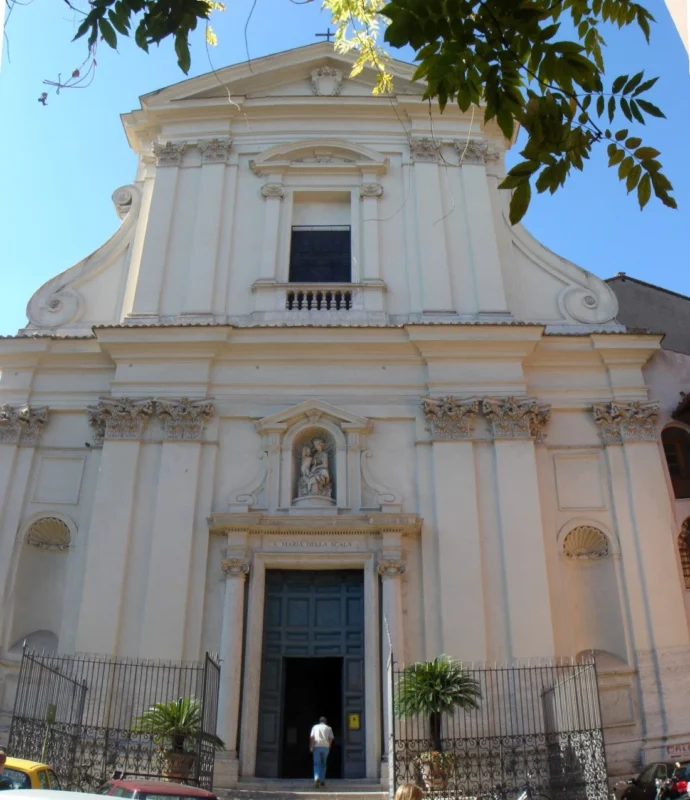
- Church of Santa Maria della Scala300 m


Upcoming events nearby
- Christmas Garden Rome at the Orto Botanico, November 19, 2026 to January 10, 2027300 m
- Giorgio Griffa / Kamrooz Aram: Paintings at the American Academy in Rome, from October 20 to November 28, 2026300 m
- Las Grietas by Fabiola Ferrero at Museo di Roma in Trastevere, from October 1 to November 22, 2026300 m
- Le Parole delle Scrittrici at Museo di Roma in Trastevere, October 15, 2026 to May 27, 2027300 m