Rome Synagogue (Great Synagogue)
In short. There are buildings in Rome that blend into their surroundings, and buildings that, on the contrary, were built specifically to be seen.

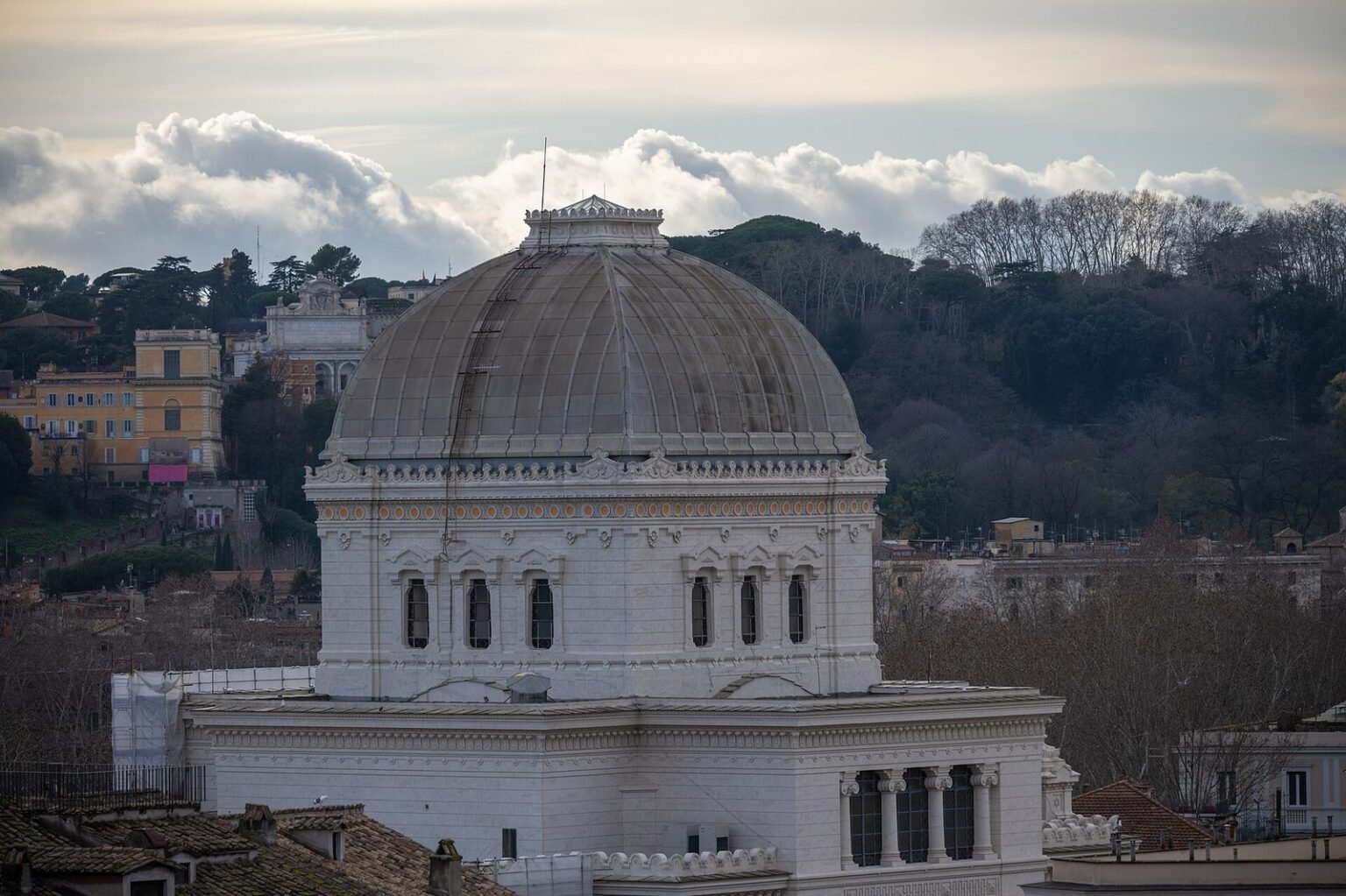
There are buildings in Rome that blend into their surroundings, and buildings that, on the contrary, were built specifically to be seen. The Rome Synagogue (Great Synagogue) belongs without hesitation to the second category. It stands on Lungotevere de' Cenci, in the Sant'Angelo rione, where the river makes a gentle bend and Tiber Island appears just a few dozen meters away. Its square dome, covered in aluminum, stands out from the profile of Roman rooftops with a determination that is anything but accidental. Along the Tiber you notice it before you get there, because it is one of the few monuments in the city that you can recognize from far away without any explanation. In a view made up of round domes and Romanesque bell towers, that square-based pavilion is an absolute visual anomaly, and that anomaly is exactly the message.
But the Rome Synagogue is not just a piece of eclectic architecture from the early twentieth century. It is the physical and symbolic center of the oldest Jewish community in the Western diaspora, present in this city continuously for over 22 centuries. No other Jewish community in Europe can say the same. The Jews of Rome were here before the Colosseum, before Hadrian's Pantheon, before Saint Peter's. They were here when Rome was a republic and the Mediterranean was a sea to be conquered. They have come through the empire, Christianity, the Middle Ages, the ghetto, emancipation, the Shoah, and they are still here. Walking along this Lungotevere with that awareness completely changes the way you look at the building.
Here you will find the Rome Synagogue (Great Synagogue), inside and out, told with the calm it deserves: the architecture and its reasons, the Jewish Museum that occupies its basement, the very long history that came before it, the terrible years that marked it, the three papal visits, and all the practical information you need to plan a visit that really works. I'll warn you right away about one thing, because it is the source of most of the misunderstandings: you don't enter a synagogue the way you enter a church. You enter through the Jewish Museum, with a ticket, with security checks, at set times, and not during services. It is not rudeness. It is the direct consequence of things that really happened in this place.
Where the Rome Synagogue (Great Synagogue) is and how to get there
The address that matters is Lungotevere de' Cenci, at the height of the rione XI Sant'Angelo, the smallest rione in Rome. The complex occupies one of the four regular blocks that arose from the demolition of the old ghetto. It is bordered on one side by the lungotevere, and on the others by via Catalana, via del Tempio and the open space that today is called Largo Stefano Gaj Taché. The public entrance, the one to the Jewish Museum that all visitors pass through, opens onto via Catalana. It's worth learning by heart, because the monumental facade you see from the river, with its large staircase, is not the door you go through for a visit. It is the liturgical entrance, reserved for worshippers and ceremonies.
On foot, which is the right way
From the Campidoglio, head down toward the Theater of Marcellus and in 10 minutes you're on via del Portico d'Ottavia. From Largo di Torre Argentina it takes just under five minutes to via Arenula and via Santa Maria del Pianto. From Trastevere, cross the Ponte Cestio and the Ponte Fabricio, passing through Tiber Island. This is the most beautiful route of all, because the Ponte Fabricio is the oldest Roman bridge in the city still in use, built in 62 BC. It also has a popular nickname that says a lot: Ponte Quattro Capi, for the quadrifrontal herms of Janus that decorate its parapets. Once across the bridge on the left bank, you'll be practically right in front of the synagogue. If you have time for only one approach, choose this one. You arrive from the river, the dome grows slowly before your eyes, and the change in scale between the low houses of the former ghetto and the monumental temple makes sense without anyone having to explain it.
By public transport
Tram 8 stops at Largo Arenula and Piazza Venezia. Buses that run along via Arenula and via del Teatro di Marcello drop you off a few minutes' walk away. The metro does not reach here. The closest useful stop is Colosseo on line B, but from there it's still worth walking 20 minutes through the Forums and the Theater of Marcellus, which is a splendid walk and not a penalty. By car, simply forget it. You're inside the limited traffic zone of the historic center, parking is an illusion, and the lungotevere is a trap.
Why orientation matters more than usual
Many visitors arrive at the monumental staircase on the Lungotevere, find it closed, and conclude that the synagogue is inaccessible. It isn't so. Turn the corner toward via Catalana and you'll find the ticket office of the Museo Ebraico di Roma. It's a small logistical matter, but it saves you half an hour of confusion and a few useless laps around the block. The same confusion applies to the hours. The synagogue is an active place of worship, so the tourist visit fits into the spaces the liturgical calendar leaves free, not the other way around.
The Rome Synagogue (Great Synagogue) and the oldest community of the diaspora
To understand why this building is so important, you have to go back more than 2,000 years. The first Jews arrive in Rome in the 2nd century BC, in the Republican era, in a context of diplomatic and commercial relations between Rome and the Judea of the Maccabees. They don't arrive as slaves. They arrive as merchants, ambassadors, and free immigrants from the eastern Mediterranean. It's a detail that changes everything, because it means the Jewish presence in Rome predates by centuries both the destruction of the Temple in Jerusalem and the birth of Christianity.
Then, of course, the story gets complicated. The Jewish wars of 66-70 AD and 132-135 AD bring thousands of prisoners and slaves to Rome. The community grows, stratifies, and settles mainly in Trastevere and on the Aventine, port and working-class areas near the Tiber docks. The Jewish catacombs of Vigna Randanini on the Appia and Villa Torlonia on the Nomentana, with their inscriptions in Greek, Latin and Hebrew, tell of a large population, organized into several synagogues, that speaks the lingua franca of the empire and buries its dead with the menorah carved into the stone.
A primacy that is not rhetoric
When I say that Rome's Jewish community is the oldest in the Western diaspora, I'm not using a brochure formula. It's a verifiable fact: no European Jewish community can document a continuous presence in the same place for 22 centuries. There were no definitive expulsions, as in England in 1290, France in 1394, Spain in 1492, and Portugal in 1497. There was segregation, humiliation, imposed poverty, and persecution, but not total expulsion. Roman Jews have stayed, generation after generation, in the same four or five hectares of the city.
This produces a very particular identity, which can be heard in the language, the cooking, the liturgy and even the irony. Rome's Jews are neither Ashkenazi nor Sephardi. They are italkim, and they follow the Italian rite, the Italian minhag, an independent liturgical tradition that descends directly from the customs of Palestine in the first millennium and that today survives almost exclusively here and in a few other Italian communities. It is the rite celebrated in the main hall of the Rome Synagogue (Great Synagogue). For a Jew arriving from New York, Paris or Jerusalem, it's a disorienting experience: different melodies, a different order of prayers, different pronunciations. A liturgical language that no one else speaks anymore.
Giudaico-romanesco
There exists, or existed until a few generations ago, a specific way of speaking: giudaico-romanesco, a Roman dialect full of Hebraisms and words of Hebrew and Aramaic origin adapted to local pronunciation. Words like "sciamannato", "caiòtico", and "azzeccare" have histories that intertwine the vocabulary of the ghetto with that of the city. Today it can still be heard, in fragments, in families and shops on via del Portico d'Ottavia. It's one of the many ways this community has left traces in the Rome of everyone, often without Romans noticing.
1555, the bull Cum nimis absurdum and the birth of the ghetto
The Rome Synagogue (Great Synagogue) cannot be understood without the ghetto, and the ghetto cannot be understood without a date: July 12, 1555. That day Pope Paul IV, born Giovanni Pietro Carafa, elected just two months earlier, issues the bull Cum nimis absurdum. The title is already a condemnation: "since it is utterly absurd" that Jews, condemned by God to servitude for their guilt, enjoy freedom among Christians. With that act, the rights that Roman Jews had accumulated over previous centuries are revoked all at once, and their confinement is ordered in an enclosed area of the rione Sant'Angelo, between the Portico d'Ottavia and the bank of the Tiber.
The document is chillingly bureaucratic in its precision. It requires mandatory residence in an enclosed area with gates that close at sunset and reopen at dawn. It imposes a distinguishing sign, a cap for men and a badge for women, in glauco color, that is, a greenish yellow. It prohibits Jews from engaging in any trade, with one exception: trade in rags and secondhand clothing. It prohibits them from owning real estate. It requires a single synagogue for the entire community. It bans practicing medicine on Christians. It requires the exclusive use of Latin or Italian in account books.
The unforeseen consequences of a segregation law
Three of these rules had very long-lasting effects, and they're worth understanding because you still come across them today as you walk through the neighborhood. The ban on trade, with the exception of rags, created a forced specialization of Roman Jews in clothing and its accessories. It was a trade that stayed in families for centuries and can still be recognized today in the neighborhood's shops and at Rome's market stalls. The ban on owning property pushed wealth, when there was any, toward the most movable goods of all, gold and money: and from there comes, paradoxically, the role of moneylenders that the popes themselves later used. The ban on owning houses made any investment in building maintenance irrational, and this produced a physical decay that three centuries later would be used as a technical argument for razing the entire neighborhood to the ground.
A neighborhood built up and across
The Roman ghetto was very small, just over two hectares at the start, and the population kept growing. The only direction available was up: houses rose floor by floor, the alleys narrowed, and the light disappeared. Between adjoining homes, communicating doors were opened, and connecting bridges crossed between one block and the next. They also served as escape routes during persecutions, for example on Carnival days, when the hunting of Jews was one of the "entertainments" tolerated by the city. And since the neighborhood stood against the river, which had no embankments, the facades bore horizontal marks of different colors, left by the mud of the floods: a chronology of the floods written on the walls.
In 1572, Pope Gregory XIII added to the segregation the obligation of forced sermons: every Saturday, part of the community had to attend sermons meant to convert them. They were held in different places, including Sant'Angelo in Pescheria and the church of San Gregorio a Ponte Quattro Capi, today San Gregorio della Divina Pietà, which still shows on its facade a bilingual inscription in Latin and Hebrew from the Book of Isaiah, placed there with polemical intent. The result of the sermons over three centuries was practically zero. Popular tradition says the Jews prepared themselves by plugging their ears with wax. The scene has entered the popular imagination thanks to the movies, but the obligation is documented, and it was revoked only in 1848.
The Cinque Scole: five synagogues inside a single building
Here we come to one of the knots that make the Rome Synagogue (Great Synagogue) what it is. The bull of 1555 required a single synagogue. But the Roman community was not uniform: there were the Italkim of Italian rite, and there were Jews who had arrived from the Iberian Peninsula and from Sicily after the expulsions of 1492 and 1493, each with their own liturgy, their own pronunciation of Hebrew, and their own melodies. Forcing everyone into one synagogue meant asking them to give up their own liturgical identity.
The answer was a solution of remarkable practical intelligence: one building, therefore formally one synagogue, which housed inside it five distinct prayer halls. These are the famous Cinque Scole, from the Judeo-Roman term "scola," which indeed means synagogue: the Scola del Tempio and the Scola Nova, of Italian rite, the Scola Catalana and the Scola Castigliana, of Iberian tradition, the Scola Siciliana. Five liturgical communities under the same roof, in Piazza delle Cinque Scole, for more than three centuries. A loyalty to the letter of the law that got around its spirit, and that says a great deal about the character of this community.
What they were like inside
They were not makeshift little rooms. Over the centuries, the Cinque Scole accumulated liturgical furnishings of great quality: holy arks in polychrome marble, Baroque rabbinical chairs, embroidered textiles, silverware, lamps. Families in the ghetto, even the very poor ones, gave their scola whatever they could, and the donations piled up in layers. The result is that, within a segregated and poor neighborhood, an artistic heritage took shape that today forms the heart of the Jewish Museum of Rome.
The building of the Cinque Scole was demolished as part of the redevelopment that gutted the ghetto: the Scola Catalana, for example, was torn down in 1908. But the furnishings were taken apart, preserved, and largely reused. And that is why, when you enter the Rome Synagogue today, you see objects much older than the building that houses them: in the apse area there are two Baroque marble seats in polychrome marbles, the one on the left coming from the Scola Siciliana and dated 1586, reserved for the chief rabbi, and the one on the right coming from the Scola Castigliana, dating from 1660. They were installed in the Great Synagogue between 1937 and 1938, together with two arks placed under the side matronei, the one on the right dating back to 1586.
Continuity as a conscious choice
This transfer of furnishings is not an inventory detail. It is a statement. Whoever designed and furnished the new temple could have filled it with brand-new furnishings, and in part did so. But they wanted the building of emancipation to contain pieces of wood and marble that had lived through the centuries of the ghetto. In the hall, it's worth looking at those two seats before anything else. They are 318 years older than the synagogue, and they come from a building that no longer exists.
1870: the breach, emancipation and the end of the ghetto
On September 20, 1870, the bersaglieri entered Rome through the breach at Porta Pia, and the temporal power of the popes ended. There is a detail from that day that Roman Jews have passed down for generations: the officer commanding the battery of cannons that opened the breach was a Piedmontese man from a Jewish family, Captain Giacomo Segre. Local legend has embroidered quite a bit on it, but the fact itself is documented. It is one of those coincidences history produces now and then so that it will be remembered better.
With the annexation to the Kingdom of Italy, the ghetto was abolished and Roman Jews became full citizens. Keep in mind, though: legal emancipation arrived in a day, while social and economic emancipation took decades. The people who left the ghetto in 1870 were, for the most part, extremely poor, with trades limited by three centuries of prohibitions, with a high illiteracy rate, with health compromised by housing conditions. Freedom arrived before the conditions to exercise it.
The muraglioni and the gutting
The physical fate of the neighborhood was decided in 1875, when Parliament approved and funded the construction of the muraglioni of the Tiber, the high embankments that were meant to protect Rome from floods. The route of the new lungotevere would have required demolishing about half of the old ghetto. At that point, it was decided not to stop halfway. A more radical "sanitation" operation was undertaken, and the neighborhood was practically razed to the ground.
In 1888, with the new city master plan, most of the ancient alleys and buildings of the ghetto were torn down and replaced by a right-angled layout. via del Portico d'Ottavia was born, taking the place of the old via della Pescheria, along with via Catalana and via del Tempio. Entire blocks disappeared. Piazza Giudea disappeared along with its run-down buildings, one of the historic entrances to the neighborhood. In place of the labyrinth, four regular blocks arose, more orderly, healthier, and infinitely less characteristic.
An urban loss that is little talked about
It has to be said honestly: the gutting of the ghetto is one of the most serious losses suffered by Rome's historic fabric, and for decades it was told only as a necessary hygienic operation. Anyone who wants an idea of how the old neighborhood looked should look at the row of buildings on the north side of via del Portico d'Ottavia, next to what remains of the Augustan complex. Those surviving houses, with irregular windows and ancient fragments built into their facades, are the last surviving sample of a vanished fabric. And it is precisely from that contrast in scale and atmosphere that the Rome Synagogue (Great Synagogue) draws its visual power: the low, untidy houses of the former ghetto on one side, the monumental temple on the other.
There is an administrative note that explains the long timeline of the story. In 1888, the Israelite University of Rome signed a contract with the Comune to obtain a plot of land with adequate access roads, on which to build a synagogue of monumental dimensions. This would have allowed the demolition of the building of the Cinque Scole. That agreement was, however, rescinded in 1896. Only in 1897 did the Community buy from the Comune the area between the Lungotevere de' Cenci and via del Portico d'Ottavia, one of the four lots created from the demolitions. It took almost 30 years after the end of the temporal power to reach the first stone.
The 1889 competition and the choice of design for the Rome Synagogue (Great Synagogue)
In 1889, the first competition for the new synagogue was announced. The competition notice is an extraordinary document, because it does not simply ask for a place of worship. It asks for a building that must "rise proudly among the buildings of the new city" and have a "monumental and severe character." Words matter. "Proudly" and "monumental" are not technical specification adjectives. They are a political program. The Roman Jewish community, having come out of three centuries of confinement and a papal bull that required it to have only one synagogue, and one not even too visible, wanted to build something that could be seen from half the city.
26 groups of architects and engineers take part in the competition. Two projects are awarded equal prizes: that of Attilio Muggia, an engineer from Bologna, and that of the pupils of Guglielmo Calderini, Vincenzo Costa and Osvaldo Armanni. After the purchase of the land in 1897 a second invitational competition is called, reserved for the two winners, who are asked to rework the projects they submitted. Muggia withdraws, and in 1899 the commission is definitively entrusted to Armanni and Costa.
What It Meant to Design a Synagogue in 1899
You have to understand the problem they faced. There was not, and there is not, a canonical "synagogue style" comparable to the one Christianity had developed over 1,500 years of basilicas, Romanesque, Gothic and Baroque. In nineteenth-century Europe the emancipated Jewish communities building great synagogues all found themselves facing the same question: what form must a building have that publicly represents Judaism in a Christian city? The answers were different and all debated: the neo-Moorish of Budapest and Berlin, the neo-Byzantine, the neo-Romanesque, the neoclassical.
Armanni and Costa chose a personal path. Their stated aim was not to reproduce a model of a Jewish temple, ancient or recent, but to "generate the impression of an Eastern place of worship." They sought to evoke the architecture of the ancient Kingdom of Israel through a fusion of Assyrian, Egyptian and above all Greek elements, re-proposed not in their original purity but adapted to the Roman context and the taste of the time. Their words, in the report published in 1904, are very clear: they wanted "the new temple to take on severe, simple forms, not lacking however a moderate richness and harmonizing perfectly, in our view, with those of the other monuments of the city."
The Result: A One-of-a-Kind, Not a Compromise
How well that harmonization with the other monuments of the city succeeded has been debated for 120 years. Architectural criticism has often observed that the union of the two main sources, the Greek one without the Renaissance mediations and the Assyrian one, makes the Synagogue of Rome (Tempio Maggiore) a unicum in the panorama of the capital, hard to integrate despite the designers' intentions. Our opinion is different: that foreignness is not a flaw of the project, it is its success. A building that had blended in among the Roman churches would have betrayed the very sense of the commission. It had to be recognizable, and it is.
It should be added that, under the orientalizing decorative apparatus, the composition is rigorously classical: the distribution of masses, the division of spaces and the placement of the main elements are conceived according to Renaissance precepts. It's a building with an Assyrian-Babylonian dress and an Italian skeleton. Which, if you think about it, is the perfect definition of the community that built it.
Osvaldo Armanni and Vincenzo Costa: Who Built the Synagogue of Rome (Tempio Maggiore)
The two names every visitor should take away from here are Osvaldo Armanni, architect, and Vincenzo Costa, engineer. They were both pupils of Guglielmo Calderini, the designer of the Palazzo di Giustizia in Piazza Cavour, the one Romans irreverently call "il Palazzaccio": which gives you an idea of the architectural climate in which they worked, an age in which Rome as capital was looking for a monumental language for its public buildings and looked for it with abundant means and some excess.
In 1904, with the work complete, the two published with the publisher Balbi a volume titled Il nuovo Tempio israelitico di Roma, which is the primary source for understanding their intentions. It is a text worth knowing because it dismantles the widespread and convenient idea that the eclecticism of the late 1800s was a lazy choice made of random quotations. Armanni and Costa argue every decision: why the Assyrian, why the Greek, why not the Moorish, why not the Gothic, why that type of dome.
The Rejection of the Neo-Moorish
This is perhaps the most interesting point. In nineteenth-century Europe the neo-Moorish had become almost the "default" style for great synagogues: horseshoe arches, geometric decorations, onion domes. It was a choice that alluded to medieval Spain and the golden age of Sephardic Judaism. But for the Roman community that language said nothing: the Jews of Rome did not come from Spain, were not Sephardic, and had no reason to borrow an identity that was not theirs.
They therefore searched back, much further back, toward the world of the ancient Near East: Assyria, Babylon, Egypt, archaic Greece. That is, the historical and geographical context in which ancient Israel had really lived. It is a choice with an ironclad logic, even if the formal result, with the palmettos, the volute capitals, the bundles of squat columns, has a flavor that today inevitably looks nineteenth-century to us. Every era imagines antiquity with the eyes it has.
A Three-Year Building Site
The work begins in 1901 with the laying of the first stone on July 20. It takes three years, which for a building of that size, in an era without tower cranes and with little reinforced concrete, is very quick. The structure is in brick masonry, with cast iron and steel used for the load-bearing parts of the upper orders and the roofs. On July 2, 1904, King Vittorio Emanuele III officially visits the building, now complete: an act of enormous symbolic weight, the head of the Italian state entering the capital's new synagogue 34 years after the end of the papal temporal power.
The square aluminum dome: the only one in Rome
If I had to choose one element of the Rome Synagogue (Great Synagogue) to explain to someone who has 30 seconds of attention, I would choose the dome. It is a pavilion dome on a square base, clad in aluminum, and it is the only square dome in Rome. In a city that invented the hemispherical dome with the Pantheon and pushed it to its limit with St. Peter's, building a dome on a square base is a statement no Roman can misread.
It was not even the first idea. The original design by Costa and Armanni called for a stepped roof, with an even more Mesopotamian flavor, almost a ziggurat. The square pavilion dome replaced it during construction, and in hindsight it was a stroke of luck: the stepped solution would have been more didactic and less effective in the urban skyline, while the square pavilion has a geometric sharpness that works from any distance.
Why square, really
The explanations you hear around town are often fanciful. The strongest reason is twofold, both symbolic and practical. From a practical standpoint, the hall of the Temple has a Greek cross plan with a central square space: a pavilion dome set directly on that square, without pendentives and without a circular drum, is the most structurally direct solution, and the one that best reflects the interior geometry on the outside. From a symbolic standpoint, the round dome was the visual sign of Roman Christianity par excellence. Choosing the square meant asserting a different presence without explicit controversy, simply through form.
Then there is the aluminum, which in 1904 was still an almost experimental material in construction. The Hall-Héroult electrolytic process, which had made industrial production possible, had been developed in 1886, and only 20 years earlier aluminum cost more than silver. Using it to clad the roof of a synagogue in Rome in the early twentieth century was a very modern choice, almost like something from a world's fair, and it produces a particular optical effect: depending on the light and humidity, the dome changes tone, from lead gray to pale silver, and on clear sunset days it takes on a warm tint that no copper and no roof tile could give.
Where it's best seen
The square dome is visible from many high points in the city, and learning to recognize it turns the views of Rome into a kind of treasure hunt. It can be seen very well from the Orange Garden on the Aventine, from the terrace of the Vittoriano, from the Janiculum Hill, from the promenade of the Pincio, and from the terrace of the Capitoline Museums. From up there the game is always the same: first you find the Pantheon, then St. Peter's, then you let your gaze drop toward the river and look for the only roof that, in a sea of curves, has four sharp corners.
The style of the Rome Synagogue (Great Synagogue): Assyrian, Egyptian, Greek
"Eclectic" is the technical word, and like all technical words it risks saying nothing. Let's be concrete and take the building apart into its ingredients, because looking at it knowing what to look for is a completely different experience.
The Assyro-Babylonian component
You recognize it in the squat, powerful proportions of the load-bearing elements, in the preference for compact wall surfaces, in the capitals with side volutes that recall those of Persepolis, in the stylized palmettes, the rosette motifs, and the friezes with horizontal bands. It is the component that gives the building that air of archaic solidity, almost of a sacred fortress, that strikes anyone who passes by for the first time. It is not a precise archaeological quotation, as it would have been in a neoclassical building compared with the Parthenon: it is an evocation of atmosphere.
The Egyptian component
Less conspicuous, but present: it shows in the tendency toward smooth surfaces that taper slightly, in certain cove moldings, and in the stylized plant motifs that recall the papyrus and lotus of Egyptian capitals. Rome, moreover, has a very ancient relationship with Egypt: the city has more authentic Egyptian obelisks than any other city in the world, Cairo included. An Egyptian echo in an early twentieth-century Roman building is not an exotic import but almost a local custom.
The Greek and Renaissance components
The Greek component is the one the designers themselves declared as the main one, and it's more structural than decorative: it's found in the use of the order, the rhythm of the columns, the overall sense of measure. But the real frame of the building is Italian Renaissance: the absolute symmetry, the hierarchy of spaces, the central plan covered by a dome, the subordination of decoration to structure. That's why, despite its Eastern dress, the Rome Synagogue (Great Synagogue) never looks like a fair pavilion: it has a compositional gravity that comes from another tradition.
And Art Nouveau
Many descriptions also add Liberty, or Art Nouveau, to the list, and that's correct above all for the interiors and the decorative elements: the polychrome stained glass, certain painted plant motifs, the lettering of some inscriptions fully belong to the taste of 1900. It's the aspect of the building that ages best, because it's the least "programmatic" and the freest.
The Facade and Exteriors of the Rome Synagogue (Great Synagogue)
The main facade faces the river and is preceded by a wide flight of steps. It's organized around a projecting central body with a large portal, topped by a wide opening and crowned by a pediment that holds symbols of the Jewish faith. Along the whole perimeter, and this is the detail to look for, the decorative apparatus keeps repeating the two key symbols: the menorah, the seven-branched candelabrum, and the Tablets of the Law, often with the first words of the 10 commandments in Hebrew.
The reason for this insistence is stated by the architects themselves: since the style couldn't communicate the purpose of the building on its own, the function had to be "constantly recalled by the wide use of symbols of the Jewish faith." Put differently, the iconography does the work that the architectural form, being invented, couldn't do on its own. It's an honest solution and, in the result, a very effective one.
The Wooden Portals
The carved wooden doors deserve two minutes of attention all to themselves. They're worked with geometric and plant motifs that take up the same orientalizing repertoire as the stone, and they have a craftsmanship that is completely lost in photographs. Walking past, almost everyone looks up at the dome and never looks at the wood half a meter from their eyes.
The Commemorative Plaques
Over time, plaques have been put up on the outer walls of the complex that remember the Roman Jews who were victims of Nazi persecution and deportation, and the victim of the 1982 attack. They're sober plaques, without emphasis, that can be read in a few seconds and that it's right to read before going in, not after. They change the tone of the visit, and they should.
The Side on the Lungotevere
The side facing the Tiber is the one that best conveys the mass of the building, with the regular rhythm of the openings, the side bodies and the dome rising above. If you cross the bridge toward Trastevere and turn around halfway, you get the best overall view: the temple, the former ghetto behind it, and Tiber Island as the backdrop. It's a viewpoint that in 1904 didn't yet exist in its present form, because the embankment walls and the trees along the lungotevere took their final shape shortly afterward.
Inside the Hall: the Temple Hall
You walk in and the first reaction, practically universal, is to raise your head. The hall of the Rome Synagogue (Great Synagogue) is much more decorated than the exterior leads you to expect: warm colors, gilding, dense wall paintings, polychrome stained glass, an explosion of ornament that contradicts the severity of the elevations. It's a deliberate gap, and it has a precise logic: the exterior speaks to the city, the interior speaks to the community.
The hall sits at a slightly higher level than the street, and it's connected to the street by a wide flight of steps in front of the facade and by smaller staircases at the side entrances. The plan is a Greek cross, with a square central space flanked on three sides by women's galleries supported by massive columns. Under the galleries, along the side walls, the ambulatories almost form small aisles, which are sometimes used for minor celebrations. The arm opposite the main entrance has the shape of a polygonal apse, and that's where all the liturgical focus is concentrated.
The Liturgical Layout: a Nineteenth-Century Choice
Here there's a detail that Jewish visitors notice immediately and that needs to be explained to everyone else. In the traditional synagogue the space is bifocal: on one side the Aron ha-Qodesh, the holy ark that holds the Torah scrolls, set against the wall facing Jerusalem. On the other, in the center of the hall, the bimah or tevà, the raised platform from which the Torah is read and prayer is led. The worshipper stands literally in the middle, and the hall has two poles.
In the Great Synagogue this bifocality is not present. The Aron and the tevà are placed together in a single solution in the apse area, following the typical practice of synagogues built between the 1800s and 1900s in Western Europe. It's a choice that reflects the taste of the era and, if we're being frank, some influence from the spatial model of churches, with the congregation all facing the same direction toward a single focus. It's a feature of modernity and, at the same time, of formal assimilation that says a lot about the historical moment when the building was born: the generation of emancipation wanted a temple that affirmed Jewish identity and full membership in Italian society.
The effect of light
Light enters from above and from the side windows, filtered through the colors, and in the central hours of the day the hall has a golden brightness that warms the frescoes. On gray days, however, the colors fade and the architecture takes over: the columns, the rhythm of the women's galleries, and the weight of the dome stand out more. If you have the chance to choose, go in the late morning.
The Aron ha-Qodesh, the Tevà and the Ner Tamid
The Aron ha-Qodesh, literally "holy ark," is the absolute heart of any synagogue: it's the cabinet where the sifrei Torah, the handwritten scrolls of the Law, are kept. In the Great Synagogue the Aron is placed in an isolated position in front of the apse wall, and its facade is framed between composite columns decorated with gilding. Its isolation is not accidental: it allows you to walk around it and makes it an architectural object in its own right, almost a small temple inside the temple.
In front of the Aron hangs the Ner Tamid, the "perpetual light," which in Jewish tradition is never extinguished and recalls the always-lit candelabrum of the Temple in Jerusalem. The one at the Rome Synagogue is in chiseled silver, by Pio Cellini and dated 1904, so it is contemporary with the building.
The two candelabra of the Scola Catalana
On either side of the Aron there are two large bronze oil candelabra from the ancient Scola Catalana, the one demolished in 1908. And here is a detail that I find one of the most beautiful of the whole visit: those two candelabra are lit only on Yom Kippur, the Day of Atonement, the most solemn day of the Jewish year. 364 days a year they remain unlit. An object that survived the demolition of its original building and is lit once a year: it's a definition of memory better than many celebratory phrases.
The marble seats and the arks
Along the side walls of the apse, facing each other, are the two Baroque marble seats in polychrome marbles already mentioned: on the left the one from 1586 from the Scola Siciliana, reserved for the chief rabbi, on the right the one from 1660 from the Scola Castigliana. They were installed here in 1937-1938, together with two arks placed under the side women's galleries: the one on the right, from 1586, belonged to the Scola Siciliana, while the one on the left is the result of reassembling different architectural elements from the Five Scole.
Stop for a moment on that date, 1937-1938. These are the years immediately before and coinciding with the Fascist racial laws. While the Italian state was preparing to expel Jews from the civil life of the country, the Roman community was reassembling, inside its temple, the marbles from the synagogues of the ghetto. It's not irony: it's a chronological coincidence worth keeping in mind, because it makes very concrete the contrast between what a community was building and what was about to be done to it.
The women's galleries, the windows by Picchiarini and the paintings by Bruschi and Brugnoli
The women's galleries are the raised galleries that run along three sides of the hall, supported by massive columns. In Orthodox Jewish tradition, men and women pray in separate spaces, and the women's gallery is the space reserved for women. It's an aspect that raises questions, and I think it's better to address it clearly rather than sidestep it: the separation, called mechitzah, reflects a conception of prayer in which concentration requires the absence of distractions, and over the centuries it has taken very different forms. In the Great Synagogue the solution is a high, open gallery that gives women a view of the entire hall and the apse, not a visual separation.
The windows of Cesare Picchiarini
The polychrome stained-glass windows are by Cesare Picchiarini, a name worth knowing because he is the great stained-glass master of early twentieth-century Rome. Picchiarini is the same craftsman who made the cartoons of Duilio Cambellotti for the Casina delle Civette at Villa Torlonia, and this technical and stylistic connection says a lot about the cultural environment in which the synagogue was decorated: not an isolated worksite, but the heart of Roman Liberty production.
The stained glass of the Great Synagogue does not depict figures, as you'd expect in a Jewish place of worship, where the depiction of the human figure in liturgical settings is traditionally avoided. The windows are geometric and plant-based compositions, rhythmed by symbols, that work mainly through color and the modulation of light. And they work: the color quality of the hall in the hours of sun depends almost entirely on them.
Domenico Bruschi and Annibale Brugnoli
The paintings on the walls and ceilings, with decorative elements in an eclectic taste, are the work of Domenico Bruschi and Annibale Brugnoli, two decorative painters among the most sought-after in Umbertine Rome. Bruschi, from Perugia, had worked across much of central Italy on restorations and new decorations. Brugnoli, also from Perugia, did decorations in theaters, palaces and Roman churches. Having both of them on the job meant having the best available in town at that time.
Their work here is a continuous ornamental fabric, made of scrollwork, palmettes, stars, geometric frames and Hebrew inscriptions built into the decoration. At first glance it looks like a carpet. Looking at it calmly, you discover it has a precise hierarchical structure, with increasing density toward the dome and toward the apse. A practical tip: take two minutes in silence with your gaze fixed on the central vault, and let your eyes adjust. The level of detail that emerges after 30 seconds is a different thing from what you catch at first glance.
The 1904 Rieger Organ in the Rome Synagogue (Great Synagogue)
Here's something almost nobody knows, and you can't see it in the hall: behind the Aron ha-Qodesh, in a loft not visible from the room, there is a pipe organ. It is a Rieger opus 1073, built in 1904, so it is contemporary with the building, and restored by Alessandro Giacobazzi in 2011.
The instrument has a symphonic-romantic tonal character and is intact in its original features, which for an organ of that period is far from a given. It is entirely enclosed in a soberly decorated wooden case, with no façade pipes: there is no organ front to admire, no pipe in view. The console, fixed and independent, is placed on the floor beneath the sound body. It has two manuals and a pedalboard, with stops and couplers operated by drawknobs arranged in a single row above the second manual. The action is pneumatic-tubular, and there are 17 stops in all.
Why an Organ in a Synagogue
The question is a fair one, and the answer is historically interesting. The introduction of the organ into European synagogues in the 1800s was one of the most debated issues in modern Judaism. It was linked to the German Reform movement and opposed by a large part of the Orthodox world, both because of the ban on playing musical instruments during Shabbat and out of fear of imitating Christian forms of worship. That the Great Synagogue was equipped with an organ in 1904 reflects the mood of that generation: a newly emancipated, proud community that wanted a temple worthy of the capital's great public buildings, with everything that model entailed. Today the instrument is above all a historical document and a concert instrument, and the fact that it has survived intact makes it a rare piece in the Roman organ landscape.
The Italian Rite: What Is Prayed in the Rome Synagogue (Great Synagogue)
The main hall of the Great Synagogue follows the Italian rite, the minhag benè Romi, and it is one of the few synagogues in the world where this can still be heard in an ordinary service. It is not a folkloric curiosity. It is, in all likelihood, the oldest Jewish liturgical tradition to survive in Europe, distinct both from the Ashkenazi rite of Central and Eastern Europe and from the Sephardi rite of the Iberian and Mediterranean world.
The differences are not aesthetic. They concern the order and selection of prayers, the presence of liturgical poetic compositions, the piyyutim, which have disappeared elsewhere, the traditional melodies, the pronunciation of Hebrew, and some customs in the reading of the Torah. Anyone with an ear for it notices within the first 30 seconds. Liturgy scholars come to Rome specifically to hear how certain formulas are sung here, because they represent a line of transmission that has been broken everywhere except Italy.
Not Only the Italian Rite
The Roman community is not, however, liturgically monolithic. Within the complex and in the city, other rites coexist, and that is no accident: the complex also houses the Spanish Temple, which follows the Sephardi rite, and in Rome people also pray according to the Libyan tradition, brought by the community that arrived from Tripoli and Benghazi in 1967 following the end of the Jewish presence in Libya. That immigration profoundly changed the face of contemporary Roman Judaism, enriching it with melodies, customs, cuisine and families. The Museo Ebraico dedicates an entire room to it.
The Jewish Museum of Rome: the seven rooms beneath the Rome Synagogue (Great Synagogue)
The Jewish Museum of Rome occupies the rooms beneath the Tempio Maggiore and the adjoining service rooms, over an area of about 700 square meters organized into seven thematic rooms. The community's collections were opened to the public as early as 1960. The display in its present form dates to 2005. And it is from here, I repeat, that you enter: the visit to the Tempio Maggiore is in fact the concluding part of the museum route, not a separate entrance.
The museum is not a container of beautiful objects. It is the documented account of 22 centuries of Jewish presence in this city, built almost entirely on materials from the palazzo of the Cinque Scole and from the ghetto period, that is, from the years 1555-1870. Liturgical furnishings, manuscripts, incunabula, documents, registers, marble works: objects that have lived through segregation, the demolition of the quarter, war and persecution.
Room 1: The Textile Wardrobe
It opens with what is, without exaggeration, one of the most important Jewish textile collections in the world: Renaissance velvets, Baroque embroideries and lace, lampas and brocades of the 1600s and 1700s. The museum holds about 900 textiles, partly on display in rotation in the cases, partly still actually used in the city's synagogues. Many are me'ilim, the mantles that cover the Torah scrolls, and parochot, the curtains that cover the Aron. Many bear embroidery with the names of donors and dates, and are therefore records of identity as well as works of art. A detail that always strikes: quite a few of these textiles come from family garments donated to the scola and readapted for liturgical use. The most precious fabrics of a wedding became the dress of a Torah scroll.
Room 2: From Judaei to Giudei: Rome and Its Jews
It is the historical room par excellence, and the one I recommend not rushing through. Here you find casts of tombstones from the Roman Jewish catacombs and from the synagogue of ancient Ostia, medieval manuscripts, topographical maps of the city. The message is reconstructed visually: the uninterrupted presence of Jews in Rome for more than 2,000 years. The synagogue of Ostia, discovered in the 1960s during work on the road to Fiumicino airport, is one of the oldest synagogue buildings in Europe, and its existence makes clear how structured the Jewish presence was in the port of Rome.
Room 3: Festivals of the Year, Festivals of Life
Here Jewish time is explained: daily prayer, the Shabbat, the cycle of holidays, and the passages of life, from birth to marriage. It's the room that makes all the objects you see in the others understandable: once you understand what an object is for, the object stops being decorative. Whoever arrives unfamiliar with Judaism should start mentally from here.
Room 4: The Treasures of the Cinque Scole
Silver, precious textiles, polychrome marbles from the five synagogues of the ghetto: the Scola del Tempio, the Scola Nova, the Scola Siciliana, the Scola Castigliana and the Scola Catalana. It is the heart of the museum and at the same time a tribute to the Jews of the ghetto who gave their synagogues the little or the much they had. Among the pieces are crowns and finials for the Torah scrolls, rimonim in embossed silver, pointers, lamps. The quality is high and the marks of Roman silversmiths recur frequently: they were Christian workshops working on Jewish commission, which tells of a city in which legal segregation coexisted with daily economic exchange.
Room 5: Life and Synagogues in the Ghetto
Language, cooking, urban space, architecture, education, mutual aid organizations. It's the anthropological room, the one that gives back everyday life: how people really lived inside two or three hectares of city closed off by gates. The aid confraternities, the schools, the honor loans, the dowries for poor girls: a sophisticated social organization born of necessity.
Room 6: From Emancipation to Today
Works of art and documents tell the path of the community after 1870: emancipation, participation in national life, the racial laws of 1938, persecution, the postwar reconstruction, contemporary life. It's the most difficult room and the most necessary, and it should be approached with the calm it deserves.
Room 7: Libyan Judaism
Documents, objects and photographs on the history of the Jewish community of Libya and on its contribution to Roman Judaism after the arrival of the refugees from Tripoli and Benghazi in 1967. It is a story little known in Italy: a very ancient Jewish presence in North Africa, erased in a few years, and a community that rebuilt itself in Rome bringing with it its own liturgy and its own cooking. Many families of today's Jewish Rome come from there.
The Gallery of Ancient Marbles
It is the space that holds the marbles dating from the 16th to the 19th century, mostly from the decoration of the Cinque Scole. Some commemorate bequests from certain families, others document the purchase of land for the cemetery. They are not "beautiful" objects in the conventional sense: they are carved documents, and reading them in sequence is like leafing through the notarial archive of an entire community. Among the most important pieces kept in the museum is the marble Aron of the Scola Catalana, dated 1523. It is the oldest holy ark cabinet in the city of Rome, in Renaissance style, and it predates the founding of the ghetto itself by 32 years.
An Augmented Reality Experience
The museum also offers an augmented and virtual reality route devoted to the reconstruction of the ghetto in 1555, lasting about 30 minutes, plus as many minutes of guided explanation. It is useful above all for one reason: the physical ghetto no longer exists, it was demolished, and without a visual aid it is nearly impossible to imagine what the web of alleys was like, now replaced by regular blocks. If you travel with kids, it is the best way to help them understand the difference between the neighborhood then and the one today.
The Spanish Temple and the Other Synagogues of the Complex
In the basement of the complex, since 1932, you will find the synagogue of the Spanish rite, known as the Spanish Temple. Before finding its home here, the Roman Sephardic community had an independent building on lungotevere Sanzio, on the Trastevere side, built between 1908 and 1910. The move to the basement of the Great Synagogue brought the community's two main liturgical traditions together in a single monumental complex.
The Spanish Temple is a much smaller and more intimate room than the main hall, and it is the place where, if I had to choose, I would prefer to spend more time. Since 1948 it has housed some furnishings from the Cinque Scole: the Aron of the Scola Nova, a seat from 1623 and the bimah from 1851 of the Scola Castigliana. These are pieces of great quality, and their placement in a contained space lets you see them up close, which is impossible in the large hall.
Why the Small Room Is as Valuable as the Large One
The Great Synagogue is imposing, and imposing grandeur can sometimes create distance. The Spanish Temple, on the other hand, conveys the scale of the synagogue as a community space: a place where everyone knows each other, where the voice of the reader carries without amplification, where the objects have a domestic dimension. If your visit includes it, don't treat it as an appendix to the piano nobile.
One Complex, Not a Single Building
The thing to understand, and one that is often unclear even to those who have already been here, is that under the name Rome Synagogue (Great Synagogue) there is a complex network: the monumental hall, the Sephardic synagogue, the museum spaces, the offices of the rabbinate, and the religious and administrative bodies that govern the life of the Jewish community of Rome. It is not a monument standing on its own, as the Pantheon or the Baths of Caracalla can be. It is the operating headquarters of a living community, with a school, a hospital, a retirement home, shops and kosher restaurants a few tens of meters away, and thousands of people who pass by it for reasons that have nothing to do with tourism.
1904: The Inauguration of the Rome Synagogue (Great Synagogue)
The year to remember is 1904, and the two days to note are July 2 and July 27. On July 2, King Victor Emmanuel III officially visited the completed building. On July 27, the consecration took place, led by the chief rabbi of Rome Vittorio Castiglioni, who had taken office on December 17, 1903, so, a little over seven months earlier. The inauguration for worship has also been dated to July 29 in some accounts, depending on which ceremony is taken as the reference, but the overall meaning doesn't change.
The city's press followed the event with great attention, and that alone is significant. 34 years earlier, Roman Jews were still, in practice, living in a segregated neighborhood with the obligation to attend weekly sermons. Now the capital of the Kingdom of Italy was celebrating the inauguration of their monumental synagogue with the king visiting. The speed of that change, measured on the scale of a community that had 22 centuries of history behind it, was dizzying.
The Centennial Stamp
On May 20, 2004, to mark the centennial of the inauguration, Poste Italiane issued a 0,60 euro stamp showing the facade of the Great Synagogue. It is a minor detail, but it says something: a building conceived to be seen ended up on an object that circulates by definition.
The Cantors' Concert of 2005
A little-known and rather beautiful episode: on January 17, 2005, for the first time in the synagogue's history, 13 chazzanim, that is, liturgical cantors, performed here in a cantorial concert, in collaboration with the association of American Jewish cantors. For a place where the voice is the main instrument of worship, a concert of cantors is the most natural celebration possible.
The Chief Rabbis of the Rome Synagogue (Great Synagogue)
The succession of chief rabbis who served in this building is, in itself, a summary of the Italian twentieth century. It's worth reading it with the dates alongside, because the dates speak for themselves.
Vittorio Castiglioni leads the community from 1904 to 1911, and the inauguration falls to him. Angelo Sacerdoti follows, from 1911 to 1935, 24 years that span the Great War and the rise of Fascism. Then David Prato, from 1936 to 1938: a very brief term, cut short by the racial laws. Isacco Amar holds the post on an interim basis between 1939 and 1940, during the years of legal persecution. Eugenio Zolli is chief rabbi from 1940 to 1944, the most dramatic years. David Prato returns from 1945 to 1951, after the war, to rebuild.
Then comes the longest and best-known term: Elio Toaff, chief rabbi of Rome from 1951 to 2001, exactly 50 years. Since 2001 the post has been held by Riccardo Di Segni, a physician and rabbi, who has welcomed two popes to this building.
Elio Toaff, 50 years
Toaff deserves more than a line. Born in Livorno on April 30, 1915, the son of Rabbi Alfredo Sabato Toaff, he earned a law degree in Pisa in 1938. He was able to do so because the racial laws, although they excluded Jews from the university, allowed those who were already near the end of their studies to complete them. The following year he earned his rabbinical title in Livorno. He was chief rabbi of Ancona from 1941 to 1943, and after September 8, 1943 he fled to Versilia with his wife Lia Luperini and their son Ariel, escaping capture several times thanks to the help of priests and Catholic families, and ended up joining the Resistance. After the war he was rabbi in Venice from 1946 to 1951, also teaching at Ca' Foscari, and in 1951 he arrived in Rome.
His 50 years coincided with the material and moral rebuilding of the community, the season of Jewish-Christian dialogue, the Second Vatican Council and the declaration Nostra aetate, the attack of 1982 and the visit of John Paul II. In 1987 he published the autobiography Perfidi giudei, fratelli maggiori, whose title already sums up that journey: the first expression came from the Catholic liturgy of Good Friday, the second from the words spoken by the pope in this synagogue. He announced his resignation on October 8, 2001, at age 86, "to make room for younger people," giving the news himself at the end of the Hoshanà Rabbà prayers. He died in Rome on April 19, 2015, a few days before turning 100. The funeral was held here, at the Great Synagogue, and he is buried next to his parents in the Jewish cemetery of Lupi in Livorno.
1938: The Racial Laws and the Rome Synagogue (Great Synagogue)
In 1938 the Kingdom of Italy promulgates anti-Jewish legislation. It was not a German import. It was Italian legislation, voted and enforced by Italian institutions, which expelled Jews from public schools, universities, state jobs, the army, and the professions, and limited their civil and economic rights. Professors removed from their chairs, students expelled from classrooms, officials dismissed, marriages prohibited. A community that had gained full citizenship 68 years earlier saw it revoked by law.
The Great Synagogue remained active even after 1938, and this is a fact that must be understood in its precise meaning: the regime targeted the civil integration of Jews into Italian society, not the existence of worship as such. But the building's function changed. The community had to organize its own schools for children expelled from public schools, assistance for families who lost their income, and support for those trying to emigrate. The synagogue became, in addition to a place of prayer, the logistical center for the survival of a community pushed to the margins.
A Fact Not to Forget
In September 1943 the Roman Jewish community numbered between 8,000 and 12,000 people. And, a detail that proved decisive for what would happen, complete name lists existed, with names and addresses, produced by the census of Jews carried out years earlier by the Italian government. Those registers, created as an administrative tool of discrimination, became a tool of the hunt in October 1943.
September 1943: The Gold Collection in the Rome Synagogue (Great Synagogue)
Rome has been occupied by German troops since September 10, 1943. On September 26, on a Sunday afternoon, SS Lieutenant Colonel Herbert Kappler, commander of the SD and the Gestapo in Rome, summons the president of the Jewish Community of Rome, Ugo Foà, and the president of the Unione delle Comunità Israelitiche Italiane, Dante Almansi, to his office at Villa Wolkonsky. He orders them to hand over at least 50 kilograms of gold within 36 hours, threatening otherwise to deport 200 Roman Jews, and then the entire community. In exchange for the gold, he promises their safety.
The next morning, the gold collection begins inside the Great Synagogue. It is one of the harshest images in the history of this building: lines of people bringing wedding rings, chains, earrings, coins, and family heirlooms, and placing them on a scale set up in their synagogue. Donations also came from non-Jewish Romans. The Holy See, informed of the blackmail, unofficially stated that it would authorize a loan of ingots up to the required amount: it was not necessary.
At 18:00 on Tuesday, September 28, after a four-hour extension granted by Kappler himself, the community leaders present themselves at Villa Wolkonsky. They are escorted under guard to the building at via Tasso 155, where the gold is weighed twice: it comes to 50.3 kilograms. Kappler immediately ships it to Berlin.
The gold was of no use
It needs to be said as clearly as possible, because this is the crucial point: the payment did not save anyone. The promise of safety was false from the start. In the cover letter sent to Berlin, Kappler expressed doubts about the feasibility of a deportation and suggested using Roman Jews as forced labor. The reply from General Ernst Kaltenbrunner was that the priority was the "immediate and complete extermination of the Jews in Italy." After the war ended, that gold was found intact, in the crate where it had been stored, in a corner of Kaltenbrunner's office. It had never been spent. It never served any purpose, except to buy a few days of false hope.
On October 14, two days before the roundup, Kappler orders the looting of the two libraries of the Jewish Community and the Rabbinical College: two railway cars full of manuscripts, incunabula, and volumes of priceless value leave for Germany. In the same operation, the complete lists with the names and addresses of Roman Jews are taken. A part of that library's collection has never been found.
October 16, 1943: the raid on the ghetto
This day has to be discussed precisely, without excess adjectives, because the facts are enough.
At dawn on Saturday, October 16, 1943, Saturday, a day of rest, deliberately chosen to catch the largest number of people at home, the roundup begins. The operation takes place between 5:30 and 14:00, carried out by German SS troops and the order police, the Ordnungspolizei, coordinated by the Einsatzkommando of Theodor Dannecker, Eichmann's associate who arrived in Rome in the first days of October. More than 300 men from the order police, plus the 14 officers and noncommissioned officers of the command, act with precision thanks to the lists. About a hundred men operate inside the former ghetto, and the others work in different areas of the city.
The method is to first block the road access points and then evacuate one block at a time, gathering people out on the street. Arrests concentrate especially in via del Portico d'Ottavia and the adjacent streets. From the Renaissance palazzo at number 13, which residents called "the portonaccio," many of the people later deported are taken. A total of 1,259 people are arrested: 689 women, 363 men, and 207 girls and boys.
Those rounded up are loaded onto trucks covered with tarps and taken to the Collegio Militare di Palazzo Salviati, at via della Lungara 82-83, where they stay for about 30 hours in extremely harsh conditions. During those hours, on October 17, a baby is born: Marcella Perugia, 24 years old, gives birth. Checking their status leads to the release of 237 people, identified as foreign citizens, members of mixed families, or found not to be Jewish.
The remaining 1,023 are transferred to Tiburtina station and loaded onto a train of 18 cattle cars. Costanza Calò joins them voluntarily. She had escaped the roundup, but she did not want to abandon her husband and the five children who had been captured. The train leaves at 14.05 on Monday, October 18 and arrives at Auschwitz at 23.00 on October 22. The deportees remain locked in the cars until dawn. When the doors are opened, the selection takes place. 820 people judged unfit for work are killed in the gas chambers that same day. 154 men and 47 women are sent to work.
16 people returned to Italy: 15 men and one woman, Settimia Spizzichino, who also survived Bergen-Belsen and died in 2000. No children returned.
Those Who Tried to Save Someone
On that same day, there were Romans who acted. Dozens, perhaps hundreds, of people were saved thanks to the help of those who lived near the neighborhood. At Palazzo Costaguti, some fugitives were able to enter through a service door and leave by the main entrance into an area that was not guarded. 16 families remained hidden inside the building. Others were hidden in convents, private homes and hospitals. Some of these names have been recognized as Righteous Among the Nations. Many others left no trace. It is important to remember this not to balance the horror, which cannot be balanced, but because individual choice existed, and some people made it.
The Hunt Did Not End on October 16
One final clarification is necessary: the persecution of Roman Jews continued even after the great raid, with individual arrests, denunciations and deportations that went on until the city was liberated. Among the 335 victims of the massacre at the Fosse Ardeatine on March 24, 1944, 75 were Roman Jews. In total, more than 2,000 Jews were deported from Rome between October 1943 and June 1944.
The Seizure of the Great Synagogue and Its Reopening in 1944-1945
There is a chapter that is rarely told and that, in fact, concerns the walls of this building directly. From October 1943, the Great Synagogue was placed under seizure and closed to worship and to any other activity. The restriction was formally lifted only on July 5, 1945. For nearly two years, the synagogue of the oldest Jewish community in Europe remained locked.
Rome was liberated on June 4, 1944. A few days later, on June 9, 1944, the Great Synagogue once again hosted a service: a reopening charged with a meaning that needs no comment, celebrated by a community decimated, in a building that had stood empty for months, while nothing was yet known about most of the deportees. The community's historians have dedicated a volume to that day, with a title that says it all, Finalmente liberi.
What It Meant to Start Again
The community that reopened the doors of the Great Synagogue in June 1944 was not the one from 1938. Entire families were missing. Children were missing. Skills, trades and memories were missing. The looted libraries were gone. Yet life began again: the services, the school, the assistance, the weddings, the births. Anyone who visits the Great Synagogue today and finds a place full of life, with the rabbinate office upstairs and the kids coming out of school into the neighborhood, is looking at the result of that stubbornness.
The Stumbling Stones Around the Rome Synagogue (Great Synagogue)
If you walk with your eyes down in the streets around the temple, among via del Portico d'Ottavia, via della Reginella, piazza Costaguti and the nearby alleys, you'll find small brass plaques set into the pavement, about the size of a sampietrino, roughly 10 centimeters by 10. These are the pietre d'inciampo, in German Stolpersteine.
They are a widespread work by German artist Gunter Demnig, begun in Cologne in 1992. The project consists of placing, in front of the last house freely inhabited by a victim of Nazism, a plaque with their name, date of birth, place of deportation and, when it is known, date of death. In Italy, the first stones were laid in Rome in January 2010. Worldwide, more than 100,000 have been installed.
Why They Are Called That
The "stumble" is not physical: the stones sit flush with the paving and no one risks falling. It is a visual and mental stumble. You walk along distracted, your eye catches a glint of brass, you stop, you read a name, an age, a date. The expression comes from Paul of Tarsus's Epistle to the Romans: "Behold, I lay in Zion a stone of stumbling and a rock of offense." The underlying idea is to give back individuality to those who had been reduced to a number on a list.
And it works. In the streets around the Rome Synagogue (Great Synagogue) the stones number in the dozens, often in groups of four, five, six in front of the same doorway: because a whole family lived in that house, and the whole family was taken. Reading in a row the names of a father, a mother and four children with the same deportation date and the same date of death is the most effective thing that can happen to anyone arriving in this neighborhood.
How to behave
You can photograph the stones, you can read them aloud, you can stop as long as you like. You don't step on them deliberately, out of basic respect, but nobody will look at you badly if you walk over them without realizing: that's the paving. In some cities there is a custom of polishing them. In Rome you sometimes see them shine more than usual around October 16 and January 27, and that's no accident.
It also has to be said, because it's part of the recent history of this neighborhood, that some stones have been pulled up or stolen: in Rome this happened in January 2012 in Via Santa Maria di Monticelli and in December 2018 in Via Madonna dei Monti, where 20 were removed. They have been put back. It's another, very concrete, way to understand that this is not history that has been filed away.
October 9, 1982: the attack on the Rome Synagogue (Great Synagogue)
It's the hardest page and it has to be told accurately.
October 9, 1982 is a Saturday. On that day Shabbat, the bar mitzvah celebration of a few dozen teenagers of the community and the festival of Shemini Atzeret, closing Sukkot, all coincide. It is therefore a festive morning, with a great many children: it is estimated that there were at least 300 people in the Temple, including about 50 minors with their families.
At 11.55, as the worshippers come out at the end of the service, five men attack. Three position themselves to block the escape routes on Via Catalana, which the rear exit opens onto. Two take position in front of the main entrance on Via del Tempio. A security officer of the community asks two of them to identify themselves. The answer is at least three hand grenades thrown and automatic weapons fired at the crowd. The assault lasts about five minutes.
Stefano Gaj Taché, two years old, dies, hit by a fragment. Another 37 people are wounded, including his parents and his brother Gadiel, four years old, hit in the head and abdomen. It is the most serious antisemitic act in Italy since the end of World War II.
The investigations
The attack was attributed to the Revolutionary Council of Fatah led by Abu Nidal, responsible for many attacks on Jewish targets in Europe in the 1980s. Only one member of the commando has a known identity: Osama Abdel Al Zomar, arrested in Greece on November 20, 1982 while trying to cross the border into Turkey with a load of explosive. He served a sentence in Greece for arms trafficking and, despite the extradition requests made by Italy, was released. He took refuge in Libya. In 1991 he was convicted in absentia of massacre by the Court of Appeal of Rome. In September 2025, Hicham Harb, considered the mastermind of the Rome attack and of the Paris attack on the Goldenberg restaurant in August 1982, was arrested in the West Bank.
The memory of Stefano Gaj Taché
On October 7, 2007 the widening at the intersection of Via del Tempio and Via Catalana, the exact place of the attack, was named after Stefano Gaj Taché. Today that is the official address of the Jewish Community of Rome: Largo Stefano Gaj Taché, 00186 Rome. A tree was planted in his memory, with a plaque that remembers him as a victim of terrorism at only two years old.
On February 3, 2015, in his speech to Parliament after being sworn in as President of the Republic, Sergio Mattarella chose to remember a single name: "Stefano Taché, killed in the cowardly terrorist attack on the Rome Synagogue in October 1982. He was only two years old. He was one of our children, an Italian child." Those last five words carry enormous weight, and they close, on the part of the highest office of the State, a wound that also concerned the way that attack was perceived in the country at the time it happened.
When you arrive at this largo, know where you are. There's nothing spectacular to see: a widening, a tree, a plaque, the side of the synagogue. But it's the place where a two-year-old child died on leaving the Saturday prayer, and the reason why entering here today requires a security check is, quite simply, this.
April 13, 1986: John Paul II in the Rome Synagogue (Great Synagogue)
On April 13, 1986, a date that belongs to the world history of religions, something happened right here, in this building, on these steps. That day John Paul II crossed the threshold of the Great Synagogue, welcomed by Chief Rabbi Elio Toaff and by the president of the Jewish Community of Rome, Giacomo Saban. It was the first documented visit by a pope to a synagogue since Christian antiquity.
You have to measure the distance traveled to understand the weight of that gesture. The Bishop of Rome entering the Rome Synagogue: two authorities of the same city, separated by millennia of an asymmetric relationship, by three centuries of ghetto imposed by his predecessors, by compulsory sermons, by forced conversions, by distinguishing marks on clothing. And the synagogue he was entering stood literally on the area of the ghetto established in 1555 by Pope Paul IV.
The Words
In his speech John Paul II uttered the phrase that has since become the most quoted formula of contemporary Jewish-Christian dialogue: the Jews are "our beloved brothers and, in a certain way, one could say, our elder brothers." Toaff left an account of that day that is worth reading in full, and I'm quoting its central passage: "Together we entered the Temple. I walked through the silent audience, standing, as in a dream, the pope at my side, behind us cardinals, prelates and rabbis: an unusual procession, and certainly unique in the long history of the synagogue. We went up onto the Tevà and turned toward the audience. And then the applause broke out. A very long, liberating applause."
The 1986 visit didn't come out of nowhere. Behind it stood the conciliar declaration Nostra aetate of 1965, which had redefined the relationship of the Catholic Church with Judaism, and 20 years of patient work by people who had believed in it when it was by no means a given. A first meeting between Toaff and the pope had taken place on February 8, 1981 in the rectory of the church of San Carlo ai Catinari, a short walk from the ghetto.
The Will
There's a detail that tells how much that day mattered to the pope too: Elio Toaff is one of only three people named in the spiritual will of John Paul II, together with his secretary, Father Stanisław Dziwisz, and Cardinal Joseph Ratzinger. Three names in all, in a document of that kind, and one of them is the chief rabbi of Rome.
Benedict XVI and Francis: The Other Two Papal Visits
On January 17, 2010 Benedict XVI visited the Great Synagogue and also the Jewish Museum, welcomed by Chief Rabbi Riccardo Di Segni. It was a more complex and more debated visit than the previous one, at a moment of tension in the dialogue between the Holy See and the Jewish world over historical and theological questions. The pope paid tribute to the victims of the Shoah and reaffirmed the irrevocability of the path begun by the Council.
On January 17, 2016, exactly six years later, to the day, it was Pope Francis's turn. He too was welcomed by Di Segni, he condemned all violence committed in the name of God, and he took up several times the expression coined by John Paul II, broadening it: "You are our elder brothers and sisters in faith."
Why January 17
The coincidence of the dates is not accidental. January 17 is, in Italy, the Day for Deepening and Developing Dialogue between Catholics and Jews, established by the Italian Episcopal Conference and placed deliberately on the eve of the Week of Prayer for Christian Unity. That two popes chose that date to come here is a quiet way of saying that the visit was not a personal gesture but an institutional commitment.
Three Popes in 30 Years
Let's pause a moment on the overall picture: 1986, 2010, 2016. Three papal visits in 30 years, in a place where no pope had ever set foot before. It has almost become a custom, and customs have the characteristic of making us forget how extraordinary they were at the beginning. When you're in the hall, look at the tevà: that's where Toaff and John Paul II went up in 1986.
The Arch of Titus and the Gate Under Which Roman Jews Did Not Pass
A little over a kilometer from the synagogue, at the eastern entrance of the Roman Forum, stands the Arch of Titus. It was erected by Domitian after the death of his brother, to celebrate the victory in the First Jewish War and the capture of Jerusalem in AD 70, with the destruction of the Second Temple. On the inner relief of the archway, on the southern side, is carved the triumphal procession with the spoils carried from the Temple: the menorah, the seven-branched candelabrum, the table for the showbread with the sacred vessels, the silver trumpets, and the tabulae ansatae that listed the plunder.
That relief is one of the most important images in all of Jewish history: it's the oldest detailed depiction of the menorah of the Temple of Jerusalem that has come down to us. The shape of the candelabrum that we all know today derives, to a large extent, from that Roman sculpture.
Why People Didn't Pass Under It
There's a custom, handed down through generations among Roman Jews, of not walking under the Arch of Titus. The reasons are clear: that arch celebrates the destruction of the Temple and the deportation of the people. Passing through it meant, symbolically, retracing the path of the prisoners in that triumph. It isn't a formal rabbinic prescription but a usage, a choice of collective dignity kept up for centuries with great consistency, even when the arch was absorbed into the Frangipane fortress and then into the structures of the convent of Santa Francesca Romana, before the 19th-century liberations.
If you walk under it today, and there's no reason you shouldn't, do it knowing what that relief represents and why for 2,000 years part of the Romans walked around the arch instead of through it. It's one of those cases where knowing the story radically changes the experience of a monument that millions of tourists walk through every year without looking up.
The relationship between the arch and the temple
There's an invisible line linking the Arch of Titus and the Rome Synagogue (Great Synagogue), and it's one of the most interesting things to know. On one side, a monument from 81 AD that celebrates the destruction of a temple. On the other, one kilometer away, a temple built in 1904 by the descendants of that people, in the same city, with a dome visible from half of Rome. 19 centuries between the two buildings, and the same community in between, without interruption. Walk it, this route on foot, in this direction: first the arch, then the river, then the square dome.
The neighborhood around the Rome Synagogue (Great Synagogue)
The visit doesn't end when you leave the museum. In fact, that's exactly where the best part begins, because the neighborhood around it is small, dense and readable in an hour's stroll. I'll point out the elements worth looking for, in an order that works.
The Portico d'Ottavia
100 meters from the synagogue stand the remains of the Portico d'Ottavia, the great quadriporticus that Augustus had rebuilt between 27 and 23 BC, dedicating it to his sister Octavia Minor, on the site of an earlier portico built by Quintus Caecilius Metellus Macedonicus in 146 BC. The propylaeum with the pediment and the Corinthian columns that you see today is the result of a restoration in the Severan era, after the fire of 191 AD, as the inscription records. In the Middle Ages the portico was absorbed into the fish market, and the church of Sant'Angelo in Pescheria settled inside it in the 8th century.
On the right side of the portico a plaque is set into the wall, with a Latin inscription that establishes the obligation to hand over to the Conservators of the City the head and body, "up to and including the first fin," of every fish longer than the plaque itself, which measures 1.13 meters. That is: the most prized part of big fish went to the city. It's one of the most concrete and most entertaining tax rules that Rome has left written on its walls.
Via del Portico d'Ottavia
This is the main street of the former ghetto, the one that replaced the old Via della Pescheria. On the north side the row of old buildings survives and gives an idea of how the neighborhood looked before the demolition: irregular facades, reused architectural fragments, inscriptions, windows from different periods. The house of Lorenzo Manilio, from 1468, with its long Latin inscription in capital letters that dates the construction according to the era of Rome's founding, is one of the most curious Renaissance houses in the city, and it's right here.
Via della Reginella
This is the alley that gives a better idea than any other of the scale of the ghetto: very narrow, shady, tall. It was included in the ghetto in the enlargement ordered by Leo XII in 1825. Walking it, after seeing the monumentality of the synagogue, is the most effective exercise for understanding the leap between before and after.
The Fontana delle Tartarughe
In Piazza Mattei, a short walk away, is the fountain that almost everyone considers the most beautiful in Rome: the Turtle Fountain, built between 1581 and 1588 to a design by Giacomo della Porta, with the four bronze youths by Taddeo Landini. The turtles that the youths push toward the upper basin were added in the restoration of 1658 and are traditionally attributed to Bernini's circle. It's a small fountain, and that's why it's perfect.
The Theater of Marcellus and Tiber Island
On the other side, the Theater of Marcellus, begun by Caesar, completed by Augustus and inaugurated in 13 or 11 BC, dedicated to his nephew Marcellus, who died very young. It could hold more than 15,000 spectators, and its cavea was turned into a medieval fortress and then into the palace of the Savelli and the Orsini, with apartments that are still lived in today. And then the Tiber Island, with the Ponte Fabricio from 62 BC and the Ponte Cestio, home since antiquity to a sanctuary of Aesculapius and still today, through a continuity of a thousand years, home to a hospital.
Judeo-Roman cuisine around the Rome Synagogue (Great Synagogue)
You can't tell the story of this neighborhood without talking about food, because Jewish-Roman cuisine is one of the most original food traditions in Italy, and it was born right here, from the combination of Jewish dietary laws and the poverty imposed by the ghetto.
Carciofi alla giudia
They are the signature dish: Roman-variety artichokes, opened like flowers and fried in plenty of oil until they are crisp like a dry leaf on the outside and tender at the heart. The technique is far from simple. It requires two fryings at different temperatures, and restaurants in the area have been doing it for generations. They should be eaten very hot, straight out of the oil. Cold, they are not worth anything.
Fish broth and market scraps
There is a dish that today is considered a delicacy but that comes from the most absolute poverty. For the entire Middle Ages, Rome's fish market was held here, between the Portico d'Ottavia and the Theater of Marcellus, supplied by boats that came up the Tiber from Ostia. The scraps (heads, fish bones, less prized fish) were piled up near Sant'Angelo in Pescheria, and the women of the ghetto went to collect them. The only way to use them was to boil them in water. That is where the fish broth of the Roman and ghetto tradition comes from, which you now find on the menus of restaurants in the area as a prized dish.
Desserts and more
Be sure to try the ricotta and sour cherry tart, with the ricotta hidden between two layers of pastry, because the dietary rule separates dairy and meat, and the dessert had to be able to close a meat meal without breaking anything. A technical solution that became a masterpiece. The Jewish pizza, which is not really a pizza but a very hard little loaf, extremely rich in dried fruit and candied fruit. And the mostaccioli. For savory options, besides the artichokes, look for the zucchini concia, fried and marinated with garlic, vinegar and mint, and the baccalà in fried fillets.
A practical note: many places in the area are kosher and therefore follow the Jewish calendar. That means that on Friday evening and Saturday, and on holidays, they may be closed or have special hours. If you have a specific table in mind, check first. It's the same logic that governs the museum and synagogue hours: here, the calendar that counts is not the civil one.
How to Really Visit the Rome Synagogue (Great Synagogue)
Here is the practical part, and I ask you to read it carefully, because mistakes here cost you a missed visit.
You enter through the Jewish Museum, not the synagogue
The ticket is a single ticket to the Jewish Museum of Rome, and the synagogue visit is included in the route. It is not a separate entrance. Public access is on via Catalana. The large staircase on the lungotevere is the liturgical entrance and remains closed to visitors. The visit to the hall of the Great Synagogue is usually accompanied, in groups and at staggered times during the day, and in more than one language. It is not a room you enter and wander through freely as you like. This is a limit for those who like to set their own pace, but it is also an advantage, because without someone explaining the hall, the liturgical layout and the origin of the furnishings, you lose 90 percent of the meaning.
Hours follow the Jewish calendar
The museum is closed on Saturday and on all Jewish holidays. It is not a weekly closure like that of the state museums on Monday. It is the result of the fact that this is an active place of worship. Holidays follow the Jewish lunisolar calendar, so they fall on different dates every year in the civil calendar: Rosh Hashanah and Yom Kippur in September-October, Sukkot right after, Pesach in spring, Shavuot between May and June, Purim between February and March. If your trip falls during those periods, check the calendar before you plan.
The published hours cover two seasons. In winter, approximately from October 1 to March 31, opening is Sunday through Thursday from 10.00 to 17.00, with last entry at 16.15, and on Friday from 9.00 to 14.00, with last entry at 13.15. In the middle months of winter, according to the official site, closing on Sunday through Thursday moves earlier to 16.30 or 16.00, while Friday stays 9.00 to 14.00. In summer, approximately from April 1 to September 30, it's Sunday through Thursday from 10.00 to 18.00, last entry at 17.15, and Friday from 10.00 to 16.00, last entry at 15.15. These hours can change, so check the museum's official website before you go, since any changes are announced there.
Booking
Booking is strongly recommended, and during peak season and on weekends it is effectively necessary: entry is limited to set numbers of visitors and synagogue visits have fixed times. Booking also means choosing the language for the guided visit, which makes a huge difference to the quality of the experience. You book through the museum's official system.
Security at the Rome Synagogue (Great Synagogue): What to Expect
This is the part that confuses visitors the most, and yet, after reading what has happened here, it should be the most understandable of all.
Access to the complex is protected by security checks. In practice: security guards and police officers outside, bag checks, metal detectors, possible questions, and a request for an ID document. At certain times there may be a line outside even if you already have your ticket. It's the kind of procedure you find at airports, applied to the entrance of a museum.
How to make it painless
A few practical tips that always work. Arrive 15 or 20 minutes before your entry time. Bring an ID document, always, even if they don't ask for it every time. Travel light: large backpacks, suitcases and trolleys are a problem, and there is no baggage deposit big enough to accommodate them. Avoid pocket knives, scissors and similar items in your carry-on: they are the things that waste time. And answer questions without irritation: the staff are doing a job that has very concrete reasons.
Photography
Inside the museum and the synagogue, photography is subject to restrictions and is not permitted in several areas, the rules are announced at the entrance and may change. Ask and follow what you are told. It's not nitpicking: it concerns both the protection of the works and the safety of the site. The exterior, on the other hand, can be photographed freely, and as you will see later, it is also where the best photos are taken.
Dress and behavior
The criterion for places of worship applies: shoulders and legs covered reasonably, no tank tops and no very short shorts. Men are asked to cover their heads inside the synagogue, if you don't have a head covering, kippot are normally made available at the entrance. Silence in the hall, phones on silent, and no visits during services: when the community is praying, the temple is not open to visitors. This is not negotiable and it's not a whim, it is the very reason this building exists.
How much time you need
To do things at a relaxed pace, allow an hour and a half or two hours for the museum, the synagogue and the Spanish Synagogue (Tempio Spagnolo). If you add the augmented reality experience on the 1555 ghetto and a walk around the neighborhood, you can easily reach half a day. It is not a monument to "tick off" in 20 minutes between the Colosseum and Piazza Navona: if you only have 20 minutes, it's better to save it for another trip.
Who to Visit the Rome Synagogue (Great Synagogue) With
Here is some honest advice based on who you are, because this place doesn't come across the same way to everyone.
With children
It works surprisingly well, under two conditions. The first is to prepare them: explain beforehand what a synagogue is, what a Torah scroll is, and why there are security checks. The second is to pace the visit. The rooms with textiles and silverware hold little interest for young children, the temple hall with the dome, on the other hand, leaves them wide-eyed, and the augmented reality reconstruction of the ghetto is designed exactly for them. On the tragic chapters, go by age: you can tell the story of October 16, 1943 even to a 10-year-old, as long as you use precise words and no gratuitous images.
With teenagers and school groups
It is one of the most effective destinations in Rome for a school trip, and I say this having seen the combination work dozens of times: museum, synagogue, stolpersteine in the neighborhood, Portico d'Ottavia 13, and ending at the Arch of Titus. Five stops, two and a half hours, and a story that spans 2,000 years. The educational payoff is far greater than that of any lecture.
On your own
It's perhaps the best way. The museum is small, the visit to the hall is guided, and the time left over is best spent in silence, sitting on a bench along the Lungotevere looking at the dome. Rome has few places where history is concentrated so densely in such a small space.
Remembrance Dates at the Rome Synagogue (Great Synagogue)
There are days of the year when this neighborhood completely changes its appearance, and knowing them helps you decide whether to be there or not, depending on what you are looking for.
October 16
This is the anniversary of the roundup. Every year, on this date, the community and the city remember the deportees with ceremonies, readings of names, and moments of reflection in the streets of the former ghetto and in front of the Portico d'Ottavia. It is a sober day, without spectacle, and very well attended. If you happen to be in Rome on October 16, it's worth stopping by this area in the afternoon and simply standing in silence to one side. It is not a tourist event and should not be treated as one.
January 27
It's the Giorno della Memoria, established in Italy by law in 2000 and set on the anniversary of the opening of the gates of Auschwitz in 1945. Around that date, initiatives, meetings and visits concentrate throughout the city, and the Jewish Museum and the neighborhood's stumbling stones become reference points for hundreds of school classes.
October 9
It's the anniversary of the 1982 attack. Remembrance focuses on Largo Stefano Gaj Taché, at the tree and the plaque. It's a quieter and less known commemoration, but for the Roman community it carries the same weight as the other two anniversaries.
Common Mistakes to Avoid at the Rome Synagogue (Great Synagogue)
I'm listing the stumbling blocks I see most often, so you don't make them.
Showing Up on a Saturday
It's number one on the list, by far. Many visitors plan their "Jewish" day for Saturday, thinking it's the most logical day. It's exactly the opposite: on Saturday the museum is closed, many neighborhood businesses are closed, and the community is observing Shabbat. If you want to see the interior, Saturday is the only day you can't.
Arriving at the Last Minute
The last entry is 45 minutes before closing, and security checks take time. Showing up half an hour before closing means, in practice, not getting in or rushing in.
Expecting a Church
It's not a free-access building open all the time. You don't go in for personal reflection, and you don't stop by to just "take a look." It's a functioning place of worship, with a community that uses it, and the visitable part is run by a museum with precise rules.
Treating Remembrance as a Backdrop
The stumbling stones, the plaques, the square named after a two-year-old child are not decorative elements of a tourist route. Go ahead and photograph them, but read them first. It's the only common-sense rule I really ask you to follow in this neighborhood.
Reducing Everything to Tragedy
There's also the opposite mistake, and it needs saying. Someone who comes here thinking only of the Shoah misses 22 centuries of history, a remarkable artistic heritage, a liturgical tradition unique in the world, extraordinary cooking, and a living community that today works, studies, cooks, debates and laughs. The Roman ghetto is not a memorial: it's a piece of the city that is lived in.
Things to See Near the Rome Synagogue (Great Synagogue)
The location is very central and lets you build excellent itineraries without ever taking transport.
Within a Five-Minute Walk
The Portico d'Ottavia and the church of Sant'Angelo in Pescheria. The Theater of Marcellus with the temples of Apollo Sosianus and Bellona. The Fountain of the Turtles in Piazza Mattei. The Tiber Island with the Fabrician Bridge from 62 BC. Via della Reginella. The house of Lorenzo Manilio from 1468. The church of San Gregorio della Divina Pietà, with the bilingual inscription linked to the forced sermons.
Within 15 Minutes
The Capitoline Hill with the Capitoline Museums and the terrace over the Forums. The sacred area of Largo di Torre Argentina with the four Republican temples and the spot where Caesar was killed. Campo de' Fiori and Piazza Farnese. Trastevere across the bridge. The Mouth of Truth and Santa Maria in Cosmedin.
An Itinerary I Recommend
Morning: Jewish Museum and Rome Synagogue with a guided tour. Then a slow walk through the former ghetto, reading the stumbling stones, with a stop at the Portico d'Ottavia. Lunch in the neighborhood, Jewish-style artichokes mandatory in the right season, which runs roughly from October to spring. Afternoon: Theater of Marcellus, climb up to the Campidoglio, descent to the Forums, and finish at the Arch of Titus in the late-day light, when the relief with the menorah is easiest to read. It's a route of about a kilometer and a half in total that covers 21 centuries.
A Curiosity About the Rome Synagogue (Great Synagogue)
The curiosity I like best concerns aluminum. In 1904, when the dome was clad, aluminum was a material with a very recent and almost legendary history. Until the 1880s it was considered a precious metal: it cost more than silver, was displayed at world's fairs as a marvel of chemistry, and Napoleon III reserved it, the story goes, for the cutlery of the most illustrious guests, while others had to settle for common gold. Only with the electrolytic process developed in 1886 did industrial production become possible, and the price collapsed.
18 years after that collapse, the Jewish community of Rome covered the dome of its new temple with that metal, which had just become affordable. It was not a choice of thrift: it was a declared choice of modernity. A building whose decorative language looked to Assyria and Egypt was clad in the most contemporary material industry could offer. Remote past and technological present in the same object, 12 meters apart vertically from each other.
There is a second layer of curiosity, and it is optical. Aluminum does not oxidize like copper and does not take on that green patina that in Rome we associate with historic roofing: it keeps a cold metallic color that changes continuously with the light. On full-sun days the dome is almost white. With an overcast sky it becomes lead gray. At sunset it takes on warm shades. It is the only monumental roof in the city that behaves like a mirror instead of like an opaque surface, and this, in a city of terracotta and travertine, is noticed from kilometers away.
Something Nobody Tells You About the Synagogue of Rome (Tempio Maggiore)
Nobody will tell you that inside this synagogue there is a pipe organ, and that you will never see it. It is a Rieger opus 1073 of 1904, restored in 2011, placed on a loft behind the Aron ha-Qodesh, invisible from the hall, enclosed in a wooden case without facade pipes. 17 stops, two keyboards, pedalboard, pneumatic-tubular action, symphonic-Romantic voicing, intact in its original characteristics. A piece of the history of European organ building hidden above the visitors' heads, of which there is no visible trace.
But the really interesting thing is not the mechanics: it is the question that organ raises. In Judaism the use of musical instruments during Shabbat is not permitted, and in the 1800s the introduction of the organ into synagogues was one of the bitterest controversies of European Judaism, tied to the German Reform movement and contested by a large part of the Orthodox world, also out of fear of resembling churches too much. That the Tempio Maggiore was fitted with one in the very year of its inauguration tells of the ambition and the tensions of a newly emancipated generation, which wanted a building worthy of the great public monuments of the capital.
The second thing nobody tells you concerns the two bronze candelabra at the sides of the Aron. They come from the Scola Catalana, demolished in 1908, and are lit only once a year, on the day of Yom Kippur. 300 64 days unlit, one lit. They are there, in front of everyone, and nobody imagines that they are looking at two objects that spend almost their whole existence waiting for a single day.
My Advice for Visiting the Synagogue of Rome (Tempio Maggiore)
The advice is only one: do the neighborhood before going in, not after. Arrive 45 minutes ahead of your time slot, and use them like this. Enter Via del Portico d'Ottavia from the Theater of Marcellus side, walk slowly looking down, and read the stumbling stones: stop in front of those that appear in a group, because those are whole families. Stop at number 13, the one the residents called the portonaccio, and it is from there that on October 16, 1943 many of the people later deported were taken away. Slip into Via della Reginella to understand the width of the ghetto's alleys. Then go back to the lungotevere, look at the square dome from outside, and only at that point get in line for the security checks.
The reason is simple: if you enter the museum first, you'll come out with your head full of silver, textiles and dates, and you'll walk through the neighborhood distracted. If instead you read the names on the brass and then go in, every object in the museum changes weight. The textiles of the Cinque Scole are no longer beautiful antique objects: they are the things those families donated to their synagogue. It's the same museum, but it's a different visit.
The second piece of advice, minor but very useful: book the accompanied visit to the hall in a language you truly master, and choose a mid-morning slot. The light that comes in through the Picchiarini stained glass at that hour is clearly the best, the groups are smaller than in the early afternoon, and you have time left for the Spanish Temple, which almost everyone dismisses in three minutes and which deserves 15.
Another Well-Known Fact, Yet Rarely Mentioned
The fact is this: the Jewish community of Rome is the oldest in the diaspora, present in this city without interruption since the 2nd century BC. You read it in every guide, it's said on every visit, and for that very reason it has been emptied of meaning. Try to fill it again.
It means that when Julius Caesar was killed at Largo Argentina, 400 meters from here, there had already been Jews in Rome for over a century, and the sources tell that they took part in the public mourning for his death. It means that when Christians were a tiny, persecuted sect, the Roman Jews were a consolidated community with several synagogues. It means that this community saw the Western Roman Empire born and end, went through the Goths, the Byzantines, the Lombards, the popes, the Comuni, the Sack of 1527, the three centuries of ghetto, the unification of Italy, Fascism, the war, the Republic. No definitive expulsion, as happened instead in England in 1290, in France in 1394, in Spain in 1492.
But there is an even less cited corollary, and it's the one that really changes the perspective: this very continuity produced an independent liturgical tradition, the Italian rite, which is neither Ashkenazi nor Sephardi and which descends directly from Jewish customs of the first millennium. The Rome Synagogue (Great Synagogue) is today one of the very few places in the world where that rite is prayed regularly. It's not a detail for specialists: it's a liturgical language that survived because no one was ever able to interrupt it. If on any ordinary morning of prayer you happen to hear it from outside, you're listening to a melody with an unbroken chain of transmission longer than that of almost any other liturgical chant in Europe.
The right photo to take at the Rome Synagogue (Great Synagogue)
A necessary caveat: photography inside is restricted, and in several areas it isn't allowed. Ask at the entrance and follow what they tell you. The good news is that the best photos here are all taken from outside.
The right shot is taken from the Ponte Garibaldi or from the Trastevere bank, shortly before sunset. From there you capture the synagogue at three-quarters, with its side facing the Lungotevere de' Cenci, the square dome against the sky and the Tiber in the foreground. If you move a few meters, the outline of the Tiber Island also comes into the frame. The late-day light hits the cut aluminum and makes it glow, while the brick of the building turns pinkish. It's the only moment of the day when the dome stops looking gray and becomes the brightest point in the scene.
The second shot, the one almost nobody takes and the one that tells the story of the place better, is from below, from via del Portico d'Ottavia: you put in the foreground one of the surviving houses of the old neighborhood, with its irregular windows and ancient fragments built into the facade, and you let the edge of the dome appear in the background, above the low roofs. In a single frame you have the ghetto and the temple, the before and the after, the imposed poverty and the conquered monumentality. It's a photo that explains itself and is worth 10 captions.
The third, if you have the time and the legs: the view from above, from the Orange Garden on the Aventine or from the terrace of the Vittoriano. It's not a photo of the synagogue, it's a photo of Rome in which the synagogue sits: look for the only roof with four clean corners in a landscape of round domes. Having someone else find it is the best game I know for understanding in three seconds why that building was designed this way.
Some important events that took place here in history
This building is just over 120 years old, and in those 120 years it has witnessed the entire arc of twentieth-century Italy. Let me line them up, in chronological order, because the sequence is more telling than any comment.
July 20, 1901: laying of the first stone. July 2, 1904: official visit by King Victor Emmanuel III to the completed building. July 1904: consecration, celebrated by the chief rabbi Vittorio Castiglioni. 1908: demolition of the Scola Catalana, whose candelabra and 1523 Torah ark were moved into the complex. 1932: the Spanish Temple finds a home in the basements. 1937-1938: installation in the apse of the marble seats from 1586 and 1660 and of the arks from the Cinque Scole.
September 26-28, 1943: the collection of 50 kilos of gold demanded by Herbert Kappler takes place inside the Temple, the gold is handed over on the 28th and will not save anyone. October 14, 1943: looting of the libraries of the Community and of the rabbinical college, two wagons of manuscripts and incunabula sent to Germany. October 16, 1943: the roundup of the ghetto, 1,259 people arrested, 1,023 deported to Auschwitz, 16 survivors. From October 1943 to July 5, 1945: the Temple is placed under seizure and closed to worship. June 9, 1944: just a few days after the liberation of Rome, the synagogue again hosts a service.
October 9, 1982: the attack, in which two-year-old Stefano Gaj Taché dies and 37 people are wounded. April 13, 1986: John Paul II enters the Great Synagogue welcomed by Elio Toaff, the first visit by a pope to a synagogue. May 20, 2004: Poste Italiane issues the stamp for the centenary. January 17, 2005: first choral concert in the building's history, with 13 chazzanim. 2005: opening of the Jewish Museum in its current layout. October 7, 2007: the open space is named after Stefano Gaj Taché. January 17, 2010: visit by Benedict XVI. January 2010: laying of the first Italian stolpersteine, right here in Rome. April 19, 2015: funeral of Elio Toaff at the Great Synagogue. January 17, 2016: visit by Pope Francis.
Who has passed through the Rome Synagogue (Great Synagogue)
Let's start with the three names everyone cites, and they deserve to be cited: John Paul II on April 13, 1986, Benedict XVI on January 17, 2010, Francis on January 17, 2016. Three pontiffs in 30 years in a place where, in 1,900 years, none had ever set foot. But the list doesn't end there, and the lesser-known visitors are often the most interesting.
Vittorio Emanuele III visited the building just after it was completed, on July 2, 1904, and was the first head of state to cross its threshold. Giovanni Spadolini, then Prime Minister, arrived here a few hours after the attack of October 9, 1982, and his presence was welcomed with a warmth that, in that climate, says a lot. Bruno Zevi, the great architecture historian, then a city councilor, gave a speech on the Capitoline Hill two days after the attack, on behalf of the community, and it has remained in the annals of Italian public debate. Sergio Mattarella, as President of the Republic, has returned to the Great Synagogue several times and chose to remember Stefano Gaj Taché in his first speech to Parliament after taking the oath, on February 3, 2015, calling him "an Italian child."
Then there are the people who lived in this building, which is a different thing from visiting it. Vittorio Castiglioni, who consecrated it. Angelo Sacerdoti, who led it for 24 years. David Prato, whose first term was cut short by the racial laws and who came back after the war to rebuild. Eugenio Zolli, chief rabbi in the darkest years. Elio Toaff, exactly 50 years, from 1951 to 2001, partisan, survivor, patient builder of dialogue, the man who stepped up onto the tevà next to a pope and who is one of the three names in John Paul II's spiritual will. Riccardo Di Segni, physician and rabbi, who has welcomed two pontiffs here. And Settimia Spizzichino, the only woman to return from Auschwitz among the 1.023 deportees of October 16, 1943, who for decades told her story to schoolchildren in this neighborhood.
But if I had to say who has really passed through here, I'd point to the thousands of people whose names nobody wrote on a plaque: the families of the ghetto who gave the Cinque Scole the fabrics and silverware that are now in the museum's display cases, the women who in September 1943 brought their wedding rings in here for a promise that would not be kept, the boys who on October 9, 1982 were celebrating their bar mitzvah, and the people who every Saturday morning, for 120 years, have climbed that staircase for a reason that has nothing to do with tourism. They are the building.
Let's close with something to keep in mind as you leave. The Rome Synagogue (Great Synagogue) was built to be seen: that was the brief of the 1889 competition, a building that would rise proudly above the new city. 120 years later, that brief has been carried out to the letter, and the square dome can be recognized from every terrace in Rome. But the part of the task that falls to us is another one: it's not enough to see it, you have to look at it knowing what was there before in those four blocks, what happened here on an October morning in 1943 and on another in October 1982, and who the people are who go in through that door on Saturday morning. If you leave the museum and stop for 10 minutes on the Tiber embankment to watch that metal change color as the sun goes down, you'll have understood this place better than anyone who has rushed through it.
Quick questions
Where is the Rome Synagogue (Great Synagogue)
It stands on Lungotevere de' Cenci, in the rione Sant'Angelo, a few dozen meters from Tiber Island. The public entrance, though, is on Via Catalana, where you'll find the ticket office of the Jewish Museum of Rome. The big staircase you see from the river is the liturgical entrance and stays closed to visitors. It's 10 minutes on foot from the Capitoline Hill and barely five from Largo di Torre Argentina. Tram 8 stops at Largo Arenula.
How to visit the Rome Synagogue (Great Synagogue)
You enter through the Jewish Museum of Rome, with a single ticket that includes the synagogue in the route. The visit to the hall of the Great Synagogue is normally with a guide, in groups, at staggered times and in several languages: you don't wander freely. During services the temple can't be visited. Men are asked to cover their heads and kippot are normally made available at the entrance. Shoulders and legs must be covered.
What are the opening hours
The published hours distinguish two seasons. In winter, roughly from October 1 to March 31, Sunday to Thursday from 10.00 to 17.00, with an earlier closing at 16.30 or 16.00 between late October and early February according to the official website, and Friday from 9.00 to 14.00. In summer, roughly from April 1 to September 30, Sunday to Thursday from 10.00 to 18.00 and Friday from 10.00 to 16.00. Last entry is 45 minutes before closing. These hours can change, so check them on the museum's official website.
When is the Rome Synagogue (Great Synagogue) closed
The museum, which the visit goes through, is closed on Saturdays and on all Jewish holidays. The holidays follow the Jewish lunisolar calendar and fall on different civil dates every year: Rosh ha-Shanà and Yom Kippur in September-October, Sukkot right after, Pesach in spring, Shavuot between May and June, Purim between February and March. If you travel during those periods, check the calendar. Saturday is the only day you won't see the interior.
Booking Is Needed and the Checks at the Entrance
Booking is strongly recommended, and in high season and on weekends it is effectively necessary, because entry numbers are limited. You do it through the museum's official system, and it lets you choose the language of the visit. At the entrance you'll find bag checks, metal detectors, and a request for an identity document. Arrive 15 or 20 minutes early and travel light: there is no storage facility sized for suitcases and trolley bags.
How Much Time the Visit Takes
Plan on an hour and a half or two hours for the museum, the synagogue, and the Tempio Spagnolo. If you add the augmented reality experience on the 1555 ghetto and a walk through the neighborhood, you'll reach half a day. If you only have 20 minutes, you're better off postponing. For the hall, the best window is mid-morning, for the light through the windows and smaller groups. It works well with children, as long as you prepare the ground first.
Article written by the editorial team at TourLeaderPro, contact them for Private/Corporate/V.I.P. Tours and Experiences.
Are you planning a trip to Rome? The English-language guides to visiting the city are on ItalyPlanner.com.