Porta Settimiana
In short. Porta Settimiana can be walked through for free, at any hour.
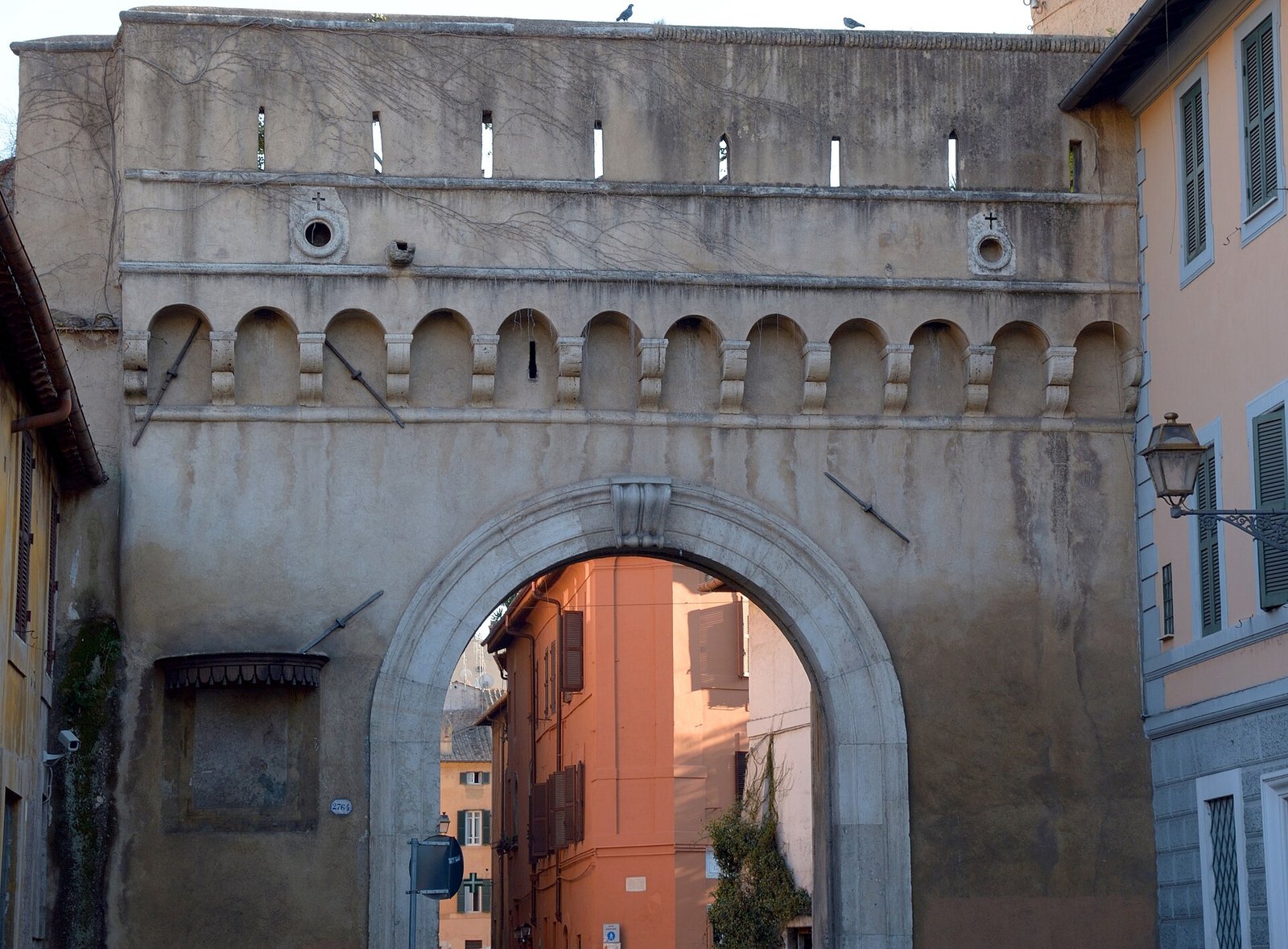
Porta Settimiana can be walked through for free, at any hour. It is at the start of Via della Lungara, in the Trastevere district, where the district's alleys pass under the arch and the long straight road toward Borgo and the Vatican opens up. It has no ticket office, no hours, no interior you can visit. The two sacred shrines painted on its fronts are looked after by the Capitoline Superintendency of Cultural Heritage.
It is a gate of the Aurelian Walls, born as a minor opening in the stretch that enclosed Trastevere on the right bank of the Tiber. What you see today, though, is not Roman. Pope Alexander VI Borgia had it rebuilt in 1498, with swallowtail battlements, and Pius VI fixed it up for the last time in 1798. Since the 17th century it has defended nothing: it is an arch inside the city.
Data checked on September 29, 2026 on the Rome city tourist portal, on the Virtual Museum of the Walls of Rome run by Roma Capitale and on the Capitoline Superintendency pages dedicated to the gate's two shrines. For the gate you don't need to book anything. To ask for information on the monument and on nearby municipal sites, the contact given by the tourist portal is the contact center 060608. The hours reported for the nearby museums come from the websites of their respective operators.
At a glance: address, hours, ticket
- Where: at the start of Via della Lungara, Rome, Trastevere district, between Via di Porta Settimiana and Via di Santa Dorotea.
- Operator: Capitoline Superintendency of Cultural Heritage, indicated as the operator of the gate's sacred shrines.
- How to get in: you don't. You walk through the gate and look at it from the street, from both sides.
- Price: free, no reservation.
- Hours: none, it is an opening on a public street open day and night.
- How to get there: buses 23 and 280, Via della Lungara stop, indicated by the official Villa Farnesina site, or on foot from Ponte Sisto.
- Information: Roma Capitale contact center 060608.
Where it is and what you really see
The gate closes off to the north the densest part of Trastevere. On one side come Via della Scala, from the area of Piazza di Santa Maria in Trastevere, and Via di Santa Dorotea, from the area of Ponte Sisto. On the other side opens Via della Lungara, straight and long, with the palaces and villas of the 16th century. The Roma Capitale tourist portal describes it as the link between Trastevere and Borgo.
The monument is recognizable from afar. It is a single arch, that is a single archway, topped by a row of corbels, the stone brackets that once supported a projecting walkway for defense. Above is an attic. According to the Virtual Museum of the Walls of Rome, on the outer facade, toward the Lungara, the attic has arrow slits, while on the inner facade, toward Trastevere, it is crowned with Ghibelline battlements, the ones with swallowtail points.
The difference between the two fronts is the first thing to look for. Whoever arrives from Trastevere sees the battlements, and the gate looks like a piece of castle slipped in among the houses. Whoever arrives from the Lungara sees instead the molded arch, that is framed by a raised profile, and the more closed attic. They are two faces of the same construction, designed for two different audiences: the city on one side, the pilgrims' road on the other.
On the western side the tower that defended the opening is preserved. The Virtual Museum of the Walls of Rome indicates it as a single one, not double as in the major gates of the circuit. Inside the archway the operator notes the travertine facing toward the city and the grooves in which the defensive grating slid. Walking under the arch slowly, the portcullis grooves can still be seen on both sides.
On the two fronts, at the sides of the arch, two sacred shrines remain with their small wooden roofs. The inner one, toward Trastevere, still shows a fresco with the Agony in the Garden. The outer one, toward the Lungara, has lost its painting and keeps only the frame and the canopy. They are tiny details compared with the mass of the gate, and for that very reason most people passing by don't even notice them.
Around the gate the district changes face within a few meters. Toward the south there are narrow alleys, low houses, doorways and shops, and in the evening a lot of foot traffic. Toward the north the Lungara widens, the sidewalks become more regular and the walls of the great complexes appear: Villa Farnesina, Palazzo Corsini, the gardens that climb to the Janiculum. The gate still marks the passage between the two worlds.
For people with mobility difficulties the gate presents no particular barriers: it is a passage on the street, at the same level as the surrounding alleys. The Roma Capitale tourist portal, for services and information on accessibility, refers to the Accessible Rome section of its site. The district's streets, however, are largely paved with cobbles and uneven, and under the arch there is no sidewalk. With a wheelchair or a stroller it's best to arrive from the Lungara, where the surface is more regular.
A curiosity about Porta Settimiana
The fortress look is a late addition, almost scenographic. When Pius VI restored it, in 1798, the gate had had no military function for over a century and a half. The encyclopedia entry on the gate notes that the work preserved a military look that is hard to understand for an opening now inside a city neighborhood. The battlements and arrow slits you photograph today, in short, have never seen a siege in their present form.
It is explained by the history of the walls. In 1643 the new Janiculum walls ordered by Pope Urban VIII enclosed Trastevere and the Janiculum in a wider circuit, and the old Aurelian gate found itself inside the city. The Virtual Museum of the Walls of Rome puts it bluntly: from then on Porta Settimiana remained a simple internal arch. And yet, a century and a half later, the pope chose to restore it as a gate of war.
In our judgment this is precisely the beauty of the monument. It is a gate that plays the part of a gate. The Ghibelline battlements serve no purpose, the arrow slits look onto a through street, the walkway on the corbels no longer exists. But the whole keeps telling whoever arrives that here the city ended and the countryside began, even though the countryside has vanished for centuries and beyond the arch there are palaces and museums.
Whoever wants to catch the curiosity at a glance should look at the gate from Via di Porta Settimiana side, inside Trastevere. From there the battlements stand out against the sky and the gate seems taller than it is. Then it's best to pass under and turn around on the Lungara side: the military effect almost disappears, and what remains is an elegant arch of pale stone, closer to a villa entrance than to a bastion.
One thing nobody tells you about Porta Settimiana
The gate's two shrines are not just any decoration. The Capitoline Superintendency links them to a 16th-century decorative cycle designed for those traveling the road to the Vatican. Whoever left Trastevere and took the pilgrims' road found a sacred image on the gate, and found another on the way back. The Lungara was then a road of devotion before being a residential street, and the gate was its entrance.
The shrine on the inner front preserves the fresco of the Agony in the Garden. The Superintendency describes it precisely: Christ in the foreground, kneeling with hands joined, an angel at upper right carrying the cross and the chalice, and the three apostles Peter, James and John asleep among the rocks. The whole is protected by a wooden canopy with fringes and tassels. The painting underwent restorations in 1973-74, with the replacement of the support, in 1993 and in 2006.
The contrary view, in our judgment, is this: the Fornarina's window on Via di Santa Dorotea is overrated as a reason to come all the way here. It is a tradition, tied to a house that other traditions place elsewhere, and almost everyone stops in front of that window. The gate's two shrines, on the other hand, are documented, dated and restored several times, and go ignored. It's better to give them the time that usually goes to the window.
The date of the inner fresco also has a small story. The Capitoline Superintendency places it in the second half of the 16th century and specifies that in the past it was attributed to the 17th. The Virtual Museum of the Walls of Rome, instead, still indicates it as a work of the 17th century. The sources do not agree, then, and the difference is not small: a century separates the Rome of the Borgias and Julius II from that of Urban VIII, who would take away the gate's role.
The outer shrine tells instead a story of loss. According to the Superintendency, it is on the outer front, to the left of the archway, and held a 16th-century Holy Family. The painting is gone. What remains are the original rectangular frame and the wooden covering of the canopy, datable between the 18th and 19th centuries. The Governorate of Rome intervened in 1931, and other restorations followed in 1994 and 2006, but the image was not saved.
Where does the name Porta Settimiana come from?
The sources do not agree, and there are three hypotheses. The Virtual Museum of the Walls of Rome ties the name to the baths of Septimius Severus that were in Trastevere and that probably fell into disuse precisely because of the construction of the walls. The encyclopedia entry on the gate proposes instead, more generically, the proximity of a monument from the age of Septimius Severus, perhaps an aqueduct arch or the Horti Getae.
The Horti Getae were the gardens of Publius Septimius Geta, son of the emperor. According to the sources on the district, the whole area took the name Septimianum for this reason, and the gate could originally have been the entrance of the gardens or of the nearby baths. These are hypotheses consistent with one another, all pointing to the Severan family, but none is confirmed by an ancient inscription remaining on the monument.
The third explanation is a legend. The encyclopedia entry reports a medieval tradition according to which Octavian had erected here seven praises to Janus, septem Iano laudes, near the god's temple, hence the gate's name. It is a story built after the fact on a name that was no longer understood. Janus, besides, was tied to the Janiculum that overlooks the gate, and the play on words was too convenient not to arise.
The same entry also recalls a hypothesis linked to position, that is the gate as the northern vertex in relation to a sanctuary of Janus. For the visitor, the practical conclusion is simple. The name almost certainly comes from the Severans, emperors of the late 2nd and early 3rd century, who had built baths and gardens in this part of the city. The seven praises to Janus should be told as legend, and nothing more.
My advice for visiting Porta Settimiana
The advice is to pass through it twice, in opposite directions, and to stop each time 20 or so steps before the arch. You arrive from Via di Santa Dorotea or from Via della Scala, look at the battlements and the shrine of the Agony in the Garden, pass under the archway looking for the grooves of the grating, then stop on the Lungara and turn around for the outer front with the molded arch and the empty shrine.
For the gate 15 minutes are enough. The rest of the time goes to what surrounds it, and there is a lot. A few minutes on foot away are Villa Farnesina and Palazzo Corsini along the Lungara, Santa Maria della Scala toward Trastevere, and the climb to the Janiculum. Porta Settimiana works better as the hinge of a morning than as a destination in itself.
Whoever wants to pair the gate with Villa Farnesina must organize the day around the villa's hours, not the gate's. According to the official site the Farnesina opens in the morning Monday to Saturday and closes on Sunday, except the second Sunday of the month, when it stays open until 17:00. A good sequence is therefore the Farnesina at 9:00, the gate and Trastevere mid-morning, lunch, and the Janiculum in the afternoon, when the light on the city is warmer.
The best moment is early morning on a weekday. The alleys of Trastevere are still quiet, the café tables don't take over the street and the light comes in raking across the houses. After sunset the arch remains passable, but the foot traffic is constant, the battlements are hard to read against the dark sky and the shrine fresco almost disappears. To really look at the gate you need daylight.
It's also worth paying attention to the street. The archway is narrow and under the arch the sidewalk practically doesn't exist. Whoever stops to photograph in the middle of the passage gets in the way of people walking and of the neighborhood's vehicles. The rule is simple: take photos from the sides, just before or just after the gate, and pass under the arch without stopping, looking up only when the road is clear.
Do you pay anything and can you go inside?
You pay nothing and book nothing. The gate is a passage on a public street, open day and night, and it is looked at from the street. The tower and the interior spaces do not appear to be open to the public, and the operator does not indicate visits to the gate's rooms. There is no ticket and no sales channel: Trastevere tour offers that mention Porta Settimiana do not give access to closed spaces.
Anyone who wants to pair it with a paid museum will find on the Lungara Villa Farnesina, at Via della Lungara 230. According to the villa's official site, since February 16, 2026 it is open Monday to Saturday from 9:00 to 14:00, with last entry at 13:15, and on the second Sunday of the month from 9:00 to 17:00. On the other Sundays it is closed. The full ticket costs €12, the reduced €10, and it is free for children up to 10 years old.
For reservations the villa gives the phone 06 68027268, for general information 06 68027242. Extraordinary openings outside hours must be requested at least 15 days in advance, with advance payment and a maximum stay of two hours, according to the conditions published by the operator. For information on the gate and on the municipal sites of the area the right channel remains the Roma Capitale contact center, 060608.
Another well-known fact, yet rarely cited
That the Lungara was the road of the pilgrims headed to St. Peter's is well known. Less often mentioned is that the gate was restored precisely for them, long before the Borgia reconstruction. The tourism portal of Roma Capitale notes that in 1451 Pope Nicholas V had the gate restored to ease the passage of pilgrims, and the encyclopedia entry adds that the restoration also covered the road. The year before, the Jubilee of 1450 had been celebrated.
The Capitoline Superintendency calls this medieval road via Sancta. The name says it all: it was not just any street, but the route that led from Trastevere to the tomb of the apostle without crossing the river. According to the sources on the rione, by the end of the 14th century there were already rules for keeping the road and the gate clean. The decorum of the route was a matter of the city's image toward those arriving from afar.
The reconstruction by Alexander VI, in 1498, also falls on the eve of a Jubilee, the one of 1500. The sources don't explicitly link the two facts, but the dates speak for themselves: the pope was rebuilding the entrance of the pilgrims' road two years before the Holy Year. Soon after, under Julius II, the road was redesigned and the area filled with villas, and the route of devotion became a prestigious address as well.
Today the Lungara has almost entirely lost its role as a pilgrims' road. People going to St. Peter's from Trastevere take other streets, and the gate is crossed mostly by those going to the Farnesina, to Palazzo Corsini or to the Botanical Garden. Yet the route is the same, straight and long, and walking it all the way to Borgo is still the best way to understand why, for centuries, the gate made sense.
There is one last aspect, often overlooked. For those arriving on foot from the south, the gate was also a border between two landscapes: inside, the inhabited rione and its trades, outside, the vegetable gardens, the vineyards and the first villas. The Virtual Museum of the Walls of Rome notes that only under Julius II did the area outside the gate become residential. Before then, leaving through Porta Settimiana meant leaving the city and walking toward St. Peter's through open countryside.
The right photo to take at Porta Settimiana
The photo that tells the story of the gate is taken from the Trastevere side, at the crossing of via di Porta Settimiana and via di Santa Dorotea, about 30 steps from the arch. The frame takes in the swallowtail battlements, the row of corbels, the arch and the Orazione shrine in the vegetable garden, with the houses of the rione on either side. It works in the morning, when the light comes from the east and hits the inner front.
The second photo is the one nobody takes: the outer front, from the Lungara, with the perspective of the road behind you. Here the gate looks plainer, with the molded arch and the attic with its arrow slits. Putting the two images side by side, you immediately grasp the double face of the monument. In the afternoon the light from the west lights this side better, and the pale stone takes on color.
The detail not to overlook is the inner shrine. You need your phone's zoom, because the fresco is small and set high up, and you need a bright day. Look for the angel at the top right with the cross and the chalice, and the sleeping apostles at the bottom. On the outer front, instead, the photo of the empty shrine, with the frame and the canopy left without a painting, tells well what is lost when a sacred image stays outdoors for centuries.
One last option is the photo from via di Santa Dorotea with the gate in the background and the arched window of number 20 in the foreground. It's the image that holds together the gate and the tradition of the Fornarina. The rule applies to every shot: no photos in the middle of the roadway under the arch, and respect for the people who live in the houses around, who live this crossing every day.
How do you get there from central Rome?
The most pleasant route is on foot from Campo de' Fiori. You go down toward the river passing through Piazza Farnese, take the last stretch of Via Giulia with the Fontana del Mascherone, then cross Ponte Sisto. On the other side, in Piazza Trilussa, you take Via di Ponte Sisto and reach Via di Santa Dorotea, which leads straight to the gate.
From Piazza di Santa Maria in Trastevere the most direct route goes through Piazza di Sant'Egidio and continues on Via della Scala, which runs north, passes in front of the church of Santa Maria della Scala and comes out right in front of the gate. It's a few minutes' walk through lively alleys. If you're coming from the Janiculum, you instead go down Via Garibaldi, which from the area of San Pietro in Montorio reaches the upper part of Trastevere, a few minutes from the gate.
By public transport, the official website of Villa Farnesina lists bus lines 23 and 280 stopping on Via della Lungara, that is on the lungotevere a few steps from the gate. Routes and stops can change because of works and events, and it's best to check them on the ATAC website the same day. If you're coming from St. Peter's, you can also do the route the other way around, on foot along the whole Lungara, entering Trastevere through the gate.
By car the visit isn't worth it. Trastevere is a limited traffic zone, parking is very scarce and the streets around the gate are narrow and crowded with pedestrians. If you're coming from outside Rome, you're better off leaving the car near a subway or train station and continuing by public transport. By bicycle the area is easy to reach from the lungotevere, but in the alleys and under the arch it's best to get off and walk.
Some important events that happened here in history
The first event is the construction of the Aurelian Walls, in the 270s. On the right bank of the Tiber the circuit enclosed a triangular area that included Trastevere, and the gate was its northern vertex, toward the Vatican hill. The Virtual Museum of the Walls of Rome classifies it among the minor gates. Its original form isn't known in detail, but it served to connect the district with the Vatican area.
In the Middle Ages the gate changed in importance. According to the Virtual Museum of the Walls of Rome it became the main route for pilgrims headed to St. Peter's. In 1451 Nicholas V had the gate and the road restored. Then, in 1498, Alexander VI Borgia rebuilt it completely, widening it and probably raising it above the original level, on a design probably attributable to Antonio da Sangallo the Elder.
The third step is the 16th century of Julius II, pope from 1503 to 1513. The Virtual Museum of the Walls of Rome notes that under him the Lungara area became residential, with villas and palaces of families such as the Chigi and the Riario. The gate, which until then opened onto vegetable gardens and vineyards, found itself introducing a luxury district. It is in these years that the villa of the banker Agostino Chigi was born, today Villa Farnesina.
The fourth event is the construction of the Janiculum walls. In 1643 Pope Urban VIII had a new circuit built that connected Trastevere to Borgo, including the Janiculum. The encyclopedia entry notes that those walls knocked down almost the whole stretch of the Aurelian circuit on the right bank of the river. Porta Settimiana remained standing, but enclosed inside the city. From that moment it lost every military role.
Then there is a church that still carries the name of the gate in its history. It is the church of Santi Silvestro e Dorotea, on the street that takes its name from the saint, a few steps from the arch. According to the sources on the rione, in 1123 it was recorded as San Silvestro a Porta Settimiana, and between 1750 and 1756 it was rebuilt by Giovanni Battista Nolli, the author of the famous plan of Rome. The gate, in short, gave its name to the buildings around it as well.
The last intervention dates to 1798, when Pius VI renovated it while keeping its warlike look. It is the gate we see today. In the 20th century attention shifted to the shrines: the Superintendency documents an intervention by the Governatorato di Roma in 1931 on the outer one, and then restorations in 1973-74, in 1993, in 1994 and in 2006 on the two sacred images. They are small works, but without them the inner fresco would be lost like the outer one.
Who passed through Porta Settimiana
The first name is that of Aurelian, who decided on the circuit in the 3rd century. Before him, in the area, the Severans had left their mark, with the baths and the gardens from which the name of the gate most likely comes. None of them left a legible signature on the present monument, but the gate keeps the mark of their era in the layout of the road and in the name itself.
Then come the popes. Nicholas V, who in 1451 had the gate and the road restored for the pilgrims. Alexander VI Borgia, who in 1498 rebuilt it from top to bottom. Julius II, who redesigned the road and made it a district of villas. Urban VIII, who in 1643 shut it inside the new walls. Pius VI, who in 1798 gave it its present look. Five popes in about three and a half centuries, for one passage arch.
There are also the names of architecture. The Virtual Museum of the Walls of Rome attributes the design of the 1498 reconstruction, with caution, to Antonio da Sangallo the Elder, a member of a family of Florentine architects very active in Rome. A few years later, along the same road, the Sienese banker Agostino Chigi had his villa built, and to decorate it he called the most sought-after painters of the moment, among them Raphael.
And then there are the pilgrims, nameless and very many. For centuries the gate was the point where those coming from Trastevere and the south left the district and set out toward St. Peter's. The two shrines, painted in the 16th century, were for them. There are no records of who passed through, but the restoration done for the pilgrims and the sacred images on the two fronts say how busy this passage was.
On the level of tradition, finally, there is the Fornarina. The tourism portal of Roma Capitale reports that on Via di Santa Dorotea, right behind the gate, Margherita Luti, model and companion of Raphael, is said to have lived, and that her decorated arched window is still visible at number 20. The portal presents the news as a tradition, and that is how it should be read. But it is the name that, more than any other, ties the gate today to the imagination of those who visit Trastevere.
Did the Fornarina really live here? Documents, tradition and legend
What the documents say mostly concerns the painting. Raphael's Fornarina, dated 1518-1519, is in the Galleria Nazionale d'Arte Antica in Palazzo Barberini. On the armband on the woman's left arm the painter wrote his own name, RAPHAEL VRBINAS. It is a painted inscription, and it signs the work. On the identity of the woman portrayed, instead, the documents are silent.
What tradition says is that the woman in the portrait was Margherita Luti, daughter of a baker from Trastevere, hence the nickname Fornarina, and that she lived in the 15th-century house at number 20 of Via di Santa Dorotea, at the corner with Via di Porta Settimiana. According to the sources on the rione, the house has a window framed by a richly decorated pointed arch. Tradition has her leaning out there to greet the painter.
Tradition, however, is not just one. The same sources on the rione note that other traditions place the Fornarina's house on Via del Cedro, also in Trastevere, or on Via del Governo Vecchio, on the other side of the river. Three addresses for the same woman are a clear signal. The house on Via di Santa Dorotea has in its favor the most beautiful window and the position next to the gate, but this doesn't make it better documented than the others.
Then there is the legend, which is the story of the tormented love between the painter and the baker's daughter, enriched over the centuries with jealousies, escapes and intrigues with the powerful of the era. The encyclopedia entry on the painting notes that the identification of the model has been questioned, and that some scholars see in the painting an ideal of female beauty or the portrait of a courtesan, rather than a specific person.
Investigations of the painting add a curious detail. According to the same entry, X-rays showed that Raphael had originally painted a landscape background in the manner of Leonardo, later covered with a myrtle bush, a plant sacred to Venus. It's a clue in favor of those who read the painting as an image of beauty and love, rather than as a portrait of a next-door neighbor. To learn more, see our page on Raphael in Rome.
In front of the window on Via di Santa Dorotea, then, it's best to keep the three levels separate. The painting and the signature are documents. The Fornarina's house is a tradition, old and shared by several addresses. The thwarted love is legend, built on very few facts. Mixing them adds nothing to the visit. The window is still lovely to look at even without believing it, and the gate, a few meters away, has a much more solidly documented history.
Porta Settimiana among the gates of the right bank: what is left?
On the right bank of the Tiber the Aurelian Walls had three gates. The encyclopedia entry notes that Porta Settimiana is the only one of the three that remained in its original place after the later transformations. The other two, according to the sources on the rione, were Porta Aurelia, on the top of the Janiculum, and Porta Portuensis, toward the river port. Both were replaced or moved with the construction of the walls of Urban VIII.
For this reason Porta Settimiana is the only point in Trastevere where you can see an Aurelian gate in the place where it was born. Its look is Renaissance and 18th-century, but the position is the ancient one. If you're looking for the Roman form of the gates, you have to go elsewhere: to Porta Latina, to Porta San Sebastiano with the Museum of the Walls, or to Porta Asinaria.
Comparison with the other gates of the circuit helps to understand the variety of solutions. Porta del Popolo was turned into a monumental facade, Porta Pia got a design by Michelangelo, Porta Maggiore absorbed the aqueducts, Porta San Paolo stands next to the Pyramid of Cestius. Porta Settimiana took another road: it became a neighborhood gate, with 15th-century battlements.
The minor gates are also a good point of comparison. Porta Metronia and Porta Tiburtina show how a secondary opening could have very different fates. If you want to line up several gates in a day, you have a long but instructive tour ahead. For the general picture of the circuit there is our page on the Aurelian Walls, and for the most ancient circuit the one on the Servian Walls.
The difference between major and minor gates is not only a matter of size. The main gates of the Aurelian circuit, on the great consular roads, usually had two towers and a wide arch, designed for cart traffic. The minor gates served local roads and districts, and had lighter defenses. Porta Settimiana belonged to this second family, and its single tower on the west side is still today its most evident sign.
What do you meet along the Lungara after the gate?
Just past the arch, the road changes pace. The Lungara runs almost straight north, parallel to the river, for a long stretch, and on both sides palaces, garden walls, convents and institutions alternate. It's a road to walk slowly, best in the morning, when the museums are open and traffic is still light. Those arriving from Trastevere have the impression of leaving the rione and entering another city.
The first big name is Villa Farnesina, on the river side, at Via della Lungara 230. It's the villa that the banker Agostino Chigi had built at the beginning of the 16th century, when Julius II turned the area into a district of residences. Opposite, on the other side of the road, stands Palazzo Corsini, home of part of the Gallerie Nazionali d'Arte Antica. They are two different visits, one of frescoes and one of paintings, and they can be done in the same morning.
Behind Palazzo Corsini, going up toward the Janiculum, extends the Botanical Garden of Rome, with its sloping gardens. The sources on the rione note that right near the Garden, around 1900, remains attributed to the baths of the Severans were found, the ones that might have given the gate its name. The link between the gate and this part of the road, in short, is ancient, and doesn't concern only the pilgrims of the Middle Ages.
Farther on, the Lungara continues between convents and institutes to Sant'Onofrio al Gianicolo and the edge of Borgo, where the pilgrims' road ended. Reaching St. Peter's from Porta Settimiana following the whole old route doesn't take great effort, but it's best done without hurry, stopping in front of the portals and the gardens. It's one of the few walks in the center where you walk a long way without meeting crowds, at least until the last stretch toward the colonnade.
When is it hard to see, and what not to expect?
The gate never closes, but there are times when it's hard to see. In the evening, especially on weekends, the crossing fills with people headed to the Trastevere venues, and stopping to look becomes difficult. The central hours of summer days are also poorly suited: the light is flat, the battlements cast no shadow and the shrine fresco blends into the plaster. Morning remains the right time.
Don't expect detailed panels, a visitor center or a signposted route. Porta Settimiana is a monument on the street, and the story has to be brought along. Don't expect either to climb the tower or enter the spaces of the gate: they are not listed as open to the public. The operator doesn't publish news of ongoing works on the gate, but barriers or scaffolding may appear for works on nearby buildings or on the road.
The outer fresco also disappoints those who don't know what to expect. The Superintendency confirms it: of the painting with the Holy Family, datable to the 16th century, nothing remains, and only the original rectangular frame and the wooden canopy of the 18th-19th century survive. It is the shrine on the inner front that still keeps a legible image. Those looking for two frescoes will find only one, and it's best to know it beforehand.
The nearby places also have limits worth knowing. Villa Farnesina, according to the official website, is closed on Sunday except the second of the month, and on weekdays the last entry is at 13:15. If you arrive in the afternoon you find the gate, the Lungara and the Janiculum, but not the villa. For the museums and churches of the rione, hours often change on holidays and in summer, and it's best to check them on the operators' websites before leaving.
Eating near Porta Settimiana
Here the problem isn't finding a place, but choosing one. The area between Porta Settimiana, Piazza Trilussa and Santa Maria in Trastevere is one of the busiest in Rome in the evening, and the offer is huge. For this very reason it's best to recognize the signs that point to a place built for passing trade: photo menus in four languages, touts on the sidewalk, items without a price, a different menu inside and outside.
There are other signs, less obvious. Places open nonstop with no kitchen break, from morning to late at night, and the window with the lady rolling fresh pasta in front of passersby, a show meant for those walking by more than for those eating. Romans, in general, avoid the places facing the busiest streets of the rione, not out of snobbery but because they know that there the price adapts to whoever walks in and the customer rarely comes back.
The simplest solution is to move a few streets away from the main flows, toward the more residential part of Trastevere or toward the Lungara, where the evening traffic drops. On a nice day a packed lunch on the Janiculum, with water from the nasoni, remains an excellent alternative. To choose without surprises, a starting point is the list of addresses on Google Maps, with places selected across Rome and Lazio.
What to combine in a day
The natural pairing is the Lungara. Past the gate you meet Villa Farnesina, with the frescoes of the early 16th century, and opposite Palazzo Corsini with the Galleria Nazionale d'Arte Antica. Continuing north you reach Sant'Onofrio al Gianicolo and then Borgo, as far as St. Peter's Square and the basilica. It's the route of the old pilgrims' road, and it's all done on foot.
Toward Trastevere the pairing is with the churches and squares of the rione. From Via della Scala you reach the basilica of Santa Maria in Trastevere, then the Museo di Roma in Trastevere and, farther east, the basilica of Santa Cecilia. If you have time, go as far as the Tiber Island. Hours and tickets should be checked on the websites of the respective operators.
If you prefer the hill, climb the Janiculum from Via Garibaldi. You pass San Pietro in Montorio with the Tempietto del Bramante, reach the Acqua Paola Fountain and continue along the promenade with the view over the city. Higher up are the Museo della Repubblica Romana and, for those looking for green space, Villa Doria Pamphilj.
On the other side of the river, across Ponte Sisto, you return toward Via Giulia, with Santa Maria dell'Orazione e Morte, the Oratorio del Gonfalone and, at the end, the basilica of San Giovanni dei Fiorentini. For a picture of the rione there is the page on the 22 rioni of Rome, and for zero-cost ideas there is Free Rome, where Porta Settimiana has a place by full right.
Frequently asked questions
Do you pay for Porta Settimiana?
No. The gate is crossed and viewed from the street without a ticket and without a reservation, at any hour of the day and night. The sacred shrines on the two fronts are looked after by the Capitoline Superintendency for Cultural Heritage. For information on the monument and the nearby municipal sites, the tourism portal of Roma Capitale lists the contact center 060608. What you do pay for is Villa Farnesina, on the Lungara: €12 full price, €10 reduced.
Can you climb the tower or enter the gate?
No. The tower on the west side and the spaces of the gate are not listed as open to the public, and the operator lists no visits. The gate is viewed from outside, passing under the vault and stopping on the two sides. If you want to walk inside a gate of the Aurelian Walls, you have to go to the Museo delle Mura, inside Porta San Sebastiano, on the other side of the city, on the Appian Way.
Who built the gate we see today?
The opening dates to the Aurelian Walls, in the 3rd century, but the present look comes from the reconstruction ordered by Pope Alexander VI Borgia in 1498, on a design probably attributable to Antonio da Sangallo the Elder. Before that there had been a restoration by Nicholas V in 1451. The last intervention is by Pius VI, in 1798, who kept the military look of the gate even though it no longer defended anything.
Why is it called Settimiana?
Almost certainly for the Severans. The Virtual Museum of the Walls of Rome links the name to the baths of Septimius Severus that stood in Trastevere. The encyclopedia entry speaks more generally of a monument from the age of the Severans, perhaps an aqueduct arch or the gardens of Geta, the emperor's son. A medieval legend derived it from seven praises of Janus erected by Octavian, but it is a story with no foundation.
Where is the Fornarina's house?
According to the tradition reported by the tourism portal of Roma Capitale, on Via di Santa Dorotea, right behind the gate, at number 20, where you see a decorated arched window. It is a tradition and not a documented fact. Other traditions place the house on Via del Cedro or on Via del Governo Vecchio. The portrait of the Fornarina painted by Raphael is in Palazzo Barberini, in the Galleria Nazionale d'Arte Antica.
What do the shrines on the gate depict?
The one on the inner front, toward Trastevere, shows the Agony in the Garden: Christ kneeling in prayer, an angel with the cross and the chalice, the three sleeping apostles. The Superintendency dates it to the second half of the 16th century, while the Virtual Museum of the Walls lists it as 17th-century. The one on the outer front, toward the Lungara, contained a 16th-century Holy Family, now lost: the frame and the canopy remain.
How much time do you need to see it?
For the gate, 15 minutes are enough, including the passage under the arch and a stop on the two sides for the battlements, the shrines and the molded arch. With the Fornarina's window and a walk along the Lungara to Villa Farnesina you need an hour. If you add the visit to the villa, which closes at 14:00 on weekdays according to the official website, count on at least another hour and arrive early.
Can you drive under Porta Settimiana?
The area is part of the center of Trastevere, with limited access for cars, and it's not worth coming by car. The gate is experienced on foot, and under the vault there is little room for pedestrians. If you arrive by public transport you find lines 23 and 280 stopping on Via della Lungara, according to the Villa Farnesina website. Before leaving it's best to check routes and detours on the ATAC website.
Who wrote this and on which sources
The text comes from the editorial team of Tour Leader Pro, the Rome-based outfit that designs itineraries, visits and cultural events across Rome and Lazio. Fares, hours and booking procedures given here come from the official sources cited in the text, as of the date indicated at the top: the pages of the Capitoline Superintendency on the shrines, the tourism portal and the Virtual Museum of the Walls of Roma Capitale, the Villa Farnesina website. Tell us what you find changed.
Organizing a visit to Porta Settimiana, for yourself or for a group, mostly means choosing the right time, avoiding the crowded weekend evenings, and building around the gate a route that holds together Trastevere, the Lungara and the Janiculum. If you add Villa Farnesina, you have to allow for the afternoon closing and the Sundays. For those who organize group trips to Rome, a useful resource is Tour Leader Pro.
The Aurelian Walls are only one chapter in the long history of the fortifications of Rome and Lazio, which continues with the 17th-century Janiculum walls, the fortresses of the Castelli Romani and the walls of the villages an hour from the capital. If you want to look beyond the city, you'll find many other gates to discover in the region. To put together a multi-day trip, a useful resource for building an itinerary is Italy Planner.