Porta Asinaria
In short. Porta Asinaria has been closed to the public since August 1, 2024 for the works funded by the PNRR, and today it can only be viewed from outside, for free, from the square.
Porta Asinaria has been closed to the public since August 1, 2024 for the works funded by the PNRR, and today it can only be viewed from outside, for free, from the square. It is in Piazza di Porta San Giovanni, in Rome, next to the 16th-century gate that everyone goes through and a few steps from the facade of the Basilica of Saint John Lateran. It is run by the Sovrintendenza Capitolina, which when the site is open charges €4 full price and €3 reduced, with reservation at 060608.
It is one of the best-preserved gates of the Aurelian Walls. Born at the end of the 3rd century as a secondary passage, it was transformed at the beginning of the 5th century into a monumental gate with two large semicircular towers, an inner gate and a guard courtyard. Through here Belisarius entered the city in 536, the Goths of Totila in 546 and Henry IV in 1084. It was closed in 1574, when the nearby Porta San Giovanni was opened, and remained buried for centuries.
Data checked on September 29, 2026 on the page of the Sovrintendenza Capitolina dedicated to the monument, on the tourist portal of Roma Capitale, on the city's construction-sites portal and in the local press of July 2026. The site is still closed. The PNRR project on the walls between San Giovanni and Santa Croce in Gerusalemme gives the end of the works as expected in the third quarter of 2026 and provides for interventions to make the towers and the interior spaces accessible. A reopening date is not published.
In Brief: Address, Hours, Ticket
- Where: Piazza di Porta San Giovanni, Rome, next to Porta San Giovanni and the Lateran basilica.
- Manager: Sovrintendenza Capitolina ai Beni Culturali, Piazza Lovatelli 35, contact center 060608.
- Status: closed to the public since August 1, 2024 for the PNRR works. Reopening date not published by the manager.
- Price when open: full €4, reduced €3, free for residents of Rome and the metropolitan area and for holders of the MIC card.
- Reservation: required at 060608, every day from 9 to 19. Groups up to 25 people. The guided tour is not included in the ticket.
- How to get there: metro A and metro C, San Giovanni station, with a transfer between the two lines.
Where It Is and What You Really See
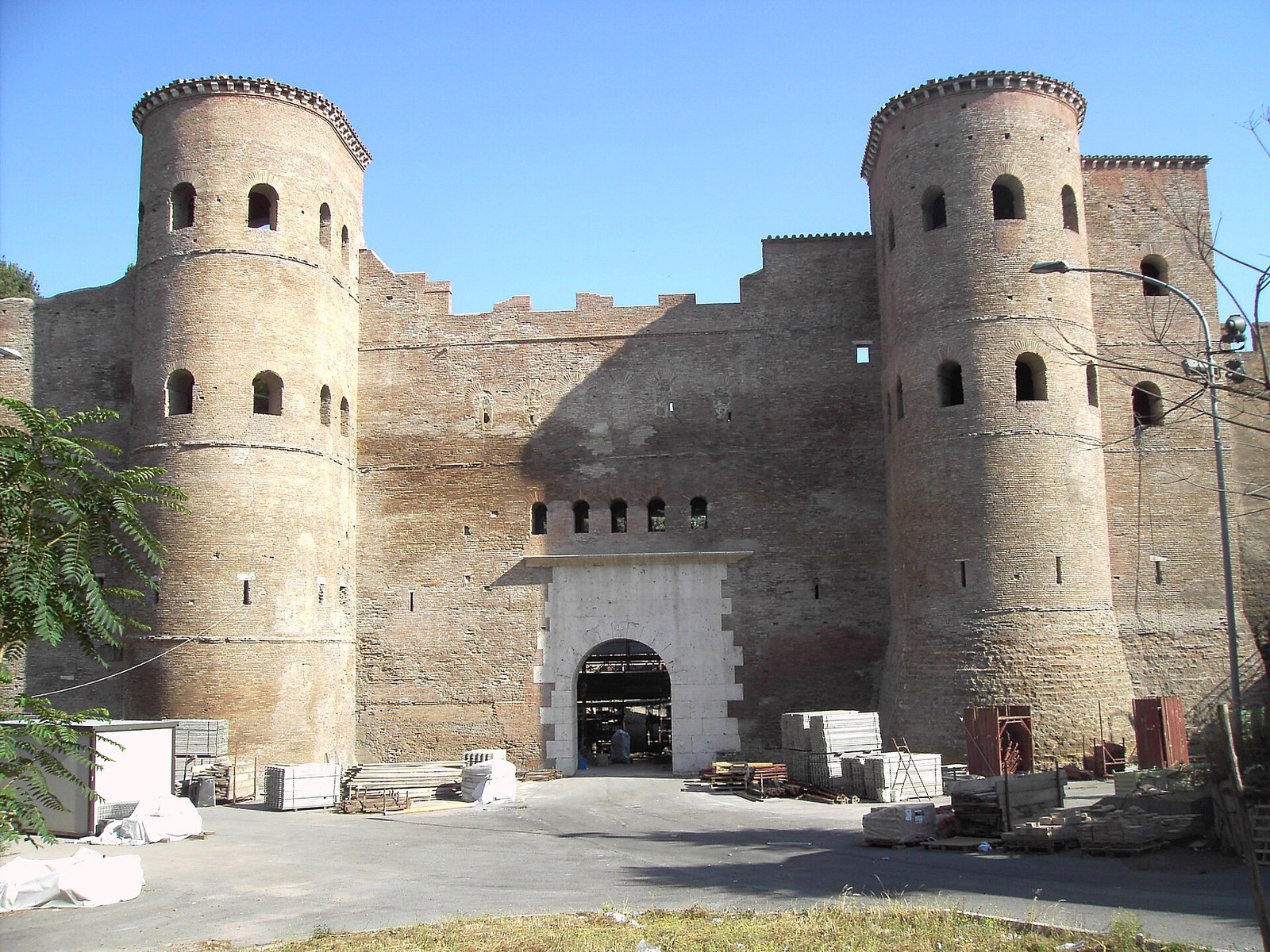
Anyone arriving in Piazza di Porta San Giovanni has the facade of the basilica on one side and the walls on the other, opened by the large 16th-century arch of Porta San Giovanni, with traffic passing under it. Porta Asinaria is right next to it, a few meters away. You recognize it by the two round brick towers, much taller and more massive than the modern arch, and by the fact that its passage opens lower than the level of the square.
That difference in level is the first clue to its history. According to the encyclopedia entry on the gate, the street level around rose by about 9 meters over the centuries, until the passage became unusable. In the 1950s the restorations freed the structure from the accumulated earth, and the gate showed itself again almost in full. That is why today you look at it a bit from above, as if it had been excavated, and in fact it was.
The two semicircular towers are the most evident part. The Sovrintendenza Capitolina describes them on four floors, with arched windows on the upper floors and the two lower ones blind, that is without openings. The floors are marked by two or three rows of bricks that stick out from the wall, like thin cornices. At the center, between the towers, is the body of the gate with a single opening, the arched passage, faced with travertine. Next to it you also see two smaller quadrangular towers.
The quadrangular towers were the stairwells. The Sovrintendenza notes that loopholes open in them, the narrow slits from which one shot without exposing oneself. Behind the outer front, toward the city, were the inner gate and the guard courtyard, an enclosed space in which whoever entered found themselves squeezed between two barriers. From the square, with the site closed, this inner part can only be partly guessed. The rest is understood from the descriptions published by the manager.
Today around the gate there is an iron fence. The local press, in July 2026, described it as a heavy barrier put up to prevent nighttime bivouacs, and spoke of a monument left in half-light and surrounded by asphalt. It is an unflattering but realistic picture. Anyone expecting a well-kept archaeological area with routes and panels will instead find a fenced monument in the middle of a busy square, waiting for the end of the works.
The context, though, helps to read it. On one side is the Lateran complex, with the basilica, the Lateran Palace, the obelisk and the Holy Stairs. On the other runs the stretch of walls that goes toward Holy Cross in Jerusalem along viale Carlo Felice. The gate stands exactly at the point where the seat of the popes touched the city wall, and this closeness explains almost everything that happened to it.
A Curiosity About Porta Asinaria
Porta Asinaria puts together two tower forms that elsewhere don't coexist. According to the encyclopedia entry on the gate, it is the only one among the ancient gates of Rome to have both cylindrical towers and quadrangular towers at the same time. The first, about 20 meters tall, are the large round towers that flank the passage. The second, lower, held the stairs. It is a detail that is easy to see even from outside, if you look at the gate from the side and not only head-on.
The combination has a practical reason. The round towers were made to resist and to give the defenders fire in more directions. The square ones served to climb quickly to the floors and the walkways, and for this they had narrow loopholes. The result is a gate that seems built in two different phases, and in part it is, because the current form is the product of the works of the emperor Honorius over an older and more modest passage.
The gate was also a belvedere over the Lateran. In the extraordinary opening of 2019, the Sovrintendenza Capitolina presented as the highlight of the visit the chance to see the Lateran basilica from the top of one of the towers. From the square the facade is seen from below, squeezed between traffic and barriers. From up there, instead, you understand the geometry of the place: the pope's cathedral on one side, the city's wall on the other, a few dozen meters apart.
Not by chance, in the Middle Ages the gate changed its name. The Sovrintendenza notes that it was known as Porta Lateranensis or Porta S. Johannis Laterani, that is the gate of San Giovanni in Laterano. The ancient name survived in documents, but for those living in Rome this was simply the gate of the Lateran. It is the same name that, with the closure of 1574, passed to the new gate opened next to it, the one everyone today calls Porta San Giovanni.
Something Nobody Tells You About Porta Asinaria
The earth that buried it also saved it. The encyclopedia entry on the gate observes that the progressive burial made it possible to preserve the inner fortification, that is the inner gate and the guard courtyard, which in other gates were demolished to let roads through. Here nobody had an interest in tearing them down, because after 1574 the gate was no longer needed. It remained closed and covered, and meanwhile the rest of the city changed.
The result is that Porta Asinaria, together with Porta San Paolo, keeps the look of an autonomous defensive work, a small fort more than a simple gap in the wall. The same encyclopedia entry makes this comparison with the Porta Ostiense. Anyone who has visited the Museo delle Mura inside Porta San Sebastiano has a good term of comparison, because there too the gate is a building with rooms, stairs and walkways, not a simple arch.
The contrary position, in our judgment, is this: Porta San Giovanni, under which the traffic headed for the Appia Nuova passes every day, is overrated as a monument. It is a 16th-century arch without towers and without defenses, conceived more as the entrance of a villa than as a military gate, as the encyclopedia entry on it also notes. The real gate of the Lateran is the one next to it, lower and less lit, which almost everyone glances at while waiting for the bus.
There is also a frequent error in photos and descriptions online: mistaking one gate for the other. Porta San Giovanni is the modern arch with the rustication, that is the blocks in relief, and the traffic underneath. Porta Asinaria is the ancient one with the round towers, lower down and fenced. In photos shared online it happens that they are swapped. Just remember the towers: where there are towers, there is the ancient gate.
How Did It Become a Monumental Gate?
At first it was a minor thing. The Sovrintendenza Capitolina explains that Porta Asinaria was born with the walls of Aurelian as a secondary passage, intended for local traffic. The encyclopedia entry defines it as a third-order opening, built between 270 and 273. It was not designed for a great consular road like the Appia or the Latina, but for a country road. For more than a century it remained a modest gap in the wall.
Its importance grew from the 4th century. According to the Sovrintendenza, the most likely reason is the closeness of the episcopal seat of the Lateran, that is the residence of the bishop of Rome next to the basilica founded by Constantine. A gate near the pope's house became a prestigious access, crossed by pilgrims, delegations and processions. Traffic increased, and with traffic the need to defend it better also increased.
The leap came with Honorius, at the beginning of the 5th century. The encyclopedia entry places the works in 401-402. The tourist portal of Roma Capitale writes that the emperor added the semicircular towers and widened the opening faced with travertine. The Sovrintendenza specifies that the inner gate and the guard courtyard were also built, and that the height almost doubled, with the towers going from two to four floors. The secondary gap thus became a gate proper.
The comparison with similar gates helps understand the result. The encyclopedia entry pairs the new Porta Asinaria with Porta Pinciana and Porta Metronia, which also began as minor passages and were then reinforced. The towers of the Asinaria, about 20 meters tall according to the same source, remain the clearest image of what it meant, for Rome at the beginning of the 5th century, to prepare for a siege.
My Advice for Visiting Porta Asinaria
My advice is not to count on the interior, for now. With the site closed since 2024 and no reopening date published, the visit is made from outside, and should be organized accordingly. Allow half an hour: a slow walk around the fence, a stop on the side of the square for the towers, and then the passage under Porta San Giovanni to see the stretch of walls toward viale Carlo Felice. The rest of the time goes to the Lateran.
Before going, it's best to call 060608 or check the monument's page on the Sovrintendenza Capitolina website. When the gate is open, the visit is by reservation, with a calendar for individuals and a maximum of 25 people for groups. The manager's page is the place where the closure or reopening notice appears first. The tourist portal of Roma Capitale carries the same notice, together with the email address info@060608.it.
Anyone who wants to see the interior must look at the extraordinary openings. In past years the Sovrintendenza opened Porta Asinaria on specific occasions: a morning of Open Days on November 23, 2019 reserved for holders of the MIC card, a visit for the European Heritage Days on September 25, 2022, an itinerary on the walls of the neighborhood on September 24, 2023. For 2025 and 2026 the manager indicates no openings of the gate, which stays closed for the construction site.
If the gate reopens, my advice is to book right away and to choose a visit that includes the towers. In the 2019 opening the Sovrintendenza promised the interior of the gate, one of the patrol walkways and the view of the Lateran basilica from the top of a tower. That is what makes the visit different from a stop in the square. Keep in mind that the guided visit, according to the manager, is not included in the admission ticket.
Can You Go In and How Much Does It Cost When It Reopens?
Today you can't go in. The page of the Sovrintendenza Capitolina warns that since August 1, 2024 the site has been temporarily closed to the public for the works provided by the PNRR, and the tourist portal of Roma Capitale repeats the same notice in the hours. There are no tickets on sale, either online or on site. The gate is viewed from the square and the sidewalk, without paying anything, at any hour of the day.
For tickets and reservations the only channel is the official one: the Porta Asinaria page on the Sovrintendenza Capitolina website and the contact center 060608, active every day from 9 to 19. There is no ticket for the gate sold by commercial platforms, and tour offers that mention Porta Asinaria don't give access to the interior until the manager reopens it. The rates published by the Sovrintendenza for when the site is open are these.
| Ticket type | Price |
|---|---|
| Full | €4 |
| Reduced | €3 |
| Residents of Rome and the metropolitan area, with ID | Free |
| Holders of the MIC card | Free |
The MIC card is the card of the Musei in Comune of Roma Capitale. In the extraordinary openings of past years the Sovrintendenza used it as the key to access, asking for the card number at the time of reservation. For those who don't have it and don't live in the metropolitan area, the full ticket remains low. The problem is not the price, but finding a date when the gate is really open.
The format of past openings gives an idea of what to expect. For the European Heritage Days of September 25, 2022 the Sovrintendenza had planned a 75-minute visit, starting at 9, with a maximum of 25 participants and led by the staff of Zètema Progetto Cultura. The itinerary of September 24, 2023 lasted an hour, started at 11:30 and accepted up to 30 people. In both cases the reservation at 060608 was required.
To go up inside a gate of the walls while the Asinaria is closed, there is the Museum of the Walls inside Porta San Sebastiano, at via di Porta San Sebastiano 18. According to the museum's official website it is open Tuesday to Sunday from 10 to 16, with last entry an hour before, and closed on Monday, May 1 and December 25. The museum admits a maximum of 20 visitors at a time, five per room.
Another Well-Known Fact, Yet Rarely Cited
That the gates of Rome also served to collect the toll is known. Less cited is how much this one brought in. The encyclopedia entry on the gate reports that in 1475 the contract for collection at Porta Asinaria was worth 74 florins and 19 soldi, a figure that indicates considerable traffic. The toll was leased to private parties through public auctions, and whoever won it collected on their own account on the goods entering the city.
There were tables with the rates for each good, but the same source notes that the collectors often committed abuses, so that many edicts were needed to curb them. It is a very concrete image of the gate in the 15th century: not a monument, but a checkpoint where people argued over the weight of loads and the amount to pay, with carters, peasants and merchants lined up in front of the arch, and some daily quarrel.
The habit was ancient. The encyclopedia entry recalls the discovery of toll stones of AD 175, markers that marked the administrative boundaries of the city where the customs offices operated, a century before the walls of Aurelian. A gate, for a Roman of the time, also meant a tax office, not only a defense against enemies.
The new Porta San Giovanni was also born for traffic reasons. The encyclopedia entry on it explains that it was made necessary by the reorganization of the Lateran area, to ease connections to and from the south of Italy. It served the via Campana, today via Appia Nuova. The old gate, too low compared with the new street level and by then congested, was closed. A matter of road layout, more than of defense, decided the end of Porta Asinaria.
The Right Photo to Take at Porta Asinaria
The photo that tells the gate is taken from the square, a bit above the passage, with the two round towers whole in the frame and the opening at the center. The difference in level is the key to the image: it shows how much the ground has risen around the monument. Step back just enough to let a piece of the walls on the sides in as well, so the gate appears for what it was, a gap in a continuous wall.
The second photo lines up the two gates. Moving to the side you can frame together the ancient towers and the 16th-century arch of Porta San Giovanni. It is the photo that resolves the mix-up between the two, and that shows the difference between a gate built to defend itself and an entrance built to let carts through. With traffic under the modern arch, it's best to wait for a red light to get a clean frame.
The third is a detail: the projecting bands of brick that mark the floors of the towers, and the arched windows on the upper floors. You need your phone's zoom or a long lens. Raking light, early in the morning or late in the afternoon, brings out the relief of the bricks, while with a high sun the surface flattens. Try at two times of day, because the faces of the towers get the sun at different hours.
A practical warning: the iron fence almost always gets into the frame from below. There is no way to avoid it entirely, and it must not be climbed over for any reason. Better to use it as a blurred foreground, or to raise the frame and leave it out by cutting the base of the towers. No photos in the middle of the roadway under Porta San Giovanni, where cars and buses pass at speed and there is little room for pedestrians.
How Do You Get There From the Center of Rome?
The simplest way is the metro. The San Giovanni station is served by line A and line C, and the Metro C company describes it as an important interchange node between the two lines, with the line C station at Largo Brindisi. From the stop it is a few minutes on foot, passing under Porta San Giovanni.
Anyone arriving from the Colosseum can walk along via di San Giovanni in Laterano, passing in front of the Basilica of San Clemente, and come out in the square in front of the facade of the Lateran basilica. It is a gently uphill walk, through a lived-in neighborhood. Alternatively you climb the Caelian Hill passing by the basilica of the Santi Quattro Coronati, a quieter street with less traffic.
From Santa Maria Maggiore the road is straight: via Merulana connects the two basilicas in a straight line and comes out in Piazza di San Giovanni. Along the street is Palazzo Merulana. Anyone coming from Termini station can take metro A, which reaches San Giovanni in a few minutes, or walk through the Esquiline Hill.
For the bus and tram lines that pass through Piazza di Porta San Giovanni, the advice is to check the updated route with Rome's public transport service or with 060608, because detours and construction often change the stops in this area. By car it's not worth it: the square is one of the heaviest traffic nodes in the city, and parking is difficult. On foot or by metro you arrive better.
Some Important Events That Happened Here in History
In December 536 Belisarius entered through Porta Asinaria, the Byzantine general who was reconquering Rome from the Goths. It is recalled by both the Sovrintendenza Capitolina and the tourist portal of Roma Capitale. The following year the gate was at the center of a political case: the encyclopedia entry reports that an alleged invitation to the Goths to enter from here cost Pope Silverius his deposition, on a charge of treason. From then on the gate had a reputation as a weak point.
The reputation as a weak gate was confirmed in 546. The account comes from Procopius of Caesarea, the Byzantine historian contemporary with the war, followed by the encyclopedia entry on the siege. Rome was defended by a garrison of about 3,000 men under the command of Bessas. The famine was very severe, with grain sold at very high prices. Four Isaurian soldiers made a deal with the Goths and, at night, on the night of December 17, let them climb up by ropes at Porta Asinaria.
The sequel also comes from the same source. Totila had a part of the walls torn down, a third according to the account, and stopped after receiving a letter from Belisarius urging him not to destroy the city. The deacon Pelagius negotiated with the Gothic king to obtain clemency for the inhabitants. Totila took the Roman senators away with him, and the city remained almost empty for a period.
On the details of the entry the sources do not fully agree. The encyclopedia entry on the siege speaks of ropes lowered from the walls. The one on the gate writes instead that the Goths found Porta Asinaria open, together with Porta San Paolo, and attributes to that sack the destruction of a third of the wall circuit. The two versions are not necessarily incompatible, but it's best not to turn them into a single scene, with the gate flung open and the enemies pouring in.
In our judgment the story says more about the city than about the gate. Rome in 546 was starving and reduced to few inhabitants, and four men of the garrison were enough to open the way to an army. The year after Belisarius's arrival, moreover, Pope Silverius had been accused of wanting to let the Goths in precisely from here. The gate had a reputation as a weak point, but the weak point was the men who guarded it.
In 1084 the emperor Henry IV and the antipope Clement III passed through here, come to drive out Pope Gregory VII. It is reported by the Sovrintendenza and the encyclopedia entry, which adds a heavy sequel: Robert Guiscard, who arrived to free Gregory, put the Lateran area to fire and sword, with serious damage to the gate and the nearby walls. In 1404 the king of Naples Ladislaus entered here, and in 1408 ordered its closure for the first time, for a month.
The definitive closure came in 1574, when Pope Gregory XIII opened the nearby Porta San Giovanni. The Sovrintendenza writes that the new gate was inaugurated the following year, and the tourist portal of Roma Capitale links it to the Jubilee of 1575. The inscription on the new gate, according to the encyclopedia entry, bears instead the date of 1574. The old gate, already buried, stayed closed until the 1950s: more than four centuries, according to the Sovrintendenza.
The 20th century gave it back. In the 1950s the restorations freed it from the earth, and the encyclopedia entry gives 1956 as the year of reopening, only as a pedestrian passage. Between 2004 and 2006, according to the Sovrintendenza, a new intervention cleaned and consolidated the outer wall curtains. Since August 1, 2024 the gate has been closed again, this time for the PNRR construction site that should make the towers and the interior spaces visitable.
Who Passed Through Porta Asinaria
The list is short but heavy. Belisarius in 536, Totila in 546, Henry IV in 1084 with the antipope Clement III, Ladislaus of Naples in 1404. The Sovrintendenza Capitolina cites three of them as decisive entries in the city's history. They are almost all arrivals of armies, at moments when Rome was changing masters. For a gate born as a secondary passage, it is a surprising list.
Then there are the ordinary passages, far more frequent. For centuries the gate was the exit of the Lateran toward the countryside to the southeast. The encyclopedia entry recalls that inside the walls the road continued as Via Santa, the route that connected the Lateran to Saint Peter's basilica. For those arriving from the countryside to the southeast, it was the most direct road to the pope's cathedral, and daily traffic of goods and people passed through here.
After 1956 the gate went back to being crossed, on foot. In recent years, before the closure, visitors passed mostly during the Sovrintendenza's openings. In September 2023 the itinerary on the neighborhood's walls started right from here, with a meeting point in front of the monument to Saint Francis of Assisi, opposite the basilica. The visit was free, with only the admission ticket according to the rate in force, limited places and reservation at 060608.
And there are today's passersby, who look at it without knowing what it is. Those waiting for a bus in the square, those coming out of the metro, those crossing Porta San Giovanni to reach the shops of via Appia Nuova. On the days of the big rallies in Piazza di Porta San Giovanni the gate remains in the background of the crowds. For most of them it stays a wall with two towers, and the fence doesn't help understand what is behind it.
Where Does the Name Asinaria Come From: Documents, Tradition or Legend?
What the documents say is simple. According to the encyclopedia entry on the gate, the name comes from the via Asinaria, a road that already existed before the walls of Aurelian. Inside the city the route continued as Via Santa, up to Saint Peter's. The gate, in short, took the name of the road, like Porta Latina that of the via Latina and Porta San Paolo that of the road to the apostle's basilica.
It remains to understand where the road's name comes from, and here we enter tradition. The tourist portal of Roma Capitale reports two explanations. The first points to the family of the Asinii, who would have had property in this area. The second is more down-to-earth: the traffic of donkeys loaded with goods entering the city from this side.
Then there is the learned legend. The encyclopedia entry cites a 14th-century theory according to which the name would come from a forum of the donkeys, a market of animals coming from the south that would have been held near the gate. It also reports the explanation of Nicola Muffel, who in 1452 linked the name to triumphal processions made on the backs of donkeys and mules. They are readings constructed after the fact, more interesting for understanding who wrote them than for explaining the gate.
The advice, faced with these tales, is to keep them separate. The via Asinaria is a fact. The Asinii and the pack donkeys are plausible hypotheses, neither of the two proven. The 14th-century market and the 15th-century processions belong to the imagination of travelers and antiquarians. Anyone visiting the gate with children does well to explain which of the three things they are telling, because the difference matters.
What Does the PNRR Construction Site Provide For?
The project is called Caput Mundi and is funded by the PNRR. The construction-sites portal of Roma Capitale describes it as conservative restoration and enhancement of the Aurelian Walls in the stretch between Piazza di San Giovanni and Piazza di Santa Croce in Gerusalemme, with an amount of €8,625,000. The implementing body is Roma Capitale. The end of the works is given as expected in the third quarter of 2026, without a precise reopening date.
For Porta Asinaria the project provides for interventions to improve accessibility to the towers and the interior spaces, and approach paths to the gate. On the stretch of walls toward Santa Croce, the expansion of visitable spaces, a garden area, the opening of the walkway on viale Carlo Felice, new cocciopesto paving, lights and handrails are indicated. If everything goes as written, the gate could become the entrance of a route along the walls.
Local politics pushes in the same direction. According to the local press of July 14, 2026, Municipio I approved an act committing the Campidoglio to remove the asphalt around the gate, to create a green corridor between the basilica, Porta Asinaria and the gardens of via Sannio, and to include the monument in the linear park of the walls. The same article specifies that for now it is a proposal, with no dates or figures.
Caution is a must. Public works in Rome often take longer than announced, and the third quarter of 2026 coincides with these weeks. Before planning a visit inside, it's best to wait for the official reopening announcement on the Sovrintendenza Capitolina page. In the meantime the gate is viewed from outside, and the nearby stretch of walls reads well even from the sidewalk of viale Carlo Felice.
Porta Asinaria Among the Other Gates of the Walls: What Sets It Apart?
The gates of the Aurelian Walls divide, broadly, between those that remained in use and those closed or transformed. Porta San Sebastiano, on the Appia, is the largest and houses the museum. Porta Latina stayed walled up for a long time but is crossed today. Porta Maggiore is born from the arches of the aqueducts. Porta Asinaria is the only one that was buried for centuries and then dug out again.
Other gates were rebuilt or replaced. Porta Pia is a work by Michelangelo for Pius IV, and its name is tied to the breach of 1870. Porta del Popolo has a Renaissance facade that covers the ancient Porta Flaminia. Porta Tiburtina preserves the Augustan arch of the aqueduct on which it rests. Porta Asinaria, instead, remained almost as Honorius left it, because nobody used it anymore.
The most useful comparison is with Porta San Giovanni, its replacement. The encyclopedia entry on it attributes it to Gregory XIII, with a design that the sources assign to Giacomo della Porta or to Giacomo del Duca, without certainty. It is an arch without towers and without battlements, with rustication and a bearded head in the keystone. In 1926 two side passages were opened for traffic. Placed one next to the other, the two gates tell two opposite ways of understanding the entrance to the city.
Much older are the Servian Walls, the Republican circuit that ran farther inside, of which stretches remain near Termini station and on the Aventine. The Aurelian Walls, originally about 18 kilometers long according to the Sovrintendenza, preserve about 12 of them today. Anyone who wants to understand the sequence of Rome's defenses will also find on our pages the Arch of Dolabella on the Caelian and the Arch of Gallienus on the Esquiline.
When Is It Closed and What Not to Expect?
The short answer is: now. Since August 1, 2024 the site has been closed for the PNRR works, and the manager gives no reopening date. Don't expect to find a custodian, a ticket office or a sign with hours. Don't even expect to be able to pass under the opening, because the fence prevents it. Everything you see today is seen from the square and the outer sidewalk.
Even when it was open, the gate was not a museum with fixed hours. The Sovrintendenza opened it by reservation, with a calendar for individual visitors and shifts for groups up to 25 people, and with extraordinary openings on occasions like Open Days or the European Heritage Days. Anyone who thinks of showing up on a random afternoon and finding it open risks disappointment even after the end of the construction site.
Don't expect a quiet square either. Piazza di Porta San Giovanni is one of the nodes of Roman traffic, with buses, cars and pedestrians crossing at every hour. On the days of big events in the square, concerts and demonstrations, the area around the gate can be closed or barricaded. Anyone seeking silence and recollection must go early in the morning, or move along viale Carlo Felice toward Santa Croce.
Eating Near Porta Asinaria
Around Piazza di San Giovanni places are not lacking, but those facing the square and in front of the basilica live mostly on passing trade. The signs to recognize are the same as all over Rome: photo menus in four languages, barkers on the sidewalk, items without a price, kitchens open continuously without a break, the window with the lady rolling fresh pasta in front of passersby. Romans avoid them not out of snobbery, but because they know that there you pay for the position.
Things change once you go out through the gate. Beyond the walls begins the Appio neighborhood, a lived-in neighborhood, with streets where you eat at resident prices and where the places count on returning customers. Toward the Esquilino too, along via Merulana and on the side streets, you find an offer designed for those who live and work in the area. The menu posted outside must match what they give you at the table, with prices written for every item.
On a nice day, a simple alternative is a packed lunch in a nearby garden, like that of Villa Celimontana on the Caelian, with water from the city's nasoni. Those who prefer to sit down do well to choose before arriving in the square, so as not to decide hungry in front of the first barker. A starting point is the list of addresses on Google Maps, with places selected across Rome and Lazio.
What to Pair It With in a Day
The natural pairing is the Lateran complex. The basilica of San Giovanni, the cathedral of Rome, is a few steps away, with the baptistery and the cloister. On the other side of the square are the Scala Santa and the Sancta Sanctorum, and next to them the Lateran Palace, which is visited by reservation. The Lateran obelisk, in the square next to the palace, completes the picture. Porta Asinaria thus becomes the last stop, the one that explains where the pope's city ended.
Those who prefer to follow the walls can leave through Porta San Giovanni and walk along viale Carlo Felice to Holy Cross in Jerusalem. The Sovrintendenza describes this stretch as one of the most imposing of the fortification, with two galleries of superimposed arcades built to cross a small valley traversed by a watercourse, the marrana di San Giovanni. Sixtus V later had the valley filled in to create a straight connection between the two basilicas.
Next to Santa Croce are the Amphitheatrum Castrense, built into the walls, and a little farther Porta Maggiore with the underground basilica, which is visited only on specific dates. Toward the Esquilino, along the same walk, are Santa Bibiana and Piazza Vittorio with the Porta Alchemica. It is a half-day route, all on foot.
Those heading south find the Caelian. From Piazza di San Giovanni you reach Santo Stefano Rotondo, the Villa Giustiniani Massimo and the Roman Houses of the Caelian under the basilica of Santi Giovanni e Paolo. For an overview of the district there is our page on what to see on the Caelian, useful for choosing the stops according to opening hours.
Finally there is an underground pairing, a few minutes from the gate. The San Giovanni station of metro C, according to the Metro C company, displays the remains of an imperial-era farm discovered during the excavations, with a large water basin of about 35 by 70 meters. It is a short stop for those who pass through the station anyway. For other ideas at no cost there are the pages on free Rome and on underground Rome.
Frequently Asked Questions
Is Porta Asinaria open?
No. The Sovrintendenza Capitolina indicates that since August 1, 2024 the site has been temporarily closed to the public for the works provided by the PNRR, and the tourist portal of Roma Capitale carries the same notice. A reopening date is not published. The construction project gives the end of the works as expected in the third quarter of 2026. For updates it's best to call 060608, active every day from 9 to 19.
How much does it cost to enter when it reopens?
The rates published by the Sovrintendenza Capitolina are €4 full price and €3 reduced. Entrance is free for residents of Rome and the metropolitan area, with ID, and for holders of the MIC card. Reservation is required at 060608. The guided visit is not included in the admission ticket. From outside, instead, the gate is viewed for free from the square at any hour, without reserving anything.
What is the difference between Porta Asinaria and Porta San Giovanni?
Porta Asinaria is the ancient gate of the Aurelian Walls, with the two round towers, built between the 3rd and 5th centuries and closed in 1574. Porta San Giovanni is the arch opened next to it by Pope Gregory XIII, with the date 1574 in the inscription, to serve the via Campana, today via Appia Nuova. The first is fenced and lower than the square. Under the second passes the everyday traffic.
Why is it called Asinaria?
It takes its name from the via Asinaria, a road older than the walls. The tourist portal of Roma Capitale indicates two possible origins of the name: the family of the Asinii, owners of land in the area, or the passage of donkeys loaded with goods. In the 14th century the idea of a donkey market near the gate also circulated. In the Middle Ages the gate was also called Lateranensis, because of the closeness of the basilica.
How did Totila enter Rome in 546?
According to the account of Procopius of Caesarea, taken up by the encyclopedia entry on the siege, the Goths entered through Porta Asinaria on the night of December 17, 546. Four Isaurian soldiers of the Byzantine garrison, who had been bribed, let them up by lowering ropes from the walls. The city was defended by Bessas and was worn down by famine. After the entry Totila had a stretch of the walls torn down, according to the sources a third.
Can you climb onto the walkway on the walls?
Not now. During the special openings of past years, such as the Open Day of November 23, 2019, the Capitoline Superintendency allowed visits to the inside of the gate, one of the patrol walkways and one of the towers, from which you can see the Lateran basilica from above. The PNRR project plans to improve access to the towers and to open the walkway on Viale Carlo Felice. To climb onto the walls today, there is the Museum of the Walls at Porta San Sebastiano.
How do you get there by public transport?
The most convenient stop is San Giovanni, served by metro line A and metro line C, with a transfer between the two lines. The line C station is in Largo Brindisi and, according to the Metro C company, it also displays archaeological finds uncovered during the excavations. From the stop you reach the gate on foot in a few minutes, passing under Porta San Giovanni. For buses and trams, check the updated route before you leave.
How much time do you need to see it?
With the site closed, 20 or 30 minutes are enough for the outside: a walk around the fence, a pause in front of the towers, a comparison with Porta San Giovanni and a look at the stretch of walls toward Viale Carlo Felice. With the Lateran complex, basilica, Scala Santa and palace, you need a whole morning. Anyone who adds the walk along the walls to Santa Croce in Gerusalemme should allow at least another hour.
Who wrote this and from which sources
The text comes from the editorial team of Tour Leader Pro, the Rome-based company that designs itineraries, visits and cultural events across Rome and Lazio. Fees, hours and booking procedures given here come from the official sources cited in the text as of the date indicated at the top: the Capitoline Superintendency page on the monument, the tourism portal and the construction-sites portal of Roma Capitale, the website of the Museum of the Walls. Tell us what you find changed.
Organizing a visit to Porta Asinaria, for yourself or for a group, today mostly means keeping an eye on the reopening: check the Superintendency page, book at 060608 as soon as dates appear, and in the meantime build the day around the Lateran and the nearby walls. For those who organize group trips to Rome, with themed itineraries on the ancient city and its defenses, a useful resource is Tour Leader Pro.
The Aurelian Walls are only one chapter in the long history of the fortifications of Rome and Lazio, which continues with the Renaissance bastions, the fortresses of the Castelli Romani and the walls of the villages an hour from the capital. Anyone who wants to look beyond the city will find many other gates and walls to discover in the region, often easier to visit than this one. To put together a trip of several days, a useful resource for building an itinerary is Italy Planner.