Porta Alchemica of Piazza Vittorio
In short. The Porta Alchemica of Piazza Vittorio is in the northern corner of the Nicola Calipari garden, inside Piazza Vittorio Emanuele II, Rione XV Esquilino, in Rome.
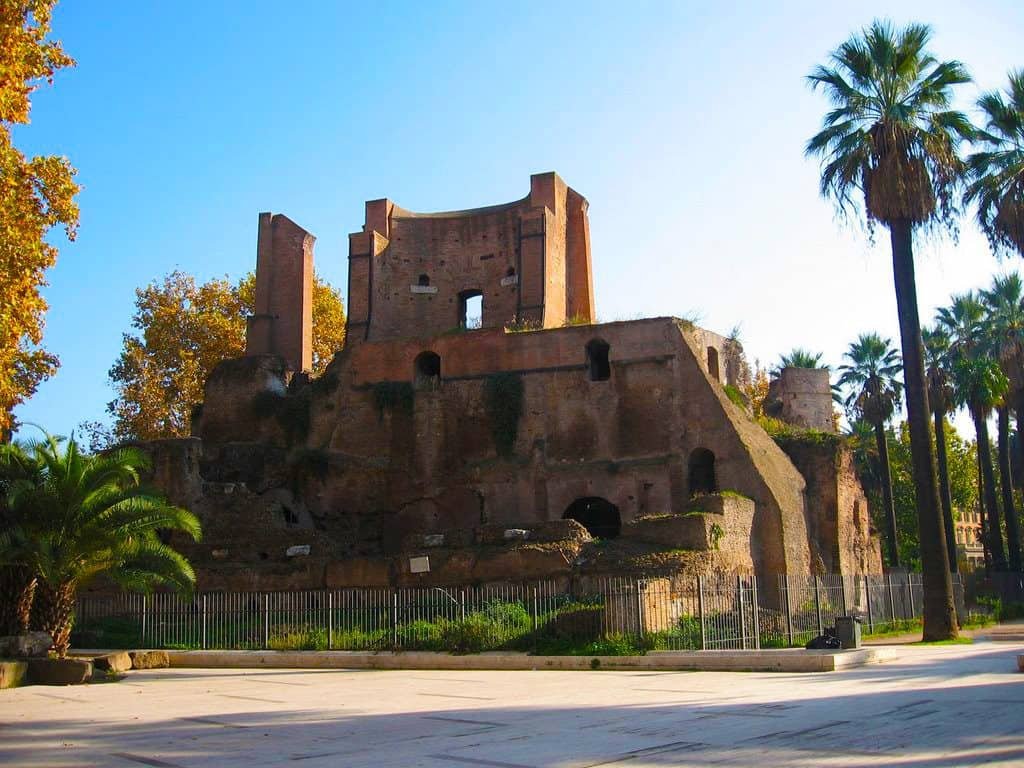
The Porta Alchemica of Piazza Vittorio is in the northern corner of the Nicola Calipari garden, inside Piazza Vittorio Emanuele II, Rione XV Esquilino, in Rome. You get there by metro line A, Vittorio Emanuele stop, which comes out on the long side of the square. From Roma Termini it's a little over 600 meters on foot along Via Gioberti. The garden is public and free to enter, with hours that change between summer and winter according to the calendar of the Roma Capitale gardens service. The door and the ruins of the nymphaeum of Alexander Severus, the ones everyone calls the Trofei di Mario, are enclosed in an archaeological fence: they can be seen perfectly well from the railing at any hour of daylight, while to enter the fenced area you need a guided visit. The Sovrintendenza Capitolina gives for admission to the Trofei di Mario a full ticket of €4.00 and a reduced ticket of €3.00, with mandatory booking at the number 060608, active from 9:00 to 19:00, and groups of at most 25 people. Admission is free for holders of the MIC card. The fares and the opening calendar should be confirmed on the Sovrintendenza website before you go, because the guided visits follow shifts that change over the course of the year. Photography is allowed, the area is on a flat street, and the view from the railing is accessible even to those who move in a wheelchair.
If you're putting together a Rome itinerary off the obligatory circuits, the page of tourist attractions collects the places worth fitting in around this stop.

What the Porta Alchemica of Piazza Vittorio really is
The monument has four names and none of them is wrong: Porta Alchemica, Porta Magica, Porta Ermetica, Porta dei Cieli. They are four labels that tell of four ways of looking at it. In substance it is a travertine portal, a little taller than a person with an arm raised, with the jambs and the lintel densely engraved with planetary signs and Latin mottoes, and a pediment occupied by a hexagram inscribed in a circle. It isn't a door in the sense that it opens onto something. It's a page of stone. Whoever built it wanted his formulas to stay legible when he was no longer around.
The man in question is Massimiliano Savelli Palombara, Marquis of Pietraforte, born in 1614 and died in 1685. The door belonged to his suburban villa on the Esquiline, a property of vineyards and kitchen gardens that occupied exactly the space where the square and its porticoes open today. Nothing remains of that villa: no pavilion, no boundary wall, none of the other doors. The Porta Alchemica of Piazza Vittorio is the sole survivor of five doors the marquis had engraved, and the only material fragment of an intellectual world that in Rome, in the 1600s, moved at mid-height between nascent science and inherited magic.
There is a dating element, and it's engraved on the pediment: 1680. The main inscription ends with that figure, and the date is consistent with what is known about the marquis's last years. The villa and its apparatus were put together between the mid-1650s and that 1680, but the door as we see it belongs to the end of that path, not to its beginning.
Marquis Massimiliano Palombara and the vanished villa
Massimiliano Savelli Palombara was not a fairground charlatan. He was a cultured Roman aristocrat, related to one of the city's historic families, able to write verse and to read Latin and Hebrew well enough to play with them. His hermetic poem, La Bugia, written in 1656 and dedicated to Queen Christina of Sweden, has come down to us and has been published in a modern edition. It's a Rosicrucian, allegorical text, built on the same images that would later pass onto the travertine of the door. Whoever wants to understand the monument must start there. The inscriptions are not decoration. They are the lapidary reduction of a thought the marquis had already put into verse.
The Villa Palombara on the Esquiline
The property stood on the summit of the hill, in a Rome that east of the Suburra frayed out into vineyards, farmhouses and ruins. It was the countryside inside the walls: a landscape that today you can't even imagine while standing on the asphalt of Piazza Vittorio. The villa's boundary wall ran along the Strada Felice, the axis commissioned by Sixtus V that today corresponds roughly to Via Merulana and its continuations. The door we see was located about 50 meters toward the intersection of Via Carlo Alberto and Via di San Vito, set into that perimeter wall.
Inside the enclosure there were a palazzina, a small pond, a little grove, vineyards, pear and apple trees, bees. We know this because one of the lost inscriptions describes it in minute detail, with a long Latin rhyme with internal rhymes listing the livestock, the fruit, the wine, the guard dog and the good air that cured the sick. It is the liveliest document we have on what that piece of the Esquiline was like before the master plan erased it.
The five doors and the lost inscriptions
The engraved doors were five. Four were lost along with the villa. Four inscriptions that ran on the walls of the palazzina were also lost. The text of those that vanished has reached us through scholarly channels, copied by those who saw them before the demolitions. That's the reason we can read today the long praise of the villa even though not a stone of it remains. On the arch of the door that opened on the opposite side, toward Via Merulana, ran the inscription that allows us to fix the marquis's epigraphic campaign at 1680.
In our view the most interesting part of the story isn't the surviving door, it's the number. Five engraved doors and four written walls mean that Palombara had turned his villa into a book you could walk through. The visitor entered through one opening and read a formula, passed through another and read another. The Porta Alchemica of Piazza Vittorio is the last surviving page of a dismembered volume.
The alchemists of Palazzo Riario and Queen Christina of Sweden
The marquis's interest in alchemy was born, in all likelihood, from a specific circle: from 1656 Palombara entered the Roman court of Christina of Sweden, installed at Palazzo Riario on the Lungara. The queen had abdicated the throne of Sweden, converted to Catholicism and since 1655 had chosen Rome as her permanent residence. She would remain there until her death in 1689. Palazzo Riario is today called Palazzo Corsini, houses the Galleria Nazionale d'Arte Antica and is the seat of the Accademia Nazionale dei Lincei, which also owns the Villa Farnesina right across, on the other side of the street. We are at the foot of the Janiculum, across the Tiber from the Esquiline: the cultured Rome of the 1600s moved between those two poles with a naturalness that traffic has made unthinkable today.
The queen's laboratory
Christina did not collect alchemists out of fashion. She had been taught by Descartes, whom she had called to Stockholm and who died in Stockholm in 1650, and she cultivated a serious interest in experimental chemistry and astronomy. At Palazzo Riario she kept a well-equipped laboratory, entrusted to the alchemist Pietro Antonio Bandiera. It must be remembered that in the 1600s the distinction between chemistry and alchemy had not yet been drawn: in the same furnace medicines were distilled and the transmutation of metals was sought, and those who worked at that furnace considered the two things parts of a single program of knowledge.
The academy: Borri, Cassini, Santinelli, Kircher
An academy formed around the queen, and the names connected with it are enough to explain why Marquis Palombara was drawn to it. There was Giuseppe Francesco Borri, physician and esotericist from a noble Milanese family, the figure who will give substance to the legend of the door. There was Giovanni Domenico Cassini, the astronomer who would measure the rotation of Jupiter and Mars and whom France would then carry off to the Paris Observatory. There was Francesco Maria Santinelli, alchemist and poet, author of hermetic writings in which the marquis recognized himself. And there was Athanasius Kircher, the German Jesuit who kept the most astonishing museum of the century in Rome, a man who wrote about geology, magnetism, the Coptic language and talking machines, getting almost everything wrong with an intellectual energy that no one has matched.
Palombara dedicated his poem La Bugia to this circle. And a tenacious tradition, not a document, holds that the Porta Alchemica of Piazza Vittorio was erected in 1680 to celebrate a successful transmutation in the laboratory of Palazzo Riario. Take it for what it is: a tradition, reported by much later scholars, not an archival fact.

The legend of Stibeum and the Porta Alchemica of Piazza Vittorio
The story everyone tells in front of the railing has a precise and late source: it was handed down in 1802 by the scholar Francesco Girolamo Cancellieri, 122 years after the date engraved on the pediment. This must be said right away, because it changes the weight of every detail.
The tale goes like this. A pilgrim shows up at the villa, called Stibeum from the Latin name of antimony, and asks for hospitality for one night. The marquis grants it. The guest spends the dark hours in the gardens searching for a mysterious herb capable of producing gold. In the morning he is seen passing through the door and vanishing forever. Behind him he leaves two things: some flakes of gold, the fruit of a successful transmutation, and a sheet crowded with enigmas and symbols that is supposed to contain the secret of the philosopher's stone.
Palombara sets upon it for years without getting anything out of it. Then he makes a decision that is both a surrender and a gesture of pride: if he can't decipher that sheet, he'll make it public. He has the enigmas engraved on the five doors of the villa and on the walls of his mansion, so that someone, sooner or later, will understand. This is the narrative reason why the Porta Alchemica of Piazza Vittorio exists: a man carving into stone a text that he himself does not understand.
The tail of the legend comes much later. Some authors have proposed, based on historical and geographical concordances and on the passing of the item among members of that circle, that the enigmatic sheet may have something to do with the Voynich manuscript, the illustrated and never-deciphered codex that belonged to the collection of alchemical texts of Emperor Rudolf II of Bohemia. Christina of Sweden donated books to her librarian Isaac Vossius, and Kircher, who really did concern himself with that codex, had been one of Borri's teachers in the Jesuit school. It's a fascinating chain of coincidences with no proof: a modern hypothesis, not a documented reconstruction.
Giuseppe Francesco Borri, the man behind the pilgrim
Beneath the legend there is a real biography, and for once it's more adventurous than the myth. Giuseppe Francesco Borri is accused of heresy and poisoning by the Holy Inquisition in 1659. He flees, and for a decade practices medicine across half of Europe, accumulating illustrious patients and equally illustrious enemies. In the end he is arrested and extradited. He is held in Rome in the prisons of Castel Sant'Angelo between 1671 and 1677.
From 1678 he obtains a regime of semi-liberty. This is the detail that makes everything fit: in those very years he resumes seeing his old friend Massimiliano Palombara, who hosts him in the villa on the Esquiline until the marquis's death in 1685. Between 1678 and 1680, therefore, the two materially have the time and the opportunity to compose the enigmatic inscriptions together. And at least one inscription of the villa, the one above the arch of the door toward Via Merulana, certainly bears the date 1680.
The ending is once again carceral. Borri is locked up another time at Castel Sant'Angelo from 1691 and dies there in 1695. From here starts the legendary tail the public loves: a few years later is placed the presumed birth of the Count of Saint Germain, the eighteenth-century alchemist who supposedly possessed the elixir of long life and whose figure partly overlaps with that of Cagliostro, who in turn claimed to have lived for two centuries. Some have wanted to see in the portraits of Borri and of the count the features of the same person. It's literature, not history, and should be told as such: no document supports the identification.
A personal judgment, since we're at it. Borri's story is more interesting when you strip it of the supernatural. A brilliant and unscrupulous physician, tried for heresy, kept in a cell for seven years and then let out for half days, who spends his last free years engraving enigmas into the wall of a vineyard with a marquis. You don't need to add the Count of Saint Germain to have an extraordinary story.

The inscriptions of the Porta Alchemica of Piazza Vittorio, one by one
Here is where everything is at stake. In front of the railing most visitors look at the form and leave. Whoever takes 20 minutes to read what is written takes home a different experience. The mottoes are short, mostly in Latin, with a single line in Hebrew. They should be read as operating instructions disguised as moral sayings: in hermetic language every sentence works on two levels at once.
The pediment and the date 1680
The inscription that runs on the pediment says: VILLAE IANVAM TRANANDO RECLVDENS IASON OBTINET LOCVPLES VELLVS MEDEAE. 1680. That is: by passing through and opening the door of this villa, Jason obtains the fleece of Medea in abundance. The golden fleece is gold, and Jason is the pilgrim who accomplished the feat. The date closes the sentence and closes the chronological question: the monument, in the engraved form we read, belongs to that year.
The Hesperian dragon, or the warning at the entrance
A second motto warns whoever approaches: HORTI MAGICI INGRESSVM HESPERIVS CVSTODIT DRACO ET SINE ALCIDE COLCHICAS DELICIAS NON GVSTASSET IASON. The Hesperian dragon guards the entrance of the magic garden, and without Hercules Jason would not have tasted the delights of Colchis. Two myths overlapped in a single line: the dragon that watches over the apples of the Hesperides and the dragon that watches over the fleece. The operating sense is clear to whoever knows the code: no one reaches the precious matter without overcoming an obstacle, and no one overcomes it alone.
SI SEDES NON IS, the motto that reads both ways
On the threshold of the Porta Alchemica of Piazza Vittorio runs the most famous and shortest formula: SI SEDES NON IS. Read from left to right it means if you sit, you do not go. Read backward, letter by letter, it gives SI NON SEDES IS, if you do not sit, you go. It's an imperfect palindrome built on purpose, and it keeps a double meaning that works both as a motto for life and as a laboratory prescription: the work does not allow immobility. Whoever stops stays outside.
The mottoes of the jambs
The jambs carry the main series of sayings. I give them with the translation, because reading them one after another you understand that they make up a single discourse.
AQVA A QVA HORTI IRRIGANTVR NON EST AQVA A QVA HORTI ALVNTVR: the water with which the garden is irrigated is not the water with which the garden is nourished. It's the distinction between common water and philosophical water, the solvent of the alchemists, which has nothing to do with the water of the well.
SOPHORVM LAPIS NON DATVR LVPIS: the stone of the wise is not given to wolves. A declaration of initiatory secrecy, and at the same time an elegant discourtesy toward the greedy.
QVI POTENTI NATVRAE ARCANA REVELAT MORTEM QVAERIT: whoever reveals the arcana of powerful nature seeks his own death. In 1600s Rome this was no hyperbole: Borri had been condemned for heresy and poisoning, and the stake for wrong ideas was a recent memory.
HODIE PECVNIA EMITVR SPVRIA NOBILITAS SED NON LEGITIMA SAPIENTIA: today a spurious nobility is bought with money, but not legitimate wisdom. Coming from a marquis, it's a jab at his own class.
EST OPVS OCCVLTVM VERI SOPHI APERIRE TERRAM VT GERMINET SALVTEM PRO POPVLO: it is the hidden work of the true sage to open the earth so that it may sprout salvation for the people. Here alchemy declares itself medicine, not enrichment: transmutation serves to produce the universal remedy.
SI FECERIS VOLARE TERRAM SVPER CAPVT TVVM EIVS PENNIS AQVAS TORRENTIVM CONVERTES IN PETRAM: if you make the earth fly above your head, with its feathers you will convert the waters of the torrents into stone. It's the coded description of a sublimation followed by a coagulation, the two fundamental movements of the work.
QVANDO IN TVA DOMO NIGRI CORVI PARTVRIENT ALBAS COLVMBAS TVNC VOCABERIS SAPIENS: when in your house black ravens give birth to white doves, then you will be called wise. The black raven is the nigredo, the phase of putrefaction and blackening. The white dove is the albedo, the whitening. No metaphor: it is the classic color sequence of the work at the furnace.
QVI SCIT COMBVRERE AQVA ET LAVARE IGNE FACIT DE TERRA CAELVM ET DE CAELO TERRAM PRETIOSAM: whoever knows how to burn with water and wash with fire makes of the earth a heaven and of heaven a precious earth. The reversal of the elements is the stylistic signature of the whole door.
TRIA SVNT MIRABILIA DEVS ET HOMO MATER ET VIRGO TRINVS ET VNVS: three are the marvelous things, God and man, mother and virgin, three and one. A perfectly orthodox formula set into a hermetic apparatus. It's the theological pass for the whole, and explains how a monument of this kind could remain standing a stone's throw from Santa Maria Maggiore without anyone tearing it down.
RVACH ELOHIM, the only line in Hebrew
Above it all, in Hebrew characters, runs the formula RVACH ELOHIM, the spirit of God that in Genesis hovers over the waters. It isn't an exotic ornament: it indicates the direction of reading of the whole apparatus. The mottoes are followed climbing from bottom to top on the right side and descending from top to bottom on the left side, an inverted U-shaped path that reproduces the ascent and the redescent of the work.
The long praise of the villa, a lost inscription
The longest of the inscriptions is not on the surviving door. It ran on the walls of the villa and has reached us through scholarly copy. It's worth reading, because it is the only extended portrait of that piece of the Esquiline before the modern city. The Latin, all built on internal rhymes and puns, begins HOC IN RVRE, CAELI RORE, FVSIS AEQVIS, PHYSIS AQVIS, SOLVM FRACTVM, REDDIT FRVCTVM, and goes on listing the manure steaming in the sun, the forest always the same as itself, the vines born spontaneously, the pear and apple trees, the little pond with the grove beside it where it's not the wolf that plays but the hare, the dog that keeps the wild beasts away from the lambs, the air that by itself heals the sick, the greens that fill the streets of the city, the cultivated furrows that give cups of wine against thirst.
Then the text turns to the visitor and changes tone: INTROVENI, VIR NON VANVS. EXTRA VENVS. VOBIS, FVRES, CLANDO FORES. Enter, man not vain. Venus, stay outside. To you, thieves, I close the doors. There follows the invitation to drink pure wine in the manner of Bacchus, to rejoice among the grapes, to take freely what one desires, and the promise that the bees will give honey in abundance. The close is the most beautiful and the most bitter part: whoever weeps in the shade of the forest would stop weeping if he understood that here summer is mixed with spring. Melancholy minds hope among the mountains, the hills and the valley of this villa, where the rampart encloses the fleece. And the last line warns that stones are born from putrefaction and that time, which seems to joke, soon gnaws away everything.
Whoever writes a sentence like that is not playing. Palombara knew perfectly well that his villa would come to an end, and wrote on the wall that it would. It's the only prophecy of the door that came true to the letter.

The planetary symbols and the metals on the Porta Alchemica of Piazza Vittorio
Beside each motto appears a sign. They are planetary glyphs, and in the alchemical alphabet each stands at once for a planet and for a metal: Saturn and lead, Jupiter and tin, Mars and iron, Venus and copper, the Moon and silver, Mercury and mercury. The engraved sequence follows this order, with some slight differences from the manuals of the time, and the difference is itself information: whoever engraved it was working from a model, not on a whim.
The most likely model is the Commentatio de Pharmaco Catholico, published within the 1666 collection Chymica Vannus. It's a text that circulated in the Rome of those years and was almost certainly in the marquis's library. The sense of the sequence is the ladder of metals: you start from lead, the most base and the heaviest, and rise toward silver and toward gold, which on the door appears not as a glyph but as an oculus, the eye inscribed in the lower vertex of the hexagram.
In front of the Porta Alchemica of Piazza Vittorio it's best to read the sequence as a path and not as a list. Each planet has its motto, each motto its operation, and the two sides of the jamb make up a going and a return. Even if you don't believe a word of alchemy, the fact remains that someone in 1680 designed an object that is read by walking.
The damage to the right jamb
In the 1980s the right jamb, as you face it, suffered an act of vandalism: the symbol of Venus was removed. The gap was later filled by a restoration. It's one of those pieces of news that raise eyebrows, and it says how little the monument was protected for decades before the fence put it under shelter.
The Rosicrucian pediment and the Aureum Seculum Redivivum
On the pediment of the door is carved a circular medallion with the Seal of David inside, the hexagram formed by two overlapping triangles, circumscribed by a circle with Latin inscriptions. The upper vertex is occupied by a cross connected to an inner circle. The lower vertex by an oculus, the eye that in alchemical vocabulary indicates the sun and gold.
This design is not a Roman invention. It appears almost identical on the frontispiece of an allegorical and alchemical book, the Aureum Seculum Redivivum by Henricus Madathanus, pseudonym of the physician and alchemist Adrian von Mynsicht, who lived between 1603 and 1638. And here is a philological detail worth the whole visit: the frontispiece of the original 1621 edition is very different, while the image the marquis copied from appears exactly only in the posthumous edition of 1677. Three years before the date engraved on the pediment. Whoever designed the door had on the table a book printed very recently, arrived in Rome fresh from the press.
The triangle with the eye, the pyramid and the dollar
The detail that always sparks discussion is the resemblance between the triangle with the oculus and the symbol that stands out on United States one-dollar bills: a truncated pyramid topped by an eye, accompanied by the Latin motto Novus Ordo Seclorum, which closely recalls the title Aureum Seculum Redivivum.
The reasonable explanation goes through a book. The pyramid of the American symbol derives from the Pyramidographia, the volume that John Greaves, who lived between 1602 and 1652, published in London in 1646 after a trip to Egypt. It is therefore possible that the frontispiece of the Aureum Seculum Redivivum and the United States emblem descend from the same printed source, with no direct relationship between them. The same symbolism was then adopted by the Illuminati of Bavaria, founded in 1776, that is, about a century after the German edition of 1677: a century, not a week, and the chronological distance should be enough to cool the conspiracy theories that have built entire shelves on this detail.
The judgment is clear: telling the Porta Alchemica of Piazza Vittorio as the origin of the dollar symbol is nonsense that makes you lose the best part. The best part is that in the Rome of 1680 a marquis read German books published three years earlier and had them carved in travertine. That is true news about the circulation of ideas, and is worth 10 times an invented conspiracy.
The two Egyptian Bes beside the Porta Alchemica of Piazza Vittorio
On the sides of the door, inside the fence, two statues of Bes stand guard, the Egyptian deity with a squat body and bowed legs. They have nothing to do with Palombara: they were placed beside the monument at the time of the nineteenth-century reconstruction in the garden, and they come from the gardens of the Quirinal Palace.
Bes deserves a couple of words, because almost nobody spends them. In Egyptian religion he is a bearded dwarf, often depicted old, with crooked legs, adorned with ostrich feathers and with a tail, sometimes winged. He isn't a god of the great temples: he is the god of the home. He protects against the evil eye and malign forces, watches over sleep, presides over music and dance, guards fertility and marriage, and above all assists childbirth and watches over newborns. His face with the tongue sticking out decorated vases and household objects, and in the Roman world his images were tied to the cult of Isis, which had enormous success in Rome.
The result is one of the most beautiful short circuits of the garden: a hermetic seventeenth-century portal flanked by two Egyptian household protectors that arrived by chance from a papal garden. None of the three elements was meant to stand beside the others, and together they form the image everyone photographs.
From the wall of Via Merulana to the garden: how the door got here
The passage is documented and should be kept in mind, because it explains why the monument seems out of place. In 1873 the door was dismantled from the villa's wall, by then caught up in the works of Rome as capital. In 1888 it was reassembled inside the gardens of Piazza Vittorio, leaning against an old perimeter wall of the church of Sant'Eusebio, and on that occasion the two statues of Bes were placed beside it.
15 years between dismantling and reassembly: 15 years in which the pieces of the Porta Alchemica of Piazza Vittorio stayed piled up somewhere, while a neighborhood was being born around them. That it survived is a small administrative miracle. The original position was about 50 meters from here, toward the intersection of Via Carlo Alberto and Via di San Vito: we are within the same block, the monument never left the Esquiline.
The practical consequence for the visitor is only one, and nobody says it: the door today is oriented and set in a way that is not its own. It no longer faces the Strada Felice, no longer closes a vineyard wall, no longer has anything to separate. It stands like a relic, and should be read knowing that its context was demolished around it.

The Trofeo di Mario and the nymphaeum of Alexander Severus
In the same enclosure as the Porta Alchemica of Piazza Vittorio rises the brick mass that since the Middle Ages has been called Trofei di Mario, or Trofeo di Mario. The name has been wrong for 700 years and no one will ever change it. It derives from the two marble trophies that until 1590 were placed under the side arches and that medieval tradition attributed to Gaius Marius, the consul victorious over the Cimbri. In reality those marbles are of the Domitianic age, datable around 89 AD, and celebrate victories against the Chatti and the Dacians. In 1590 they were taken away and set on the balustrade at the top of the cordonata that climbs to the Capitoline Hill, where anyone going up to the Capitoline Museums still sees them today without knowing they come from here.
What it really was
The building is not a temple and not an arch. It is a monumental fountain and at the same time a water distribution tower. The dating is the kind that makes archaeologists envious, because it rests on a coin: in 226 AD the emperor Alexander Severus had it depicted on the reverse of an issue, and that image allows us to fix the year and reconstruct the original appearance.
The monument closed off a branch of an aqueduct that, coming from the area of Porta Tiburtina, climbed onto the Esquiline. The height of the entry channel, measured at 9.85 meters on the third level, narrows the field to just two possible aqueducts, the Aqua Claudia or the Anio Novus. The plan is trapezoidal because the nymphaeum adapted to the confluence between Via Labicana and Via Tiburtina: a shape dictated by ancient traffic, not by taste. The structure is articulated on three levels, with rooms and channels still readable today, five channels lined with cocciopesto, a volume of about 4,000 cubic meters and a width at the base of 25 meters. It was entirely faced in marble: what we see today is the brick skeleton of a building that used to shine.
On the third level opened a central niche flanked by two arches. A basin collected the water coming down from above and conveyed it to the lower floors, from where it was distributed to the lowest districts of the city. The coins show in the niche two statues, probably the emperor and his mother Julia Mamaea, the trophies under the side arches, an attic crowned by a quadriga and other statues, and at the foot of the lower niche a large figure of the god Oceanus reclining.
The only ancient water display left standing
Here is the fact almost nobody knows and that should make this corner a serious cultural stop: of the great monumental fountains that closed off the aqueducts in ancient Rome, this is the only one that survives in elevation. All the others have disappeared. And the model of that architecture, the central niche, the side arches, the statues in the attic, the water plunging into a basin, is exactly the scheme that the Renaissance and the Roman Baroque will take up again for their water displays, from the Trevi Fountain to the Acqua Paola fountain on the Janiculum. Whoever looks at the Trofei di Mario from the railing of Piazza Vittorio is looking at the ancestor of Trevi.
Restorations and excavations
Between 1878 and 1885 Rodolfo Lanciani carried out a decisive restoration: the foundations had been left exposed by the works of the new city, and the private dwellings that from the 1600s onward had been attached to the structure like parasites were demolished. Between 1982 and 1988 new restorations and test excavations identified under the Severan nymphaeum remains in reticulate masonry of the Augustan age, perhaps an earlier fountain, which means that water, at this point of the hill, was already arriving two centuries earlier.
How to visit the nymphaeum
The fenced area can be visited only with guided visits by booking. The Sovrintendenza Capitolina indicates admission allowed only to accompanied groups, with a maximum of 25 people per visit, mandatory booking at the number 060608 from 9:00 to 19:00, full ticket €4.00 and reduced €3.00, free for holders of the MIC card. The cost does not include the guided tour, which cultural associations organize separately. Calendar and fares should be confirmed on the Sovrintendenza website before booking.

The Nicola Calipari garden and the largest square in Rome
Piazza Vittorio Emanuele II was born from the master plan of 1873, the one that was to provide housing and offices for the capital moved from Florence to Rome in 1871. Work began in 1880 and the square was officially inaugurated on Sunday, July 10, 1889, with the opening of the garden to the public. It is the largest square in the city: 60,000 square meters, 325 meters by 185, nearly 10,000 square meters more than St. Peter's Square. The nineteenth-century porticoes that surround it on all sides are a piece of Turin transplanted to the Esquiline, and for a Roman they remain a pleasant anomaly: in a summer of sun, or under a thunderstorm, you understand at once why they wanted them.
The central garden is named for Nicola Calipari, the official killed in Iraq in March 2005 after negotiating the release of the journalist Giuliana Sgrena. After about 20 months of redevelopment, the gardens reopened on October 31, 2020: relaid lawns, redesigned paths, the archaeological area made safe. Whoever remembers what it was like before knows the leap is enormous.
The market that is no more
For a century Piazza Vittorio meant one thing only to Romans: the market. Born spontaneously at the end of the nineteenth century, it occupied the square with stalls of food and every other kind of goods. Under the porticoes stood the stalls of loose tobacco and bicycle spare parts, the ones you see in Vittorio De Sica's Bicycle Thieves. The poultry sellers sold live and cooked poultry. Before Christmas the fishmongers took over with salt cod, eels and capitoni. The daily stalls held out until the 1990s. In 2001 the square was cleared and the market moved into the spaces of the former Centrale del Latte, between Via Filippo Turati and Via Principe Amedeo, where today it is called Nuovo Mercato Esquilino and is one of the most international markets in Italy.
In 2002 the Orchestra di Piazza Vittorio was born here, a musical project that brought together instruments and musicians from half the world, and in 2017 Abel Ferrara dedicated a documentary to it. The neighborhood surrounding the Porta Alchemica of Piazza Vittorio is today the most multiethnic in Rome, and that is an important part of its interest, not a footnote.
The Horti Lamiani under your feet
There is a further level, and it lies beneath the paving. The summit of the Esquiline, in the imperial age, was occupied by the Horti Lamiani, luxury gardens that belonged to the consul Lucius Aelius Lamia, consul in AD 3, then passed to the imperial domain under Tiberius and finally chosen by Caligula as his own residence. They were reception rooms with very fine frescoes, colored marbles and first-rate sculptures.
From the nineteenth-century works for the new square came masterpieces that are elsewhere today: the Venus Esquilina, busts, statues of Muses, the famous portrait of Commodus as Hercules, all found between 1874 and 1875 and kept in the Capitoline Museums, which dedicate a room to those gardens, and in part at the Centrale Montemartini. Even earlier, between the 1500s and the 1800s, the Lancellotti Discobolus and the Aldobrandini Wedding had come out of the same area.
The excavations carried out between 2006 and 2009 under the seat of the ENPAM foundation, on the side of the square, brought to light reception rooms with highly refined decorations. A 2021 agreement between ENPAM and the Soprintendenza led to the museum display of the finds. The route is called Museo Ninfeo, exhibits structures and materials of the Horti Lamiani, including seeds, roots and animal remains that document exotic plants and surprising animals in the imperial gardens, and can be visited only by booking. Hours, fares and procedures should be checked on the museum's official website, because access follows contingent shifts.
The Esquilino district around the Porta Alchemica of Piazza Vittorio
Rione XV Esquilino is the fifteenth of the 22 historic rioni of Rome and the youngest of the ancient rioni, carved out of post-unification building. Around the door is concentrated a density of monuments that in any other city would make an itinerary of two days by itself.
300 meters away, at the top of the hill, is Santa Maria Maggiore, with the early Christian mosaics of the nave and the apse by Jacopo Torriti. A little farther, on Via di San Martino ai Monti, the Basilica of Santa Prassede holds the Chapel of San Zeno, the pinnacle of Carolingian mosaic in Rome, a space so gilded that in the Middle Ages they called it the garden of paradise. On Via Merulana, halfway toward the Lateran, opens the Auditorium of Maecenas, a semi-underground frescoed hall, the only remnant of the architectural complex tied to the name of the great patron of Horace and Virgil. The southern end of the street is the Basilica of St. John Lateran, the cathedral of Rome, and a little farther Holy Cross in Jerusalem.
On the other side, toward Termini, Palazzo Massimo alle Terme holds the frescoes of the Villa of Livia and the most important collection of ancient sculpture in Italy after Naples, and the Octagonal Hall of the Baths of Diocletian shows how the largest bath complex in the city was built. Toward the Colle Oppio, a quarter of an hour at an easy pace away, are San Pietro in Vincoli with Michelangelo's Moses and Nero's Domus Aurea. Whoever wants to understand how the water that fed the nymphaeum of Piazza Vittorio worked should then go as far as the Underground Basilica of Porta Maggiore, where the eastern aqueducts entered the city.
The alchemist pilgrim and the writing on the door: what is told and what is read
The Porta Alchemica of Piazza Vittorio is a door that no longer leads anywhere: it stands alone in the gardens, covered with Latin phrases and signs that almost nobody can read at first glance. It is the only surviving piece of the villa that Marquis Massimiliano Savelli Palombara owned on the Esquiline in the 1600s, and around this relic one of the most retold stories of Rome has formed: that of a pilgrim who supposedly entered the villa, made gold and vanished at dawn leaving behind a formula that no one has managed to solve. It's worth separating the two levels right away, because here they are confused with particular ease. The door and its inscriptions are a fact, documented and verifiable in person. The pilgrim is a tale.
What is documented: the villa, the door, the move
Massimiliano Savelli Palombara, Marquis of Pietraforte, was a real figure of seventeenth-century Rome, interested in alchemy and tied to the circles in Rome that dealt with it. His villa stood on the Esquiline, in the area that today corresponds to the gardens of Piazza Vittorio Emanuele II, and the gate dates to the second half of the century. All of this is documented by the sources and by the Sovrintendenza Capitolina, which has the gate in its care.
What happened afterward is documented too. When the Esquiline was reorganized after 1870 to become a neighborhood of the new capital, the villa was dismantled: that was around 1873. The gate was taken apart and reassembled in the gardens of the piazza toward the end of the 1880s, where it still stands, flanked by two Egyptian statues of the god Bes that had nothing to do with the original layout and that come from another part of the city. It's a detail that matters: the gate you see today is a nineteenth-century assembly of seventeenth-century pieces, not a building that stayed where it was. Anyone who looks at it searching for an astronomical alignment or a "right" position is reasoning about a placement that was decided by the urban planners of the late nineteenth century.
The pilgrim's tale: how it is told
This part is tradition, not established history, and it should be told as such. The most common version says that a stranger came to the villa, a wayfarer who was looking among the plants of the garden for an herb needed for the philosopher's stone. The marquis put him up for the night. At dawn the man was gone, and in the room there remained flecks of gold, proof that the transmutation had taken place, along with sheets covered in symbols and formulas that Palombara was unable to interpret. Not wanting to lose that text, he is said to have had it carved on the gate and on the walls of the villa, so that sooner or later someone more capable would decipher it.
In some versions the pilgrim has a name: Giuseppe Francesco Borri, a seventeenth-century physician and alchemist from Milan, a person who really existed and was tried by the Inquisition, who spent the last years of his life a prisoner in Castel Sant'Angelo. In other variants other names appear, or the stranger stays anonymous. The identification with Borri is an element of the story, not a proven fact: that Borri existed and was in Rome is documented, but that he passed through Villa Palombara and made gold is not.
Why recent studies tell a different story
The most interesting point is that research of the last few decades has found the inscriptions elsewhere, before they ended up on the gate. Current studies link them to a manuscript kept in the Vatican, attributed to Palombara himself and titled "La Bugia," datable to the mid-1650s. If the reconstruction holds, the carved texts are not the mysterious legacy of an unknown guest but material that the marquis had already gathered and put in order on his own, within the alchemical culture of his time.
This doesn't erase the legend, it relocates it: it explains how a nobleman passionate about alchemy could have phrases and symbols at hand to carve without needing a miraculous guest. On many details, though, scholars still don't agree, starting with the exact date of the gate and the role of those who frequented the villa along with the marquis.
The inscriptions: what they say and who tries to read them
The phrases are real, they are carved, and anyone passing by can photograph them. They are in Latin, with one line in Hebrew, and on the sides there are seals and planetary symbols used in the alchemical tradition to indicate metals and operations. Among the most quoted is the phrase on the threshold, SI SEDES NON IS, which read backward gives SI NON SEDES IS: a play on words that translates, roughly, as "if you sit still you don't go" and, reversed, "if you don't sit still you go." On the pillars run other lines, including the one that entrusts a dragon with guarding the entrance to the magic garden.
There are quite a few modern readings and they go in different directions. Some treat the inscriptions as an operating recipe, that is, the coded description of a laboratory procedure with its timing and materials. Some read them in a spiritual key, as an inner journey disguised as chemistry. Some see in them mostly a learned game, an exercise in seventeenth-century erudition built to be admired more than applied. Finally, some warn against looking for a single meaning in a text assembled from materials of different origin. None of these readings is the official explanation, and presenting one as definitive would be wrong: the question remains open.
What you actually see today when you go
The gate is in the gardens of Piazza Vittorio, you look at it from the outside, you don't walk through it and you don't visit the inside of anything: it is a stone backdrop in the middle of the greenery, fenced, easy to read in the hours of full light when the carvings take shadow. It's worth a stop without rushing, and it's better if you've read beforehand what is written: the carved Latin isn't immediate.
Frequently asked questions about the Porta Alchemica of Piazza Vittorio
What is the Porta Alchemica of Piazza Vittorio?
The Porta Alchemica of Piazza Vittorio is a travertine portal, a little taller than a person with an arm raised, with the jambs and lintel densely carved with planetary signs and Latin mottos and a pediment occupied by a hexagram. The monument has four names, all correct: Porta Alchemica, Porta Magica, Porta Ermetica and Porta dei Cieli.
Where exactly is the Porta Alchemica of Piazza Vittorio?
The Porta Alchemica of Piazza Vittorio is in the northern corner of the Nicola Calipari garden, inside Piazza Vittorio Emanuele II, in the Esquilino district. It is enclosed in an archaeological fenced area shared with the remains of the nymphaeum of Alexander Severus, known as the Trofei di Mario.
How much does it cost to see the Porta Alchemica of Piazza Vittorio?
Looking at the Porta Alchemica of Piazza Vittorio from the garden fence is free. To enter the archaeological enclosure that surrounds it there are specific ways of getting in, and it's advisable to check them directly before the visit, because they can change over time.
Who had the Porta Alchemica of Piazza Vittorio built?
The Porta Alchemica of Piazza Vittorio was commissioned by Marquis Massimiliano Savelli Palombara, a learned Roman aristocrat who lived between 1614 and 1685, author of the 1656 hermetic poem La Bugia dedicated to Queen Christina of Sweden. Palombara was its patron and probably co-author of the inscriptions.
How long does it take to visit the Porta Alchemica of Piazza Vittorio?
From the fence, reading the carved mottos at an easy pace, you need about 20 minutes for the Porta Alchemica of Piazza Vittorio. With a guided visit inside the enclosure you comfortably reach an hour, because the Severan nymphaeum alone requires another half hour. A full tour of the Calipari garden with a stop at the two monuments fits within an hour and a half.
Is the legend of the alchemist pilgrim of the Porta Alchemica of Piazza Vittorio true?
The most told legend about the Porta Alchemica of Piazza Vittorio, that of the pilgrim Stibeum who supposedly vanished leaving behind some gold, has a precise but late source: it was passed down in 1802 by the scholar Francesco Girolamo Cancellieri, 122 years after the date carved on the pediment. Behind the tale there is probably the historical figure of the esoteric physician Giuseppe Francesco Borri.
Is the Porta Alchemica of Piazza Vittorio in its original position?
No, the Porta Alchemica of Piazza Vittorio is not in its original place. In 1873 it was taken apart from the perimeter wall of Villa Palombara, which ran along Strada Felice, and it was reassembled only in 1888, 15 years later, set against an old wall of the church of Sant'Eusebio, where it still stands today together with the two Egyptian statues of Bes.
What can you see near the Porta Alchemica of Piazza Vittorio within a 10-minute walk?
Around the Porta Alchemica of Piazza Vittorio there is a notable concentration of monuments: about 300 meters away is Santa Maria Maggiore with its early Christian mosaics, on the other side of Via Giolitti is the Nuovo Mercato Esquilino with its spices and its fish, and a few steps away is the church of Sant'Eusebio, against whose wall the monument leans.
A piece of advice on method: the Porta Alchemica of Piazza Vittorio doesn't support a trip of its own. It works very well as the opening or the close of a morning on the Esquiline. Those who work on organizing themed itineraries for groups will find a professional overview in the TourLeaderPro tourism services in Rome, while those preparing the trip in English can start from ItalyPlanner's guide best things to do in Rome.
How to really visit the Porta Alchemica of Piazza Vittorio
How much time you need
From the fence, at an easy pace and reading the mottos, it takes 20 minutes. With the guided visit inside the enclosure you comfortably reach an hour, because the Severan nymphaeum takes half an hour all by itself with the structure, the channels and the story of the aqueducts. A full tour of the Calipari garden, with a stop at the two monuments, fits within an hour and a half.
When to go and when to avoid
The best light on the inscriptions is early morning and late afternoon, when the low sun digs out the letters and makes them readable in photographs. At midday in summer the stone flattens out and the mottos disappear into a white blur. In winter the garden closes earlier: it's best to arrive at least an hour before sunset. Neighborhood market days and mornings of pouring rain are the two moments to avoid, for opposite reasons.
With children
It works, and better than you'd think, on one condition: tell the story of Stibeum before getting to the fence. A pilgrim who disappears through a gate leaving flecks of gold and a sheet full of signs is a plot that holds any child from seven years old up. The two Bes, with their funny faces and their tongues sticking out, complete the job. The garden around has lawn and room to run, and that takes care of the rest of the afternoon.
Accessibility
The garden is flat and the paths are paved or compact gravel: seeing the gate and the nymphaeum from the fence is within anyone's reach, even in a wheelchair or with a stroller. The inside of the archaeological area, on the other hand, has uneven ground and changes in level: those with specific needs should mention it when booking at 060608.
How much it costs
Looking at the Porta Alchemica of Piazza Vittorio from the fence costs nothing, today and always. Entering the area with the Trofei di Mario costs €4.00 full price and €3.00 reduced according to the rates indicated by the Sovrintendenza Capitolina, and it is free for holders of the MIC card, the annual pass that for five euros opens the civic museums to residents and students of Rome. For a Roman it is the cultural expense with the best ratio between price and return in the city.
A curiosity about the Porta Alchemica of Piazza Vittorio
The real curiosity isn't the legend of the alchemist who disappears: anyone tells that one. The real curiosity is philological and concerns a date. The design that fills the pediment of the gate, the hexagram with the cross at the top and the eye at the bottom, is not an invention of Marquis Palombara: it is taken almost literally from the frontispiece of the Aureum Seculum Redivivum by Henricus Madathanus, the pseudonym of Adrian von Mynsicht. The point is that this frontispiece, in the original 1621 edition, was completely different. The image that Palombara copied appears exactly only in the posthumous edition of 1677.
Three years. Between the printing of an alchemical book in a German-speaking area and its translation into travertine on a vineyard wall on the Esquiline, three years go by. In the seventeenth century, with the pace of mail, couriers and customs, three years is a flash. It means that Marquis Palombara was inside an active and fast European network of book exchange, that he received new publications as soon as they came out and that he read them with enough attention to tell one edition from another.
This detail overturns the way most visitors look at the Porta Alchemica of Piazza Vittorio. It is not the isolated whim of an eccentric nobleman shut up in his vineyard: it is the Roman terminal of a continental hermetic culture that circulated in print, updated itself and debated. The marquis wasn't inventing symbols, he was quoting them, the way one quotes a book that just came out today. And he quoted them with bibliographic precision, choosing one graphic version and not another.
There is a curious corollary. If the model is from 1677 and the carved date is 1680, then the gate was designed and made in a very short time, and in the same years in which Giuseppe Francesco Borri was leaving prison under a semi-release regime and returning to frequent the villa. For once, the calendar supports the tradition instead of contradicting it.
Something nobody tells you about the Porta Alchemica of Piazza Vittorio
No guide says it, but the gate you see is not in its place and not in its orientation. In 1873 it was taken apart from the perimeter wall of Villa Palombara, which ran along Strada Felice about 50 meters from here, toward the intersection between Via Carlo Alberto and Via di San Vito. It was reassembled only in 1888, 15 years later, set against an old perimeter wall of the church of Sant'Eusebio, inside the newly inaugurated garden.
Two consequences follow from this that change the visit. The first: the gate has lost its function as a threshold. Born to be walked through, to separate the vineyard from the street, today it separates nothing and leads nowhere. The inscriptions that speak of entering, of crossing, of getting past the dragon who guards the entrance, address a passage that no longer exists. It is a monument amputated of its main verb.
The second: the two Egyptian Bes statues flanking it have nothing to do with seventeenth-century alchemy. They were added on that occasion and come from the gardens of the Quirinale palace. Thousands of photographs online present them as hermetic guardians wanted by the marquis. They are not. They are two Egyptian statues recycled from a nineteenth-century setup that needed to fill the sides of the portal.
I'll add the uncomfortable part. In the 1980s someone removed the symbol of Venus from the right jamb, and it took a restoration to fix it. The fence that closes the area today, and that so many visitors experience as an annoyance because it keeps you from touching the stone, is the reason the monument is still intact. The enclosure is not a bureaucratic whim: it is what saved the Porta Alchemica of Piazza Vittorio.
The advice I give you for visiting the Porta Alchemica of Piazza Vittorio
There is one piece of advice and it is worth more than any other: arrive having already read the inscriptions and their translations. There is no panel that translates them for you on site, the fence keeps you a few meters away, the letters are dense, abbreviated seventeenth-century capitals, and without a prepared reading the gate shrinks to 10 minutes of distracted looking. With the translations in your head, on the other hand, it becomes a walk inside a text.
Second piece of practical advice: go when the sun is low. The carved travertine gives back the letters only in raking light. On a January morning at nine, or a June evening at seven, the mottos emerge from the stone as if someone had gone over them in pencil. At noon in August you can't read anything and you photograph worse.
Third: if you can, book the guided visit at 060608 and go into the enclosure. Not so much for the gate, which you can see well from the fence, as for the nymphaeum of Alexander Severus, which from outside looks like any ruin and from inside reveals the channels, the three levels and the hydraulic logic of the building. Four euros for the only monumental water display still standing from Roman antiquity is the best cultural opportunity on the Esquiline.
Fourth, and here I go against the current: don't come just for this. The Porta Alchemica of Piazza Vittorio is extraordinary as a chapter, mediocre as the only destination. Fit it into a morning that includes Santa Maria Maggiore, Santa Prassede and a stop at the Nuovo Mercato Esquilino, and the day becomes one of the best that Rome can give to someone who has already seen the center. Those who build itineraries for groups or companies will find examples of ready-made themed routes among the small-group experiences of TourLeaderPro.
Last, on safety, because it's a frequent question: the area around Piazza Vittorio has a worse reputation than its current reality. The garden is busy, lit and lived in. The precautions that apply to any area near a big station apply here, nothing more.
Another well-known fact, yet rarely cited
Everybody knows that the Trofei di Mario are not Marius's. Almost nobody completes the sentence, and the missing part is the most interesting.
The two marble trophies that gave the building its name do not belong to Gaius Marius. They don't even belong to the monument that housed them. They are from the Domitianic era, datable to around 89 AD, and celebrate victories against the Chatti and the Dacians, while the building is from 226 AD, built by Alexander Severus. Almost 140 years run between the sculptures and the fountain that displayed them: they were reused marbles, placed under the side arches to lend prestige to a new structure. Imperial Rome recycled exactly like the Rome of the popes.
The second piece of the fact is that those trophies can still be seen, and they are among the most photographed marbles in the city without anyone knowing where they come from. In 1590 they were moved to the balustrade at the top of the cordonata of the Capitoline Hill, where they still stand: anyone going up toward Michelangelo's piazza passes right between them. The monument in Piazza Vittorio keeps the name of two sculptures it lost more than four centuries ago.
The third piece concerns the record. Of the great water displays that ended the aqueducts of ancient Rome, this is the only one that survives standing, and its architectural scheme produced an illustrious line of descendants: the central niche, the side arches, the attic with statues, the water plunging into a basin are the model the great Renaissance and Baroque fountains look to. It's a fact known to specialists and ignored by passersby, who in front of this dark brickwork walk straight on toward the metro.
The right photo to take at the Porta Alchemica of Piazza Vittorio
The photograph everyone takes is frontal, from the fence, with the portal in the center and the two Bes at the sides. It's correct and useful, but it's also the least interesting, because it flattens the carvings and reduces the monument to a silhouette.
The right photo is another one and it's a detail. Get as close as you can to the fence, use the telephoto or your phone's zoom on one jamb and frame three mottos vertically, with the planetary glyphs next to them. With raking sun the letters are drawn in shadow and the result is a page of stone you can read. It's the image that gives back the true nature of the gate: a text, not an arch.
The second shot to have is the oblique overall view, taken from the corner of the enclosure so as to keep in the same frame the seventeenth-century portal and the brick mass of the nymphaeum of Alexander Severus. In a single shot you get the third century AD and the 1600s, imperial water and the gold of the alchemists, separated by 20 meters of lawn. It's the frame that sums up the anomaly of this garden.
Third option, for those with patience: the evening backlight, with the portal in dark silhouette against the lit Umbertine buildings and the porticoes in the background. It works from late spring to early autumn, when the sun sets far enough north.
Two technical warnings. The pale travertine fools light meters: it's best to underexpose by half a stop, otherwise the letters burn out and disappear. And the Bes, which are in dark stone, call for the opposite: if you want their faces readable you have to expose for them and accept a lighter background. With a phone, just tap the right spot on the screen and adjust the brightness by hand.
One last thing nobody recommends and that should be obvious: photograph the sign and the context too, the buildings with porticoes, the plane trees of the garden. In 10 years the Porta Alchemica of Piazza Vittorio will be identical and Piazza Vittorio won't.
Some important events that happened here in history
This corner of the Esquiline has a rare density of events, and it's worth going through them in order.
In 226 AD, under Alexander Severus, the great terminal nymphaeum of the aqueduct that climbs the Esquiline was inaugurated. We know it with unusual precision because the emperor had it depicted on the reverse of a coin: a building that dated itself, which archaeologists rarely get. Under its foundations, the excavations of the 1980s found structures in opus reticulatum of the Augustan era, a sign that water was reaching here already two centuries earlier.
In the Middle Ages the structure was renamed with the wrong name it still bears: Templum Marii, then Trofei di Mario, because of the two sculptures placed under the arches. In 1590 those marbles were detached and moved to the balustrade of the Capitoline cordonata.
Between 1655 and 1680 Marquis Massimiliano Savelli Palombara transformed his villa into an epigraphic apparatus: five carved gates and four inscriptions on the walls of the small villa. In 1656 he dedicated the hermetic poem La Bugia to Queen Christina of Sweden. In 1680, the date carved on the pediment, the apparatus was complete. Between 1678 and 1680 Giuseppe Francesco Borri, out of prison under a semi-release regime, frequented the villa: it is the time window in which the two may have composed the riddles together.
In 1802 the scholar Francesco Girolamo Cancellieri put the legend of Stibeum in writing, and from that moment the gate stopped being a curious private monument and became a Roman myth.
In 1873 the master plan of the new capital condemned the villa. The gate was taken apart. In 1878 Rodolfo Lanciani started the restoration of the Severan nymphaeum, whose foundations had been left exposed, and had the private houses that had been built against it since the 1600s demolished, the work lasted until 1885. Between 1874 and 1875, in the same general excavation, the masterpieces of the Horti Lamiani came back to light, from the Esquiline Venus to the Commodus as Hercules.
In 1888 the gate was reassembled inside the garden, set against a perimeter wall of Sant'Eusebio, with the addition of the two Bes from the Quirinale. On Sunday, July 10, 1889, Piazza Vittorio Emanuele II was officially inaugurated with the opening of the garden to the public.
In the twentieth century the piazza was the market of the Romans, the one in Bicycle Thieves. In the 1980s the right jamb of the gate suffered an act of vandalism with the removal of the symbol of Venus, later restored by a restoration. In 2001 the market was cleared and moved to the former Centrale del Latte. Between 2006 and 2009 excavations under the ENPAM headquarters brought to light the representative rooms of the Horti Lamiani. On October 31, 2020, after about 20 months of work, the gardens named after Nicola Calipari reopened. In 2021 an agreement between ENPAM and the Soprintendenza started the museum display of the finds in the Museo Ninfeo.
17 centuries in 80 square meters of garden. I don't know many other points in Rome where the stratigraphy is so dense and so little visited.
Who has passed by the Porta Alchemica of Piazza Vittorio
The first name is that of the master of the house: Massimiliano Savelli Palombara, Marquis of Pietraforte, 1614-1685, who was the patron of this gate and probably co-author of the text. Hermetic poet, author of La Bugia in 1656, a Roman aristocrat with a library up to date on European alchemical novelties.
The second is Giuseppe Francesco Borri, the esoteric physician from Milan whom tradition identifies with the pilgrim Stibeum. His presence in the villa between 1678 and 1680, in the period of semi-release granted after six years in prison at Castel Sant'Angelo, is the historical circumstance on which the whole legend rests. He died a prisoner again in 1695.
The third name never set foot in the villa, but it is the one that made everything else possible: Christina of Sweden. A queen who abdicated, converted and chose Rome from 1655 until her death in 1689, a pupil of Descartes, owner of an alchemical laboratory entrusted to Pietro Antonio Bandiera, animator at Palazzo Riario, today Palazzo Corsini, of the academy in which Palombara met his interlocutors. Without her court, the Porta Alchemica of Piazza Vittorio would not exist.
Through that same academy passed three leading figures of seventeenth-century Europe. Giovanni Domenico Cassini, astronomer, who worked in Rome before moving to Paris and giving his name to the division in Saturn's rings. Francesco Maria Santinelli, alchemist and poet, author of hermetic writings that circulated in the same milieu. Athanasius Kircher, Jesuit, polymath and collector, the man of the most famous museum of Baroque Rome, who really did deal with undecipherable manuscripts.
A more recent author's passage, documented in a different way: Rodolfo Lanciani, the great topographer of ancient Rome, who between 1878 and 1885 restored the nymphaeum a few meters from the gate and freed the building from parasitic constructions. It is thanks to him that the Trofei di Mario still exist today.
And then there is the collective passage, which is worth as much as the illustrious ones. For a whole century, every morning, thousands of Romans crossed this garden to do their shopping at Piazza Vittorio market. Poultry sellers, fishmongers, sellers of loose tobacco, bicycle thieves both real and cinematic. The Porta Alchemica of Piazza Vittorio has seen more housewives pass than alchemists, and that makes it a Roman monument in the full sense of the term.
What to see around the Porta Alchemica of Piazza Vittorio within a 10-minute walk
Within a 10-minute walk a complete itinerary is concentrated. Santa Maria Maggiore, with its fifth-century mosaics, is a little over 300 meters away. The Nuovo Mercato Esquilino, direct heir of the stalls of the piazza, is on the other side of Via Giolitti: spices, fish, vegetables you can't find elsewhere in Rome, and the best way to understand today's neighborhood. The church of Sant'Eusebio faces onto the same garden, and the gate has been physically leaning against its structure since 1888.
Going down Via Merulana you reach the Auditorium of Maecenas and, farther along, the Lateran. Toward Termini there are Palazzo Massimo alle Terme and the Baths of Diocletian. Toward the Colle Oppio, San Pietro in Vincoli and the Domus Aurea. For those preparing the visit in English, ItalyPlanner's three-day Rome itinerary Rome itinerary 3 days takes into account exactly this kind of combination, and the professional services of TourLeaderPro cover organization for groups and companies.
Quick questions about the Porta Alchemica of Piazza Vittorio
Where exactly is the Porta Alchemica of Piazza Vittorio?
In the northern corner of the Nicola Calipari garden, inside Piazza Vittorio Emanuele II, in the Esquilino district. It is inside an archaeological enclosure shared with the remains of the nymphaeum of Alexander Severus, the so-called Trofei di Mario.
How much does it cost to see the Porta Alchemica of Piazza Vittorio?
Looking at it from the fence is free. To enter the fenced area with the Trofei di Mario the Sovrintendenza Capitolina indicates a full price of €4.00 and a reduced price of €3.00, free for MIC card holders. Rates and calendar must be confirmed on the Sovrintendenza's website.
Do I need to book?
For the garden, no, it is public. To enter the enclosure, yes: entry is allowed only to guided groups, with mandatory booking at 060608 from 9.00 to 19.00 and a maximum of 25 people per visit.
How do you get to the Porta Alchemica of Piazza Vittorio?
By metro line A, Vittorio Emanuele stop, which opens onto the piazza itself. From Roma Termini it's a little over 600 meters on foot along Via Gioberti, a 10-minute easy walk.
How much time does the visit take?
20 minutes from the fence, reading the inscriptions. About an hour with the guided visit inside the enclosure, because the Severan nymphaeum takes time. An hour and a half for the full tour of the garden.
Can you take photos?
Yes, from the fence and inside. The advice is to go with the raking sun of the morning or late afternoon, because at noon the carvings disappear in the flat light.
Is the Porta Alchemica of Piazza Vittorio wheelchair accessible?
Viewing from the fence is, yes: the garden is flat with regular paths. The inside of the archaeological area has uneven ground and changes in level, so it's best to mention your needs when booking at 060608.
Why is it also called Porta Magica?
Because popular tradition attributed to it powers tied to the transmutation of metals and to the disappearance of the alchemist Stibeum. The four names in use are Porta Alchemica, Porta Magica, Porta Ermetica and Porta dei Cieli, and they correspond to four different readings of the same monument.
Who built the Porta Alchemica of Piazza Vittorio?
Massimiliano Savelli Palombara, Marquis of Pietraforte, who lived between 1614 and 1685. It was one of the five carved gates of his villa on the Esquiline, the only one that survives.
What year is it from?
The inscription on the pediment bears the date 1680, which remains the certain reference. The villa's epigraphic apparatus was put together between the mid-1650s and that date.
What is written on the gate?
Alchemical Latin mottos accompanied by the glyphs of the planets and the corresponding metals, plus one line in Hebrew, RVACH ELOHIM, which indicates the direction of reading. The most famous motto is SI SEDES NON IS, on the threshold, which reads in both directions.
What does SI SEDES NON IS mean?
Read one way it means if you sit you don't go, read backward if you don't sit you go. It is a deliberately constructed game and works as a prescription: the alchemical work does not allow immobility.
Who are the two statues next to the Porta Alchemica of Piazza Vittorio?
They are two depictions of the Egyptian god Bes, protector of the home, sleep, childbirth and newborns. They don't belong to the seventeenth-century design: they were added in 1888 and come from the gardens of the Quirinale palace.
Is the gate in its original position?
No. It was taken apart in 1873 from the wall of Villa Palombara, which ran about 50 meters from here toward the intersection between Via Carlo Alberto and Via di San Vito, and reassembled in 1888 inside the garden, set against a perimeter wall of the church of Sant'Eusebio.
What are the Trofei di Mario next to the gate?
A monumental fountain and a water distribution tower built in 226 AD by Alexander Severus, at the end of a branch of an aqueduct. The medieval name comes from two marble trophies, actually from the Domitianic era, moved in 1590 to the balustrade of the Campidoglio.
Can you go inside the Trofei di Mario?
Yes, but only on a guided visit by reservation at 060608, in groups of up to 25 people. It is the only monumental water display of Roman antiquity preserved standing.
Is the Porta Alchemica of Piazza Vittorio suitable for children?
Very much, if you first tell the story of the pilgrim who vanishes leaving flecks of gold. The two Bes with their tongues sticking out do the rest, and the garden around offers lawn and room to run.
Is Piazza Vittorio garden always open?
No: it follows the seasonal hours of the garden service of Roma Capitale, with earlier closing in the winter months. It's best to arrive at least an hour before sunset.
What is the relationship between the gate and the symbol on the dollar?
No documented direct relationship. The resemblance between the triangle with the eye and the emblem of the U.S. banknote is explained by a common printed source, John Greaves's Pyramidographia of 1646, taken up in different circles. The Illuminati of Bavaria were born in 1776, almost a century after the German model of 1677.
What is the difference between the Porta Alchemica of Piazza Vittorio and other similar gates in Rome?
There are no others. It is the only monumental alchemical monument in Rome and one of very few in Europe: the other four carved gates of Villa Palombara were lost along with the villa.
Can you touch the stone?
No, the fence keeps visitors a few meters away. It is a restriction that protects the monument, already damaged in the 1980s when the symbol of Venus was removed from the right jamb.
What is the Museo Ninfeo of Piazza Vittorio?
The archaeological route that displays structures and finds from the Horti Lamiani, the imperial gardens that occupied the top of the Esquiline, discovered in the excavations carried out between 2006 and 2009 under the headquarters of the ENPAM foundation. It can be visited only by reservation: hours and rates are on the museum's official website.
Where did the sculptures found here end up?
At the Capitoline Museums, which dedicate a room to the Horti Lamiani with the Esquiline Venus and the portrait of Commodus as Hercules, and in part at the Centrale Montemartini.
Is it worth coming all the way here just for the Porta Alchemica of Piazza Vittorio?
Not on its own, and it's better to say so. Included in a morning on the Esquiline with Santa Maria Maggiore, Santa Prassede and the Nuovo Mercato Esquilino, it becomes one of the smartest routes Rome offers to someone who has already seen the center.
In front of this fence the reaction always splits in two. Some see a rickety portal in a garden on the mental outskirts, and others, after 10 minutes of reading, can't tear themselves away. The difference isn't made by the monument: it's made by the translations. Bring them printed or saved on your phone, stand in front of the right jamb with the low light, and read the mottos in the right order, going up on the right and down on the left. Then turn toward the Severan nymphaeum and try to imagine the water falling from nine meters onto a marble facing. If after this exercise Piazza Vittorio still seems like just any piazza to you, you're entitled to a coffee on me under the porticoes.
Article written by the editorial team of TourLeaderPro, contact them for Private/Corporate/V.I.P. Tours and Experiences.
Planning a trip to Rome? The English-language guides for visiting the city are on ItalyPlanner.com.