Trevi Fountain
In short. The Trevi Fountain is the largest fountain in Rome, about 26 meters high and nearly 50 wide, and the most famous fountain in the world: a baroque stage set against the facade of Palazzo Poli, fed by an aqueduct that has carried water…
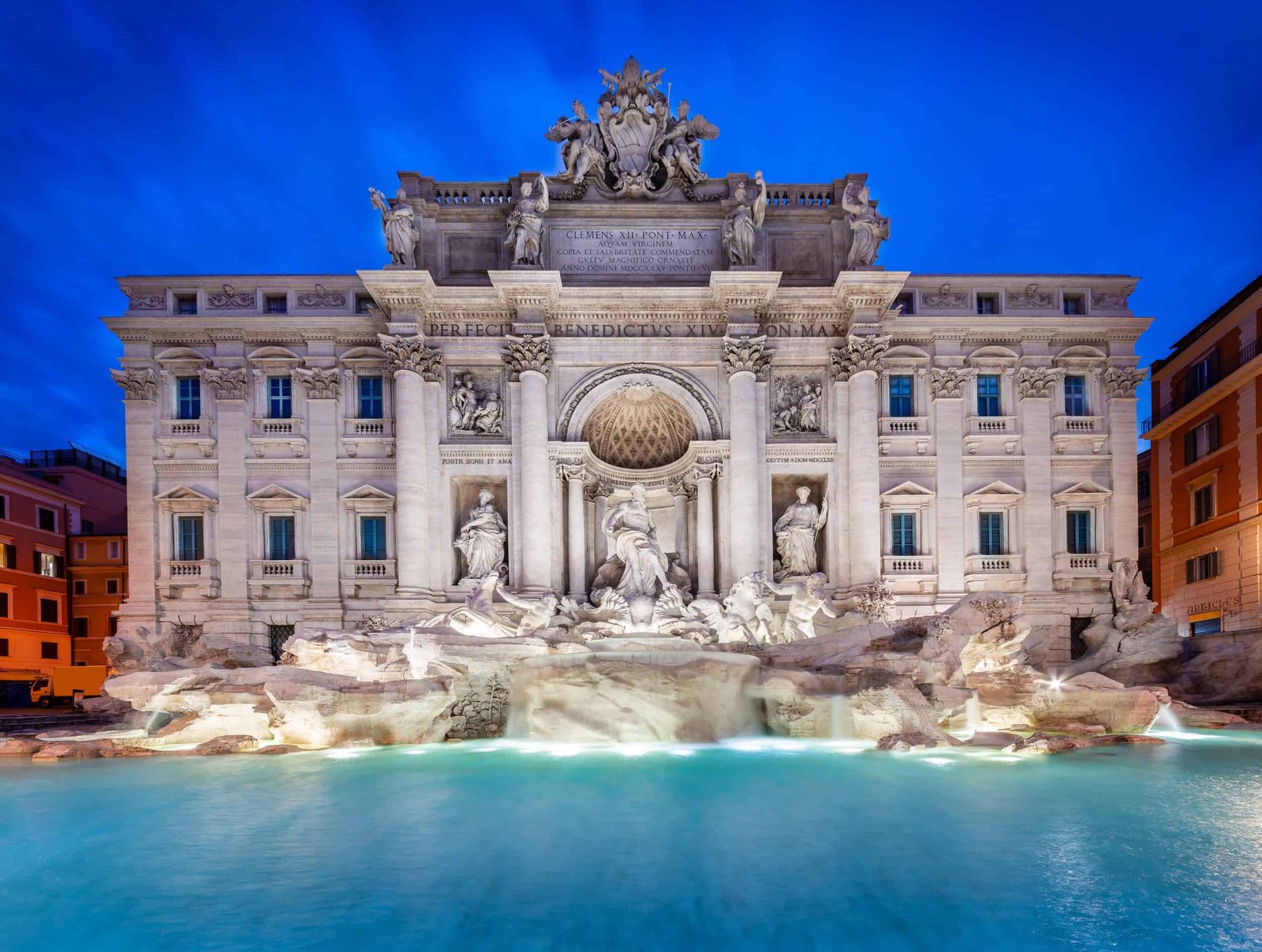
The Trevi Fountain is the largest fountain in Rome, about 26 meters high and nearly 50 wide, and the most famous fountain in the world: a baroque stage set against the facade of Palazzo Poli, fed by an aqueduct that has carried water for 2,000 years, and the spot in the city where thousands of people every day turn their backs on the water and toss a coin. And starting February 2, 2026, the visit has changed forever, and this is the news to know before you go: to go down into the basin of the Trevi Fountain, meaning the lowered area right against the pool, tourists pay a ticket of €2.00, while residents of Rome and the Metropolitan City enter for free by showing an ID. After 22:00 the gates close and the fountain belongs to everyone again, visible for free from the square, lit up. Further down you'll find hours, exemptions, and where to buy the ticket, updated to the official rules of the Campidoglio.
Here you'll find the whole Trevi Fountain: the 2,000 years of the Aqua Virgo, the 1731 competition, the 30 years of construction between Nicola Salvi and Pietro Bracci, every statue and even every plant carved in travertine, and then the 2026 rules, the coin-tossing ritual, the films, and practical tips. Make yourselves comfortable: the Trevi Fountain deserves more than the average four minutes that mass tourism gives it.
But first, the sweeter ritual, the one almost everyone misses: on the right side of the fountain, facing it, there is the fontanella degli innamorati (the Lovers' little fountain), two small jets of water in a niche. If you're at the Trevi Fountain with your partner, you can't skip drinking from it together. Roman tradition says that couples who drink from the fontanella degli innamorati will stay in love and faithful forever. The ritual dates from the time of real departures, when the fiancé left Rome for military service and the separation lasted years: they drank that water together as a promise. Everyone knows the coin toss, almost nobody knows the fontanella: make it yours.
Trevi Fountain: the Classical Period and the Aqua Virgo
The history of the Trevi Fountain begins 19 centuries before the fountain itself, and it is the history of an aqueduct. In 19 BC, Marcus Vipsanius Agrippa, son-in-law and right-hand man of the emperor Augustus, brought water to Rome from the spring basin of Salone, on Via Collatina, to supply his baths in the Campus Martius. It is the same Agrippa who built the first Pantheon, the one that still bears his name carved on the pediment. The new aqueduct was called Aqua Virgo, Virgin Water, and about the name, ancient tradition, reported by Sextus Julius Frontinus, the curator of Rome's waters who wrote about it at the end of the 1st century, tells a specific legend: a young girl, a virgin indeed, supposedly showed Agrippa's soldiers the exact place of the springs. That girl, as you'll see, is still carved on the Trevi Fountain today.
The Aqua Virgo runs for nearly 20 kilometers, mostly underground, from the springs to the Campus Martius, and here is the fact that still impresses today. It is the oldest aqueduct in Rome still in operation, the only one that has never stopped carrying water to the city from the time of Augustus until this morning. The great arches of the other aqueducts are ruins to photograph, the Aqua Virgo still works. When you look at the water of the Trevi Fountain, you are looking at a Roman hydraulic work that has been in service for more than 2,000 years. We dedicated a full profile to the aqueduct's history, which you'll find on the Aqua Virgo page.
Trevi Fountain: the Late Antique and Medieval Period
In 537, the Goths of Vitiges besieged Rome and cut the aqueducts: the Aqua Virgo came out compromised and with much reduced flow, but it was the only one that did not die. It remained in use throughout the Medieval period, with restorations documented as early as the 8th century and again in the 12th, when the Comune di Roma also connected the conduit to other springs closer to the city, in a place then called “Trebium”: and here is the first hypothesis about the origin of the name Trevi Fountain. While imperial Rome was fading and the population crowded into the bend of the Tiber, this thread of water kept arriving: without the Aqua Virgo, the rione Trevi as you know it would not exist.

Trevi Fountain: the Renaissance period
In the Medieval period, the terminal point of the Aqua Virgo was on the eastern side of the Quirinal Hill, near a trivio, a junction of three streets: "Treio" in the language of the time, and that's the second hypothesis, fairly well accepted, on the origin of the name. At the center of the junction there was a fountain with three spouts that poured water into three separate basins side by side: the first graphic record of the "Fontana del Treio," or "di Trevi," shown this way, dates to 1410. No statues, no scenery: three neighborhood basins where people drew water and watered their animals.
The first step up in quality came in 1453, when Pope Nicholas V commissioned Leon Battista Alberti, the great humanist and architect, to rebuild the fountain: Alberti replaced the three basins with a single long rectangular basin, set it against a rusticated, crenellated wall and restored the three masks the water came out of. A plaque was placed on the wall that read: "Nicholas V, Supreme Pontiff, after embellishing the city with distinguished monuments, restored the conduit of the Acqua Vergine from its ancient state of neglect in 1453." Keep this plaque in mind: two centuries from now it will vanish in a move, and no one has found it since.
Trevi Fountain: the baroque period and Bernini's project
Around 1640, Pope Urban VIII Barberini ordered Gian Lorenzo Bernini to radically transform the square and the fountain: he wanted a new scenic focal point near the family palace, Palazzo Barberini, then being completed, and visible also from the Quirinal Palace, the papal residence. Bernini designed a large monumental display of water and, before even obtaining authorization, began the work, financed among other things by the proceeds of a very unpopular tax on wine imposed on the Romans: a detail that Rome has never fully forgiven, and I'll come back to it later because the people's revenge became a proverb.
Bernini made two decisive moves that you can still see today: he enlarged the square by demolishing some small houses to the left of the existing fountain, and above all he turned the fountain orthogonally, bringing it to today's alignment, facing the Quirinal. His display of water, known from varied illustrated documentation, included two large concentric semicircular basins with a pedestal at the center just below the water surface, a base for a sculptural group probably centered on the "virgin Trivia." But the funds ran out early and were drastically cut by the war the pope had declared on the duchy of Parma and Piacenza: no central statue was carved and the work site stopped. In the move of the work site, the traces of Nicholas V's plaque were lost too, as I told you earlier.
The death of Urban VIII in 1644 settled the matter: the new pope, Innocent X Pamphili, opened a trial against the Barberini family and Bernini's project was abandoned. Bernini, who had fallen out of favor for having been the Barberini's architect, was given the task of extending the Acqua Vergine to Piazza Navona, where Francesco Borromini was supposed to create a new monumental display in front of the Pamphili palace. History then went differently, and in the square Bernini got his revenge with the Fountain of the Four Rivers: but that's another entry. At the Trevi Fountain, meanwhile, the turned basin remained and no monument: and it stayed that way for almost a century.
The failed projects: from Carlo Fontana to Benaglia's Madonna
Almost 60 years passed before Clement XI raised the problem of the Trevi Fountain again. There was no shortage of projects: Carlo Fontana proposed an obelisk on a group of rocks, modeled on the Fountain of the Four Rivers. Bernardo Castelli proposed a column on a rocky base with a spiral ramp. Other architects drew up solutions that even called for partly demolishing the buildings behind the fountain. None of these projects came to anything. And it looked like the last chance, because the family of the next pope, Innocent XIII Conti, the dukes of Poli, had recently extended the family's properties as far as Trevi square, buying the two buildings behind the fountain to replace them with a noble palace. Any monumental fountain could have compromised the palace, so it had to be carefully avoided. The palace is the one that still forms the backdrop of the fountain today. Its full history is in the entry on Palazzo Poli.
During the pontificate of Benedict XIII, a native of Gravina di Puglia, comes the most curious episode of this whole long lead-up. Out of local pride, the pope preferred artists strictly from southern Italy over the best-known architects of the time, but their projects turned out to be decidedly poor. The only work carried out was a statue of the Madonna and Child by the Neapolitan Paolo Benaglia, perhaps intended for the pedestal that Bernini had placed in the center of the two basins. The episode is curious because the artist took the "Virgin" in the aqueduct's name to mean the Madonna, rather than the young girl of Frontinus's legend who showed Agrippa's soldiers the springs. It's a full-fledged theological-archaeological gaffe, and it's surprising that nobody pointed it out, even to the pope. In any case, all trace of the statue has been lost.
The 1731 competition and 30 years of construction
Apart from the parenthesis of the pontificates of Innocent XIII and Benedict XIII, from 1721 to 1730, in the early 1700s the Trevi Fountain had become an obligatory subject for architects living in or passing through Rome, and the Academy of Saint Luke made it the subject of several competitions. Drawings and ideas by Nicola Michetti, Luigi Vanvitelli, Ferdinando Fuga and others are known, Italians and foreigners. The turning point came in 1731, when Pope Clement XII Corsini announced the great competition for a monumental water display. A first award went to the French sculptor Lambert-Sigisbert Adam, but the commission then passed to Salvi. It's said this was because the pope didn't want to entrust the work to a foreigner, or, according to another version, because Adam had to return to France. With the projects that tried to preserve the facade of Palazzo Poli discarded, attention focused on the designs of Ferdinando Fuga, Nicola Salvi and Luigi Vanvitelli, much to the displeasure of the dukes of Poli, who were still the owners and who would have seen two window bays eaten away and the palace crowned with the Corsini coat of arms. Clement XII wouldn't listen to reason. He handed the choice to a commission of experts, and the competition was won by Nicola Salvi, also because his project was the cheapest. The works were funded with 17,647 scudi, raised in part thanks to the reintroduction of the lottery in Rome. The most famous fountain in the world is the child of a lottery slip.
Salvi's project reconciled baroque and Berninian influences with the new classicist monumentalism of the pontificate. The underlying idea remained that of Urban VIII and Bernini, to tell the story of the Acqua Vergine through a marriage of architecture and sculpture. The construction site opened in 1732 and it was a marathon. Clement XII wanted to inaugurate the fountain as early as 1735, with the works still in progress. In 1740 the site stopped again, to resume two years later. His successor Benedict XIV demanded a second inauguration in 1744. Among the causes of the very long timeline, besides the grandeur of the work, were rising costs and frequent quarrels between Salvi and Giovanni Battista Maini, the sculptor in charge of the execution. Neither of the two saw the end: Salvi died in 1751, Maini the year after. The first phase had closed in 1747 with statues and fake rocks. Giuseppe Pannini was given the task of bringing the work to completion, but he was removed for the changes he had made to the original design, and the works were delayed further.
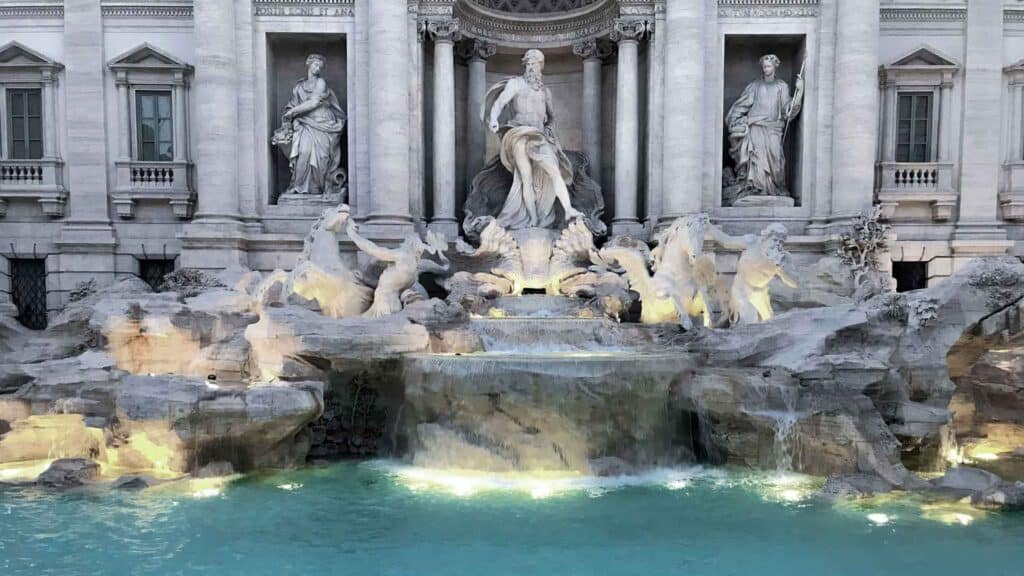
In 1759 the commission passed to the sculptor Pietro Bracci, helped by his son Virginio: the large central sculptural group that closes the work is his. On the evening of May 22, 1762, after 30 years of construction, under the pontificate of Clement XIII, the Trevi Fountain was finally returned to the public in all its majesty, and the pope inaugurated it for the third time. A note on precision about the date: some sources call that May 22 “a Sunday,” but May 22, 1762 fell on a Saturday. From Maini's first sketch to Bracci's final realization, the work was reinterpreted in an Enlightenment key: the new ideas coming from France were taking hold in Roman culture, and Bracci's agitated horse and placid horse are their most beautiful expression. Here they are.
The Trevi Fountain described, statue by statue
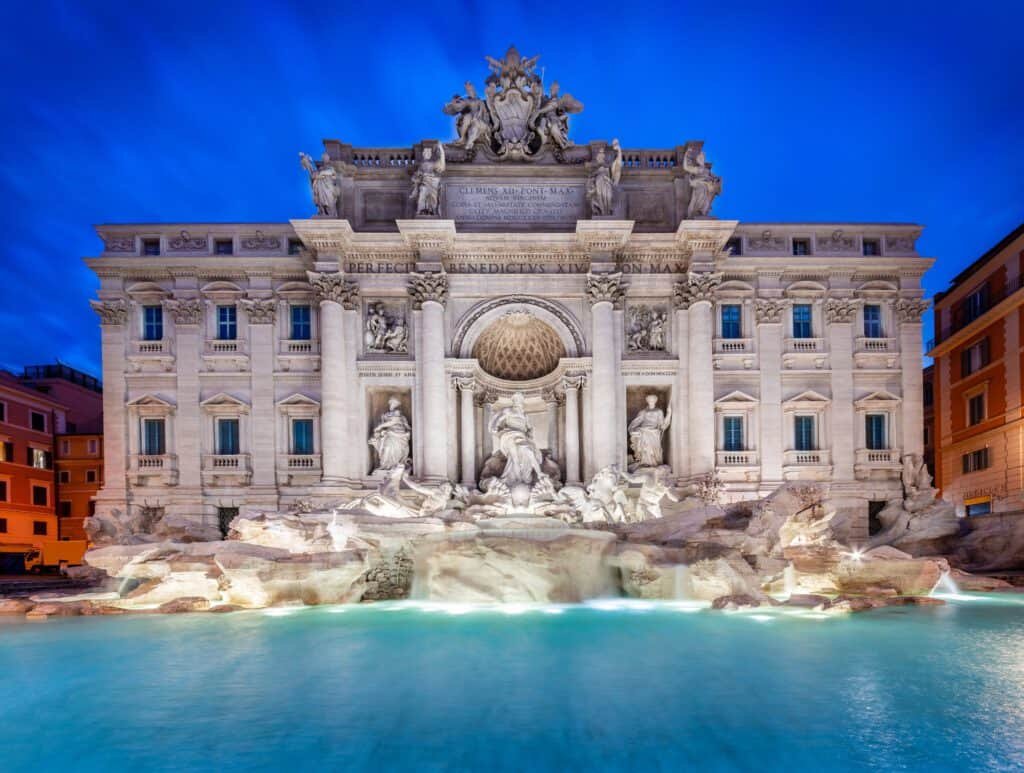
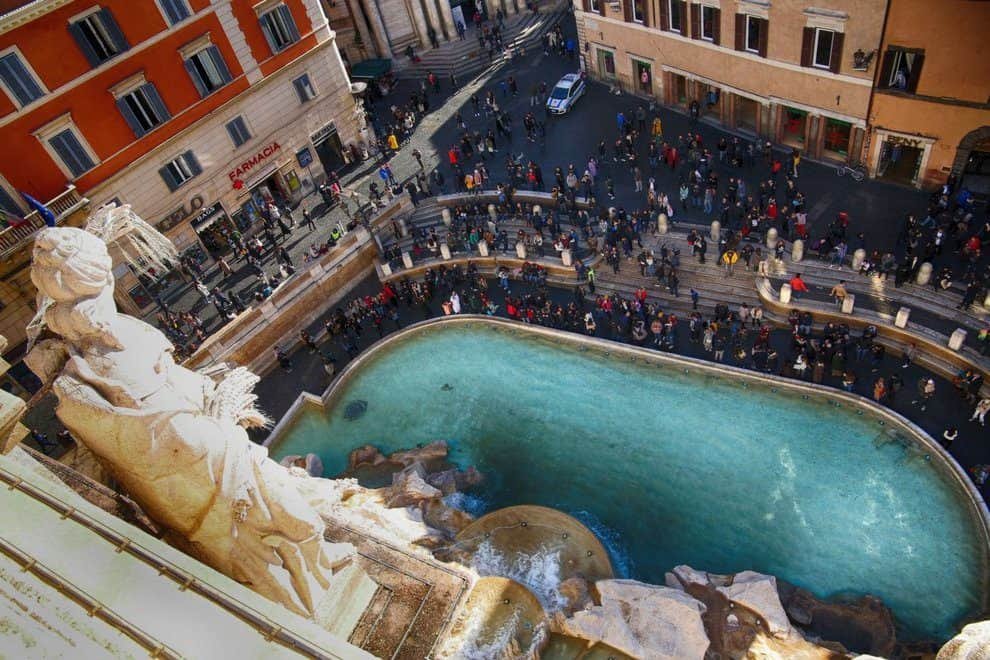
The theme of the entire Trevi Fountain composition is the sea. The fountain sits in a large rectangular basin with rounded corners, surrounded by a walkway enclosed by a short staircase, just below street level: Salvi used the staircase to make up for the difference in level between the two sides of the square, because the left side, toward the Quirinal, is much higher than the other, so much so that a short parapet was also needed to bound the street, partly covered by rocks, on one of which a cardinal's coat of arms with a rampant lion is carved. The scenery is dominated by a rocky travertine cliff that occupies the entire lower part of Palazzo Poli, and at the center a large niche framed by columns opens up, standing out as if under a triumphal arch.
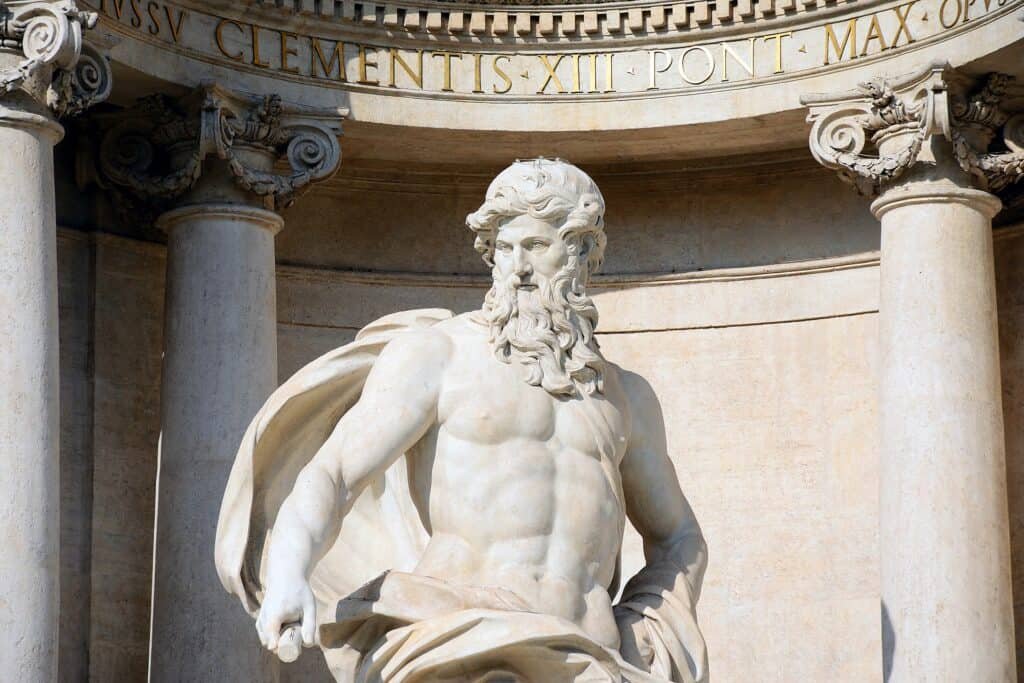
Here stands the great statue of Oceanus, carved by Pietro Bracci between 1759 and 1762 from a design begun by Maini: muscular, opulent forms, a proud and haughty gaze, a drape that barely covers the loins. The god rides a shell-shaped chariot pulled by two winged horses, nicknamed by Romans the “agitated horse,” the one on the left, and the “placid horse”: the two moods of the sea, the storm and the calm, fixed in travertine. On either side of the central niche, two smaller niches hold the statues of Salubrity, to the left of Oceanus, and Abundance, to his right, with her horn overflowing with fruit and coins: both are by Filippo Della Valle. Originally, however, the subjects planned for the two side statues were different: Agrippa and the virgin Trivia, the two protagonists of the aqueduct's story. Neither of them has disappeared, though: above the niches, two bas-relief panels depict Agrippa approving the construction of the Aqua Virgo, a work by Giovan Battista Grossi, above Abundance, and the virgin showing the soldiers the location of the springs, by Andrea Bergondi, above Salubrity. The legend of Frontinus, carved on the fountain's main level.
Now come closer, because the Trevi Fountain is also a stone garden that almost no one sees. On the cliff and the facade, dozens of plant species are carved, a herbarium in travertine: a caper plant on the facade of Palazzo Poli, a wild fig rooted at the top of the balustrade, a bush of mullein, a prickly pear, four sprigs of ivy, calla lilies and lake reeds, a trunk of oak under the statue of Salubrity, an artichoke, a vine with four bunches of grapes, a taro floating on the water, a fig, a ciombolino and a group of evergreens where the cliff ends. And two animals complete the picture: a snail crawling on the taro and a lizard hiding in a small cavity in the facade. Finding them all makes a good game with children: it works better than any audio guide.
Looking up, the four large Corinthian columns support the upper facade, where four smaller allegorical statues stand, from left to right: the Abundance of Fruit by Agostino Corsini, the Fertility of the Fields by Bernardino Ludovisi, the Wealth of Autumn by Francesco Queirolo, and the Amenity of the Gardens by Bartolomeo Pincellotti, all dated 1735. In the middle, topped by the imposing Corsini coat of arms held up by two figures of Fame by Paolo Benaglia, stands the large inscription that the pope had placed a little hastily, while work was still underway: «CLEMENS XII PONT MAX AQVAM VIRGINEM COPIA ET SALVBRITATE COMMENDATAM CVLTV MAGNIFICO ORNAVIT ANNO DOMINI MDCCXXXV PONTIF VI», that is: in the year of the Lord 1735, the sixth of his pontificate, Clement XII, Pontifex Maximus, adorned the Aqua Virgo, known for its abundance and healthfulness, with a magnificent work.
The water gushes from the rocks in several places: beneath the chariot of Oceanus it fills three basins before spilling into the main pool. The three basins were not part of Salvi's original design: they were added by Giuseppe Pannini, with the changes that cost him the commission. The sculpted rocky cliff, animated by carved plants and animals and brought to life by the abundant flow of water, was made by artists from Bernini's circle, Maini, Pincellotti, Bracci, Della Valle, together with a crowd of craftsmen of every specialty: tinsmiths, brass workers and silversmiths, carpenters, painters, stonecutters, and woodcarvers, all masterfully directed and organized by Salvi. Salvi also allowed himself a private revenge that has become a Roman legend: on the rocks covering the parapet on the left of the fountain, he had a large travertine vase carved, known as the Asso di coppe for its shape, which resembles the suit symbol on playing cards. The gossip of the time, and the anecdote is fairly well credited, says that he had it placed there to block the view of a barber who had a shop next door and kept criticizing the construction site: the vase, which has nothing to do with the theme of the fountain and has no twin on the other side, kept the unwelcome critic from getting a clear view of the work. 30 years of construction, and the architect still found time to silence a barber with a sculpture.

Trevi Fountain Today: the Restorations, the Lighting, the Set
From a conservation standpoint, the modern Trevi Fountain has three dates. The first is 1998: a general cleaning and modernization of the hydraulic system. The second is the major restoration sponsored substantially by Fendi, which began on June 4, 2014: 17 months of work on the facades, statues and rocks, limestone cleaning, micro-sandblasting, stucco repair, pictorial reintegration, consolidation of the winged horses, new waterproofing of the basin, resetting of the cobblestones of the square and of the brick curtain wall, modernization of the historic lamp posts, and cleaning of the gilded letters of the dedication. During the work, the fountain remained partly visible thanks to a panoramic walkway that crossed it, and the coin-tossing ritual never stopped: a small temporary basin collected wishes for the entire 17 months. The reopening ceremony took place on November 3, 2015, in front of hundreds of people, with the reopening of the Vergine aqueduct's pipes filling the basin.
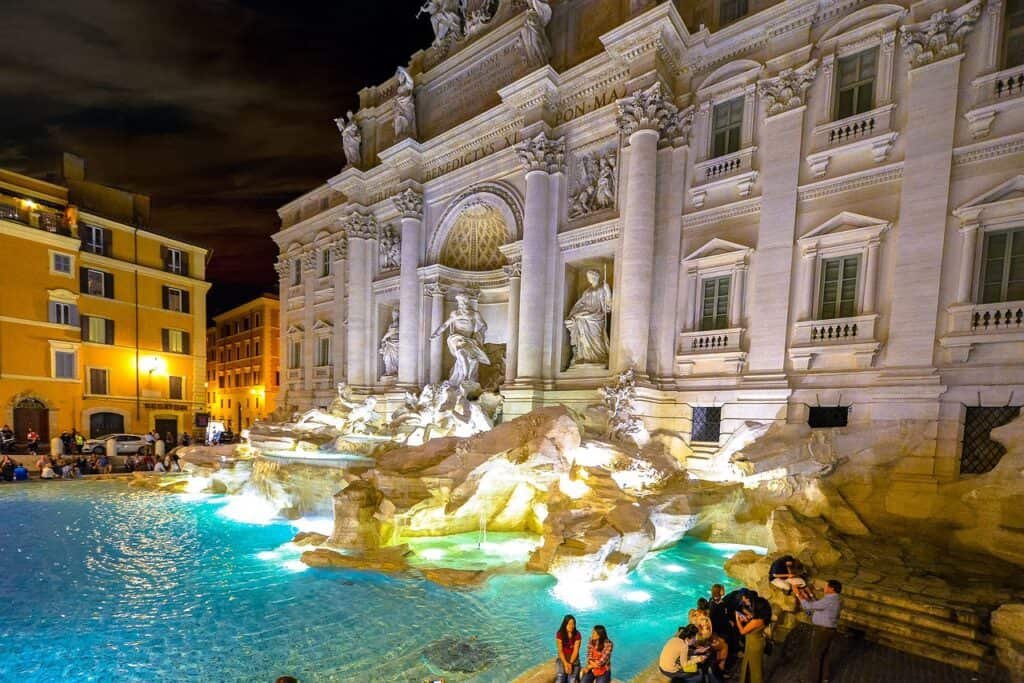
The third date is September 18, 2019, when Mayor Virginia Raggi presented the new artistic lighting: 85 underwater projectors and six wall-mounted projectors, LED technology, a total power of only 2.1 kW, and an energy saving of 70% compared with the old sodium lamps. Some projectors, aimed from the shells behind Oceanus, highlight the central structure, others, inside the basin and at the foot of the cliff, refine the side details. Seeing the Trevi Fountain lit up in the evening is a different monument from seeing it by day: two visits, not one. In the autumn of 2024, a further maintenance intervention, again with Fendi's support, cleaned the fountain ahead of the Jubilee: when it reopened on December 22, 2024, a trial of limited access to the basin began, the prelude to the revolution of 2026.
And of course the movies. Here Federico Fellini shot the most famous scene of Dolce Vita in 1960, with Anita Ekberg wading into the water in a black dress, calling "Marcello!", while Marcello Mastroianni follows her. From that moment on, the Trevi Fountain has been a permanent set in the world's imagination. Two years later, Totò, in Totòtruffa 62, sold the fountain to an Italian American tourist in front of this basin, posing as the owner: the most Roman con ever filmed. For the record, bathing in the basin is strictly prohibited and fined: Ekberg could, you can't.
Trevi Fountain tickets from 2026: official rules
Starting February 2, 2026, access to the basin of the Trevi Fountain, the lowered area in contact with the pool, is regulated by ticket. The official rules, announced by Roma Capitale and the Sovrintendenza: a €2.00 ticket for tourists and non-residents, also valid on the first Sunday of the month. Free for residents of Rome and the Città Metropolitana with an ID document, for children under six, for people with disabilities with an companion, for tour guides with a badge, and for holders of a valid Roma MIC Card. Access hours: Monday and Friday from 11.30 to 22.00, other days from 9.00 to 22.00, last entry at 21.00. After 22.00, the fountain remains visible free of charge to everyone from the square. Tickets can be bought online at fontanaditrevi.roma.it, at the Musei Civici and Tourist Info Point, at authorized sales points, or directly at the entrance, where you can pay by card only. Pre-purchased tickets are open, with no date or time. They are neither refundable nor changeable. In the first month of application, the Campidoglio counted about 230,000 paid entries. During the free trial in 2025, the site had recorded over 10 million visitors, with about 30,000 visits a day and peaks of 70,000. In our view, the €2.00 is the cheapest ticket in Rome for the experience you're buying, namely reaching the balustrade without the subway crush. Still, check hours and rules at fontanaditrevi.roma.it before you go, since operational details can be updated.
The Trevi Fountain coin toss: the ritual and where the money goes
The ritual is codified: with your back to the fountain, the coin is thrown with your right hand over your left shoulder. Tradition promises a return to Rome with one coin. The extended version, dear to guides, adds that two coins bring love with a Roman man or woman, and three bring marriage. Throwing coins remains allowed and even encouraged under the 2026 rules. What's banned is going into the water, touching the water, or eating or drinking on the balustrade. And the coins don't simply vanish: they are collected periodically and given to the Caritas di Roma, for social welfare work in shelter, inclusion and health for the most vulnerable groups. The charitable designation dates back to the 1990s, to the Rutelli administration and its agreement with Don Luigi Di Liegro, founder of the Roman Caritas, and the protocol between Roma Capitale and the Vicariate has been renewed in recent years too. In 2019, an attempt was made to divert the funds to the city coffers, and it was protests that kept the money going to Caritas. Whatever your wish may be, it funds soup kitchens and dormitories. Throw without guilt.
A curiosity about the Trevi Fountain
The most photographed statue of the fountain is not a deity: it's a vase. The Ace of Cups, the large travertine vase on the left parapet, is the only element of the Trevi Fountain that has nothing to do with the sea, the water or Agrippa. It's there, according to the anecdote already mentioned, because Nicola Salvi wanted to block the view of the nagging barber in the shop next door. Standing in front of the vase, few guess what it was for, because nobody expects a monument like this to contain a personal grudge carved in travertine. A fountain paid for with the lottery, with a playing card carved into it. Eighteenth-century Rome had a sense of humor.
Something nobody tells you about the Trevi Fountain
Beneath the square there is a second Trevi Fountain, and almost nobody visits it. A few steps from the basin, on Vicolo del Puttarello, you go down about nine meters into the Vicus Caprarius archaeological area, the so-called city of water: an imperial Roman city block with a domus and the Aqua Virgo cistern, where water from Agrippa's aqueduct still filters through today, clear, between the ancient walls. It is the physical backstage of the fountain: above the stage-set marble, below the engineering that has fed it for 2,000 years. You visit with a separate ticket, in just a few minutes. Hours are posted on site and it's worth double-checking them. In the photo above of the archaeological area, you've already seen what it looks like. When the square is a wall of people, this is the secret: the line for the fountain above doesn't exist for the fountain below.
My tip for visiting the Trevi Fountain
Play with the entry gates' timing, because the 2026 ticket has created two different fountains. The first is the Trevi Fountain basin: pay €2.00, go down the staircase, and reach the balustrade. Do it at the opening, at 9.00, or at least early in the morning, when the entrances flow smoothly, and remember that on Mondays and Fridays it starts at 11.30. The second is the Trevi Fountain after 22.00, when the gates close and the square becomes free and open again: the fountain lit by 85 projectors, the sound of the water that you can finally hear because the crowd has thinned out, the travertine turning gold. Of the two, this is the better one, and it costs nothing. The champion's combination: basin in the morning for the photo from the balustrade, return after dinner for the grand finale. And stop by the nearby Galleria Sciarra, a two-minute walk away: the most beautiful Liberty-style courtyard in Rome, free, which the tourist river from the fountain completely ignores.
Another well-known fact, yet rarely mentioned
The water in the basin is no longer running water from the aqueduct. Since the plumbing modernization, the Trevi Fountain works on a recirculation system, as common sense requires with a similar flow, and the pool water is not drinkable. The Aqua Virgo still really does arrive here, as it did 2,000 years ago. It feeds the system and continues its historic course toward the other fountains of the center, from the Barcaccia in Piazza di Spagna to the Fountain of the Four Rivers. This is the fact everyone half knows: the fountain recycles, the aqueduct lives. And if you want to drink the real Aqua Virgo a few steps from the basin, there is the fontanella degli innamorati and the nasoni of the neighborhood: Agrippa's water, free, in the glass you don't need.
The right photo to take at the Trevi Fountain
Everyone takes the classic front photo from the balustrade, and with the 2026 ticket at least you take it without elbows. But the right photo is taken from the entrance of via della Stamperia, the upper corner of the square toward the Quirinale. From there the Trevi Fountain appears three-quarter view, with the rock formation bursting from the side of Palazzo Poli and the tiny square barely containing it. It's the framing that explains the true nature of the monument, an ocean parked in a courtyard. The timing: the blue hour, the 20 minutes after sunset, when the LEDs light up Oceano and the sky is still cobalt. For the detail, use a telephoto lens on the restless horse, mane and wing against the dark travertine: it's the perfect baroque frame. And from the basin, the obligatory reverse shot: the crowd from behind tossing coins, hands in midair. Everyone photographs the fountain, almost no one photographs the ritual.
Some important events that happened here in history
19 BC: Agrippa brings the Aqua Virgo to Rome from the springs of Salone. 537: the siege of the Goths of Vitiges damages the aqueduct, which however will never die. 12th century: the city council connects the conduit to the springs of Trebium. 1410: first documented image of the three-basin fountain. 1453: Nicholas V and Leon Battista Alberti build the single basin with a plaque. around 1640: Urban VIII and Bernini turn the fountain toward the Quirinale, financing it with a tax on wine. The plaque of Nicholas V is lost. 1644: the pope dies, and Bernini's project stops. 1731: Clement XII announces the competition, won by Nicola Salvi. 1732: the construction site opens, financed with 17,647 scudi from the state lottery. 1735 and 1744: the two early inaugurations, by Clement XII and Benedict XIV. 1751-1752: Salvi and Maini die without seeing the work finished. 1759: Pietro Bracci arrives, author of the Oceano. May 22, 1762: the definitive inauguration with Clement XIII, on a Saturday, after 30 years of construction. 1960: Anita Ekberg steps into the basin for La Dolce Vita. 1998: restoration and a new plumbing system. 2014-2015: the major Fendi restoration, handed back on November 3, 2015. 2019: the new LED lighting. December 22, 2024: reopening after the Jubilee maintenance and the start of controlled access. February 2, 2026: the entry ticket for the basin begins, with 230,000 paying visitors in the first month.
Who has passed by the Trevi Fountain
The engineers and patrons first: Agrippa and his soldiers guided by a girl toward the springs, Frontinus who wrote about them, the building popes, Nicholas V, Urban VIII, Clement XII, Benedict XIV, Clement XIII, three inaugurations for a single fountain. The artists: Leon Battista Alberti, Gian Lorenzo Bernini with the interrupted project, Carlo Fontana and his obelisks never born, Nicola Salvi who dedicated his life to the fountain and did not see it finished, Giovanni Battista Maini, Giuseppe Pannini, Pietro Bracci with his son Virginio, Filippo Della Valle, and the team of four of the attic, Corsini, Ludovisi, Queirolo and Pincellotti. The nit-picking barber, silenced forever by the Ace of Cups.
And then the 1900s, which filmed here without pause: Anita Ekberg and Marcello Mastroianni in the basin for Fellini, Totò selling the fountain in Totòtruffa 62, the divas and stars of every Roman passage, and a daily flow that today reaches tens of thousands of people a day, 10 million in a year of trial. No monument in the world concentrates so many hands throwing coins: and for 30 years those coins have become meals and beds through Caritas. Everyone passes by the Trevi Fountain, but few know they are taking part, with a couple of coins, in the longest-running collection in Rome.
Rites and Beliefs of the Trevi Fountain: Which Are Truly Ancient and Which Are Not
Around the Trevi Fountain four or five gestures have accumulated that today all seem equally ancient: the coin thrown over the shoulder, the barber's vase, the maiden pointing to the spring, the little fountain where couples drink. In reality they are of very different ages: one is a tale that Roman authors were already putting in writing in the imperial era, another was born in the 1900s and was spread by the movies. It's worth keeping them apart, because this place doesn't need to be artificially aged.
The Coin Over the Shoulder: A Recent Rite, Not a Thousand-Year Tradition
Let's say it clearly: the gesture everyone knows, coin in the right hand, arm over the left shoulder, back turned to the basin to ensure your return to Rome, is not an ancient custom. It's a modern practice, which became mass in the 1900s and was spread above all by the movies: the American film of 1954 that takes its title from the fountain, and then Fellini's night scene in 1960, did more than any local tradition to turn it into a worldwide tourist obligation. On one thing scholars do not agree: how far back the habit of leaving coins in the water at Trevi can be pushed before then. Some link it to the old European custom of throwing offerings into wells and springs, documented in many places and many eras, but the passage from that generic practice to the specific rite of Trevi is not demonstrated by sources. The gesture is real, the meaning is shared, the antiquity is not.
The solid part, instead, is the economic one, and it is documented. The coins collected in the basin go to the diocesan Caritas of Rome, under a protocol between Roma Capitale and the Diocese that has been renewed for a three-year term. In the report published by the Roman Caritas the orders of magnitude also appear: about €1.43 million in 2022, almost €1.97 million in 2023, about €1.86 million in 2025, used for interventions against food poverty, for reception and social housing, for health assistance, for projects against loneliness and for children. In 2019 an attempt by the administration to divert that money to the city coffers caused quite a stir, and the charitable destination was kept. On the percentages of each single item and on who physically comes by to collect the coins it's best not to go further: the numbers change every year and the operating arrangements are not reported in a consistent way.
The Ace of Cups: The Vase, the Barber and an Anecdote That Remains One
On the right side of the fountain, at the end of the balustrade, there is a big travertine vase that Romans have always called the ace of cups, for its resemblance to the playing card. The tale goes like this: during the decades of the building site a barber on the piazza would not stop criticizing the work, and Nicola Salvi is said to have placed that vase in front of him to take away his view of the work. It's a story repeated for generations, and one of the first a guide tells here, but it must be labeled for what it is: a traditional anecdote, not a verified fact. The vase exists, the nickname exists, the unhappy barber has neither a name nor a document. Stories of this type, with the artist taking revenge on an annoying neighbor, circulate identical about several Roman monuments: a good reason to take them lightly.
The Virgin Who Pointed to the Spring: Here the Tradition Is Truly Ancient
This is the only one of the four stories with roots in antiquity, and it's worth being precise about it. The aqueduct that feeds the fountain is the Aqua Virgo, brought to Rome by Agrippa in 19 BC: that is documented. As for why it's called that, Roman authors were already reporting a story in the imperial era: some thirsty soldiers, looking for water in the countryside east of Rome, were said to have been led to the spring by a girl. Watch the logical step here: that the ancients told this story is a fact (we find it in the authors who wrote about Rome's aqueducts), that it happened is not. It's a typical legend born to explain a name. Nicola Salvi staged it anyway: the bas-relief above the right-hand niche shows the girl pointing out the vein of water to the soldiers, and it pairs with the one on the left dedicated to Agrippa. The fountain, put another way, tells on its own that it is both a work of engineering and a legend. The historical side of the matter has its own page: Aqua Virgo, and the same water also feeds the Barcaccia Fountain at the foot of Piazza di Spagna.
The Trevi sweethearts: the little side fountain and the couples' pact
Also on the right side, set apart from the main scene and much smaller, there's a little fountain with two spouts and a basin, created as a point where the people living nearby could draw Aqua Virgo water: a service, not a monument. Local tradition has attached a ritual to it: two lovers who drink together from those spouts will stay bound to each other, and in some versions the glass used must be broken right afterward, to seal a pact that can't be undone. Hence the nicknames the little fountain goes by, the lovers' fountain or the Trevi sweethearts' fountain. It's often said that the gesture began among couples separated when the young man left for military service: it's a widespread explanation, but it remains oral tradition, and the nickname in the form "fidanzatini" is not attested unambiguously by the sources. Treat it as recent city folklore.
The practical side: crowds, hours and what you really risk
The honest part is this: the Trevi Fountain is one of the most crowded spots in Europe, and the crowd is not a detail, it's the normal condition of the place. From mid-morning to after dinner you move by shoving. The only times you can breathe are early morning, just after dawn, and very late at night, when the lights and the sound of the water are all that's left: that's the reason it's worth getting up early. Access to the lower part, close to the water, is now regulated and limited, while the view from the top of the square remains free: the updated rules are in the dedicated chapter above, and they should be rechecked on the Roma Capitale channels before you go.
Quick questions about the Trevi Fountain
How much does it cost to enter the Trevi Fountain in 2026?
Access to the basin, the area right next to the pool, costs €2.00 for tourists and non-residents from February 2, 2026, including the first Sunday of the month. The view from the square stays free for everyone, and after 22:00 the perimeter is open again too.
Who gets into the Trevi Fountain for free?
Residents of Rome and the Metropolitan City with ID, children under 6, people with disabilities with a companion, tour guides with a badge and holders of a valid Roma MIC Card. These are the official exemptions of Roma Capitale: bring your ID, they ask for it.
What are the access hours for the Trevi Fountain?
Monday and Friday from 11:30 to 22:00, other days from 9:00 to 22:00, last entry at 21:00. After 22:00 the fountain can be seen for free from the square. Rules checked in August 2026 against the official communications: recheck them on fontanaditrevi.roma.it before your trip.
Where do you buy the Trevi Fountain ticket?
Online at fontanaditrevi.roma.it, at the Civic Museums and the Tourist Info Points, at authorized points of sale in cash or by card, or at the entrance, paying by card only. Tickets bought in advance are open, with no date or time, but they are non-refundable and can't be changed.
Can you still throw coins into the Trevi Fountain?
Yes, the ritual is alive and welcome: with your back to the fountain, coin in your right hand over your left shoulder. The coins collected go to Caritas of Rome for soup kitchens, shelter and assistance, in a tradition that began in the 1990s with the Rutelli administration and don Luigi Di Liegro.
What does the coin legend promise?
One coin guarantees your return to Rome. The extended version adds that two coins bring love with a Roman man or woman and three bring marriage. It's a legend, of course: but the number of coins that make their way to Caritas every year shows that as a promise it works.
Can you get in the water at the Trevi Fountain?
No: entering the water or even just touching it is forbidden and punished with hefty fines, and the staffed access points of the new entrance have made the ban much more effective. The Ekberg scene is only recreated by paying for a film set, not with the 2 euro ticket.
Why Is It Called Trevi Fountain?
The two main hypotheses: from the trivio, the «Treio», the crossroads of three streets where the medieval mostra stood, or from «Trebium», the place of the fountains connected in the 12th century. Documents show the «Fontana del Treio» as early as 1410: the name is older than all the marble you see.
Who Built the Trevi Fountain and How Long Did It Take?
Design by Nicola Salvi, winner of Clement XII's competition in 1731, worksite from 1732 to 1762, 30 years, closed by Pietro Bracci with the great central Oceanus. Salvi died in 1751 without seeing the work of his life finished: the date to remember is May 22, 1762.
Where Does the Water of the Trevi Fountain Come From?
From the Acqua Vergine aqueduct, Agrippa's Aqua Virgo of 19 BC, almost 20 kilometers, largely underground, from the springs at Salone: it is the oldest aqueduct in Rome still in operation. The basin works on recirculation and its water is not drinkable.
How Big Is the Trevi Fountain?
About 26 meters high by nearly 50 wide: it is the largest fountain in Rome, leaning against the facade of Palazzo Poli, which serves as its backdrop. The square around it, in proportion, is tiny: that is the secret behind the surprise effect when you come out of the alleys.
What to See Near the Trevi Fountain?
Two minutes away, the Galleria Sciarra and the archaeological area of the Vicus Caprarius, five minutes away, the Quirinal Palace, 10 minutes away, the Pantheon on one side and Piazza di Spagna on the other. It is the densest kilometer on the planet: use the fountain as your pivot.
How to Get to Trevi Fountain
The Trevi Fountain stands in Piazza di Trevi, in the Trevi district, wedged between the alleys: no vehicle gets right up to it, and that's fine. The most convenient stop is Metro A Barberini, from which you go down via del Tritone and via della Stamperia in less than 10 minutes on foot, on foot you're five minutes from the Quirinale, 10 from the Pantheon, 10 from Piazza di Spagna, and a quarter hour from via del Corso on Piazza Venezia side. The advice is always to arrive through the narrow alleys, from via delle Muratte or via della Panetteria, hearing the water before seeing it: the entrance to the square is the coup de théâtre that Salvi built on purpose, so don't spoil it by arriving distracted. The full itinerary can be planned with Il mio viaggio, and you'll find the other destinations in the Rome city center in the Tourist Attractions section.
One last observation, from the balustrade: the Trevi Fountain is the only monument in the world where the public turns its back on the work to take part in the ritual. 2,000 years of aqueduct, 30 years of construction, a basin sculpted out of spite, a diva in the basin and a 2 euro ticket: all true, all together, in a square as big as a courtyard. Toss the coin, drink at the fontanella degli innamorati, and come back after 22.00, when the square empties and the fountain, finally, can be heard. Rome has no more convincing goodbye than this.