Galleria Sciarra
In short. Galleria Sciarra is the covered courtyard of Palazzo Sciarra Colonna di Carbognano, in the Trevi district, and it has two entrances: one on Via Marco Minghetti, the other on Piazza dell'Oratorio, less than 300 meters from the Trevi Fountain.
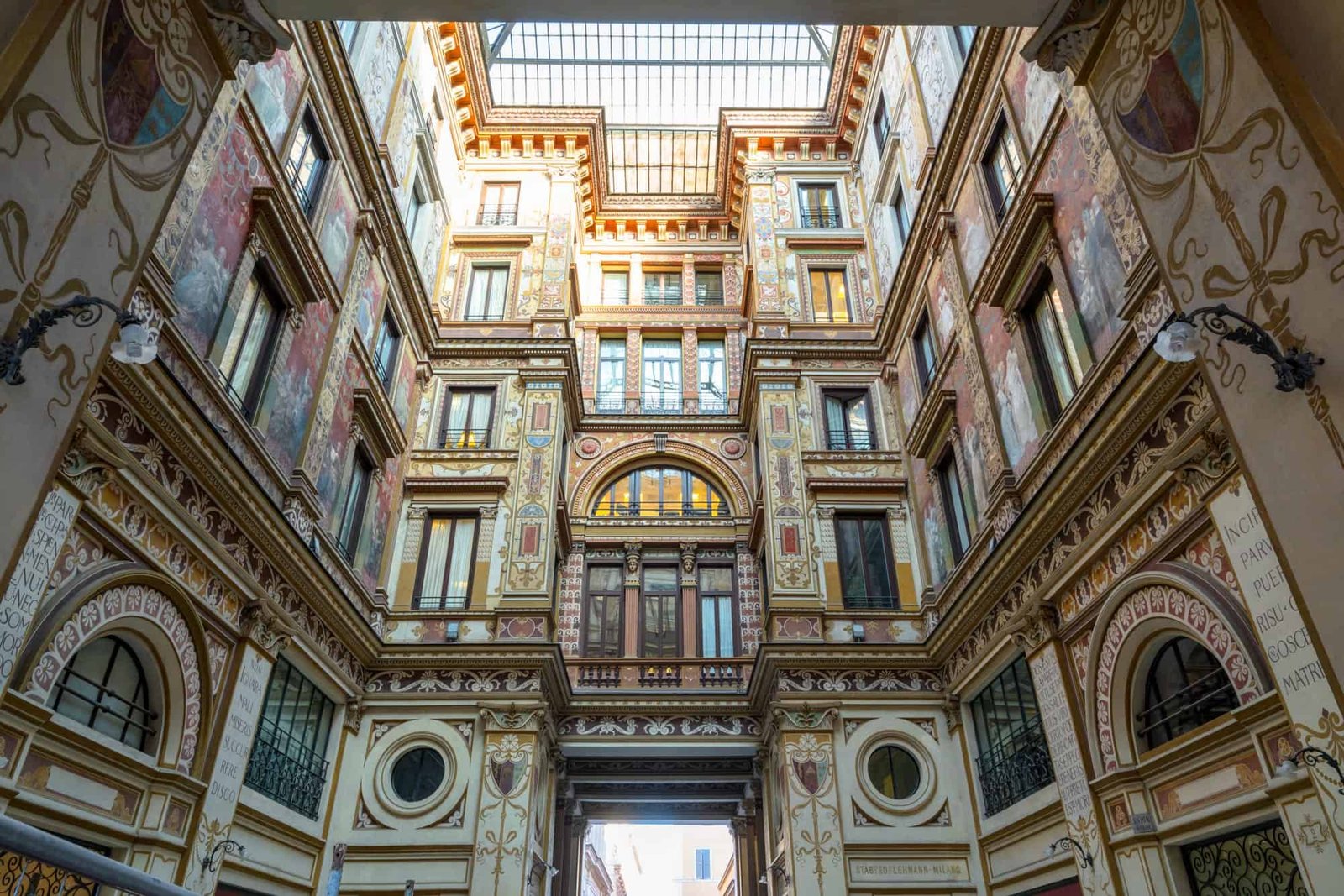
Galleria Sciarra is the covered courtyard of Palazzo Sciarra Colonna di Carbognano, in the Trevi district, and it has two entrances: one on Via Marco Minghetti, the other on Piazza dell'Oratorio, less than 300 meters from the Trevi Fountain. It isn't a museum and it has no ticket office. It's a private courtyard open to the public during office hours, as the Rome city tourism portal says, so weekday mornings and early afternoons are when the gates are almost always open, while in the evening, at night and on holidays you may find the passage barred. You pay nothing, you book nothing, and there is no card you need to get in. The most convenient public transport is metro line A, Barberini stop, a 10-minute walk downhill along Via del Tritone. By bus, line 62 stops at Corso/Minghetti, right at the start of the street. The complex the gallery belongs to is now the seat of Fondazione Roma, which has opened the main venue of the Museo del Corso on the piano nobile, with its entrance at Via Minghetti 22. That does have its own hours: Wednesday to Friday from 11:00 to 19:00 and Saturday and Sunday from 10:00 to 20:00, closed Monday and Tuesday.
If you're putting together an itinerary in the historic center, the page on tourist attractions collects the nearby places, and Galleria Sciarra fits in nicely between the Trevi Fountain and Via del Corso.

Where exactly is Galleria Sciarra and how do you get there
The topography is deceptive here, because Galleria Sciarra has no facade on the main street. It's a void carved out of a city block, and someone walking along Via del Corso can pass it a thousand times without suspecting it exists. The block is the one between Via del Corso, Via Marco Minghetti and Via delle Vergini, right next to Teatro Quirino. From the start of Via Minghetti, the street opened in the late 1800s precisely to serve the new complex, you see an arch with a gate on your right. That's the way in. The opposite exit opens onto Piazza dell'Oratorio, a quiet little square that almost no tourist crosses.
By metro to Galleria Sciarra
Line A has two useful stops. Barberini is the most direct: you come out on Piazza Barberini, take Via del Tritone and walk down for about 10 minutes to Largo Chigi, then take Via del Corso to the left and turn into Via Minghetti. Spagna works just as well if you're coming from the north, but the route is longer and more crowded. There is no metro stop right by the gallery, and anyone who tells you otherwise doesn't know the map. For archaeological reasons, the monumental center of Rome remains one of the least served in Europe.
By bus and on foot
Line 62 crosses the city from Stazione Tiburtina to Piazza Stazione San Pietro, going through Porta Pia, Barberini, Tritone and San Silvestro, and it has a stop called Corso/Minghetti. Get off there and you're 20 meters from the entrance. If you're coming from Piazza Venezia, you can walk up Via del Corso in about 10 minutes. My advice, though, is to come from the opposite side: enter from Piazza dell'Oratorio, because seen from that side the gallery opens up like a theater backdrop and the effect is far better. From Via Minghetti you catch it at an angle and half the wonder is lost.
How much does it cost to enter Galleria Sciarra and which cards are useless
Getting in costs nothing. It's the simplest piece of information on the page and also the one that causes the most confusion, because many visitors arrive convinced they have to show a pass. Let's settle it once and for all: Galleria Sciarra is not a civic museum of Roma Capitale, so the MIC Card, which is valid for the Musei in Comune system, has nothing to do with it. It isn't a state site, so the ministry's free Sundays have nothing to do with it. It doesn't appear among the affiliated attractions of the paid tourist cards. It's a private courtyard that the owner lets people walk through, and that's all.
The MIC Card and Galleria Sciarra: two separate worlds
The MIC Card is the tool that lets people who live or study in Rome enter the civic museums for a year: the Capitoline Museums on the Capitoline Hill, the Trajan's Markets, the other municipal venues. Palazzo Sciarra Colonna belongs to a private-law foundation and is not part of that system. Not even the Roma Pass, which covers civic and state sites, gives any special rights here. The good news is that you don't need it: the passage is free, and the Museo del Corso too, according to what Fondazione Roma announced when presenting its exhibition season, offers free access to the permanent collection and to the exhibitions. Before planning your museum visit, though, it's worth checking the official website, because the conditions of a private institution can change without notice.
A curiosity about Galleria Sciarra
On the arch of the entrances, up high, anyone who looks carefully finds a shield with three interlaced letters: C S S. It isn't a decorative abbreviation and it isn't the monogram of the prince who commissioned the work. They are the initials of Carolina Colonna Sciarra, the mother of Maffeo Barberini Colonna di Sciarra, and their presence changes the meaning of everything above your head. Because Galleria Sciarra is not, as people lazily keep repeating, a generic hymn to fin de siècle feminine elegance. It's a private monument that a very rich man in crisis wanted to dedicate to his own mother, having 12 feminine virtues painted along the walls of a courtyard that anyone could cross. The domestic tribute turns into a public manifesto, and for 140 years the public has kept walking through it without noticing.
The curiosity becomes tastier if you add a chronological detail. Giuseppe Cellini's cycle was completed in 1888, as stated by the inscription MDCCCLXXXVIII that runs through the decoration. In those same years Maffeo Barberini Colonna di Sciarra financed the daily La Tribuna and the third series of the Cronaca bizantina directed by Gabriele D'Annunzio, and had the deluxe edition of Isaotta Guttadauro printed at his own expense. D'Annunzio's volume is illustrated by Cellini himself: the painter who paints the feminine virtues on the courtyard walls is the same one who, in those very months, draws the plates for the most worldly poet in Italy. The gallery and the book came from the same hand and the same strongbox. It's a short circuit that no guide tells you about and that explains better than anything else what Umbertine Rome was: a new capital in which literature, journalism, real estate speculation and wall decoration were the same business, run by the same people.
In our view the secret of Galleria Sciarra is not that it's little known, but that it's little looked at. The letters C S S are right there, four meters up, and one person in a hundred sees them.
Palazzo Sciarra Colonna di Carbognano, the history that precedes Galleria Sciarra
To understand the courtyard you have to understand the palace, because the gallery was born as its far appendage and not as a separate building. The site, in this stretch of the city between the Corso and the Quirinal Hill, was already occupied in the first centuries of Christianity by sacred buildings, and from the 1400s onward by patrician residences. The area has never stopped being the address of the powerful.
The imperfect palace and the little palace
In the second half of the 1500s the Sciarra, a branch of the Colonna family that held the principality of Carbognano, owned two separate building cores here. The old sources call them by two names that say everything about their condition: the palazzo imperfetto and the palazzetto. The first was a construction site left half finished, the second a minor building. In 1610 the family commissioned the Milanese architect Flaminio Ponzio to design their unification, that is, to make one palace out of two half buildings. Ponzio is the same architect who worked for Paul V Borghese: calling him meant declaring ambitions.
Orazio Torriani and the facade
In 1641 the direction of the works passed to Orazio Torriani, also given in the sources as Torrioni, author of the noble, severe facade that you can still see today from Via del Corso: rusticated corner blocks framing the front, a bracketed cornice crowning it, three orders of windows marking its rhythm. It's Roman architecture of the full 1600s, measured and not inclined to flourishes, and it serves as a counterpoint: anyone entering the 1800s gallery after seeing this facade understands how big the leap in taste was over two and a half centuries.
The portal among the four wonders of Rome
The monumental entrance is organized around a rusticated arch. In front of it, on tall plinths, stand two fluted columns with composite capitals that support the balustraded balcony of the first floor. On the front of the plinths and on the balustrade, other columns are carved in relief, a heraldic reference to the origin of the Sciarra family from the Colonna. The quality of this portal earned it a place on a list handed down by Roman tradition, the four wonders of Rome, where it appears together with the Borghese harpsichord, the Farnese cube and the Caetani staircase of Palazzo Ruspoli. The Fondazione Roma, which now occupies the building, still claims that primacy in the presentation of its own seat. It is worth remembering that this is a popular classification and not a critical judgment: no treatise has ever codified it, which takes nothing away from its appeal.
Vanvitelli and Cardinal Prospero Colonna
In the 18th century Cardinal Prospero Colonna promotes the adaptation of the palace to the taste of the era, and Luigi Vanvitelli, a friend of the cardinal, also takes part in the architectural and pictorial renewal and designs its renovation. From those works come the domestic library, the small gallery and the Cabinet of Mirrors, rooms rich in painted decoration that increase the historical and artistic value of the complex. Anyone who knows Vanvitelli only for the Royal Palace of Caserta would do well to remember this here: his Roman work is made of restraint and interiors, not monumental perspectives.

Francesco Settimi and the rebuilding of the courtyard
At the end of the 19th century another name joins the list of technicians who worked on the complex: Francesco Settimi, who took care of the restoration of the surrounding buildings, the enlargement of the right wing of the building and the rebuilding of the courtyard. It is the kind of work nobody remembers and without which the main construction project would not have been possible: before building the glazed passage, everything that would grow up around it had to be put back in order.
Rome the capital and the birth of the Galleria Sciarra
Between 1871 and 1898 the palace is reduced in size. It seems a paradox, but it is the logic of the new city: after 1870 Rome becomes the capital of the Kingdom, the central rioni are restructured according to the reconstruction plans, and the great noble properties are broken up into profitable lots. Prince Maffeo Barberini Colonna di Sciarra entrusts Giulio De Angelis with the opening of the adjacent Via Minghetti, the construction of the block, the building of the Teatro Quirino and, behind all this, the gallery. Starting in 1882 the entire 17th-century complex between Via del Corso, Via Minghetti and Via delle Vergini undergoes a deep renovation. The building you walk through today dates from between 1885 and 1888.
Prince Maffeo Barberini Colonna di Sciarra
Maffeo was born in Rome on September 10, 1850 and died in Frascati on March 13, 1925. He is the client who commissioned the gallery and the most novelistic figure in this story. A man of equal ingenuity and prodigality, he puts his own fortune at the service of both publishing and speculation. From 1883 he finances the daily La Tribuna, founded that year and directed by Attilio Luzzatto, which with modern journalistic techniques and prestigious bylines becomes one of the most important Italian political newspapers. He then finances the third series of the Cronaca bizantina, entrusting its direction to Gabriele D'Annunzio, whose patron he is during the Roman years. His agricultural and building speculations, however, turn against him: in 1893 his name appears among those of the deputies censured by the parliamentary commission of inquiry on the Banca Romana scandal, for the renewal of permanent promissory notes. He will end up in Paris, marrying the marchioness of Bonneval, and then retiring to Frascati.
La Tribuna and the Cronaca bizantina behind the walls
The original function of the Galleria Sciarra was to connect with one another the spaces of the prince's property and businesses: the offices of La Tribuna and of the last Cronaca bizantina, until then housed at the back of the palace, and the theater. Put differently, this monumental courtyard was born as a luxury corporate corridor. Editors passed through here with their proofs, and so did typesetters, actors, creditors. Anyone who walks through it today, in silence, can hardly imagine the traffic that animated it.
The Teatro Quirino Vittorio Gassman
The theater the prince wanted still exists, it's now called Teatro Quirino Vittorio Gassman, and its entrance is on Via delle Vergini, at the corner with Via Minghetti, a few steps from the gallery. The ticket office can be reached at 06 6794585 and at biglietteria@teatroquirino.com. The box office takes a summer break from August 2 to 30 and reopens on August 31 with hours Monday to Friday from 11:00 to 18:00 and Saturday from 10:00 to 13:00, closed on Sunday. Combining a stroll through Galleria Sciarra with an evening show at the Quirino is one of the most elegant ways to use this corner of the city, and I recommend it without reservation to anyone with a free evening in Rome and no desire for lines.
Giulio De Angelis, the architect of iron
Giulio De Angelis was born in Rome in 1845 and died in Anzio on March 14, 1906. He enrolled very young at the Academy of Fine Arts of Perugia, graduated from the Politecnico di Milano in 1868 and, in between, fought as a Garibaldian volunteer in the war of 1866. He is the most singular and restless Roman architect of his time, and above all he is the one who understood before the others what cast iron and iron could do for architecture. Between 1886 and 1887 he designed on Via del Corso the Magazzini Bocconi, with the sign Alle città d'Italia, the building that would later become La Rinascente, with large glazed arches that ensured complete transparency of the front. In December 1889 he completed at Via Due Macelli 9 the palazzo del Popolo Romano, also known as Palazzo Chauvet. Galleria Sciarra, begun in 1885, belongs to the same season and the same idea: bringing the industrial lightness of iron into a city of travertine and brick.
Something nobody tells you about Galleria Sciarra
What you're looking at is no longer, structurally, De Angelis's building. In the restoration carried out at the end of the 1970s the building was completely emptied inside and rebuilt in reinforced concrete. The painted decorations and the iron structures were preserved, and that's why the visual impression remains intact, but the 1800s masonry that held them up is gone. Put bluntly: today Galleria Sciarra is a decorative shell of the 1800s mounted on a skeleton of the 1900s.
It's a piece of information that almost nobody reports and that changes how you read the monument. First, it explains why the painted surfaces are in much better condition than you'd expect from a space exposed to the air and crossed every day by hundreds of people: they were detached and put back, not simply washed. Second, it places the gallery in a typically Italian story, that of the consolidations of the 1970s, in which reinforced concrete was used generously inside historic buildings in the name of safety. Third, it should make you more cautious when talking about authenticity: here the authentic part is the color and the design of the iron, not the structure.
I'll add a second element that nobody mentions. The polychrome cast-iron columns of the atria, which look purely decorative because they seem so slender, actually bear load and came out of the Barbieri Foundry. Colored cast iron, at the time, was a technological statement: it meant the element had been cast in series in a factory and not carved in a workshop. In a city that identified luxury with marble, putting industrial metal columns in the entrance of your own residence was an almost provocative gesture, and the prince knew it perfectly well.
The verdict is clear: Galleria Sciarra is overrated as an Instagrammable spot and underrated as a document of the history of technology. It's worth more for what it says about industrial Rome than for the first impression, even though the first impression is remarkable.

The iron and glass vault of Galleria Sciarra
Look up as soon as you walk in, even before looking at the walls: the roof is the reason this space works. The gallery is a pedestrian courtyard on a quadrangular plan, laid out on a cross scheme, covered by a ribbed barrel vault in iron and glass. The central bay reaches a height three times that of the side arms and is closed by a bright glazed dome with its dark iron framework left in view. Nobody tried to hide the structure under stucco: the metal shows itself, and its weave draws the sky.
How the light works inside Galleria Sciarra
The practical result is that the light changes from hour to hour and from season to season. At midday in summer the sun comes in almost vertical and flattens the colors. In the late afternoon, or on a day with a white sky, the diffused light gives the frescoes back the depth the painter had calculated. The glass-covered spaces of the 1800s were designed for this indirect light, not for sun beating straight down. That's why I always insist on bringing groups here before 11:00 or after 16:00.
The two-story wings and the terracottas
The side wings develop on two levels, with coffered ceilings supported by alternating pilasters and columns, and they are run through by balconies, windows and cast-iron railings. The decoration includes terracotta elements that take up and mix Etruscan, Roman and Greek repertoires. This mixture is the signature of the era: late 1800s eclecticism didn't copy a model, it set many side by side, and judging it by the standards of philological coherence means not understanding it. The inscription MDCCCLXXXVIII, that is 1888, runs through the decoration and marks the completion of the work.
Giuseppe Cellini and the Glorification of Woman at Galleria Sciarra
The painted cycle is the reason this courtyard has a place in the history of art and not only in that of construction. Giuseppe Cellini was born in Rome on December 9, 1855 and died on April 29, 1940. He graduated from the Academy of Fine Arts in 1875 and then attended the School of the Museo artistico industriale between 1878 and 1880, winning first prize in the annual competitions two years in a row. In 1886 he took part in founding the group In Arte Libertas, whose name he himself suggested, and he exhibited with that circle until 1901. Among his later works are the decorations of the Ministry of Agriculture in 1918 and the work in the dome of Santa Rosa in Viterbo in 1916, but the decoration of Galleria Sciarra, completed in 1888, remains his greatest undertaking.
Encaustic, an ancient technique for a modern building
Cellini did not paint in fresco but in encaustic, a technique that binds the pigments to wax and fixes them with heat. It's a choice worth thinking about: encaustic is the technique of ancient painting, that of the Fayyum portraits, and bringing it back to life in 1885 inside a building of iron and glass is exactly the kind of contradiction that defines the taste of those years. Very old material, contemporary structure. It's also the reason the colors have a dull, milky compactness, different from the transparency of fresco: if the tones seem closer to those of a ceramic than to those of a church wall, you're not mistaken.
Giulio Salvadori's iconographic program
The conceptual design of the cycle is not the painter's. The iconographic program is owed to the man of letters Giulio Salvadori, and this detail explains why the decoration has such an orderly argumentative structure instead of the free decorative fantasy you would expect. Rome, in those years, was a city where poets and painters worked elbow to elbow, and the word often guided the image. The sources alternate the spellings Salvadori and Salvatori: the correct form of the writer's name is Giulio Salvadori.
The 12 feminine virtues of Galleria Sciarra
In the upper register run the allegorical figures of the feminine virtues, each identified by a scroll. The traditionally reported list includes 12 figures: La Pudica, La Sobria, La Forte, L'Umile, La Prudente, La Paziente, La Benigna, La Signora, La Fedele, L'Amabile, La Misericordiosa, La Giusta. They are monumental women, wrapped in garments with heavy folds, with hairstyles that alternate ancient memories and contemporary fashions. The sequence is not random: it moves from the virtues of bearing to those of character, from private virtues to social ones, and culminates in justice, which in the allegorical tradition is the regal virtue par excellence. Attributing the virtue of justice to a middle-class woman, in 1888, was not at all a neutral gesture.
The scenes of middle-class life
Below the allegories, a second narrative strand tells the day of an upper-middle-class Roman family: tending the garden, the family lunch, music practice, works of charity, the toilette and gallant conversation. Some sources also record episodes devoted to vanity, marriage and the care of children. This is where the cycle becomes a social document: furniture, clothes, objects and gestures are the real ones of 1885, painted by someone who saw them every day. If you want to know how a table was set in a Roman gentleman's house on the eve of the 1900s, this wall tells you better than an archive.
D'Annunzio's face in the Gallant Conversation
Tradition has it that in the scene of the gallant conversation Cellini portrayed Gabriele D'Annunzio, then young and already famous, editor of the magazine the prince financed. The identification is reported by several sources, including the Rome city tourism portal, but it should be taken for what it is: an established tradition, not an archival fact. The game is worth the candle anyway. Look for the scene, spot the young man with the neatly trimmed beard turning to a lady, and decide for yourself. The resemblance is half convincing, which, for a portrait hidden in a wall decoration, is already a lot.
The initials CSS and the dedication to the mother
Let's go back to the three letters on the shields of the entrances. The monogram C S S refers to Carolina Colonna Sciarra and assigns the cycle its real addressee. The whole Glorification of Woman, read this way, becomes the construction of a feminine ideal starting from a real figure, with the curious consequence that the residents of the Trevi district have strolled for generations inside the moral portrait of a prince's mother.

My advice for visiting Galleria Sciarra
The first piece of advice is about timing, and it's not a detail: it's the difference between seeing the gallery and finding a closed gate. Access follows office hours, so aim for the window between 9:30 and 18:00 on a weekday. Outside those hours the passage may be barred, and nobody will warn you in advance. If you have only one day in Rome and you want certainty, go early in the morning, before heading down to the Trevi Fountain: at nine in the morning the district is still empty and the gallery is all yours.
The second piece of advice is about how much time to give it. Almost everyone crosses it in 90 seconds, looking up twice. That's a mistake. Give yourself 20 real minutes and use them like this: five for the upper register, reading the scrolls of the virtues one by one from left to right. Five for the lower register, looking for the everyday objects in the middle-class scenes. Five for the structure, meaning the vault, the ribbing, the cast-iron columns and the balconies. Five for the entrances, where you find the shields with the monogram and the terracottas. With this method the gallery becomes a lesson in art history compressed into a quarter of an hour.
The third piece of advice is about mental equipment. Enter from Piazza dell'Oratorio side, as already suggested, and resist the temptation to start taking photos right away. Make a full lap empty-handed, then take out your phone. The reason is practical: the glass vault fools the automatic exposure of any camera, and if you shoot as soon as you walk in you'll get dark walls under a blown-out sky. After 30 seconds of adjustment the eye sees far better than any sensor, and you'll know what to frame.
Fourth and last: combine it. Galleria Sciarra alone doesn't justify a trip, but set into a 90-minute route it becomes one of the best moments of the center. A tested itinerary starts from the Trevi Fountain, enters here from the Oratorio side, exits onto Via Minghetti, reaches Piazza Colonna and Montecitorio, and ends at Galleria Alberto Sordi, which with its early 1900s glazed structure makes a perfect counterpoint. If you have more time, continue toward the Pantheon.
Another well-known fact, yet rarely cited
Everyone writes that Galleria Sciarra is the greatest example of Liberty-style decoration in Rome. What almost nobody adds is that this piece of the city sits on one of the most imposing memories of Augustan Rome: in the area occupied by the gallery there once stood the Porticus Vipsania, the great portico built by Vipsania Polla, sister of Marcus Vipsanius Agrippa, who owned a villa in the surroundings.
Vipsania's portico was not just any building. The ancient sources remember it as the place where the map of the known world, drawn up under Agrippa's direction, was displayed to the public: a representation of the empire meant to be looked at by citizens, the first great act of geographic popularization in Western history. In this area, in short, Romans came to see the borders of their world. 1,900 years later, in the same spot, a prince had the borders of the feminine world, according to the Umbertine middle class, painted on the walls of a courtyard. The parallel is too good to leave unsaid, and it has the merit of being true: the stratigraphy of Rome produces juxtapositions that no urban planner could invent.
I'll add the second well-known fact that is never explained: the reason Via Marco Minghetti exists. It isn't an ancient street and it wasn't even a street born for traffic. It was opened between 1871 and 1898, as part of the operation the prince wanted, to serve the new block and give an urban front to the theater and the gallery. The name was given to a politician who died in 1886, a protagonist of the Historic Right. So you walk on a street designed as part of a private real estate operation and named after a statesman: post-unification Rome in three lines.
One last note, and this is an opinion. I find that using Galleria Sciarra as a simple pedestrian passage has diminished how it's perceived: you cross it without stopping, and the artistic side slips away. The paradox is that this same function saved it. A courtyard that serves a purpose stays open, gets watched and gets maintained. The decorations that have been lost in this city are almost always those of spaces that became useless.

The right photo to take at Galleria Sciarra
Let's start with what doesn't work, because it's the photo everyone takes: phone pointed straight up at the dome, from the exact center of the courtyard, with the wide-angle lens. The result is a pinwheel of iron and glass in which the frescoes become a blurred band at the edges and the light from the glass burns out every detail. It's a photo already seen 10,000 times and it says nothing about this place.
The right photograph at Galleria Sciarra is a different one, and it takes three adjustments. The first is position: stand under one of the side arms, not in the center, and frame diagonally toward the opposite entrance. That way you have in a single frame the painted register in the foreground on the left, the depth of the passage in the middle and the light of the dome at the top right. The diagonal composition is the only one that gives back decoration and structure at the same time. The second adjustment is exposure: tap the screen on a painted wall and not on the glass, otherwise the camera will measure the light of the sky and throw everything else into shadow. If your phone allows it, lower it by another half step. The third is timing: overcast sky or late afternoon, never midday in summer.
The detail that is worth more than the whole
If I had to take home a single image from Galleria Sciarra, I wouldn't photograph the whole. I'd choose a vertical portrait of a single virtue, shot from below, with the iron rib passing over her head. In one frame you read everything this place is: an ancient figure, a scroll with her name, and above it the metal of a factory. The second detail I recommend is the shield with the C S S monogram on the entrance arch, which you have to look for with the zoom because it gets lost to the naked eye.
Common-sense rules for taking photos here
Personal photographs are no problem in an open passage, but it's worth remembering that this is private property and not a square: no bulky tripods, no photo sessions with outfit changes, no drones. For professional or commercial shoots the correct route is to ask the owner. It happens that groups of photographers occupy the passage for 20 minutes, and it's the quickest way to get a gate closed that has been open for 140 years.
Some important events that happened here in history
The first event is the construction itself, between 1885 and 1888, and it should be read as a historical fact and not as an archival date. In those years Rome as capital was rewriting itself: new streets were opened, vegetable gardens and convents were torn down, whole neighborhoods were built in a few months. The decision of a Roman prince to erect a covered passage of iron and glass behind his own palace, with a newspaper office on one side and a theater on the other, is the sign that the black aristocracy had understood that power had moved from the salons to the rotary presses.
The dispersal of the Sciarra collection and the law of 1892
The second event is the one that left the deepest mark on Italian history, and it concerns the walls of the palace more than those of the gallery. The Sciarra picture gallery was one of the most extraordinary in Rome: it included, among much else, Caravaggio's The Cardsharps, which came to the family by inheritance from the Barberini. The provenance is reconstructed by the museum that now owns the painting, the Kimbell Art Museum in Fort Worth: made for Cardinal Francesco Maria del Monte around 1596, bought in 1628 by Cardinal Antonio Barberini, passed by marriage to the Colonna di Sciarra and assigned in 1812 to Maffeo Barberini Colonna di Sciarra, who kept it between Rome and Paris until 1895. Then the painting vanished: almost 90 years without news, until its purchase by the Kimbell Art Foundation in 1987.
That dispersal had a legislative consequence of the first magnitude. The legal literature on heritage protection documents it precisely: following the sale abroad of some paintings from the Sciarra collection and the collection of Prince Mario Chigi Albani, Law no. 31 of February 7, 1892 was issued, which introduced penalties for anyone who removed, suppressed or destroyed the objects of protected art or science collections. Italian legislation on heritage protection, in short, owes one of its decisive steps to the paintings that left this palace. When you cross the courtyard, keep it in mind: the law that today prevents anyone from selling a Caravaggio abroad was also born from the financial ruin of the gentleman who paid for these paintings.
The consolidation works of the 1970s
The third event is technical and silent, but decisive: the great consolidation restoration carried out at the end of the 1970s, with the complete emptying of the interior, the rebuilding in reinforced concrete and the preservation of the painted decorations and the iron structures. Without that work site, in all likelihood, there would be nothing to look at today. It's the kind of event that doesn't make it into the history books and without which the art history books would have one chapter fewer.
The palace's return to public function
The fourth event is recent. After leaving the family's hands in the early 1900s, Palazzo Sciarra Colonna became the seat of Fondazione Roma, which placed its offices, its historical archive and its art collection there. The archive, acquired in 2010, preserves the documentation of the Sacro Monte di Pietà and the Cassa di Risparmio di Roma from the 1500s to the 1900s, and can be consulted by appointment with authorization from the Archival Superintendency for Lazio. With the opening of the Museo del Corso, the piano nobile became accessible to the public again: a palace that had lost its historic picture gallery now hosts a new one, built through purchases.

Who has passed through Galleria Sciarra
The first name is Gabriele D'Annunzio, and I don't say that lightly. In the years between 1885 and 1888 the Abruzzese poet frequented this block for professional reasons: he directed the third series of the Cronaca bizantina financed by the prince, and the editorial office was housed in the spaces connected by the gallery. In 1886 Isaotta Guttadauro came out, which Maffeo Barberini Colonna di Sciarra had printed in a deluxe edition illustrated by Giuseppe Cellini, that is, by the same artist who in those months was working on the walls. D'Annunzio, then, crossed a work site in which his own illustrator was painting. And, according to tradition, the painter paid him back by slipping his face into one of the conversation scenes.
The prince, the journalist, the man of letters
Maffeo Barberini Colonna di Sciarra passed through here every day for years: it was his home, his office, his theater. With him passed Attilio Luzzatto, editor of La Tribuna from 1883, one of the journalists who invented the modern Italian political daily. Giulio Salvadori passed, the man of letters who devised the iconographic program and who would later become a singular figure of Italian Catholic culture, a scholar and university professor. The actors of the Quirino passed, and the editors with proofs in hand. For about 10 years, this courtyard was one of the points where intellectual Rome met for work.
The artists: Cellini, De Angelis and the In Arte Libertas group
Giuseppe Cellini worked here for three years, on the scaffolding, with hot wax and pigments. Giulio De Angelis, the architect, followed the work site while in the same months he was putting up the Magazzini Bocconi on Via del Corso. Around them gravitated the In Arte Libertas group, founded in 1886, which brought together the Roman artists most attentive to the Symbolist and Pre-Raphaelite experiences from across the Channel: Galleria Sciarra is, in a certain sense, the built manifesto of that circle.
Who passes through today
The current population of the gallery is the most interesting of all, and I watch it with curiosity every time: office workers cutting through to go to lunch, lawyers headed to the offices in the area, wedding photographers with the couple in tow, architecture students with a notebook, and tourists who come because they saw an image and stay five minutes. No attendant, no turnstile, no audio guide. In a city that has turned almost everything into a ticket office, a place of this level that can still be crossed at random is a rarity worth defending.
The Museo del Corso at Palazzo Sciarra Colonna
Anyone who gets this far should know that, besides the courtyard, the building hosts a real museum. The Museo del Corso, the museum hub of Fondazione Roma, has its main seat at Palazzo Sciarra Colonna with the entrance at Via Minghetti 22, and a second seat at Palazzo Cipolla, at Via del Corso 320. The hours of Palazzo Sciarra Colonna are Wednesday to Friday from 11:00 to 19:00, with the last visit slot at 17:45, and Saturday and Sunday from 10:00 to 20:00, with the last slot at 18:45. The phone number is 06 87153157, active from 9:30 to 17:30, and the email address is info@museodelcorso.com. For groups accompanied by an outside guide, a free reservation is required, with a maximum of 25 people and a duration of up to 75 minutes.
The permanent collection and its rooms
The route on the piano nobile is made up of the Sala delle Colonne and the Sala delle Medaglie, followed by two rooms dedicated to the first and second halves of the Roman 17th century and by the Sala dei Paesaggi e delle vedute. The Sala dei Ritratti and the Sala dei Ricevimenti are reserved for temporary exhibitions. The core of the collection consists of works of late Baroque and Maratta-school culture, so much so that it makes this picture gallery one of the most representative of Roman painting between the 17th and 18th centuries. The collection, formed starting from a nucleus coming from the collections of the Monte di Pietà and the Cassa di Risparmio di Roma, has grown over the years through targeted purchases, and is centered above all on artists working in Rome. Unlike the aristocratic picture galleries such as that of Palazzo Doria Pamphilj or that of Palazzo Colonna, born from family estates held together by entail restrictions, this is an open collection that continues to grow. The acquisition campaign that brought it to its present size was wanted and promoted by Emmanuele Francesco Maria Emanuele, for a long time at the head of the Foundation, to whom is also due the idea of gathering the works in a permanent exhibition space created in the palace. Alongside the 17th- and 18th-century core, the following centuries are well represented, up to contemporary artists who in one capacity or another have had a link with Rome. The route does not stop at the 18th century and this, in a city that tends to close the books on art around 1750, is a courageous choice.
The medal collection
The exhibition is enriched by a selection of 400 pieces taken from the numismatic holdings of the Foundation, which counts over 2,500 specimens between medals and coins. The largest part is the series of papal medals, which covers the span from Martin V Colonna to Pope Francis: six centuries of the history of the papacy, and for the number and quality of the specimens a collection second only to the Medal Collection of the Vatican Apostolic Library. It is the section that visitors skip most often and the one that says the most: papal medals were the propaganda tool par excellence, and paging through six centuries of them means seeing how the Church wanted to tell its own story.
The exhibitions and the Cardinal's Apartments
The museum hub schedules temporary exhibitions at its two sites. Among the initiatives announced by the Foundation for the 2025-2026 season are a tribute to Carlo Maratti at Palazzo Sciarra Colonna, for the 400th anniversary of the birth of the painter from the Marche, and a show dedicated to the relationship between the Monte di Pietà and painting, reconstructed through the papers of the historical archive. The Foundation has also announced guided visits to the Cardinal's Apartments, that is, the 18th-century rooms tied to Vanvitelli's work, on the first Sunday of every month. For the updated calendar it is best to check the museum's website before showing up.
What to see around the Galleria Sciarra
The strength of this address is its location. Within a 10-minute walk there is a concentration of monuments that elsewhere would be enough for an entire city.
Toward the Corso and Piazza Venezia
Exiting onto Via Minghetti you reach Via del Corso in a minute, the straight axis that runs down toward Piazza Venezia. Walking in that direction you come to Piazza Colonna with the column of Marcus Aurelius, the Galleria Alberto Sordi, and at the end the Altar of the Fatherland with the National Museum of Palazzo Venezia. The comparison between the Galleria Sciarra and the Galleria Alberto Sordi is the exercise I always suggest: two glazed covered passages, 500 meters from one another, separated by a generation and by an opposite idea of commerce.
Toward Trevi and the Quirinale
On the other side, in three minutes you are at the Trevi Fountain, and from there you climb to the Quirinal Palace and the Scuderie del Quirinale. Anyone who wants to stay on the thread of art between the 1600s and 1700s continues toward Palazzo Barberini, the palace of the other half of the same family: the separation between the two Barberini branches explains why The Cardsharps came out of here and not there.
The Oratory of the Most Holy Crucifix
On the opposite exit of the gallery opens Piazza dell'Oratorio, named after the Oratory of the Santissimo Crocifisso, seat of the confraternity of the same name. The building is attributed to Giacomo della Porta and was built between 1562 and 1568. Inside, the cycle with the Stories of the Cross was executed between 1578 and 1584 under the direction of Girolamo Muziano and with the literary supervision of Tommaso de' Cavalieri, involving the greatest Mannerists active in Rome, among them Giovanni de Vecchi, Il Pomarancio and Cesare Nebbia. Openings are sporadic and tied to special initiatives. If you find the door open, go in without thinking twice, because it's one of the least visited 1500s interiors in the center.
A comparison with Roman Liberty style
Anyone who gets passionate about Liberty taste after this visit has only one obligatory destination in the city, the Coppedè district, built, however, 30 years later and with a completely different language, made of medievalizing fantasy and theatrical invention. Between Galleria Sciarra and Coppedè lies the distance that separates the learned eclecticism of the late 1800s from the narrative exuberance of the 1920s.
Galleria Sciarra with kids
It works better than you'd expect, as long as you turn it into a game. The courtyard is enclosed, with no traffic, a flat floor and acoustics that are fun: for a small child it's a safe space in the middle of a historic center that certainly has very little of that. With kids age six and up I always suggest an object hunt: count how many female figures there are, find the one holding a book, spot the dog in the domestic scenes, look for the three letters on the shield. It lasts 10 minutes and keeps them glued.
A practical warning: there are no facilities. No public restrooms, no changing tables, no refreshment points inside the gallery. The nearest cafes are on Via del Corso and on Via delle Vergini. A stroller gets in with no problem, because there are no steps at the entrance, but the stretch of Via Minghetti has narrow sidewalks.
Accessibility of Galleria Sciarra
The passage is at street level and has no steps at the entrances, so it can be crossed in a wheelchair without particular difficulty. The floor is even and the space is wide. The problems are outside: the sidewalks of Via Minghetti are narrow and the stretch between the Trevi Fountain and the gallery includes short climbs and sampietrini cobblestone surfaces, which you feel with small wheels. Anyone arriving by car has to keep in mind that the area is inside the limited traffic zone of the historic center.
For the museum on the piano nobile, the Foundation states that the spaces are accessible to people with reduced or impaired motor or sensory ability, that reception staff are present during opening hours and that the elevator is reserved for safety reasons for people with mobility difficulties. Anyone with specific needs does well to phone the museum's number first, which answers from 9:30 to 17:30.
When to go to Galleria Sciarra and when to avoid it
The absolute best time is a weekday morning between 9:30 and 11:00, when the courtyard is open, the district is still calm and the light comes in slanting from the dome. The second best time is late afternoon in the cold months, between 16:00 and 17:00, when the gray sky acts as a natural diffuser and the colors of the encaustic read better.
To avoid: summer midday, because the vertical light flattens everything and the glass turns the space into a greenhouse. Saturday afternoon in high season, when the crush of Via del Corso reaches all the way here. And in general evening hours and holidays, because the risk of finding the gates closed is real and there is no way of knowing in advance. A simple rule: if the offices in the area are open, Galleria Sciarra is almost always open.
Quick questions about Galleria Sciarra
How much does it cost to enter Galleria Sciarra?
Nothing. It's a private courtyard open to the public and crossing it is free. There are no tickets, reservations or mandatory visits.
Where is Galleria Sciarra?
In the Trevi district, inside the block between Via del Corso, Via Marco Minghetti and Via delle Vergini. The entrances are on Via Marco Minghetti and on Piazza dell'Oratorio.
What are the opening hours of Galleria Sciarra?
Access follows office hours, as the Rome city tourism portal says. In practice it's best to aim for the weekday window between morning and late afternoon. Outside those hours the passage may be closed.
Is Galleria Sciarra open on Sunday?
Since it's a private courtyard whose opening is tied to office hours, Sunday is not guaranteed. If you have only one day available, do what you can to go on a weekday.
Is the MIC Card valid for Galleria Sciarra?
No, and you don't need it. The MIC Card covers the civic museums of Roma Capitale. Galleria Sciarra is not part of it and is free anyway.
Do I need the Roma Pass to enter Galleria Sciarra?
No. Entry is free and no tourist card is required or useful for the passage.
How long does it take to visit Galleria Sciarra?
Five minutes to cross it, 20 to really look at it. With the museum on the piano nobile you easily get to two hours.
Can you take photographs at Galleria Sciarra?
Personal photographs are no problem. For tripods, photo sets and commercial shoots, it's private property and you need to ask for authorization.
Who painted Galleria Sciarra?
Giuseppe Cellini, a Roman painter born in 1855 and died in 1940, who worked in encaustic and finished the work in 1888. The iconographic program is owed to the man of letters Giulio Salvadori.
Who designed Galleria Sciarra?
The architect Giulio De Angelis, born in Rome in 1845 and died in Anzio in 1906, who also designed the Magazzini Bocconi on Via del Corso and the palazzo del Popolo Romano on Via Due Macelli.
What style is Galleria Sciarra?
It is described as Liberty, that is Italian Art Nouveau, even though the chronology places it a little before the full season of the movement: it's a late 1800s eclecticism that anticipates Liberty taste and mixes it with ancient repertoires.
What do the frescoes of Galleria Sciarra depict?
The Glorification of Woman: in the upper register 12 allegorical feminine virtues, in the lower one scenes of everyday life of the Roman upper middle class of the time.
Is it true that there is a portrait of D'Annunzio in Galleria Sciarra?
Tradition places it in the scene of the gallant conversation. It's an identification reported by several sources, but it remains a tradition and not a documentary fact.
Who owns Galleria Sciarra?
The gallery is the terminal part of the complex of Palazzo Sciarra Colonna di Carbognano, which today is the seat of Fondazione Roma. It is therefore private property, neither municipal nor state.
Can you visit Palazzo Sciarra besides Galleria Sciarra?
Yes, through the Museo del Corso, which is located on the piano nobile with the entrance at Via Minghetti 22 and opens Wednesday to Sunday with its own hours.
Is Galleria Sciarra wheelchair accessible?
Yes. The passage is at street level, without steps and with an even floor. If anything, the difficulties are in the approach routes, among sampietrini cobblestones and narrow sidewalks.
How do you get to Galleria Sciarra by public transport?
Metro line A, Barberini stop, then a 10-minute walk along Via del Tritone. By bus, line 62 stops at Corso/Minghetti, at the start of the street.
Can you park near Galleria Sciarra?
Practically no. The area falls within the limited traffic zone of the historic center and the parking spaces are reserved for residents. It's best to leave the car outside and use the metro.
Are there restrooms or cafes inside Galleria Sciarra?
No, no facilities. The nearest cafes are on Via del Corso and on Via delle Vergini.
What's the difference between Galleria Sciarra and Galleria Alberto Sordi?
They are two glazed covered passages a few minutes from each other, but with different functions: Galleria Sciarra is the private courtyard of a noble palace turned into a passage, while Galleria Alberto Sordi was born as a commercial gallery. The first you look at upward, the second you look at in the shop windows.
Is Galleria Sciarra suitable for kids?
Very, if you turn it into a hunt for details. It's an enclosed space, with no traffic and no steps, where kids can move safely for 10 minutes.
Is Galleria Sciarra worth visiting if I have little time in Rome?
Yes, on one condition: that it be part of a route that already includes the Trevi Fountain and Via del Corso. As a standalone 20-minute detour from the other side of the city I wouldn't recommend it.
Is there a guided tour of Galleria Sciarra?
There are no official tours of the passage, which can be freely crossed. Several Roman cultural associations include it in walking itineraries on Liberty style and on Umbertine Rome, and the museum on the piano nobile offers dedicated arrangements for groups with a guide.
Why is Galleria Sciarra little known?
Because it has no facade, no sign and no ticket office: anyone who doesn't know it exists has no way of noticing it. Its function as a passage, which made it almost invisible, is however also the reason it is still open and in good condition.
In one sentence, Galleria Sciarra is the place where Rome stops being ancient for a moment. Here there are no emperors, no popes, no martyrs: there are an indebted prince, a newspaper, a theater, a painter working on scaffolding and a mother to whom a courtyard was dedicated. It's the city of our great-grandparents, the one that stopped being a papal province and tried to become a European capital, with all its ambitions and all its collapses. Go in empty-handed, look up for 20 minutes and leave through the other side: you'll know more about Rome than an hour in line in front of a famous monument would teach you. And if you happen to find the gate closed, come back the next day at 10 in the morning. It's worth it.
Article written by the editorial team of TourLeaderPro, contact them for Private/Corporate/V.I.P. Tours and Experiences.
Planning a trip to Rome? The English-language guides for visiting the city are on ItalyPlanner.com.