Montecitorio – Chamber of Deputies
In short. Palazzo Montecitorio, seat of the Chamber of Deputies, occupies the square of the same name in Rione Colonna, about 100 meters from Via del Corso and a short walk from Piazza Colonna.
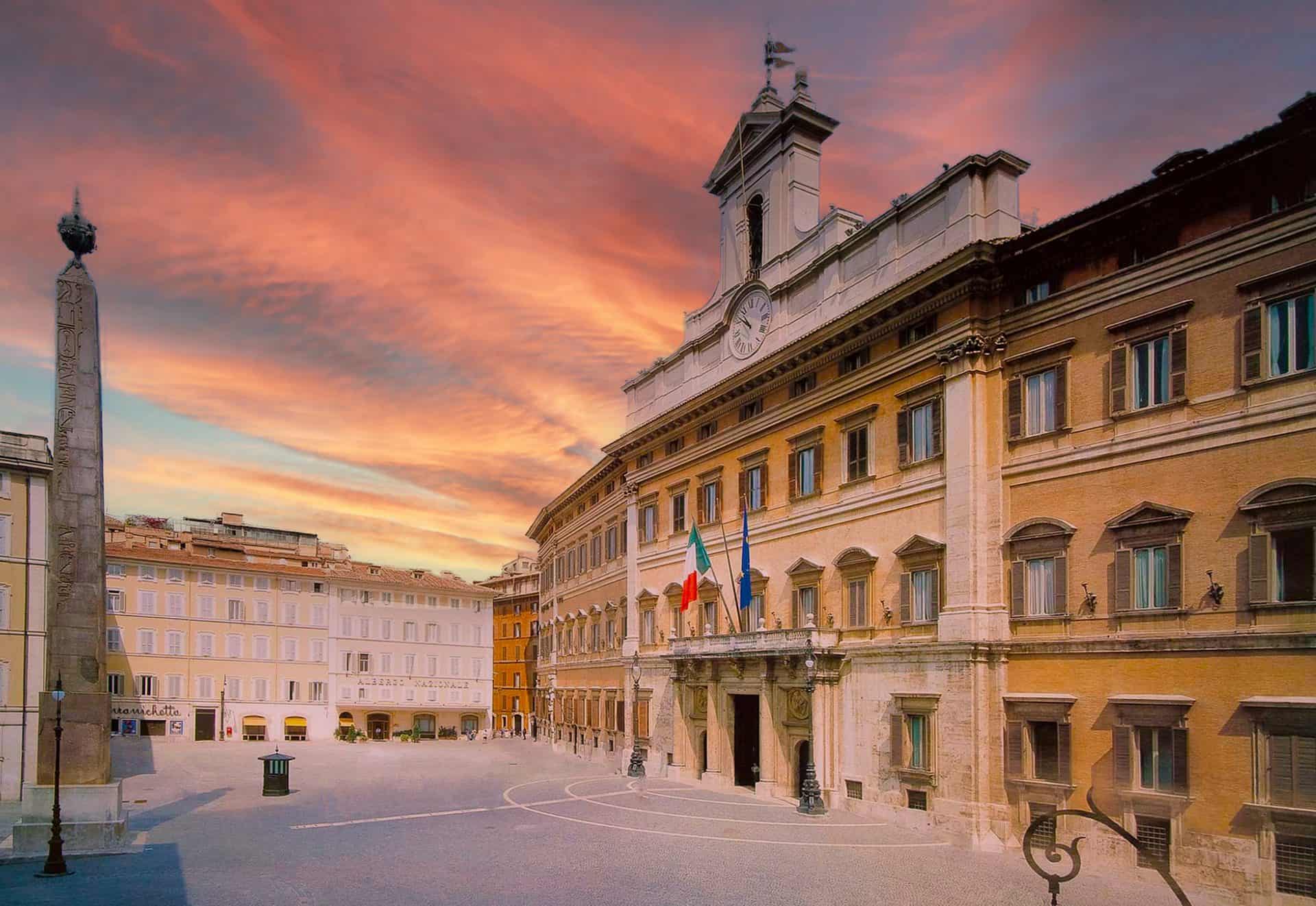
Palazzo Montecitorio, seat of the Chamber of Deputies, occupies the square of the same name in Rione Colonna, about 100 meters from Via del Corso and a short walk from Piazza Colonna. The main entrance is on Piazza di Monte Citorio. Access to the Chamber's gallery, for those who want to watch a session, is at Piazza del Parlamento 25. The palazzo visit is free and takes place through the Montecitorio a porte aperte formula, usually held the first Sunday of every month. Registration is mandatory and is done on the Chamber's events portal, eventi.camera.it. There are no paid tickets, there is no ticket office, and you do not get in by just passing by. Anyone who wants to follow a session from the gallery must go to Piazza del Parlamento 25 half an hour before the proceedings begin, fill out the request form, and show a valid identity document. The ticket is issued within 45 minutes and depends on seat availability. For men, a jacket and tie are mandatory. Minors are admitted only if accompanied, and children under 14 are not allowed in for security reasons. Coats, bags and electronic devices must be left in numbered lockers at the entrance. The nearest metro is Line A, stops Barberini and Spagna, both about 10 minutes on foot. The surface bus lines serving the area stop at Piazza San Silvestro and Largo di Torre Argentina, and from there it is a walk of a few minutes.
If you are building a Rome itinerary that combines the seats of power with the ancient Campo Marzio, the Tourist Attractions page for Rome is the place to start. The twin palazzo of Montecitorio, Palazzo Madama, seat of the Senate, is a 7-minute walk from here.

How to Visit Montecitorio: The Three Entrances
Montecitorio is not a museum and does not behave like one. It is a working government building, and tourists enter it by permission, not by right. This changes everything: the hours are not opening hours but windows of availability, booking is not a convenience but the only way through the gate, and security screening is serious. There are three ways in, and it is worth knowing all of them, because each serves a different audience.
Montecitorio a porte aperte: The First Sunday of the Month
This is the formula designed for citizens and, by extension, for visitors. The Chamber usually opens the palazzo on the first Sunday of every month. Entry is free, and the route covers the Aula, the Transatlantico and the main reception rooms. Groups are led by Chamber staff, who explain the historical, artistic and institutional aspects of the building. Registration is done online on the eventi.camera.it portal, and places sell out quickly, especially in the spring months and on Sundays close to public holidays. The calendar can change. When parliamentary business or security needs require it, the Sunday is suspended. Before planning your trip around this date, checking the Chamber's official website is essential.
A word of warning that is worth its weight in gold: Montecitorio's openings sell out faster than many visitors from abroad expect, especially those who imagine a parliament as accessible as the House of Commons. Here the numbers are limited, and the palazzo has no tourist capacity. If you want to get in, you need to put the moment registration opens in your calendar, not the day of your visit.
Watching a Session from the Gallery of the Chamber of Deputies
The second entrance is the one almost no tourist tries, and it is the most interesting. The Aula's galleries are open to the public during sessions. You go to Piazza del Parlamento 25 half an hour before the proceedings begin, fill out the form, hand over your document, and wait for the ticket, which is issued within 45 minutes if there are seats available. The rules are those of the nineteenth century and have not been softened. Visitors must remain bareheaded and silent, refraining from any sign of approval or disapproval. For men, a jacket and tie remain mandatory. Children under 14 are not admitted.
The advantage is enormous. From the gallery you see the Aula alive, with the lit velarium overhead and Sartorio's frieze running at a height of 19 meters, and you see it without a guide standing between you and the room. The drawback is that a session can be an hour of technical votes on a budget item. The practical advice is to check the parliamentary schedule on the Chamber's website and choose a day with a general debate or a question time.
School Visits at Palazzo Montecitorio
The third door is for school classes, starting from the fifth year of elementary school. You book through the online application on the Chamber's website. The route is fixed and takes in the places where parliamentary life actually happens. At the end, a certificate of participation is issued in electronic format. This is the channel with the most dates available by far, and it also gives the most educational visit, because the staff are used to explaining how the institution works and not just the tapestries.
Exhibitions and Cultural Events in the Chamber's Spaces
There is also a fourth entrance, on the side and underrated: the exhibitions. The Chamber opens its exhibition spaces free of charge at Palazzo Montecitorio, at Vicolo Valdina and at Palazzo del Seminario, for art exhibitions and historical-institutional initiatives. These are occasions to step into Chamber spaces outside the Sunday calendar, and the program can be checked on the official website. If you visit Rome regularly, you should keep an eye on that calendar more than on the open-doors one: the exhibitions are more frequent and much less crowded.
Where Montecitorio Is and How to Get There
The palace occupies the northern edge of the ancient Campus Martius, in an area you can cross on foot in a few minutes in any direction. From the Pantheon it takes five minutes, from Trevi Fountain eight, from Piazza Navona 10, from Piazza di Spagna 12. Metro Line A, with the Barberini and Spagna stops, is the closest rail option, but neither one gets you to the front door, so you have to walk anyway. Surface buses depart from Piazza San Silvestro, two minutes away, and from Largo di Torre Argentina.
A detail Romans take for granted and visitors don't: Piazza di Monte Citorio is closed to traffic and guarded. Taxis can't reach the front door on session days, and cars are stopped at a distance. If you have an appointment and are counting minutes, figure in the walk from the last point where a taxi can pull up, which, depending on the day, may be Piazza Colonna or via del Corso.
Montecitorio Square, the Obelisk and Augustus's Sundial
The square in front of the Chamber of Deputies is one of the few Roman Baroque spaces where the stagecraft still works as it was conceived: a concave palace wing that welcomes whoever arrives, and a needle of red granite piercing the sky in the center. The needle is not Baroque. It is 2,600 years old, and its history alone is worth the trip.

The Obelisk of Psammetichus II in Front of Montecitorio
The monolith is made of red granite and comes from Heliopolis, in Egypt, where it was raised under the pharaoh Psammetichus II, of the 26th Saite dynasty, whose reign falls between 595 and 589 BC. Augustus had it brought to Rome in 10 BC, together with the obelisk we now call the Flaminio, which stands in Piazza del Popolo. The shaft measures 21.79 meters. With the base and the bronze globe that crowns it, the whole reaches 33.97 meters. It collapsed at an uncertain moment between the 9th and 11th centuries and lay buried for centuries under the houses of the rione.
The recovery was the work of Pius VI, who between 1789 and 1792 entrusted the restoration to the architect Giovanni Antinori. Antinori had to fill in the missing parts, and to do it he used material taken from the Column of Antoninus Pius, a reuse that would cause an outcry today and was standard practice at the time. Look closely at the shaft in the low morning light: the restored areas stand out to the eye, and the ancient granite has a grain and a patina different from the eighteenth-century patches.
Augustus's Sundial and the Mark on the Pavement
The reason Augustus wanted that obelisk exactly there is the part that almost no guide explains well. The obelisk was not an ornament: it was the gnomon of a huge sundial laid out on the pavement of the Campus Martius, the Horologium Augusti, whose stated purpose was to check the Julian calendar reform on the ground. The shadow of the tip moved along a bronze meridian line inlaid in the paving and marked the days of the year. According to the most recent studies, the alignment of the sun on the tip fell on October 9, the day of the festival of Apollo Palatinus, Augustus's patron god: a monument that was both a scientific instrument and dynastic propaganda.
In 1998 the square was redone, and a sundial was laid into the cobblestones in memory of the Augustan one. It isn't the original and doesn't claim to be: it's a commemorative sign. The original, or what remains of it, lies many meters below the current street level, under the cellars of the buildings between via di Campo Marzio and via del Parlamento. Anyone who really wants to understand the Augustan system should combine this square with a visit to the Ara Pacis and the Mausoleum of Augustus: the obelisk, the altar and the tomb belonged to the same urban design, and taken separately they don't make sense.
The Saturday Lottery in Piazza di Montecitorio
For two centuries the square was where Romans went to gamble away their wages. Every Saturday people crowded under the palazzo to watch the lotto numbers being drawn and called out from the balcony. Stendhal left a description of it in his Promenades in Rome, and Giovanni Paolo Panini, the great Roman vedutista who lived between 1691 and 1765, painted it in a picture that is today in London. It is the most telling image of what Montecitorio was before 1871: a place of justice, taxes and luck, where crowds gathered for reasons much more down-to-earth than politics.

The Name Montecitorio: Two Theories and No Certainty
The palazzo stands on a modest rise, and scholars have never settled the question of where the name comes from. The first theory derives it from mons citatorius, the hill of summons or convocation, because in Roman times the electoral assemblies of the comitia were supposedly held there. The second derives it from mons acceptorius, the hill of acceptance, because the rubble from draining the nearby Campo Marzio was dumped on that spot. Both remain scholarly hypotheses, and neither is backed by an ancient source that explicitly says where the place name comes from. Anyone who tells it to you as established fact is selling certainty cheap.
The second theory, it must be said, has the geological evidence on its side: the rise is artificial in its upper part, a buildup of ancient and medieval waste, like many other small elevations in the Campo Marzio. The first has the political appeal of a hill of convocation that, 2,000 years later, becomes the seat of the elected assembly again. As often happens in Rome, the coincidence is too good to be proven.
Palazzo Montecitorio: The Story of a Construction Site Lasting Three Centuries
The construction history of Palazzo Montecitorio is one of the most troubled in Rome, and it explains why the building you see has two souls that don't speak to each other: a Baroque façade and a Liberty-style rear section, joined together by a work carried out in the early 20th century.
The Design by Gian Lorenzo Bernini (1653)
It all begins in 1653, when Innocent X commissions Gian Lorenzo Bernini to build a residence for the Ludovisi family, in place of an existing group of small houses. Bernini designs a building that fits the existing urban layout instead of imposing itself on it: the façade is a polygon of five bays that follows the curve of the street in front, like a fan just opened. The detail that reveals the master's hand is the corner rustication and the frames of the first-floor windows, worked in roughly dressed stone from which leaves and broken twigs seem to sprout: the illusion is of a palazzo carved out of the living rock of the rise, as if the architecture grew out of the hill. It is a very refined Baroque game, and on a façade that at first glance looks austere, it is the first thing to look at.
The works stall almost immediately. In 1654 a diplomatic dispute between Innocent X and Prince Niccolò Ludovisi, who had married the pope's niece Costanza Pamphilj, abruptly slows the site. When Ludovisi dies in 1664, the works stop completely. The palazzo remains a stump for about 20 years, an abandoned construction site in the center of Rome.
Of Bernini's original idea, no complete autograph drawing survives. The only evidence of Bernini's project is a painting attributed to Mattia de' Rossi, the master's favorite pupil, now in the Doria-Pamphilj collection. A version of that project is displayed in the office of the President of the Chamber, inside the palace. If you stop by the Galleria Doria Pamphilj, keep the connection in mind: the two collections tell the story of the same family and the same era.
Carlo Fontana, Innocent XII and the Innocentian Curia
Work resumed some 20 years later on the initiative of architect Carlo Fontana, who convinced Innocent XII, the pope remembered for his battle against nepotism, to assign the building to two very profitable public functions: the Papal Curia, meaning the highest body of the administration of justice, and the customs office. The proceeds were meant to benefit the Apostolic Hospice for Disabled Poor, the San Michele. Traces of that purpose remain in a bas-relief showing the image of the Savior and the inscription Hospitii apostolici pauperum invalidorum, now moved to the right corner of the facade and originally placed in the courtyard.
Fontana kept Bernini's convex facade but completed it in his own way. He added the sail-shaped bell tower that still rises above the central body today, and he changed the entrance design by placing two side doors alongside the main portal. The Innocentian Curia was inaugurated in 1696, and for the occasion water was brought to the large fountain at the far end of the semicircular courtyard. From then on, the palace played a leading role in the judicial and administrative life of the Papal States: in addition to the courts, it housed the Governorate of Rome and the police headquarters.
The main bell of the sail-shaped bell tower signaled the start of hearings, and its precision in striking the hours became proverbial among Romans: people set their watches by Montecitorio. Today that bell rings on very rare and solemn occasions, tied to the oath and the election of the President of the Republic. Hearing it is something that happens to people living in Rome only a few times in their lives.
From Papal Palace to Seat of the Chamber of Deputies
With the Risorgimento and the transfer of the capital to Rome, Palazzo Montecitorio was expropriated by the Kingdom of Italy and assigned to house the Chamber of Deputies. The choice was not a foregone conclusion: Palazzo Venezia and the Capitoline Hill were evaluated and rejected. Montecitorio won out for practical reasons, for the immediate availability of the spaces and for the courtyard, which could be covered quickly.
Paolo Comotto's Chamber Hall and the Acoustic Disaster (1871)
The job of building the assembly hall went to a little-known public works engineer, Paolo Comotto. In the courtyard, he erected a semicircular hall with tiered seating, on an iron framework entirely clad in wood, inaugurated on November 27, 1871. From that day on, Montecitorio has been the seat of the Chamber.
The hall proved to be a failure on every front: the acoustics were terrible, it froze in winter, and in summer it turned into an oven. Water leaks, heavy and constant, eventually led to it being declared unsafe and closed in 1900. For 20 years, the Parliament of the Kingdom of Italy legislated in a shack of wood and iron set up in a Baroque courtyard. It's a detail that school textbooks leave out, and it says a lot about the resources and priorities of post-unification Italy.
The Temporary Chamber on Via della Missione
After the attempt to build an entirely new Parliament building on Via Nazionale failed, the Chamber moved into a temporary hall set up on Via della Missione, just a few dozen meters from here. It stayed there for 18 years. The permanent seat in the expanded Palazzo Montecitorio was not inaugurated until 1918.
Ernesto Basile and the 1918 Expansion
In 1902, Public Works Minister Balenzano entrusted the Palermo-born architect Ernesto Basile with the final layout and expansion of the Parliament Palace. The project was approved in 1904 and called for a new Chamber and a new building behind the old palace. Basile was one of the absolute leading figures of Italian Liberty style, the man behind the Grand Hotel Villa Igiea and the Teatro Massimo in Palermo, and at Montecitorio he had a free hand like few architects in Italian history.
His choice was radical: he kept only the front part of Bernini's palace, reduced the courtyard, demolished the wings and the entire rear section, and on the new Piazza del Parlamento he raised a square building in travertine and red brick, with four corner towers in a medievalizing style. It's the back that almost no tourist looks at, and yet it deserves a walk around the block: the rear facade of Montecitorio is one of the most important pieces of Liberty architecture in Rome, and it doesn't look like anything else in the city. Among others, the sculptors Leonardo Bistolfi and Domenico Trentacoste worked with Basile, and they created the marble groups on that facade.
The seam between Bernini and Basile is the key to reading the entire building. Those who enter from the square see the seventeenth century. Those who exit onto Piazza del Parlamento see the twentieth century. In between is the courtyard of honor, reduced and regularized, paved with sampietrini and with a central fountain that is a copy of the one at Villa Medici.
The Chamber of Deputies Hall: Velarium, Frieze and Bronze
The Hall is the masterpiece of Basile and one of the most imposing Art Nouveau interiors in Europe. The hemicycle rises 26.21 meters from the floor to the velarium. The surface is about 780 square meters, which becomes 1,090 counting the galleries. The benches step down toward that of the Presidency and are organized into 10 sectors.

The Velarium by Giovanni Beltrami
Above the heads of the deputies opens a fan-shaped glass skylight, made in 1911 by the Beltrami firm of Milan. It covers 800 square meters of cast glass supported by a metal grid and is framed by a perimeter band of inlaid Slavonian oak. The decoration is full Art Nouveau, with floral motifs radiating from the center. It was meant to guarantee the maximum possible natural light in an enormous, very tall space, at a time when electric light was not yet reliable. Seen from below on a sunny day, it is a sight worth the whole visit to Montecitorio.
The Frieze by Giulio Aristide Sartorio
Beneath the velarium, at a height of 19 meters, runs the pictorial frieze by Giulio Aristide Sartorio in a circle, devoted to the history and civilization of the Italian people. It is the most extensive pictorial cycle created in Italy in the twentieth century: about 105 meters in total length, a height of around 3.70 meters, 50 panels, and about 280 figures. The technique is a waxy tempera, a cold encaustic with earth pigments, iron oxides and cadmium sulfides, applied in layers ranging from a few millimeters to full centimeters, so as to give the figures an almost sculptural relief when seen from below.
The chronology of the project is documented with precision. In 1908 Sartorio is in London studying ancient friezes and Mantegna. In August he completes the sketch, which the parliamentary Commission approves in November. The contract is signed in 1909 and work begins in June. The frieze is completed in October 1911, after 31 months of execution, and is retouched and installed between 1911 and 1912. The straight section carries an epic vision of Italian history, while the curved one has a more lyrical register devoted to civilization. At the center stands Young Italy on the triumphal quadriga. A documented restoration was started in August 2006.
There is a detail that has been circulating for decades and that should be handled with caution: it is said that Sartorio, pressed by deadlines, used projections and drew some faces based on slides showing mentally ill patients from the Policlinico. It is a tradition handed down by the literature on the frieze, not a verified archival fact. Tell it for what it is, an anecdote, and not as a documented fact. What is certain is the rush: 31 months for 105 meters of encaustic painting is an inhuman pace.
The Bronze Panel by Davide Calandra
Behind the seat of the President of the Chamber is a large bronze panel by the Turin-born Davide Calandra, made in 1913 and cast in Pistoia, dedicated to the glorification of the Savoy dynasty and the unity of Italy. It is the most politically dated piece in the Hall, and for that very reason the most interesting: a republican assembly keeps voting its own laws under a monument to the monarchy, and nobody has ever seriously considered removing it. Few things tell the story of the Italian relationship with its own history better.
The Benches, the Government, the Galleries
The two rows of benches placed below that of the Presidency are reserved for members of the Government: in the first sit the President of the Council of Ministers and the Ministers, and in the second, as a rule, the Undersecretaries. The galleries run along the entire perimeter. Above the presidential bench three honor galleries open: the central one for the President of the Republic, the one on the right for the diplomatic corps, and the one on the left for former members of Parliament. The others are reserved for the public, the press and guests. If you enter as members of the public, know that your position will give you an excellent view of the velarium and the frieze, and a side view of the hemicycle.
The Transatlantico of Montecitorio, the Corridor Where Politics Happens
Between the Hall and the courtyard of honor, on the first floor, stretches a rectangular hall in Art Nouveau style that is the most famous place in Italian politics after the Hall itself. They call it the Transatlantico, and those who work there also call it the corridor of lost steps.

The name comes from the furnishings and the wooden ceiling, made by the Ducrot company of Palermo, and from the Liberty-style lighting, which together recall the interiors of the great transoceanic ships of the early 1900s. Basile personally designed every element: the small sofas and armchairs in Bulgarian red, the planters, the little tables, the wrought-iron ceiling lights. The floor is a carpet of polychrome marbles, with red porphyry, Greek cipollino and Siena yellow.
The real function of the Transatlantico is that of a covered piazza. Miriam Mafai described it with surgical precision: the men gladly linger at Montecitorio, even after working hours, because they feel as comfortable there as in a club, because they have nothing else to do and the Transatlantico becomes their meeting point, where they smoke and exchange information and experiences that serve to establish group solidarity, more or less tight, up to real roped parties that will later be put to the test and played out at the bargaining tables. She added that it is not only a matter of political affinities, because in that exchange of experiences and in the formation of those roped parties there is a great deal of cross-party connection.
In our opinion the Transatlantico always disappoints when it is empty. It's beautiful, it's rich, but it's a corridor. Its value is anthropological and you only grasp it by knowing what happens there on session days. Tell the story before you go in, not after.
The First Floor of Palazzo Montecitorio, Room by Room
The first floor is the working floor of the Chamber. Besides the Transatlantico, it holds the entrance to the legislative Chamber, which rises through the full height of all three floors, and a series of service rooms that the visit route passes through or runs alongside.
The Green Room and the Press Rooms
The Green Room is meant for reading newspapers and periodicals, and takes its name from the color that unifies the upholstery and the seating. Next to it open several press rooms, the kingdom of the parliamentary reporters, a professional category that at Montecitorio has developed a jargon and a liturgy all its own.
The Ministers' Room
A room reserved for meetings between Ministers and Undersecretaries of State when they are at the Chamber of Deputies. It's a working room, not a ceremonial one, and it is one of the places where political negotiation takes shape before reaching the floor.
The Casellario and the Mail Corridor
The Casellario is the facility where the deputies' mail is sorted, along the corridor that also houses the internal post office. A wall of named pigeonholes, one for each member of parliament: it's the most banal object in the building and one of the most photogenic, because it makes the very idea of representation visible at a glance.
The Courtyard of Honor
Reduced and regularized by Basile compared with the Baroque layout, it is paved in sampietrini and has at its center a fountain that is a copy of the one at Villa Medici. It's the spot where, looking up, you see at the same time Carlo Fontana's bell gable and the twentieth-century structures: the seam between the two palaces can be read in full from here.
The Legislative Archive and the Elections Committee
The first floor also holds the Legislative Archive, which preserves the documentary memory of the Chamber's activity, and the seat of the Elections Committee, the body that verifies the credentials of the deputies and decides on electoral disputes. These aren't spectacular rooms, but understanding what is done in them changes the way you look at the rest.
The Ceremonial Rooms on the Second Floor of Montecitorio
On the second floor are the most important ceremonial rooms of the Chamber of Deputies, together with the offices of the President, of the members of the Presidency Bureau and of the Secretary General. You get there by a monumental staircase.
The Corridor of Busts
The staircase leads into the so-called corridor of busts, along which about 30 bronze and marble busts of illustrious deputies and presidents of the Chamber are displayed. It's a route worth taking slowly, reading the names: all of Italian parliamentary history is in there, from the figures of the Risorgimento to the protagonists of the twentieth century.
The Wolf Room
It is the largest room of the Bernini wing, a big rectangular hall paved with polychrome marbles. The name comes from a bronze copy of the Capitoline Wolf, placed right opposite the entrance and donated to the Chamber at the end of the 1920s. The original is at the Capitoline Museums, on the Capitoline Hill. The ceiling is taken up by the Allegory of Rome, painted by Ignazio Perricci in 1884, which celebrates Rome as capital and depicts episodes of the Risorgimento, among them the meeting at Teano between Victor Emmanuel II and Garibaldi. On the walls, Florentine tapestries of the 1600s and Flemish ones of the 1500s with biblical and historical scenes.
The Wolf Room is the place where twentieth-century Italy turned a corner twice. On June 27, 1924, 123 opposition deputies met there and decided to abandon parliamentary work until light was shed on the disappearance of Giacomo Matteotti: this is the Aventine Secession, and Filippo Turati commemorated his murdered colleague there. On June 10, 1946, in the same room, the Court of Cassation proclaimed the results of the June 2 referendum on the institutional form of the State. Between the two dates run 22 years, a dictatorship and a world war, and the room is the same.
The Library and the President's Study
Continuing along the corridor of busts, past the Wolf Room, you find the President's Library: a ceremonial room with a large table in the center, where the Presidency Bureau, the College of Quaestors and the Conference of Group Leaders meet, and where small delegations are received. Adjacent, in the same Bernini sector, is the study of the President of the Chamber, preceded by a small sitting room for short meetings. In the study hangs the painting with Bernini's project for the Palazzo di Montecitorio, attributed to Mattia de' Rossi: the President works with the image of how the palace was supposed to be in front of him.
The Aldo Moro Room
On the right side of the Wolf Room opens the room once nicknamed the Yellow Room for the color of its upholstery. On May 13, 2008, in the presence of the President of the Chamber Gianfranco Fini and on the thirtieth anniversary of Aldo Moro's death, the room was named after the statesman. The furnishings include a gilded wooden table from the 1800s from the Villa Reale of Monza and a Napoleon III style fireplace topped by a large mirror. The Rococo-style furniture comes from the Royal Palace of Caserta. After the restoration of 2021 the room hosts, on rotation, paintings from the Chamber's collection, among them the Wedding at Cana by Paolo and Benedetto Caliari.
The Knight's Room
Adjoining the Aldo Moro Room, it is the room in which the President of the Chamber receives heads of state and foreign parliamentary delegations. The walls are entirely covered in silk damask, the vault is mirrored in neoclassical taste, the furnishings are Rococo-style furniture gilded in gold leaf. The name comes from a large painting of the Modenese school of the 1700s showing the young Marquis Bonifacio Rangoni on horseback. Some female portraits and river and countryside landscapes by Crescenzio Onofri complete the ensemble.
The Queen's Room
It is the largest and most austere of the ceremonial rooms: 26 meters long by 11 wide, with ceilings 7.5 meters high. It is located above the Transatlantico and adjoins the entrances to some of the galleries of the Chamber. The name comes from a custom of the monarchic era: here the queen waited before the Speech from the Throne, with which the king opened the parliamentary sessions, and then watched it from the adjacent royal gallery.
The room is entirely designed by Basile. A wainscot in red marble and botticino runs along the whole perimeter, the floor is in a lozenge pattern of Siena yellow, the ceiling is a coffered one in very dark Slavonian oak from which hang three large wrought-iron chandeliers with floral lines. On the walls, eight Florentine tapestries of the 1600s with biblical and historical scenes: three pieces from the cycle of the life of Moses after designs by Agostino Melissi, the stories of Tobias and the scenes of Alexander the Great. They are the only elements foreign to Basile's decorative design, and with their colors they brighten an otherwise very severe room.
The Women's Room
Inaugurated in 2016 on the initiative of the President of the Chamber Laura Boldrini, it gathers the portraits of the women who opened the way in the republican institutions: the 21 women deputies elected to the Constituent Assembly, the first women mayors elected between the spring and autumn of 1946, the first woman Minister, Tina Anselmi, the first President of the Chamber, Nilde Iotti, the first President of a regional government, Anna Nenna D'Antonio.
On one wall of the room mirrors are placed. The gesture is deliberate: they signal the offices that no woman had yet held when the room was set up, and they give viewers back their own reflected image. It's the only display in the palace that doesn't celebrate the past but points to a gap, and for that reason it works better than any plaque.
The Globe Room
It takes its name from a relic kept above the entrance door: a large globe made of spheres, rotating on three feet, made in Germany in the second half of the 1800s. The room was originally the reading room of the Library and still keeps the metal shelving along the walls. Today it is equipped with multimedia facilities and is used above all for the work of parliamentary Committees meeting jointly, as well as for events. On display there is the painting with Henry IV of Spain at the Battle of Ivry by Domenico Frilli Croci.
The Gallery of Presidents
Also designed by Ernesto Basile, it holds effigies and portraits from Italian parliamentary history, including those elected in the parliamentary experiences of the pre-unification States. The collection opens with the printed image of the face of Matteo Galdi, first president of the Parliament of the Two Sicilies in 1820 and 1821, placed there in 2020 for the bicentenary of the first session of the first pre-unification Parliament, and continues with the portraits of the Presidents of the Chamber of Deputies. Along the Corridoio dei Presidenti there are also portraits of the Presidents of the Chamber in Carrara marble.
The Art Collections of the Chamber of Deputies
Palazzo Montecitorio holds more than a thousand paintings and sculptures dating from the 16th to the 20th century, a few thousand engravings and prints from different periods, a substantial core of archaeological finds and a considerable quantity of minor artistic items: clocks, period furniture, tapestries, busts. It's one of the least visited public collections in Italy, simply because the building isn't open like a museum.
An important part of these works belongs to the different Soprintendenze and is on temporary deposit at the Chamber of Deputies. The rest of the holdings, made up mostly of modern and contemporary art, was acquired directly by the Chamber starting in the 1930s. A smaller share comes from donations by the artists themselves or their heirs.
Works Returned to the Soprintendenze
During the XIII legislature, the Chamber decided to return to the Soprintendenze that own them a good number of works temporarily placed at Montecitorio, to help rebuild the museum holdings of those institutions. Among the most significant returns are La via del Calvario by Mattia Preti, Ulisse e Nausicaa by Michele Desubleo, Le quattro stagioni by Guido Reni, Fiori e cacciagione by Giuseppe Recco and the Venere dormiente by Luca Giordano. It's a decision that deserves appreciation: in a state room those paintings were seen by 30 people a year, in a museum they're seen by 30 thousand.
Works That Remain in the Palace
The palace still keeps paintings of great value, collected in large part to furnish the rooms after the expansion work of 1918. Among these, the Adorazione dei pastori by Pacecco De Rosa, from 1630, deserves a mention. In the Aula dei Gruppi Parlamentari, built in the 1960s and restored starting in 2008, there are instead two works from the 20th century and beyond: the installation Orme di leggi by Maria Lai, winner of the prize announced by the Chamber for the 150th anniversary of the Unity of Italy, and the mural Macchina per produrre calze by the Futurist Gino Severini.
The Standing Committees and Their Rooms
The 14 standing Committees work mostly on the fourth floor of Palazzo Montecitorio, and each has an equipped room. The Finance Committee occupies the room along the north corridor, recognizable by its Siena marble columns. The Productive Activities and Environment Committees are along Galleria Fontana. It's the floor where much of the legislation is physically written, long before it reaches the Aula.
A Curiosity About Montecitorio: Chamber of Deputies
The real curiosity of Montecitorio isn't in the palace: it's under the palace, and it concerns a clock as big as a neighborhood. When Augustus had the obelisk of Psammetichus II brought from Heliopolis, in 10 BC, he wasn't furnishing a square. He was installing the gnomon of a gigantic astronomical instrument, the Horologium Augusti, laid out on the paving of the Campus Martius with a bronze meridian line. The shadow of the obelisk's tip moved along that line and marked the passing of the days of the year, making it possible to check on the ground how the Julian calendar reform was holding up. An emperor who builds an urban clock to prove that his calendar works is a political statement disguised as science.
The part almost nobody tells is the alignment. According to the most recent studies, the sun lined up with the tip of the obelisk on October 9, the day of the festival of Palatine Apollo: the god to whom Augustus tied his personal fortune and his victory at Actium. The monument, put another way, was calibrated to a religious date that spoke of him. And the whole didn't end there: the Ara Pacis and the Mausoleum of Augustus were part of the same urban design, three pieces of one single discourse on time, peace and dynasty.
Of the original clock, nothing visible remains on the surface. What you see in the square today is the meridian line traced on the cobblestones in 1998, a commemorative mark that recalls the Augustan layout. The ancient remains lie quite a few meters further down, under the cellars of the buildings of the rione, at a level that urban archaeology reaches only through test digs. When you're in Piazza di Monte Citorio, look up at the obelisk and then down at the pavement: you're looking at the surface of a buried clock.
Something No One Tells You About Montecitorio: Chamber of Deputies
For almost 30 years, from 1871 to 1900, the Parliament of the Kingdom of Italy legislated inside a shed. This is not a figure of speech. The chamber built by Paolo Comotto and inaugurated on November 27, 1871 was a semicircular tiered structure set inside the courtyard of the Baroque palace, with an iron frame entirely covered in wood. A temporary solution, thrown up quickly because the capital had just arrived in Rome and the Chamber had to meet somewhere.
The result was bad in every respect. The acoustics were so poor that deputies in the back rows couldn't hear the speeches. In winter the cold was unbearable, and in summer the heat made the sessions a torture. Then came the water leaks, heavy and constant, which in 1900 forced them to declare the structure unsafe and close it. The Chamber moved into a temporary hall on via della Missione and stayed there until 1918.
Do the math: from 1871 to 1918, 47 years, the Italian elected assembly did not have a worthy home. It worked first in a wooden shed and then in a makeshift space a few dozen meters from here. The permanent seat arrived when the World War was nearly over, with Ernesto Basile's extension. When you enter the Chamber of Montecitorio and find it solemn, keep in mind that it is the third chamber in 50 years, and that the first two were a national embarrassment. This is also why Basile had such a free hand: after half a century of makeshift arrangements, Italy wanted a hall that would be seen.
The advice I give you for visiting Montecitorio, Chamber of Deputies
The advice is blunt: don't count on the open doors of the first Sunday as if they were an ordinary entrance. Aim for them the way you would aim for a concert that's sold out. Registrations on eventi.camera.it sell out quickly, and the calendar can be suspended when parliamentary work or security requires it. Anyone planning a three-day trip to Rome and hoping to squeeze in Montecitorio at the last minute is left out nine times out of 10.
The strategy that works has two legs. First leg: register as soon as registration opens for the Sunday you're interested in, putting the opening time in your calendar and not the time of the visit. Second leg: keep an eye on the calendar of exhibitions and cultural initiatives of the Chamber, which opens its exhibition spaces for free at Palazzo Montecitorio, Vicolo Valdina and Palazzo del Seminario. These opportunities are more frequent, much less contested, and allow you to enter Chamber spaces outside the Sunday circuit.
Third option, the best and least crowded: the gallery during a session. Show up at Piazza del Parlamento 25 half an hour before work begins with a valid document, fill out the form, and wait for the ticket, which arrives within 45 minutes depending on availability. Jacket and tie for men, mandatory. Anyone under 14 is not admitted. Bags, overcoats and electronic devices must stay in lockers. Check the parliamentary schedule on the Chamber's website first, and choose a day with a general debate or a question time: seeing the Chamber full and hearing it debate is worth 10 times a visit to empty halls. And dress well regardless, women included: the staff is polite, but decorum here is a requirement, not a suggestion.
One last thing about timing: allow an hour and a half for the visit to the palace and at least half an hour for lines and security checks beforehand. Don't book anything tight right after. And leave the large backpack at home: you'll get through security faster and won't have to fight with the locker.
Another well-known fact, yet rarely mentioned
Everyone knows Bernini designed Montecitorio. What almost nobody notices, standing in front of the facade, is that only the shell of Bernini is left. Ernesto Basile, between 1904 and 1918, kept only the front part of the 17th-century palace: he reduced the courtyard, demolished the side wings and the entire rear part, and behind it raised a square building in travertine and red brick with four corner towers in a medievalizing style. The palace you see from the square is a Baroque facade glued onto a Liberty-style body.
The practical consequence is that Montecitorio has to be looked at twice, from two opposite sides. From Piazza di Monte Citorio you read the 17th century: the polygonal front with five bays that follows the curve of the street, the corner rustication worked in rough-hewn stone with broken leaves and twigs, the illusion of a building carved out of rock, the sail-shaped bell gable added by Carlo Fontana, and the two side doors Fontana added alongside the main entrance. From Piazza del Parlamento you read the 20th century: the compact volume, the red bricks, the towers, the marble groups by Leonardo Bistolfi and Domenico Trentacoste.
Walking around the block takes five minutes, and almost nobody does it. This is the most common mistake visitors make at Montecitorio: they photograph the facade with the obelisk and leave, taking home half the building. Basile's rear facade is one of the most significant pieces of Liberty architecture in Rome, and the fact that it's the back of an institutional building has made it nearly invisible. Do that loop. And do it in the afternoon, when the sun hits the red bricks and the travertine changes color.
The right photo to take at Montecitorio, Chamber of Deputies
The photo everyone takes is the obelisk with the façade behind it, shot from the center of the square in broad daylight. It always comes out the same and always comes out flat, because at noon the façade is in shadow and the red granite of the obelisk fades.
The right photo is taken early in the morning, shortly after dawn, standing on the side of Via degli Uffici del Vicario and framing the square diagonally. At that hour the raking light catches Bernini's corner rustication and the first-floor windows. The roughly hewn stone casts short, sharp shadows, and you can finally see the effect the master was after, that of a palace carved out of living rock. The same light brings out the granite of the obelisk, which really looks red instead of gray. If you have a long lens, isolate the bronze globe at the top against the sky: 33.97 meters of monument condensed into one detail.
The second photo, the one that will set you apart from everyone else, is taken from the other side of the palace. Piazza del Parlamento, late afternoon, low sun on the red bricks and the travertine of Basile's four towers. It's an image nobody associates with Montecitorio, and it throws off anyone who looks at it, because it seems like another city. Try framing two towers vertically, cutting out the sky: the Liberty proportions come out beautifully.
Inside the palace, the rules on filming are set by the staff and must be asked about on the spot. In the galleries of the Aula, electronic devices stay in lockers, so the Aula while in session can't be photographed. If you enter with the doors open and are allowed to take pictures, the one shot that pays off is this: under Beltrami's velarium, camera pointed upward, framing together the glass and the upper band of Sartorio's frieze. 800 square meters of Liberty glass and 105 meters of encaustic painting in the same image.
Some important events that took place here in history
On November 27, 1871, the Chamber of Deputies of the Kingdom of Italy met for the first time at Palazzo Montecitorio, in the hall just built by Paolo Comotto inside the courtyard. Rome has been the capital for a little over a year, and Parliament is arriving from Turin and Florence. That session is the moment when the unitary state takes possession of the city.
On May 30, 1924, the Socialist deputy Giacomo Matteotti took the floor in the Aula and denounced the violence, illegalities and abuses committed by the Fascists during the elections of April 6. It is the most famous speech ever delivered in this Aula. On June 10, Matteotti was kidnapped and murdered while heading to Palazzo Montecitorio. His body will be found on August 16 in the Quartarella woods.
On June 27, 1924, in the Sala della Lupa, 123 opposition deputies decide to abandon parliamentary work until light is shed on the disappearance of Matteotti. Filippo Turati commemorates the colleague. It is the Aventine Secession, a gesture of very high moral standing and politically disastrous: the deputies were counting on the king's intervention, and Victor Emmanuel III did not lift a finger. The Communists had already left the protest in November 1924. On November 9, 1926, the Chamber declared the forfeiture of the seats of the 123 Aventine deputies. Many ended up in prison, in internal exile, or in exile.
On June 10, 1946, still in the Sala della Lupa, the Court of Cassation proclaims the results of the June 2 referendum on the institutional form of the State. Italy becomes a Republic in that room. On June 25, 1946, at 16:00, the Constituent Assembly meets for the first time at Montecitorio: 556 elected members, including 21 women. Giuseppe Saragat presides until February 6, 1947, then Umberto Terracini from February 8, 1947. On December 22, 1947, the Assembly approves the Constitution of the Italian Republic, published in the Gazzetta Ufficiale on December 27. The work ends on January 31, 1948.
It's worth pausing on a detail that only jumps out when you line up the dates: in 1924 the Sala della Lupa hosts the protest that marks the end of liberal parliamentarism, and in 1946 the proclamation that opens the Republic. 22 years, the same room, the same bronze she-wolf in front of the door. No plaque says so clearly, but it is the most meaningful coincidence in the whole palace.
Two other dates deserve a place. 1918 sees the inauguration of the new Aula by Ernesto Basile, after 47 years of temporary seats. 2016 brings the inauguration of the Sala delle donne, wanted by President Laura Boldrini: not a dramatic event, but the first installation in the palace that openly declares an absence instead of celebrating a presence.
Who has passed through Montecitorio, Chamber of Deputies
The first name is Gian Lorenzo Bernini, who in 1653 receives from Innocent X the commission to build the residence of the Ludovisi princes here, and designs the façade that still defines the square today. Alongside him is his favorite pupil, Mattia de' Rossi, to whom the painting is attributed. It is the only surviving record of Bernini's project, kept in the Doria-Pamphilj collection and present in a version in the office of the President of the Chamber.
Then Carlo Fontana, who resumes the abandoned construction site about 20 years after the death of Niccolò Ludovisi and convinces Innocent XII to install the Papal Court and the customs office there, inaugurating the Innocentian Court in 1696. The palace becomes the center of papal justice, and everyone in Rome who has a lawsuit, a debt or trouble with the law passes through it.
Stendhal, who in the Passeggiate romane describes the scene of the crowd gathered in the square on Saturdays for the drawing of the lottery numbers, called out from the balcony. And Giovanni Paolo Panini, the Roman vedutista who lived between 1691 and 1765, who painted that scene and whose painting is today in London.
In the 19th and early 20th centuries, the palace becomes the workplace of the entire Italian political class. Ignazio Perricci passes through here, who in 1884 paints the Allegory of Rome with the meeting of Teano between Vittorio Emanuele II and Garibaldi on the ceiling of the Sala della Lupa. Ernesto Basile passes through, who between 1902 and 1918 redoes half the palace and personally designs every sofa of the Transatlantico. Giovanni Beltrami passes through, with his Milanese firm that in 1911 installs the 800 square meters of the velarium, and Giulio Aristide Sartorio, who between 1908 and 1911 paints the 105 meters of the frieze. Davide Calandra passes through, who in 1913 signs the bronze panel behind the presidential seat. And the sculptors Leonardo Bistolfi and Domenico Trentacoste pass through, authors of the marble groups on the rear facade.
In 20th-century politics, the names crowd in. Giacomo Matteotti delivers here, on May 30, 1924, the speech that will cost him his life 11 days later. Filippo Turati commemorates him in the Sala della Lupa on the following June 27, in front of the 123 deputies of the Aventine. Giuseppe Saragat and Umberto Terracini preside over the Constituent Assembly between 1946 and 1948. Nilde Iotti is the first woman to sit in the Chamber's highest seat, and her portrait is in the Sala delle donne alongside those of Tina Anselmi, first woman Minister, and Anna Nenna D'Antonio, first woman President of the Giunta regionale. Since 2008, Aldo Moro has lent his name to the room people used to call the Sala gialla, at the wish of President Gianfranco Fini on the 30th anniversary of his death.
A name that people always forget: Maria Lai, the Sardinian artist whose installation Orme di leggi won the award announced by the Chamber for the 150th anniversary of the Unification, and which is today in the Aula dei Gruppi Parlamentari, next to the mural Macchina per produrre calze by Gino Severini. Two works of 20th-century Italian art inside a palace that everyone associates with the 17th century.
Things to see around Montecitorio in 10 minutes on foot
Montecitorio's location is about as central as Rome can offer, and the 10-minute walking radius contains a disproportionate number of things. Leaving the square heading east, you soon reach Piazza Colonna, dominated by the spiral column of Marcus Aurelius and closed on the north side by Palazzo Chigi, the official residence of the Prime Minister: two palaces of power 50 meters apart, something no other European capital allows itself. From there you come out onto Via del Corso and, across the street, the Galleria Alberto Sordi.
Heading south, barely five minutes away, the Pantheon. Heading west, 10 minutes, Piazza Navona and the Museo di Roma at Palazzo Braschi. Heading north, via di Campo Marzio leads to the basilica of San Lorenzo in Lucina, one of the oldest titular churches in Rome, and continuing on you reach the Ara Pacis and the Mausoleum of Augustus, which together with the obelisk close the Augustan triangle of the northern Campo Marzio.
Seven minutes southwest is Palazzo Madama, seat of the Senate: the Montecitorio and Palazzo Madama pairing is the most logical institutional itinerary in the city, and the two visits fit well into the same weekend because the Senate also has its own public openings. Eight minutes away, the Church of Sant'Ignazio di Loyola with the vault by Andrea Pozzo, which is the best lesson in Baroque perspective available in Rome. A good 10 minutes away, the Trevi Fountain and, in the opposite direction, the sacred area of Largo Argentina.
Suggested route, for those with half a day: Montecitorio, the loop around the block to Piazza del Parlamento, San Lorenzo in Lucina, the Ara Pacis, the Mausoleum of Augustus, then back via via di Campo Marzio to the Pantheon. It takes three hours walking at a relaxed pace, and you cross 2,000 years of Campo Marzio without ever taking a vehicle.
When to visit Montecitorio and when to avoid it
The best time for the square is the first hour after sunrise, in any season. The light is right for Bernini's facade and for the granite of the obelisk, the security presence is discreet, and the square is empty. The second good window is late afternoon from Piazza del Parlamento side, for Basile's facade.
The worst time is a summer midday: the square has no trees, the paving reflects the heat, the facade is backlit, and there isn't a bar offering shelter within a reasonable distance without paying Piazza Colonna prices. Avoid demonstration days too: the square is closed, pedestrian routes are diverted, and you can't get close.
For an interior visit, the season matters little because entry is by reservation only. The parliamentary calendar matters more: during budget session periods, typically between November and December, Sunday openings are more at risk of suspension and the public galleries are more contested. Spring and early autumn remain the periods when organization is simplest.
Montecitorio with children and accessibility
The 14-year age limit for access to the Aula's public galleries effectively excludes children from the most exciting part of the visit. For families, the Sunday open-door days remain available. They don't have that restriction and are suitable from age 10 up. Under that age, an hour and a half of reception rooms is too much. Schools have a dedicated channel starting in fifth grade, with a set route and a final certificate in electronic format, and it is the format designed specifically for young people.
On accessibility, the palace is an equipped institutional seat and has elevators, but the visit route includes monumental staircases and historic rooms. Specific needs should be reported at the time of booking, and up-to-date operational information can be found on the official website of the Chamber of Deputies. Anyone with particular needs should make the request well in advance and not on the day itself: security here doesn't improvise.
One piece of advice that applies to everyone, and especially to anyone traveling with children: Piazza di Monte Citorio has no shade and no benches. If you're waiting for an entry slot on a hot day, wait under the arcades of Piazza Colonna or inside the Galleria Alberto Sordi, which is two minutes away and air-conditioned.
Frequently Asked Questions about Montecitorio , Camera dei Deputati
How much does it cost to visit Montecitorio?
Nothing: entry to Montecitorio on open-door days is free, and access to the Chamber's exhibition spaces during exhibitions and cultural events is also free. There is no paid ticket and no commercial channel for entering the palace, which remains an active institutional seat and not a museum.
Do you need to book to visit Montecitorio?
Yes, registration to visit Montecitorio is mandatory and is done online at the eventi.camera.it portal. Without a reservation you won't get in: the times are not opening hours but limited availability windows, and registrations sell out quickly for open-door days.
How do you get to Montecitorio on foot from the center of Rome?
Montecitorio is located on the northern side of the ancient Campo Marzio, a few minutes' walk from the main monuments of the center: from the Pantheon it takes about 5 minutes, from Trevi Fountain 8, from Piazza Navona 10, and from Piazza di Spagna 12. The nearest metro stop is on Line A, between Barberini and Spagna, but neither one leads directly to the main entrance.
Is Montecitorio suitable for a visit with children?
Partly: the 14-year age limit for access to the Aula's public galleries effectively excludes the youngest visitors from the most exciting part of the visit. The Sunday open-door days remain suitable from age 10 up, as they don't have that restriction. Under that age, an hour and a half among Montecitorio's reception rooms is generally too long.
How high is the Chamber of Deputies' Aula at Montecitorio?
The Aula of the Chamber of Deputies, the work of architect Ernesto Basile, rises 26.21 meters from the floor to the velarium, with a surface area of about 780 square meters that becomes 1,090 counting the public galleries. It is one of the most imposing Liberty-style interiors in Europe, with the benches organized into 10 sectors that step down toward the Presidency's sector.
What is the best time to photograph the Montecitorio square?
The best time to photograph the Montecitorio square is the first hour after sunrise, in any season: the low light enhances Bernini's facade and the red granite of the obelisk, the square is empty, and the security presence is discreet. The worst time remains a summer midday, when the facade is in shade and the paving reflects the heat.
Who designed Palazzo Montecitorio?
The first design for Palazzo Montecitorio is due to Gian Lorenzo Bernini, commissioned in 1653 by Innocent X to build a residence for the Ludovisi family. Between 1904 and 1918, architect Ernesto Basile carried out heavy work on the building, keeping only the 17th-century facade and raising a square body in travertine and red brick with four towers behind it, to adapt it to its function as a parliamentary seat.
Montecitorio for group and trip organizers
Montecitorio is one of the Roman places hardest to fit into an itinerary, precisely because it isn't bought: it's obtained. There are no priority tickets, no commercial channels, and no fast line. There is a free, limited registration, and whoever gets it gets in. For organized groups, the workable route runs through the Chamber's institutional channels, and it needs to be opened well in advance.
Professionals who build itineraries for Rome and need to manage logistics, timing and alternatives when an institutional access falls through will find an established method on the pages of TourLeaderPro pages on tourist services in Rome, and operational material on managing groups in the section on professional tour escorting. For limited-capacity experiences and small groups, with access outside regular visiting hours, there is a dedicated section on custom experiences in Rome for small groups.
For English-speaking visitors planning their own trip, I recommend the guide to the best things to do in Rome and, for those with three days, the three-day itinerary. Both lay out the order of visits in a way that works with mandatory bookings, which in Rome are now the factor that decides whether a trip succeeds.
Quick Questions About Montecitorio, Chamber of Deputies
How much does it cost to visit Montecitorio?
Nothing. Entry to Montecitorio during Open Doors is free, and access to the Chamber's exhibition spaces during exhibitions and cultural events is also free. There is no paid ticket.
Do I need to book to visit Montecitorio?
Yes, registration is mandatory and is done online at eventi.camera.it. Without a booking, you can't get in.
When is Montecitorio open to the public?
Montecitorio a porte aperte is normally scheduled for the first Sunday of every month. The calendar may change or be suspended, so checking the official Chamber of Deputies website before organizing your visit is essential.
What do you see during a visit to Montecitorio?
The route takes in the Aula, the Transatlantico and the main reception rooms, with Chamber staff explaining the historical, artistic and institutional aspects of the palace.
Can you attend a session of the Chamber of Deputies?
Yes. The galleries are open to the public during sessions. You show up at Piazza del Parlamento 25 half an hour before the session begins with a valid ID, fill out the request form and wait for a ticket, issued within 45 minutes depending on availability.
Is there a dress code for entering Montecitorio?
For access to the galleries, men must wear a jacket and tie. In general, decorum in dress is required of everyone.
Can children enter Montecitorio?
For access to the Aula galleries, minors may enter only if accompanied, and entry is banned for children under 14 for safety reasons. School visits, by contrast, are open to classes starting from fifth grade.
Can you take photos inside Montecitorio?
Staff at the Chamber explain the filming rules during the visit, and you should ask about them on site. In the Aula galleries, electronic devices must be left in lockers, so sessions can't be photographed.
Where do I leave bags and backpacks at Montecitorio?
At the entrance to the galleries, coats, bags and electronic devices are kept in numbered lockers.
How long does a visit to Montecitorio take?
The reception route takes about an hour and a half, to which you need to add time for security checks at the entrance. It's better not to book tight appointments right after.
How do I get to Montecitorio by public transport?
Metro Line A, stops Barberini and Spagna, is about 10 minutes away on foot. Surface lines serve Piazza San Silvestro, two minutes away, and Largo di Torre Argentina.
What is the address of Montecitorio?
The main entrance is on Piazza di Monte Citorio, in the Rione Colonna. Access to the Aula galleries is at Piazza del Parlamento 25.
Who designed Palazzo Montecitorio?
The original design is by Gian Lorenzo Bernini, commissioned in 1653 by Innocent X. The palace was completed by Carlo Fontana, who added the campanile a vela and inaugurated the Curia Innocenziana in 1696, and was expanded by Ernesto Basile between 1902 and 1918.
Why is it called Montecitorio?
The origin of the name is uncertain. One theory derives it from mons citatorius, for the electoral assemblies said to have been held there in Roman times. Another derives it from mons acceptorius, because debris from draining the Campo Marzio was dumped on the hill.
Since when has the Chamber of Deputies been based at Montecitorio?
Since November 27, 1871, the day the chamber built by Paolo Comotto in the courtyard of the palace was inaugurated. The current Chamber, the work of Ernesto Basile, was inaugurated in 1918.
How tall is the Montecitorio obelisk?
The red granite shaft measures 21.79 meters. With the base and the bronze globe, the whole reaches 33.97 meters.
Where does the obelisk in Piazza Montecitorio come from?
From Heliopolis, in Egypt, where it was erected under the pharaoh Psamtik II, whose reign falls between 595 and 589 BC. Augustus brought it to Rome in 10 BC.
What was Augustus's meridian?
A gigantic sundial laid out on the pavement of the Campus Martius, the Horologium Augusti, of which the obelisk was the gnomon. It was used to check the reform of the Julian calendar on the ground. The meridian visible today on the cobblestones of the square is a commemorative mark traced in 1998.
Who painted the frieze in the Montecitorio Chamber?
Giulio Aristide Sartorio, between 1908 and 1911. The frieze is about 105 meters long, has 50 panels and about 280 figures, and is executed in wax tempera, a cold encaustic.
What is the velarium of the Chamber?
The fan-shaped glass skylight made in 1911 by the Beltrami company of Milan: 800 square meters of fired glass on a metal grid, with a perimeter band in inlaid Slavonian oak and art nouveau decoration.
Why is the corridor called the Transatlantico?
Because of the furnishings and the wooden ceiling made by the Ducrot company of Palermo and the Liberty-style lighting, which recall the interiors of the great transoceanic ships of the early twentieth century.
What is the Sala della Lupa?
The largest hall of the Bernini wing, with the Allegory of Rome by Ignazio Perricci on the ceiling, painted in 1884. It takes its name from a bronze copy of the Capitoline Wolf donated to the Chamber at the end of the 1920s. Here, on June 10, 1946, the Court of Cassation proclaimed the results of the institutional referendum.
What's the difference between Montecitorio and Palazzo Madama?
Montecitorio is the seat of the Chamber of Deputies, Palazzo Madama that of the Senate of the Republic. They are seven minutes apart on foot and have completely different architectural histories.
What is the relationship between Montecitorio and Palazzo Chigi?
They are neighboring buildings. Palazzo Chigi, which faces Piazza Colonna, is the official residence of the Prime Minister. Montecitorio houses the Chamber of Deputies. Between the two doorways there are a few dozen meters.
Does Parliament in joint session meet at Montecitorio?
Yes. When deputies and senators meet together, for example to elect the President of the Republic, the session is held in the Chamber at Montecitorio.
Can you visit Montecitorio without booking, just showing up?
No for the open doors, which require advance registration. Yes, in a certain sense, for the galleries during sessions, where you show up half an hour before and get a ticket subject to availability.
How far in advance should you register for Montecitorio open doors?
As soon as possible: places are limited and run out quickly. It's best to mark in your calendar the moment registrations open, not the day of the visit.
Are there free exhibitions at the Chamber of Deputies?
Yes. The Chamber opens its exhibition spaces free of charge at Palazzo Montecitorio, at Vicolo Valdina and at Palazzo del Seminario for art exhibitions and historical-institutional initiatives. The program is on the official website.
Is it worth seeing the back of Montecitorio?
Absolutely. The facade on Piazza del Parlamento, with Ernesto Basile's four towers in travertine and red brick, is one of the most important pieces of Liberty-style architecture in Rome and almost nobody looks at it.
Is there a coat check at Montecitorio?
At the entrance to the galleries, numbered lockers are available for coats, bags and electronic devices. It's better to show up with the bare minimum.
One last thought. Montecitorio is the Roman monument that gives the most to those who arrive prepared and the least to those who happen on it by chance. A square with an Egyptian obelisk and a Baroque facade, for a distracted tourist, is 10 minutes and a photograph. For those who know that under that paving there was Augustus's sundial, that behind that facade Basile demolished half of Bernini's palace to build a Liberty-style chamber inside it, and that in a room on that second floor Italy became a Republic, the same square is worth half a day. Study it beforehand, then go at dawn. And if you manage to get in, look up: the velarium and the frieze are the most beautiful and least known thing of twentieth-century Rome.
Article written by the editorial team of TourLeaderPro, contact them for Private/Corporate/V.I.P. Tours and Experiences.
Planning a trip to Rome? The English-language guides to visiting the city are on ItalyPlanner.com.