Basilica of San Lorenzo in Lucina
In short. Address: Piazza di San Lorenzo in Lucina, Colonna district, 00186 Rome.
Address: Piazza di San Lorenzo in Lucina, Colonna district, 00186 Rome. The street number changes depending on the source: the parish's official site (sanlorenzoinlucina.com) writes "Piazza di S. Lorenzo in Lucina, 6". turismoroma.it writes "Via In Lucina, 16/A". museionline.info writes "Piazza di S. Lorenzo in Lucina, 16 A". gcatholic.org and cathopedia give "Piazza di San Lorenzo in Lucina 16/A". arte.it writes "Via in Lucina, 16". The sources don't agree, but these are all entrances facing the same block between the square and Via in Lucina, and anyone arriving in the square finds the portico in front of them. Phone 06 6871494 (turismoroma.it, arte.it, cathopedia and gcatholic agree). How to get there: the official hours page gives Metro A, Barberini stop, about one kilometer on foot, and buses 100 and 119 with the Fontanella Borghese stop 150 meters away. The Spagna stop on Line A also serves the area, but the exact distance does not appear in an official source. Church admission: free. Visiting hours: here too the sources don't agree, because the official site publishes only the Mass times and those of the infopoint, while museionline.info gives Monday to Saturday 11:00-18:00 and Sunday 14:00-18:00. Masses according to the official site: weekdays 11:00 and 18:30, holidays 10:30, 12:00 and 18:30. Underground areas and excavations: visited only with a guided tour by reservation, and the published prices don't match each other: the three price lists come later in the chapter devoted to them. If you come here to understand Rome's subsoil, also plan the Basilica of San Clemente and the underground remains of the Stadium of Domitian, and start from our general index of Rome's tourist attractions.
Why the Basilica of San Lorenzo in Lucina Deserves a Stop
The Basilica of San Lorenzo in Lucina is one of the most underrated churches in the center of Rome. It's 200 meters from Via del Corso, people walk past it running toward Piazza di Spagna or the Trevi Fountain, and almost nobody looks up at the medieval portico with the two lions. Inside are a Crucifix by Guido Reni on the high altar, a chapel designed by Gian Lorenzo Bernini, a Romanesque bell tower with five tiers and, under the floor, a paleo-Christian baptismal basin four meters in diameter. Above the square, a few steps away, is Montecitorio with its obelisk: that obelisk is the gnomon of the sundial of Augustus, and part of that sundial was found right under here. Put like that it sounds like a shopping list. The point is another. The Basilica of San Lorenzo in Lucina is one of the few places in Rome where time can be read vertically without having to take a bus: modern street, medieval church, Baroque renovation, second-century Roman insula, all within the same perimeter.
The clear advice: if you have only one hour in the Campo Marzio area, this basilica is better than yet another line in front of a fountain. There's no ticket office, no turnstile, no line. There's an open door.
Where Exactly the Basilica of San Lorenzo in Lucina Is and How to Get There
The square is a compact rectangle in the Colonna district, closed to the north by the side of Palazzo Fiano and open to the south toward Via in Lucina. If you come from Via del Corso, the gap is right after the palace: two steps and you're in front of the portico. If you come from Piazza Colonna and the Galleria Alberto Sordi, it's less than 300 meters of flat walking.
On transport, the parish's information page is the authority. Metro A, Barberini stop, about one kilometer on foot. Buses 100 and 119, Fontanella Borghese stop, 150 meters. The 119 is a small electric line that circles inside the Tridente and is the convenient one if you're moving from Piazza del Popolo. The 100 follows a similar route in the central area. For the other lines running along the Corso and on Via del Tritone, there is no official source linking them to this basilica: ask the transport company's app the same day, because routes in the historic center change often because of demonstrations and marches, and given the proximity to Parliament quite a few marches pass here.
A practical piece of advice worth more than a map: don't come by car. You're inside the historic center's limited traffic zone, parking doesn't exist and the cameras are everywhere. On foot from Piazza del Popolo it takes you a good quarter of an hour going down the whole Corso, and along the way you pass the Ara Pacis and the Mausoleum of Augustus, which have far more to do with this story than it seems.
Hours, Tickets and Where the Sources Disagree
Going into the church costs nothing. That's the simple part. The rest is less straightforward, because the sources don't agree.
The parish's official website doesn't publish tourist opening hours for the basilica. It publishes the Mass times and those of the OhMyGuide - Rome Museum Store infopoint at Via dei Bergamaschi 49, which is listed as open Monday to Friday 08.30-18.00, Saturday 08.30-15.00, Sunday 11.30-18.00. Museionline.info, on the other hand, gives the basilica as open Monday to Saturday 11.00-18.00 and Sunday 14.00-18.00. These are two different pieces of information and there's no way to tell which one prevails. If you have a tight visit to plan, call 06 6871494 the same morning.
The sources differ on Mass times too. The official site says: weekdays 11.00 and 18.30, Sundays and holidays 10.30, 12.00 and 18.30. Turismoroma.it instead distinguishes two seasons: from October 1 to June 14, Monday to Saturday 11.00 and 18.30, Sundays and holidays 10.00, 11.00, 12.00 and 18.30. From June 15 to September 30, Monday to Saturday 11.00 and 18.30, Sunday 10.00, 12.00 and 18.30. A general rule that applies to any church in Rome: no tourist visits during services, and in a living parish like this one the services are not a detail.
One last note on how the space is used: San Lorenzo in Lucina is a station church on the Friday of the third week of Lent, according to gcatholic.org. On those days the crowds are different from usual and the church is occupied.
The Crypt of the Basilica of San Lorenzo in Lucina: How You Actually Visit It
You often read that the underground rooms can be partly visited. True, but useless for anyone who has to plan. You can't just walk down under the Basilica of San Lorenzo in Lucina: you go down on a guided visit, almost always by reservation, and there are three published price lists that don't match. Here they all are, with the source next to each.
First arrangement. Museionline.info lists the archaeological area as open the first Saturday of the month at 16.15 for 2.00 euros, and as an alternative a tour with an operator and audio guide for 15.00 euros.
Second arrangement. Visiteromasotterranea.it lists a guided visit at 12 euros with earpieces included, plus a 3 euro ticket to pay directly in the church, lasting an hour and a quarter, meeting at the bookshop at Piazza San Lorenzo in Lucina 5/A a quarter of an hour earlier, groups of up to 25 people, telephone 334 7401467. The same channel says there is no fixed calendar and the visit is organized privately on request.
Third arrangement. I Viaggi di Adriano, through pigierre.com, lists 15 euros full price, 13 euros reduced for members of partner programs and WeKard holders, 10 euros for under 18s and 5 euros for under 10s, meeting at Piazza di S. Lorenzo in Lucina 6 in front of the entrance, reservation required at 334 3006636 or 06 51963729 or at info@iviaggidiadriano.it. The same source notes that there are architectural barriers.
Three operators, three price lists, three meeting points. It's not a mess: it's simply how many underground sites in Rome work today, handed over to different operators at different times. The practical recommendation is just one: before you go, call and have them confirm the date, the price and the meeting point. Don't show up in the piazza hoping someone will be there.
On timing: an hour and a quarter is the length stated by the only source that states one. It's cooler down there than in the church and the floor is uneven. Closed shoes, always.
What's Under the Basilica of San Lorenzo in Lucina
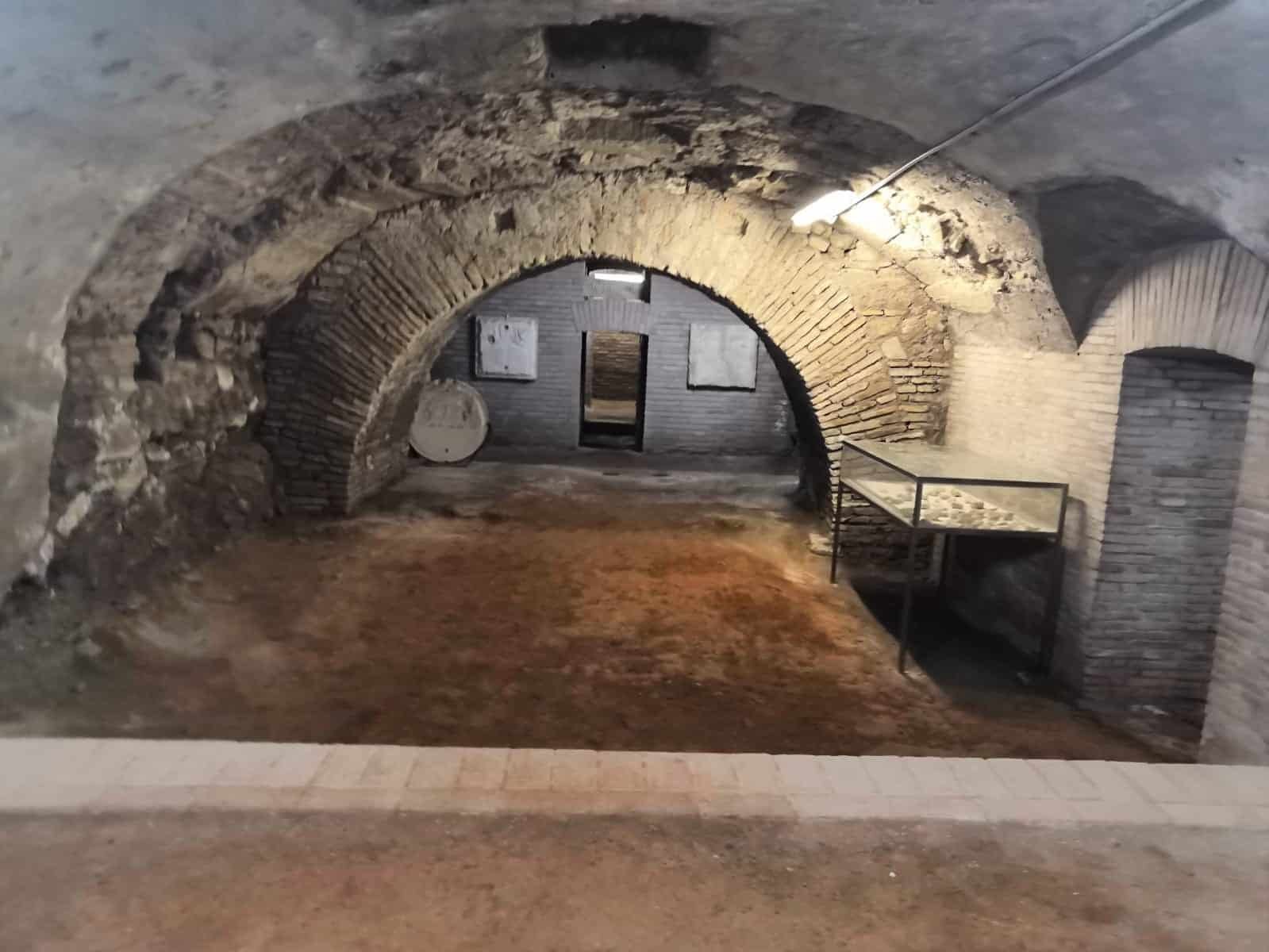
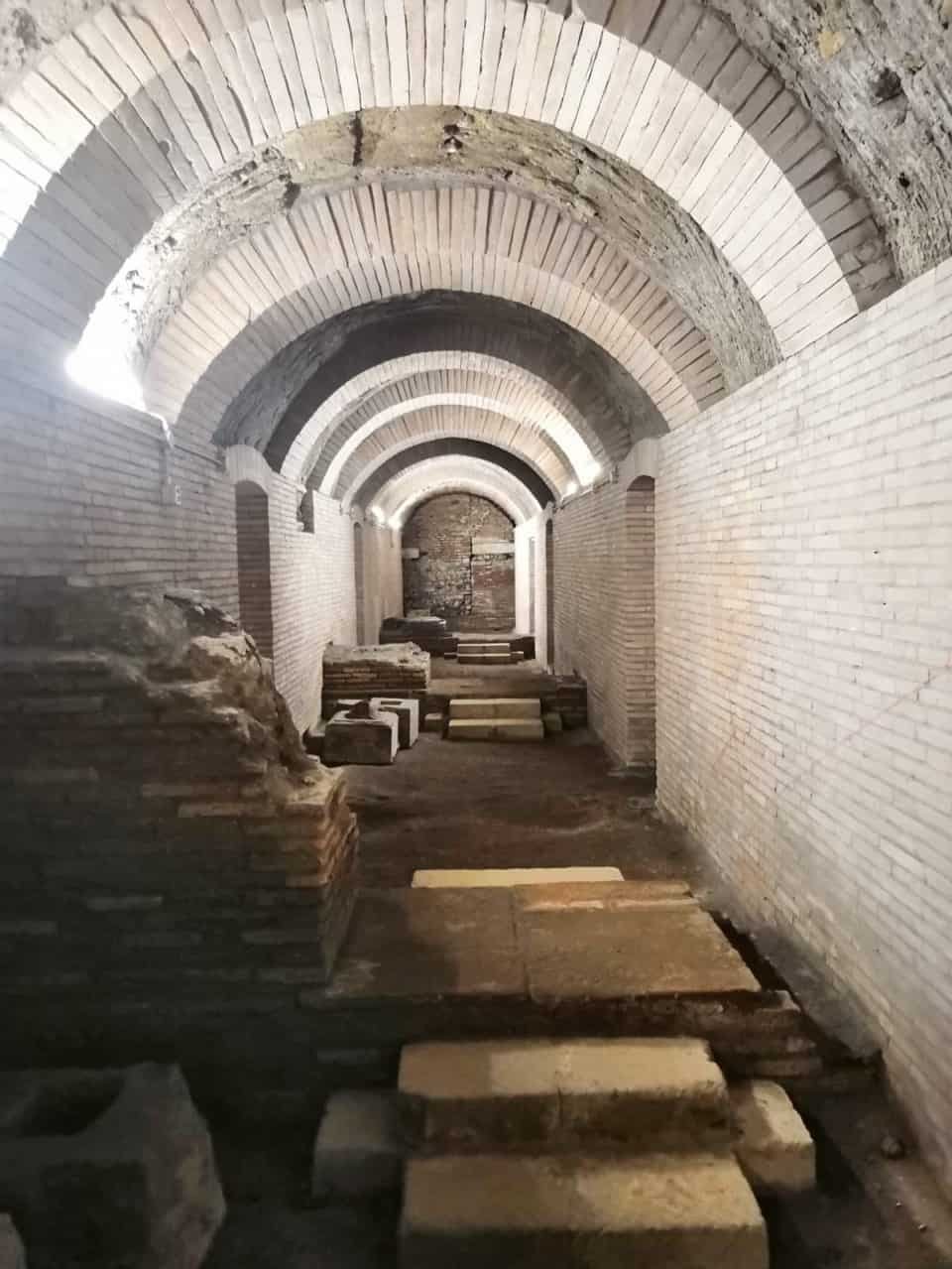
The excavations brought to light, under a room outside the nave now called the canons' hall, the circular basin of an early Christian baptistery and a smaller quadrangular basin whose purpose is unclear. Under the nave, whose floor was raised in 1598, they found the supporting walls resting on the floor of a second-century building, converted around the fourth century into an insula with a staircase to the upper floor, with a black and white mosaic and traces of painted plaster. This is the archaeological heart of the place, and the excavation sources add a few details.
The circular baptismal basin measures about four meters in diameter and was lined with marble. It's in the crypt under the chapel of San Giovanni Battista, that is, the room now called the canons' hall. Next to it is the smaller rectangular basin, with a niche and a pediment: the hypotheses assign it to the baptism of children, or to the blessing of water, or to the washing of feet. Hypotheses, not certainties.
The sources don't agree on the dates of the excavation campaigns. You often read "between 1982 and 2000". Romasotterranea.it speaks of campaigns in 1982-1983 and in 1985 run by the Soprintendenza Archeologica di Roma, and then in 1993-1998 together with the Swedish Institute of Classical Studies. Cathopedia reports 1983-1985 and 1993-1998. The English version of Wikipedia cites 1993. What you can take from this: there was more than one campaign, spread between the early 1980s and the end of the 1990s, with the participation of the Swedish Institute. The end date of 2000 isn't confirmed by these sources.
There's also a widespread misunderstanding. People often talk about the "well still visible today in the underground" as archaeological confirmation of the tradition of the temple of Juno Lucina and its miraculous water. In reality the excavation sources don't describe a well for a pagan cult: they describe a Christian baptismal installation, the circular basin lined with marble and the smaller rectangular one. The temple of Juno Lucina remains a scholarly tradition, respectable and ancient, but it isn't the well in the underground that proves it. If you want to see what a sanctuary truly dedicated to Juno looks like, the right pointer is the sanctuary of Juno Sospita, which is in Lanuvio and is a different thing.
The Sundial of Augustus and the Obelisk of Montecitorio
You often read that under the basilica's sacristy the remains of the great sundial built by Augustus in 10 BC were found, with the Egyptian obelisk now at Montecitorio as its gnomon. That's partly true, and the missing part is what makes the story interesting.
The ancient find dates to 1457, in the foundations of Palazzo Fiano-Almagià and during work on the chapel of Saints Philip and James, the one that now corresponds to the sacristy, about eight meters below street level. It was documented by Pomponio Leto, and the titular cardinal at the time was Filippo Calandrino. But the large, readable portion of the sundial's pavement, travertine slabs over 10 meters long with bronze markers, zodiac signs and Greek inscriptions, came out in 1979 in the cellars of Via di Campo Marzio 48, which is a different address, a few steps from here. So Augustus's sundial isn't "under the sacristy" as its only location: it's an enormous installation, extending under an entire block of the Campo Marzio, of which the basilica intercepts only a corner.
Pliny's account of the sundial that worked badly and of its repair under Domitian is part of the scholarly tradition of the monument, but the precise dating isn't confirmed by an official source: take it as an ancient story, not as a chronicle. The obelisk, that you can see where it stands: it's in Piazza di Montecitorio and you walk past it in three minutes.
If the subject grabs you, the natural route is this: Basilica of San Lorenzo in Lucina, then Largo Argentina to understand the ancient level of the Campo Marzio, then the Ara Pacis and the Mausoleum of Augustus. All Augustus, all on foot, all in one afternoon.
The Origins of the Basilica of San Lorenzo in Lucina and the Two Theories on the Name
The name of the Basilica of San Lorenzo in Lucina is explained in two ways, and scholars have been divided for centuries. First theory: a Roman matron named Lucina made part of her house available to the Christian community, giving rise to an ecclesia domestica. From there comes the titulus Lucinae that appears in the acts of the synod of Pope Symmachus of 499. Second theory: the name comes from an ancient temple of Juno Lucina, the goddess who presided over childbirth, near which the women of ancient Rome drew water believed to be miraculous.
The second theory is often supported by the discovery of the well in the underground. As explained above, that discovery is a baptistery, not a well for a cult. The theory of Juno Lucina stands as a place-name hypothesis, but without that proof.
The first appears the sturdier, for a simple reason: the titulus Lucinae appears in the records of 499 as the name of a community and of an already established Christian place of worship, and under the nave the excavations found a private Roman house converted into an insula, not a temple. The coincidence between the house and the name of the lady of the house is the kind of thing that happens all the time in Rome. It remains an opinion, not a fact.
A little-known detail: here, in 366, Pope Damasus I was elected. And tradition has it that Pope Marcellus I hid in this place during the persecutions of Maxentius. Damasus is not just any name for anyone who deals with underground Rome: he's the pope who arranged and monumentalized the catacombs, the one of the verse elogia. If you follow that thread, the next stop is the catacombs of Rome and in particular the catacombs of San Callisto.
Sixtus III, the Fourth Century and the Consecration of 440
The basilica arose in the fourth century according to tradition, and was consecrated as an official place of worship in 440 by Pope Sixtus III. The context makes the date less abstract: these are the years when Rome is stitching itself back together after the sack of 410, and when the tituli, the neighborhood churches tied to a name and a property, become the capillary network of the Christian city. The Basilica of San Lorenzo in Lucina was born exactly this way: not as an imperial monument, but as a block church, inside a fabric of houses.
The dedication to Saint Lawrence ties this place to the deacon martyred in 258 under Valerian, the same one to whom the basilica of San Lorenzo fuori le Mura is dedicated. Two churches, one saint, two different functions: the one outside the walls stands over the tomb, this one in the city keeps the relic of the gridiron. They complement each other and are best seen in the same week.
Paschal II, Anacletus II and Celestine III: The Medieval Building Site
Under Pope Paschal II the church was rebuilt, with completion in 1130. To him we owe the portico flanked by two lions, the medieval apse and the five-tier bell tower. Then there are the lesser-known things worth knowing.
The consecration of 1130 was celebrated by the antipope Anacletus II. It's not a trivial detail: 1130 is the year of the schism, with Innocent II and Anacletus II elected almost at the same time and Rome split in two. That this basilica was consecrated by the contender who then stayed outside the official succession explains why in 1196, just 66 years later, a new consecration was needed: that of Pope Celestine III, on May 26, 1196, recorded by the most important of the inscriptions set into the portico wall.
Behind the altar, at the back of the apse, is the cathedra of Pope Paschal II, dated 1130, in polychrome reused marbles. It deserves a long stop: it's one of those pieces that people glance at quickly in Roman churches and that instead tell the whole method of the medieval building site, that is, the systematic reuse of what antiquity had left lying on the ground. If that language of reassembled marbles interests you, the other two Roman churches to line up are Santa Prassede and San Clemente.

The Portico, the Lions and the Inscriptions
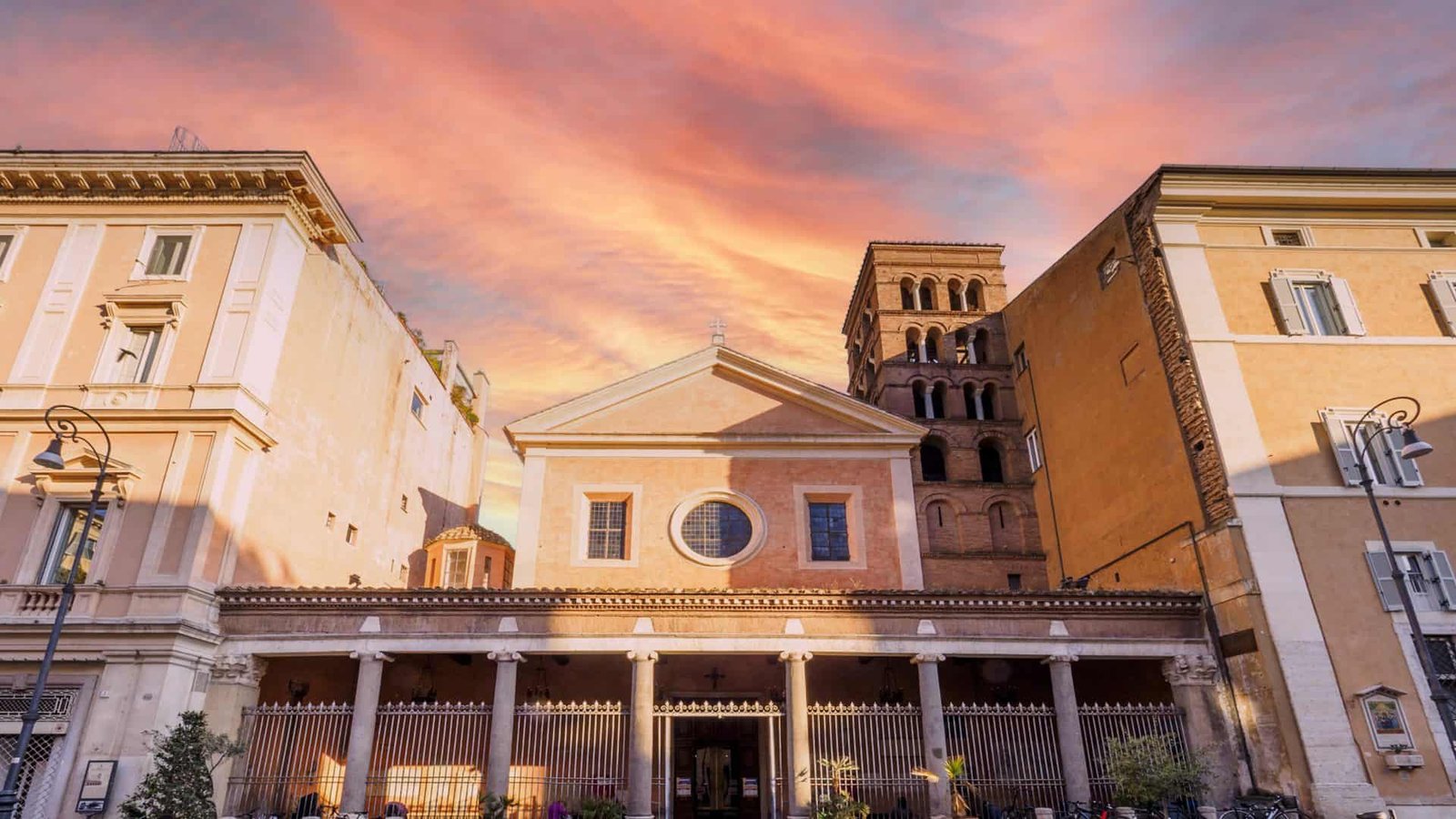
The portico of the Basilica of San Lorenzo in Lucina has six granite columns with Ionic bases and capitals, topped by an architrave made from an enormous ancient fluted column. On either side of the entrance stand two stylophore lions from the twelfth century. Medieval inscriptions are set into the portico wall, including those recording the consecrations of 1130 and 1196.
There are two ways to look at a portico like this. The first is to walk under it in three seconds. The second is to stop and ask where each piece comes from: the granite of the columns is Roman, the architrave is an ancient column lying on its side, the capitals are Ionic and not all alike, the lions are medieval and nibbled by time. The portico is a catalog of reuse. The second way is the better one, and it costs two minutes.
Above the portico, in the central part of the facade, under the triangular pediment, are the rose window in the center and two rectangular Baroque windows at the sides. The Romanesque bell tower rises set back on the right: square base and five tiers, the first two with mullioned windows on pillars and the other three with double mullioned windows on small columns, decorated with porphyry discs and green majolica basins. The bells bear the dates 1606 and 1759. Those glazed ceramic basins set into the masonry are a typical flourish of Roman Romanesque bell towers and are hard to see from the ground: bring a telephoto lens or make do with your phone's zoom.
Outside, in much more recent times, the sculpture "When I Was a Stranger" by Timothy Schmalz was placed, part of the collection inspired by chapter 25 of Matthew made for the Jubilee of Mercy. It's contemporary bronze next to medieval stone, and the contrast doesn't clash at all.
Inside the Basilica of San Lorenzo in Lucina: From Three Aisles to One
The basilica began with three aisles and today has a single nave, with four chapels on each side leading toward the high altar. The transformation dates to the seventeenth century. Around the middle of the seventeenth century the interior was redesigned by Cosimo Fanzago: the floor was raised to protect against Tiber floods and the side aisles were closed off and turned into family chapels. That's why, when you go down into the underground, you find the church's walls resting on an ancient floor: the walking level of today's basilica is not that of yesterday.
A precise date circulates for the raising of the nave floor, 1598. It's compatible with what the excavations tell, but Fanzago's transformation is from the mid-1600s: they are two distinct moments of the same problem, namely Tiber water coming into the church. Before the nineteenth-century embankments, floods in the Campo Marzio were an ordinary matter, not an emergency.
In 1606 Paul V entrusted the basilica to the Clerics Regular Minor, the Caracciolini, who kept it for centuries and shaped its artistic choices. In 1873, with the suppression laws of the new State, the building passed to the Italian state property. Today the ownership belongs to the Fondo Edifici di Culto, that is, to the Ministry of the Interior, while pastoral care belongs to the parish. This apparently bureaucratic passage comes in handy later, in the story of the restored angel: because in a church like this every intervention has to go through three different parties, and whoever forgets that ends up in the newspapers.
The High Altar, Guido Reni's Crucifix and the Cathedra
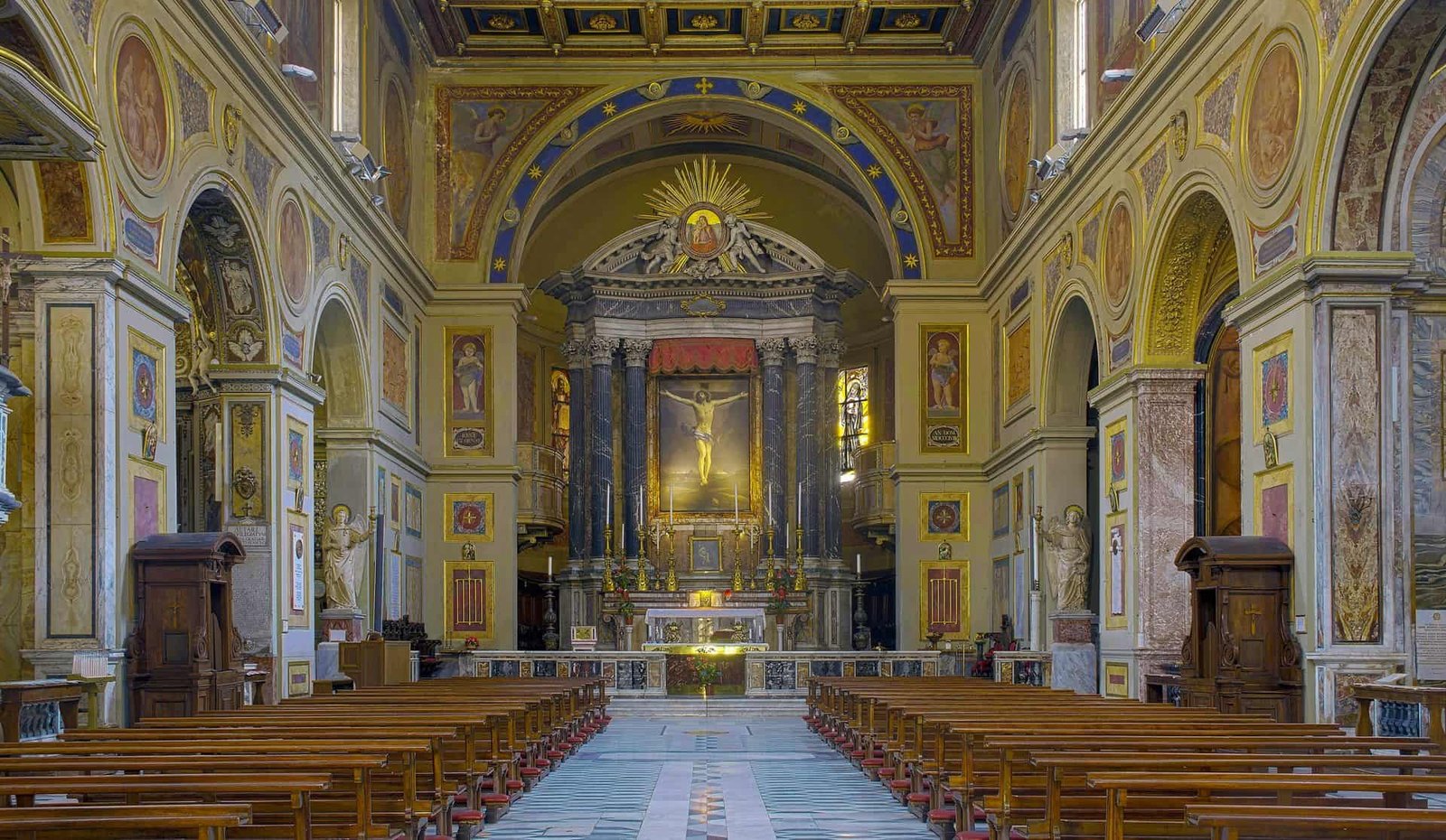
On the high altar is the canvas of the Crucifix by Guido Reni, framed by six Corinthian columns of black marble. It's the basilica's showpiece and is best seen from the nave, stepping back to the middle of the church, not from below: Reni had calculated the distance.
There are two versions on the date. Cathopedia gives 1637-1638. The English Wikipedia gives 1639-1640. In both cases we are in Reni's full maturity, in the years when his Christ on the cross becomes the reference model for half of Europe.
Two dates also circulate for the altar that holds the canvas, 1669 and 1675. According to Cathopedia the altar by Carlo Rainaldi is from 1669, and is in black marble.
Behind the altar, as already said, is the cathedra of Paschal II from 1130. Look at them together, the cathedra and the Crucifix: 500 years apart, two meters from each other.
The Three Interior Itineraries of the Basilica of San Lorenzo in Lucina
The arrangement of the chapels is not random, and it's one of the most beautiful things about the basilica. The basilica offers three paths of reading.
The first is Christological. You start from the first chapel on the left, the baptistery, where the baptism of Christ is shown, that is, the beginning. You move on to the crucifixion, Guido Reni's altarpiece above the high altar, that is, the end of the earthly path. You close with the ascension, painted on the coffered ceiling, where Christ appears with Pope Damasus I, Saint Lawrence and the matron Lucina.
The second is Marian: the birth of the Madonna, told only in the apocryphal gospels, the Annunciation, the Presentation at the Temple and finally the chapel of the Immaculate Conception.
The third is Laurentian, dedicated to the patron. In the first chapel on the right, called the Lovatti chapel since the mid-1800s, are the canvases with the key moments of the saint's life. In the lower altar are the chains with which he was imprisoned, and under the central altar the gridiron of the martyrdom is kept.
Organized theological itineraries are often reconstructions after the fact. Here, though, the sequence holds up and can be read as you walk. Try doing it in order: go in, turn left, close the loop. It takes you 20 minutes and you leave having understood the church instead of having photographed eight random altars.
The Left-Hand Chapels, One by One
Entering and turning left, the first is the baptistery, designed in 1721 by Giuseppe Sardi, with the Baptism of Jesus by Giuseppe Nicola Nasini. The date of the project and the painter's name come from Cathopedia.
The second is dedicated to Saint Charles Borromeo and holds "Saint Charles Carries the Holy Nail in Procession" by Carlo Saraceni, datable between 1612 and 1619, plus two paintings by Gregorio Preti. Saraceni is one of the least talked-about and most skilled Caravaggisti, and that procession with the nail is a piece of Lombard-Roman painting that by itself justifies a five-minute stop.
The third is of Saint John Nepomuk, with the statue by Gaetano Altobelli from 1732. The fourth is the chapel of Saint Joseph, so called for the "Holy Family with God the Father and Angels" by Alessandro Turchi, mid-1600s. This chapel belonged to the Ottoboni princes, dukes of Fiano, the family of Pope Alexander VIII, who held it in perpetual concession by papal brief: high up at the entrance you can still see their coat of arms. In 1943 the chapel was turned into the tomb of Cardinal Cremonesi and covered with green marbles that hid the Ottoboni gravestones. In a corner stands the cardinal's marble bust. People have spoken of a "denatured" chapel, and it's a judgment I share: covering one family's gravestones to make another man's tomb is a blunt way to treat memory.
The fifth chapel on this side, dedicated to Saint Francis and Saint Hyacintha, was designed in 1624 by Simon Vouet and holds the "Death of Saint Hyacintha Marescotti" by Marco Benefial, datable around 1736, plus a fresco attributed to Bernardino Luini on the cymatium. You often read that in the chapel of Saint Francis there are canvases by the French Caravaggist Simon Vouet. In reality Vouet is the author of the chapel's design in 1624 according to Cathopedia, and the paintings you see there today are not all his. A Luini in a Roman church is, besides, an anomalous and debated presence: if you pass by, look at it with curiosity and without Milan expectations.
The Right-Hand Chapels and Bernini's Fonseca Chapel
On the right the first is the chapel of San Lorenzo, the Lovatti, with the paintings by Sigismondo Rosa and the reliquary that holds the gridiron. The second is of Saint Anthony of Padua, designed in 1663 by Carlo Rainaldi, with the "Miracle of Saint Anthony" by Jan Miel, 1655-1657. The third is of Saint Francis Caracciolo, with the altarpiece in which the saint adores the Eucharist, by Ludovico Stern, around 1740. The fourth is the chapel of the Annunciation, that is, the Fonseca chapel.
This one is worth slowing down for. It was designed by Gian Lorenzo Bernini between 1660 and 1664 for the Portuguese Gabriele Fonseca, personal physician to Innocent X, known for having helped introduce the use of quinine against malaria. Bernini asked the painter Giacinto Gimignani for a copy of Guido Reni's famous Annunciation in the Quirinale, linked to the space through stucco angels made between 1660 and 1670 that lead the eye toward the lantern. And then there's the bust: Fonseca emerging from a fake window, hand on his chest, face turned toward the altar, following the typical Baroque device of bringing the patron into the scene. In the chapel there are four busts of the Fonseca family, datable to 1668-1669.
Brochure phrases urging you not to miss it say nothing. The concrete thing is this: the bust of Fonseca is one of the three or four most intense Bernini portraits you can see in Rome outside the museums, and it's in a free church 200 meters from the Corso, while people line up at the Galleria Borghese to see other Berninis. Do the math.
The Gridiron, the Chains and the Cult of Saint Lawrence
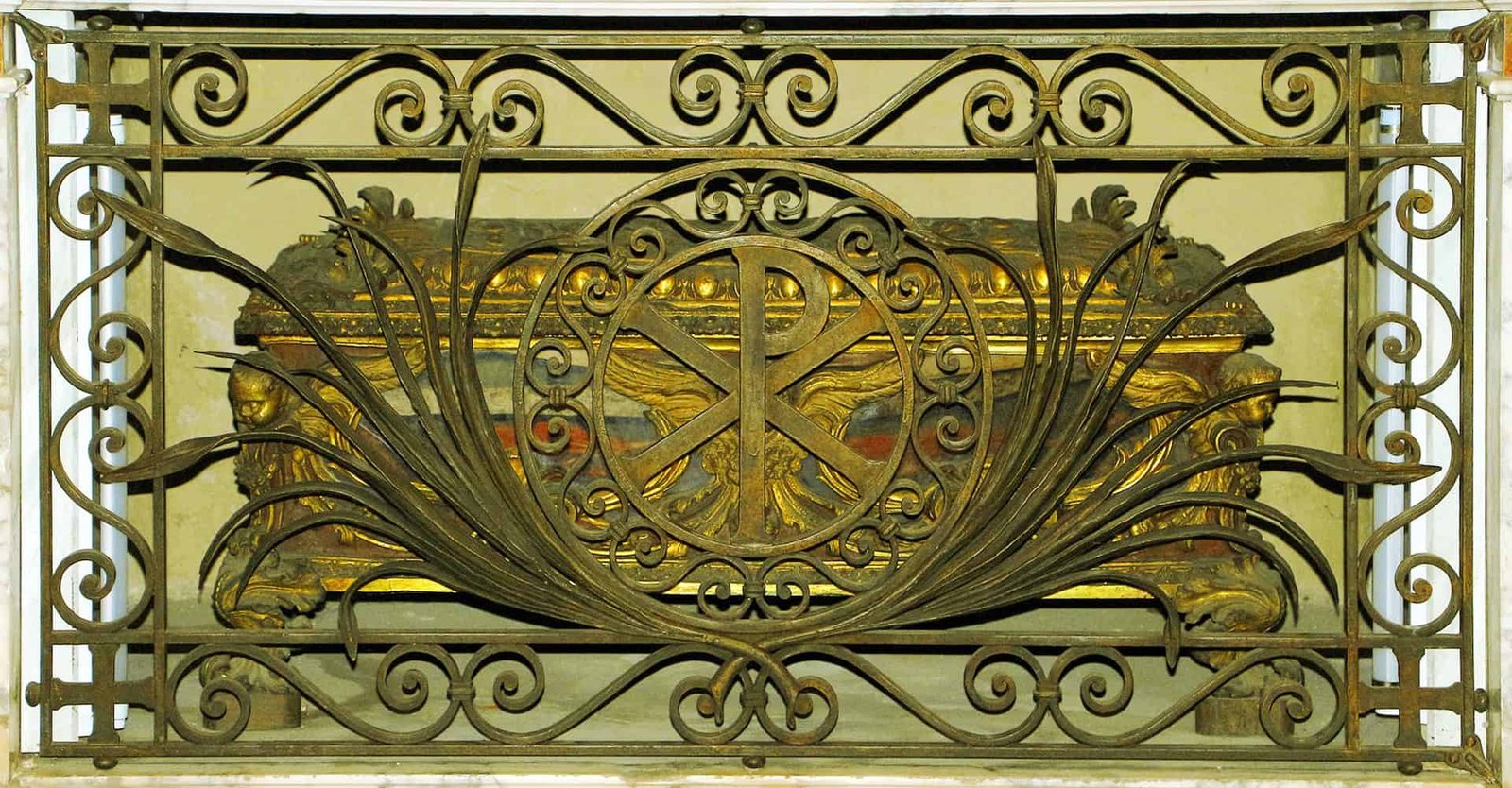
In one of the chapels a reliquary holds the gridiron on which, according to tradition, Saint Lawrence suffered the martyrdom ordered by the emperor Valerian in 258. Under the central altar is the gridiron, in the lower altar of the Lovatti chapel are the chains. They are objects of worship and should be looked at for what they are: not certified archaeological finds, but relics with a centuries-long history of veneration. This takes nothing away from the value of the place.
In the basilica there is also an eighteenth-century urn linked to this relic, and it's one of the most photographed pieces in the church.
The Mascioni Organ, Opus 302
In the apse, on the eighteenth-century choir loft on the right, stands the Mascioni opus 302 pipe organ, built by the firm from Varese. Two keyboards of 58 notes each, a concave-radiating pedalboard of 27, fully tubular-pneumatic action. These are numbers that say little to anyone who doesn't play and a great deal to anyone who does: tubular-pneumatic action places the instrument at a precise moment in the history of Italian organ building, the one between the nineteenth and twentieth centuries, before the return to mechanical action.
The instrument was commissioned by the titular cardinal Pietro Gasparri. But watch out for a common mix-up. Gasparri was created cardinal in 1907, but became titular of San Lorenzo in Lucina on January 22, 1915, as the list of titulars shows. In 1907 he was therefore already a cardinal but not yet the titular of this basilica.
Pius IX's Nineteenth Century: Busiri Vici, Bompiani and the Saved Pulpit
In the second half of the nineteenth century the basilica was reworked at the will of Pius IX: the Baroque decorations of the nave were removed and replaced with frescoes. The restorations were directed by Andrea Busiri Vici between 1856 and 1858. Roberto Bompiani painted the Ascension on the coffered ceiling between 1857 and 1858 and the Stories of the Life of Saint Lawrence in 1860. So not a generic late-nineteenth-century intervention, but a well-dated building project with an architect and a painter.
Of the old Baroque furnishings the pulpit was spared, left in its place. A curious choice, saving just one piece: and indeed today the pulpit stands there as a witness to what the church was like before the intervention. Look at it and try to imagine the whole nave in that tone.
The historical judgment on these nineteenth-century clean-ups is severe almost everywhere, and partly well founded: a lot was wiped out. But Bompiani's ceiling, with the Ascension and the Stories of Saint Lawrence, has the merit of closing the Christological path described earlier. It's not decoration tossed in at random.
A Minor Basilica Since November 27, 1908
Pope Pius X raised it to the rank of minor basilica on November 27, 1908, as reported by gcatholic.org and Cathopedia.
The nineteenth-century restoration comes first: the Busiri Vici and Bompiani project falls between 1856 and 1860.
Who Is Buried in the Basilica of San Lorenzo in Lucina
The list is long and surprising for a neighborhood church. Nicolas Poussin, the French painter, has his tomb here, built in the nineteenth century by Chateaubriand, then French ambassador to Rome, with the phrase "et in arcadia ego": the monument was donated in 1830. Adam Elsheimer, 1578-1610, the German who taught half of Europe to paint the night. Luca Marenzio, madrigalist. Josef Myslivecek, called "the divine Bohemian". Bernardo Pasquini, organist and composer, who was called Protico Azoteo in Arcadia and of whom a Carrara marble portrait by Pietro Francesco Papaleo is kept here. Domingo Miguel Bernabè Terradellas, called Terradeglias. Carlo Fea, archaeologist. Giuseppe De Matthaeis. Matteo Lovatti, 1769-1849, and Clemente Lovatti, 1779-1860. Cardinal Pietro Ciriaci, 1885-1966, titular from 1964 until his death, in the Lovatti chapel.
To this list the sources add three names: Pompeo Batoni, 1708-1787, the portraitist who painted half of the European aristocracy on the Grand Tour. The architect Raffaele Stern. And Charles Stewart, who died in 1864.
Let's pause on this for a moment. In a church with no ticket, very close to Parliament, rest a French painter, a German painter, a Bohemian composer, a Catalan one, two Italian musicians, an archaeologist and a portraitist from Lucca. The Basilica of San Lorenzo in Lucina was the parish of the foreigners of the Campo Marzio, those who came to Rome to work and stayed. It's a cemetery of artists disguised as a district church.
The Cardinal Title and Today's Titular
San Lorenzo in Lucina is a very ancient cardinal title, whose institution is probably traced back to the second century, and historically it was assigned to the cardinal protopriest, that is, the most senior of the cardinal priests.
The current titular is Cardinal Albert Malcolm Ranjith Patabendige Don, metropolitan archbishop of Colombo, in office since November 20, 2010. Before him: Pietro Gasparri from January 22, 1915 to November 18, 1934, Carlo Cremonesi from 1935 to 1943, Manuel Arteaga y Betancourt from 1946 to 1963, Pietro Ciriaci from 1964 to 1966, Pietro Parente from 1967 to 1986, Opilio Rossi from 1987 to 2004.
If you're wondering what this means in practice: the titular cardinal is not the parish priest and does not run the church. It's a symbolic bond that makes him a member of the clergy of Rome. The current parish priest of the basilica is Monsignor Daniele Micheletti, and you'll need this name in two paragraphs.
The Restored Angel and the 2026 Case
There's also a recent story, and if you come to visit someone will tell you about it.
Between the end of January and the beginning of February 2026 the Basilica of San Lorenzo in Lucina made the newspapers over a restored painting. It is a painting with two angels on either side of a bust of Umberto II. On the exact location the sources differ: ilpost.it, on January 31, 2026, places it in a chapel to the right of the altar, on a wall dedicated to the Savoy family. The Ministry of Culture press release of February 4, 2026 speaks of the "chapel of the crucifix".
The facts that the sources agree in reporting are these. The restoration was carried out by Bruno Valentinetti, 83 years old, self-taught and a volunteer, at the request of the parish priest Monsignor Daniele Micheletti. It lasted two years and ended in 2025. The face of one of the angels, once repainted, looked like Giorgia Meloni. On January 31, 2026 the Ministry of Culture issued a press release: Minister Alessandro Giuli ordered an inspection, entrusted to the Special Superintendent of Rome Daniela Porro. On February 4, 2026 a second press release announced that the face had been erased and that any restoration would require authorizations from the Fondo Edifici di Culto of the Ministry of the Interior, which owns the property, from the Vicariate and from the Soprintendenza Speciale di Roma, with a sketch attached.
In our judgment the problem is not the face and it's not the resemblance. The problem is that on a protected state-owned asset, a painting intervention is not done without authorization, even if it's free and done in good faith. That said, an 83-year-old man who spends two years of his life restoring a painting in a church for free deserves respect.
Piazza Around the Basilica of San Lorenzo in Lucina
The square is worth as much as the church, and anyone who goes in and rushes back out misses it. On the north side stands Palazzo Fiano, whose origins go back to the 13th century: it was in its foundations that in 1568 some parts of the Ara Pacis came to light. Put another way: Augustus's altar of peace stood under this block, and it was discovered by digging cellars.
On the other side is the former convent of the Caracciolini, built in 1665 to a design by Carlo Rainaldi, now home to the Carabinieri. The same Rainaldi who signed the high altar and the chapel of Saint Anthony: he worked in this block for years.
Today the square is taken up by the tables of a couple of historic places in the center. It's a spot where Romans arrange to meet, not a backdrop for tourists. If you get there around seven in the evening in summer, you'll find a neighborhood scene that the rest of the Tridente lost long ago.
Within a radius of 300 meters you have Via dei Condotti, the Galleria Alberto Sordi, Piazza Colonna with the Column of Marcus Aurelius and Montecitorio. At 500 meters, the Pantheon and the church of Sant'Ignazio di Loyola with the fake dome. At 700 meters, Piazza Navona and San Luigi dei Francesi with the Caravaggios.
With Children and for Those Short on Time
With children it works, as long as you don't treat it like a lesson. The lions of the portico can be touched and counted. The bell tower with the green ceramic plates is looked at with your nose in the air and easily turns into a treasure hunt. The gridiron with the chains, if you tell it well, holds its own against a cartoon. Below, in the excavations, the floor is uneven and there is no natural light: under six it's not recommended, over 10 it works very well.
If you have only 20 minutes: portico and lions, nave up to halfway, Reni's Crucifix seen from the right distance, the Fonseca chapel on the right with the Bernini bust, the cathedra of Paschal II behind the altar, and off you go. Those are the five pieces you won't find anywhere else.
If you have an hour and a half: add the eight chapels one by one and the coffered ceiling, and sit for five minutes at the back of the nave doing nothing. Roman churches should also be listened to: the noise of the Corso doesn't reach in here.
Accessibility of the Basilica di San Lorenzo in Lucina
For the church above ground there is no official accessibility statement: the entrance is under the portico and the nave floor is raised above the street, so allow for a few steps. Anyone who needs certainty should call 06 6871494 before setting out.
For the underground levels, though, there is official information, and it should be said without beating around the bush: the listing from I Viaggi di Adriano explicitly reports the presence of architectural barriers. Anyone who uses a wheelchair or has significant difficulty walking should expect a serious problem with the excavations.
In the underground levels the temperature is lower than above ground and the humidity higher. In August it's a relief, in January you need a jacket even if the sun is out.
When to Come to the Basilica di San Lorenzo in Lucina
The best time is late morning on a weekday, after the 11 o'clock Mass and before two in the afternoon. The light enters from the rose window and the high windows and cuts across the nave: it's the hour when Reni's Crucifix reads best, without reflections.
On Saturday afternoon the Colonna district is full of people shopping on Via del Corso and the square becomes a parking lot of strollers. On Sunday morning the church is taken up by services.
August 10, the feast of Saint Lawrence, is the day this basilica is fully itself: the relic of the gridiron returns to the center and the parish fills up. If you're in Rome in August and want to see a real patronal feast instead of a postcard, this is the address. The program changes from year to year, though, and doesn't appear to be published: ask at the parish in the days before.
A Curiosity About the Basilica di San Lorenzo in Lucina
The best curiosity concerns the shadow. Under this basilica, and under the block around it, ran the floor of the largest sundial ever built in antiquity: the one Augustus had made in 10 BC, using as its gnomon an Egyptian obelisk brought from Heliopolis. You can see that obelisk today standing in Piazza di Montecitorio, 300 meters from here, in front of the Chamber of Deputies. Every day thousands of people photograph it without knowing that it is the pointer of an instrument whose dial lies under their feet, broken into pieces among the cellars of the district.
In 1457, during work on the foundations of Palazzo Fiano and for the erection of the chapel of Saints Philip and James, now the basilica's sacristy, they dug down to eight meters below street level and found the first remains: the humanist Pomponio Leto documented it, and the titular cardinal of the basilica in those years was Cardinal Filippo Calandrino. Then the big discovery came in 1979, in the cellars of Via di Campo Marzio 48: over 10 meters of travertine slabs with bronze notches, the signs of the zodiac and inscriptions in Greek.
Here is the real curiosity: the Basilica of San Lorenzo in Lucina is built on top of a chronometer. A chronometer that, if you read Pliny, at some point stopped telling the right time, perhaps because the ground settled, so that under Domitian they had to step in. That part of the story should be taken as ancient tradition, because the exact chronology isn't confirmed by an official source.
Something Nobody Tells You About the Basilica of San Lorenzo in Lucina
That the floor you're walking on isn't that of the ancient church, and that the distance between the two is measured in meters, not centimeters.
The level of the nave was raised to protect against Tiber floods, with an intervention dated 1598 and then with the mid-1600s transformation signed by Cosimo Fanzago. Below, the excavations found the floor of a second-century building, later converted around the fourth century into an insula, with a staircase that went up to the upper floor, a black and white mosaic and traces of painted plaster. The supporting walls of the present church rest on that floor.
Nobody tells you because you can't see it. You walk in, the church is bright, the ceiling is coffered, everything looks Baroque and nineteenth-century. Then you go down and understand that you're walking on the roof of a Roman apartment building. That staircase going up to the upper floor, in particular, is striking: it's the only piece of domestic architecture in the whole basilica, the only place where you can see that people lived here before they prayed here.
The other thing nobody tells you is that this kind of stratigraphy, in Rome, is the norm and not the exception. Almost no church simply shows it. San Lorenzo in Lucina, when the underground is open, does.
My Advice for Visiting the Basilica of San Lorenzo in Lucina
Call ahead. Period.
It sounds trivial, but in this case it's the difference between a successful visit and a wasted trip. The church at street level is free and almost always open, but the sources don't agree on the hours, and none of them is the parish itself. The underground then has no fixed calendar: one of the operators openly states that the visit is organized privately on request, another lists the first Saturday of the month at 16.15, a third works by reservation only with two phone numbers. If you come from outside Rome for the excavations and show up in the piazza without booking, the chance of going down is low.
The second piece of advice concerns the order of the day. Do the church first, unhurried, and only then go down. If you go down first you'll carry the dark and the mold in your eyes and won't look at anything upstairs. If you go up last, instead, Reni's Crucifix and Fonseca's bust stay with you.
Third: don't do it in a rush in the middle of a Tridente walk. This is a church for 20 minutes minimum, an hour if you have even a little curiosity. Squeezing it in between Piazza di Spagna and the Trevi Fountain as filler is the best way not to see it.
Another Well-Known Fact, Yet Rarely Cited
That here, in 366, Pope Damasus I was elected.
It's a fact written in all the historical entries and that nobody ever tells, because Damasus doesn't have the popularity of other popes and because the 366 election was a bloody affair that nobody feels like recalling: two candidates, two factions, clashes in the streets of Rome. Damasus, though, is the pope who did more than anyone else for the memory of the Roman martyrs, the one who went down into the catacombs, had the galleries dug out and widened, and had the verse elogia carved on the martyrs' tombs. Without Damasus, the underground Rome you visit today wouldn't have the shape it has.
That his name is tied to this basilica, and that he also appears painted on the coffered ceiling next to Christ, Saint Lawrence and the matron Lucina, closes a circle: the pope of the catacombs elected in a church that rests on a Roman house and an early Christian baptistery.
Another well-known and little-cited fact, staying on the theme: tradition has it that Pope Marcellus I hid in this place during the persecutions of Maxentius. And the name "titulus Lucinae" appears in the acts of the synod called by Pope Symmachus in 499, which is the first written list of the churches of Rome. In 499 this church was already an institution. Few things in the city can say the same.
The Right Photo to Take at the Basilica of San Lorenzo in Lucina
The right photo isn't the facade. The facade alone doesn't work, because the piazza is narrow and you don't have the distance to frame it whole without distorting it.
The right photo is under the portico, standing next to one of the six granite columns, lens pointed along the row of columns toward the other lion. You get all of it at once: the ancient granite, the Ionic capitals, the shade of the portico, the medieval lion at the end and, beyond, the light of the piazza. It's a framing that tells five centuries in one frame. Take it in the morning, when the sun hits the piazza and the portico stays in shade: the contrast works for you.
The second photo is the bell tower seen from a corner of the piazza, with the zoom pushed onto the green majolica basins and the porphyry discs set between the mullioned windows. To the naked eye they look like spots. With the telephoto they become ceramic.
Inside, the sensible photo is Reni's Crucifix taken from the center of the nave, framed by the six Corinthian columns of black marble. No flash, ever: flash isn't used on a seventeenth-century canvas, and anyway it does nothing at that distance. If you have to take home just one detail, it's the bust of Gabriele Fonseca in the Bernini chapel: that face leaning out of the fake window, with the hand on the chest, is made to be caught at three-quarters.
In the underground, if you go down, remember that you photograph what the guide tells you can be photographed. A general rule that holds in all excavations under concession: ask first.
Some Important Events That Happened Here in History
Here are the dates in order, as the sources report them, with the discrepancies flagged where there are any.
Second century: the building whose remains lie under the nave is built. The cardinal title, according to tradition, would also date to the second century. Fourth century: the building is converted into an insula. According to tradition the matron Lucina makes a place of worship available to the Christian community. 258: Saint Lawrence is martyred under Valerian. The gridiron will arrive here as a relic. 366: election of Pope Damasus I. 440: Pope Sixtus III consecrates the church as an official place of worship. 499: the titulus Lucinae appears in the acts of the synod of Pope Symmachus. 1130: completion of the reconstruction commissioned by Paschal II, consecration celebrated by the antipope Anacletus II. It's also the date of the polychrome marble cathedra. May 26, 1196: new consecration by Pope Celestine III, recorded by the inscription in the portico. 1457: in the foundations of Palazzo Fiano and in the building site of the chapel of Saints Philip and James the first remains of Augustus's sundial emerge, documented by Pomponio Leto. 1568: in the foundations of Palazzo Fiano parts of the Ara Pacis come to light. 1598: raising of the nave floor. 1606: Paul V entrusts the basilica to the Clerics Regular Minor, the Caracciolini. Some of the bells are from the same year. 1624: Simon Vouet designs the chapel of Saint Francis and Saint Hyacintha. Mid-1600s: Cosimo Fanzago transforms the interior, the side aisles become family chapels. 1660-1664: Bernini designs the Fonseca chapel. The stucco angels are from 1660-1670, the four Fonseca busts from 1668-1669. 1663: Carlo Rainaldi designs the chapel of Saint Anthony of Padua. 1665: Rainaldi builds the Caracciolini convent on the piazza. 1669: high altar by Carlo Rainaldi in black marble. 1721: Giuseppe Sardi designs the baptistery. 1759: second date on the bells. 1830: Chateaubriand donates the monument to Poussin. 1856-1858: restorations directed by Andrea Busiri Vici at the will of Pius IX. 1857-1858 and 1860: Roberto Bompiani paints the Ascension and the Stories of the Life of Saint Lawrence on the coffered ceiling. 1873: the building passes to the Italian state property. November 27, 1908: Pius X raises the church to minor basilica. 1943: the chapel of Saint Joseph becomes the tomb of Cardinal Cremonesi. 1980s and 1990s: the excavation campaigns under the basilica, with the Swedish Institute of Classical Studies. On the exact dates the sources differ, as explained above. January 17, 1988: visit by John Paul II. November 20, 2010: Albert Malcolm Ranjith Patabendige Don becomes titular cardinal. January-February 2026: the case of the restored painting and the face that was then erased.
It's not a list to pad things out. It's the quickest way to show you that this church didn't have a golden age followed by a long sleep: it has worked without interruption for 1,600 years.
Who Has Passed Through the Basilica of San Lorenzo in Lucina
Popes have passed through, and not in passing. Damasus I was elected here in 366. Sixtus III consecrated it in 440. Marcellus I, according to tradition, hid here. Paschal II rebuilt it. Anacletus II, whom history records as an antipope, consecrated it in 1130. Celestine III reconsecrated it in 1196. Alexander VIII, of the Ottoboni family, had the family chapel here. Innocent X sent his personal physician here, Gabriele Fonseca, who had himself buried here. Pius IX ordered its nineteenth-century remodeling. Pius X raised it to minor basilica. John Paul II came to visit on January 17, 1988.
Artists have passed through, in two different ways: working here and staying here. Those who worked here: Gian Lorenzo Bernini, Carlo Rainaldi, Cosimo Fanzago, Guido Reni with the canvas of the Crucifix, Carlo Saraceni, Jan Miel, Alessandro Turchi, Ludovico Stern, Marco Benefial, Giuseppe Nicola Nasini, Gaetano Altobelli, Giuseppe Sardi, Giacinto Gimignani, Simon Vouet, Gregorio Preti, Roberto Bompiani, Andrea Busiri Vici, Pietro Francesco Papaleo. Those who stayed: Nicolas Poussin, Adam Elsheimer, Pompeo Batoni, Raffaele Stern, Luca Marenzio, Bernardo Pasquini, Josef Myslivecek, Domingo Miguel Bernabè Terradellas, Carlo Fea, Giuseppe De Matthaeis, Matteo and Clemente Lovatti, Charles Stewart, Cardinal Cremonesi and Cardinal Ciriaci.
And Chateaubriand passed through, who as French ambassador to Rome had the monument to Poussin built in 1830 with that phrase, "et in arcadia ego", which is the title of two paintings by Poussin himself and also a reminder of how things end. That a French writer chose a Roman church to commemorate a French painter who died 160 years earlier says everything about the role this piazza played for the foreigners of Rome.
A contemporary name, to close the round: Timothy Schmalz, the Canadian sculptor whose work "When I Was a Stranger" now stands outside the basilica. The list goes on.
What to See Near the Basilica of San Lorenzo in Lucina
Here are three loops, all on foot, all under 20 minutes of walking.
Augustus loop: from here to the Ara Pacis and the Mausoleum of Augustus, with the obligatory stop under the obelisk of Montecitorio that was the gnomon of the sundial. If you want to understand how far down the ancient level lies, finish with Largo Argentina.
Campo Marzio churches loop: San Luigi dei Francesi with the three Caravaggios of the Contarelli chapel, Sant'Ignazio di Loyola with the dome painted by Andrea Pozzo that isn't a dome, the Pantheon and Santa Maria del Popolo at the end of the Corso.
Underground loop: if the Basilica of San Lorenzo in Lucina has hooked you, the places where Rome reads vertically are the Basilica of San Clemente, with its three levels down to the Mithraeum, and the underground of the Stadium of Domitian under Piazza Navona. Then, outside the center, the catacombs of Rome. If you want to build a custom itinerary, start from the page Il mio viaggio.
Quick Questions About the Basilica of San Lorenzo in Lucina
Where exactly is the Basilica of San Lorenzo in Lucina?
In Piazza di San Lorenzo in Lucina, rione Colonna, 00186 Rome, 200 meters from Via del Corso. On the street number the sources don't agree: the parish's official site says 6, turismoroma.it says Via In Lucina 16/A, museionline.info and Cathopedia say Piazza di S. Lorenzo in Lucina 16 A, arte.it says Via in Lucina 16. Get to the piazza and the portico is in front of you.
How much does it cost to enter the Basilica of San Lorenzo in Lucina?
Entry to the church is free. You pay only for the guided visit to the underground, and there the published price lists are three and differ from one another.
How much does it cost to visit the underground?
It depends on the operator. Museionline.info lists 2.00 euros for the archaeological area on the first Saturday of the month at 16.15 and 15.00 euros for the tour with operator and audio guide. Visiteromasotterranea.it lists 12 euros for the guided visit with earpieces plus a 3 euro ticket to pay in the church. I Viaggi di Adriano, through pigierre.com, lists 15 euros full price, 13 euros reduced for members of partner programs and WeKard holders, 10 euros under 18, 5 euros under 10. The sources don't agree: check by phone.
Do you need to book for the underground?
Yes, practically always. One of the sources states that there is no fixed calendar and that the visit is organized privately on request. Another speaks of required reservation at 334 3006636 or 06 51963729, or at info@iviaggidiadriano.it. Another phone reference is 334 7401467.
How long does the underground visit last?
An hour and a quarter, according to the only source that states the length. Groups of up to 25 people.
Where is the meeting point for the excavation visit?
Here too it depends on who organizes it: one source lists the bookshop at Piazza San Lorenzo in Lucina 5/A, 15 minutes earlier. Another lists Piazza di S. Lorenzo in Lucina 6, in front of the entrance. Have it confirmed when you book.
What are the opening hours of the Basilica of San Lorenzo in Lucina?
The official site doesn't publish tourist visiting hours, only those of the Masses and the infopoint. Museionline.info lists Monday to Saturday 11.00-18.00 and Sunday 14.00-18.00. The two pieces of information don't match.
What time are the Masses?
The official site lists weekdays 11.00 and 18.30, Sundays and holidays 10.30, 12.00 and 18.30. Turismoroma.it instead distinguishes a winter season, from October 1 to June 14, with Monday to Saturday 11.00 and 18.30 and Sundays and holidays 10.00, 11.00, 12.00 and 18.30, and a summer season, from June 15 to September 30, with Monday to Saturday 11.00 and 18.30 and Sunday 10.00, 12.00 and 18.30. The sources differ, call 06 6871494.
Is there a closing day?
No official source lists a weekly closing day for the Basilica of San Lorenzo in Lucina. Religious services do suspend tourist visits though, and on Sunday morning there are quite a few.
How do you get there by public transport?
The parish's information page lists Metro line A, Barberini stop, about one kilometer away, and buses 100 and 119 with the Fontanella Borghese stop 150 meters away. The Spagna stop on line A also serves the area, but the exact distance doesn't appear in an official source.
Can you get there by car?
It's not recommended. You're inside the limited traffic zone of the historic center and there are no parking spaces. Better to take the metro plus a 20-minute walk.
How long does it take to visit the Basilica of San Lorenzo in Lucina?
20 minutes for the main pieces, an hour and a half to do it properly chapel by chapel. Add an hour and a quarter if you go down into the excavations.
Can you take photographs?
In the church yes, without flash and without a tripod, and with the respect due to a place of worship where services are held. In the underground ask the guide before shooting.
Is the Basilica of San Lorenzo in Lucina accessible to people with mobility difficulties?
For the church there is no official statement, and the level of the nave is raised relative to the street: expect a few steps and call ahead. For the underground, instead, the I Viaggi di Adriano listing explicitly notes the presence of architectural barriers.
Is it suitable for children?
The church yes, from about four or five years old, if told well: the lions of the portico, the ceramic plates on the bell tower and the story of the gridiron always work. The excavations are better from 10 years up, because of the uneven floor and the dark.
Is it cold in the underground?
Cooler than at street level and more humid. In summer it's a relief, in winter bring a jacket even if the sun is shining outside.
Who is the Lucina of the name?
Two theories. According to the first, a Roman matron named Lucina who would have hosted the Christian community in her house, hence the titulus Lucinae. According to the second, the goddess Juno Lucina, protector of childbirth, whose temple would have stood here. Neither is proven. The first appears the sturdier, but it's an opinion.
Is it true that there is a sacred well of Juno Lucina underneath?
No. The excavation sources describe an early Christian baptismal installation, with a circular basin about four meters in diameter lined with marble and a smaller rectangular basin, not a well for a pagan cult.
What did the excavations find under the basilica?
The early Christian baptistery in the crypt under the chapel of San Giovanni Battista, now called the canons' hall. And under the nave the floor of a second-century building, converted around the fourth century into an insula, with a staircase to the upper floor, a black and white mosaic and traces of painted plaster.
In which years were the excavations carried out?
The sources differ. Romasotterranea.it lists 1982-1983 and 1985, then 1993-1998 with the Swedish Institute of Classical Studies. Cathopedia lists 1983-1985 and 1993-1998. The English Wikipedia cites 1993. You often read "between 1982 and 2000", but the end date of 2000 isn't confirmed by these sources.
What does the obelisk of Montecitorio have to do with the Basilica of San Lorenzo in Lucina?
It is the gnomon of the sundial that Augustus had built in 10 BC, whose dial extended under this block. In 1457 the first remains emerged in the foundations of Palazzo Fiano and in the building site of the chapel now the sacristy, at a depth of eight meters. In 1979 the large part, over 10 meters of travertine slabs with bronze markers and zodiac signs, came out in the cellars of Via di Campo Marzio 48.
Can you visit Augustus's sundial?
Not as part of the visit to the basilica. The large fragment found in 1979 lies under another building, at Via di Campo Marzio 48. What you see down here is the Roman building fabric and the early Christian baptistery.
Who painted the Crucifix on the high altar?
Guido Reni. On the date the sources differ: Cathopedia lists 1637-1638, the English Wikipedia 1639-1640. The canvas is framed by six Corinthian columns of black marble.
Who designed the high altar?
Carlo Rainaldi. Two dates circulate, 1669 and 1675: according to Cathopedia it's 1669, and the altar is in black marble.
Is there really a Bernini in the Basilica of San Lorenzo in Lucina?
Yes. The Fonseca chapel, fourth on the right, designed between 1660 and 1664, with the marble bust of Gabriele Fonseca leaning out of a fake window, the stucco angels of 1660-1670 and four family busts of 1668-1669. Free entry, no line.
Who was Gabriele Fonseca?
A Portuguese physician, personal physician to Pope Innocent X, known for having helped introduce the use of quinine against malaria. His Bernini portrait is one of the most intense you can see in Rome outside the museums.
Is it true that Poussin is buried here?
Yes. The tomb with the monument was commissioned by Chateaubriand, French ambassador to Rome, and donated in 1830. It bears the phrase "et in arcadia ego".
Who else is buried in the Basilica of San Lorenzo in Lucina?
Adam Elsheimer, Pompeo Batoni, the architect Raffaele Stern, Luca Marenzio, Bernardo Pasquini, Josef Myslivecek called the divine Bohemian, Domingo Miguel Bernabè Terradellas, Carlo Fea, Giuseppe De Matthaeis, Matteo and Clemente Lovatti, Charles Stewart who died in 1864, Cardinal Cremonesi and Cardinal Pietro Ciriaci.
Why is it called a basilica if it's a parish?
Because it's a minor basilica, a title granted by Pius X on November 27, 1908. The exact date is reported by gcatholic.org and Cathopedia.
Who is the titular cardinal of the Basilica of San Lorenzo in Lucina?
Cardinal Albert Malcolm Ranjith Patabendige Don, metropolitan archbishop of Colombo, titular since November 20, 2010.
Who was the titular before him?
Opilio Rossi from 1987 to 2004, before him Pietro Parente from 1967 to 1986, Pietro Ciriaci from 1964 to 1966, Manuel Arteaga y Betancourt from 1946 to 1963, Carlo Cremonesi from 1935 to 1943 and Pietro Gasparri from January 22, 1915 to November 18, 1934.
Who is the parish priest?
Monsignor Daniele Micheletti.
Who owns the building?
The Fondo Edifici di Culto, that is, the Italian state through the Ministry of the Interior. The building passed to state property in 1873.
What is the story of the angel with Giorgia Meloni's face?
A painting with two angels on either side of a bust of Umberto II, restored over two years by Bruno Valentinetti, 83 years old, self-taught and a volunteer, at the request of the parish priest. The restoration ended in 2025 and one of the faces looked like the prime minister. On January 31, 2026 the Ministry of Culture ordered an inspection. On February 4, 2026 it announced that the face had been erased and that any restoration will require authorization from the Fondo Edifici di Culto, the Vicariate and the Soprintendenza Speciale di Roma. On the location of the chapel the sources differ: ilpost.it speaks of a chapel to the right of the altar on a wall dedicated to the Savoy family, the ministry press release speaks of the chapel of the crucifix.
How many chapels are there?
Four on each side, eight in all, carved out of the side aisles closed off in the mid-1600s in Cosimo Fanzago's transformation.
What is the Lovatti chapel?
The first on the right, dedicated to Saint Lawrence, so called since the mid-1800s. It holds the paintings with the key moments of the saint's life and the chains with which he was imprisoned, and Cardinal Ciriaci is buried there.
Where is Saint Lawrence's gridiron?
Under the central altar, kept in a reliquary, with an eighteenth-century urn linked to the same relic. The martyrdom, according to tradition, took place in 258 under the emperor Valerian.
What organ is in the Basilica of San Lorenzo in Lucina?
A Mascioni opus 302, on the eighteenth-century choir loft on the right in the apse: two keyboards of 58 notes, a concave-radiating pedalboard of 27, fully tubular-pneumatic action. It was commissioned by the titular cardinal Pietro Gasparri.
Who painted the ceiling?
Roberto Bompiani: the Ascension between 1857 and 1858 and the Stories of the Life of Saint Lawrence in 1860, as part of the restorations directed by Andrea Busiri Vici between 1856 and 1858 at the will of Pius IX.
What is the difference between San Lorenzo in Lucina and San Lorenzo fuori le Mura?
They are two different churches dedicated to the same saint. The one outside the walls stands on the burial site, inside the Verano cemetery complex. This one, in the heart of the Campo Marzio, keeps the relic of the gridiron and was born as a neighborhood church, a titulus.
Is it worth going in if I have little time in Rome?
Yes, precisely because it's free, open and has no lines. 20 minutes is enough for the portico, Reni's Crucifix, the Fonseca chapel and the cathedra of Paschal II. These are four things that elsewhere would cost you a ticket and an hour in line.
Are there other similar undergrounds in Rome?
Yes, and they are the natural follow-up to this visit: the Basilica of San Clemente with its three levels down to the Mithraeum, the underground of the Stadium of Domitian under Piazza Navona, and then the catacombs outside the walls.
What is the best time of year?
Any time of year is fine, because you're indoors. August 10, the feast of Saint Lawrence, is the day the basilica is most itself, but the program changes every year and doesn't appear to be published: ask at the parish in the days before.
Is there a bookshop?
One of the sources lists the bookshop at Piazza San Lorenzo in Lucina 5/A as the meeting point for guided visits. The infopoint listed by the official site is instead OhMyGuide - Rome Museum Store, at Via dei Bergamaschi 49.
How do I contact the parish?
Telephone 06 6871494. Among the published email addresses are basilicasanlorenzoinlucina@gmail.com and accoglienza@sanlorenzoinlucina.com. The official site is on the domain sanlorenzoinlucina.com. Some external listings cite a .it domain, which doesn't appear to be the active one.