San Clemente Basilica
In short. The Basilica of San Clemente is at Via Labicana 95, 00184 Rome, with the entrance opening onto Piazza San Clemente, a five-minute walk from the Colosseum according to the official website of the Irish Dominicans who run it.
The Basilica of San Clemente is at Via Labicana 95, 00184 Rome, with the entrance opening onto Piazza San Clemente, a five-minute walk from the Colosseum according to the official website of the Irish Dominicans who run it. You get there by metro B, Colosseo stop, and since December 2025 also by metro C, which has opened its new station at the Colosseum. turismoroma.it, the official tourist portal, gives December 16, 2025 as the opening date of the museum station, and romamobilita.it describes line C as Pantano-Colosseo. From there it is a good 300 meters of walking along Via di San Giovanni in Laterano, slightly uphill. Tickets: full price 10 euros, reduced 5 euros for students up to age 26 and for school groups, free for children up to age 16 accompanied by someone who buys a full-price ticket, and free for people with disabilities with a companion. These are the rates published on the "Orari e info" page of the official website basilicasanclemente.com. Hours, from the same source: Monday-Saturday 9.00-12.30 with last entry at 12.00, then 14.00-18.00 with last entry at 17.30. Sundays and holidays only 12.00-18.00, last entry 17.30. There is no declared weekly closing day. There is, instead, the midday break on weekdays and the half day on Sunday, which is in fact the trap that catches whoever arrives at 11 on a Sunday morning and finds the excavations still closed. Online booking is mandatory to go down to the archaeological excavations and is done at basilicasanclemente.com/prenota/, because the number of daily entries is limited. The general picture of this kind of underground visit in Rome is in the page on the Catacombs of Rome, and the monument behind you as you walk toward San Clemente is of course the Colosseum.
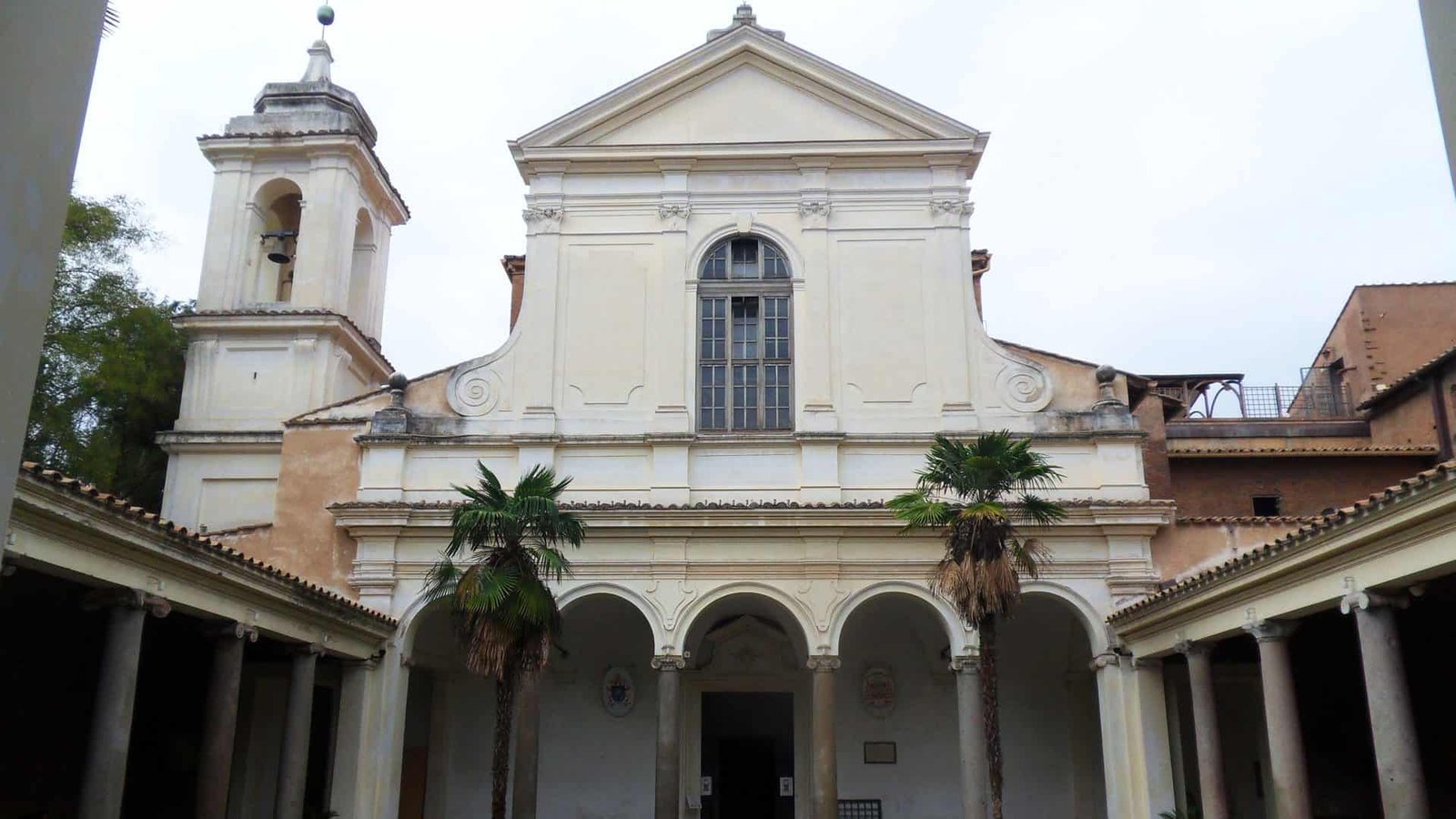
Hours, Tickets and Booking for the Basilica of San Clemente
Let's start with the practical information. Hours, prices, booking and closing day are the first thing you need to plan a morning. Here is the correct data, with the source line by line. The "Orari e info" page of basilicasanclemente.com says: Monday-Saturday from 9.00 to 12.30 with last entry at 12.00, and from 14.00 to 18.00 with last entry at 17.30. Sundays and holidays from 12.00 to 18.00, last entry at 17.30. The English version of the same page specifies that those hours apply to "The Basilica and the Excavations", that is, to the church and the excavations together. The site nevertheless invites you to check the updated calendar for any changes, and it is an invitation to take seriously: a church in active use can close for a special service without notice.
Prices. Full price 10 euros. Reduced 5 euros for students up to age 26. School groups 5 euros per student, with one teacher for every 10 students entering free. Free for children up to age 16, as long as they are accompanied by someone who buys a full-price ticket. Free for people with disabilities and for their companions. On groups there is a physical limit you should know before booking for 20 friends: the excavations are entered in groups of at most 25 people plus the guide. And there is a useful detail: at the entrance they hand you a brochure, but the basilica does not offer guided tours of its own. If you want a guide, you bring one yourself. This explains why you find dozens of paid tours sold by third parties around: they are not the official visit, they are private guides who accompany you inside a visit that is in itself free and silent.
Booking. It is mandatory online to access the archaeological excavations, and the reason stated by the site is protection of the heritage and the limited number of daily entries. The form is at basilicasanclemente.com/prenota/. On the "Prenota" page, the actual platform, the available time slots, any booking fees and the cancellation conditions are only visible at the moment of purchase. Book on the official site and read the conditions yourself at the time of purchase. For anything that doesn't add up there is the secretariat: segreteria@basilicasanclemente.com, active Monday to Friday from 10.00 to 16.00, and the phone +39 06 7740021.
One last clarification on the ticket. In the churches of Rome entry is almost always free and you pay only for any archaeological part. Here the official site gives a single price for "the Basilica and the Excavations" and does not say anywhere, explicitly, that entering only the upper church to pray or to look at the mosaic is free. No official line states it, so it should not be taken for granted. What is certain, and what the site says clearly, is that San Clemente remains an active place of worship with daily Masses: if you go at Mass time, you go the way you go to church.
Masses at the Basilica of San Clemente, and Why They Change in Summer
The Mass times appear in two sources and for once they match, which in Rome is not a given. The "Orari SS Messe" page on the official website and the turismoroma.it listing say the same thing: on weekdays Mass at 8:00 and 18:30. On Sundays and holidays at 9:00, 11:00 and 18:30. Then comes the detail that changes plans for anyone visiting Rome in summer: from July 1 to August 31 the evening Masses are suspended, both on weekdays and on holidays. Both sources say so. So in August there is no 18:30 Mass. The official website adds two more practical details: confessions are heard in Italian and English before every Sunday Mass, and the rosary is recited every weekday at 18:00. And a third one that sounds bureaucratic but saves pointless phone calls: San Clemente does not host weddings or baptisms.
Why it matters even for a tourist visit: early morning and late morning on Sunday are exactly the hours when a working church stops being a museum. Sunday visiting hours start at noon for this very reason: before that there are the two Masses. If you have only one hour and go on a Sunday morning, you won't make it. Better to go in the afternoon, or better still on a weekday at 14:00 sharp, when they reopen after the break and there is nobody downstairs yet.
The right address: two official sources give two different ones
Here two sources, both official, contradict each other. The website of the Irish Dominicans, basilicasanclemente.com, states plainly on its contacts page: Via Labicana 95, 00184 Roma RM. The official tourist portal of Roma Capitale, turismoroma.it, gives in the basilica's listing: Via di San Giovanni in Laterano 45, 00187 Roma, with the coordinates 41 degrees 53 minutes 21.59 seconds North and 12 degrees 29 minutes 49.55 seconds East. Two different streets and even two different postal codes for the same building. The sources don't agree. On the ground, this is how it works: the San Clemente complex takes up an entire block between Via Labicana and Via di San Giovanni in Laterano, and the official website specifies that the entrance is in Piazza San Clemente. If you are setting a navigation app, try Piazza San Clemente first: it is the only piece of information on which the basilica's operator commits itself when it comes to the entrance. If your navigation app takes you to Via Labicana and you find a blank wall, turn the corner. Via Labicana 95 is the address on the official website, but on its own it is incomplete.
How to get to the Basilica of San Clemente by metro, bus and on foot
Metro first. Colosseo station, line B: from there you exit, walk along the Flavian Amphitheater and turn onto Via di San Giovanni in Laterano. Turismoroma.it describes the basilica as "about 300 meters past the Colosseum," the official website says five minutes on foot. Both are right: it is a short, slightly uphill walk that at two in the afternoon in summer feels longer than it is. Since December 2025 there is also metro line C at the Colosseum: turismoroma.it dates the opening of the museum station to December 16, 2025 and mentions, in the official material, the direct connection with the existing Colosseo stop on line B. Romamobilita.it, which is the mobility agency of Roma Capitale, lists line C as Pantano-Colosseo. Metro service hours, again from romamobilita.it: Sunday to Thursday from 5:30 to 23:30, Friday and Saturday from 5:30 to 1:30. Useful to know if after San Clemente you stay for dinner around here.
Buses. Here it pays to be precise. Romamobilita.it, in a service notice dated November 5, 2025, writes "Lines 51, 85, 87, 118 running normally" after the reopening of Via dei Fori Imperiali, and specifies that lines 75, 117 and the night line nMB remain diverted because of the closure of Via Cavour. The same notice says that the 75, on Piazza del Colosseo-Santa Maria Maggiore stretch, is diverted and goes through Via Labicana and Via Merulana, and that the 117 toward San Giovanni goes through Piazza di San Giovanni in Laterano, Via dell'Amba Aradam, Via Celimontana, Via Claudia, Piazza del Colosseo, Via Labicana and Via Merulana. The night line nMB toward Rebibbia also goes through Via Labicana. On the home page of atac.roma.it the diversion is still in effect: "Via Cavour closure: we are diverting lines 75-117-nMB." So, according to these notices, the diverted 75 and 117 and the night line nMB go through Via Labicana. It remains to be checked on the ATAC route finder what the exact names of the stops in front of the basilica are, and whether lines 51, 85, 87 and 118 stop on Via di San Giovanni in Laterano or only further on toward the Lateran. If you depend on the bus, check the updated route on atac.roma.it the same day, because the construction site on Via Cavour is still shifting half the surface network.
Transit tickets, official ATAC fares: the BIT costs €1.50 and is valid for 100 minutes. The Roma 24-hour costs €8.50, the 48-hour €15, the 72-hour €22, the weekly CIS €29, valid for 7 days from first validation. If in one day you do San Clemente, the Colosseum and maybe St. John Lateran, the 24-hour pass only pays off if you move around a lot: in this area you can walk to almost everything.
On foot, the best route: from the Colosseum stop you take Via di San Giovanni in Laterano, and in barely 10 minutes you are at the door. From Santa Maria Maggiore Basilica you go down Via Merulana and cut to the right: it's the same distance. From San Pietro in Vincoli Church you go down the Salita dei Borgia, cross in front of the Colosseum and keep going. Three different routes, all under a quarter of an hour.
The four levels of San Clemente Basilica, from top to bottom
This is the most surprising part of the visit. San Clemente is made of stacked floors, like a house built on the ruins of the house before, and the remarkable thing is that you can walk through almost all of them. From the top: the current basilica, medieval, of the 12th century. Below, the ancient basilica of the 4th century, carved out of a building that had already been a private home. Further down, a group of Roman buildings of the post-Neronian period. And at a fourth level, deeper, traces of even older Roman buildings. The first two underground levels have been consolidated and are in large part walkable: the official site in fact organizes the visit on exactly three floors.
Why is the layering so obvious here? The basilica sits in a valley, the one between the Esquiline and the Caelian Hill, and valleys fill up with debris. Historical events played a part too. The Neronian fire of 64 AD is cited by the basilica's own site, which writes that the 1st-century buildings were destroyed in Nero's fire of 64 AD. On the Norman sack of Robert Guiscard in 1084, instead, a serious error circulates, explained later in a dedicated chapter.
One measurement gives the idea better than any adjective: when in the 12th century they built the new church, they buried the old one up to about four meters in height, using the ancient walls as foundation. And the central nave of the underground basilica is as wide as the central nave plus the right aisle of the basilica above. It means that while you walk in the 12th-century church, under your feet there is a wider church, shifted to the side. It's not a metaphor, it's geometry.
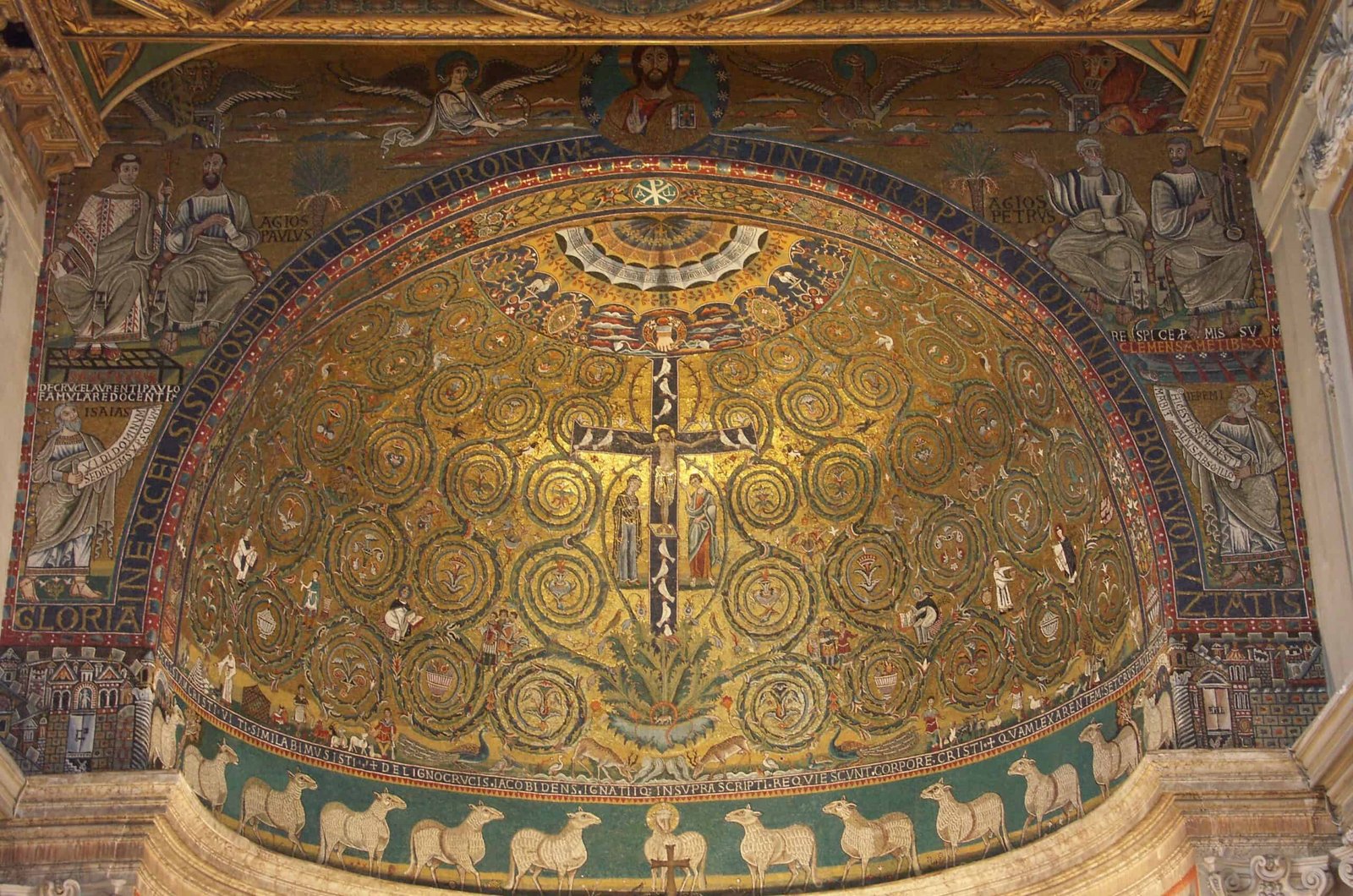
The 12th-century basilica: the apse mosaic, the schola cantorum, the floor
The visit begins upstairs, and upstairs is the showpiece. The page "I luoghi della Basilica" on the official site lists for the upper level the Cosmatesque paving, the 12th-century atrium, the Schola Cantorum and the apse mosaics. The mosaic is the reason this church is in every textbook. Turismoroma.it calls it "Trionfo della Croce" and dates it to the 12th century. It's worth describing in full: on a gold ground of Byzantine taste stands out a Christ on the cross between the Virgin and Saint John the Evangelist, from the cross branch out acanthus scrolls that form the tree of life, symbol of the church that gives life to all humanity, among the leaves appear figures of animals and men, on the cross there are 12 doves, who are the 12 apostles, at the foot of the crucifix open the four rivers of Paradise, and several animals drink there, an image of the people of God approaching the truth. Every creature has a meaning: the peacock, for example, is a symbol of immortality because its flesh was believed to be incorruptible. Above the scene, among rays of light, the hand of God extends a crown toward the cross. At the sides of the half-dome are Saint Peter and Saint Paul, and below them the prophets Isaiah and Jeremiah. Higher up, Christ Pantocrator surrounded by the tetramorph.
Our opinion, and it isn't a popular one: the mosaic should be looked at last, not first. If you walk in and drink it all in right away, then go downstairs and everything else seems like an archaeological appendix. If instead you do the route in reverse, that is, go down first to the Roman levels and come back up at the end, that gold ground hits you with a different force, because you have just seen where it all comes from. Unfortunately the official visiting route starts upstairs. So do this: upstairs take a quick look, go down, and when you come back up stop for 10 minutes in front of the apse before leaving. It's the right way to close.
The schola cantorum, that is, the marble enclosure that divides the nave in half, is a time machine inside the time machine. The official site writes that it is a medieval complex of the 12th century that reuses panels of the 6th century from the lower church. So the marble you see is 600 years older than the enclosure it is mounted in. The sources agree in speaking of an element reused from the earlier basilica with 12th-century additions. Inside the enclosure are the medieval ciborium and the Cosmatesque Paschal candlestick, that twisted inlaid column that is worth the trip by itself for those who love the work of the Cosmati.
On the floor, though, a clarification is needed that many articles out there ignore. The floors of San Clemente were long considered among the most beautiful Cosmatesque floors in Rome. It has since been shown that this paving has undergone many reworkings over the centuries, and that what we see today is therefore not the medieval original. The official website, for its part, simply speaks of "Cosmatesque paving" without going into the question of the reworkings. The two statements don't contradict each other: the floor is Cosmatesque in technique and design, but it is not an intact piece from the 12th century. Look at it knowing that.
The present structure has three aisles divided by reused columns, interrupted in the center by piers that split the nave into two spaces, with granite columns alternating with fluted marble columns. It's a detail that deserves two seconds of your attention: those columns come from dismantled Roman buildings, and you walk past them without noticing. The quadriporticus at the entrance too, which so many present as an example of early Christian architecture, is actually the result of later renovations and has been heavily reworked.
The look you see today: the 18th-century restoration under Clement XI
The church you see now didn't come down clean from the 12th century. Many interventions have changed its appearance inside and out, and its final form was given to it by a restoration between 1713 and 1719 commissioned by Pope Clement XI and entrusted to the architect Carlo Stefano Fontana. The dating holds up: the main encyclopedic source gives the same span, 1713-1719, under Clement XI with Carlo Stefano Fontana, adds that the new facade was completed in 1719 and that in those years the carved and gilded coffered ceilings with the paintings were installed. You often read that Carlo Stefano Fontana was "nephew of the more famous Domenico Fontana", but the kinship is not documented. If you're interested in Fontana genealogy, it's a family of Ticinese architects three generations long and it's easy to get confused. Here we stop where the proof ends.
What the 18th-century restoration means for today's visitor is simple: you walk into a medieval church dressed as a Baroque church. The gilded ceiling overhead and the Byzantine-style mosaic in the apse share the same space and belong to two worlds 600 years apart. In our judgment this clash is a virtue. It's the one thing at which Rome is truly a master: layering without erasing.
The Chapel of Saint Catherine and Masolino's frescoes
The Chapel of Saint Catherine of Alexandria is one of the places where you can see the beginning of the Renaissance in Rome. The official website writes that the chapel houses frescoes by Masolino da Panicale "that represent the dawn of the Renaissance". Turismoroma.it confirms the presence of the frescoes by Masolino da Panicale in the Chapel of Saint Catherine. It's on the left aisle, right as you come in, and people rush past it because they're in a hurry to go down below. Stop. They are scenes from the life of Saint Catherine and a Crucifixion, and the depth that Masolino draws out of the painted architecture is exactly the moment when Italian painting stops being medieval.
Precise dates for the frescoes don't come from an official source, and for Masolino the dates in circulation shift by a few years. The practical advice: the chapel is poorly lit, so look at it calmly and without hurry, and don't use the flash. We come back to the basilica's photo policy further on.
The lower basilica of the 4th century and its frescoes
You go down, and the temperature drops suddenly. The official website describes the second level as the "Basilica of the 4th century AD" with frescoes ranging from the 8th to the 11th century, and points out in particular the fresco of Christ among Angels and Saints and the Legend of Sisinnius, dated 1084-1100. Turismoroma.it confirms the dating of the legend to 1084-1100 and notes that the remains of Saint Cyril rest here.
The page on the frescoes of the lower basilica, also on the official website, is very rich, and it's worth going through it century by century because it's the real treasure of San Clemente. From the 8th century there is a Madonna and Child in the Byzantine taste: Mary in imperial dress with pearls, seated on a throne, Jesus holding a scroll, flanked by Saint Euphemia and an unidentified female saint. From the 9th century there is an Ascension with Christ rising among the angels and below them the disciples and Mary, and inside that scene is the portrait of Pope Leo IV, the pope who reigned between 847 and 855, recognizable from an inscription. In the same cycle are the Crucifixion, the Marys at the Tomb, the Wedding at Cana and the Descent into Limbo. And there is an Anastasis, that is, the descent into hell, with Christ going down to free the souls of the righteous in a space that looks like a prison, and with the portrait of an Eastern monk with a square nimbus.
The square nimbus deserves a note, because it's one of those details that change the way you look at a wall. In medieval iconography the square nimbus was used for people still alive at the time they were painted. So that monk, when someone frescoed him on that wall, was walking around. It's a photograph from the 11th century, made by hand.
From the 11th century, in the narthex, there are two large scenes. The first is the Miracle of the Sea of Azov, which tells of the martyrdom of Saint Clement and the miracle of the waters that recede to reveal a tomb, with the portraits of the donors of the de Rapiza family. The second is the Translation of the Relics of Saint Clement, with the pope and Saints Cyril and Methodius in procession carrying Clement's body from Saint Peter's to San Clemente. In the central nave are the stories of Saint Alexis, the saint who returns home and is not recognized, lives hidden as a servant under the stairs and dies while the family mourns him without knowing who he is. And there is the Mass of Saint Clement with the legend of Sisinnius, which is the most famous piece of the underground and to which the following chapter is devoted. The encyclopedic source adds that the lay patrons of the great frescoes were Beno de Rapiza and Maria Macellaria, and places them in the last third of the 11th century.
The legend of Sisinnius and the first words of Italian written on a wall
The most famous example is one of the first documents of vernacular Italian, the stories of San Clemente from the 11th century: the work tells of Saint Clement and Sisinnius, often described as "a Roman prefect who persecuted Clement because he was a Christian." The official source does not call him a prefect. The frescoes page of basilicasanclemente.com describes Sisinnius as a pagan nobleman, struck blind for having entered the church, whose servants try to drag a column out of the house, mistaking it for Clement. The substance of the story remains, Sisinnius's institutional role does not.
The reason this fresco is in every history of the Italian language is the inscription painted next to the figures. It is the moment when the vernacular, that is, the language people spoke in the street, enters a church painted on a wall. The transcription published on the basilica's official website gives the lines of the servants pulling the column: "Falite dereto colo palo Carvoncelle," "Gosmari Albertel traite," "Fili dele pute traite." The spelling is that of the source, without normalization and without added accents. Translated loosely: put it behind the pole, Carvoncello. Gosmario, Albertello, pull. Sons of those women, pull. Yes, there is also a lay curse, the first swear word written in Italian on a church wall, and it has been there since the 11th century. Above, to distinguish the registers, Saint Clement speaks in Latin.
The reaction is almost always the same: first you don't believe it's Italian, then you read it out loud and you understand. It's the kind of emotion you can't buy with a €40 ticket in an air-conditioned museum. It costs €10, it sits seven meters below street level, and you get there by metro.

The Mithraeum and the Roman domus
Going down further you reach the Roman level, and this is where the most outdated information circulates. Let's go through it one by one. You often read: "To the mid-2nd century AD dates instead an insula, that is, a private house that housed inside it a Mithraeum, thought to be around the 3rd century." The "I luoghi della Basilica" page of the official website says something else: the Mithraeum is dated to the end of the 2nd century AD and arose between the walls of an older Roman house, a domus, built in the second half of the 1st century AD. The "Storia" page of the same website confirms: "Around the end of the 2nd century this underground area was transformed into a temple complex by the followers of the Mithraic religion." The encyclopedic source places the Mithraeum around 200 AD, built in the courtyard of the insula. So: the house is from the 1st century, not the 2nd. The Mithraeum is from the end of the 2nd century or around 200, not the 3rd. The correct information is the one from the official website.
Inside the Mithraeum there is the altar with Mithras slaying the bull, the official website says so, besides the fresco decorations. The main hall of the cult measured about 9.6 meters by 6, according to the encyclopedic source, which adds a detail that explains why for decades it could not be studied: that space could not be investigated until 1914 for lack of drainage. It means it was underwater. It's a detail to keep in mind while you're down there, because water at San Clemente is not a memory.
A word on Mithraism, since you are in a church. The cult of Mithras and Christianity coexisted in Rome in the same block and in the same decades, and at San Clemente this coexistence is literally stacked: the pagan temple sits under the church. It's not a victory of one over the other, it's a stratigraphy. Mithraea were small, dark spaces, reserved for male initiates, with side benches for the ritual banquet. When you go down there, look at the shape of the room before the images: the shape tells you everything about the kind of religion it was.
The imperial mint, not the grain warehouse
Here is the other widespread error. About the deepest level you often read: "The first building identified is rectangular and dates to the end of the 1st century AD. It has been hypothesized that it may have been a horreum, that is, a warehouse for goods, perhaps linked to the games of the Flavian amphitheater or to grain storage." The correct information is different. The official website writes that at that level there are rooms belonging to a large public building "which is presumed to have been part of the Moneta or imperial mint." The virtual tour page of the same basilica speaks, for the third level, of Roman buildings, a domus and the probable remains of the imperial mint. The encyclopedic source agrees: an industrial building, "probably the imperial mint of Rome from the end of the 1st century AD onward," occupied the area in the Flavian age. The grain warehouse is an old hypothesis, superseded by the current reading. If you read somewhere that there was a granary under San Clemente, now you know why: it's a superseded hypothesis.
The wall of that building is made of large blocks of tuff and travertine, and it remains true that the scarcity of the remains does not allow the function to be defined with absolute certainty. But "presumed to be the mint" and "perhaps a granary" are not the same sentence, and the official sources say the first.
And then there is the water. It is perhaps the most impressive thing in all of San Clemente. The official website writes that in the Roman public building "the lost waters of ancient Rome" still flow. It's not literature: you stand at the lowest level, in silence, and you hear the sound of running water coming from an ancient channel that nobody ever shut off. 2,000 years of history over your head and a stream under your feet running as it ran under Domitian. Go just for that, if nothing else interests you.
Pope Saint Clement, Saint Cyril, Saint Ignatius: the relics
The basilica is dedicated to Pope Clement I. Correct. The "Storia" page of the official website specifies that Saint Clement was the third successor of Saint Peter and died around the year 100 AD. The turismoroma.it listing calls him the third pope after Saint Peter. The home page of the official website adds that the basilica is an active place of prayer that keeps relics of Saint Clement, Saint Ignatius and Saint Cyril. Saint Ignatius is Ignatius of Antioch, one of the Apostolic Fathers. And Saint Cyril is the Cyril of Saints Cyril and Methodius, the apostles of the Slavs, the ones of the alphabet.
Cyril's story here is a piece of 9th-century geopolitics. The "Storia" page of the basilica says that Cyril was buried here in the 9th century and that his relics now rest in the chapel dedicated to Saints Cyril and Methodius. And it is exactly the scene you see frescoed downstairs, in the narthex of the lower basilica: the translation of the body of Saint Clement from Saint Peter's to San Clemente with Cyril and Methodius in procession. The two brothers had brought to Rome the relics of Clement found in Crimea, and one of the two stayed here. Even today San Clemente is a place of pilgrimage for Slavic-speaking Catholics, and in the chapel you often find votive offerings and flags. If you happen to be there on a pilgrimage day, you will hear prayers in a language that is not Italian.
From the papacy of those years the basilica keeps another name: the "Storia" page recalls the 6th century and Pope John II, who before becoming pope was the priest Mercurius. He is the first pope in history to have changed his name on taking the throne, and the reason is that he was named after a pagan deity. He was the titular priest of this church. His monogram is on the 6th-century marble panels that in the 12th century were reassembled in the schola cantorum upstairs: those marbles have passed from one church to the other, from one floor to another, and they are still there.
The Irish Dominicans and Father Mullooly
The basilica is run by the Irish province of the Dominicans and has the dignity of a minor basilica. On the date of the assignment, though, the sources don't agree. The "Storia" page of the official website writes: "In 1677 the basilica was assigned to the Irish Dominicans, who still administer the basilica today." The encyclopedic source writes instead that the Irish Dominicans have owned San Clemente and the surrounding complex since 1667. That is 10 years of difference, not to be smoothed over at random: basilica source 1677, encyclopedic source 1667. If you need the date for a thesis, ask the secretary's office.
The figure who changed the history of this place is Father Joseph Mullooly, an Irish Dominican, prior of the convent. The "Storia" page of the official website writes that "in 1857 Father Joseph Mullooly, then Prior of San Clemente, began excavation works," discovering the lower layers. The encyclopedic source places the discoveries "in the 1860s" and specifies that Mullooly was prior of the Irish Dominican house at San Clemente from 1847 to 1880. The two fit together without contradicting each other too much: in 1857 he begins to dig, in the 1860s the results arrive. It's worth knowing, because around you will find both dates passed off as "the date of the discovery."
Our opinion of Mullooly. An Irish friar who in 1857, without modern hydraulic pumps, decides to break through the floor of his own church because he suspects there is something underneath, and goes on for years removing earth and water by hand, is a figure almost nobody in Rome celebrates. The basilica gives him a page among its protagonists. He deserved a statue, he got a staircase.
The San Clemente Project: the restoration underway now
This is the news that changes the way you will visit San Clemente in the coming years. On the official website there is a page titled "Progetto San Clemente," which describes "an extraordinary restoration, based on faith, beauty and historical responsibility" and covers both the upper basilica and the underground levels. The initiative is led by the Hortus Foundation, defined by the page itself as an American non-profit organization, supported by American philanthropists among whom Jim Perry is mentioned. The page refers to sanclementeproject.org, which redirects to the foundation's website.
The plan, according to the foundation's page, is divided into three phases. Phase 1, the 12th-century church: restoration of the interior works damaged by time, humidity and insects, cleaning and repair of the marbles, repainting and restoration of the plasters, modernization of the lighting and audio systems. Stated duration: two years. Phase 2, the 4th-century church: conservation of the surviving works at the 4th-century level, excavation of a new welcome space with interactive museum elements, visitor safety measures on flows, emergency exits and electrical systems. Stated duration: two years. Phase 3, the museum experience: ensuring accessibility of the Roman buildings and the Mithraic temple, updating the museum functions and the ticketing system, three-dimensional models and atmospheric installations, an interactive app for the route. Stated duration: a year and a half.
It is not published whether and when the works will involve partial closures of the basilica or the excavations. Neither the basilica's page nor the foundation's page states it. The practical advice is banal and useful: before booking, open basilicasanclemente.com and see if there is a notice. A construction site lasting five and a half years in total, inside a 12th-century building, will sooner or later put up some barriers.
There is also an official digital alternative: the basilica's "Virtual Tour" page offers three 360-degree routes made with Matterport, one for each level, available in Italian and English. The first level shows the apse mosaics, the ambos, the Easter candlestick, the schola cantorum and the Chapel of Saint Catherine with Masolino. The second shows the 4th-century basilica with the frescoes and the tomb of Saint Cyril. The third shows the Roman buildings, the domus and the probable remains of the mint. It is not stated whether it is free, but it is published on the official website as a consultable section. For anyone who can't go down the stairs, it is the only honest way to see the third level.
A curiosity about the Basilica of San Clemente
The real curiosity of San Clemente is not the mosaic and not the Mithraeum. It's that under the church an ancient watercourse still flows, and you can hear it. The official website writes it with a phrase that sticks: in the Roman public building of the first level "the lost waters of ancient Rome" still flow. No sign with an arrow, no illuminated panel, no sound effect. You go down, you reach the bottom, and at some point you stop hearing the footsteps of the other visitors and you hear the water.
The second reason this detail is notable is practical: that water is also the reason the lowest level stayed unknown for so long. The encyclopedic source writes that the main hall of the Mithraeum could not be investigated until 1914 for lack of drainage. That is: it was flooded. San Clemente is a place that had to be drained before it could be visited. Father Mullooly began in 1857 and it took decades to reach the bottom. When you walk on dry ground on the third level, you are walking inside a hydraulic problem solved by others.
Third curiosity, lighter. The church is dedicated to the third successor of Saint Peter, who died around the year 100 according to the official website, and the scene of his martyrdom you find frescoed downstairs in the Miracle of the Sea of Azov. A saint martyred in Crimea, whose relics return to Rome carried by two Greek brothers from Thessalonica who had invented an alphabet for the Slavs, and end up in a church built over a Persian temple of Mithras, run by Irish friars. If someone asks you what Rome is, bring them here and say nothing.
Something nobody tells you about the Basilica of San Clemente
That on Sunday morning you can't get in. Said bluntly, because it's a frequent mistake. The official hours for Sundays and holidays are 12:00-18:00, with last entry at 17:30. On weekdays it opens at 9:00 but closes at 12:30 with last entry at 12:00, and reopens only at 14:00. It means that the two most convenient time slots for a tourist, that is, late morning on weekdays and Sunday morning, are precisely the ones when you risk finding the door to the descent closed. Source: "Orari e info" page of the official website.
The second thing nobody tells you is that the basilica does not offer guided tours. The official website says so: at the entrance they hand you a brochure, but guided visits are not offered. So all those tours you find sold online as a "guided tour of San Clemente" are independent guides who accompany you inside. There's nothing wrong with that, some are excellent, but know what you are buying: you are paying for the guide, not for privileged access. The official ticket costs €10.
Third thing. Online booking is mandatory and daily entries are limited. This is the phrase from the official website, and it's not a bureaucratic detail: it means that showing up at the door without a reservation, on an afternoon in high season, can mean staying outside. It's not like any other church where you just walk in. Downstairs there are narrow spaces, and the number of people who can be there at the same time is counted.
Fourth, and this is our opinion. The real reason people leave San Clemente disappointed is that they go with half an hour. Half an hour is not enough here. Three levels, three eras, a cycle of 11th-century frescoes and a Mithraeum: if you have less than an hour, go to the Pantheon and come back another day.
The advice I give you for visiting the Basilica of San Clemente
Book for 14:00 on a weekday. It is the afternoon reopening time according to the official website, and it is usually the moment when the underground is emptiest: the morning groups have left, the afternoon ones haven't arrived yet, and there is the quietest window of the day. Go down right away and come back up at the end. Look at the apse mosaic last.
Bring a sweatshirt even in August. There is no official figure on the temperature of the San Clemente excavations, but every underground space in Rome sits well below street temperature, and here there is also running water. If you come out of the Colosseum at 36 degrees and go down seven meters, you feel it.
Closed shoes with a sole that grips. The lower levels can be walked, but they are consolidated archaeological excavations, not a museum corridor. There are stairs, and in some places the ground is uneven.
Don't plan San Clemente right after the Colosseum in the same morning if you bought a timed-entry ticket for the amphitheater. They are two visits that bite into each other: you leave the Colosseum late, walk 300 meters, and run into the midday break. Better to do the Colosseum in the morning, have lunch around here, and enter San Clemente at 14:00. Or the opposite: San Clemente at 9:00 as soon as they open, then the Palatine and the Forums at leisure.
If you come in summer, remember that from July 1 to August 31 the evening Masses are suspended: both the official website and turismoroma.it say so. It means the late afternoon is freer of services. But it also means that if you were counting on attending a Mass at 18:30 in a 12th-century basilica, in these two months you can't.
Last thing, and it's worth gold: read the Sisinnius inscription out loud. Not loud enough to disturb, at half voice. It was written to be heard, not to be studied.
Another well-known fact, yet rarely cited
That a pope was elected at San Clemente. Pope Paschal II, who had been cardinal of this church from about 1076 to 1099, was named pope in 1099 in the basilica itself. The encyclopedic source adds a clarification worth having: he was elected pope in the lower basilica, that is, in the 4th-century church, the one you visit today by going down the stairs. So the place where you stand looking at the frescoes of Saint Alexis is the place where in 1099 a conclave made a pope.
The well-known but rarely cited fact has a sequel too. The upper basilica was built in the 12th century by Anastasius, titular cardinal between 1099 and 1120, and the consecration took place on an unspecified date. The encyclopedic source confirms the picture and narrows it: Cardinal Anastasius rebuilt the current basilica in a single campaign of works placed between about 1099 and about 1120. You often read that the church was "inaugurated in 1118." That date does not appear in the sources consulted: the construction site falls between 1099 and 1120 and the exact date of the consecration is not documented.
There is a third layer of politics in this story. The demolition of the ancient church is not explained by decay alone. People often speak of the climate of Romanesque renewal brought by the Benedictines into the Roman clergy and of the deep relationship between the lower basilica and the antipope Clement III, that is, Guibert of Ravenna. No official source confirms this passage: it is a historiographical reading, not a verified fact. But it has an evident logic of its own: if the church below was tied to the name of an antipope, burying it and building on top was also a political act.
The right photo to take at the Basilica of San Clemente
The right photo is the apse half-dome shot from the back of the central nave, with the schola cantorum in the foreground. It does two things: it shows the mosaic and it shows the room it sits in, that is, the relationship between the gold background and the reused columns. If you go up too close you lose the depth, if you stay too far back the quadriporticus cuts your light.
The second photo is the Cosmatesque floor taken diagonally, not head-on. The porphyry and serpentine discs read better at an angle, and this way you also understand the double division of the nave.
One point to clarify. Neither the official website nor the turismoroma.it listing publishes a written rule on photographs: whether they are allowed everywhere, whether they are forbidden in the excavations, whether flash or tripods are forbidden. In Roman churches flash is almost always forbidden and common sense suggests it on its own in front of an 8th-century fresco: the rule in force has to be checked at the entrance. Ask the staff at the entrance, and if a sign says no, the sign wins. In the underground, anyway, the light is very low: without a tripod and without flash, with a phone, you take home little.
The photo that always works, instead, is the one from outside: the facade and the quadriporticus from Via di San Giovanni in Laterano, with the late-afternoon light coming from the side. It is also the only photo you can take without a worry, because it's a public street.
Some important events that happened here in history
Here are the facts, with the source next to each. Year 64 AD: the 1st-century buildings in this area were destroyed in Nero's fire, says the "Storia" page of the official website. From the end of the 1st century AD onward: a large public building rises on the area, presumed to have been part of the Moneta, the imperial mint, according to the official website and the encyclopedic source. Second half of the 1st century AD: the Roman domus is built, official website. End of the 2nd century AD: the underground area is transformed into a temple complex by the followers of the cult of Mithras, official website. The encyclopedic source places the Mithraeum around 200 AD.
4th century: the original basilica is born, official website. Here the sources don't agree. Turismoroma.it writes that the basilica "dates to 385 AD" and describes it as erected before 385. The encyclopedic source reports instead that in 392 AD Saint Jerome documents the existence of the church dedicated to Saint Clement. These are two different references, 385 and 392, both placed in the 4th century but not overlapping. The century is certain, the year is not.
6th century: Pope John II, formerly the priest Mercurius, is tied to this church, official website. 9th century: Saint Cyril is buried here, official website. In the same century are dated the Ascension with the portrait of Pope Leo IV, who reigned between 847 and 855, and the Anastasis, frescoes page of the official website. 1084-1100: the Legend of Sisinnius is dated, official website and turismoroma.it. Last third of the 11th century: the spouses Beno de Rapiza and Maria Macellaria commission the great frescoes, encyclopedic source.
1099: Paschal II is elected pope here, in the lower basilica. From about 1099 to about 1120: Cardinal Anastasius rebuilds the upper basilica in a single campaign. 1667 or 1677: the basilica is entrusted to the Irish Dominicans, and the two sources, as said, don't agree. 1713-1719: restoration commissioned by Clement XI with the architect Carlo Stefano Fontana, facade completed in 1719. 1857: Father Joseph Mullooly, prior, begins the excavations. 1914: only then, with the drainage problem solved, does the main hall of the Mithraeum become investigable.
And one event about which an error circulates. You often read, among the causes of the demolition of the ancient basilica, "the accumulation of rubble following the fire set by the Norman troops in 1084." The encyclopedic source defines this as a hypothesis by now superseded and adds a clear sentence: no evidence of fire damage has been found in the lower basilica. The correct information is that the sack by Robert Guiscard in 1084 did happen, but that the burning of the lower church as a cause of the burial has no archaeological confirmation. The other motives stand: the poor state of the building and the reasons of renewal of the Roman clergy.
Who has passed through the Basilica of San Clemente
Popes, first of all, and not just passing through. Pope John II, who was the priest Mercurius and was titular of this church in the 6th century. Pope Leo IV, who reigned between 847 and 855 and whose portrait is frescoed in the Ascension of the lower basilica. Pope Paschal II, who was cardinal titular here for more than 20 years and was elected pope here in 1099. Pope Clement XI, who between 1713 and 1719 paid for the restoration that gave the church the look you see. And Cardinal Anastasius, who did not become pope but built the basilica.
Saints. Saint Clement, the titular saint, third successor of Peter, who died around the year 100. Saint Ignatius of Antioch, of whom the basilica keeps relics according to the home page of the official website. Saint Cyril, buried here in the 9th century, and with him the memory of his brother Methodius: they are the two who brought Clement's relics to Rome and whom you see painted in the translation, in the narthex downstairs.
Artists. Masolino da Panicale, who frescoed the Chapel of Saint Catherine and whom the official website associates with the dawn of the Renaissance. The Cosmatesque workshops, who left the Easter candlestick and the floor. And the anonymous mosaicists of the 12th century who made the Triumph of the Cross.
Ordinary people, and this is the best part. Beno de Rapiza and Maria Macellaria, husband and wife, laypeople, patrons of the 11th-century frescoes, portrayed inside the scenes they paid for. Her name, Macellaria, tells the family trade. They were shopkeepers. They paid for one of the most important painted cycles of the Roman Middle Ages and had themselves painted into it, and 800 years later we know what they were called. Then there are Carvoncello, Gosmario and Albertello, the three servants who in the legend of Sisinnius pull the column and insult each other in the first written Italian. They never existed, probably, but they have the names of next-door neighbors.
And then Father Joseph Mullooly, the Irish prior who in 1857 decided to look at what was underneath.
Visiting the Basilica of San Clemente with kids
It works, and it works better than almost any museum in Rome, for a simple reason: you go down. Kids care little about the upper part, they care a great deal about the stairs. And the sequence church-older church-Roman house-temple of Mithras is a story that tells itself while you walk it. If you have to explain to an eight-year-old what archaeology is, here it takes you three minutes.
On the ticket: up to 16 years old, entry is free, as long as they are accompanied by someone who buys a full ticket, according to the "Orari e info" page of the official website. So two parents and two kids pay €20 in all. For Rome that's little.
The cautions. There are not railings everywhere like in a modern museum, you go down stairs, and below it is dark and cool. There is no official information on strollers, but common sense says a stroller on three levels of stairs is not manageable: if you have a small child, bring a baby carrier or a child-carrier backpack. Below there is no room to maneuver. If the child is afraid of the dark, warn them beforehand: the lower basilica is lit but kept low to protect the frescoes.
If you then want to build the whole day around underground Rome, the piece that goes best with San Clemente is a trip to the catacombs: the main page is the one for the Catacombs of Rome, and the most spectacular complex to do with kids is the Catacombs of San Callisto on the Appian Way. They are two different kinds of underground: here the layers of a city, there a cemetery.
Accessibility
Here clarity is needed more than reassurance. On the subject of accessibility, the basilica's official website does not publish a dedicated page: there is no written information on architectural barriers, elevators, stairlifts, accessible restrooms or alternative routes for those who can't do stairs. The turismoroma.it listing refers generically to the "Roma accessibile" section of the portal without giving details on the basilica. So any number or reassurance you read elsewhere does not come from these two sources.
Here is what the sources actually say. First: the ticket is free for disabled visitors and their companions, and this is written on the "Orari e info" page of the official website. Second: the basilica is a complex on three superimposed levels connected by stairs, and the underground levels are consolidated archaeological excavations, not spaces built for accessibility. Third: phase 2 and phase 3 of the San Clemente Project, as described on the Hortus Foundation website, include work on visitor routes, emergency exits and museum functions, which suggests the topic is on the table, but it is not written anywhere that the outcome will be wheelchair access to the lower levels.
The practical advice is just one: if you have a mobility difficulty, write to the secretary's office at segreteria@basilicasanclemente.com or call +39 06 7740021 before booking, and have them tell you what is feasible. The office answers Monday to Friday from 10:00 to 16:00. In the meantime, the official 360-degree Virtual Tour lets you see all three levels from home, in Italian and English.
What's around the Basilica of San Clemente
You are in one of the densest spots in Rome and you can build an entire day without ever taking a vehicle. 300 meters back is the Colosseum, with the Palatine and the Domus Aurea next to it, which has in common with San Clemente the fire of 64 and the way Rome buried its own past in order to reuse it. Going up the Oppian Hill there are San Pietro in Vincoli with Michelangelo's Moses and, a little further on, the Basilica of Santa Prassede with its 9th-century mosaics, which are the natural complement to those of San Clemente.
In the other direction, 10 minutes on foot along Via di San Giovanni in Laterano, is the Basilica of San Giovanni in Laterano, which is the cathedral of Rome. On the Caelian Hill, very close, are the Roman Houses of the Caelian Hill, which are the other great domestic underground of the area and pair very well with San Clemente, and Villa Celimontana if you need a shaded lawn. Farther south are the Baths of Caracalla and the start of the Aurelian Walls.
If instead you want to continue on the theme of archaeology under the floor, the most instructive comparison is with the Domus Romane of Palazzo Valentini near Piazza Venezia, where the same principle, that is, a Roman house under a modern palace, is told with projections and lights. San Clemente is the opposite: no staging, just bricks and water. Our preference goes to San Clemente, but they are two legitimate ways of doing the same thing.
For eating, this is trap territory. The streets around the Colosseum are full of restaurants with photos of the dishes outside. If you have an hour, move away toward the Caelian Hill or go up toward Monti: you eat better and spend less. The general page for the city's attractions is the tourist attractions page, and what interests you can be saved on My trip.
Quick questions about the Basilica of San Clemente
How much does a ticket to the Basilica of San Clemente cost?
Full price €10, reduced €5 for students up to 26 years old and school groups. Rates in effect as of August 2026 according to the "Orari e info" page of the official website basilicasanclemente.com.
Do children pay?
Not up to 16 years old, as long as they are accompanied by someone who buys a full ticket. The official website says so.
Is there free admission?
Yes: children up to 16 accompanied, disabled visitors and their companions. For school groups, one teacher for every 10 students enters free.
What are the hours of the Basilica of San Clemente?
Monday-Saturday 9:00-12:30 with last entry at 12:00, and 14:00-18:00 with last entry at 17:30. Sundays and holidays 12:00-18:00, last entry 17:30.
What is the closing day?
The official website does not state a weekly closing day. It states instead the midday break on weekdays and afternoon-only opening on Sundays and holidays. The site invites you to check the updated calendar for changes.
Do I need to book?
Yes, online booking is mandatory to enter the archaeological excavations, because the number of daily entries is limited. You book at basilicasanclemente.com/prenota/.
Can I show up without a reservation?
The official website indicates online booking as required for the excavations and as the only way to secure entry and choose date and time. No source guarantees the sale of tickets on site, so don't count on it.
How long does the visit take?
The basilica does not state an official duration for the visit. In our judgment, with three levels to see, less than an hour is little, an hour and a half is the right measure.
Are there guided tours of the basilica?
No. The official website writes that a brochure is handed out at the entrance but that guided visits are not offered. The guided tours you find for sale online are from third-party operators.
How many people can go down together?
Guided groups in the excavations are limited to a maximum of 25 people plus the guide, according to the official website.
Can you take photographs?
Neither the official website nor turismoroma.it publishes a written rule on photographs. Ask the staff at the entrance and respect the signs. In the underground the light is very low.
Is it cold in the excavations?
There is no official figure for the temperature of these spaces. They are, however, underground spaces with running water, markedly cooler than the street: bring a sweatshirt even in August.
Is it wheelchair accessible?
There is no official information on the accessibility of the complex. It is a building on three levels connected by stairs, with archaeological excavations below. Write to the secretary's office at segreteria@basilicasanclemente.com or call +39 06 7740021 before booking.
What is the exact address?
The official website gives Via Labicana 95, 00184 Roma, with the entrance in Piazza San Clemente. Turismoroma.it gives instead Via di San Giovanni in Laterano 45, 00187 Roma. These are two official sources that give two different addresses for the same complex.
How do I get there by metro?
Colosseo stop. Line B, and since December 2025 also line C, whose station at the Colosseum, according to turismoroma.it, was inaugurated on December 16, 2025. From there it is about 300 meters on foot along Via di San Giovanni in Laterano.
Which buses pass nearby?
Lines 75 and 117, diverted because of the closure of Via Cavour, and the night line nMB go through Via Labicana: romamobilita.it says so, and the diversion is also shown as active on the home page of atac.roma.it. Lines 51, 85, 87 and 118 are listed as running normally in the area. The exact names of the stops in front of the basilica have not been verified: check the updated route on atac.roma.it the same day.
How much does a bus ticket cost in Rome?
ATAC fares: BIT €1.50 valid for 100 minutes, Roma 24-hour €8.50, 48-hour €15, 72-hour €22, weekly CIS €29 valid for 7 days from first validation.
How many levels can you visit?
Three: the 12th-century basilica at the surface, the 4th-century basilica underground, and the Roman level of the 1st-2nd century with the domus, the Mithraeum and the remains of the public building. Further down there are traces of older Roman buildings, which are not part of the route.
Is there really a temple of Mithras under the church?
Yes. The official website dates it to the end of the 2nd century AD and describes the altar with Mithras slaying the bull. It arose between the walls of a domus from the second half of the 1st century.
What is the Sisinnius inscription?
It is the text painted next to the fresco of the Mass of Saint Clement in the lower basilica, dated 1084-1100, considered one of the first documents in vernacular Italian. The official website gives its lines: "Falite dereto colo palo Carvoncelle," "Gosmari Albertel traite," "Fili dele pute traite."
Can you really hear the water down there?
Yes. The official website writes that in the Roman public building of the lowest level the lost waters of ancient Rome still flow. It's the thing you'll remember most.
Who runs the Basilica of San Clemente?
The Irish Dominicans. The official website writes that in 1677 the basilica was assigned to the Irish Dominicans, who still administer it today. The encyclopedic source gives 1667 instead.
Are there Masses?
Yes. Weekdays at 8:00 and 18:30. Sundays and holidays at 9:00, 11:00 and 18:30. From July 1 to August 31 the evening Masses are suspended. Rosary at 18:00 on weekdays, confessions in Italian and English before every Sunday Mass.
Are weddings or baptisms held?
No. The official website states it on the Mass times page.
Is restoration work underway?
Yes. The "San Clemente Project," led by the Hortus Foundation, is underway in three phases covering the 12th-century church, the 4th-century one and the museum setup, for a stated total duration of five and a half years. Neither source states closures: check the notices before you leave.
Is there a virtual visit?
Yes. The official website publishes a 360-degree Virtual Tour made with Matterport, divided into the three levels, in Italian and English. It is not stated whether it is free.
Is it worth it if I've already seen the catacombs?
Yes, because it's a different thing. The catacombs are cemeteries dug into the tuff outside the walls. San Clemente is a piece of living city stacked on itself: house, temple, church, church. It's the place where you understand how Rome rose in elevation over the centuries.
What is the best time to go?
14:00 on a weekday, just as they reopen after the break. It is the emptiest time of the day.
Can I buy tickets in advance online?
Yes, in fact you must: online booking is required for the excavations and is done at basilicasanclemente.com/prenota/. Read the operating conditions, such as time slots and cancellations, at the time of booking.
Is there a phone number?
+39 06 7740021, and the secretary's office answers by email at segreteria@basilicasanclemente.com Monday to Friday from 10:00 to 16:00.
People always remember the gold mosaic of San Clemente, which is perfectly right, but the strongest memory is the sound of the water on the third level. Above, the buses go by on Via Labicana. Below, the same water that flowed when coins were minted here. Give yourself this gift: book a weekday at two, go all the way down, turn off your phone and stand still for 10 minutes. Then climb back up slowly, look at Sisinnius and his servants insulting each other in 11th-century Italian, and leave through the apse with the gold background. 10 euros. In Rome, at that price, it's hard to find better.