Domus Aurea
In short. The Domus Aurea can only be visited by reservation and only on Friday, Saturday and Sunday.
The Domus Aurea can only be visited by reservation and only on Friday, Saturday and Sunday. The entrance is on Via della Domus Aurea, inside the Oppian Hill park, and you reach it from the Colosseum in a five-minute uphill walk (metro B and metro C, Colosseo stop, buses 51, 85 and 87, tram 3). The full ticket, which includes the guided educational route and the virtual reality experience, costs €26. There are also two daily slots without a guide, at 12.00 and 17.00, at €18 full price and €2 reduced for citizens of the European Union between the ages of 18 and 25. Entries are staggered at 15-minute intervals and the number of places is limited. Booking on the official system of the Colosseum Archaeological Park, ticketing.colosseo.it, is not a suggestion, it's the only way in. From Monday to Thursday the monument is closed. It is also closed on the first Sunday of every month, which is exactly the day other state sites offer free admission.
This guide is part of the pages dedicated to the museums of Rome and reads well alongside the one on the Colosseum, because the two monuments tell the same story from opposite sides: an emperor's private palace and the public amphitheater his successors built to erase it.

What You Actually Visit at the Domus Aurea
Let's clear up one point right away, because it saves disappointment. You don't enter a golden palace at the Domus Aurea. You go down into an excavation and restoration site, beneath an artificial embankment, inside the only surviving sector of a complex that covered dozens of hectares between the Palatine, the Esquiline and the Caelian. What remains is the pavilion built on the slopes of the Oppian Hill, buried and filled with earth by the later emperors so they could build the Baths of Trajan on top of it. The burial destroyed the palace as architecture and saved it as painting: the frescoed vaults you see today exist because someone, 19 centuries ago, decided to bury them.
Where to buy tickets. The Domus Aurea can only be visited by reservation, almost always with a guided tour, and the official channel is ticketing.colosseo.it of the Colosseum Archaeological Park: there are few time slots and they sell out quickly on weekends. The guided tour with the virtual reality experience is also available on GetYourGuide. Verified on September 28, 2026.
The pavilion has more than 150 rooms, laid out along a very long façade facing south. There are no kitchens, no latrines, no recognizable bedrooms. This detail, which sounds like a trifle to archaeologists, is actually the key to reading the whole building: the visitable part was not a house where people slept. It was a reception machine, a sequence of formal halls designed to amaze guests arriving from outside. Nero didn't live here. Here he played the part of the emperor.
In our view, the Domus Aurea is the Roman monument that divides opinion the most. Anyone who goes in expecting the palace from a movie leaves disappointed, because they see dark bricks and fragments of color. Anyone who goes in knowing they're walking through a structure preserved almost entirely, with the original vaults overhead and traces of Raphael on the walls, leaves feeling they've seen something Rome has no equal for. Preparation makes the difference, not luck.
How Much the Domus Aurea Ticket Costs and Which One Is Worth It
The Full Ticket with Educational Route and Virtual Reality
The main ticket costs €26 and includes the guided educational route and the virtual reality experience. It is the ticket the Colosseum Archaeological Park sells for the vast majority of Friday, Saturday and Sunday slots. Those who buy it enter a limited group, follow a set route and, in a specific room, put on the headset to see the reconstruction of the palace as it was.
The €18 Ticket and the Trap of the Two Time Slots
There is a second ticket, €18 full price and €2 for citizens of the European Union between 18 and 25 years old, valid only for two time slots a day, at 12.00 and 17.00, without accompaniment. An €8 difference looks like a saving. It isn't. Inside the Domus Aurea, without someone explaining what you are looking at and without the visual reconstruction, the rooms shrink to dark corridors with a few patches of color on the vaults. It's the wrong place to cut your budget: if you need to save €8, save it on coffee, not on this. Legal reductions and free admissions, when they apply, are applied to the entrance fee and not to the whole package: on the official channel the items are listed separately for exactly this reason.
Domus Aurea Highlights, the themed tour on the third Thursday
The Colosseum Archaeological Park also opens the monument on the third Thursday of the month with a series of in-depth themed tours, called Domus Aurea Highlights, from 17.00 to 18.00, with a maximum of 25 participants including the guide, at a cost of €26 (for those entitled to the European 18-25 reduction, the fee is €2 plus €8 for the visit, for those entitled to free admission, €8 for the visit only). These are routes designed to show Nero's palace from a different angle than the regular route, and they're the best thing you can buy here if you've already been once. One hour, a small group, one theme only: that's the format this monument deserves.
Reductions, free admission and the first Sunday of the month at the Domus Aurea
The ministerial reduction applies to citizens of the European Union between 18 and 25 full years of age, under 18, admission is free under the national rules for state cultural sites. But watch out for one thing that ruins more day trips than you'd think: the Domus Aurea is closed on the first Sunday of every month, which is the Sunday when the Colosseum, the Palatine Hill and the other state sites are free. Anyone who plans a free day and adds the Domus Aurea will find the gate closed. The exact closure dates for the year are published on the Park's official website: check them before buying anything else.
When the Domus Aurea Is Open: Days, Time Slots and Hours
Opening is concentrated on three days: Friday, Saturday and Sunday. Entries run in time slots every 15 minutes, with the last entry in the early afternoon. The official website lists slightly different values for the visiting window from one page to another, and the only time that really counts is the one printed on your named ticket. Arrive at the gate at least 15 minutes before your slot: anyone who arrives late doesn't get into the next group, because places are counted one by one.
On the third Thursday of the month, the evening opening for the themed tours is added. Outside these windows the monument is closed, and there are no exceptions for impromptu groups. There is one entirely Roman complication to add: the monument belongs to the Colosseum Archaeological Park, and therefore to the State, while the Oppian Hill garden that surrounds it belongs to Roma Capitale. They are two different bodies, with two different chains of decision-making. In case of a weather alert or a city ordinance, the public park can be closed even when the monument would normally be open, and without crossing the park you can't get to the entrance. If the sky looks threatening, checking the Archaeological Park's channels before leaving home avoids a wasted trip.
How to Get to the Domus Aurea
Metro, bus and tram to the Domus Aurea
The reference stop is Colosseo, served by both Line B and Line C of the metro. Once out of the station, you cross over and take the uphill path into the Oppian Hill park: five minutes, a modest climb, partly uneven surface. At street level, buses 51, 85 and 87 and tram 3 stop nearby. If you're coming from Termini, you can also get off at Cavour (Line B) and walk through the Monti neighborhood heading down toward via Labicana: it's a quarter-hour, a nice walk, through stairs and alleys, and you pass St. Peter in Chains.
On foot from the Colosseum to the Domus Aurea
From the north arch of the Colosseum, cross via Labicana at the traffic-light intersection and climb into the park. The route is short but not elegant: the Oppian Hill garden has poorly kept areas, occupied benches and paths that are better avoided in the evening. During the day there's no problem at all, and in April or October the climb among the pines with the Colosseum at your back is one of the best ways to reach a monument in Rome. The practical tip: don't take the innermost path through the park, stick to the main avenue and follow the signs from the Archaeological Park.
Parking and arriving by car
Skip it. The entire area is within the limited traffic zone of the Historic Center, and the few street parking spaces around Oppian Hill are contested by residents. If you're arriving by car from outside Rome, it's quicker to leave it at a park-and-ride lot on Line B and get off at Colosseo. Taxis stop on via Labicana and viale del Monte Oppio, and you still have to walk from there.
The Fire of 64 and the Birth of the Domus Aurea
In the summer of 64 AD a fire that starts near the Circus Maximus burns for days and devastates a large part of the city. Among the things lost is the residence Nero had built to connect the Palatine with the imperial gardens on the Esquiline, the Domus Transitoria. On the still-warm ruins, the emperor makes a choice that will cost him his reputation: instead of rebuilding his house, he takes the landscape. Between the Palatine, the Esquiline and the Caelian rises a complex that is neither a villa nor a palace, but a piece of enclosed countryside inside Rome, with woods, vineyards, pastures, animals, scattered pavilions and an artificial lake at the center.
The architects are Severus and Celer, and the painter who directs the decoration is Fabullus. The ancient sources mention all three, and Tacitus sums up the work of the two designers with a phrase that still works today as a definition of Roman architecture: they had the ingenuity and the boldness to achieve with art what nature had denied. It is not an innocent compliment. In Tacitus's text, that sentence sits inside a harsh judgment on the waste and arrogance of the project.

The lake where the Colosseum later rose
In the center of the valley between the three hills, Nero has an artificial body of water dug, fed by diverting the water of a public aqueduct. Around it, according to Suetonius, buildings were arranged like cities around a sea. This detail makes everything else understandable: that valley was marshy and drained, and the emperor turns it into a private lake inside the most populous city of the Mediterranean. 10 years later Vespasian drains the lake and lays the foundations of the Flavian Amphitheater there. When you look at the Colosseum today from the top of the Oppian Hill, you are looking at the bottom of an imperial pool filled with travertine. It is the best-executed political revenge in Roman history.
The Colossus of Nero and the name of the Colosseum
At the monumental entrance to the complex, on the Velia saddle between the Palatine and the Esquiline, stood a colossal bronze statue, the work of the sculptor Zenodorus, which according to ancient sources was about 120 Roman feet tall, roughly 30 meters. It showed the emperor with the rays of the sun god around his head. After Nero's death the statue was not destroyed. It was recycled, with a new head and attributes, and later Hadrian had it moved to make room for the Temple of Venus and Roma. Ancient tradition says the move required 24 elephants, and the scene, whether true or exaggerated, remains one of the most incredible episodes in ancient engineering. The nearby amphitheater took its medieval name, the one we know it by, from the Colossus, not from its size. The base of the statue remained visible until the 20th century, then it was dismantled during the works on Via dell'Impero. Today its position is marked on the ground between the Colosseum and the Arch of Constantine.
How much the Domus Aurea cost and who paid for it
The ancient sources insist on the expense. Suetonius speaks of enormous daily sums for imperial receptions. Tacitus reports that to finance the project, the provinces and the sanctuaries of Greece and Asia were stripped, and that some Roman families were pushed to suicide so their property could be confiscated. The discontent that followed is not a colorful detail. In 65 the Pisonian conspiracy erupts, the most dangerous against Nero, and among its victims is Seneca, who is forced to take his own life. The palace, in the reading of ancient historians, is not the occasion of the crisis. It is its symbol. A ferocious epigram circulated in Rome: the Romans should emigrate to Veii, because the emperor's house was eating up the city.
How big the Domus Aurea was
The size of the complex is the first question visitors ask, and the hardest to answer honestly. The figure that circulates in textbooks is about 80 hectares, calculated on the residential core between the slopes of the Palatine, the valley where the amphitheater stands today, and the Oppian Hill. Some broader reconstructions, which also include the imperial gardens connected on the Esquiline and the properties attached toward the Caelian, reach much larger areas, more than double. The gap does not come from a dispute among scholars. It depends on what one decides to call Domus Aurea: the palace, or the whole system of imperial land that flowed into it.
To get your bearings on the ground, you need a more manageable figure. The part open to visitors, the pavilion on the Oppian Hill, extends along a front of about 300 meters with a depth of nearly 200. That is already a size no Renaissance palace in Rome reaches, and it represents a minimal fraction of the whole. Here you walk through a tiny portion of the palace.
For this kind of accounting, one simple rule applies: the figures mean little unless you turn them into walking. To grasp the extent, climb up to the Palatine Hill, look toward the Colosseum and then toward the Oppio, and realize that everything you see in between, the valley included, was fenced off and private. The number of hectares is an abstraction. That line on the horizon is not.
It Wasn't a House: It Was Many Houses Within a Landscape
The most common mistake in perspective is to imagine the Domus Aurea as a single building, a kind of modern palace with a facade and a formal courtyard. It wasn't. It was a system of pavilions spread across a built landscape: woods, vineyards, pastures with livestock and game, terraces, porticoes, fountains, and at the center an artificial body of water. Suetonius, describing it, writes that the buildings were arranged around the pond like cities around a sea. The reference model is not urban. It is that of the great seaside villas of the Bay of Naples, where the buildings follow the coast and face the water. Nero transplanted that model into Rome, onto land that was worth a fortune and belonged to the city.
Everything else follows from this: the absence of a main front, the multiplicity of visual axes, the fact that each pavilion had its own view. The political charge follows from it too. An emperor who builds the countryside inside the city tells Romans that public space belongs to him. The Flavians' response, which returned that land with an amphitheater capable of holding tens of thousands of spectators, was a precise answer to a message that had been understood very well.
Today's visitor has to perform an exercise of subtraction: remove the modern houses, remove the asphalt, remove even the Colosseum, and put back water and trees. It is the most useful exercise you can do before going underground, and no panel suggests it.
Who Designed the Domus Aurea: Severus, Celer and Fabullus
Tacitus names the two officials in charge of the project with words that carry the weight of an artist's signature: Severus and Celer, men who had the talent and the boldness to attempt with art what nature had denied. They are two names otherwise almost unknown, and they may be the first Roman architects of whom it can be said that they designed an interior space rather than a shell. The Sala Ottagona, with its dome and the light falling from above, is the built proof of that sentence.
The third name belongs to the painter. Pliny the Elder tells of Fabullus, or Famulus according to another reading of the text, an artist of severe temperament, who painted only a few hours a day and always in a toga, even while on the scaffolding, and who calls the Domus Aurea the prison of his art. The phrase has survived because it is ambiguous: it can be read as a complaint about an all-consuming commission or as an observation that the best of him remained locked inside. Either way, it shows how much that worksite absorbed the energy of the city.
A fourth name should be added, that of Zenodorus, the sculptor called to cast the bronze colossus in the vestibule, whom the sources present as the most skilled of his time in large-scale metal statuary. Four names of professionals for a single worksite is rare information for antiquity, and it suggests that the client wanted it known who was working for him.
The Mile-Long Portico and the Rotating Hall
Among the ancient descriptions there is one that continues to puzzle archaeologists: that of a triple portico a Roman mile long, so roughly 1.5 kilometers, that crossed the complex. It has never been found in full, and its reconstruction depends on how the stretches of colonnade identified at different points across the city are linked together. The Neronian portico brought back to light in front of the Oppio pavilion, and made walkable with the route opened in December 2024, is most likely a fragment of that system, and it is today the only place where the scale of those galleries can be measured in steps rather than on paper.
The second description is the famous circular dining room that, Suetonius writes, turned on itself day and night, imitating the movement of the universe. For centuries it was dismissed as literary exaggeration. Then, during an excavation on the Palatine, a circular structure came to light that was interpreted as the mechanism of a revolving hall, with a central pillar and a system of movable supports. Other scholars continue to look for the coenatio rotunda in the octagonal complex of the Oppio. The question is not closed, and anyone who tells you it has been solved is oversimplifying.
What can be stated is more interesting than an identification. Neronian architecture worked with movement: water flowing, light falling from above and changing through the day, scents spreading, surfaces reflecting. It was architecture conceived as an experience over time, not as a fixed image. 2,000 years later, the visit with the viewer tries to restore exactly that dimension, and that is why I find it defensible.
The Nymphaeum on the Celian Hill and Nero's Private Aqueduct
The lake did not fill itself. To feed the body of water, the fountains and the hydraulic games of the palace, Nero diverted water from the Aqua Claudia, the aqueduct that Claudius had brought to Rome a few years earlier, extending its terminal branch across the Caelian Hill with a series of monumental arches that took his name. Diverting a public aqueduct for your own garden is a move that Romans understood perfectly, and it fully belongs on the list of accusations.
On the flank of the Caelian Hill, built into the podium of the Temple of the Divine Claudius, stands the structure of a monumental nymphaeum over 150 meters long, with niches, fountains and a marble facing that has been completely lost. Today only the concrete core is visible, along Via Claudia, in one of the most neglected areas of the central archaeological zone. It costs nothing, it's outdoors and visible from the street, and to understand the scale of the Neronian complex it's worth more than many photographs: that gray wall tourists mistake for a retaining wall was a fountain. Anyone who goes to the Case Romane del Celio walks right past it and almost always doesn't look at it.
Minor Structures Incorporated into the Domus Aurea
The complex did not rise on virgin ground. It absorbed existing properties, imperial gardens and buildings that kept working. On the Esquiline there were the Gardens of Maecenas, passed down by inheritance to the imperial household, with their panoramic tower: Suetonius reports that Nero watched the fire of 64 from that very tower. On the Oppian Hill, ancient tradition placed the house of King Servius Tullius, an archaic memory that Romans passed down and that gave the site additional prestige.
Pliny the Elder also recalls, inside the complex, a temple dedicated to Fortune faced with phengites, a translucent stone imported from the East, which let light filter through even with the doors closed. It is one of the most impressive technical details that antiquity has handed down to us: a material chosen not for its color but for its optical behavior, that is, for what it does to light. 1,700 years before industrial glass, someone had designed a room that lit itself.
After Nero's death, some of these structures were not demolished but converted to public service functions, offices and lodgings for distinguished guests. It is a fate common to much of Roman imperial architecture: first the name is erased, then the wall is reused. It's worth keeping this in mind when you look at the bricks: almost no Roman wall has had only one life.
The Banquet for Tiridates, King of Armenia
In 66, Rome hosted the most expensive diplomatic event of the century. Tiridates I of Armenia arrived in the city after an overland journey lasting months, accompanied by an imposing retinue that included the family and relatives of the neighboring rulers, to receive the crown from Nero's hands and end a long war on the eastern front. The ceremony took place before an enormous crowd, with the city decked out and lit by torches. The sources describe a theatrical staging with purple hangings and an image of the emperor on the chariot of the Sun stretched above the audience.
The cost of those days, according to Suetonius, was measured in hundreds of thousands of sesterces a day for the upkeep of the guests alone, and the final gift to the king reached figures that ancient historians record as exceptional. This is the setting in which the palace should be placed: the Domus Aurea was still a construction site, but it was already the stage set for a foreign policy built on spectacle. If anyone wonders why an emperor would invest a fortune in a dining room, the answer is here: that dining room was a tool of government, not a whim.
What Romans Said About the Domus Aurea
Contemporary judgment has reached us in the form of jokes, and they are ferocious ones. Suetonius reports that, once the first phase of the palace was finished, Nero inaugurated it by declaring that he was finally beginning to live like a man. He also records the epigram that circulated in the streets: Romans should pack their bags and move to Veii, unless the emperor's house takes over Veii too. It isn't folklore, it's public opinion recorded by a historian.
After Nero's fall the tone changes and becomes Flavian propaganda. Martial, in the booklet composed for the inauguration of the amphitheater, celebrates the fact that where the hateful palace of one man once stretched, the baths and amphitheater of the people now rise, and he closes with the formula that Rome has been returned to herself. It is one of the most successful acts of political communication in antiquity, and it still works today: 2,000 years later the Colosseum is the symbol of Rome and Nero's House is the symbol of excess.
Tacitus and Seneca add the bitterest nuance. The first links the construction to the plunder and confiscations that financed it. The second, who was part of that court until he fell victim to it, describes the glitter of gold as a symptom of moral sickness. Reading these texts before going underground changes the tone of the entire visit: those rooms were not admired, they were feared.
The Domus Aurea Room by Room
From here on, you're inside. The standard route changed substantially with the opening on December 13, 2024, when the Colosseum Archaeological Park opened a new entrance inside the Galleria XXIV and brought the western sector of the palace back into the visit, closed for years for safety works. The sequence I describe below follows that logic: you enter from the western side, cross the central body, and arrive at the Octagonal Hall.
The new entrance and the Neronian portico
Today's passage opens in the Galleria XXIV, one of the substructure rooms, and leads onto the Neronian portico brought back to light by the excavations: a monumental colonnade that ran along the front of the pavilion, facing the valley view. Walking through it is the only moment of the visit when you really feel the true scale of the building, because the surviving height here is considerable and the gaze runs deep. Ancient sources describe very long porticoes, measured in Roman miles, that connected the complex's different bodies. What you see today is a fragment of that, but an eloquent one.
The Yellow Vault Room and the Owl Vault Room
The western sector reopened in December 2024 includes rooms named after their vault decoration: the Yellow Vault Room and the Owl Vault Room. These are the spaces where an attentive visitor starts to tell apart the hand of the Neronian decorators: light backgrounds, very thin frames, animals and small figures floating in a space without perspective. The new lighting system, calibrated not to damage the paintings, grazing and low in intensity, gives the vaults a legibility that would have been unthinkable 20 years ago. Look up and search for the owls: when you find them, you'll understand why 16th-century artists went wild for this decorative vocabulary.
The cryptoporticus of the Domus Aurea
The cryptoporticus is the long vaulted corridor that runs along the northern side of the pavilion, with the technical function of holding back the hill's earthen fill. In ancient times it was a service space and a shady passage, pleasant in summer. In modern history it is much more: it is the corridor where the greatest density of signatures and graffiti left by visitors from the Renaissance and later centuries is concentrated, carved or drawn on the walls within arm's reach. Walk through slowly, with your guide's flashlight: it is the only place in Italy where you can see, with your own eyes, the exact moment ancient Roman art starts speaking again to modern artists.
The Golden Vault Room
This is the room that gave its popular name to the entire palace. The vault was covered in stucco and gilded foil, framed by panels with mythological scenes, and was already considered in the 16th century the decorative masterpiece of the complex. Very little remains today: the surface was washed out by humidity and stripped over the centuries, and our idea of how it looked depends almost entirely on the drawings that Renaissance artists made by lowering themselves in here. It's a lesson in method: in front of an apparently empty vault, what is missing was recorded by young men with paper and a candle five centuries ago, and thanks to them we know what to look for.
The Room of Achilles on Skyros
On the flanks of the central complex open two apartments recognizable by the subject of their paintings. The first is the room known as Achilles on Skyros, from the myth told on the vault: Achilles, hidden in women's clothing at the court of Lycomedes and unmasked by Odysseus, who places weapons before him and watches his reaction. It's a learned subject, suited to an audience that recognized the story at first glance, and its presence in a reception room says something precise about the kind of conversation people were expected to have here. The painting is heavily damaged: you can read the composition, not the details.
The Room of Hector and Andromache
On the other side, the room of Hector and Andromache corresponds to it, named after the farewell of the two Trojan spouses, an episode from Book Six of the Iliad. The two rooms work as a pair, like two symmetrical poles of the composition, and draw on the same Homeric repertoire that we will find again in the nymphaeum. Anyone who knows the painted houses of Pompeii immediately recognizes the family resemblance of language and the difference in ambition: here the scale is imperial, and the cycle of images serves to build a continuous discourse from one room to the next.
The courtyards and peristyles of the Domus Aurea
Between the building blocks were open courtyards, some rectangular with a portico on three sides, others pentagonal in shape, fitted between the blocks of rooms in the eastern sector. They weren't leftover spaces: they were wells of light and air that made a very deep building livable, and at the same time inner gardens with pools and plantings. The plan of the Domus Aurea can only be read properly by taking into account this alternation of solids and voids, because every important room looks onto a courtyard or a view, never onto a blank wall.
A detail to notice: in the Oppio pavilion, the rooms are oriented to catch the sun at different times of the day, and the main façade faces south toward the valley. It's no accident. It's design. In a house without glass, orientation is the heating and lighting system all in one.
How the Domus Aurea Was Decorated
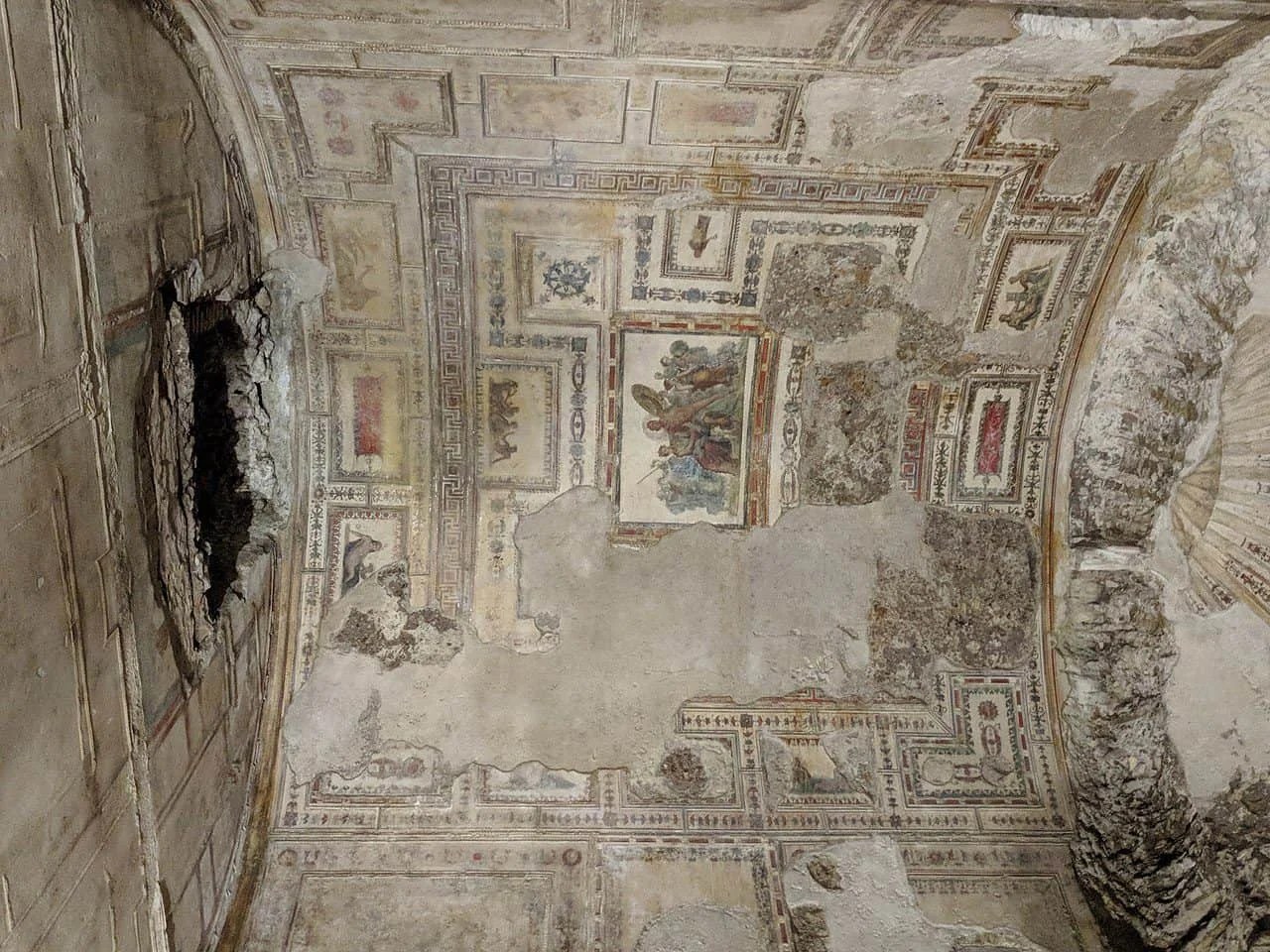
What you see today as bare brick was once covered. The walls, up to a certain height, carried plates of colored marble from all over the Mediterranean, the floors were inlaid, and the vaults were covered with modeled stucco, gilding, glass paste, and in some cases shells. Ancient sources insist on gold, gems, and mother-of-pearl, and for once archaeology confirms the substance of the account, though not the hyperbole. The holes for the metal clamps that held the plates are still visible on the walls, in regular rows. Take a look at them, because they are the material proof of the luxury described in the texts.
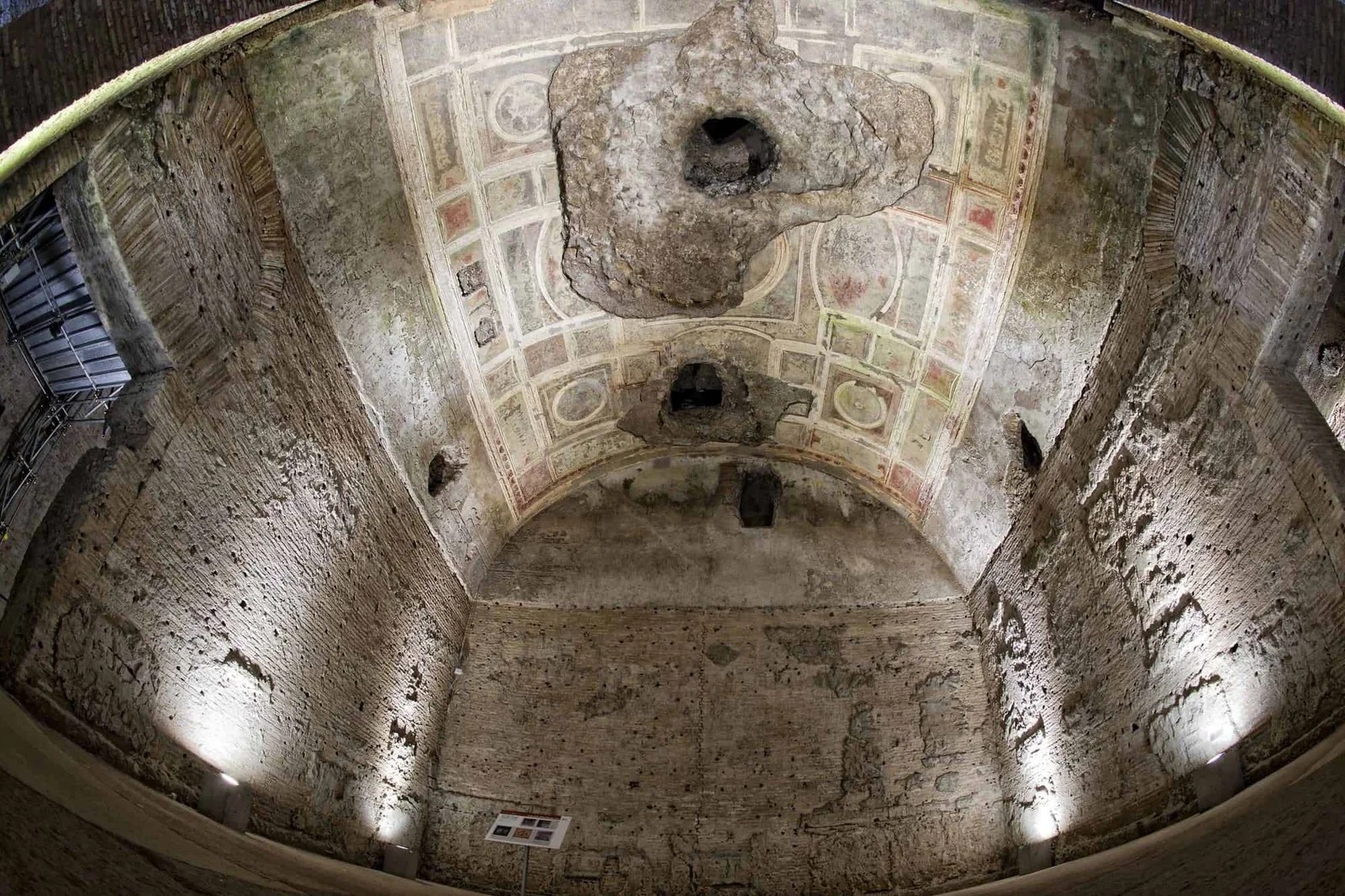
The painting survives mostly up high, on the vaults, where the looters didn't reach. It's a language made of white or light backgrounds, thin panels, impossible architectures, hybrid beings, and plant tendrils that turn into animals. Scholars classify it as the Fourth Pompeian Style, and here you see it on an imperial scale, meaning with a quality of execution that you don't find in private houses. This is the surface the Renaissance copied, and it's the one we still call by the name of the place.
The Nymphaeum of Ulysses and Polyphemus
This is the room that explains better than any other how this architecture worked. A rectangular nymphaeum, with a waterfall running down the back wall, covered in glass paste mosaics and shells, topped by a vault that simulated a natural grotto. At the center of the mosaic composition is the blinding of Polyphemus by Ulysses and his companions. The water ran, the light came in at an angle, the mosaic glittered: people dined inside a fake sea cave, on top of a hill, in the middle of Rome. This is the true Neronian luxury, and it has nothing to do with the gold of the chronicles. It's the idea that nature can be built better than it came out.
The Octagonal Hall and the Oculus
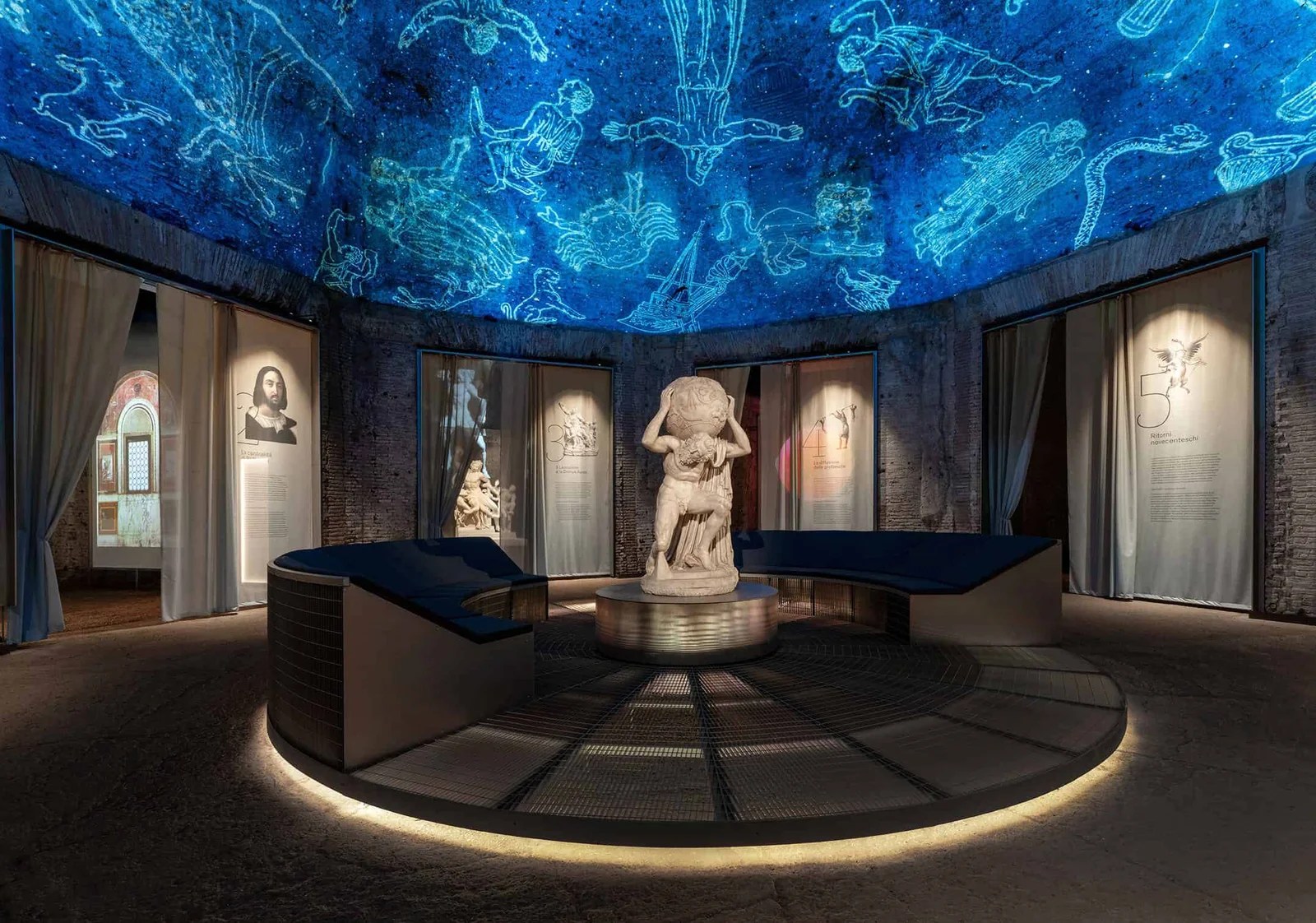
This is the moment when even the most distracted visitor stops looking at their phone. The Octagonal Hall is an octagonal-plan space covered by a dome that curves gently into the sides and opens at the center in a large circular oculus. Around it, five rooms are arranged radially, including one with a waterfall on the far wall. Light enters from above and spreads into the side rooms, which have no windows of their own. It's a zenithal lighting system designed before the Pantheon, and it is one of the decisive turning points in the history of Western architecture, because here Roman concrete stops imitating stone and begins to shape interior space like a hollow sculpture.
This room carries the most debated question in Roman archaeology. Suetonius tells that in the Domus Aurea the main dining room was round and rotated on its axis day and night, imitating the movement of the world, and that flowers and essences rained down from the ceiling. Many have wanted to identify the coenatio rotunda with the Octagonal Hall. Other scholars have proposed that the revolving room was instead on the Palatine Hill, where an excavation brought to light a circular structure interpreted as its mechanism. The question is not closed. In practice, the Octagonal Hall works just as well without the primacy: its dome alone was enough to change the history of construction.
The Sphinx Room, Found in 2019
In May 2019, the Parco archeologico del Colosseo announced the discovery of a room still buried, identified during consolidation work and reached through an opening in the wall. The paintings, left in the dark for 2,000 years, show centaurs, satyrs, armed figures alongside panthers, sea creatures, plant ornaments inhabited by birds, and the sphinx that gave the room its name. The room is not part of the ordinary visit route: it is still largely full of earth and is being studied. It does, however, tell something that no sign explains as well, namely that this monument is not finished. Under visitors' feet lie entire rooms that have never been emptied.
Virtual Reality at the Domus Aurea
The virtual reality part is not a gadget added to pad the tour. It is the tool that solves the structural problem of this monument: the surfaces you look at are bare, the marbles were stripped away, the gilded stucco has fallen, and the human mind doesn't fill those gaps on its own. With the headset, seated in the right spot along the route, you see the room reconstructed with its marble coverings, the frames, the natural light that came in through the openings, and the landscape that opened out toward the valley. It lasts a few minutes, and it's the main reason I recommend the full ticket.
A point of intellectual honesty: that reconstruction is a scientific hypothesis, not a photograph. The colors of the marbles, the exact height of some elements and the distribution of the furnishings are reconstructed on solid but debatable archaeological bases, and in 20 years the reconstruction will be different from today's. Look at it knowing this and it's worth twice as much.
The permanent worksite and the garden above the Domus Aurea
The number one enemy of this monument is water. Above the ancient vaults is the embankment of the Baths of Trajan and, above that, the public garden of Oppian Hill: every rain seeps through the soil, passes through the concrete and reaches the paintings, carrying salts that crumble them from within. After the restoration in the Jubilee years, the problem came back with force and some surfaces became illegible again. In 2010 a collapse in a room not open to the public forced the closure and years of work.
The response is an intervention that has no precedent in Rome for its ambition: replacing the soil of the garden above with a light, draining and waterproofed package, planted with shrubs with shallow roots that don't break through the vaults. The first experimental lot, presented in spring 2015, covered about 800 square meters and reduced the weight of the soil from about 3,000 to about 750 kilograms per square meter, with probes and sensors embedded in the ground to measure humidity and infiltration in real time. The overall project plans to treat the entire surface of the Oppian Hill garden in this way, divided into independent basins, for an investment estimated in tens of millions of euros and funded by the competent state administration.
This is why you visit with a hard hat when the route requires it, why the lighting is low, why the shifts are limited and why certain rooms open and close from year to year. It's not disorganization: it's a permanent first-aid station. Personally, I consider this the real reason to go now and not in 10 years. Today's route is not yesterday's and won't be tomorrow's, and every season here is worth a different visit.
How the Domus Aurea ended up underground
Nero dies in June 68, declared a public enemy by the Senate. The condemnation of his memory that follows is not only symbolic: it is a building program. The Flavians return to the city the land the emperor had taken. Vespasian drains the lake and begins the amphitheater, which Titus inaugurates in 80, the private baths of the pavilion on the Oppian Hill are adapted and opened to the public as the Baths of Titus, Domitian concentrates the imperial residence on the Palatine. In 104 a fire damages what remained of the upper floors of the Oppian wing, and Trajan makes the definitive decision: he fills the surviving rooms with earth up to the vaults and uses them as a foundation for an enormous bath complex, inaugurated in 109 and attributed to Apollodorus of Damascus.
The most hostile gesture of the damnatio memoriae is therefore also the gesture that handed us the monument. The earth packed into the rooms did what the ash did at Pompeii: it stopped the collapses, kept the light out and slowed the humidity. Without that burial, there would be nothing to see on the Oppian Hill today. It should also be added that the burial froze a construction site: many rooms were not finished when Nero died, and in some you can still see traces of the interrupted work.

What was built on top of the Domus Aurea
The Baths of Titus
The first reuse is almost immediate. The private baths that served the Oppian pavilion are adapted, enlarged and opened to the public by Titus around 80, at the same time as the inauguration of the amphitheater. It is a political gesture before it is a building one: the emperor's baths become the baths of the Romans. Few traces of the complex remain on the ground, largely absorbed by the later construction, and its floor plan is known mainly through Renaissance surveys.
The Baths of Trajan and the Seven Halls
The decisive transformation comes in 109, when Trajan inaugurates on the hill a bath complex of a size unprecedented for the time, attributed to Apollodorus of Damascus and oriented to make the most of the afternoon sun. To build it, the Neronian pavilion is filled with earth up to the vaults and used as a foundation platform. It is the act that buries the palace and hands it down to us. In the Oppian Hill park, its exedrae, retaining walls and stretches of paving can still be seen among the pines.
A little further upstream, the cistern that supplied the complex survives. It is known as the Sette Sale, although the vaulted rooms are actually nine, arranged in two staggered rows to counter the pressure of the water. It could hold some thousands of cubic meters. It is not part of the standard Domus Aurea visit, and its openings are irregular. If you happen to come on a day when it is open, go in, because it is one of the most impressive Roman concrete spaces in the city.
The Temple of Venus and Roma
The last piece is from Hadrian, around 135. On the Velia, where the Neronian vestibule stood, the double temple dedicated to Venus and Roma is built, the largest in the city. To make room for the foundations, the Colossus is moved toward the amphitheater. With that construction site, the erasure of the complex is complete: where the emperor's private entrance was, there is now a temple of the State. Anyone who enters the Colosseum today from the Forum side walks exactly over that hinge.
The Paradox of the Conservation of the Domus Aurea
The coup de grâce was also the salvation. By filling the rooms with packed earth, the Trajanic builders prevented the vaults from collapsing, kept out the light, which bleaches pigments, and slowed the air circulation, which washes away surfaces. The mechanism is the same as the volcanic ash at Pompeii, and the result is that on the Oppian Hill there survive first-century painted cycles that are practically unique in extent. No conservator could have designed a better intervention, and no one would have done it with those intentions.
The paradox has, however, a second face, which you touch during the visit. Everything that was below human height, that is, the marbles, was stripped away over the centuries. Everything that was up high, that is, the painting, remained. This creates the contradictory impression you get on entering: bare walls and painted vaults. The palace reads backward, from top to bottom. It is also the reason I insist on the ticket with the visual reconstruction. Without it, the most precious part of what you see risks staying out of focus.
Grottoes, Grotesques and the Renaissance at the Domus Aurea
Toward the end of the fifteenth century, the frescoed vaults come back to light in the most ordinary way possible. Someone, digging or walking over the earthen mound, falls into a crack and finds himself suspended in a painted room. The word spreads through Roman workshops within a few months. Artists start being lowered on ropes, with torches and sketchbooks, into what everyone calls grottoes, without knowing they are the rooms of an emperor. The name of the style comes from the name of the place: grotesques.
Pinturicchio and the First Ones to Go Down
The Umbrian painter Bernardino di Betto, known as Pinturicchio, is the name tradition puts first at the end of the rope. He is certainly among the very first to use that repertoire in his Roman decorations. Anyone who has seen the vaults he painted in the Vatican apartments and in Roman chapels easily recognizes the source: thin scrolls, candelabra, little monsters, and panels suspended on light backgrounds. It is a rare case where you can follow the passage of a figurative grammar from an ancient building to a modern one, with a margin of only a few years.
Raphael, Giovanni da Udine and the Vatican Loggias
The most striking consequence, however, is another one. Raphael Sanzio and his workshop go down into the grottoes of the Oppian Hill and take from them the vocabulary of the Vatican Loggias. There, the pupil from Friuli, Giovanni da Udine, specializes to the point of recreating the ancient recipe for white stucco in the workshop, grinding marble instead of ordinary lime. From there, grotesques spread across Europe: from Roman villas to French royal palaces, from majolica to the ceilings of English palaces. A single buried building supplied ornament to three centuries of Western art. If I had to name the number one cultural reason to buy this ticket, I would name this one: you enter the construction site of European decoration.
The Signatures on the Walls of the Domus Aurea
On the walls, at the height of a man's hand suspended on a rope, the signatures remain. There are names of sixteenth-century artists, carved or written with the flame of a candle, and names of travelers from later centuries, when going down into the grottoes had become a Grand Tour ritual. Among the names that can be read, literature also cites those of Giacomo Casanova and the Marquis de Sade. This is a reading passed down and repeated, which is not easy to verify with the naked eye on the wall. Those signatures are the first documented cultural tourism in Europe, and they are also the first documented cultural vandalism in Europe. The two things were born together, in the same room.
The Laocoön Found in 1506 a Short Walk from the Domus Aurea
On January 14, 1506, digging in a vineyard on the Oppian Hill near Nero's palace, the owner Felice de Fredis unearthed a marble group showing a man and two boys entwined by serpents. Pope Julius II sent the architect Giuliano da Sangallo to the site, who, according to his son's account, recognized the sculpture at first sight and cited Pliny. Michelangelo Buonarroti was with him. The group entered the papal collections and is today in the Museo Pio Clementino of the Vatican Museums. Pliny the Elder wrote that he had seen it in the house of Emperor Titus, and he attributed it to three sculptors from Rhodes: Agesander, Athenodoros and Polydorus. The discovery of the Laocoön and the opening of Nero's grottoes happened in the same years, on the same hectares of hill, and together they produced the fastest shift that Italian art has ever known.
The works of art removed from the Domus Aurea
Pliny the Elder, writing a few years after Nero's death, lists Greek masterpieces moved to Rome by order of the emperor and placed in the complex: bronze and marble statues taken from sanctuaries in Greece and Asia, in such quantity that the sanctuary of Delphi alone lost hundreds of them. The Domus Aurea was therefore also a forced museum, the largest organized artistic plunder of antiquity. Almost none of those works remain in situ: the Flavians relocated them to public buildings, where they were dispersed, melted down or destroyed.
The most famous piece to come out of this hill is the Laocoön group, brought to light in 1506 in Felice de Fredis's vineyard and today in the Vatican Museums. Pliny claimed to have seen it in the house of Emperor Titus, that is, in a building that stood on this same area, and he attributed its execution to three sculptors from Rhodes. The find influenced the entire sculpture of the sixteenth century, starting with Michelangelo, who witnessed its extraction.
Sculptures and fragments from the excavations of the Oppian Hill and the surrounding land are also distributed among the Roman collections, from the Vatican Museums to the holdings of the Capitoline Hill. The practical consequence for visitors is unpleasant, but it has to be said: the Domus Aurea is visited empty. The beautiful things it contained are elsewhere, and to mentally reconstruct the palace you need to add at least half a day of museum visits to your trip. It is a structural flaw of this monument, and no guide can fix it.
How to really visit the Domus Aurea
How long the Domus Aurea visit takes
The guided tour with virtual reality takes a little more than an hour, to which you should add the minutes waiting at the entrance gate and the climb through the park. In practice, plan on an hour and a half from the moment you leave the Colosseum to the moment you get back. Themed tours on the third Thursday last exactly one hour. It isn't a visit you can stretch out as you like: you enter and exit as a group, and lingering is not allowed.
Temperature and clothing for the Domus Aurea
Under the embankment the temperature stays low and stable all year, around 10 degrees, with very high humidity. In August you go from 35 degrees on the street to a cold, damp environment within a few meters: it's the temperature shock that spoils the visit for anyone who arrives in a tank top. Bring a sweatshirt or a light jacket even in midsummer, and wear closed shoes with a sculpted sole, because the floor is uneven, partly packed earth and partly wet. In winter it's the reverse: inside it's relatively less cold than outside, but the damp gets in, so thin layers are better than a heavy coat that you'd have to take off and carry over your arm.
Accessibility of the Domus Aurea
The route was designed to be accessible, and recent work has pushed hard in this direction, with walkways and ways around the level changes. Two concrete issues remain, however: the climb inside the Colle Oppio park, which has an uneven surface, and the site's character as a construction zone, which can mean temporary detours. If you use a wheelchair or are accompanying someone with mobility difficulties, call the Colosseum Archaeological Park before booking and state the time slot you've chosen: the reply is prompt and spares you surprises. Restrooms and a bookshop are available.
Rules, photos and groups at the Domus Aurea
Photos without flash or tripod are allowed under the visitor rules of the Colosseum Archaeological Park, but here there is a technical problem before a regulatory one: the light is very low, deliberately so to protect the paintings, so quick snapshots come out blurred. Guided groups are limited to 25 people, including the guide, and from nine people up, use of the earpiece system is mandatory, so no one has to raise their voice in spaces that bounce sound back. Dogs are not allowed. Bulky backpacks and long umbrellas must be left at the entrance.
The Domus Aurea with children
It works better than you'd think, but with two caveats. The first is age: under seven, the darkness, the cold, and the lack of recognizable objects get boring quickly. The second is preparation: if the child arrives knowing they're entering the house of an emperor who built a lake where the Colosseum stands today, the time flies. Virtual reality, in this case, is the decisive weapon. As a parent going along, my advice is not to fit the Colosseum and the Domus Aurea into the same morning. Two underground or semi-underground monuments in a row is too much for anyone under 10.
When to go to the Domus Aurea
The best months are April, May, October, and November: the walk up through the park is pleasant, the outside light is angled, and the contrast with the cold inside is bearable. July and August work well for a counterintuitive reason, namely that it's cool inside when the city outside is unbearable, but the time slots sell out weeks in advance. Of the three opening days, Friday morning is almost always the quietest. Sunday afternoon is the worst time. The first slot of the day has a practical advantage that's rarely mentioned: you go in before the humidity brought in by the previous groups fogs the lenses of glasses and headsets.
What to see around the Domus Aurea
The Colosseum and the Palatine five minutes from the Domus Aurea
The Colosseum is so close you can see it from the access road. The suggested order is chronological and it works: first the Domus Aurea, then the Colosseum, because that way you see the hole first and then the plug. If you have the whole day, add the Palatine, where the history of the imperial residence begins and ends, and the Palatine Museum to understand the level of imperial domestic decoration with real finds in your hands.
San Pietro in Vincoli, seven minutes uphill
Leaving the park toward the north, you reach San Pietro in Vincoli in a few minutes, where Michelangelo's Moses is located. Entry to the church is free. It's the most economical and most intelligent pairing in the area, and it also makes narrative sense: in the same half hour you see the house of the emperor whom Christians remembered as a persecutor and the unfinished tomb of the pope who bought the Laocoön found just a short walk from here.
San Clemente, the Celio and the underground
If you've developed a taste for underground Rome, head down toward via Labicana to the San Clemente Basilica, three overlapping levels from the second-century Mithraeum to the current church, and continue to the Case Romane del Celio, where you visit Roman frescoed houses beneath the Basilica of Saints John and Paul. Together with the Domus Aurea, they form the most instructive triangle in the city on how Rome built itself on top of itself. A little further on you reach the St. John Lateran Basilica.
The Baths of Trajan and the Oppian Hill park
The park you cross to reach the entrance is not just any garden: it's the floor of the Baths of Trajan. Among the pines rise brick exedrae, apses, and retaining walls. Take 10 minutes to walk around them before or after the visit, with the map in hand: you can see with your own eyes the relationship between the Trajanic level on the surface and the Neronian level under your feet, which is exactly what the guided tour tries to explain in words. For the imperial story that comes next, there are the Markets of Trajan and the Museum of the Imperial Forums. To see how large Roman baths became after this experiment, there are the Baths of Caracalla.

A curiosity about the Domus Aurea
The best curiosity isn't about gold, it's about a stone. Pliny the Elder writes that inside the Neronian complex there was a room lined with phengites, a translucent stone imported from Cappadocia, which let light through even with the doors closed. Anyone who entered had the impression that daylight was filtering through the walls. On the same page, Pliny adds the detail that makes the story irresistible: in that room Nero believed he had seen reflected the shadow of those plotting against him. A room built to be lit even at night, inside a house designed around the fear of its master.
Then there's the question of the moving ceilings. Suetonius writes that in the dining rooms the coffered ceilings were covered with rotating, perforated ivory panels, from which flowers rained down and scented essences were sprinkled over the guests. For centuries it was read as literary hyperbole, a way of depicting imperial excess. Excavations over the last few decades have, however, uncovered traces of hydraulic mechanisms and rotating devices in this complex and in its counterparts, which make the description technically plausible. The interesting point is not whether Suetonius exaggerated. It's that Roman engineering of the first century was capable of doing things that we have classified as fables for 2000 years, and that we are reclassifying now.
Third curiosity, the least spectacular and the most useful: nobody slept in here. In the entire visitable sector, not a single kitchen, a single latrine, or a single organized servants' quarters has been identified. A house without service areas is not a house. It's a theater. Anyone who visits the Domus Aurea knowing this stops looking for the emperor's bed and starts reading the rooms for what they were: backdrops for appearing.
Last curiosity, and this one is about water. The sources say that seawater and sulfurous water drawn from springs in the Alban area reached the baths of the complex, carried all the way here to serve the imperial baths. Be it exaggeration or logistical fact, the detail shows the principle this palace was conceived around: if a material or a natural element was not there, it was transported. The same mindset that diverted an aqueduct to fill a private pond also hauled salt water uphill from tens of kilometers away for a basin.
Something nobody tells you about the Domus Aurea
The Domus Aurea can be open and unreachable on the same day. The monument belongs to the State and is managed by the Parco archeologico del Colosseo. The Oppian Hill garden you have to cross to reach its entrance belongs to Roma Capitale. They are two separate administrations, with two separate alert systems. When the Campidoglio issues a closure order for city parks because of strong wind, and it happens more often than you'd think, the garden gate stays shut while the monument's ticket office is still listed as regularly operating. In that case the ticket is worth very little. Before leaving home on a day with a weather alert, it's worth checking the channels of the Parco archeologico del Colosseo.
The second thing nobody says concerns the relationship between tickets and free admission. The first Sunday of the month, which across Italy means free state museums, here means a closed gate. It's written in the Parco's official calendar along with the other closure dates of the year, but it almost always escapes those who plan their day around the Colosseum's free admission. Every first Sunday of the month I see groups climb into the park and turn back.
Third: the line that matters is not the entrance line, it's the booking line. Slots per time are few, and weekends sell out well in advance, especially in spring and during long weekends. Anyone who shows up without a ticket doesn't get in. Period. There is no last-minute ticket at the box office like at the Colosseum, there is no line where you can hope for a spot, there is no spot freed up at the last minute. If your trip to Rome includes this visit, book it first and build the rest of your day around it.
Fourth thing, technical and almost never mentioned: in here, glasses fog up. Humidity is very high and the temperature jump compared to outside is sudden, so anyone wearing prescription glasses finds themselves blind for the first few minutes, just when the guide introduces the route. Bring a microfiber cloth and plan on a few minutes to adjust. The same goes for camera lenses taken out of the bag: let them acclimate before shooting, or the first images come out milky.
The advice I give you for visiting the Domus Aurea
Take the first slot on Friday morning, with a full-price ticket and virtual reality, and don't schedule anything before it. On Friday mornings school groups haven't arrived en masse yet, the rooms are still dry from the night air, and the visor lenses don't fog up. The guide has time to answer questions instead of chasing the time of the next slot.
Second part of the advice: dress as if for a cave, not for a museum. A sweatshirt or light jacket even at Ferragosto, closed shoes with a non-smooth sole, a small backpack. Leave the bulky shoulder bag and the long umbrella at home. If you bring a camera, bring it with a fast lens and resign yourself to raising the ISO: tripods are not welcome here and flash is prohibited.
Third element, the one that really makes the difference: don't combine the Domus Aurea with the Colosseum in the same morning. It's the most common mistake of people who have two days in Rome. Two monuments of this density one after the other produce saturation, and you walk through the second without seeing it. Do the Domus Aurea in the morning, climb to San Pietro in Vincoli to see the Moses, have lunch in Monti, and save the Colosseum for the afternoon of the next day, better yet at sunset. And if you have to read just one thing before going in, read Suetonius's pages on Nero's House: they're three paragraphs and they completely change what you'll see.
Fourth and last element, which concerns the head more than the legs. Arrive with a question of your own. It can be anything: how they lit the rooms, where the wastewater ended up, why an emperor would want a rotating room. The guides of the Archaeological Park know the monument in detail and are happy to answer, but in a group of 25 people, whoever doesn't ask stays behind. The difference between a visit spent following someone's back and a visit that stays with you almost always comes down to two questions asked at the right moment.
Another well-known fact, yet rarely mentioned
Lots of people know that the Colosseum got its name from a statue, not from its own size. Almost no one, however, connects the fact to the Domus Aurea, which was that statue's house. The Colossus of Nero stood in the vestibule of the palace, on the saddle between the Palatine and the Esquiline: bronze, some 30 meters tall, the work of Zenodorus, with the emperor depicted wearing the radiate crown of the sun god. After Nero's death the statue was not melted down. It was reworked, stripped of its identity and left standing as an image of the Sun. When Hadrian needed that space for the Temple of Venus and Roma, he had it moved bodily. Ancient tradition speaks of 24 elephants used in the operation.
The colossus remained standing next to the amphitheater for centuries, so long that in the Middle Ages the building took its name from its bronze neighbor. When the statue disappeared, the name survived and passed to the amphitheater. Today millions of people say every day the name of a monument that no longer exists, believing they are describing what's in front of them.
What follows is just as rarely mentioned. The base of the Colossus, the one on which Hadrian relocated it, remained visible until the 1930s. It was dismantled during the works to open the road that cut through the archaeological area, and today its position is marked only by a ground marking between the Colosseum and the Arch of Constantine. Thousands of tourists walk over it every day while queuing to enter the amphitheater, without knowing they are stepping on the pedestal of the object that gave its name to everything.
There's a curious corollary. According to ancient descriptions, the Colossus's radiate crown had rays several meters long each, and the statue's head was rebuilt several times, changing the features of whichever emperor was in power. A sculpture as tall as a 10-story building, with an interchangeable face: the idea that Roman power had portraits with replaceable parts says more than many pages of constitutional history. The statue survived Nero because it was too costly to destroy, and it survived by changing identity.
The right photo to take at the Domus Aurea
Inside, the one photo worth taking home is this: the Sala Ottagona seen from below, with the oculus centered in the frame and a section of side wall giving depth. Rest your camera or phone on a stable surface, because the light is minimal and handheld shots come out blurry. Position yourself on the opposite side from the others in your group, wait for them to pass, and shoot when the room is empty: the emptiness is the subject. No flash, which is forbidden and also flattens everything and erases the volume of the dome.
The second photo is a detail, not a room. Look for a fragment of vault where the original decoration is still legible, a tendril scroll, a little bird, a frame, and fill the frame with it. You'll bring home a piece of Neronian painting instead of yet another dark corridor, and when you compare it with the 16th-century grotesques you'll see elsewhere in the city, that detail becomes the proof of an argument.
Outside, the best photo of the day isn't inside the monument. It's from the high edge of Oppian Hill, from the terrace facing south, where the Colosseum can be seen whole from above with the pines in the foreground. Go at sunset, when the travertine turns orange and the arches cast shadows. It's free, it's open, no booking is needed, and it's one of the few views of Rome that almost never appears on postcards. One last technical note: from that spot, the blue hour, the 20 minutes after sunset, gives you a deep sky and the amphitheater's artificial lights already on. It's the moment when the framing works best.
A recommendation worth more than any setting: inside the monument, put your camera away for the first 10 minutes. The pupil needs that time to adjust to the dark, and anyone who spends the first minutes looking at a bright screen reaches the Sala Ottagona without having seen anything. Photos are taken in the second half of the visit, when the eye has adjusted and begins to make out the colors on the vaults. It's the only photography tip that no manual writes, because it concerns the eye and not the equipment.
Some important events that took place here in history
The first event is the fire of AD 64, which burns for days and wipes out entire regions of the city. That Nero set it is an ancient accusation and not proven. That he exploited it to take the land on which to build his own palace is instead what the sources agree on. On that cleared land the Domus Aurea rises, and at the same time the political hatred that will lead the emperor to his end is born.
The second is the Pisonian conspiracy of 65, the largest senatorial plot against Nero, fueled also by the confiscations and plundering with which the construction site was paid for. It fails, and the repression that follows costs the lives of dozens of people, including Seneca, the emperor's tutor, who is forced to open his veins. The house isn't finished, and it has already caused a massacre.
The third is the welcome of King Tiridates I of Armenia, in 66. Nero crowns him in Rome with a sumptuous ceremony, before a decorated city: it is the peak of the kingdom's splendor, and the palace under construction is the declared backdrop. The fourth event is Nero's death in 68 and the damnatio memoriae that follows, with the systematic erasure of the work: the lake drained, building structures demolished, land returned to the people, an amphitheater built in the valley.
The fifth is the Trajanic burial after the fire of 104 and the inauguration of the baths in 109: the palace disappears from view for 14 centuries. The sixth is the rediscovery at the end of the 1400s, with the accidental fall through a vault and the season of descents on ropes that gives rise to the grotesques. The seventh, 10 years later, is the discovery of the Laocoön in the vineyard of Felice de Fredis, on January 14, 1506. The eighth is the collapse of 2010, which closes the monument and opens the period of structural work. The ninth is the discovery of the Sphinx Room in May 2019. The tenth, the most recent, is the opening of the new entrance in Gallery XXIV and the reopening of the western sector, on December 13, 2024.
Among all these, the most underrated is the eighth. A collapse in a closed monument doesn't make news for more than a day, but it marks a watershed: from that moment the Domus Aurea stops being treated as a site to open and starts being treated as a patient to care for, with a conservation plan that also covers the garden above and the water regime of the entire hill. The reopenings of recent years are the result of that choice, and the fact that today you can enter a sector that was off-limits 10 years ago is the most concrete result of a story that began with bad news.
Who passed through the Domus Aurea
The first name is obvious and should be stated plainly: Nero Claudius Caesar Augustus Germanicus, emperor from 54 to 68, here the patron and at the same time the director of the spectacle. Along with him came the architects Severus and Celer, who designed the complex, and the painter Fabullus, of whom Pliny reports that he worked in a toga even on the scaffolding and that he painted his most demanding work here. Tiridates I of Armenia passed through, received in 66 with a ceremony that the sources describe as the most expensive diplomatic spectacle of the empire. Later emperors passed through, each leaving a negative mark: Vespasian, who drains it, Titus, who adapts the private baths into public baths, Domitian, who moves the court to the Palatine, Trajan, who fills everything with earth.
Then there is the second passage, the one that changed the history of art. At the end of the 1400s and throughout the 1500s, painters from Roman workshops went down into the Oppio grottoes with ropes and torches. Tradition puts Pinturicchio at the head of the line, then come Domenico Ghirlandaio, Filippino Lippi, Marco Palmezzano, the Dutchman Maarten van Heemskerck, who sketches everything he sees, and above all Raphael with his workshop. From those descents comes the repertoire of the Vatican Loggias, where Giovanni da Udine reconstructs the ancient technique of white stucco made with marble dust. Michelangelo Buonarroti visits the area in those same years: on January 14, 1506, he is on the Oppian Hill, with Giuliano da Sangallo, when the Laocoön group is dug out of the ground.
The third passage is that of travelers. From the 1700s, the descent into the grottoes becomes a stop on the Grand Tour, and the walls fill with signatures of foreign and Italian visitors. Among the names that the literature cites are also those of Giacomo Casanova and the Marquis de Sade, an attribution passed down from book to book and hard to verify on the wall. What is visible with certainty is the layering: a 16th-century signature next to a 19th-century one, the handwriting of a painter next to that of a tourist.
The fourth step is contemporary and concerns the people who work there: archaeologists, restorers, structural engineers, and botanists who choose the plants for the garden above based on how deep their roots grow. It's a less romantic list than the previous ones, but without these people, nobody would get through today. We should also mention the scientific report on the discovery of the Sphinx Room, signed by archaeologist Alessandro D'Alessio, which shows the level of study with which the monument is followed room by room.
What remains is to name those who passed through here without meaning to. In the 1500s and 1600s, the hill was planted with vineyards and vegetable gardens, and the farmers who worked it regularly found fragments of marble and painted plaster, which they sold or reused. Without knowing it, they were the first excavators of the palace, and most of the accidental finds documented by modern sources are owed to them, starting with the one that in 1506 brought the Laocoön to light. The history of Roman archaeology begins with hoes, and this hill is its most striking example.
Quick Questions about the Domus Aurea
How much does a Domus Aurea ticket cost in 2026?
The ticket with a guided educational route and virtual reality costs €26. There is also a full-price ticket for €18, with a reduced price of €2 for European Union citizens aged 18 to 25, valid only for the two unguided shifts at 12.00 and 17.00. Check prices on the official Colosseum Archaeological Park website before you buy.
Do I need a reservation to visit the Domus Aurea?
Yes, a reservation is required and is made on the official system at ticketing.colosseo.it. There is no sale of tickets at the gate. Shifts are limited in number, and on weekends they sell out days or weeks in advance.
What days is the Domus Aurea open?
Friday, Saturday and Sunday, plus the third Thursday of the month for the Domus Aurea Highlights themed visits. From Monday to Thursday, the monument is closed.
Is the Domus Aurea free on the first Sunday of the month?
No. The Domus Aurea is closed on the first Sunday of every month, when other state sites offer free admission. It's one of the most common traps for people planning a weekend in Rome.
How long does a visit to the Domus Aurea take?
The guided route with virtual reality lasts just over an hour. Adding the wait at the gate and the climb through the park, it's best to plan for an hour and a half in total. The themed visits on the third Thursday last one hour.
Can I visit the Domus Aurea without a guide?
Only in the two daily shifts at 12.00 and 17.00, with the €18 ticket. All other shifts are guided. My verdict is clear: without a guide and without virtual reality, this visit is much less rewarding.
Is virtual reality included in the Domus Aurea ticket?
It's included in the €26 ticket with the educational route. It's not included in the €18 ticket.
What is the temperature inside the Domus Aurea?
Under the vaults, the temperature stays low and stable all year, around 10 degrees, with high humidity. A sweatshirt or a light jacket is needed even in August.
How should you dress to visit the Domus Aurea?
A light warm layer, closed shoes with a grooved sole, a small backpack. The floor is uneven and partly damp. Avoid sandals, heels and bulky bags.
Is the Domus Aurea wheelchair accessible?
The route is designed to be accessible, and recent work has improved the situation a lot, but the site is still a construction site, and the climb through the Colle Oppio park has an uneven surface. Anyone with specific needs should contact the Colosseum Archaeological Park before booking a shift.
Can I take photos inside the Domus Aurea?
Photos without flash and without tripods are allowed under the visitor rules of the Colosseum Archaeological Park. The light is very low for conservation reasons, so expect difficult shots.
How do I get to the Domus Aurea by public transportation?
Metro B or Metro C, Colosseo stop, then a five-minute walk uphill through the Colle Oppio park. On the surface, buses 51, 85 and 87 and tram 3 stop nearby.
Where exactly is the Domus Aurea entrance?
On Via della Domus Aurea, inside the Colle Oppio park, on the side facing the Colosseum. Since December 2024, the entrance gate is the one set up in Galleria XXIV.
Is the Domus Aurea suitable for children?
From seven or eight years old on, it works well, especially thanks to the virtual reality. Below that age, the darkness and the cold are hard to handle. Don't combine it with the Colosseum in the same morning.
How many rooms does the Domus Aurea have?
The pavilion preserved on the Oppian Hill has over 150 rooms, only part of which is included in the visitor route. The original complex stretched over tens of hectares between the Palatine, Esquiline and Caelian hills, and the vast majority no longer exists.
Why is the Domus Aurea called that?
For its gilded wall coverings and for the abundance of gold, gems and mother-of-pearl that ancient sources describe in the reception halls. The Sala della Volta Dorata preserves a direct memory of that name.
What is the connection between the Domus Aurea and the Colosseum?
The Colosseum stands in the valley where Nero had an artificial lake dug for his palace. Vespasian drained it and built the amphitheater there, returning to the people the space the emperor had taken for himself. The name Colosseum also derives from the Colossus of Nero that stood in the vestibule of the Domus Aurea.
What are grotesques and what do they have to do with the Domus Aurea?
They are the decorative repertoire of scrolls, candelabra, monsters and suspended little figures that Renaissance artists copied from the vaults of these rooms. The name comes from the grotte, meaning the underground rooms people were lowered into on ropes.
Can you see the Laocoön at the Domus Aurea?
No. The group was found on January 14, 1506, in a vineyard on the Oppian Hill near the palace, and today it is in the Museo Pio Clementino of the Vatican Museums.
What is the Sala Ottagona of the Domus Aurea?
An octagonal room covered by a dome with a central oculus, around which five rooms open in a radial pattern, lit by the light coming down from above. It is one of the turning points in Roman concrete architecture and anticipates solutions that we will find in the Pantheon.
Can you visit Nero's rotating dining room?
The coenatio rotunda described by Suetonius has not been identified with certainty. One group of scholars places it in the Sala Ottagona, another places it on the Palatine, where an excavation uncovered a circular structure interpreted as its mechanism. The question remains open.
Can you also visit the Domus Transitoria?
Nero's earlier residence, destroyed by the fire of 64, has remains on the Palatine and is not part of the Domus Aurea route. Openings are exceptional and should be checked on the official website of the Parco archeologico del Colosseo.
How far ahead should you book the Domus Aurea?
During high season and long weekends, at least three or four weeks. In winter, you can still find a spot with about 10 days' notice. It's the first thing to book when planning a weekend in Rome.
What is the difference between the Domus Aurea and the Case Romane del Celio?
The Domus Aurea is an emperor's palace, monumental and built for display. The Case Romane del Celio are private Roman homes, frescoed and developed over several phases, preserved beneath a basilica. Seen on the same day, they show the two extremes of living in Rome.
Is it worth buying a combined ticket with the Colosseum?
The Domus Aurea has its own ticket office and its own timed-entry system. It is not part of the regular circuits of the Colosseum, the Forum and the Palatine. Two separate tickets must be bought, both on the official channel.
Why is the Domus Aurea open only three days a week?
Because it is an active restoration site, with consolidation work, structural monitoring and water infiltration control taking up the other days. Public opening is compatible with the site only in limited windows and with groups capped in size.
Do you wear a helmet to enter the Domus Aurea?
The protective helmet is part of a construction site's equipment and is handed out at the entrance when the conditions of the route require it. The requirements may change depending on the work in progress and are communicated at the time of booking.
Is there a bookshop at the Domus Aurea?
Yes, and restrooms are also available. There is no café, though. For a break, it's better to head down toward via Labicana or up into the rione Monti.
Why is there so little light inside the Domus Aurea?
For conservation reasons. Light speeds up the deterioration of the ancient pigments, so the lighting is low intensity, calibrated to the surfaces and partly controlled by motion sensors that turn on the fixtures only when the group passes.
What are the Sette Sale above the Domus Aurea?
They are the large cistern that supplied the Baths of Trajan, on the Oppian Hill, actually made up of nine vaulted rooms arranged in two staggered rows. They are not part of the regular Domus Aurea route and are opened only on specific occasions.
How tall was the Colossus of Nero?
Ancient sources give a height of around 120 Roman feet, so roughly 30 meters, excluding the base. It was made of bronze, the work of Zenodorus, and depicted the emperor wearing the radiate crown of the sun god.
Is it worth it? One thing only: the Domus Aurea is not a monument to see, it is a monument to understand, and the difference lies entirely in the time you spend on it and the preparation with which you arrive. Go with the full-price ticket, go early, and on your way out climb up to the edge of the park to look at the Colosseum from above. From that point, with the palace under your feet and the amphitheater before your eyes, Roman history can be seen all together, and that doesn't happen often.
Article written by the editorial team of TourLeaderPro, contact them for Private/Corporate/V.I.P. Tours and Experiences.
Are you planning a trip to Rome? The English-language guides for visiting the city are on ItalyPlanner.com.