St. John Lateran Basilica
In short. St. John Lateran Basilica stands on Piazza di San Giovanni in Laterano, on the Caelian Hill, and it is the cathedral of Rome: not St.

St. John Lateran Basilica stands on Piazza di San Giovanni in Laterano, on the Caelian Hill, and it is the cathedral of Rome: not St. Peter's, which is the pope's basilica as universal bishop, but the Lateran, which is his seat as bishop of Rome. You can get there by metro line A, San Giovanni stop, or by tram 3, which stops right at Porta San Giovanni/Carlo Felice a short walk from the forecourt. Entry to the basilica is free, every day from 7:00 to 18:30 (source: the basilica's official website, basilicasangiovanni.va). The medieval cloister is visited separately, Monday through Saturday, closed on Sundays. The basilica's official website does not publish a ticket price, while ticket platforms list €4 full price and €3 reduced. If it matters to you, check at the cloister's ticket office on the day itself. Across the square from the basilica stands the Pontificio Santuario della Scala Santa, which is a separate administration with its own hours and rules. I will explain this more later, because it is a common mistake to think it is part of the basilica. For the full picture of the pilgrimage of Rome's seven churches, of which the Lateran is the first stop, and to plan your day around the Caelian Hill, also keep handy the page on Holy Stairs and the one on Santa Maria Maggiore, the closest papal basilica.
St. John Lateran is the cathedral of Rome, mother and head of all churches
The official name is very long, and no Roman ever uses it in full: Papal Major Archbasilica, Archpriestal Cathedral of the Most Holy Savior and Saints John the Baptist and John the Evangelist in Laterano. On the facade, in very tall letters, it says it is "omnium urbis et orbis ecclesiarum mater et caput," mother and head of all the churches of the city and of the world. This is not a line from a tourist brochure. It is a canonical title that the basilica has held since before St. Peter's was even designed.
One point needs clarifying, since it still circulates online: the reigning pope today, August 2026, is Pope Leo XIV, as shown by the Angelus addresses and homilies published on the official Vatican website, vatican.va (I read them today, the most recent dated July 26, 2026). The archpriest of the Lateran basilica, who is also cardinal vicar for the Diocese of Rome, is Cardinal Baldassare Reina, appointed in October 2024 and confirmed in the role by the basilica's official website, basilicasangiovanni.va, where he is listed with the title "archpriest of the papal basilica of St. John Lateran" and "vicar of His Holiness for the Diocese of Rome." It is a double role typical of the Lateran: the cardinal vicar governs the Diocese of Rome on the pope's behalf and, almost automatically, is also the custodian of the cathedral.
In ancient times this area was home to the noble Laterani family. Their house was near the basilica, perhaps toward today's Via Amba Aradam, and their land covered the whole area that now holds the square and the basilica complex. According to Tacitus's Annals, in 65 AD these houses and lands were confiscated by Emperor Nero. Plautius Lateranus, consul-designate for that year, had conspired against the emperor in the Pisonian conspiracy. When the plot failed, Plautius was sentenced to death and his property passed to the imperial treasury.
The origins of the site: the imperial barracks under the basilica
Around 201, part of this land was used by Septimius Severus to build a second barracks for his bodyguard, the equites singulares, the elite cavalrymen who already had a barracks near present-day Via Tasso. The new structure was called Castra Nova equitum singularium, and it occupied the very Lateran area where the imperial treasury had inherited the properties of the Laterani. Excavations carried out under the floor of the basilica and under the cloister, in several campaigns over the course of the twentieth century, brought to light large stretches of the Severan foundations and part of the ground-floor elevation of the barracks. If you visit the cloister with a guide who knows the underground archaeology, you can still read the imprint of that barracks in the layout of certain walls.
It was Septimius Severus again who gave another portion of the land confiscated from Titus Sextius Lateranus, his commander in the Mesopotamian expedition. It's not clear whether the emperor gave him the house that had belonged to Plautius Lateranus or had a new one built, but it must have been a prestigious residence in any case, since even in the Middle Ages that area was still referred to with the phrase iuxta Lateranis, near the Lateran, which gives us the place name we still use today. Historians have suggested a distant family link between Plautius Lateranus and Titus Sextius Lateranus, but it can't be proven with certainty. I mention it because it's often read as an established fact, and it isn't.
The land then passed, whether by purchase or by inheritance we don't know, to a certain Fausta, recorded in the sources as the owner of a domus Faustae in the Lateran territory. The historiographical tradition identifies this Fausta with the second wife of Emperor Constantine, and it is to this name that the foundation of the basilica is tied.
A Curiosity About St. John Lateran Basilica
The curiosity I like to tell first is the one about the obelisk in the middle of the square, in front of the apse facade of the basilica. It is the oldest obelisk in Rome, erected in the temple of Amun at Karnak, in Egypt, in the 14th century BC, under the pharaohs Thutmose III and Thutmose IV. It reached Rome only in 357 AD, commissioned by Emperor Constantius II, and it was erected in the Circus Maximus, where another obelisk already stood, the one that is now in Piazza del Popolo. It fell, broke into three pieces, and stayed buried for centuries until it was found again in 1587. Pope Sixtus V had it raised again the following year, in 1588, in its current position in front of the Lateran, to a design by the architect Domenico Fontana, the same man who also moved the Vatican obelisk to St. Peter's Square. By itself it measures 32.18 meters. With the base and the cross on top it reaches 45.70 meters, which makes it the tallest obelisk in the world, taller even than those that remain in Egypt. Take your time when you walk past it, before going in. Most tourists photograph it in a rush and don't realize they're looking at a stone that has seen the pharaohs, Constantius II and Sixtus V.
Constantine's Foundation and the Donation to Pope Miltiades
Constantine, who grew up at the court of Diocletian, was acclaimed emperor by the army in Britain in 306, when his father Constantius Chlorus died. Years of struggle between several claimants to the throne followed, until on October 28, 312, Constantine defeated Maxentius at Saxa Rubra, on Via Flaminia, in the battle that went down in history as the Battle of the Milvian Bridge. Christian tradition tells that the night before, Constantine had seen a divine sign in a dream, a cross with the words in hoc signo vinces, which he had painted on his soldiers' shields. It is a hagiographic tale, not a historical document, and I point that out for honesty's sake, but it is the tale that all later Christian sources handed down and that made the Lateran the symbolic place of the Constantinian turning point.
After defeating Maxentius, Constantine went to Milan and strengthened the alliance with Licinius, proclaiming in 313 the edict that granted Christianity freedom of worship. Back in Rome, he found the Lateran area in his hands: the domus Faustae and the Castra Nova of the equites singulares, the guard corps that had supported Maxentius and that Constantine disbanded. On that land, freed of the enemy barracks, he gave Pope Miltiades the space to build a domus ecclesiae, the first official seat of the Church of Rome. It's a detail that has always struck me: the first Christian cathedral of Rome was physically born on top of a dismantled military barracks, almost a symbolic gesture even before an urban planning one.
Something No One Tells You About St. John Lateran Basilica
What they rarely tell you, when you visit St. Peter's thinking you have seen "the pope's basilica," is that St. Peter's has never been the cathedral of Rome. This one has always been, the Lateran, from the fourth century until today. The confusion arises because the pope lives and celebrates almost always in the Vatican, and because St. Peter's is enormously more visited and more photographed. But the episcopal cathedra of Rome, the liturgical seat from which the bishop of Rome, who is the pope, formally exercises his ministry over the diocese, is here, in the apse of the Lateran basilica, not at St. Peter's. Every November 9 the Church celebrates the dedication of the Lateran basilica with a liturgical feast of higher rank than many others, precisely because it is the feast of the cathedral of Rome. I tell you this because I often hear foreign visitors surprised, when they discover it here in front of the facade, that the most important church of Catholicism from the hierarchical point of view is not the one with Michelangelo's dome.
My Advice for Visiting the Basilica of San Giovanni in Laterano
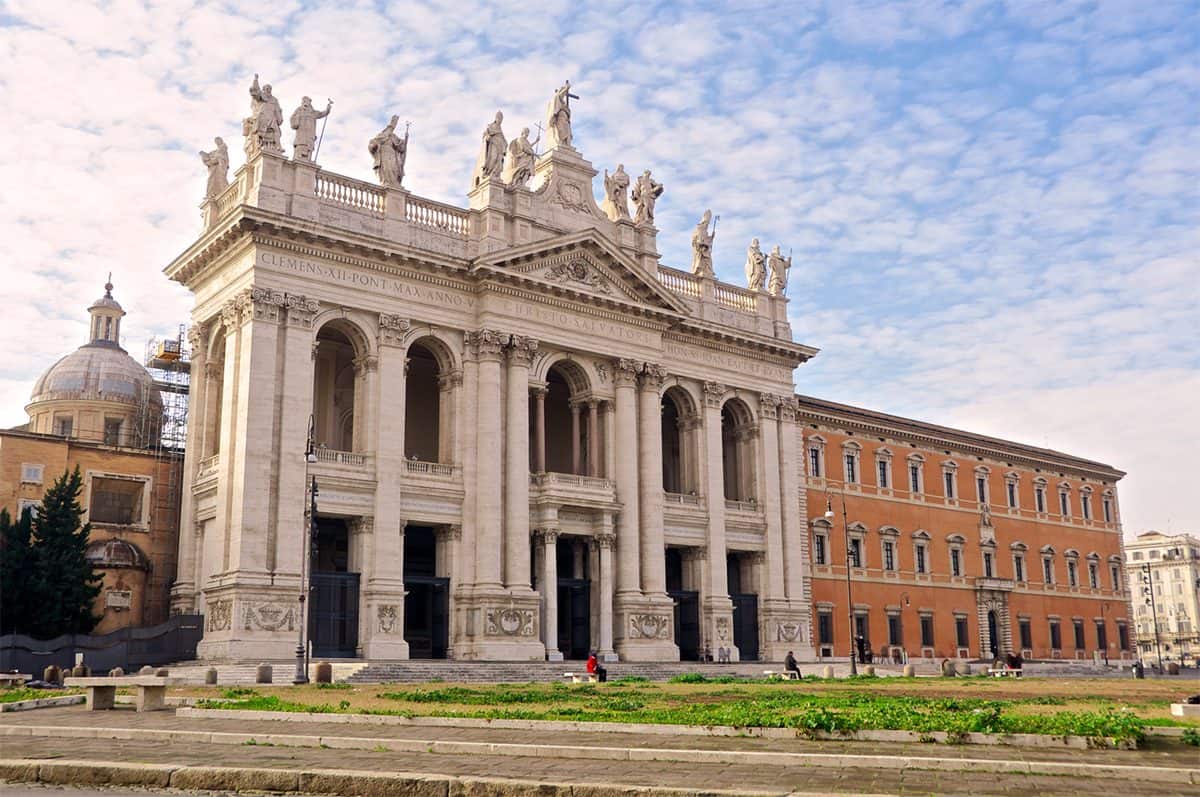
My practical advice is simple: enter by the main facade, the one with the statues of Christ and the 12 apostles on the balustrade, but leave by the north transept, the one facing Porta San Giovanni, and from there continue on foot to the Baptistery, which is a few steps on the left of the historic facade, and finally cross the piazza to the Scala Santa. In an hour and a half, walking calmly, you've seen three different places that tell three different centuries of the same story, without having to retrace your steps. If you have time for the cloister too, put it last before leaving the basilica: it is the quietest place in the whole complex and works well as the close of the visit, not as the opening, because in there you feel like sitting down and not like rushing off to see something else. Another recommendation: don't go at noon in August thinking it is less crowded than the Vatican basilicas. It is, compared with St. Peter's, but the bus of organized pilgrims arrives punctually here too, especially early in the morning. If you're coming from Termini, also consider the option of arriving on foot from the Colosseum along Via di San Giovanni in Laterano, a walk of about 20 minutes slightly uphill: it's a route that makes you understand better, with your legs, the real distance between the tourist heart of the ancient city and what for centuries was the religious and administrative heart of Rome, that is, right here.

The Consecration, the Title and the Five Councils
The basilica was consecrated in 324, or according to other sources in 318 (the two datings still coexist in scholarship, and honestly neither can be discarded with certainty), by Pope Sylvester I, and dedicated to the Most Holy Savior. Only in the ninth century, under Sergius III, was it also dedicated to Saint John the Baptist, and in the twelfth century, under Lucius II, Saint John the Evangelist was added too: hence the double title of San Giovanni that we all use today, even though the main patron, by original dedication, remains the Savior.
From the fourth century to the end of the Avignon period, in the fourteenth century, the Lateran was the only seat of the papacy. The Patriarchio, the Lateran residence attached to the basilica, was the residence of the popes throughout the Middle Ages, and the complex hosted five ecumenical councils: a fact few remember when they think of the Lateran only as a beautiful Baroque facade.
What the Constantinian Basilica Looked Like
The original Constantinian basilica was already very similar, in plan, to the present one: five aisles, and the perimeter walls coincided more or less with today's. A rectangular hall divided into five aisles by marble colonnades with Corinthian capitals, 15 columns with a high entablature on each side of the main nave and 21 columns supporting the arcades between the side aisles. At the end of the central nave, to the west, a large apse opened. Constantine, after having the basilica built, enriched it with a precious ciborium for the high altar.
Sacks, Vandals and the First Early Medieval Restorations
After the splendor of the fourth century, events followed that marked, for better and for worse, for over a thousand years, the history of the Lateran archbasilica. At the beginning of the fifth century, during Alaric's Visigothic sack of 410, the cathedral was stripped of its precious Constantinian baldachin, immediately replaced by Sixtus III. In 455 Genseric's Vandals plundered the church of all its treasures.
Pope Hilarius, who was pontiff from 461 to 468, had three oratories built around the baptistery: the one of St. John the Baptist, the one of St. John the Evangelist and the one of the Holy Cross, the latter later demolished by the Baroque renovations of Sixtus V. The Oratory of St. Venantius was built in the sixth century under Pope John IV. At the beginning of the ninth century Leo III rebuilt the basilica's ceilings and decorated the apse windows with polychrome stained glass. In the tenth century an oratory dedicated to St. Thomas was built on one side of the portico, which in the past served the popes to put on their liturgical vestments before entering the church.
Another well-known fact, yet not often mentioned
The well-known fact, but rarely told with the right details, is that in the central portal of the basilica, the one you see as you enter from Alessandro Galilei's facade, the bronze doors of the ancient Roman Curia are mounted, the seat of the Senate in the Roman Forum. They were moved here in the seventeenth century, from the church of Sant'Adriano al Foro, under Pope Alexander VII, when the Borromini remodeling was completed. Every time you push that door to go in, or see it open for a solemn service, you are literally touching a piece of the ancient Roman Senate, moved a few kilometers and readapted as the door of a Christian basilica. It's one of the few points where pagan antiquity and Christian Rome touch physically, not only symbolically, inside the same building.
The thirteenth century, the first Jubilee and Giotto's lost frescoes
In the twelfth century the roof of the basilica was restored and the portico of the baptistery was adapted into two chapels, dedicated to Saints Rufina and Secunda and to Saints Cyprian and Justina. In the same century the old facade with its mosaic decoration and the entrance portico were also redone, and the baptistery and the Scala Santa were given bronze doors, now kept in the chapels of the two St. Johns inside the baptistery.
At the end of the thirteenth century major works were undertaken under Boniface VIII for the Jubilee of 1300, the first great jubilee in the history of the Church, proclaimed from the Lateran itself: the new loggia of the blessings and the frescoes by Giotto, or his school, and by Cimabue, sadly lost today. Think about it when you're under that facade: the very concept of the Holy Year, with pilgrims arriving in Rome from all over Europe for the indulgence, was born here, in this square, seven centuries before the Jubilee of 2025 that has just ended, with the closing of the holy doors on January 6, 2026.

The Lateran Baptistery: all of Rome was baptized here
Correction: here is the full English translation.
Coming out of the basilica's historic facade, on the left side, you'll find the Lateran Baptistery, one of the most important buildings in the history of Christian architecture because it is the first monumental octagonal baptistery ever built, and the model that practically all later European baptisteries were inspired by, up to the one in Florence. The octagonal plan dates to the fourth century, possibly wanted by Constantine himself, but the look we see today, with the interior colonnade, comes from the reconstruction ordered by Pope Sixtus III between about 432 and 440. Under the dome is the baptismal font. Eight red porphyry columns, 6.3 meters high, were put in place by Pope Sergius III between 904 and 911, with composite capitals that support a second octagonal entablature.
In the fifth century an atrium to the south and three chapels, to the west, north and east, were added, dedicated respectively to St. John the Baptist, the Holy Cross and St. John the Evangelist. In the seventh century the chapel of St. Venantius was added. The interior frescoes with episodes from the life of Constantine, the ones many guides cite as proof of his baptism here, actually date to the 17th century. They are a late celebration, not a testimony from the period. As for Constantine's baptism at the Lateran, popular tradition takes it as certain, but the most solid historical sources place his baptism elsewhere, near Nicomedia, shortly before his death. It's another case where legend is stronger than documentation, and I prefer to tell you plainly rather than repeat the legend as if it were a fact.
On the baptistery's hours, the official sources don't agree. The basilica's official site, basilicasangiovanni.va, gives opening every day from 9.00 to 19.00, free admission and no reservation. turismoroma.it instead gives 7.00-12.30 and 16.00-19.00. I won't choose between the two, I'm telling you how it is: check both sources, or call the basilica's number, before planning your visit around this schedule.
The Scala Santa, across from the basilica but under a different administration
Crossing the square, toward the east, stands the Pontifical Sanctuary of the Scala Santa and Sancta Sanctorum, at Piazza di San Giovanni in Laterano 14. Tradition holds that the 28 marble steps, now covered with a wooden casing to protect them from wear, are the ones Jesus climbed in the praetorium of Pontius Pilate in Jerusalem, and that St. Helena had them brought to Rome in the fourth century. You can climb them on your knees, in silence, or on foot using one of the two side staircases, for those who don't feel up to it or don't want to take on the ritual climb. At the top is the Sancta Sanctorum, the former private chapel of the medieval popes, which you visit with a separate ticket, €3.50 full price and €3 reduced according to the official site scala-santa.com.
Here too the sources don't agree on the hours. The sanctuary's official site, scala-santa.com, gives Monday to Saturday 6.00-13.30 and 15.00-18.30, Sunday 7.00-13.30 and 15.00-18.30 (with early closing at 18.00 from November to March). turismoroma.it instead gives a single schedule, every day, from 9.00 to 13.30 and from 15.00 to 18.30. These are two different morning opening times, six or seven versus nine. I won't choose, I'm pointing it out to you and I recommend checking with the sanctuary's number, +39 06 7726641, on the same day.
Inside the Sancta Sanctorum, behind the altar, protected by silver plates since the 13th century, is kept the icon of the Savior called the Acheropita, that is, not painted by human hand according to the Greek meaning of the word. Recent studies date it between the fifth and sixth centuries, and it depicts Christ enthroned. A pious medieval legend says that the evangelist Luke began to paint it and that angels then completed it. I point it out as a legend, not as a historical fact, because the basilica itself presents it in these terms. Every year, on the night between August 14 and 15, the icon was carried in procession from the Lateran to Santa Maria Maggiore, where at dawn the rite of the encounter with another much-venerated Roman icon, the Salus Populi Romani, took place. It was a medieval procession that crossed centuries of the city's history, passing ideally through the Roman Forum. The chapel of the Sancta Sanctorum, in the Gothic form we see today, dates to Pope Nicholas III, between 1277 and 1280, with frescoes of the Roman school and a Cosmatesque floor. Under the altar, accessible only to the pope, Pope Leo III had a cypress chest placed with many ancient Christian relics, including, according to the sanctuary's tradition, a fragment of the little bed on which Jesus lay during the Last Supper.
The Move to Avignon and the Abandonment of the Lateran
In the fourteenth century, the decisive event in the history of the Lateran basilica was the move of papal power from Rome to Avignon, and the abandonment of the Lateran that followed. In 1378, with the election of Gregory XI, the Avignon period ended and the papacy returned to Rome, but it found the Lateran in terrible condition. From then on the popes preferred the Vatican, and all later restorations focused on the care of the basilica and the baptistery, while the Patriarchio was slowly left to fall into ruin.
In the fifteenth century, Pope Martin V, between 1426 and 1431, had the floor and the wall paintings redone, with work by Gentile da Fabriano and Pisanello. From 1431 to 1447, under Eugene IV, the failing columns of the nave were encased in brick and the arches were vaulted in place of the straight entablatures. It was an architectural turning point that fixed the structural layout Francesco Borromini would work on two centuries later.
The 1500s: From Paul III to Sixtus V
In the sixteenth century, after the Sack of Rome in 1527, Pope Paul III proposed demolishing the Patriarchio to recover roof tiles and beams to use in restoring the church. He also removed the ring-shaped portico of the baptistery and changed its dome to the current octagonal drum, covered by a lead roof. Pius IV embellished the baptistery and had the basilica's ceiling built, a work that Pius V continued. At the end of the century Sixtus V had the Patriarchio demolished entirely to build the Lateran Apostolic Palace, today the seat of the Vicariate of Rome, designed by the architect Domenico Fontana, the same man who, in the same period, raised the obelisk in front of the basilica.
The Right Photo to Take at St. John Lateran Basilica
The right photo, in my opinion, is not the head-on shot of Alessandro Galilei's facade, which everyone takes and which squeezes columns, statues and portico into a single frame without saying much. The right photo is from the north transept, the one facing Porta San Giovanni. From there you frame together the Baroque side facade, the Egyptian obelisk in the background and, if you're lucky with the late afternoon light, the play of shadows between the columns of the portico. It's the only spot in the square where a single frame holds together the whole layering of the basilica: Roman, Egyptian, Baroque. If you have even just 10 more minutes, go into the Cosmatesque cloister and photograph the paired twisted columns, decorated with gilded mosaic by the Vassalletto marble workers in the 1200s. It's inlay work that no digital photograph really captures the way it looks in person, but you get close.

Borromini's Great Remodeling in the 1600s
For the Jubilee of 1600, Clement VIII renewed the basilica, in particular the transept and the altar of the Most Holy Sacrament, to a design by Giacomo della Porta. The real total reorganization dates to 1650, though, the one wanted by Pope Innocent X and entrusted to Francesco Borromini, who rebuilt the central nave and the side aisles as we see them today. The work was finished in 1660 under Pope Alexander VII, who also had the apse mosaic restored and, as mentioned above, had the bronze doors of the ancient Roman Curia moved to make the central portal.
Inside, in the large niches designed by Borromini, the statues of the 12 apostles were then placed, the work of several sculptors between the 1600s and the early 1700s. It's one of the most successful scenic effects of the basilica, 12 monumental figures that mark the rhythm of the central nave like human columns.
Alessandro Galilei's Facade and the 1700s
In the eighteenth century, continuing the attention to the exterior front, the facade we see today was finally completed. It was designed by Alessandro Galilei, who also designed the Corsini Chapel inside the basilica, and was finished a few years before the Jubilee of 1750. It's the one with the large two-order portico, topped by the statues of Christ and the apostles that can be seen from the whole square and also from far away, along Via Merulana.
What to See Inside: Papal Altar, Ciborium, Cosmatesque Floor
At the center of the nave, above the papal altar, stands a Gothic ciborium commissioned in 1368 by Pope Urban V from the sculptor Giovanni di Stefano. Up high, inside the ciborium, two reliquaries are kept that, according to the basilica's tradition, hold the heads of Saints Peter and Paul. 12 15th-century paintings by Antoniazzo Romano and his school decorate the structure. Beneath the papal altar, according to tradition, is preserved the wooden altar on which Saint Peter himself is said to have celebrated Mass. These are traditional accounts, not verifiable historical documents, and I report them just as the basilica itself presents them on its official website, without passing them off as archaeological certainties. In the left transept, above the Sacrament altar, is preserved a panel that tradition holds is part of the table from the Last Supper.
The Cosmatesque floor, restored in the 20th century under Pius XI, is made of geometric inlays of colored marbles using the technique of medieval Roman marble workers, the same one seen in the cloister. It was during that restoration that the remains of the ancient barracks of the equites singulares of Septimius Severus were found, the same ones I mentioned at the beginning. The floor you walk on today literally covers an imperial barracks from the 3rd century.
The apse mosaic: from Torriti to Vespignani
Looking up toward the apse, the mosaic you see today has a rather turbulent history, and it is worth telling it in full instead of dismissing it with a generic adjective. The iconographic core dates to the 5th century, but it was deeply reworked in the 13th century by Jacopo Torriti, the Franciscan friar who worked on a commission from Pope Nicholas IV, the first Franciscan pope in history, elected in 1288. Torriti depicted Christ at the top, below him the dove of the Holy Spirit, and lower down a large jeweled cross from which light and water flow, a symbol of the Trinity. At the base of the cross rises a mountain from which spring the four rivers of the earthly Paradise. Around them appear the Virgin interceding for the pope, the apostles Peter and Paul, and Saint John the Baptist. The mosaic itself also bears two Franciscan signatures, those of Torriti and of his collaborator Jacopo da Camerino. Art historians read this detail as a small medieval autograph, rarely found this explicit.
What you see physically today, however, is not the original 13th-century mosaic. In 1884, when Leo XIII had the presbytery enlarged and the apse rebuilt farther back, the mosaic was taken down and redone from scratch by the workshops of the time. It faithfully kept Torriti's iconography but, according to art critics, lost much of the original pictorial quality. I say this because guides often present this mosaic as "Torriti's work" without adding that the surface in front of you is a 19th-century remake, faithful in its design but not in its hand.
The Cosmatesque cloister of the Vassalletto family
The cloister, which I already mentioned when talking about the right photo to take, deserves a more precise description because it is one of the best-preserved medieval cloisters in Rome. It was built between the late 12th and early 13th centuries by the Vassalletto marble workshop, the same family of Roman craftsmen credited with other Cosmatesque masterpieces in the city. The double colonnade is made of paired columns, that is, joined two by two, some smooth and some twisted, decorated with colored marble inlays and gilded glass paste in the Cosmatesque technique, the same one you find in the basilica's floor. In the center of the courtyard is a garden with a medieval well, and along the walls are preserved sculptural fragments and inscriptions recovered over the centuries from the ancient basilica, including portions of the medieval papal cathedra. It is the point in the complex where, more than anywhere else, you can still feel the atmosphere of a 13th-century monastery, and that is also why I recommend it as the last stop of the visit, not the first.
Some important events that happened here in history
Five ecumenical councils were held at the Lateran, between the 12th and 16th centuries, and they settled doctrinal and disciplinary questions that shaped the history of the Catholic Church. Here, in 1300, Pope Boniface VIII proclaimed the first Jubilee in history, starting a tradition that continues today, with the latest Holy Year celebrated in 2025 and ended with the closing of the holy doors on January 6, 2026. Here, in 1929, the Lateran Pacts were signed between the Kingdom of Italy and the Holy See. They ended the Roman Question, open since 1870, and created Vatican City State as we know it. It is a political agreement that bears the name of this place even though it was signed in the Lateran Apostolic Palace, not inside the basilica itself. The agreement was signed, on one side, by the head of government Benito Mussolini for the Kingdom of Italy, and on the other by Cardinal Secretary of State Pietro Gasparri for Pope Pius XI. That signing also gave rise to the term "Roman Question," which appears in every Italian high school history book, often without saying clearly where the agreement was signed, which is right here, at the Lateran. And here, over the centuries, came sacks (the one by Alaric in 410, the one by the Vandals of Genseric in 455), fires and reconstructions, up to the 19th-century restorations ordered by Leo XIII, who between 1876 and 1886 commissioned the architect Francesco Vespignani to demolish the medieval apse and rebuild it farther back, enlarging the space of the choir.
19th-Century Restorations and the 20th Century up to the Jubilee of 2000
In the 19th century, before Leo XIII, Pius IX had also had the tabernacle and the confessio restored. In the 20th century, besides the Cosmatesque floor restoration under Pius XI already mentioned, for the great Jubilee of 2000 the new Holy Door was inaugurated in the Pontifical Sanctuary of the Scala Santa, the work of the sculptor Floriano Bodini, who died in 2005. That door stayed closed until the opening of the next Holy Year, the Jubilee of 2025, and was closed again on January 6, 2026, like the other holy doors of the papal basilicas of Rome. Today, anyone visiting the basilica finds it closed, waiting for the next ordinary Holy Year.
Who Has Passed Through St. John Lateran Basilica
Over more than 16 centuries, almost all the popes in the history of the Church have passed through here, since it was their seat until the 14th century. Sylvester I, who consecrated it. Sixtus III, who rebuilt the baptistery. Sergius III, who added the porphyry columns. Innocent X, who called on Francesco Borromini for the great 17th-century remodeling. Boniface VIII, who proclaimed the first Jubilee in history here. Emperors have passed through, like Constantine, to whom we owe the very founding of the complex, and heads of state of the 20th century, when in 1929 the treaty that bears the name of this place was signed in the Lateran Apostolic Palace. And every day for 700 years, the pilgrims of the seven churches pilgrimage have passed through, finding here the first stop of their spiritual itinerary through Rome, a route that also touches Saint Paul Outside the Walls, San Lorenzo fuori le Mura and Holy Cross in Jerusalem, which is a few minutes' walk from here along Via Carlo Felice.

The Lateran Treasury Museum
Inside the complex, with its own hours and entrance, there is also the basilica's museum, inaugurated in 1984 by Pope John Paul II. It displays liturgical vestments and furnishings from different periods, reliquaries and significant objects covering a span of time from the Middle Ages to today, according to the official description of the basilica. Among the pieces that struck me most when I was there are the chains attributed to St. John the Evangelist, used according to tradition to take him from Ephesus to Rome, and the cope that Pope Boniface VIII wore to proclaim the first Jubilee in 1300, the same event I talked about earlier. There are also relics of St. Helena, St. Cecilia, St. Barbara, St. Francis and St. Catherine of Siena, a monstrance from 1830 made to replace one destroyed by Napoleonic troops, and a large wall hanging from 1620, commissioned by Cardinal Chigi, which depicts the whole Lateran complex as it was before the 16th- and 17th-century demolitions: a precious visual document for understanding how this square has changed over time. One display case is dedicated to the Jubilee, with the tools historically used to open the Holy Door and bricks from different periods recovered during the works.
With Children and Accessibility
Con i bambini funziona bene, a patto di gestire il tempo: la navata centrale, con le 12 statue degli apostoli, è un buon gioco da fare in piedi, "find the apostle with his symbol", and the youngest kids get less tired if you go through the cloister before or after the basilica, where they can move around without disturbing anyone. I advise against climbing the Scala Santa on your knees with small children, who usually don't understand the meaning of the gesture and end up running on the steps: it's better to use the side staircase.
On accessibility, the basilica has access ramps and platforms in the main portico and inside, according to the official website. The Cosmatesque floor is still uneven in some spots, since it's a historic floor, so wheelchair users should consider bringing a companion for the oldest stretches. At the Scala Santa and the Sancta Sanctorum, for those who can't climb the central staircase, there are still the two side staircases, which can be walked normally and are easier to handle with strollers or mild mobility difficulties. In the official sources read today, indications about an elevator or an alternative route for wheelchair users, so if that's your case I recommend calling the sanctuary before planning your visit.
What's around the basilica
Around the basilica, on the Caelian Hill, there's a lot more to see if you have a whole day. A few steps away, inside the Aurelian Walls, which here take the name of Porta San Giovanni and Porta Asinaria, you can continue toward the Basilica of Saints John and Paul and, beneath it, the Roman Houses of the Caelian, a complex of layered ancient dwellings that show well, on a domestic scale, the same imperial Rome that hides beneath the Lateran. Not far away you'll also find Villa Celimontana, a perfect park for a break after your visit, and, right next to the basilica, the Casino Giustiniani Massimo al Laterano, a historic part of the Lateran complex. If you want to follow the path of the seven churches all the way, you can go as far as the little church of Domine Quo Vadis, on the Appian Way, or to Santa Cecilia in Trastevere. With tram 3, in a few minutes, you also reach the Colosseum, if you'd rather end the day among the archaeological excavations of the center instead of among churches. And if you're more interested in the walls than the churches, from here you can follow a long stretch of the Aurelian Walls on foot, toward San Sebastiano. Porta Asinaria in particular, right next to Porta San Giovanni, is one of the best-preserved gateways in the Aurelian Walls, and it's worth a five-minute stop even just to look at the late antique masonry up close before heading back on the metro.
How to visit today: hours, prices, reservations
I'm summing up here all the practical information checked today, so you don't have to go back to the top of the page. Basilica: free admission, open every day from 7.00 to 18.30, source basilicasangiovanni.va. Cloister: open Monday to Saturday, closed Sunday, with hours that the basilica's official website gives as 9.00-17.00 and a ticket-selling platform gives instead as 9.00-16.30. The price is not published by the official website, and ticket resellers give it as €4 full price and €3 reduced, to be checked on site. Baptistery: free, but with two different sets of hours depending on the sources read today, 9.00-19.00 according to the basilica's official website or 7.00-12.30 and 16.00-19.00 according to turismoroma.it. Scala Santa: free entry to the staircase, donations welcome. Sancta Sanctorum €3.50 full price, €3 reduced. The hours have two different versions, 6.00-13.30 and 15.00-18.30 Monday to Saturday according to the official website scala-santa.com, or 9.00-13.30 and 15.00-18.30 every day according to turismoroma.it. Treasury Museum: open every day from 9.00 to 17.30 according to the basilica's official website, which doesn't publish a ticket price. For up-to-date information, call directly 06.698.86409. You don't pick between sources that contradict each other: you check on the day, even better by calling the official numbers I listed above.
For groups of more than 20 people who also want to see the Sancta Sanctorum, you need to reserve by email with the Scala Santa sanctuary. For the basilica and the baptistery, according to the official sources read today, individual visitors don't need to reserve.

Quick questions about St. John Lateran Basilica
How much does it cost to enter St. John Lateran Basilica?
Nothing. Admission to the basilica is free, every day, according to the official website basilicasangiovanni.va.
What are the basilica's opening hours?
From 7.00 to 18.30 every day, source: the basilica's official website.
Does the basilica close on any particular days?
The sources don't report a fixed weekly closure for the basilica itself. Occasional closures are still possible for solemn services or liturgical events, so check the news section of the official website before you go if you're visiting on an important holiday.
Do I need a reservation to visit the basilica?
No, not for individual visitors, according to the official sources. Large groups, especially for the Sancta Sanctorum, do need to book.
How much does the basilica cloister cost?
The basilica's official website doesn't publish a price. Ticket sales channels show €4 full price and €3 reduced. Check at the cloister ticket office on the day itself.
When is the cloister open?
From Monday to Saturday, closed on Sunday. The sources differ slightly on the exact closing time, between 16.30 and 17.00. Arrive by mid-afternoon to be sure.
Is the Lateran Baptistery free?
Yes, admission is free and no reservation is needed, according to the basilica's official website.
What are the Lateran Baptistery's hours?
Here the sources don't agree. The basilica's official website lists 9.00-19.00 every day, while turismoroma.it lists 7.00-12.30 and 16.00-19.00. I won't choose between the two. Check before you go, maybe by calling the basilica.
Is the Scala Santa inside St. John Lateran Basilica?
No, that's a common mistake. The Scala Santa and the Sancta Sanctorum are a separate shrine across the square, with their own administration, hours and tickets.
How much does it cost to climb the Scala Santa?
Climbing the steps is free, with offerings welcome. The separate ticket is only needed to enter the Sancta Sanctorum, the chapel at the top: €3.50 full price, €3 reduced.
Do you have to climb the Scala Santa on your knees?
No. Anyone who wants to can climb on their knees, in silence, on the central wooden-covered steps. Those who prefer can use one of the two side staircases and walk normally.
What are the Scala Santa's hours?
Here too the sources differ. The official website scala-santa.com lists Monday to Saturday 6.00-13.30 and 15.00-18.30 (Sunday from 7.00), while turismoroma.it lists 9.00-13.30 and 15.00-18.30 every day. Check by calling the shrine before planning your morning around these hours.
How do I get to St. John Lateran Basilica by metro?
Take Line A to the San Giovanni stop, three stops south of Termini. From the stop to the basilica's facade it's about five minutes on foot, slightly uphill along Via dell'Amba Aradam, or directly through Porta San Giovanni.
Which tram stops near the basilica?
Tram 3, with the Porta San Giovanni/Carlo Felice stop, a few steps from the forecourt.
Are there useful buses to get there?
Yes, several ATAC bus lines serve Piazza di Porta San Giovanni. Check the official ATAC app or Moovit on the day of your visit, because bus routes in this area change more often than the metro and tram routes. For surface buses, some secondary sources report outdated or superseded information, such as the old line 650, replaced some time ago by a diversion of line 590. Best to rely on the lines listed above.
How long does a full visit take, with the baptistery and Scala Santa?
Plan at least an hour and a half: half an hour for the basilica, 20 minutes for the baptistery, half an hour between the Scala Santa and the Sancta Sanctorum, and the rest for walking around the square.
Is St. John Lateran Basilica suitable for children?
Yes, especially the nave with the statues of the apostles, which works well as a visual game. Climbing the Scala Santa on your knees is less suitable for younger children, so it's better to use the side staircase.
Is the basilica accessible for people with mobility difficulties?
According to the official website, the basilica has ramps and platforms. However, the historic Cosmatesque floor is uneven in some stretches. Wheelchair users may need an assistant for those spots.
Why is the Lateran called the cathedral of Rome and not St. Peter's?
Because historically and canonically it is. The cathedra of the bishop of Rome, that is the pope, has been in the apse of the Lateran basilica since the fourth century. St. Peter's, on the other hand, is the basilica built over the tomb of the apostle Peter, a different place with a different role.
Who is the pope today, and who runs the basilica day to day?
The reigning pontiff today is Pope Leo XIV, according to the official vatican.va pages checked today. The archpriest of the basilica, who is also cardinal vicar for the Diocese of Rome, is Cardinal Baldassare Reina, appointed in October 2024.
What are the heads of Saints Peter and Paul kept in the ciborium?
They are two reliquaries, high up in the 14th-century Gothic ciborium. According to the basilica's tradition, they contain the heads of the two apostles. This is a matter of religious tradition, not documented archaeological proof, and should be understood as such.
What should you look at more closely inside the basilica?
The Gothic ciborium over the papal altar, the Cosmatesque pavement, the 12 statues of the apostles in the Borromini niches and, in the transept, the large bronze door that comes from the ancient Roman Curia.
What's the difference between the basilica, baptistery, cloister and Scala Santa?
They are four different places in the same complex, each with its own hours and rules: the basilica is the actual church, the baptistery is the octagonal building where all of Rome was baptized for centuries, the cloister is the medieval garden with separate hours and tickets, and the Scala Santa is a shrine managed separately, across the square.
Can you take photos inside the basilica?
The sources don't report an absolute ban on photography inside the basilica, unlike some Roman catacombs, where it is banned. Still, avoid using flash during religious services, out of respect for those who are praying.
What is the obelisk in front of the basilica?
It's the Lateran Obelisk, the oldest in Rome, brought from Egypt in 357 AD and raised here in 1588 by Domenico Fontana at the wish of Sixtus V. With its base and cross, it is the tallest existing obelisk in the world, 45.70 meters.
What is in the Cosmatesque cloister?
A thirteenth-century double colonnade with twisted columns in pairs, decorated with gold mosaic by the Vassalletto marble workers, and archaeological remains of the Roman barracks buried under the complex.
Is it worth visiting the basilica with a guide?
For the basilica alone, which is free and open all day, you can manage on your own with a good printed or audio guide. To really understand the archaeological layers under the floor and in the cloister, a guide who knows the excavations makes a big difference.
Is the St. John Lateran Basilica still part of the Jubilee?
No, not anymore: the last Holy Year, the Jubilee of 2025, closed with the closing of the Holy Doors on January 6, 2026. Today the basilica is visited under ordinary conditions, without the special Jubilee rules.
How is it different from Santa Maria Maggiore or St. Peter's?
They are all major papal basilicas, but with different roles: St. Peter's is linked to the tomb of the apostle Peter and to the Vatican see, Santa Maria Maggiore is the main Marian basilica in Rome, and the Lateran is the cathedral, the historic episcopal seat of the bishop of Rome. If you want to compare all three in a single day, you can plan it, but allow at least a full half day so you don't have to rush.
What else can you see with the Lateran in the same day?
The Holy Stairs, the baptistery, the cloister, and then Holy Cross in Jerusalem a few minutes' walk away, or i Santi Giovanni e Paolo with the Case Romane del Celio on the Celian Hill.
Where can you eat after the visit?
The area around Porta San Giovanni and via Sannio has several places to eat. Check a current map at the time of your visit.
What does the basilica's apse mosaic depict?
Christ at the top, the dove of the Holy Spirit, a jeweled cross from which light and water flow, and around them the Virgin, the apostles Peter and Paul, and St. John the Baptist. The iconography is thirteenth-century, the work of Jacopo Torriti, but the visible material surface today is a nineteenth-century restoration faithful to the original design.
Who built the basilica's cloister?
The Vassalletto marble workshop, between the late twelfth and early thirteenth centuries, using the Cosmatesque technique of inlays of colored marble and gold glass paste.
Can you attend Mass at St. John Lateran Basilica?
Yes, since it is Rome's cathedral, the basilica has a regular liturgical life, with weekday and holiday Masses. The exact times should be checked on the official website basilicasangiovanni.va, because they change with the liturgical season, and a time listed here could easily be out of date.
Is there an official audio guide for the basilica?
Official sources don't specify an audio guide service run directly by the basilica. There are audio guides sold by outside tour operators instead. Check at the ticket office for the cloister or the museum on the day itself.
How tall is the obelisk compared to the basilica's facade?
The obelisk, with its base and cross, reaches 45.70 meters, and it is visible from far away, also because the square in front of the basilica is very wide and open. It's one of the best viewpoints in the neighborhood for photographing ancient Egyptian art and Baroque architecture together.
Is the basilica museum included in the cloister ticket?
Official sources list separate hours for the basilica's internal museum, with its own phone contact, different from the cloister's. Treat it as a separate visit and ask on site about any combined tickets.
What's the difference between the Sancta Sanctorum and the Lateran Baptistery?
These are two separate buildings and should not be confused. The Lateran Baptistery is the octagonal building next to the basilica where for centuries all of Rome was baptized. The Sancta Sanctorum is the private chapel of the medieval popes, at the top of the Scala Santa, on the other side of the square.
What can be seen in the basilica's Treasury Museum?
Liturgical vestments, reliquaries, the chains attributed to Saint John the Evangelist, the cope of Boniface VIII from the Jubilee of 1300 and a large 17th-century woven wall hanging that shows what the Lateran complex looked like before the 16th-century demolitions. It is open every day from 9:00 to 17:30, according to the basilica's official website.
Is the Acheropita icon of the Sancta Sanctorum really painted by an angel?
It is a pious medieval legend, not a historical fact: tradition says the evangelist Luke began it and angels completed it. Recent studies date the icon between the 5th and 6th centuries.
Let me close as a Roman, with the obelisk behind you and Galilei's facade in front of you: the Lateran is the place where the Church of Rome has set its seat, not its spotlight, and for this reason it is less crowded than St. Peter's, even though it is, hierarchically, the most important place of all. Enter through the facade, look at the bronze door that comes from the Roman Forum, walk through the nave to the Gothic ciborium, then head out toward the baptistery and end at the Scala Santa. If you have 10 minutes to spare, sit in the Cosmatesque cloister and don't take photos for a while: beneath those feet lies a barracks from 2,000 years ago, above it is the cathedral of the bishop of Rome, and in between are 16 centuries that are rarely seen this close together in a single courtyard.
Contact Information
Nearby
 Ala Brasini – Vittoriano Complex100 m
- Palazzo Bonaparte100 m
- Piazza Venezia100 m
- National Museum of Palazzo Venezia100 m
- Palazzo Venezia100 m
- San Marco Evangelista al Campidoglio100 m


Upcoming events nearby
- Kandinsky, the Revolution of Abstraction at Palazzo Bonaparte100 m
- Rome Marathon 2027, Run Rome The Marathon, Sunday, March 14200 m
- LEGO brick models exhibition at via d’Aracoeli 6 in Rome, open daily from November 11, 2026300 m
- Manifesto 2026, day 2: Blak Saagan and Laura Agnusdei at Chiesa Valdese, November 27, 2026300 m