Domine Quo Vadis Church
In short. Address and location, before anything else: Domine Quo Vadis Church stands on Via Appia Antica, right at the junction with Via Ardeatina, just outside the Aurelian Walls, in the south sector of Rome between the Appio-Latino and Ardeatino neighborhoods.
Address and location, before anything else: Domine Quo Vadis Church stands on Via Appia Antica, right at the junction with Via Ardeatina, just outside the Aurelian Walls, in the south sector of Rome between the Appio-Latino and Ardeatino neighborhoods. The street number is not listed by any official source. The reliable reference is the Appian Way-Ardeatina junction. The headquarters of the Ente Parco regionale dell'Appia Antica is at Via Appia Antica 42, 00179 Rome, phone 06 5126314, that is, a stone's throw from the church. If you need the exact number for a package or a navigation app, ask there.
How to get there, using the numbers from the official source. The line that serves this stretch of the Appian Way is 118. The Parco archeologico dell'Appia Antica, a site of the Ministry of Culture, lists "Bus 118 dal centro storico (fermata S. Gregorio)" for the Complesso di Capo di Bove and "Bus 118 da Celio/Vibenna a Appia/Squillace" for the Villa dei Quintili. The 118 therefore leaves from the Celio, below the Colosseum, passes the Baths of Caracalla, exits through Porta San Sebastiano and runs along the Appian Way. Domine Quo Vadis Church is on its route, and it is the first thing you see after the gate. The other official combinations for getting down to the Appian Way are Metro Line A to the Arco di Travertino stop plus bus 660, and Metro Line A to the Colli Albani stop plus bus 663 or 664. But those take you farther along, toward Cecilia Metella and the Quintili, not in front of the church. Check the exact stop timetable on the day itself on the ATAC website, in the section dedicated to routes and timetables.
Walking from Porta San Sebastiano works very well, and it is the recommended way: you leave through the gate, keep to Via Appia Antica, and after about 10 minutes of walking on a gentle uphill slope you reach the junction with the Ardeatina. You often read "about 800 meters from Porta San Sebastiano": no official source measures that distance, so treat it as a rough order of magnitude and not a certified measurement. What the Appian Way Archaeological Park website does describe is the geography of the place, and that is worth more than a number: "Dall'incrocio con Via Ardeatina, però, all'altezza della chiesa del Domine, quo vadis? comincia un lungo rettilineo della strada romana eccezionalmente ben conservato". In plain terms: Domine Quo Vadis Church is the point where the modern road ends and the real Appian Way begins.
Tickets, hours, booking. Domine Quo Vadis Church is an active Catholic place of worship, not a museum: there is no ticket office, no booking, and no mandatory guided visit. On opening hours, the truth has to be told instead of filling in a blank field: no official source publishes an opening schedule for the church. So you won't find an invented timetable here. What you will find instead is the useful number, which is 50 meters from the gate: the Punto Informativo Turistico dell'Appia Antica of the Regional Park, phone and WhatsApp 06 5135316, email puntoappia@parcoappiaantica.it, open every day from 9.30 to 17.00, and until 18.00 during daylight saving time. Call them the morning of your visit and ask whether Domine Quo Vadis Church is open. It is the most reliable information you can get.
To get your bearings on where you're going, the church opens onto the first mile of the Appian Way Park and sits at the point where the Caffarella Valley joins the ancient road. From here on, the true Catacombs of Rome begin, the large ones.

Where exactly Domine Quo Vadis Church is and why it stands right there
The location of Domine Quo Vadis Church is no whim. It is the most logical point in the whole area. Two ancient roads split here: Via Appia, heading south toward Capua and Brindisi, and Via Ardeatina, pointing toward Ardea. In an ancient city, a crossroads is a dense place: you stop, you say goodbye, you make a decision. Whoever was leaving Rome for the last time did it here. Whoever was coming back understood here that they had arrived.
The Appian Way Archaeological Park explains that the first four kilometers of the Appian Way do not preserve the ancient paving stones on view, and that the main monuments on this stretch are reached by passing along Viale delle Terme di Caracalla and Via di Porta San Sebastiano. Then there is the sentence already quoted: from the junction with Via Ardeatina, at the height of the church, the long straight stretch of exceptionally well-preserved Roman road begins. That's why Domine Quo Vadis Church is a threshold and not just any stop: before it there's asphalt, after it there's the road.
One more thing to keep in mind about geography. We're outside the Aurelian Walls, and in ancient times the dead were buried outside the walls. Everything around the Domine Quo Vadis Church within two kilometers, from the Christian catacombs to the pagan columbaria to the mausoleums along the road, exists for that reason: Roman law banned burials inside the pomerium. The church sits literally on the border between the city of the living and the city of the dead, and the legend attached to it tells of a man who flees the first and goes toward the second. This is not a poetic coincidence, it's urban planning.
In our opinion the Domine Quo Vadis Church is tiny, and most people drive past it without seeing it. That's a mistake. It's not a monument to photograph for its architecture, which is modest. It's a monument to understand for its position. It's worth five minutes of your time, and worth knowing before you get there, otherwise it looks like any chapel with an uneven floor inside.
How much does it cost to enter the Domine Quo Vadis Church, and what are its hours?
The price is zero: no source lists an admission ticket for the Domine Quo Vadis Church, and in Roman practice, churches that hold services don't charge admission. Inside you'll almost always find a donation box and a table of holy cards and booklets: that's a donation, not a fee, and no one will stop you if you leave nothing. One or two euros in the box is the bare minimum, given that the place is open for free and someone keeps it open.
Hours are the most delicate point: no official published schedule is available. You won't find here what the aggregator sites say, because a wrong schedule for a small church sends people to a closed door after half an hour on the bus. As a rule of thumb, you can say that the churches along this stretch of the Appian Way follow the classic Roman rhythm, opening in the morning, closing during the central hours of early afternoon, and reopening until sunset. The nearby basilica of San Sebastiano fuori le mura, whose official website publishes its hours, states 8.15-18.00 from October to March and 8.15-19.00 from April to September. Take that as an indication of the area's rhythm, not as the hours of the Domine Quo Vadis Church.
The practical way to avoid a mistake is just one: call the Punto Informativo Turistico dell'Appia Antica at 06 5135316, open every day from 9.30 to 17.00 and until 18.00 during daylight saving time, or write to puntoappia@parcoappiaantica.it. They are a few dozen meters away and can tell you the real situation. Alternatively, the Ente Parco switchboard at 06 5126314, with the secretary's office open Monday through Thursday 9.00-13.30 and 14.30-16.30, and Friday 9.00-13.30.
A final money note that applies to the whole day, not just the church: the Appian Way Archaeological Park sells an annual pass called "La Mia Appia Card" for €25, with unlimited access to its sites, and the combined ticket for the Mausoleo di Cecilia Metella plus the Complesso di Capo di Bove costs €8 full price, €2 reduced, and €4 with the Roma Pass. The Domine Quo Vadis Church has nothing to do with those tickets, because it isn't a site of the Archaeological Park: it's a church, and you just walk in.
The Quo Vadis legend: what the sources actually say
Here we need to go slowly and make distinctions, because this is the part everyone tells wrong.
The story goes like this. Peter is fleeing Rome to escape Nero's persecution. On the Appian Way he meets Jesus walking in the opposite direction, that is, toward the city. Peter asks him: "Domine, quo vadis?", Lord, where are you going? And the answer is "Eo Romam iterum crucifigi", I am going to Rome to be crucified again. Peter understands, turns back, and faces martyrdom. According to tradition, the Domine Quo Vadis Church stands on the exact spot of that encounter.
Now the part that needs to be said clearly. That dialogue is not in the New Testament. It comes from the Acts of Peter, and the Acts of Peter is an apocryphal text, meaning non-canonical: the Church does not include it in the Bible. On this text, the facts are these. The Acts of Peter is among the earliest apocryphal Acts of the apostles, composed in the second half of the 2nd century AD, roughly between 150 and 200, probably in Asia Minor. The original language is Koine Greek. Most of the text has reached us through a Latin translation, the Codex Vercellensis, with the title Actus Petri cum Simone, preserved in the Biblioteca Capitolare del Duomo di Vercelli. Its main content is the contest of miracles between Peter and Simon Magus, and the same text contains the earliest witness to the tradition that Peter was crucified upside down. The traditional attribution is to Leucius Charinus.
So, putting them in order of certainty: that this story was circulating in Rome in the 2nd century is documented, because the text exists and is dated. That the episode actually happened historically is a matter of faith, not of documents. That it happened at this exact point on the Appian Way is a later local tradition, which consolidated around the church. It's worth keeping these separate even while you're inside: the Domine Quo Vadis Church is a monument to a narrative, and it loses nothing if you know that.
A detail almost nobody connects. If the oldest source for the meeting on the Appian Way is also the oldest source for the upside-down crucifixion, then the two images were born together, in the same text, in the same setting. They are not two separate traditions that met later. They are two scenes from the same story. This changes the way you look at the fresco of the Crucifixion of Peter inside the church.
The Footprints in the Marble of the Domine Quo Vadis Church: They Are a Copy, and Perhaps Not Christian
This is what people come in for, and it's also the thing where the most lies circulate. It's best to break it down into three pieces, each one for what it is.
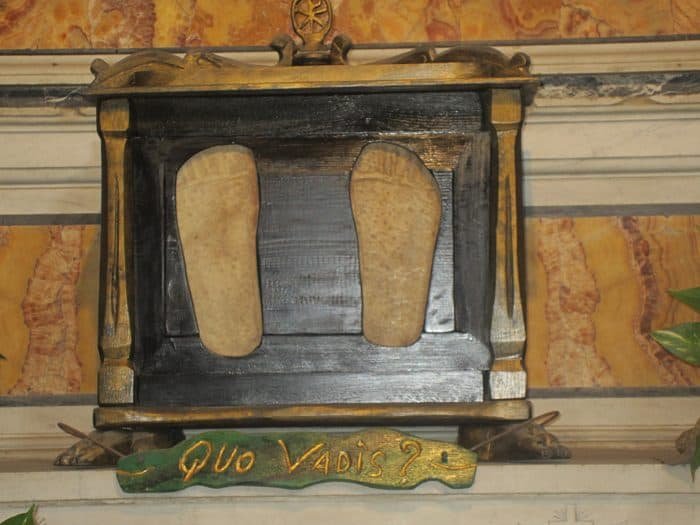
First piece, the certain one. In the center of the floor of the Domine Quo Vadis Church there is a marble slab with two footprints carved into it. Tradition says these are the footprints left by Jesus at the moment of his appearance to Peter. The one you see is a copy. The original is kept in the nearby Basilica of San Sebastiano fuori le Mura, at Via Appia Antica 136. On this point, the Italian and English encyclopedia entries agree. It's in bold because it's the detail missing from half the guides, and because it changes the meaning of the visit: you're looking at a reproduction of an object that is somewhere else, not the relic.
One clarification on where the original is: the official website of the Basilica of San Sebastiano fuori le Mura does not mention the slab with the footprints among the items on display. That doesn't mean it isn't there. It means there's no official confirmation of its exact location inside the basilica. If you go there specifically, ask in the sacristy before walking through all the aisles.
Second piece, the measurements. It's often said that the footprints are 27.5 centimeters long, corresponding to a shoe size of 44 or 45, a notable size for the period. The figure also appears in the Italian encyclopedia entry, but it isn't confirmed by any official source: it should be treated as a reported figure, not a verified measurement. One observation: if these are votive footprints carved by a stonemason, their length says something about workshop conventions and little or nothing about anyone's foot.
Third piece, and the most interesting one. It's often said that this is actually a pagan ex voto to the god Redicolo, offered by a traveler before leaving to secure a safe journey, or upon returning to give thanks, and that a similar example can be seen at the Capitoline Museums. Two clarifications. The first: the idea that this site has a background tied to the god Redicolo also appears in the English encyclopedia entry, which says the site could represent the Christian adaptation of a temple dedicated to Rediculus. So the hypothesis exists, and it isn't an invention. The second: no source confirms that the slab with the footprints is specifically an ex voto for Redicolo, and none confirms the presence of a similar ex voto at the Capitoline Museums. So the correct picture is this. That carved footprint slabs were an ancient votive genre is plausible and recurrent in scholarship. That this slab is an ex voto for Redicolo is a scholarly hypothesis. That a twin of it exists on the Capitoline Hill is unverified.
In our view, a piece of marble with two carved feet, in a roadside shrine on a consular road, has every appearance of an ancient votive object reread in a Christian key. This kind of thing has happened a hundred times in Rome. But "has every appearance of" is not a source, and the difference between the two phrases shouldn't be lost.
The God Redicolo, Hannibal and the Field Outside Porta Capena
Since the name Redicolo has come up, it's worth telling the story properly, because it's one of the most Roman stories there is.
Rediculus was a minor Roman deity whose shrine, the fanum Rediculi, stood outside the Porta Capena, that is, right in this area, at the start of the Appian Way. The most cited source is Festus, who writes: "Rediculi fanum extra portam Capenam fuit, quia accedens ad Urbem Hannibal ex eo loco redierit quibusdam perterritus visis". Literally: the shrine of Redicolo stood outside the Porta Capena, because Hannibal, approaching the city, turned back from that place, frightened by certain apparitions.
The historical context is 211 BC, when Hannibal arrives before Rome and then withdraws. Roman tradition explains that retreat with divine intervention: the god appears to the Carthaginian and tells him to redire, to turn back. In one version, the divine request takes the form of a hailstorm. Varro, in the Saturae Menippeae, book XXXIX, gives the god the epithet Tutanus, meaning protector, and puts into his mouth some verses in which he claims to have defeated Hannibal's army at night. Pliny the Elder, in the Naturalis Historia, mentions the temple and also tells a separate story, that of a talking crow buried in the campus Rediculi. And he adds a topographical detail that is worth its weight in gold here: the temple stood on the side of the Appian Way opposite the tomb of Herodes Atticus and Regilla.
On the etymology there are two versions, and both should be reported, because the ancients themselves didn't agree. The first derives the name from redire, to turn back, in reference to Hannibal's retreat. The second derives it from ridiculus, ridiculous, and claims that the Romans founded the temple to keep mocking the enemy who had run away. The first is the official explanation, the second is the joke. Knowing the Romans, it's best to keep both open.
Why tell all this when talking about the Domine Quo Vadis Church?. Because it shows what kind of place this crossroads is. Here, within 300 meters and four centuries, there have accumulated: a sanctuary dedicated to the god who makes enemies turn back, the funerary estate of Herodes Atticus and Annia Regilla, and a church built on the spot where, according to the story, an apostle turns back. The theme of turning back has persisted on this stretch of the Appian Way since before Christianity. Either it's a coincidence or a layering, and it's the most interesting thing in the whole area.
A warning about attributions, because it's easy to get this wrong here. In the Valle della Caffarella there is a building that scholarly tradition calls the "temple of the god Redicolo." The website of the Comitato per il Parco della Caffarella clarifies that it is actually a Roman funerary building from the 2nd century AD, most likely the tomb of Annia Regilla, and that the traditional name remains unexplained. So: the fanum of Redicolo from the ancient sources and the so-called "temple of Redicolo" in the Caffarella are two different things, and anyone who confuses them is making a mess. This happens often in guidebooks.
The 1081 Document and the Name of the Domine Quo Vadis Church?
Now for the piece that is worth more than all the others, and it is the only truly documentary datum the sources cite on the ancient history of this church. On the website of the Comitato per il Parco della Caffarella, on the page dedicated to the so-called temple of Redicolo, a document from 1081 is cited. It names the place where the "valche" operated, that is, the installations for fulling and washing cloth, and it contains this formula: concedimus Sanctam Mariam que cognominatur Domine quo Vadis. We grant Santa Maria, who is nicknamed Domine quo Vadis.
Let's stop for a moment on that line, because it says three things at once. First: in 1081 the church already existed. Second: its official name was already Santa Maria, and "Domine quo Vadis" was already a nickname, a cognomen, that is, the way people called it. Third: the church was the subject of a grant, so it was a property with an income, not an abandoned chapel. 11 centuries later the substance hasn't changed: today's signs say Santa Maria in Palmis and everyone calls it Domine Quo Vadis.
This evidence allows us to set the chronology better than the generic formula "medieval origins." The other dates come from encyclopedia sources, not official ones, and should be taken as such. The Italian entry speaks of a small chapel erected in the 9th century, while the English one says that a shrine has existed on this site since the 9th century and that the current church dates from 1637. So, in order of solidity: The existence of the church and its double name in 1081 is documented by a deed. The origin in the 9th century is a tradition reported by encyclopedias. The 17th-century rebuilding agrees across all sources and is visible to the eye.
There is a curious secondary detail. The 1081 document speaks of valche. The valche were fulling mills, hydraulic installations for beating and degreasing wool cloth, and they stood where there was running water. We are at the confluence of the Appian Way and the Almone valley, and the water was there. So the Domine Quo Vadis Church in the 11th century did not stand in the middle of a landscape of romantic ruins. It stood inside a productive area, with people working and making noise. The archaeological silence of the Appian Way is a recent invention.
Why It Is Also Called Santa Maria in Palmis
The Domine Quo Vadis Church has two names, and it's good to know both, because on official documents, on signs and in diocesan lists you will almost always find the second.
The official name is Santa Maria in Palmis. The popular name, the one everyone uses, is Domine Quo Vadis. About the origin of the second there is no doubt: it comes from Peter's question. About the origin of the first, the traditional explanation is that "in Palmis" derives precisely from the episode of the footprints. Palma in Latin is the palm, and it applies both to the hand and, by extension, to the sole of the foot. The footprints in the stone are the palmae. This etymology is not discussed in any official source. It is the current explanation, but it remains a traditional one.
The nice thing, and it says a lot about how names work in Rome, is that the 1081 document already records the double name. The notary writes the liturgical name and then adds the nickname, because otherwise nobody would know which Santa Maria is meant. In Rome there are hundreds of Santa Marias, and the nickname is the only address that works: Santa Maria in Trastevere, Santa Maria in Cosmedin, Santa Maria sopra Minerva, Santa Maria in Palmis. The nickname is the real name.
What You See Inside the Domine Quo Vadis Church?, Step by Step
The inside of the Domine Quo Vadis Church is very small, and you can get around it in a little under a quarter of an hour. It's best to follow it in the order you come across things, because without a route you leave with the idea of having seen a white room with a strange floor.
From the street you see a simple facade, with a single order. The current description is this: the facade is divided by two side pilasters, that is, two flat pillars set against the wall. At the top there is a tympanum and the coat of arms of the Barberini. Above the entrance door sits a smaller tympanum, topped in turn by a large window. The coat of arms with the bees is the patron's signature, and it alone tells you what century you're in.
You enter, and the church is a single nave, with no columns, no transept, and no dome. Look up at the altar: in the center is the image of the Madonna of the Transit, and on either side are two frescoes, the Crucifixion of Jesus and the Crucifixion of Peter. Above the altar, inside a lunette, is the fresco of the Meeting of Jesus with Peter, the scene that gives the whole place its name. On the side walls, two other frescoes with the same subjects are repeated.
There is only one side chapel, and inside it there's something that deserves two minutes: a fresco of Saint Francis and the view of Rome with its churches. The views of Rome painted inside churches are documents, not decorations. They show which buildings were recognizable and important at the moment someone picked up the brush. Look at it searching for the bell towers you recognize.
In the center of the floor, set into it, is the slab with the two footprints. It's the spot where 90 percent of visitors stop, often without knowing it's a copy. Watch where you step: it's an old floor, not a museum walkway.
Finally, on the right as you enter, there's the bronze bust of Henryk Sienkiewicz, the Polish writer. The English encyclopedia entry specifies that the bust stands on a modern column and that, according to tradition, Sienkiewicz got the inspiration for his novel while sitting in this church. The bust gets a chapter of its own, because it's the reason this place is famous in half the world.
A clear opinion, and not everyone will like it: from an artistic point of view, the Domine Quo Vadis Church is modest. The frescoes are by a routine hand, the architecture is elementary, and the facade is clean and without inventions. If you come to Rome for art, this isn't the place to spend an hour. If you come to understand a story and to see where the real Appian Way begins, then it's worth the trip, and it's worth more than much more celebrated places.
The 17th-Century Rebuilding and the Barberini Coat of Arms
The church you see today is not the medieval one. The English encyclopedia entry states bluntly that the current church dates from 1637 and that the facade is 17th-century. The Italian entry speaks of a chapel built in the 9th century and a 17th-century rebuilding. The two entries agree on the century, and only the English one gives the exact date. It should be taken as an encyclopedic reading, not as an archival document, because no consultable diplomatic source confirms 1637.
The 17th-century rebuilding can be read in the facade before anything else. Two side pilasters, a triangular tympanum, a simple portal. No giant order, no columns, no play of curves. Compare it in your mind with what was being built inside the walls in the same decade, and you immediately understand that here there was neither the patron nor the budget for architecture. It was a church for the road, on a road that was then open and dangerous countryside.
For years the facade has been credited with a coat of arms of the Barberini family. However, the coat of arms on the facade does not appear to be confirmed by consultable sources: the two encyclopedic entries describe the facade without mentioning it. It's a piece of information that has appeared in guides for years, to be checked with your own eyes when you stand in front of the church. The Barberini bees, if they're there, can be seen with the naked eye from the sidewalk: there are three, arranged in a triangle. If you see them, the tradition is confirmed on the spot.
One element that holds up without problems is the general chronology of the site. The church has stood there for at least 1,000 years in some form, because the document of 1081 already names it with that nickname. Even earlier, according to the English encyclopedic reading, the site may have been a shrine from the 9th century. And earlier still, again according to the same reading, a temple to Rediculus may have stood in this area, which Christianity would have repurposed. These are three layers of hypotheses stacked one on top of the other, and in our view they should be kept separate rather than merged into a single story: the 1081 document is a fact, the 9th-century shrine is a reconstruction, and the repurposed pagan temple is a conjecture.
Who Runs the Domine Quo Vadis Church Today?
The Italian encyclopedia entry lists the officiating body as the Congregazione di San Michele Arcangelo, the Micaeliti, with an attached 17th-century convent.
As for how certain this is, the information rests on an encyclopedia entry, not on a direct source from the organization. If it matters to you, for example because you want to know whom to contact for a Mass or a group visit, ask on site or at the Vicariate of Rome.
The practical point that follows from this is simple: the Domine Quo Vadis Church is a place of worship, not a museum. That changes how people behave there. It isn't a place where you walk in talking loudly, eating a sandwich, or livestreaming with your phone in hand. If someone is praying inside, you lower your voice and wait. It's not bigotry, it's that the place is open for free precisely because it's a church, and the way to keep it open is to behave accordingly.
Henryk Sienkiewicz, the Novel and the 1905 Nobel Prize
The reason the Domine Quo Vadis Church is known in Chicago, Warsaw and Manila isn't the architecture, and it isn't even the Appian Way. It's a novel. Quo vadis? by Henryk Sienkiewicz, published at the end of the 19th century, carried the question that gives this church its name around the world, and it has created a steady flow of visitors that has lasted 125 years.
The official Nobel Prize website gives these details: Henryk Sienkiewicz received the Nobel Prize in Literature in 1905, with the official citation because of his outstanding merits as an epic writer, that is, for his exceptional merits as an epic writer. Born May 5, 1846 in Wola Okrzejska, died November 15, 1916 in Vevey, Switzerland. One detail: the official Nobel page does not name the novel Quo Vadis in the citation. The prize was given for his body of epic work as a whole, not for a single book. Anyone who tells you that Sienkiewicz "won the Nobel for Quo Vadis" is oversimplifying.
Inside the church, on the right, is the writer's bronze bust. The English encyclopedia entry specifies two things: the bust rests on a modern column, and according to tradition Sienkiewicz supposedly conceived the novel while sitting right here. The verb matters: according to tradition. No document, no letter, no direct testimony appears to confirm the scene. It's a nice anecdote and perhaps true, but it remains an anecdote.
A bust in a church of this kind is a jarring note. It sits there the way an award sits in a trophy case, and it shifts the focus from the place to its literary reputation. That said, it's also the only thing inside the church that explains why there are Polish tour groups lining up in July. If you arrive while a group is inside, wait outside for 10 minutes: they move through quickly.
The Caffarella Valley, Starting Just a Little Further On
From the Domine Quo Vadis Church you can reach the Caffarella valley on foot, and that's one of the best reasons to put this church at the start of a day and not the end. The Caffarella is the green area between the Appian Way and Via Latina, and it's the only place in Rome where you can walk through an agricultural landscape inside the Grande Raccordo Anulare.
A few figures circulate about the Caffarella. Area of roughly 200 hectares, running from the Aurelian Walls to Via dell'Almone, with the Casale della Vaccareccia, the Sepolcro di Annia Regilla, the course of the Almone River, the remains of the Triopio di Erode Attico, and a main path of about six kilometers. No official park page confirms the hectare figure or the length of the route: these numbers should be taken as a traditionally repeated order of magnitude, not as official data. If you need the exact figure, ask at the Punto Informativo Turistico dell'Appia Antica, whose contact details you'll find further on.
One element of the Caffarella, however, is verified, and it is the one that links the valley to the history of our church's name. The caffarella.it page dedicated to the god Redicolo explains that the so-called temple of the god Redicolo visited in the valley is actually not a temple: it is a funerary building from the second century AD, probably the tomb of Annia Regilla, the wife of Herodes Atticus. The traditional name, the one still found on some signs and in many guidebooks, remains without a satisfactory explanation. So if you walk through the Caffarella and find the sign for the Temple of Redicolo, you'll know you're looking at a tomb that has carried the wrong name for centuries.
We've dedicated a whole page to the valley, with its routes and entry points: Caffarella Park. There is also a tiny, extraordinary church inside the valley, Church of Sant'Urbano alla Caffarella, that sits exactly above the presumed temple of Redicolo and can only be visited by reservation. If you have a full morning, the Domine Quo Vadis Church plus the Caffarella is the best walk you can take in this part of Rome.
Two Different Parks, and Why It's Worth Knowing
This is one of those boring things that still save you from wasting half a day. Two separate administrations operate on the Appian Way, with different sites, different contacts and different tickets.
On one side is the Parco Regionale dell'Appia Antica, a regional body that manages the land, the trails, the green areas and the information point. The contacts page lists its address as Via Appia Antica 42, 00179 Roma, phone 06 5126314, park ranger line 06 5115107 active from 7:30 to 19:00, and email info@parcoappiaantica.it. The office is open Monday to Thursday 9:00-13:30 and 14:30-16:30, and Friday 9:00-13:30. There is also the Punto Informativo Turistico Appia Antica: puntoappia@parcoappiaantica.it, phone and WhatsApp 06 5135316, open every day from 9:30 to 17:00, which becomes 18:00 during daylight saving time. This is the number to use for questions about the trails, bikes and guided tours.
On the other side is the Parco archeologico dell'Appia Antica, which depends on the Ministry of Culture and manages the state monuments: the Mausoleum of Cecilia Metella, the Villa dei Quintili, the Capo di Bove complex, the Circus of Maxentius and others. It has its own tickets and its own hours. On its website there is one detail that matters for you: the Domine Quo Vadis Church is not listed among the sites managed by the archaeological park. It is not a state monument, it is a church. So no archaeological park ticket is needed to enter, and no card covers it.
Also from the same official site, here are some details you'll need if you combine the church with a paid visit. The Capo di Bove complex is at Via Appia Antica 222, covers 8,600 square meters, holds a thermal bath complex dating from between the 2nd and 4th centuries, and houses the Archivio Cederna. The ticket is combined with Cecilia Metella: 8 euro full price, 2 euro reduced, 4 euro with Roma Pass. There is also an annual card called La Mia Appia Card at 25 euro. Note, however: the same official page reports that Capo di Bove has been closed to the public since June 22, 2026 for restoration work. If you had planned to go, check before you leave home.
For the Villa of the Quintilii, the official page lists two entrances, Via Appia Antica 251 and Via Appia Nuova 1092. It is open Tuesday to Sunday, with last entry 75 minutes before closing, and seasonal hours: October 9:00-18:30, November to February 9:00-16:30, March 9:00-18:30, April to September 9:00-19:15. Tickets: 8 euro full price, 2 euro reduced for citizens of the European Union aged 18 to 24, 4 euro with Roma Pass, free for under 18. Phone +39 333 6180565, email pa-appia.villaquintili@cultura.gov.it. You can get there by Metro Line A to Colli Albani and then by bus 664 or 663, or by bus 118, which also passes near us.
This split administration is a real hassle for visitors, who have no reason to know who manages what. In practice, there is no single ticket for the Appian Way and no single website. If you want to do things properly, keep two tabs open on your phone.
A Curiosity About the Domine Quo Vadis Church?
The real curiosity is not the legend, which everyone already knows. It's the name. The church's nickname, the one nobody would ever use for an ordinary church, is documented long before it became a tourist draw.
The caffarella.it page dedicated to the god Redicolo cites a document from 1081 that contains the phrase concedimus Sanctam Mariam que cognominatur Domine quo Vadis. Roughly translated: we grant Saint Mary, who is nicknamed Domine quo Vadis. The document also names the place of the valche, that is, the fulleries, the workshops where cloth was fulled using water. So a thousand years ago, in a deed of concession, that nickname was already the label used to identify the church, and around it there was a production activity tied to water.
A name that sounds like a nineteenth-century novel title is actually older than the novel by eight centuries. And the official name, Santa Maria in Palmis, is the one nobody uses. For the Domine Quo Vadis Church, the nickname beat the name, and it won so thoroughly that today the nickname is on road signs and maps.
A note on how layered this piece of Rome is. The 1081 document dates from the century when the Appian Way, outside Porta San Sebastiano, was a country road with towers, farmhouses and little else. The fact that it was worth writing a popular nickname for a small church into a notarial deed means that nickname was already the only way to make clear which church was being discussed. A communication success from the year 1000.
One Thing Nobody Tells You About the Domine Quo Vadis Church?
That it is not a monument and is not run by any park. And that, in a place where everything else has a ticket, is disorienting.
On the official website of the Archaeological Park of the Appian Way, which lists the sites the Ministry manages along the road, the full list does not include the Domine Quo Vadis Church. It's not an oversight. It's that it isn't a state property open to paid visits. It is a church with services, with its own opening hours, its own sexton and its own donation box. No card includes it, no combined ticket covers it, and no ministry website publishes its hours.
The practical result is twofold. On one hand, it's good news: you can enter for free, without booking, without a line. On the other hand, it's an inconvenience: there is no official online source that publishes reliable, up-to-date hours. The hours circulating online are reported by third parties, not published by the body that runs the church.
My advice, which is worth more than any timetable: treat it like any parish church. Go in the morning, between 9 and 12, or in the late afternoon before dinner. Avoid the central lunch window, which in Roman churches is the hour when it is most often found closed. And if you find it closed, you still have the façade, the junction and the start of the Appian Way in front of you.
The advice I give you for visiting the Domine Quo Vadis Church
There is only one piece of advice, and it comes as an order: don't come by car. Or rather, if you do come by car, don't stop here.
The church stands exactly at the junction of via Appia Antica and via Ardeatina, in a spot where the road is narrow, without a sidewalk worth the name, with a blind curve and traffic moving at speeds that don't match the width of the roadway. There is no parking. Cars parked in unregulated spots make visibility worse for everyone. It is the ugliest and most dangerous stretch of the entire Appian Way.
The best option, if you're up for walking, is to go on foot from Porta San Sebastiano. It's about 800 meters, with a slight uphill and then downhill stretch. You pass under the gate's arch, walk along the Aurelian Walls, and reach the junction in about 10 minutes. The Museo delle Mura, inside the gate at Via di Porta San Sebastiano 18, is an excellent starting point and is itself worth half an hour. On the museum's official website, the single contact number listed is 060608, and the same page noted Sunday, August 2 as a free-admission day.
For public transport, take bus 118. On the official pages of the Archaeological Park of the Appian Way, the 118 is listed as the line connecting the historic center with the Appian Way, with a reference terminus in the San Gregorio and Celio Vibenna area and stops along the road. This information should be taken for what it is: an indication from the official pages of nearby monuments, not a service timetable. Check routes and frequencies on the official channel of Rome's public transport on the day itself, because on this line summer and Sunday changes are frequent.
One last piece of advice, less logistical. Go in, look at the slab with the footprints, then come back out and turn your gaze south. That's where the stretch of the Appian Way begins that the official Archaeological Park website describes, word for word, as a long straight stretch that is exceptionally well preserved. The church is the entrance to that straight stretch. Seen this way, as a threshold and not a destination, it works much better.
Another well-known fact, yet rarely mentioned
That the footprints are a copy. Many people know this, it's written in half the internet, and yet every day someone kneels in front of the slab convinced they're looking at the original.
The Italian and English encyclopedia entries say the same thing: the slab you see in the Domine Quo Vadis Church is a copy, and the original is in the Basilica of San Sebastiano fuori le Mura, a little further along the same Appian Way. The same entries give the size of the footprints, 27.5 centimeters, which roughly corresponds to a shoe size of 44 or 45.
There is a limit, though. The official website of the Basilica di San Sebastiano fuori le mura lists the address, Via Appia Antica 136, 00179 Roma, the basilica's hours, October to March 8:15-18:00 and April to September 8:15-19:00, and the Mass times: Saturday at 18:00 or 18:30, Sunday at 8:30, at 10:00 except July and August, at 12:15 except August, and at 18:00 or 18:30. But the basilica's official website makes no mention of the slab with the footprints. So the location of the original at San Sebastiano is an encyclopedic and traditional detail, not confirmed by the body that should be keeping it. If you go and want to see it, ask in the sacristy before wandering around for nothing.
And then there's the point that gets mentioned even less, the one that makes the whole question really interesting: it is by no means certain that those footprints were originally a Christian object. The most widespread reading among scholars is that it is a pagan ex voto, a slab with footprints left by someone setting out on a journey or giving thanks for having come back. Ex votos of this type are documented in the Roman world. Christianity, arriving later, would have reinterpreted the object in light of its own history. A similar ex voto at the Capitoline Museums, often cited for comparison, is not confirmed by a direct museum source: it remains a comparison handed down through tradition and not verified.
The Right Photo to Take at Domine Quo Vadis Church?
The right photo is not the slab. The slab always comes out badly: it lies on the ground, the light inside is poor, and the flash flattens the relief and gives you two gray blurs that you can't make sense of on a phone.
The right photo is taken outside, with your back to the portal, with the Appian Way running off toward the south. Stand on the side of the church, wait for a gap between two cars, and frame the road narrowing between the low walls. It's the image that shows where you are: not in a monument, but at the start of the real Appian Way, the one that continues straight from here according to the description from the Parco archeologico. If you have a mid-range lens, the result is much better than with a wide-angle lens, because the wide-angle widens the road and kills the sense of perspective.
The second recommended photo is the three-quarter view of the facade, taken from the Ardeatina side. Head-on it doesn't work: it's a flat facade, with two pilasters and a pediment, and straight on it becomes a geometric drawing with no depth. From three-quarters you capture the side, the lateral wall and a bit of greenery behind, and the church stops looking like a backdrop.
Timing: late morning or early afternoon. The facade faces a direction that stays in shade in the early hours of the day, and in shade the travertine turns flat. At sunset the light is beautiful but the traffic is worse, and you end up standing in the middle of the road to take the photo, which is not advisable.
One common-sense rule inside: no flash, no tripods, no filming during services. It's a church open for free, not a set. If people are praying, you wait or you give up. You'll find the photo of the slab already taken everywhere, and yours won't add anything.
Some Important Events That Happened Here in History
Here are the main milestones, separating facts from traditions, because on this stretch of the Appian Way the two are usually mixed together.
211 BC, or thereabouts. The English encyclopedia entry on Rediculus quotes Festus word for word: Rediculi fanum extra portam Capenam fuit, quia accedens ad Urbem Hannibal ex eo loco redierit quibusdam perterritus visis. That is: the sanctuary of Rediculus stood outside the Porta Capena, because Hannibal, approaching Rome, turned back from that place frightened by certain apparitions. The same entry notes that Varro, in the Saturae Menippeae, book XXXIX, uses the epithet Tutanus for the same deity, and that Pliny the Elder mentions the temple and a talking crow buried in the campus Rediculi, placing the sanctuary on the side of the Appian Way opposite the tomb of Herodes Atticus and Regilla. The etymology wavers between redire, to return, and ridiculus. It should be said that this is Roman antiquarian material, not a chronicle: it tells us what the Romans told, not what happened.
Second half of the 2nd century AD. The Acts of Peter are composed, the apocryphal text in which the episode of the Quo vadis appears. The Italian encyclopedia entry dates them between 150 and 200 AD, probably in Asia Minor, written in Koine Greek and preserved above all in the Latin version called Actus Petri cum Simone, contained in the Codex Vercellensis of the Chapter Library of the Vercelli Cathedral. They are also the first attestation of Peter's crucifixion upside down. Tradition attributes them to Leucius Charinus. It bears repeating: this is an apocryphal text, not canonical, and it is not a historical source for the year 64.
2nd century AD, a little later. In the Caffarella Valley, the funerary building is constructed that for centuries will be called the temple of the god Redicolus and that, according to the caffarella.it page, is in all likelihood the tomb of Annia Regilla, wife of Herodes Atticus.
366-384 AD. The English encyclopedia entry recalls an epigram by Pope Damasus I dedicated to Peter and Paul, linked to the memory of the two apostles in this part of the Appian Way. The fact is encyclopedic.
9th century. According to the encyclopedia entries, a sanctuary or a small chapel already existed at this spot. It is the oldest reconstructed Christian presence for the site, and it remains a reconstruction.
1081. The document already cited grants Sanctam Mariam que cognominatur Domine quo Vadis. It is the first solid documentary basis for the name. It is the most important date on this list, and the most ignored.
1637. The English encyclopedia entry gives this date for the current church. A 17th-century rebuilding, facade with pilasters and a pediment, attached convent. Encyclopedic data, not archival.
1905. Henryk Sienkiewicz receives the Nobel Prize in Literature. Official data, from the prize's website. From then on the church becomes an international destination, and the bust enters the building.
March 24, 1944. A few hundred meters away, along Via Ardeatina which starts from this crossroads, takes place the Fosse Ardeatine massacre: 335 victims. The data comes from the official website of the Mausoleum, which lists Via Ardeatina 174, 00179 Roma, open Monday to Friday 8:15-15:15 and Saturday and Sunday 8:15-16:45, free admission, contacts info@anfim.org and +39 06 6795629. The Ardeatine Caves Mausoleum is not a tourist add-on to this walk: it is the reason the Ardeatina, which begins here, is not a road like the others.
June 22, 2026. The Capo di Bove complex, a little further along the Appian Way, closes to the public for restoration. Data from the official page of the Archaeological Park. It is on this list because it is the only recent event that concretely changes the day of anyone coming here.
Who has passed by Domine Quo Vadis Church?
In order, and with the honesty to separate those who actually passed through from those who passed through only in the story.
Peter, in the account of the Apocryphal Acts. This is the reason the name exists, and it is the only presence for which we have not the slightest proof. The Acts of Peter tell that the apostle, fleeing Rome during the persecution, meets Christ going in the opposite direction, asks him Domine, quo vadis? and hears in reply that he is going to Rome to be crucified again. Peter turns back. The text is apocryphal, composed more than a century after the events it recounts. Anyone who presents this scene as history is making a leap that the sources do not allow.
Hannibal, in the Roman antiquarian account. Outside the Porta Capena, according to Festus, the Carthaginian general supposedly stopped and turned back. The sanctuary of Rediculus arose from that memory. That Hannibal came within sight of Rome is history, that he stopped at this spot because of an apparition is an etiological legend, meaning a story built to explain a name.
Roman travelers, unnamed. If the votive offering hypothesis holds, ordinary people heading south passed through here, leaving a mark of their feet in the hope of returning. They are the least celebrated figures and, in our judgment, the most interesting in the whole history of this crossroads.
Pope Damasus I, by association. His epigram on Peter and Paul ties his memory to this stretch of the Appian Way, according to the English encyclopedia entry.
Henryk Sienkiewicz, according to tradition. The bronze bust inside the church and the story of the inspiration for the novel. The anecdote is tradition: no direct source documents it. The 1905 Nobel, on the other hand, is documented by the prize's official website.
Anyone who has walked the Appian Way in the last two millennia. Said without rhetoric: this crossroads is the point where the consular road separates from the city. Those heading to Brindisi, those returning from the East, those carrying goods, those fleeing, those marching. They all passed here, because there was no other road. The church came later, and it put a roof over a crossroads that was already important.
What's within 10 minutes on foot of Domine Quo Vadis Church?
The crossroads is a distribution hub, and this is its best quality. Here is what you can reach on foot, with the distances you actually walk and not the ones a map promises.
Toward the north, backward. 800 meters and you're at Porta San Sebastiano, the largest and best-preserved gate of the Aurelian Walls, which houses the Museum of the Walls at Via di Porta San Sebastiano 18, 00179 Roma. From the museum you walk the patrol path, and it's the only spot in Rome where you can see the city from the top of the walls. Another 10 minutes on foot from the gate and you reach the Baths of Caracalla.
South, straight on along the Appian Way. About a kilometer and a half and you reach the Catacombs of St. Callixtus, then the Basilica of St. Sebastian Outside the Walls at Via Appia Antica 136, where according to tradition the original of the slab is kept, and the Catacombs of St. Sebastian. Just beyond is the Villa of Maxentius. If you have the legs and half a day, keep going to Capo di Bove at number 222, which however has been closed for restoration since June 22, 2026, according to the official page.
East, into the greenery. You go down into the valley and enter the Caffarella Park. From there you reach the Church of Sant'Urbano alla Caffarella, which is visited by reservation only, and you can continue toward the Aqueducts Park if you have a full day and sturdy shoes.
West, along the Ardeatina. The Mausoleum of the Ardeatine Caves, Via Ardeatina 174. Free admission, hours from the official website: Monday-Friday 8:15-15:15, Saturday and Sunday 8:15-16:45.
For the overall picture of the area, see our page on the Appian Way Regional Park, and if the underground world interests you, we have a cross-cutting guide to the Catacombs of Rome.
How to fit Domine Quo Vadis Church into a day on the Appian Way
Two routes that really work. These are not guidebook itineraries: they are about timing and walking.
Half a day, all on foot. Start at 9:00 from the Baths of Caracalla. Head up Via di Porta San Sebastiano, enter the Museo delle Mura, walk the walkway along the top of the walls, come down and take the Appian Way. By around 11:00 you're at Domine Quo Vadis Church, which at that hour has a good chance of being open and not crowded. 20 minutes in and out. Then you decide: either go down into the Caffarella and head back to the city through the valley, or continue on the Appian Way toward the catacombs. Either way, you'll be having a late lunch.
Full day, by transit and on foot. Early morning at the Villa of the Quintilii, which opens at 9:00 and, according to the official page, is closed on Mondays. Take Metro A to Colli Albani, then bus 664 or 663, or the 118. Around noon, walk down the Appian Way toward the city, seeing the monuments you pass, and finish in the afternoon at Domine Quo Vadis Church and Porta San Sebastiano. The advantage of this direction is that you end up near central transit instead of finding yourself nine kilometers from home at seven in the evening.
One warning, no beating around the bush: the Appian Way is not an urban stroll. The first stretch, the one that starts from our church, is shared with cars, has no continuous sidewalk, and in places forces you to walk right up against the wall. Sundays are much better, since private traffic has historically been restricted on part of the road, but check the conditions the day before you go: the Sunday traffic rules are not confirmed by an official source.
With children, with little time, with mobility difficulties
With children. The church itself keeps them busy for five minutes, and those are the five minutes of the slab. The fact that you can see two footprints in the marble works on anyone under 10. The advice is to tell the story before going in, outside, while looking at the Appian Way: the escape, the meeting, the question, the return. Then go in and look for the slab. Also tell them it's a copy: kids handle the truth very well, it's the adults who get offended.
With little time. 20 minutes is enough for the church. If you have 40, add the 50 meters on the Appian Way past the fork, just to see the start of the straight stretch. If you have less than 20, don't come: getting here always takes longer than the visit, and you'd end up spending an hour getting there for a quarter hour of church.
With mobility difficulties. No official source exists on the accessibility of the Domine Quo Vadis Church. Given the nature of the site, one can say the building is small and on one level, so the interior has no significant internal stairs, but the real problem is getting there: the road around it is narrow, the surface is uneven, and the sidewalk is discontinuous. Anyone using a wheelchair or walking with difficulty should think about the approach route before thinking about the entrance. If you need a definite answer, the Punto Informativo Turistico dell'Appia Antica also answers on WhatsApp at 06 5135316, every day from 9:30 to 17:00, and until 18:00 during daylight saving time.
When to come and when to avoid
The best time is spring and the first half of autumn. April, May, October. The light is good, the Caffarella is green, and walking doesn't kill you. In those months the long opening hours of the nearby monuments let you do more: the Villa dei Quintili, for example, according to its official page, closes at 19:15 from April to September and at 18:30 in October and March.
The worst time is July and August during the central hours of the day. There is no shade on the first stretch of the Appian Way, the asphalt gives back heat, and Roman churches have reduced hours in August. A concrete detail from the website of the Basilica of San Sebastiano: the 10:00 Mass is not celebrated in July and August, and the 12:15 Mass is not celebrated in August. It's a clue to how summer works around here.
Sunday has two sides. On one hand, it's the day when the Appian Way is most livable and most used by walkers and cyclists. On the other, it's the day when the church is a full church, with services, and when the sightseeing visit has to take second place. If you go on a Sunday, go early or in the afternoon.
An opportunity to note. The website of the Museo delle Mura listed Sunday, August 2 as a free-admission day. Around that date is the chance to combine the walls and the church in half a morning at no cost. Check the museum's official channel, because free-admission days change from month to month.
The contradictions that remain open
What the sources don't resolve remains open. Here they are in order, so you can form your own view.
The first. Origin of the slab with the footprints. Version A, the traditional Christian one: they are the footprints left by Christ in his encounter with Peter. Version B, the historical-archaeological one, consistent with Roman practice: they are a pagan votive offering, left by a traveler setting out or returning, later reread in Christian terms. The two versions cannot be reconciled, and no source settles the question. Sources: the Italian and English encyclopedia entries.
The second. The name of the deity and the nature of its sanctuary. Version A: outside Porta Capena there was a fanum of Rediculus, and the English encyclopedia entry quotes Festus word for word. Version B: the caffarella.it page says the building called the temple of Redicolo in the valley is actually a 2nd century tomb, and that the traditional name remains unexplained. The two can coexist only if the ancient sanctuary and the modern building called a temple are two different places, but no source states this explicitly.
The third. The church's chronology. Version A, English encyclopedia entry: sanctuary from the 9th century, current church from 1637. Version B, Italian encyclopedia entry: chapel built in the 9th century, a 17th century rebuilding with no precise date. The two resemble each other but do not agree on precision. Anyone who gives you 1637 as a certainty is using only one of the two.
The fourth. Opening hours. There is no official version. Different hours circulate on third-party sites, and none of them is published by the body that runs the church. Anyone who gives you a precise opening time for the Domine Quo Vadis Church is passing on something they cannot guarantee. That's why you won't find a timetable here: you'll find a recommended time window and a reminder to check.
Anatomy of a Legend: An Apocryphal Text, a Fork in the Road and a Reused Stone
The Domine Quo Vadis Church is one of the few places in Rome where you can see, in a few square meters, the mechanism by which a legend is born: a story that isn't in the canonical books, a topography that makes it plausible, and an ancient object reused to give it body. Taken one by one, these three things can be explained perfectly well. Put together, they produced one of the best-known scenes in Roman Christianity, and taking them apart in order is more interesting than either believing it or dismissing it.
The story does not come from the Gospels
This is the decisive point, and it's best to say so right away: the episode of "Domine, quo vadis?" does not appear in the four Gospels or in the Acts of the Apostles, in any form. It appears instead in the Acts of Peter, an apocryphal text that scholars place in the second half of the 2nd century and that we know mainly through a Latin translation preserved in a manuscript kept in Vercelli. The apocryphon is not a modern forgery. It is ancient Christian literature. It circulated, it was read, but it never entered the canon, and the Church does not consider it Scripture.
In the story, Peter leaves Rome to escape persecution. On the road he meets Christ walking in the opposite direction, asks him where he is going, and hears in reply that he is going to Rome to be crucified a second time. Peter understands, turns back, and faces martyrdom. The scene has a precise function within that text: to explain why the apostle did not flee. It is constructed as a lesson, not as a chronicle.
From there the episode had a long life. It was taken up by later Christian authors and then by the great medieval hagiographic collection, the Legenda Aurea of Iacopo da Varazze, which in the thirteenth century passed it on to all of Europe. When the nineteenth century drew from it the title of a hugely successful novel, and then cinema turned it into a colossal production, the scene had been common heritage for seven centuries. Literary success widened the audience, not the evidence. The starting point remains an apocryphon from the 2nd century.
The slab: what it really is, and where the original is
Inside the church, at the center of the floor, you can see a marble slab with two footprints. Two caveats, and both are documented. The first: the one displayed here is a copy. The original is a little further on, in the Basilica of San Sebastiano fuori le Mura, where it was moved and is still kept. Anyone who enters convinced they are looking at the stone of tradition is looking at a cast.
The second caveat concerns the object itself. Scholars consider it most likely that it is a Roman ex voto from the pagan era, not an imprint left by someone. The two footprints carved in the marble belong to a genre well attested in the Roman world: the so-called plantae pedum, slabs with carved feet that were dedicated to deities on the occasion of a journey. Some are known with formulas tied to departure and return. They appeared along the consular roads and in suburban sanctuaries, that is, exactly where a traveler passed on leaving the city or returning to it. They were an offering for a journey completed or for a safe return, an ordinary religious gesture.
What stays open is exactly what is always open with a piece that has no certain inscription and no excavation context: which deity it was dedicated to, in what year, and by whom. With reasonable certainty one can name the type. The rest is reconstruction. Anyone who presents it as a miraculous imprint is making a claim no source supports. Anyone who dismisses it as a forgery made on purpose is exaggerating in the other direction, because the stone is genuinely ancient. It simply speaks of a different religion.
The fork in the road, that is, why the scene is here
The church stands where the Appian Way splits from the via Ardeatina, a few hundred meters from the walls, just outside Porta San Sebastiano. It is a topographical detail that explains a lot. A man fleeing Rome toward the south in the 1st century would have passed right through here. It was the point where you had to choose the road, and choosing the road is exactly the metaphor on which the story is built. The legend settled where the ground made it believable.
The fork, though, was not an ordinary place even before. This suburban stretch was dense with tombs, sanctuaries and roadside cults, and the large underground Christian cemeteries are just a step away, from the Catacombs of San Callisto onward. When a story looks for a specific point to attach itself to, it almost always chooses a place already charged with meaning. Here there was plenty of it.
Reuse: how an object changes religion
The point that makes this case instructive is the meeting of the two things. A slab with two carved feet, left by a Roman traveler along the Appian Way, stays in place for centuries. On the same stretch of road, a story about Peter who turns back has been circulating for a long time. At some point someone connects the two, and the ex voto becomes the material proof of the encounter. No fraud is needed. It is enough that one generation finds obvious what the previous one had only imagined.
Rome is full of this mechanism. Stones and blocks from the Roman era have been read in a Christian key for centuries, and in more than one case modern studies have returned the object to its original function without the cult suffering for it. Here the outcome is the same: the slab remains interesting, but for different reasons than those for which it is usually looked at. It tells of an ancient traveler, not of an apparition.
What remains solid, once the legend is set aside
Dismantling it does not mean erasing it. That Peter died a martyr in Rome under Nero is a very ancient and widely accepted Christian tradition, attested as early as the late first century and in the second. That there was a Christian community in Rome in those years is beyond dispute. The encounter on the Appian Way, however, belongs to an apocryphal text and not to that core. It is tradition, not chronicle, and the two levels should not be confused.
There is also a different kind of historical fact: the duration of the story. A scene born in a non-canonical text of the second century has passed through medieval preaching, reached novels and film, and still brings people to this stretch of road, regardless of how it actually happened.
Quick questions about the Domine Quo Vadis Church?
Where exactly is the Domine Quo Vadis Church?
At the fork between Via Appia Antica and Via Ardeatina, just outside Porta San Sebastiano, in the south quadrant of Rome. The street number does not appear in any official source. As a geographic reference, the intersection is unmistakable.
Do you have to pay to enter?
No. It is a church where services are held, not a ticketed monument. The website of the Parco archeologico dell'Appia Antica does not list it among the sites managed by the Ministry, so there is no state ticket and no card that includes it. As in every church, there is a donation box.
What are the opening hours of the Domine Quo Vadis Church?
They are not published by an official source. The recommended window is late morning, between nine and 12, or late afternoon. Avoid the lunch hour. If you need certainty, ask the Punto Informativo Turistico dell'Appia Antica, 06 5135316, also via WhatsApp, every day 9:30-17:00 and until 18:00 during daylight saving time.
Do I need a reservation?
No. There is no booking system. You just walk through the door.
How long does a visit take?
20 minutes inside is plenty. Add 10 minutes outside to look at the entrance to the Appian Way, which is the best part.
Are the footprints in the marble real?
They are genuine footprints carved into a marble slab, but the one you see in the church is a copy. The Italian and English encyclopedia entries place the original in the Basilica of San Sebastiano outside the walls. The basilica's official website does not mention it, so it's best to ask in the sacristy.
How big are the footprints?
27.5 centimeters, according to the Italian encyclopedia entry. That corresponds to a shoe size of 44 or 45.
Are the footprints Christian or pagan?
The sources disagree. Christian tradition reads them as the footprints of Christ. The historical-archaeological reading interprets them as a pagan ex voto left by travelers. No source settles the question.
What is the official name of the church?
Santa Maria in Palmis. The Italian encyclopedia entry lists it as Chiesa di Santa Maria in Palmis, Quo Vadis. The nickname has completely replaced the official name in common use.
Where does the Quo Vadis story come from?
From the Acts of Peter, an apocryphal text dated between 150 and 200 AD according to the Italian encyclopedia entry, written in Greek and preserved mainly in the Latin version Actus Petri cum Simone in the Codex Vercellensis. It is not a canonical text and not a historical source on the events of the first century.
Is the Domine Quo Vadis Church old?
The name is documented in a document from 1081. The encyclopedia entries mention a chapel or shrine as early as the ninth century. The building you see dates from the 17th century, and the English encyclopedia entry gives 1637.
Who runs it?
According to the Italian encyclopedia entry, the Congregation of San Michele Arcangelo, with a 17th-century convent attached. The information is not confirmed by a direct source from the organization.
How do I get there on foot?
From Porta San Sebastiano it is about 800 meters along Via Appia Antica. Just under 10 minutes, but on a road open to traffic and with an intermittent sidewalk.
How do I get there by public transport?
The reference is line 118, listed on the official pages of the Parco archeologico dell'Appia Antica as a connection between the historic center and the Appian Way. Route and timetables should be checked on the day itself on the official channel of Rome's public transport.
Can I drive there?
Technically yes, but in practice it is not advisable. There is no parking, the road is narrow, the curve is blind, and unregulated parking at that spot is a safety problem for everyone.
Can I take photos inside?
With common sense and without flash. It is a working church: no filming during services, no tripods, and if someone is praying, you wait.
Is there a link to Sienkiewicz's novel?
Inside the church there is a bronze bust of the writer on a modern column. According to tradition, as reported by the English encyclopedia entry, Sienkiewicz would have found the inspiration for the novel here. It is tradition, not documentation. The 1905 Nobel Prize, on the other hand, is a documented fact on the prize's official website.
Is it worth going with children?
Yes, for the slab with the footprints, which wins them over in two seconds. Tell the story outside before going in, and tell them that what they see is a copy.
Is it accessible to people with mobility difficulties?
No official source on accessibility is available. The building is small and on one level, but the approach is problematic: narrow road, uneven surface, broken sidewalk. For a definite answer, call the Appia Antica Tourist Information Point, 06 5135316.
What do I see inside?
A single nave, the slab with the footprints set into the floor, frescoes of the Crucifixion of Christ and that of Peter, a lunette with the meeting of Peter and Christ, a Madonna del Transito, a side chapel with Saint Francis and a view of Rome, and the bust of Sienkiewicz.
What's right after the church on the Appian Way?
The stretch begins that the official website of the Archaeological Park of the Appian Way describes as a long, exceptionally well-preserved straightaway. Further on you'll come to the Catacombs of San Callisto, San Sebastiano fuori le Mura and its catacombs, and the Villa of Maxentius.
Can I combine the visit with the Mausoleum of the Ardeatine Caves?
Yes, it's on Via Ardeatina, which starts from this same junction, at number 174. According to the official website: free admission, Monday-Friday 8:15-15:15, Saturday and Sunday 8:15-16:45.
Is Capo di Bove open to visitors?
No. The official page of the Archaeological Park reports that it is closed to the public from June 22, 2026 for restoration work.
How much does the Villa of the Quintilii cost?
According to the official website: 8 euros full price, 2 euros reduced for EU citizens aged 18 to 24, 4 euros with Roma Pass, free for under 18s. Open Tuesday to Sunday, seasonal hours, last entry 75 minutes before closing.
Who manages the Appian Way?
Two different bodies. The Parco Regionale dell'Appia Antica, Via Appia Antica 42, phone 06 5126314, for the territory and tourist information. The Parco archeologico dell'Appia Antica, which depends on the Ministry of Culture, for the state monuments and tickets. They are separate entities, with separate sites.
Can you reach La Caffarella from here?
Yes, on foot. The valley begins just past the junction. Inside there are the Casale della Vaccareccia, the course of the Almone, the remains linked to Herodes Atticus, and the small church of Sant'Urbano, which can only be visited by reservation.
What is the most common mistake people make when they come here?
Thinking it's a destination and not a passage. It's a small church, modest from an artistic point of view, with a copy inside. Its value is the place where it stands: the start of the real Appian Way, the junction with the Ardeatina, the threshold between city and countryside. Those who arrive expecting a monument are disappointed. Those who arrive knowing what it is come back.
The Domine Quo Vadis Church is the most famous and most misunderstood spot on the Appian Way. People arrive, photograph two footprints that are a copy, leave, and go away convinced they've seen the scene of a legend. It's better to do the opposite. Go inside, take a quick look at the slab, then step back out and stand for 10 minutes at the edge of the road, looking at the road as it narrows and heads south. That's the real thing. Armies, merchants, pilgrims and people fleeing have set out from there for 2,300 years. The church came later, to put a name to a question that everyone has asked at least once in their life while looking at a road that moves away. You don't need to believe the legend to understand why they built a church right there. You just need to stand in that spot and look in the right direction.