Aqueducts Park
In short. The Parco degli Acquedotti is located in Rome with its main entrance on via Lemonia, in the Appio Claudio neighborhood, southeast of the center.
The Parco degli Acquedotti is located in Rome with its main entrance on via Lemonia, in the Appio Claudio neighborhood, southeast of the center. Access is free of charge, with no ticket, no ticket office and no closing time: you can enter on foot or by bicycle from via Lemonia, from via delle Capannelle and from several openings along the perimeter. You can get there on Metro A, getting off at Giulio Agricola or Subaugusta, from which it's about 10 minutes on foot to the arches. Lucio Sestio and Cinecittà are also convenient, depending on where you want to enter. By bus, lines 557, 559, 590, 650 and 654 serve the area. The park covers about 240 hectares of open meadow crossed by the arches of the ancient aqueducts, and it is the most photographed stretch of the Parco regionale dell'Appia Antica. Updated details on access and any guided tours are on the official website of the Parco archeologico dell'Appia Antica.
Anyone who knows Rome knows this is one of the few places where antiquity isn't fenced off behind a ticket booth: the arches of the Claudio run through the grass, dogs chase balls under pillars 2,000 years old, and people jog where the water that supplied the Palatine once flowed. It's worth understanding this before you arrive, because at first glance it looks like a meadow with some ruins, when in fact it's the densest concentration of Roman aqueducts to survive outside the walls.
Where it is and how to get to the Parco degli Acquedotti
The park occupies the strip of countryside between the Appio Claudio neighborhood, via delle Capannelle and the Rome-Cassino-Naples railway line, in Municipio VII (the ancient Tuscolano). The reference address is via Lemonia, 00174 Rome, but there is no monumental entrance: the park opens along its entire perimeter and you enter wherever you happen to be, often by simply crossing the street from the neighborhood.
Getting to the Parco degli Acquedotti by metro
Metro Line A runs along the entire north side of the park. The useful stops, from north to south, are Giulio Agricola, Subaugusta, Cinecittà and Lucio Sestio. From Giulio Agricola and Subaugusta you reach the first arches in eight to 10 minutes on foot, passing through the residential streets of the neighborhood. This is the route I recommend to those coming from the center, because it drops you right at the height of the Felice aqueduct. From Lucio Sestio you enter closer to the southern sector, the one toward Roma Vecchia. Keep in mind that from the station to the grass there is always a stretch of city to cross: the park doesn't have its own metro entrance.
By bus and by bicycle
The surface lines that run alongside the Parco degli Acquedotti are the 557, 559, 590, 650 and 654. Stops change names constantly, so it's best to set via Lemonia or via del Quadraro as your destination in the transit app. By bicycle, the park is connected to the cycle and pedestrian path that runs down toward Tor Fiscale and, from there, toward the Caffarella and the Appian Way: it's one of the longest green routes Rome can offer without touching traffic. Those arriving by car will find free parking on the neighborhood streets, with the patience typical of every Roman residential area.
What the Parco degli Acquedotti is
The Parco degli Acquedotti is what remains of a stretch of the Agro Romano that once extended without interruption from the city gates to the Alban Hills. Today it's an island of countryside of about 240 hectares, wedged between postwar apartment buildings, and it takes its name from the imposing remains of six of the 11 great aqueducts that supplied ancient Rome with water. Crossing it, wholly or in part, were the Anio Vetus (underground), the Acqua Marcia, the Tepula, the Iulia, the Claudio and the Anio Novus. To these is added the Felice aqueduct, a work of the Renaissance papacy, still today linked to irrigation in the area. In the past the area was called Roma Vecchia, after the medieval farmhouse that still stands there.
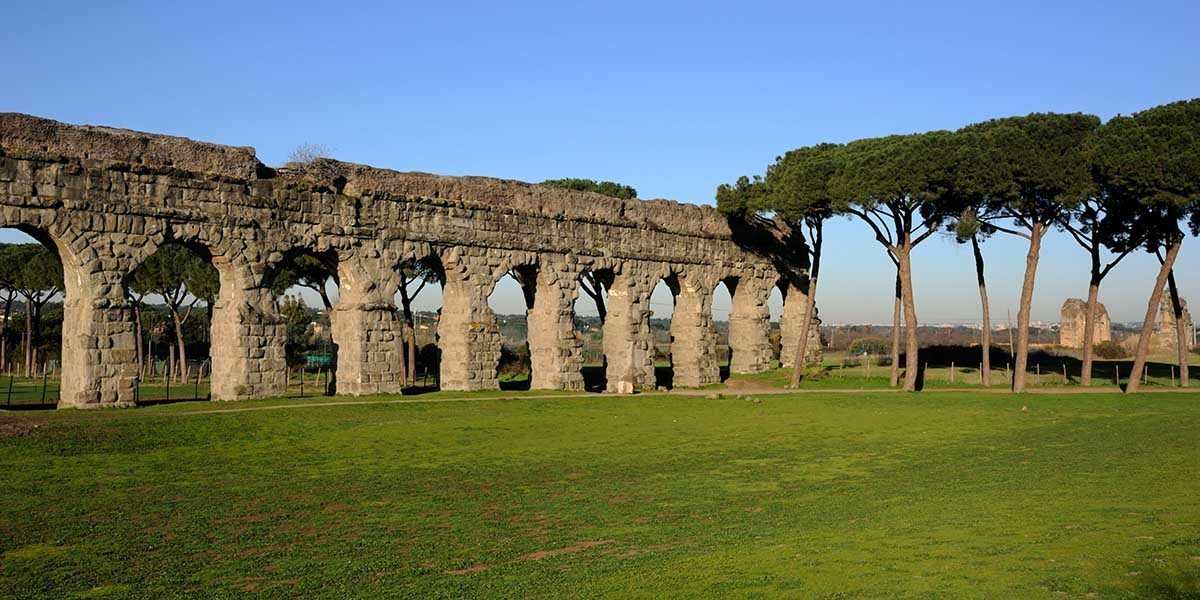
The strength of the place is in its scale. The arches of the Claudio are not a fragment in a display case: they are a travertine wall nearly 30 meters high in the best-preserved stretches, cutting across the meadow in a straight line for hundreds of meters. Walking beneath them, you understand better than in any museum what it meant to bring water to a capital of 1 million inhabitants, making it flow for dozens of kilometers using only the slope of gravity. Rome consumed water as no city would again for millennia, and here you can see its skeleton.
The aqueducts of the Parco degli Acquedotti
The name is plural for a specific reason: several aqueduct channels run side by side in the park, built in different centuries and often stacked on top of one another to save on pillars. It's worth telling them apart, because it's rare to be able to see them all together in a single field of view.
Anio Vetus, Marcia, Tepula and Iulia
The oldest ones run largely underground or are reduced to a few traces. The Anio Vetus, the second aqueduct of Rome, was begun at the end of the 4th century BC and passed here underground. The Aqua Marcia, of the 2nd century BC, was the longest and the most prized for the quality of its water: in the park it is found mainly because on its remains the Felice aqueduct was set up in modern times. Tepula and Iulia, of the 1st century BC, traveled stacked on the same piers, according to an economy of engineering that became common practice in Rome. Of these channels today you see fragments and raised ground rather than whole arches, but their presence explains why so many names pass through a single meadow.
The Claudia and the Anio Novus, the Giants of the Park
The arches everyone photographs belong to the Claudian aqueduct and, above them, to the Anio Novus. The two channels were begun by the emperor Caligula in AD 38 and inaugurated by Claudius in AD 52: they ran together, with the Anio Novus set above the channel of the Claudia, on the same row of monumental piers. The Claudia carried clear water drawn toward Subiaco. The Anio Novus, fed by the Aniene, was more abundant but cloudier. In the Parco degli Acquedotti this double channel forms the scenery you see in photographs and films: an alignment of arches in blocks of tuff and travertine that still holds up, after almost 20 centuries, the weight of its own channel.
The Felice Aqueduct, the Signature of the 1500s
The aqueduct that today appears the most continuous and in good condition is the most recent. The Felice aqueduct was built between 1585 and 1590 at the will of Pope Sixtus V, born Felice Peretti, from whom it took its name. To build it, the route of the ancient Aqua Marcia was partly reused, with stretches sacrificed and materials reused: this is the reason why of the Marcia, in the park, few traces remain today. The Felice brought running water back to a Rome that since the Middle Ages had drawn almost only on the Tiber and wells, and fed the great monumental fountains of the reborn city. In the park it is the one from which, still today, the little pond flows.
The History of the Parco degli Acquedotti
The survival of this meadow is a recent story and not at all a given. For centuries the area was countryside and pasture, with its ruined aqueducts serving as a backdrop to vegetable gardens and farmhouses. Then came the expansion of the city, and with it the risk that everything would end up under concrete like the surrounding countryside.
From Agro Romano to Public Green Space
The master plan of 1965 designated the area as public green space, a restriction on paper that then had to become reality. In the 1970s the zone was expropriated and cleared of the shacks, the so-called borghetti that had leaned up against the arches of the Felice aqueduct: whole families lived among the ancient piers, in one of the many improvised suburbs of the Rome of the boom. The soprintendenza began restorations, but for years the area remained in a state of semi-abandonment, and new illegal buildings kept popping up.
The Committee and the Entry into the Appia Antica Park
In 1986, faced with the decay and the concrete risk of building speculation, a group of citizens founded the Committee for the Safeguarding of the Parco degli Acquedotti and Roma Vecchia. It was one of those neighborhood battles that in Rome have saved more heritage than many laws. With the support of scholars, among them the archaeologist Lorenzo Quilici, in 1988 the committee obtained the inclusion of the Acquedotti area in the Appia Antica Regional Park: from that moment the fate of the meadow was tied to that of the great archaeological park, and the threat of concrete moved away.
Recent Interventions
The latest works have put things back in order: the old illegal vegetable gardens have been removed, the course of the marrana of the Acqua Mariana has been restored with its water and landscape layout, and the bike and pedestrian link with the Tor Fiscale area has been built, which has stitched the park back to the rest of the Appia countryside. The result is what you see today: a living park, much frequented, where archaeology, outdoor sport and even some farming activity coexist.
The Monuments and Archaeological Remains of the Parco degli Acquedotti
Besides the aqueducts, the meadow hides a collection of ruins that tell 15 centuries of history, from the empire to the Middle Ages to the railway of the 1800s. Here are the ones worth looking for, as you walk.
The Villa delle Vignacce
At the northwest end of the park are the remains of the Villa delle Vignacce, a large suburban residence of the 2nd century AD. Tradition attributes it to Quintus Servilius Pudens, a wealthy brick manufacturer whose name recurs on the brick stamps: if the attribution is correct, the owner supplied the bricks of his own villa. Today some rooms remain and above all a large cistern, a sign of the close link between the villa and the water of the aqueducts that passed beside it. Recent excavations have yielded sculptures and bath structures of good quality.
The Villa dei Sette Bassi
Just outside the most visited sector stands the Villa dei Sette Bassi, the second residence by extent in the whole Roman suburb after the Villa dei Quintili. Tradition links it to a figure named Septimius Bassus, perhaps a consul or a prefect of the 2nd century AD. Its ruins, tall and articulated, give the idea of how much luxury there was in this countryside at the city's gates, where the aristocracy built villas served directly by the imperial water channels.
The Casale di Roma Vecchia
The Casale di Roma Vecchia is the building that gave the whole area its old name. Datable to the 13th century, it is a fortified farmhouse of medieval origin, grown by reusing ancient materials, like almost everything built in this countryside. For centuries it was the reference point for the farmers and travelers who followed Via Latina, and still today its silhouette marks the landscape of the southern sector of the park.
The Casale del Sellaretto
Much more recent is the Casale del Sellaretto, an old railway keeper's house built along the Rome-Ceprano railway around 1862. It is a fragment of nineteenth-century industrial archaeology amid the Roman ruins, and it recalls that this meadow, besides the aqueducts, also saw the first railway lines of the Kingdom of Italy pass.
Tor Fiscale and the Campo Barbarico
At the edge of the park, toward Porta Furba, rises the Tor Fiscale, a medieval tower built by exploiting the point where the arches of the Claudian aqueduct and of the Aqua Marcia cross twice, forming a closed quadrilateral. This very natural enclosure of arches gave rise to the so-called Campo Barbarico: during the Gothic war of the 6th century, when the Ostrogothic king Vitiges besieged Rome defended by Belisarius, the Goths camped in the space enclosed between the two aqueducts, which offered shelter and control of the roads. The name has stayed attached to the place for 15 centuries.
The Marrana dell'Acqua Mariana, Via Latina and the Tomb of the Cento Scalini
The marrana of the Acqua Mariana is an artificial ditch that Pope Callixtus II had dug in 1122 to bring water to the mills and gardens outside the walls: it still crosses the park and has recently been restored. Of Via Latina, one of the great consular roads, a stretch of basolato remains in the park, the big stones of the Roman paving. And then there is the Tomba dei Cento Scalini, a hypogeum tomb that I talk about further on, because around it grew the best-known legend of the neighborhood.

The Mystery of the Tomba dei Cento Scalini
Between the Claudian aqueduct and the railway, a concrete platform and a grate cover the mouth of a hypogeum tomb that the neighborhood calls the Tomba dei Cento Scalini, from the number of steps you go down to reach it. Inside, the space recalls a catacomb: a burial chamber with sarcophagi in rough marble, bones and fragments, from which tunnels start that, according to popular tale, lead to an underground labyrinth.
The most repeated urban legend dates to the 1980s. It is told that a group of boys, curious to explore the labyrinth, went down to the burial chamber and ventured into the tunnels unrolling a ball of twine as Ariadne's thread. Some thugs who had followed them are said to have cut the twine, and the boys never came back. Since then, says the legend, whoever passes by the tomb at night hears the wails of those restless spirits who are still looking for the exit. Beyond the folklore, one fact is certain: the access was indeed closed and made safe between the late 1980s and the early 1990s. The grate you see today is that closure.
The Parco degli Acquedotti in the Movies
Few suburbs in the world have left so many frames in the history of cinema. The arches of the Claudia have appeared in films that defined the very image of Rome, and they continue to be a sought-after set. If you feel you recognize the place even before having been there, it's because you have already seen it on screen.
Fellini's La Dolce Vita
The opening sequence of La Dolce Vita, the film Federico Fellini shot in 1960, takes place right here: a helicopter carries a large statue of Christ in flight toward Saint Peter's, and beneath it the arches of the park's aqueducts pass by. These are the first seconds of the film, and it is perhaps the most famous shot ever filmed in this countryside. That shot alone is worth the place's international fame.
Mamma Roma by Pasolini
In 1962 Pier Paolo Pasolini chose this area for Mamma Roma, with Anna Magnani. The park and the nearby Quadraro neighborhood serve as the backdrop for the working-class story of the film: the aqueducts become the daily horizon of a harsh outskirts, just as they were then for the thousands of people who lived in the shantytowns built against the arches. Pasolini made the ancient ruin the backdrop of contemporary poverty, and no one has done it with as much force.
Il Marchese del Grillo and La Grande Bellezza
In 1981 Mario Monicelli brought Alberto Sordi here for several scenes of Il Marchese del Grillo: the Claudio arches and the Roman countryside accompany the marquis's carriage rides. Much more recently, in 2013, Paolo Sorrentino included the park among the images of La Grande Bellezza, the Oscar-winning film that put Rome back at the center of the world's imagination. Half a century and dozens of productions have passed between one masterpiece and the next: the arches remain the same.
TV series
Television has also used this meadow for a long time. The international blockbuster Rome set scenes of ancient Rome here, popular Italian productions such as I Cesaroni and Distretto di Polizia used it as a recognizable backdrop for the southern outskirts. Even today, it's not unusual to come across a set built among the arches: the park remains one of the most affordable and spectacular filming locations the city can offer, because the set design is already there, free, for 2,000 years.
The nature of the Parco degli Acquedotti
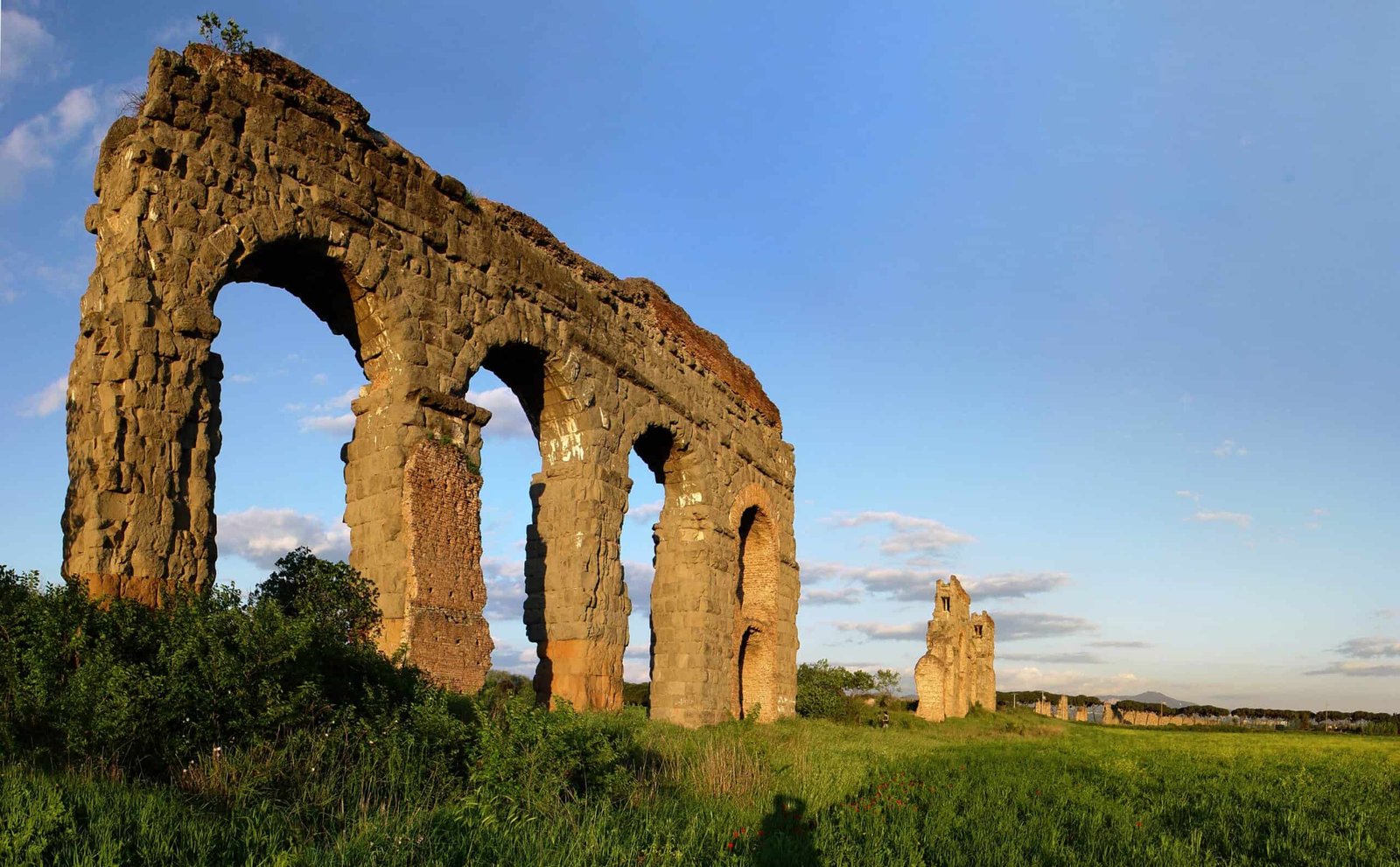
Reducing the park to its ruins would be a mistake: it's also a real green space, lived in every day by the neighborhood. The vegetation is dominated by the large umbrella pines, the dark canopies that appear in every image of this meadow and that, backlit at dawn, account for half of its appeal.
The small lake, the waterfall and the marrana
From the Felice aqueduct a small lake flows out, feeding a watercourse and a modest waterfall, following the route of the ancient marrana of the Acqua Mariana. It is the coolest and most secluded corner of the park, where herons and moorhens nest and where a bit of shade gathers in summer. A detail that escapes many hurried visitors, all focused on the arches.
Sports, planes and countryside
The park is a daily destination for runners and cyclists: long dirt trails cross it from one end to the other, good for jogging and mountain biking, and along the perimeter there are private sports facilities for soccer, five-a-side, tennis, rugby and golf. Even farming and livestock activities survive, a remnant of the Agro Romano that never fully died out here. There is, however, one detail that needs mentioning: the park lies under the landing path of Ciampino airport, and planes passing at low altitude are frequent and loud. For some it spoils the quiet, for others it adds a contemporary appeal, with the jet cutting across the sky above the imperial arches.
The Parco di Tor Fiscale
Next to the Parco degli Acquedotti, toward Porta Furba, extends the Parco di Tor Fiscale, now connected to the first by the cycle and pedestrian path. It takes its name from the medieval tower already mentioned, the one built at the double crossing of the aqueducts. This is the Campo Barbarico area, more compact and less crowded, ideal for those who want to continue the walk away from the crowds. You can get there on Metro A to Porta Furba, or on bus lines 650, 657, 663, 664 and 765. Think of the two parks as a single great itinerary: together they tell the story of the whole aqueduct system better than any book.
A curiosity about the Parco degli Acquedotti
The curiosity that almost no one notices concerns the dual nature of the arches you're looking at. What seems to be a single aqueduct is actually an overlay: on the piers of the Claudio runs, set higher up, the channel of the Anio Novus. They were two separate conduits, carrying water of different quality, which the Roman builders decided to route along the same row of arches to save piers, materials and land. The Claudio carried clear water from pure springs toward Subiaco. The Anio Novus, drawn directly from the Aniene river, was more abundant but often cloudy, so much so that settling basins were built along its route.
There's more, and it's an engineering fact that never fails to amaze: these channels worked only by gravity, without a single pump. The water started from springs at a calculated elevation and flowed down toward Rome with a minimal slope, a few centimeters every 100 meters, kept constant for tens of kilometers using basic surveying instruments. A level error of just a few degrees would have stopped everything or emptied the channel. The arches that you photograph today as romantic ruins are in fact a masterpiece of measurement, proof that ancient hydraulic engineering worked with precisions that seem impossible to us for the time.
Something nobody tells you about Parco degli Acquedotti
What the quick guidebooks don't say is that the majestic arches of the Claudio, the ones on the postcards, are not the best-preserved aqueduct in the park. The conduit that still appears most continuous, intact and recognizable over long stretches is the Felice aqueduct, and it is not ancient at all: it dates to 1585-1590, was built under Pope Sixtus V, and is 15 centuries younger than the Claudio. Many visitors photograph it thinking it's Roman. In fact that compact, regular wall was built by partly reusing the route of the ancient Acqua Marcia, which was largely dismantled to make room for the new papal conduit. That's why only very few traces of the Marcia, one of Rome's most famous aqueducts, remain in the park today.
The second thing people tend to overlook is that this meadow was inhabited until the 1970s. Thousands of people lived in the borghetti, shacks built directly against the arches of the Felice, in one of the poor outskirts that surrounded postwar Rome. The same arches that now serve as the backdrop for wedding photos were, back then, the wall of home for entire families. Knowing this changes the way you look at the place: it's not an untouched relic, it's a place that kept living, and being inhabited, until just a few decades ago.
The advice I give you for visiting Parco degli Acquedotti
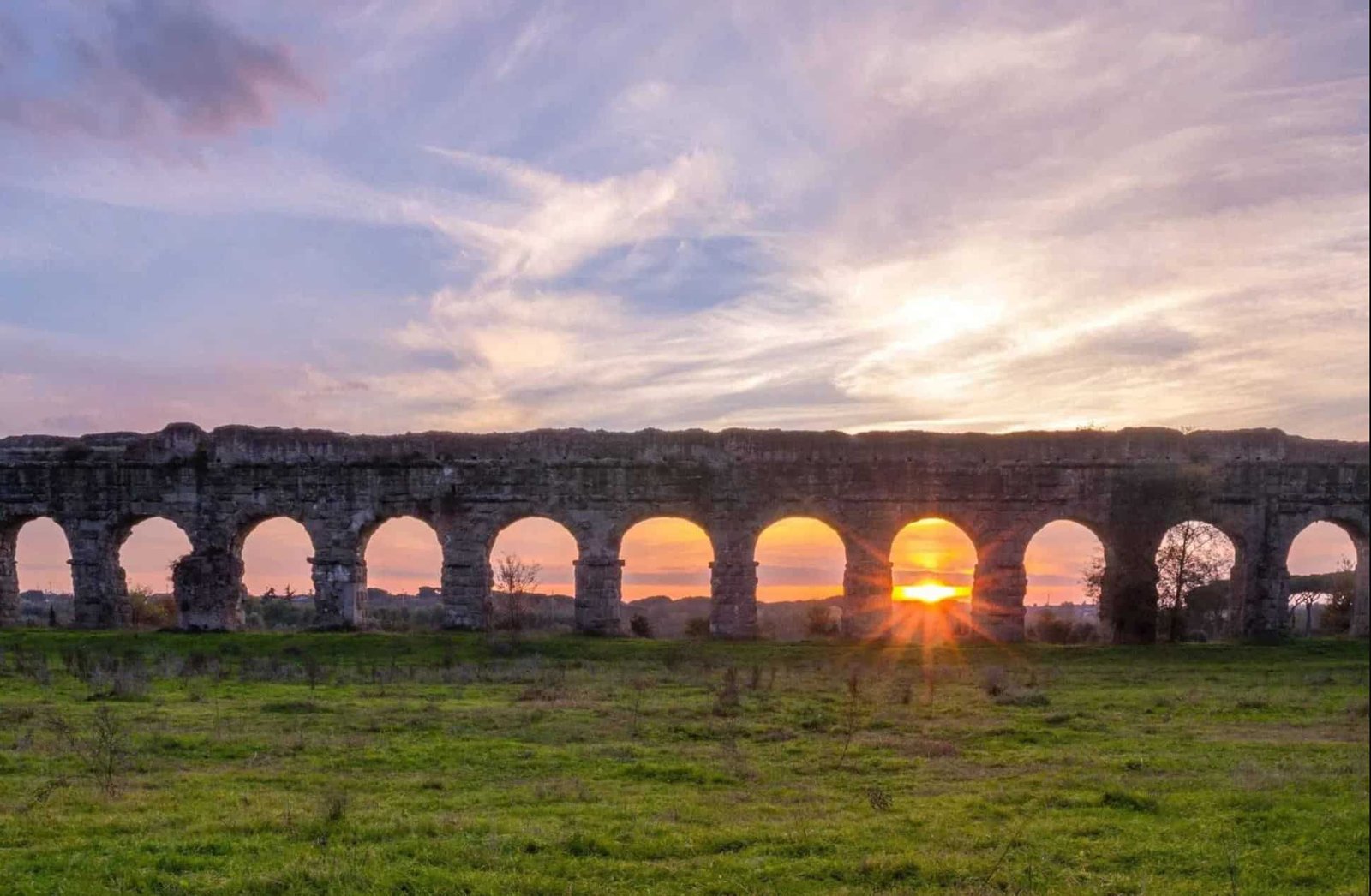
The advice is simple: come at dawn or shortly before sunset, not at noon. The park is an open meadow with almost no trees in the central part, and full daylight flattens it, besides baking you in summer without a single bit of shade. In the first hour of the morning, instead, low mist wraps the base of the arches and the pines stand out in silhouette against a rosy sky: it's the light that all the photographers and all the directors who have passed through here have looked for. At sunset the travertine lights up orange and the atmosphere is that of the Grand Tour prints.
In practice: get off at Giulio Agricola or Subaugusta, enter via Lemonia and head straight for the Claudio arches, then follow the conduit south to the Felice pond. Plan on at least an hour and a half for a real walk, two if you want to reach Tor Fiscale. Bring water, because inside the park there are no reliable bars or kiosks, wear sneakers because the paths are dirt, and leave nothing valuable unattended on the grass. Avoid days with strong wind and, if noise bothers you, know in advance about the planes from Ciampino. It's free and always open: the only investment it asks of you is getting up early.
Another well-known fact, yet rarely mentioned
It's always said that Parco degli Acquedotti is part of the Appian Way Park, and in fact it has been since 1988. What is rarely mentioned is how it got there: not through a decree from above, but thanks to a neighborhood battle. In 1986 it was a group of citizens who founded the Committee for the Protection of Parco degli Acquedotti and Roma Vecchia, faced with the decay and the concrete threat of the building speculation that was devouring the countryside around it. With the support of scholars, including the archaeologist Lorenzo Quilici, that committee obtained in 1988 the inclusion of the area in the Appian Way Regional Park, protecting the meadow from the bulldozers.
It's worth remembering because in Rome this is not an exception, it's almost the rule: many of the places we take for granted today were saved by resident committees more than by laws. Without that mobilization, most likely today we would be walking among apartment buildings and not among arches. The meadow that seems eternal to you is, in fact, the result of a political decision made in the 1980s, and of a handful of citizens who did not give up.
The right photo to take at Parco degli Acquedotti
The photo you'll take home, the one that shows you why so many directors came here, is the one of the Claudio arches lined up, shot at an angle with the low sun behind you. Stand along the channel, not head-on: run the arches diagonally toward the back of the frame, so perspective shrinks them one after another to the horizon. With the morning haze, the bases of the arches dissolve and they seem to float over the grass. At sunset the travertine turns golden. If you have the patience to wait for a runner or a cyclist to pass under an arch, you'll also get a human scale that conveys the nearly 30 meters of height.
The second shot to try is the one with a stone pine in the foreground and the blurred arches behind. It's the most Roman image there is, the one from nineteenth-century drawings. If you want the sky to cut through the scene, pose when a plane bound for Ciampino passes. The modern jet over the imperial aqueduct is a contrast that always works. Avoid the midday hours, when flat light kills the relief of the stones. And get low: almost everyone photographs standing up, but a low viewpoint, with grass in the foreground, conveys the mass of the arches much better.
Some important events that happened here in history
The oldest event linked to this place is military. During the Gothic War of the 6th century, when the Ostrogothic king Vitiges besieged Rome, which was defended by the Byzantine general Belisarius, the Goths camped in the space enclosed by the double crossing of the Claudio and Marcio aqueducts, near today's Tor Fiscale. That natural enclosure of arches, which offered shelter and allowed control of the roads arriving from the south, was called Campo Barbarico, and the name stuck to the place for 15 centuries. The aqueducts, which the Romans had built to carry water, were thus turned into a fortification for those who wanted to take the city.
Many centuries later, in 1122, Pope Callixtus II had the Marrana dell'Acqua Mariana dug, the artificial ditch that still runs through the park, to feed mills and gardens outside the walls. It was one of the first great hydraulic works in Rome after the collapse of the ancient system. Then, between 1585 and 1590, Pope Sixtus V had the Felice Aqueduct built, bringing running water back to a city that had been without it for centuries. In very recent times, the decisive event has been civic rather than monumental: the expropriation in the 1970s, the clearing of the borghetti, and the entry into the Parco dell'Appia Antica in 1988. These three steps rescued this meadow from concrete and handed it to those who cross it today.
Who has passed through Parco degli Acquedotti
Water from the emperors literally flowed across this meadow. The Claudio and Anio Novus aqueducts were commissioned by two Julio-Claudian emperors: Caligula, who began construction in 38 AD, and Claudius, who inaugurated them in 52 AD, giving his name to the more famous of the two. Along Via Latina, of which a stretch of basolato paving remains in the park, armies, merchants and pilgrims heading south toward Capua and Naples passed for centuries. And here the Gothic king Vitiges camped with his army in the 6th century.
In modern times, those who passed through here did so mostly with a movie camera. Federico Fellini shot the opening of La Dolce Vita here in 1960. Pier Paolo Pasolini set Mamma Roma here with Anna Magnani in 1962. Mario Monicelli brought Alberto Sordi here for Il Marchese del Grillo in 1981. Paolo Sorrentino included the park in La Grande Bellezza in 2013. In between, generations of filmmakers, photographers and painters of the Grand Tour have sought out these arches for the same reason: they are the perfect synthesis of the Roman countryside, the one the rest of Europe imagined while reading Goethe. Today it's mainly the neighborhood's Romans who pass through, running and walking their dogs where water once flowed to the imperial palaces.

Parco degli Acquedotti with Children
It's one of the parks best suited to families that I know in this part of Rome, and for a simple reason: it's huge, open and without fences, so kids can run on the grass while adults look at the arches. There are no tickets, turnstiles or lines, and there aren't even obvious dangers as long as you stay away from the railway and the ditches. Bring a ball, a small bicycle or a kite. The afternoon wind is often perfect, and seeing a kite rise next to a 2,000-year-old aqueduct is one of those memories that stay.
A practical warning from a parent: inside the park you won't find reliable restrooms, changing tables, or well-equipped bars, so get organized before you go, in the neighborhood. Bring water and snacks. In summer, with no shade in the central part, the late afternoon is better. The Laghetto del Felice is a good goal for a child-friendly walk, with ducks and waterbirds to watch, but keep an eye on the little ones near the bank. To tell them about the place, the Tomba dei Cento Scalini and its legend of children lost in the labyrinth work better than any history lesson.
When to visit the Parco degli Acquedotti
The best season is the in-between one: April, May and October bring green meadows, long light and comfortable temperatures. Spring fills the field with tall grass and flowers. Autumn, with the Roman ottobrate, is perhaps the most beautiful moment, when the countryside turns golden and the light stretches out. The Roman summer, on the other hand, needs to be managed. In the central part of the park there is no shade, and at noon in July the meadow becomes a scorching griddle. In those months the park is best enjoyed only at dawn and after six in the evening, which are also the hours when the light works best for photographs.
As for opening hours, the park is always open, but it's better not to go after dark. It's a large, unlit space with little supervision at night, so it's best saved for daytime. On summer evenings the park hosts outdoor film series, including cinema arenas such as the Roma Cinema Arena, with free screenings among the arches. On those occasions the site is staffed and makes for an evening visit that's different from usual.
What's around the Parco degli Acquedotti
The park is an excellent starting point for exploring the whole south east area of Rome, the one along the Appia and the countryside. A few minutes away, following the green path, you reach the Caffarella valley and from there the entire Appian Way Park, with its tombs, catacombs and basalt paving. Along the Appia you'll meet the Catacombs of San Callisto and the Catacombs of San Sebastiano, and further on the vast Villa of the Quintilii, the imperial residence that even surpasses in size the Villa dei Sette Bassi in our park.
Toward the city, the grand monumental entrance to the Appia is marked by the Porta San Sebastiano, the most imposing of the Aurelian Walls. On the opposite side, a short walk from the Metro A stops, lie the Cinecittà studios, the dream factory of Italian cinema, not by chance so close to a park that has seen so much film. If you love the big screen outdoors, in summer you'll find film series like those at the Casa del Cinema. And if the view from the park has piqued your curiosity, that line of hills your gaze reaches toward is the Castelli Romani, where the aqueducts went to capture their water.
The Parco degli Acquedotti and the Grand Tour
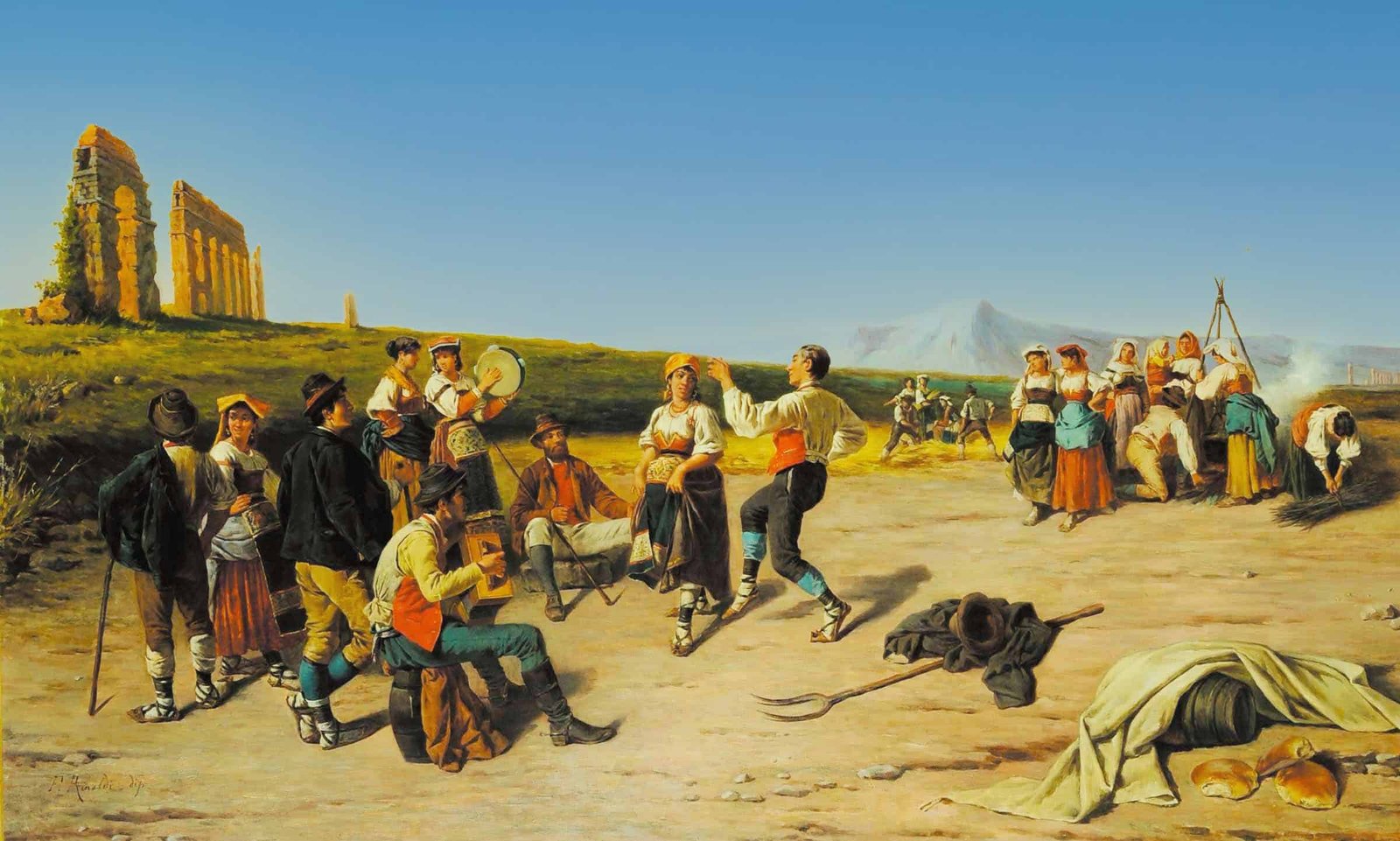
Long before cinema, it was painters and draftsmen who made these arches famous. Between the eighteenth and nineteenth centuries the Roman countryside was one of the regular destinations of the Grand Tour, the great educational journey that brought artists and young aristocrats from all over Europe to Rome. What they sought was not only the city of monuments, but exactly this: the ancient ruin immersed in the countryside, the travertine worn by time among the tall grass, the umbrella pines against the low sky at sunset. The aqueduct arches, with their regular row fading into the horizon, were the ideal subject for that taste for the sublime and for the melancholy of ruins.
Anyone who knows the views and engravings of that era finds here, almost unchanged, the same scene: the aqueduct cutting across the plain, the flock or the shepherd in the foreground, the low light. It's no accident that film directors and photographers of the twentieth century kept looking for this meadow. They were chasing an image built two centuries earlier, the very idea of the Roman countryside that educated Europe had formed by reading Goethe and looking at the prints brought home from the Italian trip. Walking here at dawn means stepping inside that image, which time, for once, did not erase.
The water that explains the Parco degli Acquedotti
To really understand why these arches exist, you need to keep one number in mind: at its peak, ancient Rome was served by 11 great aqueducts that brought it every day a quantity of water that no European city would know again until well into the 1800s. Water was not only for drinking: it fed the public baths, where tens of thousands of people passed through every day, the fountains, the nymphaea of the villas, the latrines, and the mills. It was a concrete sign of the power of the State, and its interruption, when the Goths cut the channels in the sixth century, was one of the wounds that sank the ancient city.
The Parco degli Acquedotti is the place where this system can still be seen in its entirety. Here the conduits came in from the countryside to the southeast, from the springs of the Aniene and the area around Subiaco and Tivoli, after a journey of tens of kilometers almost entirely in underground tunnels. Only in the final stretches, to cross the dip in the terrain while keeping their elevation, did the channels rise on arches: and it is precisely this last stretch on arches, the one at the gates of Rome, that has survived in this meadow. Anyone walking under the Claudio is at the end of an engineering route as long as a small province, of which they see only the last, monumental kilometer.
Why so many aqueducts in the same place
The reason six different conduits converge on this strip of countryside is geographic: almost all of Rome's prized springs lay to the southeast, toward the mountains, and from there the water had to enter the city from this direction. To avoid multiplying masonry works, Roman engineers ran the channels side by side and often stacked on top of each other, using the same piers for several conduits. That is why, in the Parco degli Acquedotti, you can read centuries of layering in just a few hundred meters: the Republican channel next to the Imperial one and, above them all, 1,500 years later, the papal masonry of the Felice.
Flora and Fauna of the Parco degli Acquedotti
The character of the landscape is given by the Italian stone pines, the umbrella-shaped ones, that dot the meadow and appear in every view of the park. They are the symbol tree of the Roman countryside, the one Grand Tour painters always placed beside ruins, and here they play the same scenic role. In the central part of the park, tree cover is sparse, and the space is dominated by open meadow: this openness gives the arches their monumental solitude, but it is also the reason there is no shade in summer.
The area richest in life is the wet one, around the small lake and the watercourse that rises from the Felice and follows the ancient marrana. Here the standing water attracts birds and creates a microenvironment that is cooler and greener, unlike the rest of the dry meadow. Farming and livestock activities also survive in the area, a remnant of the Agro Romano, so it is not unusual to see horses or sheep at the edges of the park, a contrast with the buildings of the neighborhood that alone is worth the walk.
Accessibility of the Parco degli Acquedotti
The Parco degli Acquedotti is an open green area, largely flat, which in theory makes it accessible even to people with mobility difficulties or those pushing a stroller. That said, it has to be said honestly that the main paths are packed dirt, not paved: after rain they become muddy, and in some stretches the surface is uneven. A wheelchair or a sturdy stroller manages well along the most used paths on dry days, while the secondary trails toward the lake or Tor Fiscale can be rough.
Since there are no turnstile entrances, there are no barriers to access in the strict sense: you can enter at street level at several points along the perimeter. Anyone who needs certainty about accessible services and routes should check in advance on the official website of the Parco dell'Appia Antica, because inside the park services are kept to a minimum. The Metro A stops that serve the area have elevators, but it's worth checking their status before you set out.
Quick questions about the Parco degli Acquedotti
How much does it cost to enter the Parco degli Acquedotti?
Nothing. Entry to the Parco degli Acquedotti is free of charge, with no ticket and no ticket office, every day.
What are the opening hours of the Parco degli Acquedotti?
The park is a green area with free access, always open and with no closing times. To be safe, it's best to visit in daylight, avoiding nighttime hours.
How do I get to the Parco degli Acquedotti by metro?
Take Metro A, getting off at Giulio Agricola or Subaugusta, and walk eight to 10 minutes toward via Lemonia. The Cinecittà and Lucio Sestio stops are also convenient.
Which buses go to the Parco degli Acquedotti?
Lines 557, 559, 590, 650 and 654 serve the area. Set via Lemonia as your destination, because stop names often change.
How big is the Parco degli Acquedotti?
About 240 hectares, between the Appio Claudio neighborhood, via delle Capannelle and the Rome-Cassino-Naples railway.
How many aqueducts run through the Parco degli Acquedotti?
Six of Rome's 11 great ancient aqueducts: Anio Vetus, Marcia, Tepula, Iulia, Claudio and Anio Novus. To these is added the Felice aqueduct, from the sixteenth century.
What are the most famous arches in Parco degli Acquedotti?
Those of the Claudian aqueduct, with the Anio Novus channel on top, begun by Caligula in 38 AD and inaugurated by Claudius in 52 AD.
Is the Felice aqueduct ancient?
No, it's Renaissance: it was built by Pope Sixtus V between 1585 and 1590, partly reusing the route of the ancient Aqua Marcia.
Which films were shot in Parco degli Acquedotti?
Among others, Fellini's La Dolce Vita (1960), Pasolini's Mamma Roma (1962), Monicelli's Il Marchese del Grillo (1981) and Sorrentino's La Grande Bellezza (2013), as well as many television series.
Can you bring dogs to Parco degli Acquedotti?
Yes, it's one of the parks most frequented by dog owners in the area. The usual rules of common sense and respect for other visitors apply.
Can you ride a bike in Parco degli Acquedotti?
Yes, the dirt paths are suitable for mountain bikes, and a bike and pedestrian route leads all the way to Tor Fiscale and the Appian Way.
Is Parco degli Acquedotti suitable for children?
Very much so: it's big, open and has no fences. Just watch out for the railway and the ditches, and bring water and a snack because there are no facilities inside.
Are there cafés or restrooms in Parco degli Acquedotti?
Inside the park there are no cafés or reliable restrooms. It's best to plan ahead, in the streets of the surrounding neighborhood.
Do you need to book to visit Parco degli Acquedotti?
No, access is free and doesn't require a reservation. Any guided tours or events may have their own rules, indicated on the official website of the Parco dell'Appia Antica.
What is the Tomba dei Cento Scalini?
An underground tomb between the Claudian aqueduct and the railway, closed off by a grate, around which the neighborhood's best-known urban legend has grown. The entrance has been secured and can't be used.
Why are there airplanes above Parco degli Acquedotti?
The park lies under the landing route of Ciampino airport, so low-altitude flights are frequent.
What is the best time to photograph Parco degli Acquedotti?
Sunrise and sunset, with the low sun hitting the arches from the side. Midday hours flatten the light and take depth away from the stones.
What's the difference between Parco degli Acquedotti and Parco di Tor Fiscale?
They're adjacent and connected. Parco degli Acquedotti holds the great arches of the Claudian aqueduct. Parco di Tor Fiscale, toward Porta Furba, holds the medieval tower and the area of the Campo Barbarico, and it's quieter.
Is Parco degli Acquedotti part of the Appian Way?
Yes, since 1988 it has been included in the Parco regionale dell'Appia Antica, after the mobilization of a citizens' committee formed in 1986.
If I had to sum up in one sentence why I always come back gladly to Parco degli Acquedotti, I'd say this: it's the place where Rome stops being a museum and becomes countryside again, without losing a single stone of its history. Come early in the morning, walk along the Claudian aqueduct to the little lake without hurry, and let the arches give you the measure of time. It won't ask you for a euro, and it will give you back one of the truest images of the city.
Article written by the editorial team of TourLeaderPro, contact them for Private/Corporate/V.I.P. Tours and Experiences.
Planning a trip to Rome? The English-language guides for visiting the city are on ItalyPlanner.com.