Villa of the Quintilii
In short. The Villa dei Quintili is visited at the Appia Antica Archaeological Park: the main entrance with the ticket office and the small parking lot is at Via Appia Nuova 1092, at the seventh kilometer, while the second gate, the one at the…

The Villa dei Quintili is visited at the Appia Antica Archaeological Park: the main entrance with the ticket office and the small parking lot is at Via Appia Nuova 1092, at the seventh kilometer, while the second gate, the one at the Santa Maria Nova farmhouse, opens onto Via Appia Antica at number 251, at the ancient fifth mile. You can enter Tuesday through Sunday. Monday is the closing day. The hours change with the season: from April 1 to September 30 9:00-19:15, in March and October 9:00-18:30, from November 1 to the end of February 9:00-16:30, with last entry 75 minutes before closing. The ticket for the Villa dei Quintili and Santa Maria Nova site alone costs €8 full price and €2 reduced (€4 with the Roma Pass) and on the same day is valid for both entrances. Anyone who also wants to see the other places in the area can choose the park ticket at €12, valid seven days by reservation. On the first Sunday of the month admission is free. Transportation: from Metro A you get off at Colli Albani and take bus 664 or 663, or the 118 from the center along the Appia. For updated information on fares, reservations and closures it's always best to check the official website of the Appia Antica Archaeological Park before leaving.
Here you'll find the full picture of the area, from the baths to the Grand Nymphaeum, with the page dedicated to the Appia Antica Park as a starting point for planning the day on the regina viarum.

Villa dei Quintili: Where It Is and How to Get There
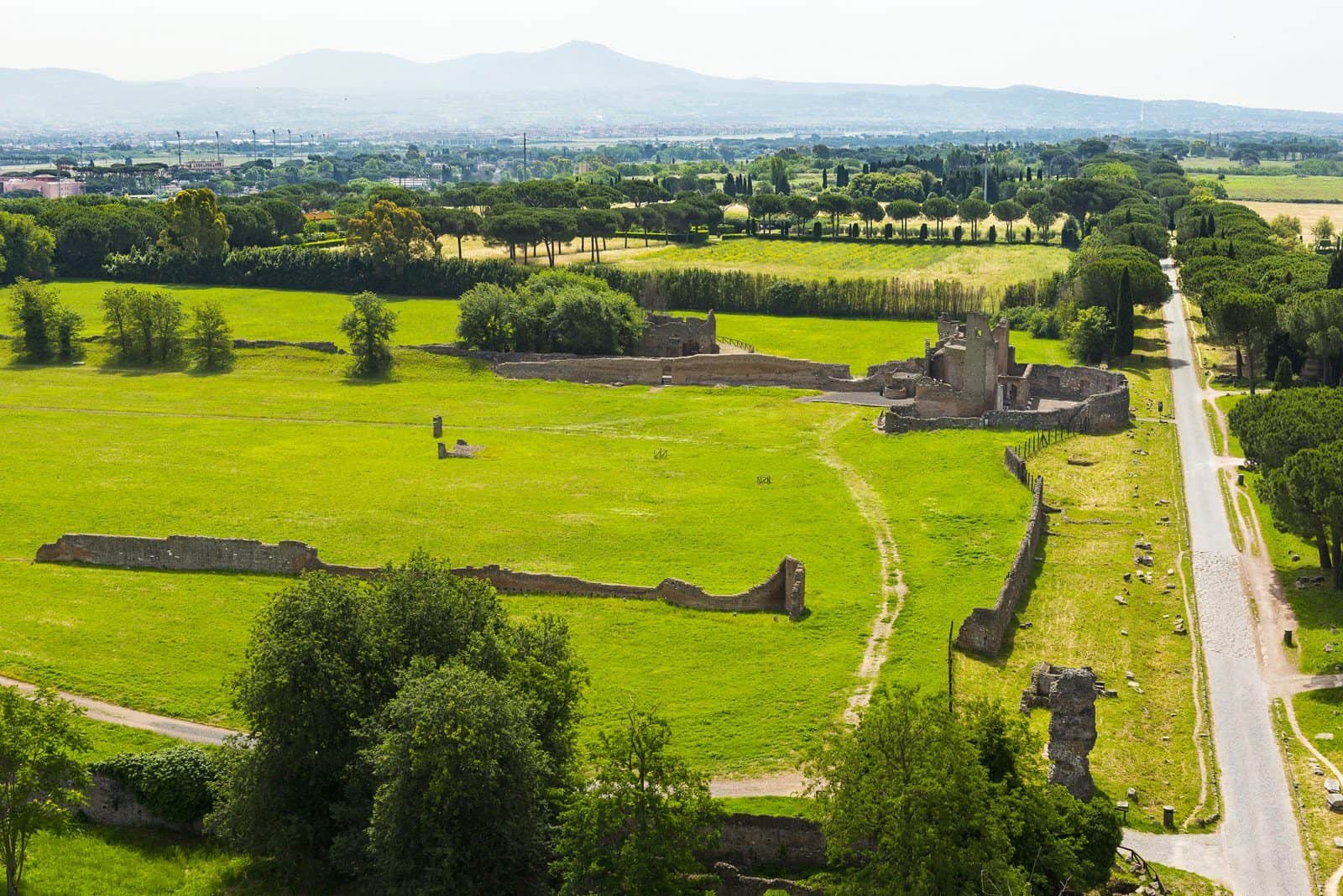
The villa occupies the plateau between the fifth mile of Via Appia Antica and the seventh kilometer of Via Appia Nuova, in that strip of Roman countryside that the ancients called ager and that today the Appia Antica Archaeological Park protects as a single landscape. The residence stood on a hill formed by a tongue of lava erupted in prehistoric times by the Alban volcano, the great volcanic complex of the Colli Albani, and sloped down toward the watercourse that still bears the name Fosso dello Statuario. Anyone arriving notices right away: the ground rises, and from above the gaze runs free over the plain to the Castelli.
Where to buy tickets. The Villa dei Quintili belongs to the Appia Antica Archaeological Park: tickets, hours and the combined ticket with Cecilia Metella are on the website of the Appia Antica Archaeological Park. You can't book through the city and there is no 060608. No booking platform sells a dedicated product for this site. Checked on September 28, 2026.
The Entrances to the Villa dei Quintili: Appia Nuova and Santa Maria Nova
There are two ways in, and it's no small detail. The historic gate is the one at Via Appia Nuova 1092, where you find the ticket office, the Antiquarium and a small but convenient parking lot. From here you go up toward the monumental baths, which are the visual heart of the site. The second entrance, opened in recent years, is the one at Via Appia Antica 251, at the Santa Maria Nova farmhouse, the old farm that the friars ran for centuries. Entering from Santa Maria Nova you walk on the Roman paving stones and reach the Grand Nymphaeum from the right side, the one the Grand Tour travelers saw when arriving from outside Rome. The ticket is a single one and on the same day lets you pass from one entrance to the other, covering the whole area. It's the best way to understand how the villa was designed to be crossed.
How to Get to the Villa dei Quintili by Public Transportation
The simplest way by public transportation starts from Metro line A: you get off at the Colli Albani stop and continue with bus 664 or 663 toward Appia Nuova, getting off at number 1092. Alternatively, from the historic center bus 118 runs along Via Appia Antica and stops near the Santa Maria Nova entrance, a slower trip but priceless for the scenery. Those arriving by car have a small parking lot at Via Appia Nuova entrance. On spring weekends it fills up early, so arriving at opening time is a good idea. For those who love bicycles, the villa is one of the destinations of the great ride along the Appia Antica, and from here you continue toward the mausoleum of Cecilia Metella without ever leaving the ancient paving.
Tickets and Hours of the Villa dei Quintili
The standard ticket for Villa dei Quintili and Santa Maria Nova costs €8 full price and €2 reduced, with a €4 rate reserved for holders of the Roma Pass. The reduced €2 price is available to European Union citizens between 18 and 24 years old, while admission is free for minors under 18. If you want to walk the entire complex, and not just the Villa dei Quintili, you can choose the park ticket at €12 (€10 for Friends of the Park), valid for 7 days and to be booked in advance. It includes, in addition to the villa, the Mausoleum of Cecilia Metella, the Antiquarium di Lucrezia Romana, the Villa di Sette Bassi and the Tombs of via Latina. There is also a personal annual pass, the Mia Appia Card, at €25, with unlimited access for one calendar year.
Seasonal hours and the first Sunday of the month
The Villa dei Quintili keeps hours that change four times a year, following the light: 9:00-19:15 from April 1 to September 30, 9:00-18:30 in March and October, and 9:00-16:30 from November 1 until the end of February. The weekly closing day is Monday. The last entry is set 75 minutes before closing, and at a site this large that margin really needs to be respected: to see the baths, the nymphaeum and the Antiquarium at a relaxed pace, you need at least 2 hours. Admission is free on the first Sunday of the month, as at all state cultural sites, and for the Villa dei Quintili it is the busiest day. If you're looking for quiet, choose another day. Tickets can be bought on the Musei Italiani portal and app or at the on-site terminals, which accept card payments only. Prices, hours and bookings should always be rechecked on the official website, because they change with the seasons and with conservation needs.
A curiosity about the Villa dei Quintili
The Villa dei Quintili is so large that for centuries Romans mistook it for a city. In the Middle Ages and up to the 18th century the site was called Roma Vecchia, because the mass of ruins, with the arches of the baths as tall as palaces and the line of arches of the aqueduct that runs along the Appia Nuova, seemed too imposing for a private house. It had to be the remains of an ancient town, a buried neighborhood, a Rome that came before Rome. The mistake lasted a long time, and in the maps and reports of scholars the name Roma Vecchia ended up covering a vast area, extending to include land as far as via Prenestina, toward Tor de' Schiavi and Villa Gordiani. Only the study of the brick stamps, the marks pressed into the bricks, and the discovery of the fistulae aquariae, the lead pipes with the owners' names engraved on them, restored the site's true identity: not a city, but the residence of two brothers. It's worth keeping this in mind while you walk: what the sign today calls, with philological precision, Villa dei Quintili, the shepherds and travelers of 300 years ago walked through believing they were treading the ruins of a lost metropolis. It is one of those mismatches between what we see and what we know that make the Appian Way a place unlike any indoor museum.
The Quintili brothers: who owned the villa
The names the lead pipes have given us are those of two brothers, Sextus Quintilius Condianus and Sextus Quintilius Valerius Maximus. They were not just any gentlemen: they were noble, highly cultured, and both served as consuls in the same year, 151, under Antoninus Pius. Their learning was proverbial. An ancient tradition even credits them with a treatise on agriculture written in four hands. It shows how much they were regarded as men of knowledge as well as power. Large landowners, held in high honor by Antoninus Pius and then by Marcus Aurelius, the Quintili belonged to that small group of senatorial families whose wealth and prestige could overshadow the emperor.
Their fortune was exactly what brought about their downfall. When Commodus, son of Marcus Aurelius, came to the throne, the emperor's greed for their property turned into the most convenient accusation: conspiracy. Around 182-183 the two brothers were killed, and the great estate passed to the imperial treasury. The villa thus went from the residence of private citizens to an imperial villa, and it stayed that way for generations. The dating of the restorations, together with inscriptions, portraits and references in the sources, shows that it remained in use as an imperial estate at least until the time of the emperor Tacitus, that is, for the whole 3rd century. Commodus, who liked to present himself as Hercules reborn and to fight in the arena, took his rivals' villa and made it his own. The Grand Nymphaeum overlooking the Appian Way bears his mark as patron.
Something nobody tells you about the Villa dei Quintili
The sign says the brothers were killed. What almost nobody adds is that one of the Quintilii managed to escape the sentence with a stratagem worthy of a novel, and his story has reached us thanks to the Greek historian Cassius Dio, who wrote a few decades later. Sextus Condianus, son of Maximus, knew he was on Commodus's list. Instead of waiting for the assassins, he secretly drank rabbit blood. Then he mounted his horse and let himself fall from the saddle as if struck by a sudden illness, vomiting that blood in front of everyone so that it looked like a fatal hemorrhage. Carried home dying, he disappeared from there. In his place, in the coffin, the body of a ram was burned. Condianus wandered the empire, constantly changing his appearance, name and clothes, and his escape set off a grotesque manhunt. Commodus, obsessed with the idea that he was alive, had many innocent people who resembled him put to death, and in the following years even false Condiani appeared, impostors pretending to be him. We will never know whether the real Sextus Condianus survived or died unknown in some province. Walking among the ruins of his house, knowing that his master faked his own death so as not to lose it, changes the way you look at those walls. The Villa dei Quintili is not only a masterpiece of architecture. It is the setting of one of the boldest escapes of antiquity.
The Pavilion Villa: How the Villa dei Quintili Was Organized
The Villa dei Quintili was what is called a pavilion villa: not a single compact building, but a succession of building complexes that followed the shape of the terrain, spread between the upper part of the hill and the frontage on the Appian Way. From the brick stamps it can be deduced that the original core dates to the late Hadrianic period, that is, the first half of the 2nd century. The villa then grew through successive additions, especially once it became imperial property. There was a private residential area, reserved for the owner and his family. There was a representative area, where guests and clientes were received. There were porticoed gardens, bath complexes, service rooms and water cisterns. Excavations in recent decades have made the connections between these spaces clearer, showing how one moved from the residence to the public rooms along carefully designed routes. The result is an architectural whole that cannot be read at a glance. You have to walk it, go up and down, and understand that each terrace had a function. This is both its difficulty and its beauty.
The Monumental Baths of the Villa dei Quintili
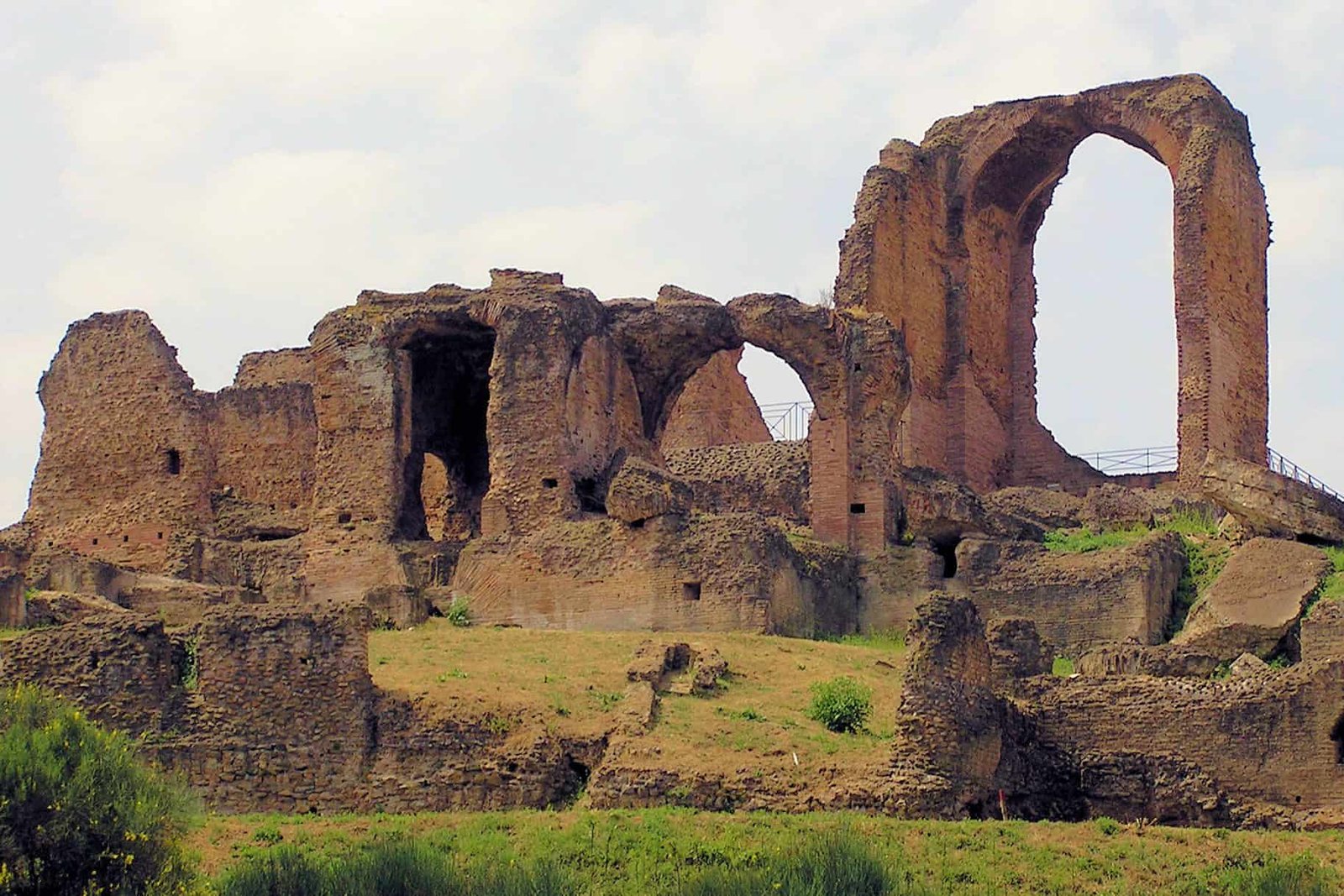
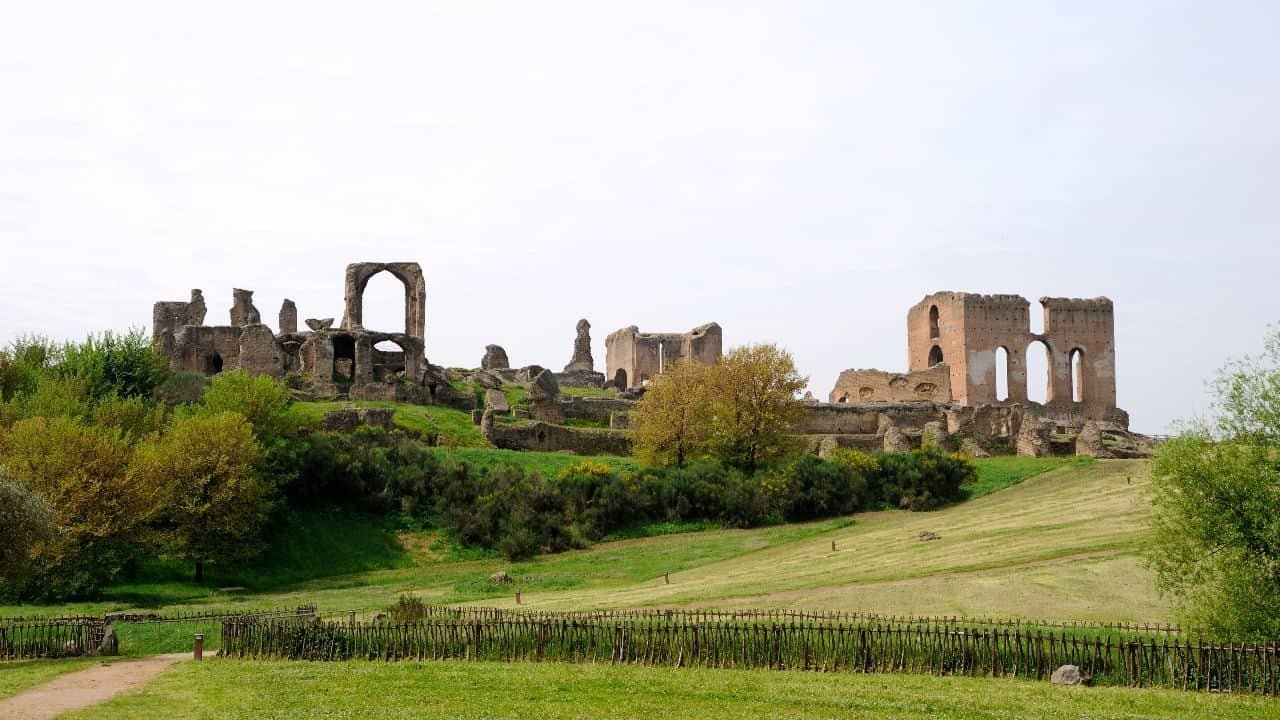
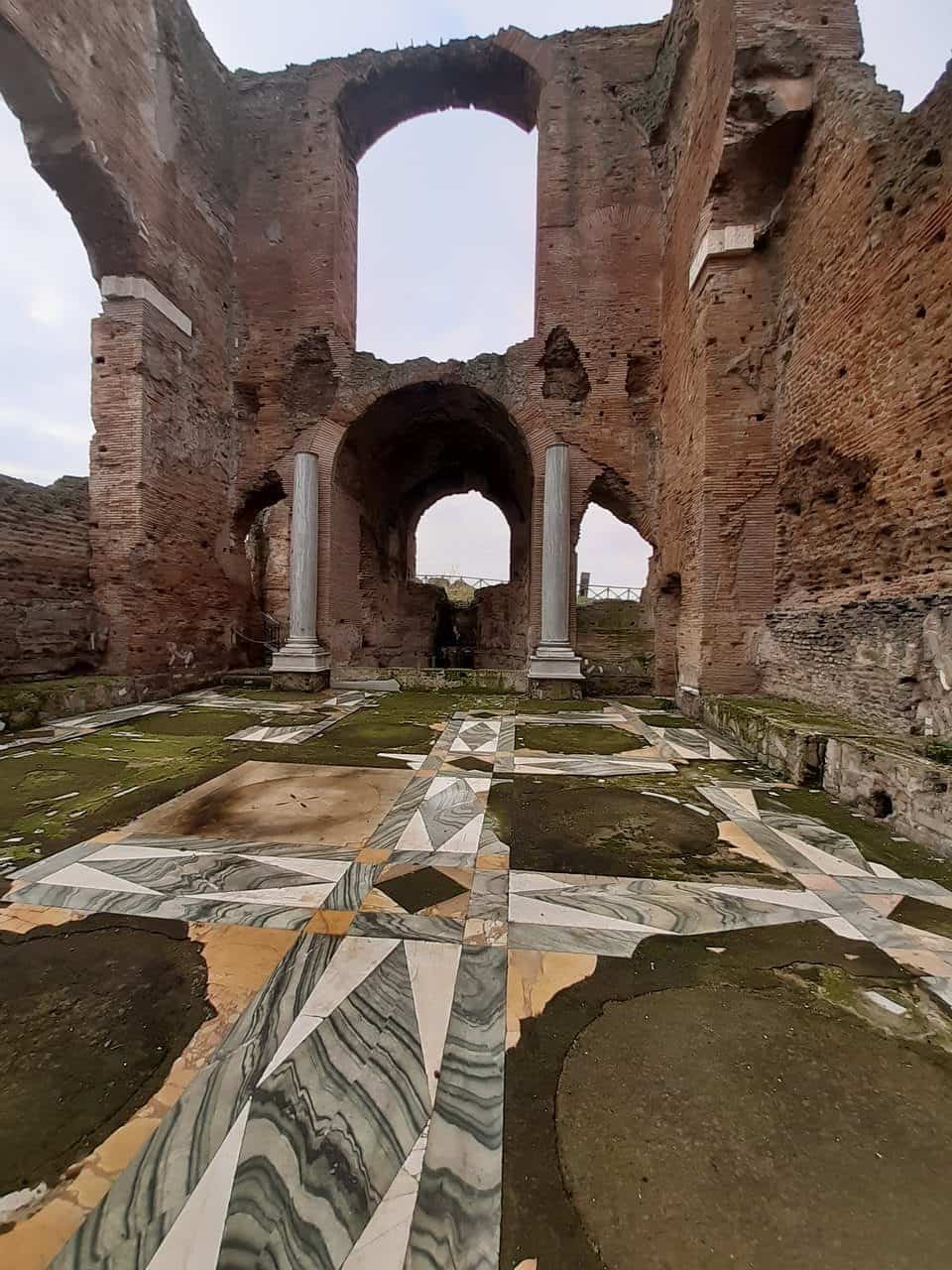
If there is one image that stays with you from the Villa dei Quintili, it is its baths. The bath halls rise on the plateau with very tall walls and warm red bricks pierced by large windows. From a distance, they look more like a ruined basilica than a private bath. They were not public baths. They served the owner and his guests, and that is exactly what makes them striking, because the luxury of a monumental bathing complex, worthy of a city, was here at the disposal of a single family. The layout followed the classic route of the Roman bath, organized into rooms of rising temperature.
The Calidarium and Frigidarium of the Quintili Baths
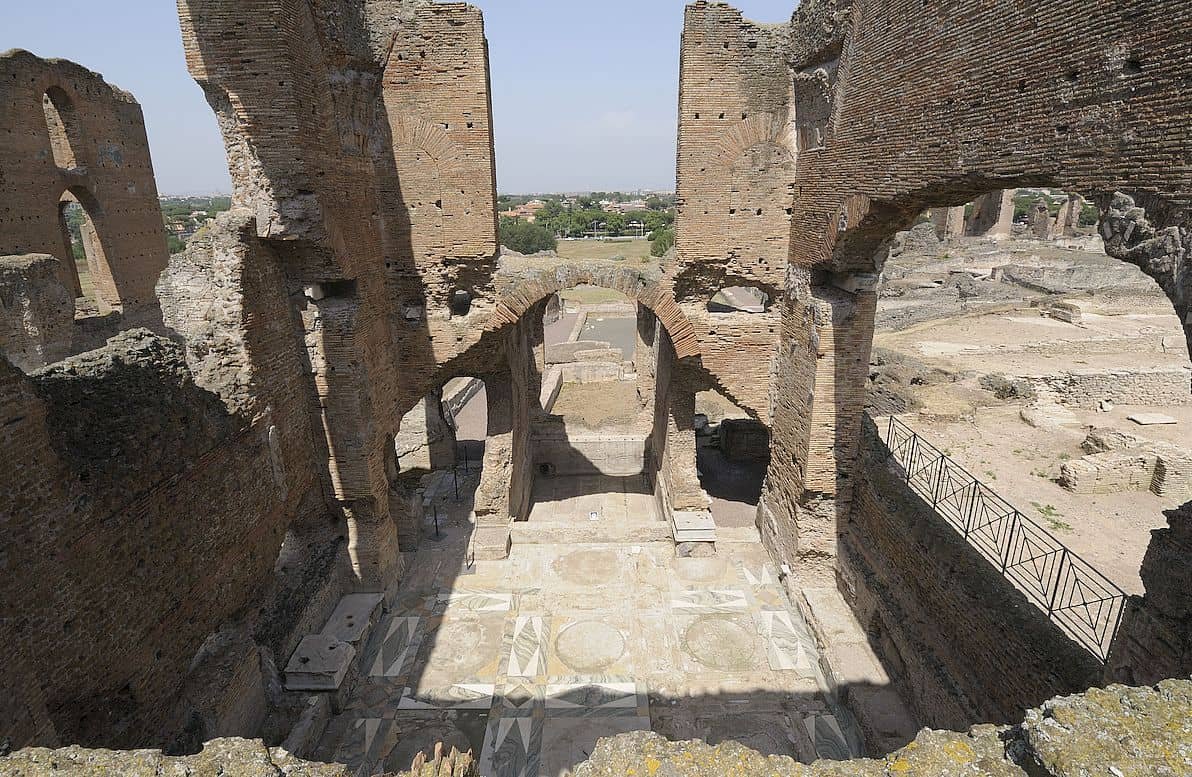
The calidarium was the hot bath room, heated from below through the hypocaust system, the stacks of small pillars that let hot air circulate under the floor and inside the walls. Oriented to catch the afternoon sun through the large windows, it was the room where you stayed to sweat in the steam. The frigidarium, at the opposite end of the route, held cold-water basins where bathers plunged at the end, to close the pores and tone the body. Between the two large halls, excavations in 2007-2009 uncovered the rooms of the tepidarium, the lukewarm passage room that mediated the temperature change. Visitors today walk among these rooms open to the sky, and with a little imagination they can rebuild the route of a bath 18 centuries ago: the hot, the warm, the cold, and then the open air of the garden again.
Heating and Engineering in the Quintili Baths
What strikes you, in front of the bath halls, is the engineering that kept them running. Under the floors ran the hypocaust: rows of small brick pillars, the suspensurae, held up the walking surface and let circulate the hot air produced by external furnaces, the praefurnia. The heat then rose along the walls through cavities of terracotta tubes, heating the rooms like a modern wall system. Feeding a system like this required wood in quantity, specialized staff and a constant water supply: that is why the villa needed its own aqueduct and its large cisterns. The walls we see bare today were covered with fine marbles and mosaics. The big windows, which now frame the sky, were closed with sheets of glass to hold in the warmth. Looking at the baths of the Villa dei Quintili and seeing them only as ruins is an error of perspective: they were a sophisticated thermal machine, the technological luxury of an age.
The Grand Nymphaeum on the Appia Antica
The real calling card of the Villa dei Quintili was not the front door but a fountain. On the Appia Antica, at the fifth mile, the Grand Nymphaeum opened, a scenic facade of water, marbles, niches and columns designed to amaze anyone passing on the consular road. Whoever arrived in Rome from the south, after days of travel, met this wall of water and understood at first glance the rank of whoever lived up there. Tradition ties its monumental form to Commodus, who after taking possession of the villa made it a manifesto of his own power. With the end of the ancient world the nymphaeum changed jobs: in the medieval period its massive structure was turned into a castrum, a fortification, as happened to so many Roman ruins that offered ready-made walls. The look the nymphaeum has today derives in large part from a restoration carried out after the unification of Italy, when people wanted to give the facade on the Appia a monumental legibility again. From the Grand Nymphaeum comes the statue of Niobe now displayed in the Antiquarium: the fountain was not only water, it was a gallery of sculptures facing the road.
The Hippodrome, the Xystus and the Gardens of the Villa dei Quintili
Between the Appia and the main body of the residence stretched a very long garden: the xystus, the colonnaded avenue dug out for a stretch of almost 300 meters, which connected the road to the residential core and served for walks and physical exercise. In the vocabulary of Roman villas the xystus was the covered walkway of the gardens, and here it reaches the dimensions of a public park. The excavation campaigns between 2002 and 2009 brought to light a large portion of these colonnaded gardens and a substantial part of the reception area, giving back the idea of a villa conceived also as a spectacle of greenery. In 19th-century writing some rooms were christened with grand names, like the so-called Maritime Theater, on the model of the famous one at Hadrian's Villa in Tivoli: names to interpret with caution, because they were born from the enthusiasm of the excavators more than from philological certainties. The fact remains that the Villa dei Quintili joined architecture and landscape in a single project, where the bath, the garden and the view over the countryside were part of the same experience.
The Aqueduct and Cisterns of the Villa dei Quintili
A residence with monumental baths, water features and a scenic nymphaeum doesn't stand up without a water supply to match. The Villa dei Quintili had its own, and in part you can still see it: along Via Appia Nuova runs a stretch of arched aqueduct that served the complex, feeding a system of large cisterns. Scholars have identified several, including the so-called Grande Cisterna, the Cisterna Piranesi and the Cisterna Mediana, names partly handed down by modern scholarship. They were capacious tanks, necessary to guarantee constant flow to the bath pools and the fountains even in the dry months. Walking toward Via Appia Nuova entrance you pass right next to these structures, which the hurried visitor often mistakes for minor ruins: in reality they tell the story of the hydraulic engineering without which the villa's luxury would not have been possible. Water, at the Villa dei Quintili, was not an accessory: it was the raw material of splendor.
From Imperial Residence to Roma Vecchia: The Long History of the Property
The life of the Villa dei Quintili did not end with the fall of the empire. The complex remained partially in use for a long time: brick stamps from the time of Theodoric have been found, a sign that in the sixth century something here still worked, and later traces are attributed to the early Middle Ages, pottery and burials identified in some rooms. Then it followed the fate of all the old imperial properties: the fundus of the Quintili passed, from century to century, into the hands of ecclesiastical institutions. In the 10th century we find it cited among the possessions of the monastery of Sant'Erasmo on the Caelian. From the 12th century it belonged to that of Santa Maria Nova, today's Santa Francesca Romana at the Forum, and it is from this passage that the name of the farmhouse and of today's second entrance derives.
It was the monasteries, and later directly the Apostolic Camera, that authorized the use of materials found on site and the excavations, at their own discretion. Toward the end of the eighteenth century the estate, by then commonly called Roma Vecchia, passed to the Hospital of the Santissimo Salvatore ad Sancta Sanctorum, today's complex of San Giovanni in Laterano. In 1797 the Monte di Pietà, which administered the Hospital's assets, sold it to Giovanni Raimondo Torlonia. A few years later Pius VI also granted the family the marquisate of the same name, created for the purpose. From the consuls of 151 to the Torlonia bankers, ownership of the Villa dei Quintili spans almost 2,000 years of Roman history, and each transfer has left its mark on the land.
Santa Maria Nova and the farmhouse of the Villa dei Quintili
The entrance to Santa Maria Nova, at via Appia Antica 251, is not just a second gate: it is a piece of agricultural history of the Roman countryside. The farmhouse that gives the gate its name is the old estate that the friars of Santa Maria Nova ran on these lands for centuries, and today it is a space restored by the Park for visitor reception and temporary exhibitions. Entering here means reaching the villa from the Appian Way side, the paved consular road, and facing the Great Nymphaeum from the viewpoint it was designed for, that of those traveling toward Rome. The farmhouse periodically hosts exhibitions devoted to the storerooms and finds of the Appian Way area. It's worth checking the official website, because a current exhibition can add a lot to the visit. Those with time can walk the entire internal route from one entrance to the other with the same ticket, walking inside the villa as people once did, from the monumental front on the Appian Way up to the baths on the hill.
The advice I give you for visiting the Villa dei Quintili
My advice for the Villa dei Quintili is not to treat it as a quick, in-and-out visit. This is not a half-hour site: it's a landscape, and it has to be walked. Set aside at least two hours, bring water and a hat if you go in summer, because there's very little shade and the plateau is exposed to the sun. Enter through the via Appia Nuova entrance early in the morning, right when it opens: the low, raking light on the baths' walls is the best for understanding the height of the rooms, and the temperature is still bearable. Go up to the baths first, then head down toward the Great Nymphaeum from the Appian Way side, and finish with the Antiquarium, which puts in order in your head what you've seen scattered across the site. If you can, choose a weekday rather than the first Sunday of the month, when free admission brings a lot of people. On Sundays the Park often organizes free guided tours. Check the official website, because a guide makes the difference between seeing some walls and understanding an imperial residence. One last practical tip: wear closed shoes. The ground is unpaved, grassy, and at times uneven, and elegant sandals are a mistake you'll pay for on the first uphill stretch.
The Antiquarium of the Villa dei Quintili
At the entrance on via Appia Nuova, the small site museum gathers what the excavations have yielded and what has stayed in Rome. It's here that you grasp what a wealth of sculpture the villa once held. Among the major pieces is a colossal statue of Zeus from the Hadrianic period, along with herms of deities, decorative elements, and opus sectile floors, the technique of cut and inlaid marble that covered luxury floors. There is the statue of Niobe from the Great Nymphaeum, and there is a find that deserves a particular stop: a Christian alabaster that bears the incised ichthys, the fish, symbol of the early Christians, found in the 1792 excavations and originally kept in the Museo Kircheriano. Its presence tells the story of the site's long life, which continued to be frequented even after the imperial villa declined. The Antiquarium is small and takes little time to see, but it is the key to reading everything else. Without the sculptures, the baths and gardens remain just walls. With the sculptures in front of you, you can sense the furnishings of a residence that the eighteenth-century popes plundered to fill their museums.
The Excavations of the Villa dei Quintili over the centuries
Few places in Rome have a history of excavation as long and eventful as the Villa dei Quintili. This is no coincidence: rising along a consular road, in a stretch dotted with illustrious tombs, the site has attracted artifact hunters for at least five centuries. The villa stood near the two ancient burial mounds that tradition attributed to the Horatii and the Curiatii, and not far from the tomb of Titus Pomponius Atticus, Cicero's friend. The fundus bordered that of the sophist Herodes Atticus. It is in this tangle of memories that the most famous mix-ups take root.
The Sarcophagus of Tulliola and the first finds
In 1485, at the farmhouse held by the friars of Santa Maria Nova, the sarcophagus of a girl was found in such an extraordinary state of preservation that people chose to believe she was Tulliola, Cicero's daughter. The body was displayed at the Palazzo dei Conservatori on the Capitoline Hill and drew crowds of the curious, until it had to be buried again. It was a false attribution, born from the wish to give a famous name to an anonymous find, but it says well how much the site was considered a deposit of illustrious antiquities.
The Excavations of Pius VI and the Grand Tour
Until the end of the 18th century these lands were part of the ecclesiastical patrimony, and excavations were authorized by the Apostolic Chamber, with an interest still mainly commercial: these were the years of the Grand Tour, when the market for ancient finds flourished. Between 1783 and 1792 Pius VI promoted several campaigns to enrich the Pio-Clementino Museum. From those excavations come sculptures now scattered among the Vatican Museums, the Glyptothek in Munich, the Louvre and private collections, such as the Braschi Aphrodite and two replicas of the Boy with the Goose. This is the paradox of the site: much of what the Villa dei Quintili contained is admired today everywhere except at the Villa dei Quintili.
The Torlonia, Nibby and the Dispute with Canina
In 1797 the estate was bought by Giovanni Raimondo Torlonia, and with the Torlonia began a new season of private excavations, whose finds ended up in the family collection. Between 1828 and 1829 Antonio Nibby directed the research, who also surveyed the topography of the ruins and concentrated the dig between the bath halls and the so-called Maritime Theater. From there emerged two columns of cipollino marble that Giuseppe Valadier reused for the new facade of the Teatro Tordinona, also a Torlonia property. Between 1850 and 1856 Alessandro Torlonia entrusted a new cycle of excavations to Giovanni Battista Guidi. In those years the papal government had the Appia Antica arranged by Luigi Canina, and the overlap generated conflicts: the dispute ended with the halt of Canina's work and the handing over of some finds to the government as furnishings for Via Appia.
Thomas Ashby and the 20th-Century Excavations
After the unification of Italy the site was surveyed, mapped and photographed by Thomas Ashby between 1899 and 1906, in documentation that remains precious. In the 1920s the large headless statues of Apollo Citharoedus and Artemis came to light, entirely by chance, now at the National Roman Museum in Palazzo Massimo, and in 1929 the remains of a rustic villa at kilometer 7 of the Appia, also linked to the Quintili complex because of the quality of the sculptures. The systematic campaigns of the Superintendency between 1998 and 2009, directed among others by Rita Paris and carried out by the archaeologists Riccardo Frontoni and Giuliana Galli with others, finally made the main remains visitable, bringing to light the residential area, the colonnaded gardens and the rooms of the tepidarium between the two bath halls. It is to this recent work that we owe the Villa dei Quintili that we can walk through today.
Another Well-Known Fact, Yet Rarely Cited
Anyone who knows the Appia knows the Villa dei Quintili is enormous. What is rarely mentioned is how little of it has stayed on the spot, and how much is scattered around the world. Four centuries of excavation campaigns worked like a diaspora: the villa's best sculptures are now in the Vatican Museums, the Glyptothek in Munich, the Louvre in Paris, in private collections that nobody visits. The Braschi Aphrodite, the groups of the Boy with the Goose, the Apollo Citharoedus and the Artemis at Palazzo Massimo: the Villa dei Quintili dressed half of Europe and in Rome, in proportion, only a minimal part remained, kept in the Antiquarium. It's a fact that changes the way you look at the empty spaces: those bare niches of the nymphaeum and the baths today were not empty, they were full of marbles that someone, at a precise and documented moment, carried off legally, with a papal authorization or a Torlonia deed of ownership. The site we visit is not only the villa mutilated by time. It is the villa emptied by three centuries of collecting. Keeping this in mind makes every surviving fragment far more precious than its apparent modesty would suggest.
The Right Photo to Take at the Villa dei Quintili
The photo worth the trip at the Villa dei Quintili is the one of the backlit thermal rooms. Stand with your back to the upper part of the plateau in the late afternoon, when the sun sinks toward the Appian Way, and frame the large windows of the calidarium with the light coming through them. The brick walls light up red and the openings become blades of light. That is where the villa stops looking like a pile of ruins and becomes architecture again. A second shot to plan for is the Grand Nymphaeum seen from the Appian Way, the same view the ancient travelers had arriving from the south. The monumental facade with the paved road in the foreground tells, in a single frame, the relationship between the residence and the regina viarum. For those who like wide shots, the plateau offers long views toward the Castelli Romani and the aqueduct, best on clear winter days, when the air is clean and the Alban Hills stand out sharply. Avoid the midsummer noon. The flat light flattens the walls and erases the volumes. The Villa dei Quintili photographs well at low-light hours, early morning or evening, when the shadows give depth to the stones.
Some important events that have happened here in history
The chronicle of the Villa dei Quintili is made of episodes that span 18 centuries. The first and darkest is the murder of the two Quintili brothers around 182-183. Commodus, according to Cassius Dio, had them strangled by the praetorians at the end of a banquet in their own home, in order to seize their property. With that crime the villa passed to the emperor and changed its fate forever.
In 1485 the discovery of the sarcophagus of the presumed Tulliola turned the site into a public affair for a few weeks, with crowds flocking to see the body displayed on the Capitoline Hill. In 1797 the sale of the estate to the Torlonia by the Monte di Pietà, which managed the properties of the Ospedale del Santissimo Salvatore, opened the chapter of private excavations that would scatter the villa's sculptures. A few years later, Pius VI even granted the Torlonia the marquisate of the same name, created for the occasion. In the 1920s excavations uncovered by chance the large statues of Apollo and Artemis, now at Palazzo Massimo, and in 1929 the villa rustica at kilometer seven.
There is also a recent event, of a different kind. In 2011 director Woody Allen chose the ruins of the Villa dei Quintili to shoot some scenes for the film To Rome with Love, using the thermal architecture as an example of ancient Rome. For once the villa served as a backdrop not to an emperor, but to an American comedy, and it brought its walls to screens around the world. From the murder ordered by Commodus to the set of a contemporary film, the Villa dei Quintili has continued to be a place where history is staged.
Who has passed through the Villa dei Quintili
The list of those who passed through here is long and starts with the emperors. Antoninus Pius and Marcus Aurelius knew the two Quintili well and held them in great esteem. Commodus, who had them killed, took their villa and signed it with his own nymphaeum. After him the residence remained imperial property for generations, until at least the time of Tacitus, in the 3rd century. Brick stamps show that it was still in use in the time of Theodoric, in the 6th century.
Then came the scholars and artists. In the 18th and 19th centuries the villa was a worksite for antiquarians and archaeologists. Antonio Nibby worked there between 1828 and 1829, Giovanni Battista Guidi in the 1950s for Alessandro Torlonia, Luigi Canina touched it with his works on the Appian Way, and Giuseppe Valadier reused its columns for the Teatro Tordinona. At the start of the 20th century the British topographer Thomas Ashby explored and photographed the site between 1899 and 1906, leaving an irreplaceable visual record. Even earlier, generations of Grand Tour travelers had passed through Roma Vecchia drawing its ruins, including the visionary fancy of Giovanni Battista Piranesi, whose name has remained linked to one of the cisterns. And in our time the cinema has also passed through here, with Woody Allen and the cast of To Rome with Love. Emperors, popes as patrons, archaeologists, engravers and directors: the Villa dei Quintili has hosted, in different forms, the power and imagination of almost 20 centuries.
The Villa dei Quintili in the landscape of the Appian Way
To understand the Villa dei Quintili, you have to look at it in its context, because the choice of site was not accidental. The Romans built their tombs along the consular roads, and this stretch of the Appian Way was an address of absolute prestige. The villa rose at the height of two ancient tumulus tombs that tradition attributed to the Horatii and the Curiatii, the heroes of the legendary duel between Rome and Alba Longa. The fundus bought by the brothers bordered that of Herodes Atticus, the very wealthy Greek sophist and patron who was a friend of emperors. Not far off was the tomb of Titus Pomponius Atticus, friend and correspondent of Cicero. Living here meant placing yourself in a geography of memory, among names that every educated Roman knew.
The villa's grounds were very large, so much so that in 1929 excavations identified, at the seventh kilometer of the Appian Way, the remains of a rustic villa: an agricultural outbuilding, an estate that produced for the residence. The quality of the sculptures found nearby has led scholars to consider it part of the Quintili complex. This helps explain the scale of the property: not a single house, but an estate that combined the luxury of the lord's residence with the production of the countryside, all overlooking the road that led to Rome. Today, walking from this plateau toward the other monuments of the Appian Way, from the Mausoleum of Caecilia Metella to the Villa of Maxentius, gives you the idea of an ancient landscape that is still legible, where each ruin speaks to the one beside it. It is this continuity, more than the single monument, that is the true heritage of the Parco Archeologico dell'Appia Antica.
What to See Around the Villa dei Quintili
The Villa dei Quintili is not an isolated site. It is a chapter of a route along the Appian Way that can be put together in a day. Toward Rome, on the same road, you'll find the Mausoleum of Caecilia Metella with the Castrum Caetani, the complex of Capo di Bove, and the large area of the Villa of Maxentius with its circus. Not far away are the large Christian catacombs: the catacombe di San Callisto and the catacombe di San Sebastiano, and the small chiesa del Domine Quo Vadis at the start of the Appian Way. If you want to broaden your view to the residential luxury of the Romans, you can plan a visit to Hadrian's Villa in Tivoli and the large Baths of Caracalla, which help you understand the scale of ancient bath architecture. For those with time, a trip to Ostia Antica completes the picture of daily Roman life. The whole area is part of the protected territory of the Appian Way Park, and it is designed to be explored on foot or by bicycle.
The Villa dei Quintili with Children
The Villa dei Quintili is a destination that works well with children, provided you take it for what it is: a large outdoor space rather than a museum. Little ones can walk here, run across the lawns, and climb up and down among the ruins without the constraints of an enclosed room. The story of the two brothers killed by a wicked emperor who wanted their house is the kind of tale that keeps them attentive. The very tall baths capture the imagination better than many explanations. Be careful, though, about a couple of practical things. There is little shade, so in summer you'll need hats, water, and the right hours, morning or late afternoon. The ground is uneven, so a stroller struggles on the unpaved dirt paths, and a baby carrier or child carrier backpack is more convenient for the youngest. The Antiquarium, short and with real statues, is the final reward. Overall, the Villa dei Quintili offers children what indoor museums don't: room to move while they learn.
When to Visit the Villa dei Quintili and When to Avoid It
The best time for the Villa dei Quintili is the shoulder season: spring, between April and June, when the Roman countryside is green and in bloom and the temperatures are mild, and autumn, between September and November, with golden light on the brickwork. Winter has its severe charm, with clear air that opens up the view of the Castelli, but the days are short and the opening hours end at 16:30. Summer is the hardest season. The plateau has no shelter and the midday heat is demanding, so it's best to aim for the 9:00 opening or the last hours of the afternoon. Avoid the first Sunday of the month if you're looking for quiet, when free admission draws many visitors. The villa is vast and absorbs crowds well, but the Antiquarium and the ticket office get crowded. Sunday, on the other hand, is the day when the Park often offers free guided tours, and if you want a guide, that is your opportunity. The right formula: a weekday in mid-season, in the morning, with comfortable shoes.
Accessibility of the Villa dei Quintili
The Villa dei Quintili is an outdoor archaeological site on natural ground, and this should be kept in mind when it comes to accessibility. The paths are largely unpaved, grassy and uneven, and getting between the different areas involves slopes and irregular stretches that can be challenging for people with mobility difficulties or those who use a wheelchair. The Antiquarium and the areas around the entrances are easier. Anyone with specific accessibility needs should contact the Appian Way Archaeological Park in advance to ask about usable paths and any services available, because conditions can change with maintenance and season. The official website remains the reference for up-to-date details.
Quick questions about the Villa dei Quintili
How much does the Villa dei Quintili ticket cost?
The ticket for Villa dei Quintili and Santa Maria Nova costs €8 full price and €2 reduced, with a rate of €4 for Roma Pass holders. There is also a park ticket for €12, valid seven days, for all the sites. Always check current prices on the official website.
When is entry to the Villa dei Quintili free?
Entry is free on the first Sunday of every month, like at the other state cultural sites, and for visitors under 18. It's the busiest day, so if you want calm, choose another day.
What are the opening hours of the Villa dei Quintili?
Open Tuesday to Sunday: 9:00-19:15 from April to September, 9:00-18:30 in March and October, 9:00-16:30 from November to February. Closed Mondays. Last entry is 75 minutes before closing.
Is the Villa dei Quintili closed on Mondays?
Yes, Monday is the weekly closing day. On the other days, Tuesday to Sunday, the site is open regularly according to the seasonal hours.
How do I get to the Villa dei Quintili by public transport?
Take Metro A to Colli Albani, then bus 664 or 663 toward Appia Nuova, getting off at number 1092. From the center, as an alternative, bus 118 runs along the Appian Way and stops near the entrance to Santa Maria Nova.
Are there two entrances to the Villa dei Quintili?
Yes. One is at Via Appia Nuova 1092, with the ticket office, Antiquarium and parking. The other is at the Santa Maria Nova farmhouse, at Via Appia Antica 251. The same ticket is valid for both on the same day.
How much time do I need to visit the Villa dei Quintili?
Plan on at least two hours to see the baths, the Grand Nymphaeum and the Antiquarium at a relaxed pace. It's a large site that you explore on foot, and if you're in a hurry, you risk seeing only part of it.
Is the Villa dei Quintili suitable for children?
Yes, it's a large outdoor space where kids can move around freely, and the story of the brothers killed by Commodus fascinates them. You'll need a hat and water in summer, and the unpaved ground makes a stroller awkward.
Is the Villa dei Quintili accessible by wheelchair?
The site is outdoors, with unpaved paths and uneven ground that is not easy for people with mobility difficulties. The areas around the entrances and the Antiquarium are easier. It's better to contact the Park first to ask about usable routes.
Do I need to book for the Villa dei Quintili?
For the villa ticket alone, booking is usually not necessary, while the €12 park ticket requires a reservation. Tickets are bought on the portal and the Musei Italiani app, or at on-site terminals, which accept only cards.
Can I take photos at the Villa dei Quintili?
Yes, amateur photography is allowed, and the site lends itself well to it. The best shots are the baths against the light in the late afternoon, and the Grand Nymphaeum seen from Via Appia Antica.
What can I see in the Antiquarium of the Villa dei Quintili?
Sculptures and finds from the excavations, including a colossal statue of Zeus from the Hadrianic period, the Niobe from the Grand Nymphaeum, herms, opus sectile floors and a Christian alabaster with the ichthys from the excavations of 1792.
Why was the Villa dei Quintili called Roma Vecchia?
Because of the imposing ruins: the baths and the aqueduct were so large that in the Middle Ages people thought they were the remains of an ancient city, not a private house. The name Roma Vecchia long referred to a very large area.
Who were the Quintili brothers?
Sextus Quintilius Condianus and Sextus Quintilius Valerius Maximus, highly cultured nobles, both consuls in 151. They were killed around 182-183 on the orders of Commodus, who wanted their property, and the villa thus became imperial property.
Is it true that a film was shot at the Villa dei Quintili?
Yes. In 2011 Woody Allen shot some scenes there for To Rome with Love, using the baths' architecture as an example of ancient Rome.
What is there to see near the Villa dei Quintili?
On the Appian Way: the Mausoleum of Cecilia Metella, Capo di Bove, the Villa of Maxentius, the Catacombs of San Callisto and San Sebastiano, and the church of Domine Quo Vadis. A little further on, the Baths of Caracalla and Ostia Antica.
Does the Villa dei Quintili ticket also include Santa Maria Nova?
Yes, the same ticket gives access to Villa dei Quintili and Santa Maria Nova on the same day, moving from one entrance to the other across the complex.
What is the best time to visit the Villa dei Quintili?
Spring and autumn, with mild temperatures and good light. In summer it's best to go early in the morning or late in the afternoon because of the sun. In winter the clear air gives long views, but the days are short.
Is there parking at the Villa dei Quintili?
Yes, there is a small parking lot at the entrance on via Appia Nuova 1092. On weekends in spring it fills up quickly: it's best to arrive when it opens.
How big is the Villa dei Quintili?
It is one of the most extensive residential complexes in the Roman countryside. It included monumental baths, colonnaded gardens, a scenographic nymphaeum on the Appian Way, cisterns, an aqueduct and even a rustic villa at kilometer 7. Because of its imposing size, in the Middle Ages it was mistaken for a city and called Roma Vecchia.
Are there guided tours of the Villa dei Quintili?
Yes. The Park often offers free guided tours on Sundays, and a guide here helps a lot in reading the ruins. It's worth checking the calendar on the official website of the Parco Archeologico dell'Appia Antica.
The final advice on the Villa dei Quintili
If I had to point to just one site on the Appian Way for someone who wants to understand what luxury really was for a wealthy Roman, I would point to the Villa dei Quintili without hesitation. It is not the easiest to reach, it doesn't have the crowds of the center, and for that very reason it gives back something that has been lost elsewhere: the silence, the space, the true scale of an imperial residence immersed in the countryside. Take your time, walk all the way to the end, stop in front of the large windows of the baths at sunset, and think that here a man drank hare's blood to pretend to be dead and not lose all of this. Few ruins in Rome tell, together and with this same force, the beauty and the ferocity of ancient power.
Article written by the editorial team of TourLeaderPro, contact them for Tour ed Esperienze Private/Aziendali/V.I.P.
Are you planning a trip to Rome? The guides in English for visiting the city are on ItalyPlanner.com.