Vatican Museums
In short. The Vatican Museums have their entrance on Viale Vaticano, with no street number, on the north side of the Leonine Walls: Italian territory up to the threshold, Vatican City State one meter beyond.


The Vatican Museums have their entrance on Viale Vaticano, with no street number, on the north side of the Leonine Walls: Italian territory up to the threshold, Vatican City State one meter beyond. Get there by Metro A, stops Ottaviano (10 minutes on foot) or Cipro (eight minutes), with tram 19 and buses 32, 81 and 982 to Piazza del Risorgimento, or with lines 49 and 492, which stop in front of and near the entrance respectively. The full ticket costs 20 euros, the reduced ticket 10 euros (ages seven to 18 and students up to age 25 with ID), and children under seven enter free. Booking online through the official portal tickets.museivaticani.va adds a booking fee of five euros, but it avoids a line that in high season exceeds two hours, and for me it isn't an option: it's the condition for a sensible visit. Open Monday to Saturday from 8.00 to 20.00 with last entry at 18.00. Closed on Sunday, except the last Sunday of the month, when admission is free, from 9.00 to 14.00 with last entry at 12.30. In 2026 the holiday closures are January 1 and 6, February 11, March 19, April 6, May 1, June 29, August 14 and 15, and December 8, 25 and 26. The calendar changes every year, so check the official website before fixing the date. This guide is part of the collection of museums of Rome and works alongside the page on Vatican City.
What the Vatican Museums really are
The plural is no affectation. The Vatican Museums are a confederation of museums, galleries, chapels and monumental apartments that grew over five centuries within the Apostolic Palaces and around the Cortile del Belvedere: seven kilometers of exhibition route, tens of thousands of works on display and a far greater number in storage. In 2023 they recorded 6.8 million visitors, a figure that places them firmly in second place in the world after the Louvre and that grew further with the 2025 Jubilee. Since January 1, 2017, the directorship has been held by Barbara Jatta, the first woman to lead the institution. A legal peculiarity few people know: an article of the Lateran Treaty of 1929 establishes that the Holy See may not sell off the collections and must guarantee their visitation to scholars and tourists. It is a kind of international easement: the pope is the custodian of this heritage, not its owner in the full sense of the word. My opinion: anyone who enters thinking only of the Sistine Chapel wastes the most densely packed ticket in Europe. The Sistine is the finale, but three quarters of the value is spread along the route that almost everyone walks through in a hurry.
Where to buy tickets. The Vatican Museums sell directly through their own portal tickets.museivaticani.va: timed-entry tickets, with online booking strongly recommended because without it you can wait in line for two hours. Priority entry with the Sistine Chapel is on GetYourGuide. Checked on September 28, 2026.

The history of the Vatican Museums: from the Laocoön to the 20th century
It all begins with an agricultural discovery. On January 14, 1506, in a vineyard on the Oppian Hill near Santa Maria Maggiore, a marble group re-emerges that Pliny the Elder had described 15 centuries earlier: Laocoön and his two sons crushed by sea serpents, the Trojan priest punished for having distrusted the Greeks' wooden horse. Pope Julius II della Rovere sends Giuliano da Sangallo and Michelangelo Buonarroti, who were working for him in those months, to examine it. On their advice he immediately buys the sculpture from the owner of the vineyard, and a month later displays it to the public in the Vatican, in the Courtyard of the Statues of the Belvedere. That gesture of 1506 is the birth certificate of the Vatican Museums: a collection of antiquities open to view, not a private treasure. It would take until 1771, however, for Clement XIV to turn the collection into a public museum in the modern sense, open by statute and not as a courtesy. From then on every pope added a piece: Pius VI expanded it, Pius VII rebuilt after the Napoleonic plunder, Gregory XVI founded the Egyptian, Etruscan and Profane museums in the 19th century, Pius XI in 1932 gave the complex a monumental entrance and a purpose-built Picture Gallery, and Paul VI opened the museums to 20th-century art in 1973. The Napoleonic episode deserves one more line: with the Treaty of Tolentino of 1797 the Papal States had to hand over the major masterpieces to France, which were taken to Paris. After the Congress of Vienna in 1815 it was the stubborn diplomacy of Antonio Canova, a sculptor lent to politics, that brought most of them back to Rome. Without Canova, today you would see the Laocoön at the Louvre.
The Twentieth Century and the New Entrance to the Vatican Museums
1938 gives the history of the Vatican Museums an episode of icy diplomacy. In May, Adolf Hitler arrives in Rome as the guest of Victor Emmanuel III and Mussolini, with Via dei Fori Imperiali decked out for celebration and all. Pius XI does not intend to receive him. He moves to the villa at Castel Gandolfo for those days and, in an unprecedented step, has both St. Peter's Basilica and the museums closed to all visitors. The message is clear: the head of Nazism must not be able to set foot on Vatican territory, not even with a tourist ticket. Anyone who wants to learn more about the papal summer residence can find the entry on Castel Gandolfo, which today is itself a museum site. The other watershed is the Holy Year of 2000. A new monumental entrance opens in the Vatican walls, a few meters to the left of the one from 1932, with one passage for entry and one for exit, designed for flows of millions of people. On the way out you still walk the spiral staircase designed by Giuseppe Momo in 1932, a double spiral with a bronze balustrade by Antonio Maraini, where those going up and those going down never cross paths. It's one of the most photographed pieces of architecture in Rome, and people walk past it without knowing it's almost a century old. In 2006, for the five-hundredth anniversary, the Vatican Museums permanently opened to the public the excavations of the Roman necropolis along Via Triumphalis, on the Vatican Hill: tombs of middle and humble classes, the perfect counterpoint to the imperial marbles on the upper floors.
Tickets, Opening Hours and Booking for the Vatican Museums
A reasoned summary, checked against the current official rates. Full-price ticket €20. Reduced €10 for children between seven and 18 years old and for students up to age 25 with a student card or proof of enrollment. School groups €5 per student with a letter from the school. Free for children under seven and for people with certified disabilities, with a companion. Booking online costs €5 extra (€2 for schools) and assigns an entry time slot: you skip the ticket office line, but not the security checks. On the last Sunday of the month, entry is free for everyone from 9.00 to 14.00, with the last admission at 12.30: good on paper, brutal in practice, because the line starts forming at dawn. My clear verdict: the free Sunday only works for people who already know the museums and are aiming for two or three specific rooms. For a first visit, it's better to go on a Tuesday or Thursday at 8.00, paying. The Friday and Saturday evening openings, when active in the season, are the most civilized window of all: fewer groups, raking light on the Pinecone Courtyard, a breathable Sistine Chapel. A practical warning: tickets are non-refundable, and the only official sales channel is the official museum portal. The resellers you find on the street in Piazza del Risorgimento sell the same entry at a marked-up price, bundled with a guided tour that is often mediocre.
How to Get to the Vatican Museums
Metro line A is the most reliable option: from Termini it's six stops to Ottaviano, seven to Cipro, and both are less than 10 minutes' walk from Viale Vaticano entrance. From Ottaviano, walk up Via Ottaviano to Piazza del Risorgimento and follow the walls. From Cipro, cut through Via Fra Albenzio or follow Viale Vaticano as it slopes gently uphill. On the surface, the area is served by tram 19, terminus in Piazza del Risorgimento, and buses 32, 81, and 982. The 49 stops right in front of the museum entrance, and the 492 is a few steps away. Anyone arriving by car would do well to think again: parking around the walls is a war of attrition, and private parking lots in the Prati area charge airport rates. On the other hand, the location is perfect for building a day on foot. Once you leave the museums, it's a quarter of an hour down to St. Peter's Basilica. Continue along Via della Conciliazione to Castel Sant'Angelo, and if you still have legs, climb up to the Janiculum for sunset. Behind the walls, on the south side, there is also the passeggiata del Gelsomino, the former railway bed that offers an unusual view of the great dome. Almost no tourists know it.
The Pio Clementino Museum, the Ancient Heart of the Vatican Museums
Founded by Clement XIV Ganganelli in 1771 and expanded by his successor Pius VI Braschi, to whom it owes its name, the Pio Clementino is the museum of classical sculpture par excellence. Its core is the Courtyard of the Statues commissioned by Julius II in the early 16th century, transformed in the 18th century into a public museum under the influence of Enlightenment thought, with new rooms designed by Alessandro Dori, Michelangelo Simonetti and Giuseppe Camporese around the Palazzetto del Belvedere of Innocent VIII. Here the 18th century restored with a heavy hand: many statues have arms, noses and attributes integrated by the restorers of the time, and spotting the additions is half the fun for anyone looking closely. With Tolentino, the best pieces left for Paris. With Canova, after 1815, almost all of them returned.

The Octagonal Courtyard: Laocoön and Apollo Belvedere
The ancient Courtyard of the Statues, redesigned on an octagonal plan by Simonetti, keeps in its corner niches the two marbles that educated the eye of Europe. The Laocoön, found in 1506, signed according to Pliny by the Rhodian sculptors Agesander, Athanodoros and Polydorus, is the manifesto of ancient pain: Michelangelo studied it for his nudes, and the entire Baroque owes it the twisting of bodies. The Apollo Belvedere, a Roman copy of a Greek original attributed to Leochares, was for Winckelmann the absolute peak of ideal beauty. Today critics are more lukewarm, but I keep finding it a glacial and perfect god, and I understand why Goethe wrote about it as an apparition. Also in the courtyard is the Perseus Triumphant by Antonio Canova, acquired by Pius VII when the void left by the marbles that departed for Paris called for a modern champion. Comparing it with the Apollo, a few meters away, is a lesson in the history of taste better than many textbooks.
The Square Vestibule and the Apoxyomenos
At the entrance to the route, the Square Vestibule leads to the Cabinet of the Apoxyomenos: the athlete scraping the oil off his arm with a strigil, the only complete known marble copy of Lysippos's bronze, found in Trastevere in 1849. It is one of the most intelligent sculptures of antiquity, entirely built on the minimal, everyday gesture after the contest, and almost everyone passes it by without stopping because the room comes before the celebrities of the courtyard. Mistake: stop.
The Animal Room of the Vatican Museums
A bestiary in marble: lions, dogs, crabs, a boar, horses, creatures reassembled in the late 18th century by the sculptor and restorer Francesco Antonio Franzoni, who built a real stone zoo out of ancient fragments. It is the children's favorite room, and not only theirs. Here you understand how elastic the boundary between archaeology and invention was in the century of the Enlightenment. The group of Mithras sacrificing the bull and the two Molossians in green basalt are worth the stop on their own.
Gallery of the Statues, Hall of the Busts and Cabinet of the Masks
The Gallery of the Statues occupies the 15th-century loggia of the small palace of Innocent VIII, with the frescoed lunettes by the circle of Pinturicchio still visible up high. It houses the Sleeping Ariadne, the Apollo Sauroctonos of Praxitelean memory and the large Barberini candelabra. The Hall of Busts lines up emperors and private citizens: the portrait gallery where Rome stops being an idea and becomes a series of faces, wrinkles included. The Cabinet of the Masks, with its mosaic of stage masks from Hadrian's Villa, houses the Cnidian Venus, a copy of the statue by Praxiteles that first dared the full nude of the goddess. In antiquity it was the most famous sculpture in the Mediterranean.
Muses Room: the Belvedere Torso
Built by Simonetti to house the group of Apollo and the Muses from Tivoli, the room has at its center the Belvedere Torso, signed by Apollonius son of Nestor, Athenian: a seated hero, perhaps Ajax contemplating suicide, reduced to trunk and thighs. Michelangelo revered it, refused to integrate it and made it the model for the nudes of the Sistine Chapel and the Christ of the Last Judgment. Those in a hurry can skip something, but in front of the Torso you stop. It is the piece that explains all the others.
Round Hall, Greek Cross Hall and Chariot Hall
Simonetti's Round Hall is a small Pantheon, complete with a coffered dome. At the center is the monolithic basin of red porphyry from the Domus Aurea, over four meters wide. Around it stand the gilded bronze Hercules from the Forum Boarium and the colossal head of Zeus from Otricoli, and on the floor are mosaics from Otricoli with centaurs and tritons. The Greek Cross Hall houses the two most important porphyry sarcophagi of late antiquity: that of Saint Helena, mother of Constantine, with battle scenes, and that of Constantina, the emperor's daughter, with harvesting putti already allusive in a Christian sense. The Chariot Hall, up high, displays the chariot reassembled in the 18th century by Franzoni around an ancient seat that in the Middle Ages had served as the episcopal throne in San Marco. You see it through a gate, and that's fine as it is.
Museo Chiaramonti and Galleria Lapidaria of the Vatican Museums
The long corridor that connects the Palazzetto del Belvedere to the Vatican Palaces, the old Bramante corridor, has housed since 1806 the museum wanted by Pius VII Chiaramonti and arranged by Antonio Canova in person. The criterion is stated openly: to present the three sister arts together, sculpture in the 1,000 ancient pieces lined up, architecture in the brackets made from ancient cornices, painting in the frescoed lunettes by young artists paid out of Canova's own pocket, including a lunette that celebrates the return of the works from Paris. The dense display, almost like a noble storeroom, does not isolate the masterpieces. It reflects the ideas of Quatremère de Quincy, for whom works can only be understood by comparison, even with the minor pieces. It is the part of the Vatican Museums that most resembles a 19th-century depot that survived intact, and that's why I love it: here you can see how antiquity was studied two centuries ago. The collection of Roman portraits is among the richest in existence. The Galleria Lapidaria, in the southern part of the same corridor, is a library of stone: over 3400 inscriptions set into 48 walls, arranged by theme (religion, emperors, army, trades, family, Christianity, excavations at Ostia) by Abbot Gaetano Marini between 1805 and 1808, when epigraphs were the Library's responsibility because they were considered documents on a par with manuscripts. Daily life, wills, insults, dedications: ancient humanity written in the first person. It is open on request, generally for study, and that's a shame. The Ostia inscriptions go well with a trip to the Ostia excavations.
The Braccio Nuovo of the Vatican Museums
The return of the works confiscated by Napoleon required a reorganization and made a new gallery necessary. Pius VII entrusted it to the Roman architect Raffaele Stern and, after his death in 1820, to Pasquale Belli, who brought it to its inauguration in February 1822 under the supervision of the Commission of Fine Arts chaired by Canova with Filippo Aurelio Visconti and Antonio D'Este. It is the highest page of Roman Neoclassicism: a 68-meter gallery with a coffered vault and skylights, a floor of marble slabs framing authentic Roman mosaics, 28 niches for larger-than-life statues, stucco friezes by Francesco Massimiliano Laboureur inspired by ancient reliefs. This is home to the Augustus of Prima Porta, found in 1863 in the villa of Livia along Via Flaminia: the emperor in armor, with a cuirass decorated with the return of the Parthian standards, the most copied state portrait in Western history. A little further on, the colossal personification of the Nile reclining with 16 putti playing on him, one for each cubit of the river's flood, and the two gilded bronze Peacocks from the mausoleum of Hadrian, the originals of the ones you now see copied in the Cortile della Pigna.
The Museo Gregoriano Egizio of the Vatican Museums
Founded by Gregory XVI in 1839, the Gregoriano Egizio occupies nine rooms carved out of the former retirement apartment of Pius IV in the Belvedere palazzetto, with a hemicycle that opens onto the terrace of the Nicchione della Pigna. The first display was curated by the Barnabite Luigi Ungarelli, one of the fathers of Italian Egyptology, a disciple of Ippolito Rosellini, who had been Champollion's companion on his expedition. In some rooms the 19th-century wall decorations in Nilotic style survive, an imagined Egypt that is now a document in itself.
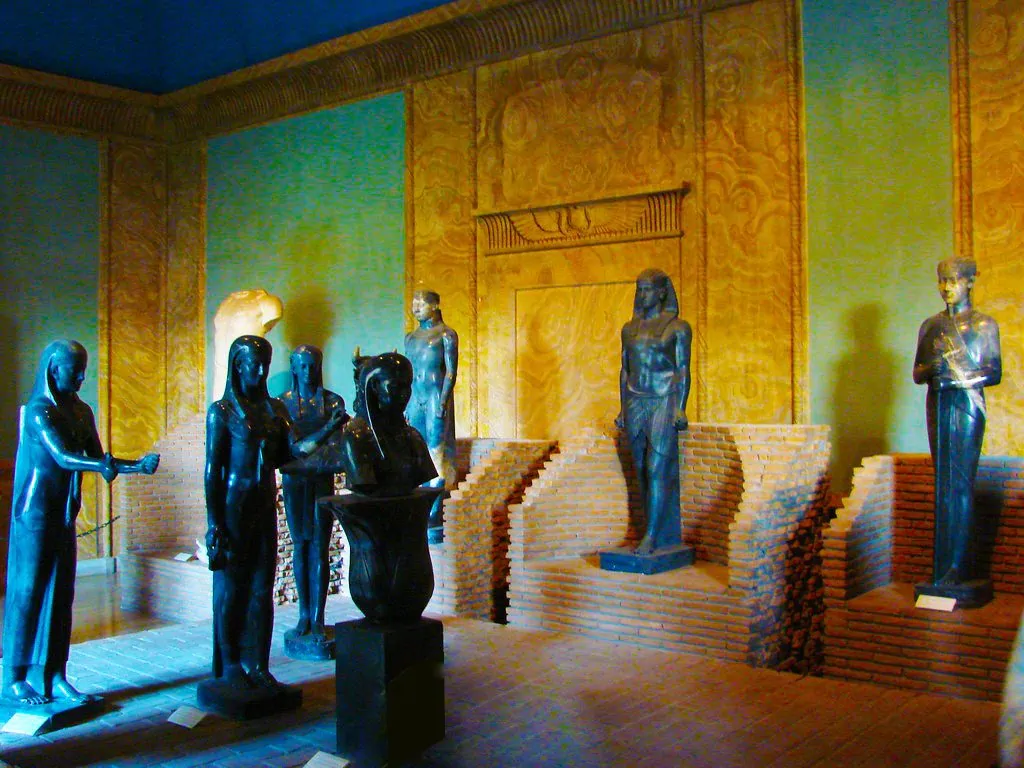
The nine rooms of the Gregoriano Egizio
The route follows a precise order that is worth respecting. Room I collects the epigraphic finds, stelae and hieroglyphic inscriptions. Room II holds the funerary customs of ancient Egypt, with mummies, painted sarcophagi, canopic jars and a Book of the Dead. It's the room the kids don't want to leave anymore, and I get it. Room III reconstructs the Serapeum of the Canopus from Hadrian's Villa at Tivoli, with the Egyptianizing sculptures the emperor wanted in his residence. If you've visited Hadrian's Villa, you find here the missing pieces of that stage. Room IV tells the story of Egypt and Rome, that is the Egyptian fashion in imperial Rome, with the large statuary group from the Horti Sallustiani now in the Hemicycle. Room V is the statuary room, with the colossus of Queen Tuya, mother of Ramses II. The Terrace of the Nicchione offers a breath of air over the courtyard. Rooms VI and VII display the Carlo Grassi collection and the materials from Alexandria and Palmyra, a hinge between Hellenistic Egypt and the Roman East. Rooms VIII and IX close with the antiquities of the Near East, which came in during the 1970s: reliefs and inscriptions from the Assyrian palaces of Nineveh and Nimrud, cuneiform tablets, seals. In half an hour you cross 3,000 years and three empires. No other section of the Vatican Museums has this density per square meter.
The Museo Gregoriano Etrusco, the section everyone skips
I'll say it plainly: the Gregorian Etruscan Museum, also founded by Gregory XVI, in 1837, two years before the Egyptian, is the most unfairly ignored section of the Vatican Museums, partly because it sits on the upper floor, away from the direct route to the Sistine. Its rooms hold the grave goods of the Regolini-Galassi tomb from Cerveteri, excavated in 1836: embossed gold, the large fibula with little lions, the funeral chariot of an Etruscan princess of the seventh century BC. There is the Marte di Todi, one of the very few large Etruscan bronzes to survive being melted down, and there are first-rate Greek ceramics that came from the necropolises of Etruria, including the Exekias amphora with Achilles and Ajax playing dice, one of the most famous vases ever painted. Anyone who gets passionate about the subject can continue in spirit to the Banditaccia necropolis in Cerveteri and to the museum at Villa Giulia: the three stops together make up the most complete Etruscan story that Italy has to offer.
The Gregorian Profane Museum of the Vatican Museums
The third of the Gregorian museums, the Profane, was founded in the Apostolic Palace of the Lateran on May 16, 1844, at the wish of Gregory XVI Cappellari, as a showcase for the papal excavations in Rome and its surroundings: Cerveteri, Veii, Ostia. In the 1960s all the Lateran collections were moved to the Vatican, and in June 1970 the new wing designed by the studio of Vincenzo, Fausto and Lucio Passarelli was inaugurated, strongly encouraged by Paul VI: a modern building, lit entirely by natural light from windows and skylights, with metal grilles in place of walls for a flexible display that favors the contexts of origin. It is a museum architecture that set a model and holds up very well in comparison with today's museums. The route begins with the Greek originals, funerary steles and votive reliefs, with fragments of the Parthenon frieze donated over time to the Holy See. It continues with Roman copies of Greek originals, including the group of Athena and Marsyas that reproduces the bronze by Myron from the Acropolis, and the Niobid Chiaramonti. It culminates in imperial-age sculpture with the reliefs of the Cancelleria, Domitian propaganda recarved for Nerva, the portrait of Julius Caesar, the Mausoleum of the Haterii with its sculpted construction crane, the mosaics of athletes from the Baths of Caracalla and the famous mosaic of the asarotos oikos, the unswept floor with the leftovers of a banquet rendered in tiny tesserae: the humor of a 2nd-century mosaicist that still works today.
The Pio Cristiano Museum of the Vatican Museums
Founded in 1854 by Pius IX in the Lateran Palace, a year after the establishment of the Pontifical Commission of Sacred Archaeology that excavated the Roman catacombs, the Pio Cristiano collects the remains of Christians of the first centuries: mainly sarcophagi with biblical scenes from the 3rd to the 5th century, along with materials from the 18th-century Sacred Museum of Benedict XIV and pieces recovered from Rome's churches and fountains, where sarcophagi had been reused for centuries as basins. The original arrangement is due to the Jesuit Giuseppe Marchi and to a very young Giovanni Battista de Rossi, the founder of modern Christian archaeology, who arranged the works by iconographic theme with a didactic and catechetical purpose, alongside a collection of hundreds of funerary inscriptions. In 1963, at the wish of John XXIII, the museum was moved to the Vatican together with the Gregorian Profane and the Ethnological, rearranged by Enrico Josi and reopened in 1970. The symbol piece is the statuette of the Good Shepherd, a young, beardless Christ with a sheep on his shoulders, a Christian reworking of a pagan type. Around it is the complete typology of sarcophagi: with fluted decoration, with continuous frieze, with double register, with columns, up to the dogmatic sarcophagus with one of the earliest depictions of the Trinity and the scenes of the Nativity and the Epiphany. Anyone who leaves here reads the catacombs with different eyes: the visit pairs well with the Catacombs of St. Callixtus, which share materials similar in period and iconography. Even the funerary mosaics of Ciriaca, from the cemetery near San Lorenzo, deserve more than the 30 seconds they typically get.
Anima Mundi, the Ethnological Museum of the Vatican Museums
The ethnological museum began with an event: the 1925 Vatican Exhibition, through which Pius XI wanted to show the cultural and spiritual traditions of all peoples. Over 1 million visitors came, and more than 100,000 objects arrived from every continent. The success convinced the pope to make the exhibition permanent, and the Missionary Ethnological Museum was born, housed at the Lateran until its move to the Vatican in the early 1970s. The first director was Father Wilhelm Schmidt, the most authoritative Catholic ethnologist of the twentieth century, who oversaw the selection of the 40,000 works that remained as gifts to the popes. The core was joined by pieces from the Borgia Museum of Propaganda Fide, with the collection of Cardinal Stefano Borgia (1731-1804), an omnivorous collector of rarities. Among these were pre-Columbian works given to Innocent XII in 1692, the date from which the history of the collection is traced. Today the museum, renamed Anima Mundi and rearranged according to contemporary criteria, holds over 80,000 objects: sculptures from Oceania and Australia, African art, evidence of Asian traditions, materials from the indigenous peoples of the Americas, and prehistoric finds. Because of the fragility of the materials, the works on display rotate periodically. The statue of Quetzalcoatl and the Polynesian deities a few corridors away from Raphael: this is the point where the Vatican Museums stop being a European museum and become an atlas.

The Carriage Pavilion of the Vatican Museums
Inaugurated on April 19, 1973 by Paul VI beneath the Giardino Quadrato, it is the museum of papal mobility: it starts with the sedan chairs and ends with the popemobiles. The centerpiece is the Berlina di Gran Gala, built in Rome in 1826 for Leo XII, gold and velvet for coronations. Around it are nine ceremonial carriages of popes and princes of the Holy Roman Church, including the one belonging to Cardinal Luciano Luigi Bonaparte, a gift from his cousin Napoleon III. Two traveling carriages tell the story of the end of temporal power: one brought Pius IX back to Rome from exile in Gaeta after the Roman Republic, the other was used for the last journey of the Papa Re. Then the engines. The first car entered the Vatican shortly after the start of Pius XI's pontificate, a Bianchi Tipo 15 donated by the Association of Catholic Women of Milan, with Diplomatic Corps license plate 404. After the Lateran Pacts of 1929, car makers competed with one another: the Graham Paige 837, the Citroen Lictoria C6 designed to measure, the first Mercedes, and the 460 Nurburg designed by Ferdinand Porsche. There are the Mercedes 300 SEL, the Land Rover, Toyota and Mercedes 230 GE popemobiles, the last Volkswagen Beetle to leave the Mexican factory in 2003, the white Renault 4 given to Pope Francis in 2013, which he drove himself, and even a Formula 1 Ferrari steering wheel. And there is the open-top Fiat 1107 Nuova Campagnola in which John Paul II crossed St. Peter's Square on May 13, 1981, the day of the assassination attempt by Ali Agca. Seeing it in person has an effect that no photograph can capture.
The Philatelic and Numismatic Museum of the Vatican Museums
It is the youngest collection, opened on September 25, 2007, and collectors consider it a small Mecca. The philatelic section organizes the issues of Vatican City by pontificate, from Pius XII to Benedict XVI, with postal cards, air letters and the issues of the Papal States from 1852 to 1870: new stamps, canceled stamps, traveled envelopes, as well as the plates, cylinders and intaglio plates with which the stamps were printed, and the original sketches on the walls. The numismatic section ranges from the divisional coins of 1929 to the commemorative ones, from Vatican lire to the euro, with the series of the Holy Years and the rare issues of the Sede Vacante, coins and stamps struck during the interregnum between one pope and the next. It seems like a museum for specialists, but in fact it is a parallel history of the twentieth century told in miniature, and you can visit it in 20 minutes with no line at all.
The Museums of the Vatican Apostolic Library
Since October 1, 1999, the museum collections of the Apostolic Library have come under the Vatican Museums, and they form one of their most complex sections: you pass through them on the way back from the Sistine Chapel, along the Library wing, and almost nobody knows what they are looking at. Until Leo XIII, the rooms were the Library's own seat, with its collections: coins, cameos, gilded glasses from the catacombs, gems, bronzes, enamels, ivories, objects that the papal librarians considered documents as much as the codices. Under Pius X the paintings went to the Pinacoteca. In the twentieth century the practice took hold of assigning to these collections the gifts offered to the popes by sovereigns and heads of state, so that among the display cases appear diplomatic gifts from every era and continent. The monumental centerpiece is the Sistine Hall, built by Domenico Fontana for Sixtus V in 1588 straddling the Belvedere Courtyard, frescoed with the pope's deeds and with the history of ancient libraries. Scholars still have access to the digitized collections and to the Library's online catalog, which has put tens of thousands of manuscripts online.
The Christian Museum, the Papyri Room and the Room of Addresses
On October 4, 1757, with the apostolic letter Ad Optimarum Artium, Benedict XIV Lambertini established the Christian Museum in the Vatican, at the southern end of the corridor that bounds the Belvedere Courtyard to the west, and entrusted its more than 1,000 pieces to the Veronese scholar Francesco Vettori (1692-1770). The idea was both Enlightenment and apologetic: to illustrate the faith and culture of the early Christians through finds from the catacombs, read with philological tools. Vettori arranged them by class inside cabinets designed specifically for them, parts of which survive. As the collection grew, the museum extended into the nearby rooms: the Papyri Room, assigned by Clement XIII to the Latin papyri of the Church of Ravenna (6th-9th century), and the room later called the Room of Addresses, which Pius VII fitted out as his personal library and Gregory XVI used to display the paintings of the early masters, moved in 1909 by Pius X to the new Pinacoteca. Since then the room has held the addresses of homage to Leo XIII and Pius X, that is, the celebratory parchments that arrived from all over the world, which is where the name comes from. From 1936 the Library's collections of applied arts have been kept here, and since 1999 they have been managed by the Vatican Museums.
The Profane Lapidary ex Lateranense
Opened in 1981, it is the reorganization of the epigraphic collection that Gregory XVI had arranged at the Lateran into three lapidaries, Profane, Jewish and Christian, moved to the Vatican in 1963. The inscriptions are divided by origin. Those from outside the city or from municipalities are arranged by ancient cities of Lazio (Ostia, Falerii Novi, Veio, Ferentino, Preneste, Tivoli, Tusculum), and those from Rome are grouped by content: deities, emperors, senators and knights, priests, calendars, soldiers, professions and trades, with archaeological contexts reassembled, such as the tomb of the slaves and freedmen of the Volusii Saturnini. There are also the tabulae lusoriae, game boards carved into marble that ancient Romans bet on, small cippi, cinerary urns, Greek inscriptions and unpublished fragments. The original collection numbered about 3430 inscriptions, of which only 860 are fully legible, and it has grown over time. An outdoor area near the Minor Mosaic lines up 78 items, among cippi and altars, that came out of the storerooms. The general public can see only part of the municipal sections, with Falerii Novi and Veio at the front. The rest is territory for epigraphers, who have here a mine without equal.
The Gallery of the Candelabra at the Vatican Museums
Climbing to the level of the upper galleries, the route to the Sistine Chapel passes through three monumental corridors one after another. The first is the Gallery of the Candelabra, 80 meters of sixteenth-century loggia enclosed with glass under Pius VI, marked by pairs of Roman marble candelabra from the 2nd century that give it its name, and lined with closely packed ancient sculptures, like an art market: the Satyr with the Goose, the many-breasted Ephesian Diana, sarcophagi with Greek myths. The vault was repainted at the end of the nineteenth century under Leo XIII by Domenico Torti and Ludwig Seitz with Thomist allegories. In the tradition of nineteenth-century guidebooks the gallery was also called the Gallery of Tapestries, because in 1838 the series of the Scuola Nuova was installed there. Today the two names refer to two successive stretches of the same axis, and the confusion survives on many web pages. Here the stream of groups moves quickly. If you stop even just two minutes to look at a sarcophagus, you'll have the strange experience of being alone in the middle of 1,000 people.
The Gallery of the Tapestries at the Vatican Museums
The second corridor displays the tapestries of the so-called New School, woven in Brussels in the workshop of Pieter van Aelst during the time of Clement VII (1523-1534) from designs by Raphael's pupils, and displayed for the first time in the Sistine Chapel in 1531. They are called that to distinguish them from the Old School, the tapestries woven from Raphael's original cartoons under Leo X, now in the Picture Gallery. On the window side runs the 17th-century series with the Stories of the Life of Urban VIII, produced by the Roman workshop founded in 1627 by Cardinal Francesco Barberini and active until 1683: the young Maffeo Barberini graduating in Pisa, regulating the waters of Lake Trasimeno, becoming a cardinal under Paul V and then pope, Countess Matilda donating her property to the Holy See, the consecration of St. Peter's Basilica in 1626, Rome saved from the plague. Among the Flemish Gospel scenes are the Adoration of the Shepherds, the Presentation in the Temple, the two versions of the Massacre of the Innocents, the Supper at Emmaus and the Resurrection, famous for the optical effect of Christ's gaze that seems to follow whoever walks: stand at one end of the hall, fix your eyes on him, and walk the whole gallery without taking your eyes off him. It is the most effective perspective game in the Vatican Museums, and it costs 30 seconds.
The Gallery of Maps of the Vatican Museums
The third corridor is for me the most beautiful of the three, and I say this knowing I'm doing the tapestries an injustice: 120 meters long by six wide, entirely frescoed between 1580 and 1585 at the wish of Gregory XIII Boncompagni, the pope of the calendar reform. The scientific project is by the Dominican Ignazio Danti, mathematician, geographer and papal cosmographer: 40 maps of the regions of Italy painted on the walls as if you were walking along the ridge of the Apennines, with the Adriatic territories on the right and the Tyrrhenian ones on the left. Girolamo Muziano, Cesare Nebbia, the Flemish brothers Matthijs and Paul Bril, Giovanni Antonio Vanosino da Varese and Antonio Danti worked on the decoration, with the vault by Antonio Tempesta and others: on the ceiling, corresponding to each region, are frescoed the religious and miraculous events that occurred there, to show that Providence has touched every corner of the country. It is the first unified portrait of Italy, geographic and spiritual at once, made three centuries before political unity: an unmatched document on the state of places in the 16th century.

The 40 maps, region by region
It's worth knowing what you're looking at, because every map hides city plans and battle scenes. Puglia has three maps: the Salento Terra d'Otranto, Apulia with Capitanata, Molise and the Benevento territory, where the battle of Cannae is painted, and the Tremiti Islands. Abruzzo is shown with the city of L'Aquila, the Marche have Piceno with Macerata, the Ancona territory with the plan of Loreto, and the Duchy of Urbino with plans of the capital and of Pesaro and the battle of the Metaurus. Four maps for Emilia-Romagna: the Flaminia, that is Romagna, with Rimini, the crossing of the Rubicon complete with the phrase Iacta est alea and the battle of Ravenna, the Duchy of Ferrara with Comacchio and the siege of La Mirandola led by Julius II in person in 1510-1511, the Bolognese lordship with a plan and panorama of the chief city, the Duchy of Piacenza and Parma with the battles of the Trebbia and Fornovo. The Veneto, Friulian, Trentino and Lombard lands take up four maps, without modern divisions because in the 16th century much of it was Venetian territory: the Duchy of Mantua with Attila stopped by Pope Leo the Great, Friuli with Istria, the Venetian Transpadana with Vicenza and Padua, the Duchy of Milan with the battles of the Ticino and Pavia and the surrender of King Desiderius to Charlemagne in 774. Next come Piedmont and Monferrato with Turin, Liguria, Etruria with Florence and San Miniato, the island of Elba with Portoferraio, the Perugian territory with the battle of Lake Trasimeno, and Umbria with Spoleto. For Lazio there are two maps: the Tuscia Suburbicaria, the Patrimony of St. Peter with Viterbo and Orvieto, and the Latium et Sabina with the plan of Rome. Then the historic Campania with Naples and the battle of the Garigliano of 915, the Principality of Salerno with Montevergine, Lucania, the two Calabrias, Sicily with Palermo, Syracuse and Messina, painted with the north at the bottom because the modern convention of orientation did not yet exist, Sardinia, Corsica and Malta with La Valletta and the great siege of 1565. Two territories outside Italy but papal or Christian close the sequence: Avignon with the Comtat Venaissin, then a papal possession, and Corfu with the battle of Lepanto painted alongside.
General maps, ports and the gallery's ceiling
Near the end, two overview maps summarize the program: the Italia antiqua, with the Latin inscription praising the healthiness of the places, the mildness of the sky and the fertility of the soil, and the Italia nova, where it is stated that Italy has always been considered full of arts and learning. To complete the series, there are the perspective views of the four great ports of the 16th century: Venice, Ancona, Genoa and Civitavecchia, urban portraits of extraordinary documentary value. A tip: the Galleria delle Carte is the point on the route where groups bunch up the worst. Go through it the first time with the flow, looking at the gilded ceiling, then, if the schedule allows, go back a few meters and look for your home region on the wall. I have never seen anyone remain indifferent in front of their own town painted in 1580.
The Raphael Rooms in the Vatican Museums
The four rooms on the second floor of the Papal Palace were the apartment Julius II chose as his residence in 1507, so he would not have to live in the halls of his hated predecessor Alexander VI, one floor below. In 1508 the pope called on a 25-year-old from Urbino, recommended by Bramante, to decorate them: Raphael Sanzio. The project lasted, between the master and the students who carried it on after his death in 1520, from 1508 to 1524, and it changed European painting.

The Stanza della Segnatura, where the School of Athens lives
It was the first to be frescoed, between 1508 and 1511, when it housed the private library and the Segnatura tribunal: the program celebrates the True, the Good and the Beautiful. On the wall of philosophy is the School of Athens: Plato pointing to the sky with the face of Leonardo, Aristotle opening his hand toward the earth, Euclid bent over a compass with the features of Bramante, Heraclitus seated in the foreground added to the plaster after it was already finished, after Raphael had peeked at the vault of the Sistine Chapel while it was still under construction: it is a tribute to Michelangelo, painted in his own style. In a corner, under the dark cap, Raphael looks out at us: one of the very rare self-portraits included in a Vatican fresco. Facing it, the Disputation of the Holy Sacrament arranges heaven and earth around the Host, on the other walls are Parnassus with Apollo and the poets, and the Virtues with the legal scenes. If you have 10 minutes in total for the Rooms, spend them here and nowhere else.
The Stanza di Eliodoro and the Stanza dell'Incendio di Borgo
The Stanza di Eliodoro (1511-1514) raises the dramatic tone: the Expulsion of Heliodorus from the Temple, the Mass at Bolsena with the eucharistic miracle of 1263, the Liberation of Saint Peter from Prison, the most surprising nocturne of the Renaissance with three different sources of light, and the Meeting of Leo the Great with Attila, where the face of the pope is that of Leo X, elected while work was underway. The Stanza dell'Incendio di Borgo (1514-1517) takes its name from the fresco of the fire of 847 put out by Leo IV with a sign of the cross: the foreground scene, with the young man carrying his old father to safety like Aeneas with Anchises, is by now largely the work of the workshop from the master's drawing, and it shows. Here the quality begins to thin out, and that is instructive: you can see with the naked eye the difference between Raphael's hand and that of his assistants.
The Sala di Costantino and the Logge di Raffaello
The Sala di Costantino, the largest, was completed after Raphael's death by his students Giulio Romano, Giovan Francesco Penni and Raffaellino del Colle (1520-1524): the Battle of Ponte Milvio is a hurricane of horses and bodies that anticipates Mannerism, and recent investigations have restored to Raphael's own hand two figures in oil, the Iustitia and the Comitas. Next to the Stanze runs the Loggia di Raffaello, the loggia of 13 bays on the Courtyard of San Damaso begun by Bramante and completed by Raphael, decorated between 1517 and 1519 by his team: Giovanni da Udine for grotesques and stuccoes in the ancient manner, rediscovered by studying the Domus Aurea, Giulio Romano, Penni, Perin del Vaga, Polidoro da Caravaggio. The 52 biblical stories on the vaults earned it the name Raphael's Bible: 12 bays of the Old Testament, from the Creation to the stories of Moses, Joshua, David and Solomon, and a 13th with the stories of Christ. Catherine II of Russia had it copied in full for the Hermitage in Saint Petersburg. The Logge are not part of the standard route and can only be seen on special tours or with permits: if the chance comes up, don't pass it up, because they are the high point of grotesque decoration of all time. Antonio Paolucci, who directed the Vatican Museums for years, considered the Loggia Raphael's most important legacy, and the description is not an exaggeration.
The Sala dei Chiaroscuri and the Cappella Niccolina
Between the Stanze and the state rooms opens the Sala dei Chiaroscuri, in the medieval core of the palace. Here lived the cubicularii, who served the pope's chamber, and the palafrenieri who carried his sedia gestatoria. In the past it was also called the Parrot Room, after the court bird that was kept there, and in the 1500s secret consistories were held in it. The wooden ceiling with gilded coffers and the emblems of Leo X was carved to a design by Raphael. The series of Apostles and Saints in fake aedicules, painted in 1517-1518 by Raphael and his workshop, was repainted almost entirely by the brothers Federico and Taddeo Zuccari after 1560, and the graffiti with the dates 1518, 1519, 1540 and 1541 mark its stratigraphy. A door leads into one of the most precious spaces in Italy: the Cappella Niccolina, on the top two floors of the tower of Innocent III, which Nicholas V had frescoed between 1447 and 1450 by Beato Angelico, with documented payments from 1448. The parallel stories of the holy deacons Stephen and Lawrence, from consecration to martyrdom, run on two registers under the vaults with the Evangelists and the Doctors of the Church. It is Angelico's Christian Humanism at its peak, gold and blues of miniature quality brought to monumental scale. The Niccolina too stays off the ordinary routes and opens for dedicated visits: one more reason to come back.
The Chapel of Urban VIII and the Chapel of San Pietro Martire
Two minor rooms that the old public of the Vatican Museums barely knew, and that deserve a line each. The chapel of Urban VIII dates from 1631, when the papal architects turned a small room measuring five meters by 4.40 in the southwest corner of the Borgia Tower, next to the Stanza dell'Incendio, into a private oratory: a lunetted vault, gilded stuccoes, Stories of the Passion entrusted to the Florentine Alessandro Vaiani, who died on the job and was probably assisted by his daughter Anna Maria, with the Flagellation, the Crowning with Thorns and the Meeting with Veronica in the lunettes. The altarpiece with the Pietà is a fresco by Pietro da Cortona from 1635. The walls are covered with corami, gilded and painted leathers that served as wallpaper in noble homes: goat or calf skins silvered and varnished with saffron resins to imitate gold. The small chapel of San Pietro Martire, in the center of the tower of Pius V (1566-1570), was decorated in 1570 by Giorgio Vasari with his pupil Jacopo Zucchi. In a display case next to the altar it holds the treasure of the Lateran Sancta Sanctorum, found in 1905 in a box sealed since the 1500s: the early medieval Syrian silks with the Annunciation and the Nativity, the enameled cross of Pope Paschal I (817-824), the silver Vatican Capsella, the Byzantine reliquaries, including the one for the head of Saint Praxedes. Objects that spent 12 centuries closed under an altar: few treasures in the world have such a novelistic biography.
The Sala dell'Immacolata and the Sala delle Nozze Aldobrandine
The Sala dell'Immacolata, next to the Stanze, celebrates the proclamation of the dogma of the Immaculate Conception made by Pius IX on December 8, 1854. The cycle was entrusted to the painter from Ancona Francesco Podesti (1800-1895), who worked there with his team from 1856 to 1865, looking after every detail, from the carved doors to the Roman floor mosaic bought at ancient Ostia. On the walls are the Discussion of the Dogma, a gallery of portraits of the theologians, and the Proclamation set in Saint Peter's, with the Crowning of the Marian image in which Podesti, who was present at the events, inserted his own self-portrait. It is academic painting of 19th-century Rome at the highest degree of officialdom. It doesn't move you, but it documents an era with photographic precision. Not far away, the Sala delle Nozze Aldobrandine, built by Flaminio Ponzio for Paul V between 1605 and 1608 and formerly called the Samson Room for the Stories of Samson by Guido Reni on the vault, has been since 1838 the sanctuary of ancient painting. Here are the Aldobrandini Wedding, the Roman nuptial frieze found on the Esquiline in 1601 that for two centuries was the most studied ancient painting in Europe, the Heroines of Tor Marancia, the landscapes with the adventures of Ulysses from Via Graziosa, discovered in 1848 and known as the Odyssey cycle, the frescoes from Ostia with the ship Isis Geminiana and the mosaics of the Furietti collection. A single room that contains almost all the surviving Roman easel painting: it should be taught in school, and instead it's one of the emptiest.
The Borgia Apartment of the Vatican Museums
On the first floor of the palace, below the Stanze of Raphael, extend the six rooms that Rodrigo de Borja y Doms, a Spaniard from Valencia, Pope Alexander VI from 1492 to 1503, had decorated by Pinturicchio: the Sibyls and Creed Rooms in the Borgia Tower, those of the Liberal Arts, the Saints and the Mysteries in Nicholas V's wing, called secret chambers in the diary of the master of ceremonies Johannes Burckhard, and the Hall of the Popes in the 13th-century wing of Nicholas III. Bernardino di Betto, called Pinturicchio, a small painter in stature and a giant in his trade, carried out the commission with his team between the autumn of 1492 and the beginning of 1494, at legendary speed: a letter of March 29, 1493, in which the pope justifies to the people of Orvieto the suspension of work on the Duomo, documents the painter's Vatican commitment. With him worked Piermatteo d'Amelia, Antonio da Viterbo called Pastura, and others. The mixed technique, partly dry, allowed the splendor of gold, stucco and gilded pastiglie that culminates in the Hall of the Saints, where the Disputation of St. Catherine lines up portraits of the Borgia court and the Borgia heraldic bull dominates a cycle on the Egyptian mysteries of Isis and Osiris: Egypt was entering papal iconography half a century before Sixtus V's obelisks. After the death of Alexander VI, Julius II refused to live under the image of his rival and moved up a floor, giving history the Stanze of Raphael. The apartment then housed nephew cardinals, including St. Charles Borromeo, Pius VII's Picture Gallery in 1816, and Cardinal Mai's library, until Leo XIII restored it and opened it to the public at the end of the 19th century. Today the rooms host part of the Contemporary Art Collection: Lucio Fontana beneath Pinturicchio's vaults is a jolt that still strikes me as a stroke of genius.

The Vatican Picture Gallery, room by room
The Picture Gallery is the only part of the Vatican Museums with a building all its own, built in the Garden of the Quadrangle by the architect Luca Beltrami at the wish of Pius XI and inaugurated on October 27, 1932: a freestanding pavilion surrounded by avenues, oriented to give the paintings the best light. It settled a long-standing question: the papal paintings had wandered for decades from palace to palace without a worthy home. The first collection, 118 paintings chosen by Pius VI around 1790, did not last long: the Treaty of Tolentino took the finest of them. The modern idea of a picture gallery open to the public was born in 1817, after the Congress of Vienna and Canova's recoveries, since then the collection has grown to today's roughly 460 paintings, arranged in 18 rooms by chronology and school, from the 13th-century primitives to the 19th century.

From the origins to Giotto: Rooms I-III of the Picture Gallery
Room I opens with the 12th to 15th centuries: panel paintings on gold grounds, painted crosses, the Byzantine taste slowly dissolving. In Room II Giotto dominates with the Stefaneschi Polyptych, painted with his workshop around 1320 for the altar of the old St. Peter's Basilica, commissioned by Cardinal Jacopo Stefaneschi, who is portrayed twice offering the work: it is the physical bridge between the vanished Constantinian St. Peter's and us. Around it, Pietro Lorenzetti, Simone Martini, Bernardo Daddi. Room III is the 15th century of Angelico: Fra Angelico with the stories of St. Nicholas of Bari from the Perugia predella and the Stigmata of St. Francis, Filippo Lippi with the Marsuppini Coronation, Benozzo Gozzoli. Small rooms, masterpieces of extraordinary density and almost always empty, because most visitors head straight for the Sistine: make the most of them.
Melozzo, Perugino and Raphael: Rooms IV-VIII of the Picture Gallery
Room IV belongs to Melozzo da Forlì: the detached fresco with Sixtus IV appointing Platina prefect of the Vatican Library (1477), a manifesto of the cultural power of the della Rovere family with the future Julius II standing in the foreground, and the Musician Angels detached from the apse of Santi Apostoli, the most reproduced faces in the whole museum. In Room V, between the 15th and 16th centuries, Ercole de' Roberti stands out with the little stories of Saint Vincent Ferrer, along with Francesco del Cossa. Room VI collects the late Gothic polyptychs with Carlo and Vittore Crivelli. Room VII holds the Umbrian Quattrocento, with the Resurrection of San Francesco al Prato and the Decemviri Altarpiece by Perugino, master of the young Raphael. Room VIII is the sanctuary: at the center the Transfiguration, Raphael's last work, left almost finished at his death in 1520 and displayed next to his funeral bed, at the sides the Madonna of Foligno and the Oddi Altarpiece, below the predella with Faith, Hope and Charity, on the walls the 10 tapestries of the Scuola Vecchia woven in Brussels by Pieter van Aelst after Raphael's cartoons for the Sistine Chapel. A single room with three major altarpieces and the Sistine tapestries: in any other museum in the world it would be the whole collection.
From Leonardo to Caravaggio: rooms IX-XII of the Pinacoteca
Room IX holds Leonardo da Vinci's Saint Jerome, an unfinished and heartbreaking monochrome, which resurfaced in the 19th century in two pieces, one of which, tradition has it, was reused as a lid in a shop. The penitent saint is an anatomy of pain that is worth the price of the Pinacoteca ticket by itself. Next to it, the Pietà of Pesaro by Giovanni Bellini. Room X is the Venetian and Emilian 1500s, with Titian's Madonna of San Niccolò dei Frari, Correggio with the parts of the so-called Triptych of Humanity, and Paolo Veronese. Room XI moves to the late 1500s with Barocci and Cavalier d'Arpino. Room XII is the dramatic 1600s: Caravaggio's Deposition, painted between 1602 and 1604 for the Chiesa Nuova, the body of Christ slipping toward us over the stone of the anointing, and around it Guido Reni's Crucifixion of Saint Peter, Domenichino's Communion of Saint Jerome, Nicolas Poussin's Martyrdom of Saint Erasmus, painted for an altar in Saint Peter's. The Deposition was among the works taken to Paris by Napoleon and among those recovered by Canova. When you look at it, remember that it crossed the Alps twice on muleback.
The last rooms of the Pinacoteca of the Vatican Museums
The final rooms complete the panorama: XIII and XIV with the 1600s of Pietro da Cortona and the Flemish painters, XV with portraits, including the Clement IX by Carlo Maratta and the Benedict XIV by Crespi, XVI dedicated to Wenzel Peter, the Bohemian painter of animals, with his Earthly Paradise teeming with 200 species, XVII to Bernini's terracotta sketches for the Cathedra of Saint Peter, XVIII to icons and late gold grounds. The collection thus covers, without a break, seven centuries of painting: from Giotto to Beato Angelico, from Melozzo to Perugino and to Raphael, from Leonardo to Titian, to Veronese, to Caravaggio and to Crespi. A clear chronological order that is also the best crash course in Italian art history available in Rome. To continue it with the 1600s of the private collections you need the Galleria Borghese, the natural counterpoint to this Pinacoteca.
The Contemporary Art Collection of the Vatican Museums
On May 7, 1964, in the Sistine Chapel, Paul VI gathered the artists and told them bluntly that a rift had opened between the Church and the art of the present, and that it had to be closed. The Collection of Modern Religious Art, inaugurated on June 23, 1973, is the concrete result of that speech: about 8,000 works gathered in a decade of diplomatic work led by the pope's personal secretary, Monsignor Pasquale Macchi, adding donations from artists, collectors and institutions to the small 20th-century core that had already entered the Pinacoteca under Pius XII. The selection on display winds from the Borgia Apartment toward the Sistine: Van Gogh and Gauguin next to Medardo Rosso, early 20th-century German art and Northern European graphics, Milan and the Scuola Romana, Italian sculpture from Manzù to Marino Marini, Guttuso and Gentilini, Morandi with his still lifes, Chagall, the room of Salvador Dalí and Spain, South America, figurative painting and the second half of the 20th century in the United States, Great Britain, abstraction from the 1940s to the 1970s with Capogrossi, Fontana and Burri, Francis Bacon, de Chirico and Carrà, Kandinsky, up to the room dedicated to Tano Festa, who rereads Michelangelo, and the Studio Azzurro room with video. An entire room, inaugurated in 2011, holds the core of works by Henri Matisse for the genesis of the Chapel of the Rosary in Vence, which came in 1980 as a donation from his son Pierre: studies, chasubles, the maquette. 300 meters before the Last Judgment, this collection is the perfect test. Whoever goes through it with attention arrives at the Sistine with eyes lit up, whoever skips it arrives only tired.
The Sistine Chapel, the finale of the Vatican Museums
You enter through a small door, after kilometers of galleries, and the most famous ceiling in the world is there, 20 meters up. The Sistine Chapel takes its name from Sixtus IV della Rovere, who between 1477 and 1480 had the ancient Cappella Magna rebuilt on the biblical proportions of the Temple of Solomon: 40.5 meters long by 13.20 meters wide. Between 1481 and 1482 the strongest team of the Quattrocento frescoed its walls: Pietro Perugino, Sandro Botticelli, Domenico Ghirlandaio and Cosimo Rosselli, with Biagio di Antonio, Bartolomeo della Gatta and Luca Signorelli, painted the Stories of Moses on the south wall and the Stories of Christ on the north, in typological parallel, above the painted hangings and below the row of portraits of the early popes. Pier Matteo d'Amelia painted a starry sky on the vault. The marble screen, the singers' gallery and the coat of arms above the door belong to the same period. On August 15, 1483, Sixtus IV consecrated the chapel, dedicating it to the Assumption. For the dedicated guide with all the visiting details, I'll refer you to the page on the Sistine Chapel: here are the facts every visitor to the Vatican Museums needs to keep in mind.

Michelangelo's Vault and the Last Judgment
In 1508 Julius II, nephew of Sixtus IV, ordered Michelangelo Buonarroti, who considered himself a sculptor and wanted nothing to do with it, to repaint the vault. Four years on a scaffolding of his own design, largely without help: in October 1512 the work was finished, and on November 1, the feast of All Saints, the pope inaugurated the new vault with a solemn Mass. The nine central panels hold the Stories of Genesis, from the Separation of Light to the events of Noah, with the Creation of Adam at the exact center. Around them: five Sibyls and seven Prophets on monumental thrones, the nudes holding bronze medallions, the Miraculous Salvations of Israel in the pendentives, and the Ancestors of Christ in the spandrels and lunettes. 20 years later, toward the end of 1533, Clement VII de' Medici asked him to return to paint the altar wall. The Last Judgment was begun in 1536 under Paul III and unveiled in the autumn of 1541. To make room for it, Perugino's altarpiece of the Assumption, the first two episodes of the fifteenth-century series, and two lunettes by Michelangelo himself were sacrificed: 400 figures around Christ the Judge, the flayed skin of Saint Bartholomew with the artist's distorted self-portrait, and Minos with donkey ears who has the face of the master of ceremonies Biagio da Cesena, who had dared to criticize the nudes. The controversy led, after the Council of Trent, to the breeches painted by Daniele da Volterra, which earned him the nickname Braghettone. On the entrance wall, the original frescoes, damaged by the collapse of the architrave in 1522, were redone in the second half of the sixteenth century by Hendrik van den Broeck and Matteo da Lecce. The full restoration of 1979-1999, funded by Japanese television, removed centuries of glue and soot and gave back those acid, brilliant colors that at first scandalized half the academic world: today we know that Michelangelo was also a daring colorist.
The Conclave in the Sistine Chapel of the Vatican Museums
The Sistine Chapel is not a museum hall: it is the papal palace chapel, and since 1492, with the election of Alexander VI, almost all conclaves have been held there. Under the Last Judgment the stove is set up from which the smoke comes out, white or black. The cardinals vote under the eyes of Christ the Judge, and the last time this happened was in May 2025, when the conclave gathered here elected Leo XIV, the first North American pontiff in history. John Paul II, in his homily of April 8, 1994, for the end of the restoration of the Last Judgment, called the chapel the sanctuary of the theology of the human body and recalled that it was in that very space that he had accepted his own election: words that remain the best explanation of the place. For visitors, the rule is simple: silence required, no photos, shoulders and knees covered. And a practical tip: as soon as you enter, go straight to the back wall and stand beside the marble screen, on the left side as you face the Last Judgment. It's the spot with the best view of the vault, and the flow of groups passes behind you without sweeping you along.
How to Really Visit the Vatican Museums
The Vatican Museums' mandatory route from the entrance to the Sistine Chapel measures, in its shortest version, about three and a half kilometers. With detours into the side Museums, you easily pass five. The average visit lasts three hours, a serious one takes a full day, and a complete one doesn't exist: by personal rule, you always go back to the Vatican Museums. My tested plan for a first visit of four hours: entry at 8.00, right away the Pio-Clementino Museum with the Octagonal Court and the Torso, the Gregorian Egyptian Museum in half an hour, a climb to the galleries of the Candelabra, the Tapestries and the Geographic Maps, the Raphael Rooms, the Contemporary Art Collection at a brisk pace, the Sistine Chapel before 11, when the crowding becomes inhuman, exit and the Pinacoteca with a clear head, ending in the Courtyard of the Pinecone, where the large Roman bronze pinecone, almost four meters tall, which in the Middle Ages stood in front of the ancient St. Peter's, shares the space with Arnaldo Pomodoro's Sphere within Sphere, the golden sculpture from 1990 that rotates on itself. For slower paces there is the official audio guide and the guided tours of the Museums. For visitors with mobility issues, the route is almost entirely accessible with elevators and ramps, and wheelchairs are available for free loan at the cloakroom. On food I'll say just one thing: the indoor cafeteria serves food, but the sandwich brought from home is not allowed, because the checks don't welcome it. Better to go out and eat in Borgo Pio. When to go: Tuesday, Wednesday and Thursday mornings are the best days. Monday is crowded because the other Roman museums close. Saturday is the worst day of the entire year, and the last Sunday of the month is an exercise in survival. From November to February, excluding holidays, the Vatican Museums return to a human scale: it's my favorite period, and I don't hesitate to recommend it.
The Vatican Museums with Children and the Vatican Gardens
With children, only one rule works: few things, chosen well. The circuit that works up to age 10 is: Hall of the Animals, mummies of the Gregorian Egyptian Museum, the chariot in the Hall of the Biga, Geographic Maps turned into a region hunt, popemobiles in the Carriage Pavilion, and the Sistine Chapel as the grand finale, with the story of the smoke signal told beforehand, outside, because inside you can't talk out loud. Two and a half hours, no more. You can bring a stroller, and there are elevators. For high school students, I add the Raphael Rooms with the game of hidden portraits in the School of Athens. A separate chapter is the Vatican Gardens, which can only be visited with a guided tour or minibus booked through the official portal: half a hill of woods, fountains and orchards behind St. Peter's, with the Casina di Pio IV and the Radio Vaticana tower. The garden ticket includes admission to the Museums, and the combination of gardens in the morning plus Museums in the afternoon is the most complete Vatican day you can build without special audiences.
The Belvedere Courtyard and the Courtyard of the Pinecone
To understand the shape of the Vatican Museums, you have to look at them from above, at least in your mind. In 1506, the same year as the Laocoön, Julius II commissioned Bramante to connect the Apostolic Palace to Innocent VIII's Belvedere villa, 300 meters farther north on the hill. The Belvedere Courtyard was born, a stage set of terraces and ramps designed for tournaments and naumachiae, flanked by two long corridors. It is the framework on which the whole museum has settled. The western corridor became the Chiaramonti Museum and Lapidary Gallery. The transverse wings built later, the Library of Sixtus V in 1588 and the Braccio Nuovo in 1822, cut the single open space into three distinct courtyards. The northern one is the current Courtyard of the Pinecone, closed by the Niche designed by Pirro Ligorio. Under its shell towers the Roman bronze pinecone of the 1st-2nd century, almost four meters tall, signed by the founder Publius Cincius Salvius. In antiquity it decorated a fountain near the Campus Martius, and in the Middle Ages it stood in the atrium of the old St. Peter's, where Dante saw it. He mentions it in the Inferno to give the measure of a giant's face. On the sides, the two bronze peacocks are copies of those from Hadrian's mausoleum, kept in the Braccio Nuovo. In the center of the lawn, since 1990, the Sphere within Sphere by Arnaldo Pomodoro turns. Five centuries of architecture at a single glance: stopping here for 10 minutes, maybe sitting on the steps of the Niche, is the right way to start or end the visit. The courtyard is also the only point on the route where you're outdoors without special bookings.
How Much a Day at the Vatican Museums Really Costs and How to Save
Let's do the math like a head of household, not a brochure. Two adults and two kids, ages 10 and 15: 20 plus 20 plus 10 plus 10 makes €60, plus €20 for online booking for four people, total €80. Add a round-trip metro ticket, two coffees, and four small bottles of water, and the day goes over €100 before lunch. How to cut costs: Children under seven pay nothing. The indoor drinking fountains cancel out the water expense. The coat check is free. A postcard with a Vatican stamp costs less than any souvenir and is worth more. How not to save: buying marked-up tickets or quick tours on the street. These add €20 or €30 per person for a service the official portal sells for €5. The last Sunday of the month is free, and for someone living in Rome who can afford to go and come back, it's a great deal. For someone with three days in the city, it's a false saving, because it burns half a day in line. Holders of certain category cards, such as art history teachers, accredited journalists, and ICOM members, get reduced or free entry with ID. The exact list is on the official website, and it changes, so check it before you leave. One last point, often forgotten: an audio guide costs a few euros and is a good substitute for a group tour if you're a couple. If you're four or more, though, a shared licensed guide costs less than you'd think, and it transforms the visit. Still, the best money you'll spend in here is one thing: the €5 booking fee. It buys you time, and time is the only currency that's really in short supply at the Vatican Museums.
What's around the Vatican Museums in 10 minutes on foot
The exit onto Viale Vaticano drops visitors into an area that deserves more than a rush to the metro. Borgo Pio, a 10-minute walk down along the walls, is the last papal borgo to survive the 19th-century demolitions: workshops, honest trattorias, and the Acqua Marcia drinking fountain. Piazza del Risorgimento opens onto the Prati neighborhood, with Via Cola di Rienzo for anyone who wants real shops at prices Romans pay. St. Peter's Basilica and its square by Bernini are a quarter of an hour away. Castel Sant'Angelo is 20 minutes along the walls of the Passetto di Borgo, the fortified corridor the popes used to flee from the palace to the castle, with Clement VII the first to do it in 1527. On the other side, the uphill walk along Via Leone IV leads to the neighborhood markets of Prati. Anyone with the legs and the curiosity can look for the entrance to the Vatican railway station, the smallest and least busy station of any sovereign state in the world, now used by the tourist train to Castel Gandolfo. In the evening, the area between Ottaviano and Cipro stays a residential neighborhood with restaurants that locals go to. After a day in Italy's most visited museums, eating dinner among Romans is the perfect decompression.
A curiosity about the Vatican Museums
The right arm of the Laocoön you see today isn't the one that made the statue famous. When the group came out of the vineyard in 1506, the arm was missing, and for four centuries the Trojan priest was displayed with a restoration that had him reaching heroically upward, in keeping with the taste of the High Renaissance. That's how generations of artists drew him, and how all of Europe copied him. In 1905, the archaeologist and antiquarian Ludwig Pollak found a marble arm bent backward in a Roman shop, and he figured it might belong to the Laocoön. He donated it to the Vatican Museums, where it stayed in storage for decades. Only with the restoration of the 1950s was Pollak's arm recognized as belonging to the group and reattached. It fit, and it proved right those who, like Michelangelo, had argued from the start that the arm should be bent, not outstretched. The result is the more compact and more tragic figure you see today in the Octagonal Courtyard: not a hero who defies the sky, but a man who is losing. Every time I walk through there, I tell this story, because it teaches two things that apply to all of the Vatican Museums. Ancient statues we admire are often the result of modern choices. And a learned junk dealer's hunch can correct 400 years of academic certainty. Pollak, for the record, died in Auschwitz in 1943. The plaque that commemorates him is the right way to close this story.
One thing nobody tells you about the Vatican Museums
Inside the Vatican Museums there is a post office of the world's smallest state, and almost no visitor notices it. The Vatican Post has counters along the museum route and in Piazza San Pietro: you buy a Vatican stamp, write a postcard and send it through a foreign postal system with its own postmark, notoriously faster than the Italian one for international mail. For those who collect, or for those who want a souvenir that costs less than €2 and is worth more than any gadget, it's the right move. The Museo Filatelico e Numismatico, which I wrote about above, adds historical depth to the gesture. Second thing they don't tell you: the Vatican Gardens ticket includes admission to the museums, so if you're planning both visits you don't have to buy two full-price tickets. Third, the most valuable one in summer: the drinking water fountains along the route, Cortile della Pigna at the top, eliminate the €3 bottle. The water comes from the aqueduct, the same as the Roman fountains. Fourth and last: the free cloakroom next to the entrance accepts backpacks and umbrellas, and getting rid of your backpack before seven kilometers of galleries is not a detail. It's the difference between a visit and a penance. These are trifles no brochure mentions, but a guide who keeps them quiet makes you lose time, money and your back.
The advice I give you for visiting the Vatican Museums
Book the first entry at 8.00, arrive at 7.30, and as soon as you're inside, do something counterintuitive: don't stop at the first marvels. Cross the Cortile della Pigna, climb to the Pio Clementino for the Torso and the Laocoön, then head straight to the upper galleries and the Sistine Chapel, which between 8.30 and 9.30 is a place for contemplation, while at 11.30 it's a subway platform at rush hour. After the Sistine Chapel, the route brings you back toward the exit. At that point, with most of the crowd still coming in, take your time going back to what you skipped: the Pinacoteca first, which stays quiet at any hour, and the side museums, Egyptian, Etruscan, Anima Mundi, Carriages, where the groups never set foot. It's a pattern that doesn't let you down: the quality of a visit to the Vatican Museums depends not on how much you see, but on the order in which you see it. On the calendar: from November to February, holidays excepted, you'll find the best conditions of the year. In summer there are only the early morning hours and the evening openings, when they are running. One last thing about dress, because every week I see someone turned away at the door of the Sistine Chapel: shoulders and knees covered, for men and women, no exceptions. A light scarf in your backpack in July solves the problem elegantly.
Another well-known fact, yet rarely mentioned
Everyone knows the Sistine Chapel is the chapel of the conclaves. Few remember that the only valid ticket to see it is the Vatican Museums ticket. The Sistine Chapel has no entrance of its own and is not reached from St. Peter's Basilica, which is free and has only the security line. These are two separate visits, in two different places, with two different lines. A not small part of the 6,800,000 visitors a year finds out on the spot, after hours in the wrong line, and the sellers of inflated tickets around Piazza del Risorgimento live exactly off this misunderstanding. There is a second little-mentioned corollary: the basilica and the museums open on independent schedules. On Sundays, when the museums are closed, St. Peter's is open. On Mondays, when almost all of Rome's civic and state museums rest, the Vatican Museums are open, and that's why Monday is one of the busiest days here. Third corollary, a historical one: until 2000, entrance and exit shared the 1932 passage, with crossing flows that today would seem madness. The current double passage, opened for the Jubilee, is the reason a machine handling nearly 7 million people a year holds up without collapsing. Knowing these three simple things, which almost no guide lines up, is worth more than many pages of art history. It's the difference between organizing your day and suffering through it.
The right photo to take at the Vatican Museums
The signature photo is taken on the way out: Giuseppe Momo's spiral staircase, from the upper landing, framing the double spiral that descends toward the 1932 main door. The exact spot is the central balcony. Use the widest lens you have, hold your phone perfectly level and pointed down, and Antonio Maraini's bronze ramp creates the vortex on its own. That's what makes this staircase one of the most photographed in the world. The best time is late afternoon, when the outgoing crowd thins and the skylight gives soft light. In the morning, the staircase is packed with people and the spiral gets lost. Here are the alternatives I recommend. In the Cortile della Pigna, Arnaldo Pomodoro's Sfera con Sfera reflects the facade of the Nicchione and the people walking around it. A portrait reflected in the golden sphere is more original than the usual selfie. In the Gallery of Maps, stand at the exact center of the corridor and photograph the golden vault stretching toward the far end, keeping both walls symmetrical. In the Octagonal Courtyard, shoot the Laocoön slightly from below and from the left, where the twist of the torso comes through better. Remember the two absolute bans. Photography is strictly forbidden in the Sistine Chapel, under a preservation agreement dating back to the restoration. Everywhere else on the route, you can photograph without flash and without a tripod. Following these rules isn't nitpicking. It's the very small price of keeping these rooms intact.
Some important events that took place here in history
Few places in the world have a comparable record of events. On January 14, 1506, the discovery of the Laocoön starts the collection. In 1508, Michelangelo climbs the scaffolding of the Sistine Chapel, and in 1512 he comes down having changed the history of painting. On May 6, 1527, the Landsknechts from the Sack of Rome camp in these halls. In the Room of the Segnatura, the graffiti the soldiers carved into Raphael's frescoes can still be read, including an inscription praising Luther, scratched onto the Disputa. Vandalism as historical document. In 1541, the unveiling of the Last Judgment divides the court between enthusiasm and scandal. In 1797, the Treaty of Tolentino sends the masterpieces to Paris, and in 1816 Canova brings them home. In May 1938, Pius XI closes the museums and the basilica to keep Hitler out. On May 13, 1981, the Fiat Campagnola, now on display in the Carriage Pavilion, crosses St. Peter's Square at the moment of the assassination attempt on John Paul II. On April 8, 1994, the same pope celebrates the end of the restoration of the Last Judgment with a homily on the sanctuary of the theology of the human body. In 2000, the new Jubilee entrance opens. In October 2006, to mark 500 years, the necropolis along Via Triumphalis opens to the public. And history keeps passing through here. In March 2013, the Sistine Chapel elects Francis. In May 2025, it elects Leo XIV, the first North American pope, while tourists wait outside for the museums to reopen. No other museum in the world suspends visits because it has to elect a head of state.
Famous visitors to the Vatican Museums
The list of illustrious guests starts with the house artists: Michelangelo and Raphael, who kept tabs on each other from across the corridor between 1508 and 1512, Pinturicchio in the Borgia Apartments, Blessed Fra Angelico in the Niccolina Chapel, Vasari, who painted frescoes and took notes for his Lives of the Artists, and Bernini, who crossed these courtyards for half a century as architect of the basilica. Then come the great documented visitors. Johann Joachim Winckelmann, the founder of modern art history, worked here as superintendent of Rome's antiquities from 1763 and built his idea of Greek beauty on the Apollo Belvedere. Goethe, in his Italian Journey, recounts visits from 1786 to 1788 and the awe he felt before the statues of the Belvedere. Antonio Canova in practice directed these museums as inspector general of the Fine Arts, and he saved them twice, first by organizing the Chiaramonti and then by snatching the confiscated works back from Paris. Stendhal in his Roman Walks and Charles Dickens in his Pictures from Italy of 1846 left pages about the Vatican galleries, not always kind: Dickens found the Last Judgment overcrowded with muscles, and reading that today is funny. The twentieth century added the heavyweights of diplomacy and culture: from Konrad Adenauer to John Kennedy, every head of state received at the Vatican crosses the Courtyard of San Damaso and the rooms you just read about. On May 7, 1964, Paul VI gathered a large crowd of artists in the Sistine Chapel, and that meeting gave birth to the Contemporary Art Collection. When you walk through the Gallery of Maps surrounded by crowds, console yourself: you're in a line that has lasted for five centuries, with different names.
Quick questions about the Vatican Museums
How much are Vatican Museums tickets?
A full ticket costs €20. The reduced ticket is €10 for kids aged seven to 18 and for students up to age 25 with proof of enrollment. School groups pay €5 per student. Online booking adds a €5 booking fee (€2 for schools). Children under seven and people with certified disabilities enter free, along with their companion. Tickets are non-refundable.
Do I need to book the Vatican Museums?
Formally no, in practice yes. The official channel is the portal tickets.museivaticani.va, which assigns an entry time slot: from March to October, ticket office lines regularly exceed one hour and often two, and the best dates sell out days in advance. My advice is to book at least one or two weeks ahead, aiming for the first slot at 8.00.
What are the opening hours of the Vatican Museums?
Monday through Saturday from 8.00 to 20.00, with last entry at 18.00. On Sunday the museums are closed, except for the last Sunday of the month, when they are free and open from 9.00 to 14.00 with last entry at 12.30. The annual calendar of holiday closures should be checked on the official website before your visit.
When are the Vatican Museums closed in 2026?
Besides the regular Sundays, the 2026 closures are: January 1 and 6, February 11, March 19, April 6 (Easter Monday), May 1, June 29 for Saints Peter and Paul, August 14 and 15, December 8, 25 and 26. Extraordinary closures may be added for ceremonies and conclaves: during a papal election, the Sistine Chapel is taken off the route.
Are the Vatican Museums free on the last Sunday of the month?
Yes, with entry from 9.00 to 12.30 and closing at 14.00, unless it coincides with a holiday. Reservations are not possible: you queue, and in the tourist months the line starts before dawn and wraps around the walls. I'll say it without diplomacy: for a first visit it's the worst possible choice, while for someone who wants to revisit two specific rooms it can work.
How long does a visit to the Vatican Museums take?
The sensible minimum is three hours, which covers the direct route to the Sistine Chapel with a few stops. A visit that includes the Pinacoteca and a couple of side museums takes five or six hours. The seven kilometers of galleries can't be exhausted in one day: it's better to choose an itinerary and leave yourself a reason to come back.
Is the Sistine Chapel included in the Vatican Museums ticket?
Yes, and it's the only way to see it: the Sistine Chapel can only be reached through the museum route, not from St. Peter's Basilica. There are no tickets for the chapel alone. Be wary of anyone on the street selling fast-track entry to the Sistine Chapel: they're reselling the regular museum ticket at a markup.
Can you take photos in the Vatican Museums?
Yes, throughout the route, without flash and without tripods, for personal use. The one absolute exception is the Sistine Chapel, where photography and filming are prohibited: the ban is enforced by guards who keep reminding visitors. Rooms with temporary bans for exhibitions or restorations are marked on site.
How do you get to the Vatican Museums by public transport?
Metro line A, stops Ottaviano or Cipro, both less than 10 minutes on foot from the entrance on viale Vaticano. Alternatively, tram 19 and buses 32, 81 and 982 stop at piazza del Risorgimento, the 49 stops in front of the entrance, and the 492 stops nearby. From Termini station it takes about 20 minutes by metro. Driving is not recommended: parking around the walls is an expensive ordeal.
Is there a dress code at the Vatican Museums?
Yes: shoulders and knees covered, no tank tops, miniskirts or hats in sacred spaces, and the Sistine Chapel above all. This applies to men and women alike, even in the middle of summer. A scarf or shawl in your backpack solves it. Anyone who shows up uncovered really does get turned away, every day.
Are the Vatican Museums wheelchair accessible?
To a very large extent, yes: elevators and ramps cover almost the entire route, including the Sistine Chapel and the Pinacoteca, and you can ask for a wheelchair on loan for free at the cloakroom. People with certified disabilities enter free with an companion and have priority access. A few minor rooms with historic staircases remain off-limits.
Can you enter the Vatican Museums with backpacks and strollers?
Strollers, yes. Large backpacks, suitcases and long umbrellas must be left at the free cloakroom after the security checks, which work like those at an airport. I recommend traveling light: every kilo on your shoulders feels multiplied by seven kilometers of galleries.
Can you eat inside the Vatican Museums?
Inside there are a café, a pizzeria and snack points, with museum prices and honest quality. A picnic brought from home is not welcome at the checkpoints. The best choice is still to step outside and sit in Borgo Pio or the streets of Prati, where the balance between quality and price is still that of a real neighborhood.
Are there audio guides and guided tours of the Vatican Museums?
Yes: the official audio guide can be rented at the entrance in many languages, Italian included, and the museums organize their own guided tours, bookable through the official portal, including those for the Vatican Gardens and special areas. Authorized outside guides work with radio headsets: if you choose one, verify that they are licensed.
What is the best day to visit the Vatican Museums?
Tuesday, Wednesday or Thursday, first entry at 8.00. Mondays are crowded because the other Roman museums are closed. Saturday is the worst day of the week. The last Sunday of the month, when it's free, is the hardest of all. From November to February, holidays excluded, the crowds drop noticeably, and it's the period I prefer.
Can I visit the Vatican Gardens with the museum ticket?
No: the gardens can only be seen with a guided tour or by minibus, booked through the official portal, because they are an area of the Vatican State that is not open to free access. The gardens ticket, however, includes entry to the Museums on the same day: if you want to do both, you pay only once.
What should I see at the Vatican Museums if I only have two hours?
Stripped-down route: Cortile della Pigna, Cortile Ottagono with Laocoön and Apollo, Sala delle Muse with the Torso, Galleria delle Carte Geografiche, Raphael Rooms limited to the Segnatura, Sistine Chapel. Skip the Pinacoteca, which deserves a visit of its own. Two hours only works with a pre-booked early-morning entry and a brisk pace.
Is Michelangelo's Pietà in the Vatican Museums?
No: the Pietà is in St. Peter's Basilica, first chapel in the right nave, and you can see it for free. In the Vatican Museums, Michelangelo's work is the ceiling and the Last Judgment of the Sistine Chapel. It's the most frequent mix-up I hear at the turnstiles, along with the belief that the Sistine Chapel is inside the basilica.
What is the famous spiral staircase at the Vatican Museums?
It is the helical staircase by Giuseppe Momo, from 1932, with a bronze balustrade by Antonio Maraini: a double helix in which going up and coming down never cross paths. Today it is walked on the way out, and it is the most famous photo subject of the complex. Don't confuse it with the original sixteenth-century Bramante staircase, which is visible only on special tours.
Can you exit directly from the Sistine Chapel toward St. Peter's?
The door on the right side of the Sistine Chapel leads down toward the basilica, but it is reserved for groups with an authorized guide. An individual visitor has to go back toward the museum exit and walk the outer route around the walls, about 20 minutes on foot. If this passage interests you, it's one of the concrete reasons to consider a guided tour.
Can you visit Via Triumphalis necropolis with the regular ticket?
No: the excavations of the Roman necropolis under the Vatican Hill, open to the public since 2006, are visited with a dedicated reservation and in small groups, and they have their own closure periods. They are one of the most interesting underground sites in Rome: common burials, not monumental, with grave goods left in place.
Do the Vatican Museums open in the evening?
In some seasons, yes: in recent years, the evening openings on Fridays and Saturdays, with extended hours and limited entries, have been a regular feature from spring to autumn. The schedule changes from year to year and should be checked on the official website. When they are on, it's the quietest time slot of all.
What's the difference between the Vatican Museums and the Capitoline Museums?
The Capitoline Museums, on the Capitoline Hill, are Rome's civic museum, founded in 1471 with the donation of the Lateran bronzes: smaller, focused on the history of the city. The Vatican Museums are the popes' collection: vaster, universal, with painting and art from all over the world. A Roman would tell you they complement each other, and he'd be right: they are the two oldest museums in the world, and they compete for the title with elegance.
Is the ticket for Vatican Museums and Castel Gandolfo worth it?
The Castel Gandolfo museum complex, with the Apostolic Palace and the papal villas on Lake Albano, depends on the same Vatican Museums and has its own tickets, cheaper than the Roman ones (current rates are on the official website), with combined options and even a tourist train from the Vatican station at certain times. For those who have already seen the Roman museums, it's the perfect half-day trip out of town.
Where does the plural in the name Vatican Museums come from?
Because there really are many museums: Pio Clementino, Chiaramonti, Braccio Nuovo, Gregoriano Egizio, Etrusco e Profano, Pio Cristiano, Anima Mundi, Pinacoteca, Collezione d'Arte Contemporanea, Padiglione delle Carrozze, Filatelico e Numismatico, plus galleries, chapels and monumental apartments. Each core was founded by a different pope, in a different century, and the plural is their identity card.
To wrap up: treat the Vatican Museums like a city, not a monument. No one expects to see Rome in three hours, and no one should expect it from seven kilometers of art history. Pick one neighborhood at a time, book the dawn slot, let the Sistine Chapel be a stop and not an obsession, and set aside for your second visit at least one of the rooms you have only walked through today. It's the most generous museum I know toward those who come back, and the strictest toward those who rush.
Article written by the editorial team of TourLeaderPro, contact them for Tours and Private/Corporate/V.I.P. Experiences.
Planning a trip to Rome? English-language guides to the city are available at ItalyPlanner.com.