Castel Gandolfo (RM)
In short. Castel Gandolfo can be reached from Rome in just under an hour.
Castel Gandolfo can be reached from Rome in just under an hour. The regional train on the Roma Termini - Albano Laziale line stops at Castel Gandolfo station, a few hundred meters below the historic center, uphill. Alternatively, Cotral buses leave from the Anagnina terminus, the end of Metro A. Those arriving by car take Via Appia, state road 7, and at kilometer 22 in the locality of Due Santi turn onto provincial road 140, which leads straight into town. The village, with just under 9,000 residents, overlooks Lake Albano from the rim of an extinct crater and is one of the Most Beautiful Villages in Italy. The heart of the visit is the Pontifical Villas complex. The Apostolic Palace, the pope's summer residence for centuries, has been open to the public as a museum since 2016, while the Pontifical Gardens, which contain the ruins of Emperor Domitian's villa, can be visited since 2015. Tickets for the Palace and Gardens are bought through the official channel of the Vatican Museums, which manage them. It's worth booking, especially on summer weekends. Piazza della Libertà, with the church and fountain designed by Bernini, and the lake viewpoint can be reached on foot and cost nothing.
This guide is part of the pages dedicated to the Castelli Romani Park and reads well alongside those on Albano Laziale, which shares the lake shores with Castel Gandolfo, and Lake Albano, where people go for a swim in summer.

Where Castel Gandolfo is and why the village is so special
The village sits on the western ridge of the crater that holds Lake Albano, Italy's deepest volcanic lake. The cliff drops nearly 170 meters down to the water's surface, and from up there, on clear days, the view reaches all the way to the sea. We're in the Castelli Romani, the ring of villages on the Alban Hills that Romans have always visited for the air, the wine and the cool. Castel Gandolfo belongs to the Città Metropolitana di Roma Capitale and borders Albano, Marino and the territory of the comune of Rome. The peculiarity that no other village in Lazio can claim is the dual nature of its land. One part of the territory, that of the Pontifical Villas, is extraterritorial to the Holy See under the Lateran Pacts of 1929, with an ideal border between the Italian village and the pope's small state.
The village is shaped like an elongated balcony along the rim of the crater. On one side the houses look toward the lake, and on the other toward the countryside and Via Appia. In between runs the main street, which leads into the monumental square. Anyone arriving expecting just a simple viewpoint soon realizes that the landscape here is layered. Beneath the pope's gardens lie the ruins of an imperial villa, under the lake runs a tunnel dug 25 centuries ago, and in the village a miniature Bernini holds it all together.
From the Savelli castle to today's village
Before it was the pope's town, Castel Gandolfo was a real castle. The old core grew around a medieval fortress, long controlled by the powerful Savelli family, who made it the center of a fief overlooking Via Appia. The name of the place itself preserves the memory of that fortified past, linked by tradition to a family, the Gandolfi, who held properties there. When at the end of the 16th century the Savelli, buried in debt, had to hand over the fief to the Camera Apostolica, the fortress changed course: from feudal stronghold to papal residence. The village visited today keeps the narrow, elongated shape of the old ridge settlement, with the main street following the crest and alleys descending toward the lake. Anyone walking through the historic center, without noticing, retraces the layout of a medieval castle transformed, century after century, into a summer retreat town.
Lake Albano and its volcanic basin
Lake Albano fills two overlapping craters of the Vulcano Laziale, the extinct volcano that built the Alban Hills. It is about 170 meters deep, has no significant inflows, and for this reason, in ancient times, its level caused not a few problems: when it rose too high it threatened to overflow onto the plain. This is where the hydraulic work I'll discuss later comes from. Today the basin is largely included in the Castelli Romani Regional Park, and the shores alternate wooded stretches, called pentime in dialect, with equipped beaches where people swim in summer. On the Castel Gandolfo side, at the foot of the cliff, a small lakeside promenade with restaurants and bathing establishments welcomes those who come down to swim, rent a canoe or rent an electric boat. Rowing also trains on the water, with the canoe and rowing stadium used for the 1960 Rome Olympic Games.
What to See in Castel Gandolfo
Here I summarize the map of the visit, then unpack it piece by piece in the chapters that follow. The monumental core is all around Piazza della Libertà: the Apostolic Palace, the Collegiate Church of San Tommaso da Villanova with its fountain, and the entrance to the Pontifical Villas. Outside the village, inside the gardens, rest the ruins of Domitian's villa. Down toward the lake, the Roman nymphaea and the mouth of the ancient emissary open up. Around them, a ring of late Renaissance and baroque villas tells the story of the period when cardinals built their country residences here.

The Apostolic Palace of Castel Gandolfo, Now a Museum
The Apostolic Palace is the building that gave the village its worldwide fame. The first stone was laid in 1628 under Pope Urban VIII Barberini, who chose Castel Gandolfo as his summer residence and entrusted the project to Carlo Maderno. The complex was expanded and reorganized around 1660 under Alexander VII, with Bernini's hand in the design of the square and the church. The last major overhaul dates to 1930, after the Lateran Pacts, when the palace became Vatican territory in every sense. For centuries, popes spent the hot months here, overlooking the lake, far from the sultry heat of Rome.
The Pope's Rooms Inside the Apostolic Palace of Castel Gandolfo
Since 2016, at the wish of Pope Francis, the private apartments have become a museum route. You walk through the reception rooms and the spaces the popes actually used: the throne room, the study, the library, the bedroom, and the private chapel where an image of Our Lady of Czestochowa is kept. Along the walls runs a gallery of portraits of popes from the 16th century to today, which reads like a long line of faces and coats of arms. Opening the private rooms carries historical weight: for the first time, a place that had been off limits by definition became open to anyone who bought a ticket.
There is a very recent chapter worth knowing before you go up. Pope Francis, throughout his papacy, had never stayed at Castel Gandolfo, preferring to stay at Santa Marta, and that is why he could turn the residence into a museum. With Pope Leo XIV, elected in 2025, the tradition of the summer stay has returned: the pontiff spent rest periods at Villa Barberini in the summer of 2025. The residence now has a double life, museum for visitors and summer home for the pope, and this can affect the days and opening hours of some parts. It is best to check the official Vatican Museums calendar before you leave.
The Artworks and Exhibitions Inside the Castel Gandolfo Museum
The route is not made up only of furnished rooms: the Apostolic Palace also houses artworks and rotating exhibitions. The displayed pieces include Renaissance paintings on the theme of the Passion of Christ, linked to the names of Bellini and Sodoma, and a weaving made from a cartoon by Raphael showing the Stoning of Saint Stephen, from the same series as the famous Vatican weavings. One space is dedicated to the memory of 1944, when the residence took in displaced people during the bombings: the exhibition titled after that year uses documents and photographs to tell of the role of refuge the palace played during the war. The gallery of papal portraits, which runs through the whole route, lets you line up the faces of the popes who succeeded one another here, from the 16th century to the present day. It is a small museum compared with the Vatican Museums in the city, but for that very reason it can be visited at a leisurely pace, without the crowds of Rome's major collections.
How to Visit the Apostolic Palace of Castel Gandolfo
The museum of the Apostolic Palace is run by the Vatican Museums, which sell tickets through their own official channel. The same management also looks after the Vatican Museums in the city and the Vatican Gardens. There are different formulas: a visit to the palace alone, a visit to the gardens alone, and combined tickets that include both, sometimes with the little train that connects Vatican City to Castel Gandolfo along the Vatican railway. Since prices, hours and closing days change by season and can vary when the pope is in residence, the one practical tip is to book your ticket in advance on the official site and not show up at the gate hoping to get in on a whim, because places in the gardens are limited and guided visits leave at fixed times.
The Pontifical Gardens and the Villa of Emperor Domitian
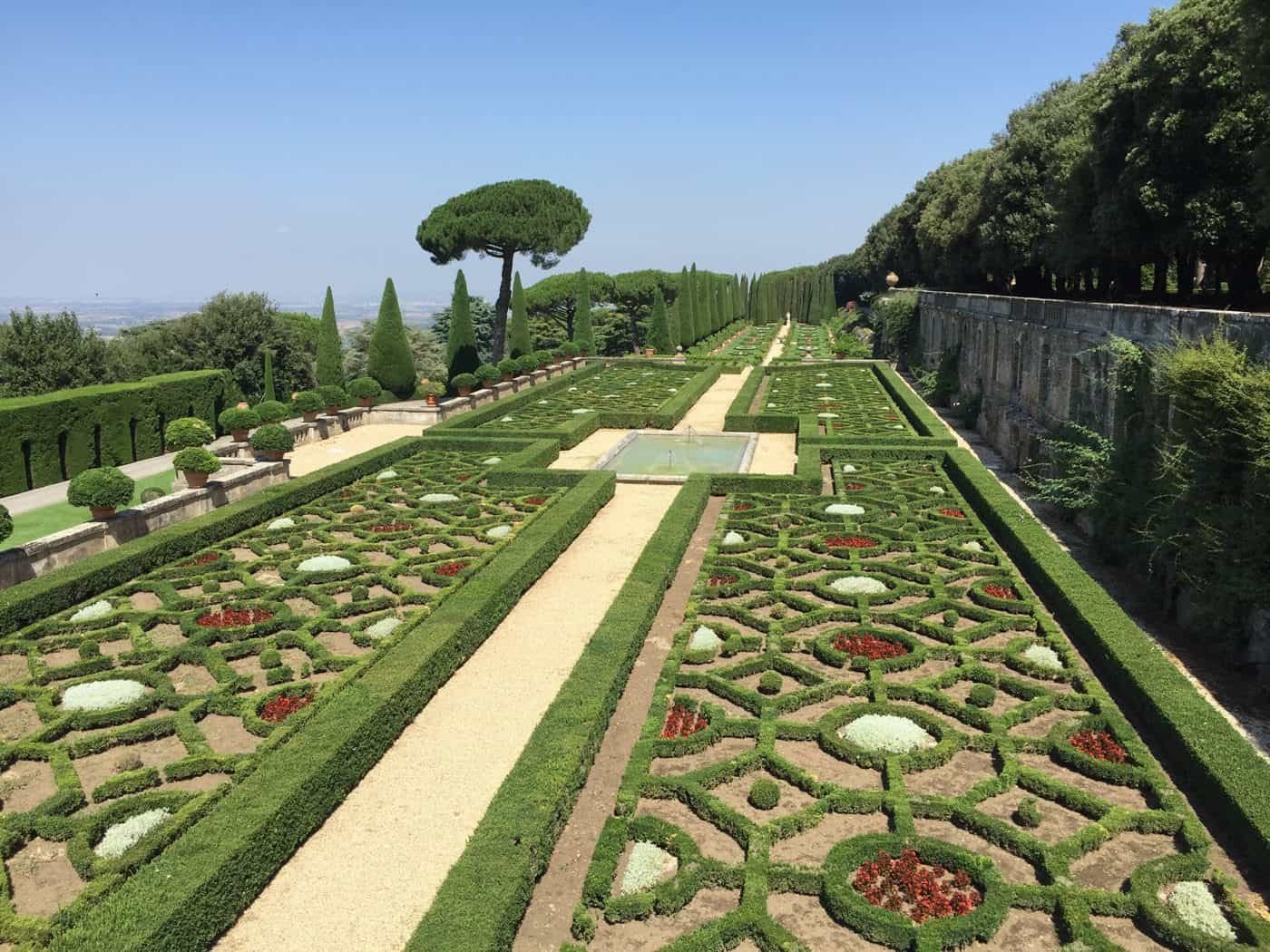
If the palace is the devotional heart of the residence, the Pontifical Gardens are its archaeological wonder. They stretch over an enormous area, well beyond that of the village, and include several distinct spaces: the Giardino del Moro, the so-called Giardino Segreto, Villa Cybo and Villa Barberini. Beneath and within these gardens lie the ruins of Domitian's Alban villa, the emperor who reigned from 81 to 96 AD and who built one of the most ambitious imperial residences of his time here.
Domitian's Villa in the Gardens of Castel Gandolfo
The villa was laid out on three large terraces cut into the side of the hill, each several hundred meters long, with residential quarters organized around courtyards, cryptoporticoes for strolling in the shade, nymphaea, a theater and even a hippodrome. In practice, it was a small city of imperial pleasure, designed for the holiday retreat of the prince and his court. The systematic excavations that brought these structures to light date back to 1929, under the pontificate of Pius XI, in the very years when Villa Barberini was becoming part of papal territory. Walking through the gardens in the Italian style, knowing that the architecture of a Roman emperor runs beneath the boxwood, is the most memorable experience of the whole visit.
The continuity between the ancient villa and the modern gardens is no accident: the popes chose this hill because it had already been chosen, 15 centuries earlier, by people looking for the same thing, good air and a view of the lake. Ultimately, the pope's summer residence is the direct heir of the emperor's holiday villa.
The Giardino del Moro, the Giardino Segreto and the Villas Within the Pontifical Villas
Visitors to the Pontifical Gardens discover that they are not a single garden, but a mosaic of areas with distinct histories. The Giardino del Moro has the most regular layout, designed in the Italian style, with square boxwood hedges, straight avenues and fountains. It is the part that gives the postcard image of the papal garden. The so-called Giardino Segreto is a more intimate and secluded space, designed for meditation and for the pope's private walks. Villa Cybo, acquired in 1774, and Villa Barberini, incorporated in 1929, add their buildings and parterres to the complex. Most of the ruins of Domitian's villa are concentrated in the area of Villa Barberini, and it was there that the excavations of 1929, under Pius XI, were concentrated. Walking through the gardens therefore means crossing, without interruption, a baroque garden, a working vegetable garden, an orchard and an imperial archaeological site, all overlooking the lake's crater.
The Cryptoporticus, Theater and Hippodrome of the Imperial Villa
It is worth pausing to consider how elaborate Domitian's villa was, because it helps you read what you see. The cryptoporticus was a long covered gallery, partly dug into the ground, that let people walk in the shade even during the hottest hours and linked the different wings of the residence. The theater, of the usual semicircular form, hosted performances for the court. The large elongated open space that the sources call a hippodrome, or stadium, was used for strolling, exercise and perhaps staged hunting shows. It was a typical feature of the great imperial villas, a monumental garden shaped like a circus. Added to these were the nymphaea, water halls decorated with statues and mosaics, of which examples overlooking the lake survive. Taken together, these spaces convey the image of a residence designed as a small country palace, where the emperor could live for months with his entire court.
The Collegiate Church of San Tommaso da Villanova, Bernini in Miniature
Facing the palace on Piazza della Libertà stands the church that alone would be worth the trip: the Collegiate Church of San Tommaso da Villanova, designed by Gian Lorenzo Bernini on commission from Alexander VII and built between 1658 and 1661 as the palatine chapel of the residence. It is one of the rare churches that Bernini could set out from scratch, without having to deal with an existing building, and for this reason it deserves close attention.
The Plan and Dome of the Church of San Tommaso da Villanova
The plan is a Greek cross, with four equal arms converging beneath a dome with a drum and lantern. Bernini looked to illustrious models and fused them: the memory of the coffered ceiling of the Pantheon and that of the ribs of the dome of Santa Maria del Fiore in Florence can both be found here, scaled down to the size of a village church but treated with the same ambition. The result is a bright, compact interior, where the eye rises straight upward.
The Stuccoes of Antonio Raggi and the Altarpiece by Pietro da Cortona
The interior stucco decoration is the work of Antonio Raggi, Bernini's most refined collaborator. In the dome, eight roundels run with Scenes from the Life of Saint Thomas of Villanova, the Augustinian saint to whom the church is dedicated. On the high altar, in the apse, is the Crucifixion painted by Pietro da Cortona, one of the great protagonists of Roman baroque. Having Bernini's architecture, Raggi's stucco and an altarpiece by Pietro da Cortona in a single building means having, concentrated in a few square meters, the best of the team that was redesigning Rome in those same years. In front of the altar, it's worth looking up at the dome before you look at the altarpiece. That is where you recognize the master's hand.
The Other Churches of Castel Gandolfo
Besides the Collegiate Church, the area holds a small rosary of churches that tell different eras. The church of Santa Maria Assunta was begun in 1619, with the first stone laid under Pope Paul V. It housed the reformed Franciscans and then the Propaganda Fide, and it was hit by the Anglo-American bombings of February 10, 1944. The church of the Madonna del Lago, on the shores of Lake Albano, was consecrated in 1977 by Pope Paul VI. There is also the church of Santa Maria Ausiliatrice, in the Borgo San Paolo neighborhood, the church of San Sebastiano, dedicated to the patron saint, along Via Appia at kilometer 23, next to the municipal cemetery, and the small church of Santa Maria della Cona. These aren't monuments you wait in line for at the ticket office. Instead, they frame the religious life of the village around its papal vocation.
The Cardinals' Villas Around Castel Gandolfo
When the popes got into the habit of spending the summer here, the cardinals and the great families followed them, and the area filled up with villas. Inside the Pontifical Villas, Villa Cybo was purchased in 1774, while Villa Barberini, with its summer college, entered the papal holdings in 1929. Outside the Vatican enclosure, other residences survive. Villa Torlonia dates to the sixteenth century, belonged to the Giustiniani, and was redesigned in 1829 for Duke Carlo Torlonia. Villa Chigi was built by Cardinal Flavio Chigi inside the dried-up crater of the so-called Laghetto di Turno, and today it has been converted into a golf club. These are pieces of a landscape where Roman aristocracy came to breathe, and it can still be read today from the boundary walls and the gates along the roads.
The Archaeological Sites on Lake Albano
The side of the basin is riddled with antiquities. Besides Domitian's villa in the gardens, the area has a Republican villa traditionally attributed to Publius Clodius Pulcher, Cicero's rival, near the fourteenth milestone of Via Appia, and the large nymphaea overlooking the water.
The Doric Nymphaeum and the Nymphaeum of Bergantino
The Doric Nymphaeum is a rectangular hall carved into the rock above the lake, dating to the first century BC, with niches arranged on two tiers. It is one of those spaces where water, stone and shade created the artificial coolness the Romans sought in summer. The Nymphaeum of Bergantino, also called the Baths of Diana, is a circular grotto that originally was part of the complex of Domitian's villa. It held mosaic floors and sculptural groups, some of which are today kept in the Apostolic Palace. These are delicate sites, not always open for free visits, but they show how densely this shore was inhabited by imperial luxury.
The Submerged Prehistoric Village and the Necropolises
Not everything on the lake is Roman or papal. Some traces are much older. On the lake bed and along the shores of Lake Albano, archaeologists have identified the remains of a prehistoric settlement, the so-called Villaggio delle Macine, a Bronze Age pile-dwelling settlement of which the driven posts remain, along with materials that ended up underwater when the lake level changed. It is rare evidence of how these shores were inhabited thousands of years before Rome. Completing the picture are burial areas such as the necropolis of Pascolare, which document the continuous use of the territory from prehistory to the classical age. These are sites for specialists, not set up for tourist visits, but they explain why the whole basin is considered by scholars an extraordinary stratified archive of history, from the village of huts to the pope's residence.
The Emissary of Lake Albano
The mouth of the emissary is perhaps the most surprising and least looked-at monument in the entire area. It is an artificial tunnel just over a kilometer long, carved into the rock to regulate the level of the lake and prevent it from overflowing. Tradition dates it to 398 BC, and the chapter on historical events discusses it further on, because its origin is tied to one of the most curious pages of early Roman history. From an engineering standpoint, it is considered one of the oldest major Roman hydraulic works, second in age only to the Cloaca Maxima.
The striking thing is that the tunnel still works. Dug by hand into the peperino bedrock, using the technique of vertical shafts that provided air and removed the spoil, it kept draining the lake's overflow toward the valley for 25 centuries, without ever stopping. Precisely because it is so hard to walk through, its interior was little studied for a long time. In recent years, groups of speleologists have explored and surveyed it section by section, bringing to light the precision with which the ancient technicians calculated the slope. It is the kind of monument that doesn't photograph well and doesn't make the news, yet it tells, better than any temple, the practical mindset with which Rome tackled its problems.

The Specola Vaticana, when the pope's observatory was here
For much of the twentieth century, the pope's astronomers watched the sky from Castel Gandolfo. The Specola Vaticana, the astronomical observatory of the Holy See, was moved here in 1933, inside the Apostolic Palace, when Rome's lights had become too bright to observe the stars from the city. Telescopes were mounted on the palace domes, and for decades Jesuit scientists worked overlooking the lake. Then the sky over the Castelli Romani also got dirtied with light: in 2008 the main observing facility was moved to the United States, to Arizona, where the air is darker and clearer. The historic part and the library remain tied to Castel Gandolfo, but the research on the stars has moved elsewhere. It is a small parable of how modern life, with its lights, drove astronomy out even from the pope's garden.
It's worth remembering that the Specola Vaticana is not a sham institution. It is one of the oldest astronomical observatories in the world in terms of continuity, and the Jesuits who worked there made real contributions to science, from cataloguing stars to studying meteorites. Hosting it for decades adds an unexpected dimension to Castel Gandolfo. Besides being a residence and a museum, the palace was also for years a place of science, where the Church looked at the sky through telescopes. The observatory domes, still visible on the palace skyline, are the sign of that era.
The village, the square and the lake lookout
Once the tickets and gates are set aside, what remains is the simple pleasure of the village. Piazza della Libertà is a baroque living room: on one side the mass of the palace, on the other the facade of the church, with the fountain in the middle. From here, alleys run down toward the lookouts, where the railing looks directly onto Lake Albano and the cone of Monte Cavo. It is the most photographed view in town, and deservedly so. The streets of the center are full of restaurants and shops. The food is that of the Castelli, with porchetta, homemade bread and the white wines of the hills. On feast days the square comes alive, and the pace is the slow rhythm of villages where people gladly stop at a little table.
Piazza della Libertà deserves to be read as a whole, because it was conceived that way. Bernini, called in by Alexander VII, did not design only the church. He conceived the entire space as a stage set, with the facade of the Collegiata as the backdrop, the palace closing one side and the fountain marking the center. It is a rare case in which an architect was able to compose a whole square from scratch in a village, and the result has the scale of Roman baroque theater reduced to village size. Sitting here, with your gaze moving from the church facade to the railing over the lake, is the best way to understand why the popes fell in love with this place.
The Lakeside Path and Swimming in Lake Albano
Anyone who wants to swim has to go down. From the upper part of the town you reach the shore by road or by a downhill walk, and at the foot of the cliff there are beach clubs and small beaches where people dive in during the summer. You can rent canoes, pedal boats and electric boats, and the rowing eights zip across the water. The lake is swimmable in the equipped stretches and stays cool even on scorching days, precisely because it is deep. It's the best way to end a visit: in the morning the pope's gardens, in the afternoon your feet in the water of the crater.
A Curiosity About Castel Gandolfo (RM)
The least known curiosity concerns the pope's train. Inside the Vatican walls there is a railway station, and from that station a line runs, through the Italian network, all the way to Castel Gandolfo. The connection dates back to the Lateran Pacts, which established the Holy See's right to a railway link, and for decades it was used for official trips and freight. Today the Vatican railway has been rediscovered for tourism: in some periods a special train takes visitors from the Vatican to the pope's summer residence, combining in a single ticket the Vatican Gardens in the city and the Pontifical Villas on the lake. It is the only case in the world where you can board a train departing from a sovereign state, the smallest on the planet, to reach an imperial Roman garden.
It's worth adding a second curiosity, tied to the name. The name of the town does not come from the pope's castle, but from a medieval fortification linked to the Gandolfi family, and before that to the Savelli, who held the fief for centuries. The village existed well before it became a papal residence. Its papal history, as famous as it is, is only the latest chapter of a much longer story, one that goes all the way back to the myth of Rome's origins.
Something Nobody Tells You About Castel Gandolfo (RM)
What guidebooks rarely mention is that, according to tradition, Alba Longa, the mother city of Rome, stood beneath Castel Gandolfo. The myth has it founded by Ascanius, son of Aeneas, and the founder of the Alban dynasty from which Romulus and Remus were said to descend. Alba Longa is the city that the newly born Rome supposedly destroyed, deporting its inhabitants to the Caelian Hill. The famous duel between the Roman Horatii and the Alban Curiatii arose precisely from this clash. No one has ever identified the exact site of Alba Longa with certainty, and scholars still debate whether it was here, on the shore of Lake Albano, as ancient tradition holds, or somewhere else on the hills. Cicero himself, speaking of Clodius's villa in these parts, recalls the memory of the ancient city.
The consequence of this story is fascinating. When you walk through the gardens of the Pope's summer residence, you are walking on ground that Rome's memory considers its cradle. That's no minor detail. It means this hill above the lake has been, one after another, the presumed site of Rome's mother city, an emperor's holiday villa, and the summer home of popes. Three times chosen by the powerful, and always for the same reasons: the cool air, the water and the view.
The legend of Alba Longa is not a scholarly detail for a few specialists. It is the foundation of the Roman national myth. According to the account handed down by authors such as Livy and Virgil, after Ascanius a long line of Alban kings followed, until the city came into conflict with young Rome and was razed to the ground by King Tullus Hostilius, who moved its inhabitants inside the Roman walls. Many of Rome's most illustrious families, beginning with the Julian clan to which Julius Caesar belonged, claimed an Alban origin. Knowing that, according to tradition, all of this has these very shores as its backdrop changes the way you look at the landscape. Lake Albano is not only beautiful. It is the place that the ancient Romans considered the beginning of their own history.
The Advice I Give You for Visiting Castel Gandolfo (RM)
My advice is not to treat Castel Gandolfo as a half-day hit-and-run trip. The town rewards those who stay. Early in the morning, as soon as they open, it's best to book the visit to the Pontifical Gardens, when the sun is still low and the ruins of Domitian don't have the flat light of noon. Then go down to the square, enter San Tommaso da Villanova while it's still empty, and have a coffee at the belvedere. I leave the afternoon for the lake: a swim, or just a walk along the lakeshore with an ice cream.
The second thing I recommend is always checking the official Vatican Museums calendar before you leave, for two concrete reasons. The first is that the museum of the Apostolic Palace and the Gardens have closing days and fixed visiting hours, and the number of spots in the gardens is limited. The second is that, with the pope's return to his summer residence, some areas may close or change their hours during papal stays. Booking your ticket in advance, through the official channel, saves you the disappointment of a closed gate. Finally, a simple but true warning: from the train station to the center it's uphill, and in summer you'll sweat. Anyone with walking difficulties should use the shuttle service or come by car.
Another Well-Known Fact, Yet Rarely Mentioned
Many people know that Castel Gandolfo is the Pope's summer residence, but few stop to consider what happened here during World War II. Between January and February 1944, while the Anzio front was setting the Castelli Romani ablaze, the extraterritorial territory of the Pontifical Villas became a refuge. Pope Pius XII opened the doors of the residence and the Vatican properties to thousands of displaced people fleeing the bombings: about 12,000 people are said to have been taken in within the papal enclosure. Children were also born in the rooms of the palace and in the gardens, and tradition has it that some were baptized with the pope's name, Eugenio, Pius XII's baptismal name.
The refuge, however, was not spared. On February 10, 1944, a bombing hit the buildings and the church of Santa Maria Assunta, causing deaths among the displaced people who had sought shelter there. Other bombs fell on the territory in the first days of February. This is a page of history the town remembers, and the museum of the Apostolic Palace has dedicated exhibition spaces to it. Behind the postcard image of the summer residence lies this memory of war, fear and solidarity, which is worth keeping in mind as you walk through those same halls.
The Right Photo to Take in Castel Gandolfo (RM)
The photo everyone is after is the same one, and for once the choice is justified: Lake Albano seen from the belvedere in the center, with the railing in the foreground, the green basin dropping steeply, and the cone of Monte Cavo closing the horizon on the far shore. You shoot from the alleys that open downhill from Piazza della Libertà. The best light is late afternoon, when the sun lights the opposite wall of the crater and the water takes on a deep color. At noon, with the sun high, the lake tends to turn leaden and the photo loses its punch.
If you want a less obvious shot, though, turn toward the town and frame the square with the facade of the Collegiata del Bernini and the bulk of the palazzo facing each other. It's a small baroque stage that fits entirely into one image. And for those who enter the gardens, the photo to take home is the one of the Italian-style boxwood hedges with, in the background, the surface of the lake framed by the trees. It's the only spot where you can understand at a glance that the pope's garden is suspended above a crater.
Some important events that took place here in history
The first great event is very ancient and concerns the lake's emissary. Livy recounts that in 398 BC, while Rome had been besieging the Etruscan city of Veii for years, the waters of Lake Albano swelled in an extraordinary way, with no rain to account for it. The prodigy frightened the Romans, who sent envoys to consult the oracle at Delphi. Both an Etruscan haruspex and the response of Apollo pointed the same way: to win, Rome had to let the lake's waters drain off in a ritual manner, without letting them reach the sea. From here, according to tradition, came the decision to dig the emissary, the tunnel that still drains the lake today. The story may be myth or the memory of a real event. What remains is the technical fact: a hydraulic work of that scale, second only to the Cloaca Maxima, shows a surprising engineering skill for the era.
From the Savelli to the Papal State
In the Middle Ages the fief changed hands several times. In 1221 the castle became the property of the Savelli family. In 1389 it was leased to the Capizzucchi, then returned to the Savelli in 1436. The decisive moment comes at the end of the sixteenth century: on June 30, 1596, the fief, burdened by the Savelli's debts, was seized by the Apostolic Camera, and on May 27, 1604, it was declared an inalienable possession of the Church. From then on, Castel Gandolfo belongs, one way or another, to the papacy. In 1628 Urban VIII stayed there for the first time as a summer residence, starting a tradition that lasts, with interruptions, to this day.
The Republic of Albano and the Napoleonic Age
A little-remembered chapter is the revolutionary one. In February 1798, in the wake of the pro-French Roman Republic, the short-lived Republic of Albano was proclaimed in Castel Gandolfo too. An uprising followed and, on February 24, an armed clash known as the battle of Frattocchie, on the plain below the town. It was a brief and violent interlude, which ended with the return of papal order, but which marked the territory just as it marked many other places of the Papal State in those years.
The End of the Papal State and the Lateran Pacts
With September 20, 1870, and the capture of Rome, the Papal State ends. For almost 60 years the popes consider themselves prisoners in the Vatican, and no one stays in Castel Gandolfo anymore. The turning point comes on February 11, 1929, with the Lateran Pacts, which resolve the Roman Question and recognize the Holy See's full sovereignty over the Pontifical Villas, declared extraterritorial territory. The summer residence is reborn and renovated, and in 1933 it hosts the Vatican Observatory. It is the legal framework that still underpins today the relationship between the Italian village and the pope's small state.
Who Has Passed Through Castel Gandolfo (RM)
The first to pass through here are, above all, the popes. From Urban VIII, who inaugurated the residence in 1628, to Alexander VII, who had it designed by Bernini, all the way down to the pontiffs of the twentieth century and of our own time. Pius XI promoted excavations of Domitian's villa there and brought the Observatory in 1933. Pius XII opened its doors to displaced people during the war. Paul VI consecrated the church of the Madonna del Lago there in 1977. Benedict XVI chose Castel Gandolfo as his first residence after resigning the papacy in 2013, withdrawing here while the accommodations in the Vatican were being prepared. Pope Francis, who never stayed here, made it a museum open to everyone from 2016. Pope Leo XIV, elected in 2025, brought the pope's summer stay back to the residence.
Even before the popes, the power of ancient Rome passed through here. The emperor Domitian kept his holiday villa here. According to Cicero, the villa of Publius Clodius Pulcher, the tribune who was his mortal enemy, stood not far away. And, going back to myth, these hills hold the memory of Ascanius and the Alban dynasty, that is, the legendary roots of Rome. In modern times the village attracted the Roman aristocracy, the cardinals who built their villas here, and more recently the Grand Tour travelers and landscape painters, who climbed up to the Castelli to paint the lake and the light. Few places this small have seen emperors, popes, revolutionaries and artists pass through, in no particular order.
Among the painters, one name deserves a separate line. Jean-Baptiste Camille Corot, the great French landscape painter, spent time in Italy in the 1820s and painted Lake Albano with the village of Castel Gandolfo in the background. One of his views, titled after the lake and the town, is today held at the Metropolitan Museum in New York. His canvases, painted outdoors to capture the true light, made this view known to an international audience and anticipated the way that, a century later, tourists would photograph the very same vantage point. When you lean out over the belvedere, you see exactly the painting Corot saw first.

How to Organize a Day Trip to Castel Gandolfo from Rome
Castel Gandolfo is the classic day trip from Rome, and with a little planning it's easy to do without stress. If you plan to visit the museum of the Apostolic Palace and the Pontifical Gardens, the first step is to book your ticket on the official Vatican Museums website a few days in advance, choosing a morning slot: the light is better and it's less hot. Leave Rome early on the regional train from Termini toward Albano Laziale, and get off at the Castel Gandolfo station. From there it's about 10 minutes on foot uphill to the center, or you can take the shuttle service when it's operating.
A well-spent day could look like this: in the morning, the guided visit to the gardens and the ruins of Domitian, then the museum in the papal apartments. Around noon, Piazza della Libertà, the Bernini Collegiate Church and a stop at the belvedere. Lunch in a center osteria with porchetta and Castelli wine. In the afternoon, the walk down to the lake for a swim or a stroll along the lakefront. Those who aren't interested in the gardens can cut everything down to half a day and pair the visit with another Castelli village, for example Albano or Ariccia, both reachable in a few minutes. The return trip to Rome by train still leaves time for dinner.
Castel Gandolfo with Kids and Accessibility
Castel Gandolfo works well with children too, as long as you pace yourself. The Pontifical Gardens, with their open spaces, fountains and Roman ruins among the greenery, are the part the little ones enjoy most. The palace museum, on the other hand, calls for the behavior of a place of devotion and attention, but the route is short. For kids, the real reward is the afternoon at the lake, with swimming, boats and gelato. Keep in mind that the village is all uphill and downhill, so a stroller on the cobblestone alleys is awkward, and a baby sling or a child carrier backpack is the better option for the youngest.
As for accessibility, the layout of the town, perched on the edge of the crater, means slopes and steps in several places, and the walk from the station to the center is steep. Anyone with mobility difficulties would do well to arrive by car and check ahead, on the official Vatican Museums website, the access conditions for the museum and the gardens, and whether there is any shuttle service. The square and the church are flat and reachable without much effort once you're up top.
Where to Eat and What to Drink in Castel Gandolfo
A visit to Castel Gandolfo almost always ends at the table, and that's only right, because the cooking of the Castelli Romani is one of the reasons Romans have always climbed these hills. The area's signature dish is porchetta, boned, seasoned and roasted whole pork, which in Ariccia, just a few kilometers away, even has a recognized designation. In the fraschette and the osterias in the center, you'll find it sliced and served with homemade bread. Alongside the porchetta come cured meats, cheeses from the hill farms, coratella with artichokes in spring, and the first courses of the Roman tradition. It's substantial cooking, not fussy, made to go with wine.
The wine, then. The Castelli Romani are white wine country. The Castelli Romani appellation and the more famous Frascati cover the vineyards around the village, with grape varieties like malvasia and trebbiano. They are wines to drink young and fresh, made for everyday meals more than for the cellar, and they capture the character of the area perfectly. If you want to understand the Castelli, all you have to do is sit in a fraschetta, order a tagliere and a carafe of white, and watch the sunset over the lake. A practical tip: avoid the places with menus translated into five languages overlooking the most photographed lookout, and look for the osterie on the side streets, where locals still eat.
Castel Gandolfo and the Other Castelli Romani Around It
Castel Gandolfo is best visited as part of a wider loop, because the Castelli Romani are a cluster of villages very close to one another. On the other shore of the lake is Albano Laziale, with its Roman remains. A little further on you come down to Ariccia, with its monumental bridge, the Palazzo Chigi, and the most famous porchetta in Lazio. Inland you reach Genzano di Roma, famous for its Infiorata, and Nemi, perched above its small, dark lake. On the other side are Marino with its grape festival, Frascati with its Tusculan villas, Grottaferrata with its Greek abbey, and higher up Rocca di Papa at the foot of Monte Cavo. A weekend in the Castelli, based in Castel Gandolfo or nearby, is one of the best ways to get to know the less touristy Lazio.
Quick Questions About Castel Gandolfo (RM)
How do you get to Castel Gandolfo from Rome?
By the regional train on the Roma Termini - Albano Laziale line, Castel Gandolfo stop, a few hundred meters below the center. By Cotral buses from the Anagnina terminus, the end of metro line A. Or by car along Via Appia, the state road 7, turning at kilometer 22 in the locality of Due Santi onto the provincial road 140. From the station to the village, the road is uphill.
How much does it cost to visit the Apostolic Palace in Castel Gandolfo?
The museum of the Apostolic Palace and the Pontifical Gardens are run by the Vatican Museums, which sell tickets through their official channel, with different options for the palace, the gardens and combined visits. Since prices vary by season, it's worth checking them and booking ahead on the official website before your visit.
Can you visit the Apostolic Palace in Castel Gandolfo?
Yes. Since 2016 the popes' private apartments have been open to the public as a museum route. You can see the throne room, the study, the library, the bedroom, the private chapel and the gallery of portraits of the popes. With the pope returning to the summer residence, some areas may have reduced openings at certain times.
When did the Gardens of Castel Gandolfo open?
The Pontifical Gardens have been open to visitors since 2015, and the Apostolic Palace apartments since 2016. Before those dates the complex had been closed to the public for centuries.
Do you need to book for the Pontifical Gardens?
Yes, it's definitely worth it. Places are limited, and several garden visits leave at fixed times, often with a guide. Showing up at the gate without a ticket means risking not getting in, especially on summer weekends.
Can you swim in Lake Albano at Castel Gandolfo?
Yes, in the equipped stretches at the foot of the cliff, where there are beach clubs and small beaches in summer. You can rent canoes, pedal boats and electric boats, and rowing crews train on the water. Being a deep lake, the water stays cool even on the hottest days.
How much time do you need to visit Castel Gandolfo?
For the village alone, the square and the church take a couple of hours. Adding the palace museum and the Pontifical Gardens easily brings you to half a day, and with a swim in the lake it fills a whole day. The town rewards those who aren't in a hurry.
What is there to see for free in Castel Gandolfo?
Piazza della Libertà with the facade of the Bernini Collegiate church and the fountain, the interior of the church of San Tommaso da Villanova, the lookouts over Lake Albano, and the streets of the historic center can all be visited for free. The palace museum and the gardens, on the other hand, charge admission.
Who designed the church in Castel Gandolfo?
The Collegiate Church of San Tommaso da Villanova was designed by Gian Lorenzo Bernini between 1658 and 1661, commissioned by Pope Alexander VII as the palace chapel of the residence. The stucco work is by Antonio Raggi, and the altarpiece is a Crucifixion by Pietro da Cortona.
Why is Castel Gandolfo the Pope's summer residence?
In 1628 Pope Urban VIII chose this hill above Lake Albano to escape the heat of Rome, starting the tradition of the summer stay. The fief had already belonged to the Church since the early 1600s. Since then, many popes have spent the hot months there.
What was Domitian's villa at Castel Gandolfo?
It was the imperial residence that Emperor Domitian built between 81 and 96 AD on three terraces carved into the hill, with nymphaea, cryptoporticoes, a theater and a hippodrome. Its ruins lie today inside the Pontifical Gardens and were excavated starting in 1929.
Is there still an astronomical observatory in Castel Gandolfo?
The Vatican Observatory was moved here in 1933, inside the Apostolic Palace. In 2008, due to growing light pollution, the main observing site was moved to Arizona. The historic part and the observatory's library remain associated with Castel Gandolfo.
Is Castel Gandolfo one of the Most Beautiful Villages in Italy?
Yes, the town is recognized among the Most Beautiful Villages in Italy, for its historic center overlooking the crater, its baroque square and the landscape of Lake Albano.
How do I get to Lake Albano from the center of Castel Gandolfo?
From the upper part of town, you can go down to the shore on the road that leads to the lakefront, or walk down. By car, follow the road that runs along the basin. Be aware that the return trip to the village is uphill.
What to see around Castel Gandolfo in the Castelli Romani?
Within a few kilometers, one can visit Albano Laziale, Ariccia with the Palazzo Chigi, Genzano di Roma with its Infiorata, Nemi on its lake, Marino, Frascati with the Tusculan villas, Grottaferrata with the Greek abbey and Rocca di Papa at the foot of Monte Cavo. They are all villages of the Castelli Romani Park.
When is the best time to go to Castel Gandolfo?
Spring and early autumn offer ideal light and temperatures. Summer is beautiful for the lake but crowded, and with the pope in residence, some areas may have reduced openings. Late afternoon is the best time for the lake viewpoint.
Is the Castel Gandolfo museum suitable for children?
Yes. The gardens, with the Roman ruins and the outdoor spaces, appeal to younger children, and the lake offers an afternoon diversion. In the palace museum, you need to keep the behavior appropriate to a place of devotion, but the route is short and varied.
Is there a direct connection from the Vatican to Castel Gandolfo?
At certain times, a tourist train leaves from the railway station inside Vatican City and reaches Castel Gandolfo, combining the Vatican Gardens in the city and the Papal Villas on the lake in a single ticket. It's a special experience, to be checked on the official calendar of the Vatican Museums.
Why is the lake at Castel Gandolfo called Lake Albano?
The name comes from Alba Longa, the ancient city that Roman tradition places on these shores and that was considered the mother city of Rome. The same adjective, albano, is found in the Alban Hills and in the name of Albano Laziale, on the other shore.
Who built Domitian's villa in Castel Gandolfo?
It was built by Emperor Domitian, who reigned between 81 and 96 AD, as an imperial summer residence. It spread across three terraces and included cryptoporticoes, nymphaea, a theater and a hippodrome. Its ruins are in the Pontifical Gardens and were excavated from 1929.
Can you visit the emissary of Lake Albano?
The emissary is a very ancient tunnel, still working, difficult and not designed for free visits: generally only groups of speleologists go inside. Its importance can be grasped, however, by knowing its history, which is tied to the war between Rome and Veii in 398 BC.
Which pope opened Castel Gandolfo to the public?
Pope Francis, who never stayed at the residence, opened the Pontifical Gardens in 2015 and the apartments of the Apostolic Palace as a museum in 2016. With Pope Leo XIV, elected in 2025, the pope's summer stay has also returned.
Did Benedict XVI live in Castel Gandolfo?
Yes. After resigning the papacy in 2013, Benedict XVI withdrew for some months to Castel Gandolfo itself, while the accommodations in the Vatican were being prepared, where he would then spend the following years.
What to see in Castel Gandolfo if it rains?
When the weather is bad, the focus is on indoor sites: the museum of the Apostolic Palace with the papal apartments and the gallery of portraits, and the Collegiate Church of San Tommaso da Villanova by Bernini. The town center's osterie, with porchetta and Castelli wine, complete a day spent sheltered.
The final verdict on Castel Gandolfo
If I had to say just one thing, I'd say this: Castel Gandolfo is much more than a papal postcard. It's a hill that three different civilizations chose for the same reason, and that holds together, in a few hectares, the myth of Rome's origins, an imperial villa, a Bernini in miniature and a lake where people go swimming. Don't come just to photograph the palace from below and leave: take the time to enter the gardens, look up at the church dome and go down to the water. It's one of those places that, looked at calmly, tells the whole of Italy in a morning.
Article written by the editors of TourLeaderPro, contact them for Tours and Private/Corporate/V.I.P. Experiences.
Are you planning a trip to Rome? English-language guides to visiting the city are on ItalyPlanner.com.