Marino (RM)
In short. Marino (RM) sits in the Colli Albani, about 20 kilometers from the center of Rome, on the side facing Lake Albano, at 389 meters above sea level at the highest point of the historic center.
Marino (RM) sits in the Colli Albani, about 20 kilometers from the center of Rome, on the side facing Lake Albano, at 389 meters above sea level at the highest point of the historic center. The town hall is in Largo Palazzo Colonna, in the palace of the same name. By train, take the FL4 regional line from Roma Termini, Albano Laziale branch. Get off at Marino Laziale station, a little below the center, after the stops at Ciampino, Acqua Acetosa, Sassone and Pantanella. The trip takes 37 minutes on average, trains run once an hour per branch, and the ticket from Termini to Albano costs €2.10, so getting to Marino Laziale doesn't cost any more. From the station it's a 10-minute uphill walk to the center. By car from the Grande Raccordo Anulare, exit at the Appia or the Tuscolana and continue on Via dei Laghi (SS 217) or Via Castrimeniense. The most convenient parking is the parking garage in Piazzale degli Eroi and the blue-striped spaces along Corso Vittoria Colonna, which stay closed to traffic on Sagra dell'Uva days. Churches are free to enter. The Basilica di San Barnaba is open on weekdays and Saturdays from 7.30 to 18, and on Sundays from 8 to 11 and at 18. The Museo civico Umberto Mastroianni, in Piazza Matteotti in the former church of Santa Lucia, has free admission during the municipal opening hours, which should be checked on the Comune di Marino website before you leave. The Mithraeum on Via Borgo della Stazione can only be visited by reservation, with guided groups of up to 14 people, on weekends of the second, third and fourth weeks of the month. A standard visit costs €10, and the combined routes with the underground circuit or the Santa Lucia cistern cost €14.90 and €15. Book on the website of Archeoclub Colli Albani. The Sagra dell'Uva takes place every year on the first Sunday of October, with free admission.
Marino is one of the 13 municipalities of the Parco regionale dei Castelli Romani, the first one you reach coming from Rome, before Castel Gandolfo and the Lake Albano. Anyone organizing a day in the Colli Albani with a guide will find professional tourist services for Rome and the surrounding area on TourLeaderPro. For English-speaking readers, there is a guide dedicated to Marino on ItalyPlanner.
Marino (in the Marinese dialect, Marini) today has about 46,600 residents and still is, for Romans, the City of Wine. The 1925 Sagra dell'Uva is the oldest Italian event of its kind, and since 1925 the Fountain of the Four Moors has run wine instead of water on the afternoon of the first Sunday in October. Ettore Petrolini brought the town into the collective memory with Franco Silvestri's 1926 song Na gita a li Castelli, which everyone knows as Nannì: "Look, there's Marino, the grape festival is on, fountains that pour wine, what abundance there is." Carlo Emilio Gadda, who really did go to the festival, wrote about it in 1934 in a passage of Il castello di Udine titled La festa dell'uva a Marino, where around the fountain of the Moors "a crazy battle has broken out, with impious surge, toward the free wine taps," and the crowd "drinks and gets soaked, pushed back by elbows saturated with folklore." Gadda's page is worth more than any brochure. Anyone who reads it before heading up to Marino understands that the Sunday is not a wine tasting. It is a popular ritual with its own cheerful violence.

The Sagra dell'Uva of Marino (RM): a century of wine from the fountains
The Sagra dell'Uva of Marino, which locals simply call the Sagra, takes place every first Sunday of October. The first edition was held on Sunday, October 4, 1925. It was organized, on behalf of the town administration, by the Roman-dialect poet of Marino origin Leone Ciprelli, who had been working on it since the previous year. That evening, at seven, the Fountain of the Four Moors ran wine for the first time, and a large part of the wine handed out was supplied by producer Luigi Capri Cruciani, who would later serve as mayor of Marino, deputy and senator. The 1925 program also included a horse race along Via Castrimeniense, colored lights and the election of a Grand Magistrate of the Grape. The Opera Nazionale Dopolavoro granted the event the title of Sagra, a title few other events in Italy could claim. In the fifth edition, Ciprelli added the costumed historical parade that still marches along Corso Trieste today. Ciprelli died on January 30, 1953. In 1963 his remains were moved to Marino's municipal cemetery, which is the most fitting resting place for the man who invented the most imitated festival in Lazio.
Lepanto and the Madonna del Rosario: the religious roots of the Sagra di Marino
The secular festival coincides with a much older religious feast. On October 7, 1571, the fleet of the Holy League defeated the Ottoman fleet at Lepanto. Pope Pius V credited the victory to the intercession of the Madonna of the Rosary and set its celebration for October 7. The commander of the papal galleys was Marcantonio II Colonna, lord of Marino, who returned to his fief on November 4, 1571, with the trophies taken from the Turks. An Ottoman shield is still preserved today in the basilica of San Barnaba, in the Rosary chapel, as an ex voto for the victory. The Sunday historical procession re-enacts exactly that return. Everything else, floats, fountains, songs, came later.
Marino's Wine from Alba Longa to Charles V
Viticulture on the Alban Hills is as old as Rome. Latin authors knew and valued the area's white wine under the name Albanum, after the city of Alba Longa, the legendary mother city of Rome that tradition places on the shores of Lake Albano. In the Middle Ages and the early modern period, the vineyard was the main occupation of the people of Marino and of all the neighboring towns. In 1536, Emperor Charles V of Habsburg, passing through Rome after the victory at Tunis, drank Marino's wine during a banquet and, according to the chronicles, liked it. The farmers of Marino were so attached to their vineyards that they repeatedly turned to the Madonna del Popolo, the thirteenth-century image now in San Barnaba, so that she would keep hailstorms and out-of-season rains away. On February 2, 1611, the Community, gathered in an extraordinary assembly, even chose to adopt Saint Barnabas as patron "appresso Sua Divina Maestà" so that he would protect the fief from the hailstorms that had ruined the harvests of the previous three years. Today the local wine carries the Marino DOC designation, a white made from Malvasia and Trebbiano grown on volcanic soil.
From the 1904 Feste Castromenie to the 1925 Sagra
At the start of the twentieth century, the idea arose of a festival that would make Marino's wine known and draw Romans. Transportation had changed. The Rome-Albano railway, completed in 1889, and then the Tramvie dei Castelli Romani, which linked almost all the towns with the capital, had made the quick day trip a Sunday habit. After a series of natural disasters had put production in crisis, the municipal administration organized the Feste Castromenie in 1904, dedicated to the Roman municipality of Castrimoenium, between September 11 and October 10, in connection with the Ottobrate romane. They were successful mainly in Roman cultural circles, but there is no record that they were repeated. It took 20 years and the inventiveness of Leone Ciprelli for the idea to return in the form we know.
The Program of the Sagra dell'Uva di Marino: Saturday, Sunday, Monday
The program is the result of a hundred years of experiments, and for many years now it has followed a fixed pattern. The core is Sunday afternoon. Depending on the local administrations and the available funds, the celebrations may start a month earlier or be compressed into three days. In recent years, the entertainment starts on Thursday or Friday and does not go beyond the Monday of the Sagretta.
On the eve, Saturday, in the late afternoon, around 18:00, the announcement of the victory at Lepanto is re-enacted through the streets of the historic center. A herald on horseback, with trumpeters, drummers and flag-wavers, travels along Corso Vittoria Colonna and Corso Trieste reading the proclamation that calls the people to Palazzo Colonna. From the balcony overlooking Piazza della Repubblica, actors in sixteenth-century costume, playing the governor and the notables of the fief, announce the Christian victory, the victory of the feudal lord Marcantonio II Colonna, and his solemn return set for the following day. In recent years, the text of the proclamation has been softened. It no longer dwells on the losses inflicted on the Turkish enemy or on the number of prisoners, which nonetheless remain carved in peperino and chained to the Fontana dei Quattro Mori.
Sunday is the core and the reason for being of the Sagra dell'Uva di Marino. In the morning, the solemn Mass at San Barnaba and the procession of the Madonna of the Rosary, then the supplication to the Madonna di Pompei. In the afternoon, the historical procession in sixteenth-century costume, the parade of allegorical floats with grapes and finally, in the late afternoon, the "miracle of the fountains that give wine." Monday is the Sagretta, also called Sagra dei marinesi. Since the postwar period, the secular program has been repeated for a smaller audience, without procession and without supplication, with the historical procession stripped of famous guests and foreign groups, the floats and, once again, the wine from the fountains. On Monday evening there is a closing concert, usually in Piazza San Barnaba, and fireworks launched from the Domenico Fiore municipal stadium.
The Other Fountains That Give Wine: Campidoglio, Wangen, Velletri
Marino's miracle has illustrious precedents. In Rome, the fountains at the foot of the cordonata of the Capitoline Hill gave wine to the crowd on two occasions: in 1644 for the election of Innocent X and in 1670 for that of Clement X. In Alsace, at Wangen, a fountain dispenses wine every July 3. In Italy, however, the Marino miracle remains the most famous and essentially unmatched. The only exception is the grape and wine festival of Velletri, which in 2019, at its 89th edition, made wine gush from a fountain for once.
Guests, incidents and numbers from a century of the Sagra dell'Uva di Marino
In 1930 the first Bottega del Vino d'Italia opened in the premises of Palazzo Colonna. In 1931 there were nearly 50,000 attendances. The war destroyed the palazzo and the fountain, but in 1945 the festival resumed among the rubble. Then came guests from the world of cinema: Charlton Heston in 1960, Sophia Loren with Carlo Ponti and Virna Lisi in 1961, Domenico Modugno and Edoardo Vianello in 1962. In 1970 Banco del Mutuo Soccorso played, a progressive rock group born right in Marino. In 1980 Ivan Graziani held a concert for which he was paid 5,280,000 lire. In 2000 Gina Lollobrigida was the godmother of the 76th edition. In 1998 the poster was drawn by Giorgio Forattini, with Italian politicians bottled. In 2001 the Sagra was moved to October 14 because of a constitutional referendum. In 2004, for the 80th edition, 80 cast-iron fountains were installed, one per edition. The most famous incident dates to October 5, 2008, the 84th edition. Due to an error by the valve operators, the wine ended up in the taps of homes in the historic center instead of the public fountains. The authorities in the square toasted with water, while families in the kitchen filled pots with white wine. The news went around the world. The Times wrote that a town where wine comes out of the taps is almost paradise. Since then, every reporter who goes up to Marino on the first Sunday of October hopes deep down that it happens again.

A curiosity about Marino (RM)
The most beautiful curiosity doesn't concern wine but water. From Castrimoenium, the Roman castrum that stood where the Castelletto district is today, the Aqua Tepula began. In 125 BC the censors Gnaeus Servilius Caepio and Lucius Cassius Longinus captured this aqueduct on the Alban Hills to bring it to Rome. The springs, at the 10th mile of Via Latina between Grottaferrata and Marino, gushed at 16 or 17 degrees (hence the name). They supplied Rome with about 190 quinariae, nearly 8,000 cubic meters a day. In 33 BC Agrippa restored it and channeled it into the new Aqua Iulia. Anyone who looks toward Rome from the terrace of the Barco Colonna has under their feet the head of one of the conduits that made the capital great. The relationship with water also explains the festival. The fountain of the Four Moors gives wine once a year only because for the other 364 days Marino has had water in abundance, from the Acquasanta springs to the Fontanile d'Ammonte, where women washed clothes until the 1930s. The second curiosity is geological. Marino sits on the rim of the crater that holds Lake Albano, and the stone it is built from, peperino, is the gray lava with dark spots from the eruptions of the Vulcano Laziale. The peperino quarries, between the center and the station, provided work for generations of stonecutters, so much so that in 1910 they too went on strike alongside the farmers. A plaque in the Mithraeum commemorates the quarry slaves who frequented the underground sanctuary in the 2nd century. Third curiosity, for music lovers: Banco del Mutuo Soccorso, one of the founding groups of Italian progressive rock, was born in Marino, and the first Sagra it played was the one in 1970. Marino isn't only a town that drinks. It's a town that gave water to Rome, stone to its churches, and a piece of its soundtrack.
Something nobody tells you about Marino (RM)
Nobody in the brochures tells you that the Fountain of the Four Moors you see today in Piazza Matteotti is not the one from 1632 and isn't even in its original location. The 17th-century fountain stood in Piazza Lepanto, leaning against Palazzo Colonna. On Wednesday, February 2, 1944, at around 12.30, B-25 Mitchell bombers of the 15th Air Force hit the center of Marino. The chain bombs brought down the palazzo, and the palazzo collapsed onto the fountain. What you see is the 1969 reconstruction, the work of a group of sculptors from Marino. It was moved to the square where the town hall had moved in 1884, and where, until 1903, there was a fountain in the Bernini style. That fountain was dismantled to make way for the tracks of the Castelli tram. Another thing that goes unmentioned: the festival that today seems eternal was born at the height of the regime, bearing the mark of the Opera Nazionale Dopolavoro. The wine for the first edition was supplied by Luigi Capri Cruciani, who had been a popular mayor and would go on to become a Fascist deputy and senator. Before 1923, Marino had a republican and anticlerical town council, peasant leagues from 1902, and land occupations in 1898 and 1917. Fascism arrived there not through the squads but through the conversion of the republican majority. The podestà, Ugo Colizza, was a former anarchist who was on the list of subversives until 1929. The Sagra is therefore also the record of how a red town was tamed with a festival. Finally, beneath the historic center runs a network of tunnels, cisterns and cellars carved into peperino stone. This is the underground Marino that the Archeoclub Colli Albani offers tours of, together with the Mithraeum and the Roman cistern under Santa Lucia. The Sagra's cellars are the surface. The real city of Marino is underneath.
The advice I give you for visiting Marino (RM)
The advice is simple: go to Marino twice, once for the Sagra and once on any ordinary Saturday in spring or at the end of October. You go to the Sagra for the crowds, the procession, and the paper cup under the tap, and you accept everything that comes with it: packed trains, impossible parking, and Piazza Matteotti, where you can't breathe. Anyone who really wants to see the town picks the wrong day on purpose. On a Saturday morning, take the FL4 train at eight from Termini, and you'll reach Marino Laziale before nine. It's 10 minutes of uphill walking, and you're in Piazza San Barnaba, with the basilica open and empty, the Neptune of Tripisciano dripping, and the bar baking its ciambelle al mosto. From there, the route I suggest is this: San Barnaba, Corso Trieste with Palazzo Castagna, Piazza Matteotti with the Four Moors and the civic museum in the former Santa Lucia, then down Corso Vittoria Colonna to Palazzo Colonna and Mastroianni's Warrior, the Barco Colonna for the view over the lake, and the park of Villa Desideri to rest. Before all that, book the Saturday afternoon visit to the Mithraeum on the Archeoclub website. It lasts 40 minutes, there are 14 places, and there are only three usable weekends a month. Don't try to do the Mithraeum and the Sagra on the same day: on the first Sunday of October, all the town's energy is in the piazza. For those arriving with a group or a company who want a guide to tie Marino, Castel Gandolfo and the lake together in a single day, TourLeaderPro offers private and small-group experiences. And here is a firm opinion: the Mithraeum alone is worth the trip, and the Sagra is worth the trip only if you like crowds. If you have to choose one, choose the Mithraeum.
What to see in Marino (RM): the religious architecture
The Collegiate Basilica of San Barnaba Apostolo in Marino
The mother church of Marino dominates the square of the same name and is the largest church in the Castelli Romani: 58.75 meters long, a transept 24 meters wide, and a dome that reaches 36 meters to the lantern. The first stone was laid on June 10, 1640. The works ended in 1655. The first Mass was celebrated on October 22, 1662. The solemn consecration didn't come until May 14, 1713. Pius IX raised it to minor basilica on September 23, 1851. It has three naves with a transept and eight side chapels, and the whole facade is in local peperino, which is why it looks gray and severe where contemporary Roman churches are travertine. With its consecration, the two old parish churches, Santa Lucia and San Giovanni, were deconsecrated. Inside, on the back wall of the presbytery, is the Martyrdom of Saint Barnabas attributed to Bartolomeo Gennari, a pupil and brother-in-law of Guercino. In the left transept is a Martyrdom of Saint Bartholomew that the parish attributes to Guercino himself, and it's the work that makes it worth going in. The Rosary chapel holds the Ottoman shield brought back from Lepanto by Marcantonio II Colonna, an ex voto for the victory, and a Madonna of the Rosary on copper by Sebastiano Ceccarini from 1748. Other canvases are attributed to Luigi Garzi, Giuseppe Ghezzi, and Francesco Rosa. The most venerated image is the Madonna del Popolo, a 13th-century effigy moved from Santa Lucia on December 10, 1662, in front of which winegrowers asked for protection from hail. On May 31, 1944, an air raid damaged the roof and dome. The restoration rebuilt the arch, recovered the frescoes, and returned the Madonna del Popolo to its altar on August 25, 1948. The basilica is open on weekdays and Saturday from 7.30 to 18, and on Sunday from 8 to 11 and at 18. The feast of the patron saint, Saint Barnabas, is June 11. My personal take: go in during the early afternoon, when the light from the dome's drum falls on the presbytery, and look for the Gennari before the Guercino, because the less famous painting tells the story of the saint who gave the city its name better.
The Oratory of the Gonfalone and the church of the Santissima Trinità
Next to the basilica stands the Oratory of the Gonfalone, seat of the confraternity of the same name, which in the 1600s followed the rebuilding of the neighborhood around the new collegiate church. The church of the Santissima Trinità, built around 1636 along the Corso, is a single-nave building from the high 1600s, plain on the outside like all the peperino churches of Marino, and it houses the image of the Santissimo Crocifisso di Marino, the object of a local devotion that in past centuries went out in procession during calamities. It's the church where people of Marino go in for a short prayer between one errand and the next, and that's why you'll usually find it open in the morning.
Santa Maria delle Grazie, the Santissimo Rosario, and the Sanctuary of the Acquasanta in Marino
The church of Santa Maria delle Grazie, a little outside the old center, belongs to the period of the votive churches of the Castelli. More important architecturally is the church with the attached convent of the Santissimo Rosario. It was commissioned by Lorenzo Onofrio Colonna, the same man who in 1677 approved the last statutes of Marino, and it was completed in 1712 to a design by the architect Giuseppe Sardi. It has a Greek cross plan and an interior entirely of white stucco in the rococo style, which, against the gray of Marino's peperino, gives the effect of a sugar room. It's one of the most elegant 18th-century interiors in the Colli Albani and remains the least visited, because the convent is cloistered and openings are tied to services. Ask at the parish. The Sanctuary of Santa Maria dell'Acquasanta, in the neighborhood of the same name below the center, is carved into the rock next to a spring that the faithful consider miraculous. According to local tradition, the origins of the cult go back to the sixth century. The Madonna is venerated there as protector of travelers, and the spring alone explains the name of the neighborhood and the presence of the nearby Fontanile d'Ammonte.
The former churches of Santa Lucia and San Giovanni, Sant'Antonio di Padova, and the churches of the outlying hamlets
Santa Lucia, on Piazza Matteotti, is Marino's medieval church. It dates to around 1100, with three naves and a central apse in Gothic forms, and it was the parish church until San Barnaba was consecrated. The Madonna del Popolo comes from here. Deconsecrated in the 1600s, it has housed the Museo civico Umberto Mastroianni since 2000. Under the floor, at the end of the 1990s, the Roman cistern was found, which I'll talk about further on. The former church of San Giovanni, the other old parish church, had the same fate. Sant'Antonio di Padova serves the neighborhood of the same name. In the outlying hamlets you'll find the church of the Natività di Maria Vergine at Santa Maria delle Mole, the church of San Giuseppe at Frattocchie, the church with the convent of the Trappist fathers, also at Frattocchie, a community linked to the Roman abbey of the Tre Fontane, the church of Santa Rita da Cascia at Cava dei Selci, and Santa Maria Ausiliatrice at Fontana Sala. These aren't churches for an art itinerary, but if you pass through Frattocchie on a Sunday morning, the Trappists' church has a silence that doesn't exist anywhere else along the rest of Via Appia Nuova.
What to see in Marino (RM): the civic architecture
Palazzo Colonna di Marino, the town hall born from Antonio da Sangallo
Palazzo Colonna is the barony palace of the fief, today the seat of the Comune, and it dominates the entrance to the historic center from corso Vittoria Colonna. Ascanio I Colonna commissioned the project from Antonio da Sangallo the Younger. Under Marcantonio II, the victor of Lepanto, the palace was a quarter complete, and work continued in the late 16th century with Girolamo Rainaldi. On the western side run the so-called "mura bramantesche," the sloping bastion that supports the palace toward the valley. Here in 1904 the municipal antiquarium was set up, and it was dispersed by bombing. Here in 1930 the first Bottega del Vino d'Italia opened. From the balcony on piazza della Repubblica, every Saturday of the Sagra, the governor in costume announces Lepanto. On February 2, 1944, bombs brought it down onto the Fountain of the Four Moors, and postwar reconstruction gave back its volume but not the antiquarium. The Colonna family, which still owns the Galleria Colonna at the Santi Apostoli in Rome, ceded the palace and the Barco to the Comune in perpetual emphyteusis in 1916, through Isabella and Vittoria Colonna. It was the end, a century after the abolition of feudal rights, of five centuries of Colonna presence.
Palazzo Matteotti and Piazza Matteotti in Marino
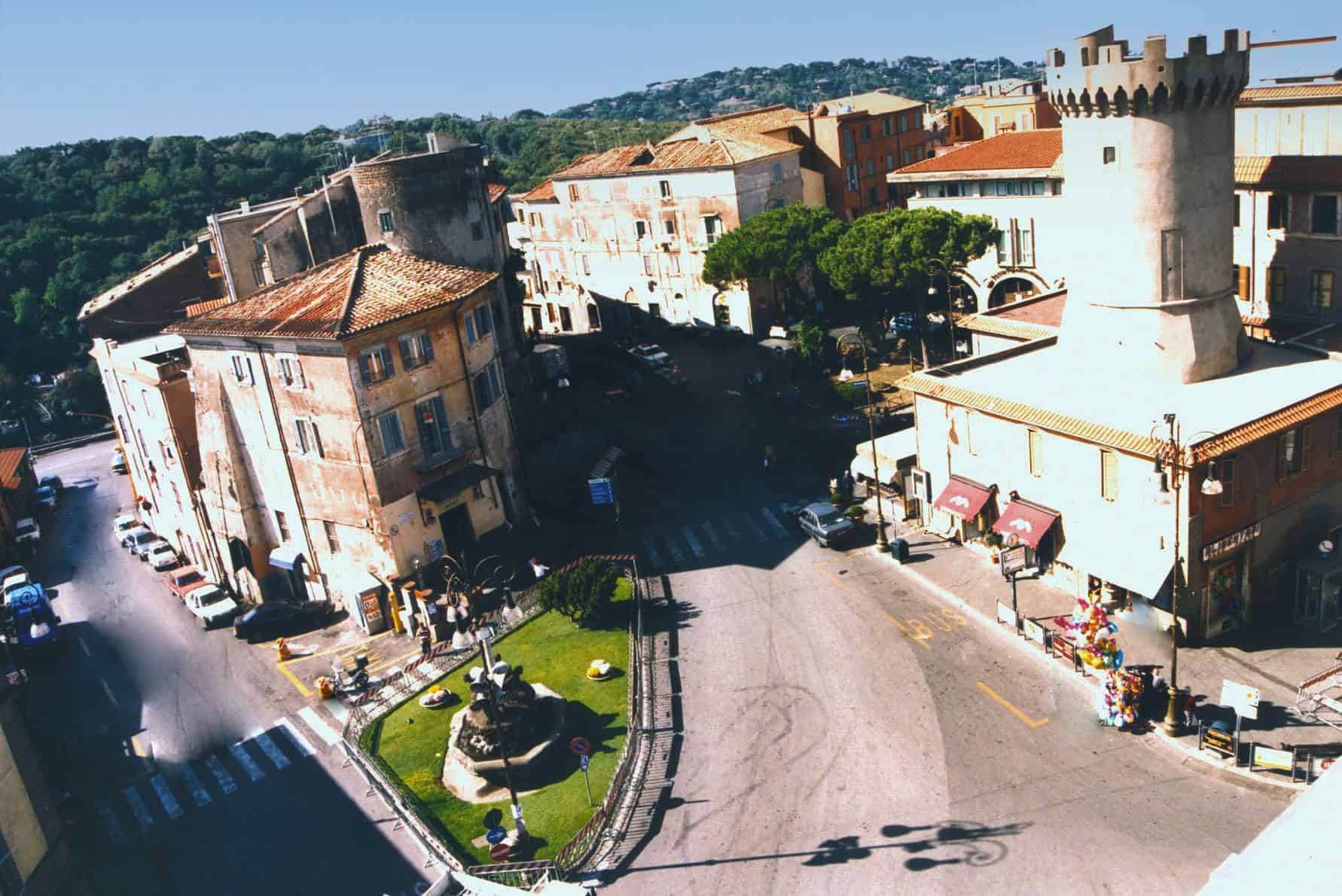
Palazzo Matteotti, on the piazza of the same name, is the nineteenth-century town hall built after 1870 by the Republican town council. In 1884 the council moved the municipal residence there from Palazzo Colonna. In front, at the center of the square, a fountain in Bernini style was placed. It was dismantled in 1903 to make room for the tracks of the Tramvie dei Castelli Romani. Today the square hosts the Fountain of the Four Moors, rebuilt in 1969, the former church of Santa Lucia with the civic museum, and the bar tables. It is Marino's living room and the stage of the wine miracle.
Villa Desideri, the Giardini Colonna, the Barco Colonna and Villa Colizza
Villa Desideri, formerly Colonna di Belpoggio, is today Marino's public park. Its entrance on corso Vittoria Colonna is marked by the fountain from 1990. It houses the municipal library Vittoria Colonna, named after the poet marchioness of Pescara, the most illustrious of the women of the house of Colonna and a friend of Michelangelo. The Giardini Colonna are what remains of the representative greenery of the barony palace. The Barco Colonna, above the center toward the lake, was the hunting reserve of the feudal lords. It passed to the Comune with the palace in 1916. It is Marino's natural terrace, the one from which you can see the whole of Lake Albano, with Castel Gandolfo on the opposite shore. On its edges it keeps the Casino Colonna, where sculptor Umberto Mastroianni lived until his death in 1998. Villa Colizza, formerly Colonna di Bevilacqua, and Villa della Sirena complete the ring of noble villas around the old core.
Palazzo Bandinelli, Palazzo Castagna and Palazzo Capri
Palazzo Bandinelli stands in Borgo Garibaldi, outside the old city walls. Bartolomeo Bandinelli had it built in the 15th century. It later passed to the Roman Confraternity of San Giovanni Decollato, the confraternity of condemned men, of which Bandinelli had been a member. Palazzo Castagna, on corso Trieste, was erected around 1580 by Cardinal Giovan Battista Castagna, a friend of Marcantonio Colonna. In 1590 he became pope as Urban VII and reigned for 13 days, the shortest pontificate in history. The people of Marino call it "u' palazzu pentu," the painted palace, for the frescoed friezes of the facade, now erased by time. Palazzo Capri, of the family that gave Marino the mayor and senator Luigi Capri Cruciani, closes the series of palaces on the corso.
Villa Gabrielli, the villa of Sophia Loren and Carlo Ponti in Marino
Villa Gabrielli, also called Villa Sara or Villa Capri, is on via dei Laghi, state road 217. It was a farm estate that Angelo Gabrielli, prince of Prossedi, turned into a villa in the mid-1700s. The Rococo frescoes painted around 1765, with family portraits, hunting scenes and children's games, are among the most important 18th-century interior decorations in the Castelli Romani. At the beginning of the 1900s the villa passed from the Gabrielli to the Capri. In the postwar period the producer Carlo Ponti bought and restored it. He lived there with Sophia Loren, enlarged the 19th-century park, and hosted half of world cinema. In 1961 the couple, with Virna Lisi, were guests of honor at the Sagra. The villa is private and is not open to visitors. From via dei Laghi you can get a sense of the park, nothing more, and anyone who promises otherwise has never gone in.
Military Architecture in the Territory of Marino (RM)
In the countryside of Marino, since the 11th century, small fortresses and towers are attested along the roads and at control points of the territory. In 1388 Tor Leonardo is mentioned for the first time, built along Via Appia over a Roman tomb near the present Santa Maria delle Mole: it belonged to the chapter of the Basilica of Saint Peter in the Vatican, then to the abbey of Santa Maria di Grottaferrata and finally to the Colonna. The castle of Palaverta, on the road of the same name near the hamlet of Castelluccia, was a guard post on Via Nettunense: it arose in the 12th century and took its present name in 1509, when the Colonna rented it to Paolo Averta. Not far away stand the Pecoreccia Lanza tower, the Castellazza tower and the remains of the castrum Castelluccie, mentioned as early as the mid-10th century, passed to the Orsini and razed to the ground by Cola di Rienzo in 1347. Along Via Pedemontana dei Castelli, which connects the Tuscolana to the Appia cutting across the Anagnina, arose Tor Messer Paoli, probably the center of an early medieval massa already from the eighth century and then of the Orsini, the Basilian monks of Grottaferrata and the Colonna. A tower at Sassone, mentioned in 1212. The torraccio della Marana, or dell'Acqua Sotterra, near the marana of the Pietrare at Pantanelle, existing since 1216. None of these towers is a monument you can visit: they are ruins among the vineyards and warehouses, and should be read as the milestones of a countryside that for 1,000 years was the frontier between Rome and the barons.

The Fountains and Watering Troughs of Marino (RM)
The Fountain of the Four Moors of Marino
The symbol fountain of the town was made in 1632 on commission from the Community to celebrate the victory of Lepanto of Marcantonio II Colonna. The design by the architect Sergio Venturi was upended by the will of Duke Filippo I Colonna and by the taste of the Marino sculptor Pompeo Castiglia, who carried out the peperino parts with the mason Pietro Taccia. The result is a column of white marble with a Corinthian capital, the heraldic emblem of the Colonna, to which four Turkish prisoners, the "moors," are chained, above a peperino basin held up by eight sirens, another family symbol. Placed in Piazza Lepanto, it was crushed by the collapse of Palazzo Colonna on February 2, 1944 and rebuilt in 1969 by Marino sculptors in its present position in Piazza Matteotti. Its fame is tied to the miracle of the fountains that give wine: it was the first to do so, on October 4, 1925, and since then it remains the only fountain in Italy worth a line one Sunday a year.
The Fountain of Neptune in Piazza San Barnaba
The fountain in Piazza San Barnaba was commissioned by the Municipality in 1889 from the Sicilian sculptor Michele Tripisciano, the same one who sculpted in Rome the monument to Metastasio in Piazza della Chiesa Nuova. At the center of the elliptical basin, with two side troughs for animals, is the white marble group of Neptune and Triton that gives the fountain its name. Anyone who knows Bernini's Triton Fountain in Piazza Barberini recognizes in it the 19th-century quotation, more composed but of good hand.
Fontanile d'Ammonte, Fontanile Comunale, Gaudenzio's Fountain
The Fontanile d'Ammonte is the wash house outside the town, in the Acquasanta district near the tower of the same name, used as a public wash house until the 1930s thanks to the abundance of spring water and the nearby marana of the Pietrare. The Fontanile Comunale was built by the Municipality in 1896 in Borgo Garibaldi as a public watering trough, just outside the town on the busiest road toward Rome, provincial road 73/a Via Castrimeniense. The "Gaudenzio" fountain was the watering trough under the Bramantesque walls on the western front of Palazzo Colonna, so called for unknown reasons and demolished in the 1950s to make room for a few parking spaces. In 2012 a small fountain in period style was rebuilt on the spot.
The 20th-Century Fountains of Marino
The most recent fountains tell the civic history of the town. The fountain of Via Garibaldi, inserted in the staircase that climbs to Piazza San Barnaba, dates from the 1960s. The fountain at the center of the garden of Piazza Garibaldi was built for the 1990 soccer World Cup, when Marino hosted the official training camp of the Italian national team. For the same occasion the fountain of Corso Vittoria Colonna at the entrance to the park of Villa Desideri was made. The Berninian fountain of Piazza Matteotti, placed after the town hall moved in 1884, was dismantled in 1903 for the tram. The town has kept building fountains the way others build monuments, and I think it's the most honest way to remember that everything, here, begins with water.
The Monuments and Outdoor Sculptures of Marino (RM)
The War Memorial of Marino
The first war memorial was the work of Ettore Ferrari, the sculptor of the Giordano Bruno in Campo de' Fiori. It was made after World War I and placed in what is now largo Giacoma de Settesoli: a bronze hero dressed only in a Greek helmet, his right hand raised toward the sky and the torch of life in his left. The bombings of 1944 destroyed it. A new monument was not designed until 1969 and was placed in piazzale degli Eroi: an altar of peperino surrounded by long steel slabs raised toward the sky. At the end of the 1980s, with the works for the multi-story car park in the piazzale, this one was also demolished. The current one, on the same site, dates from 1998 and is the work of the sculptor Alberto Piras. Three monuments in 80 years for the same dead: it's a story that says a lot about how Marino treats its own memory.
The Warrior by Umberto Mastroianni and the Man of Boville
The Warrior is a large bronze sculpture by Umberto Mastroianni, a master of Informal art who lived at the Casino Colonna in the Barco until his death in 1998. The artist donated it to the Comune, and it was placed in largo Oberdan, at the foot of Palazzo Colonna, in the early 1990s. It is the most important 20th-century artwork in the country, and people walk right past it without looking: stop and look. The Monument to the Man of Boville, in peperino, is by the sculptor Paolo Marazzi of Marino. It stands in Frattocchie, at the junction of via Appia Nuova (SS 7) and via Nettunense (SS 207), marking the site of ancient Bovillae.
The Albano Stone Biennale and Its Sculptures
Other large peperino works scattered around the town are the reminders of the Biennale della Pietra Albana, an event launched in 1978 and ended in the early 1990s, which invited sculptors from all over the world to work the local lava. What remains is the Monument to the Brotherhood of Peoples by Paolo Marazzi, from the first edition in 1978, in largo Giacoma de Settesoli. Then there is The Family by the Japanese Kazuto Kuetani, from the second Biennale in 1980, at the Vittoria Colonna library in the park of Villa Desideri. The work dedicated to Spanish mythology by Luis Ramos, from the seventh Biennale in 1990, is in the garden of piazza Garibaldi. Man with Angel by the French artist Sylvie Kleine stands on via Garibaldi, in front of the headquarters of the Banca di Credito Cooperativo San Barnaba, the bank that the abbot and parish priest Guglielmo Grassi founded in 1909. It is an outdoor museum of contemporary sculpture in volcanic stone that nobody advertises. In our view, it is the most original thing Marino has after the Mithraeum.
The Archaeological Sites of Marino (RM): Mithraeum, Bovillae, Mugillae
The territory of Marino "innumeris antiquitatum vestigiis refertissimus est", is extremely rich in countless ancient remains, wrote the Jesuit Athanasius Kircher in his Latium of 1671. The oldest evidence is the Iron Age hut floor found in the Cave di Peperino quarter, near the station, in the 1970s by Pino Chiarucci, later director of the civic museum of Albano Laziale. It is one of the rare examples of its kind in Lazio. Other pre-Roman finds had been made from the 1800s through the 1910s in the necropolises of Riserva del Truglio, Pascolari di Castel Gandolfo, Campofattore and other spots along the rim of Lake Albano.
The Mithraeum of Marino, the Painted Sanctuary Under the Station
The most sensational find was the Mithraeum of Marino, discovered by chance in 1962 during work to enlarge a cellar on via Borgo della Stazione. It is one of the three painted mithraea in Italy and among the best preserved in the world. The sanctuary occupies a pre-existing cistern carved into tufa, reached through a gallery 29 meters long and three meters wide. On the back wall is the fresco of the tauroctony: Mithras in eastern dress, a starry cloak, a Phrygian cap and trousers, slays the white bull. On either side, in small panels, are the battle of Jupiter against the Giants, Saturn, the birth of Mithras from the rock, the carrying of the bull, the pact with the Sun, and the miracles of the god, along with the two torch-bearers Cautes and Cautopates. The accepted dating is the second half of the 2nd century AD. A plaque commemorates the slaves from the peperino quarries who visited the sanctuary. It can only be visited with the Archeoclub Colli Albani: groups of 14 people, 40 minutes, on the second, third and fourth weekends of the month. The basic visit costs €10 and must be booked on the association's website, which also offers combined routes with the underground circuit (€15) and the Santa Lucia cistern (€14.90). Among the mithraea of Rome and its surroundings, the one in Marino is one of the few where the painting reads like a page, and it's worth a visit even for those who know nothing about Mithras.
The Roman Cistern Under Santa Lucia and the Umberto Mastroianni Civic Museum
At the end of the 1990s, beneath the former church of Santa Lucia in Piazza Matteotti, a Roman cistern was found that was later adapted into a Christian place of worship. In 2000, in the spaces of the restored church, the Museo civico Umberto Mastroianni opened. It holds finds from the protohistoric period through the Roman and medieval eras, the remains of the municipal antiquarium set up in 1904 at Palazzo Colonna and scattered by the bombings of 1944, and a collection of notarial documents from the 16th century onward. Admission is free. Opening hours follow the municipal schedule and should be checked on the Comune di Marino website.
Bovillae and Mugillae, the Latin cities of the Marino area
Bovillae, between the locality of Colle Licia and the hamlet of Frattocchie, along the Appia, was excavated between 1823 and 1825, then in 1910 and 1930. The circus, the site of the theater and the scola actorum, the temple of Veiove and the shrine of the gens Iulia, the family of Caesar and Augustus that was said to come from Bovillae, all came to light. The ancient Latin city of Mugillae, near Santa Maria delle Mole, has long been debated. Today it seems to have been identified with good probability, but the site, never explored by archaeologists, is threatened by urban expansion. Legambiente, together with some residents, is fighting to save it. In Frattocchie, in recent years, two stretches of road have been brought to light: a branch road of the Nettunense toward the hills and a branch of the Appia found during excavations for the McDonald's in the former STAFF area, heading toward vicolo del Torraccio. Along this road, three tombs with one skeleton each were identified. The area, inside the restaurant, can be visited under glass coverings, and it remains the most cited case in Italy of archaeology inside a fast-food restaurant. Along the Appia Antica, right beside Via della Repubblica, in Santa Maria delle Mole, a structure has been identified that looks like a small thermal bath complex. On the same road, during excavations for ENEL cables, stretches of floor mosaic and other remains still under study have emerged. Anyone who loves Via Appia can continue toward Rome as far as Capo di Bove.

The natural areas of Marino (RM)
Marino's public green spaces are spread between the center and the outlying districts. In the center there are the park of Villa Desideri, the Barco Colonna, the Bosco Ferentano, the garden of Piazza Garibaldi, the park of the Acquasanta neighborhood and the one in the Cave di Peperino neighborhood. In Cava dei Selci there is the Parco della Pace and the Parco Sassone. In Santa Maria delle Mole, there are the Giovanni Falcone park and the Spigarelli park. The Bosco Ferentano deserves a few more words: it is the strip of woodland that slopes down toward the Ferentana valley, where scholarly tradition places the Caput Aquae Ferentinum and the Lucus Ferentinae, the site of the assemblies of the Latin League. Archeoclub Colli Albani offers a route linking the Mithraeum with the Ferentana valley (€15), and with children it's the right walk: half an hour in the woods, a spring and a story to tell. For the rest of the Alban Hills, from Monte Cavo di Rocca di Papa to the lake of Nemi, the English guide to the Castelli Romani on ItalyPlanner is worth using.
Another well-known fact, yet rarely mentioned
Everyone knows Marino is Colonna country. Few people remember that the fief served as the family's military headquarters for a century and a half, and that for this reason it was destroyed twice on the orders of a pope. The first time was on July 8, 1501, when Alexander VI Borgia, at war with the Colonna who had sided with the French, decreed its destruction. With the brief Coelestis altitudinis potentiae of October 1, he also gave Marino and 36 other fiefs to his nephew Giovanni, the Infante Romano, possibly a son of Lucrezia Borgia and Pedro Calderón. The second time was in 1526, on the orders of Clement VII, together with Zagarolo, Gallicano, Artena, Subiaco and Cave. The Colonna responded the following year by opening their gates to the imperial army during the Sack of Rome in 1527. Another well-known but rarely mentioned fact concerns the road. For centuries Marino was a stop on the stagecoach route to Naples, which ran through here from the convent of Santa Maria ad Nives di Palazzolo and from Velletri. When Pope Pius VI had Via Appia Nuova reopened between 1777 and 1780, traffic moved to the plain and made the fortune of Albano and Genzano, while Marino lost its role as a stopping place and trading point. The historian Giuseppe Tomassetti saw the destruction of 1501 as the end of the Middle Ages in Marino. In our view, though, the real reason Marino, unlike Albano, has kept a compact historic center and a rural identity is the reopening of the Appia. Those who stay off the main road age better.
The right photo to take in Marino (RM)
The photo everyone takes is the Fontana dei Quattro Mori with the glass under the tap, on the Sunday of the Sagra. It's a crowd shot, almost impossible to compose: the square is packed, the late October afternoon light is low and raking, and the wine coming out is white, so in photos it looks like water. If you really want it, climb the steps of the former Santa Lucia, which are raised above the square, and wait for the moment when the flag throwers in the parade pass in front of the fountain. The flags add the color the wine doesn't. The photo I recommend is a different one. From the Barco Colonna, above the center, you can see all of Lake Albano, with Castel Gandolfo on the far shore and, on clear days after rain, the sea behind it. In the morning the lake is in shade and the papal palace at Castel Gandolfo is in light. In the afternoon it flips. The second photo is in the Mithraeum, but the tauroctony is lit with cold light and photos taken without flash come out blue. Ask the guide for the seconds of darkness before the explanation, and use your phone with the exposure at its minimum. Third photo: the facade of San Barnaba from the steps of via Garibaldi, which, with the gray of the peperino against the October sky, is the most Marino photo there is, without a bunch of grapes in the frame. Save the grape bunches for the floats. Those, yes, are made to be photographed.
The history of Marino (RM) from its origins to today
Marino in antiquity: Riserva del Truglio, Mugillae, Bovillae, Castrimoenium
The first documented human settlements in the Marino area date back to the 1st millennium BC, in the Latial period II A (900-830 BC). The earliest finds from the Riserva del Truglio necropolis date to the Latial period III (770-730 BC), and the necropolis reached its peak in the Latial period IV A (730-640 BC). About 30 tombs belong to this period, one of the most important funerary concentrations in the Alban Hills. Near the station, at Cave di Peperino, the hut floor mentioned earlier was found, one of the rare examples of its kind in Lazio. In the pre-Roman historical period, several settlements arose in the area. Mugillae, near Santa Maria delle Mole, was razed to the ground in 490 BC by the Volsci led by Gnaeus Marcius Coriolanus. Bovillae, between Colle Licia and Frattocchie, took in the people of Alba Longa after the city was destroyed in 658 BC. It was the homeland of the gens Iulia, and in AD 14 Emperor Tiberius founded the Sodales Augustales there, having the great circus and the theater built. The Lucus Ferentinus, the sacred grove where representatives of the cities of the Latin League gathered, according to the most widely accepted hypothesis stood in the locality of Prato della Corte, outside the hypothetical urban area of Alba Longa and near the legendary Caput Aquae Ferentinum. A more recent proposal places it toward La Cecchina, in the municipality of Albano Laziale. In Roman times, in all probability for military purposes, the fortified settlement of Castrimoenium was founded on the site of today's Castelletto district. The Aqua Tepula set out for Rome from there. Near the station, in 1962, the Mithraeum came to light.
Marino in the early Middle Ages
Already before 476, Bovillae was in decline. After the 1st century there are no written sources about the municipality, although the area has yielded early Christian finds: an oratory whose fragmentary remains were found in the 18th century near Frattocchie, and a catacomb at Due Santi, discovered in the same century, whose location has been lost. The gradual abandonment of the Appian Way after the 6th century and the Saracen raids of the 9th and 10th centuries pushed the population uphill, and hilltop centers such as Marino emerged. From the 8th century the Church took over governance of Lazio and, to secure supplies and control, set up patrimonia and domuscultae made up of massae and fundi. Within the Marino area fell estates of the patrimonium Appiae and of the massae Marulis, with its center probably at Grottaferrata near the 12th milestone of the via Latina. Also there was Sulpiciana, founded by Pope Adrian I along the Nettunense from Frattocchie to Castel Savello near Albano.
Marino in the late Middle Ages: Tuscolo, Frangipane, Orsini, Colonna
In the 11th century the territory probably came under the orbit of the Counts of Tusculum, the family that governed Rome from nearby Tusculum between 999 and 1179 through the "family papacy," and it was perhaps they who first fortified the hill of the town center. The first mention of the castle would date back to 1090, in the dowry that Agapito of the Counts of Tusculum gave to his daughter, bride of Oddone Frangipane, together with Rocca di Papa and Monte Compatri. The document could, however, be a later interpolation, forged to legitimize a Frangipane usurpation, though in the 13th century the Frangipane fully governed Marino. In 1237 the feudal lady Giacoma de Settesoli, widow of Graziano Frangipane, friend of Saint Francis of Assisi (the "frate Jacopa" who brought him almond sweets on his deathbed) and inspirer of the Third Order, granted the first statutes to the Marino Community. His son Giovanni Frangipane left his property in his will in 1253 to the Abbey of San Saba on the Aventine and to Santa Maria di Grottaferrata, with a share for the poor of Marino. After a brief usurpation by the Counts of Poli, in 1266 Cardinal Matteo Rubeo Orsini bought Marino "et turrim cum ipsius tenimento suo" for 13.000 provisini. Under the Orsini, the castle withstood two sieges: in 1267 by the Ghibelline senator Enrico di Castiglia, and in 1347 by Cola di Rienzo. During the Western Schism, on April 30, 1379, the mercenary armies of Urban VI and the antipope Clement VII clashed in the Battle of Marino: the papal forces of Alberico da Barbiano won. The feudal lord Giordano Orsini, a follower of the antipope, was driven out by his son Giacomo, who held the fief until 1385, when he was in turn expelled by his cousin Onorato Caetani. Conquests and reconquests followed: between 1399 and 1405 Marino belonged to the Apostolic Camera, from 1408 to 1414 to Ladislaus of Naples, who gave it to Giordano and Niccolò Colonna, then again to the Caetani, who sold it to the Colonna in 1419 for 12.000 florins. From then on the Colonna used the castle as a military base: in the war of 1433-1436 against Eugene IV, which ended with the destruction of Palestrina and the family's exile in Naples, in the wars of 1482 and 1484-1486 between Sixtus IV, later Innocent VIII, and Ferdinand of Naples, in the crisis of Charles VIII's descent in 1494-1495, which set them against Alexander VI and ended with the destruction of Marino ordered on July 8, 1501.

Marino from the 16th to the 18th Century
Alexander VI gave the fief to his nephew Giovanni, entrusting its care, because of his minority, to the Cardinal Archbishop of Cosenza, Francesco Borgia. But already in 1503, after the pope's death, Fabrizio I Colonna returned to the castle. In 1526 Clement VII had Marino razed to the ground along with the other Colonna fiefs, and the Colonna took their revenge in the Sack of Rome. They fought again against Paul III in 1539, the War of the Salt, and against Paul IV in 1556-1559, before Marcantonio II Colonna swore allegiance to Julius III in 1550 and closed the season of wars between the papacy and the barons. Under Marcantonio II, admiral at Lepanto in 1571, Marino changed face. In 1564 the seal of the Community appeared, the knight with the banner that is still the city's coat of arms. In 1566 the new statutes came out, and in 1572 the "Bandi, provisioni et ordinationi" against gambling, blasphemy and brawling. Palazzo Colonna, commissioned by his father Ascanio I from Antonio da Sangallo the Younger, was one quarter complete. For Cardinal Ascanio II Colonna, an unpopular governor against whom the people of Marino rebelled in 1599, Paul V granted in 1606 the elevation of the fief to a hereditary duchy. Tradition holds that in 1618 the people of Marino, in public assembly, elected Saint Barnabas as patron, celebrated on June 11. The 17th century was the century of great works: around 1636 the Santissima Trinità, between 1640 and 1662 the basilica of San Barnaba, the opening of the Strada Larga, today Corso Trieste, and in 1632 the fountain of the Four Moors. The plague of 1656 halved the population. The last statutes were drafted in 1675 and approved in 1677 by Lorenzo Onofrio Colonna, who had the convent of the Santissimo Rosario built, completed in 1712. The 18th century brought the economic blow of the reopening of the Appia Nuova, wanted by Pius VI between 1777 and 1780, and then the revolution. With the Republic proclaimed in Rome on February 15, 1798, Albano, Frascati and Velletri declared themselves sister republics on February 18, and Marino only in early March. When Trastevere rose against the French on February 20, the people of Albano and Velletri joined the reaction with a few thousand men, while those of Marino and Frascati stayed loyal to the revolution. The battle was fought at Frattocchie on February 28, 1798. The French under Gioacchino Murat won, and they sacked Castel Gandolfo and Albano. General Championnet congratulated the people of Marino for their loyalty, and it was precisely that loyalty that cost Marino the sack by the Neapolitan Sanfedist army that drove out the French in 1799.
Marino in the 19th century: from Napoleonic canton to City
With the annexation of Lazio to the French Empire in 1807, Marino became the seat of a canton and Grottaferrata was attached to it, until Pius VII returned to Rome in 1814. In 1816 the motu proprio "Quando per ammirabile disposizione" discouraged the feudal lords so much that almost all of them gave up their feudal rights, and Filippo III Colonna did the same. Colonna rule ended, although the family remained owner of the Marino properties and sold them off slowly over a century, until the emphyteutic transfer of the palace and the Barco to the municipality in 1916 by Isabella and Vittoria Colonna. Gregory XVI (1831-1846) was the pope most attached to Marino: he restored local government in 1831, elevated Marino to a city in 1835, opened the college of the Doctrinaire Fathers and had the Gregorian bridge built, the access from Castel Gandolfo along Via Maremmana III (SS 216). After Porta Pia, on September 20, 1870, the municipal council was immediately dominated by a republican and anticlerical majority. It built the new town hall, today Palazzo Matteotti, and in 1880 began work on the railway connection with the then hamlet of Ciampino, already joined to Rome since 1856 by the Rome-Frascati railway. The Rome-Albano line was completed in 1889, and in 1889 the Neptune fountain arrived as well.
Marino from the early 20th century to fascism
In the last years of the 19th century, the peasants' struggle against the semi-feudal exploitation by landowners also began in the Castelli. It was less intense than in the North but much more alive than in the South. The first occupation of land in Marino was in 1898. In 1902 a peasant resistance league was formed. In 1910 the protest spread to the stonecutters of the peperino quarries, the working class peculiar to the town. New occupations in 1917 hit the lands of the Colonna and Grazioli families, which were leased to the popular mayor Luigi Capri Cruciani, and opened a long legal dispute. The Biennio Rosso saw invasions by veterans in the localities of Casa Bianca, Sant'Antonio and Castelluccia. Meanwhile, the cooperative Colli Parioli began building a garden city in Ciampino for 221 families of former combatants. Political clashes produced incidents and deaths. Fascism struggled to take hold. The first squadrist "tour" reached Frascati, Marino and Albano on April 27, 1921, and found a hostile environment. After the March on Rome, violence was not needed, because in 1923 the Republican majority merged into the fascio, as did the Popolari in Monte Porzio Catone and Castel Gandolfo, the nationalists in Rocca Priora, and still others in Ariccia. The regime presented itself with men recycled from other groups: Capri Cruciani as deputy and senator, and Ugo Colizza, a former anarchist who later became podestà. It lost credibility on the eve of the war, when police informers reported widespread anti-fascist speeches and empty squares at rallies. In this climate came the Feste Castromenie in 1904 and the Sagra dell'Uva in 1925. In 1909 the parish priest, Abbot Guglielmo Grassi, founded the Banca di Credito Cooperativo San Barnaba. Until his death in 1954, he also ran the parish Oratorio and a theater activity that trained generations of people from Marino.
Marino in World War II: February 2, 1944
The first bombing hit the hamlet of Ciampino on July 19, 1943, a military target because of its railway junction and airport. On September 8, just a few hours before the announcement of the armistice, the planes involved in the tragic bombing of Frascati hit Squarciarelli, in the municipality of Grottaferrata. They cut a branch of the Marino aqueduct and the tram lines. After the landing at Anzio on the night of January 22 to 23, 1944, the war reached the Castelli. On Wednesday, February 2, 1944, at about 12:30, B-25 Mitchell bombers of the U.S. Fifteenth Air Force, each carrying 1,360 kilograms of bombs, hit the center of Marino. Zaccaria Negroni, who headed the local Committee of Liberation, recounted it in Marino sotto le bombe. The Candelora service had just ended, and people were going home for lunch. At the roar of the engines, few ran to the shelters, because so many formations had already passed. "A sudden boom abruptly breaks every illusion." It was the collapse of Palazzo Colonna. Then came "a rain of bombs," and the town was "buried in smoke and the dust of falling plaster." There were shouts, moans and rubble. The bombings continued in the following days. With the front nearby, the prefect of Rome ordered the evacuation of the city. The prefectural commissioner left the decision to Negroni, who refused to have the order carried out. He wanted to avoid the deportation of residents to a refugee camp and the looting of homes, as had happened in Lanuvio. On May 31 another raid damaged the roof and dome of San Barnaba. The Allies entered on the night of June 3 to 4, 1944, against a few German squads.
Marino from the postwar period to the new millennium
Mayor Zaccaria Negroni, appointed by the Allies, faced a town where 10 percent of the buildings had collapsed. The aqueduct was reduced, Ciampino was razed to the ground, the town hall in Palazzo Colonna was nearly destroyed along with the Fountain of the Four Moors, the basilica was damaged, and railway and tram lines were cut. Reconstruction started right away. The plan was approved between 1953 and 1954: the classification as a municipal road of Viale della Repubblica in Santa Maria delle Mole, which opened the development of the hamlet, the public lighting in Ciampino, the founding of the Vascarelle neighborhood, and the expansion of the aqueduct. In 1974 Ciampino became an independent municipality. 1990 brought to Marino the national soccer team's training camp for the Italian World Cup, and two new fountains. 2000 brought the civic museum in the former Santa Lucia. 2008 brought wine in the taps. Marino today is a municipality of over 46,000 residents, divided between a historic center that lives off the Sagra and commuters, and plain hamlets: Santa Maria delle Mole, Cava dei Selci, Frattocchie, Fontana Sala, Due Santi, Castelluccia and Pavona. These grew along the Appia and the Nettunense.
Some important events that happened here in history
On April 30, 1379, under the walls of Marino, the battle took place that decided the first act of the Western Schism. The mercenaries of Urban VI, led by Alberico da Barbiano with his Company of Saint George, defeated the mercenaries of the antipope Clement VII. It is an episode that textbooks place in Rome, but it actually belongs to this hill. On November 4, 1571, Marcantonio II Colonna entered Marino with the trophies of Lepanto, and the Turkish shield in San Barnaba is the physical witness of that day. On July 8, 1501, and again in 1526, the town was destroyed on the orders of two popes, Alexander VI and Clement VII. In 1536, Charles V drank Marino's wine in Rome and praised it. On February 2, 1611, the Community chose Saint Barnabas as protector against hail. In 1656, the plague carried off more than half the population. On February 28, 1798, at Frattocchie, the French troops of Murat defeated the Sanfedist militias of the Castelli. In 1835, Gregory XVI gave Marino the title of Città. On October 4, 1925, at seven in the evening, the Fountain of the Four Moors gave wine for the first time. On February 2, 1944, at 12:30, the B-25s destroyed Palazzo Colonna and the fountain. On the night between June 3 and June 4, the Allies liberated the town. In 1962, the Mithraeum came to light. In 1990, Bearzot's national team spent its World Cup training camp here. On October 5, 2008, wine came out of the household taps. If I had to choose the most important event, I wouldn't choose the Sagra. I would choose the battle of 1379. Without Alberico da Barbiano's victory, the Schism would have taken another course, and Marino, for one afternoon, was the center of Christendom.
Who has passed through Marino (RM)
Popes, condottieri, poets and actresses have passed through Marino, and almost all of them came for the wine or for war. Giacoma de Settesoli, the Roman noblewoman whom Saint Francis called "Brother Jacopa," was lady of the castle, and in 1237 she gave it its first statutes. The square where the first monument to the Fallen stood is named after her. Cardinal Matteo Rubeo Orsini bought it in 1266. Henry of Castile in 1267 and Cola di Rienzo in 1347 besieged it in vain. Alberico da Barbiano won a victory there in 1379. Marcantonio II Colonna returned there in triumph in 1571, and Vittoria Colonna, the poet and friend of Michelangelo, has her name on the main street and on the library. Cardinal Giovan Battista Castagna, later Urban VII, the pope of 13 days, built himself the painted palace on Corso Trieste around 1580. In 1536, Charles V did not come to Marino, but he drank its wine in Rome, and the chronicles recorded it. The Jesuit Athanasius Kircher studied its antiquities in the 17th century. Joachim Murat fought there in 1798, and Jean Étienne Championnet praised its republican loyalty. Gregory XVI benefited it as no other pope did. Leone Ciprelli invented the Sagra in 1925, and Ettore Petrolini sang about it from 1926. Carlo Emilio Gadda attended it and wrote about it in 1934. Umberto Mastroianni lived in the Casino Colonna until 1998 and left the Guerriero there. Carlo Ponti and Sophia Loren lived at Villa Gabrielli and were guests at the Sagra in 1961. Charlton Heston had been there in 1960. Modugno and Vianello arrived in 1962, and Gina Lollobrigida in 2000. Banco del Mutuo Soccorso, born in Marino, played at the Sagra in 1970, and Ivan Graziani did in 1980. Zaccaria Negroni saved the town from displacement in 1944, and he was its first mayor during the reconstruction. And in 1990, Baresi, Baggio, Schillaci and the entire World Cup national team passed through here, and they prepared the "notti magiche" in Marino. In our view, none of these people left a mark comparable to that of an almost unknown sculptor, Pompeo Castiglia, who in 1632 chained four Turks to a column and gave the town the image that still identifies it.
How to really visit Marino (RM): duration, route, guide
For the historic center, three hours on foot is enough: Piazza San Barnaba with the basilica and the Nettuno, Corso Trieste with Palazzo Castagna and the Santissima Trinità, Piazza Matteotti with the Fountain of the Four Moors and the civic museum, Corso Vittoria Colonna with Palazzo Colonna, the Guerriero, Villa Desideri, and finally the Barco for the view. With the Mithraeum and the underground circuit, you end up with a full day, and it's worth booking the early-afternoon visit to keep the morning free. The Sagra is a different story. On Sunday, you arrive by train before noon, eat in one of the cellars in the center (the porchetta and the ciambelle al mosto are the festival foods), and wait for the procession in a fixed spot, because moving after four is impossible. The Sagretta on Monday offers the same miracle with a third of the crowd, and for those who don't like crowds, it's the right choice. Licensed guides of the Rome Province cover the Castelli. For a private day with a guide among Marino, Castel Gandolfo and the lake, TourLeaderPro also organizes corporate and team building formats.
Marino (RM) with children and accessibility
With children, Marino works well outside the Sagra and less well during it. The crowds in Piazza Matteotti aren't suited to strollers, and on the first Sunday of October it's better to choose the Sagretta on Monday, with the floats and fountains but without the crush. The Mitreo suits children from seven or eight years old: the 29-meter tunnel and the story of the god who kills the bull impress them more than any museum. Below that age, the darkness and the group of 14 people wear them out. Villa Desideri park, the garden in Piazza Garibaldi and the Bosco Ferentano are the places to let kids run. The walk to Lake Albano from the Barco is downhill on the way there and uphill on the way back, which is worth considering. For accessibility, the historic center is sloped and paved with sampietrini. The basilica of San Barnaba has a staircase at the entrance. The Mitreo, because of its underground layout with a tunnel and steps, is not accessible by wheelchair. The civic museum in the former Santa Lucia is on the ground floor. If you arrive by train, expect a steep 10-minute climb from the station to the center. With mobility difficulties, it's better to drive and use the multi-level parking lot in Piazzale degli Eroi, a few steps from Piazza Matteotti.
How much it costs to visit Marino (RM) and how to save
Marino is one of the most affordable destinations in the Castelli. The train from Termini costs less than €3 per trip with the regional fare. The churches and the civic museum are free, and so are the Barco and the parks. The only real expense is the Mitreo: €10 for the basic visit, €14.90 with the Santa Lucia cistern, and €15 with the underground circuit or the Valle Ferentana, all with a guide included. Book on the Archeoclub Colli Albani website. At the Sagra, the fountain wine is free. You bring your own glass or buy one in the square. Lunches in the cellars are priced like a small town, not a capital. The biggest saving is leaving the car in Rome. On the first Sunday of October the center is closed, and makeshift parking costs as much as a lunch.
What's around Marino (RM) within a 10-minute radius
A 10-minute drive or one train stop away is Castel Gandolfo, with the Apostolic Palace and the Ville Pontificie, and below it Lake Albano, with its beach and lakefront. On the opposite side is Albano Laziale, with the remains of the Castra Albana and its churches. Uphill, there is Grottaferrata with the Greek abbey of San Nilo, Rocca di Papa and Monte Cavo. Downhill, there is Frattocchie with Bovillae and the Appia, and further on the Appia Antica toward Rome. The English guide to Lake Albano from ItalyPlanner and the one to the Castelli Romani together cover the full loop for visitors from abroad. My practical tip is to combine Marino and Castel Gandolfo in one day. They are consecutive stops on the FL4, and together they make a complete outing, with the wine uphill and the lake downhill.
When to go to Marino (RM) and when to avoid it
The best time is the first Sunday of October if you want the Sagra, and the following Monday if you want the wine without the crowd. For the rest of the year, spring is good for the Bosco Ferentano and the Barco, summer evenings for the cellars with tables outside, and June 11 for the feast of San Barnaba. Avoid the Sagra Sunday if you dislike crowds, August if you want shops open, and the weekends of the first week of the month if you're aiming for the Mitreo, which doesn't open on those days. Watch out for the FL4 summer closures. In recent years the railway has suspended service in August for works, so check the timetables before you leave.
What to eat in Marino (RM) and where
The Sagra's signature dish is porchetta, which the people of Marino defend with the same conviction as Ariccia, served in a rosetta roll with Marino DOC white wine. Ciambelle al mosto, sweet rings made with grapes and the year's must, are sold in the bakeries of the center from September to November, and they're the right souvenir. Then there are the cellar foods: pork coppiette, pecorino with fava beans in spring, beans with pork rind in winter, and the wines from the cooperative and private cellars that carry the Marino designation. The right place to eat is one of the cellars in the historic center. They set out tables on the street on weekends and during Sagra evenings. The names change, the quality is almost always honest, and the prices are reasonable. Don't look for Michelin-starred restaurants. Marino is a town of frasche and open bottles, and anyone who goes expecting something else is in the wrong town.
Quick questions about Marino (RM)
When is the Sagra dell'Uva di Marino held?
Every year on the first Sunday of October, with the eve on Saturday and the Sagretta on Monday. The first edition was held on Sunday, October 4, 1925.
What time does the fountain in Marino serve wine?
In the late afternoon on Sunday, after the historic procession and the parade of floats. The Sagretta on Monday repeats the schedule. The exact time changes every year, so check the official program from the Comune di Marino.
How much does the Sagra dell'Uva di Marino cost?
Nothing. Entry to the town is free, and the fountain wine is free. You only pay for what you eat and drink in the cellars.
How do I get to Marino from Rome by train?
Take the FL4 line from Roma Termini, Albano Laziale branch, stop at Marino Laziale. The trip takes 37 minutes on average, with a train every hour. A regional ticket to Albano costs €2.10.
How far is Marino from Rome by car?
About 20 kilometers from the center. From the Raccordo Anulare, exit at Appia or Tuscolana, then take the via dei Laghi or the via Castrimeniense. It takes a quarter of an hour without traffic.
Where do you park in Marino?
In the multi-level car park in piazzale degli Eroi, near piazza Matteotti, and along corso Vittoria Colonna. During the Sagra days the center is closed, so the train is better.
How do you visit the Mithraeum of Marino?
Only by reservation with the Archeoclub Colli Albani, on the weekends of the second, third and fourth weeks of the month, in groups of no more than 14 people. The visit lasts 40 minutes and costs €10.
Is the Mithraeum of Marino suitable for children?
From seven or eight years old, yes. The underground gallery and the bull fresco will impress them. Below that age, the darkness and the length of the visit will tire them out.
Is the Mithraeum of Marino accessible by wheelchair?
No. It is an underground space with a gallery and steps. Piazza Matteotti, the civic museum on the ground floor and the parks are accessible.
How much does the Umberto Mastroianni civic museum in Marino cost?
Entry is free. The opening hours are those of the Comune di Marino, and you should check them on the official website before your visit.
How much time do you need to visit Marino?
Three hours for the historic center. A full day with the Mithraeum, the underground areas and the Barco. Two days if you add Castel Gandolfo and Lake Albano.
What can you see from the Barco Colonna in Marino?
All of Lake Albano, Castel Gandolfo on the opposite shore and, on clear days, the sea. It is the town's lookout point, and it's free.
What is the difference between Marino and Castel Gandolfo?
Castel Gandolfo is the town of the pope and the lake, all facing the water and more touristic. Marino is the town of wine and wine cellars. It is larger, more popular, with a historic center that is lived in. They are one train stop apart and are best visited together.
What wine do they drink in Marino?
Marino DOC, a white wine made from Malvasia and Trebbiano grown on the volcanic soils of the Colli Albani. It's the same wine that flows from the fountain on the Sagra Sunday.
What are the ciambelle al mosto of Marino?
Sweet ring-shaped cakes made with the dough of new grape must and raisins, typical of the bakeries of the Castelli between September and November. They are the dessert of the Sagra.
Can you take photos inside the Mithraeum of Marino?
Without flash, and with the guide's consent. The light is cold and the photos come out bluish. Lower the exposure.
Why is the fountain in Marino called the Quattro Mori?
For the four Turkish prisoners chained to the column, which celebrate the victory of Marcantonio II Colonna at Lepanto in 1571. It was built in 1632 and rebuilt in 1969 after the bombs of 1944.
What is the Sagretta of Marino?
The Monday replay of the Sagra, born after the war, with a procession, floats and wine from the fountains, for a smaller crowd. It is the Sagra of the people of Marino.
Is Marino free on the first Sunday of the month?
Marino is free every Sunday. The churches, the civic museum, the parks and the Barco don't charge admission. The Mithraeum always charges, including on the first Sunday of the month.
What can you see in Marino in one hour?
Piazza San Barnaba with the basilica, corso Trieste, piazza Matteotti with the Fountain of the Four Moors, and the civic museum if it's open. The Mastroianni Warrior is five minutes away.
Where did Sophia Loren live in Marino?
At Villa Gabrielli, on the via dei Laghi. Carlo Ponti bought and restored it after the war. It is private and cannot be visited.
Where exactly is Marino in relation to the Castelli Romani?
At the northern entrance to the Castelli, between Ciampino and Castel Gandolfo, on the rim of the Lake Albano crater, inside the Parco regionale dei Castelli Romani.
Is Marino worth a day? Yes, but not the day you're thinking of. The Sagra is a ritual to see once in your life, standing up, in the wrong shoes and with wine on your coat. The real town reveals itself on a Saturday in November, with the Mithraeum booked, the basilica empty and the lake that looks like a silver coin from the Barco. Do the two things in this order: the festival first, then the silence. You'll understand why Romans have kept coming up here for 100 years.
Article written by the editorial team of TourLeaderPro. Contact them for Tours and Private/Corporate/V.I.P. Experiences.
Planning a trip to Rome? English-language guides for visiting the city are on ItalyPlanner.com.