Palestrina (RM)
In short. Palestrina is 37 kilometers from Rome, on the slopes of Monte Ginestro, and its monumental center has a precise address: Piazza della Cortina, 00036 Palestrina (RM), where the Museo Archeologico Nazionale Prenestino occupies Palazzo…
Palestrina is 37 kilometers from Rome, on the slopes of Monte Ginestro, and its monumental center has a precise address: Piazza della Cortina, 00036 Palestrina (RM), where the Museo Archeologico Nazionale Prenestino occupies Palazzo Colonna Barberini and from where you enter the area of the Sanctuary of Fortuna Primigenia. The combined ticket listed by the Ministry of Culture costs €10 full price and €2 reduced, is valid for two consecutive days and includes the museum, the sanctuary and the forum complex. Admission is free on the first Sunday of the month and no reservation is required. The weekly closing day is Tuesday: it is open Wednesday through Monday, with last entry one hour before evening closing. On the museum's opening time the two ministry pages do not agree (one says 9:00, the other 9:30) and the open-air archaeological area closes earlier in the cold season: call 06 9538100 or check gabiipraeneste.cultura.gov.it the day before. By car from Rome you leave the A24 at Tivoli, or the A1 at San Cesareo or Valmontone, or you take Via Prenestina. The municipality lists eight parking lots, four free (Kennedy, della Pace, Belvedere, Fanfani) and four paid. By public transportation, take a Cotral bus from the Roma Anagnina terminus, on metro line A. Alternatively, take the train from Roma Termini to Zagarolo and connect by bus to Palestrina.
If you are putting together an itinerary of museums in Lazio, the starting point is our guide to the museums of Rome, where Palestrina fully belongs as a stop outside the city.
Let's say it right away, because it's what matters: Palestrina is not a pretty village with two churches and a view. It is one of the three or four most important ancient architectural works in Italy, and by a tragic accident we know it well only thanks to the bombs of 1944. The medieval town that covered the sanctuary was torn open, and under the rubble came out a Hellenistic complex of superimposed terraces that no one had imagined at that scale. Anyone who arrives thinking they'll get through it in an hour is badly mistaken.

Praeneste before Palestrina (RM): the Latin city on the mountain
The present-day town stands on ancient Praeneste, a Latin city that in antiquity was famous throughout the Mediterranean for its oracular sanctuary. The first finds attesting to the occupation of the site are the so-called princely burials, the Barberini Tomb and the Bernardini Tomb, and they date to the early 8th century BC: grave goods with goldwork, ivories, bronzes and Eastern vessels that tell of a very rich community, part of the Phoenician and Greek trade routes long before Rome counted for anything. It is the period archaeologists call Orientalizing, between the 8th and 7th centuries BC, and Praeneste reaches its peak in it.
On the founding, the ancient traditions quarrel with one another, which is usually a good sign: it means the city was important enough to deserve more than one myth. Some sources name Telegonus, son of Ulysses and Circe, as founder. Others name the eponymous hero Praenestus, son of King Latinus and grandson of Ulysses. Cato, Varro, Virgil and Solinus instead tie the city to the figure of Caeculus, believed to be the son of the god Vulcan and found as a baby near some fires that were said to have dimmed his sight, hence the name. These are legends, and as such they should be told as legends: none of these versions has historical value, all of them have documentary value for how the Romans imagined the origins of their most awkward neighbors.
Awkward they were. Praeneste put up fierce resistance to Rome, even forming an alliance with the Gauls against the Romans, and was subdued along with its allies of the Latin League. Its strategic position, dominating the Sacco Valley and an obligatory passage on the routes between Lazio and southern Italy, explains both the military relentlessness and the later fortune: it was precisely that control of the pass that brought the capital that financed, at the end of the 2nd century BC, the monumentalization of the forum and the sanctuary.
In 90 BC the citizens of Praeneste obtained Roman citizenship. A few years later came the bill: in 82 BC, during the civil war, the city sided with Gaius Marius the Younger, who met his death here. Lucius Cornelius Sulla, on that occasion, had the male population exterminated and installed a military colony there. The inscriptions confirm it in the coldest way possible: after Sulla, almost all the Praenestine family names that recur in the epigraphs change. A turnover of population, read in stone.
Once the slaughter was over, Praeneste became a first-choice vacation spot. Augustus frequented it, along with the coasts and islands of Campania and cities near Rome like Lanuvium and Tibur. In 39 AD Caligula, in honor of the goddess Fortuna worshipped here, founded two legions that took their name from the goddess: legio XXII Primigenia and legio XV Primigenia. A military dedication to a provincial deity says how much weight that cult carried in the minds of the Romans.
The Sanctuary of Fortuna Primigenia, masterpiece of Republican architecture
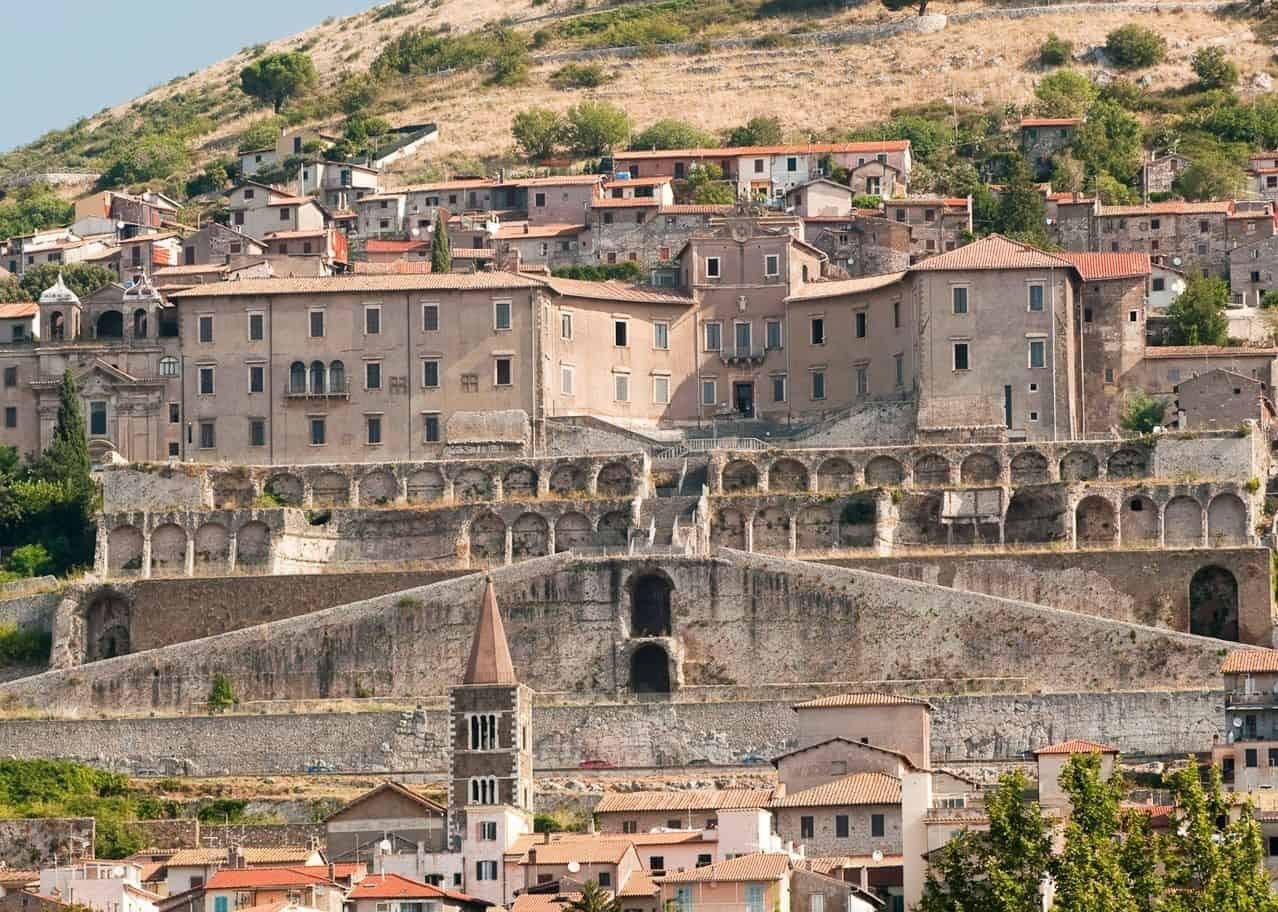
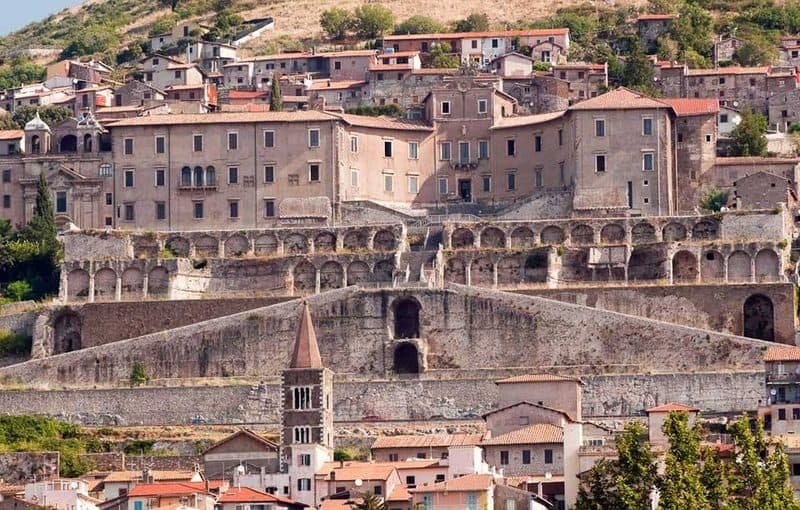
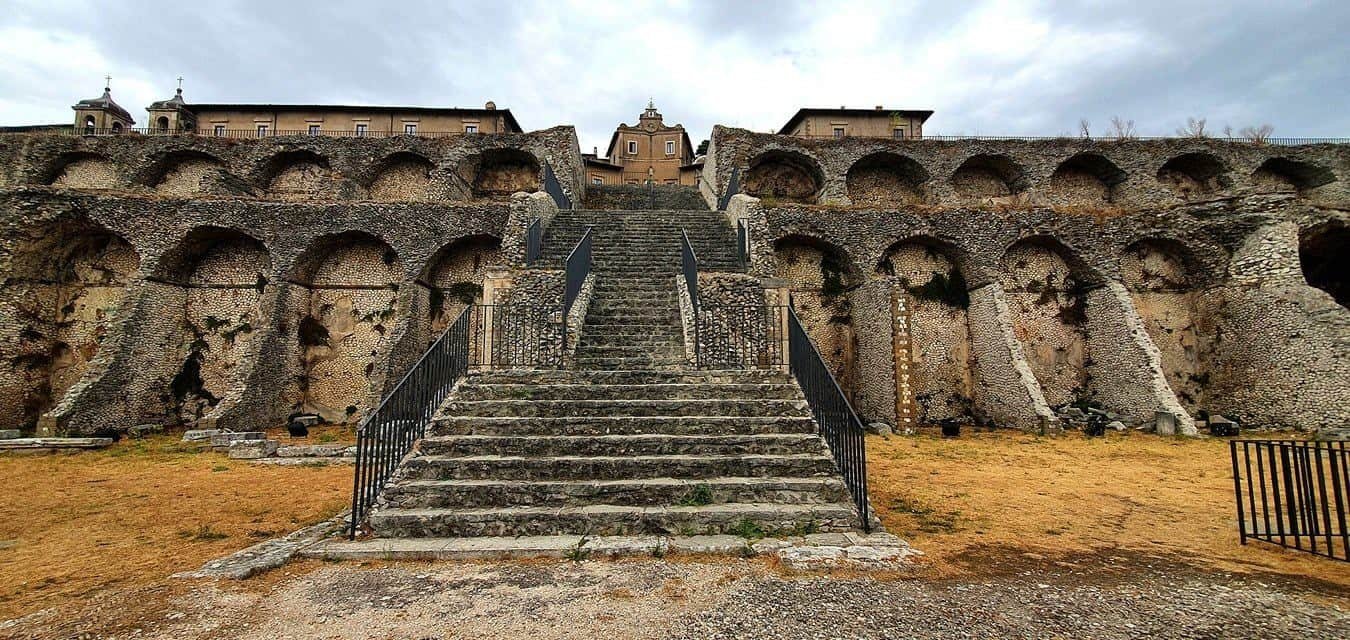
The Sanctuary of Fortuna Primigenia is a grandiose architectural creation that the most recent studies date to the last decades of the 2nd century BC, even though the place of worship is much older. It is organized in a series of artificial terraces laid out on the rocky slope, connected by ramps and monumental staircases, with the central axis climbing to the hemicycle at the top. The type of sanctuary on artificial terraces is common in the Hellenistic period in central Italy, and another example is found at Monte Rinaldo, in the La Cuma archaeological area. But the scale and ambition of Praeneste are of a different order of magnitude.
The technical key is concrete. The sanctuary ranks among the masterpieces of Roman architecture of the Republican era because it takes a scenic layout of Hellenistic ancestry and builds it in opus caementicium, that is, with a technique that allows vaults, galleries and substructures impossible to obtain with stone cutting alone. It is not decoration applied to a mountain: it is the mountain rewritten as architecture. If I had to point to a single place for understanding what the Romans had invented in built space, I would point to these ramps, not to a temple with columns.
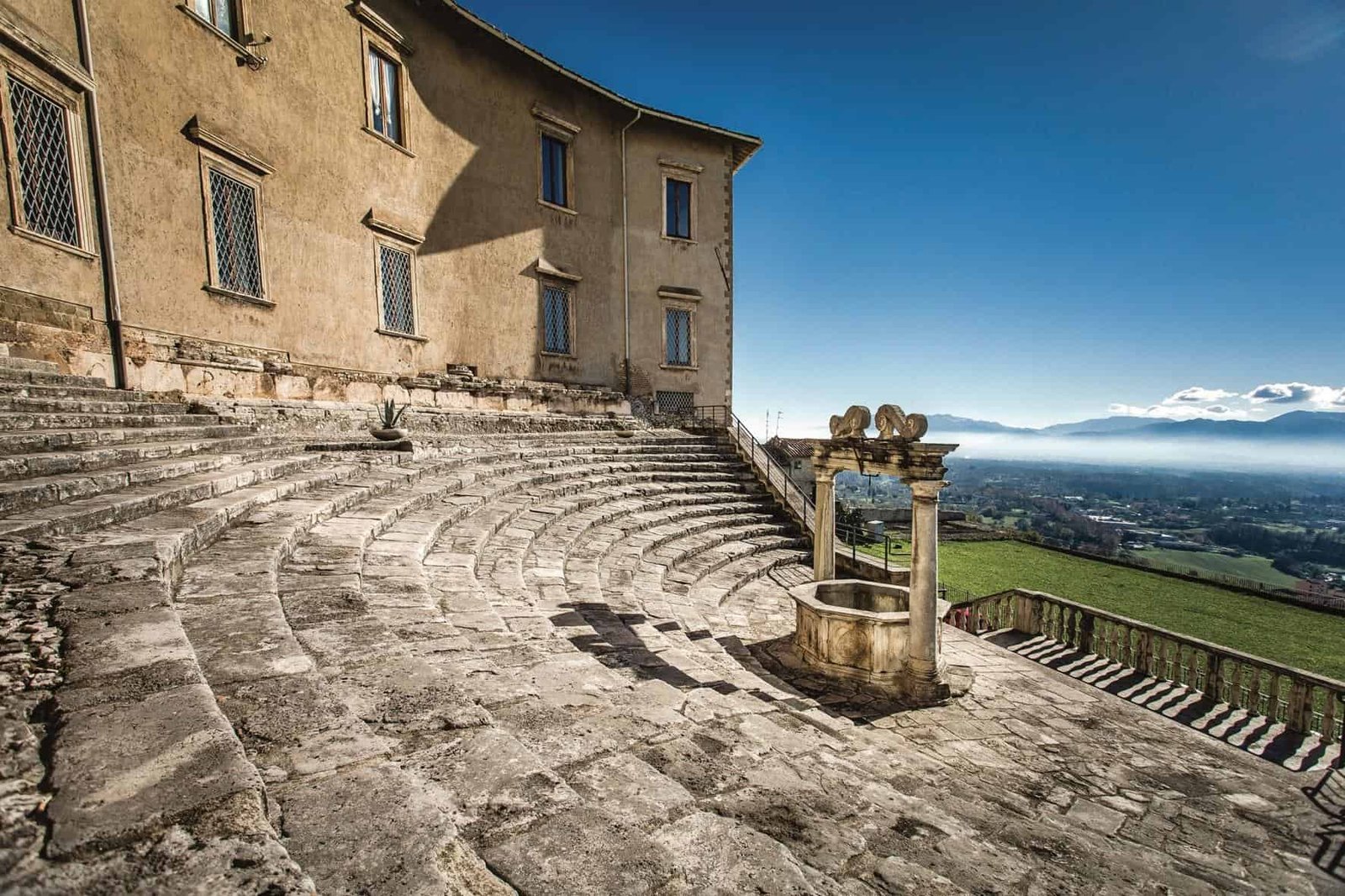
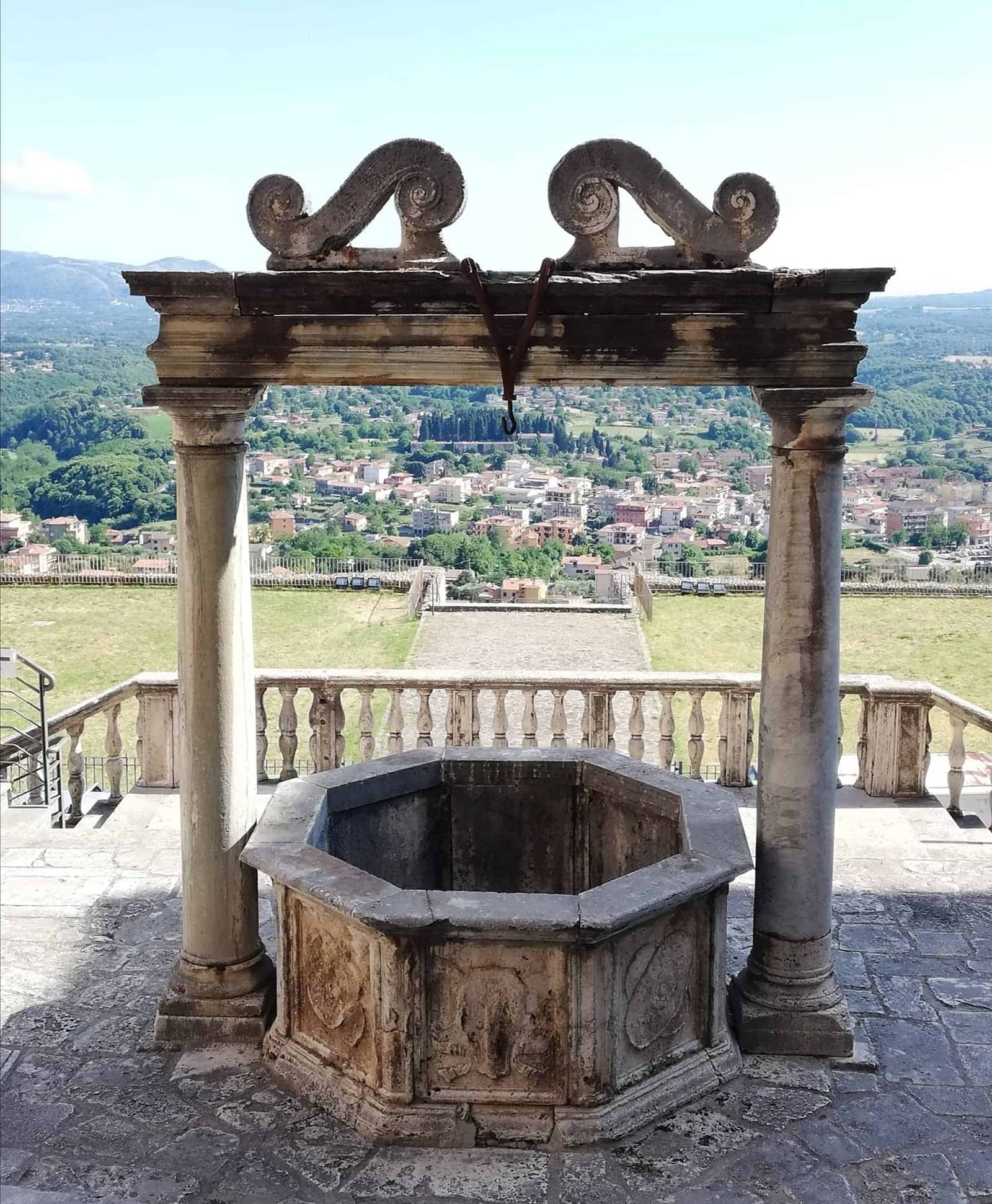
You climb, and you reach the terrace of the hemicycles. In front of the right-hand exedra there is a well identified as the one in which, according to Cicero, the Praenestine nobleman Numerio Sufficio found the sortes, wooden tablets from which auspices were drawn. The mechanism of the oracle, as far as the ancient sources let us infer, was as simple as it was effective: the oracles were presumably written inside the well itself by a female figure who remained in the shadows, and a boy was lowered into the well who, having received the responses, handed the tablets to whoever had asked the question and had paid an adequate contribution. A child, a well, a shadow and a fee: the machinery of the sacred explained in four elements.
Stop on the terrace and look down the valley. On clear days the view reaches the sea, and you understand why the sanctuary was built here and not elsewhere: whoever climbed had to see the world from above before learning their destiny. It is the staging that makes the oracle, not the other way around.

The ramps, the stairs and the terrace of the hemicycles
The open-air visit route goes down and up again: you take monumental stairs and ramps, stop on the terrace of the hemicycles and reach the upper levels, where the 17th-century palace has taken the place of the cavea. The change in elevation is real and not negligible, the ancient steps are uneven and in some stretches slippery when damp. Closed shoes with a treaded sole, always. Ballet flats and city sandals, here, are a mistake you pay for.
The route advice is counterintuitive: do the archaeological area first and then the museum, not the other way around. If you go into the museum first, the Nile mosaic captures your attention and you go back outside with your head elsewhere. If instead you climb the terraces first, when you then see the models and materials in the museum you already have the geometry of the place in your body and you understand everything in half the time.
The civic Forum of Praeneste and the Antro delle Sorti
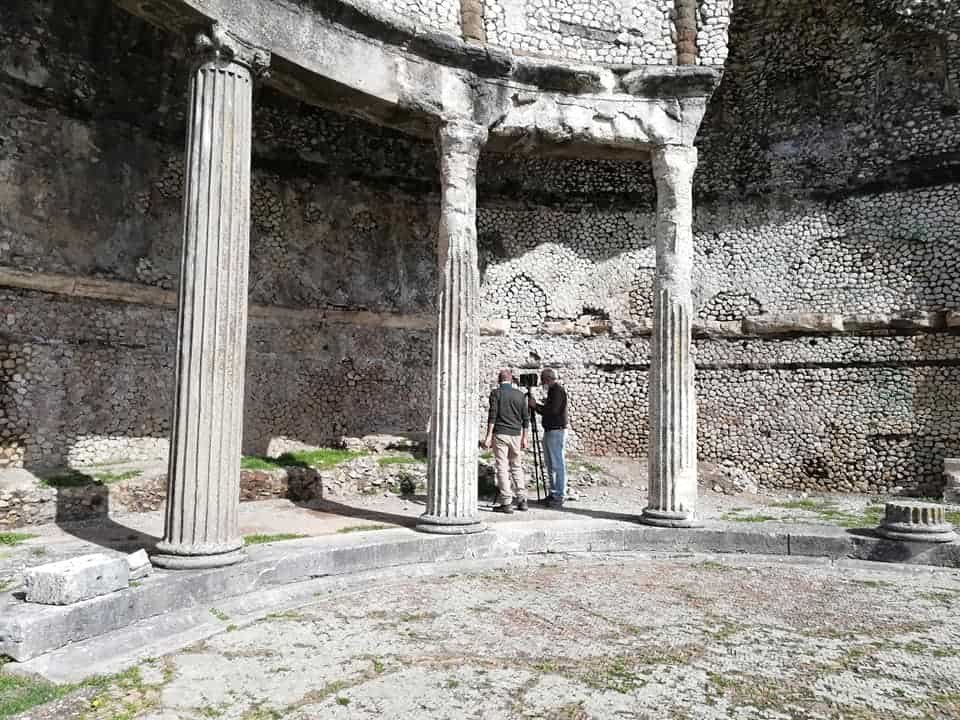
In correspondence with today's Piazza Regina Margherita and under the Cathedral Basilica of Sant'Agapito, conspicuous remains of the forum survive, with the basilica and part of an early Etruscan-Italic temple. To this core belong rooms that scholarly tradition baptized with very evocative and for a long time misleading names: the Antro delle Sorti and the so-called Erario Romano. For centuries it was believed that they were part of the upper sanctuary. Research has clarified that they instead belong to the complex of the Republican-era city forum. It is an important correction, because it changes the geography of the sacred at Praeneste: the oracular sanctuary above, civic life and its monumental buildings below, two distinct poles and not a single organism.
In the Antro delle Sorti is preserved the marine mosaic with fish and sea beds, of the Alexandrian school, a twin in technique and figurative culture of the more famous Nile mosaic. They are two faces of the same commission: a city that at the end of the 2nd century BC has its public buildings decorated by craftsmen of Hellenistic-Egyptian culture. It is not decorative exoticism. It is a declaration of belonging to the great world.
The necropolises: Muracciola-Torresina and Colombella
Outside the center the territory preserves two necropolises. The one at Muracciola-Torresina was discovered in 2008 in the locality of the same name. The one at Colombella instead belongs to the oldest Praenestine excavation tradition. They cannot be visited like the big archaeological parks and access depends on special openings: ask at the museum ticket office, which is the reliable information point on what is accessible during the period of your visit.
The Museo Archeologico Nazionale Prenestino in Palestrina (RM)
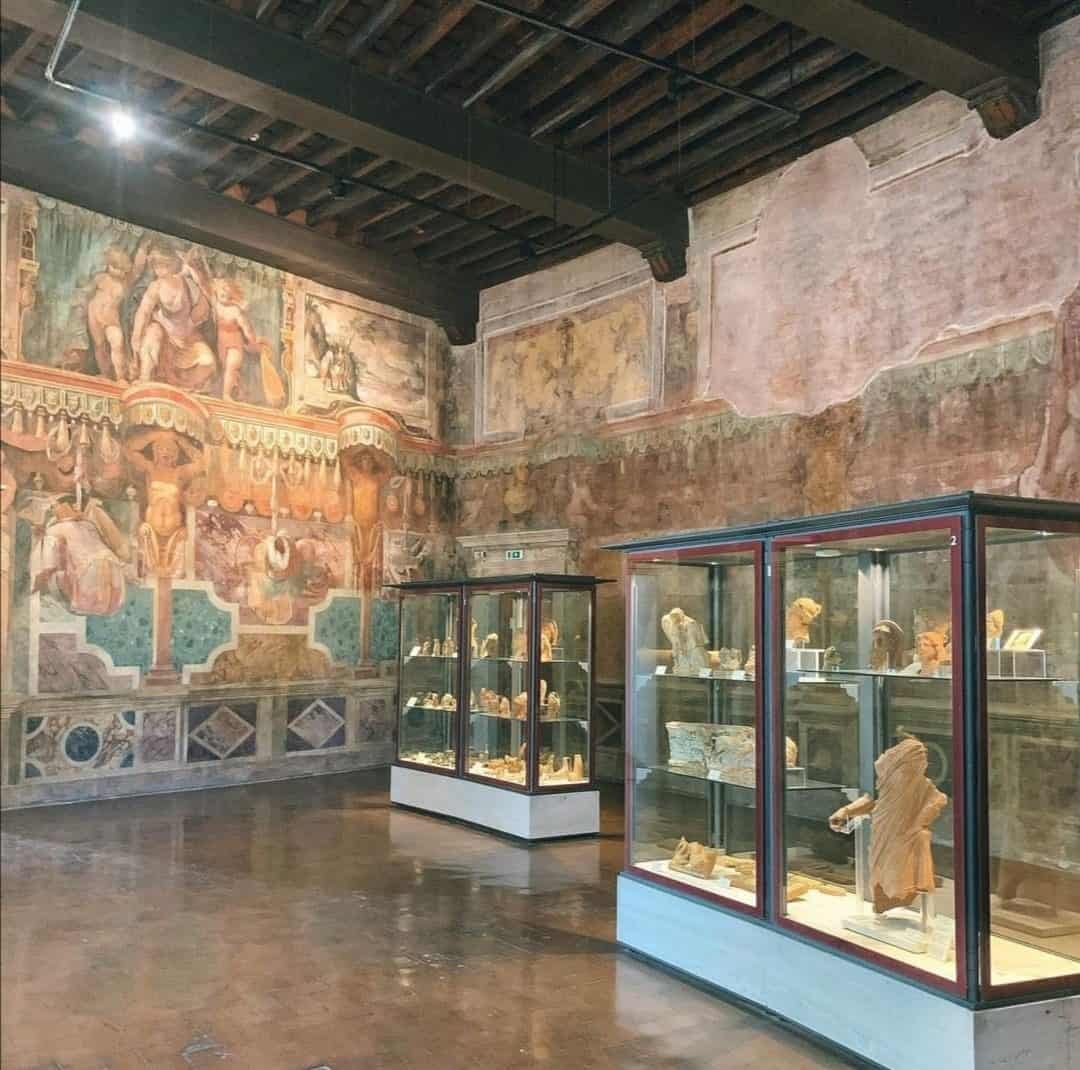
The National Archaeological Museum of Palestrina occupies Palazzo Colonna Barberini, at the top of the sanctuary, and holds most of the finds discovered in the city: both recent acquisitions and the historic pieces of the Praenestine Barberini collection. There are 16 rooms and the display, which dates to 1998, is arranged by didactic and chronological criteria. It is a display that is by now a few years old, but it holds up: the sequence is clear, the captions do their job and the route climbs from floor to floor up to the final coup de théâtre.
The museum is not only a container for collections. It is a museum of itself, for the value of the palace that houses it, and it is also an open institution: it promotes educational activities with schools, hosts lectures on archaeological and art-historical subjects and is a venue for concerts of classical and polyphonic music. Hearing a motet by Giovanni Pierluigi sung a few dozen meters from his birthplace, inside a palace built on top of a Republican oracle, is one of those experiences that alone justify an evening outside Rome.
The 16 rooms of the Praenestine Archaeological Museum, one by one
The real surprise is reserved for those who give themselves the time to go through all 16 rooms instead of heading straight for the mosaic. The route opens with the oldest materials of the area and with the Orientalizing burials: it is the section where you can measure the wealth of Praeneste in the 8th and 7th centuries BC, that of the princely tombs. It continues with the statuary and reliefs of the Republican and Imperial periods, with portraits, with altars.
Then there is the section of the ex-votos, which is the one I recommend looking at most carefully even though it attracts fewer tourists. An oracular sanctuary lives on this: anatomical terracottas, statuettes, offerings from those who asked or gave thanks. They are poor objects next to rich marbles, and they are the material proof that real people with real problems came up here.
The section of the Praenestine cistae deserves a long stop. Cistae are cylindrical bronze containers, mostly meant for women's toilette, with a lid, figured feet and walls engraved with a burin with mythological scenes. Praeneste was their production capital between the 4th and 3rd centuries BC: the engraved drawing is of very high quality, often derived from lost Greek painted models, and for scholars it is one of the few windows onto the great vanished Hellenistic painting. Anyone who walks past in 30 seconds misses the smartest piece in the museum after the mosaic.
Going up you meet the reliefs, the inscriptions, the architectural materials of the sanctuary and the reconstructive models that let you read the complex of terraces in its original form. The model is the most useful teaching tool in the whole museum: look at it before going back down outdoors, or, if you followed the advice and came up afterward, use it to check what you have just walked.
The Nile mosaic, the showpiece of Palestrina (RM)
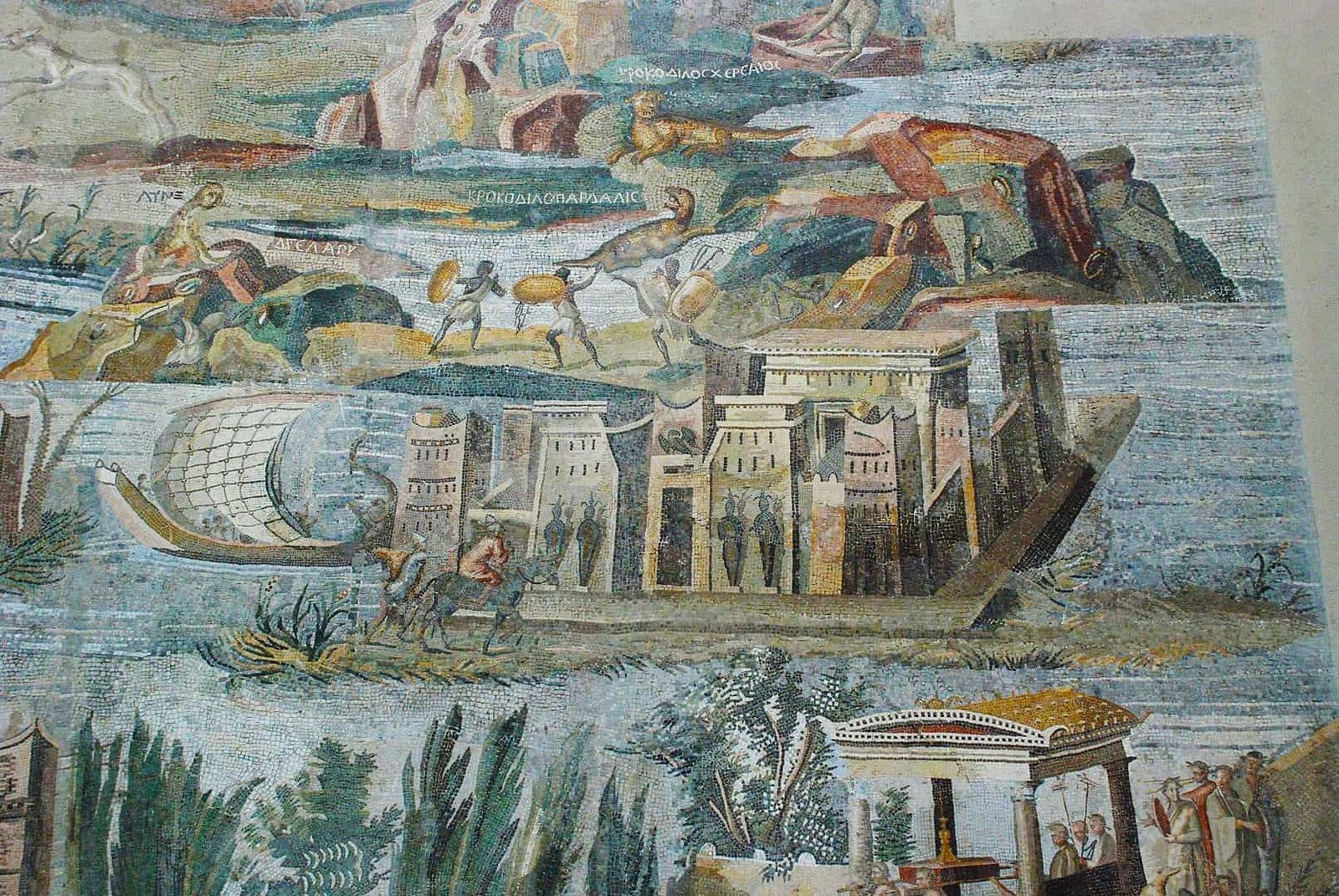
The summit of the collection is the Nile mosaic, a masterpiece of art and technique from the end of the 2nd century BC. It occupied the apse of the apsed building of the forum, it was a floor and not a wall, and it is now displayed vertically in the upper room of the museum so that it can be read. It represents Egypt during the Nile flood, from top to bottom: in the upper band the Nubian landscape with rocks, exotic animals and hunters, each accompanied by an inscription in Greek indicating the species. In the central and lower band the flooded Delta, with canals, boats, reed huts, buildings with columns, a banquet under a pergola, soldiers lined up in front of a shrine.
Look at it the way you look at a reasoned map, not like a painting. It is a document of what the Romans knew and wanted to know about Egypt shortly after meeting it militarily and commercially, and the zoological precision of certain figures points to access to Alexandrian scientific repertoires. The tesserae are minute and the color range includes glass: look closely at the blues.
One recommendation: give it at least 20 minutes and look for a side position. Viewing it head-on flattens the bands. Slightly from the side you recover the depth of the levels and you make out the minor scenes better, which are also the most fun. And look for the animals with the name written next to them: it is the detail that wins over even the kids.

Palazzo Colonna Barberini and the Chapel of Santa Rosalia
Palazzo Colonna Barberini is built at the top of the sanctuary and its facade follows the line of the ancient circular exedra: it is the shape of the temple that dictates the shape of the palace, not vice versa. Destroyed several times in the wars between the Colonna and the popes, the present building is the result of the 17th-century reconstruction, and it is the one that now houses the museum. Look at it from below, from the square: the curve is very evident and tells in one stroke 17 hundred years of stratification.
Inside the complex is the Chapel of Santa Rosalia, commissioned by the Barberini and tied to devotion to the Palermo saint, with 17th-century decoration and a layout worth the detour. It is a small room, often overlooked by those rushing to the mosaic, and for that very reason it is a good one to visit: ask at the ticket office whether it is open the day of your visit, because accessibility can vary.

Hadrian's Villa at Palestrina, or Villa of the Emperors
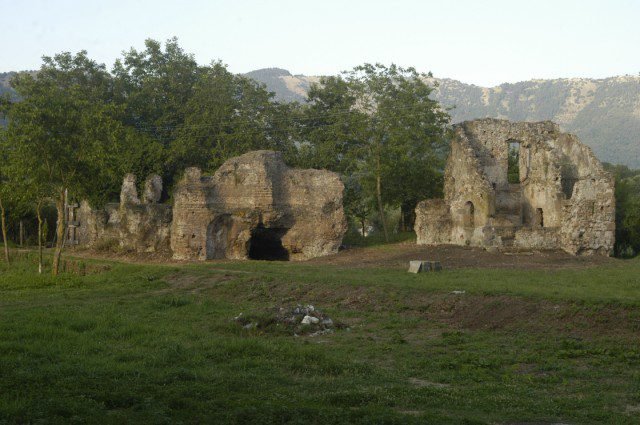
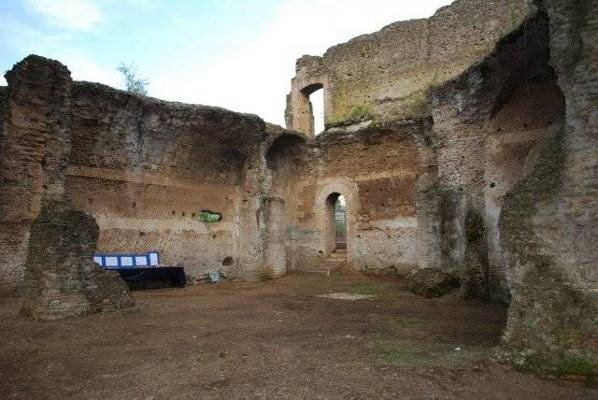
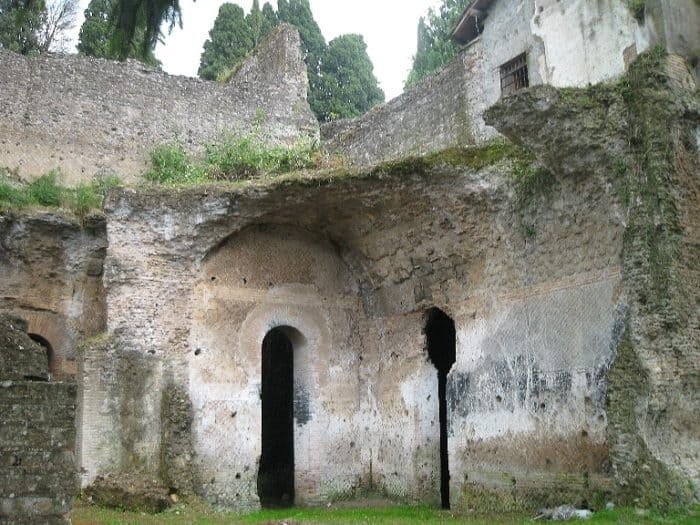
Near the municipal cemetery survives a monumental complex that local tradition calls Hadrian's Villa or Villa of the Emperors. The name comes from a discovery: at the end of the 18th century the Scottish art dealer Gavin Hamilton found there the colossal statue of Antinous in the guise of Dionysus-Osiris, the so-called Antinous Braschi, now in the Sala Rotonda of the Museo Pio-Clementino in the Vatican. From that find came the identification of the site as the villa of the Emperor Hadrian at Palestrina. The attribution must be taken for what it is: a scholarly tradition based on a strong clue but not on documentary proof. The complex in any case reached its greatest expansion in the age of Hadrian's principate, at the beginning of the 2nd century AD.
The building technique is opus mixtum, with reticulate work of pyramidal tuff blocks alternating with courses of brick. Large rectangular rooms with barrel vaults used as cisterns survive, a cryptoporticus on two levels, a hall called the room of the two exedrae and a belvedere room aligned precisely with the sanctuary of Fortuna below. That alignment is not accidental and it is the most fascinating thing about the site: whoever built up here wanted to have the sanctuary on axis, the way you keep a picture hung straight in front of the bed.
From the Middle Ages monks settled in the monumental substructures and built inside them the church of Santa Maria, the convent, the cloister and the refectory. The church, with a single nave, preserves a 15th-century fresco of a Madonna enthroned brought back to light in 2008, and in the apse Renaissance grotesque stuccoes, originally gilded, commissioned by Archbishop Paolo Alberi at the end of the 16th century. The complex is the object of study by a research group coordinated by Professor Nicoletta Marconi of the University of Rome Tor Vergata, in collaboration with the municipality and the superintendencies: accessibility depends on ongoing campaigns and organized openings, so check before going up.
The churches of Palestrina (RM), one by one
Palestrina's religious heritage is much broader than anyone coming only for the archaeology expects. The top is the Cathedral Basilica of Sant'Agapito Martyr, seat of the suburbicarian diocese of Palestrina, which rises over the remains of the ancient forum and reuses its structures: the Romanesque bell tower and the ancient blocks in the facade tell that continuity better than any sign. Sant'Agapito, patron of the city, is the young Praenestine martyr whose devotion has for centuries held up the town's civic calendar.
Next to the cathedral, the Bishop's Palace completes the religious hub of the upper city. The Church of Santa Rosalia is tied to the Barberini complex. The Church and Convent of San Francesco preserves the memory of the Franciscan settlement. The Church of Sant'Antonio Abate with the Carmelite convent is the focus of the January festival. The Church of Santa Croce with the Poor Clares Monastery keeps alive the presence of women's monastic life.
Completing the map are the Church of Santa Lucia, the Church of Santa Maria in villa, the Church of Santa Maria dell'Aquila, the Church of San Giovanni Battista, the Church of Sant'Egidio, the Church of San Girolamo, the Church of Santo Stefano at Portella, the Church of the Madonna del Trullo, the Church of San Pietro in basso, the Church of the Santissima Annunziata, the Church of the Sacra Famiglia, the Church of the Madonna delle Grazie, the Church of San Giovanni Paolo II and the Church of the Madonna del Ristoro. They are buildings of very different age and importance, from medieval foundations to parishes of the second half of the 20th century, and almost all open to coincide with services: if you want to visit more than two or three, plan around the Mass schedule. If you are short on time: cathedral and Sant'Antonio Abate, and forget the rest.
Palaces, fountains and gates: the civic architecture of Palestrina
Besides Palazzo Colonna Barberini, the city preserves the House of Giovanni Pierluigi da Palestrina, the composer and organist who is the leading figure of the Roman school of the 16th century and of Renaissance polyphony. I'll come back to it shortly, because it deserves a chapter of its own. Then there are Palazzo Verzetti and Villa Torresina, and above all the Triangolo Barberini hunting lodge, a mid-17th-century construction by the architect Francesco Contini, very dear to the Barberini: triangular plan, loaded with symbols, with the building and its outbuildings following a rigorous geometry. It is one of those Baroque oddities that drive scholars of symbolism crazy and that is worth seeing at least from the outside.
The fortified circuit of walls comes in several phases: polygonal walls of the 5th century BC, then reworkings of the 2nd century BC, then the medieval stretch. Walking along the walls is the best way to understand how much the city has shrunk and risen over the centuries. The surviving gates are the Porta del Sole, from the 17th century, the Porta San Cesareo, dedicated to Saint Caesarius, deacon and martyr of Terracina, to whom an ancient church now vanished was dedicated, the Porta San Martino and the Porta delle Monachelle.
In the urban fabric you find the Statue of Giovanni Pierluigi da Palestrina by the sculptor Arnaldo Zocchi, the War Memorial by the sculptor Vincenzo Parisi with a bronze wreath by the Praenestine sculptor Francesco Coccia, the Fontana del Pupazzo, the Fontana del Borgo and the Fonte Ceciliana. For greenery and a place to sit there are the Parco Barberini and the Parco Giacomo Matteotti. The Former Municipal Slaughterhouse is one of those 20th-century containers reused for cultural activities. The Museum of the Resistance and the 11 Martyrs, on Via Pedemontana, preserves the memory of the 1944 massacre that I discuss further on.
Finally the Rione degli Scacciati, the oldest in Palestrina, up high, behind the palace. The name evokes the refuge of those who escaped the assault of Cardinal Giovanni Maria Vitelleschi in 1437: the scacciati are literally those who were driven out and came back. It is the neighborhood where the town looks most like itself, and where there are no signs for tourists. Go there at the end of the morning, when the light enters the alleys.

Giovanni Pierluigi da Palestrina, the prince of music
Giovanni Pierluigi was born in Palestrina in 1525 and died in Rome in 1594. His career reads like a climb through the most important Roman musical chapels: organist and choirmaster in the cathedral of Palestrina from 1544, director of the Cappella Giulia in Saint Peter's under Julius III from 1551, papal singer in 1555, master at Saint John Lateran between 1555 and 1560, master of the Cappella Liberiana in Santa Maria Maggiore from 1561, and again at the Cappella Giulia from 1571 until his death.
His most famous work is the Missa Papae Marcelli, a six-voice Mass composed at the time of the pontificate of Marcellus II and published in 1567. He presented it to Pius IV to show that the sacred text could remain comprehensible even within a complex polyphonic writing, thus supporting the reforming line of the Church after the Council of Trent. Around this episode a tenacious legend arose, according to which that Mass alone saved polyphony from a condemnation by the Council. The legend is later, while Pierluigi's role in the debate is documented. Telling the two apart is exactly the job a serious popularizer has to do.
The complete works, 946 compositions in 33 volumes, were published by Breitkopf and Härtel between 1881 and 1907. The Giovanni Pierluigi da Palestrina Foundation is based in the birthplace, a 15th and 16th-century building restored and granted to the Foundation in 1994: three floors, an exhibition on the biographical, artistic and editorial path from 1525 to 1594, the room for seminars and concerts, period furnishings, portraits and a specialized library of about 7,000 volumes with manuscripts from the 16th to the 19th century. Pay attention to the address and the hours: the Foundation gives Vicolo Pierluigi 3, the municipal page gives Corso Pierluigi 52, and the time slots also differ. Call 06 9538083 before going. The entrance is at street level but not wheelchair accessible.
The Mann brothers in Palestrina and the German 20th century
Between 1895 and 1897 Heinrich and Thomas Mann stayed in Palestrina, which in their letters is the small town in the mountains where one works well and spends little. Thomas was just over 20 and was not yet anybody. The town enters his major work much later: in Doctor Faustus the protagonist Adrian Leverkühn's conversation with the devil is set in an Italian small town modeled on Palestrina. That Mann's imaginary composer meets the demon in a town that bears the name of the most orthodox of the sacred polyphonists is not a detail: it is the very structure of the novel.
Anyone who loves German literature can walk through the historic center keeping those pages in mind. Don't expect a Mann house museum: expect a town that, with its stairs and its loggias, explains why a writer set the most unsettling scene of his career here.
A curiosity about Palestrina (RM)
The real curiosity of Palestrina is not the mosaic: it is the fact that the sanctuary re-emerged thanks to the bombs. Until 1944 the medieval and modern town covered almost entirely the ancient terraces: houses, vegetable gardens, stables and streets rested on the Republican substructures, which were used as cellars and storerooms without almost anyone imagining what they really were. The form of the complex had been known to scholars since at least the 16th century, when Pirro Ligorio and other antiquarians attempted reconstructions of it, but it remained largely theory.
In 1944 Allied bombing devastated the historic center. It was a tragedy for the population and an enormous loss of historic buildings, and no archaeological discovery makes up for it. But the destruction of the buildings that had settled on the sanctuary after its ancient abandonment made it possible to bring the Republican complex back to light in its entirety, and the archaeological work of rediscovery that followed was, and still is today, remarkable.
From here comes a paradox worth keeping in mind as you climb: the monument we admire today is readable because the town above it was wiped out. The postwar reconstruction then redrew the center around the archaeological area, inverting the relationship: before, the sanctuary was inside the town, now the town is around the sanctuary. Few Italian cities have undergone such a radical reversal of their own image in a single decade. When the older Praenestines talk about the historic center, they are talking about two different places that carry the same name.
Something nobody tells you about Palestrina (RM)
Nobody will tell you that Palestrina gave its name to an embroidery stitch known and practiced all over the world: the Palestrina stitch. It is a knotted stitch, worked by wrapping the thread around itself so as to leave on the fabric a line of small raised knots, and it is used for outlines and borders because it holds its shape and gives thickness. In international embroidery schools it appears under the Italian name or as Palestrina stitch: a town of 12 thousand inhabitants that enters the technical vocabulary of half the world thanks to the hands of its women.
On the date of birth of the stitch and its link to a specific Praenestine manufacture, popular sources say different things and not all can be checked, so I tell it for what is documentable: a technique that bears the name of the city and entered the embroidery manuals under that name. If someone offers you a precise dating to the century, ask them for the source.
The second thing nobody tells you concerns geography. Palestrina is often described as part of the Castelli Romani. It is not: the Castelli are the area of the Colli Albani, on the other side of Via Casilina, while Palestrina belongs to the Monti Prenestini and looks onto the Sacco Valley. The confusion comes from the fact that both areas are the classic day trips for Romans, but geologically and historically they are two different worlds: volcanic and lake-based the one, limestone and pass-country the other. If you want the other side of the coin, look at the Castelli Romani Park and compare the two landscapes.
The advice I give you for visiting Palestrina (RM)
The most useful advice is about time. Palestrina is not a two-hour stop: plan on a full half day, better a whole day. The realistic count is this: two and a half hours for the museum and the archaeological area if you take it slowly, 40 minutes for Pierluigi's birthplace, an hour for the historic center and the gates, lunch. Whoever arrives at 11 and leaves at two has seen a postcard.
The second piece of advice is about the day. On Tuesday the museum is closed, so keep it out of your plans. On the first Sunday of the month admission is free and this brings people: if you hate crowds, avoid it. If you are on a tight budget and willing to share the mosaic with others, take advantage of it. The best period is the second half of September or the first half of October: the light on the terraces is low and warm, the summer heat is over and the town is not yet in winter mode. August, with the Palio, is beautiful but of a completely different kind: you go for the festival, not for the archaeology.
Third piece of advice, the most practical of all: park down below and walk up, or use the free parking lots listed by the municipality. The upper center has narrow alleys and one-way streets that, with a family car, become a miserable experience. And bring water: on the terraces, in summer, there is almost no shade.
Fourth and last. If you come with a group or want a truly guided visit, with the archaeology explained on the spot instead of read on panels, rely on licensed professionals: our editorial team works with TourLeaderPro, which organizes certified tourist guiding in Rome and Lazio. It makes an enormous difference in places like this, where without someone to explain the concrete you see only walls.
Another well-known fact, yet rarely cited
Everyone knows the sanctuary was an oracle. Almost no one stops to think about what that meant in economic and political terms. The oracle of the Praenestine sortes was an institution with a flow of clients, a staff, an administration and a budget. Cicero, who in De divinatione tells the story of Numerio Sufficio and the tablets, writes as a skeptical Roman and speaks of it as a practice by then frequented by the common people more than by the magistrates: a precious source precisely because it is critical.
The point is that oracular consensus produced money, and the money produced that architecture. The terraces are not an act of spontaneous devotion: they are a sacred real estate investment, financed by a local ruling class enriched by trade along the valley and eager to compete with the great Hellenistic sanctuaries of the eastern Mediterranean. The reference model, for scale and staging, is the terraced complexes of the Aegean, and the city imports it consciously.
Add the detail of the boy lowered into the well and the female figure in the shadows and you will understand that it was also a well-designed theatrical machine. The response came from the depths, in terse language, carried by a child: no adult intermediary, no face to remember, no attributable responsibility. It is a carefully built device of credibility, and the Romans knew it very well. I don't say this to belittle the ancient sacred, which was a very serious matter: I say it because the sanctuary is better understood if you also look at it as an enterprise, and this is a reading you almost never find on the panels.

The right photo to take in Palestrina (RM)
The photograph you take home from Palestrina is just one, and it is not the mosaic. It is the shot from the upper terrace, with the palace's hemicycle behind you and the plain descending toward the Sacco Valley: you see the town in tiers, the countryside, and on clear days the line of the sea. Take it with the wide-angle and keep a piece of ancient wall in the foreground in the lower corner, otherwise the depth is lost and the panorama goes flat.
Now the right time. The curved facade and the terraces face southwest, so the good moment is late afternoon: the raking light enters the niches, draws the rows of tuff blocks and the vaults, and the plain fills with golden haze. At midday in summer you don't shoot here: violent contrast, black shadows, burned-out sky. If you arrive with a group in the middle of the day, take the group photos and put off the portrait of the complex until the end of the visit.
The second photograph I recommend is technical and is inside the museum: the close-up detail of a portion of the Nile mosaic, for example one of the animals with the Greek inscription next to it. Check the filming rules at the ticket office and in any case no flash, ever, on a mosaic: repeated direct light is not good for the surfaces and on top of that it gives you reflections that ruin the shot. Lean on the railing to steady yourself and raise the sensitivity instead of adding light.
The third, for those with patience, is from below: from the road going up, with Palazzo Colonna Barberini closing the frame at the top and the terracing beneath. It is the image that explains the structure to someone who has never been here, and it is worth more than any caption.
Some important events that happened here in history
The first is the destruction of 82 BC. Praeneste supported Gaius Marius the Younger against Sulla, the younger Marius met his death there during the siege, and Sulla's reprisal was the extermination of the male population and the founding of a military colony. It is one of the most brutal episodes of the Roman civil war and it left its mark in the epigraphs, where the family names change almost en bloc.
The second is medieval and concerns the Colonna. Granted for three generations by Pope John XIII to the related senator Stefania in 970, the city passed by marriage to her descendant Countess Imilia, in the 12th century to the Counts of Tusculum and from them to the Colonna, who opposed its return to the Holy See and progressively consolidated their rule over it, making it, after the grant by Pope Honorius II, the family's principal historic possession. That tie came at a high price: in the spring of 1299 Boniface VIII had it razed to the ground, and in 1436 or 1437 Cardinal Giovanni Maria Vitelleschi destroyed it again from the foundations to punish the Colonna's opposition to Eugene IV. In 1449 Nicholas V returned it to the Colonna with the express prohibition against rebuilding the fortress there, which was nonetheless rebuilt in 1482.
The third is from the 19th century: in 1849, during the Risorgimento, Lieutenant Luigi Cucelli distinguished himself at Palestrina by accompanying Garibaldi's retreat from Rome after the fall of the Roman Republic. A minor episode in the textbooks, decisive in local memory.
The fourth is the most painful and dates to May 28, 1944. Some German soldiers were stealing poultry on the farm of Agapito Pinci, in the locality of Vigesimo. Threatened, Pinci turned to a group of partisans active not far away, at Colle Francolino, which also included Carla Capponi and Rosario Bentivegna, the latter in command of the partisan formations of the Monti Prenestini. The unit intervened, clashed with the Nazis and a German soldier was killed. Immediately afterward another group of German soldiers passing through burst into the Pinci farmhouse and took away 11 people, including the entire family. The 11 believed they had been chosen for a job on the provincial road of Valmontone and that they would be able to go home in the evening. Shortly after setting out they were shot near the house. Their names: Carlo Pinci, Mario Pinci, Umberta Pinci, Corrado Pinci, Viviana Pinci, Agapito Pinci, Genesio Pinci, Alvaro Scaramella, Giuseppe Lupi, Giulio Lulli, Elena Ilardi. The Nazi command admitted it had been an unauthorized reprisal but did not return the bodies, which were buried in the town cemetery only two days after the arrival of the Allies. The memory of the massacre is preserved at the Museum of the Resistance and the 11 Martyrs, on Via Pedemontana. Go there: it takes 20 minutes and changes the way you look at the town.
Who passed through Palestrina (RM)
Augustus came here on vacation, and the ancient source puts it next to Lanuvium and Tivoli among the places the emperor preferred when he left Rome. Caligula, in 39 AD, dedicated to the Praenestine Fortuna two legions, the XXII and the XV Primigenia: a public act that says how much that cult weighed at court. Cicero wrote about the Praenestine sortes in De divinatione, and it is thanks to him that we know the story of Numerio Sufficio and the well.
In the Middle Ages and the Renaissance the city was the battlefield of popes and cardinals: Boniface VIII, who had it destroyed in 1299. Cardinal Giovanni Maria Vitelleschi, who repeated the operation a century and a half later. Nicholas V, who returned it to the Colonna in 1449. Pius V, who in 1571 raised it to a principality in favor of Giulio Cesare Colonna. Among the bishops of Palestrina there are five cardinals who later became popes, which makes the suburbicarian see one of the most prestigious in Lazio.
In the 16th century Giovanni Pierluigi was born here, the prince of music, the composer who gave the name of the city worldwide circulation in conservatories. In the 17th century the Barberini arrived with their architects, Francesco Contini first among them, and the city took on the Baroque form that it partly preserves.
In the 18th century the Grand Tour passes through, and above all Gavin Hamilton passes through, a Scottish painter, antiquarian and dealer, who at the end of the century found the Antinous Braschi in the villa near the cemetery and put it on the Roman antiquities market: the statue would end up in the Sala Rotonda of the Museo Pio-Clementino. Between 1895 and 1897 Heinrich and Thomas Mann arrive, and Palestrina enters 20th-century German literature through Doctor Faustus. In 1849 Garibaldi had passed through, in retreat. And in 1944 war and its 11 dead passed through, in the tragic sense.
Traditions and folklore in Palestrina (RM)
Palestrina has a dense festive life, almost all tied to the calendar of the saints. The main event is the Palio and Festival in honor of Sant'Agapito, patron of the city, which falls on August 18 and usually runs from the 17th to the 19th. The religious celebrations run in parallel with the Palio di Sant'Agapito, in dialect lo palio, a contest among the four historic districts that compete through a series of games for a banner showing the saint, made every year by a different artist.
The four districts correspond to four horizontal bands of the city: Porta San Cesareo for the upper part, Porta San Biagio for the band between upper and central, Porta San Giacomo for the central part and the historic center, Porta San Martino for the lower part. The gates compete in six games: tug of war, archery, the ball game, similar to Florentine calcio, the race of the conca, with vessels full of water balanced on the head, the spindle, in which four women competitors, one per district, must spin a set quantity of wool in a set time, and finally the joust of the scifa, the most awaited game: a horseman at a gallop must thread a wooden lance through a metal ring placed under the bottom of a round wooden vessel, the scifa, hanging in the air. If you happen to be in Palestrina on those days, the joust of the scifa is the contest to see: the rest you can skip, that one you can't.
On January 17 they celebrate Sant'Antonio Abate, protector of animals. It is a festival of ancient tradition that goes back to the agricultural and pastoral world of the Praenestine community. The protagonists are three historic categories: the mulattieri, who carried goods with mules even where roads did not reach, the carrettieri, who with animal-drawn carts took goods toward Rome, and the bovari, who raised and still raise cattle. The representatives of the three associations are protagonists both of the religious solemnities, such as the blessing of animals and vehicles, and of the folkloric aspects, such as the exchange of flags and ribbons among the members. The parade of animals dressed up with ornaments and flowers to the church of Sant'Antonio Abate for the blessing is the most beautiful scene of the Praenestine winter.
On March 19, for San Giuseppe, the Focaraccio is lit: big bonfires on which an effigy of the saint is placed. On the origin and historical continuity of this custom the available sources are popular ones and not all reliable, so I mention it as a living tradition without attributing a date to it.
What to eat in Palestrina (RM): giglietto and gnocchetti
The signature product is the giglietto, a dry biscuit shaped like a lily. Local tradition traces its origin to the French exile of the Barberini family: the court cooks are said to have tried to reproduce in dough the lily of Saint Louis from the French heraldic coat of arms. It is a tradition, not an archival fact, and as such it should be told as one. The real giglietto is made with few ingredients, flour, eggs and sugar, without yeast, and has a dry, crumbly texture that calls for a sweet wine or a coffee. The festival is dedicated to the first week of August, the Festival del Giglietto e Ghiottonerie dei Monti Prenestini.
The historic dish is the gnocchetti a cò de soreca, literally gnocchetti shaped like a mouse's tail: pasta of only flour and water, pulled by hand into tapered sticks that recall a tail. It is poor cooking, of the kind made when eggs were a luxury, and the sauce changes from house to house. If you find it on the menu of a real trattoria, order it: it is the dish that tells the story of the city better than any reinterpretation.
A clear opinion, since the question comes up often. In Palestrina you eat well in the family trattorias of the center and you eat in a touristy and mediocre way in a couple of places with a view: the view is paid for, and not always in the kitchen. Ask where the municipal employees have lunch around one o'clock and follow that advice.
How to really visit Palestrina (RM): duration, route, accessibility
The route I recommend starts from the lower parking lot, climbs on foot toward the historic center, touches the Sant'Agapito cathedral and the remains of the forum in Piazza Regina Margherita, continues to Pierluigi's birthplace, enters the archaeological area from below and climbs it terrace after terrace up to the museum. After the museum, a loop through the Rione degli Scacciati and a descent along the walls. Five or six hours including stops, without rushing.
On accessibility we have to be honest: the sanctuary is a terraced complex on a slope, with ramps, staircases and uneven ancient surfaces. Some stretches of the open-air route are difficult or impassable in a wheelchair and even with a rigid stroller. The museum, housed in a historic palace, has vertical routes. Access conditions and the availability of elevators should be asked directly of the staff at the numbers listed by the Ministry, because a generic answer in these cases does more harm than good. Pierluigi's birthplace has a street-level entrance but is not wheelchair accessible.
With children it works, but under certain conditions. The Nile mosaic is a giant picture book and kids get passionate about it if someone points out the animals and the names written in Greek. The terraces are an archaeological playground, but they are also a significant change in elevation: under four years old bring the baby carrier, not the stroller. An hour and a half in the museum is the most a primary school child can take. Spend the rest outdoors.
Where to stay in Palestrina and the surrounding area
Palestrina has limited accommodation: a few hotels, some bed and breakfasts in the historic center and agriturismi in the countryside toward Carchitti and toward the Monti Prenestini. It is a sensible choice if you want to use the town as a base to explore the valley and the nearby villages instead of going back to Rome every evening. If you arrive by car, pay attention to something trivial but decisive: in the upper center the alleys are narrow and parking near the property is never guaranteed, so ask for confirmation when you book.
If instead you sleep in Rome and come here for the day, the timing is simple: about an hour by car without traffic, a good hour and a half with Cotral from Anagnina. To organize a whole Roman week with one or two days outside the city, our editorial team points to the English-language guides of ItalyPlanner on day trips, which think precisely in terms of same-day departures and returns.
What to see around Palestrina (RM)
The surrounding area is rich and underrated. 10 kilometers away stands the Sanctuary of Mentorella, in the Monti Prenestini, one of the oldest places of worship in Lazio and a formidable viewpoint over the Aniene valley. In the same direction you climb toward the mountain villages. Going down toward the valley you meet Genazzano, with the Colonna castle and the Bramante-style nymphaeum, and Castel San Pietro Romano, which looks down on Palestrina from above and offers the best viewpoint over the whole complex: if you have a car, go up there at sunset, it's five minutes and it changes the day.
Farther away but within an hour, Subiaco with the Benedictine monasteries, Tivoli with its villas, Anagni the city of the popes, Segni with the Cyclopean walls, Artena and Carpineto Romano on the Lepini, Cori with the temple of Hercules. For those looking for water and greenery there are Lake Giulianello and the Bosco di Paliano. Toward Ciociaria line up Ferentino, Alatri with its acropolis, Fumone, Collepardo, Vico nel Lazio, Fiuggi with its waters, Trevi nel Lazio, Filettino, Vallepietra with the sanctuary of the Trinity, the ruins of Camerata Vecchia and the ghost village of Antuni.
One last note on the hamlet of Carchitti: it was born at the end of the 19th century, when a famine that struck the mountain populations pushed a group of farmers from Capranica Prenestina to move onto a territory of the municipality of Palestrina, devoting themselves to growing strawberries. It is a story of internal migration of a few kilometers that created a village and an agricultural supply chain that is still active.
How much it costs to visit Palestrina (RM) and how to save
The combined ticket of the state circuit, according to the ministry page, costs €10 full price and €2 reduced, is valid for two consecutive days and includes the museum, the sanctuary and the forum complex. No reservation is required and ticketing also goes through the official app of Italian museums. Free admissions and reductions follow the national rules of state museums, so check your category on the circuit's website before leaving.
The simplest way to save is the first Sunday of the month, with free admission. The second is to use the two-day validity of the ticket, if you sleep in the area: an afternoon for the archaeological area, the next morning for the museum, without rushing. The third, trivial and underrated, is to come with Cotral: the cost of the trip from Anagnina is a fraction of what you would spend on fuel, toll and parking, and it spares you the alleys.
If you are looking for other zero-cost ideas in Lazio, our collection of free museums in Rome is the right starting point for building an inexpensive weekend.
When to go to Palestrina (RM) and when to avoid it
From April to June and from mid-September to the end of October is the ideal period: manageable temperatures on the terraces, good light, smaller crowds. July and August are hard, because the archaeological area has almost no shade and the heat on the slope is felt: if you go, go at opening or in the last two hours.
To avoid, if you are looking for calm: the three days of the Palio, August 17 to 19, when the town rightly thinks of the festival and not of visitors, and the first Sunday of the month, when free admission brings a lot of people. To avoid in absolute terms: Tuesday, the weekly closing day of the museum.
In winter Palestrina has a different and more austere charm: clear sky, cold air, a view that reaches very far. The archaeological area closes earlier, at 16:30 in the cold season according to the circuit's website, so plan your day in the morning. And it is the right season for the Sant'Antonio Abate festival on January 17, which is the most authentic in the Praenestine calendar.
Quick questions about Palestrina (RM)
How much is the ticket for the museum and sanctuary of Palestrina (RM)?
The Ministry of Culture page lists €10 full price and €2 reduced for the combined ticket, valid two consecutive days and including the archaeological museum, the sanctuary and the forum complex. Check the updated conditions on the circuit's website before leaving.
What is the closing day?
Tuesday. The museum and the archaeological area are open Wednesday through Monday.
What are the hours of the Museo Archeologico Nazionale Prenestino?
The ministry pages list the morning opening between 9:00 and 9:30 and closing at 19:30, with last entry at 18:30. The two pages do not agree on the opening time: call 06 9538100 the day before.
And the Sanctuary of Fortuna Primigenia?
Wednesday to Monday from 9:30 to 16:30 from the last Sunday of October to the last Saturday of March, and from 9:30 to 18:30 from the last Sunday of March to the last Saturday of October.
Do I need to book to visit Palestrina (RM)?
No. The ministry page expressly states that no reservation is required. Tickets are bought at the ticket office or through the official app of Italian museums.
Is admission free on the first Sunday of the month?
Yes, admission is free on the first Sunday of every month, as in other state museums. Expect more crowds than usual.
How far is Palestrina from Rome?
About 37 kilometers. By car you get there in just under an hour without traffic, and with the Cotral bus from Anagnina it takes longer.
How do I get to Palestrina (RM) without a car?
With the Cotral bus from the Roma Anagnina terminus, on metro line A. Alternatively, take the train from Roma Termini to Zagarolo and connect by bus to Palestrina.
Where do I park in Palestrina?
The municipality lists eight parking areas, four free (Kennedy, della Pace, Belvedere, Fanfani) and four paid. The advice is to park down below and walk up.
How much time do I need to visit Palestrina (RM)?
Half a day is the bare minimum, a full day is the right measure: two and a half hours for the museum and archaeological area, the rest for the historic center, Pierluigi's house and lunch.
Can I take photographs of the Nile mosaic?
The filming rules should be checked at the ticket office. In any case no flash: it ruins the shot and is not good for the surface.
Is Palestrina suitable for people in wheelchairs?
The archaeological area is a terraced complex with ramps and ancient steps, so partly difficult or impassable. For the museum, housed in a historic palace, ask the staff about access conditions at the numbers listed by the Ministry.
Is Palestrina (RM) suitable for children?
Yes, with some care: baby carrier instead of stroller on the terraces, an hour and a half at most inside the museum, and use the animals of the Nile mosaic as a treasure hunt.
What is the difference between the museum and the sanctuary?
The museum is inside Palazzo Colonna Barberini and holds the finds, the Nile mosaic included. The sanctuary is the open-air complex of terraces on which the palace is built. They are two parts of the same ticket.
Is Palestrina part of the Castelli Romani?
No. Palestrina belongs to the Monti Prenestini and looks onto the Sacco Valley. The Castelli Romani are the area of the Colli Albani, on the other side of Via Casilina.
Who was Giovanni Pierluigi da Palestrina?
The composer born here in 1525 and died in Rome in 1594, the leading figure of Roman Renaissance polyphony, author of the Missa Papae Marcelli published in 1567. His birthplace houses the Foundation named after him.
Can I visit Pierluigi's birthplace?
Yes, it hosts a biographical exhibition and a music library. Address and hours differ between the Foundation's page and the municipal one: call 06 9538083 before going.
What is the Palestrina stitch?
A knotted embroidery stitch that takes its name from the city and appears in international manuals also as Palestrina stitch. It is used for outlines and borders and leaves a line of raised knots on the fabric.
What do you eat in Palestrina (RM)?
The giglietto, a lily-shaped biscuit tied by tradition to the Barberini, and gnocchetti a cò de soreca, a poor pasta of flour and water. The giglietto festival is dedicated to the first week of August.
When is the Palio di Sant'Agapito held?
Around August 18, usually from the 17th to the 19th, with the contest among the four districts: Porta San Cesareo, Porta San Biagio, Porta San Giacomo and Porta San Martino.
Where is the best view of Palestrina?
From Castel San Pietro Romano, the village that looks down on the city from above: five minutes by car and you take in the whole terraced complex.
What is Hadrian's Villa in Palestrina?
A monumental complex near the municipal cemetery, also called Villa of the Emperors, which owes its name to the 18th-century discovery of the Antinous Braschi. It reached its greatest expansion at the beginning of the 2nd century AD.
If I had to choose a single day trip to recommend to someone who has already seen the center of Rome, I would choose this one. Not because Palestrina is convenient or easy, which it is not: because it is the place where you understand, by walking, what the Romans had invented in architecture, and because the Nile mosaic is one of those objects in front of which you stay longer than you had planned. Climb slowly, look at the panorama before looking at the stones, and don't make the mistake of treating it as a stop between two more important things: here the important thing is this. For those who read in English and want to build the itinerary on their own, a good starting point is the pages of ItalyPlanner on art and history and the guide to the best things to do in Rome. For a tailor-made guided visit, including for corporate groups, there are the custom experiences of TourLeaderPro.
Article written by the editorial team of TourLeaderPro, contact them for Private/Corporate/V.I.P. Tours and Experiences.
Planning a trip to Rome? The English-language guides to visiting the city are on ItalyPlanner.com.