Fiuggi (FR)
In short. Fiuggi (FR) is reached from Rome in just over an hour. Take the Autostrada A1 heading south, exit at Anagni-Fiuggi, and climb along regional road 155 for about 20 kilometers, up to just under 800 meters in the Monti Ernici, where the…

Fiuggi (FR) is reached from Rome in just over an hour. Take the Autostrada A1 heading south, exit at Anagni-Fiuggi, and climb along regional road 155 for about 20 kilometers, up to just under 800 meters in the Monti Ernici, where the air changes suddenly and the summer loses five or six degrees. By bus, Cotral routes connect the main town to the Ciociaria. If you travel by train, get off at Anagni-Fiuggi station, on the Roma-Cassino line, and continue by bus, because the old narrow-gauge railway that once ran into the town has not existed for decades. The resort is split into two distinct, complementary areas: Fiuggi Città, the medieval village perched on the hill at 747 meters, and Fiuggi Fonte, the early 20th-century spa quarter spread out lower down, around 621 meters, among the chestnut woods. What brings some 100,000 people up here every year are two springs, the Fonte Bonifacio VIII and the Fonte Anticolana, which supply an oligomineral water that has been famous for seven centuries for dissolving kidney stones. The springs open for the season, roughly from April to October, with hours and prices that the operator revises every year. However, the operator does not publish prices on its website, and the figures circulating in magazines and hotel websites belong to other seasons. Before you go, call the spa and ask for the prices and discounts for the current season.
If you are building an itinerary in southern Lazio, this guide pairs well with our nearby pages on Anagni, the city of popes a quarter hour's drive away, and Alatri with its cyclopean acropolis.
Why People Come to Fiuggi: The Water That Dissolves Stone
The story of Fiuggi is the story of its water, and it makes sense to start there, because everything else, the huge hotels, the parks, the festivals, even the name of the town, came later and as a result. The water that flows from the two springs is a very light oligomineral. The fixed residue measured at 180 degrees is 123 milligrams per liter, the pH is 7.63, and the temperature at the source stays around 12 degrees all year round. These numbers say little to anyone outside the trade, but they explain the feeling of lightness you get when you drink it. It's a water that passes through you without weighing you down, which is why the doctors of the cure prescribe two or three liters a day.
The secret isn't the hardness, which is minimal, but a group of organic compounds, the so-called humic substances, which the water picks up as it slowly filters through the ancient volcanic deposits of the Ernici. These organic acids are credited with the effect that made Fiuggi famous: a marked diuretic action and a documented ability to act on stones in the urinary tract, helping to break them up and eliminate them. In 1999, a scientific study measured in the lab the dissolving effect of Fiuggi water on kidney stones, giving an experimental basis to a reputation that until then rested only on centuries of tradition. The fact remains that people don't come here for general wellness. They come for a specific cure, the drinking cure, which means drinking the water according to a protocol, on an empty stomach, walking between glasses along the park paths.
It's worth saying this plainly: if you're looking for steaming tubs and hot baths, you'll be disappointed, because Fiuggi is not an immersion spa like Saturnia or the Terme di Tivoli. Here the water is drunk, not bathed in. The ritual is more sober and older, and it's also why the town has a slow pace, made for strolling and resting, that you either love or find boring. In our view, it's its greatest strength.
Fiuggi Fonte: The Park of the Two Springs
The beating heart of the spa town is the large park that contains both springs, 14 hectares of designed green space where the local vegetation, the chestnut and holm oak trees of the Ernici, has been joined over time by silver cedars, sequoias, evergreens and flower beds. The Fiuggi Fonte quarter was born at the end of the 19th century as a settlement almost separate from the old village of Anticoli, and it developed along the axis that was once called via Prenestina and is now via Nuova Italia, the road connecting the two springs and leading to piazza Spada. For decades the two centers, the old village up high and the spa town down below, remained separate. It was the postwar urban development, with the long hairpin bends of via Diaz acting as the hinge, that stitched them into a single built-up area.
The Fonte Bonifacio VIII
The Fonte Bonifacio VIII is the more famous of the two, the one named for the pope who made the water famous in the 13th century. Its appearance today is not the original one: the current complex was redesigned by the architect Luigi Moretti and built between 1967 and 1969, demolishing the Liberty-style baths that the architect Garibaldi Burba had designed at the beginning of the century. What remains of the Liberty building is the grand scenic entrance, which is worth a stop and a photograph even before going in. Moretti, one of the major names of 20th-century Italian architecture, signed here a rationalist layout of low pavilions immersed in greenery, with the water-serving counters distributed under porticoes that invite strolling. It is the most frequented spring, the one where the bulk of the morning drinking cure is concentrated, and in high season it can be crowded in the early hours.

The Fonte Anticolana
The second spring, the Fonte Anticolana, is also called the new spring because it was inaugurated in the 1920s, and it is open in the central season, roughly from April 1 to September 30. It stands inside the same vast park as the Bonifacio VIII, but has a broader function than simple water service: here are the medical rooms for the admission exams to the cure, the Center for Inhalation and Insufflation Therapies and the Physiotherapy Center, that is, the whole health side of the establishment. The Fonte Anticolana is also the cultural lung of the baths, because it houses the Teatro delle Fonti, an open-air stage that during the season hosts concerts, shows and conferences. If the Bonifacio VIII is the spring of the morning ritual, the Anticolana is the one where the spa day stretches toward evening, between a stroll and an event.
How the Cure Works at Fiuggi
The protocol of the drinking cure is simple but has to be respected: you drink the fresh spring water on an empty stomach, in increasing amounts under medical supervision, walking between one glass and the next because movement helps the diuretic effect. Those who follow a complete cycle usually stay one or two weeks: formulas and subscriptions should be asked about at the baths, because the operator doesn't publish them. You don't need to book the single morning entry, but the admission medical exam is recommended for those undertaking the cure for the first time or for a specific condition. The practical advice is to arrive early, as soon as the springs open, when the water is coolest and the avenues are still empty.
Fiuggi Città: the Medieval Village on the Hill
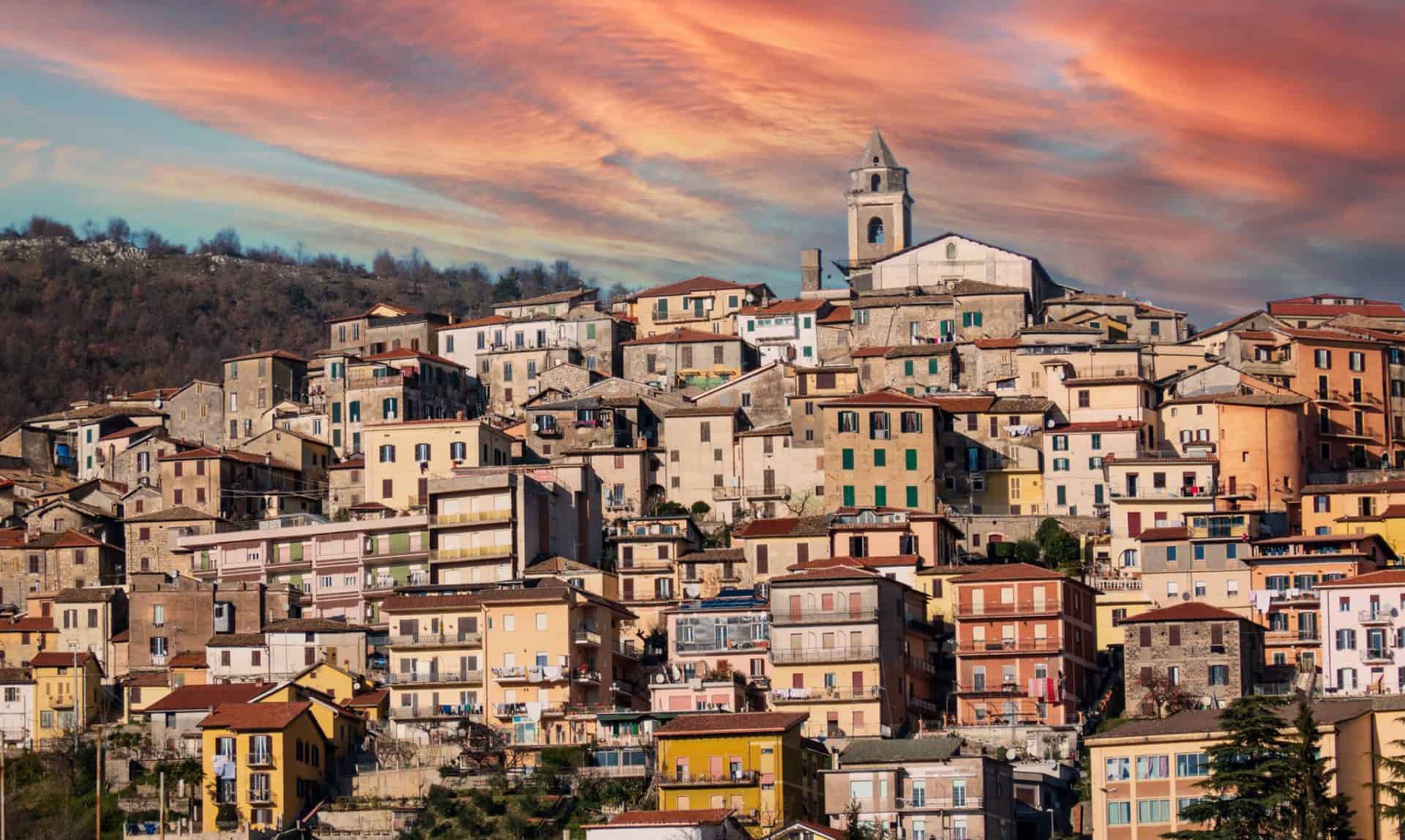
Going up from the spa area to the old village you change era. Fiuggi Città, what the old-timers still call Vecchia Fiuggi, is perched at the top of the hill and has kept the physiognomy of the Middle Ages almost intact. The urban fabric divides in two: the upper part, where the castle perhaps stood and where today are the main church and the noble palazzetti, and the lower part, more working-class, laid out on the flanks of the hill and crossed by a maze of alleys, some circling the hill like a collar, others steeply ramped. The upper part is crossed by two main streets, one of which, Via Processionale, must have been the artery of greatest importance.
What makes a walk up here memorable are the small details: the little squares that open suddenly, like those of Mastro Giorgio and Piave, the small houses decorated with bare stone alone, and above all the windows. Anyone who looks up finds two-light windows from the 13th and 14th century and a few Renaissance windows set into the facades, survivors of a settlement that has crossed eight centuries without being distorted. The advice is not to arrive at the top with the goal of seeing a specific monument, but to get lost: the village of Fiuggi is enjoyed by walking aimlessly, raising your eyes to the two-light windows and the portals.
Palazzo dei Canonici and Palazzo Falconi
Among the buildings of the old village stands out the Palazzo dei Canonici, with its pointed-arch portals and windows with stone jambs, an example of that civil architecture in living stone that gave dignity even to the bourgeois homes of the countryside. Not far away is Palazzo Falconi, built in the 18th century, which preserves interiors of a certain merit for decoration and furnishing. Palazzo Falconi hides a curiosity worth telling: around 1800, when word spread in Fiuggi, later proved false, that Napoleon was about to arrive in town, an anonymous painter dedicated an entire room of the palace to him in good time, the Sala Napoleone. The emperor never came, but the room remained, an unwitting witness to misplaced enthusiasm.
The Churches of Fiuggi: San Biagio, San Pietro and the Others
The religious heritage of Fiuggi is richer than its spa fame lets you imagine, and it is worth going through one church at a time. The municipality counts five parishes: three in the old village and two in the modern part.
The Church of San Biagio
The best known is the Church of San Biagio, dedicated to the patron saint of the town. Its structure is Romanesque, but today it is hidden under a heavy layer of plaster that masks its ancient origins. Inside are two notable works: a 14th-century fresco attributed to the Giottesque school, and a painting by the Cavalier d'Arpino, that is, Giuseppe Cesari, one of the leading painters of Rome straddling the 16th and 17th centuries, the master in whose workshop the young Caravaggio also trained. The church was originally the town's collegiate church, until that role passed to San Pietro.
The Collegiate Church of San Pietro Apostolo
The Collegiate Church of San Pietro Apostolo is today the main church of Fiuggi. It was built from scratch in 1617 and, over the course of the 17th and 18th centuries, it was enriched with decorations that make it the most sumptuous place of worship in the village. It stands in the upper part of town, where tradition places the ancient castle, and its bulk dominates the profile of Vecchia Fiuggi.
Santo Stefano and the Smaller Churches
The Church of Santo Stefano Protomartire preserves a distinctly medieval character, and its Romanesque structures remain in full view, without the plaster that covers San Biagio. Within the town's territory there are also many other sacred buildings, some unfortunately reduced to ruins: the Church of San Quinto, once belonging to the Benedictines of Subiaco, the Capuchin Convent with the Church of the Beata Vergine in Campanica, of 12th-century origin, the Madonna della Stella with a modern fresco linked to strong popular devotion and a local legend, the Church of Santa Maria del Colle, also called de foris, the Church of San Rocco, the Church of Santa Chiara and the Church of the Tre Cone. In the modern part of town stand the Church of Regina Pacis, from 1922, and the Church of Santa Teresa del Bambin Gesù, built in the 1990s. If you have little time, focus on the first three in the village. If you have the whole day, look for the Capuchin convent for its quiet and its view.
The Monumental Hotels of Fiuggi
Fiuggi has hospitality on a large scale in its DNA: with about 15,000 beds, it is the second city in Lazio after Rome for accommodation capacity. This vocation left behind two buildings that are monuments in every sense, not simple hotels.
Palazzo della Fonte
Palazzo della Fonte is the most famous hotel in Fiuggi, a building in Liberty style built in the early years of the 20th century to a design by architect Garibaldi Burba, the same architect who had designed the Liberty-style thermal baths that were later demolished, with decorations and frescoes by Galimberti. Opened in 1913 as the Grande Albergo, it was immediately one of the most prestigious in Europe. It stands on a green hill of about eight hectares, and over its history it has hosted leading figures and even the Italian royal family. In the 1990s it belonged to the Italian-British magnate Charles Forte, who had built an international hotel empire starting right from the Ciociaria area.
The Grand Hotel and the Teatro Casinò of Piazza dell'Olmo
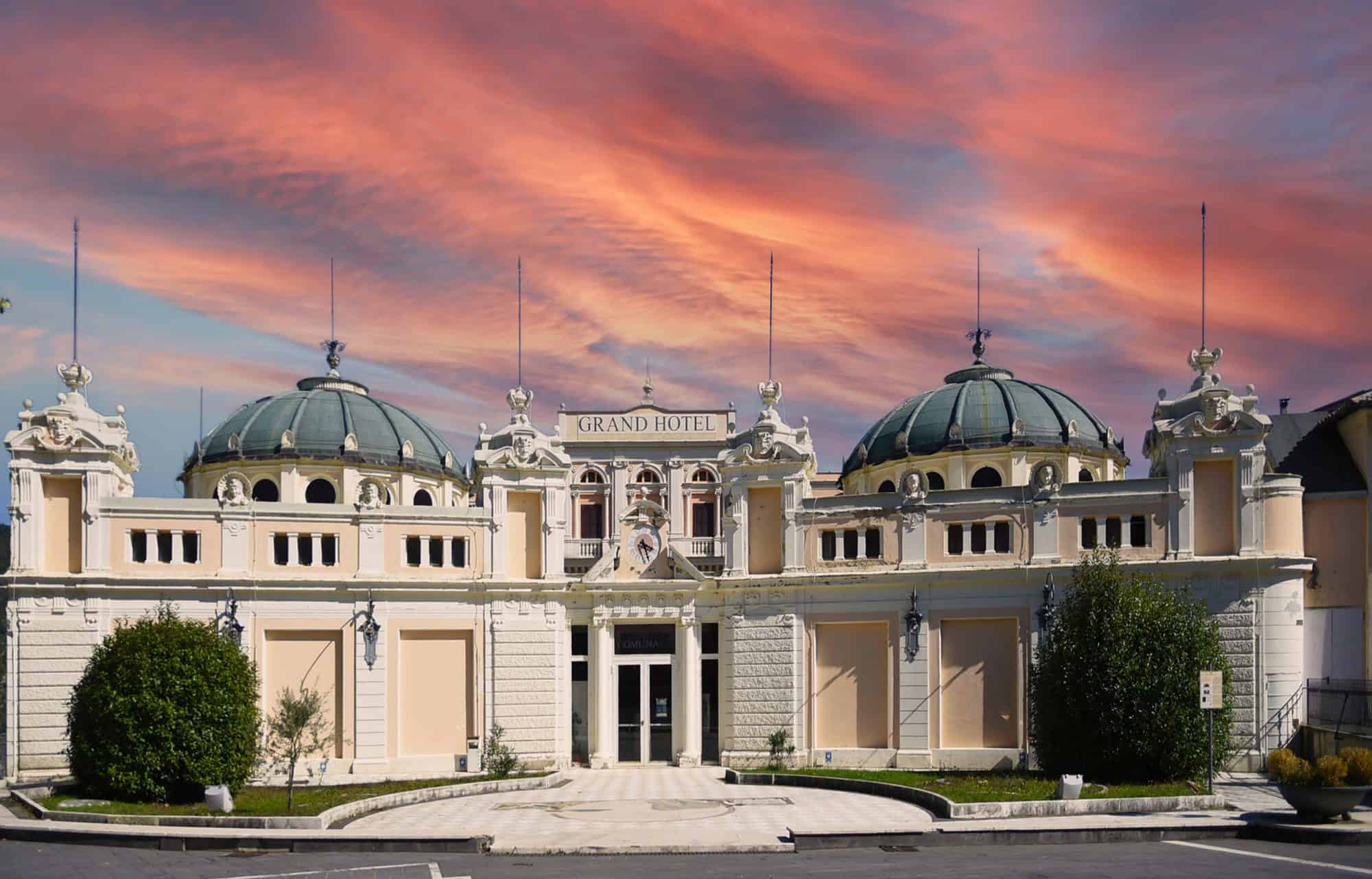
The other great Liberty building is the Grand Hotel Teatro Casinò di Piazza dell'Olmo, today Piazza Trento e Trieste, designed in 1906 by architect Giovan Battista Giovenale and opened in 1911. This one also stands on a hill of about eight hectares and was once one of the best hotels on the continent, hosting important figures and the King of Italy. It was wanted by engineer Celestino Carlini. It was then bought by the Società Grandi Alberghi and abandoned before World War II. In 1964 the municipality bought it back. In 2017 it was chosen as a Luogo del Cuore by the FAI, the Italian Environment Fund. Today it houses a theater with an exhibition hall and a hotel school, in a dual role as monument and trade school that suits it well.
Lake Canterno, the Ghost Lake Near Fiuggi
A few kilometers from the town, between the territories of Fumone, Ferentino, Fiuggi and Trivigliano, lies one of the most curious places in all of the Ciociaria: Lake Canterno, which everyone calls the ghost lake. The nickname is not a tourist gimmick but an exact description of how it behaves. The basin formed in the 19th century after flooding what were then cultivated fields. It tends to partially empty in some periods of the year or even disappear completely, only to re-form days, months, or even years later. Between 1894 and 1943 it remained completely dry for almost half a century.
Its changeable nature depends on a natural sinkhole, the Pertuso, connected to the river of the same name: when the flow drops, the water goes underground and the lake disappears. For a long time one detail puzzled everyone: as soon as the lake re-formed, it was already possible to catch fish there, as if they had appeared out of nowhere. The mystery was solved in 1943, when it was discovered that the Pertuso sinkhole connects with an underground cave where the fish survive even during long periods of drying up, and then repopulate the basin as soon as the water returns.
The lake's modern history is marked by industry. In 1942 the Società Elettrica Romana drained it to build a tunnel pipeline about two kilometers long and exploit the water for hydroelectric purposes, with a drop of about 300 meters. To avoid stopping the sinkhole, a sort of dam was built in the middle of the lake, and to guarantee more water a tunnel canal over 6,800 meters long was dug, coming from Guarcino. Today Lake Canterno, though transformed, is part of a regional nature reserve. It has a variable extent of about 1.1 square kilometers, a perimeter of five kilometers and a depth that ranges between 15 and 25 meters. The wetlands have attracted the typical birds of these environments, from the grey heron to the moorhen to the purple heron. For those visiting Fiuggi by car, it is a detour that pays off.

The history of Fiuggi, from the Ernici to the Svolta
The story of this place begins long before the modern spa. A small village called Felcia is believed to have existed already in the time of the Ernici, the Osco-Umbrian people settled in this area of Lazio before the Roman conquest. In 367 BC Rome's domination began, and the earliest records of the properties of the local waters, then known as Fons Arilla, date back to the Roman period. Originally the settlement stood on the plain, in the countryside. It was barbarian invasions and Saracen raids that pushed the inhabitants to take refuge on the nearby hill, where the historic center still stands today, easier to defend.
The Middle Ages and the age of the Colonna
At the start of the 12th century the ancient Anticoli, the name of Fiuggi until 1872, lost part of its territory in an unlucky struggle against Guarcino and other nearby centers. In the 13th century the figure entered the scene who would forever tie his name to these waters: Pope Boniface VIII, who, by buying Torre Cajetani, could also claim feudal rights over Anticoli. With the rise of Alexander VI Borgia, the castle of Anticoli was entrusted to Cardinal Ascanio Sforza and then to Giovanni, son of Lucrezia Borgia. In the 16th century it was the Colonna who seized the territory, which they held through a series of events until 1816.
The name change and the birth of the spa town
The name Fiuggi is recent. With Lazio's entry into the Kingdom of Italy in 1870, Anticoli became part of the district of Frosinone, and in 1872 the qualifier Campagna was added to the old name, referring to the former papal province of Campagna and Marittima. The turning point came at the start of the 20th century. In 1910 city councilor Pietro Martini, who had founded the newspaper Fiuggi in 1905, presented a motion to change the municipality's name. It served to keep the link between the ancient village of Anticoli and the spa town, by then much better known, and to distinguish the town from the municipality of Anticoli Corrado. The motion, supported by Mayor Gian Francesco Verghetti, was approved unanimously, and with a royal decree of August 9, 1911, Anticoli di Campagna became Fiuggi, extending to the whole municipality the name of the springs' hamlet. That same year the Fonte Bonifacio VIII was inaugurated, launching the promotion of the waters, and in 1913 the Grande Albergo Palazzo della Fonte opened.
The Vicinali railway
In 1916 the Rome-Fiuggi-Alatri-Frosinone railway, known as Le Vicinali, was inaugurated, with a narrow gauge of 950 millimeters and a single track. This infrastructure gave the decisive boost to spa tourism, bringing Romans down to the valley and up into town by a very special branch line, the Fiuggi Fonte-Fiuggi Città, which from the central station in the valley climbed along Via Armando Diaz up to Piazza Trento e Trieste. An intermediate station on two levels, now a parking lot, stood at the junction with the road to Vecchia Fiuggi. The town section was discontinued on June 30, 1960, right in the middle of the Rome Olympics. The connection with Alatri closed in 1978, and the entire line ceased on the night of December 27, 1983, after a landslide near Genazzano.
Fiuggi and its events: festivals, food festivals and reenactments
Anyone who arrives in Fiuggi in summer finds a town that lives on events, some of national and international appeal. It's worth checking the calendar before choosing dates, because a festival can completely change the atmosphere of an evening.
Summer festivals in Fiuggi
The Fiuggi Family Festival, started in 2008, is a film festival dedicated to family movies, and it's the event that has done the most to put the town's name beyond the regional borders. Since 2007 the third week of July has hosted the Festival Internazionale della Chitarra Città di Fiuggi, an event for guitarists and classical music lovers. The Festival delle Città Medievali is a classical music festival that makes use of the setting of the old village. On the band music front, the national Bacchetta d'Oro competition has been held since 1997.
The Palio di Bonifacio VIII and the feast of San Biagio
The most heartfelt historical reenactment is the Palio di Bonifacio VIII, in which the city's contrade, each represented by its own knight, compete in a chivalric tournament made up of horse jousts, costume parades and performances by the local flag-throwers. The oldest festival, however, is that of the patron saint San Biagio, celebrated on the evening of February 2 with the reenactment of the Stuzze, which I'll talk about later because it deserves a chapter of its own. The calendar is completed by the Christmas markets, the Notte Bianca dello Sport, and in autumn the two most-loved food festivals: Castagne Insieme, in October, a non-profit event organized by the Movimento Pro Sanctitate under the patronage of the Pro Loco and the Comune, and the Sagra della Polenta, also in October.

What to do in Fiuggi beyond the thermal baths
It would be a mistake to reduce Fiuggi to the drinking water cure alone. The town is also equipped for sports and leisure: there are golf and tennis courts, swimming pools, a riding stable, archery, mountain bike trails and a minigolf course. In the evening the streets of the center come alive with shops, art galleries and auction houses, and the evening shopping stroll is part of the ritual for those who stay a long time. The hill climate, cool in summer thanks to the nearly 800 meters of altitude and the chestnut woods, is in itself a reason to head up when the plains become stifling. Among the traditional crafts, pottery, terracotta work and goldsmithing still survive, found in a few workshops in the village.
The surroundings of Fiuggi worth seeing in a day
Fiuggi is a good base for exploring Ciociaria and the Monti Ernici. A quarter of an hour away you reach Anagni, the city of popes with its cathedral and the palace of Boniface VIII, the setting of the famous slap. Just beyond is Ferentino, with its polygonal walls, while Alatri preserves one of the best-preserved Cyclopean acropolises in Italy. Heading up into the mountains you reach Subiaco, with its Benedictine monasteries carved into the rock. Going down toward the west, you come across Genazzano and Carpineto Romano, homeland of Pope Leo XIII. If you have more days, you can push on to Palestrina and its sanctuary of the Fortuna Primigenia, or toward Tivoli with its villas. For the route of religious treasures, it's worth a stop at the Anagni Cathedral Museum.

The Liberty look of Fiuggi and the town that keeps growing
Walking through Fiuggi Fonte, you notice right away that the architecture doesn't have a single style but a whole sampler of them. The water quarter, which grew quickly from the early 1900s and then again after the war, mixes Swiss-style villas, postmodern houses, Umbertine palaces, Liberty buildings and modern constructions, all placed side by side along the same streets. It's the portrait of a place that has lived through several waves of tourist fortune, and with each wave it built according to the taste of the moment, without a unified design. Liberty remains the noblest hallmark, that of the spa's belle époque, and you can read it in the facades of the Palazzo della Fonte and in the surviving entrance of the old Fonte Bonifacio VIII. But alongside it coexist the bourgeois decor of the late 1800s and the functional simplicity of the boom-era apartment blocks.
The town has kept spreading outward, following its main routes: Via Prenestina toward Acuto, the road to Alatri and the provincial road to the Altipiani, gradually filling in the spaces between them too. This growth came at a price. The greenery that once surrounded the historic center has shrunk in favor of private construction and, above all, hotels, called upon to support the 15,000 beds that make Fiuggi the second city in Lazio for accommodation capacity. In short, whoever looks beyond the spa appearance finds an architectural laboratory of the 20th century, messy but readable, where every era has left its signature.
Fiuggi's handicrafts: ceramics, terracotta and goldsmithing
Alongside its waters, Fiuggi keeps a craft tradition worth seeking out among the town's workshops. The most deeply rooted are ceramics and terracotta, which draw on the local availability of clays, and goldsmithing, practiced by masters who work precious metal with techniques handed down over time. These trades survived the industrial wave and the monoculture of spa tourism, and today they represent a small heritage to rediscover for anyone who is not satisfied with the standard souvenir.
The advice, for anyone who wants to bring home something authentic, is to skip the more touristy shop windows on the main street and slip into the alleys of Vecchia Fiuggi, where a few workshops still work terracotta by hand. It is also a way to see the town with different eyes, not as a backdrop but as a place where things are still made. In the evening, in fact, it is the shops, art galleries and auction houses that bring the streets of the city to life, in a stroll that is part of the stay just as much as the morning glass of water.
The Monti Ernici and Fiuggi's climate
The reason Fiuggi has always been a summer retreat, even before it was a spa town, lies in its position on the Ernici Mountains. The old town looks out from its 747 meters over the range, and even the lower part, at 621 meters, remains high enough to enjoy cool air when the Ciociaria plain and Rome itself swelter in the heat. The chestnut woods that surround the town do the rest, tempering the days and scenting the autumn, when chestnuts become the stars of the table and of the food festival. It is a microclimate that doctors of the past prescribed as much as the water: going up to Fiuggi already meant breathing better.
From Fiuggi, routes head into the interior of the Ernici and toward the nearby towns that dot the mountain, from Guarcino to Collepardo, from Vico nel Lazio to Trevi nel Lazio, many of which preserve medieval villages and secluded sanctuaries. Anyone who loves walking finds a convenient base here, with the town and its services close at hand and the mountain beginning right outside the built-up area. It is the double nature that made Fiuggi's fortune: an equipped spa town set in a hilly environment that is still largely green.
A curiosity about Fiuggi (FR)
The curiosity few people know concerns the chemical origin of Fiuggi's fame, and it is more fascinating than any legend. The water that dissolves kidney stones owes its virtue not to minerals, which are in fact very few, but to a group of organic molecules, the humic substances, which are in practice the product of the extremely slow decomposition of plant matter underground. Put simply, the centuries-old fame of Fiuggi rests on what the chestnut woods of the Ernici have left in the ground over the centuries, filtered drop by drop by rainwater that seeps down through the mountain's ancient volcanic deposits. It is young, light water, with a dry residue of only 123 milligrams per liter, which acts on the body thanks to substances we normally associate with mud and rotting leaves, not with crystalline purity.
There's more: precisely because it is so poor in salts, Fiuggi's water has a remarkable solvent power, meaning it tends to carry away whatever it encounters. This is exactly why it helps break up small stones and encourage their expulsion. The lightness you feel when drinking it is not just a suggestion: it is the same physical property that has given it seven centuries of fame. Drinking this water, in the end, means drinking the geological history of the Ernici Mountains.
Something no one tells you about Fiuggi (FR)
No tour guide tells you that in August 1911, the same month Anticoli di Campagna changed its name to Fiuggi, a declaration of war was signed in this quiet spa town. Prime Minister Giovanni Giolitti and the Foreign Minister, who had retreated here on vacation as many notables of the time did, worked out right here in Fiuggi the decision that would lead Italy into the Libyan War against the Ottoman Empire. The town of waters, born to treat kidneys, thus ended up serving as the backdrop to a political choice of international scope, almost by chance, simply because the powerful happened to spend the summer there.
It was not an isolated episode. Two years later, in 1913, with the opening of the Palazzo della Fonte, the royal family began staying in town, and from Fiuggi the king signed Italy's declaration of neutrality at the start of the First World War. For a few seasons, in short, this corner of Ciociaria served as an informal seat of Italian power, where between a glass of water and a walk in the parks decisions were made that ended up in newspapers across half the world. It is a side of Fiuggi that residents know well and visitors almost always ignore, absorbed as they are by the wellness dimension alone.
The advice I give for visiting Fiuggi (FR)
The advice is not to treat Fiuggi as a half-day, in-and-out trip, because that way you won't really understand it. The town lives in two different rhythms, and to grasp both you need at least one night. Early in the morning the scene is the spa parks: you arrive at the springs just as they open, when the water is coldest and the avenues are still empty, you drink the first glass and walk under the cedars and sequoias together with the regular spa patrons, many of whom have been coming back every year for decades. It is a slow, silent ritual, one to go along with without hurry.
In the afternoon, instead, you climb to the old town: leave the car below and tackle on foot the maze of alleys in Fiuggi Città, looking for the 13th-century two-light windows, the small squares of Mastro Giorgio and Piave, and the Collegiate Church of San Pietro at the top. In the evening, return to the modern part for the stroll among the shops. The best time is midsummer, when the nearly 800 meters of altitude bring a coolness you would only dream of in Rome. If you are after quiet, however, avoid the weeks of the big festivals, which fill the hotels. One last practical recommendation: the water cure only makes sense if you drink it in quantity, so bring a personal glass and plan on many bathroom stops, because the diuretic effect is real and spares no one.
Another well-known fact, yet rarely cited
Everyone knows Fiuggi's water treats kidney stones, but almost no one remembers that its fame doesn't begin with Boniface VIII, but with the Romans, a millennium and a half earlier. The first written records about the properties of these waters in fact date to the Roman era, when the spring was known as Fons Arilla and was already serving the people of that time. Boniface VIII, in the 13th century, discovered nothing: he simply made fashionable a cure that the area had practiced for centuries, and he did so with the authority that came to him from the papal tiara. It was his notoriety, more than any therapeutic novelty, that propelled Fiuggi into legend.
The little-cited fact, then, is the temporal depth of this vocation. When we drink today at the Fonte Bonifacio VIII we are performing a gesture that has been repeated at Fiuggi, in one form or another, for over two millennia. Few spa towns can claim such a long continuity between the ancient and contemporary use of the same natural resource. The pope gave it his name, but the history is much older than he is.
The right photo to take in Fiuggi (FR)
The photograph that best conveys the sense of the place is not the one of the dispensing counters, but the one of the surviving Liberty-style entrance of the old Fonte Bonifacio VIII. When Luigi Moretti rebuilt the complex between 1967 and 1969, he demolished almost the entire original layout by Garibaldi Burba, but left standing the grand scenic entrance from the early 20th century. It is there that you can capture in a single shot the town's dual soul, the elegant Liberty style of the Belle Époque and the essential rationalism of the economic boom, side by side. Go in the first morning light, when the low sun brings out the decorative details of the facade and the park's paths are still empty.
If you prefer a more romantic image, the second choice is the town of Fiuggi Città wrapped in fog, which in autumn and winter rises from the valley and settles on the hill: the stone houses and bell towers emerging from the mist are among the most memorable views in all of Ciociaria. In summer, on the other hand, aim for a high town square, that of Mastro Giorgio or Piave, with a medieval two-light window as a frame. In every case, the advice is to climb up for the overall shot and then come back down to look for the detail: Fiuggi tells its story well both from far away and up close.

Some important events that took place here in history
Thanks to its secluded position and its capable hotels, Fiuggi has hosted some events that went well beyond the local scale. The most striking, which has already been mentioned, is the signing of the declaration of war against the Ottoman Empire in August 1911, decided here by Giolitti during his vacation. To this is added the royal signing of Italian neutrality in 1914, at the start of the Great War, also carried out in town while the royal family stayed at the Palazzo della Fonte.
Between October 4 and 6, 1957, Fiuggi hosted the sixth meeting of the Bilderberg Group, the private gathering that brings together leaders in politics, finance and industry of the Western world: the choice of a discreet, well-served spa town was no accident. During the Second World War, moreover, with the Allies blocked by the Germans along the Gustav Line, the city's grand hotels were requisitioned and turned into military hospitals, changing their nature for a few years.
But the event that fixed Fiuggi's name in the history books of Italian politics is another: on January 27, 1995, the congress of the Italian Social Movement was held here, and it dissolved right there to give birth to the National Alliance. That passage, in which the party abandoned its neo-fascist references to embrace a pro-European right, went down in history as the Svolta di Fiuggi, and since then the town's name has become synonymous in Italy with that change. A small spa town thus ended up naming a national political turning point.
Who has passed through Fiuggi (FR)
The list of those who have passed through these waters begins with two names that alone make the place famous. The first is Pope Boniface VIII, born Benedetto Caetani, the pontiff who in the 13th century frequented the area often to treat his kidney stones by drinking this water, and who, by giving his name to the main spring, delivered it to fame. The second is Michelangelo Buonarroti, tied to these waters by a letter, not a trip.
In 1549 Michelangelo wrote to his nephew Lionardo that he had drunk for about two months the water of a fountain 40 miles from Rome, "which breaks the stone". The letter does not name Fiuggi, and no document says he came here: the identification with this spring is reasonable, but it remains an identification. The catchy phrases attributed to him about the spring have no support. The full story is in the entry for the Terme di Fiuggi.
After them the territory passed to the great Roman families: the Colonna held it for three centuries, and the Borgia got involved through Alexander VI, who entrusted the castle of Anticoli first to Cardinal Ascanio Sforza and then to Giovanni, son of Lucrezia Borgia. With the 20th century and the birth of the spa town came the powerful figures of the Italian state: Giovanni Giolitti, who decided the Libyan war here, and the royal family, which made Fiuggi a summer residence from the Palazzo della Fonte. In the 1990s the Palazzo della Fonte belonged to the Anglo-Italian magnate Charles Forte, one of the kings of the global hotel industry, born not far from here. And for the 1995 turn, the entire ruling class of the Italian right paraded through Fiuggi. Few towns of 10,000 inhabitants can line up such a cast in seven centuries.
The Stuzze of Fiuggi: the legend of Saint Blaise
The most identity-defining festival of Fiuggi deserves a separate story: the Stuzze, celebrated every year on the evening of February 2 in honor of the patron saint, San Biagio. Tradition holds that in 1298 the town was about to be besieged by two enemy armies. According to legend, San Biagio then had the idea of setting fire to some large huts to trick the attackers. One of the two armies, seeing from a hill that Fiuggi was already in flames, became convinced that the other had already entered and was sacking the city, and gave up the attack. The second army, seeing the same fire, thought exactly the same thing. Thus, both deceived by the flames, the two armies withdrew and the town was saved without a battle.
From that episode, which belongs more to popular tradition than to documented history, comes the rite of the Stuzze, the great bundles of firewood and brushwood that are still lit today on the night of February 2 in the old town, amid songs and stornelli. It is the festival in which the people of Fiuggi recognize themselves, much more than in the summer festivals designed for tourists, and it is the best occasion to understand the soul of the town beyond the spa. Anyone who happens to be in town in early February should not let it pass: they will see a Fiuggi that does not exist in summer.
Quick questions about Fiuggi (FR)
How far is Fiuggi from Rome?
Fiuggi is about 80 kilometers southeast of Rome, just over an hour by car along the A1 highway with the Anagni-Fiuggi exit, and then the regional road 155 up to altitude.
How do you get to Fiuggi without a car?
By bus with Cotral services that connect Rome to Ciociaria, or by train to the Anagni-Fiuggi station on the Rome-Cassino line, then continuing by bus into town. The old direct railway that climbed up to the center has not been in operation since 1983.
What is Fiuggi water used for?
It is an oligomineral water with a marked diuretic effect, used for centuries in treating urinary tract stones: it helps break up small kidney stones and encourages their elimination. The cure is done by drinking the water according to a protocol, not by bathing.
Can you bathe at the Fiuggi spa?
Fiuggi's springs are drinking thermal waters, not immersion baths: the ritual is the hydropinic cure, that is, drinking the water on an empty stomach while walking in the parks. For wellness treatments with tubs and pools, you go to the spas and fully equipped hotels, not to the springs.
When do the Fiuggi springs open?
The springs open for the season, roughly from April to October. The Fonte Anticolana is generally open from April 1 to September 30. Hours and periods can vary from year to year, so it's best to check the official spa website before you go.
How much does it cost to get into Fonte Bonifacio VIII?
Entry to the morning cure costs roughly 5 euros, with reductions for children from 12 to 16 years old, reduced rates for residents and for people with disabilities, and weekly and fortnightly passes for those who follow the full cycle. Exact prices change every season and should be checked on the official website.
Do you need a reservation to drink the water at the springs?
For a single morning entry, you generally don't need a reservation. The medical admission visit is recommended for those starting the cure for the first time or for a specific condition.
How long does a thermal cure in Fiuggi last?
A full cycle usually lasts one or two weeks, which is why the seven-day and 14-day passes exist. For a simple sightseeing visit, one day is enough, but to really catch the atmosphere, it's best to stay at least one night.
What's the difference between Fiuggi Città and Fiuggi Fonte?
Fiuggi Città, or Vecchia Fiuggi, is the medieval village perched on the hill at 747 meters. Fiuggi Fonte is the lower thermal quarter from the 1900s, around 621 meters, which grew up around the two springs. Today the two areas are joined into a single town by the serpentine of Via Diaz.
What to see in Fiuggi in one day?
In the morning, the spa parks with the water cure, in the afternoon the medieval village of Fiuggi Città with its mullioned windows, the Collegiata di San Pietro and the Chiesa di San Biagio, and at the end of the day the shopping stroll in the modern part. If you have a car, add Lake Canterno.
Is Fiuggi suitable for children?
Yes, and not only because of the Fiuggi Family Festival dedicated to family films. The town has pools, minigolf, a riding center and large green parks where the youngest can move around safely, and the fresh hill climate makes summer more bearable.
When is the best time to go to Fiuggi?
Midsummer is the best period for the climate, with the almost 800 meters of altitude providing cool air. Autumn is lovely for the chestnut and polenta food festivals and for the mists over the village. In early February there is the Stuzze di San Biagio festival. If you're looking for quiet, avoid the weeks of the big festivals.
What do they eat in Fiuggi?
The cuisine is the mountain Ciociaria cooking, with the Ernici chestnuts as the stars in autumn, celebrated at the Castagne Insieme food festival, and polenta at the Sagra della Polenta in October. It's a hearty, earthy cuisine, a good match for the hill climate.
Why was Fiuggi called Anticoli?
The town was called Anticoli, then Anticoli di Campagna, until 1911, when by Royal Decree it took the name of the spa hamlet, by then much better known. The change also served to distinguish it from the comune of Anticoli Corrado, which was then in the same province.
Who was Boniface VIII and what does he have to do with Fiuggi?
Boniface VIII, pope between 1294 and 1303, frequently visited the area to treat his kidney stones by drinking this water. By giving his name to the main spring, he cemented its fame. The territory, moreover, had come under his feudal influence after the purchase of Torre Cajetani.
What is Lake Canterno?
It is a lake near Fiuggi, known as the ghost lake because it empties and refills unpredictably depending on the flow of the Pertuso sinkhole. Between 1894 and 1943 it remained completely dry. Today it is part of a regional nature reserve rich in birdlife.
Is Fiuggi accessible for people with mobility difficulties?
The spa parks, with their level paths designed for the cure walks, are the easiest part. The old village of Fiuggi Città, on the other hand, is made of uphill alleys and steep ramps and is much more challenging. For specific needs, it's best to check with the accommodations.
What to see around Fiuggi?
Anagni with its cathedral and the palace of Boniface VIII, Alatri with its cyclopean acropolis, Ferentino with its polygonal walls, Subiaco with its Benedictine monasteries, and then Genazzano, Carpineto Romano and, farther away, Palestrina and Tivoli. Lake Canterno is the closest natural destination.
A Last Word on Fiuggi
If I had to say in one sentence why I keep coming back to Fiuggi, I'd say it's one of the few places an hour from Rome where time really slows down. It's not an art city to tick off a list, and anyone who comes looking for thrills leaves empty-handed. It's a place of waters, of slow walks under the cedar trees, and of an ancient cure that the Ernici practiced even before the Romans, and that is repeated the same way every morning today. Go up, drink your glass of water, get lost in the alleys of the village up high, and let the Roman rush slide off you. The rest, the fresh air of the chestnut trees and the silence, is Fiuggi's doing.
Article written by the editorial team of TourLeaderPro, contact them for Private/Corporate/V.I.P. Tours and Experiences.
Are you planning a trip to Rome? English-language guides to visiting the city are at ItalyPlanner.com.