Anagni (FR)
In short. Anagni is reached from Rome in just over an hour: you take the A1 motorway toward Naples and exit at Anagni-Fiuggi, then about 10 kilometers of provincial road lead to the upper city, perched at 424 meters above sea level over the…

Anagni is reached from Rome in just over an hour: you take the A1 motorway toward Naples and exit at Anagni-Fiuggi, then about 10 kilometers of provincial road lead to the upper city, perched at 424 meters above sea level over the middle Sacco valley, in the heart of Ciociaria. Those who don't drive have the Anagni-Fiuggi station on the Rome-Cassino railway line, served by regional trains that leave from Roma Termini: the station is in the valley, and a local bus service connects it to the historic center, which stands on top of the hill. From Rome there are also regional coach runs that leave from the Anagnina terminal. Schedules change often, so it's best to check them on the carrier's website before leaving. The old village is visited on foot: cars are left in the parking lots along the city walls and in the lower area, because the streets of the medieval center are narrow and partly pedestrian.
The two visits that give the sense of the city are the Cathedral Museum and Crypt, in Via Leone XIII, and the Palace of Boniface VIII, at Strada Vittorio Emanuele 238. The Cathedral Museum, which includes the famous crypt of San Magno, charges a full ticket of €9 and a reduced one of €6, with a special reduced rate of €3. Hours are 9:00 to 13:00 and 15:00 to 18:00 between November and March, with the afternoon closing pushed back to 19:00 from April to October, and last entry is set one hour before closing. Booking is required, especially for the crypt, whose access is limited for conservation reasons: the phone number is 0775 728374. The Palace of Boniface VIII, run by the Archeoares cooperative, opens 9:30 to 13:00 and 15:00 to 19:00, with a full ticket of €5 and a reduced one of €3, audio guide included, and free admission for children under 12, residents of Anagni and visitors with certified disabilities. All fares and hours should be rechecked on the official websites before your visit, because they vary with the season and holidays.

To plan a trip in the area, the page dedicated to Fiuggi covers the other most convenient destination in the area, 15 minutes away by car, and lets you build a day that combines the history of Anagni with the baths and woods of the Ciociaria mountains. Anyone who wants to stay on the theme of the Cyclopean cities of Lazio will find material in the pages of Alatri and Priverno, which complete the picture of the walls in polygonal masonry.
What Is Anagni (FR) and Why Is It Called the City of the Popes
Anagni is a comune of just over 20,000 inhabitants in the province of Frosinone, the second in the territory by extent with its 113 square kilometers. The ancient center occupies the summit of an elongated hill overlooking the Sacco valley, the natural corridor that has always connected Rome to Campania. This position explains almost everything about its history: whoever controlled Anagni watched over one of the most important transit routes of central Italy, and for this reason the city was contested, fortified and inhabited by powers far larger than itself.
The nickname of city of the popes isn't a tourist gimmick. Four pontiffs were born in Anagni, all between the 12th and 13th century, at the moment when the Roman papacy was reaching the peak of its temporal power. They were Innocent III, born Lotario dei Conti di Segni, one of the most powerful popes of the Middle Ages. Gregory IX, Ugolino dei Conti di Segni, the pontiff who canonized Francis of Assisi. Alexander IV, Rinaldo dei Conti di Segni. And Boniface VIII, Benedetto Caetani, the pope of the first Jubilee of 1300 and protagonist, in spite of himself, of the episode that made the name of Anagni famous in the history textbooks of half of Europe. Three of them belonged to the same family, the Conti di Segni, a fact that gives the measure of how much this corner of Lazio weighed in the geography of ecclesiastical power.
In the 13th century Anagni became a true papal residence. The pontifical court stayed there for long periods, the city grew rich with palaces and churches, and the population, according to traditional estimates, reached figures very high for the era. When the papacy returned permanently to Rome and then moved to Avignon, Anagni experienced an equally sharp decline: the same sources tell of a demographic collapse that reduced the city to a few thousand inhabitants. The historic center that you visit today preserves the layout of that medieval season, with its tower-houses, loggias, stone portals and the web of alleys climbing toward the acropolis.
The History of Anagni (FR), from the Saturni to the Caetani
The Legendary Origins and the City of the Hernici
Local scholarly tradition attributed the founding of Anagni to the god Saturn, who supposedly created it in the golden age together with five other cities of Lazio whose names begin with A: Alatri, Anagni, Arpino, Atina and Ferentino, which for this reason were called the Saturnian cities. It is a mythical genealogy, like many that circulated in the Renaissance to lend nobility to the antiquity of Italian towns, and it should be taken for what it is: a tale of origins, not a historical fact. The grain of truth is that the area was already inhabited in pre-Roman times by the Hernici, an Italic people settled in the mountains that still bear their name, the Monti Ernici. Anagni was probably the main center of their league.
Roman Anagni
The Romans conquered Hernici territory in 306 BC, after a long struggle. Anagni thus entered Rome's orbit, first as a community governed by a prefect, then as a municipality. The city did not vanish from history: here, according to the sources, Fabius Valens was born in 35 AD, a general and consul of 69, one of the strongmen of the year of the four emperors and a legion commander. The traces of the ancient settlement can still be read in the urban fabric, in the structures absorbed into later buildings and above all in the great polygonal walls that encircle the acropolis.
The Middle Ages and the Rise and Fall of the Caetani
The phase that gave Anagni its present face is the medieval one. In 1160 Pope Alexander III excommunicated Emperor Frederick Barbarossa and the antipope Victor IV here, in one of the harshest episodes of the clash between papacy and empire. The city then passed under the control of the Caetani family, who made it their stronghold in the 13th century. It was the period of greatest splendor: Anagni became a papal residence, it filled with people, it was covered in construction sites. Then came 1303, the clash between Boniface VIII and the king of France, Philip the Fair, and with it the episode of the slap, which marked the beginning of a long decline. In the following centuries the city remained a center of the Papal States, touched by the Napoleonic events of the late 18th century, when it took part in the uprisings that led to the Roman Republic, and by the Risorgimento. Only the economic boom of the 20th century, with the passage of the highway and the arrival of industry in the valley, gave Anagni back a role as a productive center, while the upper town kept its medieval patina intact.
The Cathedral of Santa Maria Annunziata in Anagni (FR)

Anagni Cathedral, dedicated to Santa Maria Annunziata, stands on the highest point of the city, the ancient acropolis, where in Roman times there was in all probability a pagan place of worship. It is the monument that sums up the double soul of the village: religious power and artistic ambition. It was built in phases. The Romanesque body dates to the years between 1072 and 1104, when Bishop Pietro da Salerno promoted a massive building project. In the middle of the 13th century the Gothic forms were added, which today show up mostly in the vaults and in some details of the elevation. The result is a building that holds together the Romanesque solidity of the structures and the Gothic lift of the later additions, without one canceling the other.
The Exterior and the Bell Tower
Outside, what strikes you is the compact bulk, in blocks of local stone, and the bell tower that rises detached from the body of the church. A bronze statue of Boniface VIII is placed on one wall, a reminder of the unbreakable bond between the city and its most famous pope. The apses facing the valley, with their loggias, are one of the spots from which the cathedral reads best, because they show the layering of materials and eras. Anyone who reaches the top from the eastern side comes upon it suddenly, after the last climb, and understands at once why this building dominated the life of the city.
The Interior, the Cosmatesque Floor and the Caetani Chapel
Inside, the layout has three aisles. Your eye goes straight to the Cosmatesque floor, one of the finest in Lazio, made with the opus sectile technique: small tiles of colored marble and glass paste form geometric designs that carpet the nave like a stone rug. The Cosmati, the families of Roman marble workers active between the 12th and 13th centuries, reused ancient marbles to create these mosaics, and in Anagni they gave proof of their mastery. In the presbytery area there is a ciborium and a paschal candelabrum from the same school. The Caetani Chapel holds a large tomb linked to the pope's family. The church also keeps the reliquary of Saint Thomas Becket, the archbishop of Canterbury murdered in 1170, a sign of the relations that tied Anagni to the Christian world beyond the Alps. In this cathedral, in 1160, the excommunication of Barbarossa took place, and within these walls Pope Innocent IV was elected: European history passed through here more than once.
The Crypt of San Magno, the Sistine Chapel of the Middle Ages

Beneath the cathedral opens the space that by itself justifies the trip: the crypt of San Magno, which scholars and guides have long called the Sistine Chapel of the Middle Ages. It is a demanding comparison, and for once it is deserved. The crypt covers about 540 square meters, with 12 columns supporting 21 vaults, arranged in three aisles that follow the plan of the church above. It was built in the same Romanesque phase, between 1072 and 1104, to house the relics of San Magno, patron saint of the city. But the reason for its fame is the decoration: every surface, vaults, walls, columns, is covered by a cycle of frescoes that extends without interruption, a very rare case of a medieval pictorial program preserved almost entirely.
The Fresco Cycle and the Three Masters of Anagni
The frescoes were painted between the end of the 12th and the beginning of the 13th century by different workshops, which scholars have distinguished into three anonymous hands: the First Master of Anagni, also called the Master of the Translations for the scenes of the transport of relics. The Second Master, or Ornamental Master, specialized in decorative layouts. And the Third Master of Anagni. The iconographic program tells the story of humanity's salvation, from the creation to the Last Judgment, interweaving episodes from the Old and New Testaments, stories of the saints and the Apocalypse. It is a library in images designed for an audience that did not read, but that knew how to recognize every figure and every symbol.
The Vault of Science and Plato's Timaeus
There is one vault that deserves a few extra minutes on its own. It shows man at the center of concentric circles representing the cycles of the cosmos and of nature, with the four elements arranged in harmonic proportion according to an idea that derives from Plato's Timaeus. Beside it appear two physicians of antiquity, Hippocrates and Galen, portrayed discussing this theory. It is an extraordinary page of medieval culture, showing how in the crypt of Anagni faith coexisted with Greek philosophy, medicine and astronomy. In front of this vault it is worth stopping and looking up calmly: it is the point where the cycle stops being only devotion and becomes thought.
My Advice Before the Crypt
The crypt has low light and a controlled microclimate: the frescoes survived precisely because the environment stayed stable for centuries, and for this reason visits are limited in time and in number. It is best to go in without hurry, let your eye adjust to the half-light, and resist the temptation to photograph everything: many parts are backlit and the camera does not render what the eye sees in person. Give the crypt at least a full half hour, not the 10 minutes many grant it in passing.
The Palace of Boniface VIII and the Room of the Slap

The Palace of Boniface VIII, on Strada Vittorio Emanuele, is the other pole of the visit. It is a 13th-century building linked to the Caetani family, today home to a museum route set up in the historic rooms. Inside are preserved frescoed rooms of great interest, with geometric and plant decorations covering the walls: checkerboard motifs set in quatrefoil figures, eight-petal flowers, birds inside medallions, borders with plant scrolls and faux marble panels in shades of green, ocher, reddish and brown. This decorative culture, from the end of the 13th century to the early 14th, says a lot about the luxury of the papal court when Anagni was a capital.
The most famous room is the one that tradition links to the outrage of September 1303, remembered as the room of the slap. It is here, according to the account handed down, that the old Pope Boniface VIII was held prisoner and humiliated by the men who came to capture him. The visit to the palace, with an audio guide included in the ticket, lets you connect the painted walls to the great historical episode that unfolded between these rooms, and understand how a papal court lived far from Rome.
The Slap of Anagni: What Really Happened in 1303

The Slap of Anagni is one of those episodes that mark a watershed in history. At the end of the 13th century Pope Boniface VIII and the king of France, Philip IV, known as the Fair, were at daggers drawn over power: who really ruled, the pope or the king? The pontiff claimed the superiority of spiritual authority over temporal authority, and the French sovereign did not intend to recognize it. The clash grew bitter with documents, excommunications and threats. In September 1303 an armed group led by Sciarra Colonna, a member of the Roman family that was the pope's sworn enemy, and by Guillaume de Nogaret, adviser to the king of France, arrived in Anagni, where Boniface VIII was in his residence, and took him prisoner.
The elderly pontiff, who was over 80, stayed in the hands of the conspirators for a few days, in humiliating conditions. Tradition has it that Sciarra Colonna struck him with an iron gauntlet, and hence the name of the slap, but whether the physical act really happened or is a later legend remains debated among historians: the value of the episode is above all symbolic. The people of Anagni, after the initial confusion, rose up and freed the pope. Boniface VIII returned to Rome, but the blow had been too hard: he died a few weeks later, in October 1303. The episode marked the end of the idea of a papacy able to lay down the law to European sovereigns and opened the way to the move of the papacy to Avignon, the beginning of what would be called the Avignon captivity. Dante Alighieri, who was a bitter adversary of Boniface VIII, nevertheless condemned the outrage in very harsh words in the Purgatorio, comparing the capture of the pope to the Passion of Christ: Christ, he writes, is taken prisoner again and mocked between two thieves.
The Cyclopean Walls and the Arcazzi di Piscina of Anagni (FR)
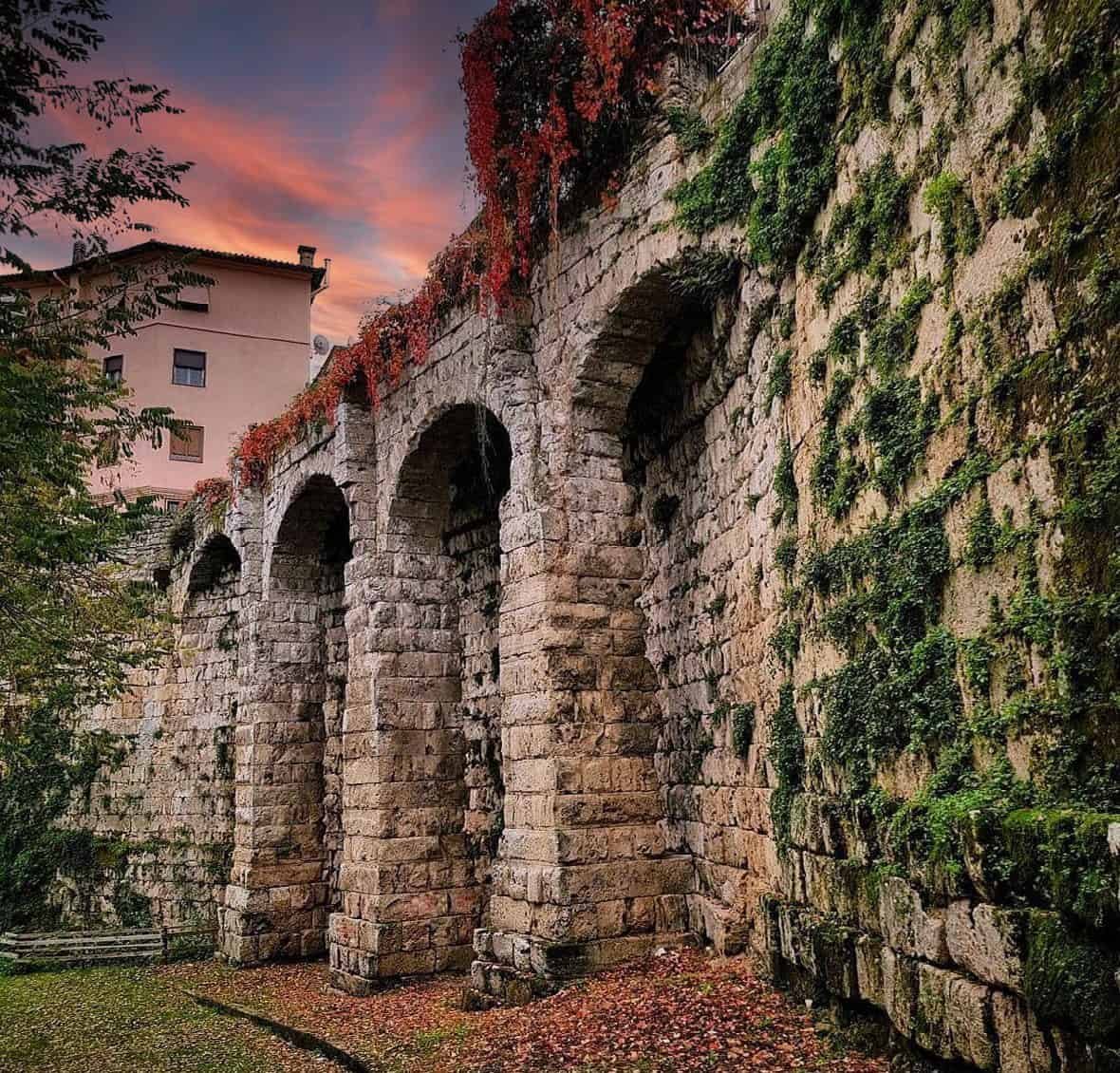
Around the city runs a circuit of walls in polygonal masonry, the ones that scholarly tradition called Cyclopean because it was believed that only the Cyclopes, mythical giants, could have lifted stone blocks so large. In reality these are walls built in pre-Roman times and later reworked, with squared limestone blocks fitted together dry, without mortar. Anagni shares this technique with its neighbors Alatri, Ferentino and Veroli, so much so that the group is studied together as a defensive system of the ancient Hernici. The walls enclose the medieval city and run alongside the current ring road. In some stretches they form terraces that recall hanging gardens, especially near the Parco della Rimembranza. Restored during the pontificate of Pius IV in the 16th century, they bear inscriptions celebrating the pope.
The Gates and the Aqueducts
Of the ancient city gates, Porta Cerere, Porta Santa Maria and Porta San Francesco survive, while Porta San Nicola and Porta Tufoli have largely disappeared. But the hydraulic monument worth the detour is the Arcazzi di Piscina, imposing masonry arches that were part of a system for bringing in and collecting water for the city. They are mighty structures, little visited by passing tourism, that tell how much engineering work it took to keep alive a town perched on a hill without abundant springs. Anyone with time and legs can look for them by following the signs from the center: the reward is a piece of Anagni that almost no one photographs.
The Medieval Center of Anagni (FR): Tower Houses, Loggias and Casa Barnekow

The historic center of Anagni is one of the best preserved medieval villages in Lazio, and you can walk it in a couple of hours if you go slowly. The main street, once the axis of power, is lined with palaces, tower houses, loggias and portals spanning a range of centuries, from the 13th on. Every so often a mullioned window, a pointed arch or a carved coat of arms recalls that families tied to the papal court lived here. The warm-colored local stone gives the village a uniform tone that turns golden in the light of late afternoon.
Casa Barnekow
Among the most curious buildings is Casa Barnekow, a house with a 13th-century layout and a façade entirely covered in frescoes, which takes its name from a Swedish baron, Albert Barnekow, who restored and decorated it in the 19th century. Local tradition holds that Dante Alighieri stayed within these walls during a passage through Anagni. It is a tradition, not a documented fact, and it should be told as such, but it adds to the literary appeal of the village. The painted façade, with its mottoes and its figures, is one of the most photographed spots in the center.
The Town Hall and the Other Churches
The Palazzo Comunale also deserves a look, a medieval building with a large arch spanning the street, typical of 13th-century civic architecture. Scattered through the fabric of the center are then several minor churches and the house-museum dedicated to the sculptor Tommaso Gismondi, an Anagni artist of the 20th century, which lets you close the circle between the Middle Ages and the contemporary art tied to the city.
Anagni (FR) with Children and for a Family Day Trip
Anagni works well with children too, as long as you pace the stops. The crypt, with its frescoes full of scenes, animals and figures, holds the attention of the little ones if you tell it as a big illustrated story instead of a lesson. The Palace of Boniface VIII, with the story of the slap, lends itself to an adventure tale: the old pope, the armed knights, the city that rises up. The Cyclopean walls and the Arcazzi go over well because they are big and concrete, you can touch them, you climb them with your eyes. The historic center, largely pedestrian, lets you walk safely. The only thing to watch is the surface: the streets are stone and uphill, so better comfortable shoes and sturdy strollers, or a baby carrier for the youngest.
Accessibility in Anagni (FR)
The historic center of Anagni stands on a hill and has slopes and stone paving that can be demanding for people with mobility difficulties. The Cathedral Museum, however, has provided accessibility solutions: tracked mobile stairlifts and an elevator are available to reach the rooms, with the recommendation to report the visit in advance by calling the museum, which also reserves free parking for visitors with disabilities. For the Palace of Boniface VIII and the other places, it is best to ask for up-to-date information when you book, because the layout of historic buildings does not always allow barrier-free routes.
When to Go and How Much Time to Spend in Anagni (FR)
You can visit Anagni all year, but the season changes the experience. Spring and autumn are the best periods: mild weather, good light for photographs, less sultry heat than in high summer. In summer the hill catches some air, but in the middle hours the sun beats down hard on the exposed streets, so it is better to concentrate the visit in the morning or from late afternoon. In summer, between July and August, the city hosts medieval reenactments and parades that liven up the center: the current contrade number eight, while originally there were 12, each tied to figures and symbols of the medieval period. A full visit takes a full day: half a day is barely enough for the cathedral with the crypt and the palace, but it leaves out the walls, the center and the less-trodden corners. If you want to pair Anagni with another destination, you can add the baths of Fiuggi or one of the nearby Cyclopean cities.
What to See Around Anagni (FR)
The position of Anagni makes it an excellent starting point for exploring Ciociaria and its surroundings. A few kilometers away is Fiuggi, with its historic baths and the upper village. Toward the Monti Ernici you meet Alatri, with its megalithic acropolis among the best preserved in Italy, and Carpineto Romano, home of Pope Leo XIII. Farther south, Ciociaria offers Arpino, birthplace of Cicero, and Priverno with the Abbey of Fossanova. On the side of the Castelli and the Prenestine area you can reach Genazzano and, a little farther on, Subiaco with its Benedictine monasteries. For those coming from Rome who want to build a wider itinerary in Lazio, Tivoli with Hadrian's Villa and Sermoneta complete the picture of destinations an hour's travel away.
Boniface VIII, the Jubilee of 1300 and Anagni (FR)
To really understand Anagni you have to dwell on the figure of Boniface VIII, the pope the city produced and who found his ruin here. Benedetto Caetani, such was his name, rose to the papal throne in 1294, after the resounding resignation of his predecessor Celestine V, the hermit who had abdicated after a few months. Boniface VIII was a pontiff of great political ambition, determined to reassert the supremacy of the papacy over every earthly power. In 1300 he proclaimed the first Jubilee in history, the Holy Year that called pilgrims to Rome with the promise of indulgence: an event of enormous scale, which filled the streets of the city and marked the peak of the prestige of his pontificate. According to tradition, Dante Alighieri himself was among the pilgrims of that Jubilee.
Right at the apex, however, the clash with France came to a head. Boniface VIII claimed with the bull Unam Sanctam the superiority of spiritual authority over temporal authority. King Philip the Fair, busy building a modern, centralized State, was not willing to yield. The legal and theological clash degenerated into the physical assault of 1303 at Anagni. There is something tragic in the fate of this pope: the city that had given him birth and that he had honored became the theater of his humiliation, and the most powerful pontiff of his time died a few days after being freed by his own fellow citizens. The bronze statue on the wall of the cathedral is the memory that Anagni has chosen to keep of its most illustrious and most unlucky son.
How to get to Anagni (FR) from Rome and the surrounding area
From Rome the most convenient way to reach Anagni is the car: you take the A1 motorway toward Naples and exit at Anagni-Fiuggi, after which you follow the signs for the city, about 10 kilometers of uphill provincial road. The travel time from the Grande Raccordo Anulare is about 40 minutes in normal traffic conditions, a little over an hour from the center of Rome. By train you use the regional Roma-Cassino line, getting off at the Anagni-Fiuggi station. Note that the station is in the valley floor, several kilometers from the historic center that rises on the hill, and has to be reached by the connecting bus or by taxi. There are also regional bus runs departing from Rome, generally from the Anagnina terminus on line A of the metro. Since train and bus schedules change frequently, and with the weekday and holiday timetable, it's best to check them on the carriers' websites the day before departure. Those arriving from Naples take the same A1 toward Rome, with the same exit. Once in the city you get around on foot: the center is largely pedestrian and there is no point in trying to cross it by car.
The coat of arms and symbols of Anagni (FR)
The coat of arms of Anagni tells in images its history as a papal and ancient city. In use since the 12th century, it shows an eagle above a rampant lion, symbols of strength and sovereignty. Two decussate keys appear on it, that is, crossed, a direct reference to papal power, surmounted by a small cross, and the acronym SPQA, a copy of the Roman SPQR, which claims for Anagni the dignity of a municipium heir to Rome. A golden crown signals the status of city, recognized since the medieval period. The Latin motto that accompanies the coat of arms, HERNICA SAXA COLUNT QUOS DIVES ANAGNIA PASCIT, recalls the Hernici, the ancient people of these mountains, and the bond of the city with its own land. Reading the coat of arms, before or after the visit, helps line up the three layers of Anagni: the Hernican root, the Roman inheritance and the papal vocation.
The Gismondi house-museum and 20th-century art in Anagni (FR)
Not everything in Anagni stops at the Middle Ages. In the historic center you can visit the house-museum dedicated to Tommaso Gismondi, a sculptor from Anagni of the 20th century, author of works of sacred and civic subjects found in many Italian churches and squares. The house-museum gathers models, sketches and sculptures, and allows you to close the city route with a contemporary note, showing how the artistic vocation of Anagni did not die out with the golden centuries. It is a short stop, suited to those who want to see a less-trodden side of the city and understand the link between an artist of the last century and the figurative tradition of the place. The opening hours are more limited than at the great monuments and it's best to ask on the spot or at the tourist office.
The cuisine and products of Ciociaria in Anagni (FR)
A visit to Anagni is completed at the table, because Ciociaria has a hearty and ancient land cuisine. The dishes you find in the trattorias of the center and the surroundings are those of the Lazio peasant tradition: homemade pastas such as sagne, fini fini, gnocchi, dressed with meat sauces, legume soups, grilled meats and game in the right seasons. There is no shortage of cured meats and cheeses from the farms of the Ernici and Lepini mountains. Among the symbol products of the broader area are the cannellino bean and other traditional crops of the valley. Those who want to pair history with appetite find in Anagni and in the nearby towns places where the cooking remains tied to local raw materials. For a lunch, it's better to leave the most touristy street and look for the trattorias frequented by the locals: they are the ones that tell the territory with greater sincerity.
What it costs to visit Anagni (FR) and how to plan
Visiting Anagni is not expensive. The biggest expense is the two main tickets: €9 for the Cathedral Museum and Crypt, with reductions to €6 and €3, and €5 for the Palace of Boniface VIII, with a reduced ticket of €3 and audio guide included. Families can ask the ticket offices about reductions and any free admissions, which at the palace apply to children under 12 and to residents. The historic center, the walls, the gates and the glimpses can be visited free, just by walking. The expense to budget for is, if anything, parking and lunch. To plan well, it is best to arrive in the morning, book the time slot for the crypt, and space out the visits so as to respect the midday break, when the monuments close. The fares listed should always be checked on the official sites of the two museums before departure, because they change with the season.
Anagni (FR) and the Other Cities of the Hernici
Anagni is not an isolated case: it is part of a network of ancient Hernici centers that share polygonal walls and a parallel history. Alatri, with its megalithic acropolis of Cyclopean blocks, is perhaps the most spectacular example of the technique. Ferentino and Veroli complete the picture of the fortified centers in the mountains. Anyone with a real passion for pre-Roman archaeology can build a two- or three-day itinerary that touches them all, using Anagni or Fiuggi as a base. The comparison between the walls of Alatri and those of Anagni is instructive: the same defensive idea, different monumental results. It is a way to understand that Ciociaria, before being a land of popes, was already a region of fortified and powerful cities.
A Curiosity About Anagni (FR)
The least known curiosity of Anagni concerns the vault of science in the crypt of San Magno. In a sacred space, built to house the relics of a saint, the medieval painters depicted man at the center of the cycles of the cosmos, the four elements in harmonic balance and two pagan physicians of antiquity, Hippocrates and Galen, engaged in discussing a theory rooted in Plato's Timaeus. In the heart of the Middle Ages, in a provincial crypt, someone decided that the story of Christian salvation could live on the same vaults alongside Greek philosophy and ancient medicine. It is a detail that escapes anyone who walks in expecting only biblical scenes, and that instead says a great deal about how learned the patron was who ordered that cycle. Most visitors pass under that vault without noticing it: knowing what to look for, before going in, completely changes the visit. If I had to name the reason the crypt deserves the comparison with the Sistine Chapel, it would not be the quantity of frescoes, which is enormous too, but precisely this intellectual ambition.
One Thing Nobody Tells You About Anagni (FR)
What the hurried guides don't say is that in Anagni the cathedral with the crypt and the Palace of Boniface VIII are two tickets and two separate managements, with different hours and fares, and that the crypt has limited entry. In practice it is not enough to show up and hope to see everything in a row: on weekends and long holiday weekends the crypt can run out of available places, and anyone who arrives without booking risks being left out of the most important space. The thing to do is to call the cathedral museum first, at 0775 728374, check availability for the crypt and reserve the time slot, then organize the visit to the palace and the center around that time. There is a second practical detail that almost no one points out: many of the convenient parking lots are in the valley or along the city wall, and the last stretch toward the center is uphill. Anyone with walking difficulties must factor that in and, for the cathedral, ask in advance about reserved parking and the stairlifts.
The Advice I Give for Visiting Anagni (FR)
The advice I give to anyone visiting Anagni for the first time is to reverse the instinctive order. Almost everyone goes straight into the cathedral, rushes down into the crypt, and then wanders the center tired and distracted. Better to spend the first minutes going around the outside of the walls and looking out over the Sacco valley, to understand where you are and why the city was born there: geography explains history. Then you climb toward the acropolis calmly, visit the Palace of Boniface VIII when the groups are still few, and keep the crypt for the moment when you have booked entry, going in without hurry and staying at least half an hour. The crypt should be seen with a rested eye, not at the end of a marathon. One last piece of advice concerns timing: late afternoon, when the light drops, is the moment when the stone of the center turns warm and the streets empty out. It is the right hour for walking without hurry and for the best photographs. Avoid instead the single midday stop in summer, with the sun straight overhead and the monuments closed for the break: you end up seeing little and sweating a lot.
Another Well-Known Fact, Yet Rarely Cited
That four popes were born in Anagni you read everywhere. What is rarely mentioned is that three of them belonged to the same family, the Conti di Segni: Innocent III, Gregory IX and Alexander IV were all expressions of a single house of the area, while Boniface VIII came from the Caetani. This means that for about a century the papacy was, in large part, a matter of families from this part of Campagna e Marittima. It was no accident, but the fruit of networks of power, marriage alliances and control of the territory that made Anagni and its surroundings a forge of men destined for the papal throne. There is a second fact little remembered: the very Anagni that gave birth to Boniface VIII was also the place of his outrage and, in effect, of his end. The city that had produced and protected him was the stage of his humiliation. This coincidence between cradle and symbolic tomb of medieval papal power is perhaps the deepest key to understanding Anagni: a place that saw the greatest temporal power of the Church born and also recorded its decline.
The Right Photo to Take in Anagni (FR)
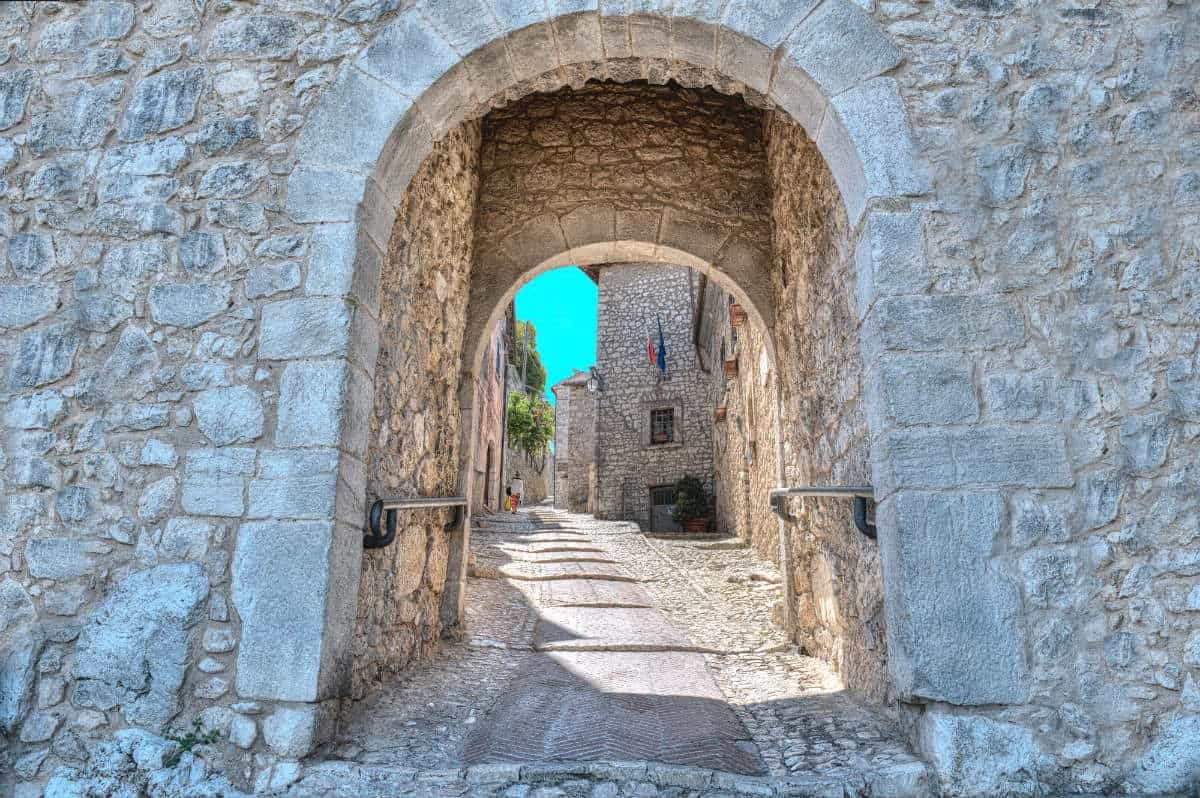
The right photo to take in Anagni is not the frontal close-up of the cathedral, which is beautiful but predictable. The photograph that brings home the sense of the city is taken from the side that looks at the apses of the cathedral and the detached bell tower, with the Sacco valley opening in the background: you understand in one stroke that this is a monument built to dominate a territory. The moment is late afternoon, when the low sun cuts across the stone from the side and lights up its warm color, and the long shadows give relief to the blocks of the walls. A second shot not to be missed is the frescoed façade of Casa Barnekow, which holds up well even in the diffuse light of morning. Inside the crypt, on the other hand, it is best to give up the camera almost entirely: the half-light and the conservation restrictions make the photos disappointing, and the time spent framing is time taken from looking. Anyone who really wants a keepsake should aim at a well-lit detail, without flash, which is forbidden in the crypt.
Some Important Events That Happened Here in History
Anagni has hosted more than one event that left its mark on European history. In 1160 Pope Alexander III excommunicated Emperor Frederick Barbarossa and the antipope Victor IV here, in one of the tensest moments of the struggle between Church and Empire. In this same city Pope Innocent IV was elected. But the event that made Anagni a textbook name is the slap of September 1303, when the men of Sciarra Colonna and Guillaume de Nogaret captured and humiliated the elderly Boniface VIII in his palace, an episode that hastened the pope's end and opened the way to the move of the papacy to Avignon. Even earlier, in the 13th century, Anagni had been the setting of the papal court in its years of greatest splendor, with the city turned into a residence of the pontiffs. In more recent times, in 1798, Anagni took part in the Jacobin uprisings that led to the birth of the Roman Republic, becoming the capital of a department. In 1805 it was annexed to the Napoleonic empire, and during the second Roman Republic of 1848-1849 it hosted the command of a division of the republican army. Every stone of the upper city has seen at least one of these events pass by.
Who Passed Through Anagni (FR)
People who marked history have passed through Anagni, or were born there. Four popes were born here: Innocent III, Gregory IX, Alexander IV and Boniface VIII, the quartet that earns the nickname city of the popes. Kings and emperors stayed here in the course of the medieval disputes, and in 1303 the shadow of the king of France, Philip the Fair, arrived through his men, Guillaume de Nogaret at the head, together with the Roman Sciarra Colonna. Local tradition also ties the name of Dante Alighieri to Anagni, saying he stayed here, perhaps at Casa Barnekow: it is an undocumented tradition, but the poet did speak of the city anyway, condemning in the Purgatorio the outrage suffered by Boniface VIII in words of scorn, even though he was a political adversary of the pope. In the 19th century it was the Swedish baron Albert Barnekow who chose Anagni as his home, restoring and frescoing the house that bears his name. In the 20th century the city gave birth to the sculptor Tommaso Gismondi, whose house-museum can be visited in the center. Walking through Anagni means crossing the places where these names intersected.
The Medieval Reenactments and the Days of the Slap in Anagni (FR)
In summer Anagni is not only stone and frescoes: the city reenacts its past with parades and events in costume. The current historic center is divided into eight contrade, while originally there were 12, each tied to figures and symbols of the medieval period, and in the summer months, between July and August, these districts liven up the streets with processions, drums, flag throwers and costumed participants. The episode that the city stages with the most pride is precisely the slap of 1303: the reenactment retraces the arrival of the conspirators, the capture of Boniface VIII and the reaction of the people of Anagni. Attending these days means seeing the medieval center in its natural element, with the scenery turning into theater. The dates vary from year to year and are published by the Comune and by the city associations in the months before summer, so it is best to find out before planning the visit around the festival. Anyone who happens to be in Anagni on a reenactment weekend finds the city at its liveliest, with the only drawback of heavier crowds.
Anagni (FR) and Ciociaria: A Multi-Day Itinerary
Anagni works as a gateway to Ciociaria, and anyone with more than a day can turn it into the first piece of a broad itinerary. The Anagni day is devoted to the cathedral, the crypt, the Palace of Boniface VIII and the center. On the second day you go up to Fiuggi for the baths and the upper village, or head for Alatri for the megalithic acropolis. A third day can push toward Arpino, the city of Cicero, with its acropolis of Civitavecchia and its pointed arch, or toward Priverno and the Cistercian Abbey of Fossanova. Anyone who prefers to put together papal history and monasteries can link Anagni to Subiaco, cradle of Benedictine monasticism, and to Genazzano. Toward Rome, finally, the same route lets you add Tivoli with Hadrian's Villa. Ciociaria rewards those who travel it slowly, among perched villages, abbeys and cuisine of the land.
The Gesture the Sources Don't Tell: How Anagni Entered the Textbooks with a Slap
In Anagni, in September 1303, something enormous happened: a pope was assaulted and held prisoner in his own house by armed men in the service of the king of France. This is documented, with dates and names. What almost everyone remembers, though, is not the assault: it is a slap. A man striking Boniface VIII in the face, in some versions with an iron gauntlet. Here is the problem: that very detail, the only one that has stayed in collective memory, is also the most fragile of the whole affair, and historians have long considered it a narrative addition more than an established fact.
The Conflict That Leads to That Day, and That Is All Documented
Before the alleged slap there is a very harsh political clash between Boniface VIII and Philip IV of France, known as the Fair, and this part is not legend: it is in the papal records, which can still be read today. The spark is money. In 1296 the bull Clericis laicos forbids sovereigns to tax the clergy without the consent of the Holy See, and Philip responds by blocking the export of precious metals from the kingdom, that is, cutting the flows toward Rome. The clash flares again in 1301 with the king's arrest of the bishop of Pamiers, and escalates in 1302, when the bull Unam sanctam asserts in extreme terms the superiority of spiritual power over temporal power.
At that point the French court changes strategy: instead of arguing about taxes, it accuses the pope. Guillaume de Nogaret, jurist and adviser to the king, publicly maintains that Boniface is illegitimate and a heretic and asks that a council judge him. In the summer of 1303 the pope prepares the excommunication of the sovereign. Nogaret's expedition to Italy is born to prevent that document from reaching its destination, and to bring the pope before a council in France. Joining the jurist is Sciarra Colonna, a member of the Roman family that Boniface had fought and stripped a few years earlier: a personal enemy, not just any mercenary.
What the Documents Say About September 7, 1303
The core of the facts is solid. On September 7, 1303 an armed group enters Anagni, where Boniface VIII was in his summer residence, and storms the papal complex. The pope is captured and held in custody for a few days, while the palaces and goods of the Curia are plundered. Nogaret demands that the pontiff abdicate or follow him to France. Boniface refuses. After a few days the situation reverses: the people of Anagni rise up, drive out the attackers and free the pope. This too is documented, and it is the reason the city has a proud relationship with that story.
The end is quick. Boniface is taken back to Rome under the protection of the Orsini and dies on October 11, 1303, a few weeks after the attack. Here too precision is needed: that he died as a direct result of the violence suffered is an interpretation, widespread already then and taken up later, but not a diagnosis. He was an elderly and sick man, and the sequence of humiliation, displacement and political collapse is enough to explain the rest without having to add blows received.
Where the Document Ends and the Tale Begins
Let's get to the point. The sources closest to the days of the assault describe threats, insults, the demand for abdication, the plunder. They do not describe a slap. The image of the blow to the face dealt by Sciarra Colonna becomes established later, in the chronicle tradition and then in popular history, until it becomes the very name of the episode. On this the scholars who have dealt with it agree in substance: the attack is history, the slap is tale. It is not a minor detail, because it means that one of the most cited episodes of Italian history has passed into the textbooks under a title that in all probability describes a gesture that never happened in that form.
The same caution is due to the sentence that tradition puts in the pope's mouth, something like "here is my neck, here is my head", spoken while he awaits the blow. It is a perfect line, and for that very reason it should be treated as tradition: it belongs to the way the scene was built after the fact, not to a record. What the sources give back is an old man who refuses to resign, which from a political point of view is more interesting than any slap.
Dante, and Why the Image Took Hold So Well
A decisive contribution comes from Dante, who is a witness of his own time and has no sympathy for Boniface VIII. In canto XX of the Purgatorio he stages the outrage of Anagni in very harsh words: "I see the fleur-de-lis enter Alagna, and Christ made captive in his vicar". The lily of France enters the city, and in the pope Christ himself is captured. Pay attention, though, to what Dante actually writes: he does not speak of a slap, he builds a parallel with the Passion, with the mockery, the vinegar and the gall. It is the scheme of the outraged Christ, not the chronicle of a blow. And yet it is precisely that scheme that prepares the ground: if the scene is a new Passion, a physical gesture of scorn becomes almost necessary to complete it.
Here lies the reason the image worked better than the facts. The decline of the papacy's temporal power is a long process, made of taxation, jurists, assemblies and bulls: unreadable, if you tell it that way. A slap, instead, can be seen. It concentrates in one second a reversal that had lasted decades: the layman who raises his hand against the sacred and goes unpunished. A few years later the papal seat moves to Avignon, and the scene of Anagni becomes retroactively the threshold between two eras. Societies tend to remember in images, and an effective image ends up outliving the sources that contradict it.
What Is Left to See, and How to Read It Without Taking the Bait
In Anagni the places of this story are all still standing and can be visited within a few hours. The Palace of Boniface VIII preserves the room that local tradition indicates as the setting of the episode: it is worth entering it knowing that the name of the room is a fact of memory, not an archival datum, and that no contemporary document assigns the gesture to a specific room. Seeing it with this awareness takes nothing away from the visit, on the contrary: it is more interesting to observe a real 13th-century room than to imagine a theatrical scene.
Quick Questions About Anagni (FR)
How far is Anagni from Rome and how do you get there?
Anagni is a little over 60 kilometers from the center of Rome, about an hour by car along the A1 highway with the exit at Anagni-Fiuggi. By train you get off at Anagni-Fiuggi station on the Rome-Cassino line, in the valley below the center, connected by a regular bus. Regional coach runs from Rome also exist. Timetables should be checked on the carriers' sites.
Why is Anagni called the city of the popes?
Because four pontiffs were born there between the 12th and 13th centuries: Innocent III, Gregory IX, Alexander IV and Boniface VIII. In the 13th century the city was also the residence of the papal court.
How much is the ticket for the Cathedral Museum and Crypt of Anagni?
The full ticket is €9, the reduced ticket €6, with a special reduced ticket of €3. The fares should be rechecked on the museum's official site before the visit.
Do I need to book to visit the crypt of San Magno?
Booking is recommended, and for the crypt it is in effect necessary in periods of heavier crowds, because entries are limited to preserve the frescoes. It is best to call the museum at 0775 728374.
What are the opening hours of the Anagni Cathedral Museum?
From November to March from 9:00 to 13:00 and from 15:00 to 18:00. From April to October the afternoon closing is pushed back to 19:00. Last entry is one hour before closing.
How much is the Palace of Boniface VIII?
The full ticket is €5 and the reduced ticket €3, with audio guide included. Entry is free for children under 12, residents of Anagni and visitors with certified disabilities.
What is the crypt of San Magno?
It is the crypt beneath Anagni Cathedral, entirely frescoed with a cycle from the late 12th and early 13th century. For the richness of its paintings it is called the Sistine Chapel of the Middle Ages.
What was the Slap of Anagni?
It is the outrage suffered by Pope Boniface VIII in September 1303, when the men of Sciarra Colonna and Guillaume de Nogaret captured him in his palace. The episode hastened the pope's death and opened the way to the move of the papacy to Avignon.
Can you take photographs inside the crypt?
Conservation rules limit filming and forbid flash. Given the half-light, the photos turn out disappointing anyway: better to spend the time looking.
Is Anagni suitable for children?
Yes, if you pace the stops. The frescoed crypt, the story of the slap and the great Cyclopean walls capture the attention of the little ones. You need comfortable shoes for the uphill stone streets.
Is Anagni wheelchair accessible?
The historic center is uphill and has a stone surface, so it is demanding. The Cathedral Museum, however, has mobile stairlifts and an elevator and reserves parking for visitors with disabilities, upon notice by phone. For the other places it is best to ask in advance.
How much time do you need to visit Anagni?
For a full visit, including the cathedral, crypt, Palace of Boniface VIII, walls and historic center, you need a full day. Half a day is barely enough for the two main monuments.
When is the best time to go to Anagni?
Spring and autumn offer mild weather and excellent light. In summer, better in the morning or late afternoon, avoiding the middle hours. Between July and August the city hosts medieval reenactments and parades.
What are the Arcazzi di Piscina?
They are imposing masonry arches that were part of an ancient system for supplying and collecting the city's water. They are little visited by passing tourism and are worth a detour for anyone who likes hydraulic monuments.
What are the Cyclopean walls of Anagni?
They are walls in polygonal masonry, built with large limestone blocks fitted together dry in pre-Roman times and later reworked. Anagni shares the technique with Alatri, Ferentino and Veroli, centers of the ancient Hernici.
Where did Dante stay in Anagni?
Local tradition ties Dante's stay to Casa Barnekow, a 13th-century house with a frescoed façade. It is an undocumented tradition: the poet did speak of Anagni in the Purgatorio anyway.
Which popes were born in Anagni?
Innocent III, Gregory IX, Alexander IV and Boniface VIII. Three of them, the first ones, belonged to the Conti di Segni family. Boniface VIII came from the Caetani family.
What is there to see near Anagni in a day?
In the surroundings are Fiuggi with its baths, Alatri with its megalithic acropolis, Carpineto Romano, Arpino city of Cicero and Priverno with the Abbey of Fossanova. Toward Rome you can reach Genazzano, Subiaco and Tivoli.
Is Anagni in the province of Rome or Frosinone?
Anagni is in the province of Frosinone, in Lazio, and is the second-largest municipality in the province by territorial area. It is in Ciociaria, in the middle Sacco valley.
The Final Verdict on Anagni (FR)
In Ciociaria, Anagni remains the city that surprises most those who expect a simple provincial village. It has a monument, the crypt of San Magno, that holds its own against the great fresco cycles of Italy, and a history that for a century coincided with that of the European papacy. If you have a single day and want to understand how power worked in the Middle Ages, between faith, art and politics, this hill above the Sacco valley explains it better than many famous museums. The recommendation is simple: book the crypt, give it the time it deserves, and save your legs for the center. Anagni rewards those who visit it slowly.
Article written by the editorial team of TourLeaderPro, contact them for Private/Corporate/V.I.P. Tours and Experiences.
Planning a trip to Rome? The English guides to visiting the city are on ItalyPlanner.com.