Sermoneta (LT)
In short. You reach Sermoneta by climbing the road that leaves the Pontine Plain and rises to the hill of the Lepini Mountains, in the province of Latina, in southern Lazio.

You reach Sermoneta by climbing the road that leaves the Pontine Plain and rises to the hill of the Lepini Mountains, in the province of Latina, in southern Lazio. The historic center is pedestrian and can be visited on foot in half a day. The main monument is Caetani Castle, on Via della Fortezza, run by the Fondazione Roffredo Caetani, which can be visited only on a guided tour in shifts of about an hour. The full ticket for the castle is €8, reduced to €6 for visitors with disabilities and their companion, and free for children under 12 accompanied by an adult. For school groups the fee is €5. Public openings alternate through the year. Private groups are admitted all year except Monday, the weekly closing day, and school classes on dates to be agreed with the Foundation's booking office. By car from Rome it's about 68 kilometers and an hour and 20 minutes of travel. By train you get to Latina Scalo from Roma Termini with Trenitalia and continue by Cotral bus to Sermoneta. Parking is outside the walls, because cars don't enter the village. Anyone who wants to combine the nearby Ninfa Garden should know that it can be visited only by reservation, on specific dates of the season, through the garden's official website. The two destinations are a few kilometers from each other and make up the classic outing in the area.
To find your way among the nearby villages and the other destinations of the Lepini Mountains, it's best to start from the Lepini Mountains page, the area Sermoneta belongs to by geography and by history.

Where Sermoneta is and how to get there from Rome
Sermoneta is a walled village of medieval layout that occupies a spur of the Lepini Mountains, overlooking the reclaimed Pontine Plain. The municipal territory descends from the height to the plain and includes the plain hamlets, born in the 20th century, of Doganella di Ninfa, Tufette, Pontenuovo and Carrara, on the borders with Cisterna di Latina and with the provincial capital Latina. The historic center, the one the visitor comes to see, remains instead clinging to the hill of olive trees, ringed by walls and dominated by the castle. Anyone arriving from the plain sees the town appear suddenly after the last bend, with the bulk of Caetani Castle on top and the cathedral tower as its counterpoint.
By car from Rome to Sermoneta
From the capital the most direct route follows the A1 highway south to the Valmontone exit, then the roads that descend toward the Pontine Plain, or else Via Pontina up to Latina and from there the climb toward the Lepini. The distance is about 68 kilometers and the stated travel time is about an hour and 20 minutes, which becomes longer on summer weekends, when the plain fills with traffic toward the sea. The car remains the most convenient means, because it lets you combine in the same day the Ninfa Garden, Valvisciolo Abbey and maybe a second Lepini village. The practical advice is not to aim to park inside the town: you can't enter inside the walls by car.
By train and bus to Sermoneta
Without a car the trip requires two means of transport. From Roma Termini you take the regional train on the line to Naples via Formia and get off at Latina Scalo. From the station a Cotral bus links the plain to the village. The total time indicated is about an hour and 55 minutes, and the bus runs toward the historic center are not very frequent, so the current Cotral timetable should be checked before leaving, in particular for the evening return. For anyone traveling as a day trip from Rome without a car, this is the real constraint: the last useful run downhill determines the time you have to leave the village.
Where to park in Sermoneta
The parking areas are outside the city walls, near the access gates. From there you enter on foot and climb through the paved alleys up to the square and the castle. Those with mobility difficulties should keep in mind that the village is all uphill and cobblestone: comfortable shoes are the first recommendation, and strollers struggle on the stairs and the cobbles.
Sermoneta at a glance: the hill, the walls, the silence
The town has a compact, readable shape: the circle of walls encloses a maze of limestone alleys climbing upward, with tower-houses, loggias and flying arches that span the streets. At the top sits Caetani Castle, on the other side of the town the Santa Maria Assunta Cathedral with its bell tower. In between, Piazza del Popolo with the Loggia dei Mercanti. The appeal of Sermoneta is that it has stayed intact: the land reclamation and the postwar depopulation, which elsewhere erased historic centers, here froze the village as it was, so much so that the Touring Club Italiano has awarded it the Bandiera Arancione (Orange Flag), the recognition of tourism and environmental quality for inland areas. It's not a fake museum-town: it's a real, lived-in town that has simply lost its hurry.

The history of Sermoneta, from the Volsci to the Caetani
The history of Sermoneta is the history of a position: the hill controlled Via Pedemontana, the artery that in the Middle Ages had replaced the Appia in the connections between the north and the south of the peninsula, when the marsh had made the plain route impassable. Whoever held Sermoneta held the road and the customs post. Around this control was built the fortune of one of the most enduring feudal families of Lazio, the Caetani.
Sulmo, Ninfa and the origins of Sermoneta
The territory was inhabited already in the archaic era. Scholarly tradition places near the present Valvisciolo Abbey the ancient Volscian city of Sulmo, which Virgil mentions in the Aeneid. This is a hypothetical identification, not a certain archaeological fact. According to the most widespread reconstruction, the expansion of the Pontine marshes and the Saracen raids pushed the inhabitants of ancient Sulmo to move onto the hill, where the name Sermoneta appears in documents already in the 11th century. The castrum Sermineti passed in the early 13th century under the rule of the Annibaldi family.
The arrival of the Caetani in 1297
The moment that changes the village's destiny is 1297, when Pietro Caetani, Count of Caserta, buys Sermoneta with the support of his uncle Benedetto Caetani, who rose to the papal throne as Boniface VIII in 1294. With the same operation the Caetani put together a compact holding that includes Sermoneta, Ninfa, Bassiano and the lakes of Fogliano and Caprolace. The family makes the village the center of its domains in southern Lazio, precisely because of its position on the Pedemontana. In the struggles for control of the road and the customs post, the people of Sermoneta side with the Caetani against nearby Ninfa and against Sezze. It's from this period that the expansion of the medieval core dates, still well preserved today, with the Castle and the Santa Maria Assunta collegiate church as its poles.
The Borgia interlude: Lucrezia in Sermoneta
Between 1499 and 1503 the castrum passed under the rule of Pope Alexander VI, the Borgia, who, after confiscating it from the Caetani, granted it to his daughter Lucrezia Borgia and then to his grandson Rodrigo of Aragon, her son, who was the first to bear the title of Duke of Sermoneta. It's to Alexander VI that the extensive military restructuring of the castle is owed, which took on the appearance still visible today, with the citadel and the crenellated patrol walkway. Under Lucrezia's government, in 1501, a new municipal Statute was drawn up, which in fact never came into force because of the Caetani's return in 1503. It was a brief interlude but a heavy one in the stones: much of what makes the castle a real fortress today bears the signature of that Borgia intervention.
The decline of Sermoneta and the reclamation of the Agro Pontino
From the 16th century, with the first reclamation works of the Agro Pontino and the reopening of the plain Appia, the village began a slow decline. In 1567 it lost the title of capital of the Caetani duchy, which moved its central seat to Cisterna. In 1928, in the locality of Doganella di Ninfa, the Opera Nazionale Combattenti placed one of the headquarters for the great reclamation of the Agro Pontino promoted in those years. After the war the historic center suffered heavy depopulation in favor of the plain hamlets, where life was more comfortable. On the other hand, that very abandonment saved the integrity of the ancient village, which in the following years became a destination for growing cultural tourism. The municipality today has about 10,000 inhabitants, spread between the hill and the plain.
Caetani Castle of Sermoneta
Caetani Castle is the reason most visitors climb to Sermoneta, and rightly so: it's one of the best-preserved medieval fortresses in Lazio, never reduced to a ruin and never distorted by fanciful reconstructions. Its origins go back to the 13th century, under the Annibaldi. The Caetani purchase of 1297 and above all the expansions of the 15th century give it the structure of a fortified residence, while the Borgia intervention of the late 15th century turns it into a war machine, with the defensive citadel and the walkways added. In the 16th century the fortress was adapted to artillery. Then, from the 17th century, progressive abandonment, use as a warehouse in the 19th century and finally the restorations that made it the visitable monument of today. The property belongs to the Fondazione Roffredo Caetani, the same one that owns and manages the Ninfa Garden.
The Maschio and the Maschietto of Caetani Castle
The castle's silhouette is dominated by the Maschio, the main tower 42 meters high, flanked by the smaller tower called the Maschietto. The Maschio is the symbol of the village, visible from all over the Pontine Plain: it was the last defensive redoubt, the point where the garrison would have holed up if the walls had fallen. Climbing to the top pays off with a view that on clear days reaches the sea and the Pontine islands, and inland takes in the chain of the Lepini. Around the towers run the moat, the drawbridge and the crenellated curtain wall of the Borgia era, which make the logic of a real fortress readable at a glance.
The Camere Pinte of Caetani Castle
The residential and artistic heart of the castle is the Camere Pinte, the frescoed rooms dating to around 1470, when the fortress was also a noble residence. The walls preserve decorations with mythological and allegorical scenes, of late Gothic and Renaissance taste, which tell the domestic face of the Caetani, that of the court and of representation, in contrast with the military harshness of the rest of the building. Other frescoed rooms are attributed to the school of Pomarancio. It's worth stopping before these paintings, because they are the most fragile and least obvious part of the visit, the one that sets Sermoneta apart from the many castles reduced to empty walls.
The dungeons and prisons of Caetani Castle
The guided tour also goes down into the low, dark part of the fortress, the dungeons and prisons, where inscriptions and graffiti carved over the centuries survive. It's the hard face of feudal power, the one that postcard castles usually hide. The contrast between the painted rooms of the main floor and these confinement spaces is the best summary of what a medieval lordship was: culture and force in the same building, a few meters apart.
How to visit Caetani Castle: hours and tickets
Entry to Caetani Castle is exclusively by guided tour, in shifts of about an hour. The full ticket is €8. There's a reduced €6 ticket for visitors with disabilities together with their companion, free admission for children under 12 accompanied by an adult, and a discounted €5 fee for school groups. Large private groups can book all year except Monday, the weekly closing day. School classes visit on dates to be agreed with the Foundation's booking office. Drones, animals and picnics are not allowed inside the enclosure. Comfortable shoes are a must because of the stairs, which make a stroller inadvisable. Opening hours and dates vary through the year: before climbing up it's best to check them on the website of the Fondazione Roffredo Caetani, because the castle isn't open continuously like a city museum.

Santa Maria Assunta Cathedral in Sermoneta
At the opposite end of the village from the castle stands the Santa Maria Assunta in Cielo Cathedral, the collegiate church that is Sermoneta's second great monument. The church was built on an older place of worship, according to tradition a temple dedicated to the goddess Cybele, and the current building dates to around the 12th century, with the usual layering of later interventions. The original plan had three aisles. The Gothic cross vaults, of Cistercian taste, replaced the original wooden roof at a later time. The cathedral is protected by the Soprintendenza for its historic and artistic value.
The Romanesque bell tower of Sermoneta cathedral
The bell tower is the oldest and most characteristic part: a square-based tower 24 meters high, marked into six stories by string courses, with two-light windows with paired colonnettes, datable between the 11th and 13th centuries, and therefore earlier than the Cistercian reworkings of the church. The pyramidal roof that topped it was destroyed in the 16th century: local tradition says lightning struck it in 1561. The bell tower remains the visual signal of the village from the side opposite the castle's Maschio, and the two vertical elements, the military tower and the bell tower, answer each other from one end of the town to the other.
Benozzo Gozzoli's Madonna in Sermoneta cathedral
The work that alone is worth the climb into the cathedral is the panel by Benozzo Gozzoli, one of the great painters of the Florentine Renaissance, dated 1456 and kept in the Chapel of the Angels, in a side aisle. It depicts the Virgin enthroned, also called the Madonna of the Angels, holding in her hands the model of the city of Sermoneta. It's the oldest painted representation of the village, an urban portrait of the mid-15th century, valuable as a painting and at the same time as a historical document. To stand before a painted image of your destination five and a half centuries ago, while outside the church door that same profile is still recognizable, is the most intense experience the visit offers. It's worth the symbolic ticket and it's worth the line, if there is one.
The other works and chapels of the cathedral
The church holds other important works. On the lunette of the portal a Madonna and Child between Saints Peter and Augustine is signed by Pietro Coleberti in 1422. On the inner facade a 15th-century Last Judgment is attributed to Desiderio da Subiaco. The choir was frescoed in the early 17th century on commission from Flaminio and Alessandro Americi, with Stories of the Virgin centered on the Assumption, completed by Bernardino Cesari, younger brother of the more famous Cavalier d'Arpino. A monumental wooden canopy by Giuseppe Baccari from 1683, a wooden crucifix by Francesco Cavallini from 1689 and the Chapel of the Most Holy Rosary with 18th-century frescoes by Giovanni Domenico Fiorentini complete the ensemble. The 20th-century restorations, in particular that of 1963, brought back to light the medieval pillars that the Baroque interventions had plastered over.
San Giuseppe Church and the Caetani Chapel of Siciolante
San Giuseppe Church, built starting in 1525 under the patronage of the Caetani, with the facade and access staircase completed in 1733, holds the village's Renaissance painting masterpiece: the Caetani Chapel frescoed by Girolamo Siciolante da Sermoneta in 1550, on commission from Bonifacio I Caetani. The iconographic program is ambitious. In the vault stands the Assumed Virgin. In the middle register three scenes from Genesis, the Creation of Adam, the Creation of Eve and the Original Sin. In the lower register three scenes of the Passion, the Flagellation, Christ before Pilate and the Ascent to Calvary. Under the apse a Holy Family with Saint Jerome and Saint Bonaventure, and in monochrome the Sacrifice of Isaac and Moses before the Burning Bush. The church has a single nave with three chapels per side. Among these is the Mazzancollo chapel, decorated between 1605 and 1606, with the side saints by Angelo Guerra d'Anagni. The Caetani Chapel is the reason art historians climb to Sermoneta: it's one of the most accomplished early works of Siciolante, measured against Michelangelesque models.
Girolamo Siciolante, the painter born in Sermoneta
Girolamo Siciolante, born in Sermoneta around 1521 and died in Rome around 1580, is the village's most illustrious son. Trained in the orbit of Perin del Vaga and in comparison with Francesco Salviati, he worked in Rome on the great building sites of the second half of the 16th century, from the decoration of palaces to altarpieces for Roman churches, in a style that reconciles Counter-Reformation rigor with the lesson of Michelangelo and Raphael. In Sermoneta, besides the San Giuseppe frescoes, works of his on panel are preserved. One of these comes from Valvisciolo Abbey, where it adorned the high altar. Knowing Siciolante before visiting the Caetani Chapel changes the visit: you stop looking at an anonymous fresco and start reading the work of an artist who from his mountain town reached the papal building sites. Of Sermoneta itself there is also news of a Giovanni Paolo, a painter active in Cori in 1527, a sign that the village produced a small artistic tradition.
The other churches of Sermoneta
Besides the collegiate church and San Giuseppe, the village and its territory preserve several religious buildings that complete the visit. San Michele Arcangelo Church, inside the historic center, also hosts concert events in the summer months. San Francesco Church and the former convent testify to the Franciscan presence. Santa Maria delle Grazie Church and the remains of Santa Maria della Vittoria Church, from the 16th century, are tied to the memory of the Battle of Lepanto and to the vow of Onorato Caetani. None of these has the fixed hours of a museum: many open for services or during events, so it's best to ask on the spot or at the Pro Loco which ones can be visited on the day of your trip.
The Loggia dei Mercanti and the civil architecture of Sermoneta
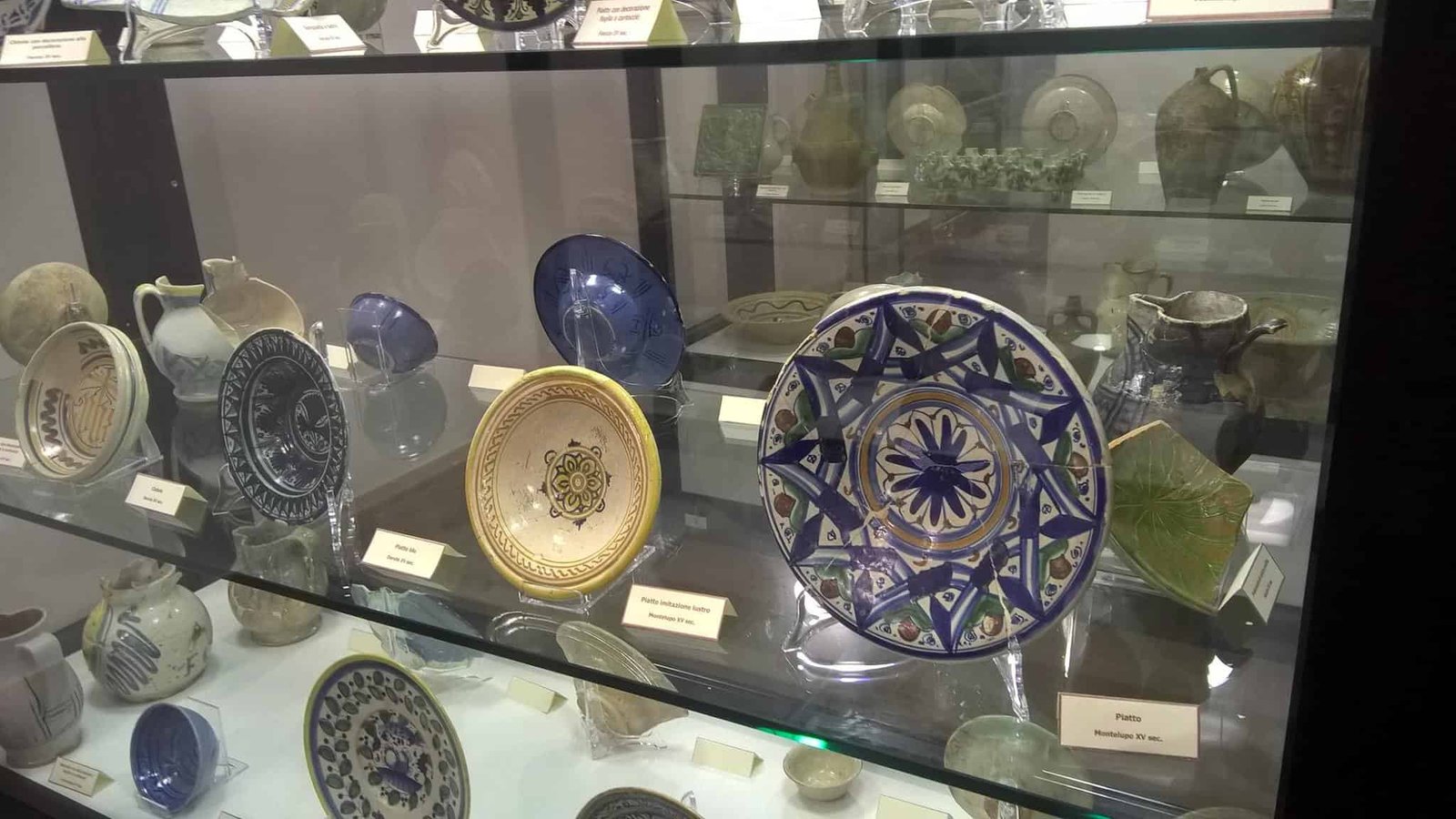
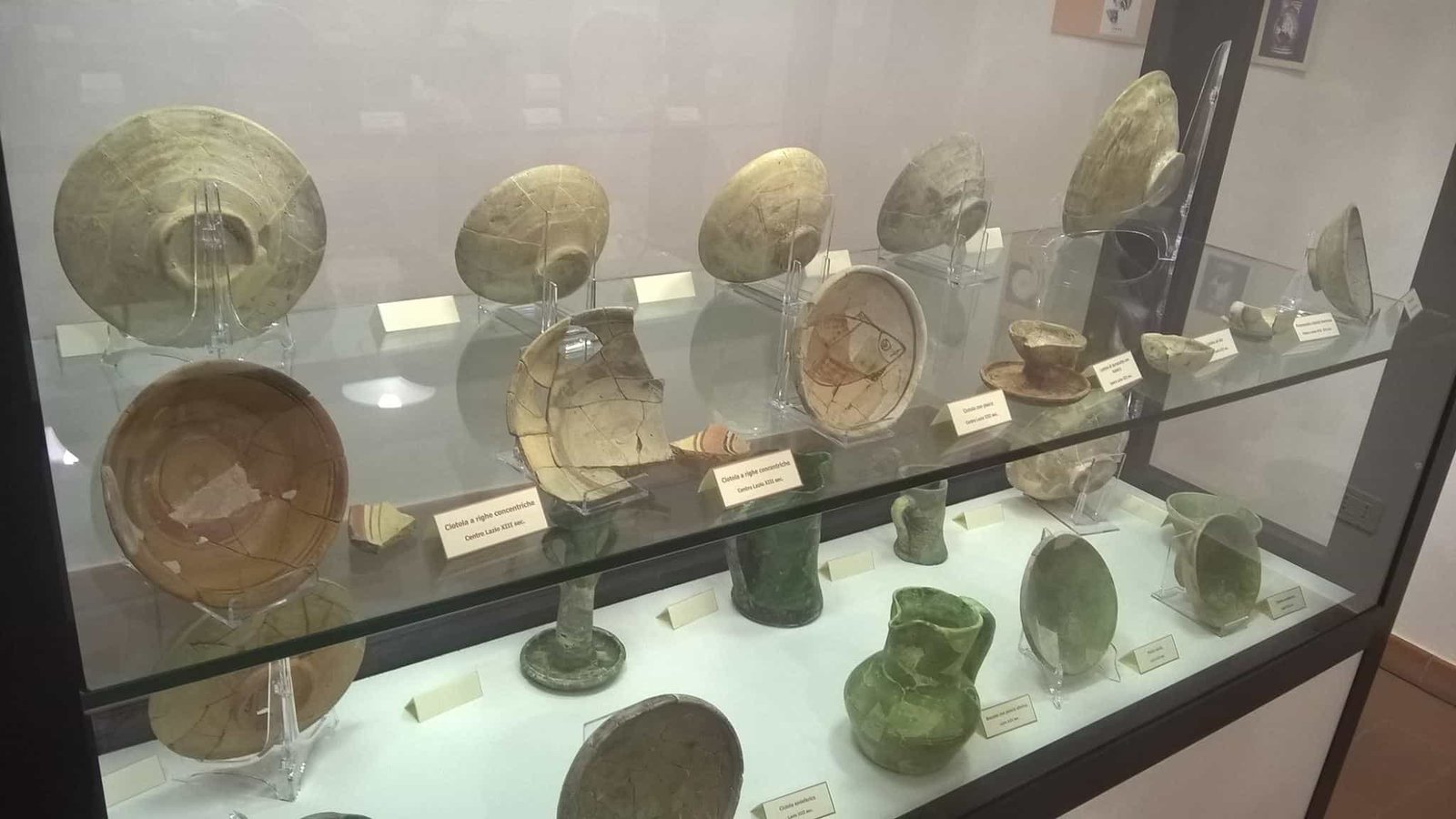
On the main square of the village opens the Loggia dei Mercanti, an open portico that once hosted commercial exchanges and bargaining, and that today serves as a meeting place and a shelter to stop under. It's the most photographed image of Sermoneta after the castle: the stone arches frame the life of the town and change face with the light of the day. Around the square are arranged the buildings of civil power: Palazzo Americi, from the 16th century, now home of the Town Hall, and Palazzo De Marchis-Caetani, also from the 16th century, which houses the Permanent Ceramics Exhibition. Ceramics is a local vocation that deserves a stop: the two rooms of the small museum tell of a craft production tied to the territory, and are the chance to understand a trade that has ancient roots here.
The ancient Jewish ghetto of Sermoneta
One of the lesser-known chapters of Sermoneta is its Jewish community, which in the 15th century was among the liveliest of the Lepini Mountains. The first documented presence dates to 1297, when a certain Sabbatuccio appears among those who swear loyalty to Pietro Caetani, but it is between the 1420s and the 1460s that the notarial records reveal a relatively large community, with about 20 heads of families, some of whom came from Fondi, Velletri and Anagni. A prominent figure was Abramo di Mosè, whom in 1448 the feudal lord exempted from the annual taxes, calling him his beloved servant, in exchange for services rendered: he was active in fishing, livestock raising, pawn lending and butchery, often in partnership with Christians. The Jewish quarter occupied the Contrada degli Idoli, in the Portella district, an area of predominantly Jewish character already from the 1440s, the synagogue stood on today's Via Marconi, once called Via degli Ebrei. The community declined after the early 1500s, with many sales of property, and was expelled in 1569, in 1574 only the synagogue and the cemetery remained in Jewish hands. Walking in that district today, knowing you are crossing a Via degli Ebrei of five centuries ago, adds to the visit a layer of history that hurried guides almost always skip.
The walls, gates and military architecture of Sermoneta
Sermoneta's defensive system doesn't end with the castle. The circuit of walls that embraces the village, with its entrance gates, was a single body with the fortress, on the territory there are also preserved the Torre Petrara and, on nearby Monte Carbolino, the remains of polygonal walls called Cyclopean, of pre-Roman age, which bear witness to an archaic settlement long predating the medieval village. Nearby is also the archaic necropolis of Caracupa, an archaeological site documenting the ancient presence on these heights. Anyone with time and legs can look for these elements outside the main circuit: they tell the long history of the hill before the Caetani built their dominion there.
Valvisciolo Abbey near Sermoneta
A few kilometers from the village, at the foot of the Lepini Mountains, stands Valvisciolo Abbey, one of the destinations that complete the trip to Sermoneta. According to tradition the place was inhabited around the year 1000 by Greek Basilian monks, the present building was built between 1150 and 1170 and completed by the Cistercians who arrived around the middle of the 12th century, so much so that it is considered the oldest Gothic-Cistercian church in the Marittima and Campagna area. A later tradition, widespread locally but without documentary proof, also links the abbey to the Templars. The facade has a large rose window formed by 12 small marble columns, the interior, with three naves, is marked by eight plain rectangular pillars without ornament, in keeping with Cistercian sobriety, and the choir is lit by three arched single-light windows and a small rose window high up. The square cloister, restored in 1957, has groin vaults. The abbey is open every day, with approximate hours of 7:00-12:30 and 15:00-19:00, guided visits and access to the museum are arranged with local contacts. The sobriety of this space, after the richness of the castle and the cathedral, is a counterpoint worth the short detour.
The Ninfa Garden, at the foot of Sermoneta
Sermoneta's inseparable pair is the Ninfa Garden, the oasis that spreads across the plain, in the territory of Cisterna di Latina, over the ruins of an abandoned medieval city. The garden, with an informal English layout, was created by the Caetani starting in the 1920s on the remains of Ninfa, crossed by the river of the same name, today it occupies about eight hectares within a protected area of 106 hectares, declared a Natural Monument by the Lazio Region on February 25, 2000, which also includes the Pantanello wetland. It is run by the Fondazione Roffredo Caetani onlus, established in 1972 by the will of Princess Lelia Caetani, last heir of the family, the same foundation that owns Sermoneta castle.
Visiting the garden isn't free: you enter only by reservation, on specific dates of the season that runs roughly from March to November, mostly on weekends, booking through the garden's official website. The opening dates for the year change and should be checked in advance, because places are limited and on spring weekends they sell out quickly. Anyone planning the day has to fit the time booked at Ninfa around the climb up to Sermoneta, keeping in mind that the two destinations are a few kilometers apart but each requires its own time. The most famous period is spring, when the blooms are at their best, but for that very reason it is also the most crowded and the hardest to book.

To explore the oasis in depth, you should read the page dedicated to the Ninfa Garden, which tells its botanical history and the visiting rules.
The Festival Pontino di Musica at Caetani Castle
In summer Sermoneta becomes for a few weeks a capital of chamber music. The Festival Pontino di Musica, organized by the Fondazione Campus Internazionale di Musica, brings great masters and young talents every July to the historic places of the area: the courtyard of Caetani Castle in Sermoneta, the cloister of Valvisciolo Abbey, Fossanova Abbey and other venues in the province of Latina. Listening to a string quartet in the castle courtyard, with the medieval walls as a sounding board and the sky of the Lepini overhead, is an experience no concert hall can replicate. Tickets for individual concerts have modest prices, on the order of a few euros, with booking recommended. Anyone visiting Sermoneta in July should check the festival calendar: happening upon a concert evening is worth the trip more than any daytime visit.
The festivals and traditions of Sermoneta
Sermoneta's calendar of events is full and runs through the whole year. It begins in January with the Sagra della Polenta, on the Sunday closest to January 17, the feast of Saint Anthony Abbot. In March the Festa di San Giuseppe, patron saint of the town, is celebrated, along with the Festa dei Fauni on March 18. Spring continues with the Maggio Sermonetano. In July the Festival Pontino di Musica arrives, and with it the season of concerts at the castle. On the first weekend of August the international festival Sermoneta in Folklore takes place. On September 29 the centuries-old Fiera di San Michele returns. In fall and winter the village prepares for Christmas in Sermoneta, with artistic nativity scenes, concerts and theater shows throughout the holiday period.
The most scenic tradition is the Historical Reenactment of the Battle of Lepanto of 1571. Onorato IV Caetani, who at Lepanto commanded the papal infantry, returns to the village every year with his troops and meets the court. The reenactment celebrates the outcome of the famous naval battle and at the same time the vow that, according to tradition, Onorato made to the Madonna at the hardest moment of the clash, promising to build her a church in case of victory, the Madonna della Vittoria Church, whose ruins remain. Attending the reenactment means seeing the village tell in the first person an episode in which its feudal family played a real part in European history.
What to see around Sermoneta
Sermoneta is an excellent base camp for exploring the Lepini Mountains and the Pontine Plain. A short walk from the municipal territory are the ruins of the ancient Latin city of Norba, perched on a plateau with its polygonal walls, and the Privernum Archaeological Park, in the territory of Priverno. Among the nearby villages, Sezze is worth a detour, Sermoneta's old rival perched on the other slope, and so is Cori, with the Temple of Hercules from the Republican age. Going further inland into the Ciociaria you find Anagni, the city of the popes, Alatri with its megalithic acropolis, Carpineto Romano and the baths of Fiuggi. Toward the sea, on another day, you go down to Sperlonga and Gaeta. Toward the Castelli and the Sacco valley, finally, Genazzano deserves a look. Many of these destinations lie within half an hour or a little more, and let you build itineraries of two or three days without ever going too far.
Sermoneta with kids
Kids like the castle: the towers, the drawbridge, the dungeons and the story of dukes and battles work better than any book. The one-hour guided tour is within their reach, as long as they're used to walking, because the village is all stairs and climbs. Strollers struggle on the cobblestones and the castle stairs, so with the youngest a baby carrier or child-carrier backpack is best. The Ninfa Garden, with the river, the little bridges and the open spaces, is the other destination kids enjoy, provided you respect the rules of the oasis. A day that alternates the fortress with the garden, with a lunch break in between, holds together the adults' pleasure and the little ones'.
When to go to Sermoneta
Spring is the best time to combine the village with the Ninfa Garden, but it's also the most crowded and the one in which Ninfa reservations must be made well in advance. Summer, with the Festival Pontino, gives you concert evenings at the castle, which are worth the trip on their own. By day the heat of the plain is felt, but on the hill the air is easier to breathe. Fall offers good light for photographs and fewer people. Winter has the charm of the village in the mist and the atmosphere of Christmas in Sermoneta, with the nativity scenes and concerts, but some destinations have reduced hours. In every season the advice is to check beforehand the castle's openings and Ninfa's dates, because neither works on the continuous hours of a city museum.
How to organize a day in Sermoneta
A well-planned day in Sermoneta combines the village, the castle and at least one of the nearby sights. The fixed constraint, if you also want to see Ninfa, is the booked time slot for the garden, which has to be set well in advance because spots are limited. Everything else fits around that. If you come by car, you can pack in more stops: morning in the village and at the castle, lunch inside the walls, afternoon at Ninfa or at Valvisciolo Abbey, which doesn't require a reservation. If you come by public transport, you have to plan everything around the last Cotral bus heading down the hill, and it's best to focus on the village and the castle alone, without overloading the schedule. The guided tour of the castle lasts about an hour. The cathedral and a walk through the alleys take another two or three hours at an easy pace. Bring comfortable shoes, water in summer and a bit of patience for the climbs: Sermoneta is a vertical town, and anyone who rushes it misses half of it. Before leaving, it's worth checking just two things: the opening dates and hours of Caetani Castle on the website of the Roffredo Caetani Foundation, and Ninfa's availability on the garden's official website. With those two checks done, the rest of the day goes smoothly.
The view of the Lepini Mountains from Sermoneta
Sermoneta's position is itself part of the visit. The village sits on a spur of the Lepini Mountains overlooking the Pontine Plain, and from several points in town, in particular from the castle walkways and from the top of the Maschio, the view runs across the reclaimed plain to the coast, with the Pontine Islands appearing on clear days, and inland it takes in the limestone chain of the Lepini, with Monte Carbolino and the nearby heights. It's the same view that made the hill strategic: from here they controlled the plain, the road and the movements down below. For today's visitor, that military value has turned into scenic value. The best hours are early morning, when the haze lifts from the plain and the village emerges above the veil, and late afternoon, when the low light sets the limestone of the walls aglow. If you like walking, you'll find trails in the surroundings that climb the Lepini and give you the village seen from above, with the castle and the cathedral marking the two ends of the profile.
Sermoneta village on foot: alleys, tower houses and squares
The right way to get to know Sermoneta is to get lost in its alleys. From the entrance gate you climb along paved streets that narrow and widen with no apparent logic, following the spontaneous layout of a settlement that grew on a slope. The houses are built of local limestone, many with the structure of the medieval tower house, tall and narrow, and arches that span the alleys to counter the thrust of the walls. Every so often the fabric opens into a wider space or a small square, and the climb gives you sudden glimpses of the plain below. The civic heart of the village is Piazza del Popolo, with the Loggia dei Mercanti on one side and the town hall buildings on the other. From here the streets branch off, leading to the castle on one side and to the cathedral on the other. Walking without a map, letting the slopes decide the route, is the best way to understand how a walled village worked: every dead-end alley was a defense, every arch a reinforcement, every tower house a small garrison. In one hour of slow strolling you cross the whole built history of Sermoneta, from the 13th-century walls to the 16th-century palaces of the Caetani.
Sermoneta ceramics and the craft workshops
Ceramics are an old vocation of Sermoneta, and the permanent exhibition set up in the 16th-century Palazzo De Marchis-Caetani preserves the memory of it. The rooms display pieces that tell of a craft production tied to the area and its clays, a trade with deep roots here. It's worth a short but instructive stop: understanding the local ceramics helps you read the village as a living community, which for centuries lived on the work of its hands, and not only as a collection of monuments. In the alleys a few craft workshops still survive, where the ceramic tradition sits alongside other crafts. It's the kind of purchase that makes sense to take home from a trip like this, far more than a mass-produced souvenir. If you're interested in crafts, give the exhibition half an hour and then keep your eyes open in the alleys: the workshop signs are as much a part of the landscape as the stones of the houses.
A curiosity about Sermoneta (LT)
The curiosity few people know is about a painting. In Santa Maria Assunta Cathedral, the panel that Benozzo Gozzoli signed in 1456 shows the Virgin enthroned, holding a model of Sermoneta in her hands: it is the oldest painted image of the village known. The detail that surprises is its fidelity. Anyone who leaves the church and looks at the town's profile finds again, five and a half centuries later, the same cluster of houses around the castle that the Florentine painter placed in the Madonna's palm. It's like having a 15th-century photograph of your destination, painted by one of the masters of the Renaissance, hanging in the very place it portrays. Many visitors enter the cathedral for the bell tower and don't notice that the real rarity is that model: an urban portrait that precedes by centuries the very idea of a topographic view, and that makes Sermoneta one of the very few villages that can be seen as it was in the 15th century through the eyes of a contemporary. It's worth getting closer, looking for the details of the walls and towers, and comparing them with what you've just walked through on the way up.
Something nobody tells you about Sermoneta (LT)
What hurried guides leave out is that for more than a century Sermoneta had a large Jewish community, integrated into the economic life of the village. In the 15th century, between the 1420s and the 1460s, notarial documents record about 20 Jewish heads of family, active in pawnbroking, butchery, livestock raising and fishing, often in partnership with local Christians. One of them, Abramo di Mosè, was exempted from taxes in 1448 by the feudal lord, who called him his beloved servant. The Jewish quarter occupied the Portella district, in the Contrada degli Idoli, and the synagogue stood on today's Via Marconi, which used to be called Via degli Ebrei. The community was then expelled in 1569, and in 1574 only the synagogue and the cemetery were still in Jewish hands. It's a story that doesn't appear on tourist signs, yet it explains an important piece of how a feudal village worked: not a closed place, but a small market where different trades and faiths lived side by side. Walking along Via Marconi knowing what it was is a different way of walking in Sermoneta.
My advice for visiting Sermoneta (LT)
To organize the day, my advice is to reverse the instinctive order. Almost everyone puts Ninfa first and Sermoneta after, because the garden has a booked time slot and seems the main constraint. It makes more sense to think the other way around: build the day around Ninfa's time slot, which is fixed and can't be moved, and fit Sermoneta into the free hours, because the village can be visited at an easy pace and without lines. Early in the morning I go up to the castle with one of the first guided tours, when the light is good and the groups haven't arrived yet. Then I go down to the cathedral for Gozzoli's panel and the bell tower, have lunch in the village, and in the afternoon I reach Ninfa at the booked time. If you have only one day and have to choose between the two, keep in mind that the castle can be visited all year while Ninfa opens only on a limited number of dates: if you haven't booked Ninfa in time, it's better to spend the day on Sermoneta and Valvisciolo Abbey, which doesn't require a reservation. And if you happen to be there in July, check the calendar of the Festival Pontino: an evening concert in the courtyard of Caetani Castle changes the meaning of the whole trip.
Another well-known fact, yet rarely mentioned
We know Lucrezia Borgia was duchess of these lands, but we forget how much that brief rule weighed on the stones of Sermoneta. Between 1499 and 1503 Pope Alexander VI confiscated the fief from the Caetani and assigned it to his daughter Lucrezia and his grandson Rodrigo of Aragon, the first to bear the title of Duke of Sermoneta. In those barely four years the castle was transformed from a fortified residence into a war machine: the defensive citadel, the crenellated patrol walkways and the adaptation to the logic of artillery all bear the signature of the Borgia intervention. In 1501, under Lucrezia's rule, a new municipal Statute was even drawn up, but it never came into force, because in 1503 the Caetani regained possession of the fief and the interlude closed. The paradox is that the current look of the fortress, which visitors admire as a symbol of Caetani power, is in large part the work of the one who had wrested the castle from the Caetani. Four years of Borgia left a more lasting mark in the stone than centuries of ordinary management.
The right photo to take in Sermoneta (LT)
The most obvious postcard is the village seen from the uphill road, with the castle on top and the walls enclosing the hill: you take it as you climb from the plain, and on clear days the Pontine Plain forms the backdrop all the way to the sea. But the photograph few people look for is a different one: you climb the Maschio of the castle, the tower 42 meters high, and from up there you frame the town from above, with the roofs packed around the cathedral and the Lepini behind. It's the same perspective, reversed, as the one Benozzo Gozzoli painted in the Madonna panel. For the light, the late-afternoon climb in autumn or spring is the best: the low sun carves out the stones of the houses and sets the limestone of the walls aglow. Inside the village, the Loggia dei Mercanti with its arches frames the life of the square and changes at every hour of the day. And if you have patience, wait for a concert evening of the Festival Pontino: the lit castle courtyard, with the audience gathered, is the image that tells Sermoneta better than any daytime view.
Some important events that happened here in history
The history of Sermoneta is marked by a few turning points that left their mark. In 1297 Pietro Caetani bought the village with the support of his uncle Boniface VIII, starting the long rule of the family that would make the hill the center of its holdings in southern Lazio. Between 1499 and 1503 the Borgia interlude, with the confiscation of the fief and its assignment to Lucrezia Borgia, transformed the castle into the fortress we see today. In 1536 Emperor Charles V, returning from the African campaign, stopped at the castle of Sermoneta on his way to Rome: the presence of the most powerful man in Europe within these walls is one of the moments when the history of the village intertwines with that of the continent. In 1561, according to local tradition, a lightning bolt struck and destroyed the pyramidal roof of the cathedral's bell tower. In 1571 Onorato IV Caetani commanded the papal infantry at the Battle of Lepanto, the episode the village commemorates every year. In 1567 the loss of the title of capital of the duchy, which passed to Cisterna, marked the start of the decline. Finally, in 1928, the Doganella di Ninfa became one of the headquarters of the great reclamation of the Agro Pontino, the project that would change forever the plain at the foot of the hill.
Who passed through Sermoneta (LT)
Figures who belong to great history have passed through Sermoneta. Boniface VIII, the Caetani pope, was the indirect architect of the family's rise over the village. Lucrezia Borgia was its duchess between 1499 and 1503, together with her son Rodrigo of Aragon, and left there the imprint of the 1501 Statute and of the renovation of the castle. Emperor Charles V stopped there in 1536. In the field of art, Benozzo Gozzoli left in Sermoneta, with the 1456 panel, the first painted portrait of the town. And from Sermoneta set out Girolamo Siciolante, born here around 1521, to become one of the most sought-after painters of Rome in the second half of the 16th century, working on papal worksites after training alongside Perin del Vaga. Onorato IV Caetani carried the name of the village to Lepanto in 1571, at the head of the papal infantry. A local tradition, not confirmed by documents, holds that even Leonardo da Vinci was a guest of the village: it's a fascinating legend that is best told for what it is, a handed-down tale and not a proven fact. Today, every July, the great chamber music performers whom the Festival Pontino brings to Caetani Castle continue that chain of illustrious visits.
Where to eat and the local products of Sermoneta
The cooking in the area is that of the Lepini and the Pontine Plain: land-based dishes, bread, oil from the hill of olive trees on which the village stands, cheeses and cured meats. Not every place deserves the same verdict, and addresses change over time, so rather than recommending a specific name, which would need to be checked at the time, the general rule is to eat inside the village, where you find trattorias and osterias facing the alleys, and to ask for the daily dishes tied to the season. The Sagra della Polenta in January is the occasion when the local food tradition shows at its best. The extra virgin olive oil of the Lepini Mountains is the product to look for as an edible souvenir of the trip.
The child ghost at Caetani Castle: what people say and what the record shows
The most told story of Sermoneta is not a battle or a siege: it is the ghost of a child said to wander the rooms of Caetani Castle. You hear it from the custodians, you find it picked up by local news outlets, and it has become the village's calling card. It's best to say it right away: it is oral tradition, not a historical fact, and it is told in versions that don't match each other. The interesting thing, though, is that the castle really does have a dark story, documented, with names and dates. And it's harsher than the ghost.
The real fortress, before the legend
The castle was born in the early decades of the 13th century at the hands of the Annibaldi, on a ridge point that controls the passage between Rome and the Kingdom of Naples: it is not a residence disguised as a fortress, it is a fortress, period, with outer walls that in some stretches exceed three meters in thickness. In 1297 the Annibaldi sell Sermoneta and the connected territories to Pietro Caetani, nephew of Pope Boniface VIII: this transfer is documented by the sources, and it is the act that ties the family's name to this hill for the following 700 years. Under the Caetani the fortress grows by accumulation, up to the five circuits of walls that you can still read today as you climb from the village toward the Lepini Mountains that serve as their backdrop.
The Borgia interlude, the dark part the record actually shows
Between the end of the 15th century and the start of the 16th comes the most violent episode in the castle's history, and there is nothing legendary about it. Pope Alexander VI Borgia strikes the great baronial families of the Papal States to make room for his own children. The Caetani are excommunicated and stripped of their fiefs: Sermoneta passes to the Borgia, and Lucrezia becomes its lady, through a deed of sale that the sources consider a front. Giacomo Caetani, who at that moment heads the house, is arrested on a charge of lèse-majesté, locked up in Castel Sant'Angelo and dies there in 1500: the sources report poisoning, and this version is the current one in scholarship, even though on the details of the death in prison historians have no conclusive document. The other Caetani save themselves by fleeing.
Under the Borgia the castle is not neglected: it is then that the 16th-century fortifications take shape, with the citadel and the bastions attributed by the sources to Antonio da Sangallo the Younger, designed to withstand firearm artillery. After Alexander VI dies the wind turns: under Julius II the Caetani regain possession of the fief and rebuild the fortress. That story explains the feel of this place much better than any apparition.
The Painted Rooms and the portrait the legend attached itself to
Inside the complex is the so-called House of the Painted Rooms, three rooms frescoed by a hand close to the circle of Pinturicchio, with mythological figures and the theological virtues: they are the most delicate and most beautiful part of the visit, and they are documented. In the 16th century Girolamo Siciolante, the painter born in the town, also worked here. In one of the noble rooms there is a painting of a young boy, and the legend has fused onto that picture: the child in the portrait would be the child of the ghost. The identification, however, rests on nothing verifiable: the portrait exists, the identity of the subject is not established, and the leap from painting to presence was made by oral tradition, not by the archive.
The ghost: the versions don't match
In the version most widespread today it is a blond child, a little Caetani prince who died in circumstances never clarified: some say he was killed in the underground rooms, others that he was the victim of a feud over the succession, and laughter, footsteps and wailing in the noble rooms are attributed to him. There is, however, at least one other version in circulation, which speaks not of a child but of a young jester, tied to the circle of Boniface VIII and put to death, to whom pranks in the castle and in the village are attributed. Two different tales, with different protagonists and different eras, living together in the same place: it is the typical sign of a story built by accumulation, not of a remembered event.
For neither version does a document exist: no deed recording the violent death of a Caetani child in the fortress, nor a contemporary chronicle that mentions it. All there is are reported testimonies, collected in recent years from custodians and visitors and taken up by local popularization. So: the castle is history, the Caetani are history, the Borgia are history, the ghost is popular tradition, and it should be told as such. You don't need to believe in it to find it interesting: you need to know where one ends and the other begins.
Why such a story takes root right here
A castle that worked for centuries as a military machine leaves behind spaces that lend themselves to it: closed courtyards, narrow stairs, underground rooms, halls with long acoustics. Then there is the later history. In 1798 Napoleonic troops sack the fortress, carry off its cannons and turn it into a prison: a fortress used as a prison produces stories by itself, and produces them for generations. Then come the restorations promoted by Gelasio Caetani between the 19th and 20th centuries, and in 1944, during the fighting tied to the Anzio landing, the fortress again serves as a refuge for the family and the population. That such a place has also carried along imagined presences is no surprise. You find the same mechanism a little farther down, among the ruins of the Ninfa Garden, where on a medieval city truly destroyed and abandoned tradition has built a curse and a noblewoman who is said to wander among the ruins.
How to visit today, and what to check first
Since 1977 the castle has belonged to the Roffredo Caetani Foundation, established by Lelia Caetani, the last heir of the family, the same foundation that manages Ninfa. You enter only with a guided tour, in a group and on a set route, for about an hour: it is not a free visit, and you have to fit the departure times of the tours. Tickets are bought online through the foundation's network, with reduced rates for school groups and groups.
Quick questions about Sermoneta (LT)
How far is Sermoneta from Rome?
About 68 kilometers, with an hour and 20 minutes of travel by car. By train you get to Latina Scalo from Roma Termini and continue by Cotral bus, for a total of almost two hours.
How much is a ticket for Caetani Castle in Sermoneta?
The full ticket is €8. The reduced ticket is €6 for visitors with disabilities and their companion, free for children under 12 with an adult, and €5 for school groups. Opening hours and dates vary during the year and need to be checked on the website of the Roffredo Caetani Foundation.
How do you visit the castle of Sermoneta?
Only with a guided tour, in tours lasting about an hour. Large private groups can book all year except Monday, the weekly closing day.
How much time do you need to visit Sermoneta?
The village with the castle and the cathedral can be visited in half a day. Adding the Ninfa Garden and Valvisciolo Abbey fills the whole day.
Do you need to book to visit Sermoneta?
For the village, no, you walk around freely on foot. For the guided tour of the castle and especially for the Ninfa Garden, a reservation is required: Ninfa opens only on specific dates and by reservation through its official website.
Can you drive into the village of Sermoneta?
No, the historic center is pedestrian. Cars are left in the parking lots outside the walls and you enter on foot.
Is Sermoneta suitable for children?
Yes, the castle with its towers and dungeons is a big hit with the little ones. Keep in mind, though, that the village is all stairs and climbs and that strollers struggle on the cobblestones.
Is Sermoneta wheelchair accessible?
The village is uphill and cobbled, with stairs in the castle, so it presents difficulties for anyone with mobility problems. It's best to ask the Foundation about access options to the castle before the visit.
What should you absolutely see in Sermoneta?
Caetani Castle, Santa Maria Assunta Cathedral with the panel by Benozzo Gozzoli, the Loggia dei Mercanti and the Caetani Chapel frescoed by Girolamo Siciolante in San Giuseppe Church.
What is the best time to go to Sermoneta?
Spring to combine it with the Ninfa Garden, summer for the Festival Pontino concerts at the castle, autumn for the light and the quiet. In every season it's best to check the openings first.
How far is the Ninfa Garden from Sermoneta?
A few kilometers: the two sights are close to each other and make up the classic trip of the area. The garden is in the territory of Cisterna di Latina, on the plain, at the foot of the Sermoneta hill.
Can you visit Valvisciolo Abbey near Sermoneta?
Yes, the abbey is open every day, with general hours of 7:00-12:30 and 15:00-19:00, and doesn't require a reservation. Guided tours and the museum are arranged with local contacts.
What is Sermoneta's Orange Flag?
It's the tourism and environmental quality mark that the Touring Club Italiano awards to inland villages that combine historical heritage and hospitality. Sermoneta has received it.
When is the Festival Pontino di Musica in Sermoneta?
In July. The concerts are held in the courtyard of Caetani Castle, in the cloister of Valvisciolo Abbey and at other venues in the province. The calendar and tickets can be found through the Campus Internazionale di Musica Foundation.
Who manages the castle of Sermoneta and the Ninfa Garden?
Both are managed by the Roffredo Caetani Foundation, established in 1972 at the wish of Princess Lelia Caetani, the last heir of the family.
What do you eat in Sermoneta?
Cooking of the Lepini and the Pontine Plain: land-based dishes, cured meats, cheeses, bread and the extra virgin olive oil of the hill. The Sagra della Polenta in January is the most typical food festival.
Can you take photos inside Caetani Castle?
Visiting rules change and some frescoed rooms may have restrictions, so it's best to ask the guide at the start of the tour. Outside, the view from the Maschio and the village from the uphill road make the best photographs.
Is there a museum to see in Sermoneta?
Yes, the permanent ceramics exhibition, set up in Palazzo De Marchis-Caetani, tells the craft tradition of the village. The big museum attraction remains, however, Caetani Castle with its frescoed Painted Rooms.
Why is Sermoneta linked to Lucrezia Borgia?
Because between 1499 and 1503 Pope Alexander VI confiscated the fief from the Caetani and assigned it to his daughter Lucrezia and his grandson Rodrigo of Aragon. In those years the castle was transformed into the fortress we see today.
Who was Girolamo Siciolante da Sermoneta?
A painter born in Sermoneta around 1521, active on the papal worksites of Rome in the second half of the 16th century. In Sermoneta he frescoed the Caetani Chapel in San Giuseppe Church in 1550.
Which villages can you see near Sermoneta?
The ruins of Norba, Priverno with the Privernum park, Sezze, Cori with the Temple of Hercules, and farther away Anagni, Alatri, Carpineto Romano and Fiuggi. Toward the sea, Sperlonga and Gaeta.
If I had to sum up Sermoneta in one sentence, I'd say it's the village where the Middle Ages is not a stage set but the real form of the town: a castle that was a true fortress, a cathedral that preserves its own portrait painted in the 15th century, a district that recalls a Jewish community of five centuries ago. Go there without hurrying, go up to the castle with one of the first tours, stop in front of Gozzoli's panel, and if you can, combine it with the Ninfa Garden by booking in good time. It's not a grab-and-go destination: it's a hill that rewards those who give it a whole day and a bit of attention.
Article written by the editorial team of TourLeaderPro, contact them for Private/Corporate/V.I.P. Tours and Experiences.
Planning a trip to Rome? The English guides to visiting the city are on ItalyPlanner.com.