Sperlonga (LT)
In short. Sperlonga (LT) is a white village perched on a spur of rock overlooking the Tyrrhenian Sea, halfway between Terracina and Gaeta, just under 120 kilometers south of Rome.
Sperlonga (LT) is a white village perched on a spur of rock overlooking the Tyrrhenian Sea, halfway between Terracina and Gaeta, just under 120 kilometers south of Rome. The historic reason it's worth the trip is inside the archaeological area of the Villa of Tiberius and in the National Archaeological Museum that goes with it: the address is Via Flacca at kilometer 16.300, with the entrance on Via Valle Corsara. The museum is open from 8:30 to 19:30, last entry at 19:00, and is closed on Mondays as well as January 1 and December 25. The outdoor archaeological area, on the other hand, has a seasonal closing time that gets earlier in the winter months. The full ticket costs €5, the reduced one for the 18-25 age group costs €2, and entry is free under 18. For information and opening status, the contact given by the Lazio museums directorate is the number +39 393 8088763. By car from Rome you take the Pontina to Terracina and then Via Flacca toward Gaeta. By train you get off at Fondi-Sperlonga on the Rome-Naples line and continue with the local bus that connects the station to the village, about 9 kilometers away as the crow flies. The right time for the historic village and the sculptures is spring or early fall. July and August pay you back with the sea but ask in return for lines, traffic on Via Flacca and parking that can't be found.
To place Sperlonga within its stretch of coast, it helps to keep the Riviera di Ulisse in front of you, the area that joins its beaches to those of Gaeta and the promontory.
Where Sperlonga Is and How to Get There
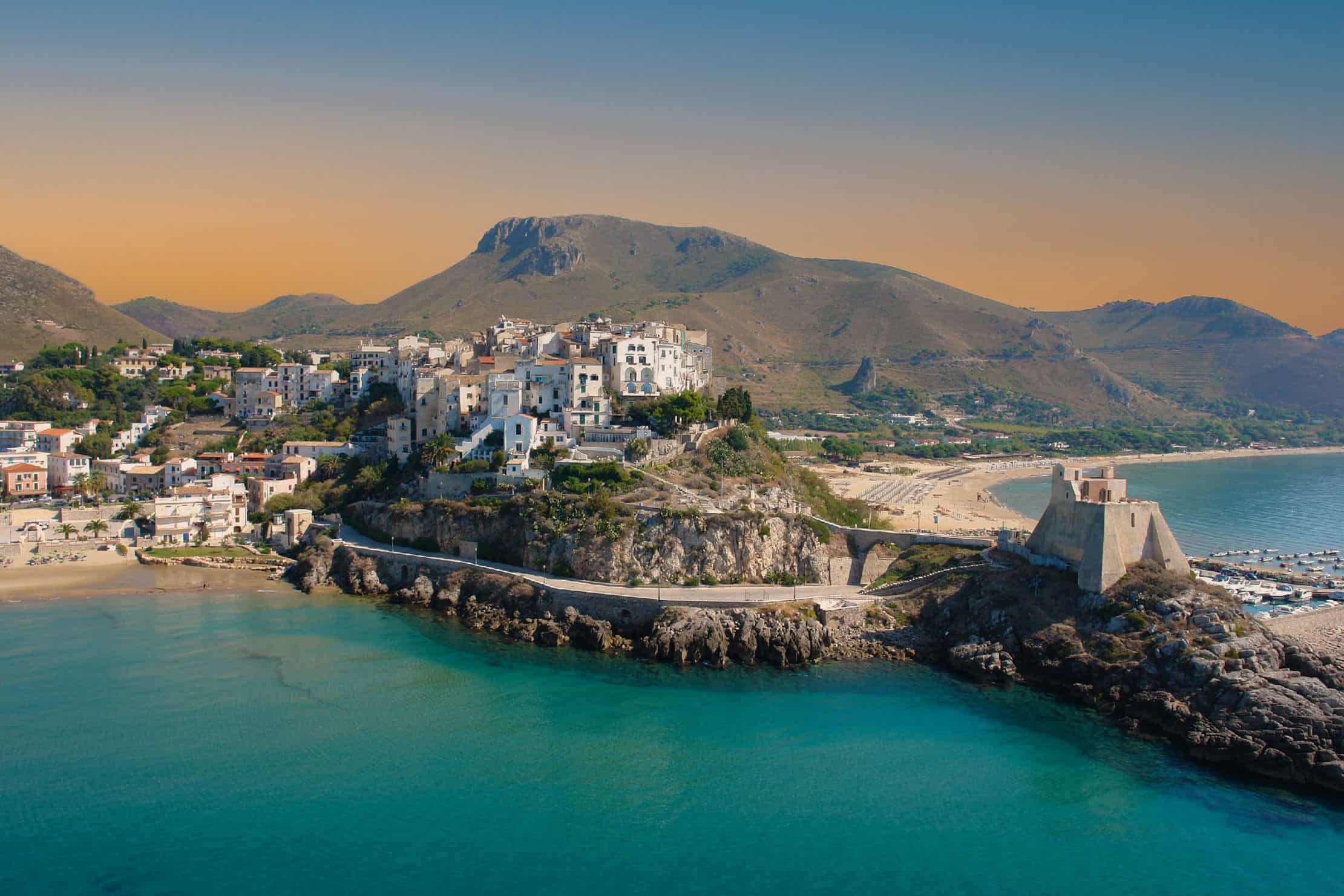
Sperlonga occupies the San Magno promontory, a spur of the Aurunci Mountains about 60 meters high that pushes out into the sea between the Fondi plain and the Gulf of Gaeta. The town proper is the cluster of white houses at the top, with the sea opening in front of it on two sides and the flat countryside behind. It's a detail worth having clear before you leave, because it shapes every practical choice: you go up to the historic center, you go down to the beaches, and cars almost always stay outside the walls.
By Car from Rome to Sperlonga
The most direct route from Rome is the roughly 116 kilometers of Via Pontina, State Road 148, which you stay on as far as Terracina. From there you take Via Flacca, State Road 213, which runs along the coast between Terracina and Gaeta and passes right below Sperlonga. Alternatively you can get on the Autostrada del Sole, the A1 Rome-Naples, exit toward the Frosinone area and come down to Terracina, then rejoin Via Flacca. Via Flacca is beautiful and scenic, with tunnels cut into the rock and glimpses of the open sea, but on summer weekends it turns into a funnel. If you have to be back in the evening, count on lines that form as early as the early afternoon.
By Train and Bus to Sperlonga
Sperlonga has no train station of its own. The reference stop is Fondi-Sperlonga, a stop on the Rome-Naples line via Formia, served by regional trains and a few intercity trains. From the station to the village it's about 9 kilometers as the crow flies, which become a handful more following the road. The link is provided by the local bus of Autoservizi Piazzoli, which leaves from the square in front of the station. Schedules change between the summer and winter seasons and are posted at the stop. If you arrive without a car, have them confirmed before you set out, because on off-season weekdays the runs thin out quite a bit.
Parking and Access to the Center of Sperlonga
The historic center is pedestrian and you reach it on foot from a series of parking lots at the edge of town and along the coastal strip. In high season the hunt for a parking spot is the first chore of the day, and prices go up accordingly. It's best to arrive early or rely on the outermost lots and walk. Once inside, Sperlonga can only be explored on foot, among ramps, arches and stairways that make any other means of transport impossible.
The White Village: The Historic Center of Sperlonga
Whoever reaches the top finds themselves inside a labyrinth of white lime. Sperlonga is the kind of town built to confuse anyone who doesn't know it, and it was out of necessity: a maze of alleys, underpasses, courtyards and stairs created to slow down the raiders who came up from the sea. The overall shape, curled in on itself in concentric circles around the old castle, earned the town the nickname of tortoise shape. The houses lean against one another, the white keeps the heat away, and at every turn a sliver of blue opens between two walls.
The Medieval Gates and Walls of Sperlonga
In the 11th century the settlement was ringed with walls, and two gates remain of that defensive circuit. One is the Portella, also called Porta Carrese. The other is Porta Marina, facing the sea. Both carry the carved coat of arms of the Caetani, the great family that dominated this stretch of southern Lazio for a long time. They are the two openings through which you enter and leave the old core, and going through them is the right way to understand how the town worked: few entrances, controllable, with the rest of the walls closing off the spur.
Alleys, Stairways and the Murals of Sperlonga
Getting around Sperlonga means losing your bearings on purpose. The alleys fork, go up and down, pass under the houses with arches and vaults, and every now and then pop out onto a natural terrace with the Tyrrhenian Sea at your feet. Along the walls, in several places, you come across murals that tell the story of the town, and in particular the pirate raids that kept it on alert for centuries. They are a painted reminder of how much the sea, here, was as much a resource as a threat. The best light for these walks is late afternoon, when the white of the houses turns golden and the shadows lengthen the alleys. You don't need a map and you don't need a destination: the right way to visit the old core is to get lost, take the ramp that goes down when everyone else is going up, duck into the underpass that seems to lead to a private courtyard and instead comes out on a lookout right above the water. The town is small, you always find your way back, and every detour gives you a glimpse you wouldn't see from the main street.
The Churches of Sperlonga
The oldest religious mention of the village concerns the Santa Maria di Sperlonga Church, already recorded in 1135. The current parish church is the Madonna Assunta in Cielo Church, consecrated on August 15, 1964, which gathers the liturgical life of the town. Then there is the San Rocco Chapel, which dates to the 15th century and is closely tied to the patron saint's feast and to the procession that goes down to the sea every September. They are simple buildings, village in scale, to be looked at for what they are: the places around which a community of fishermen organized its calendar for centuries.
Palazzo Sabella and the Antipope in Sperlonga
Among the village's civil architecture, Palazzo Sabella stands out, which local tradition holds to have been the refuge of the antipope Clement VII in 1379, in the turbulent years of the Western Schism. It's an attribution to be taken with the caution it deserves: tradition repeats it, but it is a fact that stays on the level of local memory rather than that of certain documentation. It still works as a clue to how much this corner of the coast, though remote, was caught up in the great events of its time.
The Villa of Tiberius and the Grotto at Sperlonga
The archaeological heart of Sperlonga is a short distance from the village, to the south, where Via Flacca runs along the sea. Here, in Roman times, a seaside villa stretched out, which the emperor Tiberius enlarged starting from a pre-existing late-Republican layout. The rooms were arranged around a portico facing the water, but the invention that makes the site unique is another: the use of a large natural cave, the spelunca that gave the town its name, turned into a banquet set.

How the Imperial Villa of Sperlonga Came About
The original core of the residence was a late-Republican villa, one of the many luxury complexes that dotted this coast and that were both homes and businesses. Many of these villas had tanks for fish farming, and fish production was an integral part of the owners' economy. Tiberius expanded the whole and made it an imperial villa in every respect. The landscape that surrounded it was the one you can still sense today: the cliff, the shallow, clear sea, the grotto open like a natural apse toward the water.
The Grotto of Tiberius: The Dining Room Carved into the Rock
The grotto was fitted out as a cenatio, the summer dining room, and the design played everything on water. In front of and inside the cavity, a rectangular basin, a fishpond fed by seawater, and a large circular pool were carved out. At the center of the sheet of water an artificial island housed the triclinium, so that the diners ate literally suspended over the sea, with rock over their heads and coolness all around. The walls and niches of the grotto were populated by sculptural groups of colossal size that staged episodes of the Odyssey: a mythological gallery meant to amaze the guest while he ate. It is one of the most spectacular ideas of architectural theater that Roman antiquity has left us.

The Collapse of AD 26 and the Saving of Tiberius's Life
The grotto left behind an episode that ancient historians handed down. In AD 26, while Tiberius was banqueting in this very cenatio, a collapse of rocks from the vault threatened to bury the diners. The one who saved the emperor, according to the account, was Aelius Sejanus, the powerful Praetorian prefect, who shielded him with his own body, protecting him from the boulders. The episode is reported by Tacitus in the Annals and by Suetonius, and the fact that two ancient sources record it places it among the documented facts rather than the legends. There is something mocking about it, in hindsight: a few years later Sejanus would fall from favor and be executed by order of Tiberius himself.
The National Archaeological Museum of Sperlonga
The sculptures that adorned the grotto are no longer in their original place, but a short distance away, in the Sperlonga National Archaeological Museum, inaugurated in 1963 next to the archaeological area. The museum was created precisely to house, study and reassemble the recovered fragments, and it is one of those museums where the content and the place explain each other: you look at the marble inside the rooms and then step out to see the grotto it comes from, or the other way around. That is the reason it's worth visiting the two parts on the same round.
The 1957 Discovery at Sperlonga
The discovery is recent and almost accidental. In 1957, during construction work on the coastal road between Terracina and Gaeta, the future Via Flacca, an enormous quantity of marble fragments came to light in the area of the grotto. The sculptures had been reduced to thousands of pieces, and it was the patient work of excavation, recovery and reassembly that gave back the main groups. The grotto itself had been known to scholars since the early 20th century, but it is the discovery of the sculptures, in 1957, that gave the site its fame and set in motion the modern tourist development of the town.
The Scylla Group
One of the key groups is Scylla's attack on Odysseus's ship. The sea monster, half woman and half tangle of dogs and tails, seizes the hero's companions and tears them from the ship: a scene of violence and movement that must have loomed over the water of the fishpond, reflected in it. It's the type of subject that Hellenistic sculpture loved, all twisting, taut muscles and despair, and at Sperlonga it found a perfect setting in the damp darkness of the grotto.
The Blinding of Polyphemus
The second great group is the blinding of Polyphemus. Odysseus and his companions drive the red-hot stake into the single eye of the cyclops, put to sleep by wine: one of the most famous moments of the Odyssey, rendered with the same dramatic emphasis as the Scylla group. Colossal, theatrical, built to be looked at from below while reclining at the table, it gave the banquet guest the intoxication and danger of the Homeric tale just as he himself was drinking.
The Theft of the Palladium and the Abduction of Ganymede
Alongside the two major groups the museum keeps the remains of other episodes. There is the theft of the Palladium, with Odysseus and Diomedes removing from Troy the sacred statue of Athena on which the fate of the city depended. And there is the abduction of Ganymede, the young man carried off to heaven by Zeus's eagle, a subject that breaks the Odyssean sequence and introduces a different tone. Together with the large groups they make up a coherent figurative program, built around the adventures of Odysseus and the mythology that cultured Romans knew by heart.
The Sculptors of Rhodes and the Link to the Laocoön
The fact that makes Sperlonga a textbook case concerns the hand that sculpted these marbles. Among the fragments, inscriptions have appeared with the names of three Rhodian sculptors: Athanadoros, Hagesandros and Polydoros. They are the same three names that Pliny the Elder, in his Natural History, gives as the authors of the Laocoön, the famous group now in the Vatican Museums. The coincidence fueled one of the hottest debates in 20th-century archaeology on the dating and attribution of these works, and linked the provincial museum by the sea to the most discussed masterpiece of ancient statuary. Whoever arrives at Sperlonga knowing this looks at the fragments with different eyes.

Hellenistic Sculpture and Imperial Taste at Sperlonga
To understand why these marbles matter, you have to place them in their own language. The groups in the grotto speak the dialect of great Hellenistic sculpture, the kind that after Alexander the Great had abandoned classical composure in search of pathos: twisting bodies, tensed muscles, faces distorted by pain or fear, compositions full of diagonals and movement. It is the same formal world as the Laocoön and the so-called Farnese bulls, an art that aims to hit the viewer in the gut more than in the reason. Tiberius, who was attached to this coast and who knew a thing or two about cultured leisure, chose Odyssean subjects for his grotto because the Odyssey is, first of all, a poem of the sea and of sea monsters: Scylla and Polyphemus were the perfect repertoire for a dining room overlooking the water. The iconographic choice was not random decoration, it was a statement: the emperor dining sheltered in the cave while around him, sculpted in marble, other sailors are devoured by the sea.
The Debate Over the Dating of the Sperlonga Sculptures
The coincidence of names with the Laocoön has divided scholars for decades, and the crux is the dating. Some have read the Sperlonga marbles as Greek originals of the 2nd or 1st century BC, brought here and readapted. Others see copies or reworkings of the imperial age, made by Rhodian workshops active in the time of Tiberius. The question is intertwined with the equally thorny one of the dating of the Laocoön itself, which swings between the Hellenistic hypothesis and that of a Roman production based on older models. It's not a detail for specialists: how you answer determines how you tell an entire chapter of the history of art, the passage from the Greek world to the Roman one. Sperlonga, with its inscribed signatures, is one of the few concrete footholds on terrain made almost only of attributions, and that's why the museum, however small and peripheral, appears in every textbook that tackles the problem.
Hours, Tickets and How to Visit the Sperlonga Museum
The museum is open from 8:30 to 19:30, with last entry at 19:00, and is closed on Mondays as well as January 1 and December 25. The outdoor archaeological area, the one of the villa and the grotto, follows a seasonal closing time that gets earlier in the cold months and later in summer. It's worth checking it beforehand, because the point of the visit is to see the rooms and the grotto together. The full ticket costs €5, the reduced one for young people between 18 and 25 costs €2, and under 18 you get in free. One practical warning that is worth the whole paragraph: the archaeological area is not accessible to people with mobility disabilities, because of the shape of the terrain and the differences in level toward the grotto. For times and opening status, the contact given is the number +39 393 8088763.
The Beaches of Sperlonga
The second reason people come to Sperlonga is the sea, and here the geography is simple: the promontory of the village divides the coast into two large stretches of sand, with a series of smaller, more secluded coves as you move south, toward Gaeta. The sand is fine and light, the water shallow and clear, and in several places the rocks dive into the sea, creating small sheltered corners.
Levante Beach in Sperlonga
Levante Beach opens at the foot of the old village, on the side that faces east. The seabed is sandy and slopes gently, which makes it the most convenient choice for families with small children. It's the beach closest to the town, so it's also the busiest. Anyone looking for space in August finds it only by arriving early.
Ponente Beach in Sperlonga
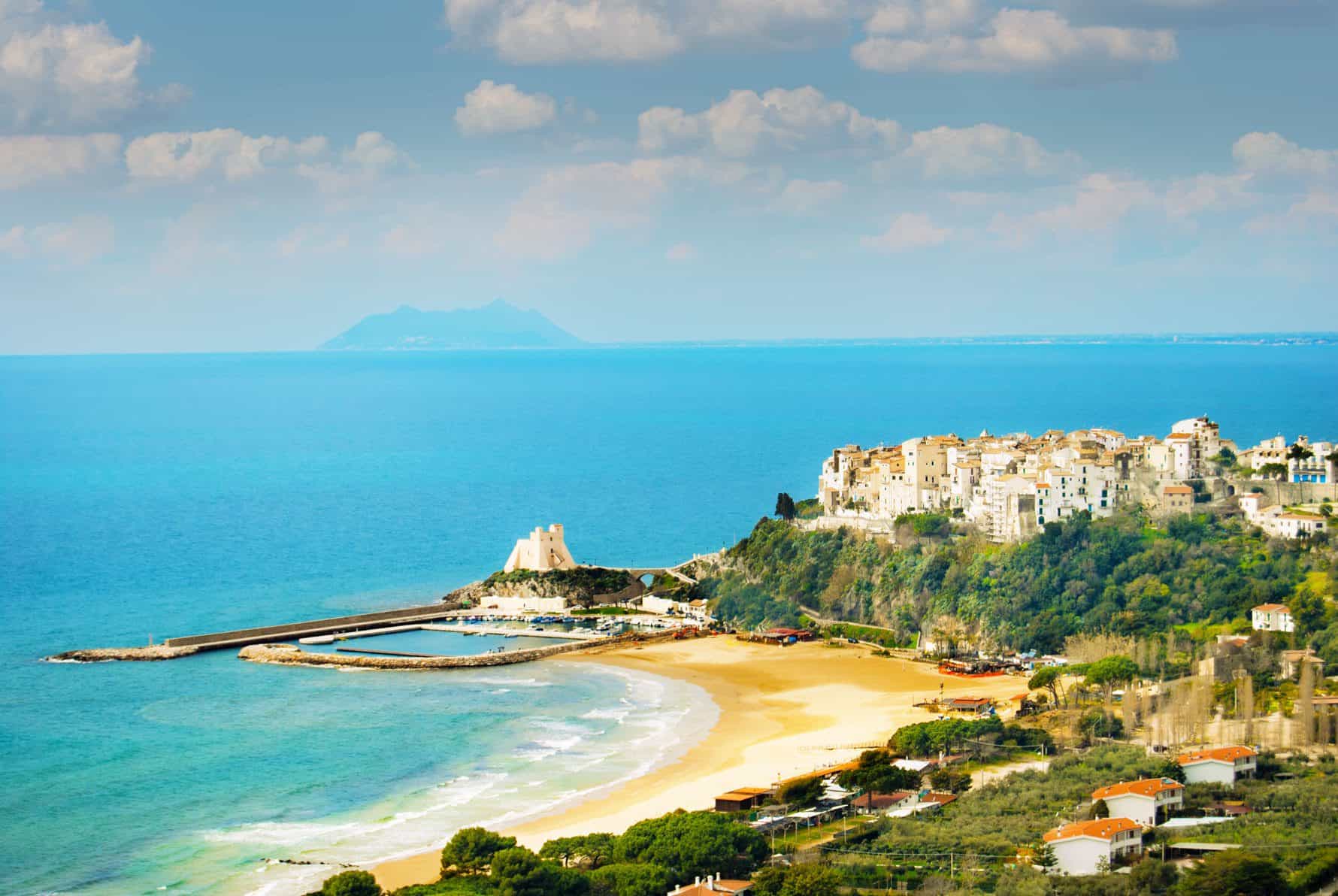
On the opposite side, in front of the historic center, stretches Ponente Beach, the longest. From here you get the classic view of Sperlonga, with the white houses at the top of the spur and Torre Truglia closing off the promontory. It alternates stretches of free beach with equipped beach clubs, and it gives the best sunsets, since it faces west. It's the postcard beach, the one that ends up in most of the photographs of the town.

Angolo Beach
Between Levante Beach and the area of the Grotto of Tiberius is Angolo Beach, a more intimate stretch with turquoise-toned water. It's a middle ground between the convenience of the central beaches and the privacy of the coves to the south, and it rewards those who feel like walking a little farther from the crowded heart of town.
Bazzano Beach and the Coves South of Sperlonga
Moving south, past the area of the imperial villa, the coast changes character: the sand gives way to rocks and small inlets. Bazzano Beach, with its clear sea over rocky seabeds, is one of the favorite spots for people who snorkel. These are less serviced and wilder beaches, which call for water shoes and a minimum of self-reliance, but they give you the cleanest water and the most intense colors.
The Other Beaches and Coves of Sperlonga
The coast keeps other names that local word of mouth passes down: the Bambole beach, the 300 Steps beach, which warns you from its name alone of the price to pay going down and coming back up, and other small coves often reachable only from the sea, by boat or kayak. Toward the Gaeta promontory, where the rock throws itself into the water, wonderful inlets open up that remain cut off from the roads and reward those who move by sea.
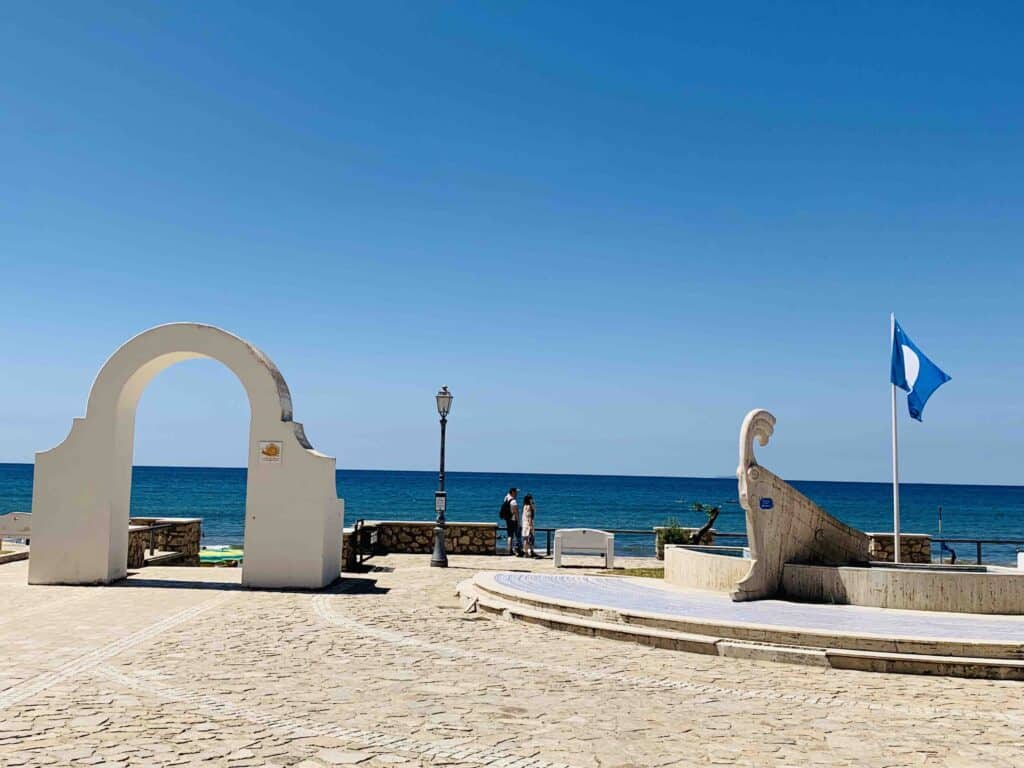
The Blue Flag of Sperlonga
The waters of Sperlonga are among the clearest on this stretch of the Tyrrhenian, and the town regularly displays the Blue Flag, the recognition that rewards the quality of bathing waters and beach services. The first award to the municipality dates to 1996. It's a fact that matters above all for those traveling with children: combined with the shallow, sandy seabed of the central beaches, it makes Sperlonga a comfortable and safe seaside destination.
Torre Truglia and the coastal towers of Sperlonga
At the tip of the promontory, where the spur plunges into the sea, stands Torre Truglia, the visual symbol of Sperlonga. It was built in 1532 on the remains of an earlier Roman-era watchtower, as part of the defensive system designed to raise the alarm when pirates arrived. Its history is a list of destructions and reconstructions: razed to the ground by the men of the corsair Barbarossa, rebuilt in 1611, destroyed again by the Turks in 1623. Between 1870 and 1969 it was used as the seat of the Guardia di Finanza. Today it houses the marine environment education center of the Riviera di Ulisse Regional Natural Park. It is the point from which you take in the whole coast at a glance, and on clear days you can make out the islands on the horizon.
The Truglia was not alone. The defense of Sperlonga rested on a network of towers: the Torre Maggiore, also called Torre Centrale, within the town, the Torre del Nibbio and the Torre di Capovento, the latter erected like the Truglia in 1532. They were the eyes of the town on the sea, and their number tells better than any chronicle how daily and concrete the corsair threat was.
The Riviera di Ulisse Park and the nature around Sperlonga
Sperlonga is set within a system of protected areas that safeguards the coast and the hinterland. The promontory of the Villa of Tiberius, with the coast as far as Torre Capovento and Punta Cetarola, is protected as a natural monument. More generally, the coastal strip falls within the Riviera di Ulisse Regional Park, which extends as far as Gaeta. Around the town are sites of community interest for their flora and fauna, from Lago Lungo to the Duna di Capratica, as far as the rocky coast between Sperlonga and Gaeta. There is also a less touristy and more technical aspect: the limestone cliffs around the town are known to climbers all over Italy, and in the good season they attract climbing enthusiasts to the walls that drop straight into the sea. It's a lesser-known face of the town, but consistent with its geography: the same limestone spur that protected the village from pirates and that houses the grotto of Tiberius today offers rock routes a few steps from the sea, and whoever arrives in Sperlonga with rope and harness knows they will find a playground that combines climbing with an end-of-day swim.
The history of Sperlonga, from the Spartans to the Saracens
Traces of human presence in the territory of Sperlonga go back to the Upper Paleolithic. A mythical tradition holds that Amyclae, a city founded by the Spartans, stood here, and that alone says how ancient the site's calling is. In the Roman age the territory, part of the jurisdiction of the municipium of Fundi, filled with maritime villas, the most famous of which remains that of Tiberius. Many of them combined luxury with fish production, with their tanks for raising fish.
From the medieval castrum to the tortoise-shaped village
In the 6th century, among the ruins of the imperial villa used as makeshift shelter, the real settlement took shape higher up, on the promontory of San Magno, to defend against raids from the sea by the Saracens. The name of the town, in all likelihood, derives precisely from the great grotto, the spelunca incorporated into the villa of Tiberius. A document of the 10th century mentions the castrum Speloncae, which included a small church dedicated to Saint Peter, patron of fishermen. Around the castle the town grew in concentric circles, up to the tortoise shape it has today. In the 11th century came the walls, with gates bearing the Caetani coat of arms.
The sack of Sperlonga and the pirate raids
For centuries Sperlonga remained a small fishing village held in check by pirates, who went as far as kidnapping its inhabitants to reduce them to slavery, as the murals on the walls of the village still recall. Despite the watchtowers, the town was attacked and sacked in 1534 by the Ottoman admiral Khair ad-Din, known as Barbarossa. In 1623 a fleet of Barbary corsairs returned to devastate it, and of that raid a memory remains in a poem, Il sacco e rovina di Sperlonga nel 1623, the work of the surgeon and poet Curzio Mattei of Lenola. Rebuilt between the 17th and 19th centuries, the town took on the appearance it keeps, with churches and noble palaces added to the old core.
From Terra di Lavoro to the province of Latina
For centuries Sperlonga belonged to the Kingdom of Naples and then to the Kingdom of the Two Sicilies, part of the old province of Terra di Lavoro, in the district of Gaeta. It stayed tied to that province even after Italian unification. In 1927, with the downsizing of Terra di Lavoro decided by the regime, the municipality was taken from Campania and added to Lazio. From 1934 it became part of the newly created province of Latina, then called Littoria. It's an administrative story that explains why, even today, Sperlonga looks as much toward Gaeta and the Naples area as toward Rome.
Via Flacca and the Birth of Tourism in Sperlonga
The modern turning point has a precise date: February 9, 1958, when Via Flacca was inaugurated, the coastal road that links Terracina to Gaeta passing below the town. Until then Sperlonga was an isolated and very poor village. The road broke its centuries-old isolation. Within a few years other pushes added up: the discovery of the sculptures of the Villa of Tiberius, in 1957, and the arrival of well-known vacationers, among the first the actor Raf Vallone, who helped make the place fashionable. The Darsena, built in 1972, started nautical tourism. In 2013 the expansion of the marina, brought to 185 berths, consolidated its vocation. From a forgotten fishing town, Sperlonga has become in half a century one of the best-known seaside destinations in Lazio, and it is listed among the most beautiful villages in Italy.
From Italian Unification to Tourism: The Darsena and the Port of Sperlonga
The town's 19th-century story follows that of the Mezzogiorno. After the defeat of Francis II of Bourbon at the hands of Garibaldi and the annexation of the Kingdom of the Two Sicilies to the Kingdom of Sardinia, which became the Kingdom of Italy in 1861, Sperlonga continued for a long time to be part of the old province of Terra di Lavoro, before the 20th-century reorganizations that would move it to Lazio. For the whole 19th century and beyond it remained a poor, closed fishing town whose economy depended on the sea and little else. The modern season, the one that made Sperlonga a well-known name, was built in a few decades: Via Flacca in 1958, the Darsena designed by engineer Francesco Piergianni and built in 1972, which opened the town to nautical tourism, and finally, in 2013, the expansion of the marina brought to 185 berths equipped with services. In a little more than half a century Sperlonga has gone from extreme poverty to one of the most solid beach economies on the Lazio coast, without however entirely losing the look of the old seaside village.
The Festivals and Traditions of Sperlonga
The patron saint festival of Sperlonga falls in the days around the first Sunday of September and honors San Leone and San Rocco, with celebrations in the Madonna Assunta Church. The most heartfelt moment is the procession of San Rocco: the statue of the saint goes down in the evening to the sea, where fireworks are set off, and then goes back up to the historic center, passing in front of the chapel dedicated to him and threading through the alleys and stairs of the town. It's one of those festivals in which the town shows itself for what it has been for centuries, a seafaring community gathered around its patron saints, and whoever happens to be in Sperlonga in those days sees it in its most authentic version.
Sperlonga with Kids
Sperlonga works well with kids, but it has to be managed. The sea at the central beaches, with fine sand and a seabed that slopes gently, is as suitable as it gets for the little ones, and the Blue Flag is an extra guarantee on the quality of the water. The flip side is the village: all stairs and climbs, hard with a stroller, tiring in the hot hours. My advice is to split the day, the morning on the beach and the late afternoon in the historic center, when the heat drops. The visit to the archaeological area should be calibrated to age: the Grotto of Tiberius and the sculpted sea monsters have remarkable storytelling potential if you prepare them for it, but the route has differences in level and isn't suitable for strollers.
How to Really Visit Sperlonga in a Day
A well-built day in Sperlonga has a precise rhythm. Early morning is for the archaeological area: arrive when the museum opens, give it at least an hour and a half between the rooms and the grotto, and take advantage of the coolness and the low light on the cliff. Midmorning, with the cultural part already done, head down to the beach. If you want convenience, aim for the central beaches of Levante and Ponente. If you want clear water and fewer people, move toward the rocky coves to the south. Lunchtime is spent at the sea or in one of the town's trattorias, which draw on the tradition of southern Lazio. Late afternoon, when the sun goes down, is the time for the village: the climb through the white alleys, the gates with the Caetani coat of arms, the lookouts over the sea, Torre Truglia on the tip. In the evening, if you stay, the historic center lights up and comes alive. It's a program that alternates culture, sea and a walk without wearing you out, and that puts everything at the hour when it pays off most: the sculptures with a fresh head, the sea in the hot hours, the village in golden light.
When to Go to Sperlonga and When to Avoid It
If the goal is the village, the sculptures and Torre Truglia, the right time is spring and early fall: mild weather, crisp light, a lively town but not besieged. If the goal is the sea, summer is almost obligatory, but with a few precautions. July and especially August turn Sperlonga into a magnet: Via Flacca clogs up, the parking lots fill at dawn, the central beaches get crowded. Anyone who can only come in August should arrive very early or head for the coves to the south, less convenient and for that reason less packed. A weekday always beats a weekend, and June and September remain the best compromise between warm sea and a town you can breathe in. To avoid, for those looking for quiet, the big summer holiday weekends and the heart of August: those are the days when Sperlonga is at its worst in terms of lines and crush, and when even the visit to the archaeological area risks turning into a queue. Anyone with no calendar constraints should reason the opposite way from the crowd: come when the others don't, and you'll find the same sea and the same village with half the effort.
What's Around Sperlonga
Sperlonga is an excellent base camp for the southern stretch of the Lazio coast. To the south, past the promontory, there's Gaeta with its gulf and the Sant'Agostino beach. To the north, past Terracina, opens the Circeo National Park with the San Felice Circeo beach and the Torre Paola beach at Sabaudia. The Terracina beach is the gateway from the north, while offshore, on clear days, the islands of Ponza stand out, reachable by ferry. Inland, for those who want to alternate sea and culture, there are the museums of Priverno and the Terra Pontina Museum in Latina.
A Curious Fact About Sperlonga (LT)
The name of the town doesn't come from a saint, a family or a military leader, but from a hole in the rock. Sperlonga comes, in all likelihood, from the Latin spelunca, meaning cave, and the cave in question is the natural one that the emperor Tiberius incorporated into his villa and turned into a dining room. It's a rare case of a place name that carries its archaeological origin with it: to say Sperlonga is to say cavern, and the cavern is still there, a couple of kilometers from the center, with the remains of the sculptures that made it a marvel inside. Whoever arrives thinking of a picturesque name finds that the town is called, literally, after the cavity that was its first heart. The extra curiosity is that this spelunca was known and cited long before the sculptures came to light: the grotto was known to scholars from the early 1900s, but to rediscover what it really contained, they had to wait until 1957 and the work on Via Flacca. The town, in short, bore the name of the grotto centuries before knowing what treasure that grotto had kept.
Something Nobody Tells You About Sperlonga (LT)
The postcard sells the white village and the beaches, and almost nobody arrives knowing that one of the most fascinating mysteries in the history of art is tied up at Sperlonga. Among the fragments recovered in the grotto, inscriptions have appeared with the names of three sculptors from Rhodes: Athanadoros, Hagesandros and Polydoros. They are exactly the three names that Pliny the Elder, centuries earlier, had given as the authors of the Laocoön, the marble group now kept in the Vatican Museums and considered one of the peaks of ancient sculpture. The overlap has set off a debate that has lasted for decades on the dating of the works, on the relationship between the Sperlonga marbles and the Laocoön, and on how much those three artists actually sculpted. In practice a provincial museum overlooking the Tyrrhenian Sea is closely tied to the most discussed masterpiece of classical statuary, and most visitors leave without knowing it. The practical advice that follows is simple: give the museum the same time you give the beach, because what is inside those rooms is not a corollary of the sea, it is the reason archaeologists all over the world know the name of this town.
My Advice for Visiting Sperlonga (LT)
To plan the day, my advice is to reverse the order that comes instinctively. Almost everyone heads for the beach in the morning and puts off the museum until the afternoon, when they're tired, overheated and not in the mood to read captions: that way the archaeological area becomes a rush and the sculptures a heap of broken marble. Do the opposite. Arrive early and start with Tiberius's villa and the museum, with a fresh head and before the sun beats down. Give the grotto time, go out to see it in person after you've seen the marbles inside the rooms, and work out in your mind where each group stood. Then, with the cultural part already in your pocket, head down to the beach for the rest of the day and enjoy the sea without guilt. The second tip concerns the village: save it for late afternoon, when the light turns the white of the houses yellow and the heat loosens its grip. Climbing through the alleys at noon in August is a penance. Doing it toward evening, with the cool air coming off the sea, is when Sperlonga is at its best. And leave the car as far away as possible without regrets: here you walk, and it's part of the game.
Another Well-Known Fact That Is Rarely Cited
Everybody knows that Sperlonga is now in Latina Province, but few stop to consider how recent and forced that boundary is. For centuries the town wasn't part of Lazio at all: it belonged to the Kingdom of Naples and then to the Kingdom of the Two Sicilies, within the province of Terra di Lavoro, in the district of Gaeta, and it looked toward Gaeta and Naples for culture, dialect and trade. The turning point came only in 1927, when the Fascist regime, downsizing Terra di Lavoro, tore the municipality away from Campania and attached it to Lazio. From 1934 Sperlonga became part of the new province of Latina, then called Littoria. It's a well-known fact yet one that gets little weight, because it explains many things tourists notice without understanding them: the emotional closeness to Gaeta more than to Rome, certain inflections of the local speech, a cuisine that draws on the tradition of southern Lazio and Naples. Sperlonga has been part of Lazio by decree for less than a century. For the rest of its history it was the last fringe of another world.
The Right Photo to Take in Sperlonga (LT)
The photograph that sums up Sperlonga is taken from Ponente Beach, looking toward the promontory: the white village rising like a pyramid on the rock spur, Torre Truglia closing off the tip, the sea in the foreground. It's the classic framing, and for a good reason: it brings together in a single glance the three things that make the town, the white, the rock and the water. The right time is late afternoon, when the western sun lights up the houses and makes them stand out against the blue. At noon the light is flat and the white burns. If you feel like walking, the other photo to take home is the one from the top of Torre Truglia or from the lookouts of the historic center, with your gaze skipping over the rooftops and reaching the islands on the horizon on clear days. And there's a third image, less obvious, which I recommend to anyone who loves details: one of the inner alleys, narrow between two white walls, framing a strip of sea at the end. You don't need the wide view to tell the story of Sperlonga. Sometimes a corridor of whitewash and a sliver of blue at the end is enough.
Some Important Events That Happened Here in History
The first big event dates to Roman times and comes close to tragedy. In 26 AD the emperor Tiberius was feasting in the grotto of his villa when a rockfall from the ceiling threatened to bury him along with his dinner guests. The one who shielded him with his own body was the prefect Aelius Sejanus, and the episode is recorded by Tacitus and Suetonius. The second event, or rather the series of events, is the pirate raids: the sack of 1534 by the Ottoman admiral Khair ad-Din, Barbarossa, and the devastating raid of the Barbary corsairs in 1623, the latter crystallized in a seventeenth-century poem, Il sacco e rovina di Sperlonga nel 1623, written by the surgeon and poet Curzio Mattei of Lenola. The third big event is recent and changed the face of the town: the discovery, in 1957, of thousands of sculptural fragments in the grotto of Tiberius, during work on Via Flacca. And the date that closes the circle is February 9, 1958, when the opening of that same Via Flacca broke the village's centuries-old isolation and started the tourism season that still lasts. An emperor nearly buried, the pirates, the rediscovered marbles and a road: the history of Sperlonga can be told entirely with these four facts.
Who Passed Through Sperlonga (LT)
The first name is the one that weighs most of all: the emperor Tiberius, who had one of his maritime villas here and made it a place of spectacular banquets, and with him Aelius Sejanus, the praetorian prefect who saved his life in the collapse of the grotto. Through their marbles three great sculptors of the Greek world also passed through Sperlonga, the Rhodians Athenodoros, Hagesander and Polydorus, the same names tied to the Laocoön: their works lived on this coast before ending up in fragments and then in the museum. In the Middle Ages tradition has it that the antipope Clement VII took refuge there, in 1379, in the years of the Western Schism, in what is today Palazzo Sabella. It's an attribution to take with caution, but it says how much the village was inside the events of its time. In modern times, when Sperlonga was still a poor and secluded town, one of the first outsiders to fall in love with it was the actor Raf Vallone, who in the 1950s helped make it fashionable and bring holiday-makers here. And, on the negative side, pirates also passed through: Barbarossa and the Barbary corsairs left a mark on the town that the murals in the alleys still recall.
Quick questions about Sperlonga (LT)
How far is Sperlonga from Rome?
About 116 kilometers. By car you follow Via Pontina to Terracina and then Via Flacca. Alternatively you can take the Autostrada del Sole, exiting toward the Frosinone area and going down to Terracina.
How do you get to Sperlonga without a car?
By train you get off at Fondi-Sperlonga station, on the Rome-Naples line via Formia, and from there you continue with the scheduled bus of Autoservizi Piazzoli that connects the station to the village. Schedules change between summer and winter and should be checked at the stop.
How much is the ticket for the museum and the villa of Tiberius in Sperlonga?
The full ticket costs €5, the reduced ticket for young people between 18 and 25 costs €2, and admission is free under 18.
What are the opening hours of the National Archaeological Museum of Sperlonga?
The museum opens from 8:30 to 19:30, with last entry at 19:00, and is closed on Monday as well as on January 1 and December 25. The outdoor archaeological area has a seasonal closing that comes earlier in winter, so it's best to check it before the visit.
Is the Sperlonga museum wheelchair accessible?
The outdoor archaeological area, because of the shape of the terrain and the differences in level toward the grotto, is not accessible to people with motor disabilities. For the museum rooms, it's best to ask for confirmation at the official contacts before going.
What can you see in the grotto of Tiberius?
The natural grotto was turned into a summer dining room with tanks and a pool, and housed colossal sculptural groups with episodes from the Odyssey. The sculptures are now in the nearby museum. In the grotto you can still read the scenic layout that held them.
Why is Sperlonga called that?
The name derives in all likelihood from the Latin spelunca, that is, grotto, in reference to the great natural cave incorporated into the villa of Tiberius.
What is the best beach in Sperlonga for children?
Levante beach, at the foot of the village, has fine sand and a shallow, gently sloping bottom, ideal for families. The long Ponente beach also works, with free stretches and beach clubs.
Does Sperlonga have the Blue Flag?
Yes, the municipality regularly displays the Blue Flag for the quality of its bathing waters. The first award dates to 1996.
How much time do you need to visit Sperlonga?
For the village, the villa of Tiberius and the museum, half a day is enough. If you add the sea, the whole day is the right measure. Anyone who also wants to explore the coves to the south should allow two days.
Can you swim near the villa of Tiberius?
Yes, Angolo beach lies between the grotto area and Levante beach, and farther south, toward Bazzano, rocky coves open up that are suited to snorkeling.
Is Sperlonga one of the most beautiful villages in Italy?
Yes, Sperlonga is on the list of the most beautiful villages in Italy, for its white tortoise-shaped historic center and its position on the promontory.
What is Torre Truglia in Sperlonga?
It is the coastal tower at the tip of the promontory, built in 1532 as part of the lookout system against pirates, destroyed and rebuilt several times. Today it houses the marine environment education center of the Riviera di Ulisse Park.
When is the patron saint festival of Sperlonga?
In the days around the first Sunday of September, in honor of Saint Leo and Saint Roch, with the procession of Saint Roch that goes down to the sea and the fireworks.
Can you get to Sperlonga by boat?
Yes, the marina has berths and many of the most beautiful coves south of the town are easily reached by sea, by boat or kayak.
What is the best time to visit Sperlonga?
For the village and the museum, spring and early autumn. For the sea, summer, better if June or September. July and August pay off with the sea but bring traffic, crowds and difficult parking.
Are there climbing routes in Sperlonga?
Yes, the limestone cliffs around the town are known to climbers and in the good season draw climbing enthusiasts to the walls that drop straight into the sea.
Who sculpted the statues in the grotto of Tiberius?
The inscriptions found bear the names of three Rhodian sculptors, Athanadoros, Hagesandros and Polydoros, the same ones the ancient sources name as the authors of the Laocoön in the Vatican Museums.
What to see near Sperlonga?
To the south, Gaeta and its gulf. To the north, Terracina and the Circeo National Park. Offshore, the islands of Ponza. Inland, the museums of Priverno and the Museo della Terra Pontina in Latina.
Why is Sperlonga white?
The houses of the village are plastered and whitewashed with lime, an ancient choice that responds to the climate: white reflects the light and keeps homes cooler in the hot months. Together with its tight tortoise shape, it gives the town its compact and luminous look.
What does Sperlonga have to do with the Laocoön in the Vatican Museums?
The inscriptions found in the grotto of Tiberius bear the names of the same three Rhodian sculptors whom the ancient sources name as the authors of the Laocoön. That link is what made the Sperlonga museum a case studied all over the world for the dating of ancient sculpture.
Can you visit the grotto of Tiberius?
Yes, the grotto is part of the outdoor archaeological area, which has seasonal closing hours separate from those of the museum and should be checked before your visit. The route has elevation changes and isn't suitable for people with mobility difficulties.
Where do you park in Sperlonga?
The historic center is pedestrian. You leave the car in the lots at the edge of town and along the coastal strip, which are paid and in high demand in high season. It's best to arrive early or choose the outermost lots and continue on foot.
The Final Impression of Sperlonga
If I had to say in one sentence why I gladly go back to Sperlonga, I'd say it's one of the few places on this coast where the sea doesn't erase everything else. You can go for the beach and that's perfectly fine, but it would be a mistake to treat it like any seaside destination in southern Lazio: the white, tortoise-shaped village and, above all, the grotto of Tiberius with its marbles make it a place that rewards those who want to read and walk, more than it rewards those who only want a lounge chair in the sun. My invitation is to give the museum the same respect you give the sea, to climb up to the village when the heat drops, and to come off-season if you can. Sperlonga on a weekday in May, with the town awake but not under siege and the sculptures all to yourselves, is an experience that crowded August can never give back to you.
Article written by the editorial team of TourLeaderPro, contact them for Private/Corporate/V.I.P. Tours and Experiences.
Planning a trip to Rome? The English guides for visiting the city are on ItalyPlanner.com.