San Felice Circeo (LT)
In short. San Felice Circeo is a municipality in Latina Province, on the promontory that closes the Pontine plain to the south.
San Felice Circeo is a municipality in Latina Province, on the promontory that closes the Pontine plain to the south. The town hall occupies the Palazzo Baronale, in Piazza Lanzuisi, in the historic center about a hundred meters above sea level. From Rome it is a little more than 100 kilometers: by car you take Via Pontina as far as Borgo Faiti or up to the level of Terracina, then follow the turnoff for the Circeo, and in normal conditions you arrive in an hour and 40 minutes, which in summer easily become two and a half hours. By public transport the hub is the Priverno-Fossanova railway station on the Roma Termini-Napoli via Formia line: from there the bus connections toward the Circeo are run by the regional intercity service, with reduced runs off season and on holidays, so the schedules should be checked the day before departure on the carrier's site. The beaches are free in the state-owned stretches not given in concession. At the beach clubs the rate is set by each individual establishment and changes from year to year, so on this page you will not find a price list: ask the lifeguard before spreading out your towel. The Pro Loco office is at Piazza Lanzuisi 1, telephone 0773 547770, and remains the most reliable point for visiting hours and seasonal openings. The patron saint is Saint Felix the martyr and he is celebrated on July 29. The inhabitants are a little more than 10,000.
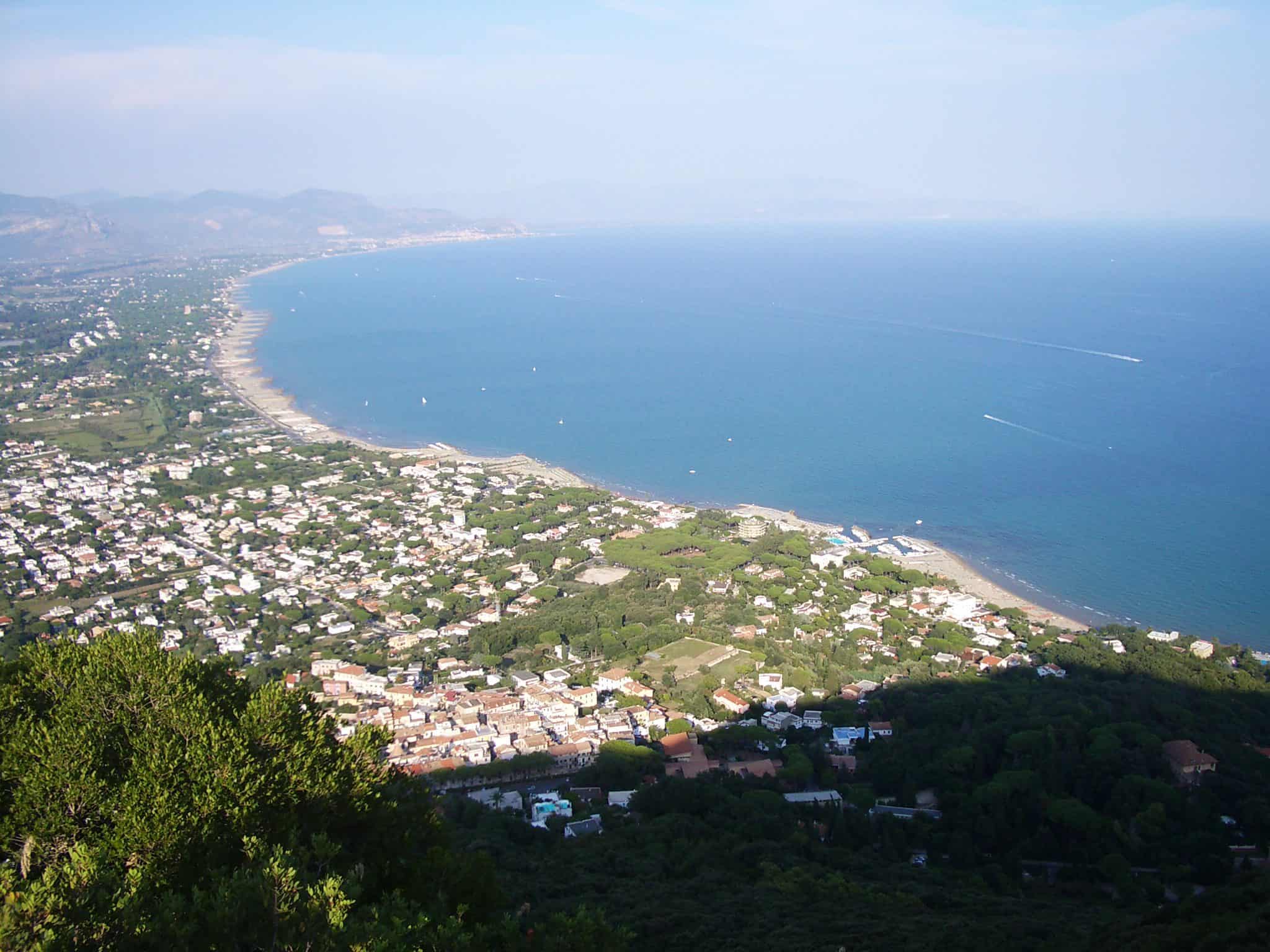
The municipal sandy coastline measures about 11 kilometers, from Torre Fico to the border with Terracina, and from here the Riviera di Ulisse begins. The whole territory falls within the Circeo National Park, whose administrative seat is in Sabaudia, at Via Carlo Alberto 188, telephone 0773 512240.
How to Get to San Felice Circeo and Where to Leave the Car
Those who arrive by car have two strategies, and they are different. The first: aim straight for the seafront, enter from Viale Europa and look for a spot along the coastal road. It works in June and in September. In August, after 09:30 in the morning, it is wasted time. The second: go up to the historic center, leave the car in the parking areas below the town and walk down toward the sea, or do the opposite, that is, park down below and climb up. The rates for paid parking and the blue-line stretches change with the seasonal ordinances of the Municipality, so they should be read on the signs on site: it is the only piece of data that no web page keeps reliably up to date.
A firm opinion: in high season the Circeo is visited by arriving very early or arriving in the late afternoon. The window between 10:00 and 17:00, in August, is a line of sheet metal along Viale Europa and a fight for one square meter of sand. Anyone who can get from the seafront to the historic center by bicycle solves half the problems, though you have to allow for a serious climb in the last two kilometers.
For those coming from Rome without a car, the alternative to the train to Priverno-Fossanova is the direct bus on the Pontine route. Here too, the summer and winter runs do not coincide. Those arriving from the south can rely on the Monte San Biagio-Terracina Mare station. From Sperlonga and from Gaeta the most convenient connection remains the car along the state road.
The Beaches of San Felice Circeo, Stretch by Stretch
The Circeo coastline is not a single beach: it is a succession of different environments that follow one another over 11 kilometers, and whoever confuses them ends up in the wrong place. It is worth going through them in order, from east to west, as they are met by someone arriving from Terracina.
The Port Beach and Torre Fico
The coastline begins at the foot of Torre Fico, with the small beach of the port area. Torre Fico is one of the four coastal towers ordered in 1562 by Pope Pius IV, who commissioned Nicolò and Bonifacio Caetani, lords of Sermoneta and of San Felice, to erect four fortifications to defend the coast. The name is said to derive from the prickly pears that still surround it today. It stands to the east, on the side of the Quarto Caldo, and it is seen well from the port. The beach here is short and frequented by those who arrive by boat: it is not the stretch to spend the day, but it is the best point to understand the geography of the promontory in five minutes.
The Beach Behind the Residences on Via Terracina
The long, thin tongue of sand behind the residences on Via Terracina is in fact reserved for those who live in the houses on the sea. Some gates of the residential complexes, however, keep a pedestrian passage always open, and that passage is a right of access to the state maritime property, not a courtesy concession. The sand is not the most beautiful of the Circeo: the seabed slopes down quickly and the stretch is beaten by the east wind. On the other hand it stays quiet even at Ferragosto, and that is an advantage worth quite a bit. If you are looking for silence more than a postcard, this is where you should look.
Viale Europa and the Fratta
Continuing toward Monte Circeo, the seafront of Viale Europa is mostly occupied by beach clubs, with thin strips of free beach wedged between one and the next. In summer they are crowded from 09:00 in the morning. The widest free stretch of Viale Europa is called by everyone in town the Fratta: the name comes from a tamarisk tree with bushes around it, and fratta in the local dialect is precisely the thick bush. On that piece of shoreline, once in a while, big-draw summer concerts are organized. In our view Viale Europa is the most overrated stretch of the Circeo: you pay for the convenience of nearby parking and give up the landscape.

Lungomare Circe, the Most Beautiful Stretch
Lungomare Circe is something else. Here too the beach clubs dominate, but the free strips that remain look out on an emerald green sea, with the mountain behind and the historic center visible above, on the rocky platform. The flaw is there and it is serious: they are very thin strips, and almost always have rocks in front, which means rubber water shoes to get into the water and no room for the children's games. Go for the color of the water and for the view, not for the convenience.
The Coves of the Cliff and the Precipizio Area
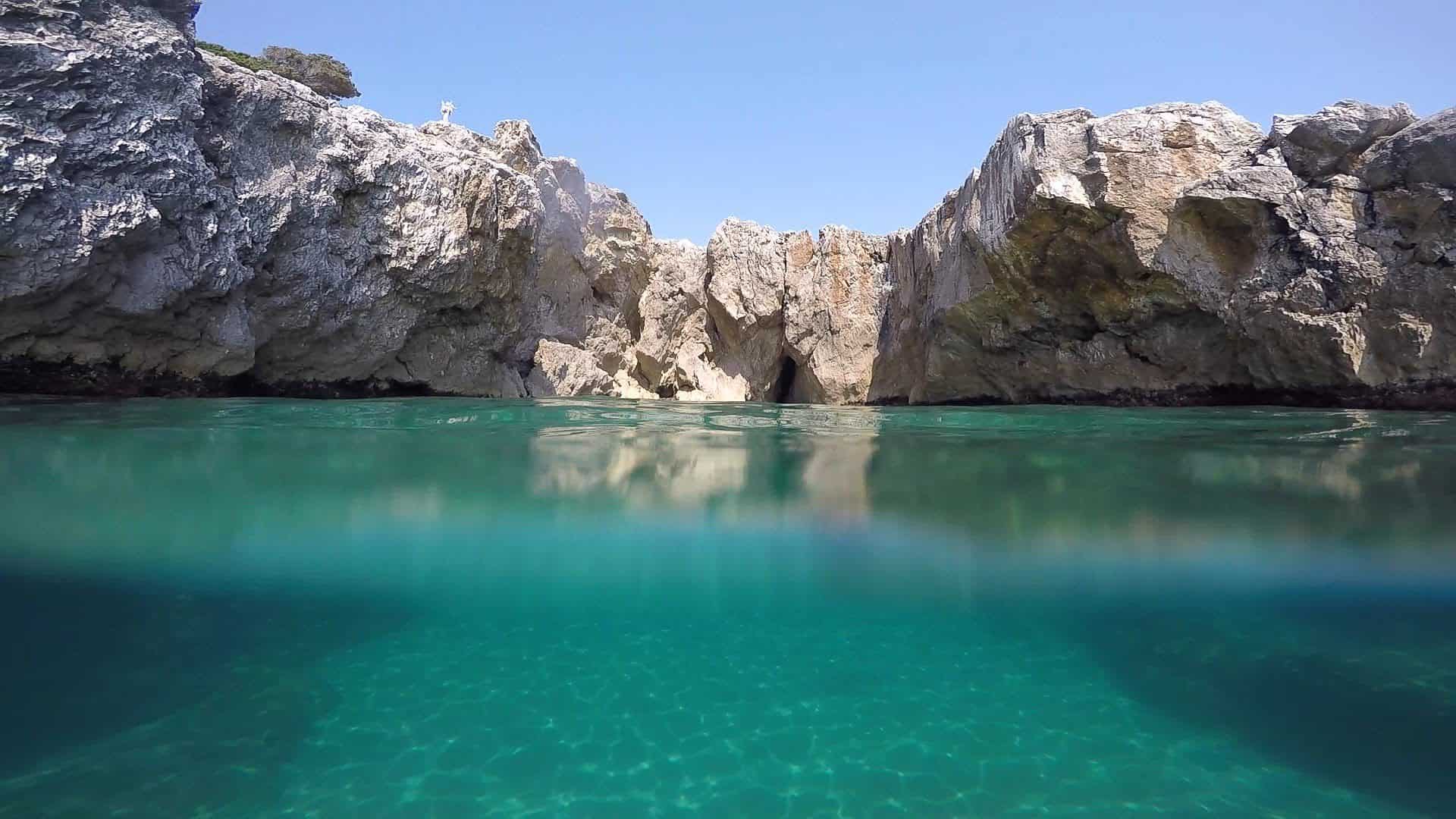
Along the cliff of the promontory, coves with free access open up. Almost every point of the cliff, except the inaccessible Precipizio area, can become an excellent place to swim, as long as you have trained feet and no expectation of services. The Precipizio should be left alone, and not out of formal prudence: it is a wall that drops sheer into the sea, with no path and no way out from below. Anyone who tries it with a rough sea also endangers those who would have to come and rescue them.
The Quarto Caldo and the Cliff
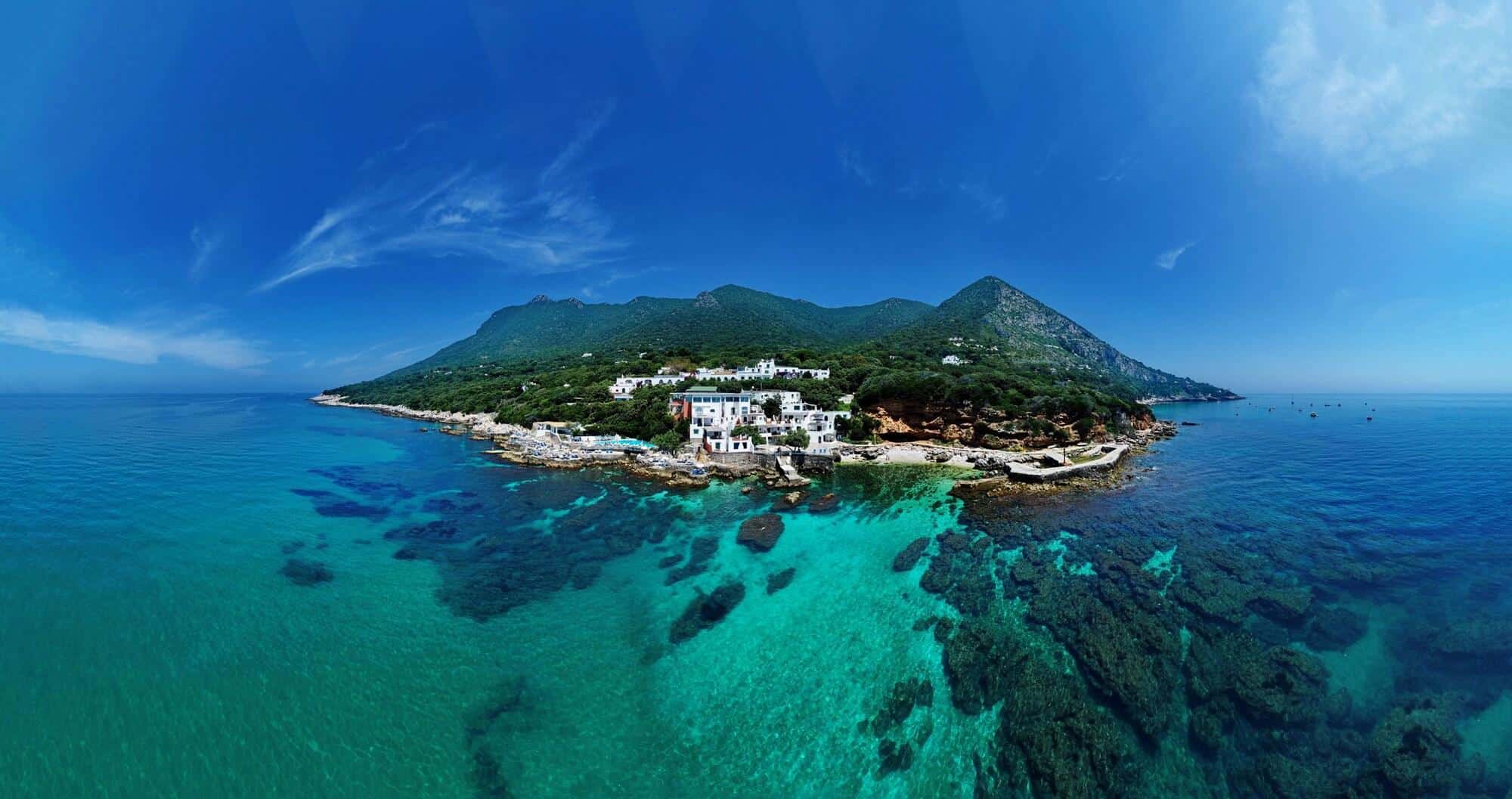
San Felice Circeo, besides the sandy coastline, has a harsher soul. It is the cliff of the Quarto Caldo, the southern side of the mountain, the one exposed to the sun all day. You get there from Via del Faro, which you take after passing the historic center, and along that road several accesses to the sea open up. There are no organized facilities: only rock, Mediterranean scrub and water. The Capo Circeo Lighthouse, built in 1866, stands right on this side, about three kilometers from the town, and remains the visual reference for getting your bearings. Bring water: on the Quarto Caldo, at noon in July, there isn't a thread of shade.
La Rinascente
One of the accesses most loved by the locals of San Felice is reached from Via Grotta delle Capre, the first side street on the left of Via del Faro, going down the first staircase you meet on the right. Some rocks smoothed by the sea serve as natural lounge chairs and the water, at that point, is very clear. It is the place where the locals bring the mask and stay until sunset. A practical warning: the staircase is steep and the return, with the low sun and tired legs, is harder than the descent.
The Punta Rossa Batteries
The Punta Rossa Batteries are the best compromise between cliff and convenience. You reach Via del Faro, continue onto Via delle Batterie, pass the Hotel Punta Rossa and a few meters after that a paved descent leads to the sea. The place is characterized by the cliff, but it also includes two coves that are not entirely natural, made by man, which lead into a clear seabed: with mask and fins you meet fish and mollusks among crevices and little caves. The name comes from the coastal artillery batteries, and the history of the place is told in a dedicated volume found in the bookstores of the Pontine area. If I had to choose a single point on the Quarto Caldo for a whole day, I would choose this one.
Beyond the Promontory: Torre Paola and the Bufalara
To the north, past the promontory, the coast of Sabaudia begins. The beach of Torre Paola and the one at Bufalara are the two wildest free beaches in the entire Circeo National Park. Torre Paola is the first of the four sixteenth-century towers and the only one that largely preserves its original structure. It takes its name from Lake Paola behind it, and guards the western slope, the Quarto Freddo. Bufalara is reached after the bridge, by a path that crosses the dune: attendance is low, the sand fine, the Mediterranean scrub comes almost to the water. A short distance away, inland, opens the Piscina delle Bagnature nature reserve, one of the forest pools of the Selva di Circe, much less visited than it deserves.

The Promontory: Geography and Geology of San Felice Circeo
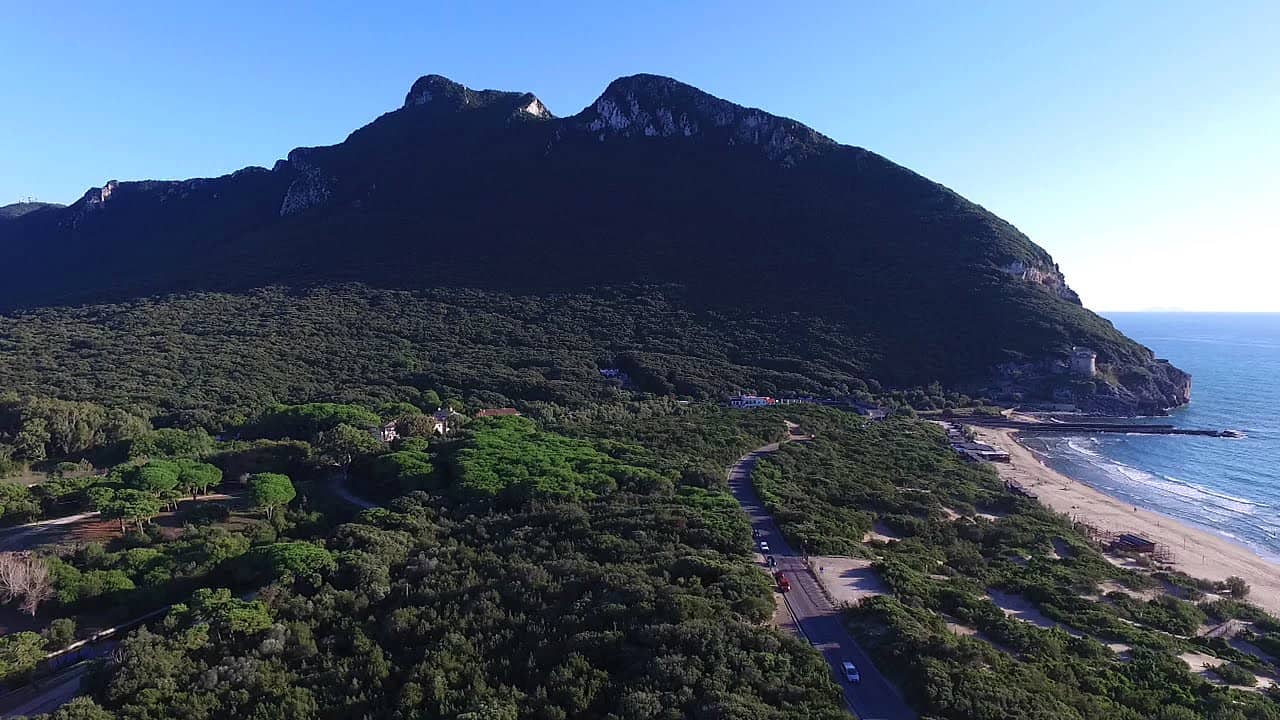
The municipal territory is made up of two clearly distinct areas: the promontory, about 6 kilometers long, and the flat part behind it. They are two different worlds, and you feel the difference within 10 minutes of driving.
Seen from Anzio, the promontory draws the profile of a reclining woman's face, identified by tradition with the sorceress Circe: the peak called Picco di Circe corresponds to the nose. Seen from Gaeta, the perspective changes entirely and the mountain looks like an island, the one the ancients called Aeaea. It is not a tourist suggestion made up at a desk: it is a real optical effect that depends on the angle of observation and the haze over the plain, and it fed the mythical geography of Greek navigators.
Along the ridge rise, one after another, the Vetta di Paola, the Picco di Circe which at 541 meters is the highest point, the Punta di Torre Moresca, the Punta di Vasca Moresca, the Punta del Fortino di Cretarossa, the Punta del Semaforo at 412 meters and the Punta dell'Acropoli, also called delle Crocette, at 352 meters. On the eastern slope rise several hills that surround the Historic Center: Peretto, Guardia Orlando and Monticchio to the north, Monte Morrone and San Rocco to the south.
Geological surveys have shown that the promontory consists mostly of limestones of different kinds: crystalline and white, compact, cherty with brachiopods, clayey. The plain below is instead formed of submerged sands, reclaimed during the 1930s. That the mountain was truly an island in the Quaternary is told by several converging clues: the discovery on the promontory of a gray sandstone later found only at 300 meters of depth, the fossil marine grooves, the marks left by marine erosion at altitude and the information drawn from the study of the Pliocene strata.
The Prehistory of San Felice Circeo: Grotta Guattari and the Neanderthal
Alberto Carlo Blanc and the Discovery of 1939
San Felice Circeo owes a great deal to the paleontologist Alberto Carlo Blanc, who from 1936 began systematic research around the promontory. The southern slope is riddled with caves and rock shelters, and that is where Blanc concentrated his work. In 1939 he identified the cavity that today bears the name of the family that owned the land, the Grotta Guattari: the entrance was blocked by very ancient landslides, and that very closure had sealed the context for tens of thousands of years.
Having made his way inside, Blanc realized he was in an environment that had hosted Neanderthal man. At the center of a ring of stones lay a Neanderthal skull, the one that would go down in history as the Circeo Man. The cave also preserved a dense presence of fossil bones of rhinoceros, ox, horse and deer, and medium-sized stones used as tools. The stratigraphy yielded traces of elephants, rhinoceroses, hippopotamuses, hyenas and bears: a fauna that is hard to imagine today on this coast. The geological age was traced back to a span between 50,000 and 60,000 years ago. In the same period as the skull, the mandible of a second individual came to light, Circeo II. In 1951 came a second mandible, Circeo III. In 1954, in another cavity, Blanc recovered the lower jaw of a child who lived about 50,000 years earlier.
One clarification is needed, because for decades the opposite version circulated: Blanc's original interpretation, according to which the skull was the object of a cannibalistic ritual and the ring of stones a human arrangement, has been seriously called into question by later studies, which attribute the bone accumulation above all to the action of hyenas. The ritual version remains a historiographically important hypothesis, but it is no longer the prevailing reading.
What Emerged from the Most Recent Excavations
In October 2019 the Superintendency of Archaeology, Fine Arts and Landscape for the provinces of Frosinone and Latina began new systematic research at the Grotta Guattari, in collaboration with the University of Rome Tor Vergata. On May 8, 2021 the Ministry of Culture announced the result: the remains of nine Neanderthal individuals, bringing to 11 the total number of individuals documented in the cavity counting the two already known. Eight of them are dated between 50,000 and 68,000 years ago, the oldest falls between 90,000 and 100,000 years ago.
The human remains include a skullcap, occipital and skull fragments, mandible fragments, two teeth and three partial femurs. Alongside these, thousands of animal bones were recovered: hyenas in large numbers, aurochs, red deer, rhinoceros, elephant, giant deer, cave bear and wild horses. The dig was directed by Francesco Di Mario, with Mauro Rubini for the anthropological part and Mario Rolfo for Tor Vergata. INGV, CNR-IGAG, the University of Pisa and Sapienza University collaborated. The 1939 skull is not at Circeo: it is kept in Rome, at the Pigorini prehistoric and ethnographic museum.
The cave has become visitable again on scheduled occasions, with limited-number visits by reservation and entrance from Via Alcide De Gasperi, run by the Superintendency. Openings are not continuous during the year: anyone who wants to enter must inquire in advance with the Superintendency or the Pro Loco, because the calendar changes from season to season. It is the most important prehistoric site in southern Lazio and one of the most important in Europe, and it's worth the wait.

The Grotta del Fossellone and the Other Caves
The Grotta del Fossellone is the second most important cavity for paleontology at Circeo. Inside, signs of meals, hearths and assorted tools have been recognized, along with the same abundance of worked stones documented at the Guattari. It was inhabited by both Neanderthal man and Homo sapiens, and this makes it valuable: it allows you to read in a single deposit the passage between two different humanities. Other caves of the promontory and other areas around have yielded blades, hunting tools, objects in obsidian and terracotta. Along the coast there are also sea caves reachable only from the sea, among them the Grotta Azzurra, the Grotta del Presepio and the Grotta della Maga Circe, which in summer are the destination of boat excursions from the port.
The Obsidian of Palmarola
The most extraordinary detail of the entire Circeo prehistoric complex is the obsidian. This volcanic glass does not exist on the promontory: the nearest deposit is on the island of Palmarola, in the Pontine archipelago, tens of kilometers of open sea away. Finding it at Circeo means only one thing: those people were able to build boats capable of open-sea crossings, and to repeat the voyage regularly enough to feed an exchange. Prehistoric navigation in the central Tyrrhenian is not a romantic hypothesis, it is a fact you can read in the materials.
The Ancient History of San Felice Circeo
The Pre-Roman Era
Starting from the middle of the third millennium BC, Lazio was inhabited by proto-Latin peoples who lived on pastoralism and agriculture, in villages of huts and later in fortresses built on the heights. Around 1000 BC other Italic peoples arrived, Sabines and Etruscans, and with those waves the whole territory was occupied: in the mountains that bound the Pontine Marshes the Ausonian-Opicans settled. The Etruscans were present throughout the area and founded Terracina and Velletri. After the retreat of Etruscan power came the wave of the Volsci, who occupied Circei and Terracina, pushing as far as the gates of Rome.
Circeo was already in antiquity a significant commercial center: a landing place for foreign navigators who had dealings with the local peoples and those of the hinterland. It is believed that the promontory could have served as a landing station for the Phocaeans, the Greek people who had colonies in Sicily and several ports of call along the Tyrrhenian coast of Italy. It was in all probability the Phocaeans who located at Circeo the Odyssean story of Ulysses and Circe, and from there the Greeks began to tell legends tied to the promontory, the sorceress and their children. The fame of Circeo among the Greeks at such an early period suggests that the site experienced a commercial flowering much earlier than other cities of Lazio.
The Roman Colony, the Volsci and the Wars against Rome
Two colonies were established at Circeo a century apart: so report Livy, Dionysius of Halicarnassus and Diodorus Siculus. The first was sent by Tarquin the Proud and led by his son Arruns. Circei then appears in the first treaty between Rome and Carthage, traditionally dated to the first year of the Republic, 509 BC. Dionysius explains that the colony was sent because the promontory held a strategic position on the sea. The archaeological traces of this first colony are however very few, so much so that many scholars doubt a Roman presence in the Tarquinian age: the only clue comes from the Acropolis, and probably consists of the second circuit wall, the one that surrounds today's Historic Center.
Shortly after, the colony had to face the Volscian invasion. Livy reports that the Volsci, led by Coriolanus, conquered Circei, driving out the Roman colonists. Dionysius instead tells that Circei surrendered without resistance, and that Coriolanus did no damage or violence to the citizens, limiting himself to asking for supplies for the army and a tribute in money: a request that, to be made, presupposes a prosperous community. The two versions do not coincide and neither can be verified: they are literary sources late with respect to the events they tell. The surrender, in any case, would be understandable: Circei was protected by walls but isolated from the rest of the marshes, could not receive relief, and the Volsci were conquering all the neighboring cities.
After Volscian domination, in 393 BC the Romans and Latins decided to retake Circei and built the perimeter of the Acropolis, making it a fortress city. A few years later, in 385, Circei undertook together with other peoples a war against Rome, won by Rome, which imprisoned some of the people of Circei. In 383 Circei allied again with Praeneste, Velletri and Lanuvio against Rome: the war ended a year later, again with a Roman victory. In 340 the Latin War broke out and Circei took active part in it, so much so that one of the two praetors of the Latin League was Lucius Numicius Circeiensis. After two years Rome prevailed and the repression was harsh for all 10 Latin cities. A last clash took place during the Second Punic War, when Circei and other neighboring cities refused to supply Rome with soldiers and provisions: Rome responded six years later, demanding double the men and supplies requested. Throughout the Roman period, however, Circei was a flourishing colony: strategically important, equipped with a port, and soon a vacation spot for prominent figures of Roman politics.
Roman Remains in the Area
Many of the great names of ancient Rome stopped at Circeo and left traces. Some spent vacation periods here, others were confined here in gilded exiles. The triumvir Marcus Aemilius Lepidus arrived in 36 BC, relegated by Octavian after the end of his political career, and stayed 20 years. The remains of his villa can be seen today from the belvedere of the Historic Center, Piazzetta Marconi: a short distance away a large construction of the Roman age can be made out, known as the Villa dei Quattro Venti. The attribution to Lepidus is traditional and not documented by an inscription: it should be taken for what it is, a strong local tradition but unproven. The area has been the object of recovery work and the visit depends on the site's opening calendar, which is best checked with the managing body.
There are remains of two other Roman villas: one on Monte Morrone, the other in the Peretto area, where a water cistern belonging to a building of the Republican age remains. On the religious front, the very ancient temple dedicated to the cult of the goddess Circe, assimilated to Venus, which stood on the highest peak of the promontory, deserves mention: its date is that of the second colony, around 390 BC, and today the base and several traces remain. Near the temple the head of a marble statue depicting the goddess was found, today kept in Rome in the collections of the National Roman Museum.
Another temple stood in the Monticchio area, and the finds show a very ancient construction, around the fifth century BC: ceramic fragments, bronze figurines and Siculo-Punic coins have been found. Other abundant finds of figurines and statuettes come from the Fontana Copella area, where a votive deposit was later identified. Statues, bas-reliefs and inscriptions have turned up just about everywhere in the territory.
Among the major monuments, one should recall the canal port of Torre Paola, which joins the lake to the sea, and the Fossa Augusta, the canal that started from the lake and flowed out on the opposite side, at Rio Torto: the work can still be read, albeit with many changes, and it was part of the Neronian project to connect Ostia to Lake Avernus in Campania. Little known is the stretch of Via Severiana that passes at the foot of the promontory, between the Selvapiana scrub and the mountain: the roadway is no longer visible, but you can make out funerary buildings, tombs and tombstones that form a true necropolis. Finally, in the territory of the neighboring municipality of Sabaudia stand two of the most important Roman remains of the area: the Fonte di Lucullo and the Villa di Domiziano.
The Middle Ages in San Felice Circeo
The Early Middle Ages and the Saracen Raids
The history of Circeo has a wide documentary gap, running from the fall of the Western Roman Empire to the year 1000. These are the years of the barbarian invasions, and it cannot be ruled out that the inhabitants of the colony suffered violence and devastation, first under Alaric and then under Genseric. No documents exist attesting the passage of those peoples through Circeo, but the cities along Via Appia were attacked, and the silence of the sources is not proof of calm.
Circei was instead certainly destroyed in the ninth century by the Saracen raids. In the first half of the 800s the Italian coast, from Sicily to the mouth of the Tiber, was struck and plundered by Arab ships sailing from Tunisia. In 829 Circei suffered a first devastation and the few surviving inhabitants took refuge in Terracina. The whole century was marked by naval battles between Saracens and the Papal States, with victories of the papal fleets in the second half: Pope John VIII defeated 18 enemy ships, and the fugitives hid in the woods of Circeo. At the moment of victory, however, the maritime cities of Gaeta, Salerno and Amalfi signed peace with the Saracens, who stayed near the Garigliano for 30 years. In those three decades the coastal towns of southern Lazio were plundered and razed to the ground. Circei met the same fate: total annihilation. The ancient colony was gone, and from then on the settlement changed its name several times: Rocca Circei, Rocca Circea, Rocca de Circeio, Castrum Sancti Felicis, Locus Sancti Felici.
The Frangipane Fief
The Rocca Circea begins to appear in documents of the Early Middle Ages. It was built by the popes or by the people of Terracina right after the destruction of Circei. Entrusted for a time to Terracina, it then passed to the lordship of Marino of Formosa. In those years Terracina was at war against Gaeta, and the alliance of the Rocca Circea with the people of Gaeta is attested in important documents: Marino of Formosa left the citizens ample freedoms, but in exchange asked for armed protection and a military alliance with the army of Gaeta. In 1138 Gaeta fell under the Normans' kingdom, the lordship of Marino of Formosa abandoned the Rocca and the Normans occupied it for a short time.
The twelfth century saw the arrival of the Frangipane, a family first Ghibelline and then Guelph, who dominated the whole Pontine area and became among the most important defenders of the papacy. In 1145 Pope Lucius II granted them the Rocca Circea as well, since they already owned Terracina. At the beginning of the 1200s the people of Terracina began to rebel against Frangipane rule by occupying the Rocca. In 1207 Pope Innocent III bought the fief. In 1239 Pope Gregory IX entrusted the people of Terracina with the task of fortifying it, ever more aware that it was a decisive strategic point for the defense of the Papal States.
The Templars at Circeo and the End of the 1200s
Also in 1239, in a period of very harsh struggles between Gregory IX and Frederick II, the pontiff ordered the Knights Templar to take possession of the Rocca Circea: the emperor intended to attack the Papal States from the south. The Templars already owned the church of Santa Maria della Sorresca, on Lake Paola, but only in that year did the pope order the Rocca to be reactivated and fortified. It is in this period that the settlement changed its name to Castrum Sancti Felicis.
Today in the Historic Center you can still recognize the places built and inhabited by the Templars, who erected a convent and the tower that dominates the central square. The Templars' Tower was built between 1240 and 1259 and keeps the clock, moved here in the nineteenth century from the baronial palace, with the six-hour dial in the Italian style: a detail almost nobody notices and which instead tells of an entire system of time measurement, the one in which the day was counted starting from sunset. In 1259 the Castrum Sancti Felicis was entrusted to a new lord, Giordano Pironti-Conti: he and his descendants ruled until the end of the century, when through violent occupation the fief passed to the Roman family of the Annibaldi.

From 1301 to 1492: The Arrival of the Caetani
1301 is a cardinal date: the Annibaldi ceded the entire Castrum Sancti Felicis to Pietro Caetani. The family's rule would last more than 400 years. The Caetani had become very powerful after the election to the papal throne of one of their members, Benedetto, who took the name Boniface VIII. After the pope's death the house reached its peak with Onorato I, count of Fondi. The Castrum was governed first by Pietro, then by Cardinal Francesco, then by Nicolò I.
In 1378 the Western Schism began, and the Caetani and the Pontine lands had a leading role in the affair. Onorato I occupied Circeo and only in 1400 did the Church, by means of a crusade, manage to defeat him. For a few years the territory was governed by the Church, then in 1411 it returned to the Caetani. The figure who most distinguished himself for what he did here was Giacomo IV: he lived in the castle of San Felice and worked to improve the living conditions of the inhabitants.
In 1441 war broke out between Alfonso V of Aragon and Pope Eugene IV. The Aragonese occupied Terracina and pushed on to the Castrum Sancti Felicis, destroying it completely. Two years later the territory returned under the protection of the Church. These are the years in which Onorato III Caetani wanted to reclaim the castle and the pontiffs denied it to him: indeed they had him imprisoned, and only after 30 years could the count return to govern. In 1482 Circeo was occupied by Alfonso duke of Calabria, at war against Sixtus IV, and in 1495 by the French militias of Charles VIII, after which it passed stably under the dominion of the Papal States.
The Modern Era at San Felice Circeo
The Sixteenth Century: The Destruction, Guglielmo Caetani, the Coastal Towers
The sixteenth century began badly. In 1501 San Felice was destroyed by Frederick I of Aragon: the king was on his way into exile in France after the outcome of the Treaty of Granada and, having reached Circeo with his ships, decided to land and raze the town to the ground, because the territory had been governed by the Caetani, political enemies of the Aragonese house. The inhabitants fled and the few survivors moved to Sermoneta. With the death of Alexander VI the town again became a possession of the Caetani.
The new pope Julius II summoned Guglielmo Caetani, then in exile in Mantua, and by a document entrusted him with the task of rebuilding and restoring the castle of San Felice. Guglielmo called together the old inhabitants who had moved to Sermoneta and Terracina and, during a meeting, declared his intentions: reconstruction at his own expense of the castle and the walls, donation of lands to the original inhabitants, reconstruction of the mills. The citizens, in exchange, would have to commit to rebuilding their own houses and defending the town from any external attack. The actual reconstruction took place in the following century, but to Guglielmo are owed the rebuilt circuit of walls, the lower part of the Palazzo Baronale and the arched gate that is still today the entrance to the town. Throughout the sixteenth century his successors tried to continue with the repopulation plans, obtaining however scant results.
In 1562 Pope Pius IV commissioned Nicolò and Bonifacio Caetani, lords of Sermoneta and San Felice, to erect four towers to defend the coast. The century was marked by continual attacks by Barbary corsairs who plundered the Lazio coasts: the Circeo promontory was one of their favorite targets, because the inlets offered shelter for attacking passing ships, and very often the pirates landed to carry out raids and kidnappings. The first towers built were Torre Paola and Torre Fico. Torre Paola takes its name from the locality, stands near the lake of the same name, and guards the western side, the Quarto Freddo. Torre Fico owes its name to the prickly pears that surround it and guards the eastern side, the Quarto Caldo. In a single year of work the two towers were ready, and they immediately stood out as the sturdiest and most functional on the whole coast. Next came Torre Cervia, built at the point of the promontory that juts farthest toward the sea and named for the deer that passed through that area, and Torre Moresca, erected on a very rugged stretch. The other towers of Circeo, among them Torre Olevola, came later.
The 1600s: San Felice Takes the Shape It Has Today
In the first decades of the 1600s the Caetani started a serious program of repopulation and reconstruction. 11 families from Ischia arrived, followed by groups from Sperlonga, Naples, Orvieto, Nettuno, Roccagorga and many other places in Lazio, Campania and Umbria. By the end of the century the population had grown by two thirds, and many surnames of that time have lasted to this day: anyone with an ear for dialects notices right away, because the San Felice dialect keeps Ischian traits that you don't hear elsewhere in the province.
In urban terms, in the 1600s the town took on the look it has kept almost unchanged. The Caetani completed the construction of the Palazzo Baronale, today the town hall, renovated the convent, built a church inside the palace, of which some remains can be seen under the arch that links Piazzale San Francesco to Piazza Lanzuisi, and completed the present Corso Vittorio Emanuele. They improved the inhabitants' conditions in general, so much so that they opened manufacturing activities: textile industries, tanneries, taverns. Fishing, however, was not practiced, for fear of pirate attacks, and hunting was reserved for the duke. It was, in any case, a prosperity the town had never known before, perhaps since the days of Rome, and it arrived just as the rest of the peninsula was bent under plague and the 30 Years' War.

The 1700s: Rule by the Apostolic Chamber
The first 20 years of the 1700s were marked by changes of ownership: the fief went from the Caetani to the Ruspoli, then to the Orsini. In 1720 it was sold to the Reverend Apostolic Chamber, which ran it for 150 years. Pope Clement XI and Cardinal Collicola, his collaborator, immediately started weighty works: they put back into operation the Roman canal near Lake Paola, by then silted up, built a new parish church, which is the present one, restored the convent and turned it into housing for the citizens, and opened an arched gate in the Palazzo Baronale for the passage of carts.
In 1730 Pope Clement XII entrusted the territory to his own nephew Neri Maria Corsini, a leading figure in Roman circles, with a past of diplomatic posts at the courts of Europe. He governed San Felice for 40 years: he halved the taxes, tried to make Lake Paola rich in fish again and enlarged the parish church. After his death the town passed under the direct government of the Apostolic Chamber. Among the governors who took turns was Giovanni Angelo Braschi, later elected pope under the name Pius VI: he had a significant number of new houses built, enlarged the parish church again, reopened the alabaster quarry and granted the people of San Felice permission to cultivate in the Terracina scrub. In the 1700s the last coastal tower, Torre Olevola, was built, or rather rebuilt.
A detail of religious history worth reporting: the old patron saints of the town were Saint Caesarius of Terracina, deacon and martyr, and Saint Sebastian the martyr, until April 27, 1777, the day the church was consecrated to Saint Felix, pope and martyr. In the archpriest church, relics of Saints Caesarius and Sebastian were kept.
The 1800s: Prince Poniatowski
Along the road that leads from La Cona to the Historic Center you meet, on the left, a descent named after Prince Stanislao Poniatowski. Two centuries later the memory of and gratitude toward this figure are still alive among the people of San Felice, and it is not a figure of speech from a brochure: it is one of the few positive memories of lords that survive in a town that had seen many masters.
The prince, nephew of the Polish king Stanislaus Augustus, leased the fief in 1808 and ruled it for 14 years. At the start he appointed a trusted minister, dismissed shortly after because he had raised the rents on the inhabitants. His work greatly benefited the population: he planted vineyards and orchards across the whole territory, built new houses in the Historic Center, carved out storerooms and cellars by expanding the spaces of the Palazzo Baronale, placed the clock on the Templars' Tower so everyone could know the time, improved the road system with roads connecting the several points of the territory, restored the condition of the lake and of the premises meant for the fishermen. He also built a villa in a wonderful spot on the promontory: that villa is today known as Villa Aguet, but it was the Polish prince who wanted it. Several artists from Rome in his service came to Circeo, and among them Giuseppe Valadier, who cast the great bell of St. Peter's Basilica in the Vatican. In 14 years the town flourished again and the inhabitants knew a true period of prosperity.
The Napoleonic Period, the Risorgimento and Brigandage
During the Napoleonic period the promontory was again given the role of bulwark for coastal defense. The arrival of French troops brought the construction of the two batteries of Torre Cervia and Torre Moresca, the latter still visible, and the setting up of an optical telegraph in the Acropolis area. In 1814 Joachim Murat, king of Naples, abandoned Napoleon and began a march toward the Papal States. The French general commanding the troops at Circeo found himself facing the Neapolitans, posted in the Acropolis area: under pressure from the soldiers and the population, the French withdrew without engaging in battle. The Napoleonic small fort still seen today is the most concrete remnant of that season. In the following decades the promontory, with its impenetrable scrub and its caves, became a refuge for the brigands who infested the border between the Papal States and the Kingdom of Naples.
The Historic Center of San Felice Circeo, on Foot
The village can be visited in an hour and a half walking slowly, and it's best done in the evening. You enter through the arched gate wanted by Guglielmo Caetani and come out in Piazza Vittorio Veneto, where the Templars' Tower with its six-hour clock serves as backdrop to all the little tables in town. From there an arch leads to the Palazzo Baronale, today the town hall, and to Piazza Lanzuisi, where the Pro Loco is based in the Porta del Parco, a building that preserves a Templar chapel. The church of the Beata Vergine della Pietà is the eighteenth-century parish church, expanded several times, mentioned above.
The best moment is the belvedere of Piazzetta Marconi at sunset: from there you see the Pontine plain, the sea as far as Terracina and, below, the remains of the Roman villa. Of the Cyclopean walls of ancient Circeii, stretches in polygonal masonry remain along the perimeter of the Acropolis, recognizable to the naked eye by the enormous blocks fitted together without mortar. The Acropolis was probably built at the beginning of the third century BC and represented the last defensive bulwark of the city.
The permanent exhibition Homo Sapiens and Habitat, set up in 1978, displays in five thematic sections the prehistoric materials of the area: it is small and does not have the air of a big museum, but it is the key to understanding the caves, and whoever skips it arrives at the Guattari without the tools. Hours and opening are seasonal: ask the Pro Loco before going up.
Trail 750 and the Picco di Circe
Numbered trail 750 climbs to the Picco di Circe, the highest point of the promontory at 541 meters. It is the classic Circeo hike and it is not a stroll: the elevation gain is concentrated in a short space, the surface is smooth, slippery limestone rock, and in summer the slope is exposed to the sun for most of the route. You need real hiking shoes, not a sneaker, and you need plenty of water. The reward, on clear days, is a view that runs from the Lepini Mountains to the Pontine Islands, with Lake Paola and the Sabaudia dune spread out below.
It's best to start at dawn even in June, and give up entirely between 11:00 and 16:00 in the hot months. Anyone who doesn't feel up to it can fall back on the routes in the state forest, flat, where pools like the Piscina delle Bagnature offer a completely different environment, damp and shady, with fauna you don't meet by the sea.
When to Go to San Felice Circeo and When to Avoid It
June and September are the right months. The water in September is warmer than in June, traffic is halved, the beach clubs are still open and the town breathes. July is bearable on weekdays. August, especially the week of Ferragosto, is the worst version of this place: lines, parking nowhere to be found, free beaches full by 9:00.
April and May are splendid for the promontory and for the blooming of the scrub, with the sea still cold. In winter Circeo is another place: almost empty, windy, with the old town returning to its inhabitants. Those who like walking will find the best conditions for trail 750 in the cold months. The flip side is that many businesses close and public transport runs become much less frequent.
A note that has to be said frankly: in 2026 San Felice Circeo is not among the Lazio municipalities awarded the Blue Flag, a recognition that in the province of Latina went to Latina, Sabaudia, Terracina, Fondi, Sperlonga, Gaeta, Formia and Minturno. It doesn't mean the sea is unusable, because the certification criteria cover many management aspects besides water quality. It does mean, however, that the flag, often cited on promotional pages, isn't there this year.

San Felice Circeo with Kids
With small children the right stretch is the sandy coast of Viale Europa and Via Terracina area, where the seabed slopes gently and the sand is fine. The coves of the Quarto Caldo, however beautiful, are the exact opposite of what a family with a three-year-old needs: rocks, steep stairways, no shade and no services. The beach clubs on Viale Europa and Lungomare Circe generally offer showers, restrooms and lifeguard service, and for an afternoon with little ones the cost is worth the peace of mind.
For the cultural side, the Homo Sapiens e Habitat exhibition works very well with kids from seven years up: Neanderthals are a subject that grabs them, and the story of the Grotta Guattari has all the ingredients of a mystery, the landslide that seals, the skull in the ring of stones, the scientific revision that overturns the interpretation. I advise against trail 750 under the age of 10 and in midsummer.
Accessibility
The old town is the sore point: rocky platform, steep slopes, paving stones and stairways. A wheelchair moves with difficulty beyond the main square and you need strong arms. On the seafront the situation is better, because the sidewalk on Viale Europa is flat and many beach clubs have walkways on the sand. The availability of job chairs and dedicated services varies from concession to concession and should be asked about directly at the beach club before you arrive. The coves of the Quarto Caldo and the Punta Rossa Batteries are not accessible to people with walking difficulties, and there is no sense in fooling yourself about the opposite.
How Much a Day in San Felice Circeo Costs
The cheapest day costs the fuel and nothing more: free beach on the public stretches, your own umbrella, a sandwich from home. The cost grows with the beach club, and the prices of umbrella and loungers are set by each lido with a price list posted at the entrance, with significant differences between first and second row and between high and low season. Paid parking weighs, in high season, more than you would imagine.
Three concrete ways to spend less. First: park only once and get around on foot or by bicycle, instead of moving the car from one stretch to another. Second: prefer the free stretches of Lungomare Circe to the first row of a beach club, because the view is the same and the cost is zero. Third: eat at noon with baked goods from the town and save the restaurant for the evening, when the service is better and the diners are less rushed.
What to Eat in San Felice Circeo
Circeo cooking is both of the sea and of the buffalo, which is a typically Pontine combination. Among the local products are buffalo cheeses and meats, eucalyptus and sulla honey, the zucchini and watermelons of the reclaimed plain, and blue fish. The signature dish is the canascione, a stuffed pizza of the local tradition, and at Easter the viscotta appears, the sweet holiday bread.
A note on method, since I don't name venues: at Circeo good fish costs money, and the fixed-price tourist menus along the seafront rarely hold up against a trattoria in the old town where you eat what came in that morning. Ask what fish there is today before opening the menu: the answer will tell you everything you need to know about the place.
What's Around San Felice Circeo
Within half an hour you cover a very different range of landscapes. To the north are the dune and lake of Sabaudia, with the Torre Paola beach and the Bufalara, and farther up, beyond Latina, the coast of Torre Astura, Nettuno and Anzio. To the south you quickly reach Terracina with the temple of Jupiter Anxur, and continuing, Sperlonga and Gaeta. Inland you climb to the Lepini Mountains, with Sermoneta and the Garden of Ninfa, which within 40 minutes by car take you to a world completely different from the seaside one. From the port, in summer, depart the sea connections to the Pontine islands and the excursions to the sea caves of the promontory.
If you want to build a broader itinerary on the coast, you can start from the Riviera di Ulisse, and if you're looking for inspiration among the destinations of Lazio, you can stop by the page of tourist attractions. For tailored professional accompaniment, with licensed guides and tour escorts, the reference is TourLeaderPro.
A Curiosity About San Felice Circeo (LT)
The curiosity that almost nobody tells is about obsidian. In the caves of the promontory and in the prehistoric sites around it, objects in obsidian have turned up, a black, sharp volcanic glass that does not exist at Circeo and never has: the nearest deposit is on the island of Palmarola, in the Pontine archipelago, separated from the coast by tens of kilometers of open sea. There is only one possible explanation for how that material got here: someone went to get it, by sea, with boats able to withstand an open-sea crossing, and did so often enough to sustain a stable exchange.
This deserves to be weighed carefully. We are talking about prehistoric communities that we commonly imagine as stationary, tied to their hunting territory, and who instead organized sea expeditions to an island that can be seen from the coast only on clear days. They needed hulls, they needed weather knowledge, they needed the ability to find their way toward a distant outline of land, and they needed an economic motive: obsidian is the best raw material for sharp blades before metallurgy, and in the Neolithic it worked as a prized commodity.
The second curiosity lies in the optical effect of the promontory, which changes nature depending on the point from which you observe it. From Anzio it is the profile of a reclining woman and the peak called Picco di Circe draws her nose. From Gaeta it is an island floating on the haze, the ancient Aeaea of the poets. You don't have to believe in the sorceress to recognize that this double profile guided the mythical geography of ancient sailors. Try looking at it from both sides on the same day: it is an experiment that works, and it is worth more than any educational panel.
Something Nobody Tells You About San Felice Circeo (LT)
That the most famous interpretation of prehistoric Circeo has been dismantled by science, and nobody will tell you in front of the cave. When Alberto Carlo Blanc found the Neanderthal skull in the middle of a ring of stones, in 1939, he drew from it the reconstruction of a cannibalistic rite: a deliberately placed skull, a circle of rocks arranged by man, a cult of the head. That image entered school textbooks for two generations and made Circeo the symbolic place of the violent and ritual Neanderthal.
Later studies reversed the reading. The re-examination of the marks on the bones and the very composition of the deposit, dominated by hyena remains, indicate that the accumulation formed in large part through the work of the animals that used the cave as a den, and not through intentional human action. The ring of stones, in all likelihood, is the result of natural processes. It is a classic case of how archaeology corrects itself.
Why is it interesting and not just pedantic? Because Circeo today is worth more scientifically than before, not less. 11 Neanderthal individuals documented in a single cavity, with datings that cover a span between 100,000 and 50,000 years ago, make Guattari one of the densest sites in Europe for the Middle Paleolithic. The true story, that of bodies dragged by hyenas into a cave that a landslide then sealed, is less theatrical than the legend but says much more about how people lived and died on this coast. The tourist who goes in knowing this looks with different eyes.
My Advice for Visiting San Felice Circeo (LT)
Split the day in two, and don't try to do sea and culture in the same time slot. Circeo punishes anyone who approaches it with the single-parking-spot logic. The tried and tested sequence is this: wake up early, go up to the old town by 8:30 when the roads are clear, tour the village and the lookout at piazzetta Marconi in the low light, breakfast in the square. Then you go down toward the sea and choose a single stretch to stay at until the afternoon: Viale Europa if there are small children, Lungomare Circe if the color of the water matters, the Punta Rossa Batteries if you have a mask and fins and trained feet.
The second piece of advice is about shoes. At Circeo you need two pairs: one for the sea, ideally with a rubber sole for the rocks in front of Lungomare Circe, and one closed with real grip for the old town and any trail. Whoever shows up with only flip-flops gives up half the place from the start.
The third: call ahead. The openings of the Grotta Guattari, the Villa dei Quattro Venti and the Homo Sapiens e Habitat exhibition depend on seasonal calendars that change, and the Pro Loco in Piazza Lanzuisi answers and knows. Showing up in front of a closed gate is the most common mistake I see made here, and it is avoided with a two-minute phone call. If your main goal is the cave, build the trip around the date of the visit, not the other way around.
Last, and it counts as a blunt verdict: if you have only one day and love walking, give it to the promontory and give up the beach. Lazio has many sandy shores. Of limestone mountains that drop sheer into a green sea, it has only one.
Another Well-Known Fact, Yet Rarely Cited
Everyone knows Circeo was an island. Few know that this is not a poetic metaphor but a geological conclusion supported by independent, converging evidence. The first is a gray sandstone found on the promontory and then found again only at a depth of 300 meters: the same formation, at the same elevation, tells of a completely different sea level. The second is the fossil sea grooves, cut by the wave into the rock and today suspended well above the shoreline. The third is the marine erosion readable on surfaces that water hasn't touched for millennia. The fourth comes from the study of the Pliocene layers of the surrounding plain.
The plain that today separates the mountain from the rest of Lazio is made of submerged sands, that is, of a sea floor that emerged and then became marsh, and the land reclamation of the 1930s simply made farmable and livable a territory that for millennia had been water and malaria. Circeo, in short, became mainland relatively recently, and the ancient name of the island, Aeaea, was not an invention of the poets: it was a description.
The practical consequence of this fact can still be seen today. On the promontory the flora is that of an island, with endemic species and concentrations of species that the plain doesn't have. The fauna of the caves tells of a separate ecosystem. And the very shape of the municipal territory, split in two between mountain and plain, depends on this double nature. Whoever drives along the coastal road and then climbs to Via del Faro crosses, within 10 minutes, two geological histories millions of years apart.
The Right Photo to Take in San Felice Circeo (LT)
The photograph that takes Circeo home is not shot on the beach. It is shot from the lookout at piazzetta Marconi, in the old town, an hour before sunset: from there you frame the Pontine plain fading away toward Terracina, the line of the sea, the roofs of the village in the foreground and, at lower right, the remains of the Roman villa. The low light of the end of the day separates the planes and gives back the depth that the noon sun flattens completely.
The second shot, the one almost nobody looks for, is taken from the sea. If you get on one of the boats that leave the port in summer for the tour of the caves, ask to pass offshore on the western side in the late afternoon: from there the promontory takes on the profile of the reclining woman and, with the right haze, seems to detach from the mainland. It is the same image the Greek sailors had before them, and it is impossible to get from shore.
A third option, for walkers: from trail 750, climbing toward the Picco di Circe, the view opens on Lake Paola and the Sabaudia dune, with the perfect line of the coast running straight for kilometers. A technical tip: use a long lens and compress the planes, because the wide angle here shrinks everything and gives back an empty photograph. And for the Torre dei Templari, in the square, get close and frame only the face of the six-hour clock: that detail tells the town better than any panorama.
Some Important Events That Happened Here in History
The first is from 1939: the discovery of the Grotta Guattari by Alberto Carlo Blanc and the finding of the Neanderthal skull now kept in the Pigorini museum in Rome. It was an event of international resonance, which put Circeo on the map of world paleoanthropology and which, with the ritual interpretation later revised, shaped for decades the popular image of Neanderthal man.
The second is May 8, 2021, when the Ministry of Culture announced the results of the research begun in October 2019 by the Superintendency for Archaeology, Fine Arts and Landscape for the provinces of Frosinone and Latina with the University of Rome Tor Vergata: nine new Neanderthal individuals, bringing the documented total in the cave to 11, dated between 50,000 and 68,000 years ago, with the oldest between 90,000 and 100,000.
The third is 1501, when Frederick I of Aragon, on his way into exile in France, landed at Circeo and razed the town to strike at the Caetani. The destruction was total and the survivors moved to Sermoneta. The village we see today comes from the reconstruction begun by Guglielmo Caetani on commission from Julius II and completed in the seventeenth century with the repopulation by families from Ischia.
The fourth is 1239, the year Gregory IX ordered the Templars to take possession of the Rocca Circea as an anti-imperial move against Frederick II. The town changed its name to Castrum Sancti Felicis and acquired the tower and the convent that still define its center today.
The fifth is 1814, when the French troops holed up at Circeo withdrew without a fight before the advance of Joachim Murat's Neapolitans, under pressure from the soldiers and the local population.
The sixth is September 1975 and has to be named without relish, because it belongs to the civil history of the town and of the nation: on the night between the 29th and 30th of that month, in a villa on the promontory, two Roman girls were kidnapped and tortured. Rosaria Lopez, 19, was killed. Donatella Colasanti, 17, survived by playing dead. The trial that followed and Colasanti's testimony had an enormous weight in the Italian debate on sexual violence and its legal treatment. For an entire Italian generation, Circeo is also this name, and it would be dishonest to write a guide to it pretending nothing happened.
Who Has Passed Through San felice Circeo (LT)
The first list is the Neanderthals, and that's no joke: 11 individuals documented in Grotta Guattari alone, over a span from 100,000 to 50,000 years ago, make this promontory one of the most densely populated places in Europe for our extinct cousins. After them came Homo sapiens hunters, who left hearths, tools and food remains in Grotta del Fossellone layered over the Neanderthal ones.
In classical antiquity Circeo was a land of illustrious Romans. The triumvir Marcus Aemilius Lepidus, the third man of the Second Triumvirate with Octavian and Antony, arrived there in 36 BC, relegated by the future Augustus, and spent the last 20 years of his life there: a gilded and humiliating exile, within sight of the sea, for the man who had been pontifex maximus. Before him Tarquin the Proud, according to the tradition reported by Livy, had sent a colony there led by his son Arruns, and the Volscian commander Coriolanus had come there with his army. Circei gave Rome a praetor of the Latin League, Lucius Numicius Circeiensis.
In the Middle Ages the promontory passed from hand to hand among the protagonists of papal politics: the Frangipane, who received the Rocca from Pope Lucius II in 1145, the Knights Templar, installed by order of Gregory IX in 1239, Giordano Pironti-Conti from 1259, the Annibaldi of Rome, and from 1301 the Caetani, the family of Boniface VIII, who stayed over 400 years with figures such as Onorato I count of Fondi, Giacomo IV and Onorato III.
In the modern age two kings landed here: Alfonso V of Aragon in 1441 and Frederick I of Aragon in 1501, both to destroy. Pope Pius IV, in 1562, decided from Rome on the four towers that still mark the coast today. Among the eighteenth-century governors of the Apostolic Camera was Giovanni Angelo Braschi, later Pope Pius VI, and Cardinal Neri Maria Corsini, nephew of Clement XII, ruled the territory for 40 years.
The nineteenth century carries the name of Prince Stanislao Poniatowski, nephew of the last king of Poland, who held the fief on lease from 1808 for 14 years and transformed it: roads, houses, vineyards, the clock on the Templar Tower, the villa now known as Villa Aguet. Giuseppe Valadier, the founder of St. Peter's great bell, came from Rome in his service. Then came Napoleon's French with their coastal batteries, and in 1814 Joachim Murat's troops. In the twentieth century it was the turn of Alberto Carlo Blanc, who from 1936 made the promontory his own research site, and of the Roman vacationers who since the postwar period have built the place's seaside reputation.

Quick Questions About San felice Circeo (LT)
How far is San felice Circeo (LT) from Rome?
A little over 100 kilometers, with a drive of about an hour and 40 minutes in normal traffic conditions. On summer weekends and during the week of Ferragosto the travel time can easily exceed two hours, especially on the last stretch toward the seafront. The main road is Via Pontina.
How do you get to San felice Circeo by public transportation?
The most useful train station is Priverno-Fossanova, on the Rome Termini-Naples line via Formia. From there the connection to Circeo is by road, with the regional suburban bus service. There are also direct bus runs on the Pontina route. Schedules change between the summer and winter seasons and on holidays, so check them on the carrier's website before leaving.
Are the beaches of San felice Circeo free or paid?
Both. The shoreline alternates beach clubs and free stretches: the largest of the latter, on Viale Europa, is called the Fratta by the locals. On Lungomare Circe the free strips are thin and often have rocks in front. The coves of the Quarto Caldo cliff are all free access and have no services.
What is the most beautiful beach in San felice Circeo (LT)?
For the color of the water and the view, the Lungomare Circe stretch. For those who love mask and fins, the Punta Rossa Batteries. For those looking for real sand and services, Viale Europa. For those who want nature without compromise, Torre Paola and the Bufalara, just beyond the promontory, in the territory of Sabaudia.
Does San felice Circeo have the Blue Flag?
Not in 2026: the shoreline did not reconfirm the required criteria and the town is not among the 10 in Lazio that were awarded. In Latina Province the recognition went to Latina, Sabaudia, Terracina, Fondi, Sperlonga, Gaeta, Formia and Minturno.
Can you visit Grotta Guattari?
Yes, with limited-number visits by reservation, run by the Superintendency for Archaeology, Fine Arts and Landscape for the provinces of Frosinone and Latina, with access from Via Alcide De Gasperi. Opening is not continuous throughout the year: the calendar should be checked in advance with the Superintendency or with the town's Pro Loco.
Where is the skull of Circeo Man?
In Rome, in the collections of the Pigorini Prehistoric and Ethnographic Museum. At Circeo, instead, the Homo Sapiens and Habitat Permanent Exhibition holds prehistoric materials from the area, arranged in five thematic sections.
How many Neanderthals have been found at San felice Circeo (LT)?
11 individuals documented in Grotta Guattari alone: two already known and nine announced by the Ministry of Culture on May 8, 2021, at the end of the research begun in October 2019. Eight are dated between 50,000 and 68,000 years ago, the oldest between 90,000 and 100,000.
How long does it take to visit San felice Circeo?
The historic center takes an hour and a half on foot at an easy pace. A full day allows the village plus a beach. Adding Trail 750 and Circe's Peak takes a second day, because the climb and descent take up a whole morning and should be done in the cool.
Is the trail to Circe's Peak difficult?
It isn't technical, but it isn't a stroll. The elevation gain up to the 541 meters of the summit is concentrated in a short distance, the smooth limestone surface is slippery and the slope is exposed to the sun. You need trekking shoes with a lugged sole, plenty of water and a dawn start in the warm months.
Is San felice Circeo (LT) suitable for children?
On the sandy shoreline yes, particularly in the area of Viale Europa and Via Terracina, where the seabed slopes gently. The cliff coves, with steep stairways and no shade, are instead not recommended for the very young. The Homo Sapiens and Habitat Exhibition works well with kids from age seven up.
Can you get to the beach in a wheelchair?
On the seafront it's workable: the sidewalk on Viale Europa is flat and many beach clubs have walkways on the sand. The availability of Job chairs and dedicated services varies from concession to concession and should be asked of the individual beach club before leaving. The historic center, with its slopes and stairways, remains difficult.
Where do you park in San felice Circeo?
Along the shoreline and in the parking areas below the historic center. Rates and blue-striped stretches depend on the town's seasonal ordinances and should be read on the signs on site. In high season it's best to arrive before 09:00, leave the car just once and get around on foot or by bicycle.
What is the best time to go to San felice Circeo (LT)?
June and September. In September the water is warmer than in June, traffic is halved and the beach clubs are still open. April and May are excellent for the promontory and for the flowering maquis, with a cold sea. August is the month to avoid if you can choose.
What's the difference between San felice Circeo and Sabaudia?
San Felice Circeo is a medieval village on a rocky platform 100 meters above the sea, with a coast of mixed sand and cliff. Sabaudia is a town founded in the 1930s, on the plain, with 15 kilometers of continuous sandy dune and Lake Paola behind it. They are two different experiences, and anyone looking for endless sand has to go to Sabaudia.
What do you eat in San felice Circeo?
Blue fish, cheeses and buffalo meats from the Pontine plain, zucchini and watermelons from the area, eucalyptus and sulla honey. The signature dish is the canascione, a filled pizza of the local tradition. At Easter they make the viscotta, the sweet bread of the holidays.
What are the coastal towers of San felice Circeo?
The four ordered by Pius IV in 1562 are Torre Paola and Torre Fico, built first and in a single year, then Torre Cervia and Torre Moresca. Torre Olevola was built, or rebuilt, in the eighteenth century. Torre Paola keeps its original structure in large part. Of the others, ruins remain and, at Torre Moresca, the battery from the Napoleonic era.
What is the Villa dei Quattro Venti?
A large Roman villa visible from the belvedere of Piazzetta Marconi, traditionally identified with the residence of the triumvir Marcus Aemilius Lepidus, relegated to Circeo in 36 BC. The attribution is local tradition, not confirmed by an inscription. The area has been the subject of recovery work and access depends on the site's opening calendar.
Can you visit the sea caves of Circeo?
Yes, from the sea: in summer boat excursions leave the port along the cliff, calling among others at the Grotta Azzurra, the Grotta del Presepio and the Grotta della Maga Circe. From land those cavities cannot be reached, and the Precipizio area should be avoided in any condition.
Is San felice Circeo one of the Most Beautiful Villages in Italy?
Yes, the historic center is part of the national circuit of the Most Beautiful Villages in Italy. The town has a little over 10,000 inhabitants, the old core stands about 100 meters above sea level and the patron saint, Saint Felix the Martyr, is celebrated on July 29.
What to see in San felice Circeo in half a day?
The Templar Tower with its six-hour clock in Piazza Vittorio Veneto, the Palazzo Baronale and Piazza Lanzuisi, Beata Vergine della Pietà Church, the stretches of polygonal walls of the Acropolis and the belvedere of Piazzetta Marconi with the view over the remains of the Roman villa. If there's time left, the Homo Sapiens and Habitat Exhibition.
One last word. Circeo is one of the few places in Lazio where three time scales touch within two kilometers: the cave with 11 Neanderthals, the base of the goddess's temple, the Templar tower with the clock that counts the hours the Italian way. Anyone who comes only for the beach umbrella takes home a day at the sea like any other. Anyone who bothers to go up to the village at sunset and look at the promontory from the sea understands why the Greek sailors put a sorceress there. Do it outside August, and bring serious shoes. To explore the rest of the region I refer you to the ItalyPlanner guide to Lazio and, for Italian coasts in general, to their selection of the best beaches. If instead you're looking for professional accompaniment, the reference remains the team at TourLeaderPro.
Article written by the editorial team of TourLeaderPro, contact them for Private/Corporate/V.I.P. Tours and Experiences.
Planning a trip to Rome? The English guides to visiting the city are on ItalyPlanner.com.