Bufalara Beach, Sabaudia
In short. Bufalara Beach is on the Sabaudia coast, in Latina Province, on the stretch of shore that starts where the town's seafront ends and continues north, toward Latina, inside the boundaries of Circeo National Park.
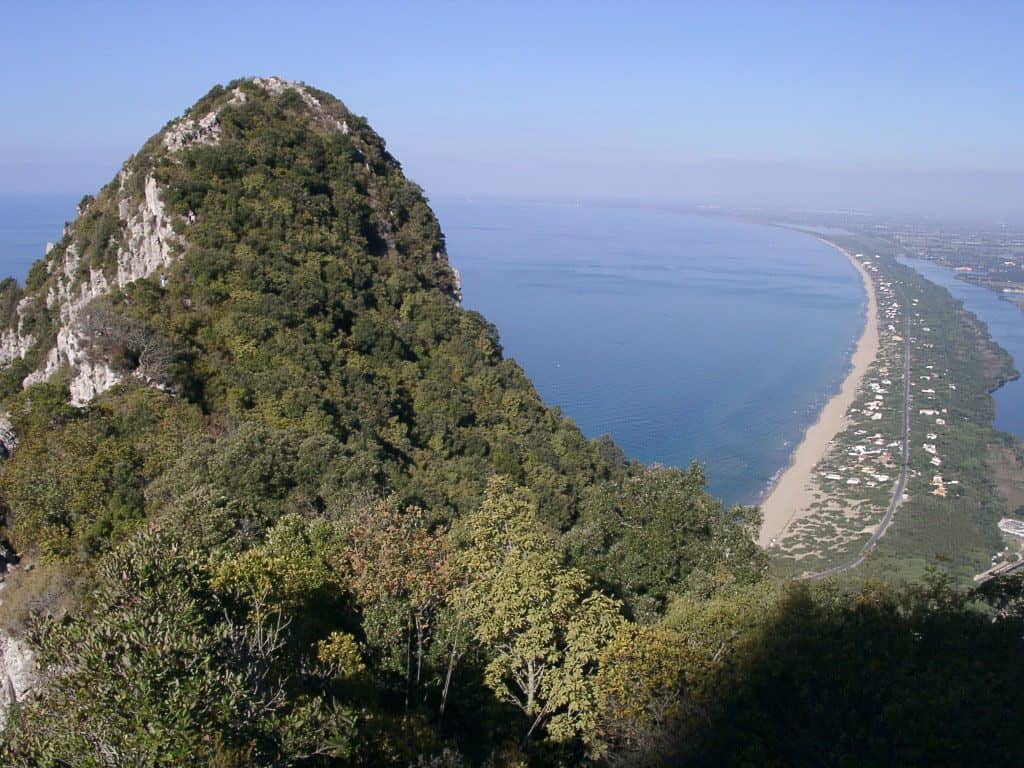
Bufalara Beach is on the Sabaudia coast, in Latina Province, on the stretch of shore that starts where the town's seafront ends and continues north, toward Latina, inside the boundaries of Circeo National Park. From Rome it's about 90 kilometers, from Latina just under 25. Behind you, the Circeo Promontory closes the horizon to the south. In front is the open Tyrrhenian Sea. In between is a high sand dune covered in Mediterranean scrub that separates the sea from the countryside of the coastal lakes. This is not an equipped beach and it never has been: there are no beach clubs, no kiosks, no showers, and the only way to reach the shore is to leave the car where the road ends and walk along the wooden walkways that cross the dune. The name comes from the water buffalo that graze on the plain behind it, still today, in a semi-wild state. If you already know the Pontine coast, you should also read the pages on Torre Paola Beach, Lake Fogliano and Lungomare di Rio Martino, because Bufalara can't be understood on its own: it's one segment of a coastal system about 20 kilometers long, and every segment has different rules, access points and character.
Let me say the most important thing right away, because it's the one that changes the day for anyone who shows up unprepared. Bufalara is not a comfortable beach. You walk, you carry everything by hand, there's no shade except what you build yourself, no drinking water, no bathroom, nobody selling a sandwich. In return, and for many people it's a return worth the effort, you get a beach that stays half empty in August less than an hour and a half from Rome, with water that lets you see the bottom when the sea is calm, and an intact dune behind it that in Italy has almost no equals left. It's a trade: comfort for space. Whoever accepts the trade comes back. Whoever doesn't would do better to stay at the Sabaudia seafront, where the services are.

Where Bufalara Beach, Sabaudia Is and How to Really Get There
The geography here is simple to describe and less simple to travel. Sabaudia sits on a narrow strip of land between Lake Paola, which locals also call Lake Sabaudia, and the sea. The town seafront runs along that strip for a few kilometers, with its villas, its beach clubs and its numbered access points. At some point, heading north, the paved road stops following the sea and bends inland: that is the boundary past which the wild stretch begins, and Bufalara is the name for the first long segment of that stretch. To the south, in the opposite direction, the same seafront leads to the bridge and then to Torre Paola Beach, at the foot of the promontory. It's Bufalara's twin beach but with different features: wider, more crowded, with the sixteenth-century tower and the mouth of the canal as its backdrop.
By Car from Rome: The Most Sensible Route
Anyone leaving Rome has basically two options, and they're not equivalent. The first is the Pontina, State Road 148, which you take from EUR or from the Grande Raccordo Anulare and which runs straight down toward Latina through the Agro Romano and then the reclaimed plain. The second is the A1 motorway to Valmontone and then the state road toward Latina, which only makes sense for anyone starting from the east or southeast of the city. In the vast majority of cases the answer is the Pontina. From there you continue toward Latina, pass the Latina junction and keep going toward Terracina until the exits for Sabaudia, or you head down to the sea earlier, following the signs for Latina Lido and then Strada Lungomare.
The final part is the one that counts. Once you reach the Sabaudia seafront, you have to drive it heading north, that is, with the sea on your left and the Circeo Promontory receding behind you. You pass the villas, the numbered access points, the last beach clubs, and at some point the road forces a right turn. That's where you leave the car, at that break between city asphalt and dirt road. From then on you go on foot. I won't give a number of parking spaces because there is no marked parking lot with counted stalls: it's roadside spaces and dirt areas, and their real capacity depends on the season, on any municipal ordinances and on the common sense of whoever parks. What I can say for certain, from firsthand experience of many summers, is that on a weekend in July or August those spaces fill up by the end of the morning, and that arriving at 11:00 almost always means turning back a kilometer to look for a spot.
By Train and Public Transport: The Uncomfortable Truth
Sabaudia has no train station. The Rome-Naples line via Formia has a stop named Priverno Fossanova and one named Monte San Biagio Terracina, both far from the Sabaudia coast and served by bus lines that work well for people going to the town and much less well for people who want to reach a point on the dune where the road ends. The Cotral intercity service connects Latina and Sabaudia, and in summer the municipality runs internal connections between the center and the seafront, but the schedules change every year and there is no run at all that takes you to the end of the seafront, which is precisely the point where the path to Bufalara begins.
The conclusion, said without beating around the bush: Bufalara can't reasonably be reached by train. If you don't have a car, aim for the Sabaudia seafront, which you can reach by public transport and is still a nice beach, or arrange a rental or a ride. On this coast the last kilometer is always the problem, and improvising it burns two hours of your day.
On Foot Along the Dune: How Far You Really Walk
From the point where you leave the car, the path continues parallel to the sea, on the inland side of the dune, and you can follow it for kilometers. The first ways down to the shore come almost immediately: they are wooden stairs and walkways that cross the line of dunes and drop the swimmer straight onto the sand. If you stop at the first one, you already find a wide beach with few people. If you feel like walking 10 or 15 minutes more, you find progressively fewer people, down to stretches where the chance of meeting another human being becomes remote even in high season.
By Bike and on Horseback: The Long Path to Rio Martino
You can also ride the path that runs behind the dune by bike, with wide tires, and in some stretches on horseback. Continuing north you reach the Rio Martino area, where the canal of the same name flows into the sea and where there is a coastal tower. From there, along the country roads behind the lakes, you can extend the ride to Lake Fogliano. It's a beautiful route and not advisable in the height of summer, for a banal and serious reason: there's no shade, there are no drinking fountains, and the glare off the pale sand raises the perceived temperature. From October to April, on the other hand, it's one of the best bike rides on the Lazio coast, and the Rio Martino stretch deserves a stop of its own.
What Bufalara Beach, Sabaudia Really Is: A Dune, Not a Town
It's worth clearing up a misunderstanding that comes up often. Bufalara is not a town, not a hamlet, not a development with an association and a set of rules. It's a place name for a stretch of coast and the countryside immediately behind it, within the municipal territory of Sabaudia. It has no entrance, no ticket office, no opening hours. But it does have something that many Lazio beaches have lost: a continuous line of dunes, several meters high in some places, covered by pioneer vegetation and scrub, which works as a physical barrier between the sea and the inland.
The Circeo Coastal Dune
The dune system that runs along this coast is considered one of the largest and best preserved left in Italy. It extends almost continuously between the Capoportiere area, to the north, and the Circeo Promontory, to the south, for about 20 kilometers, and it separates the sea from the four coastal lakes that characterize the park. Its preservation is no accident: it's the result of protection that dates back to the 1930s and that has prevented, along this stretch, the continuous construction that elsewhere has devoured the entire coastal strip.
Walking along the path, you cross bands of vegetation that follow one another with an almost textbook regularity. On the sand closest to the sea grow the pioneer species, the ones that tolerate salt and wind and have very long roots compared to the part above ground. Climbing toward the crest, low shrubs appear, bent by the wind. On the sheltered inner slope, the Mediterranean scrub becomes tall and dense, with mastic, myrtle, phillyrea, junipers. It's a succession you can read with the naked eye in 50 meters of walking, and it explains better than any sign why trampling the dune is a problem: those plants are what holds the sand in place, and once a gap is opened, the wind does the rest.
Why the Walkways Exist and Why You Should Use Them
The wooden walkways are not tourist furniture, they are a conservation device. They concentrate foot traffic in specific points and keep the dune from being crossed at random in a hundred different places. Where the system works, the dune ridge holds. Where it fails, so-called deflation corridors open up, erosion channels that the wind widens season after season until it breaks the dune in two.
Frequently Asked Questions About Bufalara Beach, Sabaudia
Is Bufalara Beach free?
Yes, Bufalara Beach in Sabaudia is a stretch of free beach with no bathing concessions, no ticket and no kind of access control. The flip side is the total absence of services: anyone who goes has to bring everything needed, including shade, because there are no beach clubs or support points.
Are there lifeguards at Bufalara Beach?
No, at Bufalara Beach in Sabaudia there are no lifeguards or rescue stations. When the sea is rough, judging safety is entirely up to whoever goes into the water, and the straight, exposed coast, with no breakwater reefs, can produce sandbars and currents that people who only use equipped beaches don't know.
Why is it called Bufalara Beach?
The name of Bufalara Beach means the place of the water buffalo, that is, the area where herds once grazed and where their keeping was organized, before the full land reclamation of the territory. It's not a name invented by a tourist office, but a working place name left on the land by generations of livestock raising.
What is the best time to go to Bufalara Beach?
The short answer for Bufalara Beach in Sabaudia is September. Spring too, from April to early June, is a good time for anyone not looking only for a swim: the dune blooms, the Mediterranean scrub smells wonderful, migratory birds pass through the nearby lakes and the beach is practically empty.
What time should you arrive at Bufalara Beach in high season?
At Bufalara Beach you should really arrive early, between 7:00 and 8:00 in the morning in high season, not at 9:30 as people usually mean. The main reason is parking: the spaces available at the end of the Sabaudia seafront are limited and they don't grow with the crowds.
Why is Bufalara Beach still so wild near Rome?
Bufalara Beach exists as a half-deserted stretch 90 kilometers from Rome for a specific administrative reason: the protection of Circeo National Park. Without that protection, this coast would have had the same fate as much of the Lazio shoreline, that is, a continuous row of buildings down to the water's edge.
What is near Bufalara Beach?
South of Bufalara Beach, toward the promontory, is Torre Paola Beach, which closes off the Sabaudia shoreline at the foot of Circeo and is the equipped and more accessible version of the same coast, with the sixteenth-century tower and the mouth of the canal that connects the lake to the sea.
Free Beach and Concessions: What Is Public and What Is Not
There's a lot of confusion on this point, and it's worth setting it straight once and for all, because it concerns all Italian beaches and not just this one. The sea shore, in Italy, is public state property. No stretch of beach is privately owned. What exists are state concessions, that is, authorizations the State grants to private parties to manage a portion of shore for tourist and recreational purposes: that's where beach clubs come from, with their umbrellas, their cabins and their prices.
Bufalara Is a Free Beach
The Bufalara stretch is a free beach in the full sense of the term: there are no concessions, no beach clubs, nobody renting out an umbrella. This means access is free and anyone can spread their towel wherever they prefer, respecting the park's rules. It also means, and this is the flip side, that there's no lifeguard service, no bathrooms, no assistance. The responsibility is entirely on whoever goes into the water.
If you want to understand how the concession system works and how to tell a public access point from a reserved one, you can read the general explanation in the guide to free beaches in Italy. It applies to Bufalara as it does to any other stretch of the Italian coast, and it saves a lot of pointless arguments under the sun.
The Rules That Really Matter Here
Since this is an area inside a national park, environmental protection rules are added to the ordinary rules of bathing. The two that affect a visitor's day the most are the conservation of the dune, which means a ban on walking on it outside the equipped paths, and waste management: there is no bin for trash to end up in, so everything you bring has to be taken back. For the specific rules on animals, fires, camping and access to certain sectors, you should read the signs at the start of the path, because the park authority's requirements and municipal ordinances can change from one season to the next, and it makes no sense to trust a page written from a desk.
A Curiosity About Bufalara Beach, Sabaudia
The curiosity concerns the name, and it's more interesting than it seems. Bufalara is not a poetic name invented by some tourist office: it's a working place name, the kind that gets deposited on a territory in Italy when an activity occupies it for generations. It indicates the place of the water buffalo, that is, the area where the herds grazed and where their keeping was organized. Before the full land reclamation of the 1930s, the plain behind this coast was a mosaic of stagnant water, reed beds, wet pastures and woods, and the water buffalo was the animal that tolerated that terrain better than any other: it weighs a lot, it sinks, and despite this it moves through mud where an ordinary bovine can't stay on its feet.
The result is that the place name tells of an economy that has almost entirely disappeared but not entirely, because there are still water buffalo on this plain. The reason has changed: back then they were work animals and animals for survival in a hostile environment, today they are dairy herds that supply the Pontine cheese makers. A swimmer who walks the path today and sees, beyond the dune, a herd standing still in a pasture with their legs in the water is looking at the same scene that could be seen here before this plain was drained. It's one of the very few points on the Lazio coast where the continuity of a productive landscape can still be read without the need for captions.
The Water Buffalo, the Coastal Lakes and the Countryside Behind the Beach
Anyone who comes to Bufalara looking only at the sea misses half the place. The inland part, the one the path runs alongside and the dune hides from the swimmer lying on a towel, is just as remarkable, and has a precise structure worth knowing before you come.
The Four Coastal Lakes
The coast between Latina and Circeo is characterized by a chain of brackish coastal lakes, separated from the sea by exactly the dune discussed above. From north to south they are Lake Fogliano, Lake Monaci, Lake Caprolace and Lake Paola, which is the Sabaudia one. They are shallow bodies of water, connected to the sea by canals, with a salinity that varies according to the season and the rains, and with an enormous ecological function: they are stopover and wintering areas for migratory birds, and this makes them one of the most important birdwatching spots in central Italy.
Bufalara sits with its back to the central pair of this system, Lake Monaci and Lake Caprolace. From the path, in some places, you catch glimpses of the water surfaces beyond the reed beds, and in autumn and winter the number of birds you can see without any instrument is surprising for anyone who isn't expecting it. Lake Fogliano, which is the northernmost and the most visitable of the four, has a historic garden, buildings and equipped routes, and remains the best starting point for anyone who wants to understand this environment without improvising.
The Birds You Actually See
I won't give textbook lists, I'll tell you what you see. In the cold months, from the shores and from the path, you easily spot herons, little egrets, cormorants, coots and ducks in considerable numbers. Flamingos frequent this stretch of coast and their presence on the Pontine lakes is now regular, though not guaranteed on any single day. In summer the picture thins out quite a lot, as is normal: most of the migratory birds are elsewhere, the heat keeps still what remains, and the summer visitor sees mostly gulls, a few bee-eaters hunting over the dune and, on the sand, the tracks.
The tracks are the chapter I recommend looking at most closely. The dry sand of early morning records everything that passed during the night: foxes, porcupines, birds, insects, and in some stretches the characteristic marks of sea turtles, which in recent years have begun to nest with growing frequency along the central Tyrrhenian coasts. If during a walk you come across an area fenced off with stakes and tape on the high sand, it is almost certainly a marked and monitored nest: leave it absolutely alone, even from a distance, because nighttime disturbance is one of the main causes of failed nesting.
The Water Buffalo: How to Behave
The water buffalo you see from the paths are farm animals, not wildlife, and they are found on private or otherwise managed land. They are calm animals, used to human presence at a distance, but they are still large cattle with calves in tow, and the rule is always the same: you look from outside, you don't approach the fences, you don't enter the pastures, you don't go looking for a close-up photo. This applies especially to anyone traveling with dogs, which should be kept on a short leash in sight of a herd: a loose dog running toward a pasture is the fastest way to create a serious problem for itself, for the animal and for the owner.

Something Nobody Tells You About Bufalara Beach, Sabaudia
The thing you almost never read about concerns the water, and specifically how the seabed on this stretch behaves. The coast here is straight, exposed, with no breakwater reefs and no artificial beach nourishment. A seabed like this, sandy and gently sloping but not uniform, produces two phenomena that people who only use equipped beaches don't know: sandbars parallel to the shore and rip currents that form in the gaps between one bar and the next.
It works like this. The incoming waves push water toward the shore. That water has to go back, and it goes back by concentrating in the points where the sandbar is interrupted. At those points a narrow, fast flow is generated, directed out to sea. By eye, from the water's edge, you can recognize it because it's a band of darker, calmer water in the middle of waves breaking on both sides, often with a tongue of foam or suspended sand moving away from the shore. It's the classic trap: it looks like the best place to get in, because there are no waves, and it's actually the worst.
The rule for getting out of it, which holds on all exposed sandy coasts, is never to swim against the current toward shore. You swim parallel to the water's edge, sideways, to get out of the band, and only then head back toward land. The rip current is narrow, you get out of it in a few meters of lateral swimming, and it never pulls you underwater: it pulls you out to sea, which is a different thing and much less lethal, as long as you don't use up all your energy fighting it head-on.
The reason this chapter weighs more here than elsewhere is simple and has to be said clearly: at Bufalara there is no rescue service. There are no lifeguard towers, no lifeguards, no rescue boat. If something goes wrong, the nearest help is kilometers away and phone coverage along the dune is not always reliable. This doesn't make the beach dangerous in absolute terms, and on calm-sea days swimming is as easy as anywhere. But it does require a level of caution that nobody applies at a beach with a beach club. With a rough sea, a southwest wind and a flag that elsewhere would be red, here there is no flag at all: the decision is yours, and it's best to make it from the shore.
The advice I give you for visiting Bufalara Beach, Sabaudia
The main advice is just one, and it's about timing, not gear. Arrive early. Not early as people usually mean it, that is 09:30. Really early, between 07:00 and 08:00 in the morning in high season. There are three concrete reasons and none of them is aesthetic.
The first is parking. The spaces available at the end of the seafront are limited and they don't increase, and anyone who arrives in mid-morning on an August Saturday spends half an hour looking for a spot and ends up leaving the car much farther back, lengthening on foot a route that was already long on its own. The second is the walk: crossing the dune at 08:00 in the morning, with cool sand and the sun low, is a stroll. Doing it at noon with 20 kilograms of gear is an effort you pay for the rest of the day. The third is that the light and the water in the morning, here, are simply better: the sea tends to be calmer before the thermal breeze picks up, and the clarity in the early hours is the reason this beach has the reputation it has.
What to bring, specifically
Water, and more than you think: two liters per person in July and August is not excessive, because there's no place to refill and going back to the car to drink means losing 40 minutes. A sturdy umbrella, with a base that really holds, because the afternoon breeze here is constant and a light umbrella becomes a projectile. Alternatively a sun cloth with stakes, which works better than you'd think on the dry sand of the dune. A packed lunch in a rigid container, because nobody will sell you anything. A bag for the trash, all of it, cigarette butts included. High-protection sunscreen and a hat, because the shade is whatever you bring. Closed shoes for the stretch of path. An extra towel or sheet to cover up in the central hours, which is more effective than any cream.
Circeo National Park: what makes it different
Bufalara exists as a semi-deserted beach 90 kilometers from Rome for a precise administrative reason, and that reason has a name: Circeo National Park. Without that restriction, this stretch of coast would have had the same fate as a large part of the Lazio coastline, that is a continuous line of buildings down to the waterline.
A park born in unusual circumstances
Circeo is one of the oldest Italian national parks, established in the 1930s, and its birth has a peculiarity that sets it apart from all the others. The other historic Italian parks were born to protect mountains and Alpine or Apennine wildlife. Circeo was born instead to save a sample of what was being destroyed: the complete land reclamation of the Pontine Plain, underway in those very years, was draining and transforming an extensive wetland, and the creation of the park served to preserve a strip of the great lowland forest and a portion of the lake and dune system. It was born, to put it another way, as compensation for an enormous transformation, and this origin explains its odd shape: not a compact block, but a set of different pieces stitched together.
The park's five environments
There are basically five pieces, and it's useful to know them because they make a trip here much more varied than a single afternoon at the beach would suggest. The first is the State Forest, a remnant of the great lowland forest that covered the plain, with its seasonally flooded woods. The second is the system of the four coastal lakes. The third is the coastal dune, the one you walk over to reach Bufalara. The fourth is the Circeo Promontory, with its vegetation on two radically different slopes, the seaward one dry and Mediterranean, the landward one humid and almost Apennine, and with its caves. The fifth, detached and out in the sea, is the island of Zannone, in the Pontine archipelago, added to the park later.
Because of its value, the area is part of the international program that recognizes biosphere reserves, a recognition that rewards precisely the coexistence of conservation and human activity. It's a point worth keeping in mind when you look at this coast: it isn't pristine nature, it's a landscape where a 20th-century land reclamation, intensive farming, a newly founded town and a preserved natural system touch each other within a few kilometers.
Another well-known fact, and yet rarely cited
The well-known fact is that Sabaudia is a town founded in the 1930s, built from scratch on the reclaimed plain and inaugurated in 1934. Everyone knows it, you read it everywhere, and it's true. What gets cited far less is the urban-planning consequence that this choice had on the coastline, and which is precisely the reason Bufalara looks the way it does today.
Sabaudia, unlike almost all the other seaside towns in Lazio, was not born as a town on the sea. It was born as an agricultural and administrative center on the shore of Lake Paola, a few kilometers from the coast, with a precise hierarchy: the square with the civic tower, the town hall, the church, the public buildings, and then the residential fabric. The sea, in that design, is a resource but not the center. The seafront developed at a later time, as a seasonal extension, and for exactly this reason it remains a relatively thin ribbon that never swallowed the entire coastal strip. When the ribbon ends, it really ends: there is no seaside suburb thinning out, there is a sharp line beyond which the dune begins.
The original urban plan bears the signatures of a group of young architects, Gino Cancellotti, Eugenio Montuori, Luigi Piccinato and Alfredo Scalpelli, and its critical fortunes have been singular: contested for a long time because it was tied to the propaganda of the regime that had wanted it, Sabaudia was later reassessed as one of the most coherent results of Italian Rationalism, for the cleanness of its volumes, its relationship with green space and the measure of its scale. The discussion over whether architecture can be judged separately from the power that commissioned it is an old one and doesn't end here, but in terms of landscape the result is the one described: a compact town, an unbuilt coast, a sharp separation between the two.
The Right Photo to Take at Bufalara Beach, Sabaudia
There is only one right photo and it's not the one everybody takes. The one everybody takes is the water's edge with the sea and nothing else, and it gives a generic image that could be shot on half the beaches of the Mediterranean. The photo that really tells the story of this place is taken by standing at the water's edge and looking south, with the Circeo Promontory closing the line of the coast: you get a perspective in which the beach narrows into the distance, the dune runs parallel like a second line, and at the end the massif rises from the plain like an island. It's that overlap of three elements, sand, dune, mountain, that gives the measure of the place.
The Hour and the Light
Late afternoon is the best moment, for a technical reason: the sun sinking toward the west, that is, over the sea, lights the promontory from the side and brings out its slopes and relief, which at noon look flat and without volume. Early in the morning you get the opposite effect but just as good a result: the promontory backlit, dark, with the sea haze separating its outline against a still pale sky. At noon, with the sun straight overhead, the dune loses all relief and the sand burns out every shade. It's the worst hour of all, and you'll recognize it because all your photos will look washed out and you won't understand why.
The Second Framing, the One Nobody Tries
The second framing is made by turning your back to the sea. You get down almost to the level of the sand, put the dune crest with its wind-bent grasses in the foreground, and let the background open onto the plain with its fields and, with a bit of luck and a telephoto lens, the water buffalo at pasture. It's the image that explains the place name and that nobody shoots, because when you arrive at the sea you look at the sea. The ideal moment is first thing in the morning, when the raking light draws every ripple in the sand and the animals' nighttime prints are still readable.

Some Important Events That Happened Here in History
This strip of coast has a historical layering that the current landscape, apparently empty, hides very well. I'll summarize the moments that have left a trace still readable today, from the most remote to the most recent.
The Prehistory of Circeo
The Circeo Promontory that closes the horizon to the south is one of the most important prehistoric sites in Europe. Its caves, opening at the base of the massif toward the sea, have yielded materials and human remains from the Neanderthal era, and the discovery made in the late 1930s in one of these cavities had international resonance. Later research has revised many of the initial interpretations, in particular those about alleged funeral rites, and the scientific debate is still open. The fact remains that this coast was inhabited by human groups tens of thousands of years before anyone thought of a beach. When you look at the promontory from the water's edge at Bufalara, you are looking at a mountain that has been a reference point for navigation and human settlement since before written history.
Myth and the Romans
The very name of the promontory refers to the sorceress Circe, and ancient tradition placed here the island of Aeaea from the Odyssey. It's a location the ancients accepted with conviction, so much so that a settlement stood on the promontory and the coast was dotted with maritime villas of the Roman era. Lake Paola, behind Sabaudia, hosted fish farming facilities and an imperial residential complex: the fish ponds connected to the sea by canals are one of the most remarkable testimonies of the relationship between the Romans and this lagoon system. Anyone interested in these themes will find useful material in the Priverno Museums and in the Privernum Archaeological Park, a little way inland.
The Coastal Towers and Defense from the Sea
Between the sixteenth and seventeenth centuries this whole coast was equipped with a chain of watchtowers, built to raise the alarm against the raids from the sea that plagued the Tyrrhenian shore. The best known on this stretch is the tower that watches over the mouth of the canal at the foot of the promontory, near Torre Paola Beach. Another lies to the north, at the mouth of Rio Martino. The towers were connected to each other by line of sight, and their mutual distance along the coast is no accident: it was meant to guarantee that a smoke or fire signal was always visible from the next one. Walking the Bufalara path, you walk exactly in the space between two of these outposts, on a stretch that for centuries was considered dangerous precisely because it was open and indefensible.
Malaria and Land Reclamation
Throughout the nineteenth century and until the 1920s, the Pontine Plain was one of the most serious malarial areas in Italy. Stagnant water made the plain almost uninhabitable in the hot months, and the permanent population was reduced to a few communities living in extremely hard conditions. In the forest, temporary settlements of huts survived, inhabited by families who came down from the Lepini Mountains for the grazing and charcoal season and went back up before summer. The full land reclamation carried out in the 1930s changed everything in a few years: drainage canals, pumping stations, draining, the founding of new towns, the settling of tens of thousands of colonists from the northeast. It was an operation of engineering and social engineering together, with human and environmental costs that historians have studied in depth, and the landscape you cross today coming to Bufalara is its direct product. The Pontine Land Museum, in Latina, is dedicated to the story of that transformation, and I recommend it to anyone who wants to really understand where they are.
The War
In 1943 and 1944 this coast became a front line again. The German defenses along the shoreline, the Allied landing farther north and the fighting that followed left marks that you still meet today along the Pontine coast in the form of bunkers and positions, like the Punta Rossa batteries on the promontory. There was also a heavy and lesser-known environmental consequence: the sabotage of the reclamation systems and the artificial raising of the waters brought malaria back for a time to a plain that had just been cleaned up. Anyone who visits the Anzio Landing Museum finds the military picture of those months reconstructed.
Protection and Tourism
The last chapter is the one that directly concerns the reader. Between the 1960s and 1980s the entire Lazio shoreline went through the seaside building expansion that irreversibly changed a large part of the coast. Here, the national park protection, the urban planning limits and the international recognition of the area as a biosphere reserve slowed that process, and the result is the current situation: a seafront built and finished, and beyond its end a free stretch kilometers long. It's not an accident, it's not an oversight, it's the product of administrative decisions made and defended over time.
Who Has Passed Through Bufalara Beach, Sabaudia
Starting in the 1960s, Sabaudia and its shoreline had an intellectual and artistic presence that left lasting traces, and that deserves to be told without turning it into a list of names.
Pasolini, Moravia and the Seafront Group
The name most tied to this coast is Pier Paolo Pasolini, who spent many summers on the Sabaudia shoreline and who found here exactly what he was looking for: distance from Rome, open sea, a landscape not yet saturated. Alberto Moravia frequented the same stretch of coast for a long time, and the house on the seafront became for years a gathering point for writers, directors and intellectuals. Dacia Maraini, tied to both in those years, has told of those summers several times in her writings.
Pasolini is also behind the most famous defense of Sabaudia's architecture, formulated in a television interview in the first half of the 1970s. The reasoning, in summary, was this: the town did not appear to him as a product of the regime's rhetoric, but as a work that had kept a provincial and Italian character. The real homogenizing power, the one that was erasing the real differences between places and people, was no longer that of back then but that of mass consumption. It was a provocative argument and consistent with all his thinking of those years, and it has had enormous influence in the later debate on Italian Rationalism. Anyone walking through the center of Sabaudia today, with the civic tower and the porticoes, has the material of that discussion before their eyes.
Who Comes Today
If I have to say who I really meet today, walking the Bufalara path on any day in June: a few Romans who have known the place for 20 years and don't tell anyone, a few foreign couples who found the beach on a map and don't understand why it's empty, a couple of photographers with tripods at dawn, birdwatchers in the cold seasons, cyclists heading to Rio Martino, and every now and then a fisherman with his rod planted in the sand. It's a thin and steady presence, very different from the crowd that stops at the seafront, and the difference between the two publics is measured exactly in the distance from the parking.
When to Go to Bufalara Beach, Sabaudia and When to Avoid It
The short answer is September. The long answer deserves a few more lines, because the seasons here change the place radically.
Spring
From April to early June, Bufalara is probably at its best for anyone not coming just for a swim. The dune blooms, the Mediterranean scrub smells wonderful, the temperature allows you to walk for hours, migratory birds pass through the lakes and the beach is completely empty. The water is still cold for most people until late May, but for a day of walking, photography and observation it's the ideal season. The spring wind can be strong and changes the look of the sea from one hour to the next.
Summer
July and August are the season of numbers: warm water, long days, a sea that is generally calm in the morning hours. They are also the season of problems: full parking, scorching sand on the path, zero shade, and the need to bring everything with you. Ferragosto, here as everywhere, is to be avoided on principle. The paradox of Bufalara is that it remains much less crowded than any other Lazio beach in the same period, for the simple reason that the walk works as a filter: most people, faced with 20 minutes on foot with their gear, give up.
September and October
September is the month I recommend to anyone who can choose. The water has accumulated the heat of the whole summer and is at its maximum temperature, the traffic on the Pontina has gone back to normal, parking can be found, the days are still long enough and the afternoon light gets progressively better. October adds the advantage of complete solitude and takes away the certainty of good weather: it's the month of the first Atlantic disturbances, and an October storm surge on this coast is a remarkable show to watch from the dune, as long as your towel isn't spread out.
Winter
In winter the Bufalara becomes a different place and, in some ways, the most interesting one. Storms reshape the shoreline, the sea leaves large piles of posidonia on the sand, and those piles, which many mistake for dirt, are actually a natural defense structure for the coast: they absorb the energy of the waves and hold the sand. The lakes behind the beach fill up with wintering birds. You can walk the trail very well with the right shoes. It's the season when you best understand how this coastal system works, and when you meet practically no one.
The weather that matters
Two practical points that are worth more than any generic forecast. The first: the southwest wind, the libeccio, is the one that stirs up the sea on this coast and makes swimming uncomfortable or unwise. With a strong libeccio, the free stretch, without any artificial protection, becomes a beach to look at and not to use. The second: the afternoon sea breeze is almost a summer constant and usually picks up between noon and 14:00, so an umbrella that looked firmly planted at 11:00 can fly away by 15:00. That's the reason I insist on a heavy base.
What's around Spiaggia della Bufalara, Sabaudia
A day at the Bufalara combines very well with other half days within a few kilometers, and that's the real advantage of the area over a single-theme stretch of coast.
South, toward the promontory
Torre Paola Beach closes the Sabaudia shoreline at the foot of the Circeo and is the equipped and more accessible version of the same coast, with the 16th-century tower and the mouth of the canal that connects the lake to the sea. Continuing on you reach San Felice Circeo, a village on the inland side of the promontory, with a compact historic center, a harbor and some of the most beautiful coves in Lazio, reachable by sea. On the promontory are the trails to Circe's Peak and, on the sea side, the Punta Rossa batteries. Farther south are Terracina, with the Temple of Jupiter Anxur on Monte Sant'Angelo, and Sperlonga, with its white village and the villa of Tiberius.
North, toward Latina
Following the coast in the opposite direction you find the Lungomare di Rio Martino, the Lido di Latina and, a little inland, Lake Fogliano, which is the most convenient gateway to the park's lake system. Farther north are Torre Astura, with its fortress on the sea, and the Torre Astura Grove.
Toward the interior
Anyone with a full day who wants to alternate sea and inland has the Ninfa Garden, at the foot of the Lepini, which is one of the best-known gardens in Europe and requires a reservation and an organized visit. There's also the San Valentino Oasis, the Pontine Land Museum in Latina, to understand the land reclamation, and the Priverno Museums with the nearby Privernum Archaeological Park. Anyone who simply wants another wide free beach closer to Rome can consider Capocotta, which shares with the Bufalara the logic of the protected dune and the numbered accesses, but with far more services.
Eating and sleeping
You don't eat on the beach because there's nothing there. Anyone who wants to sit down at a table has to go back toward the Sabaudia waterfront or head up to the center, where the offer is that of a provincial town with a strong tourist season, with fish as a constant. The signature product of the area remains Pontine buffalo mozzarella, which has a different character from the Campania one and is bought directly at the dairies on the plain. I don't name restaurants, prices or hours: they change from season to season, and wrong advice does more harm than no advice.
Quick questions about Spiaggia della Bufalara, Sabaudia
Is Spiaggia della Bufalara free of charge?
Yes. It's a stretch of free beach with no beach concessions, no ticket and no access control of any kind. The flip side is the total absence of services.
Is there a lifeguard service?
No. There are no lifeguards or rescue stations. When the sea is rough, the assessment is entirely up to whoever goes into the water, and it's best to make it from the shore.
How far do you walk from the parking?
The first access points to the sea are reached in a few minutes from where the road ends. To find truly solitary stretches you need 20 to 40 minutes of walking on the trail behind the dune, with the return to count on under the afternoon sun.
How many parking spaces are there?
There is no parking lot with counted spaces: people use the side spaces and the dirt areas where the waterfront ends. In high season they fill up early, and it's the main reason I recommend arriving by 8:00 in the morning.
Can you get there by public transportation?
Not in any reasonable way. Sabaudia has no railway station and no line goes to the end of the waterfront, which is the starting point of the trail. You need a car.
Do you really see the buffalo?
Often, yes, in the pastures of the plain behind, looking from the trail toward the interior. They are farm animals on managed land: you watch them from outside, without approaching the fences.
Can you bring a dog?
The rules on animal access in the park areas and on the beaches can vary according to the ordinances in force: read them on the signs at the start of the route. In any case, where it's allowed, a leash is essential because of the wildlife, nests on the sand and pastures.
What is the best time?
September for swimming, April and May for walking and the dune in bloom, the cold months for birdwatching on the lakes. Ferragosto is the only period I would always avoid.
What's the difference between the Bufalara and Torre Paola?
Torre Paola closes the shoreline to the south, at the foot of the promontory, has a wider beach, is easier to reach and more crowded, with the tower and the mouth of the canal as scenery. The Bufalara runs north of the waterfront, is narrower, has no services of any kind and is earned on foot. They are two opposite ways of being on the same coast.
In our view the Bufalara is one of the few beaches in Lazio that gives back exactly what you give it. Whoever arrives at 11:00, parks badly, walks five minutes and complains about the lack of a bar will take home a mediocre day and will be right. Whoever arrives at dawn, walks half an hour with a light backpack and accepts spending eight hours without buying anything will find in front of them a piece of Mediterranean coast that in Italy now exists in very few places: an intact dune behind, open sea in front, a mythological mountain at the end of the horizon and silence. It's not a beach for everyone, and that is precisely the reason it still is that way.
Article written by the editorial team of TourLeaderPro, contact them for Private/Corporate/V.I.P. Tours and Experiences. For an organized day between Sabaudia, the Circeo and the coastal lakes, with a licensed tour guide, start from the TourLeaderPro contact page. Tour operators who build itineraries on the Pontine coast will instead find the consulting service in the section dedicated to tour operators.
Planning a trip to Rome? The English guides to visiting the city are on ItalyPlanner.com. For those who think in day trips out of the city there is the guide to the best day trips from Rome, while those who want to understand how free Italian beaches really work, concessions included, will find the explanation in the guide to free beaches in Italy.