Circeo National Park
In short. The seat of the Park Authority and the reference point for information: Via Carlo Alberto 188, 04016 Sabaudia (LT), phone 0773 512240, email segreteria@parcocirceo.it.
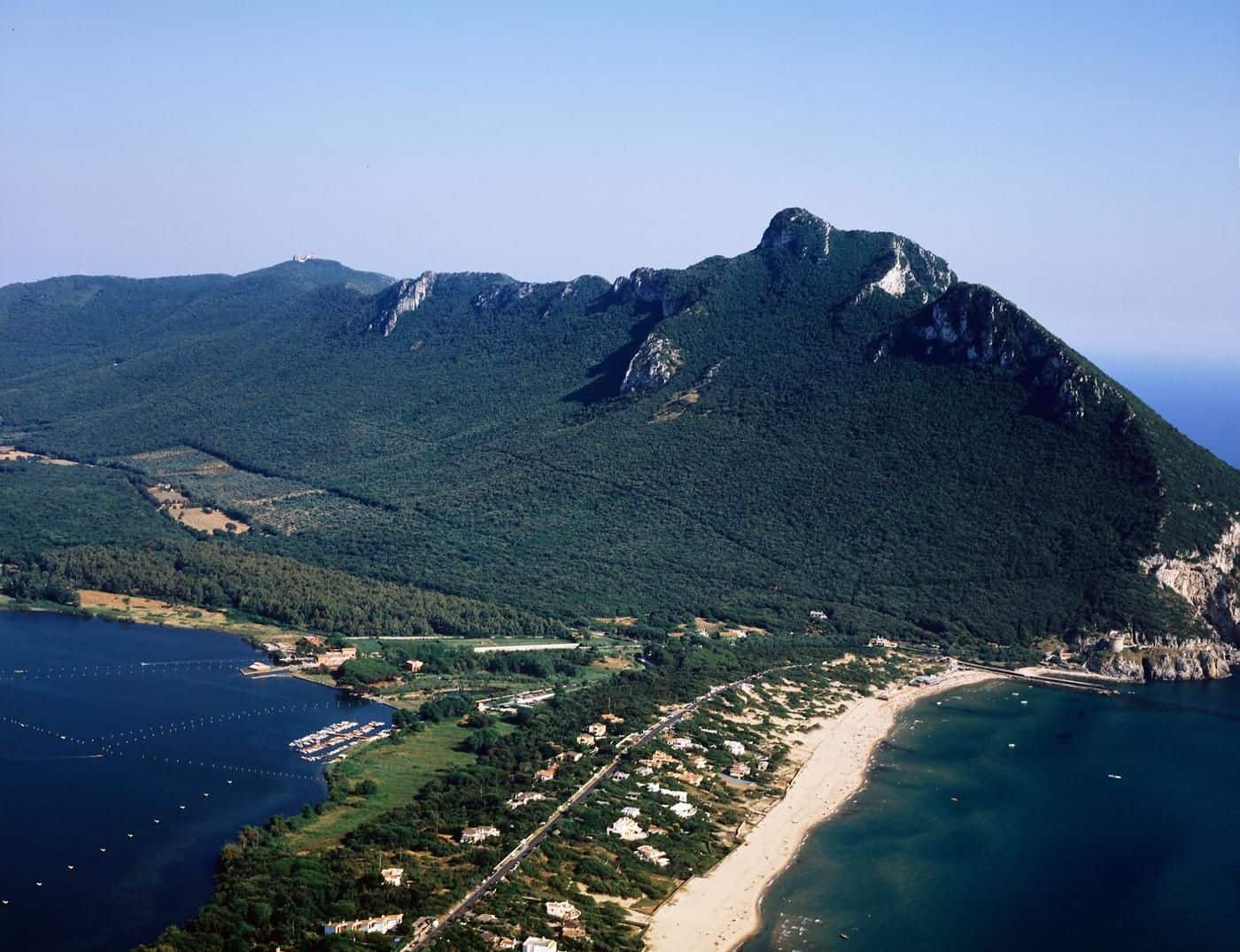
The seat of the Park Authority and the reference point for information: Via Carlo Alberto 188, 04016 Sabaudia (LT), phone 0773 512240, email segreteria@parcocirceo.it. Admission to Circeo National Park is free: the forest, the dune, the lake shores and the trails of the promontory are open, with the restrictions that apply in the strict reserves and in the regulated-access areas. From Rome you get there in a little over an hour and a half by taking the Pontina toward Latina and continuing to Sabaudia or San Felice Circeo: it's about 100 kilometers. Guided tours, environmental education centers, equipped areas and hiking calendars change from season to season and should be checked with the Park Authority before setting out. If you arrive without a car, you need a bus transfer from the last useful station: check the regional connection schedules the day before, because in the low season the runs thin out.
If Circeo is the first stop on a tour of Lazio's protected areas, the same logic then leads to Abruzzo, Lazio and Molise National Park and to Aurunci Mountains Nature Park, which close off the same landscape to the east.
What Circeo National Park really protects
Circeo National Park was established in 1934 with Law 285 and became the third Italian national park, after Gran Paradiso and Abruzzo. The date matters more than the ranking. In 1934 the Pontine plain was a construction site: canals were being dug, masses of water moved, forests cut down to make room for farms. The idea of protecting a piece of that plain while it was being turned upside down is an almost contradictory gesture, and for that very reason interesting: the aim was not to save a rare species or a monument, it was to save a sample of environments that risked disappearing all together.
The result is a protected area of about 8,900 hectares, according to the regional tourism portal, spread across the territories of Latina, Sabaudia, San Felice Circeo and, for Zannone alone, Ponza. It is not a mountain park with a compact perimeter: it is a long, narrow strip, squeezed between the sea and the reclaimed plain, plus a detached island offshore. This shape explains everything the visitor will find on the spot, including its limits.
Why Circeo National Park doesn't resemble any other Italian park
In other national parks you climb. Here you walk on the flat for kilometers inside a lowland forest, then in half an hour you climb a limestone promontory a little over 500 meters high and find yourself with the sea under your feet and the plain behind you. The total elevation change of a day's visit can be ridiculous, and yet the environments you cross are four or five, each different from the others. It's a density that in Italy has few comparisons.
In our view Circeo is the Italian park that is hardest to visit if you arrive unprepared and easiest if you arrive with a clear idea. It has no monumental entrance, no ticket office that sorts you out, no mandatory route. Anyone who shows up hoping the park will explain on its own what to do spends the afternoon in a line on the Sabaudia seafront and goes home convinced they saw a beach. Anyone who knows where to go sees five landscapes in a day.
The milestones in the administrative history of Circeo National Park
The perimeter of Circeo National Park has never stood still. In 1979 the island of Zannone entered the park, for its natural value. In the 1970s, as the Park Authority tells it, illegal building on the Latina coast led to that stretch being excluded from the protected area. To make up for the loss, the coastal lakes of Fogliano, Monaci and Caprolace were included later, that is, precisely the wetlands that today earn the park a large part of its international fame. The 1991 framework law on protected areas then imposed a reorganization: the managing Authority was established in the mid-2000s, the president appointed in 2007, the first director in 2008.
Put that way it sounds like bureaucracy. It is instead the reason why some things at Circeo work and others don't: a park administered for 60 years as a state forest became an autonomous body only relatively recently, and it shows in the signage, in the visitor centers, in the communication. It improves year by year, but anyone expecting the organization of an Alpine park is thrown off.

How to get to Circeo National Park from Rome
The distance from Rome is about 90 or 100 kilometers depending on the entry point. It's not far, but there is only one road and on summer weekends it predictably clogs up.
By car to Circeo National Park
You take the Pontina toward Latina. If you're heading for Sabaudia, the forest and the lakes, exit at Latina and continue on the provincial road that leads to the seafront. If you're heading for San Felice Circeo, the caves and the promontory, keep going south and take the road that climbs to the village. One piece of advice: if the goal is to walk in the forest or watch birds on the lakes, leave Rome before seven. By nine the traffic toward the sea is already building, and in July and August the final stretch toward the Sabaudia seafront can cost 40 minutes just to find parking. Parking, in high season, is the real enemy of the day.
By train and bus to Circeo National Park
The park has no railway station. The useful stations are those of the line that runs south along the Pontine plain, from which you then need a local bus to Sabaudia or San Felice Circeo. Schedules are subject to seasonal changes and should be checked with the regional carrier: in winter you can count the afternoon runs on the fingers of one hand, and being stranded in Sabaudia at six in the evening in January is not an experience I wish on anyone. If you travel without a car, make your base in Sabaudia or San Felice and get around on foot and by bicycle.
By bicycle in Circeo National Park
The bicycle, here, is not a fallback: it's the right way to get around. The state forest is crossed by almost flat forest roads, wide, mostly compacted dirt, which let you cover distances unthinkable on foot. The Sabaudia seafront runs along the whole dune ridge. If you want to link the lakes to the edges of the forest, or reach the village of Fogliano from the plain side, on a bicycle you do it without effort. In summer you start at dawn: after 10 the shade of the forest is no longer enough.
The five souls of Circeo National Park
The park can only be told well if you break it down. Five environments, five different logics, five different ways of visiting them.
The coastal dune
A sand ridge about 25 kilometers long that separates the sea from the coastal lakes, with heights that in some places come close to 30 meters. It is the most fragile environment in the park and the most trampled, because it coincides with the beach.
The coastal lakes and wetlands
Four brackish bodies of water lined up behind the dune: Paola, also called Lake Sabaudia, Caprolace, Monaci and Fogliano. They are the reason thousands of waterbirds stop here every year.
The lowland forest, the Selva di Circe
About 3,300 hectares of lowland woodland, the surviving remnant of the ancient Selva di Terracina. It is the largest lowland forest in Italy.
The Circeo promontory
A limestone block that rises to 541 meters and plunges into the sea, with two climatically opposite slopes and a row of caves at the base, some of which changed the history of paleoanthropology.
The island of Zannone
103 hectares of rock and holm oak woods off Ponza, the best preserved of the Pontine islands, inside the park since 1979.
One day isn't enough for all five. If you only have one day, choose two that are next to each other: forest and lakes, or promontory and dune. Trying to see them all ends in a day spent in the car.
The coastal dune of Circeo National Park
The dune ridge runs for about 25 kilometers at the foot of the promontory and is an environment that the European Union considers a priority: coastal dunes of this extent, in Italy, are not left anywhere else. Behind the beach the ridge rises to come close to 30 meters, a height that surprises anyone who imagines a dune as a kid-sized hill. You walk on it only on the designated walkways: every step off the path breaks the roots that hold the sand together, and an open dune comes apart in a few storm surges.
The vegetation of the dune in Circeo National Park
The dune of Circeo National Park has two plant faces. On the side facing the sea lives a halophilic flora, that is, one able to withstand the salt carried by the spray and the wind: low, succulent plants that grow creeping along the ground. Moving inland the Mediterranean scrub takes over, taller, denser, with the big-berry juniper forming almost impenetrable cushions, the mastic tree, rosemary. In spring the flowering changes the color of the entire ridge, and it is the moment when this environment truly deserves the detour.
The plant to look for is the sea daffodil, which opens its white flowers in midsummer right on the sand. It blooms from July to August, withstands salt and heat, and is regularly trampled by people who spread out their towel without looking where they put it. If you find it, photograph it and leave it where it is: it doesn't survive transplanting and it doesn't survive being picked either.
Dune, erosion and storm surges
Sabaudia's shoreline is losing sand. Winter storm surges eat away at the base of the dune ridge, and every spring the beach looks different from the year before, in some stretches with sand steps one meter high. It's neither a recent nor a local phenomenon, but here it shows more than elsewhere because behind the dune there's nothing to fall back on: there's the lake. Anyone who visits the dune in winter, right after a libeccio storm, will understand in half an hour what it means to protect a coastal environment.
The beaches of Circeo National Park
The beach is the same dune seen from the sea side, and the park reaches all the way to the waterline. Very wide free stretches face the shore, among them Bufalara beach, Torre Paola beach below the promontory and, at the other end, San Felice Circeo beach. Farther south the coast continues toward Terracina beach, outside the park boundaries. If you want an empty beach even in July, you'll find it in the stretches farthest from the access roads: it's a 15-minute walk on the sand, and that's all it takes to lose 90 percent of the crowd.
The coastal lakes of Circeo National Park
Behind the dune, lined up like beads on a string, four brackish lakes make up the most important system of coastal wetlands in Italy. They aren't lakes in the Alpine sense of the word: they're lagoons, with brackish water, shallow bottoms and canals that connect them to the sea. Their value is measured in birds. The park's wetlands have been recognized as a wetland of international importance, and Circeo National Park owes a decisive part of its scientific importance to these bodies of water.
Lake Paola, or Lake Sabaudia
It's the largest and best known, because you drive along it when you arrive in Sabaudia and because the town's bridge crosses it. It has a branching shape, with arms that reach into the countryside, and it connects to the sea through a canal under the promontory. On its shores is one of the largest archaeological complexes in southern Lazio, the imperial villa discussed further on. The best light for looking at it is late on a winter afternoon, when the promontory is reflected on the still water and the Rationalist town is backlit.
Lake Caprolace
Smaller, wilder, with low banks and reed beds that run down into the water. It's the lake where wintering ducks are counted in the thousands on cold days and where the greater flamingo has become a frequent presence. It has no developed lakefront, and that makes it the best of the four for serious observation.
Lake Monaci
The smallest and the least visited, wedged between the dune and the farmed fields. The name recalls a monastic property, and its modesty is its good fortune: if you get there on foot in the early morning hours, in autumn, you'll find a silence that no longer exists on the other bodies of water.
Lake Fogliano and its garden
Lake Fogliano closes the series to the north and is perhaps the most surprising place in the park, because next to the water there's a village with a botanical garden that began in the late 1800s as a collection of exotic species. Palms, bamboo, tropical trees planted a few meters from a lagoon environment: a contrast that works very well in photographs and that tells the story of the era of the great noble estates in the plain before the land reclamation. Access to the village and the garden depends on the seasonal openings set by the Park Authority.
The birds of the lakes of Circeo National Park
The number usually cited is more than 260 species observed. That number doesn't tell the visitor much, so let me translate it: on a January morning at Caprolace, with decent binoculars, you easily go home having seen the greater flamingo, the gray heron, the little egret, the cormorant, the mallard, the coot, the wigeon, the pochard and, in the right periods, the black-winged stilt. If you're patient, you'll add the marsh harrier, which hunts low over the reed bed with that unmistakable flight, undulating and slow. It's a density of sightings you won't find anywhere else within an hour and a half of Rome.
The Selva di Circe: the lowland forest of Circeo National Park
The Selva di Circe is what remains of the Selva di Terracina, the great lowland forest that covered the Pontine plain before the land reclamation. About 3,300 hectares, the largest lowland forest in Italy. We need to agree on what a lowland forest means: not just any woodland, but an environment where trees grow on soil that floods in winter and dries out in summer, with fauna and flora that depend on that cycle. Very few patches of it have survived in western Europe, and this is one of the largest.
The forest pools
In the Selva di Circe, "piscine" is the name for the depressions that fill with rainwater during the winter and dry up in summer. They aren't permanent ponds: it's precisely the alternation that makes them valuable, because they host amphibians and invertebrates that wouldn't survive if fish were present. Some are protected as strict nature reserves, among them the Piscina delle Bagnature and the Piscina della Gattuccia, where access is forbidden or tightly regulated precisely so as not to disrupt the water cycle. If you visit the forest in February, you'll find them full and see the woods reflected in them: it's the image of this park that I always carry with me.
The lestre, the vanished villages of the Selva
The lestre were forest clearings inhabited seasonally, before the land reclamation, by the people who lived in the woods in huts of branches, raising livestock and gathering firewood. They weren't permanent villages: they were settlements that moved with the seasons and with malaria. The reclamation of the 1930s wiped them out, moving those families to the farmsteads and the newly founded towns. The place names remain, and one of them, the Lestra della Coscia, today gives its name to a strict nature reserve. Walking through the forest knowing that under those woods there were houses made of branches completely changes the walk.
The trees of the Selva di Circe
The forest of Circeo National Park is a meeting point between the continental plant world and the Mediterranean one. In the same woods grow the Turkey oak, the ash and the pedunculate oak, trees associated with temperate Europe, next to the holm oak, the laurel and the cork oak, which belong to the Mediterranean. In the understory you find hawthorn, blackthorn, strawberry tree, tree heath and butcher's broom. This overlap is the park's real botanical rarity, more than any single rare species: it's a forest that shouldn't exist in this form and that survives thanks to the shallow water table.
The animals of the Selva di Circe
The master of the house is the wild boar, which reaches high densities in the forest and which you meet with some regularity along the forest roads in the evening. Alongside it live the badger, the fox, the stone marten, the weasel, the porcupine, the hedgehog, the hare and the hazel dormouse. The fallow deer deserve a separate discussion: the population seen in the forest descends from animals that escaped from an enclosure in the 1950s and have since gone feral, a presence that zoologists consider foreign to the original fauna. Among the reptiles and amphibians you can meet the whip snake, the grass snake, the viper, the toad, the frog and the turtles, including the pond turtle, a species that is becoming very rare throughout Italy.
A practical recommendation about wild boars, which no brochure writes with the right frankness: you don't photograph them up close, you don't feed them, and if you run into a female with piglets you change route without arguing. The animals of the Selva aren't tame, and the Pontine boar is a big animal.

The promontory of Circeo National Park
Monte Circeo rises to 541 meters and behaves like an island attached to the mainland. Geologically it's a limestone-dolomite massif of Mesozoic age, formed by sedimentation and then transported, over the course of geological history, by several tens of kilometers from its original position. Seen from the plain it looks like a mountain lost in the middle of the flatlands. Seen from the sea, with its elongated outline, it has for centuries suggested the profile of a reclining woman, and it's this resemblance that fed the legend of the sorceress.
The Quarto Freddo and the Quarto Caldo
The promontory has two slopes that seem to belong to two different regions. The northern one, called the Quarto Freddo, gets little direct light, holds moisture and hosts a dense holm oak grove with ash and black hornbeam: it's an almost Apennine woodland a stone's throw from the sea. The southern one, the Quarto Caldo, is beaten by sun and wind, with exposed rock, Phoenician juniper, myrtle, mastic and rosemary. In half an hour of walking you go from one to the other, and no book explains the concept of exposure better than this walk.
The dwarf palm of Circeo National Park
On the warm slope grows the dwarf palm, the only native palm in Europe. It isn't a showy plant: a low tuft of fan-shaped leaves that looks like any ordinary shrub to someone who doesn't know it. Its interest is biogeographical, because it signals a climate that in peninsular Italy is found only at a few southern coastal sites. Seeing the dwarf palm and the black hornbeam on the same ridge, a few hundred meters apart, is one of those things that are taken for granted at Circeo and that would make the news elsewhere.
Climbing the promontory: the trails of Circeo National Park
From the village of San Felice Circeo start the routes that lead toward the summit and the viewpoints on the northern slope. They aren't long itineraries, but the ground is rocky, often smooth and slippery from foot traffic, and exposed in several places. You need real hiking shoes, plenty of water, and the discipline not to set out in the middle of the day in the hot months: on the Quarto Caldo there's no shade and the rock gives off heat until evening. The view from the top covers the whole arc of the lakes, the dune, the forest and, on clear days, the outline of the Pontine islands.
The Ruins of Circe and the acropolis
At the top of the promontory there are remains of walls in polygonal masonry and of ancient structures, known as the Ruins of Circe, which gave their name to a state nature reserve. They are fortifications from the pre-Roman and Roman eras, and their defensive and lookout function is understood immediately when you look at the sea from up there. Archaeological readings of the details of the building phases remain debated: what is documented is the presence of a fortified settlement at altitude, and what belongs to tradition is the identification with the sorceress's home.
The coastal towers of the promontory
The perimeter of the promontory and the dune is dotted with watchtowers built to defend against Barbary raids between the 1500s and 1600s: Torre Paola at the mouth of the canal, Torre Cervia on the southern slope, Torre Fico, Torre Olevola, Torre Vittoria. Some are privately owned and can't be visited, others are ruins accessible from the outside. They still help you read the landscape: a tower every few kilometers means this coast was dangerous for 300 years. To the same military logic, much later, belong the Punta Rossa batteries, 20th-century positions overlooking the sea.
The caves of Circeo National Park and the Guattari Cave
At the base of the promontory, on the slope facing San Felice, opens a series of cavities that make up one of the most important prehistoric deposits in Europe: Guattari Cave, Fossellone Cave, Breuil Cave, Capre Cave, Impiso Cave, Azzurra Cave, Presepe Cave, Maga Circe Cave. In this respect Circeo National Park is a prehistoric archaeology site even before it is a natural area.
The 1939 discovery
On February 24, 1939, some workers quarrying stone for the landowner, Alessandro Guattari, broke through an ancient landslide and opened a cavity that had been closed for tens of thousands of years. Inside, in what was called the Antro dell'Uomo, lay a Neanderthal skull in an excellent state of preservation, missing part of the right orbital area and with an enlarged foramen magnum, surrounded by a ring of stones. The skull, known as Circeo 1, was studied by Alberto Carlo Blanc, who carried out the excavations with Luigi Cardini.
The ritual hypothesis and its revision
Blanc interpreted the arrangement of the finds as the trace of ritual cannibalism: the circle of stones, the foramen magnum enlarged to extract the brain. It was a hypothesis that entered the textbooks and for decades defined the image of Neanderthal man in the collective imagination. At the end of the 1980s that reading was dismantled: no marks from stone tools were recognized on the skull, but rather marks from hyena teeth, and the cave was reinterpreted as a hyena den, with the human remains accumulated by the carnivores. It's one of the most instructive course corrections in European paleoanthropology, and it should be told as it is: the first reading was fascinating and wrong.
The recent excavations in the Guattari Cave
Between 2019 and 2021, new excavation campaigns led by the Superintendency brought to light remains attributable to nine Neanderthal individuals, which add to those already known and bring the total number of individuals documented at the site to 11. The datings place eight of these finds in a range between about 50,000 and 68,000 years ago, while one is much older, between 90,000 and 100,000 years. Alongside the human remains, large quantities of animal bones have emerged: elephant, rhinoceros, deer, a sample of fauna that gives the picture of a Pontine plain profoundly different from today's.
The Museo Homo Sapiens e Habitat in San Felice Circeo
The story of the promontory's prehistory now has a museum home in San Felice Circeo, the Museo Homo Sapiens e Habitat, dedicated to human presence in the Circeo caves and the relationship between humans and the coastal environment. Hours, tickets and visiting arrangements should be checked with the Municipality of San Felice Circeo before you show up, because the openings follow seasonal calendars. The original skull found in 1939 is not at Circeo: it's kept in a national museum in Rome.
If you want to complete the historical picture of the plain, there's a second museum reference a short distance away, the Pontine Land Museum, which tells the story of the land reclamation and the founding of the new towns.

The island of Zannone in Circeo National Park
Zannone became part of Circeo National Park in 1979 for its natural importance, and it's the only sector of the park that is not on the mainland. It belongs to the Pontine archipelago together with Ponza, Ventotene, Palmarola, Santo Stefano and Gavi, and it's among the smallest: about 103 hectares. It's uninhabited, and the fact that no one has lived there for a long time is the reason for its integrity.
The nature of Zannone
The island's vegetation is Mediterranean, with scrub and oak woods: Zannone is the only one of the Pontine islands to have kept its plant cover intact, while the others were cleared and farmed for centuries. Birds of prey nest on the cliffs, among them the peregrine falcon, and the island works as a stopover for many migratory species crossing the Tyrrhenian Sea. The waters around it are clear for very simple reasons: no sewage, no development, no port.
The mouflon of Zannone
A population of mouflon lives on the island, introduced in 1922 with three pairs from Sardinia for hunting, when Zannone was run as a private hunting reserve. It's a textbook case: an animal brought by humans for the pleasure of hunting that, a century later, has become part of the island's identity and also a management problem, because its browsing affects the regeneration of the woods. The Zannone mouflon is the living reminder that even inside a national park, nature is never a pure starting point.
The monastery of Santo Spirito
On the island remain the ruins of a Cistercian abbey dedicated to the Holy Spirit, abandoned at the end of the 13th century. A monastery on a 100-hectare rock, without abundant water and without land to farm, says a lot about the settlement logic of medieval monks, who sought isolation and not comfort. The remains are modest but readable, and for those who land there they are the only sign of organized human presence before the 1800s.
The villa, the marquis and 1970
On the ridge facing the Tyrrhenian Sea stands a villa built when the island was the private hunting reserve of Marquis Camillo Casati Stampa di Soncino. In the 1960s Zannone was the summer buen retiro of the marquis and his wife Anna Fallarino, a former actress, married in 1959 after the annulment of her previous marriage. The couple's private life, marked by the husband's voyeuristic inclinations, fed the society gossip columns for years, along with the chatter of the archipelago's fishermen, who half a century later still tell it to tourists on their boats.
The story ends badly. On August 30, 1970, in Rome, on Via Giacomo Puccini, Camillo Casati Stampa killed his wife and the young Massimo Minorenti with a rifle, and immediately afterward took his own life. The event entered the annals of Italian crime reporting as the via Puccini murder. After the tragedy the villa on Zannone was closed, and the island went back to being what it was before: a wooded rock in the middle of the sea. This story is part of the island's history, and it will be told on board anyway, often seasoned with invented details. The documented facts are the ones written above, and everything else belongs to local legend.
How to visit Zannone
Zannone can be reached only by sea, departing from Ponza. There is no lodging, there are no services, and overnight stays on the island are not allowed. Access on land and use of the trails follow the rules of the protected area and can vary according to the season and conservation needs: if you're planning the excursion, check access conditions beforehand with the Park Authority and with the authorized operators who provide the transport. The typical day involves the crossing in the morning, a few hours on land and the return in the afternoon.
A blunt opinion, even if it disappoints someone: Zannone is not a beach trip. If you want a long swim and a beach umbrella, you'll find them better in Ponza or Palmarola. Zannone rewards those who are interested in nature, ruins and silence, and punishes those who arrive thinking they'll find an equipped beach resort.
Sabaudia, the town inside Circeo National Park
Sabaudia and Circeo National Park were born in the same two-year period, and the coincidence is no accident. The town's cornerstone was laid on August 5, 1933, and it was inaugurated on April 15, 1934. The urban plan came out of a competition won by the group of Luigi Piccinato with Gino Cancellotti, Eugenio Montuori and Alfredo Scalpelli: four young architects who delivered one of the clearest manifestos of Italian Rationalism.
The Rationalist architecture of Sabaudia
If you arrive in Sabaudia expecting the monumental rhetoric of the regime's 20 years, you'll be thrown off. The town is made of simple volumes, plastered surfaces, aligned windows, low porticoes. The vertical element is the civic tower of the town hall, which works as a visual landmark from the whole plain. The architects didn't quote the ancient world: they built according to the logic of modern European architecture of those years. That's why Sabaudia still interests scholars today, and why, in the 1970s, it was defended by intellectuals and filmmakers who had nothing to do with the regime that had wanted it.
The visit takes an hour and a half on foot, square by square. My advice is to do it early in the morning, when the raking light carves out the facades, and to look at the minor details: the cornices, the stairs, the window and door frames. Sabaudia is a town you understand from the detail, not from the overall view.
The seafront and the bridge of Sabaudia
The seafront runs along the top of the dune ridge, with the sea on one side and Lake Paola on the other. It's the most photographed stretch of coast in southern Lazio and also the most delicate, because the road and the parking lots sit directly on the dune. The bridge over the lake is the most convenient viewpoint for taking in lake, dune and promontory all at once.
San Felice Circeo, the village of Circeo National Park
At the other end of the promontory, the village of San Felice Circeo is perched on a natural balcony, with a central square overlooking the plain and a medieval fabric of narrow alleys. From here the trails to the summit start, from here you go down toward the caves, from here the boats that run along the cliffs depart. The village is small and in August it's packed: if you're going for the visit and not for the aperitivo, arrive in the morning or out of season.
The myth of Circe and the promontory
The name of the park and of the village comes from the sorceress Circe, the figure in the Odyssey who turns Ulysses' companions into pigs. The identification of the promontory with the island of Aeaea belongs to an ancient tradition taken up by Latin authors and consolidated over the centuries, not to a verifiable fact: Homeric geography is not a nautical chart. It's still worth telling, because for 2,500 years this mountain was looked at by those sailing along the coast as the place of the sorceress, and that story left traces in place names, in the names of the caves and in travel literature.
The Villa of Domitian in Circeo National Park
On the shores of Lake Paola extends an imperial residential complex of the Roman era, attributed to Domitian, which occupies more than 45 hectares and is one of the largest archaeological sites in southern Lazio. It isn't a single building: it's a system of terraces, residential rooms, service structures and water-related installations, spread along the lakeshore in a setting that is wooded today.
I advise visitors to adjust their expectations. It isn't an archaeological park with an equipped route and panels at every structure: access depends on openings and organized visits, and the arrangements should be checked with the Park Authority. What stays with you is the relationship between ruin and water: Roman walls emerging among the holm oaks a few meters from a lagoon, with the promontory in the background. To understand why an emperor would choose this place, five minutes on site are enough.
Birdwatching in Circeo National Park
If I had to give just one reason to come back to Circeo National Park in winter, I'd choose the birds. The park's wetlands host the wintering of thousands of waterbirds and are an obligatory stopover for migrations between Africa and Europe. More than 260 species have been observed inside the protected area.
The right seasons for birdwatching
From November to February the lakes host the wintering populations: dabbling and diving ducks, coots, herons, cormorants, flamingos. Between March and May the migrants heading north pass through, and it's the period of the waders on the shallows and the songbirds in the scrub. In August and September the flow starts again in the opposite direction. Full summer is the worst season: heat, harsh light, heavy disturbance, few species.
Where to watch birds in Circeo National Park
The shores of Caprolace and Monaci offer the best spots, because they're less frequented and have reed beds that act as a screen. Fogliano is excellent on the village side. On Lake Paola observation is harder because of the nearby road and houses. Some observation posts and some routes have regulated access: access conditions and any mandatory accompaniment should be checked with the Park Authority.
What to bring
Binoculars of 10x magnification at a minimum, a spotting scope if you have one, neutral clothing, waterproof shoes because the shores are muddy, and a field guide. The most common mistake I see people make is arriving at noon: birds are watched in the two hours after dawn and the two before sunset, and the rest of the day is wasted time. The second mistake is talking. The third is getting too close to the water's edge: the whole flock takes off and the morning ends right there, for you and for anyone else in the area.
The trails and routes of Circeo National Park
The hiking network of Circeo National Park is organized into three families of routes, which require different preparation.
The forest routes
These are flat itineraries on forest roads and trails, suitable for everyone, and also rideable by bicycle, with a length ranging from two to more than 10 kilometers. They're the best for families, for the in-between seasons and for hot days, because the tree cover noticeably lowers the perceived temperature. Watch out for mosquitoes from May to September in the wetter areas.
The promontory routes
These are the most demanding: concentrated elevation gain, rocky ground, exposed stretches, no water along the route. You tackle them with proper shoes and never in the middle of the day in summer. In return they deliver the view that justifies the trip.
The wetland routes
These are short, flat itineraries along the lake shores, designed for observation. They call for slowness and silence more than legs. They're perfect in winter, when the rest of the park is less attractive and the lakes are at their peak population.
Signage and maps of Circeo National Park
The signage exists but isn't impeccable everywhere, and in the forest the intersections of forest roads all look alike. Practical advice: download the track before leaving and don't count on phone coverage, which is patchy in some sectors of the Selva. A paper map in your pocket never hurt anybody.
Circeo National Park with kids
The park works very well with kids, as long as you pick the right environments. The forest is the ideal place: flat, shady, full of animal tracks to look for, with wide forest roads where a child's bicycle goes along without problems. The lakes hold their attention if you bring binoculars and turn the observation into a recognition game. The dune requires an explanation of why you don't leave the walkway, and it's an excellent lesson in environmental education in the field.
The promontory, on the other hand, I don't recommend with small children: slippery ground, exposed stretches, no shade. Better to put it off for a few years. At the Park Authority headquarters, in Sabaudia, there are facilities dedicated to welcoming visitors and to education, including a play area built in 2019 and named after Alex Langer: check opening times and activities beforehand.
Accessibility in Circeo National Park
The honest answer is that it depends on the sector. The flat, compact, wide forest roads are the most practical with an accompanied wheelchair, at least on the dry stretches. After days of rain the surface becomes difficult. The lakefronts are partly accessible, with the same reservations about the surface. The seafront and the center of Sabaudia offer regular urban routes. The promontory and the cave trails are not accessible. For precise information on equipped routes and services, it's best to contact the Park Authority directly at the number given at the beginning.
When to go to Circeo National Park
Spring
The best season by far. The dune is in bloom, the forest is at its greenest, the migrants pass through the lakes, the temperatures allow you to walk on the promontory too. April and May are the two months I recommend to anyone who comes only once.
Summer
It's the season when the park receives the most visitors and shows the least. The heat and the crowding on the shore make anything other than the beach difficult. If you come in summer, you organize yourself around dawn: at 7:00 in the morning the forest is empty and cool, by 11:00 it's a whole other story.
Fall
October and November are underrated. The forest changes color, the first wintering birds arrive on the lakes, the light gets lower and becomes perfect for photography. On the sea, in fall, you may happen to see the jellyfish called by-the-wind sailors, which the wind pushes toward the coast.
Winter
A season for specialists and photographers. Lakes full of birds, flooded forest pools, a clear promontory, empty beaches. The cold here is mild, the humidity is not: you dress in layers and wear boots. It's the best season at Circeo, and it rarely disappoints those who try it.
Frequently asked questions about Circeo National Park
How much does it cost to enter Circeo National Park?
Access to Circeo National Park is free, because it's an open protected area with no entrance ticket. You may pay for services, such as guided tours, bike rental, admission to museum facilities, the boat crossing to the island of Zannone and paid parking during the beach season.
How do you get to Circeo National Park from Rome?
Circeo National Park is about 90 or 100 kilometers from Rome depending on the entry point: you take the Pontina toward Latina, exiting at Latina for Sabaudia, the forest and the lakes, or continuing toward San Felice Circeo for the promontory. On summer weekends the traffic on this single road clogs up predictably.
Is Circeo National Park suitable for kids?
Yes, it works well with kids as long as you pick the right environments: the forest is flat, shady and full of animal tracks to look for, with wide forest roads where a bicycle goes along without problems. The lakes hold their attention if you bring binoculars, while the dune requires an explanation of why you can't leave the walkways.
Is Circeo National Park wheelchair accessible?
It depends on the sector: the flat, compact, wide forest roads are the most practical with an accompanied wheelchair, at least on the dry stretches, and so in part are the lakefronts. The seafront and the center of Sabaudia offer regular urban routes, while the promontory and the cave trails of Circeo National Park are not accessible.
When is the best time to visit Circeo National Park?
Spring is the best season by far for Circeo National Park: the dune is in bloom, the forest is at its greenest, the migrants pass through the lakes and the temperatures allow you to walk on the promontory too. April and May are the two recommended months for anyone who comes only once.
Can you see fallow deer in Circeo National Park?
Yes, if you walk in the Selva di Circe you often come across herds of fallow deer, but they don't descend from the historical fauna of the Pontine forest: they are animals that escaped from an enclosure in the 1950s, when the state forest hosted a wildlife area, and have lived free in Circeo National Park ever since.
What can't you do in Circeo National Park?
In Circeo National Park you don't leave the trails and walkways on the dune, you don't pick plants or flowers, sea lily included, you don't light fires and you don't smoke in the forest during high-risk periods. Dogs are always kept on a leash, also because wild boars really are present in the protected area.
How much it costs to visit Circeo National Park
Access to the protected area is free. You may pay for services: guided tours, excursions with a guide, bike rental, admission to museum facilities, boat crossings to Zannone, paid parking during the beach season. The real cost of a day at Circeo, for those who arrive by car from Rome, is almost all fuel and food. For a boat trip to Zannone or a specialized guided tour, the operators set the rates, and they change from year to year: ask before you leave.
One thing worth spending money on is a guide. Circeo National Park is a place that explains itself very little: the landscape doesn't tell you by itself the difference between a forest pool and a puddle, doesn't explain why the dwarf palm is there, doesn't say what's under that forest. With a competent guide the same walk is worth three times as much. If you're organizing a group visit or a company outing, it's best to rely on licensed professionals: the tour guiding service of TourLeaderPro works on exactly this, and for large groups there's a dedicated channel for organizing group trips in Italy.
Rules and good manners in Circeo National Park
Few rules, all reasonable. You don't leave the trails and walkways on the dune. You don't pick plants or flowers, sea lily included. You don't light fires and you don't smoke in the forest during high-risk periods. Dogs are kept on a leash, always, out of respect for the wildlife and for their own safety, since the wild boars are really there. You don't feed wild animals. Trash goes back with you, peels included, which take months to disappear in a dune environment. You don't cross the strict nature reserves: it's not a formality, it's the reason they exist.
I'll add an unwritten rule that matters a lot to me: in the hours of dawn, on the lakes, you keep quiet. Anyone who arrives talking loudly ruins the work of someone who has been there for two hours, staking out in the cold.
What to see around Circeo National Park
The park combines well with the coast that comes before it and the one that follows. To the north are Lido di Latina and the reclaimed plain. To the south the coast continues toward Terracina and then toward Sperlonga, with its white village overlooking the sea. Inland, a short distance away, the Garden of Ninfa offers a perfect contrast with the coastal environment: medieval ruins, fresh water and an English-style garden. If you have more days, you can extend to the ridges of the Monti Aurunci Nature Park or take the ferry to the islands.
If you're planning a wider trip in the region, you'll find an overview in the English guide to the Lazio region on ItalyPlanner and, for the capital, in the list of things to do in Rome.
A curiosity about Circeo National Park
The curiosity is about the fallow deer. Anyone who walks in the Selva di Circe and comes across a herd of fallow deer thinks they're looking at the historical fauna of the Pontine forest. That's not the case: those deer descend from animals that escaped from an enclosure in the 1950s, when the state forest hosted a wildlife area. No one reintroduced them for scientific reasons, no one counted them before they multiplied. They simply escaped and never came back.
What follows is more interesting than the anecdote. A population of fallow deer in a lowland forest is not a decorative detail: it browses the shoots, selects which species manage to regenerate, and changes the structure of the understory within a few decades. Zoologists consider the fallow deer a non-native species for this territory, and managing it inside Circeo National Park is one of the technically most complicated chapters in the administration of the protected area, exactly like the mouflon on the island of Zannone, which arrived in 1922 with three pairs from Sardinia to satisfy the hunting passion of an owner.
The curiosity, in short, is twofold. The first part makes you smile: two populations of ungulates settled by accident or by whim inside the oldest park on the Lazio coast. The second part makes you think, and it concerns an idea that is dismantled with particular effectiveness at Circeo: the idea that inside a protected area nature is an original, unchanging given. Here nature is the result of what people have done, undone and forgotten, starting with the land reclamation that wiped out the marsh and ending with a gate left open 70 years ago. Looking at the deer of the Selva knowing this is a different experience from just photographing them.
Something nobody tells you about Circeo National Park
No brochure writes it, but Circeo National Park is not a park you visit: it's a park you choose. There's no main entrance, no marked route from beginning to end, no ticket that gives access to a prepackaged itinerary. If you arrive without having decided beforehand what to see, you end up in the one place the GPS knows, the Sabaudia seafront, and you become convinced that the park is a coastal road with cars parked on the dune.
The second thing nobody mentions concerns internal distances. On the map the park is small. In practice, to get from the northern lakes of Fogliano to the village of San Felice Circeo you cross the whole protected area, on roads with one lane in each direction that clog up in season. An internal transfer that looks like 20 minutes can take 50. Planning three different environments in the same day means spending half the time in the car.
The third concerns mosquitoes. In the Selva di Circe, in the wet months, the mosquito pressure is serious, especially in the evening hours and near the flooded pools. It's not the malarial marsh of a century ago, luckily, but a repellent in your pocket radically changes the quality of a walk in the forest between May and September. It's one of those pieces of information that institutional websites never give and that any guide who has worked here will tell you before you even set out.
The fourth, finally, concerns the season. Almost everyone comes to Circeo in summer. Almost everything that makes Circeo National Park unique is at its best in winter and spring. This gap between when people come and when it's best to come is the real anomaly of this protected area.
The advice I give you for visiting Circeo National Park
The advice is one thing and should be taken literally: split the park into two days and don't try to squeeze it into one. If you only have one day, choose two adjacent environments and give up the others without regrets.
This is how I build the first day. Leave Rome before 7:00, arrive at the northern lakes around 9:00, two hours of observation between Fogliano and Monaci with binoculars. A short transfer to the forest, entry onto one of the forest roads and two hours of walking on the flat, with a stop at the pools if the season keeps them full. Late lunch in Sabaudia. Afternoon devoted to the Rationalist town, square by square, and then the bridge over the lake for the last light. You go home with forest, wetlands and 20th-century architecture.
The second day is the promontory day. Base in San Felice Circeo, climb the mountain in the cool hours, descend toward the cave side, afternoon on the southern coast or on a boat under the cliffs. If you have a third day and the sea is calm, spend it on Zannone, departing from Ponza.
The advice within the advice is about timing. At Circeo National Park dawn is not a photographer's affectation: it's the only moment when the forest is cool, the lakes are crowded with birds, the dune is empty and the promontory can be seen all the way to the islands. Getting up at 5:30 completely changes the quality of the visit. Whoever arrives at 11:00 sees the same place at 50 percent of its potential, and pays for parking too.
Another well-known fact, yet rarely mentioned
Everyone knows that Circeo National Park was established in 1934 to save a piece of landscape from land reclamation. Almost no one remembers the second half of the story, which is much less edifying: in the 1970s part of the coastline, the Latina stretch, was removed from the protected area because illegal building had by then compromised it. It's not a technical detail: a national park that retreats in front of concrete is a rare thing, and here it happened. The compensation came later, with the inclusion of the coastal lakes of Fogliano, Monaci and Caprolace, which today make up the park's natural heritage of greatest international importance.
The paradox deserves to be told in full. Circeo National Park lost a piece of coast to illegal building and in exchange gained the wetlands that gave it worldwide scientific fame. A very bad deal turned, for once, into a good result. That story also explains why the park's perimeter, looked at on the map, has such an irregular shape, with indentations that seem incomprehensible: they aren't conservation choices, they're administrative scars.
There's a second well-known and little-told fact: the UNESCO recognition under the Man and the Biosphere program, which since 1977 has included this territory among the biosphere reserves. Everyone cites the acronym, few explain what it involves. The program isn't meant to put an area under glass: it's meant to build a sustainable relationship between human communities and the environment, with research, monitoring and training. Applied to a territory born from the largest environmental transformation operation of 20th-century Italy, that recognition has an almost ironic meaning, and precisely for that reason a deep one.
The right photo to take at Circeo National Park
The photograph everyone takes is the promontory seen from the Sabaudia seafront, with the dune in the foreground. It's a good photograph and there's no reason to snub it, but it has to be taken at the right hour: at sunset in winter, when the sun falls to the right of the mountain and the sand takes on a warm color that doesn't exist in summer. At noon in August the same framing gives you a flat mountain and a white sea.
The photograph I really recommend, though, is another one: the promontory reflected in Lake Paola, shot from the Sabaudia bridge in the early morning hours, with the water still. In those conditions the mountain doubles and the town's Rationalism enters the frame on the left, backlit. It's a photo that tells in a single frame everything Circeo National Park is: an isolated ridge, a lagoon, a town designed at the drawing board in the 1930s.
The third photograph, for those with patience, is the one of the forest interior in February, with the pools flooded and the trunks mirrored in the shallow water. You need a tripod, you need the diffuse light of an overcast day, you need to accept having soaked boots. The result doesn't look like any seaside image and shows the park that almost nobody photographs.
Two practical recommendations. On the dune you shoot from the walkway, not by climbing onto the sand: the photograph isn't worth the damage. On the lakes you use a telephoto lens and stay far from the birds. Anyone who gets closer to fill the frame gets only a flock taking off and a photograph of empty water.
Some important events that happened here in history
On February 24, 1939, some workers extracting stone at the base of the promontory, on behalf of the landowner Alessandro Guattari, broke through an ancient landslide and opened a cavity sealed for tens of thousands of years. Inside, a Neanderthal skull surrounded by stones. The news went around the scientific world and the Guattari Cave became one of the reference sites of European prehistory. The reading given by Alberto Carlo Blanc, that is, a cannibal rite celebrated by Neanderthals, lasted for decades and ended up in school textbooks. At the end of the 1980s a re-examination of the remains showed hyena tooth marks and no marks from stone tools, and the cave was reinterpreted as a carnivore den. Between 2019 and 2021 new campaigns recovered remains of nine more individuals, bringing the documented total at the site to 11, with datings between about 50,000 and 68,000 years ago and one much older find.
The second event is the comprehensive land reclamation of the Pontine plain, in the 1930s: canals, pumping stations, farmsteads, new towns. It was the operation that wiped out the marsh, moved tens of thousands of people, uprooted the inhabitants of the lestre and cleared a large part of the Selva di Terracina. Circeo National Park was born in 1934, with law 285, as a partial countermeasure to that transformation, and became the third Italian national park after Gran Paradiso and Abruzzo. In the same two-year period, on August 5, 1933, the cornerstone of Sabaudia was laid, and it was inaugurated on April 15, 1934: park and town were born together, children of the same season and of opposite logics.
The third event belongs to crime reporting. On August 30, 1970, in Rome, on Via Giacomo Puccini, Marquis Camillo Casati Stampa di Soncino shot and killed his wife Anna Fallarino and the young Massimo Minorenti, then took his own life. The marquis had made the island of Zannone his own hunting reserve and summer refuge, and the villa built on the island's ridge remains the most recent mark of that story. After the crime the villa was closed and Zannone went back to being an uninhabited rock, to enter the park in 1979.
The fourth event is less dramatic and more important for the future: the recognition of the area as a biosphere reserve in UNESCO's Man and the Biosphere program, since 1977, and the recognition of the wetlands as an area of international importance. They are administrative acts, not discoveries, but they changed the way the territory is studied, monitored and managed.
Who passed through Circeo National Park
The first to pass through here, in the story, is Ulysses. Ancient tradition identifies the promontory with the island of Aeaea, the home of the sorceress Circe who turns the hero's companions into pigs: an identification taken up by Latin authors and consolidated over the centuries, which belongs to literature and not to verifiable geography. It still counts as a historical fact, because for 2,500 years those who sailed along this coast have called that mountain by the sorceress's name.
The most important documented historical figure is Domitian, emperor from 81 to 96 AD, to whom the vast residential complex on the shores of Lake Paola is attributed: more than 45 hectares of structures overlooking a lagoon, a few hours' travel from Rome. The imperial choice of this stretch of coast explains better than any description what Circeo represented for the Roman aristocracy: water, fishing, hunting, climate and isolation.
In the 20th century the park and Sabaudia passed under the eyes of architects and intellectuals. Luigi Piccinato, Gino Cancellotti, Eugenio Montuori and Alfredo Scalpelli designed here, after the 1933 competition, one of the most studied towns of European Rationalism. Decades later the town and its coast entered the life and imagination of Italian cinema and literature: the Sabaudia coast hosted for years writers, directors and actors who sought here a direct relationship with the dune and with the sea in winter, and it became a recognizable place of Italian culture in the second half of the 20th century.
Through Zannone passed the Cistercian monks, who kept an abbey dedicated to the Holy Spirit there until it was abandoned at the end of the 13th century. In the 20th century passed Marquis Camillo Casati Stampa di Soncino, with his wife Anna Fallarino and the society crowd that frequented the island in the 1960s, before August 30, 1970.
Finally, every year tens of thousands of winged travelers pass through, which no list of celebrities can equal: flamingos, herons, ducks, waders and birds of prey that use the lakes of Circeo National Park as a stopover between two continents. If you're looking for the most illustrious presence in this territory, that's it.
Quick questions about Circeo National Park
How much does it cost to enter Circeo National Park?
Nothing. Access to the protected area is open and free. You pay only for services: guided tours, rentals, museum facilities, boat crossings, parking during the beach season.
Where exactly is Circeo National Park?
On the Tyrrhenian coast of southern Lazio, in Latina Province, on the territories of Latina, Sabaudia and San Felice Circeo, plus the island of Zannone, which belongs to the municipality of Ponza.
How far is Circeo National Park from Rome?
About 90 or 100 kilometers depending on the entry point, a little over an hour and a half by car outside rush hour.
When was Circeo National Park established?
In 1934, with law 285. It's the third Italian national park after Gran Paradiso and Abruzzo.
How big is Circeo National Park?
About 8,900 hectares, according to data from the regional tourism portal.
What are the five environments of Circeo National Park?
The coastal dune, the coastal lakes with the wetlands, the lowland forest known as the Selva di Circe, the Circeo promontory and the island of Zannone.
How many lakes are there in Circeo National Park?
Four brackish coastal lakes: Paola, also called Sabaudia, Caprolace, Monaci and Fogliano.
How high is Monte Circeo?
541 meters. It's a limestone-dolomite massif isolated in the middle of the reclaimed plain.
Do you need to book to visit Circeo National Park?
For free use of the forest, dune and lake shores, no. Booking or a guide is required, however, for some areas with regulated access, for guided tours and for excursions to Zannone: the conditions should be checked with the Park Authority.
Can you ride a bicycle in Circeo National Park?
Yes, and it's the best way to get around the forest and along the coast. The forest roads are wide and almost flat.
Is Circeo National Park suitable for kids?
Very much so, in the right sectors: forest, lakes and dune walkways. The promontory is not recommended with small children because of the rocky ground and lack of shade.
Can you bring dogs to Circeo National Park?
In the freely accessible areas yes, always on a leash, out of respect for the wildlife and for the animal's safety. In the strict reserves and in some protection zones specific bans apply.
What is the best time to visit Circeo National Park?
April and May for the blooms and the migrations, November to February for birdwatching and the winter landscape. Summer is the most crowded and least interesting season outside the beach.
Can you go birdwatching in Circeo National Park?
It's one of the best locations in central Italy. More than 260 species have been observed in the protected area, with peak presence in the cold months and during migration passages.
How do you get to the island of Zannone?
Only by sea, departing from Ponza, with authorized operators. Overnight stays are not allowed on the island and there are no services.
Can you swim in Circeo National Park?
Yes, along the whole sandy shoreline and in the coves of the promontory. On the dune you reach the beach by the designated walkways, without trampling the vegetation.
What animals can you see in Circeo National Park?
Wild boar, fallow deer, badger, fox, porcupine, stone marten, hare, turtles and viper in the forest. Flamingos, herons, ducks and birds of prey on the lakes. Mouflon and peregrine falcon on Zannone.
Can you visit the Guattari Cave?
The site is under archaeological protection and access is not open. The visiting arrangements, when provided, are managed by the competent authorities and should be checked before you leave.
Where is the Circeo Neanderthal skull?
The skull found in 1939 is kept in a national museum in Rome, not on site.
How much time do you need to visit Circeo National Park?
Two full days let you see four of the five environments well. A single day is enough for two adjacent environments, for example forest and lakes.
Is Circeo National Park wheelchair accessible?
In part: the flat forest roads and some lakefront stretches are passable with assistance when the ground is dry, as are the urban routes of Sabaudia. The promontory and the cave trails are not.
What's the difference between Circeo National Park and the other protected areas of Lazio?
The concentration of different environments within a few kilometers, and the presence of a lowland forest that no longer exists elsewhere in Italy at this size. An area like Abruzzo, Lazio and Molise National Park plays on mountains and large mammals, Circeo on coast, wetlands and prehistory.
Are there mosquitoes in Circeo National Park?
Yes, in the forest and near the wetlands, especially between May and September in the evening hours. A repellent in your pocket solves the problem.
Can you camp in Circeo National Park?
Free camping is not allowed in the protected area. Lodging facilities are in the towns and along the coast, outside the strictly protected areas.
The last word on Circeo National Park
It is, in all likelihood, the most misunderstood park in Italy. Misunderstood because people visit it in summer, when it gives its worst, and because it gets confused with a much-photographed beach. Whoever takes it seriously finds a forest that in western Europe has almost no equivalents left, four lagoons full of birds, a mountain with two climates on the same rock, caves that twice rewrote the history of the Neanderthals and an island where nobody lives. The final advice is to pick a winter morning, set out in the dark, arrive at the lakes with the first light and not be in a hurry. Circeo National Park gives itself only to those who slow down.
Article written by the editorial staff of TourLeaderPro, contact them for Private/Corporate/V.I.P. Tours and Experiences.
Planning a trip to Rome? The English guides for visiting the city are on ItalyPlanner.com.