Ninfa Garden
In short. The Ninfa Garden is at Via Provinciale Ninfina 68, in the Doganella di Ninfa area, in the municipality of Cisterna di Latina, in Latina Province.
The Ninfa Garden is at Via Provinciale Ninfina 68, in the Doganella di Ninfa area, in the municipality of Cisterna di Latina, in Latina Province. It is a little more than an hour by car from Rome, at the mouth of the Pontine plain, below the cliff of Norma. It can only be visited on set days, from March to November, exclusively with a guided tour and by reservation. In 2026 the dates are: March 21, 22, 28 and 29. April 4, 5, 6, 11, 12, 18, 19, 25 and 26. May 1, 2, 3, 9, 10, 16, 17, 23, 24, 30 and 31. June 2, 6, 7, 13, 14, 20, 21, 27 and 28. July 3, 4, 5, 10, 11, 12, 17, 18, 19, 24, 25, 26 and 31. August 1, 2, 7, 8, 9, 14, 15, 16, 21, 22, 23, 28, 29 and 30. September 5, 6, 12, 13, 19, 20, 26 and 27. October 3, 4, 10, 11, 17, 18, 24, 25 and 31. November 1, 7 and 8. From July 3 to August 30 the garden opens only in the evening, on Fridays, Saturdays and Sundays, with two distinct themed routes. August 15 is the only summer date with daytime access as well. A ticket for the garden alone costs €15 at the rate listed by the Roffredo Caetani Foundation, which becomes €15.75 on the sales portal with the presale fee. The two special evening routes cost €20.75. Accompanied children under 12 don't pay and don't need a ticket. People with a severe disability above 75 percent and one companion pay €8 each directly at the entrance. Reservations are made online at giardinodininfa.eu, and the call center answers at 0773 1880 888 on Fridays from 14:00 to 18:00 and on Saturdays, Sundays and holidays from 9:00 to 18:00, only during the opening periods. The daytime visit lasts about an hour, with entries staggered in half-hour slots. The evening visits last about an hour and a half. The parking lot, large and free, is in front of the gate. The Foundation's office answers at 0773 632231 and at info@frcaetani.it, while private weekday visits are arranged by writing to ingressoninfa@frcaetani.it.
If you want to place Ninfa within the area around it, the page on the Lepini Mountains brings together the villages, museums and routes of the same foothill belt, and the page on tourist attractions collects the rest of Lazio.

Why the Ninfa Garden Opens on a Limited Number of Days
The question always comes up: why does such a famous place stay closed for most of the year? The answer isn't capricious. Ninfa is a natural monument of the Lazio Region, established by a decree of the President of the Regional Council dated February 25, 2000, number 125, published in the official bulletin on April 10 of the same year. The protected area covers 106 hectares in the territory of Cisterna di Latina, of which the garden proper occupies about eight. Eight hectares is very little. A constant flow of visitors on narrow paths, riverbanks and small stone bridges would destroy in one season what three generations built over a century. The Roffredo Caetani Foundation, which manages the site, chose the opposite road from almost all the great European gardens: strict limits on numbers, opening on fixed dates, accompanying every group, closing the gate behind the last visitor.
There is also a botanical reason. Ninfa's microclimate is a fragile balance: the cliff of Norma behind it blocks the low clouds and causes frequent rain, the river that crosses the garden keeps the air humid and the temperature mild, and on this balance thrive species that shouldn't survive at these latitudes. Trampling compacts the soil, compaction suffocates the roots, and the roots of a Japanese maple or a Brazilian gunnera don't forgive. For years the Foundation has worked without chemical herbicides, an explicit choice inherited from Lelia Caetani. Anyone who complains about the effort of booking should consider that this effort is exactly the reason the garden still exists.
Our opinion is that the limit on numbers is Ninfa's greatest asset, not its flaw. There are celebrated gardens where you walk in single file smelling the aftershave of the stranger in front of you. Not at Ninfa. The group enters, spreads out, the guide speaks in a normal voice, and in the good moments you hear only the water. It's worth the early alarm and it's worth booking a month ahead.
The Ninfa Garden Opening Calendar for 2026
The calendar is built almost entirely on weekends, with a few additions on holiday long weekends. It's worth reading it month by month, because each period corresponds to a different bloom and the choice of date isn't a matter of indifference.
March and April at the Ninfa Garden
The 2026 season opens on March 21 and 22, and continues on the 28th and 29th. April adds the 4th, 5th and 6th, then the 11th and 12th, the 18th and 19th, the 25th and 26th. These are the days of the flowering cherry and ornamental apple trees, when the branches over the river turn white and pink and the green hasn't yet closed off the view. In March the garden is still bare enough to let you read the ruins: you can see the walls, the apses, the layout of the medieval town. Anyone who comes for the history should choose March. Anyone who comes for the colors should wait.
May and June at the Ninfa Garden
May is the month of the roses, and the dates are the 1st, 2nd and 3rd, then the 9th and 10th, the 16th and 17th, the 23rd and 24th, the 30th and 31st. June continues with the 2nd, 6th and 7th, the 13th and 14th, the 20th and 21st, the 27th and 28th. Anyone who has seen Ninfa only in photographs imagines a tidy rose garden. The reality is that the roses here climb the crumbling walls, scramble up the trees, spill down from the towers. The Kiftsgate rose, a Rosa filipes, behaves like a liana and can cover an entire tree. May is the busiest month and the hardest to book: the dates sell out weeks in advance.
The Summer Evening Visits at the Ninfa Garden
From July 3 to August 30 the garden changes format. It opens only on Fridays, Saturdays and Sundays, and only in the evening, with two alternative themed routes. The route "The Ninfa Garden and the Ruins" welcomes visitors from 17:15 with last entry at 18:45 and tells the story of the medieval town, the churches, the castle, the walls. The route "The Ninfa Garden and the Flora" starts at 17:30 with last entry at 19:00 and focuses on the botanical species, the grafts, the compositional choices. Both last about an hour and a half, half an hour more than the daytime visit, and both include the Hortus Conclusus. The July dates are the 3rd, 4th and 5th, the 10th, 11th and 12th, the 17th, 18th and 19th, the 24th, 25th and 26th, and the 31st. The August dates are the 1st and 2nd, the 7th, 8th and 9th, the 14th, 15th and 16th, the 21st, 22nd and 23rd, the 28th, 29th and 30th. August 15 is the only summer date when you can also enter during the day.
A clear opinion: the evening visit is the best way to get to know Ninfa, and not only because of the heat. The low light at seven in the evening does what no guide can do in words, which is to separate the planes, set the pale walls apart from the dark green and make the water glow. Also, the two routes are longer and less crowded than the standard tour. If you have only one chance in the whole season and you can stand the Pontine heat, choose a Friday at the end of August.
September, October and November at the Ninfa Garden
September brings back daytime hours, opening on the 5th and 6th, the 12th and 13th, the 19th and 20th, the 26th and 27th. October continues on the 3rd and 4th, the 10th and 11th, the 17th and 18th, the 24th and 25th and the 31st. The season closes on November 1, 7 and 8. Autumn is the period I recommend to anyone who has already seen Ninfa in spring and fears getting bored: the Japanese maples turn red, the sweetgum and the tulip tree turn yellow, the river rises with the first rains, the groups thin out. It's also the moment when you can best see the architecture of the garden, because the foliage thins and the lines of the avenues reappear.
How Much the Ninfa Garden Costs and How to Book
The rate listed by the Roffredo Caetani Foundation for the garden alone is €15. On the official sales portal the ticket appears at €15.75, because a presale fee is added to the entrance price. The two summer evening themed routes, "The Ninfa Garden and the Ruins" and "The Ninfa Garden and the Flora", cost €20.75 on the same portal. On the same site you can also buy the ticket for Sermoneta's Caetani Castle, at €8.25, and the one for Pantanello Park, at €6. Accompanied children under 12 enter free and don't need a named ticket. People with a certified severe disability above 75 percent and their companion pay €8 each, on site.
Booking the Ninfa Garden, Point by Point
Purchase is online, and the managing body explicitly warns that ticket availability at the ticket office on the same day is not guaranteed. Translation: showing up at the gate hoping for a free spot is an excellent way to lose a day. Payment accepts PayPal, credit cards and prepaid cards, even without an account. The ticket is tied to the date and time slot chosen, is not transferable to other dates, can't be changed and is not refundable: the Foundation considers refunds only for closures due to force majeure. The ticket is not named, and the name on the order is simply that of the person who paid, so it works perfectly well as a gift.
At the entrance you show the order summary received by email, printed or on your phone screen. A practical tip worth gold: take a screenshot or download the PDF before leaving, because the connection inside the park is not guaranteed and coverage in that stretch of plain is capricious. Anyone with an Apple device can add the ticket to the digital wallet before the visit.
English-Language Tours and Group Visits at the Ninfa Garden
The guided tours in English start at 10:30 and 15:30. Private groups are organized on weekdays, outside the public opening calendar, by writing to the Foundation at the address dedicated to entries. It's the format I recommend to associations, schools and groups, because it lets you walk calmly and agree on the angle of the story. The educational visits for schools are concentrated between April and May. Anyone accompanying a coach should know that bus parking in front of the entrance is not guaranteed on official opening days: the alternative indicated by the managing body is the Doganella area, a few kilometers away.
How to Get to the Ninfa Garden
By Car
From Rome the simplest road is Via Pontina as far as Latina, then the signs for Doganella di Ninfa and Cisterna di Latina. Alternatively, you exit the A1 motorway at Valmontone and head down toward Cisterna via Cori, a longer but much more beautiful route that crosses the foothill belt of the Lepini. If you come from the south, take Via Appia to Cisterna and then the Ninfina provincial road. The address to enter in the navigator is Via Provinciale Ninfina 68, Doganella di Ninfa, Cisterna di Latina. The parking lot in front of the gate is free and spacious, and free charging stations for electric vehicles have been installed in the area as part of the latest redevelopment work.
By Train and Public Transport
The railway station indicated by the official site is Latina Scalo, on the line that runs from Roma Termini down toward Naples via Formia. From the station to the garden there are about 7 kilometers, covered by taxi: the official site warns that the area is not served by public transport, and it's wise to ask the Foundation's call center for confirmation before leaving. Anyone without a car who doesn't want to take a risk should consider an organized trip, or budget for the taxi from the station, which on opening weekends is a much-requested service.
How Much Time to Allow
The daytime guided visit lasts about an hour, and at the end the group is accompanied to the exit to make room for those entering after: it's not possible to stay and stroll on your own. The half-hour slots regulate only access, not duration. Adding up the trip, parking, the wait at the gate and the stop at the refreshment point at the exit, a trip to Ninfa from Rome takes a full half day. My advice is not to squeeze it between two other commitments. Pair it, if anything, with Sermoneta, which is about half an hour away by car and deserves the afternoon.

What the Ninfa Garden Really Is
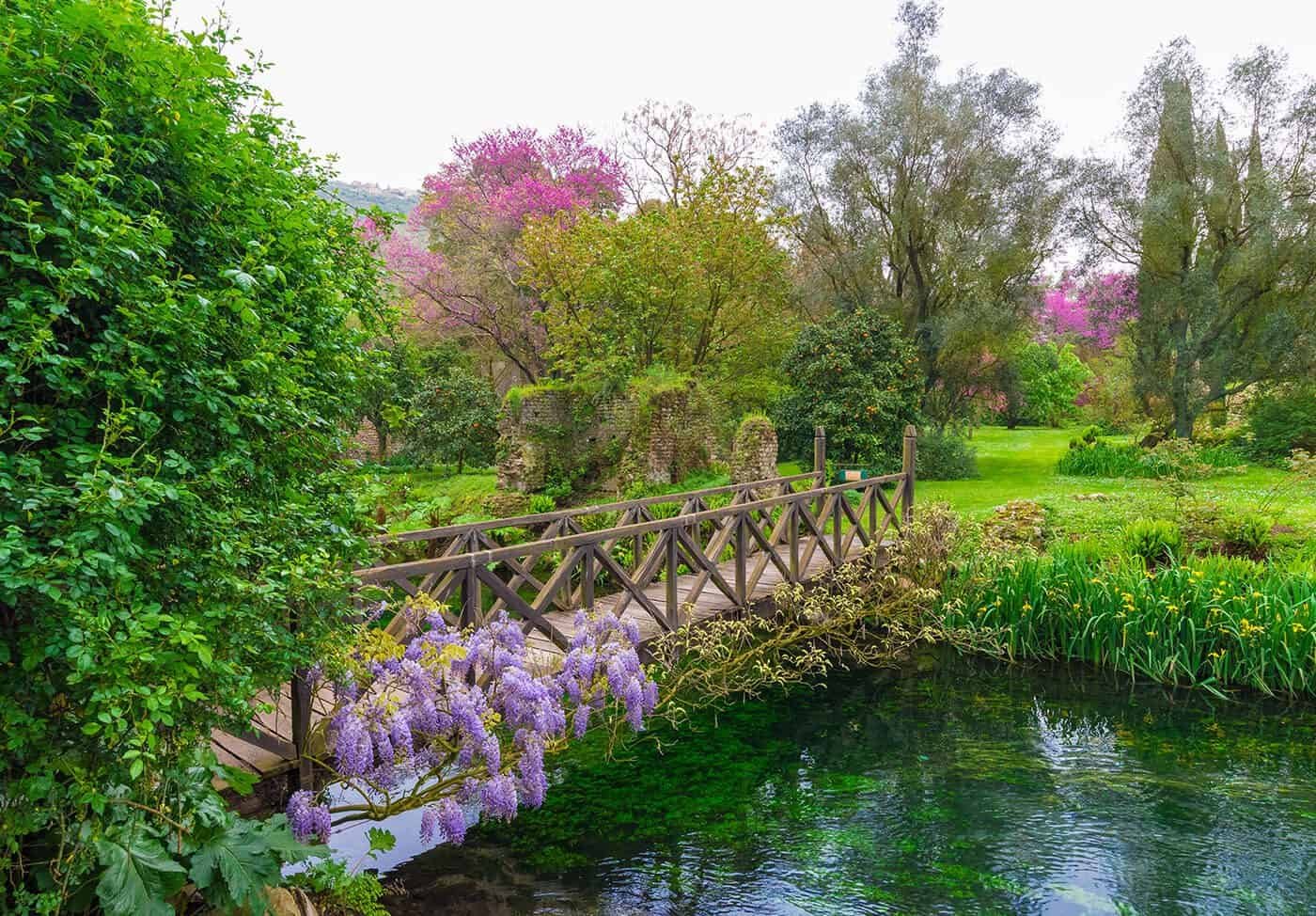
It's worth clearing up right away a misunderstanding I see repeated on every trip. Ninfa is not a park built around a few decorative ruins. Ninfa is a dead medieval town, destroyed in 1381 and never rebuilt, over which 600 years later a garden was laid out. The walls you walk through are the walls of houses, churches, workshops, hospitals. The 32-meter tower was the castle tower. The building that today hosts exhibitions and offices was the town hall. The stone bridge that gets photographed more than anything else was the bridge the carts crossed.
The formula that makes Ninfa unique in Europe is precisely this overlap: an English garden, that is, a garden that feigns the disorder of nature, built over a medieval urban grid that dictates its paths. The avenues follow the old streets. The flower beds occupy the city blocks. The roses climb along the apses. Anyone who knows the history of gardens knows how rare such a case is: the English picturesque of the 18th century built fake ruins to give the landscape melancholy, whereas here the ruins are authentic and the melancholy was earned over six centuries of abandonment.
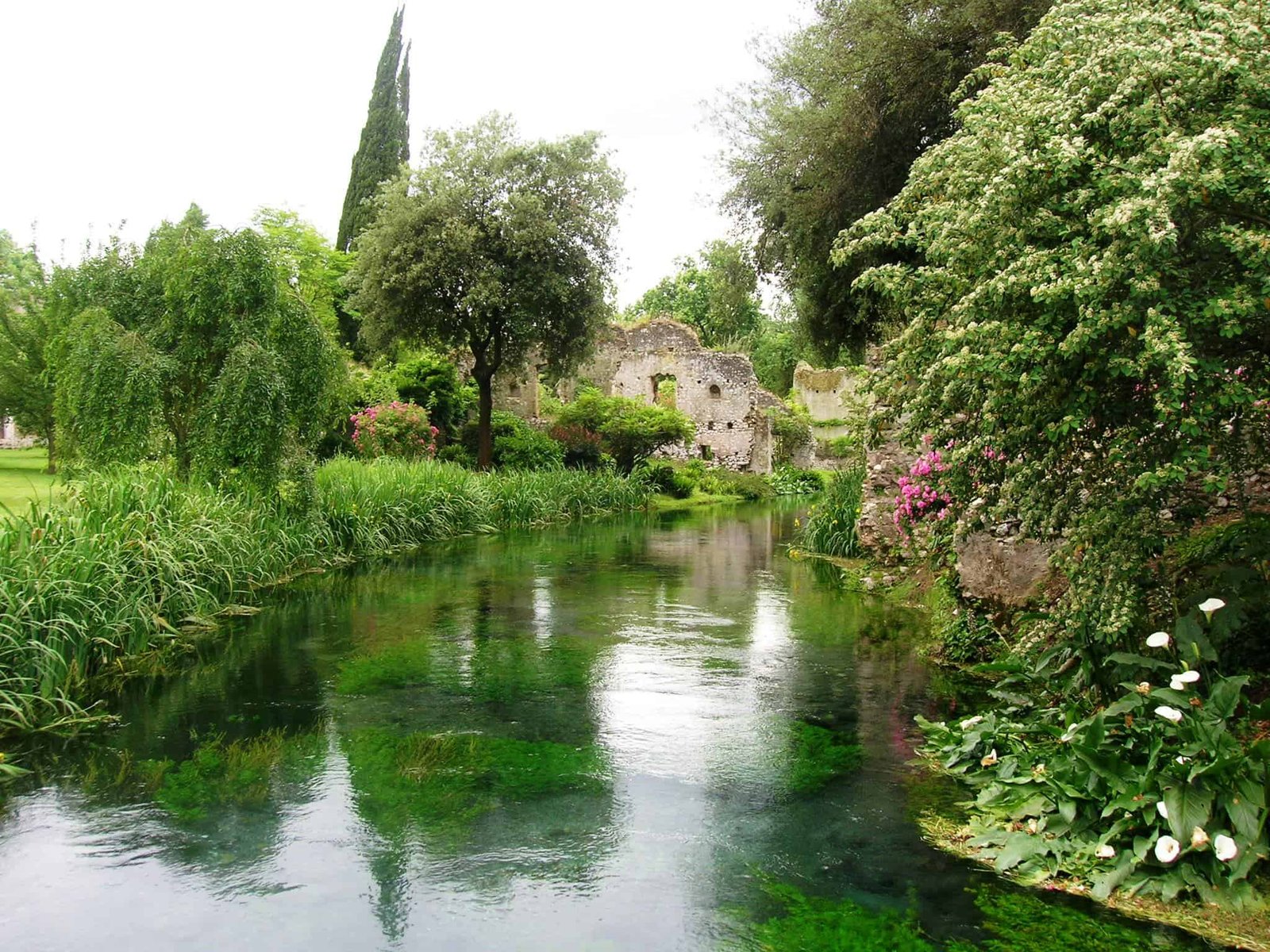
The protected area has two distinct parts. The first is the garden, about eight hectares, laid out starting in the 1920s and crossed by the Ninfa river. The second is the Pantanello, about 100 hectares of rebuilt wetland, completed in 2009, with six small lakes and native vegetation that reproduces the marsh environment that preceded the full land reclamation of the 1920s and 1930s. They are two different experiences and two different tickets.
The Ninfa Garden Visit, Step by Step
The guided route always touches the same key points, with some variations according to the season and the level of the river. It's worth arriving knowing what you are looking at, because an hour goes by quickly and the Foundation's guides, who are good, can't tell everyone everything.
The Small Lake and the Spring
You begin with the water, because everything at Ninfa begins with the water. The small lake is fed by a resurgence spring that surfaces just below the water line: it's the point where the aquifer of the Monti Lepini, after passing through the limestone, returns to the light at the foot of the relief. In the Middle Ages the Caetani built a retaining wall to raise the level and enlarge the body of water, with the twofold purpose of powering the mills and raising fish. The color of the small lake, a green that shifts to blue on clear days, depends on the purity of the water and the pale bottom.
On the lake's islet, according to the most accepted reconstruction, there stood in classical times a small temple dedicated to the deities of the waters, the nymphs: hence the name of the place, the river and the town. Be careful about the degree of certainty, because here the line between document and tradition is thin. The existence of a water cult at this spot is considered very probable by historiography and is taken up by the Foundation, but it doesn't rest on an inscription found in situ. I call it what it is, that is, a very solid reconstruction and not an epigraphic fact.
The Ninfa River
The river rises from the small lake and crosses the whole garden. Before the full land reclamation it ran for more than 40 kilometers through the Pontine countryside, called Ninfa in the first stretch and Sisto farther downstream, until it flowed out between Terracina and Circeo. Starting in the 1930s the spring waters were diverted just south of the garden into the Collettore delle Acque Medie, in effect separating the upper course from the old Ninfa-Sisto. It's a hydraulic change that explains a large part of today's Pontine landscape, and that at Ninfa is read in negative: the river inside the garden keeps its clarity precisely because it was isolated from the drainage system of the plain.
In the waters of the upper course lives the macrostigma trout, called here the Ninfa trout. It's a Mediterranean endemic species, of modest size, that survives only where the water stays cold, oxygenated and low in sediment. Seeing it isn't a given, but in the stretches under the bridges, with the sun high and a bit of patience, the shadows can be made out very well. Until the 1970s the small lake and the canals also hosted the otter. Today kingfishers and moorhens are seen on the water, green lizards and wall lizards warm themselves in the sun on the crumbling walls, and hoopoes pass overhead.
The Roman Bridge and the Other Bridges of the Ninfa Garden
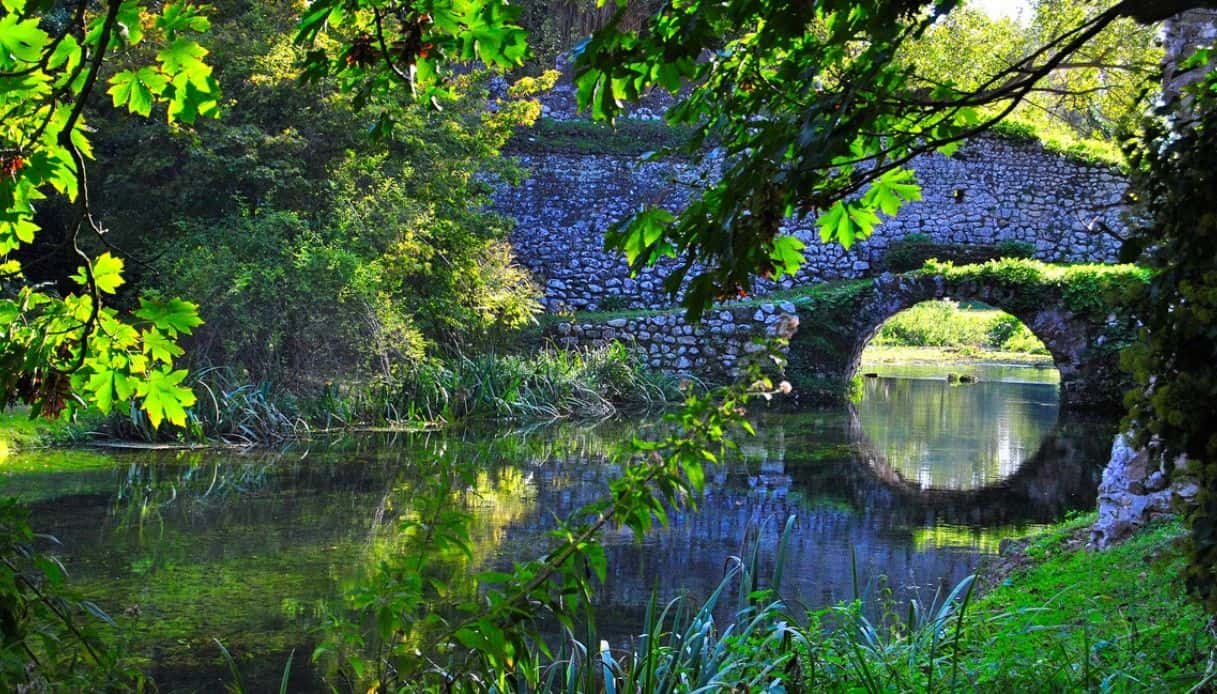
The river was crossed in the town by three bridges. The oldest is the Roman one, which bears witness to the passage of the Appia pedemontana, the inland variant that since the Republican era connected Cora, Norba, Sulmo, Setia and Privernum along the valley floor. The second is the Macello bridge, with two spans, built against the defensive walls. Two explanations circulate for the name. The first, a romantic one, tells of an assault in which enemies tried to enter the town by going up the river and were slaughtered with lances right at the bridge, so that the water turned red. The second, much more likely and accepted by scholars, is that the slaughter building simply stood near the bridge, and has since been lost. The third crossing is the wooden bridge, rebuilt in modern times, and it is the one that offers the most photographed view of the garden.
The Castle and the Tower
The castle stands near the lake, outside the circle of walls. Its construction begins in the 12th century, under the Frangipane, and continues from 1308 with the enlargement ordered by Pietro Caetani. Originally it was a tower with a walled enclosure at the base. With the enlargement came a square-plan structure protected by a perimeter wall with swallow-tail battlements, rotated 45 degrees relative to the tower and with small turrets at the corners. Against the perimeter wall a noble house was built, with a large hall onto which opened Gothic two-light windows facing the town.
The tower, today completely restored, has a square plan and is 32 meters high, with arrow slits along the shaft and swallow-tail battlements at the top. After the fall of Ninfa the complex was badly damaged, but it continued to be used for years as a prison, before its final abandonment. Looking at the tower from below, with the roses climbing up it, it's hard to imagine that it was a jail. And yet the darkest event in Ninfa's history happened right up there.
The Old Town Hall
The medieval town hall, enlarged in the period of greatest Caetani prosperity, had a curious second life: in 1765 Duke Francesco V had it turned into a granary, when by then nothing remained of the town but ruin and malaria. Restored by Gelasio Caetani in the 1920s together with the tower, the town hall is today the space where the Foundation hosts temporary exhibitions. In May 2026 the solo show by the maestro Tommaso Andreocci titled "Ninfa più vera del vero" was set up there. It is the only covered space on the route, and on rainy days it becomes a godsend.
Santa Maria Maggiore, the Church of the Popes
It was the main church of the town. Its construction dates, in all likelihood, to the 10th century, with an enlargement in the first half of the 12th. It had three aisles: the central one covered by a pitched roof, the two side ones with masonry vaults. Today what remains are the ruins of the outer perimeter, the semicircular apse and the Romanesque bell tower of the 13th century. In the apse two frescoes can still be recognized, one of them depicting Saint Peter, datable to 1160-1170. Other frescoes of the church were detached and moved for conservation to the Caetani Castle of Sermoneta. In the 15th century Onorato III promoted a general restoration, and the church remained in use until the 16th century, outliving by more than a century the town that had built it.
Here, on September 20, 1159, Pope Alexander III was crowned. It is the highest-ranking historical event that took place at Ninfa, and I tell it at length further on. In front of that apse it's worth giving yourself 30 seconds of silence: a pontiff elected on the run, inside a provincial church, while the emperor hunts him down, is a scene that no Roman basilica can offer.
San Giovanni and Its Stumpy Bell Tower
The church of San Giovanni dates to the 11th century and today its ruins are so fragmentary that it's hard to reconstruct its plan. In all likelihood it had a single nave, side chapels and a semicircular apse, partly still visible, with traces of frescoes depicting angels. Until the early 1900s the scene of the healing of a blind man and the translation of a saint's body were also legible. Today they no longer are. The 13th-century bell tower is still standing, about 10 meters high, with its top collapsed. Near the church grow an American walnut, several ornamental apple trees, a pink-leaved Japanese maple, a copper beech, a white-leaved maple and a silver-leaved pine. It's one of the spots where the contrast between stone and foliage works best.
San Biagio and the Diversion of the Walls
San Biagio dates to the 12th century and explains on its own how medieval urban planning worked. It was so close to the circle of walls that, in order not to leave it outside, the walls were diverted during construction: the defenses were built around the sacred, not the other way around. It is a tiny structure, with a single nave and a semicircular apse. It was decorated with a Christ in Glory and a Virgin among the Apostles, datable to the 12th or 13th century. Both frescoes are now displayed at the Caetani Castle of Sermoneta.
San Giovanni Outside the Walls
It takes its name from its position, a few hundred meters beyond the circle of walls, near the lake. Enlarged in the 13th century in Gothic forms, it was a church of considerable size, with three aisles, and an apse in opus reticulatum with brick inserts. It preserves the remains of a Theophany fresco of the 12th or 13th century, in which angels, the decorated border and the drapery can still be made out. The construction technique of the apse, which reuses the reticulate work of Roman tradition together with brick, is a valuable clue: at Ninfa ancient material was salvaged from the ruins of the plain and put back to use without philological scruples.
The Other Churches of Medieval Ninfa
The list of documented churches inside and outside the walls is long and worth reading in full, because it gives the measure of how populated this town was: Santa Maria Maggiore, San Biagio, San Giovanni, San Paolo, San Salvatore, San Pietro fuori le mura, Sant'Eufemia, Sant'Angelo, San Clemente, San Martino, San Quintino, San Leone, San Parasceve and San Vincenziano. 14 places of worship for a community of a few thousand souls: a ratio that looks disproportionate today and that was instead normal in the 13th century, when every guild, every district and every important family wanted its own altar. Of many of these churches little more than the name remains in the archive records.
The Two Monasteries Around Ninfa
Outside the walls stood two monasteries. The first, called Marmosolio, was in the Vaccareccia area. Built in the 11th century, it passed to the Cistercians in the 12th and was destroyed in 1171. The second, Santa Maria di Monte Mirteto, was founded in 1216 near a cave that since 1183 had been dedicated to Saint Michael the Archangel and was already a pilgrimage destination during the 12th century. The cave was frescoed in the 14th century and of those paintings only minimal traces remain today. The monastery grew rich in property and works of art until 1432, when Pope Eugene IV united it with the monastery of Santa Scolastica in Subiaco. From then on the decline was rapid. An earthquake in 1703 leveled the church, which was rebuilt and then abandoned, ending up turned into a warehouse.
The Hortus Conclusus, the Novelty of the Ninfa Garden
It is the most important addition of recent years to the visiting route. The Hortus Conclusus is the walled garden of Renaissance layout that in the 16th century Cardinal Nicolò III Caetani had built to a design by the architect Francesco Capriani da Volterra: two avenues crossing at a right angle and two niches from which water flowed and then poured into the river, where trout were raised. At the cardinal's death, in 1585, the layout quickly fell into ruin, and for centuries it remained a closed area, inaccessible to visitors.
The restoration came with the project "The Ninfa Garden: from the memory of the past to new resilience and sustainability", financed with €2 million from the National Recovery and Resilience Plan through the Ministry of Culture, to which the Foundation added its own resources for a total of about €2.2 million. The project ranked second out of 1,181 national applications. The works covered the areas between the access avenue to the old town hall and the southern shore of the lake, with an architectural restoration of the hortus and a botanical restoration that reintroduced species of Renaissance tradition, served by an irrigation system with sensors to optimize water consumption.
The visit to the Hortus Conclusus is included in the ticket, at no extra charge, in the first two and last two daily entry turns in the periods from March 21 to June 28 and from September 5 to November 8, as well as on August 15. It is also included in the two special summer evening routes, in the school educational visits in April and May and in the private group visits. In practical terms: if you care about it, book a time slot very early in the morning or very late in the afternoon. It's the information that makes the difference between a complete visit and a half visit.
The Hydroelectric Plant and the 1860 Turbine
Below the level of the lake, in a building that no visitor was able to see for decades, there is Ninfa's hydroelectric plant. The turbine is a Francis by the firm Voith, built in 1860 and arrived at Ninfa in 1895, when the Caetani family was starting the transformation of the site. The plant went into operation in 1908, using the thrust of the spring that gushes just below the surface of the lake, and since then it has produced the energy that made the garden self-sufficient. It worked for more than a century, until its recent retirement.
The redevelopment project provided for the restoration and museum display of the old turbine, now idle, the upgrading of the building that houses it and the installation of a new high-efficiency unit able to produce two or three times the energy of the historic machine. It's a detail that demolishes the idea of Ninfa as a purely contemplative place: here a family of engineers made roses and industrial hydraulics walk together, and did it when the plain out there was still marsh and malaria.

The Cypress Avenue
Along the cypress avenue grow the Erythrina crista-galli, the so-called South American coral tree, with scarlet inflorescences that recall the beak and crest of a tropical bird. It's a plant that in northern Italy doesn't survive the winter outdoors and that here instead thrives: the most immediate proof of how special Ninfa's microclimate is. The contrast between the dark verticality of the cypresses and that bright red is one of the most successful compositional choices in the garden.
The Lavender Avenue
The lavender avenue accompanies a series of presences that seem taken from different continents and lined up: weeping cherries, a Himalayan pine, a few banana plants, a Mexican pine and a South American acacia. This is Ninfa's signature. They didn't look for phytogeographic coherence, they didn't reconstruct environments. They checked empirically what would survive and composed by color, shape and habit, with the eye of someone who paints. Not everyone likes it: the most rigorous botanists wrinkle their noses at a garden that puts the Himalaya next to Mexico. To me, instead, it seems to be exactly the reason for its appeal.
The Rock Garden
One area is dedicated to the rock garden, with iberis, eschscholzia, veronica, alyssum, aquilegia, dianthus and dwarf pomegranates. It's the smallest part and the one most neglected by hurried visitors, who walk here looking up toward the towers. A mistake: the rock garden is the point where you understand the gardeners' hand, because it requires artificial drainage, continuous control of weeds and weekly maintenance, all without chemical herbicides.
The Macello Bridge and the Water Vegetation
Near the Macello bridge grow violet-flowered armandii clematis, climbing hydrangeas, maples and a poplar. Continuing along the river you meet a grove of hazels, an Acer saccharinum and a Liriodendron tulipifera, the tulip tree, which in autumn turns a full yellow and is recognized by its squared leaf, as if cut straight across at the tip. Near the Roman bridge are a Photinia serrulata, jasmines and wisterias. Just before the wooden bridge is a stand of bamboo of Chinese origin, which on windy days makes that dry rustle of canes that you hear from far away at Ninfa.
At the wooden bridge there is a Gunnera manicata, the plant with enormous leaves typical of Brazilian river environments, along with papyrus, a cedar and an Australian Casuarina tenuissima. The gunnera is the photo kids ask for most, for a simple reason: its leaves can exceed a meter and a half in diameter and a child disappears under one. A Lonicera involucrata climbs the town hall, a star magnolia blooms in front of the castle, and behind Santa Maria Maggiore Church you'll find a yellow trumpet vine, a group of yuccas and several rose beds.
On the main facade of the same church grows a Cotinus coggygria, the smoke tree, with feathery pinkish flower clusters that look like cotton candy from a distance, and a cedar with a tillandsia resting on its trunk, an epiphytic plant with no functional roots that gets its nourishment and water from the moisture in the air. A tillandsia on a cedar, in the province of Latina, is perhaps the image that best sums up the ambition of this place.
The Plants of the Ninfa Garden
The numbers vary depending on the source, and it's worth saying so precisely. The Foundation speaks of more than 1,000 plants introduced into the garden over the course of the century. The regional protected area's profile speaks of about 2,000 plant species, different in shape, size and color. The two figures don't contradict each other, because they count different things: the specimens planted by the family and the overall variety present in the area, including wild species. In any case, the figure that matters for the visitor is another one: in eight hectares you go from Brazil to the Himalayas in 200 meters.
The Roses of the Ninfa Garden
The roses are the identity of Ninfa and the reason May is the most contested month. In the protected area there are about 160 varieties. Among those on record are the Rosa filipes "Kiftsgate", which is not a bush but a climber able to cover a full-grown tree. Then there's the "Alba semiplena", an old rose with an intense scent, the "Général Schablikine", a tea rose of the late 1800s with a coppery flower, the "Madame Alfred Carrière", a white-pink climber that also tolerates difficult exposures, the "Clair Matin", the "White Rock", and the "Mermaid", with a simple pale yellow flower and a habit that covers yards of wall.
The idea of letting roses climb the ruins goes back to Marguerite Chapin and then Lelia Caetani, and it's a choice that set a standard all over Europe. In 1949 Marguerite ordered 128 rose varieties by herself, almost all from English nurseries. The criterion wasn't collecting: they were looking for roses able to withstand the humidity of the valley floor, climb uneven masonry and bloom for a long time. If you visit in mid-May, you'll find them at their best. If you arrive in late June, you'll still find many, but not the full show.
The Cherry and Ornamental Apple Trees
The blossoming of the flowering cherries and the ornamental Malus opens the season and is the reason the calendar starts in the third week of March. They are trees chosen for the moment and the color: the petals fall on the water and the current slowly carries them down the river, which is the effect for which thousands of people book year after year. The exact bloom dates vary from year to year by 10 or 15 days depending on how the winter goes, and no calendar can guarantee it. If you go in late March and find the branches still bare, it's not a failure of organization: it's the weather.
The Magnolias of the Ninfa Garden
The magnolias on record in the area include the Magnolia stellata in the "Rosea" and "Water Lily" varieties, the Magnolia denudata and the Magnolia grandiflora. The stellata blooms very early, before putting out leaves, with narrow, abundant petals, and at Ninfa one of them guards the space in front of the castle. The denudata, the Chinese magnolia with large white flowers, is one of the oldest ornamental plants cultivated in the world, present in Chinese temple gardens for over 1,000 years. The grandiflora, evergreen and North American, is instead the magnolia of Italian tree-lined avenues of the 1800s, and at Ninfa it serves as a dark mass in the background.
The Japanese Maples
The maples are the reason it's worth coming back in October. In the area, Acer palmatum "Dissectum" and "Dissectum Atropurpureum" are documented, that is, the varieties with deeply cut, almost threadlike leaves, light green the first and reddish brown the second. These are plants that suffer from dry wind and direct afternoon sun, and at Ninfa they find the shade and humidity they need thanks to the river. Near San Giovanni Church grows a pink-leaved Japanese maple that rivals the cherry trees in spring.
The Shrubs and Climbers
Among the shrubs and climbers of the area, birches, buddleias, camellias, ceanothus, clematis, dogwoods, wisterias, prunus and viburnums are recorded. It's the backbone of a classic English garden, with a variation: here the shrubs don't enclose green rooms but pad out the spaces of the medieval houses. Walking along the avenues you pass continually between two stone walls a meter and a half high that were domestic walls, and inside those rectangles grow buddleias and viburnums. It's a form of plant archaeology that has few parallels.
Water Plants and Exotics
The most spectacular component, and the most fragile, is the one tied to the river. Papyrus, gunneras, bamboo, marsh irises, climbing hydrangeas: these are plants that need constant water and at Ninfa find it without artificial irrigation, because the spring doesn't dry up. Add the Australian Casuarina tenuissima, the Himalayan pine, the banana plants, the South American acacia and the epiphytic tillandsia and you have the inventory of a garden that, born as an exercise in English taste, has become in fact an acclimatization laboratory.
One last technical opinion: anyone who arrives at Ninfa expecting a tidy botanical garden, with labels and flower beds sorted by family, will be disappointed. Ninfa doesn't explain plants, it uses them. Anyone who wants to understand systematics would do better to spend half a day at the Rome Botanical Garden, below the Janiculum, or at the Rome Rose Garden on the Aventine, which does very serious cataloguing work on roses. Ninfa is something else: it's a painting made with plants.
The History of Ninfa, from the Roman Town to Its Destruction
This is the part that almost everyone skips and that instead gives meaning to every stone of the garden. It's worth going through it in full, in order, distinguishing documented facts from traditions.
The Origins: the Temple of the Nymphs and the Appia Pedemontana
A settlement at Ninfa already existed in Roman times, but it was a small farming center, not a town. The name almost certainly derives from the cult of the water nymphs, tied to the spring and to the small temple that tradition places on the lake's islet. The place was served by the Appia pedemontana, the inland variant that since the Republican era connected Cora, Norba, Sulmo, Setia and Privernum along the valley floor, avoiding the marsh. Anyone who visits Cori, Norma with nearby Norba, Sezze and Priverno today retraces exactly that line.
The 8th Century: Constantine V's Gift to Pope Zachary
Around the middle of the 8th century Pope Zachary received as a gift from the Eastern emperor Constantine V, known as Copronymus, vast agricultural areas near Norma, where a country estate existed. The gift was a thank-you: the pontiff had opposed the Lombard advance by interceding with King Liutprand. It is the first act that permanently ties Ninfa to the Church of Rome, and it explains why for the next five centuries possession of this patch of plain would be contested between popes and baronial families.
The Fortune of the Toll
In the same period Via Appia and Via Severiana, which ran farther down, became impassable because of the advancing marsh. Commercial traffic shifted to the pedemontana, which passed right next to Ninfa. Whoever controlled that stretch could impose a toll, and the toll proved a gold mine. In a few decades the farming village became an urban center with houses, churches and workshops. Ninfa's wealth, throughout its history, never came from the land. It came from the traffic passing through.
The Pactum Ninfensium of 1116
Between the 10th and 11th centuries, although the territories formally belonged to the Papal State, the real rulers of the area were the counts of Tusculum. At the beginning of the 12th century Pope Paschal II regained control of the town, and in 1116, with the act known as the Pactum Ninfensium, he entrusted it to its own inhabitants in exchange for loyalty to the Church, some economic obligations and the order to tear down the defensive walls. It's a remarkable document: for a moment Ninfa was, in effect, a community that governed itself. The clause about tearing down the walls says everything about the balance of power, because a city without walls is a city that can't say no.
The Frangipane and the Election of Alexander III
Ninfa then passed to the Frangipane, the powerful Roman family. In 1159, at the death of Adrian IV, the college of cardinals split and two popes were elected: Rolando Bandinelli, who took the name Alexander III and had the support of the Frangipane, and Ottaviano de Monticelli, who called himself Victor IV and was backed by Frederick Barbarossa. Alexander III was immediately captured by his rival, and was freed by Oddone Frangipane, who offered him refuge at Ninfa. On September 20, 1159, in the church of Santa Maria Maggiore, Alexander III was crowned pontiff.
The imperial revenge came 12 years later. In 1171 Frederick Barbarossa had the city sacked and then set on fire. It's the first of the two blows that history holds in store for Ninfa, and the lesser one: it recovered from this one.
The Decline of the Frangipane and the Changes of the 1200s
At the end of the 12th century the Frangipane, buried in debt, sold most of their properties. The positive legacy of their rule was the construction of the first part of the castle and the defensive walls. In the 1200s Ninfa was administered by Giacomo Conti, as attested by an oath of allegiance from 1215, and then by his descendants. Toward the end of the century the city went through a convulsive phase that brought the Annibaldi to power first and then the Colonna, who took possession of it on April 30, 1293.
1297: The Caetani Arrive
With the election of Boniface VIII, born Benedetto Caetani, pope from 1294, the Colonna family was excommunicated and its assets confiscated. In 1297 Pietro Caetani bought Ninfa for 200,000 gold florins, although the official investiture as head of the fiefdom came only on October 10, 1300. Sermoneta, Ninfa and the lakes of Fogliano and Caprolace formed a single, flourishing estate entrusted to the Caetani by the family pontiff. It's the beginning of a bond that lasts to this day, 700 years later, and it's the reason the garden bears the name of a Caetani foundation.
The 1300s: Ninfa at Its Height
The Caetani period was one of great prosperity. The walls were reinforced, the castle enlarged, a tower was built, a retaining wall was erected to hold back the spring water and widen the lake, the town hall was expanded, and new mills and two hospitals were built, the one of San Matteo and the one known as Le Mancinule. The churches inside and outside the walls were many, the artisan and commercial shops very dense. In this phase the first efforts to reclaim the surrounding marsh were also attempted, with partial results.
The Disputes of the 1300s
At the death of Boniface VIII the rival families claimed the lost territories: the Annibaldi sacked Ninfa and, to keep possession of it, asked for the help of the army from Rome. A change in the political situation allowed the Caetani to take the village back in 1314. In 1317 the territory was assigned to Benedetto III, count palatine, and in 1355 to his nephew Giovanni. But the family, ruined by debt, had to sell its territories, and the palatine branch would die out in the 16th century.
In 1369 Ninfa was bought by the Caetani of Fondi, led by Onorato I, who paid off the debts of his predecessors and restored the city walls. It looked like a rebirth. Instead it was the antechamber to disaster.
1381: The End of Ninfa
The fatal blow came from the Western Schism. The Avignon pope Clement VII, an ally of Onorato, confirmed him in the office of rector of the area and declared the Palatines stripped of all rights. Urban VI, the pope of Rome, answered by excommunicating Onorato and depriving him of all his rights. A fierce local war followed, which in 1380 led to the siege of Ninfa: the city was sacked and in 1381 completely destroyed by the neighboring communities, with pickaxes. Not a fire, not an earthquake: a methodical demolition, wall by wall, decided by people who lived a few kilometers away.
Ninfa was never rebuilt. A few huts of farmers who worked the surrounding countryside remained, but the advance of the marsh and malaria forced them to leave too. The city that lived off the toll of a road died when the road stopped being safe.
The Massacre at the Tower, 1447
In the 1400s the castle, by then in ruins, was still used as a prison. In 1447 took place the episode remembered as the Ninfa massacre: one of the prisoners locked in the tower killed a jailer, and in reprisal Onorato III had all the prisoners thrown from the tower, among whom was a deacon. The killing of a cleric was unacceptable to the Church. Onorato, to avoid excommunication and the confiscation of all his fiefs, had to submit to a public flogging.
The Ironworks of 1471 and the Last Attempt
In 1471 the Caetani opened an ironworks at Ninfa, whose construction had begun in 1457, using the driving force of the river. The business lasted a few years and closed. It's the first, timid attempt at industry in a place that four centuries later would equip itself with its own hydroelectric plant: the power of water has always been Ninfa's real resource.
The Cardinal's Garden and the Long Abandonment
In the 16th century Cardinal Nicolò III Caetani commissioned the architect Francesco Capriani to build a garden in the area of Ninfa: a simple layout, two avenues at right angles and two niches from which water flowed into the river for raising trout. At the cardinal's death, in 1585, the garden fell into ruin. In the 18th century nothing living was left of Ninfa: the last mill and the fulling mill, the facility for fulling cloth, closed too. In 1765 Duke Francesco V turned the town hall into a granary, and in the same period Pope Pius VI began a drainage of the marshes that ended in nothing.
For more than three centuries Ninfa was therefore just a mass of ivy-covered ruins in the middle of malaria. And it is precisely this condition that made it famous in the 19th century.
Ninfa in Its Splendor: the Town That No Longer Exists
In the 14th century, at the height of its fortune, Ninfa was a real town. The documented houses numbered more than 150, all equipped with an attic and a granary, a sign of an agricultural economy with surpluses to store. The churches, inside and outside the walls, numbered about 14. There were paved streets, mills, three bridges, two hospitals, a castle and a town hall. The circle of walls measured roughly 1,400 meters and was punctuated by at least 11 towers, but research holds that there were probably more.
1,400 meters of walls is the measure of a medium-sized center, comparable to the walled villages still visited today in the Lepini. The difference is that Sermoneta, Bassiano and Cori stayed inhabited, with houses reworked, plaster redone, windows widened. Not Ninfa. Ninfa stopped in 1381 and since then has not been touched except by roots. It's the reason archaeologists consider it a case study: a medieval urban plan frozen in time, with no later overlays.
The Two Measures of a Dead Town
Try this exercise as you walk. Count the rectangular spaces lining the avenues: those are the houses. Look at how small they are: 4 meters by 6, 5 by 7. Raise your eyes to the 32-meter tower and you'll understand the balance of power between the lord and his subjects. Then look for the semicircular apses, which are the most recognizable element of the surviving churches. Once you've done that, you'll have read the town better than someone who only photographs it.
Ninfa and the Travelers of the 19th Century
The ruins of Ninfa began to enjoy European fame from the early 19th century, when Romantic taste discovered the appeal of ruins overgrown with vegetation. The most famous of the visitors was the German historian Ferdinand Gregorovius, author of the monumental history of Rome in the Middle Ages, who in his travel pages collected in Italian under the title Passeggiate romane devoted to Ninfa a description that entered the canon. His best-known image is that of the ruins of a town that, with its walls, towers, churches, convents and dwellings, lies half submerged in the marsh.
Gregorovius compared Ninfa with Pompeii, and judged Ninfa better. He explained the reason himself: at Pompeii, he wrote, the houses stand rigid like mummies pulled out of the volcanic ashes, while at Ninfa a fragrant sea of flowers stirs, every wall, every church and every house is wrapped in a veil of ivy, and over all the ruins wave the purple banners of the triumphant god of spring. The comparison is rhetorically constructed, but it captures a real difference: Pompeii is archaeology, Ninfa was and is a living organism that has eaten a town.
To put it plainly: the expression "Pompeii of the Middle Ages" has been around for two centuries and is handy for headlines, but it is imprecise. Pompeii was buried in one afternoon, Ninfa was demolished and then slowly abandoned over the span of generations. The similarity is in the final effect, not in the cause.
Who Created the Ninfa Garden
The garden doesn't come from a signed design. It comes from three women and two men of the same family, over a span of 60 years, and from a boy from Latina who inherited its custody. It's worth getting to know them one by one, because each left a recognizable mark.
Ada Bootle-Wilbraham, the Englishwoman Who Brought the Garden to the Pontine Plain
Ada Bootle-Wilbraham was born in 1846 and died in 1934. She was the second daughter of Edward Bootle-Wilbraham, of a family related to the barons of Skelmersdale, and of Emily Ramsbottom. On July 11, 1867 she married Onorato Caetani, then prince of Teano. The marriage, celebrated in England, required a papal dispensation because she was Anglican. They had six children: Leone in 1869, Roffredo in 1871, Livio in 1873, Giovannella in 1875, Gelasio in 1877 and Michelangelo in 1890.
Ada was a lady-in-waiting to Queen Margherita of Savoy, joined the Rome section of the Italian Alpine Club in 1882, went hunting on horseback and discussed riding with anyone. She also started a horse breeding farm near Cisterna, crossing local mares with Arabian and English blood to obtain sturdy horses, later supplied to the Italian army. But the legacy that interests us is another one: it was she who planted the exotic botanical garden at the Caetani residence on Lake Fogliano, and it is from her Fogliano experience that the idea of repeating the experiment among the ruins of Ninfa was born. The road that leads to Villa Fogliano, inside the Circeo National Park, now bears her name.
Gelasio Caetani, the Engineer
Gelasio Caetani, son of Ada and Onorato, is the man who set the work in motion in 1921. He had a degree in civil engineering from Rome and a diploma in mining engineering from Columbia University in New York. He had started as a mine worker in the United States and rose to management roles, inventing machinery for metal extraction. He was a soldier in the Great War, brought aid to the Belgians during the German invasion and helped the victims of the Avezzano earthquake. He was a city councilor in Rome in 1920, a member of parliament in 1921, Italy's ambassador to Washington from 1922 to 1925, where he oversaw the construction of the new diplomatic headquarters, and a senator in 1934, the year of his death. He never married, claiming that marriage would have prevented him from carrying out his activities.
At Ninfa he did what a hydraulic engineer knows how to do: he drained the area, regulated the waters, consolidated and restored the ruins, in particular the tower and the town hall, to make a summer residence out of them. He was the first to reclaim the Pontine marsh, and he also restored the Caetani Castle of Sermoneta. He published about 10 volumes on the history of the family, practiced sculpture and photography, and was a member of the Accademia dei Lincei and of the National Research Council. Without his drainage and consolidation work, none of the women of the house could have planted anything: at Ninfa the poetry rests on a work of engineering.
Roffredo Caetani, the Composer
Roffredo Caetani was born in Rome on October 13, 1871 and died there on April 11, 1961. Prince of Bassiano and last duke of Sermoneta, he was the godson of Franz Liszt, who early on recognized his musical talent. He studied piano with Giovanni Sgambati in Rome, harmony and counterpoint with Cesare De Sanctis and Nicola Tacchinardi, and continued in Berlin and Vienna, where he met Brahms. He composed string quartets starting in 1887, the Intermezzo sinfonico per grande orchestra op. 2 performed in 1889, the opera Hypatia that debuted in Weimar in 1926 and L'isola del sole, staged in 1943 at the Teatro dell'Opera di Roma. In 1939 he was named an academician of Santa Cecilia. From 1932 he settled in the castle of Ninfa, and later at Palazzo Caetani in Rome.
The detail that no guide mentions: a garden designed by a painter and lived in by a composer has a compositional logic, not a botanical one. The groupings of color, the intervals between the masses, the green silences between one bloom and the next are choices that come from other arts.
Marguerite Chapin, the American of the Magazines
Marguerite Chapin was born on June 24, 1880 in Waterford, Connecticut, to a well-off and cultured New England family, the daughter of Lindley Hoffman Chapin and Lelia Gilbert. Orphaned very young, she moved to Paris in 1902 to study singing. In 1911 she married Roffredo Caetani in London. They had two children: Lelia, born in 1913, and Camillo, born in 1915. Marguerite died at Ninfa on December 17, 1963.
Her undertaking was not the garden, or not only. It was literary publishing. She founded and financed two magazines that matter in the cultural history of 20th-century Europe: Commerce, published in Paris from 1924 to 1932, multilingual, which published authors of the caliber of James Joyce alongside newcomers. And Botteghe Oscure, published in Rome from 1948 to 1960 and closed because of financial difficulties, which hosted texts in five languages, English, French, Italian, German and Spanish. Giorgio Bassani collaborated on the editorial staff of Botteghe Oscure, and the magazine published some of the most important pages of poetry and prose of those years. The magazine's name came from the Roman street where the Caetani had the family palace, Via delle Botteghe Oscure 32, home of the house since 1776.
At Ninfa Marguerite introduced hundreds of plants, almost all bought from English nurseries, and shrubs and roses in quantity: in 1949 alone she ordered 128 varieties of roses. She opened the garden to writers and artists, and made the residence a place of literary conversation. Her sister Cornelia Van Auken Chapin was a sculptor. Another sister, Katherine Garrison Chapin, was a poet and the wife of United States Attorney General Francis Biddle.
Lelia Caetani, the Painter
Lelia Caetani was born in Paris in 1913 and died in 1977. She was a painter of urban and rural landscapes, portraits and still lifes, with a palette of subtle color shades that derives from her training in France, England and Italy. On September 17, 1951 she married Hubert Howard. They had no children, and with her the branch of the family tied to Ninfa died out after more than 700 years. Her brother Camillo had fallen on the Albanian front on December 15, 1940.
It is to Lelia that the garden owes its definitive form. In the 1930s she and her mother gave it its English layout. Later she introduced magnolias, prunus and climbing roses, matching colors with a painter's criterion but respecting the natural habit of each plant. She banned the use of chemical herbicides, a decision that in the 1960s was almost eccentric and that today looks farsighted. Her most concrete legacy, however, is legal: on July 14, 1972 she established the Roffredo Caetani Foundation, named after her father, to honor and perpetuate the memory of the house and to continue the social and educational work he had begun.
Hubert Howard, the English Husband
Hubert John Edward Dominic Howard was born on December 23, 1907 and died on February 17, 1987. He was the son of the diplomat Esmé William Howard, 1st Baron Howard of Penrith, and of Isabella Giovanna Teresa Gioachina Giustiniani-Bandini. In 1940 he volunteered for the British expedition to Finland. In 1941 he was assigned to the Allied psychological warfare division in Italy, where he served as an intelligence officer during the Italian campaign. He married Lelia in 1951 and with her continued the restoration of the garden. At their death the complex passed to the Foundation, which still manages it today.
Lauro Marchetti, the Custodian
There is one figure who doesn't belong to the family and who counts at Ninfa as much as the Caetani. Lauro Marchetti was born in Latina on April 30, 1949. As a child he was hit by a car. Roffredo Caetani and his wife Marguerite, who came to visit him, saw to it that he was operated on in a Roman clinic. From that gesture grew a relationship that changed his life. Lelia discovered him while he was drawing flowers and plants and invited him to Ninfa. She and Hubert Howard became his tutors and financed his studies and professional training in France and England. Before dying, Lelia symbolically entrusted the garden to him by giving him seven snowdrop bulbs. The year after her death, Hubert Howard named him secretary general of the Foundation, a post Marchetti held until 2019. Today he is its superintendent.
This passage disproves the easiest reading of Ninfa, that of an aristocratic whim. The continuity of the garden, through half a century of Italian history that was very hard on private heritage, was guaranteed by a boy from Latina who grew up among those roses.
The Roffredo Caetani Foundation and the Other Family Foundations
The Roffredo Caetani Foundation was established on July 14, 1972 by Princess Lelia. Today it administers the Caetani Castle of Sermoneta, the Ninfa Garden and Parco Pantanello, and together with the Camillo Caetani Foundation it runs the farm named after Gelasio Caetani. Its seat is in the Tor Tre Ponti area, on Via Appia, in the territory of Latina.
It is not the family's only institution. The Camillo Caetani Foundation was born in 1956 at the wish of Roffredo and Marguerite, in memory of their son Camillo who fell in Albania in December 1940. It is based in Rome, at Via delle Botteghe Oscure 32, and preserves the family archive, promotes studies on the family and the territory, funds scholarships and organizes conferences. Then there is the Leone Caetani Foundation, established between 1921 and 1924 at the Accademia Nazionale dei Lincei at the wish of Prince Leone, an orientalist, who left it his library of books and manuscripts. Three foundations for a single family: a case more unique than rare in the history of Italian patronage.
The Natural Monument and Parco Pantanello
The protected area established in 2000 covers 106 hectares in the municipality of Cisterna di Latina and is entrusted to the Foundation for management. Next to the historic garden is the Pantanello, about 100 hectares of rebuilt wetland, completed in 2009, with six small lakes and native vegetation that recreates the conditions that preceded the full land reclamation of the 1920s and 1930s. Parco Pantanello has a separate ticket, costs €6 on the official portal and is visited on its own route.
Around the garden, starting in 1976, over about 1,800 hectares, a WWF oasis was also created for the protection of the area's fauna: a wooded plantation and a system of wetlands were built there that favor the stopover and nesting of birdlife, and on about 15 hectares an attempt was made to recreate the marsh vegetation typical of the area, the vegetation that existed until the 1930s before the land reclamation. The area lies along one of the main migratory routes followed by birds going from Africa up toward Europe. After the oasis was created, teals, mallards, gadwalls, herons, lapwings and some species of raptors returned. About 100 bird species have been recorded in the area of the natural monument.
For those with a whole day and a serious interest in nature, the best formula is this: the garden in the morning, the Pantanello in the afternoon. They are two complementary readings of the same landscape, the tamed one and the wild one, and whoever sees only the first takes home half the story. Anyone with only half a day should choose the garden without hesitation.
The Literary Park and the International Fame of the Ninfa Garden
On September 22, 2018 the garden joined the network of Literary Parks with the dedication to Marguerite Chapin, under the name Literary Park "Marguerite Chapin e i luoghi dei Caetani". It is a recognition that rewards Ninfa's role as a meeting place for writers and as the physical home of two magazines that made 20th-century literary history. Every year the Foundation hosts a literary residency for young authors, and in October 2025 the garden joined the International Day of Literary Parks.
As for the line that follows Ninfa in every headline, the "most beautiful garden in the world" attributed to the New York Times, take it for what it is: a journalistic label repeated for decades, which appeared in editorial lists and rankings, not an official judgment or an award. Ninfa is part of the network of the Grandi Giardini Italiani, receives around 70,000 visitors a year and is certainly among the most visited historic gardens in Lazio. The rest is headline-speak. The place doesn't need borrowed superlatives.
When to Go to the Garden of Ninfa
March, for the ruins
The first two openings of the season are the best for those who come to read the medieval town. The foliage is still sparse, the apses and walls stand uncovered, the cherry trees are only just starting. It's cool, the light is low, there are fewer people. If your interest is history, book March 21 or 22 and dress in layers.
May, for the roses
It's the famous month, the most beautiful and the most crowded. The climbing roses are at their peak, the wisteria is finishing and the herbaceous peonies keep it company. Book well in advance because the dates sell out. Anyone who chooses May has to accept a full garden and tight shifts: the deal is clear and it's worth it.
June and July, for the water
In the heat, the river becomes the protagonist. The temperature difference between the sunny path and the bank in the shade of the bamboo easily exceeds five degrees, and it's a physical sensation that no photograph captures. From July 3 the visits switch to the evening ones, and with them to the best light of the year.
October, for the color
Maples, tulip trees and sweetgum turn red and yellow, the water level rises again, the groups thin out and the guides have more time. It's the season I recommend to those coming back a second time, and to those who photograph seriously. The October light at four in the afternoon, raking across the pale walls, is the best thing Ninfa can offer a lens.
When to avoid
Avoid the holiday long weekends if you can: April 25, May 1, June 2 and November 1 concentrate the highest demand and the parking lot fills up very early. Also avoid the middle hours of July and August, but the calendar already decides that for you, since in summer you only get in in the evening. And if it rains, go anyway: visits are guaranteed even in the rain, and any suspensions for extreme weather conditions are assessed on site. Ninfa wet, with steam rising from the river, is memorable.
The Garden of Ninfa with Children
It works well, on two conditions. The first is age: under four, an hour of guided visit on foot, with no chance to run, becomes an ordeal for everyone. The second is preparation: a child who knows he's entering a city destroyed 600 years ago and has to find the houses, the bridge and the prison tower has a great time. A child taken to see flowers gets bored in 10 minutes. Accompanied children under 12 don't pay for a ticket and don't need a separate entry pass.
The spots that capture the little ones most are three: the gunnera with giant leaves near the wooden bridge, the small pond with trout and the bamboo creaking in the wind. Watch out with strollers: the paths are packed earth and gravel, the little bridges are narrow, and a stroller with small wheels becomes a burden. A baby carrier or a child-carrier backpack is better. Educational visits organized for schools take place between April and May and are booked by writing to the Foundation.
Accessibility at the Garden of Ninfa
The subject has to be handled honestly. Ninfa is a garden on natural ground, with paths of earth and gravel, exposed roots, stone and wooden bridges, slight but constant changes in level. It is not a flat museum route. People with a certified severe disability above 75 percent and their companion pay 8 euros each at the entrance. The Foundation specifies that wheelchair rental is not available, so those who need one must bring their own. People with moderate mobility difficulties get by with closed shoes and a stick, but it's a good idea to call the call center in advance and work out the route together, along with the least crowded time slot.
A practical tip that applies to everyone, not only to those with walking problems: closed shoes with a treaded sole. Anyone who shows up in flip-flops risks spending the hour looking at their feet instead of the roses.
Dogs, Photos and Rules at the Garden of Ninfa
Dogs are allowed, on a leash of one and a half meters and with bags for waste. It's a rare concession among historic gardens and it must be respected to the letter. Damaging flora and fauna, bringing in food and leaving the group are forbidden. Personal photographs can be taken without problems along the whole route. For professional filming, photo shoots and drones you need to arrange it in advance with the Foundation.
At the exit there is a bar with a refreshment area, for which booking is recommended at 351 5626270, and a souvenir shop. Car parking is free and spacious. Bus parking in front of the entrance is not guaranteed on official opening days, and in that case the alternative indicated is the Doganella area, a few kilometers away.
What to See Around the Garden of Ninfa
Sermoneta, about half an hour away
The Caetani Castle of Sermoneta is the natural complement to Ninfa and belongs to the same Foundation: the ticket costs 8.25 euros on the official portal. Here are kept the detached frescoes from the churches of Ninfa, those of Santa Maria Maggiore Church and the Christ in Glory with the Virgin among the Apostles from San Biagio Church. Seeing the empty apses at Ninfa first and then the paintings that decorated them at Sermoneta is the smartest itinerary you can build in this area.
Norma and Norba
Above Ninfa, on the edge of the cliff, is Norma, and just outside the town lies the archaeological area of Norba, a Latin city destroyed in 81 BC during Sulla's civil wars. From up there you can see the whole Pontine plain down to the sea, and you understand with your own eyes why the cliff blocks the clouds and gives Ninfa its climate. It's the best viewpoint over the whole area.
The villages of the Lepini
The foothill strip offers Cori, with the Temple of Hercules and the Museum of the City and the Territory. Bassiano, home of Aldo Manuzio and of the ham that bears its name. Sezze with its outlook over the plain. Priverno with the city museums and the nearby Privernum Archaeological Park. They are all stops on the same ancient foothill road that passed beside Ninfa, and a well-planned weekend puts two or three of them together.
The plain and the sea
Heading down toward the coast you reach the Museum of the Pontine Land, in Latina, which tells the story of the land reclamation and the founding of the new towns: it's the second half of the story that at Ninfa you only sense. Farther down still are the Circeo National Park, with the coastal lakes and the state forest, and the beaches of Lido di Latina. Anyone with two days does Ninfa and Sermoneta on the first, Circeo and the lakes on the second.
A Curiosity About the Garden of Ninfa
The curiosity I like best isn't about a plant or even a ruin: it's about a machine. Below the level of the lake, in a low building that for decades no visitor could approach, is the garden's hydroelectric plant. The heart of the system is a Francis turbine built by the German firm Voith in 1860, which arrived at Ninfa in 1895 while the Caetani family was starting the transformation of the site, and entered service in 1908. It produced electricity using the thrust of the spring that surfaces just below the surface of the lake, and kept doing so for over a century, until its recent retirement: 116 years of uninterrupted work for a machine designed when a united Italy was only a few months old.
The meaning of that turbine goes beyond the technical anecdote. It means that the Garden of Ninfa, in the middle of a plain that until the 1930s was swamp and malaria, lit itself. No power line, no dependence on the outside: the river running through the ruins turned the turbine and the turbine lit the castle, the house, the little paths. Energy self-sufficiency achieved in 1908 and kept for more than a century, in a place everyone imagines as pure aesthetic contemplation.
The restoration funded by the National Recovery and Resilience Plan provided for turning the old, now stopped turbine into a museum piece, recovering the building that houses it and installing a modern high-efficiency unit able to produce two or three times the energy of the historic machine. The new irrigation system of the Hortus Conclusus is also run by sensors that dose the water according to real need. The continuity is perfect: the family that in 1908 put a turbine under a lake is the same institution that today installs moisture sensors in a Renaissance garden.
The conclusion is always the same: Ninfa is not a place where time stopped. It is a place where time kept working, silently, below the level of the water.
Something Nobody Tells You About the Garden of Ninfa
The thing nobody tells you, and which radically changes the quality of the visit, concerns the time slot you choose when you book. On the sales portal all the slots look equivalent: you pick the half hour that suits you and go. It isn't so. The visit to the Hortus Conclusus, the Renaissance walled garden commissioned in the sixteenth century by Cardinal Nicolò III Caetani and recently restored with funds from the National Recovery and Resilience Plan, is included in the ticket at no extra charge only in the first two and the last two entry shifts of the day, in the periods from March 21 to June 28 and from September 5 to November 8, as well as on August 15.
Translated: whoever books a mid-morning or mid-afternoon slot, that is the most convenient and therefore the most requested, leaves Ninfa without having seen the newest and one of the most interesting areas of the complex. Whoever books the first shift of the morning or one of the last of the afternoon enters the hortus without paying a cent more. The same inclusion applies to the two summer evening themed routes, to the school educational visits in April and May and to midweek private groups.
I'll add a second piece of information that isn't widely known, of the same practical kind. The guided visit lasts about an hour and the half-hour slots regulate only entry, not how long you stay: at the end of the tour the group is escorted to the exit to make room for the next one. There is no possibility of staying to wander alone, of sitting on a bench to read, of going back to re-photograph the bridge. Many visitors arrive convinced of the opposite and organize the day on a wrong assumption, with the disappointment that follows.
Third thing nobody will tell you: the ticket is not named. The name that appears on the order is that of whoever paid and is not checked at the entrance. Anyone buying for friends or relatives doesn't have to worry about names, but must remember that the ticket is tied to the date and the time slot and can be neither changed nor refunded. On this the Foundation makes no exceptions, except for closures due to force majeure.
My Advice for Visiting the Garden of Ninfa
Book the first shift of the morning, on a weekday if you manage to find one among the extraordinary openings or through a private group visit, and bring three things: closed shoes with a treaded sole, a light duster coat even in May, and a screenshot of the ticket saved on your phone. I insist on the first point because it makes the difference between a visit and an hour of balancing acts: the paths are earth and gravel, the bridges are smooth and damp, the roots surface.
The second piece of advice is about pace. Ninfa lasts an hour and the hour flies. If you spend the first 20 minutes photographing the pond, you'll reach the most beautiful part with the guide speeding up. Better to divide the visit mentally into three thirds: the first for the water and the ruins at the entrance, the second for the heart of the garden with the bridges and the churches, the third for the final stretch and for the Hortus Conclusus if you booked the right slot. Photograph a little at the beginning, a lot in the middle, and in the last third put the phone away.
Third piece of advice, the one nobody follows and everybody should: listen to the guide. It's not a formality. The Foundation's guides know the garden plant by plant and know the history of the medieval town, and at Ninfa the second explains the first. Without the story of the destruction of 1381 those walls are just walls, and without the story of the Caetani family those roses are just roses.
Last piece of advice, a logistical one: don't squeeze Ninfa between two commitments. With the trip, the parking, the wait at the gate and the final stop, a visit from Rome takes a full half day. Combine it with Sermoneta, which is about half an hour away and belongs to the same Foundation, and you'll have built the perfect day in the province of Latina. If instead you have time and an interest in nature, spend the afternoon at the Pantanello Park, which has a separate ticket and shows the plain as it was before the land reclamation.
Another Well-Known Fact, Yet Rarely Cited
That Ninfa is a destroyed medieval town, everyone knows, or nearly everyone. Much less known is who destroyed it, and above all how. In 1381 Ninfa was not burned by a foreign army or razed by an earthquake: it was demolished with pickaxes by the neighboring communities, in the context of the local war triggered by the Western Schism. The Avignon pope Clement VII had confirmed Onorato I Caetani in the office of rector of the area. The Roman pope Urban VI responded by excommunicating him and stripping him of every right. Between 1380 and 1381 the town was besieged, plundered and then taken apart stone by stone by its own neighbors.
This detail changes the meaning of everything you see. A burned city keeps its blackened walls and collapsed floors. A methodically demolished city keeps only what wasn't worth carrying away. That's why at Ninfa what remains are apses, bell towers and foundation masonry, and not architraves, columns, portals, cornices: the worked material was removed and reused elsewhere. Anyone walking among the ruins is actually looking at the waste of a quarry, not the rubble of a fire.
The second element rarely cited is that Ninfa did not die all at once. After 1381 the huts of the peasants who worked the countryside remained, and Santa Maria Maggiore Church stayed in use until the sixteenth century, that is for over 150 years after the end of the town. The castle continued to function as a prison, and in 1447 the massacre of the tower took place there. In 1471 an ironworks even opened, whose works had begun in 1457, which used the power of the river and closed after a few years. The agony lasted three centuries and what finally killed it was not war: it was the advancing swamp and malaria.
The third thing almost nobody tells is that abandonment was its salvation. Had Ninfa been rebuilt, today it would be an ordinary village of the Pontine plain, with houses redone in the Sixties and a church restored twice. It's because nobody lived there anymore that its medieval layout has come down to us intact, and that three generations of Caetani were able to use it as the scaffolding of a garden. The misfortune of a fourteenth-century community is the good fortune of today's visitor: it's an uncomfortable thought, but it is the historical truth.
The Right Photo to Take at the Garden of Ninfa
The photograph everyone looks for is the one of the bridge with the river below and the ruins in the background. It's a beautiful image and you should take it, but it's also the most photographed of its kind in Italy and nine times out of 10 it comes out flat, because at noon the light falls straight down and flattens every volume. If you want it to come out well, stand at an angle to the bridge, not head-on, and include in the foreground a dark mass of foliage to give depth.
The photo I actually recommend is another one: the castle tower seen from below, with the flowering branches of a cherry tree or the climbing roses cutting the shaft diagonally. 32 meters of swallow-tail crenellated masonry, and pink in the middle. It's the image that sums up in a single shot the two souls of Ninfa, the fortress and the garden, and it has a further advantage: you shoot it vertically, so it works even better on phones.
The best moment is the summer evening visit, between 6 and 7:30 in the evening, when the light comes in low from the west and runs through the garden instead of falling straight onto it. In that half hour the pale walls take on a warm color, the green separates into three or four distinct planes and the water becomes a mirror. The second good moment is October in the late afternoon, with the maples ablaze. The worst is the middle of the day in May, which is exactly the slot almost everybody books.
Two technical details. First: don't count on the tripod, because the group walks and there's no time to set it up, and for professional filming you need a prior agreement with the Foundation anyway. Second: the gunnera near the wooden bridge, with leaves that can exceed a meter and a half in diameter, is the best subject for a photograph of scale, that is with a person underneath. It's the image that always works in family collections, much more than the bridge.
One last recommendation: don't spend the hour behind the lens. Ninfa has a sound, that of the water and the bamboo, which no photograph records, and it has a smell, that of the roses mixed with the dampness of the river, which is worth the trip as much as the images. Take 10 good shots and then look.
Some Important Events That Happened Here in History
The first event by rank is the coronation of a pope. On September 20, 1159, in the Santa Maria Maggiore Church of Ninfa, Rolando Bandinelli was crowned with the name of Alexander III. At the death of Adrian IV the college of cardinals had split: one part had elected Bandinelli, backed by the Frangipane, another had chosen Ottaviano de Monticelli with the name of Victor IV, supported by Frederick Barbarossa. Alexander was captured by his rival and freed by Oddone Frangipane, who offered him refuge right at Ninfa. Anyone looking today at that bare apse, with grass between the bricks, is looking at the place where began the pontificate that 20 years later would bend the emperor and obtain the peace of Venice.
The second event is the imperial revenge. In 1171 Frederick Barbarossa had the city that had given asylum to his adversary plundered and then burned. Ninfa recovered, rebuilt and kept prospering for two centuries, but the political lesson was clear: whoever controlled that pass of the plain automatically entered the great games of Europe.
The third event is the purchase of 1297. With Boniface VIII on the papal throne, the Colonna excommunicated and their property confiscated, Pietro Caetani bought Ninfa for 200,000 gold florins. The formal investiture as head of the fief came on October 10, 1300. Sermoneta, Ninfa and the lakes of Fogliano and Caprolace became a single estate of the family. It's the act that generates everything else: the prosperity of the fourteenth century, the enlargement of the castle, and 700 years later the very existence of the garden.
The fourth event is the destruction. Between 1380 and 1381, within the local war generated by the Western Schism between the Avignon pope Clement VII and the Roman pope Urban VI, Ninfa was besieged, plundered and finally demolished with pickaxes by the neighboring communities. It was never rebuilt. In the history of Italian towns it is a rare case: not a slow depopulation, but a deliberate erasure.
The fifth is the massacre of 1447. The castle, by then in ruins, served as a prison. A prisoner locked in the tower killed a jailer, and in reprisal Onorato III had all the inmates thrown from above, among them a deacon. Killing a cleric cost Onorato the risk of excommunication and of the confiscation of his fiefs. To avoid them he had to submit to a public flogging. A 32-meter fall, and a corporal penance inflicted on a feudal lord in front of the people.
The sixth is the union of the monastery of Santa Maria di Monte Mirteto with Santa Scolastica of Subiaco, decided by Pope Eugene IV in 1432. It seems an administrative act and instead it marked the end of a flourishing religious community, which from 1216 had gathered property and works of art around the grotto dedicated to Saint Michael the Archangel since 1183. In 1703 an earthquake brought down the church. Rebuilt, it was then abandoned and reduced to a warehouse.
The seventh is the failed attempt of the eighteenth century. In 1765 Duke Francesco V turned the old town hall into a granary, and in the same years Pope Pius VI started a reclamation of the Pontine marshes that came to nothing. It's the lowest point of the arc: of Ninfa not even a working mill remained.
The eighth is the rebirth of 1921, when Gelasio Caetani began the reclamation of the area, the consolidation of the ruins and the restoration of the tower and the town hall to make them a summer residence. The age of the garden is counted from that year, and to that year dates the choice that made Ninfa what it is: not rebuilding the city, but cultivating it.
The ninth is the establishment of the Fondazione Roffredo Caetani, on July 14, 1972, by the will of Princess Lelia. With her a house of seven centuries died out and the body was born that still today administers the garden, the Caetani Castle of Sermoneta and the Pantanello Park. Few Italian families have managed their own end with as much lucidity.
The tenth is recent: the establishment of the natural monument by decree of the President of the Lazio Regional Government of February 25, 2000, number 125, published in the bulletin on April 10 of the same year, over 106 hectares in the municipality of Cisterna di Latina. And the eleventh is even closer to us: the project funded with 2 million euros from the National Recovery and Resilience Plan, ranked second out of 1,181 national applications, which gave visitors back the sixteenth-century Hortus Conclusus and turned the hydroelectric plant into a museum piece.
Who Has Passed Through the Garden of Ninfa
The first name is that of a pope on the run. Alexander III, that is Rolando Bandinelli, arrived at Ninfa in 1159 escorted by Oddone Frangipane, who had snatched him from the hands of the rival Victor IV, and here he was crowned on September 20 of that year. He is the only pontiff crowned in this strip of the Pontine plain, and his presence cost the city the fire of 1171 ordered by Frederick Barbarossa.
The second is Boniface VIII, born Benedetto Caetani, pope from 1294. He did not reside at Ninfa, but it was he who made possible the purchase of 1297 by his nephew Pietro Caetani, after the excommunication of the Colonna and the confiscation of their property. The family that today gives its name to the Foundation arrived here thanks to a pope.
The third is Cardinal Nicolò III Caetani, who in the sixteenth century called the architect Francesco Capriani da Volterra to build a pleasure garden among the ruins, with two crossing paths and water niches for raising trout. At the cardinal's death, in 1585, the layout fell into decline. Four centuries later that enclosure became open to visitors again under the name of Hortus Conclusus.
The fourth is Ferdinand Gregorovius, the German historian author of the great history of Rome in the Middle Ages, who visited the ruins in the nineteenth century and described them in his travel pages collected in Italian as Passeggiate romane. It was he who fixed the image of a city that with walls, towers, churches, convents and houses lies half submerged in the swamp, and judged it superior to Pompeii because at Pompeii the houses stand rigid like mummies pulled out of the volcanic ashes, while at Ninfa a fragrant sea of flowers stirs. The tourist fortune of Ninfa begins with those lines.
The fifth group of names is that of the literary twentieth century. Marguerite Chapin Caetani, who lived at Ninfa and died at Ninfa on December 17, 1963, founded and funded in Paris Commerce, published from 1924 to 1932, which printed among others James Joyce, and then in Rome Botteghe Oscure, active from 1948 to 1960 in five languages, on whose editorial staff Giorgio Bassani collaborated. The garden and the family palace were for 40 years a hub of European literary conversation. The Literary Park named after Marguerite Chapin, inaugurated on September 22, 2018, ties to the place the names of Virginia Woolf, Giuseppe Ungaretti, Alberto Moravia and Pier Paolo Pasolini.
The sixth is the tradition of illustrious guests, which has to be taken for what it is, that is solid local memory but not documented case by case: among the twentieth-century visitors are remembered the poet Gabriele D'Annunzio, the writer Boris Pasternak, author of Doctor Zhivago, and, in 1935, Benito Mussolini during a visit to the Agro Pontino at the height of the land reclamation season.
The seventh is Hubert Howard, British intelligence officer in the Italian campaign, who in 1951 married Lelia Caetani and with her brought the garden to completion, then managing it until his death in 1987. The eighth is Lauro Marchetti, born in Latina in 1949, raised under the protection of the family, secretary general of the Foundation until 2019 and today superintendent: the only non-Caetani who has left a mark at Ninfa comparable to that of the princes.
The ninth, as a joke, is the 70,000 visitors who pass through here every year. In a place open fewer than 80 days a year, with limited groups and one-hour visits, that number tells of enormous demand and tiny capacity. It's the reason it pays to book a month ahead, and it's not a figure of speech.
The Curse of Ninfa: How the City Died and What the Legend Tells
The Garden of Ninfa grows inside the corpse of a city: it's not a metaphor, because under the climbers and along the river are the walls, the apses and the mill walls of a town that ceased to exist between the fourteenth and fifteenth centuries. On top of that end a second story has settled: a curse, a crime, a ghost. It's best to keep the two things separate, because the first is documented and the second is tale.
Ninfa was a real city, not a village of a few houses
The sources and the excavations give back a respectable town. At its best, in the fourteenth century, Ninfa counted over 150 houses, a circuit of walls of about 1,400 meters with at least 11 towers (probably more), a castle with a square tower, a town hall, two hospitals, bridges, shops and the mills driven by the river. The churches were more than a dozen inside and outside the walls, with Santa Maria Maggiore Church as the main one. The wealth came from the position: when the Appia and the Severiana became impassable because of the advancing swamp, traffic moved onto the foothill road, and Ninfa collected the tolls.
The place also enters great history: in 1159, in the main church of Ninfa, Pope Alexander III was consecrated, to whom the Frangipane had offered refuge while in Rome his election was contested. It's documented by the sources, and it's the reason the name of a vanished town recurs in Church history textbooks.
How Ninfa died: the dates, and where the sources differ
The end was not a single event, but a sequence. A first blow comes in the twelfth century, when the city is plundered and burned by the imperial troops of Frederick Barbarossa. On the year the sources differ, and both 1171 and 1165 are given. Anyone who writes a flat date is simplifying.
The decisive blow came two centuries later. The Caetani had bought Ninfa at the end of the thirteenth century, under the pontificate of Boniface VIII, who was of the family: Pietro Caetani bought it in 1297 (formal investiture in 1300), strengthened the walls and enlarged the castle, and the city had its best season with them. Then came the Great Western Schism, with two opposing popes, and the Caetani split. The Fondi branch, led by Onorato I Caetani, sided with the pope of Avignon. Between 1380 and 1381 Ninfa was besieged, plundered, burned and demolished, and was never rebuilt.
On who materially destroyed it in 1381 the authors do not agree: some reconstructions attribute the destruction directly to Onorato Caetani, count of Fondi, others speak of an onslaught by the neighboring towns that took the ruins apart with pickaxes. The result is the same, the responsibility as told is not: it's a real divergence among the sources, and it's best to know it before repeating a single version.
Why nobody came back: the swamp and malaria
The least spectacular part is the one that weighed the most. A few peasants stayed even after 1381, but the advance of the swamp and malaria made the area unlivable. It wasn't a decision made one morning: it was standing water winning on points over generations. In the sixteenth century Cardinal Nicolò III Caetani tried, having a garden with paths and trout pools made among the ruins, which declined after a few decades. In the eighteenth century almost nothing was left of the city, and the old town hall had become a granary. The papal reclamations failed, and the problem would stay open until the great twentieth-century reclamations of the Agro Pontino. For centuries Ninfa was a place where people died of fevers: it's this, more than war, that made it a dead city.
The curse and the blood: here we are in tradition
On a void like that, popular narrative has settled in comfortably. The version that circulates most, and which is popular tradition, not a historical fact, is that of Princess Ninfa: daughter of the lord of the castle on the lake, promised in marriage to whoever managed to reclaim the swamps. Two suitors show up: Martino, honest and in love, and Moro, a sorcerer, who on the last day drains the waters with a spell. To avoid marrying him the girl throws herself into the lake and vanishes, and since then her spirit would caress the plants of the garden at night. It's a legend born to explain a name, with no documentary evidence.
There is then a second strand, darker: that of the curse on the city, tied to an episode of blood and to the figure of a noblewoman killed within these walls, who would still wander among the ruins. Here we have to be clear: it circulates in different forms, the woman is identified differently each time, and there is no version with a verifiable name, date and source. Treat it as folklore, not chronicle. The only blood the documents truly attest is that of the sieges of 1380 and 1381, which have nothing supernatural about them.
A garden inside the ruins, not in place of the ruins
Here lies the difference between Ninfa and any other historic park in Lazio. When in 1921 Gelasio Caetani started the reclamation of the area and the restoration of some ruins, the choice was not to level and start over: it was to plant inside the dead town, leaving the walls, the apses and the tower standing. The work continued with his mother Ada Bootle Wilbraham, then in the 1930s with Marguerite Chapin and above all with Lelia Caetani, who gave the place the informal English-style layout seen today. It's a romantic twentieth-century garden that uses as its skeleton a fourteenth-century city: the roses climb the churches, and the ruins are not a scenic backdrop but the frame on which everything was built.
Lelia, last of the family, before dying in 1977 left everything to the Fondazione Roffredo Caetani, which still today manages the garden and the castle of Sermoneta. In 2000 the area was declared a natural monument. For the geographic context you can go up to Norma, which looks at the plain from above, or widen the tour to the Circeo National Park, where you understand what this swamp was before the reclamations.
Visiting Ninfa today: few dates, and only by booking
The garden is not open every day and never has been: the Foundation opens it on set dates between late March and early November, almost always on weekends and on some holidays, with evening openings in the warm months. For 2026 the calendar published by the Foundation starts on March 21 and ends on November 8. Access is by booking from the garden's official website, and the visit is made along defined routes, not freely.
Quick Questions About the Garden of Ninfa
Where is the Garden of Ninfa
At Via Provinciale Ninfina 68, in the locality of Doganella di Ninfa, in the municipality of Cisterna di Latina, in the province of Latina, at the foot of the cliff of Norma and on the border with the territory of Sermoneta.
How much does the Garden of Ninfa ticket cost
The fare indicated by the Fondazione Roffredo Caetani for the garden alone is 15 euros. On the official sales portal the ticket appears at 15.75 euros with the presale fee included. The evening summer themed routes cost 20.75 euros. The Caetani Castle of Sermoneta costs 8.25 euros and the Pantanello Park 6 euros on the same portal.
Do you need to book to enter the Garden of Ninfa
Yes, and booking is the rule, not an option. Entry is regulated exclusively by booked visits divided into time slots, only on the set days from March to November. Purchase is online and the availability of tickets at the ticket office on the same day is not guaranteed.
When is the Garden of Ninfa open in 2026
March 21, 22, 28 and 29. April 4, 5, 6, 11, 12, 18, 19, 25 and 26. May 1, 2, 3, 9, 10, 16, 17, 23, 24, 30 and 31. June 2, 6, 7, 13, 14, 20, 21, 27 and 28. July 3, 4, 5, 10, 11, 12, 17, 18, 19, 24, 25, 26 and 31. August 1, 2, 7, 8, 9, 14, 15, 16, 21, 22, 23, 28, 29 and 30. September 5, 6, 12, 13, 19, 20, 26 and 27. October 3, 4, 10, 11, 17, 18, 24, 25 and 31. November 1, 7 and 8. From July 3 to August 30 entry is in the evening only.
How long does the visit to the Garden of Ninfa last
The daytime guided visit lasts about an hour. The two evening summer themed routes last about an hour and a half. The half-hour time slots concern only the moment of entry.
Can you walk around the Garden of Ninfa on your own
No. Access is exclusively by guided visit and at the end of the tour the group is escorted to the exit to allow the next one to enter. Leaving the group is not allowed.
Do children pay at the Garden of Ninfa
Accompanied children under 12 pay no entry ticket and don't need a separate pass, so they don't have to be listed at booking.
Is the Garden of Ninfa wheelchair accessible
The route runs on natural ground, with paths of earth and gravel, exposed roots and stone and wooden bridges. People with a certified severe disability above 75 percent and their companion pay 8 euros each on site. Wheelchair rental is not available: those who need one must bring their own. To assess the route it's best to talk to the call center first.
Can you bring dogs to the Garden of Ninfa
Yes, on a leash of one and a half meters and equipped with bags for waste. It's one of the few major sites of this kind in Italy that admits them.
Can you take photographs at the Garden of Ninfa
Personal photographs are free along the whole route. For professional filming, photo shoots and drones a prior agreement with the Foundation is needed.
What happens if it rains
Visits are guaranteed even in the rain. Any suspensions for particularly adverse weather conditions are assessed on site.
Is the Garden of Ninfa ticket refundable
No. The ticket is not refundable and can't be changed for either date or time, because places are limited. The Foundation considers refunds only in case of closure for force majeure.
Is the ticket named
No, it's bearer. The name that appears on the order is that of whoever made the payment and does not affect the checks at the entrance.
How do you get to the Garden of Ninfa from Rome
By car, drive Via Pontina to the level of Latina and then follow the signs for Doganella di Ninfa and Cisterna di Latina. Alternatively, exit the A1 at Valmontone and go down through Cori. By train, the station indicated by the official website is Latina Scalo, on the line that goes from Roma Termini down toward Naples via Formia, with about seven kilometers left to cover by taxi, because the area is not served by public transport.
Is there parking at the Garden of Ninfa
Yes, in front of the entrance there is a large free parking lot for cars and buses, with free charging stations for electric vehicles. The space for buses is not guaranteed on official opening days: in that case the alternative indicated is the Doganella area, a few kilometers away.
Can you visit the Garden of Ninfa in English
Yes. Guided visits in English start at 10.30 and 15.30.
How do you book a group visit to the Garden of Ninfa
Private group visits take place on weekdays, outside the calendar of public openings, and are arranged by writing to the Foundation at the address dedicated to entries. Educational visits for schools are concentrated between April and May.
What is the best time to visit the Garden of Ninfa
May for the roses, March for the ruins and the cherry trees, October for the autumn colors and the light. Summer offers only the evening visits, which are the best from a photographic point of view.
What is the difference between the Garden of Ninfa and the Pantanello Park
The garden is the historic and cultivated part, eight hectares of English-style layout above the medieval ruins. The Pantanello is the rebuilt wetland, around 100 hectares completed in 2009 with six small lakes and native vegetation that reproduces the marsh environment prior to the reclamation. They are two separate tickets and two separate routes.
Is the Garden of Ninfa really the most beautiful garden in the world
The formula has circulated for decades in the Italian press and is attributed to a ranking by the New York Times. It remains a journalistic label, not an official title. The solid fact is another: Ninfa has been a natural monument of the Lazio Region since 2000, belongs to the network of the Grandi Giardini Italiani and receives around 70,000 visitors a year in fewer than 80 opening days.
How many visitors does the Garden of Ninfa receive
About 70,000 a year, concentrated in the opening days alone. It's the reason for the limits and for the difficulty of finding a spot on May weekends.
What Is the Hortus Conclusus of the Garden of Ninfa
It is the walled garden of Renaissance layout commissioned in the sixteenth century by Cardinal Nicolò III Caetani, recently restored with funds from the National Recovery and Resilience Plan and reopened to the public. The visit is included in the ticket, at no extra charge, in the first two and the last two daily entry shifts in the periods from March 21 to June 28 and from September 5 to November 8, as well as on August 15, and in the special summer evening routes.
Can You Eat at the Garden of Ninfa
Bringing food into the garden is not allowed. At the exit there is a bar with a refreshment area, for which booking is recommended, and a souvenir shop.
How Many Plants Are There in the Garden of Ninfa
The Foundation speaks of over 1,000 plants introduced over the course of the century. The regional protected-area sheet counts about 2,000 different plant species. The roses on record are about 160 varieties and the birds observed about 100 species.
What Is There to See Around the Garden of Ninfa
The Caetani Castle of Sermoneta, about half an hour by car, which belongs to the same Foundation and keeps the detached frescoes from the churches of Ninfa. Norma and the archaeological area of Norba on the cliff above. The villages of the Lepini Mountains, from Cori to Bassiano to Sezze to Priverno. And farther down the valley the Museum of the Pontine Land and the Circeo National Park.
How Much Time Does a Trip to the Garden of Ninfa from Rome Take
A full half day, including the trip of just over an hour each way, the parking, the wait at the gate, the hour of visit and the final stop. With a full day you can combine Sermoneta or the Pantanello Park.
One last thing. Ninfa is not a place to tick off a list. It is a dead city on which a family of engineers, musicians, painters and publishers built for 60 years a living organism, and which survives today because someone had the courage to keep it closed almost all year. Book the first shift of the morning or the last of the afternoon, put on serious shoes, listen to the guide to the end and in the last quarter of an hour stop photographing. The sound of the water under the Roman bridge, with the roses coming down from the prison tower, is what you'll take home. The photographs you find everywhere.
Article written by the editorial team of TourLeaderPro, contact them for Private/Corporate/V.I.P. Tours and Experiences.
Planning a trip to Rome? The guides in English to visit the city are on ItalyPlanner.com.