Norma (LT)
In short. Norma is a comune in the province of Latina, in the Monti Lepini, about 80 kilometers from Rome and an hour and a half by car from the Grande Raccordo Anulare.
Norma is a comune in the province of Latina, in the Monti Lepini, about 80 kilometers from Rome and an hour and a half by car from the Grande Raccordo Anulare. The town hall is at Piazza Primo Maggio 11, 04010 Norma (LT), and the town has just under 4,000 residents, a little over 400 meters above sea level, on the edge of the limestone cliff that the locals call the Rave. By car you take the Pontina SR148 to Latina, then the Appia SS7 to Latina Scalo and from there the provincial road that climbs toward Norma and Bassiano. Alternatively you leave the A1 motorway at Valmontone and continue toward Cori. By public transport you take the regional train from Roma Termini to Latina Scalo, about 40 minutes, and complete the trip with the Cotral bus line that connects the station to the town on weekdays. The village can be visited freely and without a ticket. The Archaeological Park of Ancient Norba, one kilometer from the center in the Civita locality, has free entry and is always accessible. The Museo Civico Archeologico "A. G. Saggi", in Via della Liberazione, is open Tuesday to Saturday from 9 to 14 and from 15 to 18, on Sundays by reservation only, closed Mondays, with a full ticket at €2.50 and reduced at €1.50, free under 10 years old and for people with disabilities. Guided visits to the park cost €5 for adults and €3 for those under 18 and over 65, free under 10. For groups of 10 or more people booking is mandatory at least 48 hours ahead, by writing to cultura@comune.norma.lt.it or calling 0773.1710161 from Tuesday to Saturday. The museum hours may vary when the staff is busy with the park guide service: it's best to call before you leave.
Norma is part of the system of villages described on the page dedicated to the Lepini Mountains, and it is best read together with the Garden of Ninfa, which stretches literally at its feet, and with Sermoneta, the Caetani castle a few kilometers away.

Where Norma (LT) is and why it's called the grandstand of the Monti Lepini
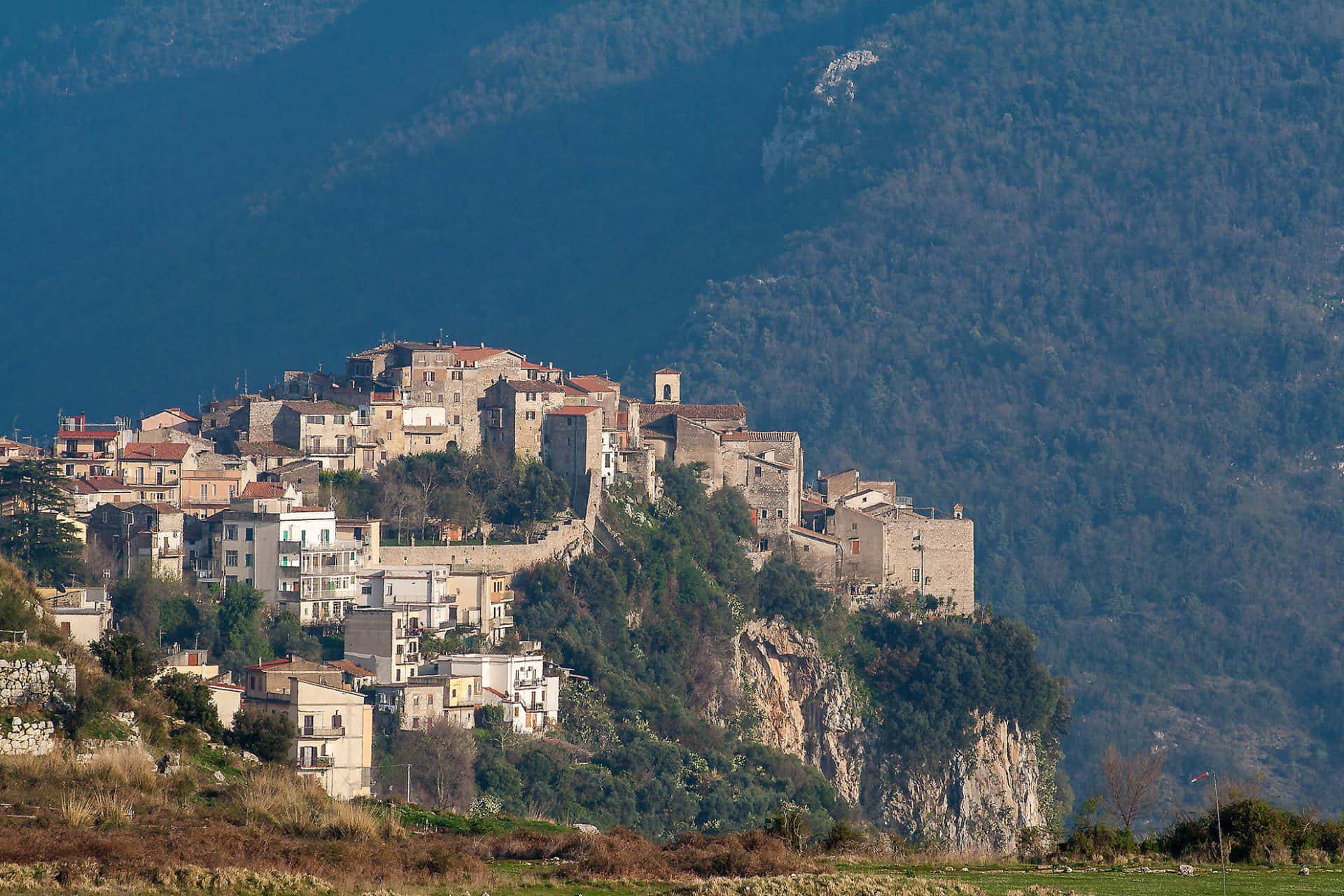
The nickname is not an advertising invention. Norma occupies the very edge of the mountain, a spur of limestone that drops with a vertical wall, the Rave, onto the Pontine Plain. Anyone leaning out from the town's viewpoint has in front of them a flat expanse that reaches the sea: on clear days the eye runs from Nettuno to Terracina, with the Circeo promontory closing the gulf and, farther off, the outline of the Pontine islands. Under the cliff, a few hundred meters as the crow flies, is the dark green of the Garden of Ninfa and its medieval ruins. Beyond, on the hill opposite, Sermoneta with its castle. The word grandstand, in this sense, is exact: you watch the plain as from the box of honor of a theater.
The altitude is modest, a little over 400 meters, but the drop to the plain is almost all concentrated in the leap of the Rave, and that is what makes the panorama so violent. The rock is the same one the Roman colonists of the 4th century BC cut to build the polygonal walls of ancient Norba, one kilometer farther up from the modern town. Norma, in name and in stone, is the daughter of that city: when Norba was destroyed in 81 BC and never rebuilt, the population scattered between Ninfa and the countryside, and only in the Middle Ages, around the year 1000, did a new settlement take shape around a castle on the edge of the cliff. The ancient name held on, with the b turned into an m.
The municipal territory descends from the mountain to the plain and includes the localities of Ospedaletto and Contrada Carella. The economy, historically, is that of a town of shepherds and olive growers: oil remains the reference product, and in 2015 the active businesses in town were a little over 160. A small number, which says how much life in Norma still depends on the land and, for some decades, on the tourism that comes up for the ruins, for free flight and for chocolate.
How to get to Norma (LT) from Rome
By car to Norma (LT)
The most direct road is the Pontina. You leave the Raccordo, follow the SR148 toward Latina and, just before the provincial capital, take the Appia SS7 toward Latina Scalo. From here the signs for Norma and Bassiano lead in about 20 minutes to the hairpin bends that climb to the town. It is the route I recommend to those who want to stop at Ninfa before or after, because the Garden lies right along the climb. Those arriving from the Frosinone side or the Casilina instead leave the A1 at Valmontone and cross Cori: it is the most beautiful road, all hills and olive groves, and it lets you add to Cori a stop at the Temple of Hercules. In both cases the travel time from Rome is a good hour and a half, longer on summer weekends when the Pontina clogs toward the sea.
By train and bus to Norma (LT)
The regional train from Roma Termini stops at Latina Scalo, the station of the lower city, in about 40 minutes, with frequent runs throughout the day. From Latina Scalo to Norma you continue with the Cotral bus line, which however runs on weekday schedules and with sparse frequencies: anyone arriving on Sunday has to arrange a taxi from the station or a ride. The free-flight associations that operate on the Rave offer their students a pickup service at the station. For the ordinary visitor the honest solution remains the car, and I say it with regret, because Norma would deserve a connection worthy of its panorama.
Where to leave the car and how much time to allow in Norma (LT)
The historic center is small and largely pedestrian in its inner lanes. You park at the edges of the town and continue on foot. For the Archaeological Park there is a dedicated parking lot in the Civita locality, in front of Porta Maggiore, which also serves as a meeting point for paraglider pilots. A complete visit, village plus park plus museum, takes a full half day. With the Garden of Ninfa and Sermoneta you can easily fill a whole day, and my advice is not to squeeze the time: the Norba park is walked on stones and grass, and anyone who rushes sees nothing.
What to see in Norma (LT): the itinerary in the village
The medieval town is compact, defended by nature on three sides and, originally, accessible through only two gates: Porta Maggiore and the Porticina. The layout we see today is in large part the one imprinted by the Caetani around 1530, when the family, which held Norma as a fief together with Sermoneta and the nearby lands, rebuilt and enlarged the settlement beyond the perimeter of the old castle. The inner streets are narrow, with staircases, arches and covered passages that follow the slope of the cliff.
The gates and urban structure of Norma (LT)
Porta Maggiore, for the modern town, is the entrance through which the valley road enters the settlement. The Porticina is the minor access. The fact that a hill village had only two openings says everything about its defensive nature: the Rave on one side, the mountain on the other, and in between a settlement that didn't need great walls because it already had them under its feet. In the 19th century the town left this enclosure: the Corso, with its row houses and regular facades, is a work of the end of the century, and the modern fabric starts from there.
The Palazzo Baronale of Norma (LT)
The Palazzo Baronale is the feudal residence, the building that in the sequence of the lords of Norma marked the passage from the medieval castle to the representative dwelling. The Caetani held it until the 17th century, when the fief passed to the Borghese, who kept it until the unification of Italy. Don't expect a palace: it is a town palace, sober, which is worth above all for its position and its relationship with the streets around it. Next to it, Palazzo Felici is the other historic residence of the center.
The Collegiate Church of the Santissima Annunziata in Norma (LT)
The town's main church dates to the age of Boniface VIII, the Caetani pope who between the end of the 13th century and the early 14th century secured for the family dominion over Ninfa, Sermoneta and Norma. The building was enlarged in 1533, in the same years in which the Caetani were redesigning the village, and it preserves works attributed to Lello da Velletri, a painter active in southern Lazio in the 15th century. The frescoes that decorate the interior today, on the other hand, are from 1945: a date that in Norma is not neutral, because the town came out of the war with the wounds of the front line and with hundreds of displaced people hosted by local families. The Collegiata is open during the hours of services. Outside those, it is not guaranteed to be accessible.
The Sanctuary of the Madonna del Rifugio in Norma (LT)
The chapel of the Madonna del Rifugio is the place of Norma's devotion, raised to a Marian sanctuary in 1967. The feast is celebrated on the first Saturday of September, with the procession that crosses the town. The title, Rifugio, meaning refuge, has its own eloquence for a village that for centuries offered shelter to those fleeing the malarial plain and, in 1944, to those escaping the bombings.
San Rocco and the Madonna del Carmine in Norma (LT)
The other two churches of the center complete the picture. San Rocco, the saint who protects against epidemics, is celebrated from August 15 to 23, in the days when the town fills with those who return for the holidays. The church of the Carmine was founded in 1781 and completed only in 1912, more than a century later: a slowness that tells of the finances of a mountain town and, at the same time, the tenacity of a community that doesn't give up finishing what it has begun.
The viewpoint over the Rave of Norma (LT)
The endpoint of the itinerary in the village is the lookout over the cliff. From here the Pontine Plain stretches out to the sea and the Garden of Ninfa appears as a dark patch, with the mirror of the little lake reflecting the afternoon light. It's the place where you understand the geography of the whole territory: the mountain, the land reclamation, the straight canals, the towns founded in the 1930s, the Circeo. Whoever is in a hurry should settle for this: it is already a lot.
Norma (LT)
The ancient Norba, the stone city above Norma (LT)
The real reason to come up to Norma is one kilometer from the town, in the Civita area: the Archaeological Park of the Ancient City of Norba, one of the best-preserved Roman cities of the Republican period in Italy in its plan and walls, and also one of the least tamed sites in Lazio. There is no fence, no ticket office, no walkways. You enter from Porta Maggiore and walk among the ruins on grass where sheep graze, with the feeling, authentic for once, of standing in front of an ancient city as 19th-century travelers saw it.
The history of Norba, from the Latin League to Sulla
Norba appears in the sources as a city of the Latin League. Dionysius of Halicarnassus lists it among the communities that, under the leadership of Octavius Mamilius, agreed against Rome to put Tarquinius Superbus back on the throne. After the Latin defeat at Lake Regillus, tradition says that in 492 BC Rome sent colonists to Norba to make it a stronghold in the Pontine territory, exposed to pressure from the Volsci. The excavations have shown, however, that the visible structures, walls included, belong to the 4th and 3rd centuries BC: 492 is the date of the colony, not of the stone city we see. In the area, moreover, there was an older settlement, from the 9th century BC, attested by the necropolis of Caracupa and the megalithic walls of Monte Carbolino.
Norba was loyal to Rome in the Latin wars and during the Second Punic War, when it served as an impregnable fortress and took in many Carthaginian soldiers as hostages, defending itself against the neighboring peoples of Priverno, Sezze and Fondi. Its moment of greatest prosperity falls between the 2nd and the early 1st century BC. Then came the civil war between Marius and Sulla: Norba sided with Marius, was besieged by Sulla's troops and fell in 81 BC through the betrayal that opened the gates at night to Aemilius Lepidus. Appian tells that the inhabitants, furious, chose not to surrender: some killed themselves, others killed each other, others hanged themselves, and the city was burned to the point that, the historian writes, no booty was taken from it. It is because of this fire that Norba has reached us with its plan so intact: nobody really rebuilt it, and Pliny the Elder, in the 1st century AD, already lists it among the vanished cities of Latium vetus. Some of the survivors went down to Ninfa. Other exiles, according to a tradition taken up by scholars, founded Norba Caesarina in Spain, today's Cáceres. A reduced settlement survived until the 2nd century AD, when malaria depopulated the area.
The linguist Giacomo Devoto interpreted the name Norba as "strong city". Right etymology or not, it is certainly an exact description.

The polygonal walls of ancient Norba
The circuit of walls is the masterpiece of the site. It runs for more than 2 kilometers, by the most cautious measurements around 2,300 meters and by others up to 2,500, and encloses a plateau of about 40 hectares, of which only 2 have been excavated. It is built in polygonal masonry with large blocks of local limestone, in some stretches 10 or 12 meters high, and with such tight, smooth joining that scholars distinguish three building phases in it: the oldest manner in the mid-4th century BC, the later manners between the end of the 4th and the middle of the 3rd. The Treccani Encyclopedia calls it one of the most interesting circuits in Lazio for the precision of the cutting and the arrangement of the gates. In the 19th century it was believed to be much older: Petit-Radel attributed it to the Pelasgians, Gerhard to the age of the Tarquins. The excavations of 1901 settled the question, dating the material to the 4th century BC.
In front of these blocks the question everyone asks is the same: how did they lift them? The answer is not in mystery but in organization: quarries a few meters away, inclined planes, levers, and a military colony that had every interest in shutting itself inside a wall that no Volscian army could climb. Norba is the proof that Roman engineering of the Republic, before concrete and the arch, already knew how to build big.
The four gates of ancient Norba
There are four main gates, all from the 4th century BC. Porta Maggiore, also called Porta Setina because it faces Sezze, is the current entrance to the park and the most monumental. A round tower flanks it so as to strike on the exposed side, the right one, anyone who tried to force it, following a principle that archaeologists recognize as derived from the Greeks. Porta Ninfina opens onto the precipice toward Ninfa. Porta Signina faces Segni. Porta Serrone di Bove, on the western side, makes use of a steep slope. The minor gates, the posterns, are many and served the daily traffic of a city that lived on farmland and grazing. The sources on the site also speak of a square tower of 15 meters along the circuit.
The greater acropolis and the temple of Diana
On the highest point of the plateau stands the greater acropolis, home of the public buildings and the garrison, ringed by terraces in polygonal masonry. Here the base of a temple with pronaos, cella and a pillared portico on three sides is preserved. The finds recovered have made it possible to attribute it to Diana. From this platform the view takes in the whole plain, and it doesn't take much imagination to understand why the Romans chose this very balcony to watch over the road between Lazio and Campania.
The lesser acropolis and the oldest temples
The lesser acropolis is the oldest part of the city. It hosted two rectangular temples of uncertain dedication, which in the early Middle Ages were turned into Christian churches, reusing the ancient structures. It is here that the 1901 excavations found the most archaic materials of the site, from the 5th century BC: a fragment with Iuno Sospita and two votive heads. They are the only traces of a phase before the stone city, and they remain the strongest argument for those who maintain that the colony of 492 was not an invention of the annalists.
The baths of ancient Norba
Just downhill from the greater acropolis, at the center of the settlement, a bath complex in opus caementicium is preserved, datable between the end of the 2nd and the early 1st century BC, with calidarium, tepidarium, frigidarium, apodyterium and laconicum. It is, together with the walls and Porta Maggiore, the best-preserved structure in the park, and one of the oldest public baths in Lazio. It was built a few decades before the destruction, and so used for a single generation. Looking at it you understand that Norba, on the eve of the civil war, was a rich city, up to date on the models of Rome and with public money to spend.
The forum and the decumanus of ancient Norba
The forum occupies a rectangular area of about 125 by 63 meters, set on terraces that overlook the settlement, supported by walls in polygonal masonry. A large road axis, the decumanus, crossed the whole city, paved with limestone basoli and flanked by sidewalks. Under the roadway ran sewers, still working in some stretches. The parallel and orthogonal streets divide irregular blocks, adapted to the slope. Norba is one of the best Italian examples of regular-plan urban design from so early an age, and the terraced layout gave it, and still gives it, a scenic look.

The domus of ancient Norba: the burnt seeds and the caduceus
The excavated residential districts show atrium houses with an impluvium for collecting rainwater, a cistern underneath, cubicula, triclinium and tablinum: the model of the Republican Roman house, in a provincial version but not a poor one. Two domus have a name. The House of the Burnt Seeds preserves in its layers the carbonized seeds of the fire of 81 BC: the material proof, tiny and moving, of Appian's account. The House of the Caduceus owes its name to the motif of the winged staff drawn in the floor of terracotta and colored limestone. The same symbol appears on coins linked to the name of the Norbani. Archaeologists also describe the house of the large impluvium, the house of the small altars, the house with columns and the house of the dolphins, with mosaic floors. Walking from one house to another on the original paving is the best experience in the park.
The sanctuary of Juno Lucina
In the southern area of the city stands the sanctuary of Juno Lucina, the goddess who protects women in childbirth. The temple, datable between the end of the 4th and the early 3rd century BC, had a pronaos, cella, access stairway and large fluted columns with capitals. Around it opened a porticoed square and ancillary structures. The attribution is documented by dedications on metal sheets found in the excavation, not by conjecture: it is one of the happy cases in which the name of the deity is written on the offerings.
Water, cisterns and terraces of ancient Norba
Norba had no aqueduct. It lived on rainwater collected in many wells and cisterns, dug under the houses and in the squares. It's a detail that explains a lot: a city perched on a limestone cliff, without springs at that elevation, survives only if every roof becomes a collector. This too entered into the choice not to rebuild it after 81 BC: the Treccani Encyclopedia recalls that the site, hard to reach and with rocky terrain, was abandoned in the imperial age because the Augustan peace had made so uncomfortable a fortress useless.
The excavations of ancient Norba, from 1901 to today
The excavations began in 1901 under the direction of Luigi Pigorini, with Luigi Savignoni and Raniero Mengarelli, and were decisive for the chronology of the walls. Recent work, led by Stefania Quilici Gigli, has reconstructed the shape of the city through topographical studies and identified the main public and residential complexes. The finds are divided between the Museo Nazionale Romano and the Museo Civico of Norma: sacred stones, weapons, inscriptions on bronze sheets, votive deposits, statuettes, fragments of masks, simas and antefixes. The park is now looked after by the municipality with the association Amici dell'Antica Norba.
How to visit the Archaeological Park of Norba
Entry is free and with no set hours. The guide service is paid, €5 full price and €3 reduced, free under 10, and for groups of 10 people or more booking 48 hours ahead is required. For schools there are dedicated rates, €3 per student for the park alone and €4.50 for park and museum, with teachers and chaperones free. On summer weekends the municipality offers sunset visits. They are the best of the year, and it's worth finding out ahead of time. You need closed shoes, water and a hat. There is no shade, the ground is stone and grass, and the sheep have the right of way. The verdict is clear: Norba is worth more than many paid sites in the province, and its being free should not fool anyone about the quality.
The Virtual Civic Archaeological Museum of Norma (LT)
The Museo Civico Archeologico "A. G. Saggi" occupies the restored rooms of the old town hall on Via della Liberazione, in the historic center. It opened in October 1995 on the initiative of the Lazio Region and the municipality, with an idea that was pioneering at the time: telling the story of Norba with photographs, finds, casts, models and virtual reconstructions, to help the visitor imagine the city before climbing among the ruins.
The sections of the Museum of Norma (LT)
The route starts from the model of the urban layout, which shows the city founded in the 5th century BC and destroyed in 81. It continues with the section dedicated to the temples and places of worship, with the clay ex-votos from the votive deposits. It presents full-scale reconstructions of domestic rooms, kitchens and looms, which make life in a Norban domus concrete, and it illustrates the walls and the water collection systems. Video stations and films with three-dimensional virtual reconstructions accompany each section, with an animated voice narration designed for kids. In the basement an 18th-century oil storeroom is preserved, with its tanks: a surprise that links ancient Norba to the town of olive presses.
Hours and tickets of the Museum of Norma (LT)
Open Tuesday to Saturday, 9-14 and 15-18. Sunday by reservation. Monday closed. Full price €2.50, reduced €1.50, free under 10, for chaperones, group leaders and people with disabilities. Holders of the LazioYouth Card get the reduced rate Tuesday to Friday and on the first and third Saturday of the month. The museum warns that hours may change when staff accompany groups to the park: booking by email at cultura@comune.norma.lt.it avoids finding a closed door. The visit lasts a full hour and should be done before the park, not after, because the ruins read much better with the model fresh in your eyes.
The Antica Norba Chocolate Museum in Norma (LT)
Norma also has a sweet record: the first Chocolate Museum born in Italy, opened in 1995 inside the Antica Norba factory, at Via Capo dell'Acqua 20. Artisan chocolate came to the town in the 1980s, and in a few decades it has become an identity as much as the oil and the chestnuts. The museum tells the story of cocoa from the Maya to the modern bar, shows behind glass the machinery of the old factory, displays advertising prints, historic packaging, scales and period chocolate pots, and ends with a fountain and a chocolate tree that children remember more than the polygonal walls. The Chocolate School lets you watch the production phases and take part in the making. The tasting is included in the visit and the shop sells bars and spreads from the area. Hours change with the seasons and visits are generally by reservation: the contacts are 0773 259052 and 335 1618135. For those traveling with children it is the link that holds the day together: first the stone, then the cocoa.

Flying from Norma (LT): paragliding on the Rave
Norma is one of the Italian capitals of free flight. The takeoff is inside the archaeological area of Norba, just past the Porta Maggiore parking lot, on the edge of the cliff: you start a few meters from the walls of the 4th century BC, with the Pontine Plain under your feet and the Garden of Ninfa as the reference for landing. The windsocks show the conditions. On favorable days pilots land back up at altitude, otherwise in the Ninfa area. It's a show even for those who don't fly: on spring and fall weekends the sky above the Rave fills with colorful sails, and the town's viewpoint becomes an audience.
Tandem flying in Norma (LT)
On the Rave there are sports associations that organize courses, tandem flights with a pilot, gift vouchers and logistical assistance from Latina Scalo station. Prices and conditions must be asked of them directly, because they depend on the season and the type of flight. One more recommendation: free flight is an activity that needs the right weather and experienced pilots, and serious accidents have happened in Norma. Fly only with someone enrolled in a recognized school, never with improvisers.
Walking around Norma (LT): Monte Carbolino, Furchia Vecchia and Monte Mirteto
Norma is also a town of trails. The ridges above the town, Monte Carbolino and Monte Furchia Vecchia, preserve the remains of ancient settlements and stretches of megalithic walls that scholarly tradition called Cyclopean and that archaeologists link to the pre-Roman settlement of the area, the same as the Caracupa necropolis. They are half-day walks, with views alternating between the plain and the inner valleys of the Lepini toward Bassiano and Carpineto Romano.
Sant'Angelo in Monte Mirteto, the church in the cave
At the foot of the Rave, on the southwest side, stands the sanctuary that the town calls Sant'Angelo or Santa Maria di Monte Mirteto: a karst cave turned into a church in 1183, with medieval frescoes and a primitive altar, around which a monastery arose. It is the most intimate place in the Norma area, a rock hermitage reached on foot, which in the Middle Ages marked the border between the Norma of the Caetani and the Ninfa of the Frangipane. Access conditions vary. Before going up, ask in town or at the culture office.
The trails from Norma (LT) to Ninfa and Sermoneta
Mule tracks go down from the town to the plain, making it possible to link Norma, the Garden of Ninfa and, with more effort, Sermoneta on foot. The descent is steep and the climb back asks for trained legs. In the hot season it should be done early in the morning. If you prefer water to mountains, a little way off you'll find the spring area of Monticchio, with its pools and channels, and the Torre Petrara, a medieval outpost on the road between Ninfa and Sermoneta.
A curiosity about Norma (LT)
In Norma the legend of the hen with the golden chicks is handed down. In the tunnels under ancient Norba, they say, a treasure in the shape of a hen with her brood, all gold, is supposedly hidden. It would be easy to dismiss it as a village tale, and yet the story has a learned backbone. The theme of the hen with chicks belongs to the barbarian goldsmithing of the early Middle Ages: the Museo del Duomo of Monza holds a gilded silver plate with a hen and seven chicks, from the age of Queen Theodelinda. From this comparison came the hypothesis that a barbarian chief, probably Lombard, is buried at Norba with a precious grave set of that kind, and that popular memory preserved its echo, turning a real treasure into an enchanted one. Nobody has ever found the hen. But whoever walks between the two temples of the lesser acropolis, turned into churches precisely in the early Middle Ages, walks in the century in which that legend could have been born. This is the kind of curiosity worth telling kids in Norma: a fairy tale with an archaeological hypothesis inside.
A second curiosity, more distant: Cáceres, in Extremadura, was called Norba Caesarina, and a tradition taken up by scholars holds that the name comes from the Norban exiles who ended up in Spain after the destruction of 81 BC. The little town of the Lepini would thus have a daughter, now a World Heritage site, on the other side of the Mediterranean.
Something nobody tells you about Norma (LT)
The Archaeological Park of Norba is always open and free, and many people know that. What few say is that for this very reason the visit is organized the opposite way from elsewhere. There is no gate pushing you in at nine and out at seven, no panel every 10 meters, no mandatory route. The concrete risk is to enter from Porta Maggiore, walk 50 meters, see meadows and blocks of stone and turn back convinced you've seen everything. To avoid it you need to know three things. The first: the baths, the forum and the domus are in the central, upper part of the plateau, and you get there following the paved decumanus, not the sheep paths. The second: the museum in town, with the model, is the map the park lacks, and for €2.50 it's the best investment of the day. The third: the museum staff are the same ones who accompany you to the park, which is why the municipal site warns that hours may vary and that on Sunday it opens only by reservation. Whoever writes an email on Thursday for Sunday finds museum and guide. Whoever shows up without warning finds, at best, the park empty and the museum closed.
There is another detail you rarely read about: the House of the Burnt Seeds. In that domus the excavations found the carbonized seeds from the fire with which the Norbani destroyed their own city rather than hand it to Sulla. It isn't a spectacular find, there's no gilded display case. It's an excavation datum. But it's the closest thing to an eyewitness that we have of that night of 81 BC, and knowing those seeds exist changes how you look at everything else.
The advice I give you for visiting Norma (LT)
There is one piece of advice and it concerns the order of things. Norma should be visited on a day built around the Garden of Ninfa, which opens only on dates set by the Roffredo Caetani Foundation, almost always on weekends from spring to fall, with guided visits by mandatory reservation and a ticket that the official site lists at €15.75. First you book Ninfa, weeks ahead in rose season, and then you fit Norma around it: museum in the morning, Norba park midday, lunch in town with ramiccia, the egg pasta rolled by hand, and in the afternoon the descent to Ninfa, which from the cliff is reached in a quarter of an hour by car. Whoever does the reverse, Ninfa in the morning and Norba on a summer afternoon, ends up walking on limestone at three with 35 degrees and not a tree. It happens often.
If Ninfa is closed on the chosen day, it's not a tragedy. Replace it with Sermoneta and the Caetani castle, which has continuous hours, or with Sezze and its museum. In any case you go up to Norma in walking shoes, not sandals. You bring water, because there is none at the park. You check the weather, because on the Rave the wind that makes paraglider pilots happy makes visiting the ruins tiring. And you leave an hour, at the end, for the viewpoint at sunset, when the plain turns pink and the lights of Latina come on: it's the moment the grandstand was built for.
Another well-known fact, yet rarely cited
Everybody knows that the walls of Norba are "Cyclopean", and the word appears in every description of the site. What is rarely mentioned is that throughout the 19th century scholars quarreled over who had built them, and that the answer came only with the dig. Louis Petit-Radel, at the beginning of the 19th century, saw in the polygonal walls of Lazio the work of the Pelasgians, a pre-Hellenic people who came from Greece in a fabled age. Eduard Gerhard, more cautious, assigned them to the age of the Tarquins, that is, the 6th century BC. Both started from the same idea: that a technique so archaic in appearance had to be very ancient. The 1901 excavations of Savignoni and Mengarelli, under Pigorini, found 4th-century BC materials in the circuit and closed the debate: the walls of Norba are Roman, of the Republican period, and their perfection is not the sign of a mythical age but of a mature technique, which the Romans had learned and brought to a higher level.
Why is it a fact worth repeating? Because it takes apart a stubborn prejudice: that the beauty of polygonal work is "mysterious". It isn't. It is the product of military organization and quarries within reach, in a colony that was afraid of the Volsci. The three building manners that can be told apart along the circuit tell of a building site that lasted decades, with different crews and evolving techniques. Whoever looks at the walls of Norba with this in mind sees them better: not an enigma, but a job of work. And a job far more impressive than any Pelasgian legend.
The right photo to take in Norma (LT)
The photo everyone takes is the panoramic view from the town viewpoint toward the plain and the sea, and it should be taken, but at the right hour: late afternoon, with the sun behind you lighting Ninfa and the Circeo, or early on an autumn morning, when fog covers the Pontine Plain and Norma floats above a white sea with the peaks of the Lepini sticking up around it. It's the image that justifies the nickname.
The photo I recommend, though, is another one: Porta Maggiore seen from inside the park, with the round tower in the foreground and the polygonal blocks fitting together without mortar, and in the background, beyond the gap, the plain. You need a wide-angle lens and a moment when low sun, early in the morning or toward evening, draws the shadows between the blocks. At noon the stone flattens and the wall looks like a pile of rocks. If there are sheep, better: they give the scale and give the scene back as 19th-century travelers saw it.
Third option, for those with patience: the sails of the paragliders taking off from the Rave, photographed from the town viewpoint with the Garden of Ninfa in the background. A medium telephoto lens, a spring weekend with a west wind, and the photo tells in a single shot the three souls of Norma: the cliff, the ruins, the flight.

Some important events that happened here in history
81 BC: the night Norba destroyed itself
The event that marks the whole history of the place is the end of Norba. During the civil war the city had chosen Marius. When Sulla prevailed, his troops besieged it. It was a betrayal that opened the gates at night to Aemilius Lepidus. Appian tells that the inhabitants, instead of surrendering, killed themselves, some with their own hands, some killing each other, some hanging themselves, and that they set fire to the city so that nothing would be left to the victor. The sources waver between 82 and 81 BC, and some bring it forward to 79. The most accepted date is 81. The House of the Burnt Seeds preserves the traces of that fire. Sulla rebuilt something, but the city never recovered, and in the imperial age it was left to the mountain.
The 8th century: Norma and Ninfa given to the pope
The first medieval mention of Norma is an imperial donation. In the early years of the pontificate of Zachary, elected in 741, the Byzantine emperor Constantine V ceded to the pope the holdings of Ninfa and Norma, according to the Liber Pontificalis. The proposed dates range between 741 and 743. From that moment the territory entered the sphere of the Church and remained there, under different lords, until the unification of Italy.
The centuries of the feudal lords: Tusculum, Frangipane, Caetani
In the Middle Ages Norma was a fief of the counts of Tusculum, then of the Frangipane, who also held Ninfa. At Ninfa, in 1159, Pope Alexander III was crowned, and in 1171 Frederick Barbarossa put to fire and sword the town that had given refuge to the pontiff. Local memory extends the devastation to Norma, attributing it to the town's loyalty to Alexander III. At the end of the 13th century the family of Boniface VIII, the Caetani, acquired Ninfa in 1297 and with it Sermoneta and Norma. The fief stayed Caetani for four centuries, from the 13th to the 17th, and it is in this era that the Collegiata dell'Annunziata was born. Around 1530 the Caetani rebuilt and enlarged the village, giving it the plan we see, and in 1533 they enlarged the church.
The 16th century of wars and brigands
The 16th century was hard for all the towns of the Lepini. Norma's historical memory recalls a military occupation in 1557, in the years of the war between Pope Paul IV and Spain that devastated southern Lazio, from which Norma came out without destruction. And it recalls, in 1592, the passage of the bands of Marco Sciarra, the Abruzzese brigand who in those years terrorized the Papal States and the Kingdom of Naples, with plundering and violence against the population. These are facts handed down by local chronicles more than documented by archive sources that can be consulted, and as such they should be taken. But the picture is consistent with what we know of the era. To those decades also belongs the memory of Lepanto, the 1571 battle that the Caetani villages still celebrate with an autumn reenactment.
From the Borghese to united Italy, to the evacuees of 1944
In the 17th century the fief passed from the Caetani to the Borghese, who held it until unification. Norma was then a town of shepherds and farmers: 2,282 inhabitants in 1871, 3,348 in 1931. The Pontine land reclamation of the 1930s changed the plain below the cliff and the view from the viewpoint. The Second World War brought the front a few kilometers away, and the town took in evacuees by the 100s, an episode that the municipality remembers every year with a conference titled to the "great heart of Norma". In 1945 the Collegiata was frescoed. In 1995 the Virtual Archaeological Museum and the Chocolate Museum opened in the same year: today's Norma begins there.
Who has passed through Norma (LT)
Aemilius Lepidus, Sulla's lieutenant, is the first name that history ties to the place, and not in a flattering way: it was he who, in 81 BC, entered Norba at night through betrayal and found a city that preferred to die. Boniface VIII, the Caetani pope, perhaps never visited the village, but it was with him that Norma became land of the family and that the Collegiata took shape. The Caetani passed through for four centuries, as lords. Lello da Velletri, a painter of 15th-century Lazio, left works in the church of the Annunziata.
In the 19th century came the scholars and travelers. Louis Petit-Radel climbed to Norba to measure the walls he believed Pelasgic. Ferdinand Gregorovius, the German historian of medieval Rome, explored Ninfa at the foot of the cliff in the middle of the century and wrote famous pages about it, comparing it to a Pompeii prettier than the original. Whoever reads those pages with the Rave at their back understands where he was looking from. In 1901 the archaeologists Luigi Savignoni and Raniero Mengarelli climbed up, sent by Luigi Pigorini, and with their trenches changed the chronology of the walls. Well into the 20th century it was Stefania Quilici Gigli who put the city's topography back in order. Under the cliff, from 1921, Gelasio Caetani began planting the garden of Ninfa that is today the most booked destination in the province. And for some decades now the paraglider pilots of half of Europe have been coming through here, every windy weekend, taking off among the walls of the 4th century BC: an audience the ancient Norbani could not have imagined, but that has chosen their cliff for the same reason they chose it.
Traditions and festivals of Norma (LT)
Norma's calendar is packed. On January 17 Sant'Antonio Abate is celebrated, with the blessing of bread and animals. On Good Friday the procession of the Dead Christ goes out. For Corpus Domini the streets are covered with flower carpets. Summer brings the Norbanus Festival of international folklore in the last week of July, the Palio dei Comuni in the first days of August, the feast of San Rocco from August 15 to 23 and the Norbensis Festival in the last week of the month. The first Saturday of September is dedicated to the Madonna del Rifugio. In October, on the last weekend, the Sagra delle Castagne fills the town with braziers and mulled wine. On December 4 Santa Barbara, the patron saint, is celebrated, with a festival that is the last big date of the year. The exact dates of each edition should be confirmed on the municipality's channels, because some events move by a few days.
The typical products of Norma (LT)
Extra virgin olive oil, shepherds' ricotta, chestnuts from the woods above the town, ramiccia, that is the egg pasta cut thin by hand, and artisan chocolate: these are the five products that tell Norma at the table. The oil is that of the Lepini, green and bitter, and the 18th-century storeroom in the basement of the archaeological museum recalls how much it already counted in the 1700s. The ricotta comes from the flocks you will see at the park. The end-of-October festival is the best excuse to taste everything together.
Norma (LT) with children and accessibility
For children Norma is a successful day: the virtual museum is designed for them, with films and reconstructions. The park is an open space to run among the sheep and climb on the walls. The Chocolate Museum ends in glory. The only caution is the cliff: the viewpoint is protected, but the paths on the edge of the Rave and some areas of the park have no parapets, and the youngest should be held by the hand.
For those with mobility difficulties the story is less simple. The village is made of stairways and sloping alleys. The archaeological park is a plateau of grass and stone with no equipped paths, and with a wheelchair you can get as far as Porta Maggiore and a little beyond, not to the baths or the domus. The museum is in a historic building and it's worth asking ahead about access conditions. Entry to the museum and to the guided visits is free for people with disabilities.
When to go to Norma (LT)
The best months are April, May, September and October: the right temperature for the park, clear air for the panoramic view, Ninfa open on weekends and, in the fall, the chestnut festival. Summer is nice only early in the morning and in the evening, for the sunset visits. At noon the limestone of Norba is an oven. Winter gives the fogs on the plain and the clearest days of the year from the viewpoint, but with the museum closed on Monday and Ninfa closed until spring. Avoid days of strong wind: on the cliff it's unpleasant and at the park there is no shelter. The perfect moment, for me, is a Saturday at the end of April: roses at Ninfa, paragliders over the Rave, tall grass among the domus.
What to see around Norma (LT)
The short radius is Caetani: the Garden of Ninfa under the cliff, Sermoneta with the castle and the Valvisciolo abbey, the spring area of Monticchio and the Torre Petrara. To the north are Cori with its temples and the city museum, Lake Giulianello, Artena, Montelanico and Segni with its polygonal walls twin to those of Norba. To the south and toward the interior of the Lepini are Sezze, Bassiano, Carpineto Romano, Priverno with the Archaeological Park of Privernum and the city museums. On the plain, the Museum of the Pontine Land in Latina explains the land reclamation you see from the viewpoint. Those who extend toward Ciociaria find Anagni, the city of Boniface VIII, Alatri with its polygonal acropolis, Guarcino and Fiuggi.
Quick questions about Norma (LT)
How much does it cost to visit Norma (LT)?
The village and the Archaeological Park of Norba are free. The Museo Civico Archeologico costs €2.50 full price and €1.50 reduced. The guided visit to the park is €5 full price and €3 reduced, free under 10.
How far is Norma (LT) from Rome?
About 80 kilometers, an hour and a half by car on the Pontina or on the A1 with the exit at Valmontone. By train, 40 minutes to Latina Scalo and then a Cotral bus or taxi.
Does the Archaeological Park of Norba have hours?
No. It is always accessible and free to enter. The guided visits and summer evening openings follow a calendar that the municipality's culture office communicates from time to time.
Do I need to book to visit Norma (LT)?
For the village and the park, no. For the guided visit of groups of 10 people, yes, 48 hours ahead. For the museum on Sunday, yes, always. For the Garden of Ninfa booking is mandatory and must be made well in advance.
How long does the visit to Norma (LT) take?
An hour for the village, an hour for the museum, from an hour and a half to 2 hours for the Norba park. With Ninfa and Sermoneta you fill a whole day.
How long are the walls of ancient Norba?
More than 2 kilometers: estimates range from about 2,300 to 2,500 meters, and they enclose a plateau of about 40 hectares, of which only 2 are excavated.
Why was ancient Norba destroyed?
Because in the civil war it had chosen Marius. In 81 BC Sulla's troops, led by Aemilius Lepidus, entered through betrayal and the inhabitants preferred to kill themselves and burn the city rather than surrender.
Can you take photographs in Norma (LT) and in the park?
Yes, freely, in the village and in the park. In the museum it's best to ask the staff.
Is Norma (LT) suitable for children?
Very: virtual museum with films, outdoor park with sheep, Chocolate Museum with fountain and chocolate tree. Just watch the edges of the cliff.
Is Norma (LT) wheelchair accessible?
Only in part. The village has stairways, the park is on grass and stone with no equipped paths. You can get to Porta Maggiore and the village viewpoint. For the museum it's best to call first.
Where do you paraglide in Norma (LT)?
Takeoff is on the edge of the Rave, inside the archaeological area of Norba, near the Porta Maggiore parking lot. Landing is in the Garden of Ninfa area or, in favorable conditions, up at altitude. Fly only with recognized schools.
What's the difference between Norma and Norba?
Norba is the Roman city of the 4th century BC, destroyed in 81 BC and never rebuilt, today an archaeological park. Norma is the medieval town born around the year 1000 a kilometer farther down, which inherited its name.
What can you see from the viewpoint of Norma (LT)?
The whole Pontine Plain to the sea, from Nettuno to Terracina, with the Circeo, the Pontine Islands on clear days, and under the cliff the Garden of Ninfa and Sermoneta.
Is the Chocolate Museum of Norma (LT) open every day?
Hours vary with the season and visits are generally by reservation: it's best to call 0773 259052 before leaving. The address is Via Capo dell'Acqua 20.
When is the chestnut festival in Norma (LT)?
On the last weekend of October. The exact dates of each edition are on the municipality's channels.
Who is the patron saint of Norma (LT)?
Saint Barbara, celebrated on December 4. The first Saturday of September is for the Madonna del Rifugio, from August 15 to 23 San Rocco.
Can you walk from Norma (LT) to the Garden of Ninfa?
Yes, by the mule tracks that go down from the cliff, but the descent is steep and the return tiring. The visit to the Garden requires booking anyway. By car it's a few minutes.
What do you eat in Norma (LT)?
Ramiccia, the egg pasta cut by hand, ricotta, oil from the Lepini, chestnuts in the fall and artisan chocolate from Antica Norba.
Are there flocks in the Archaeological Park of Norba?
Yes, the park is not fenced and the sheep graze among the ruins. They are part of the landscape and don't bother anyone. The sheepdogs should be respected from a distance.
What is the best time to visit Norma (LT)?
Spring and fall: April and May for the roses of Ninfa and paragliding, October for the chestnuts and the light. In summer only in the morning or at sunset.
Is the Civic Museum of Norma (LT) free on the first Sunday of the month?
No, it's not a state museum: on Sunday it opens only by reservation with the regular ticket. Free are children under 10, chaperones and people with disabilities.
Can you see the sea from Norma (LT)?
Yes, on clear days: the coast from Nettuno to Terracina and, beyond the Circeo, the Pontine Islands.
Among the Lepini, Norma is the town that surprises most the people who arrive with preconceptions. Everyone comes for Ninfa and stays for Norba: for that plateau without gates where a Roman city let itself burn rather than yield, and where today you walk among its houses with sheep all around. The final advice is not to skimp on time on the cliff: book Ninfa, of course, but give Norma the whole morning and the sunset. You go home with the feeling, rare in Lazio, of having seen something that hasn't yet been put in the shop window.
Article written by the editorial team of TourLeaderPro, contact them for Private/Corporate/V.I.P. Tours and Experiences.
Planning a trip to Rome? The English-language guides to visiting the city are on ItalyPlanner.com.