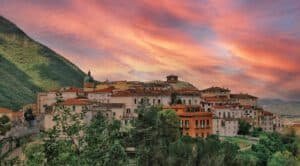
Sezze (LT)
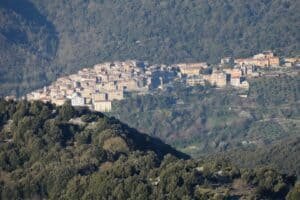
In short. Sezze is in the province of Latina, on a spur of the Lepini Mountains that overlooks the Pontine Plain, about 90 kilometers from Rome and about 20 from the provincial capital.

Sezze is in the province of Latina, on a spur of the Lepini Mountains that overlooks the Pontine Plain, about 90 kilometers from Rome and about 20 from the provincial capital. The town has two souls separated by a drop of a few hundred meters: the historic center up high, perched on ancient Setia, and Sezze Scalo on the plain, where the Sezze Romano railway station on the Rome-Formia-Naples line is, served by the regional trains that leave from Roma Termini. From the station to the village you go up by city bus or by COTRAL intercity runs, or by taxi. Without a car you should budget for this, because the historic center isn't within walking distance of the railway. By car you take the Pontina (SS148) to Latina and then regional road 156 of the Lepini Mountains with the provincial roads to Sezze, or you exit the A1 at Frosinone and cross the valley. The village can be visited free, all year, at any hour. The town's two museums, however, have hours and tickets: the Archaeological Museum (the municipal Antiquarium) is at Largo Bruno Buozzi 1, telephone 0773 804584 extension 5, and the Lepini Mountains museum system lists opening Tuesday to Saturday from 9:00 to 13:00 and from 15:00 to 18:00, Sunday morning only, closed Monday, with a full ticket of €2.50 and reduced €1.50. The Ludus Toy Museum is at Via Umberto I 46/48 and answers at the same number. Before leaving it's worth a phone call, because the small municipal museums of the Lepini open with reduced staff. The Municipality of Sezze has its seat at Via Armando Diaz 1 (switchboard 0773 804584) and publishes on its official website the dates of the Artichoke Festival and the feasts. Those who want to place the town in its chain of villages find the overall picture on the Lepini Mountains page.

Where Sezze is and why it's worth climbing up
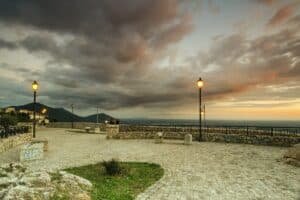
The position explains almost everything about Sezze. The town occupies a hill of the southern Lepini that descends steeply toward the plain, and is separated from the heights of Sermoneta by a small valley traversed by the Brivolco stream. From that balcony, on clear days, the gaze runs over the Agro Pontino to the sea and the Circeo promontory, with the Pontine islands on the horizon. It's the same view that struck Goethe in February 1787, when from the top of the mountain of Sezze he saw a downpour discharge on the marshes while the sun lit the columns of smoke from the scattered huts. Today's visitor has before their eyes a more orderly landscape, that of the 20th-century reclamation, but the feeling of being suspended between mountain and sea has remained identical.
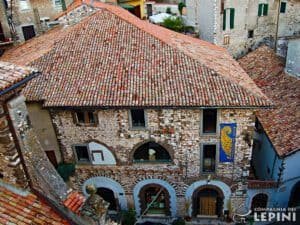
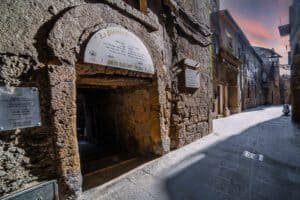
Sezze is a big town, with more than 23,000 inhabitants, and this distinguishes it from the tiny villages of the Lepini like Bassiano or Norma. Don't expect a nativity scene restored for tourists: here the historic center is lived-in, noisy, alive, with shops downstairs and stairs leading to the alleys. It's its strength and, for those seeking the perfect postcard, its limit. In our judgment it's better this way. A village that lives has smells of cooking, laundry hung out and old men sitting in front of doors, and tells much more than a stage set.
The two Sezzes: the hill and the Scalo
The municipal territory stretches from the mountains to the plain and is crossed by the Ufente River. Up high, the medieval core developed wrapping around the ancient Latin arx, the fortified summit that documents call castrum durum. Down below, around the station, grew Sezze Scalo, the modern district born with the railway and the reclamation. The plain below Sezze was the theater of the first attempts to drain the Pontine Marshes, long before the intervention of the 1930s, and the station still carries the adjective "Romano" because at the start of the 1900s it served to distinguish it from a homonymous Piedmontese station, when Sezze belonged to the province of Rome. The move to the province of Littoria, later Latina, happened in 1934, but the name of the station never changed.
The karst territory of Sezze: caves, shelters and footprints
The limestone of the Lepini is riddled like a sponge. The territory of Sezze counts caves of prehistoric interest, some frequented by Neanderthal man tens of thousands of years ago, and rock shelters with traces of painting. The most famous is the Riparo Roberto, a cavity about 30 meters long and five deep, on whose walls are preserved schematic figures drawn in charcoal in prehistoric times, interpreted as hunting scenes. From the Grotta Vittorio Vecchi come the Bronze Age grave goods displayed at the Archaeological Museum, from the Iolanda cave stone tools about 12,000 years old. And then there's the surprise no one expects from a medieval village: the dinosaur footprints, which I'll discuss further on, that made a former quarry of Sezze a natural monument of the Lazio Region.
The history of Sezze, from ancient Setia to the 1900s
Few centers of southern Lazio have such a long biography so well documented by ancient sources. It's best to retrace it in order, because almost every stone of the town points back to one of these chapters.
Hercules, the lion and the name of Sezze
According to legend the founder of Sezze was Hercules himself. Having defeated the Laestrygonians, the people of giants that tradition placed in southern Lazio, the hero supposedly joined with a local maiden, begetting Faustus, a minor figure recalled in the apocryphal poetry of the epic cycle. It's a tradition, not a historical fact, but the town took it seriously to the point of putting it in the coat of arms: a lion, the Nemean one whose skin Hercules wore, holding a cornucopia full of fruit, surrounded by the motto SETIA PLENA BONIS GERIT ALBI SIGNA LEONIS, a Leonine hexameter meaning "Sezze, full of good things, bears the emblem of the white lion." The same popular etymology links the ancient name, Setia, to saeta, the bristle, in reference to the lion's hair. Modern scholars are more cautious about the origin of the place name, but the white lion remains on flags, on portals and on the posters of the festival.
Setia, a Latin colony: the walls of the 4th century BC
The documented history begins around 382 BC, when Rome founded at Setia a Latin colony planted in the heart of Volscian territory, with the function of a garrison against those peoples. The polygonal walls that still ring the upper part of the town date to this phase: large blocks of local limestone, on average 80 by 100 centimeters, laid in the polygonal technique in the so-called third manner, the same seen at Norba and Cori, with stretches of the fourth manner and of ashlar work. The colony wasn't docile. In 341 BC one of the two praetors at the head of the army of the Latin League was Lucius Annius of Setia, and in 340 BC the city took part in the Latin revolt that ended with the battle of Trifanum and the defeat of the League. In 209 BC, in the midst of the Hannibalic war, Setia was among the 12 Latin colonies that declared themselves unable to supply further troops to Rome. In 198 BC, with the war over, it was the theater of a revolt of Carthaginian prisoners and slaves, probably also of those employed in the vineyards. In 82 BC, during the civil war, the city was taken by Sulla.
Augustus's wine and the poet Valerius Flaccus
With the season of wars past, Setia became an agricultural center surrounded by villas and famous throughout the empire for one thing only: wine. The Setinum, produced on the hills facing the plain, is cited by Strabo among the most celebrated wines of Lazio, by Martial and Juvenal as a luxury wine to serve with snow, and above all by Pliny the Elder, who in the Naturalis Historia places it at the top of the Italic ranking, recalling that it was the favorite wine of Augustus and of several of his successors, and that beneficial properties were attributed to it. Cicero names it. A metal label found at Moruzzo, in Friuli, with the inscription Vitis Setina and a consular dating of AD 106 suggests that the vines of Sezze were transplanted also very far away. Today's wine has nothing to do with the ancient one, but the fame remains a good argument for those who want to understand why a mountain town was so rich.
Gaius Valerius Flaccus, the 1st-century AD poet author of the Argonautica, an unfinished epic poem on Jason's expedition, is believed to have been born at Setia. The attribution rests on some manuscripts that add to the poet's name the epithet Setinus Balbus. Martial cites among his friends a Flaccus, whom however he calls Paduan: in all likelihood they are two different people. Sezze has in any case named a street in the center after the poet, Via Flacco, where the church of San Lorenzo and the birthplace of San Carlo are.
Sezze in the Middle Ages: San Lidano, the popes, the Caetani
In the early Middle Ages Sezze survived thanks to its fortified position, and in 956 it organized itself as a free commune. The decisive figure of this age is Lidano of Antena (1026-1118), a Benedictine monk who around 1046 built the monastery of Santa Cecilia on the plain and began reclaiming the marshy lands around it: a saint hydraulic engineer, canonized after his death and chosen as patron of the city and the diocese. His feast falls on July 2 and the Municipality still celebrates it as Patron Saint of Sezze. In the Middle Ages the town lay along the Volscian piedmont road, the only communication route between the north and south of Lazio when the plain was marsh, and this guaranteed it a troubled life, made of armies passing and conflicts with neighboring communes: Carpineto, Bassiano, Priverno, Sermoneta. But it also brought it illustrious guests. Three popes stayed at Sezze: Gregory VII in 1073, Paschal II in 1116 and Lucius III, who remained there for about a year in 1182. In 1381 the city passed into the power of the Caetani, the lords of Sermoneta, who 12 years later were driven out by a popular revolt. The Annibaldi and Frangipane families had interests and residences there.
Sezze in the modern age: plague, academies and the French
The 1600s were a hard century. The plague of 1656, the same that devastated Rome and Naples, hit the population heavily, and to it were added the raids of Spaniards and Austrians in the wars of succession. Yet precisely in those years Sezze gave itself a cultural institution: between 1641 and 1690 Accademia degli Addormentati was born, based at Palazzo Calabresi, which in 1744 transformed into Accademia degli Abbozzati, recognized as an Arcadian colony by Accademia dell'Arcadia of Rome, one of the oldest scientific-literary institutions in Lazio. It remained active until 1870. In 1798, during the Napoleonic occupation, the population drove out the French garrison. With the breach of Porta Pia and the taking of Rome, in 1870 Sezze entered the Kingdom of Italy.
Sezze in the 1900s: the Spanish flu, the gliders, the bombs
The Spanish flu epidemic of 1918 hit the town hard, and following that crisis the Colonia Agricola Pontina was established in the municipality. In the 1930s the plain of Sezze hosted a gliding field: in 1939 evaluation tests were held there for the gliders destined for the Tokyo Olympics of 1940, games that the war canceled. The war arrived for real in 1944. Sezze suffered several bombings that hit, among other things, the church of Santi Sebastiano e Rocco, razed to the ground and never rebuilt, and the church of Sant'Andrea: in the bombing that struck the latter, on May 21, 1944, 71 people died. After the front passed, Sezze too, like many Pontine and Ciociaria municipalities, suffered the violence of the French colonial troops known as the marocchinate. I speak of it precisely in the chapter on events.
What to see in Sezze: the visit to the historic center
The historic center of Sezze can be walked in half a day, but with calm it deserves a whole one. The route I recommend starts from the municipal square, goes up to the Cathedral, descends along Via Flacco toward San Lorenzo and the house of San Carlo, touches the Archaeological Museum and ends at the polygonal walls of Via del Guglietto and Porta Pascibella. Comfortable shoes: there are many stairs and the paving is unforgiving.
Piazza De Magistris and the Town Hall of Sezze
The civic living room of the town is Piazza De Magistris, where the palace of the same name stands, seat of the town hall. On the same square faces the church of San Pietro with the attached seminary, and from here the main streets of the center start. It's the meeting point of the Setini, the place of rallies and feasts, and worth a stop even just to observe the life of the town. Around it are arranged the other noble palaces that the old urban fabric preserves: Palazzo Calabresi, former seat of Accademia degli Addormentati, Palazzo de Ovis, Palazzo Iucci-Santoro, Palazzo Pontini, Palazzo Normisini and Palazzo Rappini, almost all private and visible only from the outside. The statue of San Carlo da Sezze, the Franciscan saint of whom the town is rightly proud, acts as a counterpoint to the square.
The church of San Pietro in Sezze and the Jesuits
The church of Santi Pietro e Paolo, which everyone calls San Pietro, is the building that best tells the Sezze of the Counter-Reformation. It was built starting in 1589 by the Jesuit fathers, with municipal funding of 70,000 scudi, under the supervision of Father Claudio Acquaviva, who shortly afterward would become Superior General of the Society of Jesus. The facade is in red brick framed by limestone slabs, with a pediment pierced by a circular opening and a restored clock. The interior is a single nave with four side chapels, following the Jesuit model of the Gesù in Rome, and is covered by a coffered wooden ceiling attributed to Brother da Pozzo. There are two statues of Faith and Hope of the Bernini school, frescoes by the Setino painter Giuseppe Turchi with Saints Cosmas and Damian, the Sacred Heart and Saint Michael the Archangel, and on the high altar a canvas of Saints Peter and Paul by Francesco Cozza, the Calabrian pupil of Domenichino who worked for a long time in Rome. The old account of the church spoke generically of canvases of the school of Baciccia: the documented altarpiece is Cozza's. If you have time for only one church besides the Cathedral, choose this one.
The Cathedral of Santa Maria in Sezze, reversed
The Basilica Co-Cathedral of Santa Maria, in Piazza del Duomo, is the greatest monument of Sezze and one of the most original in the province. Local tradition holds that already between the 3rd and 4th centuries a church dedicated to Saint Luke the Evangelist stood here, and Saint Luke was indeed the town's first patron, later replaced by San Lidano. The present building was born between the 12th and 13th centuries on a Romanesque church badly damaged by a fire in 1150, and is built in the white stone of the Lepini with forms that clearly show the influence of the Cistercian school of Fossanova Abbey, the great Gothic church of Priverno. A plaque recalls the consecration of August 18, 1364 by Friar Giovanni da Sora. The building received from Pope Benedict XIII the dignity of minor basilica, a title renewed in 1807 by the Chapter of San Giovanni in Laterano. It was declared a national monument by royal decree of November 21, 1940, and since 1986, with the union of the dioceses, it has been the co-cathedral of Latina-Terracina-Sezze-Priverno.
The feature that makes it unique is that the church was reversed. At the end of the 1500s Bishop Luca Cardino, who ran the diocese between 1582 and 1594, carried out a radical restoration: the entrance was moved to the side of the apse, toward Piazza del Duomo, and the liturgical orientation reversed, with the addition of seven chapels. For this reason the great Romanesque rose window with 12 small columns, originally above the entrance, is now on the rear facade, behind the high altar: whoever enters from the square walks toward what was the medieval entrance. It's one of those cases in which architecture tells a human decision better than any document, and it's worth going out and walking around the church to see the old facade with the rose window.

The interior of the Cathedral of Sezze, chapel by chapel
Inside, the church has three naves marked by squared pillars, with a sail vault in the central nave and cross vaults in the side ones, and a great apsidal curve. The most scenographic piece is the baldachin over the high altar, with twisted wooden columns, a work of 1673 by an Abruzzese carver residing in Rome, Perone, openly inspired by Bernini's in Saint Peter's in the Vatican: a provincial homage to the Roman Baroque that works very well here, because the white stone acts as a neutral backdrop. The high altar was decorated in 1734 by the Chapter of canons with the contribution of Cardinal Pietro Marcellino Corradini, the Setino who was one of the great jurists of the 18th-century curia. The canons' choir, in wood, is from 1731, the work of the German carver Enrico Breninch, restored in 2013.
The chapels should be looked at one by one. The Chapel of the Most Holy Sacrament preserves a 17th-century wooden altar. The Chapel of the Most Holy Savior has a 19th-century wooden choir by Vincenzo Bernardi. The chapel dedicated to San Carlo da Sezze, set up in 1962 after the canonization, holds the remains of Friar Bonifacio da Sezze. In an 18th-century niche is the wooden statue of San Lidano, the patron. Among the paintings stands out the Madonna of the Orphans of 1602, by the Bolognese Alessandro Bencivenga. Two medieval pieces deserve attention more than all the rest: the limestone lectern carved with the figure of an eagle and a man, a remnant of the 13th-century liturgical furnishings, and the tabernacle attributed to Paolo Romano, the 15th-century sculptor who worked for Pius II. The organ is a Fedeli donated by Pope Paul VI and coming from Castel Gandolfo. The restorations of 1968-1972, conducted by the state superintendency with funds from the Cassa per il Mezzogiorno, brought the medieval structure back to light. The baldachin draws the eyes, but the lectern with the eagle is the object that truly tells Sezze, because it is the only survivor of the church consecrated in 1364.
Via Flacco: San Lorenzo and the house of San Carlo da Sezze
Descending from the Duomo along Via Flacco you meet the church of San Lorenzo, which stands on Roman structures and the ancient city walls. Until 1892 it preserved Gothic-Cistercian forms, described by the French architectural historian Camille Enlart, who in the Lepini looked for traces of Fossanova's influence. Today the church is more modest, but it holds an altarpiece with the martyrdom of San Lorenzo recently restored. On the small square in front is the house-museum of San Carlo da Sezze, the saint's birthplace, open with hours that must be asked at the parish or the Municipality. It's a small, recollected place, of the kind you visit not for the art but to understand where a country boy who became adviser to cardinals came from.
San Carlo da Sezze, the friar who advised cardinals
Giovanni Carlo Marchionne was born in Sezze on October 19, 1613 into a peasant family. In 1636 he asked to enter the Roman province of the Reformed Friars Minor and in 1637 took his vows as Brother Carlo da Sezze, a lay religious: all his life he worked as cook, porter, gardener and alms-collector in the Franciscan convents of Rome, and meanwhile wrote an autobiography and treatises of mystical theology that earned him the trust of prelates and aristocrats. Hagiographic tradition remembers him as the only canonized saint to have received in life, during Eucharistic adoration, a wound to the heart from a ray emerging from the host. He died in Rome on January 6, 1670. He was beatified in 1882 by Leo XIII and canonized on April 12, 1959 by John XXIII. His body rests in Rome, in the church of San Francesco a Ripa in Trastevere, in the chapel dedicated to him: whoever visits Sezze and then returns to Rome can close the circle in an afternoon. Sezze celebrates him together with San Lidano on July 2, although his liturgical feast falls on January 6, the day of his death.
The Archaeological Museum of Sezze, room by room
The Archaeological Museum of Sezze, heir to the municipal Antiquarium, is at Largo Bruno Buozzi 1 and is part of the Regional Museum Organization and the Territorial System of the Lepini Mountains. Scientific direction is entrusted to Elisabeth Christiane Bruckner. It's a small, well-ordered museum that tells the southern Lepini from the Paleolithic to the Roman age through universal themes: rites, cults, death, daily life, the search for beauty. The first three rooms are dedicated to prehistory and protohistory: Paleolithic flint tools, Neolithic finds in obsidian and steatite, and above all the Bronze Age materials from the Grotta Vittorio Vecchi, where the skeletal remains of about 40 individuals were found with grave goods datable between 2300 and 1300 BC. Rooms four through 12 cover the Latin and Roman phase: funerary contexts, the votive molds of the Crocevecchia sanctuary, the bronzes and archaic antefixes from the Tratturo Caniò sanctuary with female votive heads of the 3rd-2nd century BC, stone inscriptions, a numismatic collection with asses of the 2nd century BC, mosaics and architectural terracottas, and the evidence of the colony of 382 BC. The symbol piece is the statue called the Girl of Sezze. The museum organizes interactive guided tours and educational workshops, and it's an excellent stop with children. Those who want to compare these materials with those of the valley next door find in the museums of Priverno the other half of the story.
The polygonal walls of Sezze and Porta Pascibella
The walls of the 4th century BC are the reason an archaeologist comes to Sezze. The outer circuit, which runs from east to west, is generally well preserved. The most convenient stretch to see begins by descending the steps of Via del Guglietto and continues discontinuously westward for about a kilometer. A second inner circuit, in some stretches, protected the upper part of the town where the acropolis stood. At Porta Pascibella the church of Santa Parasceve, of the 11th century, rests directly on the polygonal blocks of ancient Setia, with stones reused in the masonry: it's the point where the stratification is best seen, with Volscian and Latin Sezze beneath the medieval one. The church, with a single nave, lost much in the restoration of the late 1800s, but keeps an 18th-century altarpiece with the martyrdom of the saint. To these walls are added the medieval defensive system with five towers, among them the Tower of the Pagano family, and the country towers with the remains of the castle of Trevi. A Roman villa is also reported in the territory. Professional tip: the walls photograph well in early morning, when the raking light draws the joints of the blocks.
The other churches of Sezze
Sezze has a number of churches out of proportion to its size, a sign of how much it counted in the diocese. The church of Santa Chiara, on Via Cavour, is Baroque with an octagonal dome and has a curious particularity: the high altar is aligned with the monastery and not with the entrance door, because it served the nuns before the faithful. The altarpiece with Saint Clare and Saint Francis adoring the Madonna is by Giuseppe Turchi, the Setino painter who emigrated to Thailand to decorate the royal palace of Bangkok and died in Singapore. The church of the Holy Family, called del Bambin Gesù, on Via Corradini, is 18th-century, circular in plan, attached to the Conservatorio Corradini: it has an altarpiece by Sebastiano Conca, the native of Gaeta who was one of the most sought-after painters in 18th-century Rome, and the tomb of the servant of God Caterina Savelli. The church of San Bartolomeo, of the 12th century, on Via San Bartolomeo, also called Sant'Antonio, has beside it the former convent that houses the civic hospital. The church of Sant'Andrea, 18th-century, near an ancient gate of the walls, is the one of the bombing of May 21, 1944: half destroyed, it was rebuilt in 1949 under the direction of the Genio Civile of Latina during the episcopate of Pio Leonardo Navarra, and is now consecrated but not used for services. Outside the center, the church of Santa Lucia, medieval, on a hill on Via delle Piagge Marine, has its presbytery entirely frescoed in the mid-1500s with a Creation of the World, a Last Judgment and the figures of Saints Lucy and Cecilia. It's surrounded by modern houses and has to be sought out on purpose. The church of Santa Maria delle Grazie is attached to the municipal cemetery. The list is completed by the church of San Francesco, also called San Giuseppe, that of Sant'Anna, the parish church of San Francesco Saverio called Chiesa Nuova, the parish churches of San Lorenzo at Crocemoschitto and of Santa Lucia, the parish church of San Carlo da Sezze, the chaplaincy of San Lidano abbot, the 17th-century church of the Madonna della Pace, no longer in use, Palazzo del Seminario minore and Palazzo del Vescovado, now a private residence. On the western side of the hill, along the route of an ancient Roman road, the little church of the Madonna dell'Appoggio preserves traces of a fresco of the Virgin and Child and a founding legend: the bolting horses of the Zaccheo family supposedly "leaned" on the recesses of the Coste Vecchie, avoiding the precipice, and the church was built as an ex-voto.
The Ludus Toy Museum in Sezze
The Ludus Ethnographic Toy Museum, at Via Umberto I 46/48, was inaugurated on June 9, 2007 under the scientific direction of Umberto De Angelis and belongs to the same museum system as the Antiquarium. It's not a collection of antique dolls: it's an ethnographic museum that documents the play of the children of the Lepini Mountains, from universal toys like the rattle, the top and the slingshot to those built at home from reeds, wood and rags, with the memories, rules and meanings gathered by university ethnographic research, by the Luigi De Rosa Cooperative and by the Orso Rosso toy library of Sezze. It organizes interactive guided tours, workshops and animated readings, and works as a permanent center of education on play and childhood. Hours and ticket should be asked at 0773 804584 extension 5 or by writing to museinsieme.sezze@gmail.com. With children it's the stop that saves the day after the churches.
The Artichoke Festival of Sezze and Setino cuisine
The artichoke is the sovereign of Sezze. It grows in the piedmont strip and on the reclaimed plain, and the town has dedicated its main festival to it for over half a century, born in the early 1970s and in 2026 reaching its 55th edition, held Saturday April 18 and Sunday April 19 in the historic center. The date changes every year and should be checked on the Municipality's website, which also publishes the call for stands, the parking plan and the rules of the Vittorio Del Duca prize. In the past the festival was held two Sundays before Easter, while the latest editions have moved later. At the stalls you eat Jewish-style artichokes, roasted and golden fried, artichoke lasagna, Sezze-style bread soup, grilled meat and local sweets, with the wine of the Lepini. It's best to arrive early on Sunday, because the town fills up and the parking is down below, with shuttles and climbs.
What you eat in Sezze besides the artichoke
The cuisine of Sezze is simple and peasant, built on vegetables, bread and pork. The signature dish is bazzoffia, a spring vegetable soup (fava beans, peas, artichokes, lettuce) with eggs and stale bread, served in the town's trattorias between March and May. Then bean soup, wood-baked country bread, the Setino broccoletti, the "sini", traditionally accompanied by pizza a glio soio, a focaccia seasoned with garlic and oil. Among the sweets, the spaccaregli, biscuits of flour, lard, yeast, lemon zest and milk, which Setino grandmothers bake at Christmas and Easter. Whoever wants a real lunch should look for a trattoria in the center and ask for bazzoffia in season: out of season, better the artichokes.
The feasts and traditions of Sezze
The Setino calendar is marked by ancient feasts that survive with rare vitality. The Sacred Representation of the Passion of Christ, on the evening of Good Friday, is the major event and has a chapter of its own further on. The Feast of the Patron Saints has been celebrated since the Middle Ages on July 2, on the feast of San Lidano, alongside whom San Carlo is also celebrated today. In October the Fair of San Luca is held, tied to the town's first patron and his feast of October 18: anciently it was the most important market of the year, when shepherds came down from the mountains for the transhumance. In May the Fair of the Cross, which follows the ancient Gallican custom of celebrating the Holy Cross on May 3, while the current liturgy places the Exaltation of the Cross in September. In summer the Estate Setina program brings concerts and shows to the squares, and in December the Natale Setino enlivens the historic center with markets and nativity scenes. A town of more than 20,000 inhabitants needs real feasts, and these are: they're not reenactments for tourists but appointments that the Setini look forward to.
The Passion of Christ in Sezze, from 1933 to today
The Sacred Representation of the Passion of Sezze is an itinerant theatrical performance, with actors and extras from the town, held on the evening of Good Friday through the streets of the historic center. The origins go back to the Middle Ages, when religious confraternities staged the Mysteries of the Passion. The current form was born in 1933 on the initiative of the Setino lawyer Filiberto Gigli, who wanted to revive it enriching it with an artistic meaning, involving a director from Teatro dell'Opera of Rome, the painter Pietro Pocek and the academicians Marcello Piacentini and Gustavo Giovannoni, and attracting the attention of personalities such as the tenor Beniamino Gigli, the soprano Claudia Muzio and the actress Marta Abba. The performance was taken on tour to Rome twice: in 1950, for the Holy Year, on Via dei Fori Imperiali, with the praise of Prime Minister Alcide De Gasperi, and in 2000, for the Jubilee. In 1957 it was revived in the Setino amphitheater in September. The Associazione della Passione di Cristo has organized it since 1933. Since 1981 the direction has been by Piero Formicuccia. The 2025 edition, the 93rd, staged on April 18 41 tableaux of the Old and New Testament with over 500 actors and extras, starting at 20:30. It's a long show, outdoors, often cold: bring a jacket and arrive well ahead for a front-row spot along the route. It's one of the three most serious Passions in Lazio, and the oldest in modern form.
A curiosity about Sezze (LT)
100,000,000 years ago, where Sezze stands today, there was a beach. It is not a figure of speech: in a former limestone quarry in the municipal territory, the Petrianni quarry along the Fosso Brivolco, more than 200 dinosaur footprints have been identified, spread over three layered surfaces and dated to the Cretaceous, about 100,000,000 years ago. The tracks belong to two groups: the sauropods, the large four-legged herbivores with very long necks and tails, and the theropods, the two-legged carnivores with claws and sharp teeth. On the same surfaces you can see the polygonal cracks of dried mud, the so-called mud cracks, which confirm the shoreline environment: the animals were walking on the wet mud of a tropical coast, the carbonate platform that would later rise to form the Lepini Mountains. The Lazio Region protected the site with the decree of the President of the Region of October 3, 2016, No. 197, establishing the Fosso Brivolco and limestone surfaces with dinosaur footprints Natural Monument, an area of 1.2 hectares entrusted to the management of the Municipality of Sezze. In 2019 the footprints were presented to the public. The town thus has two records that no other village in the Lepini can claim: the polygonal walls of the 4th century B.C. and the dinosaur footprints, separated by 100,000,000 years and a few hundred meters of limestone. The visit to the natural monument must be arranged with the Municipality, because the site has no fixed opening. But knowing that sauropods strolled beneath the vineyards of Augustus's wine changes the way you look at the landscape from the Sezze belvedere.
Something nobody tells you about Sezze (LT)
The Cathedral of Sezze is visited backwards, and almost nobody notices. Whoever enters from Piazza del Duomo assumes that the facade is the one in front of which they park. Instead it is the old apse. Bishop Luca Cardino, at the end of the 1500s, reversed the orientation of the medieval church, opened the entrance on the side of the choir and put the altar where the door used to be. That is why the Romanesque rose window with 12 small columns, which in 1364 welcomed the faithful, today faces an alley behind the high altar. The practical consequence is that the most beautiful part of the church, the 13th-century facade with the rose window, can be seen only by walking around the building, and hurried visitors regularly miss it. Second thing they don't tell you: the town has two poles and the station is in the wrong one. Sezze Romano, on the Rome-Formia-Naples line, is at Sezze Scalo, on the plain, and the historic center is up high, kilometers of climb away. Whoever arrives by train must plan for the bus, and on Sundays the runs are sparse. Third thing: the two municipal museums answer the same phone, 0773 804584 extension 5, and have reduced staff. Whoever phones the day before finds the door open. Whoever shows up unannounced on a winter afternoon risks finding it closed. Fourth: the best belvedere is not the signposted one, but the stretch of polygonal walls below Via del Guglietto, from which the plain opens up without rooftops in front. We say this because too many people go home from Sezze having seen only the square and a coffee.
My advice for visiting Sezze (LT)
Come in spring, and come by car. The right season is between the end of March and May, when the bazzoffia is in the trattorias, the artichokes are in the fields and on the market stalls, and the calendar offers within a few weeks the Good Friday Passion and the Sagra del Carciofo. Whoever manages to fit both into two consecutive weekends has seen the best of Sezze. You need the car because the historic center is up high and the rest of the territory, from the polygonal walls to the caves, from the church of Santa Lucia to the dinosaur quarry, is scattered on a slope that can't be covered on foot. Leave the car in the lower parking lots and walk up: the stairs are the real experience of the town. Build the day like this: morning at the walls of Via del Guglietto and at Porta Pascibella, with low-angle light on the blocks. Then Piazza De Magistris, San Pietro and the Cathedral, going out to see the rose window at the back. Lunch in a trattoria. Afternoon at the Archaeological Museum and, with children, at the Toy Museum. Sunset from the belvedere with Circeo standing out from the sea. Whoever has a second day should spend it in the neighboring valley, among Sermoneta, the Garden of Ninfa and the Fossanova abbey at Priverno, or go down to the sea of the Circeo National Park. Avoid full August, when the heat of the plain rises all the way up here and the churches close in the middle hours. And phone the museums the day before: it costs a minute and saves a disappointment.
Another well-known fact, yet rarely mentioned
That Augustus drank the wine of Sezze is written in every guidebook, but none really says how much that wine counted in imperial Rome. Pliny the Elder, in Book 14 of the Naturalis Historia, gives the Setinum a place of honor: the first emperor preferred it to any other, and after him quite a few successors, because, it was said, it did not cause the troubles of other strong wines. Strabo lists it together with Caecuban and Fundanian among the most celebrated wines of this coast. Martial, who knew about wines, names it several times as a wine to serve with snow, aged for years, in epigrams that set it against the poor little wines offered by stingy hosts. Juvenal uses it as a symbol of luxury. A wine so much in demand meant villas, slave labor, trade: it explains the wealth of Roman Setia, the mosaics and terracottas of the museum, and also explains the slave revolt of 198 B.C., which broke out in a city where there were a great many slaves precisely because of the vineyards. The least cited fact of all is the find from Friuli: a metal tag found at Moruzzo, in the province of Udine, with the inscription Vitis Setina and the consular date of A.D. 106, proof that the vines of Sezze were shipped and replanted at the borders of the empire. The wine drunk today in the Lepini does not descend from that one, but the terraced landscape above the plain is the same one Augustus had harvested.
The right photo to take at Sezze (LT)
The photo of Sezze is the one from the belvedere, with the Pontine Plain stretching below the town all the way to the sea and Circeo floating on the horizon like an island. It should be taken in the late afternoon, when the sun goes down toward the sea and the plain lights up with a green and a gold that don't exist at 11 in the morning. On north wind days, in autumn and winter, you can also see the Pontine Islands. Look for a frame that keeps a piece of the town in the foreground, a roof, a bell tower, a stretch of wall, to give scale: the plain alone is flat, and the photo tells Sezze only if it says that the town is up high. The second photo is the Romanesque rose window at the back of the Cathedral, with the 12 small columns, to be taken in the morning when the light hits it head on. The third, for those who love archaeology, is the stretch of polygonal walls below Via del Guglietto, with a person next to the blocks to convey the size: 80 by 100 centimeters seems little on paper, and a lot in person. During the Good Friday Passion the best photos are those of the faces of the participants by torchlight, without flash, which ruins everything. One rule: at Sezze the right photo is taken from above looking down, never from below looking up, because the town does not have a scenic profile like Sermoneta and tells itself through what it dominates, not through what it shows.

Some important events that took place here in history
The chronicle of Sezze has episodes that would deserve a novel each. In 198 BC, two years after the end of the Second Punic War, the Carthaginian hostages held at Setia organized, with their slaves and those of the vineyards, an armed revolt that Rome had to suppress by sending a praetor with hastily gathered troops: one of the first servile uprisings in Roman history, more than a century before Spartacus. In 82 BC Sulla, moving up toward Rome in the civil war against the Marians, took the city. In 1182 Pope Lucius III chose Sezze as his residence for almost a year, and for that period the little town of the Lepini was in effect the seat of the papacy. In 1393 a popular revolt drove out the Caetani, who had governed since 1381, returning Sezze to the direct rule of the Church. In 1656 the plague emptied the houses. In 1798 the population rose up against the French garrison of the Roman Republic and drove it out. In 1866, in the midst of the season of post-unification brigandage, a battalion of papal Zouaves was sent to the area, and among its men, under the false name of John Watson, was John Surratt, the only one among the conspirators of Abraham Lincoln's assassination who had managed to escape capture. Recognized by an old acquaintance, he was arrested on November 7, 1866 and sent to the prison of Velletri, from which he escaped, only to be recaptured in Alexandria, Egypt, on November 23 still in Zouave uniform. In 1939 the plain of Sezze hosted glider tests for an Olympics that was never held. On May 21, 1944, a few days after the Allied breakthrough of the Gustav Line, a bombing hit the church of Sant'Andrea and killed 71 people: it's the deepest wound of Setino memory, remembered every year. Then the passage of the front brought the violence of the French colonial troops against the civilian population, the marocchinate, which hit Sezze like so many municipalities between the Lepini and Ciociaria. On May 28, 1976, during an election rally of the Movimento Sociale Italiano, the young Communist militant Luigi Di Rosa was killed in a shooting in which the MSI deputy Sandro Saccucci was involved: an episode of the years of lead that brought the name of Sezze to the front pages all over Italy and that the town remembers with a cooperative and with initiatives named after Di Rosa.
Who passed through Sezze (LT)
The list of illustrious passages begins with an emperor by proxy: Augustus never came to Sezze, but the wine of Sezze went to him, and with him to his successors, as Pliny tells. Cicero, Martial and Juvenal cite Setia in their writings. The poet Gaius Valerius Flaccus, author of the Argonautica, in all probability was born here. In the Middle Ages three popes passed through: Gregory VII in 1073, the Hildebrand of Soana of the Investiture Controversy. Paschal II in 1116. Lucius III, who in 1182 resided here for about a year. Lidano of Antena, the reclaiming monk, lived and died here a saint. In 1381 came the Caetani, the family of Boniface VIII. In 1613 Giovanni Carlo Marchionne, San Carlo da Sezze, was born here, who would become the confidant of cardinals and nobles in Rome. In the 1700s the city gave the curia Cardinal Pietro Marcellino Corradini, jurist and patron of the Cathedral and of the Conservatory that bears his name. The painter Giuseppe Turchi left Sezze to decorate the royal palace of Bangkok. In February 1787 Johann Wolfgang Goethe, traveling from Rome toward Naples, crossed the area and in the Italian Journey notes the view from the top of the mountain of Sezze over the marshes, the sea and the islands, with the downpour and the smoke of the huts: one of the few lines the German poet devotes to the countryside south of Rome. In 1866 John Surratt, the Lincoln conspirator, hid among the papal Zouaves sent to the area. In 1933 the Passion drew Beniamino Gigli, Claudia Muzio and Marta Abba, and the architects Marcello Piacentini and Gustavo Giovannoni lent a hand to the staging. In 1950 Alcide De Gasperi applauded it in Rome. In 1959 John XXIII canonized the Setino friar and Paul VI, years later, gave the Cathedral the organ from Castel Gandolfo. For a provincial town it's a notable portfolio. If I must choose one name, I choose Goethe, because his gaze from the mountain toward the marshes is still today the right way to look at Sezze.
Sezze with children, accessibility and how much it costs
Sezze works with children better than many more famous villages, for three reasons: the Toy Museum, the workshops of the Archaeological Museum and the dinosaur footprints, a subject no child refuses. The historic center, though, is made of stairs and steep climbs, and with a stroller you suffer: better a baby carrier. For those with mobility difficulties, the municipal square, San Pietro and the Cathedral are reachable with some slopes. The polygonal walls of Via del Guglietto and the church of Santa Lucia are not. Costs are minimal: the town is free, the Archaeological Museum asks €2.50 (€1.50 reduced), the Toy Museum should be asked by phone, the Good Friday Passion and the Festival are followed on the street without a ticket. A day in Sezze, train included, costs less than an entrance to the big Roman museums.
What's around Sezze
Sezze is at the center of a triangle of wonders half an hour away by car. To the north, Sermoneta with the Caetani castle and, at its feet, the Garden of Ninfa, open only on fixed dates. Above Sermoneta, Norma with the archaeological area of Norba and Cori with the temple of Hercules, to compare the polygonal walls with those of Sezze. To the southeast, Priverno with the abbey of Fossanova, the architectural mother of the Cathedral of Sezze, and farther up Sonnino, the town of the brigands. In the interior of the Lepini, Carpineto Romano, homeland of Leo XIII, and Segni with its acropolis. Toward the sea, the Circeo National Park, the beach of Terracina and, a little farther, Sperlonga with the grotto of Tiberius. On a single trip from Rome I recommend pairing Sezze with Sermoneta or with Priverno, not both: the Lepini are enjoyed slowly.
Quick questions about Sezze (LT)
Where is Sezze and how many kilometers from Rome?
Sezze is in the province of Latina, in the Lepini Mountains, about 90 kilometers from Rome and about 20 from Latina, on a hill that dominates the Pontine Plain.
How do you get to Sezze from Rome by train?
With the regional trains of the Rome-Formia-Naples line from Roma Termini to Sezze Romano station, which is at Sezze Scalo, on the plain. From there you go up to the historic center by city bus, by COTRAL intercity runs or by taxi.
How do you get to Sezze by car?
From the Pontina (SS148) to Latina and then by regional road 156 of the Lepini Mountains and the provincial roads that climb to Sezze. From the north you exit the A1 at Frosinone. The main parking lots are in the lower part of the town.
How much does it cost to visit Sezze?
The village, the churches, the walls and the belvedere are free. The Archaeological Museum costs €2.50 (reduced €1.50). The Toy Museum has a fee that should be asked at 0773 804584 extension 5.
What are the hours of the Archaeological Museum of Sezze?
The Lepini Mountains museum system lists opening Tuesday to Saturday from 9:00 to 13:00 and from 15:00 to 18:00, Sunday from 9:00 to 13:00, closed Monday. It's best to confirm by phone before the visit.
How long does the visit to Sezze take?
The historic center with the Cathedral, San Pietro, the walls and the museum can be seen in half a day. With the Toy Museum, the church of Santa Lucia and the belvedere at sunset you need a full day.
Why is the Cathedral of Sezze reversed?
Because at the end of the 1500s Bishop Luca Cardino moved the entrance from the apse side toward Piazza del Duomo and reversed the orientation of the medieval church. The original Romanesque rose window is therefore on the rear facade, behind the altar.
When was the Cathedral of Sezze consecrated?
On August 18, 1364, as a plaque recalls, by Friar Giovanni da Sora. The building dates to the 12th-13th century and has been a national monument since 1940.
What are the polygonal walls of Sezze?
They are the circuit of the Latin colony founded around 382 BC, built with large blocks of local limestone in the polygonal technique. The most accessible stretch is below Via del Guglietto. At Porta Pascibella the church of Santa Parasceve rests on the ancient blocks.
When is the Artichoke Festival of Sezze held?
In spring, with a variable date set each year by the Municipality. The 2026 edition, the 55th, was held April 18 and 19 in the historic center.
When is the Passion of Christ held in Sezze?
On the evening of Good Friday, starting around 20:30, through the streets of the historic center, with over 500 actors and extras and about 40 tableaux. It's watched free on the street.
Who was San Carlo da Sezze?
Giovanni Carlo Marchionne (1613-1670), a Franciscan lay friar, cook and porter in the Roman convents, author of mystical writings, canonized by John XXIII in 1959. The birthplace is on Via Flacco. The body is in Rome, in San Francesco a Ripa.
Who is the patron saint of Sezze?
San Lidano of Antena, a Benedictine monk and reclaimer of the territory, celebrated on July 2 together with San Carlo da Sezze. The first patron was Saint Luke, to whom the October fair is tied.
Is Sezze suitable for children?
Yes, thanks to the Toy Museum, the workshops of the Archaeological Museum and the dinosaur footprints. The historic center, though, is all stairs and the stroller is awkward.
Is Sezze wheelchair accessible?
Only in part: the municipal square, San Pietro and the Cathedral are reachable with some slopes. The polygonal walls and the outlying churches are not.
Where can you see the dinosaur footprints in Sezze?
In the Fosso Brivolco Natural Monument, in the former Petrianni quarry, established by the Lazio Region in 2016 and managed by the Municipality of Sezze. Visits must be arranged with the Municipality, because the site has no fixed opening.
What do you eat in Sezze?
Artichokes in all forms, bazzoffia (spring soup of vegetables, eggs and bread), bean soup, the Setino broccoletti with pizza a glio soio, country bread and spaccaregli, the biscuits of flour, lard, lemon and milk.
What's the difference between Sezze and Sermoneta?
Sermoneta is a small, restored, scenic village, with the Caetani castle and Ninfa at its feet. Sezze is a large, lived-in town, with the walls of the 4th century BC, a medieval Cathedral and two museums. Whoever wants the postcard chooses Sermoneta, whoever wants history chooses Sezze. The ideal is to see them together.
Can you take photographs in the churches and museums of Sezze?
In the churches yes, without flash and outside services. In the municipal museums the rules should be asked at the entrance.
When is the best time to visit Sezze?
In spring, between the end of March and May, for the Passion, the Artichoke Festival and bazzoffia. In autumn for the light on the plain and the Fair of San Luca. Best to avoid full August.
Did Goethe really pass through Sezze?
Yes: in February 1787, traveling from Rome to Naples, he notes in the Italian Journey the view from the top of the mountain of Sezze over the Pontine marshes, the sea and the islands.
Why it's worth climbing up to Sezze
Sezze isn't a postcard village and doesn't try to be. It's a real town of the Lepini, with 23,000 inhabitants, steep stairs and a history that begins with the footprints of sauropods and passes through the walls of Latin colonists, Augustus's wine, three popes, a cook saint and a Passion that has lasted almost a century. Whoever arrives expecting Sermoneta is disappointed. Whoever arrives knowing what to look for, the rose window behind the altar, the polygonal blocks below the Guglietto, the Girl of Sezze in the museum, the Circeo at sunset from the belvedere, goes home with more things than they take away from many famous places. The right moment is spring, on a weekday, with a phone call made to the museum the evening before and bazzoffia already booked: it's the best Sezze, and it costs almost nothing.
Article written by the editorial team of TourLeaderPro, contact them for Private/Corporate/V.I.P. Tours and Experiences.
Planning a trip to Rome? The English guides for visiting the city and the day trips are on ItalyPlanner.com.