Cori (LT)
In short. Cori is in Latina Province, perched on the north slope of the Lepini Mountains at an altitude ranging from about 220 meters at Cori Valle to nearly 400 meters at the acropolis of Cori Monte, and is about 50 kilometers from Rome, a…

Cori is in Latina Province, perched on the north slope of the Lepini Mountains at an altitude ranging from about 220 meters at Cori Valle to nearly 400 meters at the acropolis of Cori Monte, and is about 50 kilometers from Rome, a little over an hour and a half of travel. By car from Rome you take the route toward Velletri and the Castelli Romani, then you come down onto the provincial road that leads toward Cisterna and Latina and climb up to the town. Those arriving from the south leave Via Appia at Cisterna di Latina. The train does not reach Cori. The useful stations are Velletri, terminus of the regional line from Roma Termini, and Cisterna di Latina on the Rome-Naples line via Formia, and from both you complete the journey with the COTRAL scheduled buses that connect the Lepini town with the nearby towns. It's best to check timetables and fares of trains and buses before leaving on the official Trenitalia and COTRAL sites, because the runs to the inland villages are less frequent on holidays. Cori has no entrance ticket: the town is visited on foot, free of charge, and this is one of the reasons the climb is worth it. The two Roman temples, the polygonal walls, the churches and the squares can be crossed freely along the streets of the historic center. The Museum of the City and the Territory, housed in the Sant'Oliva complex, instead has its own hours and its own ticket, which change with the season and with the exhibitions under way and which you check on the site of the Municipality of Cori. The reference address for the museum hub is the seat on Via Tempio d'Ercole, with the municipal switchboard at 06 96617213. Anyone who wants to plan the day starts from the top, from the acropolis with the Temple of Hercules, and goes down toward the forum and the valley: you walk downhill and keep the panorama behind you only when needed.
To place Cori (LT) within its territory, the Lepini Mountains with their stone villages are described in the page dedicated to the Lepini Mountains, which helps to understand why this ridge straddling the provinces of Rome, Latina and Frosinone has preserved so many ancient centers so close to one another.
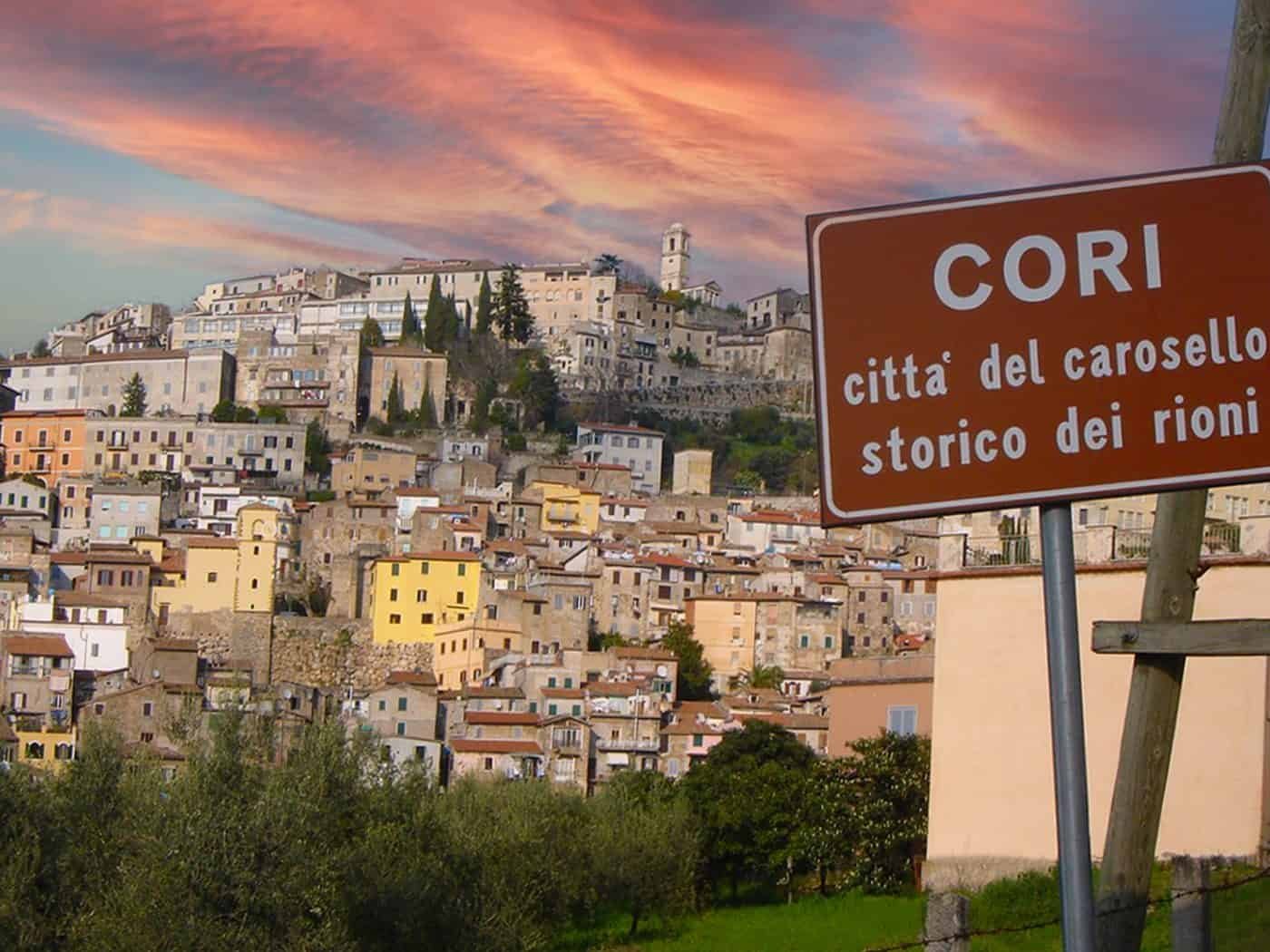
Where Is Cori (LT) and Why the Town Is Divided in Two
Cori is not a compact village squeezed around a single square. The town is divided into two quite distinct cores, Cori Monte and Cori Valle, and the people of Cori themselves divide into montanari, those who live up high around the acropolis, and vallarani, those who live in the lower part. The distinction is not recent folklore: the topography of the hill imposed for centuries two almost parallel lives, with the uphill streets as the hinge. On clear days, climbing toward the Temple of Hercules, the gaze reaches the sea: on the horizon you can make out the Pontine Islands, Ponza, Ventotene, Palmarola, and the silhouette of the Circeo promontory that closes the plain to the south. It is a detail that explains the strategic position of ancient Cora better than any sign: from up here you controlled the Pontine plain all the way to the coast.
The layout of the historic center preserves the plan of the Roman and medieval settlement, with alleys that climb, stairs, covered passages and sudden open spaces. The fabric is the typical one of the Lepini villages, built in local stone, but in Cori the stratification is denser than elsewhere: under the Renaissance houses emerge polygonal walls of pre-Roman age, and under the medieval churches lie the foundations of pagan temples. Walking through Cori (LT) means reading this overlap with the naked eye, without need of excavations.
The Origins of Cori (LT): Between Trojan Myth and the Etymology of the Raven
Several legends coexist on the origins of Cori, and it's best to keep them for what they are, foundation tales, without passing them off as chronicle. Ancient tradition attributes the birth of the city to figures of the Trojan cycle: some have it founded by Dardanus, the hero from whom the line of Troy descends, some bring in Aeneas and some a king of Alba Longa. A version widespread locally holds that, after a first destruction, the city was rebuilt by Corace, a veteran of the Trojan War, who would have given it his own name. Alongside this heroic explanation a more sober one circulates, of an etymological type: the name would derive from the Latin corax, the raven, a totemic animal tied to the place. None of these hypotheses can be proven, and no source treats them as certain history.
What the remains do confirm, instead, is the real antiquity of the settlement. Latin Cora was an important center already in the archaic age, within the orbit of the Latin League, then a Roman municipium, and its importance can be read in the ring of monuments that no village of little account could have afforded: two urban temples, a city wall circuit of great effort, a monumental forum, bridges and infrastructure in opus quadratum. The legend of Corace serves the town as an identity tale. The stone tells another story, less novelistic and more solid, made of centuries of continuous city life.
The Temple of Hercules in Cori (LT), the Doric One That Looks at the Sea
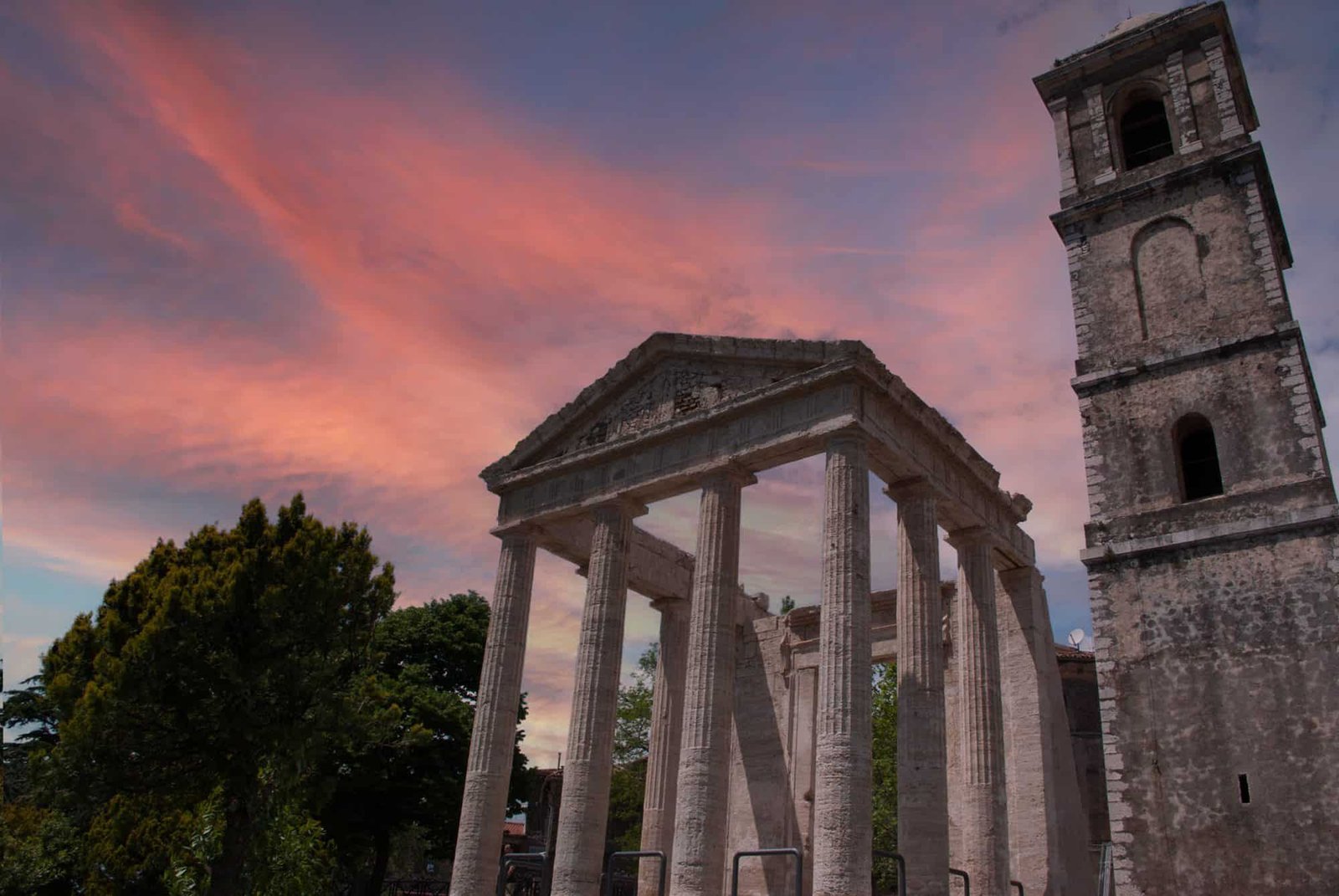
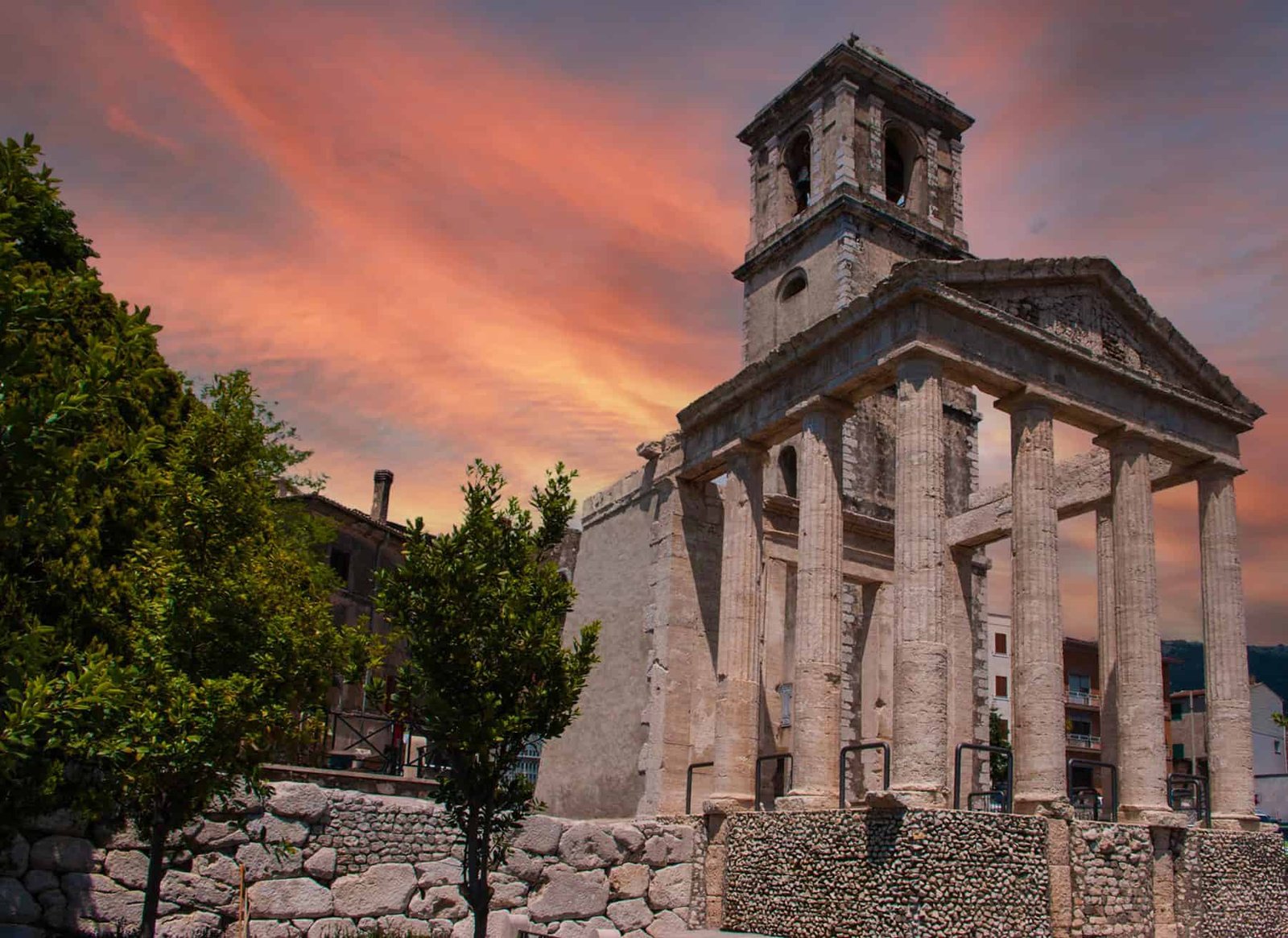
The Temple of Hercules is the symbol monument of Cori and one of the best preserved Doric temples in Lazio. It stands at the top of the hill, on the acropolis of ancient Cora, at an elevation close to 400 meters, and is visible from afar. Its dating places it between 89 and 80 BC, in the years of Sulla's dictatorship, when the architecture of Lazio reworked Greek models in an Italic key. It is a tetrastyle temple, with four columns on the front, of Doric order, and it preserves the pronaos with fluted columns about seven meters high, the architrave with alternating triglyphs and smooth metopes, and the pediment. Originally the stone was covered with painted stucco, like almost all temple building of the time: what we see today gray and bare was colored.
The Inscription on the Architrave and the Two Magistrates
On the architrave of the door the inscription can still be read that gives the names of the two magistrates who oversaw the construction of the building: Marco Maglio and Lucio Turpilio. It is a precious piece of data, because it establishes who commissioned it and confirms the late Republican dating. It is worth stopping in front of the portal and looking for the carved characters: they are the original signature of the building site, not a reconstruction.
Why It's Called the Temple of Hercules If It's Not Certain
Here something must be said that is often kept quiet: the dedication to Hercules is not documented from antiquity. The name Temple of Hercules is based on documents from Cori earlier than the 17th century and on an 18th-century inscription considered apocryphal by scholars. The attribution, in short, is a consolidated local tradition, not a certain epigraphic fact. The name stays, because it is the one by which the town has identified its monument for centuries, but whoever visits Cori (LT) does well to know it: the god to whom the temple is dedicated, strictly speaking, we do not know with certainty.
San Pietro Church and the Survival of the Temple
The Temple of Hercules has come down to us because it was incorporated into a Christian church, San Pietro, which reused its structure for centuries. The bell tower you see behind the temple belonged precisely to that church. San Pietro was destroyed by the bombings of 1944, during the Second World War, and the demolition of the medieval shell ended up restoring the ancient temple to view. It is the same mechanism of preservation that saved so many Roman buildings: becoming a church was the way of not being dismantled to make lime and building material. The temple had already been declared a national monument in 1898.
The Temple of the Dioscuri in Cori (LT) and the Forum Area
If the Temple of Hercules dominates the acropolis, the Temple of the Dioscuri guards the forum, lower down, in the fabric of the houses. It is dedicated to Castor and Pollux, the divine twins, sons of Zeus, the Dioscuri precisely, protectors of horsemen and sailors. The facade dates to the first decades of the 1st century BC, Corinthian in order, but the structures beneath may be older, datable between the end of the 4th and the beginning of the 2nd century BC. Today two of the six original Corinthian columns remain standing with a stretch of architrave, resting on what survives of the podium. A fragment of a third column is incorporated in a private home. The columns preserve traces of the stucco that covered them to simulate marble.

The Dedication to the Twins and the Temple-Treasury
Here too the inscription speaks: on the architrave the dedication to Castor and Pollux is preserved, with the names of the magistrates who financed the construction drawing on the temple's treasury. Ancient temples were not only places of worship but also deposits of money and valuables of the community, and the Temple of the Dioscuri of Cori performed this double function, of sanctuary and city coffer. The cella was tripartite, divided into three rooms, and in the center, according to reconstructions, stood the marble statues of the two twins, about 1.90 meters tall, armed and accompanied by horses, with a four-column canopy and a coffered ceiling framing the sculptures.
Via delle Colonne, Piazza Montagna and the Perimeter of the Forum
The temple anchors the area of the ancient forum, which extended between the building, Piazza Montagna, Via delle Colonne and Piazza Pozzo Dorico. Walking in this quadrilateral you constantly come across fragments of Roman public buildings reused in later constructions: bases, thresholds, squared blocks that stick out of the walls of the houses. Via delle Colonne takes its name precisely from these visible remains. Whoever visits Cori (LT) unhurriedly should walk this stretch slowly, looking up above the shop windows: the Roman forum is not fenced off, and lies below and around whoever walks.

Pozzo Dorico and the Square Above the Cistern
The large square known as Pozzo Dorico opens above a Roman structure from the Republican era with a cistern: the popular name merges the memory of the well with the architectural order of the ancient ruins surfacing in the area. It's one of those places where medieval and modern Cori built on top of Roman Cora without erasing it, reusing its water works. Today the square is one of the most beautiful open spaces in the upper center, a natural stopping point between the Temple of the Dioscuri and the climb to the acropolis.
The Polygonal Walls of Cori (LT), Two Kilometers of Cyclopean Stone
A circuit of walls in polygonal masonry, the so-called Cyclopean masonry, runs around the ancient city and is about two kilometers long. The walls are made of blocks of local limestone cut into polygons and fitted together dry, without mortar, with a precision that for centuries fed the legend of gigantic builders, the Cyclopes, which gave the walls their name. The chronology is broad: the oldest sections date to the 6th-5th century BC, with restorations and rebuilding continuing until the 2nd century BC. The walls opened into three main gates, oriented toward the main routes of the territory: Porta Romana toward Rome, Porta Ninfina toward Ninfa and the plain, Porta Signina toward Segni.

The Three Gates and the Rebuilt Porta Ninfina
Of the three gates, the Ninfina was rebuilt in 1984 on the basis of the remains and documentation, and it gives a concrete idea of the light and structure of the ancient entrances. The others can be read in the surviving stretches of wall and in place names. The gates weren't just defensive openings: they marked the economic and political orientation of the city, its relations with Rome to the north, with Segni uphill, and with Ninfa and the Pontine plain downhill. The name of each district of the historical carousel comes from these very gates, and this ties the ancient walls directly to the modern festival.
Piranesi and the Antiquities of Cora
The walls and temples of Cori entered the great atlas of Roman antiquity thanks to Giovanni Battista Piranesi, who dedicated important engravings to the ruins of Cori, collected in the volume on the Antiquities of Cora, published in the 18th century. His plates, with their taste for monumental scale and for the detail of the masonry, fixed the image of Cori in the European culture of the Grand Tour and remain a valuable document for understanding how the monuments looked before the modern restorations. Anyone who knows Piranesi's work will find in Cori (LT) the same views the Venetian engraver put on copper.
The Ponte della Catena of Cori (LT), the Roman Arch Over the Ditch
Just outside the ancient circuit, toward Porta Ninfina, the Ponte della Catena spans the Catena ditch with a single arch. It's a Roman work of the 1st century BC, built in opera quadrata with tuff blocks for the arch ring, around 20 meters high. It's one of the best-preserved Roman bridges in southern Lazio, and its height surprises anyone reaching it from below: it was designed to overcome a considerable drop in elevation and to connect the settlement with the countryside and the valley-floor roads. It's worth the small detour to see it, because it shows the engineering effort the Romans put even into a provincial town like Cora.
The Sant'Oliva Monumental Complex in Cori (LT)
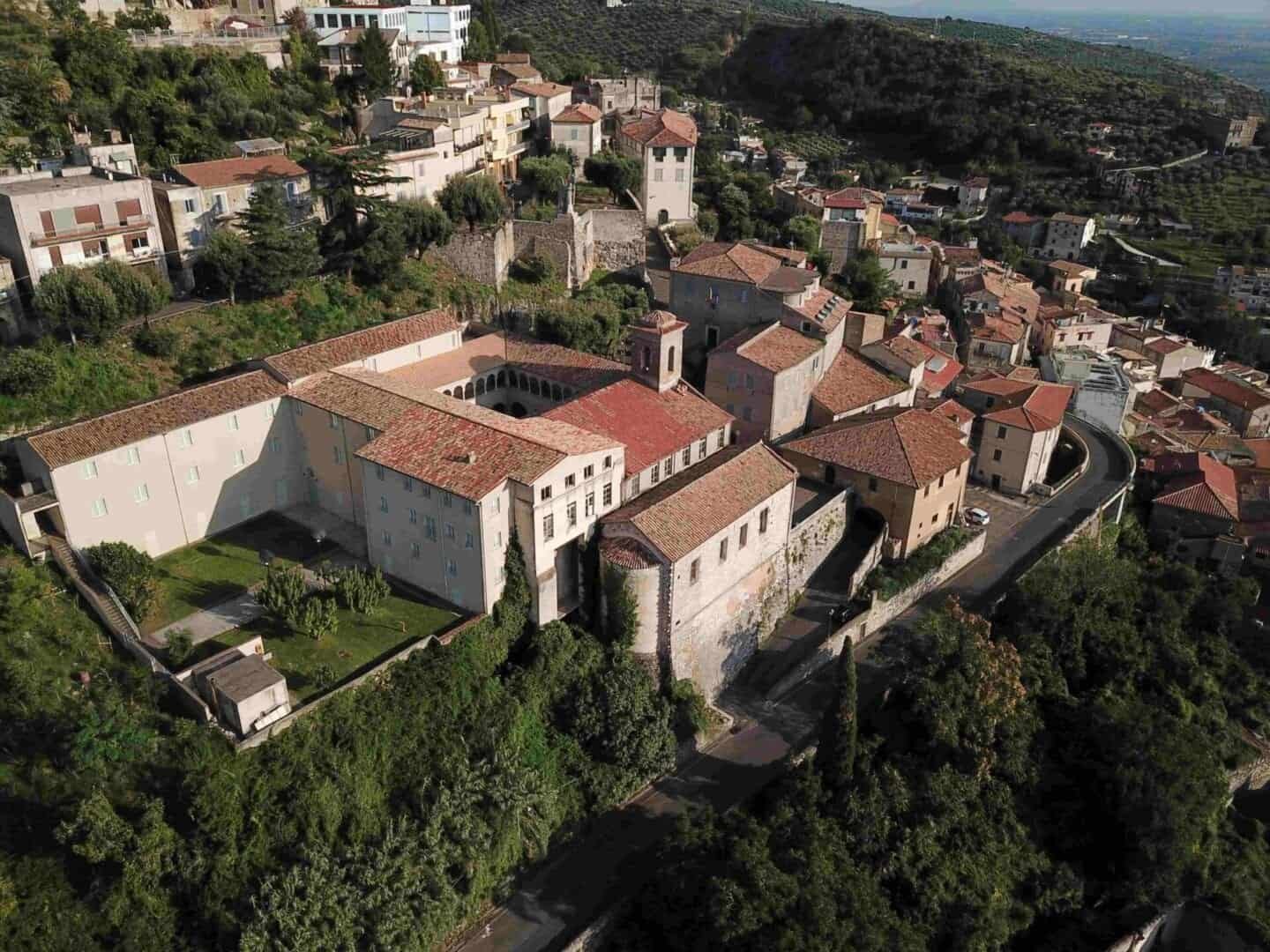
Sant'Oliva is the monumental heart of medieval and modern Cori, and it sums up 2,000 years of history in a single place. A Roman temple originally stood on the site, datable between the 3rd and 1st century BC. In the first half of the 12th century, on the ancient foundations, the church dedicated to Sant'Oliva of Anagni was built. In the second half of the 15th century the Chapel of the Most Holy Crucifix and the Augustinian convent with its cloister were added, and between the end of the 15th century and the 16th century the square and the complex took on their present appearance. Four elements thus coexist in a single organism: the medieval church that incorporates remains of the Roman temple, a 15th-century chapel entirely frescoed, a Renaissance cloister and the convent structure.

The Cloister and the Frescoed Chapel
The Renaissance cloister is one of the most intimate spaces of the historic center, with its portico and well, and it gives back the rhythm of Augustinian conventual life. The Chapel of the Crucifix preserves a 15th-16th-century fresco cycle that covers the walls and gives the measure of how much Cori was, in the Renaissance, a lively artistic center and not a periphery. In front of the frescoes it is worth taking your time: they are works of the Lazio area that tell sacred stories in a language still late Gothic that veers toward the Renaissance.
The civic role of St. Oliva in the Middle Ages
There is an aspect of St. Oliva that escapes those who look at it only as a church. In the Middle Ages this place had a fundamental political function in the life of the town: here the magistrates swore loyalty to the municipal statute, and within these walls the periodic meetings of the parliament of heads of household were held. Put another way, the church was also the community's hall. On the second-to-last Sunday of June, during the historic carousel of the districts, costumed performers reenact precisely the oath of the priors of the three districts: the modern festival stages a rite that at St. Oliva was truly celebrated centuries ago.
The Museum of the City and the Territory of Cori (LT)
The St. Oliva complex houses the Museum of the City and the Territory, the hub that gathers the finds from the excavations and monuments of Cori: architectural fragments of the temples, materials from the forum, inscriptions, elements that help recompose ancient Cora. It is the place where the pieces recovered from the temples and the forum area are kept, and visiting it after walking among the ruins closes the circle: you see up close what in the street remains walled in or up high. Hours and tickets vary with the season and with the exhibitions, and are checked on the website of the Municipality of Cori before the visit. The museum is the ideal starting point to understand the stratification of the center, especially for those who arrive without a guide.
The churches of Cori (LT), one by one
Besides St. Oliva, Cori preserves a heritage of churches that covers the whole span from the Middle Ages to the modern era, many built on top of or beside ancient structures. It is worth going through them one by one, because they tell the religious and civic history of the town better than any summary.
The Collegiate Church of St. Mary of Piety
The church of St. Mary of Piety, the Collegiata, has a Romanesque layout of medieval origin and rises in part on the remains of a Roman building. It is the mother church of the town, the reference point for the great processions, starting with that of the Madonna del Soccorso. Its bell tower is one of the recognizable marks of the urban profile of Cori.
The church of St. Francis
St. Francis was built in the early 16th century, in the years around 1521-1526, and reworked in Baroque forms in the 17th century, when it received the gilded wooden ceiling made between 1672 and 1676. It is the most accomplished example of Cori Baroque, with the gold of the ceiling contrasting with the sobriety of the stone in the rest of the town. Whoever enters expects Franciscan austerity and instead finds a rich interior, a sign of the devotion and the resources that the town knew how to muster in the heart of the modern era.
The Oratory of the Most Holy Annunciation and its frescoes
The Oratory of the Most Holy Annunciation preserves one of the most important fresco cycles in Cori. The building is of 14th-century origin, and the paintings that cover its walls date from the 15th century: a cycle that covers the rooms with sacred stories and figures of saints, the work of craftsmen of the Lazio area. It is the right place to understand how much mural painting was, between the Middle Ages and the Renaissance, the great illustrated book of communities: those who could not read read the walls. In front of these frescoes you realize that Cori (LT), in the 15th century, was not a town on the margins but a center able to call good painters.

Saints Peter and Paul, St. Savior, St. Michael the Archangel
Next to the large churches, the center preserves smaller buildings that are just as rooted in the life of the town. Santi Pietro e Paolo Church was built in 1953 on the ruins of Santissima Trinità, lost in the war. San Salvatore Church received a renovation in the 16th century. San Michele Arcangelo Church completes the picture of the churches of the upper center. To these are added buildings that have disappeared or been reduced to ruins, such as Santa Maria del Pianto, and the three churches destroyed by the bombings of 1944, Santa Caterina, San Pietro and Santissima Trinità: wounds that Cori still carries in its urban fabric.
San Tommaso da Cori (LT), the Town's Saint
Cori gave birth to a saint, Tommaso da Cori, a Franciscan friar who lived between the 17th century and the early 18th century, known for a life of preaching and poverty in the convents of the Lazio Apennines. The town preserves the memory of his birthplace and dedicates a festival to him in late November. For the people of Cori, San Tommaso isn't an abstract name on the calendar but a household presence, and his figure ties Cori (LT) to a concrete Franciscan spirituality, rooted in the territory. Anyone visiting the town in autumn may come across the celebrations dedicated to him.
The Renaissance Palaces of Cori (LT) and the Roman Towers
Cori isn't only temples and churches: the center preserves a dense fabric of 16th- and 17th-century palaces that tell of the Cori of families and institutions. Palazzo Landi-Vittori, from the 16th century, incorporates a Roman-era tower of the 1st century BC, a perfect example of the continuous reuse of ancient structures. Then there are Palazzo Riozzi-Fasanella, Palazzo Chiari, Palazzo Celli from 1632, Palazzo Luzi from 1634, Palazzo Montagna from 1594, Palazzo Marchetti, Palazzo Prosperi, which today houses the library and the municipal archive, the Palazzetto Luciani and the Palazzo del Comune, of medieval origin. Of the Roman defensive towers, four survive, two of them in Piazza Signina, including the one traditionally called Torre di Silla.
Via del Porticato and the Covered Passages
One of the most characteristic aspects of the upper center is the presence of covered streets, like Via del Porticato or Sipportica, an ancient stretch that between the 12th and 17th century was covered by the buildings above. Walking through these passages gives you a physical sense of how a medieval village grew: people built over the street, gained space upward, tied the houses together from one side of the alley to the other. It's an urban detail that is better preserved in Cori (LT) than in many nearby towns.
The Historical Carousel of the Districts of Cori (LT)
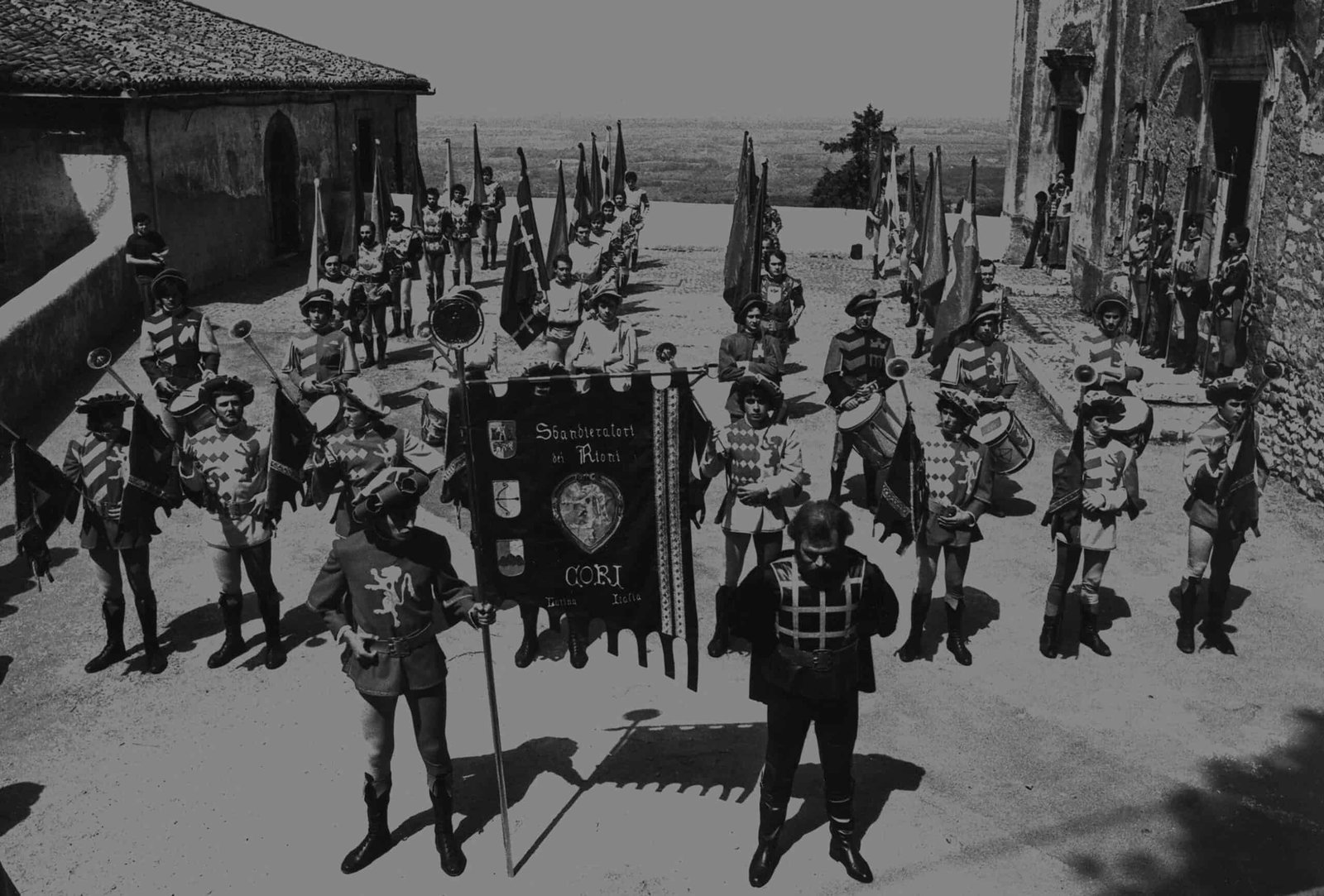
Cori calls itself the city of the historical carousel of the districts, and the description isn't advertising: the festival is the civic soul of the town. The Historical Carousel was devised in 1937, in the wake of the celebrations for the Madonna del Soccorso, who according to tradition appeared in 1521, and for Sant'Oliva, patron saint since the 12th century. It's a reenactment in Renaissance costume in which the three districts compete for the palio with a ring race, the ring joust, a horseback skill contest in which the riders must thread a suspended ring with the lance.
The Three Districts: Porta Signina, Porta Romana, Porta Ninfina
The three districts take their names from the three gates of the ancient walls, and each has its own colors and motto. Porta Signina, yellow and green, occupies the upper part of the historic center and has the motto Excelsior, ever higher. Porta Romana, light blue and yellow, in the lower part toward the northwest, has as its motto Per aspera ad astra, through hardships to the stars. Porta Ninfina, red and blue checkered, in the lower part toward the southwest, recognizes itself in the motto Viribus unitis, with united forces. All the community life of the festival is organized around these three colors, from the taverns that open on the weekends of June and July to the parades that march through the streets.
The Flag Throwers of Cori (LT) and the Wooden Flags
The distinctive feature of the carousel is the flag throwers. At the parade, with about 400 costumed participants in 16th-century dress, each district brings its own group of flag throwers, and three associations take turns in the representation. The flag throwers of Cori have a peculiarity that makes them recognizable nationwide: they use flags with an exclusively wooden pole, a choice that makes the throw harder and more spectacular. The Cori groups, founded between the 1960s and 1970s, have won recognition internationally as well.
When the Carousel Takes Place
The carousel is spread over several events between late spring and summer, with the main races placed between the end of June and the end of July, and the districts' taverns enlivening the weekends before. The exact dates change from year to year and should be checked on the official channels of the palio and of the Comune di Cori before planning your visit. Anyone who happens to be in Cori (LT) at the right time finds a transformed town, with the colors of the districts at the windows and the flag throwers' rehearsals in the squares.
The Other Festivals and Traditions of Cori (LT)
Cori's calendar doesn't end with the carousel. The festival of the Madonna del Soccorso, on the second Sunday of May, is the most deeply felt from a religious point of view: it recalls the miracle of 1521 tied to the girl Oliva and includes a long procession from the Collegiata of Santa Maria della Pietà to the sanctuary, with women carrying candles dressed in green. Then there are the festival of Sant'Antonio da Padova in June, the Madonna del Rosario on the first Sunday of October, the festival of San Tommaso da Cori in late November, and long-running cultural events such as the Festa della Collina, active since 1974, and the folk festival that brings groups from all over the world to Cori. The town, in short, has a dense community life spread throughout the year.
A Curiosity About Cori (LT)
The curiosity almost nobody tells concerns the Temple of Hercules and the Renaissance. When Raffaello Sanzio was appointed architect of the Fabbrica di San Pietro, according to tradition he also took up studying ancient monuments to understand their building rules, and among the temples that were drawn and measured was none other than the Doric temple of Cori. The idea that one of the greatest artists of the Italian Renaissance could have climbed all the way up here, or at any rate had this building surveyed, says how much the Temple of Hercules was considered a reference model for the Doric order already five centuries ago. It wasn't a forgotten provincial ruin: it was an open-air architecture manual, studied by those who built the churches of Rome.
Then there is the curiosity of the name itself. We call the monument the Temple of Hercules with confidence, but we saw that the dedication to the god rests on late documents and on an 18th-century inscription judged false. It means that the best-preserved temple of Cori carries a name that may not be its own: a small paradox that makes the climb to the acropolis even more interesting, because you are standing before a building whose divine identity remains, ultimately, an open mystery. This kind of uncertainty, declared and not hidden, is what distinguishes a studied monument from one invented for tourists.
Something Nobody Tells You About Cori (LT)
What the quick guides skip is that in Cori the Roman temples aren't enclosed inside a fenced archaeological area with a ticket, like the Roman Forum or the Imperial Forums. They are in the town, set among the houses, and you walk past them on the ordinary streets of the center. The Temple of the Dioscuri has a column incorporated into a private home. The Roman forum coincides with squares and alleys where people live. The Cyclopean walls serve as foundations for vegetable plots and gardens. This completely changes the way you visit Cori (LT): there's no mandatory route with an entrance and an exit, but a living city where the ancient is within reach, free, at any hour. For those used to paid archaeological sites, it's an almost disorienting freedom.
The flip side, which nobody mentions, is that without signs and without a map in hand you risk walking through half of the wonders without noticing. A polygonal block walled into a cellar, a reused Roman threshold, a fragment of architrave flush with the street go unnoticed by those who don't know what to look for. That's why in Cori the Sant'Oliva museum is the most useful stop before the walk, not after: it gives the keys to recognize what otherwise looks like just an old wall. The practical advice is simple: get informed before going up, then walk with your eyes open, looking down and up, not straight ahead.
The Advice I Give You for Visiting Cori (LT)
My advice is to visit Cori from the top down and never the other way around. You arrive by car or bus, go up to the acropolis with the Temple of Hercules, take in the view over the Pontine plain and the sea when the air is clear, and from there walk slowly down toward the forum, the Temple of the Dioscuri, Piazza Pozzo Dorico, the Sant'Oliva complex and finally the lower part. This way you walk downhill, you save your legs on the steep alleys, and you follow the natural historical order, from the sacred acropolis to the lower city. The climb to the temple should be done at the start, with good breath, not at the end of a day of walking.
As for when: spring and early autumn are the best seasons, with the right light and without the summer heat, which up here beats down on the pale stones. Those who want to see the town at its liveliest aim instead for the carousel period, between late June and July, keeping in mind, though, more people and the need to check the dates in advance. Allow at least a full half day, better a full day if you want to enter the churches and the museum without rushing. Comfortable shoes are a must: the alleys are stone, uphill, and in places uneven. And bring water, because up high the refreshment points thin out. One last thing: don't treat Cori as a hit-and-run to pair with Rome in the same morning. It deserves its time, and it rewards those who give it.
Another Well-Known Fact, Yet Seldom Cited
Many people know the fact in words, but few really connect it: on March 18, 1910, the Temple of Hercules was visited by King Vittorio Emanuele III. It was no ordinary stroll. At the beginning of the 20th century Italy was building its national identity also through ancient monuments, and the sovereign's visit to the Doric temple of Cori was an official recognition of the value of the site, which a few years earlier, in 1898, had been declared a national monument. The king's presence in Cori (LT) places the town in the great season of rediscovery of Lazio archaeology, the one that led to the first scientific restorations and to the protection of the temples.
Also seldom cited is the link between Cori and Piranesi's engravings. In the 18th century Giovanni Battista Piranesi put the antiquities of Cora on copper in a dedicated collection, and those plates were for educated Europe the first image of Cori. Those arriving from the Grand Tour knew the Temple of Hercules through Piranesi before even seeing it. It's a well-known fact among scholars, but it is rarely told to the ordinary visitor, who should instead know that he or she is walking inside a landscape already drawn by one of the greatest engravers of all time. Seeing in person the views that Piranesi immortalized is one of the least advertised pleasures of a visit to Cori.
The Right Photo to Take in Cori (LT)
The photo you take home from Cori is the one from the Temple of Hercules with the plain behind. You climb to the acropolis, position yourself so that you have the Doric columns in the foreground and, in the background, the expanse of the Pontine plain descending toward the sea. On clear days, with a telephoto lens or even just your eye, the Circeo and the line of the islands stand out on the horizon. The best light is that of late afternoon, when the low sun lights up the residual stucco and the limestone of the columns and lengthens the shadows of the triglyphs on the architrave. It's a photograph that holds two subjects in one: the monument and the territory that monument controlled.

If you're after a more intimate photograph instead, the one that tells the soul of the town, go down to the Temple of the Dioscuri and frame the two surviving Corinthian columns wedged between the houses: the ancient and the everyday in the same shot, with laundry hung out or a Vespa parked a step from an architrave 2,000 years old. It's the image that explains better than any caption what it means in Cori (LT) to live inside archaeology. A third option, on carousel days: the flag throwers with their wooden flags thrown into the air against the sky, in Piazza Signina or at Campo Boario, a subject of movement and color that calls for patience and a good shutter speed.
Some Important Events That Happened Here in History
The history of Cori is long and at times dramatic. In antiquity Cora was among the notable Latin cities, involved in the affairs of the Latin League and then absorbed into Rome's orbit as a municipium. The two temples, the walls and the forum are the monumental proof of a prosperous community in the late Republican era, between the 2nd and 1st century BC, when the great buildings we still see were built or renewed. The construction of the Temple of Hercules between 89 and 80 BC, in the years of Sulla, is one of these moments: it marks the highest point of Cori's architecture.
In the Middle Ages Cori became a free commune, and Sant'Oliva was its civic hub, with the magistrates' oath to the statute and the parliament of heads of families meeting within its walls. In the Renaissance the town saw a new artistic flowering, with the families' palaces, the frescoes of the Annunziata and of Sant'Oliva, and the construction of churches such as San Francesco. In 1521 comes the miracle of the Madonna del Soccorso, which generates the town's most deeply felt festival. In 1937 the Historical Carousel of the Districts is born, which turns those roots into civic spectacle.
The most painful chapter is also the most recent. During the Second World War, in 1944, Allied bombings hit Cori hard and destroyed several buildings, including the church of San Pietro that enclosed the Temple of Hercules, and the churches of Santa Caterina and Santissima Trinità. The destruction of San Pietro's shell, by a paradox of history, gave back to view the ancient temple enclosed within it. Cori still bears the marks of those wounds, and the postwar reconstruction, like the Santi Pietro e Paolo Church of 1953, is part of the town's 20th-century story. In 1898 the Temple of Hercules had been declared a national monument, and in 1910 the king's visit had sealed its value: two dates that mark the birth of modern protection in Cori (LT).
Who Has Passed Through Cori (LT)
Figures belonging to the great history of art and culture have passed through Cori, or left a mark there. Giovanni Battista Piranesi, the greatest engraver of 18th-century Europe, dedicated to the antiquities of Cora a volume of plates that made the temples and walls of the town famous among Grand Tour travelers. Tradition then links to the Temple of Hercules the name of Raffaello Sanzio, who after being appointed architect of St. Peter's would have studied and measured the Cori Doric as a model of the ancient order: a handed-down connection, to be taken as tradition and not as certain documentation, but which says how highly the monument was regarded.
In 1910 it was King Vittorio Emanuele III who climbed up to the temple, on March 18, in an official visit that consecrated Cori among the places of national archaeology. And then there is someone who didn't pass through Cori but was born there, and remained in the collective memory: San Tommaso da Cori, the Franciscan friar of the 17th-18th century, son of the town, whose birthplace is still pointed out to visitors. Around these names moves the anonymous but no less important crowd of the protagonists of Cori's life: the magistrates who swore at Sant'Oliva, the Lazio painters who frescoed the Annunziata, the Roman builders who signed the temples, Marco Maglio and Lucio Turpilio on the Doric temple of Hercules. Anyone who passes through Cori (LT) today walks in their footsteps.
The Fountains, the Monument to the Fallen and the Parco dell'Impero of Cori (LT)
The center of Cori is dotted with historic fountains that once marked the daily life of the town, when water was fetched at the public fountain. You come across the fountain in Piazza Romana, the one at Monte Pio, the fountain in Piazza della Croce and the one in Via San Rocco, built at the end of the 19th century, between 1887 and 1888. They are minor but precious architecture, because they tell of the Cori of water and work, and today they remain stopping and orientation points in the maze of alleys. Looking for them one by one is a good excuse to cross neighborhoods that fast tourism skips.
In a more scenic position stands the Monument to the Fallen, dedicated to the people of Cori who died in the First World War, designed by the architect Angelo Ternavasio and inaugurated in 1931. It's one of the marks of the 20th century in the town, together with the Parco dell'Impero, the green area laid out in the 1930s that offers a lookout and a shaded walk, handy for catching your breath between one climb and the next. These places say that Cori (LT) isn't only Roman antiquity and Renaissance: it is also a 20th-century community, with its civic memories and its public spaces.
The Selva di Cori (LT) and the Landscape of the Lepini Mountains
Above the town extends the Selva di Cori, the wooded belt of the Lepini Mountains that covers the slopes behind the built-up area. It's the landscape that has nourished Cori for centuries with firewood, pasture and water, and that today offers walking paths among chestnuts and holm oaks, with springs and fountains like the Fontana del Prato. Those with time and legs can extend the visit to the town with a walk in the woods, which gives views over the plain and an air different from that of the warm stones of the center. The Lepini ridge, with its vocation for the olive on the lower slopes and for woodland at altitude, is the natural frame that explains the position and the very history of Cori.
Olive oil, in particular, is the identity product of the territory: the slopes around Cori have been cultivated with olive trees since time immemorial, and Cori's oil is one of the gastronomic reasons to stop. On the carousel weekends, and in many seasonal food festivals, the products of the hills, oil, wine, cheeses and dishes of Lepini peasant cooking, return to the center of the festival. The link between the agricultural landscape and the life of the town, in Cori (LT), has never been severed.
Accessibility and Practical Tips for Cori (LT)
It must be said frankly: Cori isn't an easy town for people with mobility difficulties. The historic center is made of climbs, stairs, stone alleys and covered passages, and the acropolis with the Temple of Hercules can only be reached on foot along steep streets. Those who get around in a wheelchair or have trouble walking can still enjoy the lower parts and some squares, but should keep in mind that the two temples and the upper walls remain demanding. For up-to-date information on routes and access, it's best to contact the Sant'Oliva museum center or the Comune di Cori in advance.
A few golden rules apply to everyone: shoes with a sturdy, non-slip sole, water with you because the refreshment points up high thin out, and a hat in summer, when the sun beats down on the pale stones. Look for a place to park the car in the designated areas at the edge of the center, because the inner alleys are very narrow. And, again, the advice that counts: take your time. Cori is leafed through like an old book, page after page, and doesn't let itself be read in a hurry.
What to See Near Cori (LT): the Lepini Mountains and the Pontine Plain
Cori lends itself very well to being the center of a wider itinerary between the Lepini Mountains and the Pontine plain, because around it there is a density of villages and sites that few areas of Lazio can claim. Going down toward the plain you reach in a short time the Garden of Ninfa, one of the most admired gardens in Italy, which arose among the ruins of the medieval city of Ninfa, and the towered village of Sermoneta with its Caetani castle. A little farther on, on the Lepini side, is Norma with the archaeological area of ancient Norba, another Latin city with polygonal walls akin to those of Cori.
Toward the Castelli Romani and the valley you meet Velletri, the gateway from Rome, Artena with its car-free historic center, Segni with its Cyclopean walls and the famous Porta Saracena, and the Bosco di Paliano. Going up toward the inner Lepini and Ciociaria you arrive at Carpineto Romano, the birthplace of Pope Leo XIII, and farther away at Anagni, the city of the popes, at Alatri with its extraordinary polygonal acropolis, and at the baths of Fiuggi. Those who want to widen the range even more, toward the temples and villas, have within a stone's throw Palestrina with the sanctuary of Fortuna Primigenia, and farther north the great Hadrian's Villa of Tivoli.
Cori (LT) with children and on foot
Cori also works well with children, as long as you take it the right way. The visible temples, the Cyclopean walls with their enormous blocks, the covered streets and the high bridge over the ditch have something adventurous that kids like, and the story of the Cyclopes who built the walls lends itself to being told as a fairy tale with a basis of archaeological truth. The historic carousel, with the horses, the flag throwers and the Renaissance costumes, is a spectacle that captivates even the smallest. The limit is the fatigue: the alleys are steep and uneven, the stroller is awkward, and in summer the sun on the pale stones tires you quickly. With children it's best to aim for the morning, bring water and a hat, and pace the climbs, perhaps stopping for a long time in Piazza Pozzo Dorico or in the cloister of St. Oliva, where you can sit in the shade.
When to go to Cori (LT) and how much time you need
The ideal period for Cori runs from April to June and from September to October, when the temperature is mild and the light on the mountains is crisp. Full summer is hot and sunny on the acropolis, and has to be tackled early in the morning or in the late afternoon. Winter gives clear days with panoramas stretching to the sea, but the hours of daylight are few. For a serious visit you need at least half a day, and a full day if you want to combine the two temples, the St. Oliva complex with the museum, the main churches and a walk along the walls. Those who arrive in the period of the carousel, between late June and July, find the town in festival mood but more crowded, and must check the dates of the races in advance. In every season, in Cori (LT) you walk a lot and uphill: the right shoe is half the visit.
Quick questions about Cori (LT)
Where is Cori (LT)?
Cori is in the province of Latina, on the northern slope of the Lepini Mountains, about 50 kilometers from Rome and a little over an hour and a half of travel. The town is divided into two nuclei, Cori Monte above and Cori Valle below.
How far is Cori (LT) from Rome?
About 50 kilometers, a good hour and a half by car going through the area of Velletri and the Castelli Romani, or coming off the Appian Way at the height of Cisterna di Latina.
How do you get to Cori (LT) without a car?
The train doesn't reach Cori: the nearest stations are Velletri, on the regional line from Roma Termini, and Cisterna di Latina on the Rome-Naples line via Formia. From there you continue with COTRAL line buses. It's best to check schedules and connections in advance on Trenitalia and COTRAL, because the runs toward the inland villages are less frequent on holidays.
How much does it cost to visit Cori (LT)?
The town can be visited for free on foot: the temples, the walls, the churches and the squares are freely accessible along the streets of the center. The Museum of the City and the Territory, in the St. Oliva complex, instead has its own ticket and its own hours, which you check on the website of the Municipality of Cori.
Can the Temple of Hercules in Cori be visited?
Yes, the Temple of Hercules is outdoors on the acropolis and is reached on foot by climbing through the historic center. It is visible and freely approachable. For the interior and for any guided openings, it's best to ask at the St. Oliva museum hub.
Why is it called the Temple of Hercules if the attribution is uncertain?
The name comes from a local tradition attested by documents prior to the 17th century and by an 18th-century inscription considered, however, apocryphal. Antiquity has not left us certainty about the titular god: the dedication to Hercules is established by usage, not by epigraphic proof.
How many columns of the Temple of the Dioscuri of Cori remain?
Two of the six original Corinthian columns remain standing with a stretch of architrave, plus the fragment of a third column incorporated into a private home. The temple enlivens the area of the ancient forum.
What are the Cyclopean walls of Cori (LT)?
They are a circuit of walls in polygonal masonry about two kilometers long, made of large limestone blocks fitted together dry. The oldest sections date to the 6th-5th century BC, with rebuilding until the 2nd century BC. They opened into three gates: Romana, Ninfina and Signina.
What to see in Cori (LT) in half a day?
With half a day it's best to concentrate on the Temple of Hercules up high, the descent toward the Temple of the Dioscuri and the forum, Piazza Pozzo Dorico and the Sant'Oliva complex. If there's time left, the Collegiata of Santa Maria della Pietà and a stretch of the walls.
How much time do you need to visit Cori (LT) properly?
For a complete visit, with the two temples, Sant'Oliva and the museum, the main churches and the walls, you need a full day. Half a day is enough for the essential monuments without going inside everywhere.
Is Cori (LT) suitable for children?
Yes, the visible temples, the Cyclopean walls and the historical carousel appeal to kids. You do have to keep in mind steep, uneven alleys, impractical with a stroller, and the strong sun in summer: the morning is better, with water and a hat.
When does the historical carousel of Cori (LT) take place?
The Historical Carousel of the Districts is concentrated between the end of June and the end of July, with the districts' taverns open on the preceding weekends. The exact dates change every year and should be checked on the official channels of the palio and of the Comune di Cori.
What are the three districts of Cori?
They are Porta Signina, yellow and green, motto Excelsior. Porta Romana, light blue and yellow, motto Per aspera ad astra. And Porta Ninfina, red and blue, motto Viribus unitis. They take their names from the three gates of the ancient walls and compete in the ring race.
Why are the flag throwers of Cori special?
Because they use flags with an exclusively wooden pole, a choice that makes the throws harder and more spectacular. The Cori groups, founded between the 1960s and 1970s, have received recognition internationally as well.
What is the Sant'Oliva complex in Cori (LT)?
It's an organism that brings together a 12th-century church built on a Roman temple, a frescoed 15th-century chapel, a Renaissance cloister and an Augustinian convent. It houses the Museum of the City and Territory. In the Middle Ages it was also the civic seat of the commune.
Can you see the Ponte della Catena in Cori?
Yes, it is reached on foot toward Porta Ninfina. It's a Roman bridge of the 1st century BC in opera quadrata, with a single arch around 20 meters high: it's worth the small detour, especially seeing it from below.
Is the food good in Cori (LT)?
Cori has a Lepini gastronomic tradition, with olive oil as the flagship product of the territory and the dishes of peasant cooking. On the carousel weekends the districts' taverns open, where you eat typical dishes in a festive atmosphere. The rest of the year the center has trattorias and other places to eat: it's best to ask locally.
What to see near Cori (LT)?
Within a few kilometers there are the Ninfa Garden, Sermoneta with the Caetani castle, Norma with the Norba area, Velletri, Artena and Segni. A little farther, Carpineto Romano, Anagni, Alatri and Fiuggi. Cori is an excellent base for a tour of the Lepini Mountains and the Pontine plain.
What's the best time to photograph Cori (LT)?
Late afternoon from the acropolis, with the Temple of Hercules in the foreground and the Pontine plain descending toward the sea in the background. On clear days you can see the Circeo and the islands on the horizon.
One last word from someone who has seen Cori in every season: it's not a quick-postcard town, and maybe that's why it stays so real. Climb to the acropolis slowly, let the view do its work, then go down through the alleys without hurry, looking at the walls: half of Cori's wonders is walled into the houses, and only those with the patience to look for it will find it. Give it a full day, not an hour stolen from Rome, and you'll leave knowing something more for real.
Article written by the editorial team of TourLeaderPro, contact them for Private/Corporate/V.I.P. Tours and Experiences.
Planning a trip to Rome? The English guides to visiting the city are on ItalyPlanner.com.