Bassiano (LT)
In short. Bassiano is a town of just over 1,400 inhabitants in Latina Province, perched at 562 meters on the Pontine side of the Lepini Mountains, on a municipal territory of 31.6 square kilometers.
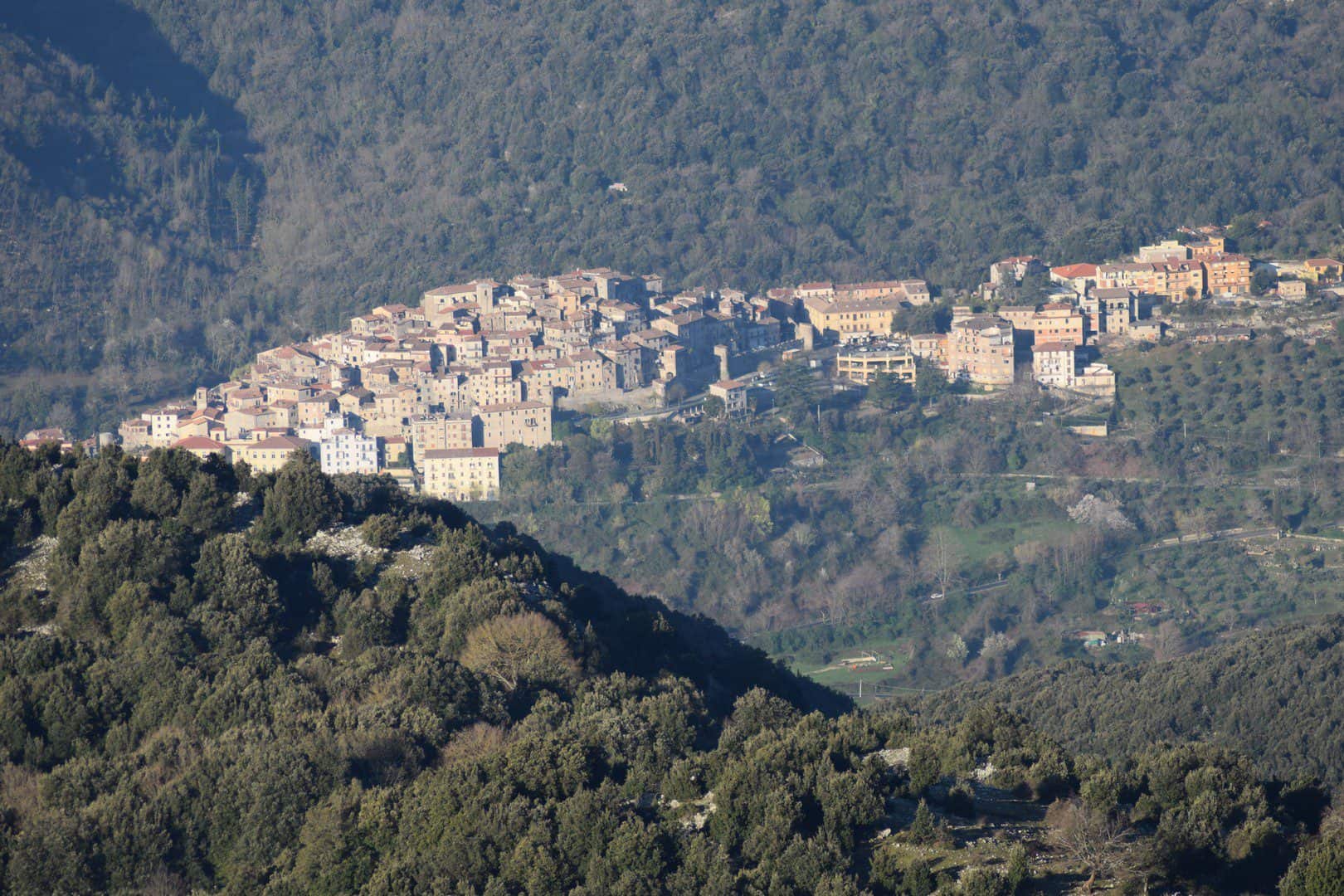

Bassiano is a town of just over 1,400 inhabitants in Latina Province, perched at 562 meters on the Pontine side of the Lepini Mountains, on a municipal territory of 31.6 square kilometers. The postal code is 04010, the area code 0773, the inhabitants are called bassianesi and the patron saint is Sant'Erasmo, the bishop of Formia whose liturgical feast falls on June 2. From Rome it's about 60 kilometers as the crow flies and about an hour and a half of actual driving: you go down the Pontina toward Latina, aim for Sermoneta, and climb on the provincial road that winds through the olive groves. By public transportation the reference is Latina, served by the Rome-Naples railway via Formia with a stop at Latina Scalo, and from there the regional Cotral bus line reaches Bassiano. The schedules, few and concentrated in school hours, must be checked on the carrier's website before leaving. By car you leave the car outside the walls, in the open areas along the ring road, because you can't enter the historic center: the village is a tangle of staircases. Visiting the town is free. The only ticket to budget for is the one for the Museo delle Scritture Aldo Manuzio, which the Ministry of Culture's portal lists at 3 euros with access by reservation, phone 0773 355013. Bassiano has the Touring Club Italiano Orange Flag.
Anyone who comes all the way up here usually wants to understand how this range is laid out. The page dedicated to the Lepini Mountains serves as the general map, and Bassiano is one of its best balconies.

Where Bassiano (LT) is and why its position explains everything else
The town occupies a saddle between Monte Carbolino and the buttresses that rise toward the Semprevisa, the highest peak of the Lepini at 1,536 meters. From below, from the Pontine plain, Bassiano can't be seen: a ridge hides it. That is its reason for being. Whoever founded it was looking for exactly this, a place invisible from the consular road and from the marshes, defensible with few arms, reachable only by paths that those who lived there knew by heart.
The administrative geography of Bassiano is curious: the municipal territory is almost all mountain, with a small foothill appendix that descends to the edge of the Agro Pontino, in the area of the Acquapuzza and the district of Antignano. Today that tongue of land is cut off from the rest of the municipality as far as roads go, and you look at it on the map wondering what sense it makes. The sense is historical, not modern: for centuries that was the only portion of Bassiano's territory facing the plain, and in ancient times it was the main access route to the hill center, which rises right behind the foothill locality.
The real distances around Bassiano
Sermoneta is a few kilometers of hairpin bends away, and with it the Ninfa Garden at the foot of the mountain. Sezze is on the other side of the ridge, Priverno and its archaeological park farther south. Latina, the provincial capital, is about 20 minutes of descent away. The sense of remoteness you feel in the alleys is therefore largely an optical effect: Bassiano is isolated vertically, not horizontally.
How to get to Bassiano by car
From Rome the simplest road goes along the Pontina as far as Latina, then you take the road toward Sermoneta and climb. The last stretch is a narrow provincial road, with blind curves and dry-stone walls: in winter, after a frost, it can be slippery in the shaded sections. Those coming from Frosinone and Ciociaria cross the Lepini via Sezze or Maenza, a longer route but much more beautiful, all woods and passes.
How to get to Bassiano by public transportation
There is no railway station in Bassiano or in the immediate vicinity. The hub is Latina Scalo on the Rome-Naples line via Formia. From there and from the provincial capital leave the Cotral buses that climb up toward the village. It's a service designed for residents and students, so with low frequencies and heavy cuts on weekends and in summer: anyone who wants to visit Bassiano in a day without a car has to build the itinerary around the published schedules, not the other way around. The advice is clear: for the Lepini you need a car, or a rented minibus with a driver if you're a group. Public transportation exists here, but it isn't designed for tourism.
The spiral village: the walls, towers and gates of Bassiano
Bassiano has a layout you don't forget: an ascending spiral. The houses wrap around the cone of the hill in concentric circles that climb, and at the top of that spiral are the Sant'Erasmo parish church and the square of the Torre Civica. It's a defensive layout before an urban one: whoever came in through a gate had to go around the whole ring to reach the top, in full view of everyone, and every curve was a blocking point.
The castle walls built by the Caetani
The castle walls date to the 13th century and were commissioned by the Caetani, the family that dominated this slice of southern Lazio for centuries. They aren't a decorative enclosure: they are the load-bearing structure of the town. The houses lean on the curtain wall, the curtain wall holds the terracing, the terracing supports the road above. Removing a piece of wall here would mean sending a whole block sliding downhill. A series of small stairways connects the rings to each other and creates a play of alleys and covered passages that culminates toward the top.
The nine towers of Bassiano
Around the walls you count nine towers. Some can still be read as such, with their square section and the masonry of irregular blocks of Lepini limestone. Others were absorbed into houses in later centuries, and you recognize them only if you look up and notice the change in masonry halfway up the facade. That's the detail to look for: the break between the medieval stone, large and roughly dressed, and the smaller, more regular masonry that was added on top of it from the 16th century onward.
The three gates of the village of Bassiano
There are three entrances to the historic center. They weren't simple openings in the curtain wall, but the threshold between two worlds that in the Middle Ages remained well separated: the urban and the rural, the inside and the outside, those with citizenship rights and those who came in to sell or work. The best known is Porta Nuova, and passing through its arch you find yourself almost immediately on the belvedere terrace, overlooking a sea of green made of beeches, holm oaks and oaks. The other gate worth naming is Porta Salamandra, the old access to the Castrum, today the entrance of the municipal museum. The place name appears in the 16th-century documents of the Caetani, when the family bought houses and shops in that very locality to absorb them into the baronial palace.
The tower houses and alleys of Bassiano
The village's building fabric is made of tower houses: narrow, tall buildings, developed vertically because space inside the walls was finite and the family grew upward, one floor per generation. You enter by an external staircase, often of stone, that leads to the first level. The ground floor was the stable or the cellar. Between one house and the next run alleys barely wider than a man, covered by reinforcing arches that counter the thrust of the walls. Walking through them in summer is the most effective way to understand why people built like this in the mountains: the shade is continuous, and so is the draft.
And it's the same draft that made the prosciutto famous, but we'll get to that.
Bassiano | The history
The origins of Bassiano are not entirely clear, and local historiography has produced over the centuries hypotheses of variable fantasy. Some authors have invoked mythological deities. Others have brought in the Roman emperors, claiming that Bassiano was founded by the emperor Caracalla, whose family name was precisely Bassianus. Still others preferred the saint, imagining that the place name derives from Saint Bassian, bishop of Lodi. These are learned traditions, not documented facts, and should be taken for what they are.
The origins of Bassiano: shepherds, marshes and raids
The established history begins around the 10th century, and it begins in an unheroic way: a group of shepherds and farmers taking refuge in a place completely hidden from the view of the plain, because down below, along the coast and in the Agro, the raids gave no respite. It's the same dynamic that created half of Apennine Italy between the 9th and 11th centuries, the incastellamento. Here, though, the visual cover is so effective that the town is invisible from the valley, and that made the difference.
The first written records of Bassiano date to 1169. A document kept in the archive of the collegiate church of Santa Maria in Sermoneta refers to the recovery of the Castrum, taken by deceit from a Lord of Bassiano by a certain Gregorio Leonis. We don't know much else about that episode, but the legal formula already says it all: in 1169 Bassiano is a castrum, a fortified settlement with a lord, not a village of huts.
Bassiano, the Acquapuzza and the hypothesis on the name
The soundest hypothesis on the origin of the place name goes through the Acquapuzza, the tower and castle that watched over the pass between the mountain and the marsh. That site is the probable continuation of the Latin castrum of Acquaputrida, whose belonging to the emperor Caracalla is attested. From there would derive the personal name Bassianus, anciently attributed to the castle of the Acquapuzza and only later transferred to the hill center, when the population migrated upward, abandoning the foothill locality.
Supporting this reconstruction is also the place name of the district of Antignano, or Antignana, which would repeat in its name the adjective Antoninianus, again referable to Caracalla and to a villa of his whose existence is attested by ancient sources right near the castrum of Acquaputrida. We remain in the field of philological hypothesis, not documentary certainty. But it's a coherent hypothesis, which explains together the name of the town, the strange shape of the municipal territory and the stubborn link with a distant and inconvenient strip of plain.

Bassiano | Middle Ages
In 1240 Pope Gregory IX appoints Trasmondo Annibaldi lord of the castles of Sermoneta and Bassiano, to thank him for the help received against the invasion attempts of Frederick II. It's a date that deserves attention because it captures the function of these villages: pawns in a game between papacy and empire, assigned as a political reward. The Annibaldi governed the town until 1297, the year in which the castle passed into the hands of the Caetani.
The Caetani held it until the abolition of feudal estates, with the parenthesis of the Borgia around 1500, when the family of Alexander VI got their hands on the Caetani domains in southern Lazio. It was a brief and violent interval, closed with the return of the castles to the old lords. The sources place that rule between the very last years of the 1400s and the first years of the 1500s.
The history of Bassiano in the 13th and 14th centuries is marked by spiritual movements, which here were not a background phenomenon but a social fact. The Spiritual Fraticelli, very strict observers of the rule of Saint Francis of Assisi and persecuted for it, found refuge in the Selva Scura cave, today annexed to the Santuario del Crocifisso. According to a local tradition the Knights Templar too left the mark of their passage, in the Santuario del Crocifisso and in the small San Nicola Church. Here, though, we are on the ground of tradition, not documentation, and it's better to say so clearly instead of feeding legends.
Bassiano | Renaissance
It's only at the beginning of the 16th century that the Caetani leave an architectural imprint of their rule over the land of Bassiano, and they do it with the baronial palace. It was Bonifacio Caetani, in 1554, who had an important palace built, conceived as a refuge from the dangers of the marsh and as a place of cure for his frail health. Mountain air against malaria: it was the medicine available, and for the lords it worked very well, because it consisted of going away to where the mosquitoes didn't reach.
The palace absorbs within itself medieval houses and shops that the Caetani had bought during the 15th century in the locality of Porta Salamandra, the main access route to the Castrum. That's why, entering the underground rooms today, you pass from 16th-century spaces to clearly older ones without leaving the building: the palace is a box that contains others.
In 1541 Camillo Caetani promulgates the statutes of Bassiano. It's worth understanding what that means: everything passed under the duke's control, property, family, church, weights and measures, the price of bread. But right at that time a weapon more powerful than gunpowder and harquebuses was dawning, and it bore the name of a native of Bassiano. The book. Through the humanist printer Aldo Manuzio, the book spreads culture and ideas, and begins to take away from the courts their monopoly on knowledge.

Aldo Manuzio, the native of Bassiano who invented the modern book
If Bassiano had given the world only its walls and its prosciutto, it would be one nice Lepini village among many. Instead it gave the man who decided how the books we read are made. Aldo Manuzio was born here between 1449 and 1452, in a town of shepherds and farmers squeezed inside nine towers, and died in Venice on February 6, 1515, after printing about 130 editions that changed the history of reading in Europe.
His education: Rome, Ferrara, Carpi
Manuzio studied Latin in Rome between 1467 and 1475, with Gasparino da Verona and Domizio Calderini, then Greek in Ferrara with Battista Guarino. In Ferrara he met Giovanni Pico della Mirandola, and that friendship opened the door to the court of Carpi, where he became tutor to Alberto and Lionello Pio. Most likely it was the Pio who financed the first steps of the printing venture: without that initial capital, the boy from Bassiano would have remained an excellent provincial Hellenist.
The Venice press and the Aldine editions
Manuzio settled in Venice around 1490 and in 1494 opened his press in the district of Sant'Agostino. The project was explicit and ambitious: to preserve Greek literature and philosophy, together with the heritage of the Latin world, spreading its masterpieces in accurate printed editions. In a few years his volumes were known all over Europe under the name of Aldine editions, and still today the term Aldine identifies for scholars a precise and precious object.
Between 1495 and 1498 he printed the complete works of Aristotle in Greek, five folio volumes that represent one of the boldest publishing undertakings of the century. In 1499 the Hypnerotomachia Poliphili came off his presses, the most beautiful illustrated book of the Italian Renaissance, an incunable that historians of graphic design continue to study page by page.
Italic type, the pocket book, the semicolon
In 1501 Manuzio launched a series of classics in which italic type was used for the first time, designed for him by Francesco Griffo and inspired by chancery handwriting. The first book set in that type was Virgil's Bucolics. In the same years he introduced the octavo format, the volume you hold in one hand and carry in a pocket or a saddlebag: the enchiridia, the handbooks. It is the direct ancestor of the paperback, and it was born from a commercial insight even before a cultural one, namely that readers wanted to carry their book on them.
Manuzio is also credited with the definitive arrangement of modern punctuation, with the invention of the semicolon and the regularization of the use of the comma and the apostrophe, and with the systematic practice of page numbering and indexes. Every time you cite a page of a book, you use a convention that starts from a man born in this village.
The anchor, the dolphin and the festina lente
The Aldine printer's mark is an anchor wrapped by a dolphin, accompanied by the motto festina lente, hasten slowly. It is the most famous logo in the history of printing and it continues to be copied: it means that haste and patience must work together, the anchor that holds back and the dolphin that darts. On the 16th-century editions on display in the town that symbol is recognizable at a glance.
The Aldine Academy and Erasmus of Rotterdam
In 1502 Manutius founded the Aldine Academy in Venice, a fellowship of scholars that required its members to speak only in Greek. Pietro Bembo and Erasmus of Rotterdam gravitated to it, and Erasmus stayed in Venice working on the new edition of the Adagia right at the Aldine house. The publishing dynasty continued with his son Paolo and with the Torresani heirs until around 1590.
One last piece of news that shows how far the name has traveled: in 1985 the page layout program that inaugurated desktop publishing was christened Aldus PageMaker in his honor, and in 2016 Italy dedicated a commemorative stamp to him. Not bad for a town of 1,400 souls.
The Museo delle Scritture Aldo Manuzio in Bassiano
The Museo delle Scritture Aldo Manuzio occupies the rooms of the 16th-century Palazzo Caetani, now home to the municipal administration, and is entered through Porta Salamandra, the old city gate. It is not a museum of manuscripts under glass: it is a historical and anthropological path through the forms of writing, built with sets and interactive devices that focus on learning through direct experience.
How to Visit the Museo delle Scritture in Bassiano
Admission is listed by the Ministry of Culture portal at €3, with opening by reservation every day of the week, and the reference phone number is the Comune's 0773 355013. The official sources don't entirely agree on hours and contacts, so the practical rule is just one: call before you go up, and have them confirm day, time and guide availability. Guided educational visits and thematic workshops are planned by reservation, which is why this museum works very well with school groups and organized groups. If you show up unannounced on a Sunday afternoon you risk finding the door closed, and it would be nobody's fault.
The Aldine Works and Bassiano's Collection
For over a decade the town has been building a collection of Aldine works, that is, volumes that came out of the press of Manutius and his heirs. Later, in collaboration with the Università degli Studi di Roma La Sapienza, the museum project proper was born, with the aim of restoring and enhancing the room that holds important prison graffiti from the late 18th century. The museum pays homage to its most famous fellow citizen and works as a center for research, conservation and enhancement of writings.
The Printing Machine Rooms
Three rooms display printing machines and trace a path in which you read the evolution of writing from stone tablets to computers, passing through the mail, cell phones, posters, pens. The installation highlights the forms of communication that wrote history and the technological revolutions that made them possible: the screw press, movable-type composition, hot printing. The testimonies on display also document the relationship of the town's inhabitants with writing in work practices, school experiences, autobiographical and lyrical ones. It's the part that surprises most, because it moves the museum from the celebration of genius to the story of those who wrote shopping lists and letters to children who had emigrated.
The Aldo Manuzio Room
One room is dedicated directly to the printer, and the installation uses the device of the impossible interview: the visitor questions Manutius and Manutius answers. It's a theatrical expedient that works very well with kids, because it forces you to formulate the right question instead of passively reading a panel. Alongside, the 16th-century printed books with the anchor and the dolphin and the motto festina lente.
Non-European Writing Systems
Another room, set up like a bazaar, gathers non-European writings: Chinese, Korean and other graphic systems that the average Italian visitor has seen 1,000 times without ever looking at them. It serves to dismantle the implicit idea that writing means lining up 26 letters from left to right.
The Graffiti Room: Bassiano's Real Masterpiece
The room titled Graffiti, or the Secondary Advantages of Exclusion, is the most relevant room in the palace and the most significant with respect to the museum's theme. It required many restoration works and a careful enhancement, carried out with La Sapienza University. The walls show graffiti and charcoal drawings: texts of denunciation, reproductions of landscapes, religious symbols, faces, and much more that is not always immediately identifiable or fully understandable.
It is legitimate to suppose that those writings, in large part dating from the end of the 18th century and the first decades of the 19th century, were produced by people held in confinement, when the building housed the prison. And this is where the museum is at its best: writing as the only thing left to someone who has been removed from every social circuit. The graffiti evoke the stories and mentality of that period with a force that no educational panel can replicate. If I had to point to a single thing to see in Bassiano, I'd point to this room, not the view.
The School Classroom and the Multimedia Lab
The path also includes the reconstruction of an elementary classroom from the Fascist era, with the desks, the pen nibs, the inkwells and the notebooks of the time, and a multimedia lab that closes the route on the present. The leap from the pen nib to the screen is barely two generations, and lined up like this it makes quite an impression.

What to See in Bassiano | Monuments and Places of Interest
Bassiano's historic center can be walked in an hour if you walk, in three if you look. The 16th-century Palazzo Caetani, home of the municipal administration and of the Museo delle Scritture, is the hub: around it are the birthplace of Aldo Manuzio, the churches, Piazza della Torre Civica and the Porta Nuova viewpoint.
Bassiano | Religious Architecture: Sant'Erasmo Church
The parish church, dedicated to Sant'Erasmo, bishop of Formia, was built around the 12th century and occupies the highest point of the spiral, with the square of the same name in front. The many restoration works over the centuries have radically changed the architecture of the original building, and whoever is looking for the Romanesque will be disappointed: what you see is largely a later guise.
On the facade there is a bas-relief depicting Christ blessing. The interior, typically neoclassical, is divided into three aisles. Behind the main altar opens a semicircular apse that holds a wooden choir from 1852, carved by the cabinetmaker Frattini. Three canvases are placed above the choir, and the central one was made in 1599 by Francesco da Castello Flander, a Flemish painter active in Rome and southern Lazio straddling the 16th and 17th centuries.
In a small chapel at the end of the left aisle there is a baptismal font from the 12th century, supported by a marble lion from the Romanesque period: it is the oldest and most beautiful piece in the church, and almost nobody looks at it because the light there is poor. The same chapel holds many frescoes from 1582. The last restoration of Sant'Erasmo Church dates to 2002.
Bassiano | San Nicola Church
Originally dedicated to Saint Peter the Apostle, San Nicola Church dates to 1200. The Latin-cross structure divides the building into two aisles, the side one with a cross vault and the central one with a truss roof, plus a transept. It's an irregular plan, the result of later additions, and for that very reason interesting: you read the history of the building site in the asymmetries.
The frescoes cover the walls almost entirely and are of popular taste: they tell the lives of the saints in a direct language, made for those who couldn't read. Among the scenes you recognize episodes the visitor doesn't expect in a mountain church, like the woman struck by the plague, and Herod and Salome. Of particular interest is the stone pulpit, leaning against a retaining wall and propped up by a column with an ornate base.
On the back wall, above the main altar, a fresco depicting the Virgin with Child was found: until the restoration it was covered by a large 17th-century altarpiece, following a common practice in churches refitted after the Council of Trent. In the central aisle is kept a precious oil on panel depicting the Most Holy Savior, the work of the Renaissance painter Girolamo Siciolante da Sermoneta, a pupil of Perin del Vaga and a leading figure of Lazio Mannerism. That a painting by Siciolante is in Bassiano is no accident: the painter was born in nearby Sermoneta, capital of the Caetani fief.
Bassiano | Santa Maria Church
The small church of Santa Maria began as part of a Benedictine monastery in the 12th century. It is on two levels: the oratory above and the chapter house below, entered from Via delle Mura, below. The lunette above the entrance portal bears a fresco of Christ blessing, which takes up the theme of the bas-relief of Sant'Erasmo.
Inside, now used as a multipurpose space, two frescoes remain visible in the apse area. The Santa Maria multipurpose center currently hosts two exhibitions: one on the unification of Italy and the museum of malacology, with shells from all over the world. It's an eccentric pairing, let's face it, but small towns do things this way, and a shell collection in a mountain town 20 kilometers from the sea has its paradoxical appeal.
Bassiano | Sanctuary of the Crucifix and the Selva Scura Cave
The Sanctuary of the Crucifix stands about three kilometers from the town center, in the Selva Scura area, and its oldest parts date to around the 12th century. It takes its name from the wooden Crucifix kept inside, carved by Fra' Vincenzo Pietrosanti in 1673. It is easily reached from the center of Bassiano starting from Porta Nuova, following Via della Croce and turning onto Via Fra Vincenzo Pietrosanti.
The place was inhabited from the beginning by the Franciscan Spiritual friars, excommunicated by Pope John XXII, and according to local tradition also by the Templar knights coming from the nearby Valvisciolo Abbey. The building, modest in size, holds the Selva Scura cave, also called the Templars' cave, entirely frescoed. The frescoes probably date to the first half of the 15th century. Adjoining the cave is the round chapel, built in the second half of the 17th century to house the wooden sculpture of the Crucifix. The sanctuary is the subject of a long and complex restoration phase begun in 1976 and not yet concluded: before going up it's best to make sure it can be visited.
Bassiano | Sanctuary of the Most Holy Trinity
The Sanctuary of the Trinity is about five kilometers from Bassiano. The small building was probably built around the middle of the 17th century and fell into ruin from the bad weather that beat down on it over the centuries. It was then entirely rebuilt by the people of Bassiano in the late 1930s. In the 1990s it underwent a new restoration, wanted by the parish priest Don Angelo Buonaiuto and the population, with the help of the helicopter unit of the State Forestry Corps and many volunteers. The presence of helicopters in the story is not a mere colorful detail: it tells how awkward it is to carry building material up there.
Aldo Manuzio's Birthplace in Bassiano
In the historic center the birthplace of Aldo Manuzio, famous 16th-century publisher, is pointed out. It's a modest dwelling, consistent with the fabric of the tower-houses, and it should be looked at knowing that the identification rests on local tradition more than on a notarial act: nobody, in 1450, recorded the birth of a peasant's son thinking he would become the man who would invent the paperback.
Bassiano Ham: Why It's Different from the Others
Bassiano ham is a traditional dry-cured ham produced in this municipality of the Lepini Mountains and included by the Lazio Region in the list of traditional agri-food products. It is not a DOP or IGP product, and anyone who presents it as such is wrong: it is a product with a regional traditional designation, whose reputation rests on the processing technique and the microclimate, not on a European production specification.
The Wind That Makes Bassiano Ham
The technical reason is an atmospheric phenomenon. The cold tramontana winds coming down from the Lepini Mountains meet the humid climate of the Agro Pontino and generate continuous, constant air currents, never stagnant. For the natural curing of a pork leg this is the ideal condition: moving air, cool temperature, humidity that doesn't stagnate. The narrow tower-houses and the shaded alleys of the village work as a natural chimney, and for centuries the people of Bassiano have hung the hams exactly where the air pulled the most.
How Bassiano Ham Is Made
The complete process takes 17 or 18 months. It starts from a trimmed leg of over 13 kilograms, which at the end of the process will yield a finished product of around eight or 10 kilograms. The documented stages are a bath in white wine with garlic and pepper, a double salting done by hand, the coating with lard, salt and chili pepper, two distinct curing phases separated by smoking with beech wood, and a final curing of 12 or 13 months.
The result has an intense red color, a decidedly salty taste and a slightly smoky profile that sets it apart immediately from the dry-cured hams of the North. It's a ham for palates that aren't afraid of salt. If you're used to the sweetness of Parma, the first taste will throw you: give it the time of a second bite, because the difference is the point, not the flaw.
The Bassiano Ham Food Festival
The traditional festival is held on the last Sunday of July and turns the village into a single table: prosciutto sliced on the spot, Lepini cheeses, the local wine. It's the busiest day of the year, and it must be said with professional honesty that the village is at its best at another time. But if your interest is gastronomic, the festival remains the occasion to taste and compare the productions of the town's different workshops without going around the shops.
The Lepini Mountains around Bassiano: hikes and nature
Bassiano is surrounded by lush nature and a panorama of olive groves, vineyards, woods and meadows. The Lepini Mountains are a limestone and dolomite massif that extends between the provinces of Latina, Rome and Frosinone, divided into two subgroups by a valley that runs between Montelanico and Maenza. Karst features are pronounced: sinkholes, swallow holes, caves and shafts of considerable speleological interest. Rainfall is abundant, and at high altitudes exceeds 2,000 millimeters a year, which explains the deep beech woods on the north slopes.
Monte Semprevisa above Bassiano
The highest peak of the range is Monte Semprevisa, 1,536 meters, in the territory of Carpineto Romano but also reachable from the Bassiano side. The climb from Bassiano is the shortest of the classic ones and takes about two and a half hours. On the Bassiano side, at around 1,052 meters, a self-managed hut operates, the Liberamonte, with a fireplace and basic supplies kept up by the visitors themselves: it works on trust and common sense, and whoever passes through leaves more than they take.
From the summit the view covers the entire Pontine plain with the Circeo promontory, the coastal lakes and, on clear days, the Pontine Islands. On winter days of strong tramontana, with binoculars, you can make out Ischia. It's the kind of view that pays back every meter of elevation gain.
The peaks and watercourses of Bassiano's territory
Among the peaks of the municipality are Dosso dell'Ospedale, Monte Calovella, Monte Carbolino, Monte Castellone, Monte del Cerro, Monte della Bufala and Monte Furchia Vecchia. The Brivolco stream also rises in Bassiano's territory and flows farther downstream into the Ufente river, in the territory of Sezze, in the heart of the Pontine plain. It's a modest but precious watercourse, because in a limestone mountain like this surface water is the exception: almost everything sinks into the karst and reemerges at the springs of the plain, like those that feed the river of Ninfa.
The Sant'Erasmo hermitage in the Lepini
Among the hiking destinations in the area is the Sant'Erasmo hermitage, reached from the Roccagorga side and the starting point of some of the most frequented itineraries of the massif, toward Monte Erdigheta and Monte Pizzone. The saint is the same as the Bassiano parish church, and the coincidence tells how deeply rooted the cult of Erasmus of Formia was across this whole side. The trail signage is that of the Club Alpino Italiano. For the climb to the Semprevisa, the reference is the itinerary named after the mountaineer Daniele Nardi.
Via Francigena from Bassiano to Sermoneta
From Bassiano you can walk a stretch of Via Francigena that descends toward Sermoneta. It's a demanding hike, with a downhill elevation drop and uneven ground, and the practical advice is to organize it with two cars or with a ride back, because the climb back at the end of the day is hard. The stretch makes up for it with what you see along the way: the plain opening up, the Caetani castle of Sermoneta growing on the horizon, the terraced olive groves.
Festivals and events in Bassiano
Life in the village follows a calendar that is busy for a town of this size. The Prosciutto festival at the end of July is the main event. In August come the Notte Rosa and the three days of the Bassiano Ferragosto, with music, long tables and games in the squares. At the end of September the Best Wine festival takes place, when the old shops of the historic center open for days of tasting devoted to local wines and not only: it's the formula I prefer, because it forces you to go inside the spaces of the village instead of staying in the square. In winter the medieval carnival stages the town as it was, with costumes and parades along the spiral of the walls. It's best to check the complete and updated calendar of events before leaving, because dates shift from year to year.
A curiosity about Bassiano (LT)
The curiosity of Bassiano is not in the stone: it's in the punctuation. The semicolon, that mark nobody knows how to use anymore and that editors have fought over for centuries, was settled into its modern form by a man born in this mountain village between 1449 and 1452. Aldo Manuzio, in his Venetian print shop opened in 1494, did not just print: he standardized the way text breathes. The comma, the apostrophe, the semicolon, page numbering, indexes. They are invisible infrastructures of reading, and we use them every day without knowing they come out of the head of a man from Bassiano.
There's more, and it concerns the body of books. In 1501 Manuzio launches a series of classics set in a new typeface, designed by Francesco Griffo, slanted and narrow: italic. The first volume is Virgil's Bucolics. That typeface served to fit more text into less space, because the format was small, octavo, meant to be carried on the person. It's the pocket book, 450 years before anyone called it that. The italic we use today for emphasis was thus born as an engineering solution to a problem of bulk, and the real curiosity is that the English word italic still preserves, in its name, the nationality of its invention.
The town museum holds sixteenth-century printed books with the anchor and dolphin mark and the motto festina lente. Looking at them knowing that the man who produced them was born inside these walls changes the experience quite a lot: the history of European culture, for once, doesn't go through a capital.
Something nobody tells you about Bassiano (LT)
No guide will tell you that the strongest piece in Bassiano is not medieval, not Renaissance and not a church: it's the walls of a prison. In the basements of Caetani Palace, when the building housed the jails, the inmates scratched and drew in charcoal on the walls. Texts of denunciation, landscapes, religious symbols, faces. A large part of those writings dates to the late 1700s and the first decades of the 1800s, and it is firsthand documentary material on a social class that normally leaves no papers: the excluded don't write books.
The title the museum gave the room is already a small essay in anthropology: Graffiti, or the Secondary Advantages of Exclusion. The secondary advantage is this, that the man removed from the world writes on the wall, and 200 years later the wall still speaks. The restoration and the study were carried out with Sapienza University of Rome, and not all the marks are deciphered: some remain of uncertain identification and partial understanding.
The second thing nobody tells you concerns logistics: the museum opens by reservation, not on continuous hours like a civic museum in a city. That means Bassiano's masterpiece can only be seen if you called ahead. It happens that people come all the way up here, take photos at the viewpoint and leave without knowing they missed the graffiti room over a phone call they didn't make. The town hall's number is 0773 355013, and it's worth dialing it a few days ahead.
The advice I give you for visiting Bassiano (LT)
The practical advice is one and it's worth the whole day: reserve the museum before you get in the car, and build the rest of the visit around the time they give you. Everything else in Bassiano is free and accessible at any time, the graffiti room is not.
As for when to go, there's no doubt: the best period is between mid-September and the end of October. The light is low and warm, the olive groves are being harvested, the temperature at 562 meters is perfect for walking and the wine festival at the end of September reopens the shops of the historic center. July and August are still tolerable here thanks to the altitude and the tramontana, but on the weekend of the food festival the town fills up and the visit becomes something else, more gastronomic and less contemplative. Winter has its stern appeal, with the plain under a blanket of haze and the village above in the sun, but you have to allow for the provincial road possibly being icy at dawn.
On getting around: shoes with lugged soles, always. The paving of the alleys is slick, uphill, and in the rain it becomes a slide. Leave the car in the lots along the outer ring road and walk up: driving into the historic center is technically impossible and administratively forbidden. Bring a bottle of water, because the full tour of the walls with the detours to the churches involves a not-trivial elevation gain.
One last piece of advice: give Bassiano a full half day, not an hour and a half. The village is used up quickly if you treat it as a stop between Ninfa and Sermoneta, and then yes, it will look the same as a hundred other Lepini towns. Sit on the terrace of the Porta Nuova viewpoint for 20 minutes doing nothing, then go into San Nicola Church and look for the ambo. It changes everything.
Another well-known fact, and yet rarely cited
Everyone knows that an excellent prosciutto is made in Bassiano. Almost nobody asks why right here, and the answer is meteorological before it is gastronomic. Bassiano sits exactly on the line of conflict between two air masses: the cold tramontana coming down from the Lepini ridges and the humid air rising from the Agro Pontino. The contrast generates continuous air currents, and the natural curing of a ham wants precisely this, air that never stops.
The rarely cited fact is that this condition can't be reproduced elsewhere by decree. You can copy the recipe, meaning the bath in white wine with garlic and pepper, the double salting by hand, the coating with lard, salt and chili pepper, the smoking with beech wood, the 12 or 13 months of final curing out of a total cycle of 17 or 18. You can't copy the air current. That is why Bassiano prosciutto has a salty, slightly smoky profile that doesn't resemble any of the great cured hams of the North, and it is also why production, industrialized from the late 1960s, has stayed tied to this handful of square kilometers.
It's worth adding a clarification that rarely circulates: Bassiano prosciutto appears in the regional list of traditional agri-food products of Lazio, not among the protected European designations. Let whoever buys it know what they're buying, and know too that the reputation, in this case, was built by the air and not by a label.
The right photo to take in Bassiano (LT)
The photo everyone takes in Bassiano is the one from the Porta Nuova viewpoint, with the sea of green of beeches, holm oaks and oaks descending toward the valley. It's a beautiful image and it should be taken, preferably in the late afternoon when the raking light separates the volumes of the forest. But it's not the right photo.
The right photo is taken from outside, from the provincial road climbing up, at any point where the road opens and the town appears whole: because it's from there that you understand the spiral. Bassiano seen from outside is a cone of houses winding on itself, with the castle walls marking the rings and the parish church of Sant'Erasmo closing the top together with the Civic Tower. No photo taken inside the village captures that structure, because inside you only see alleys. The best time is first thing on a winter morning, when the Pontine plain below is submerged in fog and the town floats above it like an island: it's a frequent phenomenon from November to February on high-pressure days.
The second shot I recommend is technical and must be taken inside the museum, where it's allowed and following the staff's instructions: a detail of the graffiti wall, in raking light, with the lens parallel to the wall. The charcoal marks from the late 1700s have very low contrast, and only side light brings them out. It's not a photo to show friends, it's a photo you look at afterward, zooming in, and in which you keep finding something: a date, a signature, the profile of a face.
The third, for those who walk: the summit of Semprevisa at 1,536 meters with the plain, Circeo and the coastal lakes in the background. From there, on clear days, the Pontine Islands enter the frame.
Some important events that took place here in history
The first documented event concerning Bassiano dates to 1169 and takes the form of a quarrel. An act preserved in the archive of the collegiate church of Santa Maria in Sermoneta records the recovery of the Castrum, which a certain Gregorio Leonis had taken by deceit from a Lord of Bassiano. We don't know the deceit, but the source fixes a point: at the end of the 12th century the town exists as a fortified castle with a lordship and a dispute over who owns it.
The second is from 1240, and comes out of a European war. Pope Gregory IX appoints Trasmondo Annibaldi lord of the castles of Sermoneta and Bassiano as a reward for the help received against the invasion attempts of Frederick II of Swabia. Bassiano thus enters, as a supporting player, the greatest political game of the 13th century, the one between papacy and empire, and comes out of it assigned as a prize to a Roman baronial family.
The third event is from 1297: the castle passes to the Caetani, who will hold it until the abolition of the fiefs. These are the years of Boniface VIII, the Caetani pope, and the transfer is not an isolated case but one piece in the building of the family holdings between Anagni, Sermoneta and the Pontine plain. Around 1500 comes the Borgia interlude, who seize the Caetani castles for a short period, closed with their return to the legitimate lords.
The fourth is from 1541, and it's a legal fact worth a battle: Camillo Caetani promulgates the statutes of Bassiano. From that moment the life of the town has a written form, from property to family to church, and writing becomes the instrument of power in a village that shortly after would become famous precisely for a man who did the exact opposite with writing, that is, put it in everyone's hands.
The fifth is from 1554, when Bonifacio Caetani has the baronial palace built, absorbing the medieval houses and shops purchased in the 1400s at Porta Salamandra. And the sixth, the most recent and perhaps the most moving, belongs to the 1900s: the complete reconstruction of the Sanctuary of the Most Holy Trinity, which fell into ruin from the weather and was rebuilt by the people of Bassiano at the end of the 1930s, then restored in the 1990s with the help of volunteers, the parish priest don Angelo Buonaiuto and the helicopters of the State Forestry Group.
Who passed through Bassiano (LT)
The name that weighs more than all the others did not pass through Bassiano: he was born here. Aldo Manuzio first saw light here between 1449 and 1452, and from here he left for Rome, where he studied Latin between 1467 and 1475 with Gasparino da Verona and Domizio Calderini, and for Ferrara, where he learned Greek with Battista Guarino. In Ferrara he met Giovanni Pico della Mirandola, and it was that friendship that brought him to the court of the Pio of Carpi as tutor to Alberto and Lionello. He died in Venice on February 6, 1515, leaving about 130 editions and a publishing dynasty that his son Paolo and the Torresani heirs carried on until about 1590.
Through Manuzio, Bassiano is indirectly linked to some of the major figures of the European Renaissance. Erasmus of Rotterdam frequented the Aldine house in Venice and worked there on the new edition of his Adagia. Pietro Bembo was a member of the Aldine Academy, founded in 1502, where by statute only Greek was spoken. Francesco Griffo, the Bolognese punch-cutter who designed the italic, worked for the man from Bassiano and quarreled with him, as happens with great craftsmen.
On the spot, the figures who left a trace are the lords. Trasmondo Annibaldi, invested by Gregory IX in 1240. The Caetani, for seven centuries: Camillo, who promulgated the statutes in 1541, and Bonifacio, who in 1554 built the baronial palace, looking in the mountains for a cure for his frail health. The Borgia, for the brief season around 1500.
Among the artists, the most illustrious passage is that of Girolamo Siciolante da Sermoneta, the Mannerist painter born in the neighboring fief, whose oil on panel of the Most Holy Savior is kept in San Nicola Church. And then Fra' Vincenzo Pietrosanti, who in 1673 carved the wooden Crucifix of the sanctuary of Selva Scura and after whom the town named the road that leads to that sanctuary. Finally, without names but with a very strong presence, the anonymous inmates who between the end of the 1700s and the first decades of the 1800s scratched the walls of the prison of Caetani Palace: they passed through Bassiano against their will, and they left us the most alive document the town possesses.
Bassiano (LT) with children, accessibility and practical visit
Bassiano with children
The Museo delle Scritture works particularly well with kids from age seven up, thanks to the interactive devices, the reconstructed classroom and the thematic workshops by reservation. The room of non-European writings, set up like a bazaar, is usually the one that captivates them most. The village itself is a safe labyrinth, without traffic, and children happily run around in it. The only caution concerns the stairways, steep and sometimes without a railing on the valley side.
Accessibility in Bassiano
We have to be honest: a village built in a spiral on a hill, all small stairs and slopes, is not an easy environment for anyone with mobility difficulties or for a stroller. Some stretches of the ring road and the area around Caetani Palace are passable, the rest much less so. Anyone with specific needs should call the town hall along with the museum reservation and ask which spaces are actually reachable.
How long a visit to Bassiano takes
The tour of the historic center with the three churches takes two hours walking calmly. The museum adds a good hour if you follow the whole route. The Sanctuary of the Crucifix, three kilometers away, takes another half day if you reach it on foot from Porta Nuova, much less by car. Half a day is the sensible minimum, a full day is the right measure if you add a lunch with the local prosciutto.
Where to sleep and eat in Bassiano
The town's accommodation offer is small and family-run, and the same goes for the restaurants: few signs, Lepini cooking, local cured meats and cheeses, legume soups. Anyone looking for a bigger base relies on Sermoneta or the coast. The suggestion remains to have lunch here and sleep elsewhere only if the schedule requires it: a night in Bassiano, with the town empty after sunset, is an experience worth the trip.
What to see around Bassiano (LT)
Bassiano works very well as a base or as a stop on a Lepini itinerary. A few kilometers away are Sermoneta with the Caetani Castle and the Ninfa Garden, which opens only on set dates and requires a reservation. A little farther on you climb to Ancient Norba, the Latin city destroyed in 81 BC, with polygonal walls among the best preserved in Lazio, and to Norma, the natural balcony over the plain.
Heading south you reach Sezze, the Privernum Archaeological Park and Priverno with its museums. On the inner side of the Lepini you find Carpineto Romano, birthplace of Leo XIII and the municipality within whose territory the summit of Semprevisa falls, Montelanico, Artena, Lake Giulianello and Cori with its Republican temples.
Anyone who wants to stretch toward Ciociaria has Genazzano, the Paliano Wood, Anagni with the Palace of Boniface VIII, Fiuggi, Ferentino, Fumone, Alatri with its acropolis, Guarcino, Collepardo and Vico nel Lazio. Toward the sea, in just under an hour, you arrive at the Circeo National Park, Sperlonga and Formia, the city of Bishop Erasmus, with the Sant'Agostino beach just beyond.
Quick questions about Bassiano (LT)
Where is Bassiano (LT)?
Bassiano is in Latina Province, on the Pontine side of the Lepini Mountains, at 562 meters of elevation, behind Sermoneta and above the Pontine plain. The postal code is 04010.
How far is Bassiano from Rome?
About 60 kilometers as the crow flies to the southeast. By road, via the Pontina and Latina, allow a good hour and a half.
How do you get to Bassiano without a car?
You take the train to Latina Scalo on the Rome-Naples line via Formia and continue on the regional Cotral bus toward Bassiano. The runs are few and concentrated in school hours. The times should be checked on the carrier's website.
Can you drive into Bassiano's historic center?
No. The village is made of stairways and alleys a little wider than a man. You park in the lots along the outer ring road and walk up.
How much does it cost to visit Bassiano?
The town can be visited for free. The only ticket is for the Museo delle Scritture Aldo Manuzio, listed at 3 euros by the Ministry of Culture portal. The rates should be confirmed at the time of booking.
Do you need to book the Museo delle Scritture in Bassiano?
Yes. It opens by reservation. The contact is 0773 355013 of the Bassiano town hall. Without a reservation you risk finding it closed.
How long does a visit to Bassiano take?
Two hours for the historic center and the churches, a good hour for the museum. Half a day is the minimum, a full day the right measure if you add lunch.
Why is Bassiano called that?
The most accredited hypothesis derives the name from the personal name Bassianus, linked to the castle of Acquapuzza and to the emperor Caracalla, whose family name was Bassianus. The place name would then have migrated to the hilltop town. Other traditions invoke Saint Bassian, bishop of Lodi. Neither of the two is documented with certainty.
Who was Aldo Manuzio and what does he have to do with Bassiano?
Aldo Manuzio was born in Bassiano between 1449 and 1452. He was the printer and humanist who in Venice, from 1494, invented the octavo pocket book, introduced italic type in 1501 and settled modern punctuation, semicolon included. He died in Venice on February 6, 1515.
How many towers does Bassiano have?
Nine towers along the 13th-century castle walls, and three gates into the village.
Is Bassiano an Orange Flag village?
Yes, Bassiano has the Touring Club Italiano Orange Flag, the tourism and environmental quality mark reserved for small inland municipalities with a valuable heritage and hospitality to match.
What do you eat in Bassiano?
Bassiano prosciutto first of all, a traditional cured ham with a deep red color, a salty flavor and a smoky note. Alongside it, Lepini cheeses, legume soups and local olive oil.
Is Bassiano prosciutto DOP or IGP?
Neither. It is included in the regional list of traditional agri-food products of Lazio.
When is the prosciutto food festival held in Bassiano?
The last Sunday of July. It is the busiest day of the year in the village.
When is the best time to visit Bassiano?
From mid-September to the end of October, for the light, the temperature and the wine festival at the end of September. Summer is livable thanks to the altitude, but on food festival days the town is crowded.
Is Bassiano suitable for children?
Yes, the museum is designed with interactive devices and workshops, and the village is traffic-free. Watch out for the steep stairways.
Is Bassiano wheelchair accessible?
Only in part. The spiral structure with stairways severely limits the routes. It's best to ask the town hall which spaces are reachable.
Can you take photos inside the Bassiano museum?
The rules on photography should be asked of the staff when you enter, as in any civic museum.
What can you see from Monte Semprevisa above Bassiano?
From the 1,536 meters of the summit you take in the Pontine plain, the Circeo promontory, the coastal lakes and the Pontine Islands. The climb from Bassiano takes about two and a half hours.
What's the difference between Bassiano and Sermoneta?
Sermoneta is the capital of the Caetani fief, with the castle and a historic center that is more monumental and more visited. Bassiano is the mountain village of the same fief, higher, more secluded, less visited, and it has two things Sermoneta doesn't: the room of prison graffiti and the memory of Aldo Manuzio.
Can you walk a stretch of Via Francigena from Bassiano?
Yes, the stretch that descends toward Sermoneta. It is demanding in elevation change and terrain. It's best to arrange two cars or a ride back.
Can you visit the Sanctuary of the Crucifix in Bassiano?
The complex is undergoing a long restoration begun in 1976 and not yet finished. Before covering the three kilometers it's best to make sure it's open.
How many inhabitants does Bassiano have?
A little more than 1,400 residents, over a municipal territory of 31.6 square kilometers.
Frequently asked questions about Bassiano (LT)
Where is Bassiano (LT) and how far is it from Rome?
Bassiano is in Latina Province, on the Pontine side of the Lepini Mountains, at 562 meters of elevation, behind Sermoneta and above the Pontine plain, postal code 04010. It is about 60 kilometers as the crow flies from Rome to the southeast, and by road, via the Pontina and Latina, you need a good hour and a half.
Why is Bassiano famous in the world of publishing?
Bassiano is famous because Aldo Manuzio was born here, between 1449 and 1452, the Venetian publisher who largely decided how the books we read are made. Manuzio printed about 130 editions in his print shop in Venice, opened in 1494, and the modern form of the semicolon is also owed to him.
What can you see at the Museo delle Scritture in Bassiano?
The Museo delle Scritture Aldo Manuzio, in Bassiano, occupies the rooms of the 16th-century Caetani Palace, seat of the town administration, entered through Porta Salamandra. It is not a museum of manuscripts under glass, but a historical and anthropological route on the forms of writing, built with stage sets and interactive devices designed for direct learning.
Why does Bassiano's historic center have a spiral shape?
Bassiano has an ascending spiral urban plan: the houses wind around the cone of the hill in concentric circles that rise to the parish church of Sant'Erasmo and the square of the Civic Tower. It is a layout designed first of all for defense, because whoever entered by a gate had to travel the whole ring to reach the top, under the control of those who lived there.
Is Bassiano prosciutto a DOP product?
No, Bassiano prosciutto is neither a DOP nor an IGP product: it is a traditional cured ham included by the Lazio Region in the list of traditional agri-food products, with a regional traditional designation. Its reputation rests on the processing technique and on the local microclimate, where the cold tramontana of the Lepini meets the humid air of the Agro Pontino, favoring natural curing.
Is Bassiano suitable for a visit with children?
Yes, Bassiano works well with children, in particular the Museo delle Scritture, which is designed for kids from age seven up thanks to the interactive devices, the reconstructed classroom and the workshops by reservation. The village itself is a safe labyrinth, without traffic, where children can move freely.
What is the best time to visit Bassiano?
The best time to visit Bassiano is between mid-September and the end of October, when the light is low and warm and the olive groves are being harvested. Before leaving, though, it's best to reserve the Museo delle Scritture, because the graffiti room in the basements of Caetani Palace can only be visited with guided access.
What are the main festivals of Bassiano?
Bassiano's calendar is packed for a town of this size: the Prosciutto food festival at the end of July is the main event, in August come the Pink Night and the three days of the Bassiano Ferragosto with music and long tables in the square, while at the end of September the Best Wine festival is held, with tastings in the old shops of the historic center.
Why come back to Bassiano (LT)
Bassiano is the Lepini town to defend most firmly when someone proposes skipping it to gain half an hour on the schedule. It doesn't have a photogenic castle like Sermoneta or the gardens of Ninfa, and the first impression from the provincial road is of a village like many others. Then you enter by Porta Salamandra, go down into the basements of Caetani Palace, switch on the raking light on the graffiti wall, and realize you are in front of the writing of men nobody was ever supposed to read. In the same building, a few meters away, the sixteenth-century printed books of a fellow townsman who taught Europe how to make a book. The most modest museum and the greatest story, in the same house.
Book ahead, climb slowly, and don't leave before you've walked the whole ring of the walls. Bassiano doesn't give itself at first glance, but it pays off well for those who give it a day.
If you're organizing a day in the Lepini for a group, it's best to hand the logistics to professionals: the TourLeaderPro tour leader service works on exactly this type of itinerary off the main circuits, and for a quote you go through the contact page. Anyone who is instead preparing the trip in English will find a general overview of the region in the ItalyPlanner guide to Lazio and ideas for day excursions on the page dedicated to day trips.
Article written by the editorial staff of TourLeaderPro, contact them for Private/Corporate/V.I.P. Tours and Experiences.
Preparing a trip to Rome? The English guides to visiting the city are on ItalyPlanner.com.