Formia (LT)
In short. Formia is a town of about 37,000 inhabitants in the province of Latina, stretched across the middle of the Gulf of Gaeta, 150 kilometers south of Rome and 80 north of Naples.
Formia is a town of about 37,000 inhabitants in the province of Latina, stretched across the middle of the Gulf of Gaeta, 150 kilometers south of Rome and 80 north of Naples. City Hall is at Via Vitruvio 190 (phone 0771 7781). You get here by train on the Rome-Naples line via Formia: Formia-Gaeta station is served by regional trains and Intercity trains from Roma Termini, with travel times from a little over an hour on the fastest trains to about an hour and a half on the regional ones. From the station to the National Archaeological Museum it's a 400-meter walk. By car: A1 highway to Cassino and then State Road 630 Ausonia down to the sea, or Via Appia (State Road 7) from Terracina through Fondi and Itri. Ferries and hydrofoils for Ponza and Ventotene leave from the port. The National Archaeological Museum of Formia is at Via Vitruvio 184: it opens Tuesday, Friday, Saturday and Sunday from 8:30 to 19:30 (last entry at 19:00), and is closed Monday, Wednesday, Thursday, January 1 and December 25. Full ticket €5, reduced €2 for ages 18 to 25, combined Sperlonga-Formia ticket €10 valid for 30 days. Phone 0771 770382. The Roman Cisternone of Castellone (entrance from Via Rampa Capo Castello) can only be visited with a guide and by reservation at 349 5328280 or at sinusformianus@gmail.com. The Tomb of Cicero on Via Appia opens according to a calendar with free guided visits, always by reservation at the same number. The beaches of Vindicio, Acquatraversa and Gianola are free or equipped depending on the stretch. The Gianola Blue Oasis is a WWF protected area inside the Riviera di Ulisse Regional Park.
Formia is one of the capitals of the Riviera di Ulisse, the stretch of Lazio coast that runs from Sperlonga to Minturno. The guide to the Riviera covers all the towns of the gulf.

Formia (LT), the City the Romans Chose for Their Holidays
Martial, in the epigram dedicated to his friend Apollinaris and his villa at Formia, opens with a line that everyone in Formia still quotes: «O temperatae dulce Formiae litus». The sweet shore of Formia, with its temperate climate. It was not a poetic courtesy. The city is sheltered to the west by the promontory of Gaeta and to the north by the Aurunci range, and it faces open sea to the south: the cold winds arrive softened, winter is short, and spring begins in February with mimosas and citrus groves. The Romans, who knew a thing or two about holidays, had figured it all out already in the 1st century BC, when the gulf was still called Sinus Formianus and the coast between Gaeta and Minturno was an unbroken row of seaside villas.
The name almost certainly comes from the Greek Hormiai, «landing place», and it already says everything about the vocation of the place: a safe shelter for ships, far from the currents that batter Terracina and the wind that sweeps Circeo. A second etymology, less accepted, points to the Latin formus, «warm», which in turn would go back to an Indo-European root. The two hypotheses don't exclude each other: the warm city and the city of the landing place are the same city.
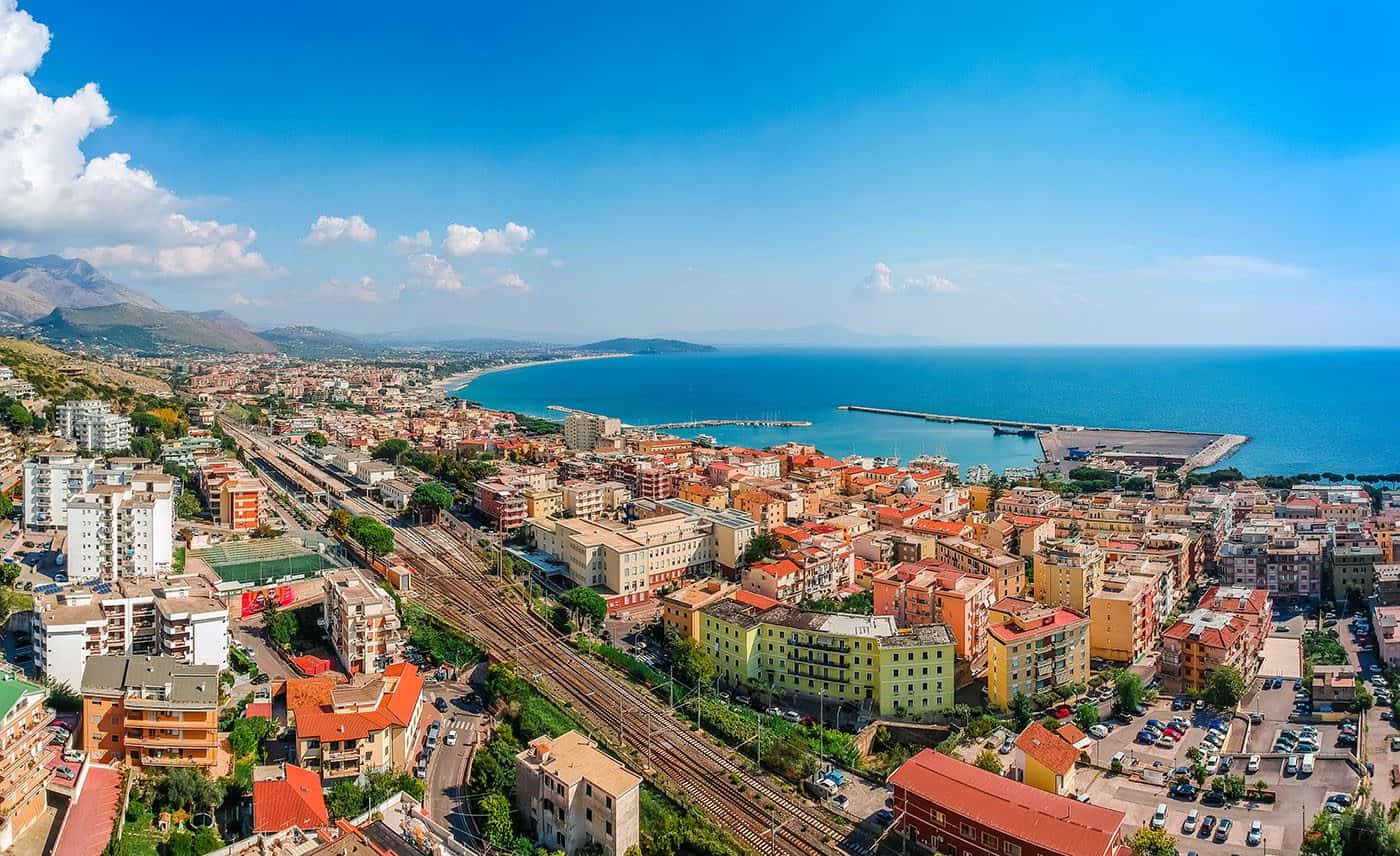
Today Formia is a transit hub with its railway station, its commercial port and the departure point for the Pontine Islands, but it is also, and above all, a layered city: a pre-Roman megalithic wall, a Roman acropolis turned medieval village, a fishermen's quarter grown around an Angevin tower, a 19th-century seafront of villas and gardens, and a 20th-century fabric rebuilt after the war, in 1944, had leveled almost everything. Anyone who arrives expecting only a beach finds a city with at least three millennia of written history in its stones, which almost no one reads in full.
Where Formia Is and How It Is Laid Out
The municipal territory runs down from the Aurunci Mountains to the sea. The coast goes from Vindicio, in the west, toward Gaeta, to Gianola and Santo Janni, in the east, toward Scauri and Minturno. In between are the port, the municipal park and the seafront of Via Vitruvio. On the hill at the center is the Castellone district, which occupies the ancient acropolis. Below, on the sea, is the Mola neighborhood, the old landing place of the mills. On the slopes of the mountain are the hamlets of Maranola, Castellonorato and Trivio, villages that were independent municipalities until 1928. From Maranola starts the three-kilometer path that climbs to the Redentore, the summit with the statue from which you look over the whole gulf: the photograph of Formia seen from the tip of the Redentore is the best one you can take of this coast, and you'll find it further on in this guide.
Why Formia Deserves More Than a Day at the Beach
Here is our opinion right away: Formia is underrated compared to Gaeta and Sperlonga because it doesn't have a compact, «postcard» historic center. The bombings of 1944 took away its turreted walls, its old churches, its palaces. What remains is scattered: a cistern under the houses, a tomb along the state road, a tower in a fishermen's quarter, a museum in a wing of City Hall, a Roman villa under a public garden. Those who agree to go looking, though, go home with more than they take away from a more «finished» city. It's the charm of layered cities, which ask to be read before they are looked at.
What to See in Formia: Monuments and Places of Interest
Formia's heritage divides naturally into four families: religious architecture, civil architecture, military architecture and archaeological sites, plus the natural areas of the Riviera di Ulisse. I'll go through them one by one, with a tip for each, because the risk in Formia is seeing three things and missing the other 30.
The Churches of Formia (LT): Religious Architecture
Sant'Erasmo Church, the Old Cathedral of Formia
Sant'Erasmo is the saint of Formia. According to tradition he was bishop of Antioch and was martyred under Diocletian in 303. His memory is tied to this city to the point that Formia was an episcopal see from the 4th to the 9th century, before the seat passed to Gaeta and with it the saint's relics, carried off in the 9th century when the Roman city was by then depopulated by Saracen raids. The current church, with three aisles, has a Renaissance layout and was remodeled several times. Inside it holds an anonymous 18th-century painting, a burial slab of the Dukes of Marzano dated 1698 and the 18th-century altar that houses the wooden statue of the saint. It is open on Sundays for Mass. On other days it's best to ask at the parish. The square in front, Piazza Sant'Erasmo, is the living room of Castellone and the natural starting point for a visit to the upper village.
Sant'Anna Church, Formerly Santa Maria del Forno, in the Village of Castellone
A small church inside the medieval quarter, once called Santa Maria del Forno because it was built next to a bakery oven of the village. Its foundation dates to the 10th century, on a site that in all likelihood held a pagan sacred building. The current appearance is modern, the result of reconstructions after the damage and thefts suffered over the centuries. It's worth going in for the Renaissance apse fresco of the Neapolitan school with the Nativity of the Virgin, and for a few works from the 18th and 19th centuries. It is usually open only for the feast of Sant'Anna, on the evening of June 1, and in December, when it hosts a very elaborate nativity scene that the people of Formia go to see every year. If you happen to be in Formia outside those dates, ask in the village: someone with the key can be found.
San Rocco, the Little Church Outside the Walls
Built in 1474 outside the walls of Castellone, with a single aisle, San Rocco has been recently restored. Inside is a 17th-century triptych with the Madonna between Saints Roch and Sebastian, the work of Girolamo Stabile, a painter active in the gulf, and the remains of a fresco in the lunette. The pilgrim saint who heals from the plague was invoked in Formia, as throughout the Mezzogiorno, during the centuries of the great epidemics: the position outside the walls is consistent with his function of protection «at the gate». For some years the little church has also hosted the Greek-Catholic Mass of the Ukrainian community, a detail that tells the story of today's Formia at least as much as that of 500 years ago.
Santa Maria della Noce, the Benedictine Hermitage above Formia
On the hills behind Castellone, in a hollow of meadows and olive trees, the hermitage of Santa Maria della Noce, with the ruins of the adjoining monastery, is an 11th-century foundation of the Benedictine monks of Montecassino, who in those centuries scattered dependencies across the whole Terra di Lavoro. The church has two aisles. It holds a 16th-century oil on panel by an unknown author, with the Madonna and Child seated on a walnut tree between Saints Benedict and Erasmus: an iconographic program that joins the founding order and the saint of the city. The dome and bell tower show forms derived from Byzantine models. The complex is now privately owned and fenced. It normally opens on Easter Monday, when the people of Formia go up for the traditional picnic in the meadows around it. One detail that connects the hermitage to the historic center: the springs of the Santa Maria la Noce area were the ones that fed the Roman Cisternone of Castellone, on the acropolis. The water the monks drank in the 11th century was the same that had quenched the thirst of Formiae a thousand years earlier.
San Remigio, the Villa Chapel Reopened by FAI
In the San Remigio area, along Via Appia toward Itri, stands the little church of 1490 with a single aisle, inside the period villa that once also belonged to the Piccolomini and is now private property. Inside, traces of floral frescoes remain on the walls, a painting of the saint and, on the altar, the case with the relic. Damaged during the war, it became visitable again for the first time thanks to a FAI day on October 18, 2015, and since then it opens only on special occasions. San Remigio, the bishop of Reims who baptized Clovis, is a rare dedication in southern Lazio, and his presence in Formia is probably tied to a change of ownership or a family devotion: a small curiosity for those who love «out of place» cults.
Santa Maria del Castagneto, the Oldest Church in Formia
Next to the cemetery, Santa Maria del Castagneto is dated to 1170 and is therefore the oldest church in Formia. The Benedictines founded it, and at the time it must have stood in the thick of a chestnut wood, hence the name. Parts of a Roman temple were reused to build it, following a very common practice in the Middle Ages of the gulf. Inside remain pieces of the old Cosmatesque floor and fragments of medieval frescoes. Restored in 1935, with the bell tower rebuilt in 1936, it is open on Sundays for the 10:00 Mass in summer and the 9:30 Mass in winter. Anyone with an hour to spare should go: Cosmatesque flooring is rare south of Rome, and here you see it within reach, without barriers.
Santa Teresa d'Avila, the Carmelite Convent of Formia
An 18th-century church with a single aisle flanked by chapels, with a measured Baroque interior, almost sober compared to the Neapolitan churches of the same period. It holds paintings by Antonio Sicurezza, the 20th-century painter from Formia (1905-1979) who left works in almost every church of the city. The former 19th-century Carmelite monastery has been waiting for restoration for years. The church, on the other hand, reopened after four years of work and can be visited in the afternoon from Monday to Saturday. If you want to understand who Sicurezza was, an artist who deserves more than a line, this is the place to begin, before San Giovanni Battista.
San Giovanni Battista and San Lorenzo, the Patron Saint's Church in the Village of Mola
In the Mola neighborhood, next to the tower, there once stood two very old churches: San Lorenzo, documented from 831, and San Giovanni Battista, from 1566, adjacent to the castle, with two aisles and a portico. Until the 18th century a wall divided them. In the 19th century the wall was torn down and the two churches became a single building with two aisles. The war destroyed it. The current church dates to 1938 and gathers the surviving works of the old one: the Baroque wooden statue of San Giovanni Battista, patron saint of Formia. A panel by an anonymous painter in the circle of Antoniazzo from the 15th century, with the Madonna and Child between Saints Sebastian and Lawrence. And the Madonna of Ponza by Geronimo Stabile, from the 16th century, formerly the altarpiece of the church of Ponza, stolen in 2002 and found in 2005 in the Vicenza area. There are also several paintings by Antonio Sicurezza. Open on Sunday mornings for Mass. A tip: look carefully at the Antoniazzo-style panel, because the Roman painting of the late 15th century, that of the workshop of Antoniazzo Romano, reached all the way down here along Via Appia, and this is one of the finest pieces of evidence of it preserved in the gulf.
The Sanctuary of the Madonna of Ponza and Sant'Antonio da Padova
In the locality that bears its name, the Sanctuary of the Madonna of Ponza dates to the 15th century and keeps on the altar the old image of Mary brought to the mainland by monks from the island, when Ponza was abandoned because of pirate raids. The link between Formia and Ponza is ancient, and the relationship with the island, which from the port you can still reach today by ferry and hydrofoil, also runs through this Madonna. The picture of the city's churches is completed by the church with its adjoining convent of Sant'Antonio da Padova, of the Friars Minor.

The Villas and Palaces of Formia (LT): Civil Architecture
Villa Rubino, Called Cicero's Villa, and the Roman Harbor of Caposele
At the end of the Vindicio seafront, toward Gaeta, is the villa that the people of Formia call Cicero's, with terraces, gardens and two nymphaea that descend to the sea beside the Roman harbor of Caposele. The ancient core dates to the 1st century BC: the 16th-century villa of the Marzano family stands on the vaulted structures of a large Roman seaside villa, with fish ponds, three monumental fountains and a landing place, and tradition has it that it is precisely Cicero's Formianum, the residence where the orator stayed many times and from which he set out, in a litter, on his last flight. It is a tradition, not a documented fact, but it is a tradition with good arguments: position, size, proximity to the mausoleum on the Appia.
The modern history of the villa is a sequence of big names. It belonged to the prince of Caposele, Carlo Ligny, who gathered there a private museum of Roman and Renaissance antiquities and who in 1791 hosted there, together, Victor Emmanuel I of Sardinia and Ferdinand IV of Bourbon. In 1852 Ferdinand II of Bourbon bought it, restored it and had it protected with the sentry box still visible at the southwest corner, from 1854. It passed to his son Francis II, and it was here, on February 13, 1861, that the capitulation of Gaeta was signed, the end of the Kingdom of the Two Sicilies, while General Cialdini had used the villa as his headquarters during the siege. In the 1920s it became the Rubino family's. Frequented as a luxury hotel by cultured figures from all over Europe, it is now private, largely subdivided into lots, and awaits a recovery that would make it visitable. From the beach and the Roman harbor, though, the ancient structures and the nymphaea can be seen well. And the signing of the surrender of Gaeta, which took place in a villa attributed to Cicero, is one of those historical coincidences that in Formia seem intended.
The Bourbon Sentry Box of Villa Rubino
The small masonry guardhouse of 1854, built to watch over the stay of Ferdinand II, is one of the most photographed and least understood objects on the Vindicio seafront. It was for an armed sentry, and its presence says how insecure the Bourbon king already felt, even on holiday, seven years before the fall of the kingdom.
The Period Palaces of Via Vitruvio
Via Vitruvio is the backbone of Formia, named after the Roman architect whom some scholars want born in these lands: a learned tradition, not a certainty. Along the street line up the 19th-century and early 20th-century palaces restored in recent years, City Hall at number 190, the museum at 184, the porticoes, the cafés. This is where the city lives, and on summer evenings the «white night» called Vivi Vitruvio closes it to traffic and fills it.
Villa Torlonia at Vindicio and the Villas of the Seafront
At the end of the 19th century the Torlonia princes built at Vindicio a villa set in a centuries-old botanical garden, with stuccoes inside, a helical staircase and a belvedere on the terrace. The Stella Maris chapel dates to the 1950s. After several changes of ownership and restorations, the villa is now a hotel property. On the same seafront the red-brick villa of the Amante family and the scenographic one that belonged to Alberto Sordi tell of the taste for bourgeois and cinematic holidays at Vindicio in the 20th century. Palazzo Forcina, from the 18th century, formerly the seat of the municipality, is now divided into private homes.
Castellone, the Torre di Mola and the Walls: Military Architecture in Formia
The Castellone of Formia and the Octagonal Tower of the Caetani
The Castellone occupies the hill of the ancient acropolis and is the district that best keeps the air of a medieval village, even though it lost its turreted walls in the war. Of the 12 original towers, two remain. The first is the 14th-century octagonal one, on the summit of the ancient Roman citadel, which shows three layers readable with the naked eye: a pre-Roman polygonal base, a phase from the Republican age and, on top, the great tower built by the Caetani. The second is the Clock Tower, also called Porta degli Spagnoli, with the 18th-century majolica clock that has been put back into operation. The name Castellone comes from the castle built by Onorato I Caetani, Count of Fondi, in the second half of the 14th century, and it went through the forms Castel Leone and Castel Lione before settling into the current one. In the alleys you meet columns and capitals of the Roman citadel reused in the houses, ancient portals, outdoor staircases. The village was born to defend against raids from the sea, and you can tell: from the tower you control the whole gulf.
The Megalithic Walls of Formia
The oldest stretch of Formia's fortifications is the wall in polygonal masonry, with rusticated and smooth blocks, which scholars date between the 4th and 3rd century BC, with a curtain in opus incertum from the 2nd century BC on top. Stretches survive along the coast and in the Castellone district. These are the walls of Aurunci Formia, predating Romanization, and they belong to the same family as the polygonal walls of Fondi, Itri, Arpino and Alatri: the great «Cyclopean» architecture of southern Lazio, which Grand Tour travelers attributed to the Pelasgians and which today is read as the work of the Italic peoples between the 5th and 3rd century.
The Torre di Mola, Symbol of Formia
In the Mola neighborhood, on Via Abate Tosti, the cylindrical tower, 27 meters high on three levels, is the most imposing remnant of the Angevin castle, built in 1296 by Charles II of Anjou as an outpost of Gaeta and to protect the mills that gave the village its name. The core is older, from the 10th century. The tower is from the 13th. In 1435 the complex passed to the Aragonese and in 1460 to Nicola Caetani, and the Caetani d'Aragona, lords of Castelmola, turned it from a fortress into a noble residence, holding it until the early 19th century. The Renaissance marble portal is an addition of 1880 commissioned by Onorato Caetani. The war badly damaged it along with the neighborhood. The restoration has covered it in light plaster. Since 2014 the ground floor has housed the Municipal Historical Archive, with the original kitchen and the chapel of San Michele Arcangelo. The upper floors are not accessible, and the tower is used as an exhibition space for shows. In the subsoil around it, traces of Roman baths remain. It is the monument Formia has chosen as its symbol, and it is the reason it is worth reaching Mola on foot along the port, instead of staying on the Vindicio seafront.

The Archaeological Sites of Formia (LT), One by One
The Roman Cisternone of Formia, the Underground Basilica of Castellone
This is the monument for which, on its own, the trip is worth it. Under the houses and alleys of Castellone, inside the acropolis, opens a cistern from the 1st century BC, 65 meters long, from 5 to 25 wide, up to 7.5 meters high, with a floor plan of about 1,200 square meters and a capacity of about 7,000 cubic meters of water. The space is divided into four aisles by 53 central pillars 6.5 meters high and 90 centimeters wide, to which 36 pillars set against the walls are added. The groin vaults are in opus caementicium, the pillars and walls in opus incertum, all covered in cocciopesto, like the floor. The water came from the springs of the Santa Maria la Noce hill and from here, through an urban distribution network, descended to the city. In type, the Cisternone compares with the Piscina Mirabilis of Miseno and with the Basilica Cistern of Istanbul, and it is considered, after the Piscina Mirabilis, one of the largest Roman hydraulic works preserved. The old popular name of «underground basilica» conveys the effect well: you enter a forest of pillars, with still water on the floor and the vaults lost in the dark.
Its rediscovery is a Formia story in three stages. In 1860 the painter Pasquale Mattej, the same who designed the city's coat of arms, explored it first and described it. In 1930 the podestà Felice Tonetti drew up a report on it. Then, between March 30 and May 5, 1985, a group of young people from the neighborhood, the Gruppo Studi e Ricerca di Castellone, mapped it again in full, when it was by then a dump of debris accumulated over 22 centuries. Recovery work began in the early 2000s and on October 11, 2003 the Cisternone was inaugurated and opened to the public. The guided visits are run by the Sinus Formianus association, with turns at fixed times and mandatory reservation at 349 5328280. Access is from Via Rampa Capo Castello. In our judgment it is the most impressive Roman underground site in Lazio outside Rome, and its masonry is so sturdy that for 2,000 years it has held up the houses built on top of it.
The Roman Theater of Formia and the Martyrdom of Sant'Erasmo
The theater from the Augustan age, from the 1st century BC, stood at the foot of the acropolis. In the 17th century a house was built on its ruins, and today the surviving structures are absorbed into private homes: you can make out the curves of the cavea and some vaulted rooms. According to popular tradition, and only that, this is where Bishop Erasmus suffered martyrdom on June 2, 303, during the persecution of Diocletian. In the Christmas period the site hosts a nativity scene that uses the ruins intelligently as a set.
The Tomb of Cicero on Via Appia
At the gates of Formia, in the Acervara area, along Via Appia toward Itri, rises the circular mausoleum of the late Republican or Augustan age that everyone calls the Tomb of Cicero. It rests on a square base in concrete masonry of 50 Roman feet, a little under 15 meters on a side, faced with limestone blocks. The circular drum is in opus reticulatum, and the interior, also circular, is divided into five niches that were meant to hold statues and furnishings. Originally the monument reached about 24 meters and carried a marble facing now lost. The attribution to Cicero is not documented by inscriptions: it is a tradition, though one supported by three strong arguments. The proximity to the place where his villa is located. The ancient sources, Plutarch first among them, which tell of the assassination right near Formia. And the mass of the building, without doubt built for an illustrious man. On the hill opposite, about a hundred meters as the crow flies, the remains of a second tomb are called the Tomb of Tulliola, after the name of Cicero's beloved daughter, who died in childbirth in 45 BC, for whom the orator planned a monument that he never managed to build. The site is entrusted to the Lazio Regional Directorate of National Museums and opens according to a calendar, with free guided visits of about half an hour by reservation at 349 5328280. Current dates should be checked before setting out.
The Opus Reticulatum Wall and the Villa of Vindicio
At the end of the Vindicio pine grove, the wall in opus reticulatum with an exedra and semicircular structure most likely belongs to an aristocratic residence of the 1st to 2nd century AD, one of the many villas that lined the coast from Caposele to Gianola. It is a few steps from the beach, with no fences: those who swim at Vindicio walk past it without knowing.
The Roman Harbor of Caposele
At the western end of the Vindicio seafront, the Roman harbor of Caposele, with its piers in concrete masonry and its fish ponds, served the large villa that is now Villa Rubino. It was a private landing place, like those that all the high-ranking seaside villas on the Tyrrhenian had, and it remains one of the most readable on the Lazio coast.
The Torricella and the Tomb on the Appia at San Pietro
On Via Appia, in the San Pietro area, the Torricella is a Roman tower tomb. In the area stood the church of the same name, San Pietro, which a document of 1002 already describes as destroyed. A short distance away, the Miramare hotel-restaurant occupies the former royal villa of the Savoy, built on the ruins of a Roman villa: after the Bourbons, the Savoy monarchy too chose Formia for its holidays.
The Roman Amphitheater under Formia Station
Under the forecourt of the railway station and behind Via Lavanga lie the remains of the Roman amphitheater of the 1st century AD, from the Claudian age, still being excavated. It is the most «hidden» monument of the city in the literal sense: whoever gets off the train walks over it. A city with a theater and an amphitheater was a city of the first rank, and Formiae was one.
San Remigio: the Turret Tomb and the Roman Fountain
In the San Remigio area, besides the chapel already mentioned, there is a turret tomb from the Imperial age. But the truly rare monument is the Roman Fountain of San Remigio, along Via Appia toward Itri and Rome: a spring from the Roman era in good condition, set against a wall of large limestone blocks, about seven meters long and a meter and a half wide, with a cistern at the back for the water supply. The water came out of two anthropomorphic mascarons representing the Sun and the Moon, and traces of one remain. Next to it you can see a stretch of Via Appia with the original paving. Roman public fountains this well preserved, along a consular road, are very rare: this one is considered unique on the peninsula, and it is a place to stop for five minutes if you are traveling on the Appia between Formia and Itri.
The Cryptoportici under the Municipal Park and under Piazza della Vittoria
The municipal park of Formia, the public garden of 1893 on the sea, rests on the cryptoportici of a Roman villa of the 1st century BC, vaulted corridors used as storerooms connected to the fish pond in front, which served as a nursery for fish and which you can still see, from the seafront, in the afternoon hours at low tide. Today the cryptoportici are used for exhibitions and displays. A second complex of cryptoportici and villa of the 1st century BC lies under Piazza della Vittoria, with remains of painted decoration on the walls. Anyone who wants to see a working Roman fish pond in its setting doesn't need to go to Sperlonga: just go down to the Formia seafront at the right time of day.

The Aqueduct, the Forum and the Stairway of the Capitolium
Near the San Giovanni Battista Church, in Mola, stretches of the Roman aqueduct from the Republican and early imperial periods remain. At number 360 on Via Vitruvio, not far from Piazza Mattej, which occupies the area of the Roman forum, ancient structures are visible: many of the statues displayed in the museum come from here. On Via Mamurra a covered staircase from the Hadrianic period belonging to the Capitolium is preserved, the temple of the Capitoline triad that dominated the forum. They are fragments, but lined up they tell of a Roman city with forum, Capitoline temple, theater, amphitheater, aqueduct and monumental cistern: the complete set of a city of standing.
Mamurra's Villa on the Gianola Promontory
On the Gianola promontory, inside the regional park, you can visit the remains of the villa attributed to Mamurra, the Formian knight who was Caesar's praefectus fabrum in Gaul, grew scandalously rich and was the target of Catullus's verse insults, who called him "Mentula." Horace, in the journey to Brindisi in the Satires, calls Formia "the city of the Mamurras." The attribution is traditional, but the villa is real and imposing: an octagonal building under excavation, two large cisterns, the Great Cistern and the Cistern of the 36 Columns, a covered staircase known as the Janara cave, remains of bath rooms and a fish-farming pool that coincides with the Roman port of Gianola. The park can be visited freely on its trails, the villa is visited on the open days organized by the park authority. If you get this far, make time for the guide to Gianola and Monte di Scauri Park.
The Acquatraversa Bridge and the Wall of Nerva
The list of archaeological sites is completed by the Roman bridge of Acquatraversa, in the area of the same name between the center and Gianola, and the complex called the wall of Nerva, near the port, a Roman structure that runs straight to the sea. The name of Nerva is traditional: the emperor, born in Narni, has no documented link with Formia, but the place name has held on for centuries.
Castello Miramare in Formia
In the Pagnano area, a short distance from Piazza Sant'Erasmo, Castello Miramare dates from the 15th century and is now a hotel with a well-known restaurant. It should not be confused with the Miramare hotel in San Pietro, the former Savoy villa: two Miramares for one city, and the Formians have always told them apart by calling the first one "the castle."
The National Archaeological Museum of Formia
The History of the Museum and the Bourbon Stables
The National Archaeological Museum of Formia occupies a wing of the 18th-century municipal palace, at 184 Via Vitruvio, known as the Stalloni dei Borbone because it housed the royal stables. It has a long history: a first city Antiquarium was destroyed by the war, a second opened in 1968, and the current museum was inaugurated in 1997 as an expansion of the latter. Today it belongs to the Lazio National Museums Regional Directorate, the same one that manages Sperlonga, and shares with Sperlonga the integrated ticket for €10 valid for 30 days, an opportunity I recommend to anyone spending two days on the Riviera di Ulisse.
The Sculptures of the Formia Forum
The collection is almost all sculpture, of high quality, datable between the first century BC and the second century AD, that is, the decades of Formiae's greatest wealth. The main core is the honorary statues, male and female, found in the forum area, the one of Piazza Mattej: they portray patrons of the city, local magistrates and members of the imperial family. Among the pieces worth seeking out is the portrait of Gaius Caesar, Augustus's grandson who died young in AD 4, whom Formia honored like all the cities loyal to the Julian house. Alongside are three male statues, a figure in the act of sacrificing, two draped female figures, a veiled head and portraits of elderly people returned from Naples, where they had ended up in the National Archaeological Museum when Formia was part of the Kingdom: a recent restitution that has given the collection coherence again.
The Maritime Villas in the Formia Museum
The second section gathers architectural elements, funerary goods and sculptures of deities and mythological subjects from the maritime villas of the coast: those of Caposele, Vindicio and Gianola. It is the necessary counterpoint to the forum statues: there the public city, here private luxury. The visit takes about 45 minutes, the museum is fully accessible for people with mobility difficulties, groups enter up to 20 people plus the guide. It's best to visit the museum before the Cisternone and the villas, not after: the statues give faces to the places.

The Sea of Formia: Vindicio, Acquatraversa, Gianola and the Blue Oasis
The Beaches of Formia from West to East
Vindicio is the historic beach, west of the port, long, sandy, with the pine grove behind it, the beach clubs and the free stretches, closed to the west by the harbor of Caposele. It is the most convenient from the center and the busiest. Acquatraversa and Santo Janni are the coves to the east, more secluded, with rocks and shallow waters. Gianola, at the eastern end, is the beach inside the park, with the promontory of the Mamurra villa over your head, and it continues toward Scauri and Minturno. Formia has the Blue Flag and the Three Sails of the Touring Club and Legambiente. Bathing conditions should still be checked season by season on the municipality's channels. To readers who ask which is the «best» beach I answer with a question: with children, Vindicio. For the sea, Gianola.
The Gianola Blue Oasis, the WWF Marine Area in Formia
At Gianola the WWF has established one of its Blue Oases. The seabed runs parallel to the coast and reaches about four meters deep. The bottom is mixed but mostly rocky, with an underwater spring and a tank for turtles. The fauna is the typical Tyrrhenian kind, varied and still rich. September is the ideal month for diving and snorkeling: water still warm, better visibility, few bathers. I refer you to the guide to the Gianola Blue Oasis for hours and access rules.

The Parks around Formia: Riviera di Ulisse, Gianola, Aurunci
Formia lies within three protected areas. The Riviera di Ulisse Regional Park brings together Gianola and Monte di Scauri, Monte Orlando in Gaeta and the Villa of Tiberius in Sperlonga in a single body. The Gianola and Monte di Scauri Park is the Formia part, with trails on the promontory between Mediterranean scrub and Roman ruins. Behind the city, the Aurunci Mountains Nature Park climbs to the 1,500 meters of the Petrella and holds, above Maranola, the rock sanctuary of San Michele Arcangelo and the summit of the Redentore. For an idea of the Aurunci Mountains as a range, before even as a park, the guide is here. The municipal park of 1893, finally, is the garden on the sea where the people of Formia stroll in the evening.
The Port of Formia and the Pontine Islands
The port is the gateway to the islands. Ferries and hydrofoils for Ponza and Ventotene leave from Formia, and for those coming from Rome it is the most convenient departure point together with Anzio and Terracina. The guide to Ponza and the guide to Ventotene explain what to expect once you land. The commercial port, with its fishing boats and fish market, is also the reason why in Formia you eat real fish, not tourist fish.
The Cuisine of Formia and the Gulf of Gaeta
The Formia table is that of the gulf. The tiella di Gaeta, a traditional agri-food product of Lazio, is a closed pizza filled with octopus, with escarole and olives, with salt cod or with onions: you find it in the bakeries of Mola and Via Vitruvio and eat it at room temperature, on the beach. Then the stuffed pizza, the fava bean and lentil salad, the paccheri with porcini and king prawns, a dish that holds together the Aurunci mountain and the sea, and the baked pezzogna with potatoes, the deep-water bream that is the most typical fish of the gulf. From the hills come the cheeses: pecorino romano DOP, ricotta, and mozzarella di bufala campana DOP, because the Garigliano plain is a step away and the buffalo knows no regional borders. The olives of Gaeta, which actually grow in Itri and on the mountains around, close every antipasto. The advice is just one: ask for the pezzogna, and if there isn't any, the catch of the day. Skip the tourist menus with frozen shrimp.
Formia and Sport: the Olympic Training Center
Formia is home to the CONI Olympic Training Center, named after Bruno Zauli, where since the 1950s the Italian national track and field athletes and those of other disciplines have trained, drawn by the same climate that Martial praised 2,000 years ago. It can't be visited, but it explains why you run into so many athletes in tracksuits in town, and why Formia has a sporting tradition that goes beyond the beach. In 2026 the city again hosted, after 52 years, the start of a stage of the Giro d'Italia.
The History of Formia from the Laestrygonians to the Reconstruction
The Myth: Ulysses, the Laestrygonians and the Sinus Formianus
The origins of Formia are lost in myth and tied to the return of Ulysses. All of ancient tradition places on this stretch of coast the land of the Laestrygonians, the cannibal giants of book 10 of the Odyssey, at whose harbor Ulysses' ships landed: only his survived, because the hero had moored it outside the bay. It is from this identification, already known to Roman scholars, that the coast between Sperlonga and Minturno took in the 20th century the name Riviera di Ulisse. A second tradition, reported by ancient sources, has Formia founded by the Laconians, that is, by Spartan colonists: it is the way the cities of southern Lazio, like many in Magna Graecia, gave themselves a noble Hellenic origin. For more than two millennia the gulf was called Sinus Formianus, the gulf of Formia, and only in modern times did it take the name of Gaeta.
Aurunci Formia and the Roman Conquest
Of pre-Italic and Aurunci formation, as the polygonal walls preserved along the coast and at Castellone show, Formia entered Rome's orbit with the conquest of the territory between the 5th and 4th century BC and was included in the Latium adiectum. In 338 BC, or perhaps 332, it received the civitas sine suffragio, citizenship without the right to vote, together with Fondi: Livy explains that the Romans rewarded the two cities this way because passage through their territory had always been safe. The passage was so important that in 312 BC Via Appia of Appius Claudius Caecus was laid out precisely through Formia, and in 188 BC the city obtained full citizenship. The guide to the Appia Antica Park tells of the other end of that road, the Roman one.
Roman Formia: the Villas of Mamurra, Maecenas and Cicero
Between the late Republic and the early Empire Formiae was one of the most appreciated holiday locations of the Roman aristocracy. The celebrated villas were those of Mamurra at Gianola and of Maecenas, and above all that of Cicero, the Formianum, one of his favorite country houses, from which he wrote many letters to Atticus. And it was in Formia that Cicero died, on December 7, 43 BC, at the hands of Antony's assassins, while trying to escape the proscriptions of the Second Triumvirate. In the following centuries the city continued to prosper: the Augustan theater, the Claudian amphitheater, the Hadrianic Capitolium, the Cisternone and the statues of the forum are the stages of that prosperity.
The Middle Ages: Mola and Castellone, the Two Villages of Formia
With the fall of the Western Empire Formia was sacked. After the invasions and the Gothic War the inhabitants took refuge in the hills, the Roman city was depopulated and in the 9th century, with the Saracen raids, the episcopal see and the relics of Sant'Erasmo also passed to Gaeta. Two nuclei were born from this, later become suburbs of Gaeta: Mola di Gaeta, on the sea, which took its name from the working mills, where at the end of the 13th century Charles II of Anjou erected the fortress. And Castellone, on the hill, around the castle of Onorato I Caetani. For centuries the two districts were separated by gardens and citrus groves, as the maps of the 16th and 18th centuries show: the Formia between Mola and Castellone was a countryside of orange trees. The municipality of Mola e Castellone was born in 1820 from the merger of the two villages. In 1862, with the Kingdom of Italy, it took back the ancient name of Formia, and in 1928 it incorporated the municipalities of Castellonorato and Maranola.
1944: Formia on the Gustav Line
In January 1944 and the following months Formia suffered very heavy damage, because it lay on the edge of the Gustav Line, the German front that ran from the Garigliano to Cassino and is remembered for the destruction of Montecassino and for the battles of Mignano Monte Lungo. The Allied bombings and the German demolitions wiped out the walls of Castellone with 10 of its 12 towers, the churches of Mola, the palaces, the Antiquarium. A large part of the historical and artistic heritage was lost, and what remains has to be read keeping that loss in mind. Anyone who wants to understand what that front was will find the guide to the Montecassino Abbey and the one on Cassino.
The Coat of Arms of Formia: the Phoenix and the Motto Post Fata Resurgo
On December 5, 1863 the city council, chaired by Mayor Gaetano Rubino, commissioned the Formia painter Pasquale Mattej to design the coat of arms of a city that, after centuries as a suburb of Gaeta, had taken back its name and wanted to rise again. Mattej, who three years earlier had been the first to descend into the Cisternone, delivered within a few days a watercolor sketch: the Arabian Phoenix rising from the pyre and taking flight toward a shining sun at the top right, with the motto Post Fata Resurgo, «after death I rise». By royal decree of April 17, 1865 the coat of arms was officially adopted, with this blazon: azure, a phoenix in its immortality, natural, looking at a gold sun in the right canton of the chief, with a bordure of 24 pieces of green, silver and red alternating. The shield crested by a gold mural crown opened with four gates and surmounted by five merlons, flanked by two green palm branches crossed under the point and tied with red, with the scroll of the motto in black Roman capital letters. A century later, in 1944, the phoenix would have had to rise a second time: Mattej's motto proved prophetic.

A Curiosity about Formia (LT)
The curiosity concerns the most venomous poet of Rome and the richest knight of Formia. Mamurra, born here, followed Caesar to Gaul as praefectus fabrum, the head of military engineering, and came back so rich that he was the first in Rome, according to Pliny, to cover all the walls of his house on the Caelian with marble and to use solid marble columns. Catullus, who detested him and Caesar, dedicated to him some of the fiercest poems in Latin literature, calling him by an obscene nickname. Horace, a generation later, telling of the journey to Brindisi in the Satires, calls Formia «the city of the Mamurras», and the joke has stuck. 2,000 years later, that knight insulted in verse gave his name to a street in the center, Via Mamurra, where the stairway of the Capitolium is preserved, and to the great villa on the promontory of Gianola. It is one of the oddest cases of a reversal of fame: the man Catullus wanted to erase is today one of the most repeated names in Formia, while the villa of Cicero, the great one, remains a traditional attribution. The second curiosity, minor but real, lies in a hydraulic fact: the springs of Santa Maria la Noce, which filled the Cisternone of the 1st century BC, are the same ones around which the Benedictines built their hermitage in the 11th century. In Formia, water chose the places before people did.
Something Nobody Tells You about Formia (LT)
Almost no one says that the end of the Kingdom of the Two Sicilies was signed in Formia, and not in Gaeta. The siege lasted from November 1860 to February 1861, with Francis II and Queen Maria Sophie shut up in the fortress of Gaeta under the fire of General Cialdini's Piedmontese artillery. Cialdini had set up his headquarters at Villa Caposele, the villa attributed to Cicero that had been, until a few months earlier, the summer residence of Francis II himself and of his father Ferdinand II. The capitulation was signed on February 13, 1861 inside that villa. Whoever strolls on the Vindicio seafront in front of the Bourbon sentry box of 1854 is looking at the place where a kingdom of seven centuries closed with a signature, in its own house and with the victors seated at its own table. The second thing that goes unsaid is more practical: the cryptoportici under the municipal park and the Roman fish pond in front can be seen for free, from the seafront, in the afternoon hours at low tide. Whoever arrives in the morning sees only water. The third concerns the station: the forecourt covers an amphitheater. Three pieces of news that appear in no brochure and that change the way you walk around the city.
My Advice for Visiting Formia (LT)
Book the Cisternone before anything else. It's the one visit you can't improvise. It's guided only and at fixed times, and when the slots are full there's no way in. The number is 349 5328280. Build your day around that time. The recommended route is this: start at the museum on Via Vitruvio, 45 minutes, to put a face on the Roman city. Go up to Castellone for the Cisternone and the two towers, an hour and a half between the visit and the alleys. Come down to the waterfront for the municipal gardens and the fish pond in the afternoon, and continue on foot along the port to Mola and the Tower. If you have a car, the Tomb of Cicero and the San Remigio fountain can be seen in half an hour on the way to Itri, better in the late afternoon with the raking light on the Appia. The sea, Vindicio or Gianola, should be kept for a second day or for early morning. The best time is between May and June, or September: in July and August Formia is a full resort town and the guided visits sell out fast. If you have only one day and must choose between the museum and the Cisternone, choose the Cisternone: the statues can be found elsewhere, a cistern like this one can't. And buy the combined ticket with Sperlonga, 10 euros for 30 days: Tiberius's villa at Sperlonga is 20 kilometers away and completes the story of the villas of the gulf.
Another Well-Known Fact, Yet Rarely Mentioned
Everyone knows Cicero died in Formia. Few remember how. On December 7, 43 BC the orator, placed on the proscription lists by the Second Triumvirate at Antony's wish, left his villa at the Formianum in a litter, heading for the sea to sail for Greece. He had already tried to flee from Astura and had given up, unable to leave Italy. The assassins, the centurion Herennius and the military tribune Popilius Laenas, whom Cicero had defended years earlier in a trial for parricide, caught up with him on a path of the villa, or on the road to Gaeta according to some versions. The servants wanted to fight. Cicero forbade it, had the litter stopped, stuck out his head and ordered them to strike. He was 63. On Antony's orders his head and the hands that had written the Philippics were cut off and nailed to the Rostra in the Forum, the platform from which he had spoken for 40 years. Plutarch says that Fulvia, Antony's wife, pierced the dead man's tongue with a hairpin. The account is Plutarch's, with Livy cited by Seneca the Elder: ancient sources, not contemporary, but in agreement on the place. Since then Formia has been, for anyone who has studied Latin, the place where the Republic stopped speaking. The mausoleum on the Appia has no inscription confirming it, and it must be said clearly: the tomb is a tradition. The death in Formia is a fact.
The Right Photo to Take in Formia (LT)
The photo that tells the story of Formia is the one from the top of the Redentore, above Maranola: the city below, the port, the Gaeta promontory on the right, Gianola and the mouth of the Garigliano on the left, the Pontine Islands on the horizon on clear days. You get there by the three-kilometer trail that starts at Maranola and passes the cave sanctuary of San Michele Arcangelo: two hours uphill, mountain boots, water, and the best light is late morning in winter, when the air is cleaned by the tramontana wind. For those who don't want to walk, the second photo is from the port jetty toward the Torre di Mola, with the bell tower of San Giovanni Battista Church and the mountain behind, at sunset, when the white cylinder of the tower catches the orange light and the boats are back in. The third, for those who love underground places, is inside the Cisternone: a pillar in the foreground, the receding naves behind, the reflection on the water. The light is low and you need a long exposure, a tripod is usually not allowed, so you rest the camera on a pillar and wait. One photo I advise against is the Tomb of Cicero from the road: the traffic on the Appia ruins it. It should be taken from inside the enclosure on opening days, with the base in the foreground.
Some Important Events That Happened Here in History
In 312 BC, when the censor Appius Claudius Caecus routes his road from Rome to Capua through Formia, the city enters the network of Roman Italy. From then on, for six centuries, anyone traveling between Rome and the South passes through here. December 7, 43 BC is the death of Cicero, the event that puts Formia in the schoolbooks of half the world. June 2, 303, according to tradition, is the martyrdom of Bishop Erasmus, who will give the city its saint and its episcopal seat for five centuries. In the 9th century comes the depopulation: Saracen raids empty the Roman city and take the see and the relics to Gaeta. Formia disappears as a name for almost a thousand years and survives as Mola and Castellone. In 1296 Charles II of Anjou builds the tower of Mola. In the second half of the 14th century Onorato I Caetani builds the castle of Castellone: the two villages are born that are still the historic center. In 1791 the Prince of Caposele hosts two kings in his villa, the king of Sardinia and the king of Naples. In 1820 Mola and Castellone merge into a single municipality. On February 13, 1861 the capitulation of Gaeta is signed at Villa Caposele and the Kingdom of the Two Sicilies ends. In 1862 the municipality takes back the name of Formia, and in 1865 the phoenix becomes its coat of arms. In 1985 four young people from the neighborhood go back into the Cisternone and map it. In 2003 the Cisternone reopens. In between, January 1944: the Gustav Line, the bombings, the city destroyed and then rebuilt, the phoenix for the second time. That's 2,300 years told through some 10 dates, and in Formia each one still has a place where you can go and look at it.
Who Passed Through Formia (LT)
The list begins with Ulysses, if you accept the myth, and with the Laestrygonians who welcomed him in their own way. Then the certain names. Cicero, who wrote dozens of letters to Atticus at the Formianum and died there on December 7, 43 BC. Mamurra, the Formian knight who got rich in Gaul with Caesar, owner of the villa at Gianola, a target of Catullus. Maecenas, who according to tradition had a villa here. Martial, who dedicated to Formia the epigram on the "sweet shore" and to his friend Apollinaris who vacationed there. Saint Erasmus, bishop and martyr, in 303. Charles II of Anjou, who fortified Mola in 1296, and Onorato I Caetani, Count of Fondi, who built the Castellone. In 1791 Victor Emmanuel I of Savoy and Ferdinand IV of Bourbon, guests together at Villa Caposele. Ferdinand II, who bought the villa in 1852, and Francis II, who spent his last summers as king there and saw his own end signed there in 1861, while General Enrico Cialdini held command of the siege. The Savoys, who after Unification built themselves a royal villa at San Pietro on the ruins of a Roman villa. Pasquale Mattej, the painter who went down into the Cisternone in 1860 and drew the coat of arms in 1863. The Torlonia princes, who at the end of the 19th century built the Vindicio villa. Antonio Sicurezza, the 20th-century Formian painter whose canvases are in almost all the city's churches. Alberto Sordi, who had at Vindicio the villa that still bears his name. And generations of Italian national team athletes, who since the postwar period have trained at the CONI Olympic center. Formia has hosted orators, poets, kings and martyrs, but on closer look the most illustrious passerby remains Via Appia: all the others arrived along it.
How to Get to Formia from Rome and How to Get Around
The train is the best solution: the Formia-Gaeta station, on the Rome-Naples line via Formia, is served by regional and Intercity trains from Roma Termini, with times from just over an hour to an hour and a half. From Napoli Centrale the time is similar. The station is 400 meters from the museum and one kilometer from the port. By car, from the A1 you exit at Cassino and head down State Road 630 Ausonia, 50 kilometers. From the Pontina and the Flacca, on the other hand, you arrive along Terracina, Sperlonga and Gaeta, the most beautiful and slowest road. In town you walk: from the museum to Castellone is 10 minutes uphill, from the port to Mola 15 minutes on the flat along the sea. For Gianola, the Tomb of Cicero and Maranola you need a car or the city bus. The municipal parking lots are along the waterfront and around the town hall. If you arrive by ship from Ponza or Ventotene, you land at the port and have the center within walking distance.
Formia (LT) with Children and Accessibility
Formia works well with children, as long as you pace it. Kids from seven years up like the Cisternone a lot, for the dark and the water, but it's damp and has steps: it's not suitable for strollers. The museum is fully accessible for people with mobility difficulties and takes three quarters of an hour, the right measure for a family. The municipal gardens and the waterfront are flat and good for strolling. The Roman fish pond, at low tide, is an observation game. Castellone has uphill alleys and stairs, like all hill villages. The beach at Vindicio, with a gently sloping seabed, is the best for little ones. The Oasi blu at Gianola is for kids who can swim and want to try a mask. The Tomb of Cicero is a short, outdoor visit: the story of the head and hands on the Rostra, told with restraint, sticks in the mind more than any lesson.
What's Around Formia: Gaeta, Itri, Minturno, Sperlonga
To the west, eight kilometers away, Gaeta with the Montagna Spaccata, the castle and the cathedral that holds the relics of Saint Erasmus taken away from Formia, and the Sant'Agostino beach. Inland on the Appia, Itri with its castle and olives, and on the same road the Tomb of Cicero and the San Remigio fountain. To the east, beyond Gianola, Minturno with the archaeological area of Minturnae, the theater and the aqueduct, and the Ponte Real Ferdinando over the Garigliano. To the north, 20 kilometers away, Sperlonga and Tiberius's villa, with the combined museum ticket. Farther away, in the Liri valley, Arpino, Cicero's birthplace: whoever wants to close the circle starts at Arpino and ends on the Appia of Formia, where the Arpinate's story ended.
When to Go to Formia and When to Avoid It
May, June and September are the right months: sea already or still warm, guided visits available, city alive but not full. July and August are the vacation months, with the waterfront packed, parking impossible to find and the Cisternone slots sold out. If you come in summer, book weeks in advance. Winter is mild, as Martial said, and gives the clearest days for the climb to the Redentore and the photo of the gulf. Many churches, however, open only on Sunday and the special openings of the Tomb of Cicero get rarer. June 1, the evening of Sant'Anna at Castellone, and June 2, the feast of Saint Erasmus, are the traditional dates. In December, the Sant'Anna nativity scene and the one in the Roman theater. Avoid days of strong libeccio: the waterfront becomes impassable and the fish ponds disappear under the waves.
Quick Questions About Formia (LT)
How much does the Formia National Archaeological Museum cost?
The full ticket costs €5, the reduced ticket €2 for young people aged 18 to 25. The combined ticket with the museum and Tiberius's villa at Sperlonga costs €10 and is valid for 30 days. The statutory free admissions for state museums apply.
What are the opening hours of the Formia museum?
Tuesday, Friday, Saturday and Sunday from 8:30 to 19:30, last entry at 19:00. Closed Monday, Wednesday and Thursday, as well as January 1 and December 25.
Can you visit the Roman Cisternone of Formia freely?
No. Entry is by guided visit only, in fixed-time slots, by booking at 349 5328280 or writing to sinusformianus@gmail.com. Admission is paid and the entrance is from Via Rampa Capo Castello, in the Castellone neighborhood.
How long does the Cisternone visit in Formia take?
Between 30 and 45 minutes. Inside it's cool all year and the floor can be damp: you need closed shoes and a light jacket even in August.
Is the Tomb of Cicero in Formia always open?
No. The mausoleum on Via Appia opens on a schedule, with free guided visits of about half an hour run by the Regional Directorate of National Museums Lazio, by reservation at 349 5328280. From the outside, from the road, you can always see it.
Is Cicero really buried in the Tomb of Cicero?
It's not documented. The mausoleum has no inscriptions and the attribution is a tradition, supported by its position next to the villa, by the ancient accounts of his death in Formia and by the size of the monument. His death in Formia, on December 7, 43 BC, is instead a historical fact.
How much time do you need to visit Formia?
One full day for the museum, the Cisternone, Castellone, the waterfront and Mola. A second for the Tomb of Cicero, Gianola and the sea. If you have half a day, choose the museum and the Cisternone.
Can you visit Formia in a day from Rome?
Yes. By train from Termini you arrive in just over an hour with the fast connections. The museum is 400 meters from the station and Castellone is a 10-minute walk away. The Cisternone must be booked before you leave.
What is the most beautiful beach in Formia?
Vindicio is the most convenient and best for children, with sand and a pine grove. Gianola, inside the park and next to the Oasi blu, has the most beautiful sea. Acquatraversa and Santo Janni are the in-between coves, more secluded.
Where is the Torre di Mola in Formia?
On Via Abate Tosti, in the Mola district, next to San Giovanni Battista Church, a 15-minute walk from the port along the sea. The ground floor houses the Historic Municipal Archive and exhibitions. The upper floors are not accessible.
What can you see in the Formia museum?
Honorary statues from the Roman forum, including the portrait of Gaius Caesar, grandson of Augustus, sculptures returned from Naples, and finds from the maritime villas of the coast: architectural elements, grave goods, deities and mythological subjects. All datable between the 1st century BC and the 2nd century AD.
Is Formia wheelchair accessible?
The museum yes, fully. The waterfront and the municipal gardens are flat. The Cisternone and the alleys of Castellone have steps and slopes and are not suitable. The Tomb of Cicero has access on natural ground.
Can you take photos in the Formia museum and in the Cisternone?
In the museum, personal photos without flash are allowed. For professional photos, write to the Regional Directorate. In the Cisternone you can take photos during the visit, without flash and without a tripod, unless the guide says otherwise.
Where to park in Formia?
In the municipal parking lots along the waterfront and around the town hall on Via Vitruvio, a few minutes from the museum. In summer it's best to arrive early in the morning or by train.
Can you go to Ponza and Ventotene from Formia?
Yes, ferries and hydrofoils leave from the port for both islands. Schedules change with the season and should be checked on the shipping companies' websites.
What is the difference between Formia and Gaeta?
Gaeta has a compact historic center on the promontory, the castle, the cathedral and the Montagna Spaccata. Formia has a rebuilt city with scattered monuments, but a deeper Roman heritage: the Cisternone, the Tomb of Cicero, the villas, the museum. Gaeta you look at, Formia you read. They are eight kilometers apart and can be visited together.
What do you eat in Formia?
The tiella of Gaeta, baked pezzogna with potatoes, paccheri with porcini and mazzancolle prawns, fava bean and lentil salad, buffalo mozzarella and the pecorino from the hills, Gaeta olives.
When is the feast of Formia's patron saint?
Saint John the Baptist is the patron saint. Saint Erasmus, the city's historic saint, is celebrated on June 2, and on the evening of June 1 Castellone celebrates Sant'Anna with the opening of the church.
Does Formia have the Blue Flag?
Yes, and the Three Sails of the Touring Club Italiano and Legambiente. Water quality should still be checked on the Comune's channels season by season.
Why is Formia called that?
From the Greek Hormiai, "landing place," for the shelter the gulf offered ships. A second hypothesis points to the Latin formus, "warm." The gulf itself was called Sinus Formianus for over 2,000 years.
What does Post Fata Resurgo on Formia's coat of arms mean?
"After death I rise again." It's the motto of the phoenix designed by Pasquale Mattej in 1863 and adopted by royal decree of April 17, 1865, for a city that had taken back its ancient name in 1862.
How many people live in Formia?
About 37,000 residents, who increase noticeably in summer with the vacationers. It includes the hamlets of Maranola, Castellonorato and Trivio, besides the historic districts of Mola and Castellone.
Formia is worth a detour from the road to Gaeta or Naples: stop for half a day, book the Cisternone and go down under Castellone. There's no other place in Lazio where you walk inside the water that quenched the thirst of a Roman city, with today's houses over your head. All the rest of Formia, Cicero included, comes after that descent.
Article written by the editorial team of TourLeaderPro, contact them for Private/Corporate/V.I.P. Tours and Experiences.
Planning a trip to Rome? The English guides to visiting the city and the Lazio coast are on ItalyPlanner.com.