Montecassino Abbey (FR)
In short. There are places you visit and places you have to look at twice: the first time for what they are, the second for what they have meant.

There are places you visit and places you have to look at twice: the first time for what they are, the second for what they have meant. The Montecassino Abbey belongs without question to the second category. From up there, from the edge of the terrace that looks over the Liri valley, what you see is an orderly agricultural landscape, the highway glittering in the sun, the roofs of rebuilt Cassino, the mountains of the Abruzzo Apennines in the background. What you don't see, but is there, is the stratigraphy: a pagan temple, a 6th-century monastery, four times razed to the ground, four reconstructions, an archive that holds the first document in Italian vernacular, a library that saved half of Latin literature, a cemetery with more than a thousand Polish crosses a kilometer away as the crow flies and a two-word motto that explains everything: Succisa virescit. Cut down, it grows green again.
There is a precise moment when the visitor understands where they are. It doesn't happen at the entrance, and it doesn't happen in the basilica. It happens when someone tells them that everything they are looking at, the stones, the cornices, the columns, the polychrome marbles, the stairs, is less than 80 years old, and that exactly 80 years ago in place of those cloisters there was a heap of rubble as high as a house. Then the face changes. Because the most famous monastery in the West is not a surviving monument. It is a monument that rose again, and not for the first time.
What follows is a long read, to do before going up, or on the way back while the train takes you to Rome. In it you'll find Benedict and the Rule, Scholastica and the storm, the Lombards and the Saracens, the earthquake of 1349 and the Neapolitan Baroque, Paul the Deacon and Thomas Aquinas as a child, Beneventan script and Constantine the African, the Placito Capuano of 960 and the bronze doors cast in Constantinople. And then there is 1944, which has to be told with precision and without emphasis: the codices saved before the bombing, February 15, the Polish II Corps, the flag of May 18, the war cemeteries all around. At the end come the practical things, which in a monastery inhabited by a living community matter more than elsewhere: hours, silence, dress, what you can do and what you can't.
Where the Montecassino Abbey is and why it sits right up there
The Montecassino Abbey stands on top of the mountain that bears the same name, just above 500 meters of elevation, in the territory of the municipality of Cassino, in the province of Frosinone. The abbreviation in the address, the one that appears in registers and maps as Montecassino Abbey (FR), always surprises someone: we are in southern Lazio, not in Campania, although the landscape, the cooking, the cadence of the dialect and half the history tell of a different geography. For centuries this was a border land between the Lombard duchy of Benevento, the papal domains and the Kingdom of Naples, and the present province is a recent administrative design compared with the 1,500 years we are talking about.
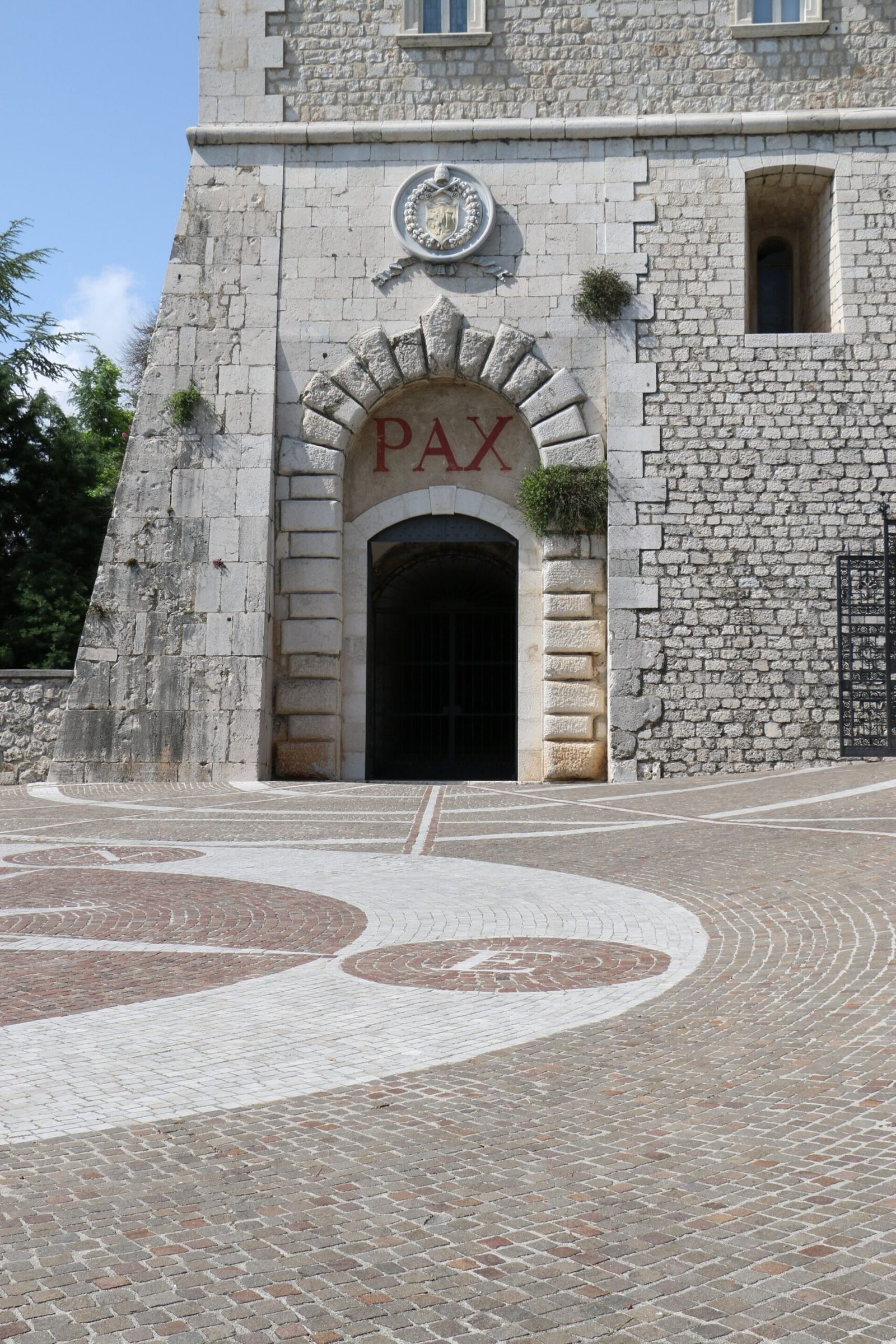
The reason the monastery stands up there and not in the valley floor is the same reason a temple stood there before it: the mountain is a natural balcony that dominates the mouth of the Liri valley, that is, the corridor through which, since always, you pass from Rome toward the South. Via Latina, which is older than the Appia on that stretch, ran at the foot of this height. Whoever controls the mountain sees anyone coming hours ahead. It's a spiritual advantage, the solitude, the detachment, the air, that turned out to be a military sentence. The same position that in the 6th century guaranteed silence guaranteed in the 20th century that the abbey ended up exactly in the middle of the most contested line of combat in Europe.
The mountain, the acropolis and the road
Below the summit, on the flanks of the mountain, lie the remains of ancient Casinum: a theater, an amphitheater, a mausoleum, stretches of polygonal walls. The monastery was not born in a void but on top of an acropolis, that is, on the high and sacred part of a Roman city. When you drive up the nine kilometers of hairpin bends that lead from the town of Cassino to the abbey's parking area, the road crosses that stratigraphy: at the base is the archaeological park, halfway up the medieval Rocca Janula with its towers, at the top the monastery. That's 3,000 years in a quarter of an hour of driving.
A detail nobody considers: the modern road exists because the old mule track was no longer enough. Until well into the 19th century people went up on foot or on muleback, and the climb took a good couple of hours. Medieval pilgrims arrived up here exhausted, which, I suspect, contributed a great deal to the mystical dimension of the experience. Today you arrive by car, with air conditioning, and the challenge is instead to slow down enough to understand where you are.
The view from the Loggia del Paradiso
The terrace that the monks call the Loggia del Paradiso is, from a purely panoramic point of view, the best spot of the Montecassino Abbey. It looks southwest, toward the valley, and on clear days it shows you a slice of plain that stretches almost to the sea. You look out from the Chiostro del Bramante, between the columns, and generally it's there that groups stop longer than I had planned. I never call them back: that is exactly the place where the landscape explains history better than any guide. From there you see the places where in 1944 there was four months of fighting, one by one, and you understand why.
Casinum: the Roman city beneath the Montecassino Abbey
Before Benedict there was a city, and not just any city. Casinum was born from an Italic settlement (the ancient sources speak of Oscans and Volscians, then of Samnites) and passed under Roman control at the end of the 4th century BC, in the context of the Samnite wars. It became a prefecture, then a municipium, then a colony, and throughout the imperial age it was a well-off center of that inland strip of southern Lazio which Via Latina kept connected to the City.
The name, according to an etymology reported by Varro, would derive from a Sabine or Oscan root meaning "old," and indeed when the Romans arrived here the place was already ancient. Marcus Terentius Varro, the great scholar, had a villa at Casinum and in the De re rustica he describes with pride his aviary along the course of the river: one of the very rare cases in which we have a first-hand description of a Roman villa installation made by its owner. That villa, plundered during the civil wars, is one of the most sought-after archaeological ghosts of the area.
The theater, the amphitheater and Ummidia Quadratilla
The archaeological park of Casinum, at the foot of the mountain, preserves two buildings for shows and a mausoleum. The theater, from the Augustan age, is set into the slope following Greek and Roman building common sense (you use the hill instead of building substructures) and could hold around 2,500 spectators. The amphitheater, elliptical, measures roughly 85 meters by 69 and reached an estimated audience of 4,500 people, which says a lot about the size and wealth of the community.
We owe the amphitheater to a woman, and that deserves a couple of words. Ummidia Quadratilla was a very rich matron of the 1st century AD, a landowner, a benefactor, and, a detail that makes her irresistible, so passionate about pantomimes that she kept a private troupe of dancers. Pliny the Younger dedicates a letter to her in which, with that punctilious courtesy of his, he tells that she died at almost 80, in excellent health and with a firm body, and that her extremely well-brought-up grandson would discreetly withdraw when his grandmother had the pantomimes perform at home. That the amphitheater of Casinum was built at this lady's expense, and that a few dozen meters away the mighty square-plan mausoleum traditionally attributed to her burial still stands, is one of the small pleasures of local history.
Why the archaeological park is worth the detour
Many visitors to the Montecassino Abbey go up to the monastery and leave without knowing that at the foot of the road, a stone's throw from the entrance, there is an archaeological park with a national museum. It's a mistake I advise not making, especially if you have the whole day. Seeing the theater and the amphitheater before going up changes the perception of what you find at the top: Benedict did not retreat into a virgin desert, he settled on the acropolis of a city that was slowly emptying out, reusing stones, masonry and memory. Western monasticism was born on top of the ruins of antiquity, literally, not metaphorically.
Saint Benedict arrives at Montecassino: 529 and the temple of Apollo
The date that all the manuals report is 529, and it's best to say right away: it's a conventional date, reconstructed after the fact, and scholars still debate whether it should be moved earlier or later by a few years. What is certain is that around the end of the 520s a monk originally from Norcia, already experienced at Subiaco, where he had lived in a cave and founded a series of small communities, climbed this mountain with a group of disciples and settled here.
Our only ancient source on the life of Benedict is the second book of the Dialogues of Pope Gregory the Great, written around 593-594, that is, about half a century after the saint's death. Gregory does not write a biography in the modern sense. He draws an edifying portrait, built on exemplary episodes and miracles, declaring that he is gathering the testimony of disciples. It's a hagiographic source, and has to be read as such. That doesn't mean it is invented, it means it must be used with the historian's tongs.
The temple, the sacred grove and the two chapels
According to Gregory, when Benedict arrives on the summit he finds still standing a temple dedicated to Apollo and a sacred grove, with the population of the surrounding area practicing sacrifices there. We are in the 6th century, Christianity has been the state religion for more than a century, but in the countryside of inland Italy the ancient cults survive. Benedict smashes the idol, overturns the altar, cuts down the grove and converts the inhabitants. In the hall of the temple he carves out an oratory dedicated to Saint Martin of Tours, the saint of converted soldiers, and it's no casual choice, and on the highest point, where the altar stood, an oratory dedicated to Saint John the Baptist, the forerunner, the baptizer.
This second oratory is the physical heart of the whole story. It's where Benedict will want to be buried, it's where the main altar of the basilica will later rise, and it's where even today you go down to reach the crypt. Every time the abbey has been rebuilt, the spot has stayed the same. 1,500 years of topographical continuity over a handful of square meters.
The cultural gesture nobody tells
The simple reading of the episode is the victory of Christianity over paganism. The interesting reading is another: Benedict does not destroy the temple, he reuses it. He transforms one building into another building, a sacred place into a sacred place. It's the same principle that will save half of ancient architecture across Europe: churches carved out of temples last, abandoned temples become stone quarries. And, on a larger scale, it's the same principle that will govern the scriptorium: you don't burn the ancient heritage, you copy it, preserve it, put it at the service of a new culture. The story of the Montecassino Abbey begins with an act of conversion that is also an act of conservation.
The Rule written at the Montecassino Abbey
If I had to name the most important object ever produced on top of this mountain, I wouldn't point to a treasure, a mosaic or an illuminated codex. I would point to a text of about 15,000 words, divided into a prologue and 73 chapters, written in a late and practical Latin, without literary pretensions: the Rule of Saint Benedict. It was composed here, in all probability in the 530s and 540s, and it has organized the daily life of millions of people for 1,500 years.
Gregory the Great calls it "remarkable for discretion and luminous in language," and he hits two real qualities. The discretio, the measure, the sense of proportion, is the signature of the text: Benedict knows the extreme asceticism of the East, the spectacular fasts, the stylites, the record-setting mortifications, and deliberately chooses another road. His Rule is a rule for normal men, with bodies that get tired and characters that quarrel.
What the Rule really says
The monastery is defined as a "school of the Lord's service," and the vocabulary is scholastic and military at once. The day is marked by the Opus Dei, the common liturgical prayer: seven daytime offices and one at night, distributed so that the Psalter is recited in full over the course of the week. Between one office and the next come meditative reading, the lectio divina, and manual labor, to which chapter 48 devotes very concrete pages, with hours that change according to the season because in summer it's hot and in winter it gets dark early.
The formula "ora et labora" that everyone knows does not appear in the text. It is a late synthesis, from the 19th century, and like all syntheses it simplifies. But it doesn't betray: the idea that praying and working are two faces of the same obligation, and that neither can eat up the other, is exactly the center of gravity of the Rule.
Stability, the abbot, guests
Three Benedictine inventions changed the social history of Europe more than people believe. The first is the stabilitas loci: the monk promises to remain in that monastery, for his whole life. It looks like a disciplinary detail, but it's the birth of the permanent institution, a body that outlives its members, accumulates property, keeps archives, plans over long periods. Without stability there is no library, no agrarian land reclamation, no documentary memory. And without these three things medieval Europe would have been another planet.
The second is the figure of the abbot, to whom the Rule devotes very dense chapters. He has full authority, but he is required to call the brothers into council on important matters, to listen even to the youngest "because often the Lord reveals to the younger what is best," not to show preference between the nobleman and the former slave, to temper severity. It's a model of government that medieval jurists will study closely.
The third is hospitality. Chapter 53 establishes that every guest who arrives is to be welcomed "as Christ himself," with particular regard for the poor and pilgrims, because, and the sentence is of impressive lucidity, "in the rich, reverential fear is already guaranteed by itself." In a continent without hotels, without public assistance and with dangerous roads, this clause meant for centuries the difference between surviving a journey and not surviving it.
An academic debate worth knowing
Since the 1930s scholars have established that the Benedictine Rule depends to a large extent on an earlier anonymous text, the so-called Regula Magistri, much longer and much more minute. Benedict knows it, uses it, and above all cuts it: he prunes, lightens, eliminates the obsession with regulation, leaves room to breathe. The genius of this text lies not so much in what it adds as in what it removes. It's a lesson that holds outside monasteries too.
Benedict and Scholastica: the last meeting and the storm
Of the pages Gregory the Great devotes to Benedict, the one that touches visitors to the Montecassino Abbey most does not concern a spectacular miracle but a dinner. Scholastica, Benedict's sister (tradition says his twin), lived in a women's community at the foot of the mountain, and once a year the two siblings met in a house outside the enclosure to spend the day talking about God. By then they were both old.
At the last of these meetings, Gregory tells, Scholastica asked her brother to stay longer, to talk all night. Benedict refused: the Rule, his own Rule, required him to return to the monastery before evening. Then Scholastica bowed her head over her hands, wept, prayed. And as she raised her head a storm broke so violent that nobody could put their nose outside the door. "God forgive you, sister, what have you done?" says Benedict, annoyed. And she, with one of the most beautiful replies in Western hagiography: "I asked you and you did not listen to me. I asked my Lord and he listened to me." They spent the night talking.
Why that episode matters
Gregory closes with a sentence that is condensed theology: the one who loved more could do more. It's the only point in the whole narrative where Benedict, the lawgiver, is outvoted, and not by a higher authority but by affection. In a text written to exalt discipline, this chapter says that discipline is not the last word. These are things that, told in front of the tomb where the two siblings are buried together, carry a different weight.
Three days later Scholastica died, and Gregory tells that Benedict, from the window of his cell, saw his sister's soul rise to heaven in the form of a dove. He had the body brought to the monastery and laid it in the tomb he had prepared for himself. That is why, under the main altar, the two burials lie side by side.
The death of Benedict and the tombs under the main altar of the Montecassino Abbey
Tradition fixes the death of Benedict on March 21 of a year around 547. Gregory tells that the saint had his tomb opened, that for six days he was seized by fever, and that on the sixth he had himself carried into the oratory, received the viaticum and died standing, held up by the arms of his disciples, with his hands raised in prayer. It's a death in liturgical posture, which painters have taken up for centuries. The bronze sculpture in the center of the entrance cloister, a work by Attilio Selva from 1952, depicts exactly this scene.
That the remains of Benedict and Scholastica rest under the main altar of the Montecassino Abbey is the constant conviction of the Cassinese tradition, reasserted over the centuries and confirmed by examinations. It has to be said honestly, however, that there is an old dispute: in the 7th century some French monks, led according to the story by Aigulf, supposedly stole the relics, taking Benedict to Fleury-sur-Loire, today Saint-Benoît-sur-Loire, and Scholastica to Le Mans. The French abbeys maintained their version for centuries. In 1107 Pope Paschal II ruled in favor of Montecassino, declaring the translation false. The dispute has never entirely closed on the historiographical level, and it's one of those stories that say a great deal about the political and economic value relics had in the Middle Ages.
The crypt and what survived
The crypt you visit today is, paradoxically, the oldest part of the visible furnishings of the monastery. It was carved at the end of the 1500s into the rock bank and decorated at the beginning of the 20th century, between 1913 and the immediately following years, by the artist monks of the German school of Beuron: an unmistakable style, geometric, hieratic, with gold, elongated figures and an almost Egyptian taste in its frontality. You like it or you don't, but it is coherent and powerful.
The point is that that decoration is still there. Being buried in the rock, the crypt withstood the bombing of 1944 while everything above collapsed. Whoever goes down those steps today sees with their own eyes the only monumental portion of the abbey predating the war. Keep this in mind, because in the flow of the visit it's easy to walk through without grasping the difference: above you are in an 80-year-old building, below you are in the only space that went through the battle.
577: the Lombards and the first destruction of the Montecassino Abbey
The first catastrophe arrives about 30 years after the founder's death. Between 577 and 581 (the traditionally indicated date is 577) the Lombard bands of Duke Zotto of Benevento climb the mountain by night and devastate the monastery. We know it from Paul the Deacon, who in turn draws on Gregory the Great, who had written that the monks managed to flee without losing their lives, "as Benedict had predicted."
The survivors go down to Rome carrying what can be carried: the liturgical objects, the community's weights and measures, and above all, according to Cassinese tradition, the autograph codex of the Rule. They are welcomed at the Lateran, where they found a community that will survive for generations. The mountain stays deserted for more than a century: a century and a half of silence in which, on the acropolis of Casinum, there is no one left.
The paradox of the first destruction
But here is the flip side, and it's a flip side that will repeat every time. The destruction of 577 sends the Cassinese monks to Rome, to the heart of Western Christendom, precisely in the years when a Roman aristocrat named Gregory is becoming pope. It is from that contact that book two of the Dialogues is born, that is, the only biography of Benedict we possess, that is, the text that makes Benedict a figure known to the whole Latin Europe. Had the monastery not been razed, perhaps the memory of the founder would have remained a local matter. The first destruction of the Montecassino Abbey is, in a very concrete sense, what made Montecassino famous.
Petronax and the rebirth of the 8th century
Around 718, at the urging of Pope Gregory II, a man from Brescia named Petronax climbs the mountain and starts again. He finds, the sources say, a few hermits scattered among the ruins and gathers them into a community. It is the second beginning, and the one that turns the place into a power.
Within a few decades the reborn abbey becomes the reference monastery of the West, and not only for spiritual prestige. Figures of the very first rank arrive. In 747 Carloman becomes a monk here, son of Charles Martel and brother of Pepin the Short, that is, one of the most powerful men in Europe who abdicates and retires up here: a political twist that brought to Montecassino a Carolingian attention destined to last. In the same period Willibald passes through, the future bishop of Eichstätt, who stays a long time before leaving to evangelize Germany. And Montecassino becomes the point where Italian Benedictine tradition joins the Frankish monastic reform that Benedict of Aniane will bring to completion under Louis the Pious.
Why the 8th century is decisive
It is in this phase that the monastery acquires the enormous landed estate, the so-called Terra Sancti Benedicti, that will make it for centuries a territorial power, with castles, villages, mills, salt works, toll rights. It's not a marginal economic detail: without that material base there would have been no scriptorium, no library, no Desiderius's building site, no medical school. Culture costs money, and at Montecassino the fields of the Liri valley paid for it.
Paul the Deacon at the Montecassino Abbey
Among the men who worked in this monastery, Paul the Deacon is the one to whom European civilization owes more than it suspects. Born in Cividale del Friuli around 720 into a Lombard family of rank, trained at the court of Pavia, he entered Montecassino around 774, that is, right after the collapse of the Lombard kingdom under the blows of Charlemagne. From 782 to 787 he is at the Carolingian court (he goes there to obtain the release of his brother, a prisoner of the Franks) and there he becomes one of the masters of that revival of studies that we call the Carolingian Renaissance. Then he comes back up here and dies here, on April 13, 799, buried in the abbey church, in a tomb of which later reconstructions have erased every trace.
The Historia Langobardorum
His major work, the Historia Langobardorum, was written here in the very last years of his life and remained unfinished. It tells the history of his people from the mythical departure from Scandinavia to the death of King Liutprand in 744, and stops there: Paul does not write the Frankish conquest, does not tell the defeat. It's the choice of a man who serves the victors and cannot bring himself to narrate the end of his own. That silence, for a historian, is more eloquent than 100 pages.
Without the Historia we would know almost nothing about the 200 Lombard years in Italy. It's from there that the stories we all know come: Alboin and the skull of Cunimund turned into a cup, Queen Rosamund, the flight of Perctarit. And it's from there that 19th-century Romantics drew material for novels and tragedies, Manzoni included.
The musical notes were born from one of his hymns
Then there is the detail that always amuses visitors, and it's true. Paul the Deacon composed a hymn for Saint John the Baptist, the Ut queant laxis. Three centuries later, a monk and music theorist named Guido d'Arezzo noticed that the first six half-phrases of that hymn each began on a note of the scale progressively higher, and used their initial syllables as names for the notes: ut, re, mi, fa, sol, la. The ut will become do in the 1600s, the si will come from the initials of Sancte Iohannes. Every time a child sings the scale anywhere in the world, they are using a text written by a Lombard monk of the Montecassino Abbey.
883: the Saracens and the second destruction of the Montecassino Abbey
The 9th century is the century of the Muslim raids in the western Mediterranean. Bands coming from Sicily and Africa move up the Tyrrhenian coasts, penetrate inland, strike the rich centers. In 883 it's Montecassino's turn.
The abbot at that moment is Bertharius, a man of great cultural stature (poet, liturgist, author of medical texts) who had had the village at the foot of the mountain fortified, creating the settlement of Eulogimenopoli, the ancestor of modern Cassino. On September 4, 883 the attackers fall on the monastery. Bertharius is killed. The Cassinese sources say he was slaughtered at the foot of the altar while praying, and since then he has been venerated as a martyr. The monastery is plundered and set on fire.
70 years of exile
The survivors go down to Teano, then to Capua. It's a long exile, and with a twist of mockery inside it: in 896 a fire at Teano destroys the exiles' library, and in that fire, according to Cassinese tradition, the autograph codex of the Rule is lost, the one the monks had saved from the Lombards three centuries earlier and brought back. Saved from the swords, burned by a fireplace.
The return to the mountain takes place around the middle of the 10th century. Abbot Aligernus, in office from about 948 until 985, brings the community back to the top, rebuilds, reorganizes the scattered landed estate and takes up lawsuits and boundaries again. And it is precisely this work of recovering the property, reconstructing who owned what after 70 years of abandonment, that produces the most famous document in the entire archive.
The Placito Capuano of 960: Italian is born in the archive of the Montecassino Abbey
In March 960, at Capua, before the judge Arechisi, a boundary case is tried between the monastery of Montecassino and a small local feudal lord, Rodelgrimo d'Aquino, who has appropriated lands taking advantage of the void left by the destruction of 883. The monastery has to prove possession for 30 years. Three witnesses testify, pointing with their hand to the boundaries of the property, and pronounce a formula that the notary transcribes not in Latin, as would be the norm, but in the spoken language, because the testimony must count literally, word for word, as it came out of the mouth:
"Sao ko kelle terre, per kelle fini que ki contene, trenta anni le possette parte Sancti Benedicti."
"I know that those lands, within those boundaries described here, were possessed for 30 years by the party of Saint Benedict." 33 words, or thereabouts, and they are the first document in Italian vernacular of which we have the preserved original. Not a scratched fragment, not a marginal gloss, not a riddle: an official legal act, dated, drawn up by a notary, with the year and the month, in a language that is no longer Latin and is already almost Italian.
What makes that line so important
Look at the text carefully. Sao for "so," with the result of the loss of the intervocalic consonant. Ko for "che," with that k which is a graphic habit of the Cassinese area. Kelle for "quelle." Que still Latinizing. Possette, a strong perfect, still very much alive today in the southern dialects. And finally parte Sancti Benedicti, which stays in Latin because it's a crystallized legal formula, the name of the legal person in the case. The notary, without knowing it, left us a sound photograph of central-southern Italy around the year 1000: the parts that state the law remain Latin, the part in which a man speaks passes into the real language.
Not one but four
The documents of this group, which philologists call the Placiti cassinesi, are actually four: the one from Capua of March 960, two relating to Sessa Aurunca and one to Teano, drawn up in the following three years, with slightly different formulas but of the same family. They were identified in the 1700s by Erasmo Gattola, archivist and historian of the monastery, and are kept in the abbey's archive. In 1943, when the papers were packed up and taken to Rome, the Placiti were among those crates: had history gone differently, the Italian language would have lost its birth certificate in a bombing.
It's worth insisting, because it's the kind of information that changes your perception of the place: when you enter the Montecassino Abbey, you are not entering only the mother house of Western monasticism. You are entering the building where the exact moment is kept when Italians began to write the way they spoke.
Desiderius and the golden century of the Montecassino Abbey
If the Montecassino Abbey had a golden age, it is the abbacy of Desiderius, from 1058 to 1087. Born Dauferio, of Lombard princely stock from Benevento, entered the monastery against his family's will, a man of highly refined taste and outsized political intelligence, Desiderius comes to govern the monastery in one of the most chaotic moments in Italian history: the Normans are conquering the South, the papacy is entering the investiture struggle, the empire presses from the north.
He plays the game masterfully. He mediates between popes and Normans, gets protection from both sides, becomes a cardinal, turns into the closest collaborator of Gregory VII and finally, when the latter dies, is himself elected pope in 1086 with the name of Victor III, an office he accepts with evident reluctance and holds for little more than a year, dying in 1087 and having himself buried here, in his monastery, not in Rome.
The building site of 1066-1071
Desiderius's masterpiece, however, is the building site. Between 1066 and 1071, five years, a trifle for medieval construction, he has the existing church demolished and builds a new one, grandiose, with the atrium, the quadriportico, the bell tower. He has marbles and columns brought from Rome, where the ancient ruins still served as a luxury quarry. He brings master mosaicists from Constantinople because the West had lost that technique, and, a decisive detail, he demands that they teach the trade to the young monks, so that the art would not leave along with the artists. It's one of the most conscious technology-transfer programs of the entire Middle Ages.
The consecration takes place on October 1, 1071, celebrated by Pope Alexander II in the presence of a crowd of bishops, Norman princes and the archdeacon Hildebrand, the future Gregory VII. The chronicles describe a sumptuous ceremony, the church gleaming with gold-ground mosaics, the floors in opus sectile, the bronze doors.
A wave that reaches as far as Sant'Angelo in Formis
Desiderius's church no longer exists: the earthquake of 1349 and the Baroque rebuildings wiped it out. But its figurative language spread, and luckily an extraordinary witness of it remains a short distance away: the basilica of Sant'Angelo in Formis, near Capua, built by Desiderius himself on land donated by the prince of Capua and frescoed by Cassinese workers. Whoever wants to understand what was seen up here in the 11th century has to make that detour: it is the reference volume of Desiderian painting, with that imposing Christ Pantocrator and the biblical stories in superimposed bands.
The bronze doors of the Montecassino Abbey
Among the very few things that have come down to us from the 11th century are the bronze doors. Desiderius had them cast in Constantinople around 1066: bronze with the designs engraved and filled with silver, according to a Byzantine technique that left other illustrious examples in southern Italy, from Amalfi to Salerno to Monte Sant'Angelo. About 50 years later, under Abbot Oderisius II, the doors were enlarged and on the new leaves something surprising was engraved: the systematic list of all the abbey's possessions, churches, castles, cities, farmsteads, with the names of the localities.
Stop and think what that means. The doors of a church are not furniture: they are the threshold, the place where the monastery meets the world. Engraving the land register on them means declaring to anyone who enters, with the solemnity of bronze and the brightness of silver, that the Terra Sancti Benedicti is this and is not up for discussion. It is at once a liturgical act and a notarial act, and for the modern historian it is a formidable source, because it gives us back the geography of Cassinese power as it was around 1123.
Those doors have gone through the earthquake, the rebuildings, the suppressions and the war. Damaged in 1944, they were recovered from the rubble and restored. When you enter the basilica, look at them: it's not a copy, it's the oldest piece the Montecassino Abbey puts in front of you.
Alfanus, Constantine the African and medicine at the Montecassino Abbey
Desiderius's circle was not made up only of masons and mosaicists. Alfanus was part of it, a Cassinese monk later archbishop of Salerno from 1058 to 1085, a Latin poet of very fine quality, translator from Greek and physician. It was he who composed the tituli, that is, the captions in verse, for the painted cycle of the atrium of Desiderius's church. It was he who translated into Latin a Greek treatise by Nemesius of Emesa on the nature of man, bringing to the West a piece of ancient philosophical anthropology. And it was he, almost certainly, who introduced into the Cassinese and Salernitan milieu the most exotic character of this whole story.
Who Constantine the African was
Constantine the African arrives from North Africa, perhaps from Carthage, in the second half of the 11th century. The sources on him are wrapped in legend (merchant, traveler, perhaps a fugitive) but the certain fact is that he knew Arabic and Arab medicine, and that around 1077 he became a monk at Montecassino, where he died before 1098-1099.
Here, under Desiderius's protection, he translated into Latin a corpus of Arabic medical texts that the West did not know: the Pantegni, a version of the medical encyclopedia of al-Maǧūsī. The Isagoge of Ḥunayn ibn Isḥāq, the manual that for five centuries would open every university course in medicine. The Viaticum, the practical travel handbook of Ibn al-Ǧazzār. And other treatises on pharmacology, dietetics, fevers, urine, eyes.
The consequence: the Salernitan medical school
The effect of those translations is hard to overstate. The Salernitan medical school, the first European institution to teach medicine systematically, the ancestor of university faculties, takes off precisely thanks to this contribution. And the texts translated by a monk at Montecassino remain textbooks across Europe until well into the 1600s.
It should be added that the abbey itself had a long practice of caring for the sick: the Rule devotes a chapter to the care of the infirm, who are to be served "as Christ in person," and the great abbeys developed infirmaries, herb gardens and pharmacies. When people say monasticism invented the European hospital they simplify, but they don't lie entirely. The Cordoba-Kairouan-Montecassino-Salerno chain is one of the best proofs that the Middle Ages was not at all a closed block: it was a world in which books traveled, and languages with them.
Beneventan script and the scriptorium of the Montecassino Abbey
Whoever enters the abbey museum and finds themselves in front of an 11th-century Cassinese codex notices right away something strange: the letters resemble nothing familiar. The a looks like oc, the e has a high eyelet, the t ligatures, the strokes are broken and rhythmic like a row of battlements. It is the Beneventan script, also called Cassinese, and together with the Visigothic and the Insular it is one of the great national scripts of the early European Middle Ages.
It was born in the southern Lombard milieu in the 8th century, matures in the 10th, reaches formal perfection precisely in the scriptorium of Montecassino in the century of Desiderius, and holds out until well into the 13th century, when the by then dominant Caroline minuscule and then the Gothic sweep it away. It's a script that is hard to read and magnificent to look at: calligraphic, stubbornly local, with a system of abbreviations and punctuation marks all its own, including a question mark of unmistakable shape.
The work of a scriptorium
Telling how a book was made up here helps to understand why so few remain. It took parchment, that is, sheep or goat skins scraped, stretched, dried, cut: for a codex of medium size a small flock was used up. It took iron-gall ink, obtained from oak galls and iron sulfate. It took trimmed goose quills, awls for ruling, the compass, pumice stone. It took a copyist trained for years, who worked in natural light (in the scriptorium candles were forbidden for obvious reasons) and produced, when things went well, a few pages a day.
Then there were the rubricator, who added the titles and initials in red, the illuminator, for luxury codices, the binder. A decorated liturgical codex could cost as much as a farm. Copying a book was an investment, not a pastime, and that is why the choice of what to copy is one of the weightiest cultural decisions you can imagine.
What we owe to the Cassinese copyists
Here restraint is a must, because quite a lot of legend circulates on the subject. It's not true that all of Latin literature was saved at Montecassino. It is true, however, and documented, that some capital texts of classical culture reached us through 11th-century Cassinese manuscripts, and that without those copies we would not read them today. The Annales and the Historiae of Tacitus in their second part, the Golden Ass and the philosophical works of Apuleius, the De lingua Latina of Varro: pieces of the first rank, which survived because someone, in a cold room on a mountain, decided it was worth using up a pile of skins and six months of life on them.
There is a scene that no document confirms but that is reasonably close to the truth: a monk copying the pages of Tacitus on the revolt of Boudicca without the faintest idea where Britain is, simply because the Rule tells him to work and the abbot told him to copy that. The transmission of ancient culture in Europe passed through thousands of gestures like this, almost all anonymous.
The library and the archive of the Montecassino Abbey
The Cassinese library is one of the great historical libraries of Italy, and, I don't say it to dramatize, it is alive. On the eve of the Second World War, when everything had to be packed in a hurry, the inventories recorded on the order of 800 papal documents, more than 20,000 volumes in the old collection and 60,000 in the modern library, in addition to incunabula, 16th-century printed books, illuminated codices, archive papers numbering tens of thousands of pieces and works of art.
The archive, in particular, is a unique case in Europe: since the abbey has survived as an institution from the 6th century to today, the documentation has accumulated with a continuity that very few bodies can claim. Inside are the Placiti of the 10th century, the papal bulls, the imperial diplomas, the land registers, the chronicles. The Chronicon Casinense of Leo of Ostia, continued by Peter the Deacon in the 12th century, is one of the richest monastic chronicles of the medieval West and our main source for Desiderius's building site.
How to get access today
The library and the archive are not part of the ordinary visiting route: they are research facilities, with consultation rooms, and access is reserved for scholars on reasoned request. There are, however, dedicated guided tours, organized by the abbey by reservation, which allow you to go in as a group with an escort. If you are passionate about old books, write to the monastery offices in good time and ask: it's the kind of request that, if made in advance and politely, often gets a positive answer.
Thomas Aquinas as a child at the Montecassino Abbey
In the castle of Roccasecca, a handful of kilometers from here, around 1225 the last son of Count Landolfo d'Aquino is born. The family has a precise plan for him: make him an abbot of Montecassino, which at that time means making him one of the most powerful men in the South, with an estate and political influence of the first rank. The boy's uncle, after all, is the abbot in office.
So at five or six years old the little Thomas is handed over to the monastery as an oblate. He grows up here for a handful of years (learning to read, to sing the office, to keep silent) until the tensions between Frederick II and the papacy overwhelm the abbey and the boys are sent back home. Thomas continues his studies in Naples, and there he meets the Dominicans.
The family twist
When he announces that he wants to enter a mendicant order, that is, to give up a career and start begging, the family reacts the way any aristocratic family of the 1200s would: it has him kidnapped by his brothers along the road and keeps him under lock and key for more than a year in the family castles, trying in every way to make him change his mind. It doesn't work. Thomas Aquinas will become the greatest theologian of the Latin West, author of the Summa theologiae, and will die in 1274 at Fossanova, in another abbey of southern Lazio, less than 50 kilometers from here.
There is an anecdote that hagiographers love and that, true or not, says something real. As a child, up here, he supposedly tormented the monks with a single repeated question: "What is God?" All his later work is, in a certain sense, the adult attempt to answer that childish question. That he first formulated it in a cloister of this mountain is one of those coincidences that make places more interesting than books.
1349: the earthquake and the third destruction of the Montecassino Abbey
The third catastrophe has no human face. On September 9, 1349 a very violent earthquake, felt from Rome to Naples, strikes the central-southern Apennines. At Montecassino Desiderius's church collapses, the bell tower breaks, the cloisters come down, the monastery is reduced to a heap. Monks and servants die. Below, the village of San Germano, present-day Cassino, is devastated.
The moment is terrible for other reasons as well: 1348 is the year of the Black Death, southern Italy is at war, the papacy is in Avignon and the monastery is going through a phase of decline. The strength to rebuild is not there. 17 years will pass before the building site restarts, and it restarts in 1366 thanks to the interest of Pope Urban V, who had been a Benedictine monk and is the only Avignon pope who took to heart the fate of the mother abbey of his order.
What is lost and what changes
With the earthquake the 11th-century basilica disappears, with its Byzantine mosaics and its opus sectile floors. The visible Middle Ages of Montecassino disappears, in effect: from then on, what you see up here will be late Gothic, then Renaissance, then Baroque. That is why the visitor who arrives expecting to find a medieval monastery is often thrown off. The Cassinese Middle Ages is not in the stones: it is in the codices, in the archive and in the idea.
In the 14th-century reconstruction, and even more in the rebuildings of the following centuries, however, the structure takes hold that still determines your visit today: the long sequence of courtyards and cloisters going uphill, one inside the other, that leads from the entrance to the church. It is an architectural and at the same time spiritual device (you climb by degrees, you detach progressively from the world) and it still works perfectly, even on those who don't think about it.
Commendams, congregations and power: from the 1400s to the 1700s
In 1454 the Montecassino Abbey enters the regime of the commendam: the abbatial title, with its revenues, is assigned to an outside ecclesiastic who neither resides nor governs the community. It's a system widespread across Europe and almost always disastrous for monastic life, because it separates money from responsibility. Among the Cassinese commendatories is also Cardinal Giovanni de' Medici, the future Pope Leo X, who held title to this monastery without ever really administering it.
The turning point comes in 1504, when Montecassino joins the reformed congregation of Santa Giustina of Padua, which by virtue of this very adhesion will take the name of Cassinese Congregation. It is a serious reform: abbots elected for a term, mutual checks among monasteries, general chapters, return to discipline. The monastery regains vigor, and the recovery shows immediately in the building sites.
The 1500s build
We owe to the 1500s two of the most beautiful spaces you will walk through. The Chiostro dei Benefattori, built around 1513, is traditionally attributed to a design by Antonio da Sangallo the Younger: lean proportions, regular rhythm, all the elegance of the full Roman Renaissance transplanted onto a mountain in southern Lazio. The Chiostro del Bramante, also called Sant'Anna, dates from 1595 and takes its name from the attribution (unproven, but tenacious) to the great architect from Urbino. At its center is an octagonal cistern flanked by Corinthian columns.
In the same period the crypt under the main altar is excavated, the monumental staircases are arranged, the accesses are reorganized. The layout you climb today step by step is essentially the one worked out in these decades.
Power you can see
A detail I always invite people to look at, because it tells the mentality of the era better than a treatise: in the Chiostro dei Benefattori, starting in 1666, two rows of statues facing each other were placed. On one side the benefactor popes (Gregory the Great, Gregory II, Zachary, Victor III, Urban V, Benedict XIII, Benedict XIV, Clement XI), on the other the lay sovereigns (Charlemagne, Henry II, Robert Guiscard, Charles III of Bourbon). It's not a devotional pantheon: it's a balance sheet carved in marble, the official list of who gave and therefore who has a right to perpetual gratitude. And, implicitly, a reminder for the powerful visitors of the time: here you enter history, all you have to do is sign a donation.
The Neapolitan Baroque of the Montecassino Abbey
In the 1600s and early 1700s the abbey takes on the look it would keep until 1944: that of a large Baroque complex of Neapolitan taste, sumptuous, luminous, marble. The basilica is rebuilt and decorated without sparing expense, and the best of the southern school comes to work on it.
There are the canvases and frescoes of Luca Giordano, the fastest painter of the century, the one contemporaries called Luca Fa Presto. There are Francesco Solimena, Paolo de Matteis, Francesco de Mura, Sebastiano Conca. There are the inlaid marbles and polychrome inlays of the workshop of Cosimo Fanzago and his followers, with that taste for geometric inlays that in Naples you recognize in half the city. The carved wooden choir, the stalls, the organs, the altars: an ensemble that Grand Tour travelers described as one of the richest in Italy. The new consecration of the basilica took place in 1727 in the presence of Pope Benedict XIII, a Dominican, who came up here in person.
Why I'm telling you about it if it's no longer there
Because almost all of this was destroyed in 1944, and because the basilica you see today is the attempt, successful in structure, inevitably different in material substance, to re-propose that image. Knowing what was there makes comprehensible what is there: the present decorations are not a gratuitous pastiche, they are the philological reconstruction of an interior documented by photographs, surveys and drawings. Some original fragments were recovered from the rubble and reintegrated. Other parts were remade. The wooden choir is a work of reconstruction. It is a building to be read with this double awareness, and for me it is precisely this that makes it moving.
Suppressions, national monument, the 1800s
The first blow comes with Napoleon: in 1799 and then in the years of the French occupation of the Kingdom of Naples the monastery suffers requisitions, spoliations and the suppression of religious communities. The monks return with the Restoration.
The second blow, more lasting, comes with the unification of Italy. The laws of 1866-1867 on the ecclesiastical estate suppress the religious orders and seize their property. For Montecassino, however, a particular path is chosen: the abbey is declared a national monument, the property passes to the State, and the monks stay on the spot as custodians and conservators of the monument itself. It's an Italian-style compromise, and like many Italian-style compromises it worked: the community did not disperse, the library stayed together, and national monument status is still today the legal framework of the complex.
The learned 1800s
The century that follows is, culturally, one of the most fruitful. The Cassinese monks devote themselves to publishing sources, to paleography, to editing archive documents, to Gregorian musicology. Montecassino becomes a destination of European culture: German philologists, English historians, French editors climb up here to consult the codices. The monastery is no longer a territorial power, but it has gone back to being what it had been in the 11th century: a center of study.
Autumn 1943: the codices put to safety
We come to the part that has to be told with the greatest possible precision and the least emphasis. In the autumn of 1943 Italy is split in two. The Allies landed at Salerno on September 9, the Germans have occupied the center-north and are organizing a defensive line that crosses the peninsula at the height of Cassino. It's obvious to anyone with a map that the monastery will end up in the middle.
Between October and November 1943 two officers of the Hermann Göring armored division, the medical captain Maximilian Becker and the Austrian lieutenant colonel Julius Schlegel, propose to the abbot that the abbey's heritage be transferred to Rome. Abbot Gregorio Diamare, who had led the community since 1910, is at first wary: he fears, with reason, that the operation will turn into a disguised plunder. In the end he accepts, asking for guarantees, involving the Holy See and having the transports accompanied by monks charged with keeping watch.
100 trucks in three weeks
The operation lasts about three weeks. Custom-made crates are built, the codices, papal documents, registers, paintings and liturgical furnishings are packed and loaded onto more than 100 trucks that go down the road of hairpin bends and take the road to Rome. With the papers also leave the elderly monks and part of the displaced people. Together with the abbey's heritage travel crates from the Neapolitan museums that had been put in safety up here precisely because the monastery seemed the best protected place in the area. The deliveries to the Holy See are completed in December 1943.
The unpleasant part has to be told too, because the historical truth stands whole: not every crate reached its destination. A certain number of works from the Neapolitan depots were diverted toward Germany and ended up in Hermann Göring's collection. Part was recovered after the war, part was not. The abbey's archive and library, instead, arrived in Rome and were saved in full.
What was saved, concretely
Thanks to those three weeks the Placiti cassinesi still exist today, along with the Beneventan codices, the bulls, the chronicles of Leo of Ostia and Peter the Deacon, the incunabula, the documents that make it possible to write the history of the medieval South. Three months later, the place where all this material had been kept for centuries no longer existed.
It's an episode to be handled with balance. It turns no one into an absolute hero, redeems nothing, compensates for nothing. It does record a fact: in the middle of a total war, some people on opposite fronts cooperated to save books, and they succeeded. It's a datum, and as such I hand it over.
The Gustav Line and the battle of Cassino
In the winter of 1943-1944 the Gustav Line is the strongest German defensive system in Italy. It runs from sea to sea, from the Tyrrhenian to the Adriatic, and in the sector that concerns us it rests on three natural elements: the Garigliano river, the Rapido river (a few meters wide but with vertical banks and icy currents) and the mountain massif on which the abbey stands. The Germans blew up the dams, deliberately flooding the plain, mined the banks, cut down trees and buildings to clear fields of fire, fortified caves and positions connected by trenches.
The sector commander, General Fridolin von Senger und Etterlin, is a practicing Catholic and, a not irrelevant detail, a Benedictine oblate. He has the abbey declared a neutral zone, with a strip of 300 meters around the walls closed to troops. On paper the neutrality exists. On the mountain, in a battle of that intensity, the 300-meter strip is a thin and shifting line.
The phases
The battle begins on January 17, 1944 and lasts until May, in four great waves. The first sees the British X Corps force the Garigliano and the US 36th Division attempt the crossing of the Rapido, an attack that ends in a massacre, with about 2,000 casualties in two days. The French Expeditionary Corps, with the Moroccan and Algerian divisions, scrambles up the mountains to the north and pays a very high price.
The second phase is that of the bombing of the monastery and the New Zealand and Indian attacks on Hill 593 and on the railway station. The third, in March, is preceded by a massive bombing of the city of Cassino (hundreds of planes, a thousand tons of explosives) that reduces the town to a field of craters and rubble, making it, once again, more defensible than before. The fourth and last is Operation Diadem in May.
The toll
It's four months of fighting among the hardest of the Western front. Overall estimates speak of more than 100,000 casualties among the Allies and tens of thousands among the Germans, figures that include dead, wounded, missing and prisoners. To these must be added the civilian victims of the area, who were many and who also include the violence suffered by the population in the days after the breakthrough. The city of Cassino was destroyed to the point that people debated whether to rebuild it elsewhere.
February 15, 1944: the fourth destruction of the Montecassino Abbey
In mid-February the Allied command is convinced, or convinces itself, that the abbey is being used as an artillery observation post. The formal request to bomb it comes from the New Zealand general Bernard Freyberg on February 12, motivated by the "military necessity" of protecting his own men. General Mark Clark, commander of the 5th Army, is against it, and will remain against it for the rest of his life. The authorization comes anyway from the higher levels.
On February 14 Allied artillery fires at the abbey shells containing warning leaflets, in Italian and English, urging the occupants to leave. Inside the monastery at that moment are Abbot Diamare, a small group of monks and a few hundred civilians (local families, old people, women, children, wounded) who had taken refuge up there convinced it was the safest place in the world.
The morning of the 15th
At 9:45 on February 15, 1944 the first wave arrives: 142 B-17 Flying Fortress heavy bombers. In the afternoon the medium bombers follow, about 40 B-25 Mitchells and as many B-26 Marauders. In all, several hundred tons of high-explosive and incendiary bombs are dropped, with estimates that in the highest reconstructions exceed a thousand tons. After the planes the artillery goes into action, with hundreds of guns and tens of thousands of rounds.
In a few hours the Baroque basilica, the cloisters, the wooden choir, the canvases of Luca Giordano, Fanzago's marbles, the bell tower, the monks' quarters, everything is reduced to dust. What remains standing are stretches of outer wall and, under the rubble, the crypt.
The dead and the mistake
In the bombing about 230 Italian civilians sheltered in the abbey died. No death of any German soldier inside the monastery is recorded, for the simple reason that, as later investigations established, the Germans were not inside the monastery. It's not a matter of opinion but of documentation: no unit was quartered in the building.
There's more, and it's the bitterest part. The foundation walls, thick and ancient, remained standing under the rubble, and the ruins turned out to be a much better defensive position than the intact building: natural ditches, stone shelters, clear fields of fire. After the bombing, and only after, the paratroopers of the German 1st Division occupied the rubble and held it for three months. The historian Herbert Bloch, who devoted fundamental studies to the subject, summed up the affair by calling it an operation useless on the military level and harmful on the strategic one.
Among the crews that took part in that bombing was a young American gunner named Walter M. Miller Jr. The experience marked him for the rest of his life and produced, 15 years later, one of the most famous science fiction novels of the 20th century, A Canticle for Leibowitz: the story of a monastic order that, after an atomic catastrophe, guards and recopies the fragments of the knowledge of a vanished world. It was written by a man who had helped destroy the monastery where that trade had been invented.
Diamare and the descent of the survivors
In the days following the bombing, the survivors remain among the ruins, in terrible conditions, with the wounded and without water. On February 17 Abbot Gregorio Diamare, then 79 years old, decides to go down. He leads on foot a procession of monks, civilians, women, sick and wounded along the mountain path, crossing a strip of front about 20 kilometers deep, toward the German rear. In the end he reaches Sant'Elia Fiumerapido.
During that passage the abbot was taken to a German command, where he was asked to sign a declaration attesting that German soldiers had never been present in the monastery. The declaration was truthful. The use made of it by propaganda was another matter, and Diamare protested the way his signature was exploited. His figure remains that of an old priest who carried to safety the papers, then the people, and finally himself. He died on September 6, 1945, at Sant'Elia Fiumerapido, without seeing the reconstruction. He was awarded the gold medal for civil valor.
This passage should be remembered in front of the abbey's facade, because it puts things in the right order. The artistic heritage saved is important. The fact that a 79-year-old man accompanied wounded people on foot across a front is more important still.
May 18, 1944: the Polish II Corps and the flag
On May 11, 1944 Operation Diadem begins, the general offensive along the whole line. To the Polish II Army Corps, about 25,000 men under General Władysław Anders, falls the hardest task: to take the abbey massif from the north, conquering the hills (593, called Snake's Head, and the others) that nobody had managed to hold in four months.
It's worth knowing who these soldiers were, because their story is among the most extraordinary of the war. They were largely Poles deported to the Soviet Union after 1939, survivors of the gulags and labor camps, freed and reorganized into an army after the German invasion of the USSR, and brought to the Middle East crossing Central Asia, Persia, Iraq, Egypt. Many had lost entire families. They fought for a country that, while they climbed this mountain, was being assigned to the Soviet sphere: most would never go home.
The two assaults
The first attack, on May 12, fails with very heavy losses. The second starts on May 17. In the night between the 17th and 18th the German paratroopers, now threatened with encirclement because in the Liri valley the front has given way, disengage from the ruins.
On the morning of May 18, 1944, a patrol of the 12th Podolski Uhlan Regiment reaches the deserted monastery and raises the Polish flag over the rubble. It is about 10:20. A trumpeter then plays the Hejnał mariacki, the call that for centuries has marked the hours from the tower of the Basilica of Saint Mary in Kraków, the melody that breaks off abruptly in mid-note, in memory, the legend says, of the trumpeter struck by a Tatar arrow. Playing it there, that morning, on those ruins, after Central Asia and the gulags, is one of the most charged symbolic gestures of the entire war.
The red poppies
In the same night between May 17 and 18, a soldier-actor of the Polish corps's theater, Feliks Konarski, wrote off the cuff the lyrics of a song. The composer Alfred Schütz set it to music in a few hours. It is titled Czerwone maki na Monte Cassino, "The red poppies on Monte Cassino," and it says that the poppies of this mountain are redder because they grew on Polish blood. It was sung for the first time only a few days later, and it is still one of the best-known patriotic songs in Poland: everyone knows it, from children to the elderly. It is the reason why, still today, buses of Polish visitors are met up here every week, often whole school groups. For them Montecassino is not an Italian monument. It is a family place.
The war cemeteries around the Montecassino Abbey
Around this mountain there are more military cemeteries than in any other area of Italy, and visiting at least one is part, in our judgment, of a complete visit. They should be walked in silence, without group photos, with the same demeanor you would keep in a village cemetery, because that is exactly what they are.
The Polish cemetery
The Polish military cemetery is the closest to the abbey. You reach it from the access road, a few hundred meters below the monastery, and it is laid out like an amphitheater on the slope, facing the walls. Just over a thousand fallen of the II Corps rest there, the register at the entrance lists 1,051. At the entrance is an inscription worth the whole trip: "Passer-by, tell Poland that we fell faithful to her service." It is the reworking of the epitaph of Thermopylae, and in that context it has a weight that needs no comment.
General Anders died in London in 1970, in exile, and wanted to be buried here with his soldiers. His tomb is at the far end, in line with the abbey. Beside the cemetery, since 2014, there is a small memorial museum opened for the 70th anniversary of the battle.
The Commonwealth cemetery at Cassino
The Cassino War Cemetery is on the valley floor, on the outskirts of the city, run by the Commonwealth War Graves Commission. More than 4,000 fallen British, Canadian, New Zealand, Indian, South African and other Commonwealth soldiers are buried there. Next to it stands the Cassino Memorial, which commemorates by name several thousand men who fell in the Italian campaign and have no known grave. It is a place of trimmed English lawns, white headstones in rows and absolute quiet, and whoever enters for the first time comes out changed: the ages carved on the stones are almost all between 19 and 25.
The German cemetery at Caira
A few kilometers away, in the district of Caira, is the German military cemetery, inaugurated in the 1960s, where about 20,000 German soldiers who fell in the area rest. It is different from the others: crosses of dark stone grouped in pairs on the slope, a sober and somber layout, a lot of shade. This too is a place of mourning, and has to be treated as such. There is no useful rhetoric to make here.
The others
The funerary geography of the battle also includes the French cemetery of Venafro, the Italian one of Mignano Monte Lungo and the memorial to the Indian fallen. It is the map of a Europe and of an entire world that passed through this valley: Moroccans, Algerians, New Zealanders, Nepalese, South Africans, Canadians, Poles, Germans, Italians, Americans, British, Indians. To anyone who wonders why the battle of Cassino is so remembered abroad, the answer is this list.
"Succisa virescit": the motto of the Montecassino Abbey
Two Latin words, a plant image: succisa virescit, "cut down, it grows green again." The reference is to the plant that, pruned or cut, sprouts again more strongly from the stump. It is the motto of the Montecassino Abbey, and it appears accompanied by the emblem of the cut trunk putting out shoots.
Now, mottos are almost always exercises in self-celebration. This one is not. This one is an account: 577, 883, 1349, 1944. Four times razed to the ground and four reconstructions, with intervals of abandonment that in one case exceeded a century. I don't know another European institution with a similar record, and note that after every destruction the abbey was rebuilt on the same spot, with the same orientation, with the altar over the same tomb.
The lesson you take home
An image helps: imagine having to rebuild your house four times, each time after it was razed to the ground, each time in the same place, knowing that the place is dangerous precisely because it is beautiful and strategic. The rational answer would be to move. After 1944 the proposal to rebuild the monastery elsewhere, or to leave the ruins as a war memorial, a solution adopted in other European places, was actually put forward. The community and the Italian government chose the opposite: where it was, as it was. Not out of nostalgia, but as an affirmation: continuity is itself a content.
The reconstruction "where it was, as it was"
The building site of the fourth reconstruction starts a few years after the end of the war and continues for a good decade. The Italian State finances the work since the abbey is a national monument. The technical direction is entrusted to the engineer Giuseppe Breccia Fratadocchi, and the heavy work is concentrated between 1948 and 1956.
The principle adopted is that of philological restoration: rebuilding the destroyed architecture in its documented form, using surveys, historical photographs, archive drawings and recovered fragments. It's not an obvious principle (postwar restoration culture is divided between those who preach reconstruction and those who consider it a fake) and it was debated then and is debated still today in architecture faculties. Here, though, the choice had a solid historical basis: the abbey had already been rebuilt three times, and nobody had ever considered it a fake.
The work on the site
Before rebuilding, it was necessary to remove: hundreds of thousands of cubic meters of rubble, on top of a mountain, on a road of hairpin bends, in a territory full of unexploded ordnance. Then everything identifiable had to be recovered from the debris (pieces of cornice, capitals, marbles, elements of the bronze doors, fragments of statues) and cataloged. Then rebuild the structures, recompose the decorations, redo the wood carvings, reposition the surviving works returned from Rome.
The new bells were cast in 1949 by the Pontificia Fonderia Marinelli of Agnone, in Molise, which is the oldest bell foundry in operation in Europe. In the 1980s, under Abbot Fabio Bernardo D'Onorio, Pietro Annigoni worked with a few collaborators on the painted decoration of the basilica, bringing to it his own 20th-century figurative language: it's the most debated part of the whole, and it's worth looking at without prejudice and forming your own idea.
October 24, 1964: Paul VI and Benedict patron of Europe
The date of the rebirth is October 24, 1964. Pope Paul VI goes up to Montecassino and consecrates the rebuilt basilica. It's a day that the reporters of the time described as one of the most crowded ever seen up here, with delegations from all over Europe and a crowd that filled the esplanades.
On the same occasion the pontiff signs the apostolic letter Pacis nuntius, with which he proclaims Saint Benedict principal patron of Europe. The title he gives the letter is already a program: "messenger of peace." The text justifies the choice by recalling that Benedict and his monks, with the cross, the book and the plow, brought Christian progress to the peoples who were emerging onto the continent after the fall of the Roman Empire, uniting religious proclamation with written culture and the work of the fields.
The context: why in 1964
The proclamation is not born in a void. In 1964 the Second Vatican Council is under way, the European Economic Community is seven years old, and the idea of building a European unity after two world wars is still a fragile project that needs shared roots. To name as patron a 6th-century monk who left a rule translated into all the languages of the continent, and to do so from the place that European armies had pulverized 20 years earlier, is a political gesture as well as a religious one. From that day the Montecassino Abbey stops being only a monastic mother house and becomes a declared European symbol.
The later papal visits
Since then the popes have come back. John Paul II went up in 1979, and his pilgrimage had a particular meaning for the Polish community, given what this mountain represents in Poland. Benedict XVI came on May 24, 2009, close to the 65th anniversary of the destruction, and celebrated and prayed at the tomb of the saint whose name he had chosen. Each time the focus of the ceremony has been the same: the small crypt under the main altar, where the whole story is concentrated.
The basilica of the Montecassino Abbey today
You reach the basilica after crossing the sequence of cloisters and climbing the great staircase. The inner facade, on the Chiostro del Bramante, is a scenographic backdrop. The entrance, as we have said, preserves the bronze doors of the 11th century, the oldest piece of the whole.
The interior is a Latin cross, with three naves, with a dome over the crossing of the transept. The light is the typical light of Baroque churches of the Neapolitan milieu: high, diffused, reflected by the pale marbles. The walls and floors are covered with polychrome inlaid marbles following the design documented before the war, and overall the effect is that of a great 18th-century interior, with 20th-century inserts that you recognize with the naked eye if you pay attention.
What to look at, in order
First thing: stop just inside and look up. The perception of breadth, in this church, is built from the vault. Second thing: look at the wooden choir behind the altar, with its carved stalls. It's the result of a long work of reconstruction and completion of the lost furnishings, and the quality of the carving deserves a few minutes. Third thing: look for the 20th-century signatures, the works of Annigoni and his collaborators, and try to tell them apart from the surrounding 18th-century language. It's an exercise that makes the visit active and leads you to really look, instead of scrolling past.
Fourth and last thing: go down to the crypt. You reach it from the sides of the presbytery. It's the most recollected space, the lowest, the quietest, and as we have said it is the only monumental part that escaped 1944. Under the crypt's altar rest Benedict and Scholastica. In there you don't talk, you don't phone, and if someone is praying you wait.
A tip on the liturgy
If your visit coincides with a moment of communal prayer, don't consider it an obstacle. The Sunday conventual Mass in late morning and the afternoon Vespers are sung in Gregorian chant, and listening to Gregorian chant in the place where the Rule that prescribes its performance was written is, for anyone with a minimum of sensitivity, the strongest experience this place can offer. It costs you half an hour and it's worth the trip.
The cloisters of the Montecassino Abbey
The visiting route is essentially a climb through courtyards. There are three main spaces, and each has a different function in the economy of the building and of your day.
The entrance cloister
The first courtyard you meet, also called the entrance or southern cloister, stands on the area where tradition places the temple of Apollo. At the center is a bronze group depicting the Death of Saint Benedict, a work by Attilio Selva from 1952, and its story deserves to be told: it was donated to the abbey by the chancellor of the Federal Republic of Germany, Konrad Adenauer. A German chancellor giving a sculpture to the abbey destroyed by the Allies to flush out the Germans, in the years when the European Community and Franco-German reconciliation were being built: the statue is as much a political document as an artistic one. Under the portico is the mosaic with Christ between the Madonna and Saint Martin.
The Chiostro dei Benefattori
This is the Renaissance cloister of 1513 attributed to a design by Antonio da Sangallo the Younger, with the double row of statues of popes and sovereigns already mentioned. Raise your eyes to the faces: they are conventional portraits, of course, but the sequence tells 500 years of relations between the abbey and the European powers. The level is the intermediate one of the complex, and from here starts the staircase that leads to the upper level.
The Chiostro del Bramante and the Loggia del Paradiso
The cloister of 1595, called del Bramante or di Sant'Anna, is the one immediately in front of the basilica: the octagonal cistern in the center, the Corinthian columns, the statues of Benedict and Scholastica at the sides of the staircase (the one of Benedict is an 18th-century work by Friar Campi of Carrara) and on the side open toward the valley the Loggia del Paradiso, that is, the belvedere. It's the point where the architecture opens onto the landscape, and it is deliberate: you climb through closed and enclosed spaces, and at the last level, a moment before the church, the wall opens and below lies the whole valley. Whoever designed this sequence knew what they were doing.
The Montecassino Abbey Museum
The Montecassino Abbey Museum is a part of the visit that very many skip in a hurry and that is instead the key to reading all the rest. It has its own route, its own entrance and its own ticket, separate from access to the monastery.
It displays what came back from Rome and what was recovered from the rubble: illuminated codices in Beneventan script, incunabula and 16th-century printed books, archive documents and papal bulls, liturgical vestments and silverware, paintings, sculptures, architectural fragments from the different phases of the abbey, archaeological materials from the mountain. There is also a section devoted to the story of the destruction and reconstruction, with photographic documentation of before and after.
Why the museum should be seen first, not last
The operating advice, which almost nobody follows: if you have time, enter the museum before going around the cloisters and the church. The reason is simple. The complex you walk through is, materially, a building rebuilt after the war. The museum instead contains the authentic objects, those that went through the centuries and the war. Seeing first the codices and the photographs of the rubble, and then walking in the cloisters, radically changes the way you look at them. Done in reverse order, the museum risks seeming an appendix. Done first, it becomes the explanation.
The piece I recommend looking for
If you have little time and want just one thing, look for a codex in Beneventan and stay there five minutes. You don't need to know how to read it. Look at the rhythm of the strokes, the ink, the millimeter uniformity of the lines, and try to imagine the hand that made it: a man who knew neither eyeglasses nor electric light, who wrote in winter in an icy room because flame was forbidden, and who took months for that volume. Then remember that this book reached you passing through an earthquake and a bombing. There is nothing in the whole abbey that tells better what we are talking about.
The territorial abbey and the downsizing of 2014
A legal particularity that visitors almost always miss: Montecassino is not a simple monastery. It is a territorial abbey, that is, an autonomous ecclesiastical jurisdiction, immediately subject to the Holy See, whose abbot exercises functions similar to those of a diocesan bishop over a defined territory. It's a very ancient and increasingly rare figure: very few remain in the world.
Until a few years ago the jurisdiction of the abbot of Montecassino included dozens of parishes spread over an area straddling the provinces of Frosinone and Caserta: a real small ecclesiastical territory, direct heir of the medieval Terra Sancti Benedicti.
The decree of October 23, 2014
On October 23, 2014 Pope Francis ordered the downsizing: the abbey's territory was reduced to the abbey church alone and the monastery with its dependencies, while the parishes passed to the neighboring diocese, which at the same time took the name Sora-Cassino-Aquino-Pontecorvo. The abbey remains territorial (the title and status were not abolished) but its extent today is minimal.
The reason is as practical as it is symbolic: a monastic community reduced to a few units cannot bear the pastoral care of dozens of parishes, and concentrating on contemplative life, hospitality and the custody of the heritage is a choice of realism. In 2013, in a parallel movement, the historic Cassinese Congregation merged into the Subiaco Congregation, giving rise to the Subiaco Cassinese Congregation: another reorganization that reflects the numerical contraction of European monasticism.
The monastic community of the Montecassino Abbey today
And here we are at the most important point, to keep in mind before any practical information. Montecassino is not a museum with extras. It is a monastery inhabited by a small Benedictine community, on the order of a dozen monks, which leads there the life prescribed by the Rule: choral prayer marking the day, work, reading, silence, hospitality.
This has a simple consequence: part of the complex is enclosure and cannot be visited, not out of secrecy but because it's somebody's home. The cells, the refectory, the interior corridors, some areas of the gardens are not part of the route. When you find a closed door or a cord, it's not an organizational spite: it's the line that separates your visit from the private life of a dozen people.
Silence is not optional
The Rule devotes to silence some of its most insistent chapters, not as mortification, but as a condition of work. In a monastery silence is the infrastructure, like running water in a hotel. In the cloisters you can speak in a low voice. In the basilica and the crypt you lower your voice until you switch it off. It's a courtesy that costs nothing and is the only thing the monks really ask.
Hospitality
The abbey's guesthouse welcomes guests, individuals and groups, following the Benedictine tradition of chapter 53 of the Rule: it is not a hotel and does not work like a hotel, but a welcome exists, must be requested in advance from the monastery offices and goes with respect for the schedule and rhythm of the house. For anyone who wants to really understand this place, spending a night there and getting up for the morning office is an experience of a completely different order from a two-hour visit.
How to get to the Montecassino Abbey
The monastery stands above the city of Cassino, in the province of Frosinone, roughly halfway between Rome and Naples. It's one of the few major destinations in Lazio comfortably reachable in a day from both cities.
By train
The Cassino station is on the Rome-Cassino-Naples railway line, served by regional trains with decent frequency. From Roma Termini the trip takes roughly an hour and a half. From Naples the times are similar. The problem begins afterward: from the station to the monastery there are about nine kilometers of uphill road with an elevation gain of more than 400 meters, and you don't do them on foot unless you are a trained hiker and are in no hurry.
There is a local bus service connecting the city to the abbey, but the runs are few and concentrated in certain time bands, and vary by season. If you plan to use it, check the schedule the same day and, my honest advice, allow for the possibility of taking a taxi for at least one of the two legs. There are some at the station, but on weekdays in low season it's best to have a number saved.
By car
It's the most sensible way. The A1 Rome-Naples highway has the Cassino exit. From the toll booth you follow the signs for the abbey and take the scenic road that climbs in hairpin bends. From the city to the monastery esplanade it's about 20 minutes of easy driving. The road is paved, wide enough, with guardrails and several points to pull over, but it's a mountain road: if you suffer from curves, sit in front. If you drive, don't get distracted by the view, which is remarkable and for that reason dangerous.
Parking is on arrival, on the esplanade in front of the entrance. On spring weekends, on holiday long weekends and on days of major celebrations it fills up: arriving by the morning is the right strategy.
By motorcycle and bicycle
The climb to Montecassino is a classic for motorcyclists (regular hairpins, generally good asphalt, continuous panorama) and a serious cycling climb: about nine kilometers with interesting average gradients and a few steeper ramps. If you tackle it by bike, start early in summer, bring water, and consider that at the top there is little shade and the wind can be cold even in July.
Hours, rules and dress for visiting the Montecassino Abbey
Entrance to the abbey is open every day, with hours that change between the summer and winter seasons. In the period from April 1 to October 31 the opening covers the whole day, roughly from 9:30 to 18:30. From November 1 to March 31 closing is moved earlier to 16:50 from Monday to Saturday and to 17:15 on Sunday. The museum has its own calendar, which at certain times of the year is more restricted than that of the monastery. Since hours may vary because of celebrations, works or provisions of the community, the golden rule is just one: check the abbey's official website or phone before leaving, especially if you go up in low season or on a particular holiday.
Dress
This is a monastery and a working church, and the access code of places of worship applies: shoulders covered and legs covered at least to the knee, for men and women. It's not a norm of custom, it's the condition for entering the basilica, and it is enforced. In summer, with 30 degrees Celsius on the valley floor, the simplest way not to find yourself in difficulty is to carry in your bag a light shirt or a large scarf and put it on at the entrance of the church.
I add a recommendation nobody puts on lists: bring a sweatshirt or a light jacket even in midsummer. We are at over 500 meters, on an exposed summit, and the temperature difference from the plain can be several degrees. The wind on the Loggia del Paradiso, on clear days, is a constant.
Shoes
You don't need trekking gear, but you do need closed, comfortable shoes with a sole that grips. The route runs along a long series of staircases and courtyards of stone and marble, often polished by centuries of passage, and with humidity or rain they become slippery. Heeled sandals and flip-flops are, here, a choice you pay for.
Photographs, phones, behavior
Photographs outdoors and in the cloisters are generally allowed. In the basilica and the crypt the rules the staff point out on site apply, and common sense suggests avoiding flash, tripods and filming during celebrations. In any case, and this is the point: no photos of people praying. The phone should be silenced at the entrance and not taken out in the crypt.
Guided tours are organized by the abbey, which has a dedicated service, and must be booked. If you arrive with a group, make contact in advance: the internal organization has capacities and time slots, and showing up with 30 people without notice is the best way to spend the morning waiting.
Accessibility
The complex is built on levels connected by monumental staircases, and this places obvious limits on those with mobility difficulties. There are alternative routes and accesses that make it possible to reach some main parts, but the situation has to be checked case by case by contacting the abbey before the visit and explaining your needs. The same goes for strollers: the route is doable, but with many stairs in between, and a baby carrier or child-carrier backpack solves quite a few problems.
How much time you need
The minimum visit (cloisters, basilica, crypt) takes a good hour. With the museum you reach two and a half hours. Adding the Polish cemetery brings you close to half a day. If you want to combine the archaeological park of Casinum and one of the valley cemeteries, allow the whole day. The suggestion, for those who come from far away only once: devote the whole day to it and don't squeeze it between two other stops.
What to see around the Montecassino Abbey
Going up here and leaving right away is the most common mistake. The area at the foot of the mountain has material for at least another half day, and the reading of the monastery comes out enriched.
The archaeological park of Casinum and the museum
At the foot of the climbing road is the archaeological area of ancient Casinum, with the Augustan theater set into the slope, the amphitheater built by Ummidia Quadratilla, the monumental mausoleum attributed to her and the remains of the urban structures. Next to it is the National Archaeological Museum named after Gianfilippo Carettoni, which gathers the materials of the site. It's a short, quiet visit, almost never crowded, and it has the merit of showing you what was on this mountain before Benedict arrived.
The Rocca Janula
Halfway up, in a dominating position over the city, you can see the walls and towers of the Rocca Janula, the fortress the abbey had erected in the 10th century to protect access to the mountain and many times contested, besieged and reworked over the centuries. The Rocca too was badly damaged in 1944 and has been the object of restorations. It's the piece that explains the military and seigneurial dimension of the medieval abbey: the monks of Montecassino were not only men of prayer, they were territorial lords with castles and men-at-arms.
The Museo Historiale of Cassino
In the city there is a multimedia museum devoted to the battle and the wartime story of the area, with period films, reconstructions and testimonies. It's well designed for anyone who wants to understand the sequence of events of 1944, and it works particularly well for kids, who in front of an animated map grasp in 10 minutes what in a book would take a chapter.
Sant'Angelo in Formis and the other detours
Whoever has a car and an extra half day has, within an hour's radius, some of the most beautiful things in southern Lazio and northern Campania: the already mentioned basilica of Sant'Angelo in Formis near Capua, with its 11th-century frescoes of the Cassinese school, that is, the best possible substitute for Desiderius's lost church. The Cistercian abbey of Casamari and that of Fossanova, where Thomas Aquinas died. The Benedictine sanctuary of Santa Maria dell'Albaneta, on the mountain, tied to the events of the battle. Cassino is also the natural gateway to the Comino Valley and to the Abruzzo, Lazio and Molise National Park.
When to go to the Montecassino Abbey
The best season, without debate, is the in-between one. From mid-April to early June the light is clear, the temperature at the top is pleasant, the meadows around are green and, a detail that here has a precise meaning, in May the poppies bloom. Whoever knows the Polish song understands right away why May, up here, is not just any month.
Autumn, from late September to early November, offers the most transparent days of the year: after a storm, from the Loggia del Paradiso you see very far. It is also the period with the fewest groups.
Summer and winter
In midsummer the valley floor is scorching, but at the top you can breathe and the breeze helps. The problem, if anything, is the haze, which on July and August afternoons can reduce the panorama quite a lot. Early morning is clearly better.
In winter the visit has a fascination all its own (fog rising from the valley, absolute silence, very few people) but you need to know two things: the hours are shorter and the road, in case of snow or ice, may present difficulties or restrictions. Before going up in January or February, a phone call is a must.
The dates to keep an eye on
March 21 and July 11 are the two main Benedictine feast days: the first is the traditional date of Saint Benedict's passing, the second the solemnity with which the Church celebrates him and the feast of the patron of Europe. February 10 is the memorial of Saint Scholastica. February 15 and May 18 are instead the two dates of the war, and around them commemorations, delegations and pilgrimages concentrate, in particular Polish ones. On those days you will find more people, but also an atmosphere that is not repeated the rest of the year: it's up to you to decide whether to seek it or avoid it.
A curiosity about the Montecassino Abbey (FR)
The last curiosity concerns a line of 27 words kept in this archive, and it concerns everyone reading this. In March 960, at Capua, a witness called to testify in a boundary case pronounced before the judge Arechisi the phrase "Sao ko kelle terre, per kelle fini que ki contene, trenta anni le possette parte Sancti Benedicti." The notary, instead of translating it into Latin as any colleague would have done, transcribed it exactly as he had heard it. That line is the first document in Italian vernacular that we possess in the original, and it is up here, in the archive of the Montecassino Abbey.
The beauty is the reason it exists. It was not born from a literary intent, a linguistic experiment or a patriotic choice: it was born from a procedural quibble. In a case of 30-year possession the testimony had to count literally, word for word, because it was on those words that it was decided who the owner was. Translating could have altered the sense. And so the language Italians really spoke, and which nobody considered worthy of being written, entered an official document out of pure legal caution. Italian is born from a scrupulous notary.
What remains is the tail of the story, which is the funniest part. In 1943, when the archive crates were loaded onto the trucks bound for Rome, the Placiti were inside too. Three months later, the building that had guarded them for a thousand years was dust. The birth certificate of the Italian language came within a handful of weeks of being erased by a bombing, and it was saved because two officers of an occupying army and an 80-year-old abbot agreed on how to pack books. Every time I tell it I see someone stop mid-step.
One thing nobody tells you about the Montecassino Abbey (FR)
Without beating around the bush: almost everything you see up here is less than 80 years old. The basilica, the cloisters, the staircases, the cornices, the marbles, the statues in the niches, the carvings of the choir. In February 1944 this place was a heap of rubble, and what now seems to you a centuries-old monastery is a philological restoration carried out after the war, with surveys and photographs in hand, under the direction of the engineer Giuseppe Breccia Fratadocchi.
Many visitors, when they find out, have a reaction of slight disappointment. It's an error of perspective, and it's worth correcting. Because the thing nobody tells you is not that the abbey is a reconstruction: it's that it has always been a reconstruction. The one the Lombards razed in 577 no longer existed from 883. The one the Saracens burned in 883 was already the second. Desiderius's magnificent church, with the mosaicists called from Constantinople, lasted less than 300 years before the earthquake of 1349 brought it down. The building you see is the fourth or fifth of the series, depending on how you count the rebuildings, and it is exactly what this place has always done: fall and rise again on the same spot.
The only material exceptions are two, and they should be sought out. The first is the 11th-century bronze doors, cast in Constantinople, with the abbey's possessions engraved and inlaid with silver on the leaves: you pass through them entering the basilica, often without looking at them. The second is the crypt, decorated by the monks of the Beuron school in 1913 and survived because it was dug into the rock. When you go down those steps, you are entering the only monumental space of the abbey that was already there in February 1944 and that went through the bombing. Touch the doorpost: it is older than everything else around you.
The advice I give you for visiting the Montecassino Abbey (FR)
The advice is just one and concerns the order of things: don't stop at the monastery esplanade. Go down 400 meters along the road and stop at the Polish military cemetery. Do it after the visit to the abbey, not before, and allow yourself at least half an hour.
The reason is that the Montecassino Abbey, seen alone, remains a beautiful abstraction: a rebuilt monastery, a long history, a panorama. Seen from the Polish cemetery it becomes something different. From there the monastery stands out above you, exactly as it stood out above those who had to take it, and the 1,051 headstones laid out like an amphitheater on the slope all look in the same direction: toward the abbey. At the entrance it says "Passer-by, tell Poland that we fell faithful to her service." At the far end, in line with the monastery, is the tomb of General Anders, who died in London in 1970 after 25 years of exile and was buried here, among his soldiers, because he could not go home.
Go in silence, without group photos, and read a few names and a few birth dates. They are men who had been deported to Siberia, who had crossed Central Asia and the Middle East to get here, and who died on an Italian mountain to free a country that, in the meantime, had already been assigned to someone else. If after the cemetery you go back up by car and see the abbey again from the hairpin bend, you will understand why the motto Succisa virescit is not an elegant Latin phrase but the technical description of this place. I add a practical recommendation: put your phone in your pocket before getting out of the car, and keep it there.
Another well-known fact, yet rarely cited
That the names of the musical notes derive from a medieval hymn is information found in every manual of music history and in half the drawing-room anecdotes. What almost nobody connects is where and by whom that hymn was written: the Ut queant laxis, dedicated to Saint John the Baptist, is the work of Paul the Deacon, the Lombard monk who spent the last years of his life in this monastery and who died here, on April 13, 799.
The mechanism is of perfect simplicity. Guido d'Arezzo, a music theorist of the 11th century grappling with the problem of teaching singers to sing precise intervals from memory, noticed that in the current performance of that hymn the first six half-phrases each started on a degree of the scale progressively higher. He took the initial syllables of the respective verses (Ut queant laxis, resonare fibris, mira gestorum, famuli tuorum, solve polluti, labii reatum) and used them as names. The ut became do in the 1600s, for reasons of vocal convenience. The si arrived later from the initials of the two final words, Sancte Iohannes. Ever since, every child in the Western world, when learning the scale, repeats a text composed by a monk of the Montecassino Abbey.
There is a second fact, equally well known and equally little associated with this place, and it is the transmission of some capital texts of Latin literature. Part of the Annales and the Historiae of Tacitus, the Golden Ass and the philosophical works of Apuleius, the De lingua Latina of Varro: these are works we read today because in the 11th century, in the scriptorium of this mountain, someone copied them out in Beneventan script on parchment. There was no Enlightenment cultural project behind it: there was an abbot who assigned jobs and a Rule that required work. The rescue of classical antiquity happened out of obedience, not out of love of letters, which, if you think about it, makes it even more remarkable.
The right photo to take at the Montecassino Abbey (FR)
The photo everyone takes is the one from the Chiostro del Bramante, with the columns in the foreground and the valley in the background, or the facade of the basilica at the end of the staircase. They are correct and predictable images: you find them identical in 10,000 albums. The right photo, the one that conveys what this place is, is another, and requires moving.
Leave the abbey, get back in the car and go down as far as the Polish military cemetery. Go in, walk to the far end, turn toward the mountain and frame the headstones in the foreground with the Montecassino Abbey closing the horizon above. In a single image you have everything: the white monastery on the summit, the mountain that made it strategic, the crosses of those who died to take it, and the geometry (not accidental, intended by the designers of the cemetery) that aligns the fallen with the objective that not all of them reached. You don't need a particular camera or special light. You only need to be in the right spot, and that spot is not inside the abbey.
Two technical notes. The best light is first thing in the morning: the sun comes from the east, lights the facade of the monastery and leaves the slope of the cemetery in soft light. In the afternoon the mountain goes into backlight and the abbey becomes a dark silhouette. And, for the season, the moment is May, when poppies bloom among the headstones and along the edges (the ones in the song that the Polish soldiers wrote in the night between May 17 and 18, 1944, the night before reaching the top).
One last thing, to be said with some firmness: at the cemetery you photograph the landscape, you don't photograph yourself. No smiling portraits in front of the headstones, no poses, no groups. It's a cemetery, and a few hundred kilometers from here there are families who know exactly which stone corresponds to which name. If you feel like taking a photo with you in it, do it on the hairpin bend just above, where the abbey is seen whole and nobody is buried under your feet.
Some important events that took place here in history
The chronology of this mountain is one of the densest in Europe, and it's best to keep it in order. Around 529 Benedict of Nursia climbs the acropolis of ancient Casinum, converts the temple of Apollo into an oratory and founds the community. In the following years he writes there the Rule, 73 chapters that will organize the monastic life of the West for 1,500 years. Around 547 he dies, and is buried together with his sister Scholastica on the spot that will become the main altar.
In 577 the Lombards of Zotto destroy the monastery: the monks take refuge in Rome, and it is from that stay that Gregory the Great's account is born, which will make Benedict famous across Europe. Around 718 Petronax of Brescia refounds the monastery. In 747 Carloman, brother of Pepin the Short, becomes a monk there. Between 774 and 799, with the Carolingian interval, Paul the Deacon works there and writes the Historia Langobardorum.
On September 4, 883 the Saracens plunder the abbey and kill Abbot Bertharius. The community stays in exile for about 70 years before returning with Abbot Aligernus. In March 960, in a boundary case between the monastery and Rodelgrimo d'Aquino, the first of the Placiti cassinesi is drawn up at Capua, the oldest document in Italian vernacular preserved in the original, which is kept in the abbey's archive.
Between 1066 and 1071 Abbot Desiderius rebuilds the basilica in five years, calling mosaicists from Constantinople and having the bronze doors cast in the Byzantine capital. The consecration is on October 1, 1071, in the presence of Pope Alexander II. Around 1077 Constantine the African enters the monastery and translates there from Arabic the texts that will give impetus to the Salernitan medical school. Around 1230 a boy named Thomas Aquinas is handed over up here as an oblate.
On September 9, 1349 an earthquake destroys the abbey. The reconstruction restarts in 1366 with Pope Urban V. In 1504 the monastery joins the reformed congregation that will take the name Cassinese. Between the 1500s and the 1700s the present cloisters and the Baroque interior come into being, and in 1727 the basilica is reconsecrated in the presence of Benedict XIII. After the unification of Italy, the laws of 1866 seize the property, but the abbey is declared a national monument and the monks remain as custodians.
Between October and December 1943 the archive, the library and the works of art are transferred to Rome. On February 15, 1944 the Allied bombing razes the monastery to the ground, causing about 230 civilian victims. On February 17 Abbot Diamare leads the survivors on foot across the front. On May 18, 1944 the 12th Podolski Uhlan Regiment of the Polish II Corps raises the flag over the ruins and a trumpeter plays the Hejnał mariacki. Between 1948 and 1956 the reconstruction "where it was, as it was" takes place. On October 24, 1964 Paul VI consecrates the basilica and with the letter Pacis nuntius proclaims Benedict patron of Europe. On October 23, 2014 the territorial abbey is reduced to the church and the monastery.
Who passed through the Montecassino Abbey (FR)
The list is long and begins with the two founders: Benedict of Nursia, who lived here, wrote the Rule and wanted to be buried, and his sister Scholastica, who rests next to him under the main altar. Right after come the abbots who remade the monastery after every catastrophe: Petronax in the 8th century, Bertharius killed by the Saracens in 883, Aligernus who brought the community back to the mountain in the middle of the 10th century, Desiderius who between 1058 and 1087 made it the most refined artistic center in Italy before becoming Pope Victor III.
The intellectuals passed through. Paul the Deacon, a Lombard from Cividale, who wrote here the history of his people and the hymn from which the names of the notes would come. Alfanus, poet and physician, later archbishop of Salerno. Constantine the African, who arrived from North Africa with Arabic in his head and left here with the medical library of the West under his arm. Leo of Ostia and Peter the Deacon, authors of the great Cassinese chronicle. Amatus, who wrote the history of the Normans. And a boy named Thomas Aquinas, who up here learned to read before becoming the greatest theologian of Latin Christendom.
The powerful passed through. Carloman, son of Charles Martel, who gave up governing the Franks to become a monk. Visiting popes and commendatary popes, among them the future Leo X. Lombard princes and Norman conquerors, emperors and kings whose statues still occupy one side of the Chiostro dei Benefattori. And then generations of Grand Tour travelers, scholars, German and English philologists who climbed up on foot or on muleback to consult the codices.
In the 20th century men passed through here who had not chosen to come. Abbot Gregorio Diamare, who at 79 carried to safety first the papers and then the people. Captain Maximilian Becker and Lieutenant Colonel Julius Schlegel, who in three weeks loaded a thousand years of library onto about 100 trucks. General Fridolin von Senger und Etterlin, a Benedictine oblate, who commanded the troops defending this mountain. General Władysław Anders, who brought 25,000 men here, veterans of the gulags, and who rests here, in the cemetery under the walls, together with his fallen. And a young American gunner, Walter M. Miller Jr., who took part in the bombing of February 15, 1944 and 15 years later wrote a novel about monks who, after the end of the world, recopy books to save them.
Finally, there passed through, and continue to pass through, those the list doesn't record: the masons of 1366 and those of 1950, the anonymous copyists of the scriptorium, the peasants of the Terra Sancti Benedicti, the hundreds of civilians who in February 1944 climbed up here convinced it was the safest place in the world, and the small community of monks who today sing Vespers in Gregorian chant before a few dozen visitors. 1,500 years of people who climbed this mountain for opposite reasons, and who all left the same result: that every time it was cut down, the Montecassino Abbey (FR) grew green again.
To close, the Loggia del Paradiso. Below is the Liri valley with its roads, its warehouses and its fields. To the left you can make out the slope of the Polish cemetery. Behind you is an 80-year-old church built over a tomb 1,500 years old. You are not looking at a surviving monument: you are looking at the fourth answer to four very ugly questions. Stay there five minutes in silence before taking the hairpin road again, and carry down those two Latin words with you. They are useful outside this place too.
Quick questions about Montecassino Abbey
Where is the Montecassino Abbey
The Montecassino Abbey stands on top of the mountain of the same name, above the city of Cassino, in the province of Frosinone, more or less halfway between Rome and Naples. We are in southern Lazio, at over 500 meters of elevation, on a natural balcony that dominates the mouth of the Liri valley. From both cities you can comfortably get there in a day.
How to get to the Montecassino Abbey
The most sensible way is the car: exit at Cassino on the A1 Rome-Naples highway and take the road of hairpin bends, about 20 minutes of easy driving to the parking lot on the esplanade. By train, get off at the Cassino station, about an hour and a half from Roma Termini, but then about nine kilometers uphill remain. The local bus has few runs that change with the season, so allow for a taxi for at least one leg.
What are the hours of the Montecassino Abbey
The abbey is open every day, with different hours between summer and winter. From April 1 to October 31 the opening covers the whole day, roughly from 9:30 to 18:30. From November 1 to March 31 it closes earlier, at 16:50 from Monday to Saturday and at 17:15 on Sunday. The museum has its own calendar, sometimes more restricted. Hours can change, so check the official website or phone before leaving.
How should you dress to enter the basilica
You need shoulders covered and legs covered at least to the knee, for men and women: it's the condition for entering the basilica and it is enforced. In summer it's enough to keep a light shirt or a large scarf in your bag. Bring a sweatshirt too, because it's windy at the top and cooler than on the plain, and closed shoes with a sole that grips: stairs and stone courtyards get slippery in the rain.
How much time do you need to visit the Montecassino Abbey
For the minimum visit, that is, cloisters, basilica and crypt, you need a good hour. If you add the museum, which has its own entrance and ticket, you reach two and a half hours. With the Polish cemetery you come close to half a day. If you also want to see the archaeological park of Casinum and one of the valley cemeteries, allow the whole day, which is the right choice for those who come from far away only once.
When is the best time to go to Montecassino
The best season is the in-between one. From mid-April to early June you find clear light, pleasant temperature at the top and in May poppies in bloom. Autumn, from late September to early November, gives the most transparent days and fewer groups. In midsummer the afternoon haze reduces the panorama, so early morning is better. In winter the hours are shorter and with snow or ice the road may have restrictions, so phone before going up.
Article written by the editorial team of TourLeaderPro, contact them for Private/Corporate/V.I.P. Tours and Experiences.
Planning a trip to Rome? The English-language guides for visiting the city are on ItalyPlanner.com.