Arpino (FR)
In short. Arpino is in the province of Frosinone, in southern Lazio, at an elevation of 447 meters on the left flank of the Liri valley, in that part of the land that everyone calls Ciociaria and that Romans simply called home.

Arpino is in the province of Frosinone, in southern Lazio, at an elevation of 447 meters on the left flank of the Liri valley, in that part of the land that everyone calls Ciociaria and that Romans simply called home. From Rome you get there in a little over an hour and a half: the Autostrada del Sole A1 to the Frosinone exit, then the expressway toward Sora and the signs for Arpino, for a total of about 110 kilometers. If you don't have a car, you can rely on the regional buses of the Lazio intercity network, changing at Frosinone. The train doesn't reach the town, and the nearest useful station remains Frosinone on the Rome-Cassino line, from which you still need a road vehicle. The village is visited entirely on foot and for free: there's no entrance ticket to the town, you pay at most for access to a few museums and to the Foundation housed in the castle, with fares you should check on the website of the Municipality of Arpino and of the Pro Loco before leaving, because hours change with the seasons. Arpino has held the Touring Club Italiano's Orange Flag since 2000, the tourism and environmental quality mark reserved for small inland towns, and you understand why within half a day.
If this is your first foray into the province, keep in mind that Arpino isn't an isolated place: it's part of a circuit of walled villages worth a whole weekend, from the acropolis of Alatri to the cathedral of Anagni, and the listing that follows helps you understand why this one in particular deserves the detour.
Let me hedge on one thing only. Arpino is sold as "the city of Cicero," and it's true, he was born here in 106 BC. But reducing it to that would be like reducing Florence to Dante. Here there's an acropolis with megalithic walls older than Rome, a pointed arch with no equal on the peninsula, a consul who changed the Roman army, a wool tradition that lasted centuries and a 20th-century sculptor among the most important in Italy. Let's take it in order.

Where Arpino (FR) is and how to really get there
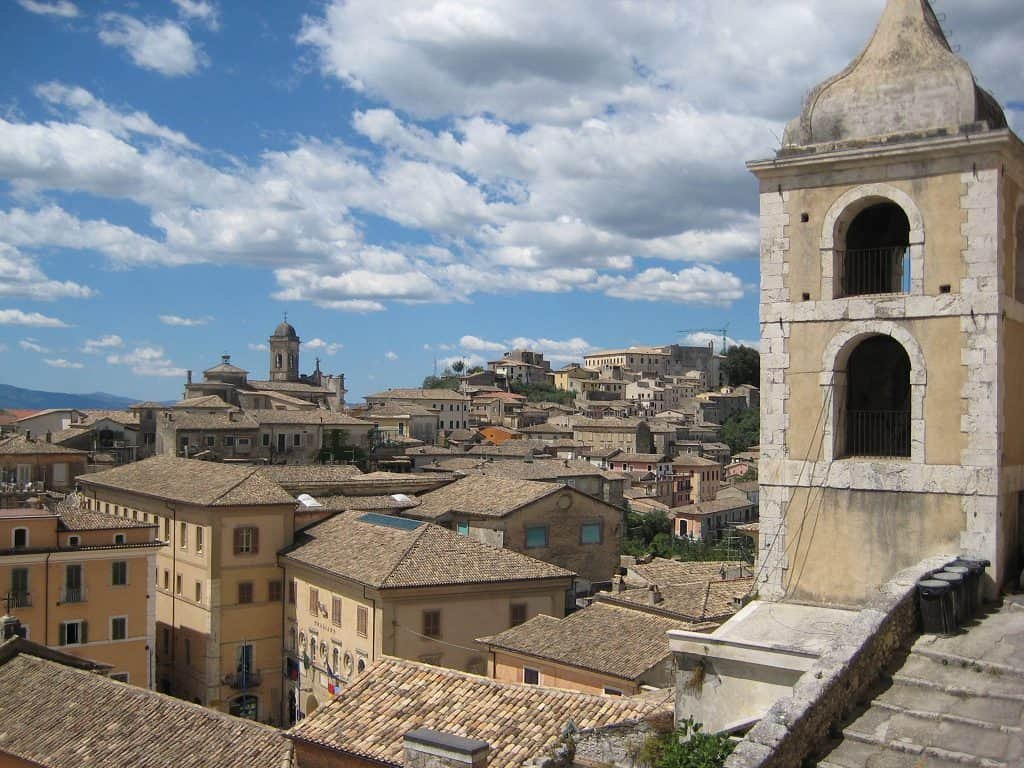
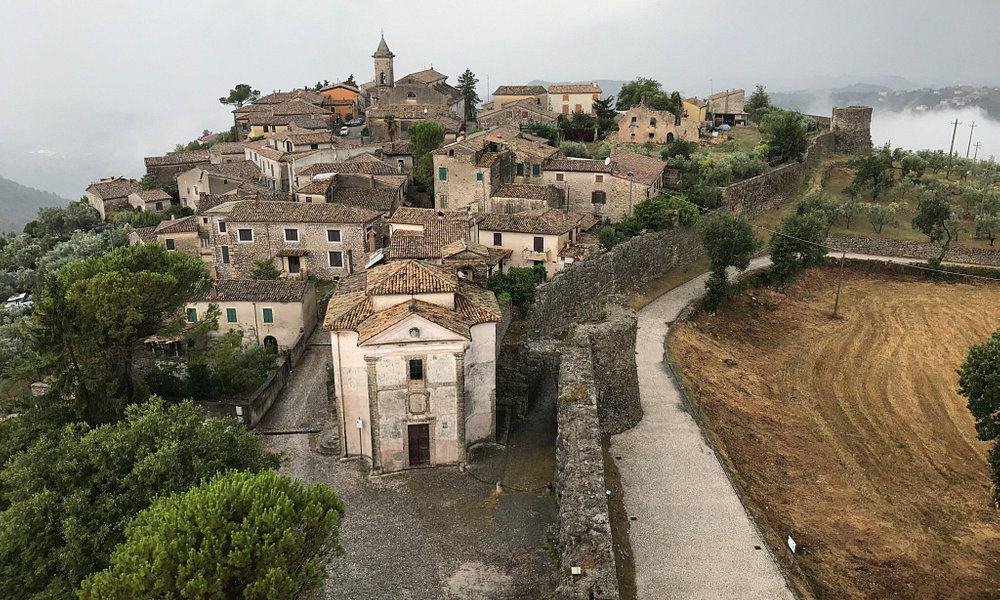
The historic center climbs a hill at 447 meters, but the municipal territory rises much higher, up to the 837 meters of Montecoccioli, and drops to 192 meters along the river: this means Arpino isn't a flat town and that the right shoes matter more than the guidebook. The lower part is modern and orderly. The upper part, the one that interests the traveler, is the medieval core with its gates, its churches and its alleys climbing uphill. Above it all, isolated on a separate rise connected to the town by a road and a path, stands Civitavecchia: the ancient acropolis, the main attraction.
Getting to Arpino (FR) by car
The most convenient route from Rome remains the A1 toward Naples to Frosinone, then the Ferentino-Sora expressway following the signs for Arpino. If you're coming from the south, from Cassino or Naples, you always exit at Frosinone or follow the state road of the Liri valley. In town, traffic in the upper part is restricted and the alleys are very narrow: it's best to leave the car in the parking lots near the center and walk up. For the acropolis of Civitavecchia there's a drivable road that takes you almost to the top, with a pull-off to park near the Torrione. It's the obvious choice for anyone who has trouble walking, because the climb from town is not trivial.
Getting to Arpino (FR) by public transportation
Without a car things get complicated, as with all the inland villages. The reference point is Frosinone: from Rome Termini or Rome Tiburtina, the regional trains on the Cassino line stop at Frosinone, and from there the intercity buses go up toward Arpino, Sora and the valley. Bus schedules are reduced on holidays, so if you're planning a Sunday, work out the return trip carefully. For a day trip from Rome, frankly, the car makes more sense: it lets you combine Arpino with other nearby villages in the same afternoon without depending on connections.
Arpino (FR), the city of Cicero: 2,000 years of history on one hill
Few small towns of 7,000 inhabitants carry a historical stratigraphy like this. Under the medieval town is the Roman municipium, under the Roman municipium is the Italic oppidum, and under that are the megalithic walls nobody can date precisely. It's worth walking this ladder backward, because every rung explains something about the next.
The origins of Arpino (FR): Saturn, the Pelasgians and the Saturnian cities
The scholarly tradition, the one humanists loved to repeat, attributes the founding of Arpino to the god Saturn or to the mythical people of the Pelasgians. It's a legend, and should be taken as one: it serves to place the city among the so-called Saturnian cities of southern Lazio, the fortified centers that share the great polygonal walls of dry-laid stone blocks. Alatri, Ferentino, Anagni, Arpino and Atina belong to this family of walled villages, and the appeal lies precisely in their kinship: anyone who has seen the acropolis of one immediately recognizes the hand in the other. The name of the town, according to an explanation that has circulated for centuries, would derive from the harp shape the hill traces when seen from above. It's one of those fascinating and unprovable etymologies that are best told as such, without passing them off as certainties.
The Volsci, the Samnites and the Roman conquest of Arpino (FR)
Before Rome, this was land of Italic peoples. Arpino was Volscian and then Samnite, contested along the shifting borders of the Liri plain. The turning point comes in 305 BC, when the Romans conquer it during the Samnite wars. Two years later it obtains citizenship without the right to vote, the condition of the so-called sine suffragio municipia, and becomes a prefecture. In 188 BC full Roman citizenship with voting rights finally arrives, a recognition that for an Italic community was worth a battlefield promotion. From that moment Arpinum is Rome in every respect, and it's no accident that within a few generations the small provincial city gave the Republic two of its greatest men.
Cicero, born in Arpino (FR) in 106 BC
Marcus Tullius Cicero was born in Arpino on January 3, 106 BC, into a family of the equestrian order, well-off but provincial. He wasn't a Roman aristocrat: he was a homo novus, a new man, someone who would reach the highest offices of the state without consular ancestors behind him. He became the greatest orator the Latin language has produced, a feared lawyer, philosopher, politician, consul in 63 BC, the year he foiled the conspiracy of Catiline. His prose is still today the yardstick against which people studying Latin are measured throughout the world, and that's why students come to Arpino every year from half of Europe. The family villa stood outside the town, toward the Fibreno river, in a place Cicero himself describes with affection in the dialogue De legibus: the little island where the Fibreno splits and rejoins, the place where he said he truly felt at home. Anyone going to nearby Lake Posta Fibreno walks through that landscape of clear waters that the orator loved.
Gaius Marius, consul seven times, an Arpinate like Cicero
The other great son of Arpino is Gaius Marius, born around 157 BC, so half a century before Cicero. He was the general who reformed the Roman army by opening enlistment to the propertyless, the capite censi, and transforming the legions from a militia of landowners into a professional army: a revolution whose consequences would be seen for a century, up to the civil wars. Consul seven times, something never seen before, victor over the Cimbri and the Teutons, uncle by marriage of Julius Caesar. That a provincial town gave Rome both the greatest of its orators and the most innovative of its generals is a circumstance the Arpinates gladly remember, and rightly so. A curious anecdote ties even Marius's name to a very distant region: some have wanted to derive the French place name Camargue from a hypothetical Caii Marii Ager, the field of Gaius Marius. It's a linguistic suggestion without serious proof, and should be reported as such, but it says a lot about how long the shadow of this Arpinate is.
Cicero and Arpino (FR): the life, the works, the villa on the Fibreno
It's worth pausing a moment longer on the man who made this name famous, because understanding Cicero helps understand the town. He was born here, into a comfortable but provincial family, and it's precisely this peripheral origin that marks him for life: in Rome he will always be, in the eyes of the aristocracy, the Arpinate, the country boy who arrived with nothing but the talent of speech. And with that talent he reaches the top. He studies rhetoric and philosophy, trains between Rome, Greece and Rhodes, and becomes the greatest lawyer of his time: the orations against Verres, the corrupt governor of Sicily, and against Catiline, the conspirator, are still studied today as models of eloquence. Consul in 63 BC, he defends republican legality with words in an age when others used armies. It's no accident that he ends badly: having remained loyal to the idea of a Republic that was collapsing around him, he is killed in 43 BC, during the proscriptions of the second triumvirate, mostly at the will of Mark Antony, whom he had struck with the Philippics. Tradition says his head and his hands, the hands that had written, were displayed in the Forum as a warning. An Arpinate who pays with his life for his intellectual consistency.
The De legibus and the island on the Fibreno near Arpino (FR)
Anyone who wants to touch the link between Cicero and his land has to read the opening of the second book of De legibus. There the orator, in dialogue with his brother Quintus and his friend Atticus, describes the family villa by the Fibreno river, the place where the river divides into two branches around a little island and then joins again right after. And in those pages Cicero speaks the line every Arpinate knows by heart: this, he says, is my true homeland, and my brother's. Here we were born of a very ancient stock. Rome is the homeland of law and citizenship, but Arpino is the homeland of the heart, the one that brought you into being. It's one of the most beautiful declarations of love for a birthplace that antiquity has left us, and it turns the landscape of clear waters around the Fibreno into a literary text you can still walk through. The nature reserve of Lake Posta Fibreno preserves precisely that character of spring-fed, crystalline waters that the orator described 2,000 years ago.
The memory of Cicero in the town of Arpino (FR)
The town has never stopped celebrating its most illustrious son. The main street bears the name Ciceronis, the Convitto Nazionale Tulliano keeps his memory alive in its very name, statues and busts of the orator dot the squares and open spaces, and the Certamen Ciceronianum, the international Latin competition, is a living tribute that every year brings his language back within these walls. It's not a dusty cult of memorial plaques: it's a daily presence, almost domestic, as if the orator were an illustrious fellow citizen who left for Rome and never really went away. In few places in Italy does the bond between a man of antiquity and his city feel so direct and continuous. I'll add a note for those who arrive expecting to find monumental Roman ruins: that's not the point here. Of Cicero's villa there's no colonnade left to photograph, and the traces of Roman Arpinum are discreet, integrated into the fabric of the town. Arpino's treasure isn't archaeological in the sense of great excavations, it's cultural and scenic: it's the continuity of a community that has lived on the same hill for 3,000 years and has never cut the thread with its own past. Anyone who comes looking for the scenic effect of an amphitheater is thrown off. Anyone who comes to understand how an identity is born and handed down leaves full.
The Acropolis of Civitavecchia in Arpino (FR): the Cyclopean walls
If I had to name a single reason to climb up here, it would be this. The acropolis of Civitavecchia sits on a rise of about 627 meters, detached from the town, and the ring of polygonal walls that wraps around it is one of the best-preserved megalithic complexes in Italy. The overall perimeter exceeds three kilometers, and at least a kilometer and a half is in excellent condition, with stretches reaching six meters in height. They're enormous limestone blocks, cut and fitted dry without mortar, with a precision that to the ancients seemed impossible for human hands: hence the adjective Cyclopean, from the Cyclopes, the only ones imagined capable of moving stones like these.
Who built the walls of Arpino (FR) and when
And here's the honest point: the dating is disputed. Popular tradition, repeated on signs and brochures, wants them extremely ancient, even from the 13th century BC. Modern scholars, who classify these works by the type of polygonal masonry, tend to place them lower, between the Iron Age and the Archaic period, roughly between the 8th and the 6th century BC. The truth is that there is no inscription, no indisputable dating layer, no firm chronological anchor: in front of these stones archaeology proceeds by comparison and by style, and the range stays centuries wide. So anyone who gets there should do the wisest thing: look at them as a pre-Roman Italic structure, extraordinary regardless of the exact millennium, and distrust anyone who fires off a date to the centimeter.
The technique of polygonal masonry at Arpino (FR)
It's worth spending a few words on the technique, because it's the signature of these places. The walls of Arpino are in polygonal masonry, also called Cyclopean or megalithic masonry: blocks of local limestone, even enormous ones, roughly shaped and fitted dry, with no mortar holding them together, the faces meeting along broken, irregular lines. Scholars have tried to bring order to this apparent anarchy by distinguishing several styles, from the roughest, with barely adapted stones and fill in the gaps, to the most refined, with polygonal blocks and thin, very precise joints. Arpino shows more than one of these styles, a sign that the ring was built, rebuilt and added to in different eras. What strikes anyone who walks past is the stability: without a gram of cement, by weight and interlocking alone, these walls have held for millennia and have withstood earthquakes that brought down much more recent buildings. Each block weighs as much as a car, some much more, and they were hoisted and placed without cranes or mechanical winches, with only the strength of men, ropes, rollers and ramps: looking at them up close means measuring the labor of whole communities at work for generations. It's not the magic of the Cyclopes, it's the engineering of weight and friction taken to a level that still leaves engineers in admiration today. For comparisons, you'll find them in the other Saturnian cities: the walls of Alatri, with their monumental acropolis, and those of Ferentino belong to the same great building family of southern Lazio.
The Pointed Arch of Arpino (FR), unique in Italy
At the highest point of the ring opens the piece that has made Arpino a destination for scholars of ancient architecture: the pointed arch, an ogival arch obtained not with the wedge-stone vault of the Romans, but by corbeling, stacking the blocks so that each projects slightly over the previous one until they close at the tip. Technically it's a corbel arch, and it forms an access gate to the citadel. Its fame comes from a simple and true fact: there is no other like it in Italy, and comparisons are sought in the Aegean and Mycenaean area, far away in time and space. Some scholars date it around the 7th or 6th century BC, but here too caution is required. In front of this gate you always stop a moment longer than planned, because the ogival point, more than a thousand years before the Gothic cathedrals, throws off anyone who has the idea that the pointed arch is an invention of the Middle Ages. It isn't, and Arpino proves it.
The Porta Scea and defensive tactics at Arpino (FR)
There's a military detail that is worth the whole climb and that almost nobody tells well. The main entrance to the citadel isn't frontal: it's a porta scea, that is, a gate that opens to the side, forcing whoever enters to walk a stretch along the wall keeping the wall on their left. The reason is brutal and brilliant. The ancient warrior carried his shield on his left arm and his sword in his right hand. Entering along a passage that forced him to turn, the attacker exposed to the defenders his right side, the uncovered one, the one without a shield, while those on the walls could strike him from above on the undefended side. A gate that kills by geometry, not by force. When you walk through it today, in peacetime, it's worth stopping to imagine the scene: it's the best way to understand how military engineers thought 25 centuries ago.
The Torrione of Cicero on the acropolis of Arpino (FR)
On the summit of the acropolis stands the Torrione, traditionally called the Tower of Cicero, although it has nothing to do with Cicero: it's a medieval tower, the heart of a small crenellated castle that made use of the rise already fortified by the ancients. It's the silhouette you see from afar, the landmark that marks the profile of Civitavecchia against the sky. Restored in the early 2010s, it keeps beside it a small parade ground, a cistern and the remains of the foundations of the complex. The popular name, as often happens, has stuck the town's most illustrious figure onto a building that postdates him by more than a thousand years: it's an affectionate little historical forgery, and you should know it, but it takes nothing away from the pleasure of climbing up there and watching the Liri valley stretch out in every direction.

The sanctuary of Santa Maria di Civita on the acropolis
Inside the acropolis enclosure, alongside the pagan and military memories, stands the sanctuary of Santa Maria di Civita, the Marian church tied to the high and ancient part of the territory. It's a sign of how these places were never completely abandoned: where there was a temple or an Italic garrison, Christianity continued to inhabit the same sacred rise. The visit to the acropolis thus ties together four eras within a few hundred meters: the megalithic of the walls, the pointed arch of the Archaic age, the medieval tower and the Marian devotion that lasts to this day.
A curiosity about Arpino (FR)
The most beautiful curiosity isn't about Cicero, as everyone would expect, but about an arch. The pointed arch of Civitavecchia is, as far as is known, the only ogival arch of that type to survive in Italy built not with the wedge-stone vault technique but by simple corbeling of blocks. This means the pointed shape, which we instinctively associate with the Gothic cathedrals of the 12th and 13th centuries AD, already existed in an Italic structure of the Archaic age, perhaps 15, perhaps 18 centuries earlier. It's not that the ancient Arpinates had invented the Gothic: it's a static arch, obtained in a technically different way, and the cathedral builders knew nothing about it. But the optical effect is disarming. You find yourself in front of an ogival gate in the middle of Cyclopean walls and your brain short-circuits, because it associates that silhouette with the wrong era by two millennia. It's the curiosity that brings architects, students and enthusiasts to Arpino from all over Europe, much more than the busts of Cicero scattered around town. A second detail, minor but delightful: the Arpinates call their great consul not with distant reverence, but almost with small-town familiarity, as an illustrious fellow villager who made it big. In 2,000 years the city has never stopped considering him family.
The historic center of Arpino (FR): what to see within the walls
Once you've come down from the acropolis, the town proper is concentrated in the medieval upper part, a maze of alleys, arches, stairways and little squares that you can tour unhurriedly in a couple of hours. It's not a frozen open-air museum: it's an inhabited village, with shops, signs, laundry hung out to dry, the provincial life that goes on among ancient stones.
Castello Ladislao and the Umberto Mastroianni Foundation in Arpino (FR)
The most important civic monument in the center is Castello Ladislao, the fortress that has dominated the town since the 14th century. Today it houses the Umberto Mastroianni Foundation, one of the most interesting contemporary art centers in southern Lazio, and this is one of those surprises that hurried visitors miss. Umberto Mastroianni, born in Fontana Liri, not far away, on September 21, 1910 and died in Marino on February 25, 1998, was one of the greatest Italian sculptors of the 20th century: he started from the figurative, passed through the Cubo-Futurist experience, and arrived at an abstract sculpture of large dynamic volumes, almost architectures in bronze. He won the international grand prize for sculpture at the 29th Venice Biennale, in 1957, with the work Battaglia. He received the Feltrinelli Prize of the Accademia dei Lincei in 1973 and the Praemium Imperiale in Tokyo in 1989, among the highest worldwide recognitions for an artist. The Province of Frosinone purchased the castle in 1985. The International Center dedicated to him has operated since 1993 and the Foundation was formally established on January 15, 1999. It holds a core of 81 works donated by the sculptor in 1992 and sections dedicated to other members of the family. Finding, inside a medieval fortress on a hill in Ciociaria, a collection of abstract sculpture of this caliber is a short circuit that alone justifies the ticket.
Who Ladislaus was and the history of the castle of Arpino (FR)
The fortress's name refers to Ladislaus of Durazzo, king of Naples between the 14th and 15th centuries, whose story is intertwined with the disputes that shook the Kingdom and its northern borders, right where the frontier with the Papal States ran. Arpino, a border land, changed masters several times among the Angevins, the Aragonese and local powers, and the castle bears the marks of this frontier history. Those who love the walled villages of the area will find echoes of this story in the fortresses of Veroli and Sora, two other centers of the Liri valley with an equally contested past.
The churches of Arpino (FR): San Michele Arcangelo and the others
The town's main church is the collegiate church of San Michele Arcangelo, dedicated to the patron saint, which preserves the layout and furnishings of the local devotion layered over the centuries. Around it, the historic center and the hamlets hold a good number of minor churches tied to the many co-patron saints the Arpinates venerate: Santa Maria di Civita itself on the acropolis, Sant'Andrea Apostolo, San Vito Martire, San Sosio, Sant'Antonio di Padova. It's a dense devotion, typical of towns where every district had its church and its feast, and which still marks the calendar today with processions and observances. The reference diocese is that of Sora-Cassino-Aquino-Pontecorvo. For opening hours, which in small towns often depend on the presence of the sacristan, it's best to ask at the Pro Loco.
The lower town and the Bridge of Cicero in Arpino (FR)
Not everything in Arpino is at the top. The lower part of the town, grown along the valley-floor roads, preserves the marks of manufacturing, 19th-century Arpino, with buildings tied to wool processing and to the life of an active small town. In this area popular memory has christened with the orator's name, once again, an ancient bridge that crosses the watercourse: the so-called Bridge of Cicero, one of those affectionate attributions the town loves, more legend than document, but part of how it tells its own story. Walking through the lower town and then climbing back up toward the medieval core is the best way to grasp Arpino's dual nature: on one side the walled village clinging to the hill, on the other the hardworking center of the valley, grown on water and looms.
Corso Ciceronis, the squares and the palaces of Arpino (FR)
The spine of the center is the street named after Ciceronis, along which stand the noble palaces of the families that counted in town, and which leads out into the squares where life is concentrated: Piazza Municipio, where the Certamen award ceremony is held every year under the eyes of half of Europe, and the open spaces where you stop for a coffee looking at the valley. The Convitto Nazionale Tulliano, the old school institution dedicated to Cicero, is an integral part of the place's identity: here classical culture isn't a souvenir for tourists, it's a living thing that fills the classrooms.
A thing nobody tells you about Arpino (FR)
No tourist guide puts it on the front page, and yet for centuries Arpino was famous not for Cicero but for wool. From the Middle Ages and throughout the modern era, well into the 19th century, this was a city of wool mills and weavers, one of the most important wool centers of central-southern Italy. Arpino's cloths were sold well beyond the borders of Ciociaria, and wool processing gave work, wealth and identity to generations of families. The town keeps the memory of this vocation in a museum dedicated to the wool industry, which collects machinery, looms, documents and the history of its historic mills, first among them the wool mill of the Diodati family. It's a piece of industrial archaeology that explains Arpino far better than many busts of the orator: without wool, this small town wouldn't have had the means to maintain the urban decorum, the churches, the schools that are still seen today. What nobody says, in short, is that Arpino's real wealth was never Cicero's rhetoric, but the fleece of its sheep. I'll add a practical detail the brochures keep quiet about: the climb to the acropolis is harder than it looks from the square, and in midsummer the limestone reflects the sun without a thread of shade. Anyone who arrives at noon in August in flip-flops regrets it. Anyone who climbs early in the morning or toward sunset finds the best light and the right temperature.
The wool tradition and industrial archaeology of Arpino (FR)
It's worth coming back to wool a bit more calmly, because it's the economic key to all of local history. The lay of the land, rich in water thanks to the Fibreno and the Liri, offered the motive power for the fulling mills and the mills used for fulling and processing cloth. Water, the wool of the flocks that grazed on the surrounding mountains, the labor of the villages: three ingredients that made Arpino and the valley a textile district before the term existed. The Diodati wool mill is the name that recurs most often, but the town hosted many mills, each with its specialized workers. When the Italian textile industry concentrated in the North, between the 19th and 20th centuries, this district declined, like many manufacturing hubs of the South. But the heritage of buildings, machines and know-how survived enough to be told. Anyone who visits the wool museum understands that the villages of Ciociaria were not backward, marginal places at all: they were nodes of a lively manufacturing economy, connected to markets, capable of exporting.
The Certamen Ciceronianum Arpinas, the Latin competition of Arpino (FR)
Once a year Arpino stops being a quiet provincial village and becomes the world capital of Latin. The Certamen Ciceronianum Arpinas is an international competition reserved for final-year students of classical high schools, founded in 1980 on the initiative of the Liceo Ginnasio Tulliano under the guidance of Professor Ugo Quadrini. The test consists of translating a passage of Cicero from Latin into the contestant's mother tongue, accompanied by a stylistic and contextual commentary: translating isn't enough, you have to understand and interpret. From a regional contest it became a European event within a few years. In some recent editions several hundred students from a wide range of countries have taken part, and the award ceremony takes place in Piazza Municipio, in Arpino, with a solemn ceremony. The event is held in spring. The exact date changes from year to year, so anyone who wants to attend should check the calendar on the Certamen's official website before planning the trip. It's an unusual and moving sight: hundreds of 18-year-olds from half of Europe bent over a text by Cicero, in the city where Cicero was born. Few events keep classical culture alive with this much force.
The advice I give you for visiting Arpino (FR)
My advice for organizing the day is simple and goes against the grain: don't start from the town, start from the acropolis. Most visitors arrive, park down below, tour the historic center, get tired and then give up on climbing to Civitavecchia because it's up high and seems inconvenient. Wrong. Go up to the acropolis first, early in the morning, when the light is raking and there's nobody around: the Cyclopean walls, the pointed arch and the view over the Liri valley deserve a fresh head and rested legs, not the leftover energy at the end of the day. Bring real hiking shoes, not walking shoes, because the ground around the walls is uneven and partly grassy. Then walk back down toward the medieval center unhurriedly, go into Castello Ladislao for the Mastroianni Foundation, have lunch in town and give the afternoon to the alleys and the churches. If you have a whole day, combine Arpino with a second walled village: Alatri with its acropolis is half an hour away, and seeing two megalithic rings in the same day makes you understand the family of the Saturnian cities better than any book. One last thing: avoid Sundays in high summer, when buses are scarce and the limestone is scorching. The ideal season is spring, or the first weeks of fall, when the Liri valley is green and the air is clear.
Another well-known fact, yet rarely mentioned
Everyone knows Cicero was born in Arpino. Almost nobody mentally connects this small town with its other illustrious son, Gaius Marius, and even fewer people remember that little Arpinum, in a handful of generations, gave Rome two of the figures who changed its history in opposite fields: the word and the sword. Marius reformed the army and opened the legions to the poor, laying, without meaning to, the foundations of the personal armies that would overwhelm the Republic. Cicero defended that same Republic with words until he paid for it with his life, killed in 43 BC on the order of the triumvirs, his head and hands displayed in the Roman Forum as a warning. Two Arpinates, two destinies, a single provincial hill behind them. And there's a genealogical detail that is almost never told: Gaius Marius was tied by marriage to Julius Caesar, having married Julia, the aunt of the future dictator. It means that the threads of great Roman politics, the kind that decides the fate of the ancient world, all pass, at some point, through this town of 7,000 souls overlooking the Liri valley. A well-known fact in its pieces, yet one almost nobody puts together all the way.
The right photo to take in Arpino (FR)
The photograph you'll take home, the one that's worth the trip, is shot at the pointed arch of Civitavecchia. But it has to be done right. The secret is to stand just outside the gate and frame it backlit, with the Liri valley breaking through in the background through the ogival opening: the tip of the arch frames the landscape and the scale of the megalithic blocks gives the measure, human and tiny, of whoever passes underneath. The right time is early morning or the last light of the afternoon, when the low sun cuts across the large limestone blocks from the side and makes their dry joints stand out. At noon the flat light flattens everything and the magic vanishes. If you want a second strong image, climb the Torrione and point the lens toward the town and the valley: from up there you grasp at a glance why the ancients chose exactly this rise, which commands every access route. A frank piece of advice: put a person under the arch to give the scale. Without a human figure beside them, those blocks look like ordinary rocks in a photo. With a person next to them, you understand that each one weighs as much as a car.
Some important events that took place here over the years
The hill of Arpino has seen 3,000 years of Italian history go by, and some episodes deserve to be remembered one by one. The first is the Roman conquest of 305 BC, when the Italic oppidum enters Rome's orbit during the second Samnite war: it's the moment when a border community chooses, or suffers, its Roman destiny. The second, and more decisive, is the grant of full citizenship with voting rights in 188 BC: from that day the Arpinates are Roman citizens in every respect, and this explains why a few decades later one son of the town, Gaius Marius, could reach the consulship and another, Cicero, the summit of republican politics. The third great chapter is the year 63 BC itself, Cicero's consulship and the suppression of the conspiracy of Catiline: the voice of an Arpinate resounds in the Roman Senate and saves, for a moment, the institutions. In the Middle Ages Arpino lives its frontier season, contested among the powers that divided southern Lazio and the border with the Kingdom of Naples, and Castello Ladislao is its scar in stone. In the modern era the story turns economic: the flowering of the wool mills between the 16th and 18th centuries makes Arpino a manufacturing center of weight, and then comes the slow 19th-century decline when industry migrates to the North. In the 20th century the hardest blow comes with the Second World War: the Liri valley and the whole of Ciociaria were land the front passed through, a step from Cassino and from the destruction of the Abbey of Montecassino in 1944, and the wounds of that period still mark the memory of the neighboring towns. Finally, the contemporary age: the birth of the Certamen in 1980 and the Orange Flag in 2000 tell the story of the cultural and tourist rebirth of a village that knew how to turn its history into a heritage to share.
Who has passed through Arpino (FR)
The list of who has passed through here, or been born here, begins with two names that weigh as much as few others in Roman history. Marcus Tullius Cicero, born in the town in 106 BC, and Gaius Marius, born around 157 BC: the orator and the general, the toga and the arms, both Arpinates, both able to change the course of the Republic. Cicero often returned to the family villa by the Fibreno, and spoke of it with nostalgia in his works, so much so that that landscape of waters is tied to his name still today. Over the centuries the town became a destination for scholars, Grand Tour travelers and students of antiquity, drawn precisely by the Cyclopean walls and the pointed arch, which draftsmen and architects came to survey as a European rarity. In the 20th century Arpino is tied to the name of Umberto Mastroianni, the sculptor born in nearby Fontana Liri, whose Foundation chose Castello Ladislao as its home, bringing contemporary art and its visitors to town. And every year, for more than 40 years, the best Latin students in Europe pass through, filling for a few days the streets and classrooms of the Convitto Tulliano: perhaps the most fitting visitors a city like this could wish for, because they come to pay homage not to a monument, but to a language and a way of thinking that was born here.

Around Arpino (FR): the surroundings in Ciociaria
Arpino isn't visited on its own: it sits at the center of one of the richest and least trodden portions of Lazio, and anyone with two or three days can build an itinerary of walled villages, abbeys and waters worth a whole weekend.
The walled villages near Arpino (FR)
The most direct kinship is with the other centers of polygonal walls. Alatri keeps perhaps the best-preserved megalithic acropolis in Lazio, with an imposing ring and a monumental gate. Ferentino combines Cyclopean walls, an acropolis and a notable Roman theater. Anagni, the city of the popes, adds its extraordinary medieval cathedral. Veroli and Sora, in the same Liri valley, complete the picture of the historic centers to see. For those who want to frame the archaeology of the area before leaving, the archaeological museum of Frosinone collects the finds of the whole province.
The waters: the Fibreno, Isola del Liri and Posta Fibreno
The landscape of waters that Cicero loved is still there. Lake Posta Fibreno is a nature reserve with very clear waters, with its famous floating island. Isola del Liri amazes with the waterfall that plunges in the middle of the built-up area, below the castle. Campoli Appennino opens the road toward the mountains and the Abruzzo National Park. If you like thermal baths, you can go down to Fiuggi, the most famous spa town in Ciociaria, less than an hour away.
The Path of Saint Benedict and the abbeys
Arpino and its surroundings fall within the area crossed by the great devotional routes that connect the Benedictine sites of central Italy, in the direction of the Abbey of Montecassino, the mother house of the order founded by Saint Benedict. Anyone walking these trails ties together mountains, valleys and villages into a single spiritual and scenic story, and Arpino, with its acropolis overlooking the valley, is one of the stops that stay with you.

When to go to Arpino (FR) and what to pack
The best season for Arpino is spring, between April and June, when the Liri valley is green, temperatures are mild and the climb to the acropolis isn't an endurance test. Early fall too, September and October, gives clear days and ideal light for photographing the walls. Summer is hot and the limestone of the acropolis reflects the sun with no shade: if you come in July or August, climb at dawn or at sunset. Winter has its austere charm, with the valley sometimes in fog and the Torrione poking up above the clouds, but the days are short and some openings are reduced. In your bag, pack sturdy shoes, because between the stone alleys and the uneven ground of the acropolis, sandals are a mistake. Bring a windbreaker even in the shoulder seasons, because up high the wind is never lacking. And bring a water bottle, since you won't find a bar on the acropolis. If you travel with children, consider that the climb is demanding: the little ones appreciate the Torrione and the view more than the subtleties of polygonal masonry, but running along the megalithic walls remains a memory they carry with them.
Quick questions about Arpino (FR)
How much does it cost to visit Arpino (FR)?
Strolling through town and climbing to the acropolis of Civitavecchia is free: there's no entrance ticket to the city. At most you pay for admission to a few museums and to the Mastroianni Foundation in Castello Ladislao, with modest fares. It's best to check the updated amounts on the website of the Municipality or the Pro Loco.
How do you get to Arpino (FR) from Rome?
By car, take the A1 to Frosinone, then the expressway toward Sora and the exit for Arpino, about 110 kilometers and a little over an hour and a half. By public transportation, take the regional Rome-Cassino train to Frosinone and then an intercity bus. The car remains the most convenient choice for a day trip.
How much time do you need to visit Arpino (FR)?
Half a day is enough for the essentials, meaning the acropolis and the historic center. With a whole day you add the Mastroianni Foundation, the wool museum, an unhurried lunch and maybe a second nearby village like Alatri or Isola del Liri.
What should you absolutely see in Arpino (FR)?
The acropolis of Civitavecchia with the Cyclopean walls, the pointed arch and the Torrione of Cicero. The medieval historic center. Castello Ladislao with the Umberto Mastroianni Foundation. If you stay long enough, the museum dedicated to the wool tradition.
Why is Arpino (FR) called the city of Cicero?
Because Marcus Tullius Cicero, the greatest Latin orator, was born there on January 3, 106 BC. The city preserves his memory in streets, statues, school institutions and in the Certamen Ciceronianum, the international Latin competition held here every year.
What is the pointed arch of Arpino (FR)?
It's a pointed arch obtained by corbeling blocks, not with the wedge-stone vault, that opens in the walls of the acropolis. It's considered unique in Italy for its technique and shape, and it astonishes because it anticipates by many centuries the ogival silhouette we associate with the Gothic.
How old are the walls of Arpino (FR)?
The dating is disputed. Tradition wants them extremely ancient, as far back as the second millennium BC. Modern scholars tend to place them between the Iron Age and the Archaic period, roughly between the 8th and 6th century BC. In the absence of inscriptions, the chronology remains approximate.
Is the acropolis of Arpino (FR) accessible by car?
Yes, a drivable road climbs almost to the top of Civitavecchia, with a pull-off to park near the Torrione. It's the solution for anyone who has trouble walking, since the climb from town is considerable.
Is the acropolis of Arpino (FR) suitable for people with mobility difficulties?
Arriving by car helps a lot, but the ground around the walls is uneven and grassy, so it's not entirely easy. The medieval historic center, with its alleys climbing uphill and its stairways, in turn requires fit legs.
Is Arpino (FR) suitable for children?
Yes, with some care. The climb to the acropolis is demanding, but the Torrione, the huge walls and the view appeal to the little ones. Bring water and suitable shoes, and avoid the hot hours of summer.
When is the Certamen Ciceronianum of Arpino (FR) held?
The event takes place in spring, but the exact date changes every year. Anyone who wants to attend the award ceremony in Piazza Municipio should check the calendar on the Certamen's official website before organizing the trip.
What is the Mastroianni Foundation of Arpino (FR)?
It's an international contemporary art center housed in Castello Ladislao, dedicated to the sculptor Umberto Mastroianni, one of the greatest Italian artists of the 20th century. It holds a core of works donated by the artist and it's a surprise inside a medieval fortress.
Was Cicero born exactly in Arpino (FR)?
Cicero was born in the territory of Arpinum, in the family villa by the Fibreno river, just outside the present-day town. He speaks of it with affection in his works, in particular in the dialogue De legibus, describing the little island where the Fibreno divides.
What's the difference between Arpino (FR) and Alatri?
Both are cities of polygonal walls, but Alatri has the more monumental megalithic acropolis, with an imposing gate, while Arpino adds the pointed arch, unique in Italy, and the dual legacy of Cicero and Gaius Marius. Seeing them on the same day is instructive.
Can you eat well in Arpino (FR)?
The cooking is that of Ciociaria, sturdy and country-style: homemade pasta, meats, legumes, products of the surrounding mountains. In the historic center and the hamlets there's no shortage of trattorias and places to stop. As always in small towns, it's best to check the hours, which follow the rhythms of the town.
Where does the name Arpino (FR) come from?
A traditional explanation derives it from the harp shape the hill traces when seen from above. It's a fascinating but unproven etymology, to be taken as a suggestion more than a certainty.
Why does Arpino (FR) have the Orange Flag?
The Orange Flag is the Touring Club Italiano's tourism and environmental quality mark for small inland towns that combine heritage, hospitality and care for the landscape. Arpino has held it since 2000, and earns it for the preservation of its historic center and its acropolis.
Who was Gaius Marius and what does he have to do with Arpino (FR)?
Gaius Marius, born in Arpino around 157 BC, was the general who reformed the Roman army and was consul seven times. Together with Cicero he is the second great Arpinate of ancient history: the city gave Rome both the greatest orator and the most innovative of its generals.
What is there to see near Arpino (FR)?
The walled villages of Alatri, Ferentino, Anagni, Veroli and Sora. The waters of Lake Posta Fibreno and the waterfall of Isola del Liri. The thermal baths of Fiuggi. And, farther south, Cassino and the Abbey of Montecassino. A whole weekend isn't enough to cover them all.
Is there a wool museum in Arpino (FR)?
Yes, the town preserves the memory of its ancient wool vocation in a museum dedicated to the wool industry, with machinery, looms and the history of the historic mills, first among them the Diodati wool mill. It's a piece of industrial archaeology that explains the village's wealth.
Where do you park in Arpino (FR)?
The alleys of the upper part are very narrow and have restricted traffic, so it's best to leave the car in the parking lots near the historic center and walk up. For the acropolis of Civitavecchia there's a road that takes you almost to the top, with a pull-off to park near the Torrione.
Can you combine Arpino (FR) with a day trip from Rome?
Yes, and it's a very nice trip. By car from Rome you get there in a little over an hour and a half and can give the morning to the acropolis and the afternoon to the historic center, or pair it with a second village of Ciociaria like Alatri or Isola del Liri. By public transportation the day is more complicated because of the connections at Frosinone.
Is Arpino (FR) part of the Path of Saint Benedict?
The territory falls within the area crossed by the Benedictine routes that converge toward the Abbey of Montecassino, the mother house of the order. Anyone walking these routes ties together the mountains, valleys and villages of the area into a single story, and the acropolis overlooking the Liri valley is a stop that stays with you.
What's the best time to photograph Arpino (FR)?
Early morning and the last light of the afternoon, when the low sun cuts across the blocks of the walls from the side and makes their joints stand out. At noon the flat light flattens everything. Spring and early fall offer the clearest days over the Liri valley.
What makes the acropolis of Arpino (FR) unique compared with the others?
The presence of the pointed arch, an ogival arch obtained by corbeling blocks that has no equal in Italy, and that coexists with very ancient Cyclopean walls and with the medieval Torrione. Few megalithic acropolises concentrate four different eras within a few meters the way this one does.
One last word on Arpino (FR)
Arpino is one of those places in Lazio that visitors underestimate until they set foot there. They arrive thinking of Cicero and leave talking about the pointed arch, the Cyclopean walls at sunset, the surprise of finding 20th-century sculpture inside a medieval castle. There's only one invitation: give it time. It's not a hit-and-run village, to be photographed in 10 minutes and filed away. It's a hill that holds together 3,000 years of Italian history, from megalithic stone to a consul's toga to the weavers' wool, and it lets itself be understood only by those who climb slowly and look carefully. Climb to the acropolis unhurriedly, stand under the pointed arch, watch the Liri valley pass through that impossible threshold, and you'll understand why, in 2,000 years, this city has never needed to shout to be great.
Article written by the editorial team of TourLeaderPro, contact them for Private/Corporate/V.I.P. Tours and Experiences.
Planning a trip to Rome? The English guides to visiting the city are on ItalyPlanner.com.