Cassino (FR)
In short. Cassino is the second city in the province of Frosinone, about 35,000 residents, at the foot of the mountain on which the abbey of Montecassino stands, and its center gravitates around piazza Alcide De Gasperi and corso della Repubblica, 03043 Cassino (FR).
Cassino is the second city in the province of Frosinone, about 35,000 residents, at the foot of the mountain on which the abbey of Montecassino stands, and its center gravitates around piazza Alcide De Gasperi and corso della Repubblica, 03043 Cassino (FR). From Rome it's about 135-140 kilometers: by car you take the A1 Milan-Naples motorway to the Cassino exit (a good hour and a half without traffic), then the SR 149 di Montecassino climbs eight kilometers from the town to the abbey. By train you take a Trenitalia regional on the Rome-Cassino-Naples line from Roma Termini (about an hour and a half or a little more, times and fares on trenitalia.com): the station is a quarter of an hour on foot from the center. From the station forecourt the local Mastrantoni bus line goes up to the abbey with a few runs a day (the abbey lists departures around 10:00, 12:35 and 15:20 and returns at 10:20, 12:50 and 17:10, to be confirmed on the operator's website before you count on them). Montecassino Abbey is free to enter: from April 1 to October 31 it's open every day from 9:30 to 18:30, from November 1 to March 31 from 9:30 to 16:15 (Sundays and holidays until 17:15). The abbey museum follows the monastery's hours and the ticket price is requested on site or at museo@abbaziamontecassino.org. The Sunday sung Gregorian Mass is at 10:30. The Casinum Archaeological Park and the Gianfilippo Carettoni National Archaeological Museum (via di Montecassino km 0.800) cost €5 full price and €2 for ages 18 to 25, free for the categories set by the Ministry and on the first Sundays of the month. The park opens at 8:30 and closes at 16:00 in winter and 19:00 in summer, the museum is open from 8:30 to 19:30, closed on January 1 and December 25. There's a Cassino-Minturno combined ticket at €8 valid for 30 days. The weekly closing day, if any, should be checked on the website of the Direzione regionale Musei Lazio. Rocca Janula, Museo Historiale (via San Marco 23, tel. 0776 272572) and the war cemeteries are the other stops: for the hours of the Rocca and the Historiale, which vary with the season, rely on roccajanula.it and historiale.it. To see everything you need two full days. In a single day you choose the abbey, the archaeological park and one cemetery.
The starting point for understanding the town is the page dedicated to the abbey of Montecassino. The overview of day trips from Rome toward southern Lazio is in the section on tourist attractions, and anyone organizing a trip with a tour leader for a group will find on TourLeaderPro a service that also covers the Cassino area.
Cassino (FR), the City That Changed Its Name Four Times
Cassino has belonged to Lazio for less than a century. Until 1927 it was in the province of Terra di Lavoro, in the Sora district, and its history unfolded entirely inside the Kingdom of Naples, and later the Two Sicilies: anyone arriving from Rome expecting a Ciociaria town has to rethink. The city is the ancient Casinum of the Romans, and the name has an explanation that comes to us from someone who knew it well, Marcus Terentius Varro, who owned a villa here and in the De lingua Latina derives the place name from the Sabine word cascum, meaning old. Varro also recalls that the Romans called the city Forum Vetus too, the ancient forum, which confirms how remote its origin was in the eyes of the ancients themselves.
The Middle Ages changed its name three times. On the ruins of the Roman forum on the plain a village arose called Castellum Sancti Petri, after the church that dominated it. Then, in the 9th century, Abbot Bertarius refounded the city at the foot of the Janulo hill and christened it Eulogimenopoli, city of Saint Benedict, in a Greek that says a lot about the monastery's cultural ties with Byzantium. Finally, because the cathedral church held the relics of Saint Germanus, bishop of Capua and a close friend of Benedict, people began to say imus ad Sanctum Germanum, let's go to San Germano, and that became the name of the city. It stayed San Germano for almost a thousand years, until the town council, on May 23, 1863, with Italy united for two years, decided on a return to the old name in its Italianized form: Cassino.
Then there's the name nobody would have wanted: Martyr City. On March 15, 1944 the city was razed to the ground by Allied bombing, exactly a month after the abbey, and on February 15, 1949 it received the Gold Medal of Military Valor. Everything you see today, apart from the Roman monuments, the Rocca and a single 19th-century building, is postwar reconstruction. Anyone looking for the medieval village with uphill alleys has the wrong town: Cassino is a modern city that carries, in every stone, the mark of what it lost, and that is exactly what makes it a place that teaches more than many intact historic centers.

How to Get to Cassino (FR) and How to Get Around
By Car from Rome to Cassino
The A1 motorway is the natural route: Cassino exit, then follow the signs for the center or straight for Montecassino. The abbey can be seen from afar, white on the mountain, and it's one of the few monuments in Italy that announce themselves from 20 kilometers away. The road that climbs from the town to the monastery, the SR 149, is wide and comfortable but full of hairpin turns: eight kilometers, a good 10 minutes, and you park in the lot below the entrance. The archaeological park is on the same road, at kilometer 0.800, with a parking lot about a hundred meters from the entrance. In town, parking is paid in the blue-line spaces of the center, while around Villa Comunale and the station it's easier to find a spot.
By Train to Cassino
Cassino is on the historic Rome-Naples line via Cassino, the first railway that, in 1863, linked the two capitals. The regional trains from Roma Termini generally take between an hour and a half and two hours, with stops at Frosinone, Ceccano, Roccasecca and Aquino. From Napoli Centrale the times are similar. The station is in piazza Giuseppe Garibaldi, a quarter of an hour on foot from the corso. From the forecourt leave the buses for the abbey and the Cotral lines for the towns of the Liri valley and the Val di Comino.
From Cassino Station to the Abbey Without a Car
The runs to Montecassino are few and need planning: anyone arriving on the 9 o'clock train who wants to go up on the 10 o'clock bus makes it, while anyone arriving at noon has to wait for the 15:20 one or take a taxi from the station forecourt. A walk up exists, along the old mule track and the paths of the Way of Saint Benedict, but it's a two-hour walk with over 400 meters of elevation gain: good for someone with legs and time, not for someone with a train to catch again.
What to See in Cassino (FR), Place by Place
Montecassino Abbey Seen from Cassino
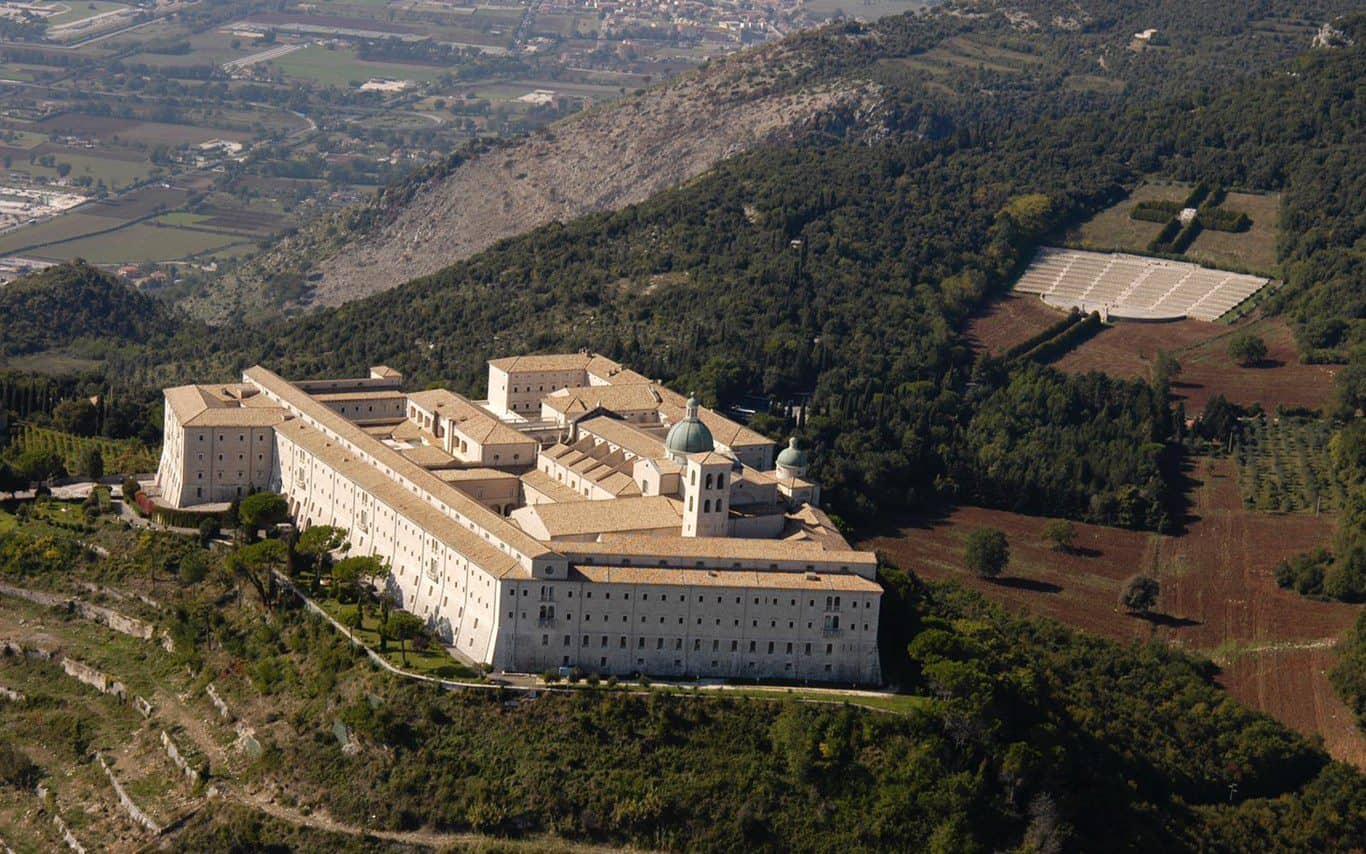
Founded by Saint Benedict of Norcia around 529 on the acropolis of ancient Casinum, Montecassino Abbey is the most famous monastery in Western Christendom. Here Benedict wrote the Rule that would shape Western monasticism, here he died and here he rests together with his sister Scholastica. The monastery has been destroyed four times: by the Lombards of Zotone in 577, by the Saracens on September 4, 883, by the earthquake of September 9, 1349 and by Allied bombers on February 15, 1944. Each time it was rebuilt, the last time with the formula "as it was, where it was" wanted by Abbot Ildefonso Rea and by the Italian State, and the rebuilt basilica was consecrated by Paul VI on October 24, 1964, the day the pope proclaimed Saint Benedict the main patron of Europe.
From the town, the relationship with the abbey is physical: you see it from every street, and you hear it, because the bells carry down to the plain. The right way to visit is to go up early in the morning, before the tour buses, enter the three cloisters in sequence (the entrance cloister, the Bramante cloister with the staircase, the Benefactors' cloister), then the basilica with the crypt and the tomb of the saint, and finally the museum. One piece of advice: the guided visit booked on the abbey's website is worth the cost, because it opens doors the individual visitor doesn't see. The complete description, room by room, is on the page dedicated to the abbey. Here the interest is in the rest, what the buses skip.

The Cathedral of Santa Maria Assunta and San Benedetto Abate
The abbey church is also the cathedral of the abbatial diocese of Montecassino, one of the last territorial abbeys left in Italy: the abbot is in every respect the ordinary of a territory that, until the reorganization of 2014, included dozens of parishes of the Cassino area. Rebuilt together with the monastery in forms that echo the Neapolitan Baroque of the 18th-century church, the cathedral keeps under the high altar the relics of Saint Benedict and Saint Scholastica, found in 1950 during the digging for the reconstruction, in a tomb that had survived the bombs. The interior, extremely rich in marbles, mosaics and gilding, throws off anyone expecting Benedictine sobriety: it's a historical choice, the return to the church the pilgrims saw in the 18th century. The side chapels, the wooden choir and the crypt with the mosaics of the Beuron school deserve more time than the tour groups allow.
The Palagio Badiale in Piazza Corte
The Palagio Badiale stands in piazza Corte, at the foot of the hill, where for centuries the abbots administered the Land of Saint Benedict. The present building was entirely rebuilt after the war by the architect Giuseppe Breccia Fratadocchi, the same man who directed the reconstruction of the abbey and of the church of Santa Scolastica, and who used here the same limestone as the mountain: the reconstruction was completed in 1951. Today it houses the curia of the territorial abbey. The square is where the city celebrates its saint: in the week before March 21, the day of Saint Benedict's passing, the Palagio hosts conferences and exhibitions that culminate in the historical procession Terra Sancti Benedicti, in medieval costume, which starts and ends right at the building. Anyone passing through Cassino in those days finds the town at its liveliest of the year.
The Casinum Archaeological Park
The archaeological park stands at the foot of Montecassino, along the road that climbs to the abbey, in the area called Crocifisso, and includes what remains of Casinum, the Roman city that stretched over sloping terraces, cut by parallel streets. The visit route takes in the polygonal walls, the porta Campana, the substructures of the road, the amphitheater, the so-called mausoleum of Ummidia Quadratilla, the theater and the nymphaeum, passing along several stretches of original flagstone road. It's an up-and-down park, partly on uneven ground, and for this reason the Regional Directorate lists it as not accessible to people with mobility disabilities. Two hours is the right time to do everything calmly, museum included. A blunt opinion: it's the most underrated archaeological park of southern Lazio, because the fame of the abbey overshadows it, and for that very reason you almost always visit it alone.

The Gianfilippo Carettoni National Archaeological Museum
The museum depends on the Lazio Regional Directorate of National Museums of the Ministry of Culture and is located on via di Montecassino at kilometer 0.800, along the state road that climbs from the center to the abbey. The building was constructed up against the walls of ancient Casinum, in a position overlooking the amphitheater and next to the porta Campana, which came to light only after the museum was built. The first stone was laid on March 15, 1966, the 18th anniversary of the destruction of the city, but the works dragged on and the inauguration came in 1979. On December 12, 2003 the museum was named after Gianfilippo Carettoni, the archaeologist to whom we owe the excavations of the Roman theater in the 1930s and the fundamental studies on Casinum, after the 18th-century ones by don Flavio Della Marra and those by Luigi Pigorini at the beginning of the 20th century.
The rooms document the life of the city and the area from prehistory to late antiquity. Three pieces deserve particular attention: the so-called sword of San Vittore, an iron weapon of the 4th-3rd century BC that tells of the Samnite world before Rome. The statue known as the Athlete or Hero of Cassino, of the Roman period, which is the masterpiece of the museum. And the funerary bed from Aquinum, a rare example of a bed in worked bone that belonged to the grave goods of ancient Aquino. The museum has a neighborhood dignity of its own: the road alongside it is the one the buses to the abbey take, and they go by without stopping.
The Roman Amphitheater of Cassino
The amphitheater was built in the 1st century AD by Ummidia Quadratilla, the matron who with her donations made Casinum a city with the monuments of a provincial capital. The plan is elliptical, about 85 meters on the major axis and 69 on the minor, with 12 tiers that could hold around 4,500 spectators: for a city of a few thousand residents these are numbers that say how much the surrounding territory gravitated toward Casinum. In the upper part there were most probably the slots for the poles of the velarium, the great awning that sheltered the public from the sun. The building is set against the slope, so that part of the cavea rests on the rock, as in Greek theaters. The memory of the amphitheater has remained in the place name: the neighborhood at its foot is still called Colosseo today, and in Cassino they say it without irony.

The Roman Theater of Cassino
The theater dates to the Augustan age, between the end of the 1st century BC and the first years of the 1st century AD, and follows the Greco-Roman theater scheme: the semicircular cavea uses the slope of the mountain to support its 20 tiers, divided into a summa cavea of seven and an ima cavea of 13. It was reached through a series of covered galleries that led directly to the highest tier. Completely forgotten in the Middle Ages, buried by landslides from the mountain and by vegetable gardens, it was brought back to light only in 1936 by Carettoni's excavations, restored in the 1950s and again in 2001. Capacity is around 3,000 seats (some sources say 2,500) and the theater is still used in summer for shows, concerts and open-air cinema: sitting on those steps on a July evening, with the abbey lit up overhead, is one of the experiences I recommend to anyone. The theater is at the intersection of via Crocifisso and via Montecassino.
The Megalithic Walls of Casinum
The ancient inhabited center was surrounded by a circuit of walls about 4.5 kilometers long. Inside the park, two stretches of wall in polygonal masonry are visible, attributable to pre-Roman constructions of the 5th-4th century BC, when the city was still Volscian or Samnite. A third ring, also polygonal, lies higher up, below the abbey: it served as a substructure for the buildings of the acropolis and joined the city's fortifications. The stones are enormous, shaped to fit together dry, and looking at them you understand why people spoke for centuries of Cyclopean walls: the technique is the same as at Alatri and Ferentino, the great acropolises of inland Lazio.
Via Latina and the Substructures
Still in the archaeological area you walk a stretch of about 230 meters of the branch that linked Casinum to the via Latina, the consular road that ran from Rome to Capua through the interior, across the Sacco valley and the Liri valley. The surface is made of large limestone slabs, the summa crusta of the Roman road, with the cart ruts still readable. On the uphill side two stretches of Republican-era substructures are preserved, retaining walls that held up large embankments and let the city spread out on terraces. It's the piece of Casinum that best explains its reason for being: a road city, set where the via Latina entered Campania, and therefore a place of obligatory passage for armies, merchants and pilgrims for 2,000 years.
The Porta Capuana
So called because it faced toward Capua, the gate is preserved along the line of the via Latina nova, in the lower part of the park. The piers and a stretch of curtain wall remain. Of the porta Romana, the one you entered the city by when coming from Rome, no trace remains: its position can only be reconstructed from the course of the walls. Anyone with patience will notice that the gate and the road are not aligned with the amphitheater: the Roman city grew in phases, and Ummidia's monuments were added to a layout already centuries old.
The Mausoleum of Ummidia Quadratilla
The structure stands on the southeast slopes of the mountain, and it's the most extraordinary construction in the park: a building on a square plan with a cruciform interior, built of large squared blocks joined without mortar, held by lead clamps, which has withstood earthquakes, centuries and the battle of 1944 without suffering substantial damage. The dating swings between the 1st century BC and the 1st century AD. Scholars have called it now a temple, now a tomb. The attribution to Ummidia Quadratilla, daughter of the consul Gaius Ummidius Durmius Quadratus, comes from an inscription found in 1757 in the nearby amphitheater, which records the amphitheater and a temple built at her expense, and it's therefore a tradition based on a clue, not a documentary certainty. In the Middle Ages the building was turned into the church of the Crocifisso, which gave its name to the hamlet, and this conversion is the reason it survived intact: nobody takes a church apart to make lime.
The Ponari Nymphaeum
The nymphaeum, named after the owners of the land where it was found, is in the middle band of the ancient city and is dated to the 1st century BC. It's a room partly sunk into the slope, on a rectangular plan, covered by a lowered barrel vault, closed on three sides and open at the front. The three walls are marked by nine rectangular niches, three per wall, which held statues and water features. It was part of a rich private dwelling and its decorations in glass paste and shells, of which traces survive, made it one of the most refined rooms in Casinum. It's mostly visited from the outside: ask the park staff if it's open on the day of your visit.
Rocca Janula of Cassino
Rocca Janula was built in the second half of the 10th century by Abbot Aligerno, with the consent of the prince of Capua Pandolfo Capodiferro, to defend the Land of Saint Benedict after the Saracen devastation, and for centuries it was the military pivot of the abbatial domain. The square tower dates to the 12th century. The pentagonal tower of the small court is from the Frederician age, because Frederick II, who made the Land of Saint Benedict a piece of his kingdom, put his hand to the fortress. Devastated by the bombing of 1944, after decades of abandonment the Rocca was restored and reopened to the public in 2015, and since then it has hosted exhibitions, shows and events. You visit the large court with the corner tower and the wall walk, the round tower, the church and the underground rooms. From the Rocca the view takes in the city, the Liri valley and the Aurunci Mountains: for a photograph of the whole it's the best spot, and it's worth more than the climb to the abbey for anyone who wants to understand the geography of the battle of 1944.
Museo Historiale of Cassino
At via San Marco 23, a short walk from the center, Museo Historiale is the multimedia museum of the battle of Cassino, inaugurated in 2004 for the 60th anniversary, with a design by Officine Rambaldi. The route doesn't display relics in showcases: it tells, with images, sounds and reconstructions, the 20th century of the city, from the Great War to the Gustav Line, from destruction to reconstruction. You visit in turns at fixed times, lasting about an hour, and it's the best preparation for anyone who then goes to the war cemeteries: after the Historiale the crosses are no longer just a number.
A Curiosity About Cassino (FR)
Ummidia Quadratilla, the woman who gave Casinum the amphitheater and the temple, is known to us through a portrait that no other Roman benefactress had: a letter of Pliny the Younger, in the seventh book of his correspondence, written at her death, when she was almost 80. Pliny describes her with a sturdy build and iron health, with a decided character, and tells the thing that made Rome talk: the old lady kept a private troupe of pantomimes, actors and dancers, and had them perform for her amusement, with a freedom that for a matron was on the edge of impropriety. He adds, though, with admiration, that her grandson Ummidius Quadratus, raised in her house, never attended those shows, because his grandmother forbade it: she had brought the boy up with a severity she did not practice herself. Pliny himself notes that the woman's will left two thirds to the grandson and one third to the granddaughter, cutting out the courtiers who hung around her.
To this literary portrait the Cassino area added stone. The inscription found in the amphitheater in 1757 records that Ummidia built at her own expense the amphitheater and a temple for the citizens of Casinum. Another inscription records the restoration of the theater. The mausoleum that bears her name is, as already said, a traditional attribution. But the coincidence between Pliny's woman, extremely rich and theatrical, and the city that preserves an amphitheater and a theater built or rebuilt by her family, is the kind that almost never happens: in Cassino you can look in the face the monument of a person whose character you know. It's the reason why, in front of the amphitheater, it's best to start from Pliny's letter before the meters and the tiers: numbers get forgotten, the old lady with her dancers does not.
The War Cemeteries of Cassino (FR)
At the end of the Second World War the nations that had fought on the Gustav Line wanted their fallen to stay in the places where they had died. In the Cassino area three large war cemeteries arose, Commonwealth, Polish and German, to which are added, a few kilometers away, the Italian military shrine of Mignano Monte Lungo and the French military cemetery of Venafro. Anyone who visits them all makes a half-day tour through a piece of European history that school books reduce to a line. The advice is to do at least two, an Allied one and the German one, because the contrast between the two ways of remembering says more than any explanation.
The Commonwealth Cassino War Cemetery
The Commonwealth cemetery is in the Folcara area, next to the university campus, and is maintained by the Commonwealth War Graves Commission. More than 4,200 servicemen are buried or commemorated there (the Commission counts 4,271, of whom 289 unnamed), from the United Kingdom, Canada, Australia, New Zealand, South Africa, India and present-day Pakistan, together with one Red Army soldier. The cemetery also contains the Cassino Memorial, which commemorates by name more than 4,000 fallen of the Italian campaign who have no known grave. The lawn is English, the headstones white and identical, and the mountain with the abbey closes off the view exactly as it did for those boys in the winter of 1944. It's open every day, free admission.
The Polish Military Cemetery of Montecassino
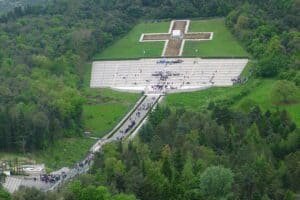
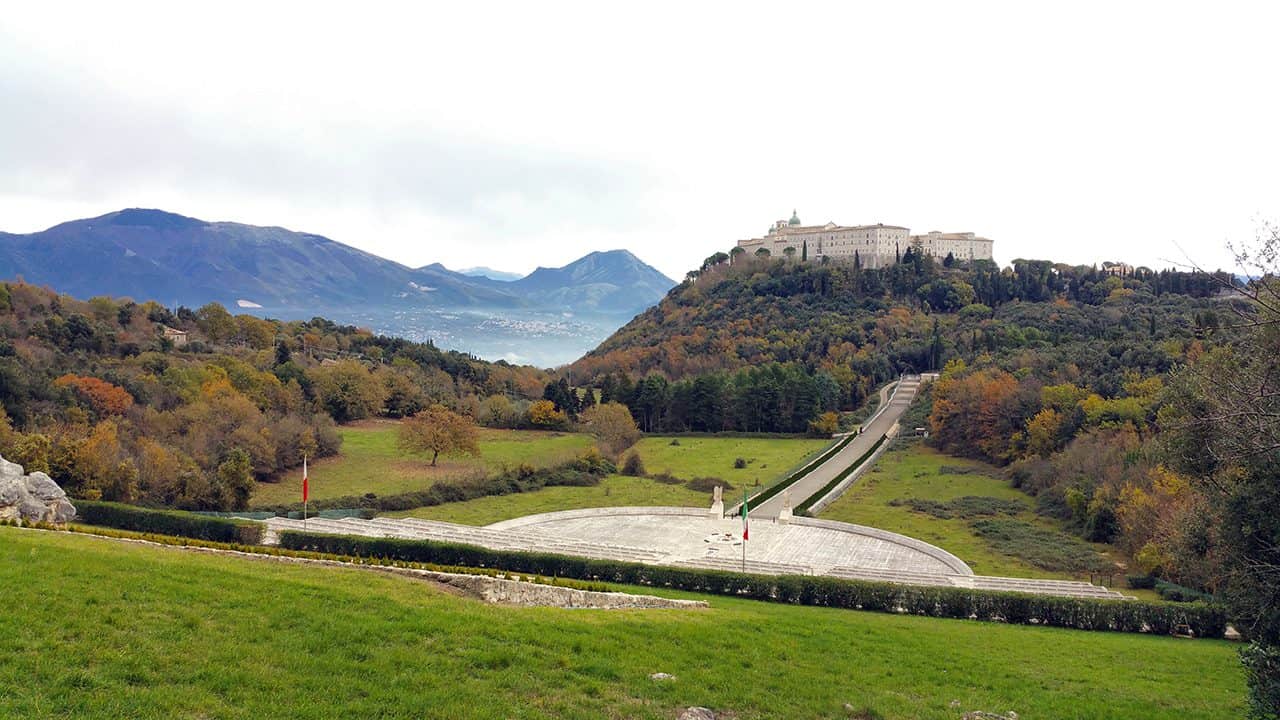
The Polish cemetery is in a hollow behind the mountain, below Point 593, the hill the Poles captured in May 1944, and can be reached from the road that continues past the abbey. Built by the soldiers of the Polish II Corps themselves, it was inaugurated in early September 1945 and today is under the protection of the Italian Ministry of Defense. A little over a thousand fallen rest there (1,051 according to the list at the entrance), among them General Wladyslaw Anders, who died in London in 1970 and is buried here, among his men, by his own wish, together with the military chaplain. One section is reserved for the Jewish soldiers of the Corps. On the entrance stone you read, in Polish and Italian, the sentence that sums up everything: "Passerby, tell Poland that we fell faithful to its service." Since 2014, for the 70th anniversary of the battle, a memorial museum next to the cemetery tells the odyssey of those soldiers, who came out of the Soviet gulags and reached Italy through Persia and the Middle East. Every May 18 the commemorative ceremony brings together relatives and Polish institutions.
The German Military Cemetery of Caira
The German cemetery stands three kilometers north of the town, on the southern slope of Colle Marino, in the Caira area. Inaugurated on May 4, 1965, it is run by the Volksbund Deutsche Kriegsgräberfürsorge, the German association for the care of war graves, which gathers there the fallen of Cassino and those exhumed from the temporary cemeteries of the South, from Calabria to Abruzzo: about 20,100 buried, many of them unknown, and since 2014 a commemorative hall with the plaques of 911 unnamed fallen. It's the largest German war cemetery in Italy. The layout of elliptical terraces, with crosses of dark stone, climbs the hill to the sculptural group at the top: a silent and severe place, which does not seek consolation.
Mignano Monte Lungo and Venafro
The shrine of Mignano Monte Lungo, in Campania, 20 minutes away by car, holds the fallen of the Primo Raggruppamento Motorizzato, the first unit of the Italian army to go back into combat alongside the Allies in December 1943. The French cemetery of Venafro, in Molise, remembers the soldiers of the French Expeditionary Corps of General Juin, largely Moroccans and Algerians, who opened the way through the Aurunci mountains in May 1944. All five cemeteries together are the map of a world battle fought on a tiny patch of land.
Something Nobody Tells You About Cassino (FR)
In the whole city there is only one 19th-century building still standing, and military historiography calls it by the wrong name. The palace of Baron De Rosa is on via Di Biasio, near via Montecassino, and was built at the beginning of the 1800s for the De Rosa family, Neapolitan entrepreneurs who later sold it to two Cassino families. Its position, which allowed control of the railway station and of the access to the city from the road to Rome and to Sora, made it a strongpoint: in 1944 a platoon of German paratroopers held it for weeks against New Zealand and Indian assaults. In British diaries and military history books the building appears as the Hotel des Roses, and as the Hotel des Roses it ended up on all the maps of the battle, but it was never a hotel. The name came from a casual translation of "casa De Rosa", and for 70 years it has been passed on from book to book. The building was restored after the war and turned into offices and schools. Walking past it nobody notices it, because it's the only building that doesn't look rebuilt, and for exactly that reason it's the one to look at.
The second thing nobody tells you concerns the linguistic fame of Montecassino. You often read that the Placiti cassinesi, the first documents in the Italian vernacular, were supposedly written at Montecassino. That's not so: they are four sworn testimonies given before the judges of Capua, Sessa and Teano between 960 and 963, in lawsuits over lands that belonged to the Benedictine monasteries, and the oldest, the Placito of Capua of March 960, contains the sentence "Sao ko kelle terre, per kelle fini que ki contene, trenta anni le possette parte Sancti Benedicti". They are kept in the abbey archive, and this is enough for the Italian language to have its archival cradle at Montecassino, but the voice that first spoke in the vernacular was that of a peasant of the Terra di Lavoro, not of a monk. Anyone who goes up to the abbey with this detail in mind looks at the library with different eyes.
The Architecture of Reconstruction in Cassino (FR)
The reconstruction plan was approved in 1946 and entrusted to the architect Giuseppe Nicolosi with Concezio Petrucci and Antonio Gatti. Nicolosi, an exponent of Italian Rationalism, designed a city with wide axes and regular blocks, and some of the reconstruction buildings are now the subject of study in architecture schools. Anyone walking along corso della Repubblica without knowing sees only postwar buildings. Anyone who knows sees a manifesto.
The INA-Casa Building on Corso della Repubblica
The INA-Casa building on corso della Repubblica, designed by Nicolosi, is the most significant building of rebuilt Cassino. It's a multifunctional block of five floors: the ground floor with shops, the first with offices, the second, third and fourth with housing. It's an Italian and provincial translation of Le Corbusier's Unité d'habitation, the idea that the home is not separate from the services that complete it: shops, offices, shared spaces in the same body. That a razed city chose to be reborn with an idea of modern architecture, and not with a fake historic center, is a decision that 70 years later deserves respect.
The Faculty of Economics and Law at the Folcara Campus
The building that houses the faculties of Economics and Law of the University of Cassino and Southern Lazio, inaugurated in May 2004, is the first building of the Folcara campus and the most imposing construction of contemporary Cassino: over 40 meters high, reinforced concrete and steel structure, 13 floors above ground. Above the basement level with the utilities there is a base slab that contains most of the 18 classrooms and the cafeteria with 300 seats. Higher up are the volumes with the department offices. At the top is the slab with the audiovisual centers of the two faculties, organized in two triangular bodies with individual work rooms arranged in a ring on two levels around double-height spaces, partly covered by glass. The university, born as the Istituto universitario di Magistero and made a state university in 1979, is today the city's leading industry after the automobile: thousands of students in a city of 35,000 inhabitants are visible in the bars and in the streets.
My Advice for Visiting Cassino (FR)
Don't do what everyone does, which is go up to the abbey, come down and leave. Cassino is understood from the bottom up. The recommended itinerary starts at 8:30 at the Casinum Archaeological Park, when it opens and the sun is still low on the steps of the amphitheater: an hour and a half among the theater, mausoleum, via Latina and the Carettoni museum. At 10:30 you drive up to the abbey, in time for the end of the Sunday Gregorian Mass or, on weekdays, for the cloisters with the right light. Lunch in town, not on the mountain. In the afternoon the Polish cemetery and, for those who still have energy, the German cemetery at Caira or Rocca Janula for the sunset over the valley. Anyone with a second day devotes it to the Historiale, to Villa Comunale with the springs of the Gari, to Terme Varroniane and to the towns around, Roccasecca and Aquino a quarter of an hour away, Atina and the Val di Comino half an hour away.
On timing: spring is the season, and the right month is May, when the ceremonies of May 18 fill the cemeteries with flags and veterans in their nineties, and the town remembers with seriousness. March, with the historical procession of the 21st, is the second choice. Summer in Cassino is hot and muggy, the basin holds the air: you go up the mountain, where it's 10 degrees cooler, and come down into town only for the Roman theater in the evening. Winter has foggy days when the abbey disappears, and frosty mornings when you can see everything as far as the sea at Gaeta. Anyone traveling with a large group, a company or an extended family does well to rely on a professional: TourLeaderPro organizes private and corporate tours for the Cassino area too, with a tour leader who knows the real times of the buses and of the doors that close.
The Natural Areas of Cassino (FR)
Cassino is a city of water. The Gari rises in town, the springs of Terme Varroniane are among the largest in Europe, and the mountains around, the Cairo to the north at 1,669 meters and the Aurunci to the south, whose regional natural park begins a few kilometers beyond the Liri, close the basin on every side. Anyone who loves walking has here the arrival of the Way of Saint Benedict, the 300 kilometers that lead from Norcia, through Subiaco and the abbeys of Lazio, to the saint's tomb.

Villa Comunale, Parco XV Marzo 1944
Villa Comunale, renamed Parco XV Marzo 1944 after the date of the city's destruction, is Cassino's main public park and one of the most beautiful in southern Lazio, because it is crossed by two branches of the Gari that join to form a clear little lake, with trout you can see with the naked eye. Tree-lined avenues, benches, play areas for children, and visitors of every age that make it the town's real living room. It hosts sporting and cultural events throughout the warm season. In August 2011 the main plaza was dedicated to Giovanni Falcone and Paolo Borsellino and the avenues to the escort officers killed at Capaci and in via D'Amelio in 1992: Francesca Morvillo, Agostino Catalano, Walter Eddie Cosina, Rocco Dicillo, Vincenzo Li Muli, Emanuela Loi, Antonio Montinaro, Vito Schifani, Claudio Traina. The idea is a path of civic memory, which remembers every day those who died defending the State. The Villa is in the center: the main entrance is on corso della Repubblica, the other entrances from via Arigni, via Gari and via Di Biasio.
Parco Baden Powell
Inaugurated in 2014, it's the city's second park and stands where the Campo Boario used to be, the cattle market that for centuries was one of the riches of the Cassino area (Cato and Varro already praised the livestock raising of these lands). Besides the children's play area it houses the offices of the city associations and, thanks to its central position, many events. The name recalls the founder of scouting, which has a long tradition in Cassino.
Terme Varroniane
Terme Varroniane are a thermal and nature park born after the war in the area called Monticello, near the railway station, where the villa of Marcus Terentius Varro stood. In the De re rustica Varro writes that he owns near Casinum a clear, deep river that runs through his villa, with bridges and an aviary that made it famous: that river is the Gari, and those springs are still here. The spring zone is classed among the largest in Italy and Europe: thousands of pools generate one of the branches of the Gari, with water at a constant 13 degrees, classified as cold medium-mineral bicarbonate waters, which the drinking-cure tradition recommends for stomach, kidney and liver ailments and for gout. Today the park houses the campground, the conference and banquet hall, the concert area and the fountains from which you drink the spring water. Access to the park is by reservation and on the days of the events calendar published on termevarroniane.it, with the campground reopening in spring. The streams are full of trout, carpione, eels and lampreys, and the transparency of the water is of the kind you don't forget.
The Springs of the Gari River
The Gari rises inside the city, on the slopes of the mountain and of Rocca Janula, behind the mother church in piazza Corte. After a short underground stretch it re-emerges in Parco XV Marzo 1944, where it forms the little lake and splits into two branches that immediately join again. Along its course it grows with the input of many springs, receives the waters of the Rapido and those of Terme Varroniane, and in the territory of Sant'Apollinare it joins the Liri to form the Garigliano, which flows for another 38 kilometers, marking the border between Lazio and Campania, to the Gulf of Gaeta. The Rapido and the Gari are also names of war: on the Rapido, in January 1944, the 36th Texas Division suffered one of the bloodiest defeats of the American army in Europe, and the Peace Bell of Sant'Angelo in Theodice rings for those dead.
The Memorials of Cassino (FR)
The Peace Monument by Umberto Mastroianni
The sculpture is by Umberto Mastroianni, the sculptor from Fontana Liri who was one of the highest voices of 20th-century Italian abstraction. It was inaugurated in 1987 and placed just below Rocca Janula, where the recovery of the fortress was supposed to give life to Parco della Pace. A second version of the work is in piazza XV Febbraio, right in the center. The monument is in steel, weighs about 100 tons and is made of tangled tubular elements that invade the surrounding space from a central core. Mastroianni does not depict the effects of the battle, the ruins or the fallen, but the cause: the explosion of a bomb, the instant when everything comes apart. It's a hard work, which does not console, and for this reason it is right for Cassino.
The Monument to Enrico Toti
In piazza Enrico Toti a bronze statue depicts the extreme gesture of the hero of the Great War: the cyclist bersagliere, already wounded, who hurls his crutch at the enemy a moment before being struck dead, on August 6, 1916, at Point 85 near Monfalcone. The monument, inaugurated in 2008, is by the sculptor Egidio Ambrosetti of Anagni. Toti was Roman, but his family came from here: his father Nicola was a railwayman from Cassino. Both of them, the city and the man, happened to know the devastation of war all the way down, and the thread that links them is this.
The Statue of Saint Benedict by Giuseppe Ducrot
At the northern entrance to the city, inside the access roundabout, rises the bronze statue of Saint Benedict by the Roman sculptor Giuseppe Ducrot, about three and a half meters tall on a large stone base. It was placed in 2009 on the occasion of the visit of Benedict XVI, on May 24, and afterward enhanced by the works that redesigned the area. Ducrot is one of the most sought-after Italian sculptors for large sacred figures of the last 20 years, and his Benedict welcomes those arriving from Rome with the book of the Rule and a gesture of blessing toward the city and the mountain.
The Peace Bell at Sant'Angelo in Theodice
The Peace Bell is on the Ponte delle Quattro Battaglie, over the Gari, in the hamlet of Sant'Angelo in Theodice. It was established on May 18, 2008 in memory of the fallen of January 1944 on the Gari and the Rapido, the first battle of Cassino. Cast by the Pontifical Marinelli Foundry of Agnone, the oldest in Italy, to a design by Severino De Santis, it weighs 1,380 kilograms and has a base diameter of 132 centimeters. Every evening at 17:00 it rings 30 strokes for the fallen of all the belligerent nations, and on historic anniversaries it rings in full peal for three minutes at noon. Hearing it at sunset, with the plain growing dark and the mountain still light, is one of the truest moments Cassino offers.

Another Well-Known Fact, Yet Rarely Cited
That the abbey was destroyed in 1944 everyone knows. That 10 years earlier you could get there by cable car, few know. On May 21, 1930 the Cassino-Montecassino cable car was inaugurated, begun the year before, which carried you from the city to the monastery in seven minutes over a drop of more than 400 meters: it was the first installation of its kind in the South and it had the longest span among those then in existence. For 13 years it was the normal way for pilgrims and tourists to go up the mountain, and the postcards of the time show the cabin hanging over the roofs of a city that no longer exists.
The end came before the bombs. In July 1943, during a training flight, a German fighter that had taken off from the Aquino airfield struck one of the cable car's cables: the cable snapped, the plane crashed and the pilot died. The installation, already out of service, was then bombed along with the city and was never rebuilt. Since then you reach the abbey only by the road of the hairpin turns. Every so often the idea of rebuilding the cable car comes back in Cassino. Every time the idea stalls. Anyone looking at the mountain today from the station can imagine the line that cut across it, and understand how different the city was that the bombers wiped out: not a village, but a modern small town, with the station, the hotel, the courthouse and a cable car from a Swiss mountain.
The Right Photo to Take in Cassino (FR)
The photograph everyone takes is the abbey from the monastery forecourt, and it's the least interesting one, because the bulk of the monastery up close crushes everything. The right photo is taken from below. The spot is the archaeological park: from the high tiers of the amphitheater, with a medium lens, you keep in the frame the ellipse of the Roman tiers in the foreground and the white monastery on the summit, and in a single image there are 2,000 years. The light is the morning light, when the sun lights up the abbey's facade and the tiers stay in soft shade. In the afternoon the mountain is backlit and the monastery becomes a silhouette.
The second photo is from Rocca Janula at sunset: from the wall walk you take in the city, the Liri valley and the line of the Aurunci, and on clear winter evenings the sea at Gaeta is a pale blade on the horizon. The third is in the Polish cemetery, from the bottom of the cemetery looking up, with the rows of crosses climbing toward the obelisk and the mountain behind: you photograph with respect, without people in the frame, and without turning a burial place into a backdrop. The fourth is the hardest: the little lake of Villa Comunale on an autumn morning, with the mist rising from the Gari and the trout under the surface. For anyone who wants the classic, one concession: the monastery seen from the road of the hairpin turns, at the last bend before the forecourt, when it appears suddenly with its walls sheer above you. But do it fast, because the bend is tight and the bus behind you won't wait.
The History of Cassino (FR)
Classical Cassino: Casinum
The first settlements arose in the caves of the hill, because the valley floor was occupied by a lake basin. Neolithic finds attest to human presence from remote times, and in the Iron Age there must have been a stable village, documented by a necropolis. To whom to attribute the foundation of the city is an open question: many scholars consider it Oscan. Between the 6th and the 5th century BC the Volsci, an Osco-Umbrian people who perhaps came down from the Sabina, occupied the area, and some research moves their presence back to the 8th century BC. Before the Roman conquest Casinum was by then a Samnite city, and the polygonal walls of the archaeological park date from that time.
Rome arrived at the end of the 4th century BC, when it took control of the Liri valley and in 312 BC founded the Latin colony of Interamna Lirenas, at the confluence of the Liri and the Spalla Bassa stream, which controlled part of the territory between Aquino and Cassino. In the Second Punic War Hannibal passed through here devastating the countryside, but Casinum stayed loyal to Rome. The Roman city was near the present hamlet of Crocifisso, crossed by the via Latina, defended by about four kilometers of walls and rich in monuments, because the city was rich. It was a municipium, then a colonia, finally a praefectura, in the stages of its gradual insertion into the Roman order. Besides the via Latina, a road left the territory toward the Val di Comino, Abruzzo and Sora, which then returned toward Rome. The city was surrounded by pagi, the rural villages, one of which became over the centuries the hamlet of Sant'Angelo in Theodice.
Among the gods the most venerated was Apollo. His temple was identified on Montecassino, the acropolis of the city, by Gianfilippo Carettoni, who in 1940 relied on the Dialogues of Gregory the Great: the complex stood where the abbey is today, also had a military function and was defended by a double circuit in polygonal masonry, partly still visible, which connected with the city walls. Delventinus was also worshipped, a local water god, which is no surprise in a city of springs. Casinum was served by an aqueduct of more than 22 kilometers. The forum, according to Carettoni, was outside the walls, because the cattle market was held there. More recent studies place it instead inside the walls, near the theater and the porta Campana. On the banks of the Gari stood Varro's villa and the baths, drawn in the 16th century by a Sangallo and today badly ruined. What does survive, at Crocifisso, is the amphitheater on the natural slope and the theater. The church of the Crocifisso is built inside the so-called sepulcher of Ummidia Quadratilla.
The economy was agricultural and famous. In the territory there was an association of oil producers, and the oil of Casinum was cited by Macrobius. Cato praised the quality of the produce of the territory. Livestock raising and the production of baskets and ropes, with the raw material growing along the waters, completed the picture. Tradition has it that Saint Peter in person, passing through these lands on his way to Rome, first preached Christianity to the people of Cassino: it's a legend, but it is certain that an ancient Christian community existed in Cassino, documented by many martyrs. After the reorganization of suburbicarian Italy, Casinum found itself in the province of Samnium. In the early Middle Ages the barbarian raids damaged it deeply, and the Lombards of Zotone destroyed it.

The Early Middle Ages in Cassino: Benedict and the Land of Saint Benedict
Of the first centuries after the fall of the Empire we know little, because of the scarcity of sources. Pope Gregory the Great, in the Dialogues, handed down to us the arrival of Benedict among the ruins of the acropolis of Casinum. The saint chose Montecassino around 529 as the seat of his monastery, the cradle of the Benedictine Order. As often happened with the first Christian institutions, the abbey arose on a pagan place of worship, the fortified acropolis: Cassino was still largely pagan and had recently suffered the devastation of the Goths. Benedict tore down the image of Apollo and the altars, consecrated the place to Saint John the Baptist and from then on never left the mountain. Here he wrote the Rule, the founding principle of Western monasticism. Here, according to Gregory, he received the visit of Totila, king of the Ostrogoths, shortly before Totila besieged Rome in December 546, the only episode in Benedict's life that can be dated with some certainty. Here he died, according to tradition on March 21, 547. The abbey became the model of Western monasticism and one of the greatest cultural centers of Europe throughout the Middle Ages.
Meanwhile the population built a village, Castellum Sancti Petri, on the ruins of the ancient forum, on the plain and not on the slope like the earlier city. But the position, so strategic, condemned the monastery and the city to be caught up in every war. In 577 the Lombards of Duke Zotone sacked the abbey and the surviving monks fled to Rome, where they stayed for more than a century. In that time the remains of Benedict were, according to the French tradition, moved to Fleury-sur-Loire, near Orléans, where the abbey of Saint-Benoît still claims them, while Montecassino maintains that it keeps the bodies of the two saints found in 1950: a dispute 13 centuries old. Around 718, with Petronax of Brescia, the monks returned to the mountain and a flourishing period followed. Paul the Deacon, the historian of the Lombards, stayed there, and so did kings in exile such as the Frank Carloman, uncle of Charlemagne, and the Lombard Ratchis. In 744, with the donation of the duke of Benevento Gisulf II, the Terra Sancti Benedicti was born, the feudal domain of the abbey, which enjoyed a greater or lesser autonomy depending on the times while remaining part, in turn, of the Duchy of Benevento, the Principality of Capua, the Kingdom of Sicily, the Kingdom of Naples and the Two Sicilies. Montecassino thus became the center of a vast and strategic territory, crossed by the roads between the Lombard duchy of Benevento, the Byzantine cities of the coast (Naples, Gaeta, Amalfi) and the Papal States.
A couple of kilometers further down, north of ancient Casinum, there was a small monastery on the banks of the Rapido. The church of the Salvatore was erected around 797 at the wish of Abbot Gisulf over a small church of San Benedetto. In 874 the emperor Louis II gave the church a relic of Saint Germanus, bishop of Capua and close friend of Benedict, and for this reason the church later became the cathedral of San Germano. Not far away, at the foot of the Janulo hill, the church of Santa Maria delle Cinque Torri, with its highly original centrally symmetrical plan with an inner colonnade, four towers at the corners and a larger one in the center, stood on ground where water surfaced: the floor was raised three times, without success. For administrative and defensive reasons, against the Saracen raids, Abbot Bertarius refounded the city at the foot of the Janulo hill, near the church of the Salvatore, and called it Eulogimenopoli. In 883 the Saracens, who were aiming to expand across the peninsula, sacked the territory, destroyed the city, the church of the Salvatore and the abbey, killed Abbot Bertarius himself and forced the monks into a long exile.
Once the invaders were driven out, the city rose again. In this period the Teano historian Erchemperto lived at Montecassino, whose Historia Langobardorum Beneventanorum is the fundamental work of the 9th century for the South. In the abbey archive are kept the four Placiti cassinesi, the first official testimonies in the Italian vernacular, recorded between 960 and 963 in the lawsuits over the monastery's lands. The city became the administrative center of the Land of Saint Benedict, because the abbot's men of government lived and worked here, such as the advocatus, who administered justice. The inhabitants took part in the political and religious struggles involving the abbey, and the city, which by now had the name of San Germano, was fortified and equipped with Rocca Janula.
From the Late Middle Ages to Unification: San Germano
Montecassino reached the peak of its prosperity in the 11th century under Abbot Desiderius (1058-1087), later pope with the name Victor III. The monks numbered more than 200 and their illuminated manuscripts became the most sought-after in Europe. The buildings were rebuilt and enlarged with Amalfitan, Lombard and Byzantine craftsmen, and the new abbey church was consecrated in 1071 by Pope Alexander II. The Land of Saint Benedict was reorganized with new settlements and castles. Here were written the Chronica monasterii Casinensis by Leo of Ostia and Peter the Deacon and the Historia Normannorum by Amatus of Montecassino, the greatest source on the Normans in southern Italy. San Germano at that time had a Jewish quarter, a Greek one and a community of Amalfitan merchants, who lived around the piazza degli Amalfitani: a small cosmopolitan city at the foot of the monastery.
The power of the abbots was soon limited by the Normans, masters of the South, and then by the Swabians. In 1199 the imperial troops besieged the abbey, camping in the city. On July 23, 1230, in the church of San Germano, the peace was signed between Pope Gregory IX and the emperor Frederick II, which closed the emperor's first excommunication: one of the most important diplomatic acts of the 13th century, signed here. 36 years later, in 1266, Manfred's men barricaded themselves in the Roman amphitheater to resist the Angevin advance of Charles I. On September 9, 1349, at nine in the morning, a great earthquake with its epicenter in the Venafro district, of estimated magnitude 6.6 and intensity X on the Mercalli scale, followed the same day by shocks near L'Aquila and in the Viterbo area, razed most of the houses of San Germano on the plain, partly sparing those built against the mountain, and badly damaged the abbey, which was repaired in 1366 under pressure from Pope Urban V. In the 14th century Rome tried to separate the administration of the city from the monastery by installing a bishop there, but the abbots kept their prerogatives. In 1505 the monastery was united to the congregation of Santa Giustina of Padua. In 1521 a revolt of the citizens plundered the abbey for days. In 1527 the plague wreaked havoc in the Cassino area.
Then three centuries without events of note, until the Napoleonic wars. Troops of the Kingdom of Naples ready to invade the Roman Republic camped at San Germano. In 1799 the city was occupied by the French, and a pro-Napoleonic administration was installed there amid widespread dissent. Withdrawing from Naples, the French devastated the territories of their opponents, Cassino included. From May 15 to 17, 1815 the city was the scene of the final clash of the Austro-Neapolitan war, the battle of San Germano, which ended with the Austrian victory and marked the end of Joachim Murat. In 1843 the philosopher Antonio Labriola was born in Cassino, the father of Italian theoretical Marxism, teacher of Benedetto Croce and correspondent of Engels.
From Unification to the Second World War
On May 23, 1863 the town council decided on the return to the old name of Cassino, and in the same year the railway arrived. In 1866 the Kingdom of Italy took over the lands of the monasteries. Brigandage grew, so much that a military garrison became necessary, and land reclamation began against floods and marshes. Cassino stayed in the province of Terra di Lavoro, Sora district, until 1927, when the province of Frosinone was created. On May 21, 1930 the cable car to the abbey was inaugurated, which in July 1943 was cut by the German fighter that had taken off from Aquino, as already told.
Then the war. The four battles of Cassino, from January to May 1944, were among the hardest of the Second World War. The city was on the north side of the Gustav Line, the German defensive line that cut Italy from the Tyrrhenian to the Adriatic, as far as Ortona, and barred the roads to Rome. The Allies pressed from the south. On February 15, 1944 the abbey was razed by an aerial bombing: the Allies believed it was occupied by the Germans, and instead killed the civilians who had taken refuge there. The works of art had been moved to Rome by the Germans before the bombing, and some disappeared on the way. Exactly a month later, on March 15, it was the city's turn, wiped out by bombers and artillery. The citizens were partly evacuated, partly stayed among the rubble. When the Allies broke through, on May 18, 1944, with the Poles on the abbey and the French on the Aurunci, there were about 54,000 Allied losses and 20,000 German. Out of a population of about 20,000 inhabitants, 2,026 civilians of Cassino lost their lives in the conflict.

From the Postwar Period to Today
The immense losses led, in the immediate postwar period, to the three war cemeteries on the municipal territory. The reconstruction was very hard and lasted until the 1960s. A malaria epidemic broke out, but there was also great national solidarity, with the children of Cassino hosted for a long time by families in the North and many donations. The city earned the title of Martyr City and the Gold Medal of Military Valor. The reconstruction plan, approved in 1946, was the work of Giuseppe Nicolosi with Concezio Petrucci and Antonio Gatti. From the reconstruction came the economic transformation that in the 1970s took Cassino from agriculture to industry and then to services. The founding, in 1955, of the Banca Popolare del Cassinate was decisive, wanted by the mayor Pier Carlo Restagno, who had understood that a bank run by local people could finance the first craft and commercial initiatives of the rebirth. The Rome-Naples stretch of the motorway, in 1962, did the rest: the SKF plant and the Fiat plant with its supplier network arrived, which changed the social fabric of the Cassino area, and in 1979 the University. Meanwhile the abbey had been rebuilt, consecrated by Paul VI on October 24, 1964.
John Paul II came twice: on May 18, 1979, to pray at the tomb of Benedict and Scholastica and visit the Polish cemetery, and on September 20, 1980, for a pastoral visit to Cassino and Montecassino. On May 24, 2009 it was Benedict XVI's turn. From the 1980s the initiatives to make Cassino the capital of a new province resumed with force: the historical link with Terra di Lavoro has led the people of Cassino to contest for decades the equation between Ciociaria and the province of Frosinone, a folkloric and cultural unity imposed in the 1920s. A province of Cassino was meant to give back an identity to the middle and lower Liri-Garigliano valley. Between 1956 and 2006, 10 bills were introduced, none approved. With the dream shelved, Cassino is today an industrial, university and commercial center, exposed however to the cyclical crises of the automobile industry, which with every cassa integrazione at the Piedimonte San Germano plant are felt throughout the city.
Some Important Events That Happened Here in History
Few places in Italy have seen so much history in so little space. On September 4, 883 the Saracens of Agropoli destroyed the abbey and killed Abbot Bertarius, who is venerated as a martyr: it was the second destruction, and the first city of the plain, Eulogimenopoli, vanished with him. In March 960, in a lawsuit over the monastery's lands, a witness spoke before the judge of Capua in a language that was no longer Latin: written Italian was born, in a notarial act. On July 23, 1230, in the church of San Germano, the pope and the emperor signed the peace that reconciled Gregory IX with Frederick II after the excommunicated crusade: two universal powers seated at the same table in a provincial city. On September 9, 1349, at nine in the morning, the Venafro earthquake razed the city and gutted the abbey, which stayed in ruins for almost 20 years.
From May 15 to 17, 1815 the battle of San Germano closed the Austro-Neapolitan war and Murat's kingdom: from Cassino the Europe of the Restoration went back to Naples. On February 15, 1944, at 9:30 in the morning, more than 200 Allied bombers dropped hundreds of tons of bombs on the abbey: it was the first monument of Christendom deliberately destroyed in a modern war, and the controversy over that decision continues. On March 15 the city followed the monastery, with a bombing that the Allied commanders themselves described as the heaviest ever concentrated on so small a target. On May 18, 1944, at 10:20 in the morning, a patrol of the 12th Podolian Uhlans Regiment raised the Polish flag over the ruins of the abbey, and the road to Rome was open. On October 24, 1964 Paul VI consecrated the rebuilt basilica and proclaimed Benedict patron of Europe: from a ruin, the idea of a united continent. On May 18, 1979 John Paul II, a Polish pope for seven months, knelt among the graves of his compatriots. And on May 24, 2009 Benedict XVI, who had chosen the name of the saint of this mountain, went up to the abbey and blessed the city. Anyone counting the events notices that Cassino recurs at regular intervals in European history: it's not a provincial city, it's a crossroads.
Who Has Passed Through Cassino (FR)
Everyone has passed through Cassino, because the via Latina and then the railway and the motorway force you to pass through it. Marcus Terentius Varro, the most learned of the Romans, had here the villa with the aviary that he describes in the De re rustica. Cicero, who had properties at Arpino and in the Liri valley, cites Casinum in the Philippics precisely in connection with Varro's villa, occupied by Mark Antony. Hannibal crossed the territory in 217 BC, and Livy tells that he wanted to go to Casinum but the guide, misunderstanding his accent, led him to Casilinum: a mispronunciation that changed a military campaign. Benedict of Norcia arrived there around 529 and never left. Totila, king of the Goths, went up the mountain to test him in 546, sending ahead a squire disguised as king, and Benedict unmasked him. Paul the Deacon wrote the History of the Lombards there. Carloman and Ratchis, kings who had given up the throne, took the monastic habit there. Frederick II signed the peace of 1230 there and strengthened the Rocca. Thomas Aquinas, born at Roccasecca a few kilometers away, was entrusted as a child to the monks of Montecassino as an oblate, in 1230 or 1231, and studied there until age 14. Giovanni Boccaccio, according to the account of his pupil Benvenuto da Imola, found the library there in neglect, with the codices mutilated by the monks to make psalters and amulets: an anecdote perhaps exaggerated, but one that made the fortune of humanism.
Joachim Murat lost his kingdom there in 1815. Antonio Labriola was born there in 1843 and brought Cassino into the history of European philosophy. In 1944, in the literal sense, half of Europe in arms passed through: General Anders with the Poles, the New Zealander Freyberg who asked for the bombing, the Frenchman Juin who won on the Aurunci, the Nepalese Gurkhas, the Moroccans, the Texans of the Rapido, the German paratroopers of the 1st division, and with them the war correspondents and the photographers who made Cassino the Italian Stalingrad. General Anders wanted to return there in death, in 1970. Paul VI, John Paul II and Benedict XVI went up there as popes. And every year, on May 18, the children and grandchildren of those soldiers pass through, arriving from Poland, Canada and New Zealand to look for a name on a white headstone. For a group that wants to follow these footsteps with a guide in English, the ItalyPlanner page dedicated to Montecassino is the starting point, and for a private tour in Italian it is TourLeaderPro, which organizes corporate and group outings from Rome toward southern Lazio.
Cassino (FR) with Children and Families
Cassino with children works better than you'd think, as long as you dose the history. The amphitheater and the Roman theater are a natural playground: you climb the tiers, test the acoustics, look for the cart ruts on the flagstones. Parco XV Marzo 1944 with the little lake and the trout is the perfect break, with the play areas and the ice cream shops of the corso a step away. At the abbey children last an hour: the cloisters, the staircase, the terrace over the valley and the crypt with the golden mosaics. The museum, with exceptions, tires them. The war cemeteries need to be explained beforehand: from age 10 up the Historiale, with its multimedia story, prepares them well and turns the crosses into stories. Terme Varroniane, with the transparent streams and the campground, are the right place for a late spring day. The stroller struggles in the archaeological park and in the cloisters with stairs. In the rest of the city it does very well.
Accessibility, Costs and How to Save in Cassino (FR)
Visiting Cassino costs little. The abbey is free, and only the abbey museum (price on site) and the booked guided visit are paid. The archaeological park with the Carettoni museum costs €5, €2 for ages 18 to 25, free for under 18 and on the first Sundays of the month under the rules of state museums. With €8 you get the combined ticket with the Minturno archaeological area, valid for 30 days, which for anyone heading down toward Formia and Sperlonga is a good deal. The war cemeteries are free and open every day. Rocca Janula and the Historiale have their own modest tickets, with hours to check on their respective websites. On accessibility: the abbey has elevators and routes for wheelchairs, with staff indicating the way. The archaeological park, because of the nature of the terrain, is declared not accessible to people with mobility disabilities, while the Carettoni museum is. The Commonwealth and German cemeteries have flat paths or ramps, the Polish one is terraced with steps. Villa Comunale is flat and barrier-free.
What's Around Cassino (FR) and What to Eat
Within a half-hour radius Cassino has more than you can see in a weekend. Aquino, the city of Thomas and of Juvenal, with the Romanesque church of Santa Maria della Libera built with Roman marbles, is 10 minutes away. Roccasecca, with the castle of the counts of Aquino where Thomas was born, a quarter of an hour. Atina and the Val di Comino, with the Lake of San Benedetto and the entrance to the Abruzzo, Lazio and Molise National Park, half an hour. Arpino, Cicero's hometown with its polygonal acropolis, 25 minutes. Isola del Liri with the waterfall in the middle of the town, half an hour. To the south the Royal Palace of Caserta 50 minutes by motorway and the sea at Gaeta and Formia an hour. The abbey of Casamari, at Veroli, closes the triangle of the great abbeys of southern Lazio with Montecassino and Fossanova.
At the table the Cassino area is more Campanian than Ciociarian, and you can tell. Among the certified products of the territory are the Atina DOP cannellino bean, which here is served in soup with pork rinds or with pasta, and the wines of the Atina DOC, reds based on cabernet planted in the 1800s by an agronomist who had studied in France. On Cassino tables you find fini fini, egg pasta cut very thin, fried pizzas, abbacchio and the pecorino cheeses of the mountains, and in season the mushrooms and chestnuts of the Cairo. The olive oil, which Macrobius celebrated 2,000 years ago, is still good: the hills around Cassino are covered in olive trees, and a bottle bought from a producer along the road to Aquino is worth more than any souvenir. I don't give names of restaurants: they change, and anyone visiting Cassino does well to ask the locals, who have strong opinions on the subject.
Quick Questions About Cassino (FR)
How Far Is Cassino from Rome and How Long Does It Take?
About 135-140 kilometers by the A1 motorway, a good hour and a half by car without traffic. By regional train from Roma Termini between an hour and a half and two hours, with times and prices on trenitalia.com.
Can You Visit Cassino in a Day from Rome?
Yes, and many people do: leaving at 8 you can calmly see the archaeological park, the abbey and one war cemetery, and be back in Rome for dinner. Two days let you add Rocca Janula, the Historiale, Terme Varroniane and the towns around.
Is Montecassino Abbey Paid?
No, admission to the abbey and the basilica is free. The abbey museum, with the price given on site, and the guided visit, which is booked on the abbey's website, are paid.
What Are the Opening Hours of Montecassino Abbey?
From April 1 to October 31 every day from 9:30 to 18:30. From November 1 to March 31 from 9:30 to 16:15 Monday to Saturday and until 17:15 on Sunday and holidays. The Sunday Gregorian Mass is at 10:30, the sung vespers at 16:30.
How Much Does the Casinum Archaeological Park in Cassino Cost?
€5 full price, €2 for ages 18 to 25, free for minors and for the categories set by the Ministry. €8 for the combined ticket with Minturno, valid for 30 days. The park opens at 8:30 and closes at 16:00 in winter and 19:00 in summer.
How Do You Get from Cassino up to the Abbey Without a Car?
With the bus of the Mastrantoni company from the station forecourt, three runs a day listed by the abbey (10:00, 12:35, 15:20 outbound), with a taxi, or on foot along the path, about two hours uphill.
Where Do You Park in Cassino and at the Abbey?
At the abbey in the lot below the entrance. At the archaeological park about a hundred meters from the ticket office. In town in the blue-line spaces of the center or in the areas around Villa Comunale and the station.
Is the Archaeological Park of Cassino Wheelchair Accessible?
No: the Direzione regionale Musei Lazio lists it as not accessible to people with mobility disabilities because of the nature of the terrain. The Carettoni museum, however, is accessible, and so are Villa Comunale and the main routes of the abbey.
Is Cassino Suitable for Children?
Yes, in moderation: the amphitheater and Roman theater, the little lake of Villa Comunale and Terme Varroniane please all ages. The cemeteries and the Historiale are for ages 10 and up.
Can You Take Photographs at Montecassino Abbey?
In the cloisters and outside yes, without limits. In the basilica and the museum you follow the posted instructions, generally no flash and no tripod, and never during services.
How Many War Cemeteries Are There in Cassino?
Three on the municipal territory: Commonwealth at Folcara, Polish below Point 593 behind the abbey, German at Caira. A few kilometers away are the Italian shrine of Mignano Monte Lungo and the French cemetery of Venafro.
How Many Soldiers Rest in the Polish Cemetery of Montecassino?
A little over a thousand, 1,051 according to the list at the entrance, among them General Anders, who died in London in 1970 and is buried here by his own wish.
What's the Difference Between Cassino and Montecassino?
Cassino is the city, on the plain, with the Roman monuments, the parks and the station. Montecassino is the mountain with the abbey, eight kilometers and 400 meters of elevation higher up. The abbey belongs to a municipality, which is Cassino, but it has a life and a history of its own.
Why Is Cassino Called the Martyr City?
Because on March 15, 1944 it was razed by Allied bombing and rebuilt from scratch after the war. On February 15, 1949 it received the Gold Medal of Military Valor.
When Does the Historical Procession of Cassino Take Place?
On March 21, the feast of the passing of Saint Benedict, at the end of a week of events centered on the Palagio Badiale in piazza Corte.
What Can You See in the Carettoni Museum in Cassino?
The finds of Casinum from prehistory to late antiquity, with three pieces not to be overlooked: the sword of San Vittore, the Athlete of Cassino and the funerary bed from Aquinum.
Does the Roman Theater of Cassino Host Shows?
Yes, in summer: concerts, theater and open-air cinema, with the cavea of about 3,000 seats and the abbey lit up above the stage. The program is published by the Comune and by the archaeological park.
Are Terme Varroniane of Cassino Open to the Public?
The park opens by reservation and on the days of the events calendar published on termevarroniane.it, with hours 11:00-21:00. The campground reopens in spring. It's not a spa establishment with hot pools: the waters are cold, at 13 degrees, and you drink them.
What's the Best Time to Visit Cassino?
May, for the spring and the ceremonies of May 18. March for the historical procession. Summer evenings for the Roman theater. Avoid the central hours of the days of summer muggy heat on the plain.
Is Cassino in Ciociaria?
Administratively it has been in the province of Frosinone since 1927, but historically it belongs to Terra di Lavoro and the Kingdom of Naples, and the people of Cassino care a lot about the distinction. Calling it Ciociarian in a bar on the corso is the quickest way to start an argument.
Where Do You Eat Well in Cassino?
The territory has the Atina DOP cannellino bean, the wines of the Atina DOC, fini fini, mountain pecorino cheeses and an excellent olive oil. For restaurants the advice is to ask in town, where the cooking is more Campanian than Lazio.
Why I Go Back to Cassino (FR)
Cassino is not beautiful in the sense that postcard villages are, and anyone who visits expecting that is disappointed. It's a city that asks to be understood before being looked at, and that repays those who do with a density of history that few places in Europe can claim in three square kilometers: a Roman amphitheater, the cradle of Western monasticism, the first sentence of Italian, the peace between a pope and an emperor, the hardest battle of the Italian campaign, and a modern reconstruction that did not want to pretend. I go back every year, in May, and every year I follow the same order: first the amphitheater, then the cemeteries, and only at the end the mountain, because the abbey, seen by someone who has understood what lies beneath, is a different abbey. Anyone preparing the trip in English will find the region's context in the ItalyPlanner guide to Lazio, and anyone who wants a tour leader will find in TourLeaderPro people who know the road of the hairpin turns and the times of the bells.
Article written by the editorial team of TourLeaderPro, contact them for Private/Corporate/V.I.P. Tours and Experiences.
Planning a trip to Rome? The English-language guides to visiting the city are on ItalyPlanner.com.