L’Aquila (AQ)
In short. L’Aquila (AQ) is the capital of Abruzzo and sits at an elevation of 721 meters, on the plateau that the Aterno River cuts from north to south, with the Gran Sasso massif closing off the horizon to the east.
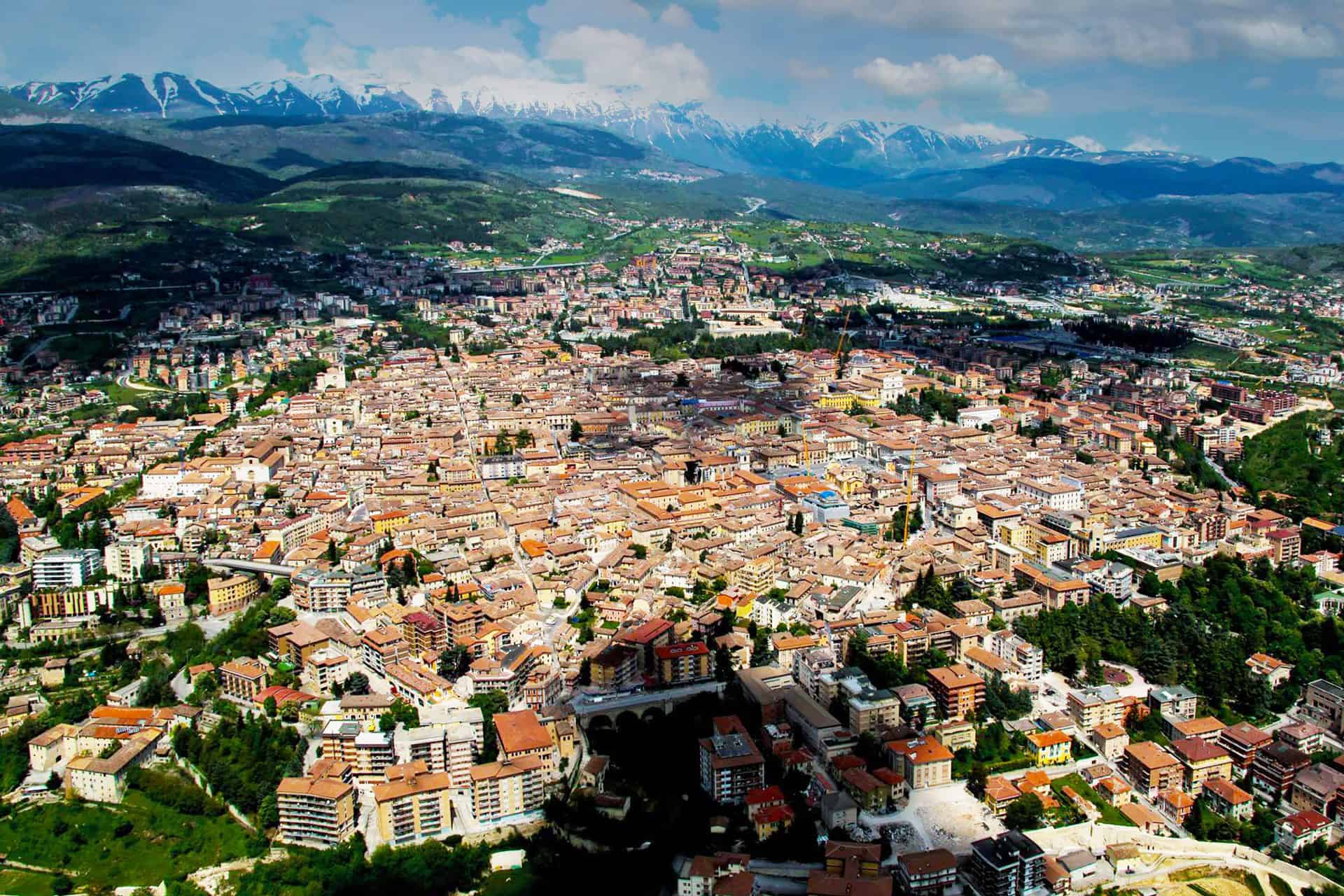
L’Aquila (AQ) is the capital of Abruzzo and sits at an elevation of 721 meters, on the plateau that the Aterno River cuts from north to south, with the Gran Sasso massif closing off the horizon to the east. From Rome you get there by car on the A24 Rome-Teramo motorway, exit L’Aquila Ovest or L’Aquila Est, about an hour and 40 minutes from Roma Est in normal traffic. By bus there are daily runs from the Roma Tiburtina terminal operated by different carriers, arriving at the Collemaggio terminal, and the trip takes around two hours. The L’Aquila railway station is on a secondary line and is not worth it: from Rome the train requires changes and takes double the time of the bus. The historic center is inside the walls and is largely pedestrian: it is best to leave the car in the perimeter parking lots along the avenues (the Collemaggio Terminal and the Porta Napoli area are the most convenient) and walk up. The main museum, the MuNDA, Museo Nazionale d’Abruzzo, occupies the Spanish Fortress: open Tuesday to Sunday from 9:00 to 19:00 with last entry at 18:00, closed Monday, full ticket €12 including the current exhibition, reduced €2, free under 18 and on the first Sunday of the month. The Amiternum archaeological park, in San Vittorino, 11 kilometers to the north, has admission at €5, reduced €2, with seasonal hours different from those of the castle. The basilicas of Collemaggio and San Bernardino are working churches and can be visited free of charge during worship hours. For the exact hours of each site it is always best to check the official website of the managing body before leaving, because in L’Aquila the post-earthquake reconstruction keeps changing what is open to visit.
If you are building a wider Apennine itinerary, the natural complement to this city is the plateau above it: Campo Imperatore, reachable from the L’Aquila basin in less than an hour by car.

How to Read L’Aquila (AQ): The City of 99 Castles
No Italian city is born like this one. L’Aquila did not grow by accretion around an ancient core: it was founded on paper in the 13th century by the federation of the castles of the L’Aquila basin, that is, by the fortified villages scattered through the Aterno valley, which decided to give themselves a single center for market and defense. The first foundation, from the Swabian era, dates to 1254. Manfred of Sicily destroyed it in 1259. Charles I of Anjou financed the refoundation in 1265. From that moment the city is organized by quarters, four districts named for San Giorgio, Santa Maria Paganica, San Pietro di Coppito and San Giovanni d’Amiterno, a division formalized in 1276.
The urban mechanism is what makes L’Aquila unique: each castellan was assigned a locale, that is, a lot inside the walls, where to build the farmhouses, the palace and the church of his own castle of origin. Paganica, Bazzano, Roio, Arischia, Lucoli, Assergi: each brought a piece of its own town into the new city. Hence the legend of the number 99, 99 castles, 99 squares, 99 churches, 99 fountains. The number is symbolic and should not be taken literally, but it conveys the historical truth well: L’Aquila is a federation of villages that took the shape of a city.
The street grid is still the same. Two axes cross at a right angle, Corso Vittorio Emanuele II and Corso Principe Umberto, and their meeting point bears the name of the Quattro Cantoni. Four buildings face that crossing: Palazzo Fibbioni, Palazzo del Convitto, Palazzo Ciolina and Palazzo INA. If you are arriving for the first time, do this exercise: stand at the Quattro Cantoni and look in the four directions. In four glances you have understood the layout of the city.
In our view: L’Aquila can only be understood by walking uphill and downhill along the transverse ridges, not by walking the corsi. The corsi are the shop window. The alleys, the costarelle and the stairways are the city.
The 2009 Earthquake and the City You Are About to See
On April 6, 2009, at 3:32, a magnitude 6.3 shock struck the L’Aquila basin. The victims were 309, the injured more than 1,500, and the Protezione Civile recorded about 5,000 aftershocks in the following month, 150 of them above magnitude 3. It was, to use the words of the national service, the first time since the Calabria-Messina disaster of 1908 that an Italian city had been hit so hard. The hamlet of Onna was nearly wiped out.
It has to be said clearly to anyone arriving today, because it shapes the visit. The historic center is not a blanket construction site as in 2012, and it is not a fully restored city either. It is a mosaic: whole blocks reopened, with cleaned-up buildings and active shops, and next to them buildings still shored up, with tie rods in view and scaffolding. Some churches are in use and can be visited, others remain closed. Anyone who promises you a definitive list of what is open is selling you an illusion: availability changes from season to season, and the only serious way to proceed is to check the websites of the institutions in the days before.
It was not the first time. The L’Aquila basin is one of the most seismically active areas of the peninsula: very serious earthquakes struck it in 1349, in 1461 and above all in 1703, when the collapse of the vaults caused carnage and required an almost complete reconstruction in Baroque forms. The face of the city that we see is the layered sum of these disasters: medieval layout, Renaissance flowering, 18th-century rebuilding, 20th-century restorations, contemporary reconstruction.
The Walls and Gates of L’Aquila (AQ)
News about the fortifications begins after the Angevin refoundation of 1265. The wall circuit was immediately imposing, and imposing it remained: the Annali of Anton Ludovico Antinori, an 18th-century scholar from L’Aquila who takes up the 14th-century chronicle of Buccio di Ranallo, report that at the time of the 1703 earthquake the city had 86 towers and 12 gates, later reduced in common use to four main entrances: Porta Bazzano, Porta Romana, Porta Napoli and Porta Santa Maria, also called Porta Castello.
The plan drawn in 1575 by Girolamo Pico Fonticulano, an architect and cartographer from L’Aquila, shows however a circuit much wider than the built-up area: the walls enclosed cultivated fields, gardens and empty spaces, because the defense also had to protect the food resources inside the perimeter controlled by the towers. Place names still confirm this today: Campo di Fossa, Largo Castello, Porcinaro. Anyone who wants to explore this logic of the fortified city will find a Roman point of comparison in the Porta San Sebastiano of the Aurelian Walls.
The gates corresponded to the locali of colonization, that is, the sectors assigned to the founding castles. Starting from the Spanish Castle, to the northwest, and proceeding clockwise you meet Porta Santa Maria (today the entrance that leads from the Fontana Luminosa into Corso Vittorio Emanuele between Palazzo Leone and Palazzo del Combattente), Porta Castello, Porta Leoni, documented in 1316 for a restoration promoted by the captain of the city, Porta Bazzano, Porta Tione, and, going down to the southwest, Porta di Bagno, Porta Roiana, Porta Rivera. Porta Napoli, at the southern end of Viale Crispi, is instead 19th-century, opened on the occasion of a visit by the Bourbon sovereign. Continuing you find Porta Stazione or Porta di Poggio Santa Maria, Porta Romana (between this and Porta Barete a Porta Pilese is hypothesized to have existed, but it is an undocumented conjecture), the monumental bastion of Porta Barete, which on the decumanus maximus corresponds to Porta Bazzano, and finally, going back toward the castle, Porta San Lorenzo and Porta Branconio.
The current perimeter can still be walked, and it is a walk I recommend to anyone with a full day. From the castle clockwise: Via Castello, Via Zara, Via Luigi Signorini Corsi along the Istituto Dottrina Cristiana, Via Francesco del Greco where Porta Leoni opens, Via Invalidi di Guerra at the edge of the 20th-century district, Via Barbara Micarelli, which leads into Via Fortebraccio and then to Porta Bazzano, then Costa Picenze with Porta Tione, Viale Luigi Rendina where the curtain wall is partly screened by the bulk of the Regional Council behind the Palazzo dell’Esposizione, Viale Luigi Cadorna on a stretch outside the original, and the resumption from Viale Crispi with Porta di Bagno toward Via Luigi Sturzo. The stretch of Viale XX Settembre was heavily tampered with by the urbanization of the 1960s and only the gates of Lucoli and Roio remain. From south to west the wall resumes at Borgo Rivera with the gate of the same name, runs along Viale Tancredi di Pentima as far as Porta Poggio Santa Maria, goes back north along Viale XXV Aprile through Porta Romana and merges into Viale Roma, where Porta Barete opened. From there, by way of Via Santa Croce, the walls return toward the castle skirting the old convent of Santa Lucia, now home of the Opera Salesiana, and along Viale San Giovanni Bosco they touch Porta Pizzoli, also called San Lorenzo, and the church of San Silvestro, to enter Viale Duca degli Abruzzi, where the 20th-century demolition left standing almost only the stretch of Porta Branconia. The last segment flanks the monasteries of Sant’Agnese and San Basilio, in the open space of Piazzale Battaglione degli Alpini, where Porta Santa Maria Paganica stood.
If you have little time, skip the whole ring and focus on just two points: the bastion of Porta Barete and the front of Porta Rivera above the fountain. These are the two places where the thickness of the curtain wall can really be read.
What to See in L’Aquila (AQ), Place by Place
Piazza Duomo and the Cathedral of Saints Maximus and George
Piazza Duomo is the main square, and it has hosted the city market since 1303: seven centuries of uninterrupted stalls, with the only suspension imposed by the earthquake. In the morning, stalls of fruit, cheeses, saffron and legumes from the plateau fill the space. In the afternoon the square goes back to being an urban void of great breadth, perhaps the most beautiful in the city.
The cathedral is dedicated to Saints Maximus and George. Maximus of Aveia is the city's patron, and his relics were translated to the cathedral in 1256, a few years after the first foundation: a political gesture as well as a devotional one, because bringing the body of the saint of the Roman city of Aveia inside the new walls meant claiming its legacy. The neoclassical facade was designed in the 19th century by Giambattista Benedetti. The building suffered very serious damage in 2009 and the restoration work site has been long and complex. Before planning a visit inside, it is best to check the access status on the website of the archdiocese.
The Fontana Vecchia also faces the square, the pair of basins restored in the 1930s by the sculptor Nicola D’Antino.

Piazza Palazzo, Palazzo Margherita and the Statue of Sallust
A few hundred meters farther north opens Piazza Palazzo, the square of civic power. At the center stands the statue of Gaius Sallustius Crispus, the Roman historian born in 86 BC in Amiternum, a Sabine city later a Roman municipium, which stood 11 kilometers from here. It is a monument that says a lot about the self-awareness of L’Aquila: the city refounded in the 13th century looks for an illustrious ancestor and finds him in the author of the Conspiracy of Catiline.
Along the long side lines up Palazzo Margherita, seat of the city hall, with the civic tower. The name comes from Margaret of Austria, natural daughter of Charles V, who governed L’Aquila in the second half of the 16th century and resided there: the memory of that governorship remained in the place name. The tower holds, in the armored chapel, the Bull of Pardon of Celestine V, which will be discussed further on.
The Basilica of Santa Maria di Collemaggio
If I had to point to a single monument in L’Aquila, I would point to this one, and not because of its fame. Collemaggio was founded in 1287 at the wish of Pietro da Morrone, the hermit of the Morrone who on August 29, 1294 was crowned pope right here, inside these walls, with the name Celestine V, after a retreat of solitude at the hermitage of Sant’Onofrio. A month after the election he issued the Bull of Pardon, which instituted the first plenary indulgence of universal character in history, even before the Roman jubilee of 1300. The basilica was declared a national monument in 1902.
The facade is the masterpiece: a rectangle of white and pink stone arranged in a checkerboard, with three rose windows and three portals, a surface that changes color at every hour of the day and has very few comparisons in Italy. The stone is the same from the quarries of Genzano di Sassa used for the Fountain of the 99 Spouts. On the left side opens the Holy Door, the oldest in Italy, which is opened on the evening of August 28 and closed again on the evening of August 29.
The 2009 earthquake destroyed the crossing area between nave and transept, with the collapse of the pillars and roofs. The restoration, financed entirely by Eni under a sponsorship agreement of 2013, was designed and directed by the Soprintendenza Archeologia, Belle Arti e Paesaggio per L’Aquila, with the architect Antonello Garofalo and the art historian Biancamaria Colasacco, and with the scientific support of the Politecnico di Milano, Sapienza Università di Roma and the Università dell’Aquila. The basilica reopened for worship on December 20, 2017 and in 2020 the work site received the European Heritage Award, the Europa Nostra prize, in the Conservation category: the only Italian case awarded that year.
Inside, the nave has returned to Romanesque bareness after the 20th-century dismantling of the Baroque apparatus. Look for the mausoleum of Celestine V, a Renaissance work that holds his remains. A firm opinion: go in mid-morning, when the light enters from the rose windows and cuts the nave on the slant. At five in the afternoon in winter the same church will seem lifeless to you.
The Basilica of San Bernardino
The second basilica of L’Aquila comes from a precise event: Bernardino of Siena, the great Franciscan preacher, died in L’Aquila in 1444, and the city decided to build him a temple. Pope Nicholas V issued the bull of authorization on September 20, 1451. Design began on July 28, 1454 and the executive contracts from August 2 of the same year. The dome was finished in 1489 and covered with lead sheets in 1492. The body of the saint was translated on May 17, 1472 and in 1505 the mausoleum that holds it was completed, sculpted by Silvestro dell’Aquila, the greatest Abruzzese sculptor of the 15th century. In the last chapel on the left is the Camponeschi mausoleum, the work of the same Silvestro, dedicated to Maria Pereira Camponeschi: the statue of the girl lying on the sarcophagus is one of the most delicate things in 15th-century Italian sculpture, and almost no generalist guide mentions it.
The facade, between 1525 and 1542, is the work of Cola dell’Amatrice, who laid out on it three superimposed orders of columns: it is considered the greatest Renaissance expression in Abruzzo. The 1703 earthquake razed a large part of the building, sparing precisely the facade. The dome was rebuilt to a design by Giovan Battista Contini and later consolidated by Filippo Barigioni. Between 1723 and 1727 Ferdinando Mosca of Pescocostanzo carved and gilded the coffered ceiling of the central nave, and to him is also owed the monumental case of the organ. The 2009 earthquake seriously damaged the apse, the bell tower, the drum of the dome and the longitudinal masonry.
You reach the basilica from the staircase on Via San Bernardino, which is a stage set in itself: climb it slowly, the facade reveals itself by degrees.
The Spanish Fortress and the MuNDA
The Spanish Fortress, or 16th-century Castle, occupies the northeast corner of the center, in the quarter of Santa Maria. It was built in the 16th century to a design by the Valencian military engineer Pedro Luis Escrivà, and its construction entailed the demolition of a stretch of the city walls. The plan is a square with four spearhead-shaped corner bastions, surrounded by a dry moat: modern military architecture, designed for artillery, and built by the Spanish not so much to defend the people of L’Aquila as to keep them in check after the anti-Habsburg revolts.
Today it houses the MuNDA, the Museo Nazionale d’Abruzzo, which returned there after a long exile in the former slaughterhouse of Borgo Rivera. The collections cover Abruzzese art from the Middle Ages to the modern age: polychrome wooden sculptures, panels, processional crosses, goldsmith work. Admission €12, reduced €2, free under 18 and on the first Sunday of the month, closed Monday, hours 9:00 to 19:00 with last entry at 18:00. The venue of the former slaughterhouse remains accessible only on special guided visits announced by the museum.
Around the fortress stretches the Castle park, with its rows of trees: it is the big park of the center and the place where the people of L’Aquila run in the evening.
Palazzo Ardinghelli and MAXXI L’Aquila
Palazzo Ardinghelli, in Piazza Santa Maria Paganica, is an 18th-century building constructed for the Tuscan Ardinghelli family to a design by the architect Francesco Fontana, with a semi-octagonal arcaded courtyard and a monumental staircase frescoed by the Venetian painter Vincenzo Damini. The post-earthquake restoration was financed by the Government of the Russian Federation with €7,200,000. The palace has become the L’Aquila seat of the MAXXI, the national museum of 21st-century arts: the official inauguration was on May 28, 2021, the opening to the public on the following June 3, with an exhibition of works made specifically by five Italian artists, among them the Colonna nel vuoto of Ettore Spalletti placed in the noble chapel.
For hours and tickets it is best to consult the website of the museum, which updates them according to the current exhibitions. The pairing of 18th-century stucco and contemporary art works better than you would expect.
The Fountain of the 99 Spouts and Borgo Rivera
Leaving the walls at Porta Rivera you descend to Borgo Rivera, a 13th-century district grown around the fountain. The Fountain of the 99 Spouts bears an inscription reading ANNO DOMINI MCCLXXII MAGISTER TANCREDUS DE PENTOMA DE VALVA FECIT HOC OPUS, and the dating to 1272 with the attribution to Tancredi da Pentima rests on that text. The facings are of interlocking blocks of white and pink stone from the nearby quarry of Genzano di Sassa, the same one as Collemaggio.
Here is the fact that dismantles the legend: the stone masks are 93, to which are added six single spouts without a face, and the count reaches 99 only by forcing the sum. The six additional mouths have no evident practical function and serve in all probability to make the symbolic number come out. None of the masks is the same as another. The wrought-iron railing was added in 1934. After the damage of 2009 the restoration was supported by the FAI with consolidation and cleaning of the stones, and the fountain became accessible again on December 16, 2010.
The district also preserves the church of San Vito alla Rivera, a small medieval place of worship, and the former slaughterhouse built around 1934. Porta Rivera, a simple round-arch gate, serves as the entrance to the district.

The Capoquarto Churches and the Other Churches of the Center
The churches still active in the historic center number more than 60, and they are the surviving trace of a much larger heritage, reduced by earthquakes and by the demolitions of the 1930s master plan. The three basilicas are San Bernardino, Santa Maria di Collemaggio and San Giuseppe Artigiano, the latter carved out of the old church of San Biagio d’Amiterno, historic seat of the Camponeschi. Alongside the cathedral of Saints Maximus and George stand the four capoquarto churches, one per district: Santa Giusta, Santa Maria Paganica, San Marciano and San Pietro a Coppito.
Santa Giusta preserves a 14th-century rose window among the most refined in Abruzzo, with the carved panels of the months. Santa Maria Paganica, capoquarto of the northern district, suffered the most dramatic collapse of 2009 and its restoration has been one of the longest in the city. San Pietro a Coppito preserves the memory of the western quarter and faces an intimate square. To these are added San Domenico, with its Angevin layout, San Silvestro, which preserves a cycle of 15th-century frescoes, and the church of the Anime Sante in Piazza Duomo, built from 1713 in memory of the victims of the 1703 earthquake and become after 2009 the photographic symbol of the wounded city, with its gashed dome. Inside it the chapel of memory has been created, one of the most successful interventions of the reconstruction.
The Civic Palaces of L’Aquila (AQ)
The civic heritage of L’Aquila is spread over the whole center and coincides in large part with institutional seats. Palazzo Margherita with the civic tower houses the city hall. Palazzo Fibbioni was its temporary seat during the reconstruction. The Palazzo dell’Esposizione hosts the Regional Council, Palazzo Centi the presidency of the Region, Palazzo Silone the regional executive. Palazzo del Convitto houses the boarding school and the Salvatore Tommasi Provincial Library, and is a 19th-century work. The former slaughterhouse of Borgo Rivera was for years the temporary seat of the Museo Nazionale d’Abruzzo. The list is completed by Palazzo Cappa Cappelli, Palazzo Carli Benedetti, Palazzo Pica Alfieri, Palazzo del Governo, the Palazzetto dei Nobili and Palazzo Farinosi Branconi.
A practical tip: many of these courtyards are visible from the doorway during office hours. Go in, look at the staircase, go out. Nobody will say anything to you, and you will see a piece of the city that hurried tourists miss.
Casa Museo Signorini Corsi
On Via Patini stands a 16th-century palace that is the model of the patrician residence of L’Aquila. In 1967 the lawyer Luigi Signorini Corsi left the house and his collection to the city administration: art furniture, paintings, coins. Among the furnishings are neoclassical secretaires, Baroque consoles and a writing desk that belonged to Pope Clement XIV. Among the paintings are works attributed to the circle of Botticelli, to Baccio Bandinelli and to Battistello Caracciolo, a pupil of Caravaggio. The collection of coins of the Abruzzese mints is notable. The earthquake made the building unusable and the consolidation project, approved in 2010, required about €650,000. The museum display holds together the conservation of domestic memory and the critical reading of the individual works, with controlled artificial light and exhibit furnishings reduced to a minimum. Check that it is open before going up: the hours of this house museum are more restricted than those of the state museums.
The Cancelle, the Fish Market and the Minor Fountains
On Via Simeonibus you see the Cancelle, a series of interconnected ogival arches, from the 15th century, set at the base of a Renaissance palace. They are not in their original position: they were next to the Duomo and were dismantled and reassembled here in the 1930s. It is one of the few relocations of medieval architecture documented in the city, and it is worth a two-minute detour.
The old fish market has been in a state of abandonment since 1830. After the visit of King Ferdinand IV of Bourbon in 1796, several projects were studied to move the fish loggias inside the historic city, and none came to fruition.
The city's fountains, besides the one of the 99 Spouts, are three and are recognizable at a glance. The Fontana Luminosa, made in 1934 by the sculptor Nicola D’Antino near the castle, with the two female figures holding the basin on their heads, has become a popular icon. The Fontana Vecchia is the pair of basins in Piazza Duomo, also restored by D’Antino. The Fountain of Neptune occupies Piazza Regina Margherita.
The Auditorium del Parco and the Contemporary Reconstruction
After 2009 two works tell the story of the reconstruction better than any conference: the memorial chapel in the church of the Anime Sante and the Auditorium del Parco designed by Renzo Piano in the green area next to the castle. The auditorium is an aggregate of wooden volumes of different colors, dry-assembled and conceived to give the city back a concert hall in a very short time while the historic theater remained unusable. People will like it or not, but it worked: music returned to the center years before the masonry buildings. The L’Aquila concert season has a solid tradition and it is worth checking the program if you spend the night in the city.
Streets, Squares and Costarelle to Walk
The center should be walked along some precise axes. Costa Masciarelli is a medieval alley that climbs the steepest ridge, from Piazza Duomo toward Collemaggio: it is the oldest street in the city in topographic terms and the most tiring. The Quattro Cantoni are the crossing of Corso Vittorio Emanuele, Corso Principe Umberto and Via San Bernardino. Via Fortebraccio, named for the condottiero Braccio da Montone, runs on the border between the San Giorgio quarter and the Santa Maria quarter. Via San Bernardino climbs with its staircase to the basilica. Corso Vittorio Emanuele crosses the city from the Fontana Luminosa to Piazza Duomo and is the artery of the evening struscio. Corso Principe Umberto is one of the decumani. Via XX Settembre is the wide stretch parallel to the walls that connects the street of Porta Napoli to the San Domenico complex.
A blunt opinion: the Corso in the evening, between seven and nine, is the real L’Aquila show. Thousands of university students fill the tables and the city stops being a catalog of monuments.
The Archaeological Sites of L’Aquila (AQ): Amiternum and Forconium
The municipal territory holds two ancient cities. The first is Amiternum, near the hamlet of San Vittorino, 11 kilometers to the north: a Sabine city conquered by the Romans under the consul Manius Curius Dentatus at the beginning of the 3rd century BC, promoted to municipium in the Augustan age, homeland of Sallust. Of the settlement remain a theater of the Augustan age, an amphitheater of the 1st century AD and a villa of the late imperial age with mosaics and frescoes, besides remains of baths and of an aqueduct, also Augustan.
The amphitheater deserves a few numbers: the cavea measures 68 meters on the east-west axis and 53 meters on the north-south one, 48 arches supported tiers arranged on two levels and the capacity is estimated at 6,000 people. The masonry is rubble-core with brick facing, and in the outer corridor the colonnade of shaped little bricks can still be read. The tiers have practically disappeared, while the outer ring is intact. The consolidation and restoration work dates to 1996. Admission €5, reduced €2, free on the first Sunday of the month, with seasonal hours: in the summer season it opens in the morning Tuesday to Thursday and on Saturday, in the afternoon on Friday, with closing on Monday and Sunday.
The second city is Forconium, near Civita di Bagno, where walls and baths dating between the 4th and 8th centuries have emerged. In the early Middle Ages the site had great religious weight because of the presence of the first cathedral of San Massimo, of which ample remains survive: the three apses, the central columns, the perimeter walls and the bell tower. Anyone interested in Roman baths finds here a provincial point of comparison with the urban complexes of the capital.

The Hamlets and the Churches Outside the Walls
The municipality of L’Aquila is vast and includes dozens of hamlets scattered in the basin and on the slopes. Several religious buildings deserve the detour. At Paganica there is the sanctuary of the Madonna d’Appari, set into the rock along the gorge of the stream. In the district of the same name are the church and convent of San Giuliano. At San Vittorino you visit the church of San Michele Arcangelo, above the catacombs. At Bazzano there is Santa Giusta outside the walls, at Assergi the church of San Franco.
The sanctuary of San Pietro della Ienca deserves a paragraph of its own. It is a sturdy, compact building, in stone, with a rectangular plan and a single nave, with the facade preceded by a small garden where a stone trough used as a watering place for sheep survives. In front is a bronze statue of John Paul II. The link with that pontiff, who frequented these slopes of the Gran Sasso, is the reason for the fame of the place. The position, among the pastures, is of the kind that repays the narrow road.
The Natural Areas Around L’Aquila (AQ)
The municipal territory lies in part within the Gran Sasso and Monti della Laga National Park, which develops around the massif, an area frequented by hikers, naturalists and skiers. A frequent misunderstanding should be cleared up: the Gran Sasso park is a different one from the Abruzzo, Lazio and Molise National Park, which is much farther south and has a distinct history, boundaries and managing bodies.
From the city departs the Tratturo Magno, the L’Aquila-Foggia Tratturo, the longest of the ancient grassy roads of transhumance, traveled for centuries by the shepherds who went down to Puglia toward the customs fair of Foggia. Five centuries of pastoral economy have left here a network of paths, rural churches and troughs that today can be walked or, in stretches, cycled.
The Sorgenti del Fiume Vera Regional Nature Reserve, near the hamlet of Tempera, protects the pools from which the Vera is born. A path goes up the watercourse from the hamlet to the springs, and it is the right walk with small children, short, flat and shaded.
In the city the parks are not lacking. The largest is the Parco del Sole, next to Collemaggio. Around the Spanish Fortress stretches the Castle park, south of the center there is the villa comunale, and in the western outskirts Piazza d’Armi hosts sports facilities and the running track. Four pine woods complete the green belt: the Pineta di Roio at Monteluco, the Pineta di San Giuliano above the convent of the same name, the Pineta di Arischia and Pizzoli on the hairpins of the Passo delle Capannelle, and the Pinete di Bagno, that is Pesco Croce and Colle Cerasitto.

The Mountain Refuges Above L’Aquila (AQ)
The municipality reaches high altitude, and the refuges prove it. The Rifugio Duca degli Abruzzi, at 2,338 meters, looks out from Monte Portella and is one of the classic balconies over the Corno Grande. The Rifugio Giuseppe Garibaldi, at 2,230 meters, occupies the basin of Campo Pericoli. The Bivacco Medaglia d’Oro Andrea Bafile, at 2,669 meters, is located on the southern slope of the Corno Grande and is an emergency shelter, not a hotel. The Rifugio Fontari is at Campo Imperatore, above the locality of Le Fontari. The Rifugio Antonella Panepucci Alessandri, at 1,700 meters, stands on Monte San Franco.
A concrete warning, not from a brochure: these are alpine altitudes on an exposed limestone massif, with sudden fog and residual snowfields until late June. Whoever goes up without boots, without a map and without having checked the morning weather makes a mistake that every summer sets the mountain rescue in motion.
Art and Styles: Three Cities Superimposed
L’Aquila reads on three stylistic registers, and the earthquakes are the cause of the stratification. At the foundation the city had a 13th-century look. Little remains of the early churches because of the 1349 earthquake. Shortly after the foundation Collemaggio arose in Romanesque forms, at the wish of Celestine V. In 1454 San Bernardino was begun, the greatest Renaissance expression in Abruzzo and among the greatest in Italy. In the 16th century came the Spanish Fortress of Escrivà. The 1703 earthquake destroyed or compromised much of the building stock, and the reconstruction of the churches took place in Baroque forms. In 1713 the church of the Anime Sante was built in memory of the victims. In the 19th century the Palazzo del Convitto was built, seat of the Salvatore Tommasi provincial library, and Giambattista Benedetti designed the neoclassical facade of the cathedral.
In painting, between the late 19th and early 20th centuries, Teofilo Patini asserted himself, born in Castel di Sangro, already established in Naples for his canvases of social denunciation on the conditions of the Abruzzese mountain people: Bestie da soma of 1886 and Pulsazioni e palpiti of 1888 are his most cited works.
The 20th century left two waves. The first is the rationalist one of the 20 years of Fascist rule, with the Casa del Balilla, the Casa della Giovane Italiana and the church of Cristo Re, and with the sculptures of Nicola D’Antino, who in 1934 made the Fontana Luminosa and restored the Fontana Vecchia. The second is that of the reinstatement restorations carried out in the second half of the 20th century by the architect Mario Moretti, who dismantled the Baroque apparatus that followed 1703 in several medieval churches to recover their original state. The operation raised harsh protests, because it involved the destruction of wooden coffered ceilings and stuccoes. In our view Moretti gained clean spaces by losing unrepeatable historical documents, and today no superintendency would make those choices. In the early 20th century too Collemaggio had undergone work on the facade, after a collapse caused by the Avezzano earthquake of 1915.
Traditions and Folklore of L’Aquila (AQ)
The Perdonanza Celestiniana
It is the festival that gives the city its identity. The name comes from the Bull of Pardon that Celestine V issued from L’Aquila at the end of September 1294, a month after his own coronation: that document instituted an annual plenary indulgence, the first of a universal character in the history of the Church, six years before the jubilee of Boniface VIII. The bull is kept in the armored chapel of the tower of the Palazzo Comunale.
The ancient civic statutes established that, since it was the citizens who had safeguarded the document, it fell to the civil authority to proclaim the Festival of Pardon, in respect of Celestine’s wording. The rule still applies: it is the mayor who reads the bull shortly before a cardinal invited by the archdiocese opens the Holy Door of Collemaggio.
The calendar is precise. The event runs from August 23 to 30. On the 23rd it is inaugurated in Piazza Palazzo with the lighting of the Tripod of Peace, fed by the Fire of the Morrone that departs from the hermitage of Sant’Onofrio. On the afternoon of the 28th the Corteo della Bolla crosses the city, with hundreds of costumed participants in medieval historical dress who accompany the document to Collemaggio. At 18:00 on the same August 28 the Holy Door opens, and from that moment run the 24 hours in which the plenary indulgence can be obtained, under the sacramental conditions provided. At 18:00 on August 29 the door is closed again. In 2019 UNESCO inscribed the Perdonanza Celestiniana on the list of the intangible cultural heritage of humanity.
A practical tip: if you want to see the procession, position yourself along the final stretch, on the avenue of Collemaggio, at least an hour early. Piazza Palazzo, where the procession forms, is fascinating but congested.

The Procession of the Dead Christ
It is one of the oldest Christian traditions of the city. The origins go back to the 16th century: the first celebration is placed in the year 1505-1506, when the Confraternity of San Leonardo had the figures made for the rite. The procession was interrupted in 1768 by a ban from King Ferdinand IV, motivated by public-order reasons, and remained suspended for almost two centuries. Only in 1954, on the initiative of the Friars Minor of San Bernardino, was the rite restored: that year the artist Remo Brindisi and Father Fedele Brindisi made 16 of the 20 simulacra that still parade today.
The procession leaves from the basilica of San Bernardino and crosses the main streets of the center. The bier of the deposed Christ is escorted by the professional associations of the city, doctors, surgeons, lawyers, together with the four standards of the historic Quarters, while the Miserere of the Theatine composer Saverio Selecchy plays. If you are lucky enough to be in L’Aquila on Good Friday, see this procession and give up any other evening plans.
The Other Recurrences of the L’Aquila Calendar
The patronal feast of San Massimo falls on June 10 and commemorates Maximus of Aveia, venerated in the city since always, whose relics were translated to the cathedral in 1256. The co-patronal feast of San Bernardino is celebrated from May 19 to 21 in the basilica of the same name, with pilgrimages to the tomb of the saint and a processional parade through the streets of the center. On January 21, the day of Saint Agnes, the Feast of Sant’Agnese and the Malelingue is held, a recurrence with a curious name that joins devotion and popular irony against gossip.
A Curiosity About L’Aquila (AQ)
The number 99 is the identity mark of the city, and almost everyone repeats it without ever having checked it. Here is the fact: at the fountain of Borgo Rivera the sculpted masks are 93, not 99. To the 93 heads are added six single mouths, without a face and without evident hydraulic function, which serve only to make the symbolic count come out. Whoever wants to check can do so: they are counted in a quarter of an hour, walking along the three sides of the trapezoid.
The real curiosity, however, concerns the origin of the number. The 99 is not born from the fountain but from the founding castles, and not even those were really 99: the 14th-century sources and the Angevin documents indicate variable figures, and modern historiography has scaled the list down. The number works as a formula, not as a census. It is the medieval way of saying very many, a number just below the perfect 100, and therefore charged with that incompleteness which in the culture of the time indicated the wait for fullness. The same logic explains why people speak of 99 squares and 99 churches: nobody ever counted them, and nobody wanted to count them.
A detail to notice: none of the masks of the fountain repeats another. There are human faces, animal heads, grotesque figures, masks that look like portraits and masks that look like jokes by the stonecutters. Some are medieval, others are later replacements, and telling them apart by eye is an exercise that amuses even the most listless visitors. Take the kids there and turn the counting into a contest: you will leave the fountain having really looked, which is the hardest thing to obtain on a tourist tour.
Something Nobody Tells You About L’Aquila (AQ)
That this is a university city, and that without that fact you understand nothing of how it works today. The University of L’Aquila has a student population of many thousands of enrollees, and after 2009 that population was the real engine of the return to life in the historic center. The first businesses to reopen in the handed-back streets were not souvenir shops, which here remain very few, but the bookstores, the copy shops, the bars and the places frequented by students. A thing follows that visitors discover with surprise: L’Aquila has neither the prices nor the rhythms of a tourist city. You eat well spending little, the tables in the evening are occupied by residents, and nobody will treat you like prey.
The second element that almost nobody talks about is the underground geography of the reconstruction. Under the streets of the center years of work on utilities have passed, pipes, cables, fiber, sewer networks, rebuilt from scratch. This is why the paving of many streets is new and regular, and why walking in the center is today more comfortable than in many intact historic villages. A bitter paradox: the disaster produced a city better equipped with infrastructure than before.
Third element, and the most delicate. Whoever visits L’Aquila enters a community that has lived through a recent collective bereavement and has not finished processing it. The plaques with the names of the victims, the work sites, the shored-up buildings are part of the landscape. The right register is that of respect: you photograph the monuments, not the wounded houses with the people who live next to them, and you avoid spectator comments about the slowness of the reconstruction in front of those who endured that slowness. Whoever arrives with this attitude finds people of L’Aquila among the most willing in Italy to tell the story of their own city.
The Advice I Give You for Visiting L’Aquila (AQ)
Give it two days, not one. It is the advice I repeat most often and that is almost always ignored. In one day you can manage the triangle Collemaggio, center, castle, and you go home with the impression of a beautiful, wounded city. In two days you add Amiternum, Borgo Rivera, the capoquarto churches and an evening on the Corso, and you go home having understood a city. The difference is not one of quantity: it is one of nature.
Here is the recommended scheme. First day, morning: arrival, parking at Collemaggio, a calm visit to the basilica, climb along Costa Masciarelli up to Piazza Duomo, market, church of the Anime Sante, light lunch in the center. Afternoon: Piazza Palazzo, the Quattro Cantoni, the staircase and basilica of San Bernardino, then the castle and the MuNDA, with at least two hours for the museum. Evening: Corso Vittorio Emanuele at the hour of the struscio. Second day, morning: descent to Borgo Rivera and the Fountain of the 99 Spouts, then by car to Amiternum at San Vittorino. Afternoon: Palazzo Ardinghelli and the MAXXI, or the climb to Campo Imperatore if the day is clear.
Two warnings that count more than everything else. The first concerns altitude: L’Aquila is the highest and coldest provincial capital in Italy together with very few others, and in winter the thermometer drops well below zero even in the center. Dress as for an alpine city, not as for an Adriatic one. The second concerns Monday: with the MuNDA closed, the day loses its museum pivot. If you can choose, avoid Monday.
One last piece of advice, against the grain. Do not plan every minute. In L’Aquila the best thing happens when you turn into a side alley and find a courtyard, a carved portal, a church open by chance. Leave at least two hours empty each day.
Another Well-Known Fact, and Yet Rarely Cited
Everyone knows that Celestine V was the pope of the great refusal, the one who abdicated after a few months and whom the Dantean tradition condemned to ignominy. Almost no one, however, connects that gesture to the place where you are walking, and to the concrete consequences that followed for this city.
The facts, as the sources document them. Pietro da Morrone, an 80-year-old hermit, is elected pope in 1294 after a conclave deadlocked for more than two years. The coronation takes place on August 29, 1294 at Collemaggio, the basilica he himself had founded in 1287, and not in Rome: a choice that already signals the intention not to be absorbed by the Roman curia. A month later he issues the Bull of Pardon, which grants the plenary indulgence to anyone, repentant and confessed, who enters the basilica between the vespers of August 28 and those of August 29. It was not a privilege for well-off pilgrims able to reach Rome or the Holy Land: it was a pardon at no cost, in a mountain church, for anyone. In December Celestine abdicates. His successor Boniface VIII annuls many of his acts and in 1300 institutes the Roman jubilee.
Here is the point that deserves attention. L’Aquila has continued to celebrate the Perdonanza every year, without significant interruptions, for more than seven centuries, and the 2026 event was the 732nd edition. No other Italian jubilee rite has a comparable continuity. And the fact that UNESCO inscribed it in 2019 among the intangible heritage of humanity certifies exactly this: the duration, the civic participation, the role of the mayor who reads the bull next to the cardinal who opens the door. A balance between civil power and religious authority that has no equal in the rest of Italy, born from a medieval statute and never dismantled.
The Right Photo to Take in L’Aquila (AQ)
The obligatory postcard is the facade of Collemaggio, and whoever shoots it is right. But it must be done the right way, and almost everyone gets the hour wrong. The checkerboard of white and pink stone looks its best in the raking light of late afternoon, when the low sun enters from the west and separates the two colors: at noon the wall flattens and photographs return a uniform gray wall. Stand at the far end of the lawn, not under the facade, and use a normal focal length: the wide angle distorts the rose windows and makes you lose the proportions.
The second framing, the one I always carry with me, is less predictable. From the avenue that climbs toward the castle, looking east on clear days, you see the profile of the lower city with the bulk of the Gran Sasso behind. It is the image that explains L’Aquila in a single frame: a city of pale stone resting on a plateau, with a mountain that towers over it by 2,000 meters. It works in winter with snow on the ridges, and it works in the first light of morning, when the air is still and the haze has not yet closed the valley.
The third choice, the most intimate: a mask of the Fountain of the 99 Spouts, shot up close, with the water coming out of the mouth and the moss on the stone. Look for the one that resembles you. The wall is high and the light always arrives soft because the front faces north: it photographs well at any hour, and it is one of the few L’Aquila subjects that does not depend on the weather.
An honest warning: the still-shored-up houses and the work sites make strong images, and I understand the temptation. Ask yourself though if you would take the same photo under your own home with the neighbors at the window. In the places of memory of the victims, the camera is lowered.
Some Important Events That Happened Here in History
The first is the foundation itself, which is already an exceptional political event: in 1254 a city is born by federative decision of the castles of the basin, a rare event in communal Italy. In 1259 Manfred of Sicily destroys it. In 1265 Charles I of Anjou finances its refoundation, and in 1276 the city is divided into the four quarters that still order it.
The second is August 29, 1294: the coronation of Pietro da Morrone as Celestine V at Collemaggio, and the issuing of the Bull of Pardon a month later. From there the Perdonanza is born, recognized by UNESCO in 2019.
The third is 1444, when Bernardino of Siena dies in L’Aquila while crossing Abruzzo preaching. The city obtains his remains, builds him the basilica authorized by the bull of Nicholas V of September 20, 1451, and translates his body on May 17, 1472. A religious event that immediately becomes an urban and economic investment.
The fourth is the earthquake of February 2, 1703, which razes much of the city to the ground and causes carnage. The Baroque reconstruction that follows rewrites the face of almost all the churches, and in 1713 the church of the Anime Sante is built as a memorial to the victims.
The fifth concerns the military 20th century and mountain tourism: after 1934 the city equips itself with a new monumental apparatus, with the Fontana Luminosa by Nicola D’Antino, while the facilities of the plateau transform the Gran Sasso into a ski destination. In those same years the master plan demolishes stretches of walls and minor churches, a loss that the people of L’Aquila still regret.
The sixth is April 6, 2009, at 3:32: magnitude 6.3, 309 victims, more than 1,500 injured, Onna nearly wiped out, the historic center declared a red zone for years. The seventh, which is the tail of the sixth, is the reopening of Collemaggio on December 20, 2017 and the Europa Nostra prize of 2020, which made that restoration a European reference for post-earthquake reconstruction.
Who Passed Through L’Aquila (AQ)
The first name is that of Gaius Sallustius Crispus, born in 86 BC in Amiternum, within the present municipal territory. He did not pass through here: he came from here. Historian, senator, governor of Africa, author of the Conspiracy of Catiline and the Jugurthine War, he is the most illustrious man of L’Aquila of antiquity, and his statue occupies the center of Piazza Palazzo.
The second is Pietro da Morrone, who in L’Aquila founded Collemaggio in 1287 and was crowned pope there on August 29, 1294 with the name Celestine V. His presence in the city is not an episode: it is the reason the Perdonanza exists, and it is the reason his remains are a pilgrimage destination in the basilica.
The third is Bernardino of Siena, who died here in 1444 during a preaching journey and whose relics are kept in the mausoleum of Silvestro dell’Aquila.
Then come the builders. Silvestro dell’Aquila, 15th-century sculptor, author of the mausoleum of San Bernardino completed in 1505 and of the Camponeschi mausoleum. Cola dell’Amatrice, who between 1525 and 1542 made the facade of the basilica of San Bernardino. Pedro Luis Escrivà, Valencian military engineer, designer of the Spanish Fortress in the 16th century. Girolamo Pico Fonticulano, who in 1575 drew the plan of the city. Ferdinando Mosca of Pescocostanzo, who between 1723 and 1727 carved the wooden ceiling of San Bernardino. Giovan Battista Contini and Filippo Barigioni, called to put the dome back on its feet after 1703. Giambattista Benedetti, 19th-century author of the neoclassical facade of the cathedral.
On the side of power, Margaret of Austria, natural daughter of Emperor Charles V, governed the city in the 16th century and gave her name to the palace of the city hall. Ferdinand IV of Bourbon visited L’Aquila in 1796, and from that visit came the projects never carried out for moving the fish loggias. The same sovereign had banned the procession of the Dead Christ in 1768. At the beginning of the 19th century, on the occasion of a visit by the Bourbon sovereign, Porta Napoli was opened.
In the 20th century the people who passed through here were Nicola D’Antino, sculptor of the city fountains, Mario Moretti, the architect of the reinstatement restorations, and Renzo Piano, author of the Auditorium del Parco built after the earthquake. John Paul II frequented for a long time the slopes of the Gran Sasso above the city, and his bronze statue in front of the sanctuary of San Pietro della Ienca preserves the memory. Among the painters, Teofilo Patini, whose artistic story links Abruzzo to the Naples of the late 19th century. I add a name that almost nobody mentions: Ettore Spalletti, an Abruzzese artist among the greatest of the second half of the 20th century, whose Colonna nel vuoto is placed in the noble chapel of Palazzo Ardinghelli.
L’Aquila (AQ) with Kids
It works better than you would expect, on two conditions. The first is to alternate monuments and open spaces: the Castle park around the fortress and the Parco del Sole next to Collemaggio let you break up the day without going back to the hotel. The second is to turn the Fountain of the 99 Spouts into a game: counting the masks, looking for the ugliest, the funniest, the one with its tongue out. In 20 minutes you have obtained real attention on a monument of the 13th century.
The MuNDA holds up well with the older kids, less with the very little ones. Amiternum instead is perfect: an open-air amphitheater where you can walk, with the ring of arches still intact and space to run. For an easy walk, the path along the river at the Sorgenti del Vera, from Tempera, is short, flat and shaded.
A practical warning: the center is uphill, with steep ridges and staircases. With a stroller it is best to move along the corsi and give up Costa Masciarelli.
How Much It Costs and How to Save in L’Aquila (AQ)
The cultural spending is contained. The MuNDA costs €12, the reduced rate is €2 under the ministerial concessions, minors under 18 enter free and on the first Sunday of the month admission is free for everyone. Amiternum costs €5, reduced €2, also free on the first Sunday of the month. The two basilicas, Collemaggio and San Bernardino, are working churches and you do not pay to enter. The fountains, squares, walls and alleys are free by definition.
The way to save, therefore, is trivial: schedule the visit on the first Sunday of the month, which zeroes out the cost of the state museum and the archaeological area. The alternative, for those who stay more days, is to check on the website of the museum for the existence of integrated tickets between the castle and the archaeological park, which are offered in some seasons. For online tickets, the museum indicates on its official website the authorized sales platform: use that one, and distrust the intermediaries that appear in searches.
On the rest, the city is cheap. Lunch in a trattoria in the center stays well below Roman prices, and in the evening a platter and a glass cost as much as a coffee and a croissant in certain areas of the capital. If you are organizing a group, for professional on-site assistance you can turn to the network of certified tour leaders of TourLeaderPro.
Accessibility: What to Expect
It has to be said without hedging: the historic center of L’Aquila is on a slope, with paving stones, staircases and curbs, and it is not an easy city for those who move in a wheelchair. The main corsi, Corso Vittorio Emanuele and Corso Principe Umberto, are passable and have redone paving. Piazza Duomo and Piazza Palazzo are flat. The transverse connections, however, are steep.
Collemaggio has a large lawn in front and access to the basilica is easy. The Spanish Fortress is equipped with internal museum routes: for details on the accessibility of the individual rooms it is best to contact the museum, which answers the phone Monday to Friday between 9:00 and 17:00 and Saturday between 9:00 and 13:00. At Amiternum the ground is natural and uneven.
The advice for families with people with reduced mobility is to set the visit on the two horizontal axes and the castle, giving up Borgo Rivera, which is reached with a major descent.
What to Eat in L’Aquila (AQ)
The cuisine is mountain cuisine, and the season matters. The L’Aquila basin produces the saffron of L’Aquila, grown on the Navelli plateau, one of the Italian spices with the strictest designation, hand-picked in the days of October and used in risottos and local sauces. From the plateau also come the lentils and mountain chickpeas, protagonists of the winter soups.
Among the dishes to look for are spaghetti alla chitarra, drawn with the stringed instrument that gives them their name, mutton arrosticini cooked over long embers, pecorinos and alpine-pasture cheeses, and the sweets of the convent tradition, from confetti to torrone. In autumn the mushrooms of the Gran Sasso and the truffle of the inner valleys appear.
I will not point you to places: they change, and a tip not verified in person is worth zero. The rule is simple: move two side streets away from the Corso, look for the place where the construction-site workers and regional employees have lunch, and check if the menu changes with the season. In L’Aquila this rule still works, because mass tourism has not standardized the offer.
When to Go to L’Aquila (AQ) and When to Avoid
The best period, for me, is the end of September. The air is clear, the Gran Sasso is sharp from the avenues, the students are back and the city is alive, temperatures are still pleasant and prices low. The second period is May, with the festival of San Bernardino from the 19th to the 21st.
August is the obligatory choice for those who want the Perdonanza, from the 23rd to the 30th: the city fills up, the program is dense, the atmosphere is unique. Whoever looks for calm and monuments in silence, however, should choose another week.
Winter is severe. L’Aquila is among the coldest provincial capitals in Italy and freezing days are the norm from December to February: whoever arrives equipped finds, though, a very beautiful city with snow, and the facilities of the plateau half an hour away by car. July and the first half of August are hot by day but always cool in the evening, because of the altitude: bring a light jacket even at Ferragosto.
The day to avoid is Monday, with the museum closed. The worst moment absolutely is a Sunday afternoon in January with fog: the city seems empty and the visit does not pay off.
What Is Around L’Aquila (AQ)
Within a radius of an hour opens one of the most intact mountain territories in Italy. Going up toward the massif you reach Campo Imperatore, the plateau of pastures that 19th-century travelers compared to the steppes of Asia. Not far away is Santo Stefano di Sessanio, a medieval stone village recovered through one of the most discussed and most successful operations of diffuse hospitality in the country.
Going back toward Lazio you meet the villages of the Cicolano and the Rieti area: Antrodoco, at the narrows of the Velino, Borgo Velino, Leonessa, with its arcaded square, and Amatrice. For those looking for the Lazio mountains, Terminillo and the Duchessa Mountains are a little more than an hour away. Toward the west, along the A24 route, you meet the Pietrasecca Caves, then Subiaco and Tivoli, which let you break up the return to Rome with a second visit. Whoever wants instead to continue into the Abruzzo of the parks finds farther south the Abruzzo, Lazio and Molise National Park and the Camosciara Nature Reserve.
For those building a wider itinerary in the region, the English-language overview of Abruzzo curated by ItalyPlanner is a good starting point for understanding distances and pairings, while ideas for day trips from the big cities are collected on the day trips page. More visit proposals in Lazio and around can be found in the tourist attractions section.
Quick Questions About L’Aquila (AQ)
How far is L’Aquila (AQ) from Rome?
About 120 kilometers on the A24 Rome-Teramo motorway. By car allow an hour and 40 minutes from Roma Est in normal traffic. By bus from Roma Tiburtina the trip takes around two hours.
How do you get to L’Aquila (AQ) without a car?
With the scheduled buses that connect the Roma Tiburtina terminal with the Collemaggio terminal every day. The train is not worth it: the line is secondary and requires changes.
How much time do you need to visit L’Aquila (AQ)?
A full day for the historic center and the two basilicas. Two days to add Amiternum, Borgo Rivera, the museums and an evening in the city. If you want to include the plateau, count on a third day.
How much does it cost to enter the castle museum?
The MuNDA, in the Spanish Fortress, costs €12 for a full ticket including the current exhibition, €2 reduced under the ministerial concessions, free under 18.
When do you get into the museums of L’Aquila (AQ) for free?
On the first Sunday of every month admission is free both at the MuNDA and at the Amiternum archaeological park.
Is the museum closed some days?
Yes, on Monday. On the other days the hours are from 9:00 to 19:00, with last entry at 18:00.
Do you need to book to visit L’Aquila (AQ)?
For the historic center and the churches, no. For the museum booking is not mandatory in normal conditions, but on long holiday weekends and during exhibitions it is advisable: the museum indicates on its official website the authorized sales platform and a number dedicated to reservations.
Can you take photos in L’Aquila (AQ)?
In the streets and squares yes, freely. In working churches the rules of the place of worship apply, no flash and no filming during services. In the museums the conditions are indicated at the entrance.
Is L’Aquila (AQ) visitable in a wheelchair?
Partially. The two main corsi, Piazza Duomo, Piazza Palazzo and the lawn of Collemaggio are accessible. The transverse connections are steep and Borgo Rivera requires a demanding descent.
Where do you park in L’Aquila (AQ)?
In the perimeter parking lots along the avenues outside the walls. The Collemaggio Terminal and the Porta Napoli area are the most convenient for reaching the pedestrian center on foot.
What is the Perdonanza Celestiniana?
The plenary indulgence instituted by Celestine V with the Bull of Pardon of 1294, celebrated every year from August 23 to 30, with the opening of the Holy Door of Collemaggio on the evening of the 28th and the closing on the evening of the 29th. Since 2019 it has been intangible cultural heritage of humanity for UNESCO.
Why is the number 99 the symbol of the city?
Because tradition holds that L’Aquila was born from the union of 99 castles, hence 99 squares, churches and fountains. The number is symbolic: at the fountain of Borgo Rivera the sculpted masks are in fact 93, plus six spouts without a face.
How high is L’Aquila (AQ)?
The historic center is at 721 meters above sea level, on a plateau along the Aterno. It is one of the highest and coldest provincial capitals in Italy.
Is the city still damaged by the earthquake?
In part. Whole blocks have been returned and are fully livable, other buildings remain shored up or closed. The situation changes from season to season: for individual churches and museums it is best to check the websites of the institutions before departure.
When did the L’Aquila earthquake happen?
On April 6, 2009 at 3:32, with magnitude 6.3. The victims were 309 and the injured more than 1,500. Earlier, very serious earthquakes had struck the city in 1349, in 1461 and in 1703.
What are the main churches of L’Aquila (AQ)?
The three basilicas of Santa Maria di Collemaggio, San Bernardino and San Giuseppe Artigiano, the cathedral of Saints Maximus and George, the four capoquarto churches (Santa Giusta, Santa Maria Paganica, San Marciano and San Pietro a Coppito) and then San Domenico, San Silvestro and the Anime Sante.
What is the difference between Collemaggio and San Bernardino?
Collemaggio is 13th-century, Romanesque, tied to Celestine V and the Perdonanza, with the white and pink checkerboard facade. San Bernardino is 15th-century and Renaissance, with the facade by Cola dell’Amatrice and the 18th-century wooden ceiling by Ferdinando Mosca. The first is visited for architecture and spirituality, the second for sculpture and decoration.
Where is Amiternum and how do you get there?
In the hamlet of San Vittorino, 11 kilometers north of the center, reachable by car in around 20 minutes. It houses an Augustan theater, an amphitheater of the 1st century AD and a late imperial villa.
Is L’Aquila (AQ) suitable for kids?
Yes, alternating monuments and green spaces. The Castle park, the Parco del Sole, the amphitheater of Amiternum and the path along the river at the Sorgenti del Vera work well with the little ones.
What do you eat in L’Aquila (AQ)?
Saffron of L’Aquila grown on the Navelli plateau, lentils and mountain chickpeas, spaghetti alla chitarra, mutton arrosticini, alpine-pasture cheeses, confetti and torrone. In autumn mushrooms and truffle from the inner valleys.
Can you combine L’Aquila (AQ) with a mountain outing?
Yes, and it is worth it. Campo Imperatore and the Gran Sasso refuges are less than an hour from the center, and Santo Stefano di Sessanio is on the same route.
L’Aquila is a city that has changed profoundly over the years: in 2011 the center was a red zone crossed by props, with the feeling of a wound without an answer. Today I go back for the pleasure of walking in it. It is not an easy city and it is not a consoling city: it asks for attention, it asks you to read the stone and the work sites together, and it gives back a lot to those who grant it two days instead of two hours. If you have time for only one trip out of Rome toward the Apennines, make this one, and make it slowly. For the organization of groups, guided visits and custom itineraries in Abruzzo and Lazio, the professional network of reference is that of TourLeaderPro.
Article written by the editorial team of TourLeaderPro, contact them for Private/Corporate/V.I.P. Tours and Experiences.
Planning a trip to Rome? The English-language guides to visiting the city are on ItalyPlanner.com.