Terminillo (RI)
In short. Terminillo (2217 meters) is the highest peak of the Reatini Mountains and closes the Rieti basin to the east, the basin of Rieti.
Terminillo (2217 meters) is the highest peak of the Reatini Mountains and closes the Rieti basin to the east, the basin of Rieti. You reach it from Rome in about two hours: Salaria (SS4) as far as Rieti, then state road 4 bis Terminillese, 20 kilometers of wide switchbacks that climb from Lisciano to Pian de' Valli, the hamlet at 1620-1640 meters where the ordinary asphalt, the shops and the parking lots end. From Rieti it's under 30 minutes in good conditions. Those arriving without a car get off at Rieti station (Terni-Sulmona rail line, but from Rome the direct connection is by road, with the regional buses to the Rieti bus station) and continue on the city bus of the Rieti transport company that links the station to Pian de' Valli in about 55 minutes, with few runs a day. Schedules change between summer and winter and should be checked on the operator's website before leaving. Going up the mountain costs nothing: you pay for the paid parking in the lots of Pian de' Valli on the busiest days, for the ski pass if you ski, and for the cable car ticket if you go up to Terminilluccio. Prices and hours of the lifts vary from season to season and should be confirmed on the website of the company that runs them.
Two things to factor in right away. The first: from November to April, chains or winter tires are mandatory on the Terminillese, and the rule is enforced. The second: the provincial road that links Pian de' Valli to Leonessa across the Sella di Leonessa closes with snow and reopens in spring. If your destination is the northern side, in winter you go up from Leonessa, not from Rieti.
Terminillo belongs administratively to the municipality of Rieti and to its province, but the whole mountain spreads over a string of foothill towns that deserve a stop: Cantalice, Leonessa, Micigliano, Poggio Bustone, Antrodoco, Cittaducale, Rivodutri, Posta and Morro Reatino.

What kind of mountain is Terminillo (RI): the numbers and the shape
The massif is limestone, with a perimeter of some 70 kilometers, and has a feature that makes it recognizable from far away: it is almost detached from the rest of the central Apennines. It's not a ridge within a chain, it's an isolated block that rises above the Rieti basin and above the Velino valley. Hence the extraordinary visibility: on clear winter days a snow-covered Terminillo can be seen from Rome, in its entirety, which doesn't happen with the other Apennine peaks above 2000 meters. It's the reason Romans have called it the mountain of Rome for 90 years, a nickname that was born from propaganda but that geography keeps justifying.
The official elevation of the summit is 2217 meters. Around the main peak lie the satellite peaks that everyone names and few can tell apart: Terminilletto (2108 meters), on which the Rifugio Massimo Rinaldi stands, and Terminilluccio, the shoulder the historic cable car reaches. Confusing Terminilletto and Terminilluccio is the most common mistake among those climbing for the first time, and it produces wrong itineraries.
Karst and the water you can't see
On Terminillo there are no significant river springs or permanent watercourses. There are seasonal streams, which appear in autumn and spring, when it rains a lot or when the snow melts, and which disappear within a few weeks. The explanation is in the rock: the limestone is fractured and permeable, the water goes in deep instead of flowing on the surface and feeds the aquifers. The group belongs to the Velino river basin, and together with the other Reatini Mountains it contributes to the Peschiera springs, located farther downstream, which supply water to a large part of Rome. When you drink tap water in a Roman neighborhood, very often it fell as rain or snow on these mountains. The fact is documented and worth telling: the mountain of the Sunday outings is also, literally, the aqueduct of the capital.
Karst also explains the glacial cirques, the sinkholes and the large scree slopes you see climbing toward the summit: forms that tell of a climate much colder than today's and that are now read as scars.
The place name: from Mons Tetricus to Terminillo
The mountain was known and named as early as antiquity. Virgil, in the Aeneid, speaks of the tetricae horrentes rupes, the frightening cliffs of Tetricus. Marcus Terentius Varro describes the gurgures alti montes and mentions the custom of driving livestock to graze up there. From Gurgures comes the name that the maps of the Papal States were still using in modern times, Monte Gurgure, and probably also the dialect monte Urulu that Loreto Mattei records in the early 1700s.
The current name appears on atlases only in the early 1800s, although it had been in use among the local people since the 1500s. Terminillo comes from termine, the boundary: the mountain marked the border between the Papal States and the Kingdom of Naples, and so the end of their respective territories. An administrative etymology, not very poetic and for that reason credible. The consequence of that border dragged on into the 1900s: for centuries the massif and almost all the foothill towns (the exceptions are Poggio Bustone, Rivodutri and Morro Reatino) belonged to the Kingdom of Naples and to the province of L'Aquila, while Rieti was papal and depended on Perugia, that is, on Umbria. Only in 1927, with the creation of the province of Rieti, did Terminillo enter Lazio. Anyone who considers it a Lazio mountain of ancient tradition is off by well over a century.
Place by place: what to see on Terminillo (RI)
The mountain has no historic center to walk. It has resorts, passes, huts and trails, and it's best tackled point by point, as you would the rooms of a museum.

Pian de' Valli, the town of Terminillo
Pian de' Valli is the main inhabited center, at around 1620-1640 meters, and concentrates almost all of the mountain's offer: hotels, residences, bars, restaurants, equipment shops, rentals, ski schools. The departure station of the lifts is a few steps from the center, which makes the place very convenient and, it must be said, architecturally unresolved. The building of the 1960s and 1970s filled the slopes with apartment blocks that have little to do with the mountain. It's a judgment now shared even by local urban planners: the expansion was excessive, speculative and unsuited to the context. Anyone who arrives expecting an Alpine village is disappointed. Anyone who arrives knowing they will find an Italian resort of the economic boom reads the landscape for what it is: a document of the 20th century, with its merits and its mistakes.
Practical advice: park in the upper lots and walk down. On snowy Sundays, the line for a parking space near the lifts can cost 40 minutes.
The church of the Immaculate Heart of Mary and of Saint Francis
It's the building that gives Pian de' Valli its only memorable profile. The construction of the large church dedicated to Saint Francis, overlooking the Holy Valley of Rieti, began in 1949 and ended in 1964. The double dedication, to the Immaculate Heart of Mary and to Saint Francis, points to the devotional climate of the postwar period and to the very strong bond between this mountain and the Franciscan memory of the valley below, that of the four sanctuaries of Fonte Colombo, Greccio, Poggio Bustone and La Foresta. The church belongs to the diocese of Rieti and is an active parish. The times of the services change a lot between high season and the empty months, and you ask on site.
A clear opinion: it's the only place in Pian de' Valli worth entering even without a religious reason. The nave, on a sunny winter day, gives back a light that no photograph from outside lets you imagine.

The Terminilluccio cable car
It's the historic symbol of Pian de' Valli and the most precious piece of industrial archaeology on the mountain. It was inaugurated on January 26, 1938, built by Ceretti e Tanfani, and links Pian de' Valli to the shoulder of Terminilluccio. It was meant as the first stretch of a much more ambitious project: in 1934 the Società Anonima Funivie del Terminillo, an offshoot of the Società Romana Costruzioni Meccaniche chaired by Prince Ludovico Potenziani, had planned three cable cars (Pian de' Valli-Terminilluccio, Campoforogna-Terminilluccio, Terminilluccio-Terminilletto) for a total investment of 4 million lire. Only one was built, the one that still runs today.
In January 1940 the same company put a ski lift into service on the Carbonaie run. It was one of the very first lifts of that type built in Italy. It's worth repeating, because it always gets overlooked: Terminillo was a technical laboratory of Italian lift engineering, not a provincial copy of the Alpine resorts.
The cable car runs both in winter and in summer. In summer it's the easiest way to bring up those who don't walk well, small children included. Fares and time slots change every season and should be checked on the operator's website before going up.
Campoforogna and the Tre Faggi lot
Campoforogna, at about 1750 meters, is where state road 4 bis ends. The place name, according to a traditional reconstruction, would derive from campus forum: on the mountain, the inhabitants of the towns on opposite slopes were in the habit of meeting to hold a market. It's a plausible etymology, not a documented fact, and it should be presented as such.
A little higher up, the Tre Faggi lot is today the most used hiking starting point on the mountain. From here the Planetary Trail starts, from here you take the routes toward the summit and toward the Sella di Leonessa. In summer it's also the place where motorcycle and car gatherings concentrate, helped by roads that are unusually wide for an Apennine mountain road.
Terminilletto and the Rifugio Massimo Rinaldi
On the top of Terminilletto, at 2108 meters, stands the Rifugio Massimo Rinaldi, run by the Rieti section of the Italian Alpine Club. It's the oldest on the mountain: it was built in 1903 by the Rome section of the CAI (founded in 1873) under the name Rifugio Umberto I. Its opening changed the history of Terminillo, because for the first time it offered a place of refreshment and shelter to climbers and hikers, and the number of visitors began to grow. It was accidentally destroyed during World War II and then rebuilt. Today it bears the name of the bishop of Rieti Massimo Rinaldi, a mountain lover to the point of being nicknamed the hiking boot bishop.
The view from Terminilletto is the best ratio of effort to reward in the whole massif: you take in the Rieti basin, the Laga Mountains, the Gran Sasso and, on clear days, the Velino-Sirente.

The Rifugio Angelo Sebastiani and the Sella di Leonessa
The second CAI hut of Rieti is the Angelo Sebastiani, at 1820 meters, near the Sella di Leonessa, the pass that separates the Rieti side from the Leonessa side. It's the arrival point of the Planetary Trail and the natural base for hikes toward the summit from the north side. In winter, when the provincial road to Leonessa is closed, the saddle becomes the domain of ski mountaineers and snowshoers.
An ancestor already existed earlier: in 1930 the Rieti CAI, founded in 1923, had put up the Trebiani cabin. In the winter of 1931 alone that cabin hosted 1300 day-trippers, a figure that says how fashionable Terminillo already was before any intervention by the regime.

The Jules Verne Planetary Trail
It's the smartest attraction on the mountain and the least advertised. The Planetary Trail of Monte Terminillo is 7.7 kilometers long and takes about 2 hours and 45 minutes at a good pace: it starts from the Tre Faggi lot and ends at the Rifugio Angelo Sebastiani. Along the route are 10 stations representing the Sun and the nine planets of the classic solar system, placed at distances proportional to the real ones: the scale covers a little less than 40 astronomical units. Walkers play the part of the photon that travels from the Sun to Pluto, and the perception of cosmic distances becomes physical, not theoretical. The initiative was born from the Rotary Club of Rieti in an interclub with Roma Capitale, as part of a project on tourism, environment and well-being. The trail has passed a decade of life and is celebrated every summer. Along the way there are thoughts on scientific, philosophical and literary themes linked to Jules Verne, which give the trail its second name. Official information is on the Planetary Trail website.
Opinion: it's the best way to get a bored teenager to walk eight kilometers without noticing. It works with adults too.
The cross-country trails of Cinque Confini
At the locality of Cinque Confini is the Terminillo cross-country skiing area, about 20 kilometers of trails in an open setting of meadows and beech woods. It's one of the few equipped cross-country centers in the center-south. It has an artificial snowmaking system and a lit loop for night skiing, a rare condition even across the Alps. Elevations are between roughly 1500 and 1600 meters, and the trails are groomed with the operators' own vehicles when snow allows.
Anyone who has never tried cross-country skiing should start here and not in Trentino: it costs less, the trails are less intimidating and the landscape, without the noise of chairlifts, is of a different quality.
The abbey of Santi Quirico e Giulitta in Micigliano
At the foot of the mountain, in the territory of Micigliano, between the Salaria and the Velino river, stands the Benedictine complex of Santi Quirico e Giulitta. The first certain records of its existence date to 984. The foundation is plausibly attributable to Benedictine monks in the first decades of the 10th century, while the archival documentation becomes substantial only between the 11th and 12th centuries. The distinction matters: the date 984 is documented, the 10th century as the moment of foundation is historiographical reconstruction. Today the complex is also used for events and ceremonies. Institutional information is on the website of the Municipality of Micigliano, which also notes the accessibility of the ground floor at street level.
Squirrels Park and activities for families
At Pian de' Valli there is an adventure park for children, Squirrels Park, with courses suspended among the trees. It's seasonal and the opening days vary, so it's best to call before planning a day around it. In the same area there are a magic carpet for the very little ones taking their first steps on skis and the beginner areas of the local ski schools.
Pian de' Rosce and the signs of ancient man
Going up along the Terminillese you come to Pian de' Rosce, the plateau where the first stretch of the road was inaugurated in December 1933. Here a few ruins and remains of terraces suggest that in the past certain areas were cultivated. The mountain, however, was never permanently inhabited: no permanent settlement, only modest shepherds' shelters. For centuries the foothill populations visited it for hunting, grazing, the common-land right to gather firewood used by farmers, woodcutters and charcoal makers, and above all for collecting snow and ice, which were then resold in the cities to preserve food. In Roman times, the ice of Terminillo served as a refrigerator.
The ruins of the abandoned lifts
Anyone walking in summer meets rusty pylons and empty stations. They are not ancient ruins: they are ski lifts built between the 1960s and 1970s, which reached their 30-year expiry and were never replaced. You can see some on Monte Terminilletto along the Conetto run, in the Rialto area and toward the territory of Cantalice, along the Cardito Nord run. It's worth looking at them carefully instead of walking around them: they tell the story of the mountain better than any information panel.
The foothill villages of Terminillo (RI)
Reducing Terminillo to the ski resort is the mistake almost all Romans make. The system of towns that surrounds it is the part that best stands the test of time.
Leonessa
At 969 meters on the northern slope, Leonessa is the most beautiful village in the area: arcades, a straight axis of 14th-century layout, the memory of the Angevins and the processing of the mountain potato. From Leonessa you go up to Campo Stella, the second ski resort of the mountain. In winter, when the saddle is closed, Leonessa and Pian de' Valli are two separate worlds that you reach by different roads.
Cantalice
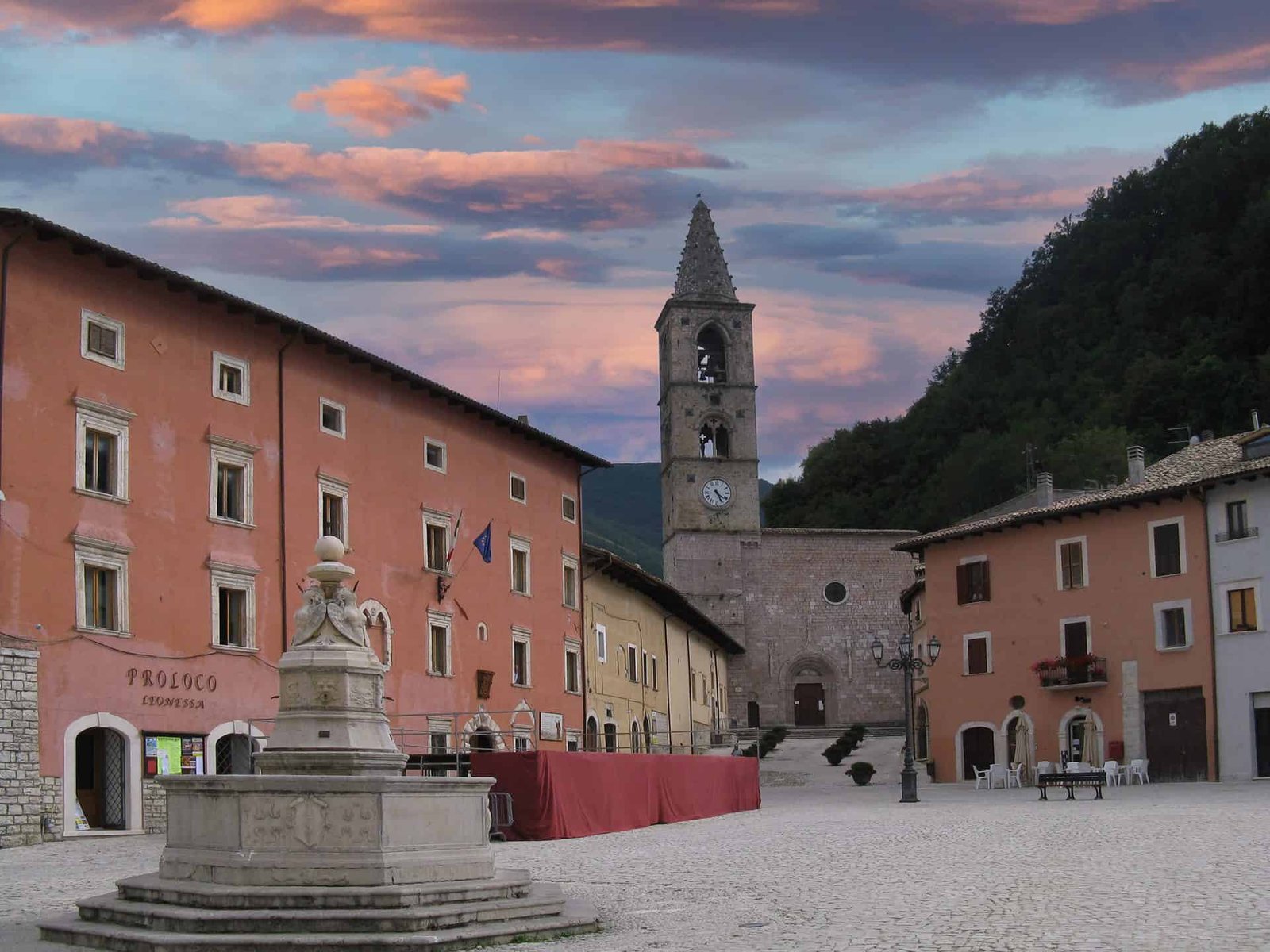
Perched on a spur above the Rieti plain, Cantalice looks at Lake Ripasottile and turns its back on Terminillo. It's the town of Saint Felix of Cantalice, the first canonized Capuchin. Below the town, on the Acquasanta ridge, on the slopes of the mountain, an airliner crashed on February 13, 1955. We talk about it further on.
Micigliano, Antrodoco and the Velino valley
Micigliano is the smallest municipality on the eastern side and holds the abbey of Santi Quirico e Giulitta. Antrodoco closes the valley with its Gole, a narrow passage between vertical walls that the Salaria has crossed for 2000 years. It's one of the most impressive stretches of road in Lazio, and you drive it without noticing if you don't know what to look at. A little farther on, the Cittaducale basin preserves the urban layout of the Angevin foundation of 1308.
Poggio Bustone, Rivodutri, Posta and Morro Reatino
Poggio Bustone and Rivodutri belonged, together with Morro Reatino, to the Papal States when everything else was Neapolitan: an administrative anomaly that can still be read in the architecture and in the dedications of the churches. Poggio Bustone is also the birthplace of Lucio Battisti and the seat of one of the Franciscan sanctuaries of the Holy Valley. Posta, on the upper Salaria, is the pass toward the upper Velino valley and toward Amatrice.
The history of Terminillo (RI)
The pioneers of exploration
Until the end of the 1800s the mountain was shepherds' land. Then came mountaineering, and with it the first systematic ascents to the summit. The pioneers set out from the town of Lisciano, at 610 meters, or from Leonessa, at 970 meters: the last points reachable by carriage on each side. From there they continued on foot or by mule along the path that led to the base camp of Pian de' Valli, at 1600 meters, the current CAI trail number 409.
The written accounts of those years are of excellent quality. The German traveler Ferdinand Gregorovius spoke of exceptionally scenic valleys crossed by foaming streams. The mountaineer Enrico Abbate, author of one of the first guides to the Apennines, described an imposing mountain with steep crests, capable in winter of recalling the emotions of a difficult Alpine climb. And it was again Abbate, in 1882, who wrote the sentence that now sounds like a bitter prophecy: if the town of Leonessa were in Switzerland, these places would undergo great transformations, the town would be modernized, hotels would rise, comfortable stagecoaches would travel wide roads continuously carrying touristes.
The birth of the ski resort
In the 1930s the Fascist government carried out on Terminillo a tourism development project of imposing size, which in a few years transformed a shepherds' mountain into a ski resort with roads, hotels and lifts. The official narrative attributed the intuition to Benito Mussolini: according to Maria Scicolone, the idea came to him during a flight from Forlì to Rome, when he asked the commander Biseo what mountain it was that they were flying over. It's an anecdote, and should be treated as one.
The reality is more of a chorus. Pushing were the mountaineers and the local mountain people, who saw the number of visitors growing year after year. Pushing were the Rieti authorities, the podestà Alberto Mario Marcucci, Prince Ludovico Potenziani and Bishop Massimo Rinaldi. And above all pushing was Angelo Manaresi, a Fascist official with notable influence over Mussolini, national president of the CAI, commander of the 10th Alpini Regiment and undersecretary of War. On May 24, 1932, in Rieti, during a rally for the anniversary of the entry into the war, Manaresi promised the mountain men who were veterans of the Great War that he would climb with them to the summit. The excursion took place on December 21 of that year. Manaresi was struck by the place and promised to bring the project to Mussolini.
The project passed without difficulty, because it served three principles dear to the regime: enhancing rural communities, promoting sport and giving the Roman middle class a nearby vacation spot. After Via del Mare and the bathing establishments of Ostia, Rome's beach, what was missing was Rome's mountain. Campocatino, in the Frosinone area, and Monte Zappi were evaluated. The choice fell on Terminillo.
In January 1933 Mussolini climbed the mountain by mule with his wife and children and said he was impressed by the beauty of the massif. That same month he ordered the podestà Marcucci to build a wide road that would climb from Lisciano to altitude: Via Terminillese, state road 4 bis. The first stretch, as far as Pian de' Rosce, was inaugurated in December 1933. The rest was completed in 1935. The road branched off the Salaria and was designed with modern criteria, to make the climb easy for motor vehicles: that is why the Terminillese still has such wide curves today. Propaganda made it a monument: at Campoforogna a memorial stone was erected to the martyrs of the Fascist revolution, and at Lisciano a granite column with the inscription With this road Benito Mussolini revealed its mountain to Rome.
Elite bourgeois tourism (1935-1960)
With the road came the facilities. In 1936 the first hotel opened, the Savoia, in 1939 the Roma. In 1938 the cable car entered service, in 1940 the Carbonaie ski lift. The village acquired civil and religious buildings: the governorate, the barracks of the Forestry Guard and a small church built by the Associazione Nazionale Alpini in 1940.
Mussolini came back many times, staying in a reserved apartment at the Hotel Roma. The trips served him to practice sport, at which according to the instructors who assisted him he was mediocre (he limited himself to a few steps with skis on his feet), and to meet Clara Petacci away from prying eyes. They served above all propaganda: in 1937 Manaresi wrote that, for the cause of the mountains, two days spent by Mussolini on Monte Terminillo were worth more than 100 speeches, reams of essays and crowds of committees. The photographs of the Duce on the snow, with skis or on the sled, sometimes shirtless, went around all of Italy.
Fame attracted the notables: the former king of Afghanistan Amanullah Khan, the prince and secret chamberlain to the Pope Francesco Chigi della Rovere, Colonel Mario de Bernardi and the criminal lawyer Bruno Cassinelli built themselves a villa on Terminillo. During World War II the mountain suffered no significant damage, apart from the accidental destruction of the Rifugio Umberto I. In the hotels, upper-class families fleeing the bombings found shelter, and sanatoriums were set up for the wounded.
In the postwar period Terminillo became the meeting point of fashionable Rome and the stage of the dolce vita in an Alpine version. It was frequented by politicians such as Palmiro Togliatti and Nilde Iotti or the prime minister Giuseppe Pella, nobles and aristocrats such as the Parodi Delfino dukes and the former king Farouk I of Egypt, and a crowd of actors and directors: Anita Ekberg, Gino Cervi, Ugo Tognazzi, Vittorio Gassman, Marcello Mastroianni, Jean Sorel, Gina Lollobrigida, Bice Valori, Paolo Panelli, Antonello Falqui, Giuliano Gemma, Raf Vallone, Massimo Girotti, Rossana Podestà, Eleonora Rossi Drago, Carla Del Poggio, Anna Maria Ferrero, Marina Vlady, Tina Pica, Luigi Zampa, Eduardo De Filippo. The mountain also became a regular location for many films produced at Cinecittà.
In those same years the works continued: from 1949 to 1964 the construction of the church of San Francesco, in the 1950s the second access road from the north side (provincial road 10 Leonessa-Campoforogna) and in 1958 the aqueduct built by the Cassa per il Mezzogiorno, which brought water to the resort by tapping three springs on Monte di Cambio with imposing pumping systems. Without that aqueduct the resort would not have stood up.

Mass tourism (1960-1980)
In the 1960s the clientele changed its skin. The economic boom put wide segments of the population in a position to afford the ski week, while the upper middle class, made mobile by the new highways, began to prefer Cortina, Saint Moritz and Courmayeur, considered more chic. Terminillo became more popular and much more crowded, and reached the peak of attendance: from the 1950s to the 1970s it was the reference resort for all of Central Italy.
To keep up with demand, dozens of lodging facilities and hundreds of private apartments appeared. The most effective summary of that season was given by the news reports of the time: in the dreams of the Roman middle class, besides the little villa at Fregene, there was the apartment at Terminillo. The slopes were expanded with nine new lifts, built both by the Società Funivie and by private parties. That urban expansion is today judged negatively by anyone who works on the territory.
Decline and attempts at revival (1980-2010)
From the 1980s attendance dropped, and the drop has never stopped. There are three reasons and they should be kept distinct. The first is the competition from Abruzzo: the Abruzzo resorts, better managed and equipped, although farther from Rome became more convenient to reach after the A24 highway opened in 1970, while Terminillo remained served only by the Salaria. The second is the irrational management of the existing lifts. The third, decisive, is the reduction in snowfall.
Already in the mid-1970s it was clear that a relaunch was needed: artificial snowmaking, use of the Leonessa side (north-facing, therefore snowier and with longer-lasting snow) and a link between the two sides to unify Pian de' Valli and Campo Stella. The first project, drawn up in 1974 by the Rieti provincial tourism board, planned to quadruple the lifts and triple the slopes. Many others followed, all with poor results: the emerging environmentalist sensibility and the quarrelsomeness of the local political and business environment blocked investment. In the meantime the lifts that reached expiry were not replaced and were shut down for lack of maintenance. The excess hotels were closed and converted into condominiums or residences.
The TSM project, from 2009 to today
In 2009 the Lazio Region approved an expense of €20 million to renovate and expand the ski facilities, funds then allocated in December 2012. The project, called TSM (Terminillo Stazione Montana), was drawn up by the municipalities of the area together with the Province of Rieti and presented to the public on December 27, 2014, with the opening of construction sites planned by 2015. It envisaged modernization of the lifts, new scenic routes, new huts and the link between the west side and the Leonessa side.
What follows is a chronicle of rejections. In September 2015 the regional technicians rejected it at the environmental impact assessment stage. The revised project was resubmitted in April 2017 and rejected again in March 2018, again for excessive environmental impact. A third version was submitted to the Region in June 2019. In December 2020 the Lazio Region definitively approved the project, link between the two sides included. In May 2021 the Ministry of the Environment raised further environmental issues. The Province of Rieti considered them surmountable.
The most recent chapter concerns the TSM2 version. In December 2025 environmental associations put the Region on formal notice against granting extensions. In May 2026 some press accounts spoke of a definitive rejection, but the Lazio Region denied it: the offices asked for an update of the environmental assessment based on new scientific data on the ecosystem, specifying that the communication does not in any way represent a rejection of the project or a definitive halt of the procedure. The 2021 environmental impact approval remains valid and the Province of Rieti is preparing the supplementary documentation requested. Both the regional administrative court (TAR) and the Council of State rejected the appeals against the assessment procedure. The sources in the field disagree on the political meaning of the affair: anyone visiting the mountain today finds a construction site that never started.
Personal opinion, and it's not popular: after 17 years of projects rejected and resubmitted, the relaunch of Terminillo no longer goes through the ski link. It goes through hiking, through snow without lifts, through the villages and through the long season from May to October, which now works better than winter.
Nature, habitats and wildlife of Terminillo (RI)
The range has notable natural value, recognized by the Natura 2000 Network of the European Union. On the Reatini Mountains there are five sites of community importance, including Monte Terminillo, the Vallone del Rio Fuggio, the Valle Avanzana-Fuscello, Monte Fausola and the Bosco Vallonina. The protected environments range from the upper montane belt to the alpine one: extensive beech woods, dwarf juniper meadows, high-altitude pastures.
The beech wood climbs to 1600-1800 meters, and in some sectors it is flanked by fir and larch reforestation carried out in the 20th century, which are immediately recognizable because they are geometric and out of place. Among the rare plants are the bilberry and stands of birch, unusual in Lazio. On the wildlife side the massif hosts wild boar, foxes, hares, squirrels, porcupines, birds of prey and the Apennine wolf. Among the species of conservation interest reported are the golden eagle, Orsini's viper and the snowfinch.
A detail that changes the way you walk: the herds grazing at altitude are not a scenic leftover, they are the reason certain meadows still exist. If grazing stops, the scrub advances and the open habitat disappears. Conservation, here, does not mean abandonment.

Skiing at Terminillo (RI): lifts, runs, ski passes
There are two resorts and they don't connect to each other. The southern one is Pian de' Valli, on the Rieti side. The northern one is Campo Stella, on the Leonessa side.
At Pian de' Valli the lifts in service are few: the historic cable car to Terminilluccio, the quad chairlift Prati delle Carbonaie-Terminilluccio, the double chairlifts of Cardito Sud and of the Carbonaie, plus a magic carpet for children. The declared alpine runs amount to about 40 kilometers, spread over about 10 trails between roughly 1600 and 2100 meters, with mostly red difficulty. At Campo Stella the Mario Foglia quad chairlift, the Rubbio triple chairlift and a ski lift for the beginner area are in operation, for about 14 kilometers of runs, including a descent about six kilometers long. The cross-country loops are at Cinque Confini on the Rieti side and at the localities of Fonte Nuova and Vallonina on the Leonessa side.
Ski passes are bought at the ticket offices of the Funivia and of Campo Togo. Fares change every season and there's no point quoting them from memory: you read them on the operator's website or ask at the ticket office on the day.
The sore point, though, is not the lifts. It's the exposure. The massif often receives warm sirocco winds that quickly melt the snow that has fallen, and climate change has significantly reduced snow cover, shortening the season to a few weeks and putting the economic survival of the resort in crisis. The winter seasons of recent years struggle to take off, and anyone planning a ski week at Terminillo three months ahead takes a serious risk.
Terminillo (RI) in summer: trails, hikes, biking
Summer, today, is the best season. The network of CAI trails covers both sides and leads to the summit and the secondary peaks. The 409 is the historic route to Pian de' Valli, the one the pioneers followed by mule. From the Tre Faggi lot the climb to the main summit takes half a day at a relaxed pace, with limited elevation gain and no technical difficulty in summer conditions. The view from the top is 360 degrees and includes the Gran Sasso, the Laga Mountains, the Velino-Sirente, the Rieti basin and, in good air, the sea.
The mountain is also a venue for rock climbing and, in winter, ice climbing, as well as a regular destination for ski mountaineers and snowshoers. By bicycle the Terminillese is one of the classic climbs of Central Italy, with regular gradients and wide asphalt. From the sporting point of view Terminillo has a long tradition: since the 1930s it has occasionally hosted stage finishes of the Giro d'Italia and other events.
Tip: if you walk in July or August, set out before eight. The heat on the open meadow, above 2000 meters, is less trivial than it seems, and you only reach shade by getting back into the beech wood.
Terminillo (RI) with children
The mountain works very well with children, as long as you moderate the ambitions. In winter the magic carpet and the beginner areas of Pian de' Valli let little ones start without trauma. The cable car takes up those who don't ski and gives them the feeling of the summit without the effort. In summer the adventure park, the Planetary Trail and the short walks in the beech wood are enough to fill two days. The whole Planetary Trail, at 7.7 kilometers, is within reach of a trained child from eight years up. Below that threshold it's best to walk only the first stretch, where the inner planets are close together and the game works best.
Bring water. On the mountain, for the geological reason explained above, there are no springs along the trails.
Accessibility of Terminillo (RI)
Pian de' Valli is flat in the central area and can be walked without excessive difficulty. The lots and sidewalks, however, suffer from uneven maintenance. The cable car allows many people with reduced mobility to reach an elevation that would otherwise be inaccessible, but access to the cabins and the conditions of the upper station should be checked with the operator before planning the climb. The abbey of Santi Quirico e Giulitta in Micigliano states that the ground-floor entrance is at street level and accessible to people with disabilities. In the huts at altitude, reachable only on foot, there is no assisted accessibility at all.
How much does a day at Terminillo (RI) cost and how to save
A summer day costs as much as fuel and lunch: the trails are free, the parking lots are largely free out of season, entering the church costs nothing. A winter day with skis costs the ski pass, the rental, parking in the paid lots and lunch at altitude. The items where you really save are three: rent the equipment in Rieti instead of at altitude, bring a packed lunch (the huts remain an excellent idea, but not every day) and choose Tuesday or Wednesday instead of Sunday, when rental prices and the line at the lifts reach their maximum.
Anyone traveling in a group or organizing a company outing will find qualified staff through the TourLeaderPro tour leading services, which works with authorized guides and tour leaders.
What to eat around Terminillo (RI)
The cooking of this mountain is that of the Rieti border area, with strong Abruzzo and Umbrian grafts: understandable, given that until 1927 the territory depended on L'Aquila. The products to look for are the Leonessa potato, grown at altitude and good for gnocchi, the legumes of the foothill plains, the sheep cheeses of the Sabina, the extra virgin olive oil of the lower slopes, and the mushrooms and truffles of the Rieti woods. Among first courses, the signature dish of the area is pasta all'amatriciana, which comes from Amatrice, in the same province, and which in the local version is made with guanciale, pecorino and no creative additions.
In the huts at altitude you eat simply: polenta, soups, cured meats, cheeses. We don't name venues because they change management with a frequency that makes any printed list useless.
When to go to Terminillo (RI) and when to avoid it
From mid-June to the end of September the mountain is at its best: flowering meadows, reasonable temperatures, dry trails, the road to Leonessa open. October gives the red beech wood and a low light that is the best of the year for photographers. From December to March it depends on the snow, and snow here is a lottery: before leaving it's best to look at the webcams of the lifts and not at generic forecasts.
To avoid: sunny Sundays after the first major snowfall, when half of Rome goes up at the same time and the Terminillese clogs from Lisciano up, and the long weekends of January, for the same reason. Anyone who can choose goes up on Friday.
A curiosity about Terminillo (RI)
The mountain of Rome entered sports history for a reason almost nobody remembers: here one of the first individual mountain time trials of the Giro d'Italia was run. It happened on May 29, 1936, in the 11th stage, with an uphill finish on Terminillo: Giuseppe Olmo won it. It was a technical novelty, not a footnote of news. Until then the pink race climbed in a group. The idea of making each rider climb the mountain alone, against the clock, changed the way Giri were built, and it was tested on this newly inaugurated road, wide and clean, which the regime wanted to show the country.
Terminillo stayed in the program for four consecutive years, from 1936 to 1939, becoming one of the most awaited stages, with the finish at Campoforogna. Local sources count over time nine stage finishes at Campoforogna, and recall that the Sella di Leonessa was crossed by the race until 2007. The sports news of those years is also the first great advertising vehicle of the resort: even before the tourist posters, it was the sports pages of the newspapers that carried the name of Terminillo throughout Italy.
Opinion: if you ride up by bike, do it knowing you are pedaling over a piece of cycling history, not just any climb near Rome. It changes the way you suffer.
One thing nobody tells you about Terminillo (RI)
That this mountain is, in fact, one of Rome's water reserves. Terminillo has no rivers, no lakes, not even a permanent stream, and anyone who goes up in summer looks in vain for a fountain along the trail. All the water that falls on the massif, rain or snow, vanishes into the fractures of the limestone and re-emerges much farther down, contributing with the other Reatini Mountains to feed the Peschiera springs, in the Velino valley. From there starts the aqueduct that supplies a significant share of the capital's water consumption.
The second part of the story is even less known. The resort, in the 1950s, had the same problem in reverse: being on a karst massif, Pian de' Valli had no water. It was the Cassa per il Mezzogiorno, in 1958, that built a dedicated aqueduct, tapping three springs on Monte di Cambio and lifting the water to altitude with systems that were imposing for the time. The paradox deserves to be told in full: the mountain that quenches Rome's thirst needed an aqueduct to quench its own.
Anyone leading a group here should tell this in front of the panorama of the Rieti basin, pointing to the direction of the springs. It works better than any anecdote about the Duce on skis.
The advice I give you for visiting Terminillo (RI)
Stop thinking of it as a ski resort and treat it as a mountain. The practical advice is this: go up on a clear day in late September or early October, park at Tre Faggi around eight in the morning, walk the Planetary Trail to the Rifugio Angelo Sebastiani, eat up there, and in the afternoon come down the provincial road toward Leonessa instead of going back. In a single day you will have science, the beech wood, the two sides, the pass, a real village with arcades and the mountain potato on your plate. Cost: fuel and lunch.
The winter variant, if there is snow, is the snowshoe hike from the Sella toward Terminilletto, starting from Leonessa because the saddle on the Rieti side is closed. The variant for those who don't walk is the cable car, which in 20 minutes solves the problem of the elevation gain and puts anyone in front of the panorama.
To avoid: the ski week booked in November. The snow of Terminillo cannot be scheduled. Book two nights when the snow has already fallen, not three months ahead hoping it falls. Anyone organizing custom transfers for groups or companies can rely on the custom small-group experiences of TourLeaderPro, which manages the logistics when the weather forces a change of plans at the last minute.
Another well-known fact, yet rarely cited
Everyone knows Terminillo was the mountain of the regime. Almost no one fully considers what that means: from an urban planning point of view, Terminillo is a foundation town. It did not grow like a mountain village around a church and a pasture. It was designed on paper in a few years, from 1933 to 1940, with the same logic applied to the new towns of the Agro Pontino: an access road built from nothing with modern criteria, a governorate, a Forestry Guard barracks, a small church, grand hotels, state-of-the-art lifts and even a commemorative stone at the arrival and a granite column at the departure.
This origin explains almost all the later problems. A foundation town has no community governing it: it has a client. When the client disappears, the buildings remain and no one decides. Hence the disorderly expansion of the 1960s, the multiplication of lifts built without an overall plan, the inability to replace them at expiry, the 15 years of relaunch projects rejected and resubmitted. Terminillo is the only place in Lazio where you can read, in an afternoon's walk, the whole arc of Italian tourism of the 20th century: authoritarian founding, boom, overbuilding, decline, stalemate.
The other side must also be said: that project left excellent mountain roads, which still make Terminillo the Apennine peak above 2000 meters easiest to reach by car from Rome. No other mountain in Central Italy offers the same ratio between altitude reached and kilometers traveled.
The right photo to take at Terminillo (RI)
The photograph everyone attempts is the summit from the lot, and it always comes out flat: midday light flattens the volumes and the snow burns out. The one that works is another: the massif seen from the southwest, from the Rieti plain, with the whole mountain rising behind the valley. You shoot from the area of Lake Lungo and Lake Ripasottile or from the heights of Cantalice, in the two hours after dawn on a clear winter day, when the snow-covered Terminillo has the sun at a slant and the plain is still in haze. In that moment you understand why they call it the mountain of Rome: it emerges alone, with no chain around it.
The second shot, less obvious, is the church of San Francesco at Terminillo framed by the Velino, with the massif behind it: it puts in a single frame the Franciscan valley, the water and the mountain, that is, the three reasons this territory exists. You need a medium telephoto lens and a day without wind.
The third, for those who walk, is the Rifugio Massimo Rinaldi on the top of Terminilletto at sunset, with the shadow of the mountain lengthening over the basin. What should be avoided, instead, is the selfie on the cable car lot with the apartment blocks behind you: it's the photograph Terminillo has carried with it for 50 years and that has done it more damage than any ministerial rejection.
Some important events that happened here in history
The most tragic is the air disaster of February 13, 1955. A Douglas DC-6 of the Belgian flag carrier Sabena, registered OO-SDB and built in 1947, flying from Brussels toward the Congo with a stopover at Rome Ciampino, crashed on the Acquasanta ridge, on the slopes of Terminillo in the territory of Cantalice, at around 1700 meters of elevation. All 29 people on board died. Among the victims was Marcella Mariani, Miss Italia 1953 and actress, just over 20 years old. The inquiry reconstructed a chain of causes: a strong crosswind not foreseen by the weather bulletins pushed the plane off course, the pilots believed they were above Viterbo and began the descent, and the correct readings of the instruments were interpreted as a radio failure because of the adverse conditions. At Terminillo there is a memorial room dedicated to Marcella Mariani, inaugurated in February 2017, which preserves the materials on that story.
The other events that marked the mountain are of a different nature. On December 21, 1932, the excursion of Angelo Manaresi with the Rieti veterans sets the development project in motion. In January 1933 Mussolini's climb by mule with his family leads to the order to build the Terminillese, inaugurated in its first stretch in December of the same year and completed in 1935. On January 26, 1938, the cable car is inaugurated in the presence of civil and religious authorities. In January 1940 the Carbonaie ski lift enters service, among the first in Italy. In 1949 the wedding of Gina Lollobrigida and Milko Skofic, celebrated in the mountains, hands Terminillo to the society pages. In 1960 the death of Eduardo De Filippo's daughter hands it to the crime pages. In 1958 the aqueduct of the Cassa per il Mezzogiorno solves the water problem of the resort. In December 2020 the Lazio Region approves the TSM project, which in May 2021 meets the objections of the Ministry of the Environment and which in May 2026 is still inside a supplementary environmental assessment.
Then there is a continuous event, with no date, that counts as much as the others: the progressive disappearance of the snow. No single day certifies it, but it is the most important historical fact of the last 30 years for this mountain.
Who has passed through Terminillo (RI)
The list of illustrious visitors is long and is best read by category.
The ancients, by literary route: Virgil names the cliffs of Tetricus in the Aeneid, Varro describes the gurgures alti montes and the transhumance on the pastures. Neither of the two, as far as we know, climbed the mountain: they named it, which for an Apennine relief in antiquity is already a lot.
The travelers and mountaineers of the 1800s: Ferdinand Gregorovius, the German historian of medieval Rome, walked these valleys and wrote about them. Enrico Abbate, author of one of the first guides to the Apennines, climbed the mountain and in 1882 foresaw with accuracy what would happen 50 years later.
The men of the regime: Angelo Manaresi, president of the CAI and undersecretary of War, who was the true architect of the project. Prince Ludovico Potenziani, who brought the lifts. The podestà Alberto Mario Marcucci, who built the road. Bishop Massimo Rinaldi, the hiking boot bishop, after whom the hut at the top of Terminilletto is named. And Benito Mussolini, who first went up in January 1933 and came back many times, staying at the Hotel Roma, having himself photographed on the snow and meeting Clara Petacci here.
The nobles and the sovereigns in exile, who built themselves a villa on the mountain: the former king of Afghanistan Amanullah Khan, Prince Francesco Chigi della Rovere, Colonel Mario de Bernardi, the lawyer Bruno Cassinelli. In the postwar period the former king Farouk I of Egypt and the Parodi Delfino dukes.
Republican politics: Palmiro Togliatti and Nilde Iotti, the prime minister Giuseppe Pella.
The cinema, which had a permanent branch office here: Anita Ekberg, Gina Lollobrigida (who married Milko Skofic at Terminillo in 1949), Marcello Mastroianni, Vittorio Gassman (who met his future second wife Diletta here), Ugo Tognazzi, Gino Cervi, Giuliano Gemma, Raf Vallone, Massimo Girotti, Rossana Podestà, Eleonora Rossi Drago, Anna Maria Ferrero, Carla Del Poggio, Marina Vlady, Tina Pica, Bice Valori, Paolo Panelli, Jean Sorel, the director Luigi Zampa, the television author Antonello Falqui and Eduardo De Filippo, whose daughter died here in 1960. And Marcella Mariani, who never reached Terminillo: her plane stopped on the ridge.
Sport: Giuseppe Olmo, winner of the mountain time trial of May 29, 1936, and all the riders of the Giro d'Italia who from 1936 on have climbed this road.
Quick questions about Terminillo (RI)
How far is Terminillo (RI) from Rome?
About 100 kilometers, around two hours by car: Salaria to Rieti, then state road 4 bis Terminillese. From Rieti it's 20 kilometers.
Can you reach Terminillo (RI) by public transport?
Yes, but with one change. You get to Rieti (by bus from Rome, or by train on the Terni-Sulmona line) and from there you take the city bus that links the station to Pian de' Valli in about 55 minutes. Runs are few and change with the season. The schedules should be checked on the operator's website.
How high is Terminillo?
The main summit reaches 2217 meters. Terminilletto, where the Rifugio Massimo Rinaldi stands, reaches 2108 meters.
How much does it cost to enter Terminillo (RI)?
Nothing. You pay only for what you use: ski pass, cable car, rental, paid parking in the lots on crowded days.
How much is a ski pass at Terminillo?
Fares change every season and by time band. They are bought at the ticket offices of the Funivia and Campo Togo, and updated prices are on the website of the company that runs the lifts.
Does the Terminillo cable car run in summer too?
Yes. The lift inaugurated in 1938 runs in both the winter and the summer season. Hours and opening days vary: check before going up.
Do you need to book to visit Terminillo (RI)?
Not for the mountain, the trails and the church. Yes for the huts at altitude if you plan to have lunch or stay overnight, especially on weekends.
How much time do you need to visit Terminillo (RI)?
Half a day for a walk and the cable car. A full day for the Planetary Trail from end to end. Two days to see Leonessa and the foothill villages too.
Are chains mandatory on the road to Terminillo?
In the winter period the Terminillese requires carrying chains on board or having winter tires. Check the ordinance in force before leaving, because the dates change from year to year.
Where do you park at Terminillo (RI)?
In the lots of Pian de' Valli and along the road toward Campoforogna and Tre Faggi. On snowy Sundays the spaces run out early: it's best to arrive before nine.
Can you cross-country ski at Terminillo?
Yes. The Cinque Confini cross-country center offers about 20 kilometers of trails, artificial snowmaking and a lit loop for night skiing. Other loops are on the Leonessa side.
What is the difference between Pian de' Valli and Campo Stella?
They are the two resorts of the same mountain, on opposite sides and not connected to each other. Pian de' Valli is on the Rieti side, facing southwest, with the historic cable car and most of the services. Campo Stella is on the Leonessa side, facing north, with longer-lasting snow and fewer crowds.
Is Terminillo (RI) suitable for children?
Yes. There are a magic carpet and beginner areas, an adventure park among the trees and short walks in the beech wood. The whole Planetary Trail is demanding under eight years old.
Is Terminillo wheelchair accessible?
The central part of Pian de' Valli is flat, but the maintenance of the paths is uneven. The cable car allows you to reach altitude, after checking the access conditions with the operator. The huts at altitude are not accessible.
Can you take photographs at Terminillo (RI)?
Anywhere outdoors, without restrictions. For the church, common sense applies: no shots during services.
Are there huts on Terminillo?
Two, both of the Italian Alpine Club of Rieti: the Rifugio Angelo Sebastiani, at 1820 meters near the Sella di Leonessa, and the Rifugio Massimo Rinaldi, at 2108 meters on the top of Terminilletto.
How long is the Planetary Trail of Terminillo?
Seven kilometers and 700 meters, about 2 hours and 45 minutes at a good pace, from the Tre Faggi lot to the Rifugio Angelo Sebastiani, with 10 stations representing the Sun and the nine classic planets.
What animals do you meet on Terminillo (RI)?
Wild boar, foxes, hares, squirrels, porcupines and birds of prey. The Apennine wolf is also present, but it is seen very rarely. Among the protected species the golden eagle and Orsini's viper are reported.
When is there snow at Terminillo?
Generally between December and March, but the season has shortened: exposure to sirocco winds and the reduction in snowfall make snow cover unpredictable. Before leaving it's best to look at the webcams of the lifts.
What do you eat around Terminillo (RI)?
Leonessa potatoes, legumes of the plains, Sabina pecorino, mushrooms and truffles of the Rieti woods, extra virgin olive oil of the lower slopes. In the huts you eat simply: polenta, soups, cured meats and cheeses.
Has the TSM relaunch project been approved?
The environmental impact assessment approved in 2020-2021 remains valid, but in 2026 the Lazio Region asked for an update of the assessment based on new scientific data. The Region specified that this is not a rejection. The construction sites, to date, have not started.
What to see near Terminillo (RI)?
Within half an hour: Rieti and its Franciscan Holy Valley, with the sanctuaries of Fonte Colombo and Greccio, the villages of Cantalice and Leonessa, the Gole di Antrodoco. A little farther, Lake Salto, Lake Turano, the Duchessa Mountains, the Marmore Falls and the Sabina of Fara in Sabina. For another mountain near Rome, there is Monte Livata.
Terminillo is more interesting today than 20 years ago, and not out of nostalgia. A mountain that has stopped working the way it was forced to work goes back to being what it was: an isolated massif, with serious woods, high meadows, an Italian story told by its own ruins and a view that reaches the sea. Anyone who goes looking for the Dolomites two hours from Rome will be disappointed, and deserves it. Anyone who goes to walk, look and understand brings home a day worth three times what it cost. If I had to choose a single day, I would choose the early morning of a Friday in October, at Tre Faggi, with the red beech wood and nobody around. Those planning the trip from far away will find on ItalyPlanner the English guide to Rieti and Terminillo, on ItalyPlanner the day trips from Italian cities and on ItalyPlanner the guides to mountains and nature.
Article written by the editorial team of TourLeaderPro, contact them for Private/Corporate/V.I.P. Tours and Experiences.
Planning a trip to Rome? The English guides to visiting the city are on ItalyPlanner.com.