Poggio Bustone (RI)
In short. Poggio Bustone (RI) is a village of just under 2,000 inhabitants in the province of Rieti, at 754 meters above sea level on the flank of Monte Rosato, about 100 kilometers north of Rome.

Poggio Bustone (RI) is a village of just under 2,000 inhabitants in the province of Rieti, at 754 meters above sea level on the flank of Monte Rosato, about 100 kilometers north of Rome. By car you get there in an hour and a half: A1 to the Fiano Romano exit and then the Salaria toward Rieti, or the Salaria the whole way. From Rieti you continue for about 15 kilometers on provincial road 2. If you are traveling by public transport, you reach Rieti by train (Terni-Rieti-L'Aquila line) or by regional buses from Roma Tiburtina and continue with the Cotral Rieti-Poggio Bustone line. Check the schedules on the Cotral website before leaving, because on holidays the runs thin out. The Franciscan Sanctuary of San Giacomo, the main reason for the visit, is at Piazzale Missioni Francescane, just above the town. It opens every day from 8:00 to 13:00 and from 15:00 to 19:00 in summer, from 15:00 to 18:00 in winter, there is no ticket and no need to book. The convent's phone number is 0746 688916. The Lucio Battisti Museum is at Via Roma 26, in the historic center. For its hours it is best to call the Comune (Via Francescana 9) or check the town website, because opening is left to volunteers. The climb to the Sacro Speco is free, in every season, and requires mountain shoes.
The village belongs to the family of towns of the Rieti Holy Valley, the one with the four Franciscan sanctuaries. The page dedicated to the Sanctuary of Poggio Bustone goes into the convent complex in depth, while here the whole town is described, from the medieval gate to the paragliding, with the sanctuary in the place it deserves, that is, at the center.

Poggio Bustone (RI) in brief: where it is and why people go
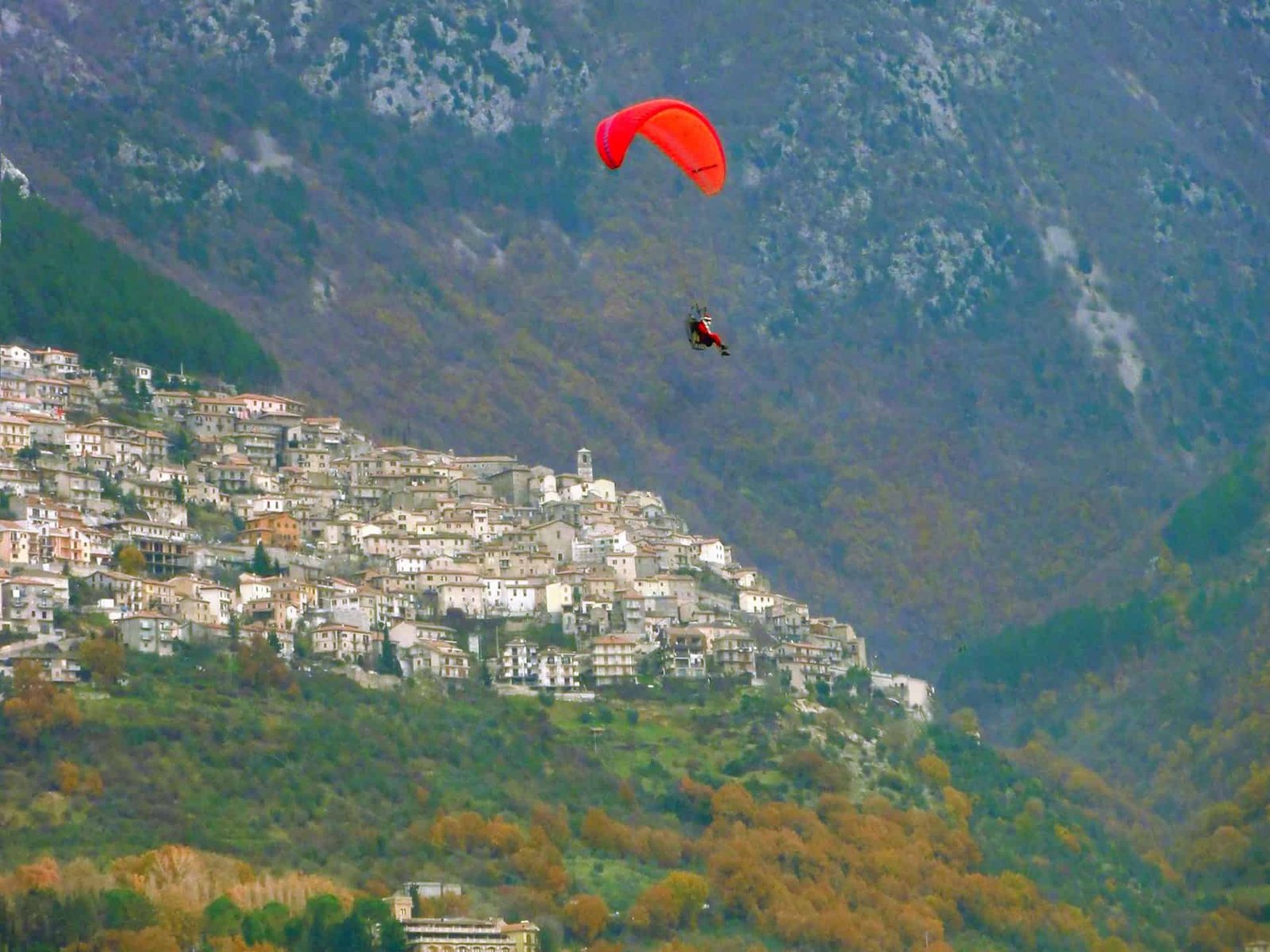
Poggio Bustone stands on the northeastern edge of the Piana Reatina, where the flat basin that was the ancient Lacus Velinus closes against the first slopes of the Terminillo massif. The town climbs the flank of Monte Rosato in a tiered layout, about 350 meters above the valley floor. From far away it looks like a staircase of houses leaning against the woods. Up close it is a tangle of narrow alleys, ramps, arches and stairs that, as you climb, stop being streets and become mountain trails. Behind it are the Reatini Mountains, in front the two lakes Lungo and Ripasottile, which from up here look like two mirrors laid on the plain.
The old name was Poggio Bastone, in use until the 19th century. The most accepted etymology links the place name to the Latin podium, the height, and to a medieval personal name, Busto. The origin of the town is documented from the 12th century, when the castrum and the podium appear in the records of the Abbey of Farfa. Until 1923 the municipality belonged to the province of Perugia, and so to Umbria. It passed to Rome that year and in 1927, with the creation of the province of Rieti, entered the new Sabine capital. It is a detail that explains many things: the poiano dialect is a central Italian dialect with strong Umbrian influences, the cooking looks to Norcia more than to Rome, and the Franciscan sanctuary is a link in the chain that starts from Assisi.
There are three reasons to come all the way up here and they fit well together in one day: the Franciscan sanctuary with the Sacro Speco above, the medieval village with the Porta del Buongiorno and the Torre del Cassero, and the memory of Lucio Battisti, who was born here in 1943 and to whom the town has dedicated a statue and, since 2024, a museum. To these you can add the porchetta, which in Poggio Bustone is a serious matter, and the sky, which paragliding enthusiasts consider one of the best in Italy.
Poggio Bustone (RI) in the Rieti Holy Valley
The Holy Valley is the name by which the Rieti basin has been called for centuries because of the four Franciscan sanctuaries that surround it: Poggio Bustone to the northeast, La Foresta just above Rieti, Fonte Colombo to the southwest and Greccio to the west. Francis frequented this valley for 15 years, from 1208 until the end of his life, and in each of the four places tradition fixes a specific episode: at Poggio Bustone the forgiveness and the sending out of the first companions, at Greccio the nativity scene of 1223, at Fonte Colombo the writing of the Rule, at La Foresta the miracle of the grapes and the cure of his eyes. Poggio Bustone is the first in order of time, and that is why pilgrims coming down from Assisi meet it first.
A curiosity about Poggio Bustone (RI)
The greeting that Francis supposedly addressed to the inhabitants when he arrived in the summer of 1208, "Buongiorno, buona gente!", has become the name of a gate, the heart of a festival and, at bottom, the identity of the town. The curiosity is that this greeting is still repeated every year, physically, house by house. On the morning of October 4, the feast of Saint Francis, a man from the town goes through the alleys with a tambourine and knocks on doors wishing good morning in the name of the saint: the poiani call it the passage of the tambourine. It is not a costumed reenactment put on for tourists, but a domestic rite that local people have performed for generations and that, if you happen to be here that day, comes at you without warning. The wording of the phrase changes from source to source, "Buongiorno, buona gente" or "Salute, buona gente", and neither is documented in the 13th-century Franciscan sources: it is oral tradition, and it is right to say so. But a tradition that has lasted eight centuries and given its name to a Gothic gate deserves more respect than many written chronicles.
The gate in question is the Porta del Buongiorno, the old entrance to the castrum, with its pointed arch. Francis, arriving from Leonessa across the mountains, supposedly entered the town from right there. Anyone who passes under that arch today, if they know the story, understands why the town never wanted to rename it.
Something nobody tells you about Poggio Bustone (RI)
The Sacro Speco is not the sanctuary you see from the esplanade. Many visitors arrive at the convent of San Giacomo, go into the church, walk around the cloister, look at the valley from the viewpoint and leave convinced they have seen the place of the forgiveness. That is not so. The place where tradition locates the apparition of the angel is the Grotta delle Rivelazioni, the so-called Upper Sanctuary or Sacro Speco, which is 400 meters higher up, beyond 1,000 meters above sea level, at the top of a steep trail in the woods that starts from the convent esplanade and takes about 30 minutes of climbing at a brisk pace, longer with children or in the heat. No sign says so with the necessary clarity and the friars, rightly, don't insist. Anyone with time and legs should climb: the chapel wedged into the rock, with the 17th-century front of 1634 set against a structure from the early 15th century, and the cave reached by a small interior stair are the real reason Poggio Bustone is a sanctuary and not a village church.
Second thing that goes unsaid: along that trail you meet six small 17th-century chapels, erected around 1650, which mark episodes in the life of Francis tied to this mountain, and in several places the rocks show the so-called Sacre Impronte, cavities that popular devotion interprets as traces left by the saint and by the devil during the struggle that preceded the apparition. They are natural forms of the limestone, and nobody serious denies it. But they are also the way a mountain community has told for centuries an event it could not explain otherwise. Looking at them with that double eye is the right way to climb.

The Sanctuary of San Giacomo, the Franciscan heart of Poggio Bustone (RI)
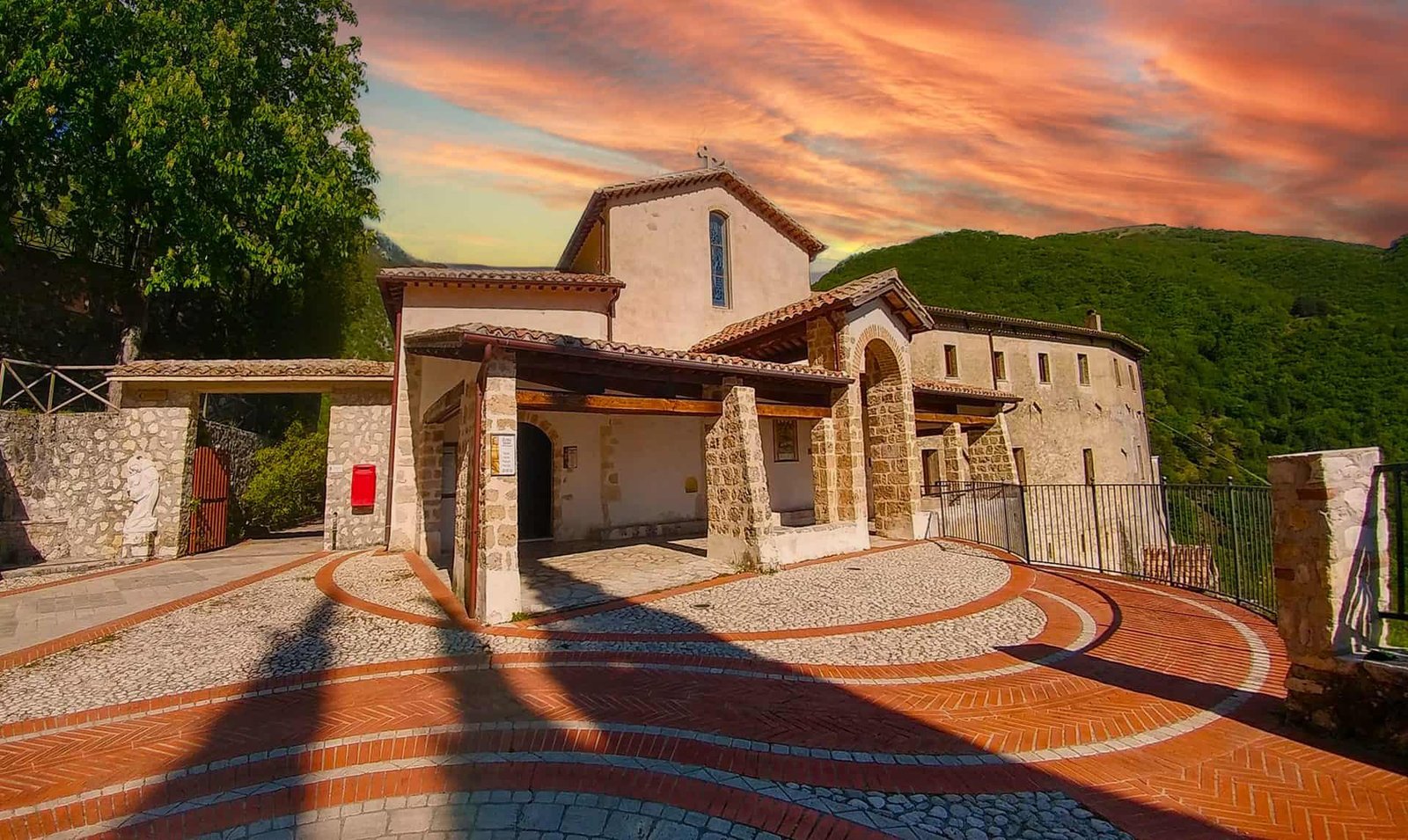
The sanctuary is just outside the historic center, uphill, in a hollow of woods that shelters and isolates it. From far away you recognize it by the white mass of the convent and by the terraced esplanade from which the view sweeps over the whole Piana Reatina to the lakes Lungo and Ripasottile and, on clear days, to the Sabine mountains in the background. The complex includes the church of San Giacomo il Maggiore, the convent with the cloister and the refectory, the hermitage known as the Lower Sanctuary, the Tempietto della Pace on the esplanade and, higher up, the Upper Sanctuary with the Grotta delle Rivelazioni. Construction began in the 13th century around a pre-existing Benedictine hermitage and continued for centuries: the present church is from the late 14th century, the convent was enlarged in the 15th century, a further floor was added in the 17th century, and the tempietto is from the 20th century. The original hermitage was restored in 1947 and the church between 1951 and 2001.
Why Francis came to Poggio Bustone in 1208
In the summer of 1208 Francis left Assisi with his first companions and went south through Cascia and Leonessa, crossing the mountains to the Rieti basin. Poggio Bustone was the first place that took him in. Franciscan tradition, taken up by the sanctuary guides and by the Order's historiography, tells that here, withdrawn in the cave on the mountain, Francis lived the decisive crisis of his conversion: the torment over the sins of his youth and the certainty, received through the vision of an angel, of being forgiven and loved by God. The prophecy about the future growth of his fraternity is tied to the same experience. It was from Poggio Bustone that Francis sent his companions out two by two to the different regions of the earth to announce peace. That is the phrase carved at the entrance of the Tempietto della Pace, and it is why this place is considered the start of the Franciscans' itinerant mission. I say it clearly, because it is often forgotten: Greccio has the nativity scene and the fame, but without what happened at Poggio Bustone in 1208 the rest of the Franciscan story of the valley would not have begun.
The church of San Giacomo il Maggiore in Poggio Bustone (RI)
The church dates to the late 14th century and has a single nave with a wooden truss ceiling, a sober structure that the restorations of the 20th century brought back to its essentials. On the walls are frescoes of different periods: the Madonna delle Grazie with the Child flanked by two angels in adoration, and a view of the castle of Poggio Bustone protected by Saint Francis and Saint Anthony, a precious image because it shows the town with its walls and its tower at a time when the castle was still standing. In the presbytery is a wooden choir of the 17th century, and the ensemble is completed by the modern art-glass windows, very colorful, and the wooden crucifix of the Franciscan tradition. It is a church that asks for 10 minutes of silence more than an art visit: the works are not masterpieces, but the space has a scale that the great basilicas have lost.
The 13th-century cloister and the Franciscan lunettes
The quadrangular cloister is the oldest part of the sanctuary of Poggio Bustone and the place around which the convent grew. It preserves a 15th-century fresco of the Madonna and Child, the most beautiful image in the whole complex, and a series of 17th-century lunettes with episodes from the life of Francis, simple and narrative in execution, meant to be read by friars and pilgrims like a serialized story. On one wall is displayed the text of the Canticle of the Creatures. Some minor paintings show scenes of the saint's daily life. It is here that the visitor understands that Poggio Bustone is a living convent, not a museum: the friars minor still reside here, the guesthouse takes in pilgrims of the Cammino di Francesco from May to October, with 20 beds and mandatory booking, and the cloister serves them before it serves us.
The refectory and the 17th-century frescoes
The refectory, open to the public, is more recent than the cloister and is decorated with frescoes from the mid-17th century: the Last Supper on the back wall, as in every self-respecting convent refectory, the Immaculate Conception and a series of saints of the Franciscan Order. There is also the wooden altar with the aedicule dedicated to Saint James that the convent's tradition ties to Francis and his first followers. The room should be looked at as a whole, with the light coming in low from the windows: the painting quality is the honest one of a local 17th-century workshop, the value is in the continuity, because the friars still eat here.
The hermitage: the Lower Sanctuary of Poggio Bustone (RI)
Beside the cloister opens the access to the hermitage, the original retreat that the Franciscans call the Lower Sanctuary. It is the refuge where, according to tradition, Francis and his companions found hospitality in 1208, carved out around a small Benedictine hermitage that already existed. Restored in 1947, it is a tiny space, with two windows closed by art glass, where only a few people enter at a time. It is the most intimate point of the complex and the one where pilgrims linger longest.

The Tempietto della Pace and the Way of the Cross
On the main esplanade stands the Tempietto della Pace, built in the 20th century to a design by the architect Carlo Alberto Carpiceci, with a marble statue of Saint Francis by the sculptor Lorenzo Ferri and a bronze angel, a work by Ronchi, bending over the saint. It is meant to recall that from this place Francis sent his companions, then very few, out into the world with the mandate of peace. You can also reach the tempietto along a path marked by the shrines of the Way of the Cross, and the particular thing is that each station is made of a different material: wood, marble, bronze, ceramic and others still, as if each artist had wanted to leave his own hand. At the end of the route is a bronze statue of the saint. It is a 20th-century Way of the Cross, and anyone looking for the Middle Ages will be disappointed. But as an outdoor devotional exercise, with the valley below, it works.
The Sacro Speco and the Grotta delle Rivelazioni of Poggio Bustone (RI)
From the sanctuary esplanade starts the trail to the Upper Sanctuary, which everyone here calls the Sacro Speco. It climbs through the woods on the slopes of Monte Rosato for about 400 meters of elevation gain, in a good half hour of walking. Along the climb you meet the six 17th-century chapels that recall the episodes tied to Francis on this mountain, from the prints of the hood to the traces of the angel, and the rocks with the Sacre Impronte. At the top, leaning against the wall of rock, is the rustic chapel built to protect the cave: the rear part dates to the early 15th century, the facade and the front to 1634. Inside, a small staircase descends to the cave proper, the Grotta delle Rivelazioni, where tradition places the vision of the angel who announced to Francis the forgiveness of his sins.
The place is solitary, silent and, in late spring, of a beauty that doesn't need legends to stand. But the legend is there, and it is that of the Sacre Impronte: in the cave Francis was supposedly visited by God and, at the same time, tempted by the devil. Escaping his grasp, he supposedly pressed against the rock, leaving the imprint of his body, still visible. It is the ideal end point of any walk that starts from the sanctuary and the reason why Poggio Bustone is, in our judgment, the most beautiful of the four sanctuaries of the valley to visit on foot: Greccio you look at, Poggio Bustone you climb.
The advice I give you for visiting Poggio Bustone (RI)
Arrive early in the morning and start from the top, not the bottom. Leave the car at the sanctuary esplanade, go straight up to the Sacro Speco while the sun is still behind the mountain and the trail is in shade, then come down, visit the church, cloister, refectory and hermitage at leisure during the morning opening window, and only after that go down into town for the village, the Battisti statue and lunch. Those who do the opposite, that is, the village in the morning and the sanctuary in the afternoon, find themselves climbing to the Sacro Speco at 15:00 on a summer day, with the trail in the sun, and in the closing break between 13:00 and 15:00 they find the convent closed. These are the two main causes of ruined days at Poggio Bustone.
Bring mountain shoes even if you intend to do only the sanctuary, because once there the temptation to climb comes to everyone, and the trail is steep, stony and slippery after rain. Bring water: there is none at the Sacro Speco. Dress so that you can enter the church and the convent, which remain places of enclosure and prayer, without the friar on duty having to say anything to you. And if you want to witness the life of the convent, weekday Mass is at 16:00, with Lauds at 7:30 and Vespers at 19:00.
On the calendar, the suggestion is clear: the first Sunday of October for the Sagra della Porchetta if you are interested in the town lively and noisy, a weekday in May or late September for the sanctuary if you are looking for silence. August 2, the Festa del Perdono, and October 4, Saint Francis, are the most beautiful dates on the religious side but also the most crowded. Avoid Sundays in July with the heat: the climb to the Sacro Speco without shade becomes a real penance.
How much time you need for Poggio Bustone (RI)
For the sanctuary, the Sacro Speco and the village you need five full hours, lunch included. The sanctuary alone, without the climb, can be visited in an hour. The climb and descent to the Sacro Speco takes an hour and a half, with a stop in the cave. The village, with the Porta del Buongiorno, the Torre del Cassero, the parish church and the Giardini di marzo, takes an hour to walk around. If you want to combine another sanctuary of the valley on the same day you can add La Foresta, which is on the road to Rieti, or Greccio, which takes 40 minutes more by car.

The medieval village of Poggio Bustone (RI): gate, tower and churches
The historic center of Poggio Bustone has the structure of the fortified towns of the Apennines: a castrum at the summit, of which the ruins of the castle and the tower remain, and below, houses leaning against one another along the contour lines, connected by stairs. The streets are narrow, largely pedestrian by necessity, the houses low and made of stone. The earthquake of 1298 razed the settlement, and what we see today is therefore, in its layout, a 14th-century reconstruction that kept layering up until the 19th century. Going up toward the upper part, the stairways become mule tracks and then trails: it is a town where the boundary between settlement and mountain has never been drawn.
The Porta del Buongiorno of Poggio Bustone (RI)
It is the old entrance to the castrum, a Gothic pointed arch in stone that survived the earthquake of the 13th century and the wars of the 20th. It owes its name, as said, to the greeting that Francis supposedly addressed to the inhabitants in 1208: "Buongiorno, buona gente!" The gate stands in a position that makes its defensive function evident: anyone arriving from the mountains, from Leonessa and from the Umbrian direction, necessarily passed through here. It is the point from which to begin the tour of the town, and also the point at which to understand that Poggio Bustone looked north, toward Umbria and Spoleto, far more than toward Rome.
The Torre del Cassero and the remains of the castle
Of the medieval fortress the lower part of the Torre del Cassero remains, a tower with a pentagonal plan, an uncommon shape that answered the need to present an edge toward the side most exposed to attack. Around it few ruins of the castle remain. The tower has a date worth remembering: in 1388 it hosted the meeting between the priors of Rieti and the representatives of Cittaducale to conclude peace after years of clashes over control of Poggio Bustone, contested between the Rieti capital and the new city founded in 1308 by the Angevins. In that century the town was a border land between the Papal State and the Kingdom of Naples, and it would remain so for five centuries.
The church of San Giovanni Battista, the parish church of Poggio Bustone (RI)
It is the main church of the historic center, dedicated to the patron saint of the town. Inside is preserved a 15th-century fresco of Saint Francis receiving the stigmata, a theme dear to a town that considers itself Franciscan from birth. Besides the high altar there are the side altars of the Madonna del Carmine, the Madonna dell'Orto and the Madonna del Rosario, and the fresco of the Madonna della Grandine, a peasant devotion typical of a mountain territory where a June hailstorm could destroy a year's harvest. Under the high altar rest the relics of a martyr Saint Felix, given to the town by the Piombino family at the request of a local friar, Fra Felice da Poggio Bustone. Local legend tells that the saint's body was loaded onto a cart drawn by oxen that, left free, climbed of their own accord all the way up to the castrum of Poggio Bustone: it is the topos, widespread throughout central Italy, of the saint who chooses for himself the place where he is to be venerated. Not to be confused with Saint Felix of Cantalice, the Capuchin born in the neighboring town, to whom the valley dedicates another sanctuary.
The church of San Pietro Apostolo
Built in the lower part of the town, it dates to the late 18th century and serves the portion of the settlement that grew outside the walls toward the plain. Next to it is the municipal sports field that bears the same name. It is a simple church, of late 18th-century taste, that deserves a glance if you walk down toward the road to Rieti.
The Giardini di marzo and the statue of Lucio Battisti
The town's public park is called Giardini di marzo, after the title of the 1972 song contained in the album Umanamente uomo: il sogno. Here stands the bronze statue of Lucio Battisti, sculpted by Maestro Manuel Campus and unveiled on September 9, 1999, the first anniversary of the singer-songwriter's death, which occurred in Milan on September 9, 1998. The statue portrays him seated, with his guitar, and visitors sit next to it for the photograph: it is the most shared image of Poggio Bustone after the sanctuary. Since January 2024 the town also has a Lucio Battisti Museum, at Via Roma 26, with his first guitars, letters to his mother, unpublished photographs and paintings, born from the collaboration between the director Giuseppe Bonomo and the nephew Andrea Barbacane.

Another well-known fact, yet rarely cited
Everyone knows that Poggio Bustone is the town of Lucio Battisti. Almost nobody remembers that Battisti lived here only the first seven years of his life. He was born on March 5, 1943, in the middle of the war, to Alfiero Battisti, a customs clerk, and Dea, a housewife. In 1950 the family moved to Rome, to Piazzale Prenestino 35, and from there the boy followed his father in later moves all the way to Milan, where his career exploded. Poggio Bustone was not a place of return for him: in maturity he chose Molteno, in Brianza, where he is buried, and he cultivated a reserve that his fellow townspeople have respected without ever ceasing to feel him one of their own. The town has therefore celebrated for decades a son who left as a child and who had no interest in being celebrated. This makes the statue in the Giardini di marzo and the museum on Via Roma something more than a tourist operation: they are the act of affection of a community toward someone who never asked for it.
There is a second well-known and rarely cited fact, and it concerns the porchetta. The one from Poggio Bustone is recognized as a traditional agri-food product of the Lazio Region, and the festival that celebrates it, begun in 1950, is among the oldest in Italy: in October 2024 the 74th edition was held. The document that the poiani cite with pride is the Gazzetta Ufficiale of 1900, in which the porchetta of Poggio Bustone appears among the products presented at the Paris Universal Exposition of that year. On the origin of the recipe the town keeps a legend: a Poggio Bustone butcher called Moretto supposedly got the idea by watching a fire in which some pigs died roasted beside a bush of aromatic herbs. It is a story to tell at the stall, not to put in a history book, and in fact I tell it here in the conditional.
Poggio Bustone (RI), town of porchetta, shearers and traditions
The porchetta of Poggio Bustone and the festival on the first Sunday of October
The porchetta of Poggio Bustone is a mountain porchetta: a whole boned pig, salted and flavored with garlic, rosemary and wild fennel, cooked slowly over wood until the crust is crisp. The Sagra della Porchetta is held on the first Sunday of October, generally over two days, Saturday and Sunday, with food stands in the historic center, music and the other local specialties. Saturday evening is the best moment for those who want to eat without the Sunday crush. Sunday lunch is the best moment for those who want to see the town on its festival day. Porchetta production at Poggio Bustone continues all year in the local workshops, and the producers supply the traveling stalls of half of Lazio: the porchetta you find in Rome in neighborhood markets has a good chance of coming from here or from Ariccia, and the poiani will tell you the difference can be tasted.
The carosini: the shearers of Poggio Bustone (RI)
The town's traditional activities, besides sheep farming, were ironworking and woodworking. But the professional specialty that truly distinguishes Poggio Bustone is another: one of the largest Italian communities of sheep shearers lives here, called carosini in dialect. They are crews that every spring travel for weeks across much of the national territory, wherever the pastures are richer, to shear flocks on piecework, and that return to town when the season is over. It is an ancient trade, physically very hard, which survives in few places in Italy and which in Poggio Bustone is still handed down within families.
The three feasts of Saint Francis at Poggio Bustone
The saint's passage is remembered with three distinct feasts. On August 2 the Festa del Perdono is celebrated, which ties the indulgence of the Pardon of Assisi to the personal forgiveness Francis received in this place: it is the most deeply felt occasion at the sanctuary. On Easter Monday, the day after Easter, the town goes up in procession to the sanctuary and pauses at the Franciscan hermitage, on a day that is at once religious and a spring outing. On October 4, the feast of Saint Francis, patron of Italy, the passage of the tambourine takes place with the good morning house by house. To these is added the feast of the town's patron, Saint John the Baptist, on June 24.

The right photo to take in Poggio Bustone (RI)
The photo that is worth the trip is taken from the sanctuary esplanade, in the late afternoon, with the lens pointed southwest: in the foreground the parapet and the balustrade of the viewpoint, below the green plain of the Holy Valley cut by the reclamation canals, and in the center the two lakes Lungo and Ripasottile which at that hour catch the light and become two silver blades. Behind, the Sabine Mountains close the horizon. In autumn, with the fogs that stagnate in the basin in the morning, the same framing gives you the town as an island above a white sea. Anyone who arrives at 8:00 on an October day finds this scene and will not find another like it in all of Lazio.
The second photo is of the town from below, from the provincial road that climbs from Rieti, before the last hairpin: the houses in tiers on the flank of Monte Rosato, the tower at the top, the bell tower, the woods above and the white convent a little higher up, detached from the settlement. You need a medium telephoto lens to compress the planes. With a smartphone you still get a readable image if you stop in the pullout before the town. The third, obvious but indispensable, is the statue of Battisti in the Giardini di marzo, which comes out better in the backlight of the morning.
At the Sacro Speco, instead, the right photo is not that of the chapel, which is small and closed in by the woods, but that of the climb: the 17th-century chapels among the beeches and, at their feet, the pilgrims plodding along with backpacks. And in spring, if you are lucky, the photo of the sky above Monte Rosato with the sails of the paragliders turning in a thermal above the valley. A serious recommendation: inside the cave and in the hermitage you do not photograph people who are praying.
Poggio Bustone (RI) from the sky: paragliding and hang gliding on Monte Rosato
The town's raised position on the edge of the Piana Reatina and the rising currents that form over the basin in the middle hours of the day have made Poggio Bustone one of the most appreciated free-flight sites in Italy. The main takeoff is on Monte Rosato, above the sanctuary, and the landings are on the plain at the foot of the town. In spring and summer, on fine days, the colored sails turning in a thermal above the valley are as much a part of the landscape as the bell tower. The site has hosted top-level competitions: in 2009 the SuperFinal of the Paragliding World Cup, that is, the final of the international season, and in 2018 the Italian Championship, valid as a pre-world event. The flight schools of the area offer tandem flights with an instructor to those who have never flown: an experience that lasts about 20 minutes and gives a view of the lakes and the sanctuary that no viewpoint can offer. For bookings and conditions you have to contact the local schools directly, because everything depends on the weather of the day.
Monte Rosato and the Terminillo behind Poggio Bustone (RI)
Monte Rosato is the relief that supports the town and on which the trail to the Sacro Speco climbs. Behind it the Terminillo massif, Rome's mountain, closes the horizon with its 2,217 meters. Trails to the Reatini Mountains start from Poggio Bustone, and a section of the Club Alpino Italiano is active in town, maintaining the trail markings and organizing hikes. The simplest route remains that of the Sacro Speco, but those with the legs can continue beyond the cave toward the ridge of the Rosato, from where the panorama opens onto the valley on one side and the mountains on the other.
The Lungo and Ripasottile Lakes Reserve below Poggio Bustone (RI)
Part of the municipal territory falls within the Lungo and Ripasottile Lakes Nature Reserve, the wetland that occupies the floor of the Piana Reatina and includes the two lakes of the same names. They are what remains of the Lacus Velinus, the great lake that in ancient times filled the basin and that the Romans began to drain in the 3rd century BC by opening the channel that now forms the Marmore Falls. The later reclamations, up to the 20th century, reduced the lake to these two sheets of water and a network of canals. The reserve is a stopover and nesting place for many species of migratory birds, and has observation hides and flat routes that can also be done by bicycle. From the sanctuary of Poggio Bustone the lakes are seen from above. From the reserve Poggio Bustone is seen from below, and the two viewpoints are complementary. Anyone with a full day can do both: the sanctuary in the morning and the lakes in the afternoon, when the raking light is best for birdwatching.
Poggio Bustone (RI) on the pilgrim routes: Francis and Benedict
Poggio Bustone is a stage on two great walking routes that cross central Italy, and for many pilgrims it is the reason for arriving.
The Cammino di Francesco in the Rieti Holy Valley
Via di Francesco connects La Verna, in Tuscany, to Assisi and from Assisi descends toward Rome to Saint Peter's Basilica. In the Lazio stretch it touches the four sanctuaries of the Holy Valley. Poggio Bustone is the stage where the route enters the Rieti basin, coming down from Leonessa across the mountains, on the same line that Francis traveled in 1208. From the sanctuary of San Giacomo the route continues toward Cantalice, the vertical town, homeland of Saint Felix, touches the sanctuary of San Felice all'Acqua with its spring and arrives at the sanctuary of La Foresta and then at Rieti. Those who walk Via di Francesco with the credential find at the convent of Poggio Bustone the stamp and, from May to October, the friars' guesthouse with 20 beds and a mandatory sleeping bag, to be booked in advance.
The Cammino di San Benedetto from Norcia to Montecassino
The Cammino di San Benedetto joins the three Benedictine places par excellence: Norcia, where Benedict was born, Subiaco, where he lived as a hermit, and Montecassino, where he founded the abbey and died. It is about 300 kilometers long, divided into 16 stages, and was born in the early 2000s. The credential is managed by the association Amici del Cammino di San Benedetto. The stages, in order, are Norcia, Cascia, Monteleone di Spoleto, Leonessa, Poggio Bustone, Rieti, Rocca Sinibalda, Castel di Tora, Orvinio, Mandela, Vicovaro, Subiaco, Trevi nel Lazio, Collepardo, Casamari, Arpino, Roccasecca and Montecassino. Poggio Bustone is the end point of the fourth stage, from Leonessa, of 14 kilometers, and the start of the fifth, toward Rieti, of 17.4 kilometers for about six hours of walking. The fifth stage coincides with the Cammino di Francesco and passes through the sanctuary, Cantalice and La Foresta, descending from the woods of the Reatini Mountains toward the water-rich plain, among sunflower fields and wheat crops. The fact that two routes, the Benedictine and the Franciscan, cross right here says a lot about the town's position: Poggio Bustone is the gateway between the Umbria of monasteries and the Lazio of sanctuaries.

The history of Poggio Bustone (RI) from the Farfa castrum to today
The origins: Farfa, the Normans and Rieti
The first documents attesting the existence of the town date to the 12th century. Around 1117 the castrum and the podium of Poggio Bustone appear in the act by which Berardo Berardi, lord of the fief, donated the territory to the Abbey of Farfa, the great imperial abbey of Sabina that in those decades was gathering donations across the whole region. Farfa's rule lasted a few years: the territory passed to the Norman kingdom, which was consolidating the northern border of the Mezzogiorno right along this line. At the end of the 12th century Poggio Bustone was included in the Rieti county and from then on its fate was tied to that of Rieti, with the tensions that followed, culminating in the peace of 1388 signed in the Torre del Cassero.
Francis in the Rieti valley
In 1208 Francis, with his first companions, began preaching in the Rieti valley and chose Poggio Bustone as his first dwelling. He did not come to rest: he came to withdraw into a cave and face what tormented him, and he came out with the certainty of forgiveness and with the idea of sending his men into the world two by two. From this moment the history of the town and that of the sanctuary proceed together: the friars built the convent around the hermitage, the town received pilgrims, and the Porta del Buongiorno took its name from the saint's greeting.
The earthquake of 1298
In 1298 a violent earthquake struck the Rieti area. Poggio Bustone was completely razed and 150 inhabitants died, an enormous number for a medieval castrum of a few hundred souls. The settlement was rebuilt on the same site in the following decades, and the sanctuary church, from the late 14th century, belongs precisely to this season of rebirth. The seismic classification of the municipality, still in zone 2 today, recalls that the risk has never ceased.
The Papal State and the governorate of 1817
From 1817, in the administrative reorganization of the Papal State that followed the Restoration, Poggio Bustone became the seat of a governorate that had under it the municipalities of Labro, Morro and Rivodutri. The town was at the extreme edge of the Papal State, right up against the Kingdom of the Two Sicilies, which began a few kilometers farther east, beyond Cittaducale. This border condition, which lasted until Italian unification, left the town with a vocation for smuggling and passage that the oldest residents still tell about.
The battle of March 10, 1944 and the silver medal
In recent history Poggio Bustone was a protagonist of the partisan struggle. On March 10, 1944 about 200 militiamen of the Republican National Guard and of the police of the Social Republic, led by the police chief of Rieti Bruno Pannaria, went up to the town for a roundup against draft evaders and the partisan bands of the area. They were met by the Lupo and Calcagnetti bands of the Paolo Calcagnetti battalion, part of the Antonio Gramsci Garibaldi Brigade, about 25 men reinforced during the clash by some 50 partisans led by Armando Fossatelli and Saturno Di Giuli. The Fascists were repulsed and withdrew leaving 16 dead on the ground, among them the police chief Pannaria himself and the deputy commissioner Vincenzo Trotti. Two civilians from the town, Domenica and Supenio Mostarda, aged 17 and 20, lost their lives. The battle of Poggio Bustone is one of the few open-field clashes won by the Resistance in Lazio. The reprisal was not long in coming: between March 29 and April 7, 1944 a large German roundup swept the Leonessa area, culminating in the Leonessa massacre with 51 civilians killed and in the burning of entire hamlets, and in April Poggio Bustone too was occupied by Nazi-Fascist troops, who brought death and destruction. For the courage of the population and for its contribution to the partisan struggle, the Comune was decorated with the Silver Medal for Military Valor for the War of Liberation.

Some important events that happened here in history
The first event, in order of importance and not of date, is the summer of 1208: Francis of Assisi, 25 or 26 years old, arrives at Poggio Bustone from the mountain with a handful of companions, withdraws into the cave on Monte Rosato and comes out with the certainty of forgiveness and with the decision to send the friars into the world. The oldest source for the episode is the Franciscan tradition gathered in the first biographers and kept by the convent. There is no notarial act of 1208, and it would be strange if there were. But the continuity of a cult in this precise place from the 13th century to today, with a convent built around the hermitage already in the same century, is in itself a document.
The second is 1298, when the earthquake razed the town and killed 150 people. The third is 1388, the year the Torre del Cassero hosted the peace between Rieti and Cittaducale, putting an end to a long dispute over control of the town. The fourth is 1900, when the porchetta of Poggio Bustone ended up at the Paris Universal Exposition and in the Gazzetta Ufficiale of the Kingdom, a gastronomic event that the town remembers as a diplomatic victory.
The fifth is March 10, 1944, the battle against the Fascist units that came up from Rieti, won by the partisans and paid for with that day's dead and with the reprisal of the following days: it is the episode that earned the Comune the silver medal. The sixth is September 9, 1999, when the statue of Lucio Battisti was unveiled in the Giardini di marzo exactly one year after his death, before a crowd the town had never seen. The seventh is the summer of 2009, when the SuperFinal of the Paragliding World Cup was held on Monte Rosato, with the best pilots on the planet competing above the Holy Valley. The eighth, the most recent, is January 20, 2024, with the opening of the Lucio Battisti Museum on Via Roma. Eight dates for a town of 2,000 inhabitants: that is not a small number.
Who has passed through Poggio Bustone (RI)
The first name is, obviously, Francis of Assisi, who arrived here in 1208 and in the following years returned several times to the Rieti valley, up to the last months of his life, when at La Foresta and Fonte Colombo he was treated for his eyes. With him passed the first companions, that group of six or seven men from Assisi who were sent out from here two by two: tradition has them leaving from this esplanade, and the friars who live in the convent today are their direct descendants in the spiritual line. In the 15th and 17th centuries passed the Observant and Reformed friars who enlarged the convent and built the small chapels of the Sacro Speco: names we do not know, but whose work we see.
In 1388 passed the priors of the Comune of Rieti and the representatives of Cittaducale, who met in the Torre del Cassero to sign the peace. In 1817 passed the papal officials who made the town the seat of a governorate. On March 10, 1944 passed, to his misfortune, the police chief of Rieti Bruno Pannaria at the head of his militiamen, and he did not come back. And passed the partisan commanders of the Gramsci Brigade, Lupo and Vero Zagaglioni known as Francesco, with Enzo Cerroni known as Uragano and Emo Battisti.
On March 5, 1943 Lucio Battisti was born here, son of Alfiero, a customs clerk, and Dea. He stayed in town until 1950 and never made it a public place of his life, but the town has claimed him: on September 9, 1999 his statue was unveiled, a work by Manuel Campus, and in January 2024 the museum with the guitars and the letters to his mother, curated by the director Giuseppe Bonomo together with the singer-songwriter's nephew, Andrea Barbacane. In the summer of 2009 passed the pilots of the Paragliding World Cup, and in 2018 those of the Italian Championship. And every year pass the pilgrims of Via di Francesco and the Cammino di San Benedetto, who arrive from Leonessa with a backpack and set out again toward Rieti. They are, today, the most frequent and most faithful passersby of Poggio Bustone, and the town, with the friars' guesthouse and the route signs, welcomes them as it welcomed the first.
How to get to Poggio Bustone (RI) from Rome and from Rieti
By car
From Rome it is about 100 kilometers and an hour and a half. The fastest route is the A1 motorway to the Fiano Romano exit and then the Salaria (SS4) to Rieti. Alternatively you take the Salaria the whole way from Rome, slower but more beautiful. From Rieti you follow the signs for Poggio Bustone on provincial road 2, about 15 kilometers. A branch of the same road connects to regional road 79 Ternana, which until 1995 was a state road and was the main link between Rieti and Terni before the expressway opened. From Terni it is 34 kilometers, about 50 minutes, on state road 79 bis. The most convenient parking is the sanctuary esplanade. For the village you leave the car at the edge of the historic center, where the streets are narrow.
By public transport
You reach Rieti by train on the Terni-Rieti-L'Aquila line, changing at Terni if you start from Rome, or by Cotral buses from Roma Tiburtina, which are more direct. From Rieti the Cotral Rieti-Poggio Bustone line stops in town. Check the schedules on the Cotral website because the runs are designed for commuters and students and are reduced on holidays. From the stop in town to the sanctuary you walk up in a quarter of an hour.
Poggio Bustone (RI) with children and accessibility
The village is made of stairs: with a stroller you suffer, with a baby carrier you do fine. The sanctuary can be reached by car as far as the esplanade, and the church, cloister and refectory are on the ground floor, without significant barriers. The hermitage has narrow spaces. The Sacro Speco is a steep mountain trail: children from seven or eight years old up do it willingly, younger ones have to be carried. Children like, in order, the Battisti statue where they can sit, the paragliders in the sky, the porchetta and the cave at the top, which has the charm of all caves. The lakes reserve, flat, is the alternative for families with strollers. For those with mobility difficulties: the lower sanctuary yes, the Sacro Speco no, the upper village with effort, the Giardini di marzo and the lower part without problems.
What is around Poggio Bustone (RI)
10 minutes by car away is Rivodutri, with the Porta Alchemica and the springs of Santa Susanna, and a little beyond, Labro, the village above Lake Piediluco. Toward Rieti you meet Cantalice, the vertical town of Saint Felix, and the sanctuary of La Foresta. Rieti itself, with the cathedral, the Palazzo Papale and the walls, is a quarter of an hour away. Anyone who wants to complete the tour of the Franciscan sanctuaries continues toward Fonte Colombo and Greccio, on the other side of the plain, and anyone who wants a day of nature goes up to Terminillo or down to the Marmore Falls, which are 40 minutes away. For the lunch break, in town there are trattorie that serve porchetta and the egg pastas of Umbrian tradition. In Rieti the choice is wider. For those who want to go deeper into the history of the Order before or after the visit, in Rome the Franciscan Museum keeps documents and objects of the origins.
When to go to Poggio Bustone (RI) and when to avoid it
The best season runs from late April to mid-June, with the Sacro Speco woods at their greenest and the afternoon thermals filling the sky with paragliders. Then September and the first half of October, with the festival and the colors of autumn. July and August are hot on the plain but tolerable at the sanctuary, which is at altitude and in the shade. The climb to the Sacro Speco in summer should be done before 10:00. Winter is harsh, with snow possible and the convent closing at 18:00: the town is beautiful with snow, but the trail above becomes dangerous without equipment. The days to avoid are long-weekend Sundays and August 2 for those looking for silence. For those looking for festivity, they are instead the right dates.
Quick questions about Poggio Bustone (RI)
How much does it cost to visit the Sanctuary of Poggio Bustone?
Nothing. The Sanctuary of San Giacomo is an active Franciscan convent, and entry to the church, cloister, refectory and hermitage is free, as is the climb to the Sacro Speco. A donation for the upkeep of the complex is welcome and goes in the boxes in the church.
What are the opening hours of the Sanctuary of Poggio Bustone?
From 08:00 to 13:00 and from 15:00 to 19:00 on summer hours, from 08:00 to 13:00 and from 15:00 to 18:00 on winter hours, every day. Lauds is at 07:30, weekday Mass at 16:00, Vespers at 19:00. For groups and for the guesthouse, call the convent at 0746 688916.
How long does a visit to Poggio Bustone (RI) take?
One hour for the sanctuary alone, an hour and a half more to climb up to the Sacro Speco and back down, one hour for the village. With lunch, a five-hour day. Anyone who sleeps in the area can add the lakes reserve or the other sanctuaries the next day.
How hard is the climb to the Sacro Speco of Poggio Bustone?
About 400 meters of elevation gain in half an hour of steep trail through the woods, with rocky stretches. It's within reach of anyone who hikes in the mountains with suitable shoes. It's not suitable for people with knee problems, for strollers or for anyone wearing sandals. After rain the ground is slippery.
Do you need to book to visit Poggio Bustone?
No, neither for the sanctuary nor for the village. Booking is required only to sleep in the convent guesthouse, open to pilgrims from May to October, and for tandem flights with the paragliding schools. For the Lucio Battisti Museum, it's best to check in advance that it's open.
Is Poggio Bustone (RI) suitable for children?
Yes, from six or seven years old and up without reservations: the cave, the paragliders, the Battisti statue and the porchetta are enough to fill a day. With younger children, limit the visit to the sanctuary and the Giardini di marzo, and leave the Sacro Speco for another time.
Can you take photos in the sanctuary of Poggio Bustone?
Yes, without flash and without disturbing people who are praying, in the church, in the cloister and outdoors. In the hermitage and in the cave, discretion is a must: they are tiny spaces where people gather in prayer.
Where is the statue of Lucio Battisti in Poggio Bustone?
In the public park called Giardini di marzo, in the center of the town. It's bronze, the work of Manuel Campus, and was unveiled on September 9, 1999.
Where is the Lucio Battisti Museum and what does it contain?
At Via Roma 26, in the historic center. Open since January 20, 2024, it displays the singer-songwriter's first guitars, his letters to his mother, previously unseen photographs and paintings. It's run with the help of the family and volunteers, so the hours should be checked before your visit.
Is Lucio Battisti buried in Poggio Bustone?
No. Battisti died in Milan on September 9, 1998 and is buried in the cemetery of Molteno, in the province of Lecco, where he had chosen to live. In Poggio Bustone there are his statue and the museum.
When is the Sagra della Porchetta of Poggio Bustone held?
On the first Sunday of October, usually over two days including the Saturday before, in the historic center. The festival began in 1950 and in 2024 reached its 74th edition.
What is the Festa del Perdono of Poggio Bustone?
The celebration of August 2, coinciding with the Pardon of Assisi, which commemorates the pardon Francis received in the cave of Poggio Bustone in 1208. It's the most heartfelt religious feast at the sanctuary, with a procession up to the Sacro Speco.
What is the passage of the tambourine?
The rite of October 4, the feast of Saint Francis, in which a man from the village walks the alleys with a tambourine and wishes people good morning house by house, repeating the greeting that the saint is said to have addressed to the inhabitants in 1208.
What is the difference between the Sanctuary of Poggio Bustone and Greccio?
Greccio is the place of the nativity scene of 1223, clinging to the rock and more famous. Poggio Bustone is the place of the pardon of 1208 and of the sending out of the first friars, less visited but with the Sacro Speco up high, which Greccio doesn't have. Greccio can be visited in an hour. Poggio Bustone asks for half a day and a climb. Anyone with only one day for the Holy Valley should do both, in this order: Poggio Bustone in the morning, Greccio in the afternoon.
What are the four Franciscan sanctuaries of the Holy Valley?
Poggio Bustone, La Foresta, Fonte Colombo and Greccio. They are all in the Rieti basin, 20 to 40 minutes by car from one another, and can be visited in one full day or, better, in two.
Is Poggio Bustone a stop on the Way of Francis or the Way of Saint Benedict?
Both. It's a stop on the Way of Francis in the Lazio stretch between Leonessa and Rieti, and it's the end point of the fourth stage of the Way of Saint Benedict from Norcia to Montecassino, as well as the start of the fifth toward Rieti, 17.4 kilometers long.
Can you paraglide at Poggio Bustone without experience?
Yes, with a tandem flight with an instructor from the local schools, which take off from Monte Rosato and land on the plain. You need to book and it depends on the weather. The best season is from April to October.
Is Poggio Bustone (RI) wheelchair accessible?
The lower sanctuary, meaning the church, cloister and refectory, can be reached by car as far as the parking area and is accessible on the ground floor. The Sacro Speco is not. The upper village is made of stairs. The lower part with the Giardini di marzo is flat.
Where do you eat in Poggio Bustone?
In town there are trattorias and bakeries serving the local porchetta and the dishes of Rieti cooking with an Umbrian stamp. For takeaway porchetta, go to the workshops in town, which sell all year. In Rieti, a quarter of an hour away, there is a wider choice.
How far is Poggio Bustone from Rome?
About 100 kilometers and an hour and a half by car on the A1 exiting at Fiano Romano and then the Salaria, or on the Salaria all the way. By public transport you need half a day, between a train or bus to Rieti and the Cotral connection.
Is Poggio Bustone in Umbria or in Lazio?
In Lazio, in the province of Rieti, since 1927. Until 1923 it belonged to the province of Perugia. The dialect, the cooking and the paths that pass through keep the link with Umbria.
One last word on Poggio Bustone (RI)
If I had to choose a single place in the Holy Valley to make a group understand what early Franciscanism really was, I would choose the cave at the top of Monte Rosato, not the nativity scene of Greccio. There you understand that everything began with one man, frightened by his own mistakes, who climbed a mountain to be forgiven and came down with the idea of sending his friends out into the world to greet people with a good morning. Poggio Bustone asks for a climb, an hour of effort and a little silence. In return it gives that story back intact. The advice is simple: climb all the way to the top, sit on the threshold of the cave and stay 10 minutes without talking. Then go down and eat porchetta. Francis, I believe, would have approved of both.
Article written by the editorial team of TourLeaderPro, contact them for Private/Corporate/V.I.P. Tours and Experiences.
Planning a trip to Rome? The English guides to visiting the city are on ItalyPlanner.com. The English guide to Rieti and the valley's Franciscan sanctuaries is on ItalyPlanner.com/rieti.