Greccio Sanctuary (RI)
In short. Some places tell their own story and some ask to be explained.
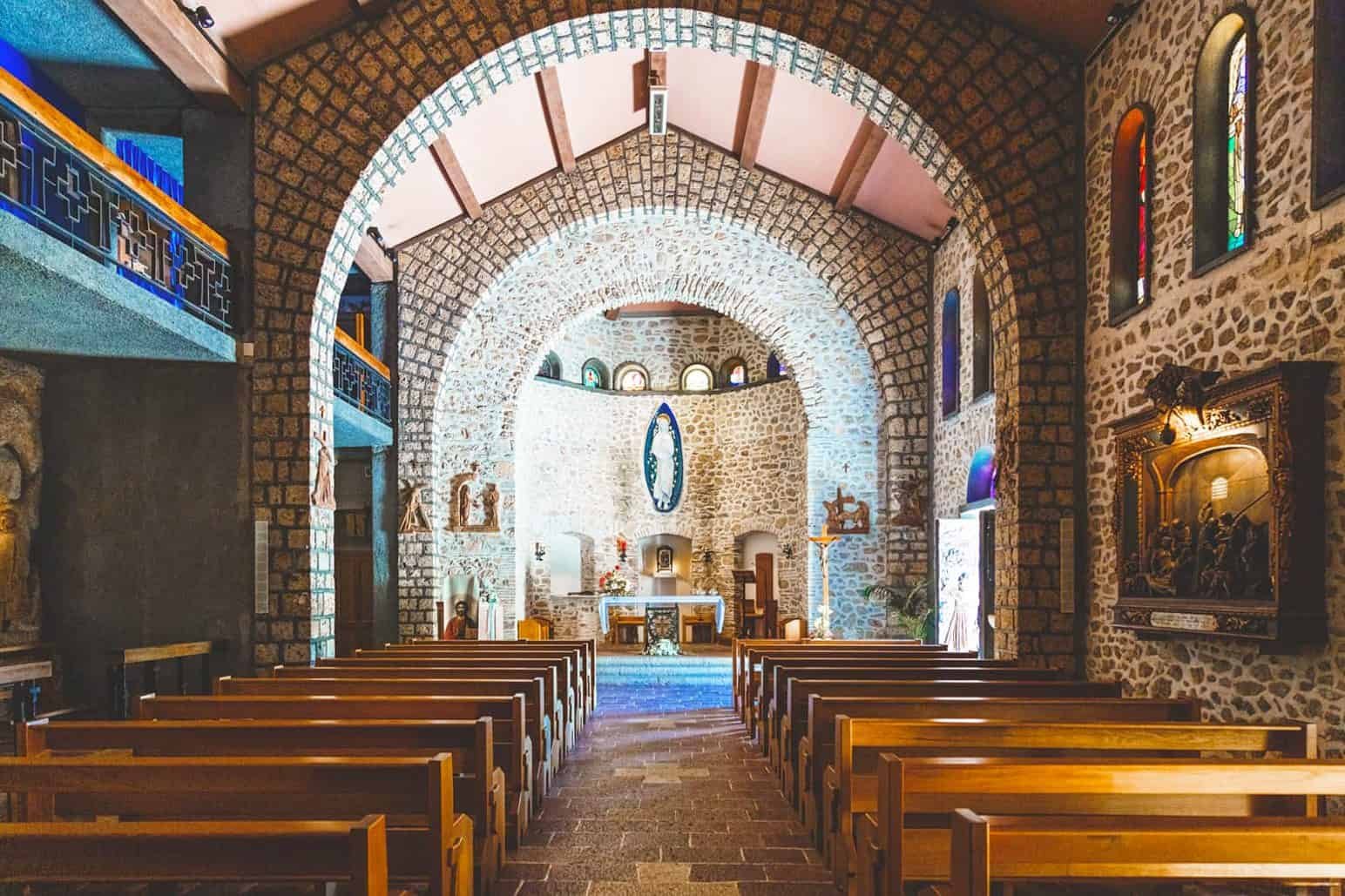
Some places tell their own story and some ask to be explained. The Greccio sanctuary belongs to the second kind: if you come up here without knowing what you are looking at, you see a convent clinging to a rock wall, four flights of steps, a wide panorama, and you leave convinced you have seen a nice spot. If you know what happened in this fold of the mountain on the night of December 25, 1223, you look at the same wall and can't stop looking at it. Because here, according to the account of Thomas of Celano, the first biographer of Francis of Assisi, the nativity scene was born. Not the ceramic nativity scene on grandma's dresser: the very idea that the Nativity could be represented, touched, smelled, staged with real hay, a real ox and a real donkey. From this cliff above the Rieti basin a custom set out that is repeated today in tens of millions of homes, on every continent, in every language. Not bad for a hermitage of friars that in its earliest phase had a refectory, a dormitory of seven meters by two and a little cell dug into the stone.
One clarification, because it is the premise for everything else: almost everything we tell about Francis at Greccio belongs to the hagiographic tradition, that is, to the Franciscan Sources, and not to a notarial record. Our main witness is Thomas of Celano, who wrote the Vita prima a few years after the events, commissioned by the Holy See, in a literary genre that is not chronicle but edifying biography. That doesn't mean it is false. It means it has to be read for what it is, an account built to say who Francis was, not to photograph him. Francis's presence at Greccio in 1223 is historically well established. The manger, the ox, the donkey, the child who comes to life in the saint's arms belong to a different register, that of devout memory, which has settled on these places like lime on walls. Knowing how to tell the two levels apart takes nothing away from the emotion. If anything, it makes it adult.
Greccio Sanctuary: where it is and why the climb is worth it
The sanctuary is in the municipality of Greccio, in the province of Rieti, on the eastern slope of the Sabine Mountains, at about 665 meters above sea level. It is a little over two kilometers from the medieval village of Greccio and roughly 15 kilometers from the provincial capital, Rieti. From Rome it is a good hour and a half by road, with the Salaria climbing the Tiber valley and then slipping toward the Rieti basin. It is a drive that has the merit of preparing you psychologically for the place, because the landscape changes gradually, narrows, becomes greener and sterner, until behind the last hairpin that kind of limestone cliff appears with the convent wedged into it.
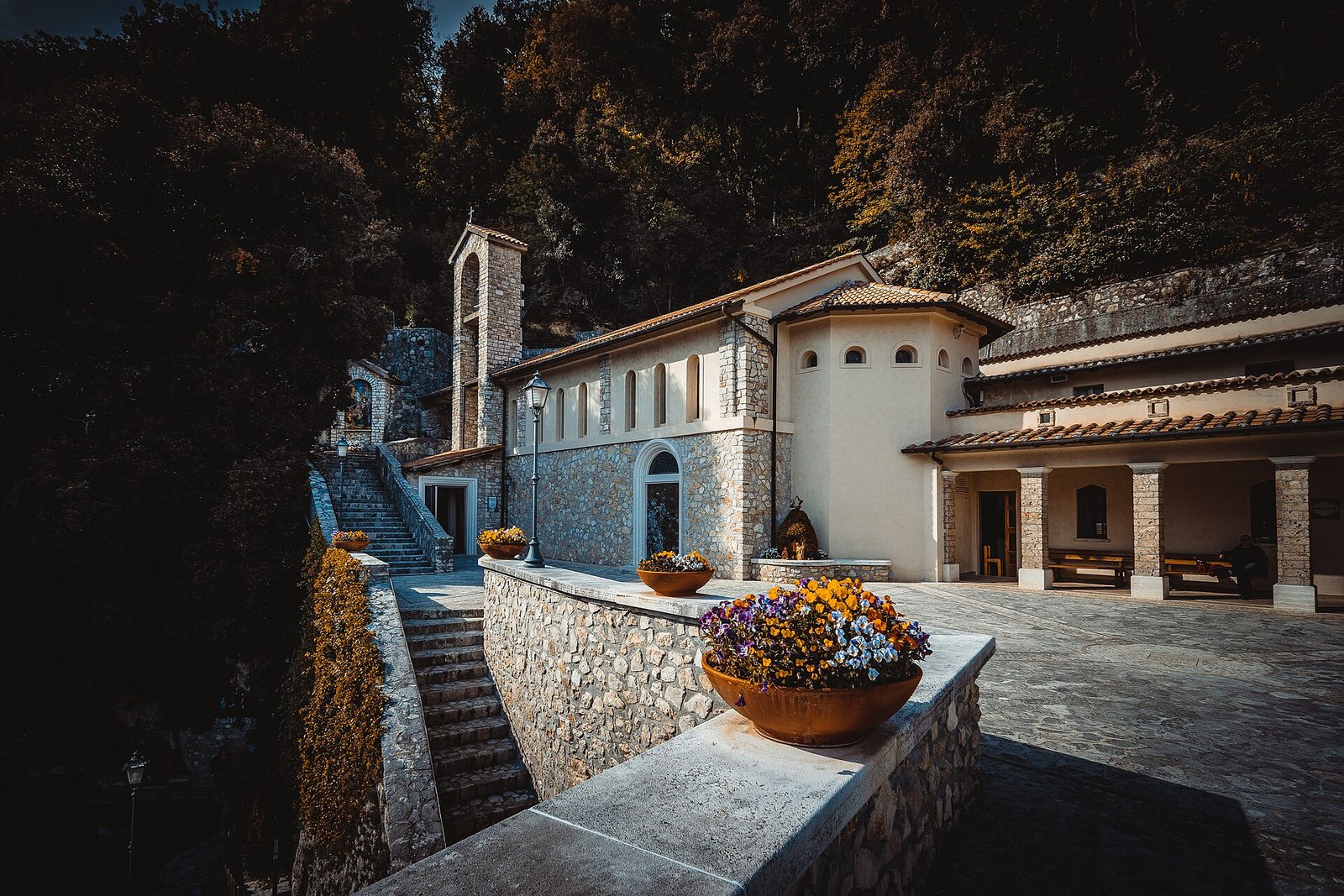
The shape of it is the first thing that strikes you, and it is not an aesthetic detail. The complex doesn't stand on an artificial terrace. It develops on several levels, using the natural overhangs of the cliff, climbing vertically like a mountain house that has found a way to balance where no one else would stand. The oldest cells are literally dug into the limestone. The churches were added above and beside them, fitting together like the pieces of a wooden game. All around, an amphitheater of holm oaks, downy oaks and hornbeams that turns dark in winter and shades the esplanade in summer.
The esplanade-viewpoint is the second blow. From there the gaze opens onto the Rieti Plain, the flat valley floor that is what remains of the ancient Lacus Velinus, the body of water the Romans drained in 271 BC with the cut ordered by the consul Manius Curius Dentatus, at the origin of the Marmore Falls. It is a panorama with narrative value, not only scenic: you can see with the naked eye, scattered along the edges of the basin, the points where the other three Franciscan sanctuaries of the area stand. The landscape, in short, is already the map of the story.
It is worth the climb for a less lyrical and more practical reason too: Greccio is one of the few major Franciscan places where there is no line. Assisi, with all due respect, is a funnel in summer. Here, except on the days of the Christmas celebrations, you walk in silence, you enter the Nativity grotto without having to count the minutes, you hear the sound of the woods. For anyone looking for contact with Franciscan spirituality and not with its industry, the difference is enormous.
Greccio Sanctuary and the village: the name, the rock, the history
Before entering the sanctuary it helps to understand the town that gives it its name, because the relationship between the two is very close. The village of Greccio sits higher up, at around 700 meters, perched on a spur that looks over the basin. About the origin of the place name, local tradition has always told a fascinating story: that the name comes from Greek settlers who lived here in ancient times. It is an explanation people like, repeated for centuries, which modern studies have however scaled back. The philologically soundest hypothesis traces the name to the Curtis de greze documented in the Middle Ages, where greze would mean quarry gravel, rubble. A geological name, not an ethnic one. If that seems less poetic to you, look at the wall the sanctuary stands on and tell me whether rubble wasn't an honest observation.
The first certain records of Greccio come between the 10th and 11th centuries from the papers of the Abbey of Farfa, the great imperial monastery of the Sabina that for centuries was the real political and economic center of gravity of these mountains. In the full Middle Ages Greccio was a fortified castle, ringed by walls and guarded by six towers: a stronghold that controlled the mouth of the valley. It was destroyed in 1242, during the convulsions of the struggle between Frederick II and the papacy, and again in 1799 by French troops, who left a very bad memory in this part of Italy. The administrative changes of the 20th century saw it pass from Perugia to Rome and finally, from 1927, to the newly created province of Rieti.
Today Greccio has just over 1,400 inhabitants between the main town and the lowland hamlets of Limiti di Greccio, Spinacceto and Sellecchia, and in 2016 it joined the circuit of the most beautiful villages in Italy. Anyone who climbs to the sanctuary and doesn't give the town half an hour is making a planning mistake: the Collegiate Church of San Michele Arcangelo preserves a 14th-century layout and memory, the church of Santa Maria del Giglio dates to the 15th century, and above all the town is home to the International Nativity Scene Museum, which collects nativity scenes from all over the world. It is the ideal secular and anthropological complement to the visit to the sanctuary: after seeing where the nativity scene was born, you see what humanity has made of it.
The relationship between village and sanctuary is, besides, written into the tradition itself. The feudal lord who according to the hagiographic sources hosted Francis, Giovanni Velita, was the lord of this castle. The people who witnessed the night of 1223 were the population of these houses. And in the fresco of the Nativity Scene Chapel, behind Francis, there is not a generic crowd but, according to the local reading, the face of the town.
Greccio Sanctuary: the fourth sanctuary of the Holy Valley of Rieti
The Holy Valley of Rieti is a name that caught on because it describes exactly what it is: a basin in which four Franciscan convents, all tied to the direct presence of Francis of Assisi between 1217 and 1225, stand a few tens of kilometers from one another, arranged almost at the four cardinal points around the plain. Greccio to the west, Poggio Bustone to the north, La Foresta just above Rieti, Fonte Colombo to the southwest. No other area of Italy, Assisi excepted, concentrates so much Franciscan memory in so little space.
Poggio Bustone and the greeting
At Poggio Bustone tradition places Francis's arrival in the valley and the greeting that became proverbial, "Good morning, good people," addressed to the inhabitants of the village. Above the convent, high in the woods, is the Sacro Speco where, according to the Franciscan Sources, Francis received the certainty that his sins were forgiven: a decisive inner passage, which the biographers place at the origin of his mature serenity. It is the airiest of the four sanctuaries, with a view that takes your breath away in winter.
La Foresta and the miracle of the grapes
At La Foresta, a few minutes from Rieti, tradition sets the episode of the grapes: the winegrower who hosted Francis saw his vineyard ruined by the pilgrims who had come to see the saint, and still got an extremely abundant harvest. Here recent history has added a beautiful secular chapter: the convent has been the seat of a social agriculture project that gave the vineyard and the work back their meaning, putting the land back into production. Francis, I suspect, would have approved of that more than of some restorations.
Fonte Colombo, the Franciscan Sinai
Fonte Colombo is the place where, according to tradition, Francis dictated the definitive Rule of the Order, the one approved by Pope Honorius III with the bull Solet annuere of November 29, 1223. For this reason it is called the Franciscan Sinai. Tradition also places here the harsh episode of the cauterization of the eyes, the attempt by the doctors of the papal court to treat the saint's severe ophthalmia with a red-hot iron. The detail the biographers hand down, that Francis addressed the fire calling it "brother," says more about the man than a thousand pages.
Greccio, the oldest of the four
Greccio is the oldest of the group and the only one that preserves rooms built while Francis was still alive. It is also the most famous, for a simple reason: the other three keep moments of Francis's inner biography, while Greccio keeps a gesture that has become the heritage of all Christendom and, beyond that, of world popular culture. 1223, the year of the nativity scene, is the same year as the Regula bullata: 12 months in which, in this valley, Francis fixes together the legal form of his Order and his most successful pastoral invention. The fact that the two things happened 20 kilometers apart, in the same winter, is a coincidence worth telling out loud.
Greccio Sanctuary and the Christmas night of 1223
We come to the heart of it. The source is Thomas of Celano, Vita prima, the biography composed a few years after the saint's death and considered the founding text of Franciscan memory. Celano tells that about 15 days before Christmas 1223 Francis called to him a man of the place, whom the text names as Giovanni, and gave him a precise task: to prepare at Greccio, in a cave, the scene of the birth of Christ. He wanted, and here the Latin phrase has remained famous, to commemorate the Child born in Bethlehem "seeing with the eyes of the body, in some way" the hardships in which he came into the world. He wanted the manger, he wanted the hay, he wanted the ox and the donkey brought to the spot.
On the night of December 25, again according to Celano, the friars arrived from the neighboring convents and the people climbed up from the village with torches and candles, so that the woods, the text says, rang with voices and the rocks sent back the lights. The manger was set up, the hay was brought, the animals were led in. Mass was celebrated over the manger, and this, mind you, is the theologically explosive detail, because it means that the Eucharistic altar physically coincided with the crib. The consecrated bread was laid where the animals' food is put. It was not a stage device. It was a visual sermon on the Incarnation, that is, on the idea that God became so concrete that he could be eaten and could be cold.
Francis, who was a deacon and not a priest, did not celebrate. He sang the Gospel and then preached. Celano insists that he spoke of the "poor king" and that, when he pronounced the name of Bethlehem, his voice filled with sweetness, as if he were bleating like a sheep. To moderns it may seem a bizarre image, and yet it is a masterpiece of portraiture: the man who is moved to the point of losing control of his voice. From a biographer writing for the canonization, a detail so unsolemn is a precious sign of authenticity.
The knight and the vision
The best-known and most delicate passage is the vision. Celano tells that a virtuous man present that night, a knight, saw in the manger a lifeless child whom Francis, drawing near, seemed to awaken. The biographer himself immediately interprets the episode symbolically: Jesus was forgotten in the heart of many, and Francis awakened him with his own work. It is worth saying this clearly to visitors, because popular tradition later stiffened this vision into a material miracle, the statuette that comes to life, which in the original text has a far more nuanced status. The first to explain its figurative sense, in short, is the first to tell it.
The hay that healed
There is an appendix that visitors love and that says a lot about the mentality of the time. Celano writes that the hay of the manger was kept by those present and that, distributed afterward, it healed sick animals and women in difficult labor. The saint had not yet left the valley and already his material trace was becoming a relic. This is the mechanism by which Franciscan places were formed: first the gesture, then the memory, then the stone built over the memory. Greccio is the textbook case.
Why it was not really the "first nativity scene"
Honesty comes first, even when precision takes away a bit of magic. Representations of the Nativity had existed for centuries: mosaics, frescoes, sculptures, Christmas liturgical dramas performed in European churches. What Francis does at Greccio in 1223 is not to invent the image of the Nativity. It is to take it out of the learned, liturgical enclosure and give it back to the people in three-dimensional, tactile form, set in a real place with real animals. It is an act of cultural translation, not of iconographic invention. And that is why it took root so well: because anyone could redo it at home with what they had. The nativity scene is the first great open source of Western devotion.
Greccio Sanctuary: Giovanni Velita, the lord who provided the cave
The name Celano gives as "Giovanni" local tradition identifies with Giovanni Velita, lord of the castle of Greccio, a descendant, according to the genealogies handed down on the spot, of the counts Berardi of Celano. He is the one who, in the story, makes the place available, provides the cave, the animals and the hay. He is, in short, the executive producer of the first nativity scene in history, and I think it is right that his name be mentioned: without a local lord willing to spend time, men and livestock, the night of 1223 would not have been possible.
Next to him the Greccio memory places his wife, Alticama Castelli of Stroncone, whose name recurs in the sanctuary's captions and in the 20th-century bas-reliefs. Husband and wife appear among the benefactors depicted on the bronze portal of the modern church and in the stained glass windows: a choice that says how much the community wanted to keep together the saint and the laypeople who welcomed him. It is not an idle devotional detail. In the first Franciscan generation the hospitality of local lords was the material condition for the Order's survival, and Greccio is the architectural proof of it.
Another tradition, this one openly legendary, tells how Francis chose the exact spot where the hermitage was to be built: he asked a child to throw a burning brand from the village toward the mountain, promising that where the brand stopped the hermitage would rise. The brand, against every law of physics, crossed the valley and landed on the rocks where the sanctuary stands today. It is a classic etiological legend, the kind that serves to explain why a building stands in such an inconvenient place. It is worth telling, because it is beautiful and because it is useful: anyone who looks at the distance between the village and the cliff understands at once that it took a miracle or a very stubborn decision. I lean toward the second, but I don't say it too loudly.
Greccio Sanctuary: the access staircase and the arrival
The arrival at the sanctuary is a small liturgy in itself, and it is worth doing properly. Going up the provincial road, just before the complex, you meet a bronze statue placed in July 2016 that shows John Paul II in the act of blessing the valley: it recalls the first pontiff who came up here, on January 2, 1983. Two hairpins further on, at the level of the parking lot, the bar and the information point, the staircase carved into the cliff begins, which is the traditional way in.
At the foot of the staircase stand two statues of Saint Francis, one in stone and one in bronze, the latter placed in 2005. Going up, almost at the end of the steps, a small terraced garden opens, which holds Omaggio a San Francesco, a travertine sculpture made in 1993 by the Sicilian sculptor Leonardo Cumbo. The travertine here is not a neutral choice: it is the stone of the Rieti basin and its calcareous waters, the same stone that built half of ancient Rome. A saint of local stone, in short.
The staircase has a function that I recommend not sabotaging. It climbs enough to change your breathing, it is narrow enough to impose single file, and at every landing the view of the valley changes. Anyone who arrives out of breath from the parking lot, walks in and looks around panting, misses the sense of the place: Franciscan hermitages are built on the principle of progressive detachment from the world, and the stairs serve exactly that. Climb them slowly. Stop twice. Look back.
A practical tip, because rhetoric is fine but ankles are not: the steps are living rock, uneven, and slippery after rain. Smooth-soled shoes are a recurring mistake here and every year produce a few falls. There is also a higher road access that notably reduces the climb, useful for those with mobility difficulties: it is best to ask on site before tackling the lower staircase.
Greccio Sanctuary: the Nativity Scene Chapel
At the top of the staircase you enter the Nativity Scene Chapel, and this is the absolute heart of the sanctuary. It is a small, low room, built around the natural cavity where tradition places the 1223 representation. Local memory dates to 1228, the very year of Francis's canonization, which took place on July 16 in Assisi at the hands of Gregory IX, the building of the chapel over the grotto. If the date is correct, and its consistency with the sources makes it very plausible, it means that the sanctification of the place was immediate: as soon as Francis became a saint, Greccio became a sanctuary.
The physical impression on entering is of being in a house more than in a church. The ceiling is close, the walls are irregular because they follow the rock, the light comes in sparse. Anyone expecting a basilica is thrown off. But it is precisely this modesty of size that makes the place memorable: here the word "poverty" is not a theological concept, it is a measurement in meters.
Past the pews set out for prayer you reach the Nativity grotto proper, a tiny space with an altar and a couple of seats. Under the altar table you can see the recess in the rock that, according to tradition, held the manger and the figure of the Child. It is the point where visitors stay longest, and where even the chattiest groups lower their voices on their own. No need to say it, it happens.
How a group behaves inside the grotto
Two instructions before going in. The first is to enter a few at a time: the space is such that six people fill it and 10 make it unusable. The second is not to talk inside. Everything there is to explain gets explained beforehand, on the esplanade or at the entrance of the chapel. Inside you just look. It is a rule that holds for believers and nonbelievers alike, because respect for a place of worship doesn't require faith, it requires manners.
Greccio Sanctuary: the fresco of the double nativity
Above the altar of the grotto is what I consider the smartest object in the whole sanctuary: a lunette fresco, of the Giotto school, attributed to an anonymous master from Narni and dated 1409. It is a work with an idea, and the idea is brilliant in its simplicity: it puts two nativities side by side.
On the right is the original Nativity, the one of Bethlehem. The Virgin nurses the Child, Saint Joseph is present, the iconography is the usual one of the Italian late Gothic, with the Madonna half reclining according to a formula that derives from the Byzantine tradition and that the Italian 14th century had by then domesticated. On the left, instead, is the nativity of Greccio: Francis dressed as a deacon, kneeling, bending over the Child, and behind him the people of the village looking on.
Stop a moment to think about what this compositional choice means. The painter is saying, by the sheer force of juxtaposition, that what happened at Greccio is not the commemoration of the Nativity. It is a second Nativity, theologically equivalent, taking place in the present of the community looking at the fresco. It is a bold claim, one no treatise could have formulated as effectively, and it explains by itself why the nativity scene has had the success it has had. The nativity scene works because it doesn't recount a distant event: it repeats it here.
Why "of the Giotto school" is not an empty label
When we say Giotto school we mean a precise visual revolution: figures that occupy a real space, that have weight, that turn and look at each other, set in architecture built with perspective criteria, however empirical. Compare this lunette mentally with a Byzantine icon from two centuries earlier and the difference jumps out: there the figures float on a gold ground, here they stand in a room. In the context of Greccio this language is entirely coherent with the content: an episode that affirms the corporeality of the Incarnation could not be painted in a style that denies the corporeality of space.
The frescoes of the corridor
From the Nativity Scene Chapel you pass into a corridor that leads to the old monastery, and it is best not to rush through it. Two frescoes are preserved there: a Nativity of the Umbrian-Marchigian school and a Saint John the Baptist, both traced back to the circle of the so-called Master of Fossa, a painter active in the 14th century in the Abruzzo and Rieti area. They are provincial works, in the noblest sense of the term: executed by a workshop, with modest means, for an audience of friars and pilgrims. Precisely for this reason they show the real circulation of the figurative language of the 14th century between Umbria, the Sabina and Abruzzo better than any masterpiece.
Greccio Sanctuary: the old monastery and the primitive dormitory
Adjacent to the Nativity Scene Chapel is the oldest core of the convent, the one where the first friars lived. It is the part I recommend visiting with the most attention, because it is the only place in Italy where you can see, almost intact, how the life of an early Franciscan community was materially organized. There are no cloisters, no monumental chapter houses, nothing of what the imagination associates with the word "convent." There is a refectory, a dormitory and a cell.
The refectory
Of the friars' refectory, the remains of the washbasin and of the drain channel dug into the stone survive. It seems little and yet it is a great deal: they are the only material traces of daily life. The washbasin shows where hands were washed before eating, the channel shows where the water went. From these two details you reconstruct a domestic organization that was essential but not improvised. Anyone who imagines the first Franciscans as mystical drifters who slept wherever they happened to be finds here a gentle rebuttal: it was poverty, not disorder.
The dormitory of the first friars
The dormitory measures about seven meters by two. I repeat the figure because it is worth letting it sink in: seven meters by two, that is, 14 square meters, for the whole community. Anyone with a double bedroom in an apartment probably has more personal space than the friars of Greccio had collectively. There were no individual cells, no beds as we understand them. People slept on pallets, set against the rock, with the cold of the mountain coming in through the openings.
It should be noted that this room is also an ideological statement. The common dormitory, without partitions, is the architectural translation of fraternity: no one has a space of their own, no one has a door to close. When, in the following decades, the Order gave itself more articulated structures and dormitories with single cells, that choice would also mark a change in the model of life. At Greccio you see the before and, a few rooms further on, you see the after.
The cell of Saint Francis, the "sacro speco"
Then there is Francis's cell, and here you have to bow your head, literally. It is a niche dug into the bare rock, so small that an adult can barely lie down in it, also called the "sacro speco," that is, sacred cave, an expression that recurs in many hermitages of the central Apennines. The rock is just that, not lined, not softened: you can see the cracks in the limestone.
I don't know many places in Italy that communicate the concept of asceticism so immediately. No explanation is needed: you look at that hole in the stone, think of a January night at 665 meters of altitude, and understand everything there is to understand about that man's choice of life. In the end this is what makes Greccio different from the great monumental sanctuaries: here things are not recounted, they have remained.
The pulpit of San Bernardino
The old core also preserves the pulpit tied to the memory of Bernardino of Siena, the great 15th-century preacher of the Franciscan Observance, the man of the radiant IHS trigram that is still seen today on the facades of half of Italy. His presence at Greccio is an important fact: it means that in the 15th century, in the middle of the Observant reform, this hermitage was considered one of the roots to start again from. Reformers always go back to the origins, and the Franciscan origins, for their generation, were these stones.
Greccio Sanctuary: the dormitory of Saint Bonaventure
Moving up within the complex you come to the dormitory called San Bonaventura, one of the most photogenic and least known rooms of the sanctuary. It was the seat of community life after the old monastery was given up: according to the convent's memory it was used from 1260-1270 until 1915. That is 650 years of continuous use, a figure that by itself tells the tenacity of this place.
Tradition attributes its construction to the time when Bonaventure of Bagnoregio was minister general of the Order, an office he held from 1257 until his death in 1274, and hence the name. Bonaventure was not only an administrator. He was the theologian who gave the Order its doctrinal arrangement and the author of the Legenda maior, the official biography of Francis that in 1266 the general chapter of Paris imposed as the only authorized version, ordering the destruction of the earlier ones. It is one of the most effective operations of memory control in the Middle Ages, and the fact that Celano's text survived anyway is a small historiographical stroke of luck for which we should be grateful to some disobedient copyist.
The room is entirely of wood: a narrow corridor onto which 15 small cells face, each closed by a low little door. Walking in it produces a particular acoustic effect, because the wood gives back the footsteps in a way that is dry and muffled at once. The first cell on the right is the one that tradition indicates as the lodging of Bonaventure and, later, of Bernardino of Siena. Here too, minimal measurements: the cell is little more than a wardrobe with a small window.
The passage from the common dormitory of the old core to the 15 individual cells of the Bonaventurian dormitory is, in 30 meters of walking, a lesson in the history of the Franciscan Order. Within two generations the informal fraternity of the first companions becomes an institution with rules, hierarchies, personal spaces and studies. It is not a degeneration, as one sometimes hears said with some simplification. It is what happens to every movement that wants to outlast the life of its founder. But it is a change, and at Greccio you can touch it.
Greccio Sanctuary: the first church of San Francesco and San Bonaventura
On the upper floor, above the Nativity Scene Chapel, is the primitive church of the sanctuary, dedicated to Saint Francis and Saint Bonaventure, which dates to the first half of the 13th century. Local sources place between 1228 and 1229, that is, immediately after the canonization, the construction of the church dedicated to the saint. It is therefore one of the very first places of worship in the world named for Francis of Assisi: it precedes or accompanies the building site of the basilica of Assisi, opened in 1228. You wouldn't say so, given the size. And that is precisely the point.
The Deposition and the tondo by Biagio d'Antonio
Above the altar is a 16th-century painting of the Umbrian school showing the Deposition among saints. On the left wall a 14th-century fresco represents Saint Francis and the angel announcing the remission of sins to him: the subject refers to the episode that tradition sets at Poggio Bustone, and its presence here shows how the four sanctuaries were perceived from the start as a single story distributed over several places.
Above the fresco is a 15th-century tondo attributed to Biagio d'Antonio, with the Madonna and Child. Biagio d'Antonio Tucci was a Florentine painter of the generation of Ghirlandaio and Botticelli, also active on the Sistine building site: finding a work of his in a hermitage in the Sabine Mountains is one of those geographical short circuits that make Italian art so much fun to talk about. Works traveled along with their patrons, and the Franciscan patrons had a network that covered the whole peninsula.
The wooden furnishings and the starry sky
The church preserves wooden furnishings of great interest: the choir stalls, a lectern and a revolving lantern support that allowed the friars to light the pages of the choir book during the night office. This last object is one of those details that make you understand what daily life was really like: night singing required light, the light was a flame, the flame had to be moved from one page to another. Someone solved the problem with a revolving wooden arm, and that someone is worth, for the history of technology, as much as an architect.
The roof is a barrel vault decorated with a starry sky, a very widespread motif in medieval and late medieval Italy that turns the ceiling into a firmament. An image of Blessed John of Parma also appears there. A painted starry sky, in a building dedicated to Christmas, is never a neutral ornament: it is the star.
Greccio Sanctuary: the portrait of Saint Francis and Jacopa de' Settesoli
In the oratory next to the primitive church, above the altar, is a painting that is the object of great veneration by the friars and deserves a discussion of its own. It shows Saint Francis with a suffering face, drying his eyes with a handkerchief. Local tradition holds that the original was made in 1225 on commission from Jacopa de' Settesoli, the saint's Roman friend, and that it was therefore the only portrait made while Francis was still alive. The canvas preserved today is a 14th-century copy of the lost original.
The detail of the handkerchief is not a pathetic flourish: it refers to the very serious eye disease Francis suffered in his last years, an ophthalmia probably contracted during the journey to the East, which brought him close to blindness and for which he came to be treated in this very area, by the doctors of the papal court then residing in Rieti. Honorius III and the curia stayed a long time in the Rieti basin between 1225 and 1226, and this explains why one Apennine valley hosts so much concentrated Franciscan history: the pope, the best doctors and the sick saint were all there together.
Who Jacopa de' Settesoli was
It is worth telling, because she is one of the most beautiful figures of Franciscan hagiography. A Roman noblewoman, widow of Graziano Frangipane, she belonged to one of the great baronial families of medieval Rome, the one that had fortified the Colosseum and the Arch of Titus. Francis called her, with rough affection and a play on grammatical gender, "Brother Jacopa": a masculine title for a woman, which in the 13th century amounted to declaring her an honorary member of the fraternity. The sources tell that she arrived in Assisi in the last days of the saint's life bringing with her, without anyone having asked, the almond sweet he loved. If you are looking for proof that hagiography can be deeply human, here it is.
That the Greccio portrait really goes back to a commission of 1225 is a claim that belongs to tradition, not to an archival document, and I always present it as such. But even accepting it with caution, the value of the image remains: a sick, exhausted Francis drying his eyes. A portrait that doesn't idealize. In an age when holiness was painted with the rigidity of the icon, someone chose to show a man who is unwell.
Greccio Sanctuary: cells, hermit caves and Blessed John of Parma
Just outside the sanctuary, immersed in the woods and set against the rock, are the hermit caves, which are perhaps the most evocative and least accessible part of the complex. The main one is that of Blessed John of Parma, minister general of the Order, who according to the convent's memory lived there in ascetic penance for 32 years, from 1257 to 1289.
The story of John of Parma is one of those that deserve to be told in full, because they explain a lot about the internal crisis of 13th-century Franciscanism. He was minister general from 1247 to 1257, a man of great rigor, a supporter of the strict observance of poverty, and he ended up overwhelmed by his closeness to Joachimite doctrines, that is, to the prophecies of Joachim of Fiore on the age of the Spirit that stirred the radical wing of the Order. Forced to resign, he named as his successor Bonaventure of Bagnoregio himself, and withdrew here, to a cave above Greccio, where he stayed more than 30 years. He died in 1289, on a journey toward the East, at Camerino.
32 years in a mountain cave is a figure worth letting settle. It is not a spiritual retreat of one season: it is half a life, with the winters of the central Apennines, the snow, the dampness of the rock. The figure belongs to the convent tradition and is plausible in order of magnitude: prolonged hermit life in Apennine caves is documented in dozens of cases between Umbria, the Marche, Lazio and Abruzzo.
The little cell of Saint Francis
Nearby is the little cell where, according to tradition, Francis withdrew to pray in solitude. Today it is converted into an oratory: a very small room that preserves an 18th-century fresco showing the Death of Saint Francis and the remains of another, older fresco, now very fragmentary. The two cells are not open to the public, and I think that is the right choice: some places are preserved only by keeping people away from them.
Even from outside, though, the view is powerful. The woods here are thick, the rock sweats, the light arrives filtered. You only have to step 50 meters away from the esplanade to understand what the hermits were looking for in these recesses: not scenery, but absolute silence and the constant temperature of the stone.
Greccio Sanctuary: the church of the Immaculate Conception
The modern church of the sanctuary, dedicated to the Immaculate Conception, was built in 1959 to a design by the architect Alberto Carlo Carpiceci. It is the building that today hosts celebrations with large crowds of the faithful, and it is also the one that divides visitors most: those who come looking only for the 13th century find it out of tune, those who look at it for what it is find it an intelligent answer to a hard problem.
The problem was this: how do you build a large church in a place where there is no room, without crushing the ancient rooms and without scarring the cliff. Carpiceci wedges it into the mountain. The building faces the little square with its apse and right side, while the facade and left side are literally covered by the flank of the mountain: half the church is inside the rock. The exterior is in stone and plaster, with a bell gable. The right side is marked by single-light windows and holds two portals that open at the beginning and at the end of the nave. The apse is octagonal and takes its light from skylights.
On the west side a staircase leads to the paths that go into the woods and to a third portal, in a raised position, which opens into the elevated women's gallery. Along the staircase is a shrine decorated with a recent ceramic showing Saint Anthony of Padua and the miracle of the Eucharist, the episode of the mule kneeling before the Blessed Sacrament. Anthony, I always remember, was a Franciscan of the first generation and for a time taught theology to the friars: his presence here is not ornamental, it is genealogical.
The interior
Inside, the church has a single nave, with a Latin cross plan without projecting transepts. On the left side and at the back runs a raised balcony that holds the women's gallery. In the space under the left balcony three small niches open that serve as side chapels. In the apse is a ceramic bas-relief showing Saint Mary Immaculate, made by the sculptor Lorenzo Ferri between 1965 and 1966.
At the back of the nave stands a large wooden nativity scene, also by Lorenzo Ferri, made in 1967 with statues from Val Gardena: an explicit tribute to the South Tyrolean carving tradition, which in the 20th century supplied nativity scenes to half of Europe. The first niche on the left side holds the organ, the second a second terracotta nativity scene made by the sculptor Luigi Venturini in 1962, the third a wooden crucifix. On the right side is a wooden sculpture showing Saint Francis and his friars assisting lepers, the work of the Spanish sculptor J. Campania, from 1925.
On the walls runs a Way of the Cross in terracotta bas-reliefs, also by Lorenzo Ferri, from 1967. Ferri, an artist with a 20th-century training tied to Italian sacred art of the postwar period, is in effect the visual director of this church: the Immaculate of the apse is his, the large nativity scene is his, the Way of the Cross is his. Looking at the three cycles together lets you understand how people tried, in the 1960s, to give sacred art a modern language without breaking with popular legibility. Successful or not, it is a chapter of Italian art history that at Greccio can be read in full.
Greccio Sanctuary: the bronze portals by Lino Agnini
The three access portals of the church of the Immaculate are decorated on the outside with bronze bas-reliefs by the sculptor Lino Agnini, and they alone deserve a long stop. The bas-relief of the front portal measures 245 by 155 centimeters and weighs over 30 quintals: it was made in 1995 by the Briman foundry of Verona. Three tons of bronze on a church door in a mountain hermitage is a figure that always impresses, and rightly: the logistics alone of getting it up here would deserve a story.
The subject is the Madonna giving the Child to Saint Francis: an iconography that directly joins the Marian dedication of the church and the memory of the nativity scene. At the sides appear Blessed John Duns Scotus, the Franciscan theologian who in the 14th century worked out the decisive argument in favor of the Immaculate Conception, and Saint Clare dying with the papal bull in her hands, supported by two sisters. The bull is the one with which Innocent IV approved the Rule of the Poor Clares, which reached Assisi while Clare was at the point of death in 1253: one of the most dramatic moments in the history of the women's Order.
And then, on the same portal, there they are: Alticama Castelli of Stroncone and Giovanni Velita of Greccio, the two benefactors. Finding the faces of two 13th-century laypeople on a bronze door cast in 1995 is proof that at Greccio the memory of 1223 is not archaeology: it is a living thing, which every generation rewrites with the means it has. The rear portal instead represents Saint Francis's meeting with the wolf, an episode the sources place at Gubbio but which iconography has made ubiquitous, because it tells in a single scene the Franciscan idea of reconciliation with creation.
Greccio Sanctuary: the stained glass and the nativity scene exhibition
The windows of the church of the Immaculate are historiated with polychrome stained glass by Father Alberto Farina, and they make up an iconographic program that retraces the story of Francis and of the sanctuary. It is worth reading them in order, because they are organized by bays.
In the three single-light windows of the first bay appear the three companions of Brother Francis: Leo, Rufino and Angelo. They are the three who, according to tradition, drew up on August 11, 1246 the so-called Letter of Greccio, addressed to the minister general Crescenzio of Iesi, who had asked the elder friars to put their direct memories of the founder in writing. In the three single-light windows of the second bay are Saint Bonaventure, Saint Clare and Blessed John of Parma. In the third bay opens a large window with The Pardon of Assisi, that is, the indulgence of the Porziuncola, flanked by two single-light windows with Lady Jacopa de' Settesoli and Giovanni Velita. In the lunettes above the two entrance portals, finally, the two Nativities: that of Bethlehem and that of Greccio. The same juxtaposition as the 15th-century fresco of the grotto, taken up five centuries later. The continuity of this place is also this: an idea that keeps being thought.
The nativity scene collection in the women's gallery
In the women's gallery the sanctuary hosts a permanent exhibition of nativity scenes that keeps growing, collecting works by different authors: among them are a terracotta Presepio by Lino Agnini and a Francesco e il suo presepio by A. Fanfoni. It is a collection with a precise logic: to show how the invention of 1223 has been declined in different materials, styles and eras. Anyone who walks through it calmly grasps something not trivial, namely that the nativity scene is a format, not a fixed image: the wood, the terracotta, the papier-mâché, the plaster change, the faces and clothes change, but the structure, the hut, the manger, the shepherds, the animals, has stayed identical for eight centuries. Few formats have had such good fortune.
Greccio Sanctuary: the chapel on Monte Lacerone
From the sanctuary a rugged path, immersed in the woods, about a couple of kilometers long, climbs to the summit of Monte Lacerone, 1,204 meters above sea level. It is the place where, according to tradition, Francis dwelled before the sanctuary arose: the local chronology places around 1209 the building of a hut among these woods, where the saint withdrew to meditate. Since then the peak has also been called Monte San Francesco.
At the point where the hut is said to have stood, next to two large hornbeams, is a small chapel built by Pope Clement XI in 1712 and later incorporated into a shepherds' house in 1889. This last detail is delightful and must be told: the history of the mountain is not made only of popes and saints, but also of shepherds who used a devotional building as the load-bearing wall of their own stable. It is how the Apennines have always treated architecture: by reusing it.
The climb to Lacerone is the right choice for anyone with half a day and trained legs. The elevation gain from the sanctuary exceeds 500 meters, the ground is stony, steep in places, and in winter it can be snowy or icy. But the panorama from the top pays you back: you see the whole Rieti basin, the Rieti Mountains with Terminillo, the Sabine ridge toward the Tiber. And you understand, looking down at the sanctuary reduced to a white patch on the wall, why Francis preferred to stay up here.
The woods and the wildlife
The slope is covered by a mixed wood in which holm oak dominates at low altitudes and then hop hornbeam, downy oak and manna ash, with beeches on the cooler exposures. It is an environment that hosts roe deer, wild boar, fox, badger and porcupine, and overhead you often see buzzards and, with a bit of luck, the peregrine falcon, which gladly nests on limestone walls like this one. The sanctuary, in fact, has neighbors who lived here before it.
Greccio Sanctuary and the Letter of Greccio of 1246
There is a document that carries the name of this place and that historians of Franciscanism know very well, while almost no visitor has ever heard of it: the Letter of Greccio, dated August 11, 1246. It was signed by three of Francis's closest companions, Leo, Rufino and Angelo, and addressed to Crescenzio of Iesi, then minister general of the Order, who at the general chapter of 1244 had asked all the friars to put in writing what they remembered of the founder.
The letter accompanies a collection of memories and contains a passage methodologically extraordinary for the time: the three write that they do not want to follow the chronological order of a legenda, but only to report episodes they know from direct experience or from the testimony of reliable friars. It is, in essence, a declaration of historiographical method drawn up in a hermitage in the Sabine Mountains in the mid-13th century. That this declaration was written here, where Francis had invented the nativity scene 23 years earlier, adds to the place a dimension that is not only devotional: Greccio is also an archive of Franciscan memory, the point where the eyewitnesses decided what to hand down.
It is worth adding that the operation had a complicated sequel. 20 years later, in 1266, the general chapter of Paris established that Bonaventure's Legenda maior was the only authorized biography and ordered the destruction of the earlier ones. Many materials collected after 1244, including those tied to the Letter of Greccio, survived in fragmentary form, flowing into later compilations that scholars have combed through for two centuries. When people say the Franciscan Sources are a building site that is still open, this is what they mean.
Greccio Sanctuary and Giotto's fresco in Assisi
Anyone visiting Greccio would do well, before or after, to look closely at the thirteenth scene of the cycle of the Stories of Saint Francis in the upper basilica of Assisi, painted between 1295 and 1299 and traditionally attributed to Giotto and his workshop. That scene is The Nativity Scene at Greccio, and it is one of the most important visual documents of the Italian Middle Ages.
The reason is technical before it is devotional. To depict the episode, Giotto paints a church presbytery seen from behind, that is, from the choir side: you see the ciborium over the altar, the rood screen with the pulpit, a large painted wooden crucifix jutting forward at a tilt, the stalls with the friars singing. It is the only figurative testimony of that piece of furnishing, the painted cross mounted on the screen and leaning toward the nave, which no Italian church keeps any longer in its original position, because the post-Tridentine reforms took down almost all the screens. Historians of architecture and liturgists study that scene the way one studies a photograph.
On the narrative level, Giotto does the same thing the master of Narni will do a century later in the Greccio lunette: he places the episode in a recognizable space, populated by people who turn, lean out, look. Francis is kneeling and holds the Child over the manger. Behind him are the friars, and on the right a group of women held back beyond the screen, according to the customs of the time. The nativity scene depicted at Assisi is already the foundation of a genre.
In the Greccio sanctuary the presence of this iconography is declared: the scene in the chapel takes up the layout of the Assisi composition, with Francis in the white dalmatic of a deacon, kneeling, adoring the Child, and at the upper right the priest celebrating. Behind the saint, according to the traditional reading, you can recognize the protagonists of that night: in the foreground the man in a long red tunic identified as Giovanni Velita, to his left his wife Alticama Castelli of Stroncone, and the people of Greccio. It is the way a community says: we were there too.
Greccio Sanctuary: Pope Francis and the apostolic letter Admirabile signum
On December 1, 2019, Pope Francis went up to the Greccio sanctuary and signed there the apostolic letter Admirabile signum, devoted to the meaning and value of the nativity scene. It is not a protocol detail: signing a papal document in the place the document is about is a choice of strong symbolic value, and it put Greccio, after eight centuries, at the center of world attention for a few days.
The text is divided into 10 paragraphs and starts from a definition worth reporting in its sense: the nativity scene is like a living Gospel, springing from the pages of Scripture. The pope retraces the episode of 1223, citing Thomas of Celano as a source, and then goes through the elements of the nativity scene one by one: the starry sky and the darkness, the ruined landscapes that in popular tradition allude to wounded humanity, the shepherds as the first recipients of the announcement, the trades of daily life that the Neapolitan nativity scene has multiplied, the Magi with their gifts, Mary, Joseph, and finally the Child.
Beyond the plane of faith, the document has an evident cultural interest: it is one of the rare occasions in which a magisterial text deals with a popular, artisanal and domestic practice, recognizing its theological dignity. The nativity scene has never been a liturgical obligation or a sacrament: it is a custom born from below, made of moss, cork, paper and figurines, handed down in families. That at Greccio, eight centuries later, a pope writes a reasoned praise of it closes a circle.
The visit, in practice
Anyone arriving at the sanctuary today finds a trace of it. The memory of that day is alive among the friars and the local community, and it clearly relaunched the flow of visitors, with practical effects too: more attention to the routes, more care in the signage, more awareness of the value of the place. Not all papal visits leave something concrete behind them. This one, for Greccio, coincided with the start of a new season of visibility that carried through to the celebrations for the eighth centenary of the nativity scene, in 2023.
Greccio Sanctuary: the popes who came up here
For a sanctuary that began as a hermitage of poverty, the papal visits are a curious chapter and should be told in order. The first pope to come up was John Paul II, on January 2, 1983, and the memory of that visit is entrusted to the bronze statue placed along the road in July 2016, which shows him blessing the valley. Pope Wojtyła had a particular familiarity with Apennine sanctuaries and with the mountains in general, and the choice of January 2, within the Christmas season, was not accidental.
Pope Francis, instead, came up twice: a first private visit on January 4, 2016, almost incognito, and then the official visit of December 1, 2019 with the signing of Admirabile signum. The fact that he chose to come the first time without a procession, in a low-key way, says something about his personal relationship with the place. And it is also a good way to make visitors understand that Greccio is not a sanctuary for show: it is a place where you go to stay, not to be seen.
It is worth recalling another element of recent history that puts Greccio in a wider horizon: in 1996 an olive tree donated by the Jewish National Fund was planted here. A tree of peace, in a Franciscan place, offered by a Jewish institution: in the context of post-conciliar interreligious dialogue it is a gesture far from obvious, and it shows how Greccio has become over the years a symbol that goes beyond confessional boundaries.
Greccio Sanctuary: the living nativity scene and Christmas in the Holy Valley
If there is a moment when Greccio becomes exactly what it is, it is the Christmas period. The village and the sanctuary host a re-enactment of the Nativity that over the decades has taken the form of a real living nativity scene with dozens of extras, staged in the historic center and its alleys, with living tableaux that reconstruct the event of 1223 together with the scene of Bethlehem.
The performances are concentrated in the days around Christmas and extend into the Epiphany period. They are evening shows, outdoors, in a mountain village: which means cold, real cold. The advice worth more than any other is to dress as for a winter walk at altitude, with suitable footwear, and to consider that seats are limited and traffic on the peak days is complicated. The exact dates and the ways of access vary from year to year: it is best to check them on the official channels of the sanctuary and of the Municipality of Greccio before setting out.
A perhaps unpopular opinion on the living nativity scene of Greccio: the best moment is not the show, but the hour before. When the village is getting ready, the extras are getting dressed, the braziers are lit and the valley below turns black with the lights of Rieti in the distance, you breathe something much more like a 13th-century night than the performance itself does. Arrive early and walk through the alleys.
The wooden nativity scene and the permanent nativities
Even out of season, though, Greccio remains the town of the nativity scene. Lorenzo Ferri's large wooden nativity scene in the church of the Immaculate can be seen all year, as can the collection in the women's gallery, and in the village the International Nativity Scene Museum shows nativities from dozens of countries. Anyone who arrives in July thinking the theme is out of season is wrong: here Christmas is a permanent fact, as the eruption is at Pompeii.
Greccio Sanctuary and the Way of Francis
The sanctuary is a stop on the Cammino di Francesco, the devotional and hiking itinerary that links the Franciscan places between Lazio, Umbria and Tuscany, and in particular on the route that joins the four sanctuaries of the Holy Valley of Rieti. There is also Via di Francesco, the longer route that goes down from La Verna to Assisi and then to Rieti and Rome. The two names overlap on several stretches and create a certain confusion among walkers: the substance is that from Greccio you can set out or arrive on foot, and it is the best way to get to know these places.
The loop of the four Rieti sanctuaries is, in length and elevation, within reach of an averagely fit walker: it develops around the basin, touches Greccio, La Foresta, Poggio Bustone and Fonte Colombo, and is walked over several days with stages that range between 15 and 25 kilometers. It is not a flat walk: you go down to the plain and climb back up the slopes at every stage, because the sanctuaries all stand halfway up the hillside. The surface alternates dirt roads, mule tracks, stretches of minor asphalt and paths in the woods.
Anyone arriving at Greccio on foot has an advantage that visitors by car don't have: they understand the distances. Eight centuries ago Francis and his companions moved between these convents on foot, often barefoot or with minimal footwear, in every season. Walking even just one stage turns an abstract biographical fact into a physical experience, and radically changes the perception of the place. I advise anyone who can't do the whole walk to park down in the valley and climb at least the last stretch on foot.
The credential and the welcome of pilgrims
As on all European walking routes, there is a pilgrim's credential to get stamped at the stages, which gives access to dedicated forms of hospitality. The sanctuary has a guesthouse reserved for pilgrims on the different routes: a small building at the foot of the complex, at the start of the lower staircase, with six beds and shared bathrooms. Guests must bring their own sheets and towels and provide their own food, and booking is required, leaving a phone number or an email address.
There is also a roomier hospitality at the parish of Santa Maria di Loreto, in Limiti di Greccio, with 28 beds in shared rooms with bunk beds, four shared bathrooms, use of the kitchen and a hall for meetings, self-managed with a sleeping bag. It is the typical solution for groups and organized walks. The sanctuary also has a multimedia room devoted to its own history and to the nature of the place, open on weekends and by reservation.
Greccio Sanctuary: how to get there and how to plan the visit
From Rome the natural route is Via Salaria, which climbs toward Rieti. Alternatively you can take the A1 motorway to Orte and then the Rieti-Terni expressway. The travel time is around an hour and a half, with noticeable variation on weekends and holidays. The last stretch is the provincial road that climbs to the sanctuary, narrow and full of hairpins: nothing demanding, but it requires attention with tour buses, and campers should be considered with caution.
The parking lot is two hairpins below the sanctuary, at the bar and the information office. The staircase starts from there. In high season and on celebration days the lot fills up and you end up leaving the car along the road: another good reason to arrive early in the morning.
Hours and information
Visiting the sanctuary is free and governed by hours that in established practice provide for continuous opening from 9:00 to 18:00, with closing at 19:00 only in the months of July and August, on weekdays as well as on Sundays and holidays. It must be said clearly that hours and arrangements can vary: it is a place of worship run by a religious community, and liturgical needs come before tourist ones. Before leaving it is always best to check by phoning the sanctuary or consulting its official website.
The address is Eremo Santuario di Greccio, 02040 Greccio (RI). There are information panels on the esplanade and along the route. For organized groups and guided visits it is good practice to announce your arrival in advance: the spaces are small and the overlap of two groups in the chapel makes the visit unpleasant for everyone.
How much time you need
Visiting the rooms takes between 40 minutes and an hour and a half, depending on how much you want to go into depth. If you add the village of Greccio and the International Nativity Scene Museum you comfortably reach half a day. If you want to climb Monte Lacerone, the day is a full one. And if you mean to take on the whole Holy Valley, you need at least two full days, which is the formula I recommend to anyone who can stay overnight in the area.
Accessibility
Let's be honest: the sanctuary is a medieval complex clinging to a cliff, and full accessibility is not possible everywhere. Many historic rooms, the grotto, the old dormitory, Francis's cell, can be reached only through narrow passages and uneven steps. There is, however, a higher access that allows you to reach the modern part of the complex and the church of the Immaculate while drastically reducing the climb. Those with particular needs would do well to contact the sanctuary in advance, which is always the most effective solution.
Greccio Sanctuary: what to see nearby
The visit to the sanctuary is rounded out very well with a few stops nearby, and the area is generous.
The medieval village of Greccio
Two kilometers further up, the village deserves a walk even just for its views over the basin. Narrow alleys, arches, staircases, the Collegiate Church of San Michele Arcangelo, the church of Santa Maria del Giglio and the International Nativity Scene Museum. You get around it in an hour, but it is an hour that completes the picture.
Rieti
A quarter of an hour away by car, the provincial capital is a city Italians systematically underrate. It preserves a notable stretch of 13th-century walls, the papal palace built in just the years when the curia was staying in the city, the cathedral with its Romanesque crypt, the underground passages of Via Cintia that show the medieval level of the city, and the square that marks, according to geographical tradition, the umbilicus Italiae, the geometric center of the peninsula. For anyone who has visited Greccio it is the perfect complementary stop, because that is where the pope and the doctors who treated Francis were.
Contigliano, Cantalice, Leonessa
Contigliano, about 10 kilometers away, is a compact village with a Baroque collegiate church that surprises with its size and decorative apparatus. Cantalice, perched on a very steep ridge a little over 20 kilometers away, is the home of Saint Felix of Cantalice, the first Capuchin saint, and offers one of the finest views over the whole basin. Leonessa, farther away and higher, is a town of medieval layout with porticoes and a first-rate mountain food tradition: people come up here above all in autumn, for the truffles and potatoes.
The Laghi Lungo and Ripasottile Reserve
At the foot of the sanctuary, in the plain, stretches the Laghi Lungo and Ripasottile nature reserve, the last remnant of the ancient Lacus Velinus. It is a wetland of great interest for birdlife, with equipped observation points, paths and flat bike lanes. Setting the rock of the hermitage against the still water of the lakes in a single day is one of the most effective landscape experiences in Lazio, and nobody does it.
The Marmore Falls
Just past the Umbrian border, about 40 kilometers away, the Marmore Falls are the great hydraulic finale of this story: they are the Roman work of 271 BC that drained the Rieti basin, and so technically the reason the Holy Valley exists as a plain rather than as a lake. The 165-meter drop is still regulated by scheduled releases. The link with Greccio, in short, is not touristic: it is geological and engineering.
Greccio Sanctuary: the Holy Valley in two days
If you have two days, here is how to use them.
Day one: arrive in the morning at Greccio, visit the sanctuary at leisure during the morning opening hours, lunch in the area, afternoon given to the village and the International Nativity Scene Museum, and toward sunset go down to Rieti for a walk in the historic center. Overnight in Rieti or in an agriturismo on the plain, which is the most pleasant solution.
Day two: morning at Poggio Bustone, climbing, for those with the legs, up to the Sacro Speco in the woods. Midday at La Foresta, which is a few minutes from the city. And afternoon at Fonte Colombo, closing the circle at the place of the Rule. Back to Rome in the evening. They are two compact days but not frantic, and they give a complete picture that no single visit can give.
A variant for walkers: replace one of the car transfers with the corresponding on-foot stage of the Cammino di Francesco, leaving the car at one end and arranging the return. It costs a bit of logistics and is worth every minute spent organizing it.
Greccio Sanctuary: the seasons, the silence and the right moment
Every place has its season, and Greccio has at least three.
Winter is the season of meaning. It is cold, the woods are bare, the rock is dark and damp, you can see your breath. It is the only period in which the story of the night of 1223 stops being a story and becomes a meteorological observation: here, on December 25, you are uncomfortable. If you want to really understand what it meant to set up a manger in the open air in this fold of the mountain, come in December or January, better on a weekday and not on the days of the living nativity scene.
Spring is the season of beauty. The woods fill with tender green, the broom explodes on the slopes, the plain below is a mosaic of fields, the air is clear and the panorama reaches very far. It is also the best time for walking, because the temperatures allow the climb to Lacerone without suffering.
Autumn is the season of color and food. The hornbeams and downy oaks turn bronze, mists settle on the plain in the morning and the sanctuary floats above a white sea: it is the spectacle photographers wait for. On the table come mushrooms, truffles, chestnuts, and the villages around hold substantial food festivals.
Summer, honestly, is the weakest season, but not because of the heat: at 665 meters, in the shade of a rock wall facing east, the temperature is more than bearable even in July. It is weak because it is the period of peak crowds and because the midday light flattens the landscape. If you come in summer, come at the morning opening or in the last hour of the afternoon.
Greccio Sanctuary: the table of the Rieti basin
No visit is complete without a well-made lunch, and Rieti cooking has a precise personality worth knowing before you sit down. It is a cuisine of mountain and plain together, which mixes sheep farming, vegetable garden and fresh water.
The signature dish is strigliozzi, hand-rolled spaghettoni of water and flour, close cousins of the Umbrian strangozzi and the ciriole of Terni, dressed plain with mushrooms and truffle or with a tomato sauce. Then there are fregnacce, sheets of pasta cut into diamonds, and pizzicotte. Among the main courses lamb dominates, in all the variations of the pastoral cooking of the central Apennines, and trout is not missing, because the Rieti plain is rich in springs and very clear watercourses.
On products, three names should be remembered. The Leonessa potato, grown at altitude, holds up in cooking in a way that makes it ideal for gnocchi and side dishes. The truffle, both the prized black and the summer one, is at home throughout the province. And pecorino, produced in a territory that made transhumance its economy for millennia: the Sabina is, besides, the homeland of PDO extra virgin olive oil, and on the opposite ridge of the basin the olive groves come down to the plain.
A practical tip: around the sanctuary the dining offer is limited to a few signs, rightly, because we are on a cliff. If you want to eat well and without hurry, plan lunch in the village of Greccio or go down toward the plain and Contigliano, where the village trattorias work with a local clientele and at prices that no longer exist in Rome. In high season and on weekends, book.
Greccio Sanctuary: why the nativity scene conquered the world
It is worth stopping to think about a point no plaque explains: how an idea born in a cave in the Sabine Mountains became the most widespread Christmas image on the planet.
The first reason is reproducibility. The nativity scene doesn't require an artist, doesn't require a rich patron, doesn't require a church. It requires poor material and a bit of patience. Anyone, in any economic condition, can build one. In the history of cultural practices, a low entry threshold is the decisive factor of diffusion, and the nativity scene has the lowest threshold imaginable.
The second reason is adaptability. The nativity scene welcomes any local context. In 18th-century Naples it becomes an urban theater with the fishmonger, the innkeeper, the butcher and the tavern. In Provence it fills with santons carrying the trades of the village. In Latin America it takes on local landscapes and faces. In Africa and Asia it adapts to the materials and features of the place. Nobody has ever considered these adaptations a betrayal, and not by chance: because already at Greccio, in 1223, the operation consisted of exactly this, bringing Bethlehem into a Lazio wood with an ox and a donkey from the area.
The third reason is emotional. The nativity scene is put together as a family, with children, with objects kept from year to year that accumulate memory. The chipped figurine, the badly glued shepherd, the moss gathered in a certain spot: they are the vehicles of a transmission that doesn't go through books. It is exactly the pastoral strategy the sources attribute to Francis, a man who communicated by gestures and images more than by treatises.
If someone tells you the nativity scene is a minor tradition compared with major sacred art, take them to Greccio and have them look at that lunette of 1409 with the two nativities side by side. Then ask them how many paintings in the history of art are reproduced every year in hundreds of millions of copies by people who know nothing about art. The answer is: none.
Greccio Sanctuary: architecture of a Franciscan hermitage
One last key to reading that I recommend, and that holds for all the Franciscan hermitages of the Apennines: look at the sanctuary as a building problem before looking at it as a monument.
The hermitages of the first Franciscan generation don't come from a plan. They come from adaptation: you find a recess, you settle in, you add a roof, then a wall, then a chapel, then a church. Growth is by accumulation, not by design. The result is an architecture that has no facade, no symmetry, no axes: it has routes. At Greccio you move through narrow corridors, steep stairs, passages that wind around the rock. The plan, if someone draws it, looks like the notebook of someone who got lost.
This is exactly the opposite of the Benedictine monastic logic, which from the cloister organizes everything in a rational and repeatable way: refectory, dormitory, chapter house, church, always in the same arrangement from Cluny to Scotland. The Franciscans, at the beginning, have no model: they have a principle, poverty, and a constraint, the place. The result is that every Franciscan hermitage is different from all the others, while every Benedictine abbey resembles all the others.
Then, of course, the Order structures itself and urban Franciscan architecture arrives: the great single-nave churches with exposed trusses, Santa Croce in Florence, the Santo in Padua, the Aracoeli in Rome, buildings designed for mass preaching. But that is a later story, and that is why Greccio is so precious: it is the earlier phase, the one that almost everywhere has been erased by enlargements.
The materials
The dominant material is the local limestone, quarried on the spot, often barely roughed out. Wood appears massively in the Bonaventurian dormitory and in the furnishings. The plaster is thin, often absent. Where there are elements of value, the travertine of the modern sculpture, the bronzes of the portals, they are 19th- and 20th-century additions. The building rule of the hermitage was: use what is there, within arm's reach.
The relationship with light
A detail visitors notice unconsciously but rarely put into words: in the old rooms of Greccio the natural light is scarce and always from the side, because the openings are small and the rock wall cuts off the sun. In the modern church, by contrast, Carpiceci brings light from above through the skylights of the apse. It is the difference between an architecture that defends itself from the cold and an architecture that can afford glass. Seven centuries of the history of building technique, in 30 meters.
Greccio Sanctuary: what to take home
I am not talking about souvenirs, even though the sanctuary has a shop with the friars' products and devotional material, and the village offers crafts tied to the nativity scene. I am talking about what is left afterward.
What is left is a measure. Greccio recalibrates proportions: someone who saw Saint Peter's the day before and Francis's cell the day after takes home a very precise idea of how wide the spectrum of Western Christianity is, from Michelangelo's dome to the niche dug into the stone. They are two extremes of the same phenomenon, and visiting them in sequence is an exercise in historical intelligence that I recommend to anyone.
What is left, then, is a question. Why here, of all places? Why did a man who had the whole of Italy at his disposal, who had been to Egypt, who spoke with cardinals, choose to go back to a cave above a town of a few hundred souls? I leave the answer to each person, but the question is the real souvenir of Greccio.
A curiosity about the Greccio Sanctuary (RI)
The curiosity I always save for the end of the visit concerns a word: dalmatic. In the fresco of the Nativity Scene Chapel, as in the scene at Assisi, Francis is depicted kneeling before the Child dressed in the white dalmatic, the liturgical vestment proper to the deacon. It is not a costume detail: it is the legal key to the whole episode. Francis of Assisi was never a priest. He received the diaconate and stopped there, by choice, considering himself unworthy of priestly orders. This means that on the night of 1223 he could not celebrate Mass: he could sing the Gospel and preach, which is exactly what Celano says he did.
A consequence follows that throws almost everyone: the man who invented the nativity scene did not celebrate the Mass of the first nativity scene. The priest was there, and is depicted at the upper right of the composition, but he is not the protagonist of the image. The protagonist is a kneeling deacon. For an age in which hierarchy was everything, putting at the center of the scene someone who was not presiding was an iconographic choice of enormous audacity, and it tells us that the invention of Greccio was born as an act of popular preaching, not as a liturgical innovation.
There is also a small corollary that amuses groups. The dalmatic, as a garment, takes its name from Dalmatia, from where tradition held that the original fabric came, and in the Middle Ages it was considered a garment of a certain luxury, so much so that its use was long regulated. The saint of absolute poverty is therefore depicted, in the most famous moment of his life, wearing the only precious garment his status allowed him. Nobody has ever seen a contradiction in this, and thinking about it they are right: the garment was not his, it belonged to the service. It is a distinction Francis would have understood perfectly.
One thing nobody tells you about the Greccio Sanctuary (RI)
The thing nobody says is that the nativity scene of Greccio, in the original account, had no figurines. Not a single one. Reread Celano: there is the manger, there is the hay, there is the ox, there is the donkey, there are real people. There is no description of sculpted or painted figures, and above all there is not, in the letter of the text, a statue of the Child placed in the crib. There is, if anything, the vision of the knight, who sees in the manger an inert child later awakened by Francis, and the biographer himself hastens to explain that the sense is symbolic.
This overturns a very widespread idea. The version that circulates in popular tales and in many guidebooks, Francis puts the figurine in the cradle and the figurine comes to life, is the result of a later layering, in which the vision of the knight merged with the by then established practice of the nativity scene with figures, and was projected back onto 1223. That is: tradition reread the origin in the light of what the origin had produced. It is a perfectly normal phenomenon in cultural history, but rarely can it be observed so clearly in a single place.
Why is it important to know this? Because it changes the meaning of the gesture. If Francis had set up an installation of statues we would have an operation of devotional art. What the sources describe is instead something more radical: a liturgy set in a scene, a participatory event, a rite in which the people don't watch a scene but stand inside it. The nativity scene with figurines, the one we all know, is the domestic and portable version that later centuries drew from that experience. In current terms: at Greccio in 1223 the model was not born, the re-enactment was born. The model came afterward, and it is the most successful child.
I add the corollary that usually closes the discussion: if you are looking for the true direct heir of the night of 1223, it is not the nativity scene under the tree at your house. It is the living nativity scene. And the fact that Greccio celebrates precisely the living nativity scene, and not only the wooden one, shows that here the memory is more precise than elsewhere.
The advice I give you for visiting the Greccio Sanctuary (RI)
Advice number one is to come on a winter weekday, early in the morning, and to climb the staircase on foot. I know it sounds like a recommendation for masochists, and yet it is the exact recipe for getting from this place everything it has to give. In winter, in the morning, in midweek, the sanctuary is almost empty: you enter the grotto alone, you hear the sound of your own breathing, you look at the fresco with no one behind you. In those conditions Greccio is not a visit, it is an experience. On spring weekends, with three buses in the parking lot, it is another thing altogether.
Advice number two concerns the order of the visit, and it is counterintuitive. Almost everyone goes in, heads straight to the Nativity Scene Chapel because it is the first thing you meet and because it is the famous one, and then walks through the rest with their attention already spent. It is better to do the opposite: pass through quickly, go up first to the Bonaventurian dormitory and the primitive church, take a look at the modern church, and only at the end go back down and stay a long time in the grotto. That way the grotto becomes the point of arrival and not the point of departure, and everything you have seen before, the cells, the dormitory of seven meters by two, the sacro speco, prepares you to understand it. It is the same principle by which dessert is eaten at the end.
Advice number three is to give 20 minutes to the esplanade-viewpoint without doing anything. Don't photograph, don't check your phone, don't comment: look at the plain. It is from that plain that the people of Greccio came up with their torches. It is that plain the Romans had drained 15 centuries earlier. It is on that plain that the other three sanctuaries stand. 20 minutes of panorama, with this awareness, are worth more than 20 photographs.
Advice number four is practical and I repeat it because it matters: shoes with a treaded sole, one more layer than you think you need, and a check of the hours beforehand, because in a place of worship run by a religious community liturgical needs change the openings and nobody will refund you the trip. The fifth and last: don't make Greccio a hit-and-run stop between Rome and Assisi. If you have to stop for 40 minutes, better not to come. This place gives back in proportion to the time you give it.
Another well-known fact, yet rarely cited
The fact is this: 1223 was not only the year of the nativity scene, it was the year of the Rule. Within a few weeks, in this same valley, Francis of Assisi brought to completion the two operations that would determine all the rest of Franciscan history. At Fonte Colombo, according to tradition, he dictated the text of the definitive Rule, which Pope Honorius III approved with the bull Solet annuere on November 29, 1223. 26 days later, at Greccio, he set up the manger.
Everyone knows the two things separately. Almost no one lines them up. And yet the sequence is illuminating, because it shows a man who in the same winter settles accounts with the institution, accepting that his movement become a regulated order, approved, slotted into canon law, and right afterward performs the freest, most popular, most anti-legal gesture of his life. First he signs the document, then he goes into the woods to make the nativity scene. If you are looking for a concise definition of the man, it is all there.
There is a further detail that makes the sequence even more significant. The sources tell that for the Greccio setup papal authorization was requested and obtained: Francis did not improvise, he moved within the rules. He had just accepted a written Rule and immediately applied it to his own invention as well. He was not a romantic rebel against the institution, as certain 19th- and 20th-century readings have wanted him: he was a man who knew perfectly well where the boundaries lay and who moved within those boundaries with enormous freedom.
The historiographical corollary is just as rarely cited. If Greccio had been done without permission, it would have remained a local episode, perhaps censored, perhaps forgotten. Having been done with approval, it entered the official biography, was painted by Giotto at Assisi 70 years later in the papal basilica, and from there spread across Europe. The most popular invention in Christian history succeeded also because it was in order. It is not a thrilling reading, but it is true, and serious guides have to say the things that don't win applause too.
The right photo to take at the Greccio Sanctuary (RI)
The right photo is not the one of the sanctuary seen from the esplanade. It is the one of the sanctuary seen from outside, from the road, with the whole rock wall inside the frame. The complex, shot up close, gets lost in details and looks like any convent. Shot from a point on the provincial road that lets you take in the cliff, it becomes what it really is: a white building wedged into a vertical wall, tiny next to the mountain. It is the only framing that tells the sense of the place, that is, the disproportion between the ambition of man and the scale of the rock.
The best light is the morning light. The sanctuary faces east, toward the basin, and so in the early hours it receives full sun while the valley below is still in shadow or covered by fog: you get a lit subject on a dark ground, which is the ideal condition. In the afternoon the wall goes into backlight and the result collapses. If you come in autumn and there is fog on the plain, that is the right morning: the sanctuary emerges above a white sea and the photograph takes itself.
Inside, photography is more delicate, in every sense. In the old rooms the light is minimal and from the side, flash is forbidden as well as rude, and tripods in a crowded chapel are an excellent recipe for becoming unpopular. The solution is to raise the sensitivity, lean against a doorpost and accept that a few shots will come out blurred. The best subject indoors is not the front altar, which everyone photographs: it is the detail of the living rock where the limestone shows bare, maybe with a strip of painted plaster next to it. That single image tells the whole sanctuary, because it shows the exact point where the mountain becomes a church.
A recommendation worth more than any technical advice: in the Nativity grotto, put the camera away. There are places where photography is a way of looking and places where it is a way of not looking. That niche of two meters by three belongs to the second category. Photograph it afterward, if you really want to, but the first time go in empty-handed.
Some important events that happened here in history
The first event is obviously the night of December 25, 1223, with the representation of the Nativity narrated by Thomas of Celano: the manger, the hay, the ox and the donkey, the Mass celebrated over the crib, Francis the deacon singing the Gospel and preaching. It is the birth certificate of the nativity scene as a practice, and from it descends all the rest of the history of this place.
The second event is the transformation of the place into a sanctuary. In 1228, the very year Gregory IX canonized Francis at Assisi, local memory places the building of the chapel over the grotto. Between 1228 and 1229 the church dedicated to the saint arose. In less than six years from the event, and in a few months from the canonization, the place was already consecrated and built. The speed is a historical event in itself: it says how strong the perception was, already among contemporaries, of having witnessed something unrepeatable.
The third event is August 11, 1246, the date of the Letter of Greccio, with which the three companions Leo, Rufino and Angelo passed on to the minister general Crescenzio of Iesi their direct memories of Francis, declaring that they would stick to what they knew from experience. It is one of the founding moments of Franciscan memory, and for historians of the Franciscan Sources it is a date that weighs as much as 1223.
The fourth event is the long hermit life of Blessed John of Parma, a deposed minister general, who according to convent memory lived in a cave above the sanctuary for 32 years, from 1257 to 1289, after naming Bonaventure of Bagnoregio as his successor. In that cave, in silence, one of the most lacerating internal conflicts in the history of the Order played out.
The fifth event is the long building season that gave the sanctuary its present form: the dormitory called San Bonaventura, in use from 1260-1270 until 1915. The chapel ordered by Clement XI on Monte Lacerone in 1712. The upper church of 1906. The church of the Immaculate Conception built in 1959 to a design by Alberto Carlo Carpiceci, with Lorenzo Ferri's cycles of the 1960s and Lino Agnini's bronze portals, the front one cast in 1995.
The sixth event is the season of papal visits: John Paul II on January 2, 1983, the first pontiff to come up here, remembered by the bronze statue placed in July 2016. Pope Francis on a private visit on January 4, 2016 and then on an official visit on December 1, 2019, when he signed right at Greccio the apostolic letter Admirabile signum on the meaning of the nativity scene. In between, in 1996, the planting of the olive tree donated by the Jewish National Fund, which places the sanctuary in a wider story of dialogue.
The seventh event, finally, is 2023: the eighth centenary of the Greccio nativity scene, celebrated with a year of initiatives that brought international attention back to this cliff and reopened, even among scholars, the file on the sources of the episode. 800 years later, the night of 1223 keeps producing events.
Who has passed through the Greccio Sanctuary (RI)
The first name is Francis of Assisi, whose presence in this valley is historically established for 1223 and who according to tradition already frequented these woods from the years around 1209, when he is said to have built a hut on Monte Lacerone. He left the Rieti Valley for good in 1226, the year of his death, never to return. With him passed through here his closest companions, Leo, Rufino and Angelo, who 20 years later, again at Greccio, would put their memories in writing.
Then the laypeople, whom usually nobody names and who instead made everything possible: Giovanni Velita, lord of the castle of Greccio, who according to the sources provided the grotto, the animals and the hay for the night of 1223, and his wife Alticama Castelli of Stroncone. Their faces return in the 20th-century stained glass and in the bas-relief of the 1995 portal, which means 800 years have not been enough to make them forgotten. And beside them, in the iconography of the sanctuary, Jacopa de' Settesoli, the Roman noblewoman friend of Francis to whose commission tradition attributes the portrait of the saint kept in the oratory.
Then the great names of the Order. Bonaventure of Bagnoregio, minister general from 1257 to 1274, theologian and author of the Legenda maior, to whose time the wooden dormitory bearing his name is traced and whose cell tradition indicates as the first on the right of the corridor. John of Parma, his predecessor, who lived here 32 years of penance in a cave. Bernardino of Siena, the great preacher of the 15th-century Observance, whose pulpit the sanctuary preserves and who according to tradition lodged in the same cell as Bonaventure.
Then the artists, often anonymous and no less important for that: the master of Narni who in 1409 painted the lunette with the double nativity, the workshop close to the Master of Fossa responsible for the frescoes of the corridor, the Florentine Biagio d'Antonio to whom the 15th-century tondo with the Madonna and Child is traced, and later Lorenzo Ferri, Luigi Venturini, Lino Agnini, Leonardo Cumbo, Father Alberto Farina, the Spanish sculptor J. Campania, the architect Alberto Carlo Carpiceci. A list that covers six centuries and shows how this hermitage has never stopped commissioning works.
Then the popes. Clement XI, who in 1712 had the chapel built on the summit of Lacerone. John Paul II, who came up on January 2, 1983. Pope Francis, twice, in 2016 and 2019. And earlier still, without coming up here but decisive for this story, Honorius III and the papal court who stayed in Rieti in the 1220s and whose doctors treated Francis's eye disease.
And finally, the list that cannot be written: the pilgrims. Eight centuries of people who have climbed that staircase on foot, from the farmers of the Rieti basin to the walkers with backpacks on Via di Francesco. They are the real register of passages, and the only one that keeps updating itself every day.
Quick questions about Greccio Sanctuary
Where is the Greccio Sanctuary
It is in the municipality of Greccio, in the province of Rieti, on the eastern slope of the Sabine Mountains, at about 665 meters above sea level. It is a little over two kilometers from the medieval village of Greccio and about 15 kilometers from Rieti. The complex is set against a rock wall and develops on several levels. From the esplanade-viewpoint the gaze opens onto the Rieti Plain.
How do you get to the Greccio Sanctuary
From Rome take Via Salaria toward Rieti, or the A1 motorway to Orte and then the Rieti-Terni expressway. Allow about an hour and a half, more on weekends and holidays. The last stretch is a narrow provincial road with hairpins. The parking lot is two hairpins below the sanctuary, next to the bar and the information office, and the staircase starts from there. In high season it fills up, so arrive early in the morning.
What are the hours of the Greccio Sanctuary
Visiting is free and, in established practice, the sanctuary opens every day from 9:00 to 18:00, with closing at 19:00 only in the months of July and August. This holds on weekdays as well as on Sundays and holidays. Hours and arrangements can however vary, because it is a place of worship run by a religious community. Before leaving, check by phoning the sanctuary or consulting its official website.
How long does the visit to the Greccio Sanctuary take
For the rooms of the sanctuary you need between 40 minutes and an hour and a half, depending on how much you want to go into depth. If you add the village of Greccio and the International Nativity Scene Museum you comfortably reach half a day. With the climb to Monte Lacerone the day is a full one. For the whole Holy Valley, with the other three Franciscan sanctuaries, count on at least two full days. Avoid the rushed stop between Rome and Assisi.
Is the sanctuary accessible to people with mobility difficulties
Only in part. It is a medieval complex clinging to a cliff and many historic rooms, such as the grotto, the old dormitory and Francis's cell, can be reached only through narrow passages and uneven steps. There is, however, a higher access that leads to the modern part and the church of the Immaculate while greatly reducing the climb. If you have particular needs contact the sanctuary in advance. The staircase is living rock and is slippery after rain.
When is the best time to go to Greccio
The recommended moment is a winter weekday, early in the morning, when the sanctuary is almost empty and you enter the grotto alone. Spring is the finest season for the woods and the panorama, and autumn brings colors and mists on the plain. Summer is the period of peak crowds: if you come then, choose the morning opening or the last hour of the afternoon. On the days of the living nativity scene traffic is complicated.
Article written by the editorial team of TourLeaderPro, contact them for Private/Corporate/V.I.P. Tours and Experiences.
Planning a trip to Rome? The English-language guides to visiting the city are on ItalyPlanner.com.